


ASTM F2732-09
(Practice)Standard Practice for Determining the Temperature Ratings for Cold Weather Protective Clothing
Standard Practice for Determining the Temperature Ratings for Cold Weather Protective Clothing
SIGNIFICANCE AND USE
This practice can be used to measure the insulation provided by different cold weather clothing systems using a heated manikin (see F 1291) and to predict the temperature rating for comfort using whole body heat loss models.
The temperature rating is for an ensemble—not an individual garment. However, manufacturers want to label cold weather garments with a temperature rating to help consumers select the product that will best meet their needs. Therefore, the standard is limited to garments that cover a substantial amount of body surface area such as jackets, coats, and insulated pants, coveralls, or snow suits. The temperature ratings of head wear, footwear, and hand wear cannot be determined with this practice.
The temperature predictions determined by this standard practice are for adults only. The physiology of children is significantly different from that of adults, so a modified heat loss model would need to be used to predict the comfort of children wearing outdoor clothing.
The temperature ratings determined by this standard practice and listed on garment labels are only guidelines for comfort and will be affected by the garments consumers wear with them, their activity level during wear, and individual differences in the physiological characteristics of people (for example, gender, age, body mass, etc.).
SCOPE
1.1 This standard practice covers the determination of the temperature rating of cold weather protective clothing ensembles. It involves measuring the insulation value of a clothing ensemble with a heated manikin in accordance with F 1291 and using a heat loss model to predict the lowest environmental temperature for comfort.
1.2 The predictive model used in this standard estimates the evaporative heat loss from a person wearing cold weather clothing as opposed to measuring the evaporative resistance on a sweating manikin. If a person is active and gets overheated in a cold environment, he/she can adjust the garments in order to dissipate excess heat.
1.3 The temperature ratings estimated by this standard practice are guidelines for thermal comfort that are designed to protect people from hypothermia when wearing cold weather protective garments. However, localized cooling, discomfort, and even frostbite could still occur at extremely low temperatures because clothing insulation is not evenly distributed over the body surface. In addition, some body parts (for example, ears, fingers, toes) have a high surface area relative to their mass, and consequently lose heat at a faster rate than other parts of the body.
1.4 This standard does not purport to address all of the safety concerns, if any, associated with its use. It is the responsibility of the user of this standard to establish appropriate safety and health practices and determine the applicability of regulatory limitations prior to use.
General Information
Relations

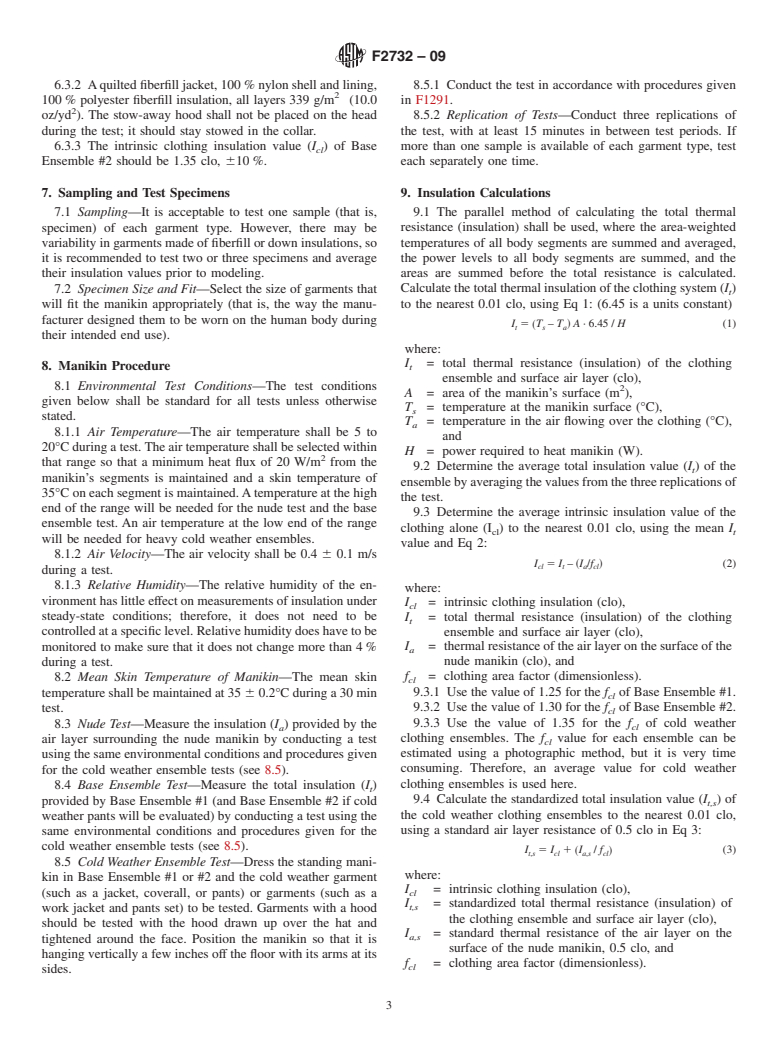
Standards Content (Sample)
NOTICE: This standard has either been superseded and replaced by a new version or withdrawn.
Contact ASTM International (www.astm.org) for the latest information
Designation:F2732–09
Standard Practice for
Determining the Temperature Ratings for Cold Weather
Protective Clothing
This standard is issued under the fixed designation F2732; the number immediately following the designation indicates the year of
original adoption or, in the case of revision, the year of last revision. A number in parentheses indicates the year of last reapproval. A
superscript epsilon (´) indicates an editorial change since the last revision or reapproval.
INTRODUCTION
Manufacturers of cold weather protective clothing want consumers to be thermally comfortable
when wearing their products. Therefore, they want to indicate the amount of warmth (that is,
insulation) their products will provide to consumers at the point of sale. This is often expressed as a
temperature rating on product labels and in product descriptions in catalogs. A temperature rating is
commonly understood to mean the lowest air temperature at which the average adult person will have
an acceptable level of thermal comfort when wearing the product.Although it is not always stated on
labels or in catalogs, manufacturers are assuming that consumers will wear the appropriate amount of
clothing with the cold weather garments.
Heated manikins can be used to measure the thermal resistance (insulation) and evaporative
resistance of clothing ensembles in accordance with F1291 and F2370, respectively. The thermal
insulation value of a cold weather protective ensemble can be used in heat loss models to estimate the
thermal comfort of people in cold environments. This approach has already been used for sleeping
bags (see EN 13537).
1. Scope the body surface. In addition, some body parts (for example,
ears, fingers, toes) have a high surface area relative to their
1.1 This standard practice covers the determination of the
mass, and consequently lose heat at a faster rate than other
temperature rating of cold weather protective clothing en-
parts of the body.
sembles. It involves measuring the insulation value of a
1.4 This standard does not purport to address all of the
clothing ensemble with a heated manikin in accordance with
safety concerns, if any, associated with its use. It is the
F1291 and using a heat loss model to predict the lowest
responsibility of the user of this standard to establish appro-
environmental temperature for comfort.
priate safety and health practices and determine the applica-
1.2 The predictive model used in this standard estimates the
bility of regulatory limitations prior to use.
evaporative heat loss from a person wearing cold weather
clothing as opposed to measuring the evaporative resistance on
2. Referenced Documents
a sweating manikin. If a person is active and gets overheated in
2.1 ASTM Standards:
a cold environment, he/she can adjust the garments in order to
F1291 Test Method for Measuring the Thermal Insulation
dissipate excess heat.
of Clothing Using a Heated Manikin
1.3 The temperature ratings estimated by this standard
F2370 Test Method for Measuring the Evaporative Resis-
practice are guidelines for thermal comfort that are designed to
tance of Clothing Using a Sweating Manikin
protect people from hypothermia when wearing cold weather
2.2 Other Standards:
protective garments. However, localized cooling, discomfort,
EN 13537 Requirements for Sleeping Bags
and even frostbite could still occur at extremely low tempera-
tures because clothing insulation is not evenly distributed over
For referenced ASTM standards, visit the ASTM website, www.astm.org, or
This practice is under the jurisdiction of ASTM Committee F23 on Personal contact ASTM Customer Service at service@astm.org. For Annual Book of ASTM
Protective Clothing and Equipment and is the direct responsibility of Subcommittee Standards volume information, refer to the standard’s Document Summary page on
F23.60 on Human Factors. the ASTM website.
Current edition approved May 15, 2009. Published June 2009. DOI: 10.1520/ Available fromAmerican National Standards Institute (ANSI), 25 W. 43rd St.,
F2732-09. 4th Floor, New York, NY 10036, http://www.ansi.org.
Copyright © ASTM International, 100 Barr Harbor Drive, PO Box C700, West Conshohocken, PA 19428-2959, United States.
F2732–09
ANSI/ASHRAE 55-2004 Thermal Environmental Condi- comfort and will be affected by the garments consumers wear
tions for Human Occupancy with them, their activity level during wear, and individual
differences in the physiological characteristics of people (for
3. Terminology
example, gender, age, body mass, etc.).
3.1 Definitions:
5. Calibration of Manikin
3.1.1 clo, n—a unit of thermal resistance (insulation) equal
5.1 Manikin—UseathermalmanikinasdescribedinF1291.
to 0.155 K-m /W.
5.2 Calibration—Calibrate the manikin using the proce-
3.1.1.1 Discussion—The value of the clo was selected as
dures in F1291.
roughly the insulation value of typical indoor clothing, which
5.2.1 The intrinsic clothing insulation value of the F1291
should keep a resting man (producing heat at the rate of 58
calibration ensemble (I ) should be 0.79 clo, 610 % before
W/m ) comfortable in an environment at 21°C, air movement cl
proceeding with this method.
0.1 m/s.
3.1.2 clothing ensemble, n—a group of garments worn
6. Base Ensembles
together on the body at the same time.
6.1 Cold weather garments are worn with other garments as
3.1.3 temperature rating, n—the lowest environmental tem-
part of an ensemble. Therefore, they need to be tested that way
perature at which a person can remain thermally neutral while
on the manikin in order to determine the temperature for
wearing a particular clothing ensemble.
comfort. All cold weather jackets, coveralls, and jacket/pant
3.1.4 thermal comfort, n—that condition of mind which
sets (where the garments are designed to be worn together)
expresses satisfaction with the thermal environment and is
shall be tested with a lightweight base ensemble that represents
assessed by subjective evaluation (see ANSI/ASHRAE 55-
the minimum amount of clothing that a reasonable person
2004).
might wear with the cold weather clothing (Base Ensemble
3.1.5 thermal insulation, n—the resistance to dry heat
#1).Coldweatherpantsshallbetestedwithabasejacketadded
transfer by way of conduction, convection, and radiation.
to the base ensemble (Base Ensemble #2). The size of the
3.1.5.1 Discussion—the following insulation values can be
garments shall be selected based on the measurements of the
determined with a thermal manikin using clo units:
manikin.
6.2 The garments used in Base Ensemble #1 are:
I = thermal resistance (insulation) of the air layer on the 6.2.1 Shirt—Long-sleeve mock turtle neck shirt, interlock
a
2 2
surface of the nude manikin.
knit, 100 % cotton, 214 g/m (6.3 oz/yd ); worn with shirttail
I = total thermal resistance (insulation) of the clothing
over jeans.
t
and surface air layer around the manikin.
6.2.2 Jeans—Denim 5-pocket jeans, 100 % cotton 397
2 2
I = intrinsic thermal resistance (insulation) of the cloth-
cl g/m (11.7 oz/yd ).
ing.
6.2.3 Men’s Underwear Briefs—Jersey knit briefs, 100 %
2 2
Total insulation values are measured directly with a manikin.
cotton, 180 g/m (5.3 oz/yd ); jockey style that fits snugly at
Intrinsic clothing insulation values are determined by subtract-
the waist and legs (from F1291).
ingtheairlayerresistancearoundtheclothedmanikinfromthe
6.2.4 Men’s Socks—Basic knit sock that covers foot and
total insulation value for the ensemble.
extends up the calf no more than 25.4 cm (10 in.) from the
bottom of the heel. Socks must be composed of at least 75 %
4. Significance and Use
cotton and shall weigh 65 6 10 g each (from F1291).
4.1 This practice can be used to measure the insulation 6.2.5 Athletic Shoes—Fabric/soft leather and soft sole.
provided by different cold weather clothing systems using a 6.2.6 Gloves or Mittens—Insulated knitted fleece gloves or
2 2
heated manikin (see F1291) and to predict the temperature mittens, 100% polyester, all layers 454 g/m (13.4 oz/yd );
rating for comfort using whole body heat loss models.
cuffs worn under jacket sleeves.
4.1.1 The temperature rating is for an ensemble—not an 6.2.7 Hat—Knitted fleece hat, 100 % polyester 129
2 2
individualgarment.However,manufacturerswanttolabelcold
g/m (3.8 oz/yd ); worn pulled down to eye brows.
weather garments with a temperature rating to help consumers 6.2.8 The intrinsic clothing insulation value (I ) of Base
cl
selecttheproductthatwillbestmeettheirneeds.Therefore,the Ensemble #1 should be 0.80 clo, 610 %.
standard is limited to garments that cover a substantial amount 6.2.8.1 The insulation value of the cold weather ensembles
of body surface area such as jackets, coats, and insulated pants, would be higher (and the predicted temperature ratings lower)
coveralls, or snow suits. The temperature ratings of head wear, if a thicker base ensemble was used. However, many people
footwear, and hand wear cannot be determined with this will not wear more clothing with the cold weather garments,
practice. and some people might not wear gloves, or a hat, or both.
4.1.2 The temperature predictions determined by this stan- Consequently, this standard practice is specifying a lightweight
dard practice are for adults only. The physiology of children is baseensembleonly.Othergarmentssuchasthermalunderwear
significantly different from that of adults, so a modified heat could be substituted for the knit shirt and jeans as long as the
loss model would need to be used to predict the comfort of intrinsic insulation value is 0.80 clo, 610 % and the head,
children wearing outdoor clothing. hands, and feet are covered in the same way.
4.1.3 The temperature ratings determined by this standard 6.3 The garments used in Base Ensemble #2 are:
practice and listed on garment labels are only guidelines for 6.3.1 All of the garments in Base Ensemble #1.
F2732–09
6.3.2 Aquilted fiberfill jacket, 100 % nylon shell and lining, 8.5.1 Conduct the test in accordance with procedures given
100 % polyester fiberfill insulation, all layers 339 g/m (10.0 in F1291.
oz/yd ). The stow-away hood shall not be placed on the head 8.5.2 Replication of Tests—Conduct three replications of
during the test; it should stay stowed in the collar. the test, with at least 15 minutes in between test periods. If
6.3.3 The intrinsic clothing insulation value (I ) of Base more than one sample is available of each garment type, test
cl
Ensemble #2 should be 1.35 clo, 610 %. each separately one time.
7. Sampling and Test Specimens 9. Insulation Calculations
7.1 Sampling—It is acceptable to test one sample (that is, 9.1 The parallel method of calculating the total thermal
specimen) of each garment type. However, there may be resistance (insulation) shall be used, where the area-weighted
variability in garments made of fiberfill or down insulations, so temperatures of all body segments are summed and averaged,
it is recommended to test two or three specimens and average the power levels to all body segments are summed, and the
their insulation values prior to modeling. areas are summed before the total resistance is calculated.
Calculatethetotalthermalinsulationoftheclothingsystem(I)
7.2 Specimen Size and Fit—Select the size of garments that
t
will fit the manikin appropriately (that is, the way the manu- to the nearest 0.01 clo, using Eq 1: (6.45 is a units constant)
facturer designed them to be worn on the human body during
I 5 T – T ! A · 6.45 / H (1)
~
t s a
their intended end use).
where:
I = total thermal resistance (insulation) of the clothing
8. Manikin Procedure t
ensemble and surface air layer (clo),
8.1 Environmental Test Conditions—The test conditions
A = area of the manikin’s surface (m ),
given below shall be standard for all tests unless otherwise
T = temperature at the manikin surface (°C),
s
stated.
T = temperature in the air flowing over the clothing (°C),
a
8.1.1 Air Temperature—The air temperature shall be 5 to
and
20°C during a test.The air temperature shall be selected within
H = power required to heat manikin (W).
that range so that a minimum heat flux of 20 W/m from the
9.2 Determine the average total insulation value (I)ofthe
t
manikin’s segments is maintained and a skin temperature of
ensemblebyaveragingthevaluesfromthethreereplicationsof
35°C on each segment is maintained.Atemperature at the high
the test.
end of the range will be needed for the nude test and the base
9.3 Determine the average intrinsic insulation value of the
ensemble test. An air temperature at the low end of the range
clothing alone (I ) to the nearest 0.01 clo, using the mean I
cl t
will be needed for heavy cold weather ensembles.
value and Eq 2:
8.1.2 Air Velocity—The air velocity shall be 0.4 6 0.1 m/s
I 5 I – ~I /f ! (2)
cl t a cl
during a test.
8.1.3 Relative Humidity—The relative humidity of the en-
where:
vironment has little effect on measurements of insulation under
I = intrinsic clothing insulation (clo),
cl
steady-state conditions; therefore, it does not need to be
I = total thermal resistance (insulation) of the clothing
t
controlledataspecificlevel.Relativehumiditydoeshavetobe
ensemble and surface air layer (clo),
monitored to make sure that it does not change more than 4 % I = thermal resistance of the air layer on the surface of the
a
during a test. nude manikin (clo), and
f = clothing area factor (dimensionless).
8.2 Mean Skin Temperature of Manikin—The mean skin
cl
9.3.1 Use the value of 1.25 for the f of Base Ensemble #1.
temperature shall be maintained at 35 6 0.2°C during a 30 min
cl
9.3.2 Use the value of 1.30 for the f of Base Ensemble #2.
test.
cl
9.3.3 Use the value of 1.35 for the f of cold weather
8.3 Nude Test—Measure the insulation (I ) provided by the
cl
a
clothing ensembles. The f value for each ensemble can be
air layer surrounding the nude manikin by conducting a test
cl
estimated using a photographic method, but it is very time
using the same environmental conditions and procedures given
consuming. Therefore, an average value for cold weather
for the cold weather ensemble tests (see 8.5).
clothing ensembles is used here.
8.4 Base Ensemble Test—Measure the total insulation (I)
t
9.4 Calculate the standardized total insulation value (I )of
provided by Base Ensemble #1 (and Base Ensemble #2 if cold
t,s
the cold weather clothing ensembles to the nearest 0.01 clo,
weather pants will be evaluated) by conducting a test using the
using a standard air layer resistance of 0.5 clo in Eq 3:
same environmental conditions and procedures given for the
cold weather ensemble tests (see 8.5).
I 5 I 1 ~I / f ! (3)
t,s cl a,s cl
8.5 Cold Weather Ensemble Test—Dress the standing mani-
where:
kin in Base Ensemble #1 or #2 and the cold weather gar
...
Questions, Comments and Discussion
Ask us and Technical Secretary will try to provide an answer. You can facilitate discussion about the standard in here.