

ASTM D7474-17
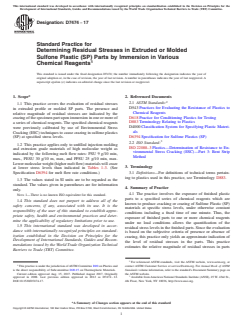
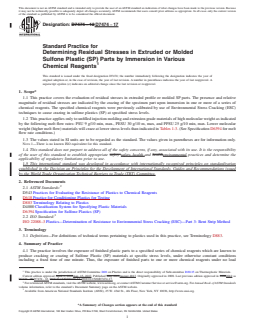
(Practice)Standard Practice for Determining Residual Stresses in Extruded or Molded Sulfone Plastic (SP) Parts by Immersion in Various Chemical Reagents
General Information
- Abstract
SIGNIFICANCE AND USE
5.1 Thermoplastic moldings contain residual stresses due to differential cooling rates through the thickness of the molding. Changes in residual stress have been found to occur with time after molding due to stress relaxation. Many part performance parameters as well as part failures are affected by the level of residual stress present in a part. Residual stresses cause shrinkage, warpage, and a decrease in environmental stress crack resistance. This practice estimates the relative magnitude of residual stresses in parts produced from the series of sulfone plastics (SP), namely polysulfone (PSU), polyethersulfone (PESU), and polyphenylsulfone (PPSU) materials.
5.2 No direct correlation has been established between the results of the determination of residual stresses by this practice and part performance properties. For this reason, this practice is not recommended as a substitute for other tests, nor is it intended for use in purchasing specifications for parts. Despite this limitation, this practice does yield information of value in indicating the presence of residual stresses and the relative quality of plastic parts.
5.3 Residual stresses cannot be easily calculated, hence it is important to have an experimental method, such as this practice, to estimate residual stresses.
5.4 This practice is useful for extruders and molders who wish to evaluate residual stresses in SP parts. This can be accomplished by visual examination after immersion in one or more chemical reagents to evaluate whether or not cracking occurs. Stresses will relax after molding or extrusion. Accordingly, both immersion in the test medium and visual examination must be made at identical times and conditions after processing, if comparing parts. It is important to note the differences in part history. Thus, this technique is suitable as an indication for quality of plastic processing.
5.5 The practice is useful primarily for indicating residual stresses near the surface.
SCOPE
1.1 This practice covers the evaluation of residual stresses in extruded profile or molded SP parts. The presence and relative magnitude of residual stresses are indicated by the crazing of the specimen part upon immersion in one or more of a series of chemical reagents. The specified chemical reagents were previously calibrated by use of Environmental Stress Cracking (ESC) techniques to cause crazing in sulfone plastics (SP) at specified stress levels.
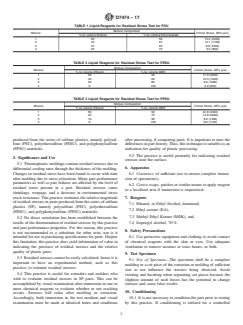
1.2 This practice applies only to unfilled injection molding and extrusion grade materials of high molecular weight as indicated by the following melt flow rates: PSU 9 g/10 min, max., PESU 30 g/10 m, max, and PPSU 25 g/10 min, max. Lower molecular weight (higher melt flow) materials will craze at lower stress levels than indicated in Tables 1-3. (See Specification D6394 for melt flow rate conditions.)
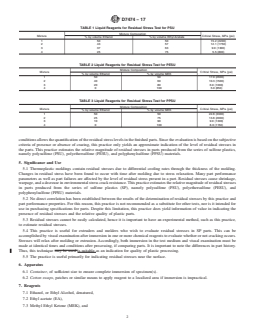
TABLE 1 Liquid Reagents for Residual Stress Test for PSU
Mixture
Mixture Composition
Critical Stress, MPa (psi)
% by volume Ethanol
% by volume Ethyl Acetate
1
50
50
15.2 (2200)
2
43
57
12.1 (1750)
3
37
63
9.0 (1300)
4
25
75
5.5 (800)
TABLE 2 Liquid Reagents for Residual Stress Test for PESU
Mixture
Mixture Composition
Critical Stress, MPa (psi)
% by volume Ethanol
% by volume MEK
1
50
50
17.9 (2600)
2
40
60
10.3 (1500)
3
20
80
6.9 (1000)
4
0
100
5.9 (850)
TABLE 3 Liquid Reagents for Residual Stress Test for PPSU
Mixture
Mixture Composition
Critical Stress, MPa (psi)
% by volume Ethanol
% by volume MEK
1
50
50
22.8 (3300)
2
25
75
13.8 (2000)
3
10
90
9.0 (1300)
4
0
100
8.0 (1150)
1.3 The values stated in SI units are to be regarded as the standard. The values given in parentheses are for information only.
Note 1: There is no known ISO equivalent for this standard...
- Status
- Published
- Publication Date
- 14-Aug-2017
- Technical Committee
- D20 - Plastics
- Drafting Committee
- D20.15 - Thermoplastic Materials
Buy Documents

ASTM D7474-17 - Standard Practice for Determining Residual Stresses in Extruded or Molded Sulfone Plastic (SP) Parts by Immersion in Various Chemical Reagents
REDLINE ASTM D7474-17 - Standard Practice for Determining Residual Stresses in Extruded or Molded Sulfone Plastic (SP) Parts by Immersion in Various Chemical Reagents
Overview
ASTM D7474-17 is the standard practice established by ASTM International for determining residual stresses in extruded or molded sulfone plastic (SP) parts by immersion in various chemical reagents. Residual stresses in thermoplastic components, such as those made from polysulfone (PSU), polyethersulfone (PESU), and polyphenylsulfone (PPSU), can significantly affect product performance. This standard provides a practical experimental method for evaluating the relative magnitude of these stresses by inducing and visually assessing stress crazing after exposure to calibrated chemical mixtures.
Key Topics
- Residual Stress in Sulfone Plastics: Molded and extruded SP parts commonly retain stress due to uneven cooling, leading to potential distortion, warpage, and decreased resistance to environmental stress cracking.
- Test Method: The practice involves immersing test specimens in a sequenced set of chemical reagents. The presence of surface cracks or crazing indicates residual stresses above specified critical levels.
- Materials Covered: This practice applies to unfilled, high molecular weight grades of PSU, PESU, and PPSU used in injection molding and extrusion.
- Chemical Reagents Used: Mixtures of ethanol with ethyl acetate (for PSU) or methyl ethyl ketone (for PESU and PPSU) are used to calibrate critical stress thresholds. The proportion of each reagent is specified in the standard.
- Surface Stress Indication: The method is most sensitive to residual stresses near the surface of the tested part.
- Relative, Not Absolute, Measurement: The practice estimates stress levels but does not provide a definitive correlation to part performance or mechanical properties.
Applications
ASTM D7474-17 offers a straightforward quality control tool for manufacturers, extruders, and molders working with sulfone plastics. Typical applications include:
- Quality Control in Plastic Production:
- Evaluate lot-to-lot consistency of molded or extruded SP parts.
- Identify changes in process conditions that influence residual stress.
- Processing Troubleshooting:
- Diagnose causes of part failure, such as warping or environmental stress cracking.
- Assess the effectiveness of annealing or other stress-relief treatments.
- Materials Development:
- Screen new grades of PSU, PESU, or PPSU for susceptibility to residual stresses.
- Comparative Analysis:
- Compare residual stresses between different production runs or tooling designs, especially for critical components in demanding environments.
- Initial Validation:
- Quickly determine whether a given molding/extrusion process produces parts with acceptably low residual surface stress before further qualification testing.
Related Standards
Understanding ASTM D7474-17 in the context of related standards can help streamline material selection and quality assurance for sulfone plastics:
- ASTM D543: Practices for Evaluating the Resistance of Plastics to Chemical Reagents.
- ASTM D618: Practice for Conditioning Plastics for Testing.
- ASTM D6394: Specification for Sulfone Plastics (SP) - covers the melt flow requirements relevant to this standard.
- ASTM D883: Terminology Relating to Plastics.
- ASTM D4000: Classification System for Specifying Plastic Materials.
- ISO 22088-3: Plastics - Determination of Resistance to Environmental Stress Cracking (ESC) - Bent Strip Method (used in reagent calibration, not directly equivalent).
Practical Value
Using ASTM D7474-17 helps ensure product reliability and process consistency when working with sulfone plastics. Early identification of high residual stress levels can prevent costly downstream failures and improve customer satisfaction through better dimensional stability and chemical resistance of finished parts. This practice is a cost-effective screen for residual stresses, aiding in process optimization and quality assurance for critical plastic components.
Relations
- Effective Date
- 15-Aug-2017
- Effective Date
- 01-Feb-2024
- Effective Date
- 01-Nov-2023
- Effective Date
- 01-Jan-2020
- Effective Date
- 01-Aug-2019
- Effective Date
- 15-Apr-2019
- Effective Date
- 01-Feb-2019
- Effective Date
- 01-Dec-2018
- Effective Date
- 01-Nov-2018
- Effective Date
- 15-Aug-2017
- Effective Date
- 15-Nov-2012
- Effective Date
- 01-May-2012
- Effective Date
- 01-Dec-2011
- Effective Date
- 15-May-2011
- Effective Date
- 01-Apr-2011
Buy Documents
ASTM D7474-17 - Standard Practice for Determining Residual Stresses in Extruded or Molded Sulfone Plastic (SP) Parts by Immersion in Various Chemical Reagents
REDLINE ASTM D7474-17 - Standard Practice for Determining Residual Stresses in Extruded or Molded Sulfone Plastic (SP) Parts by Immersion in Various Chemical Reagents
Get Certified
Connect with accredited certification bodies for this standard

DIN CERTCO
DIN Group product certification.

Smithers Quality Assessments
US management systems and product certification.
Sponsored listings
Frequently Asked Questions
ASTM D7474-17 is a standard published by ASTM International. Its full title is "Standard Practice for Determining Residual Stresses in Extruded or Molded Sulfone Plastic (SP) Parts by Immersion in Various Chemical Reagents". This standard covers: SIGNIFICANCE AND USE 5.1 Thermoplastic moldings contain residual stresses due to differential cooling rates through the thickness of the molding. Changes in residual stress have been found to occur with time after molding due to stress relaxation. Many part performance parameters as well as part failures are affected by the level of residual stress present in a part. Residual stresses cause shrinkage, warpage, and a decrease in environmental stress crack resistance. This practice estimates the relative magnitude of residual stresses in parts produced from the series of sulfone plastics (SP), namely polysulfone (PSU), polyethersulfone (PESU), and polyphenylsulfone (PPSU) materials. 5.2 No direct correlation has been established between the results of the determination of residual stresses by this practice and part performance properties. For this reason, this practice is not recommended as a substitute for other tests, nor is it intended for use in purchasing specifications for parts. Despite this limitation, this practice does yield information of value in indicating the presence of residual stresses and the relative quality of plastic parts. 5.3 Residual stresses cannot be easily calculated, hence it is important to have an experimental method, such as this practice, to estimate residual stresses. 5.4 This practice is useful for extruders and molders who wish to evaluate residual stresses in SP parts. This can be accomplished by visual examination after immersion in one or more chemical reagents to evaluate whether or not cracking occurs. Stresses will relax after molding or extrusion. Accordingly, both immersion in the test medium and visual examination must be made at identical times and conditions after processing, if comparing parts. It is important to note the differences in part history. Thus, this technique is suitable as an indication for quality of plastic processing. 5.5 The practice is useful primarily for indicating residual stresses near the surface. SCOPE 1.1 This practice covers the evaluation of residual stresses in extruded profile or molded SP parts. The presence and relative magnitude of residual stresses are indicated by the crazing of the specimen part upon immersion in one or more of a series of chemical reagents. The specified chemical reagents were previously calibrated by use of Environmental Stress Cracking (ESC) techniques to cause crazing in sulfone plastics (SP) at specified stress levels. 1.2 This practice applies only to unfilled injection molding and extrusion grade materials of high molecular weight as indicated by the following melt flow rates: PSU 9 g/10 min, max., PESU 30 g/10 m, max, and PPSU 25 g/10 min, max. Lower molecular weight (higher melt flow) materials will craze at lower stress levels than indicated in Tables 1-3. (See Specification D6394 for melt flow rate conditions.) TABLE 1 Liquid Reagents for Residual Stress Test for PSU Mixture Mixture Composition Critical Stress, MPa (psi) % by volume Ethanol % by volume Ethyl Acetate 1 50 50 15.2 (2200) 2 43 57 12.1 (1750) 3 37 63 9.0 (1300) 4 25 75 5.5 (800) TABLE 2 Liquid Reagents for Residual Stress Test for PESU Mixture Mixture Composition Critical Stress, MPa (psi) % by volume Ethanol % by volume MEK 1 50 50 17.9 (2600) 2 40 60 10.3 (1500) 3 20 80 6.9 (1000) 4 0 100 5.9 (850) TABLE 3 Liquid Reagents for Residual Stress Test for PPSU Mixture Mixture Composition Critical Stress, MPa (psi) % by volume Ethanol % by volume MEK 1 50 50 22.8 (3300) 2 25 75 13.8 (2000) 3 10 90 9.0 (1300) 4 0 100 8.0 (1150) 1.3 The values stated in SI units are to be regarded as the standard. The values given in parentheses are for information only. Note 1: There is no known ISO equivalent for this standard...
SIGNIFICANCE AND USE 5.1 Thermoplastic moldings contain residual stresses due to differential cooling rates through the thickness of the molding. Changes in residual stress have been found to occur with time after molding due to stress relaxation. Many part performance parameters as well as part failures are affected by the level of residual stress present in a part. Residual stresses cause shrinkage, warpage, and a decrease in environmental stress crack resistance. This practice estimates the relative magnitude of residual stresses in parts produced from the series of sulfone plastics (SP), namely polysulfone (PSU), polyethersulfone (PESU), and polyphenylsulfone (PPSU) materials. 5.2 No direct correlation has been established between the results of the determination of residual stresses by this practice and part performance properties. For this reason, this practice is not recommended as a substitute for other tests, nor is it intended for use in purchasing specifications for parts. Despite this limitation, this practice does yield information of value in indicating the presence of residual stresses and the relative quality of plastic parts. 5.3 Residual stresses cannot be easily calculated, hence it is important to have an experimental method, such as this practice, to estimate residual stresses. 5.4 This practice is useful for extruders and molders who wish to evaluate residual stresses in SP parts. This can be accomplished by visual examination after immersion in one or more chemical reagents to evaluate whether or not cracking occurs. Stresses will relax after molding or extrusion. Accordingly, both immersion in the test medium and visual examination must be made at identical times and conditions after processing, if comparing parts. It is important to note the differences in part history. Thus, this technique is suitable as an indication for quality of plastic processing. 5.5 The practice is useful primarily for indicating residual stresses near the surface. SCOPE 1.1 This practice covers the evaluation of residual stresses in extruded profile or molded SP parts. The presence and relative magnitude of residual stresses are indicated by the crazing of the specimen part upon immersion in one or more of a series of chemical reagents. The specified chemical reagents were previously calibrated by use of Environmental Stress Cracking (ESC) techniques to cause crazing in sulfone plastics (SP) at specified stress levels. 1.2 This practice applies only to unfilled injection molding and extrusion grade materials of high molecular weight as indicated by the following melt flow rates: PSU 9 g/10 min, max., PESU 30 g/10 m, max, and PPSU 25 g/10 min, max. Lower molecular weight (higher melt flow) materials will craze at lower stress levels than indicated in Tables 1-3. (See Specification D6394 for melt flow rate conditions.) TABLE 1 Liquid Reagents for Residual Stress Test for PSU Mixture Mixture Composition Critical Stress, MPa (psi) % by volume Ethanol % by volume Ethyl Acetate 1 50 50 15.2 (2200) 2 43 57 12.1 (1750) 3 37 63 9.0 (1300) 4 25 75 5.5 (800) TABLE 2 Liquid Reagents for Residual Stress Test for PESU Mixture Mixture Composition Critical Stress, MPa (psi) % by volume Ethanol % by volume MEK 1 50 50 17.9 (2600) 2 40 60 10.3 (1500) 3 20 80 6.9 (1000) 4 0 100 5.9 (850) TABLE 3 Liquid Reagents for Residual Stress Test for PPSU Mixture Mixture Composition Critical Stress, MPa (psi) % by volume Ethanol % by volume MEK 1 50 50 22.8 (3300) 2 25 75 13.8 (2000) 3 10 90 9.0 (1300) 4 0 100 8.0 (1150) 1.3 The values stated in SI units are to be regarded as the standard. The values given in parentheses are for information only. Note 1: There is no known ISO equivalent for this standard...
ASTM D7474-17 is classified under the following ICS (International Classification for Standards) categories: 83.080.01 - Plastics in general. The ICS classification helps identify the subject area and facilitates finding related standards.
ASTM D7474-17 has the following relationships with other standards: It is inter standard links to ASTM D7474-12, ASTM D883-24, ASTM D883-23, ASTM D883-20, ASTM D883-19c, ASTM D883-19a, ASTM D883-19, ASTM D883-18a, ASTM D883-18, ASTM D883-17, ASTM D883-12e1, ASTM D4000-12, ASTM D6394-11, ASTM D883-11, ASTM D4000-11. Understanding these relationships helps ensure you are using the most current and applicable version of the standard.
ASTM D7474-17 is available in PDF format for immediate download after purchase. The document can be added to your cart and obtained through the secure checkout process. Digital delivery ensures instant access to the complete standard document.
Standards Content (Sample)
This international standard was developed in accordance with internationally recognized principles on standardization established in the Decision on Principles for the
Development of International Standards, Guides and Recommendations issued by the World Trade Organization Technical Barriers to Trade (TBT) Committee.
Designation: D7474 − 17
Standard Practice for
Determining Residual Stresses in Extruded or Molded
Sulfone Plastic (SP) Parts by Immersion in Various
Chemical Reagents
This standard is issued under the fixed designation D7474; the number immediately following the designation indicates the year of
original adoption or, in the case of revision, the year of last revision. A number in parentheses indicates the year of last reapproval. A
superscript epsilon (´) indicates an editorial change since the last revision or reapproval.
1. Scope* 2. Referenced Documents
2.1 ASTM Standards:
1.1 This practice covers the evaluation of residual stresses
D543 Practices for Evaluating the Resistance of Plastics to
in extruded profile or molded SP parts. The presence and
Chemical Reagents
relative magnitude of residual stresses are indicated by the
D618 Practice for Conditioning Plastics for Testing
crazing of the specimen part upon immersion in one or more of
D883 Terminology Relating to Plastics
a series of chemical reagents. The specified chemical reagents
D4000 Classification System for Specifying Plastic Materi-
were previously calibrated by use of Environmental Stress
als
Cracking (ESC) techniques to cause crazing in sulfone plastics
D6394 Specification for Sulfone Plastics (SP)
(SP) at specified stress levels.
2.2 ISO Standard:
1.2 This practice applies only to unfilled injection molding
ISO 22088–3 Plastics—Determination of Resistance to En-
and extrusion grade materials of high molecular weight as
vironmental Stress Cracking (ESC)—Part 3: Bent Strip
indicated by the following melt flow rates: PSU 9 g/10 min,
Method
max., PESU 30 g/10 m, max, and PPSU 25 g/10 min, max.
Lowermolecularweight(highermeltflow)materialswillcraze
3. Terminology
at lower stress levels than indicated in Tables 1-3. (See
Specification D6394 for melt flow rate conditions.) 3.1 Definitions—For definitions of technical terms pertain-
ing to plastics used in this practice, see Terminology D883.
1.3 The values stated in SI units are to be regarded as the
standard. The values given in parentheses are for information
4. Summary of Practice
only.
4.1 The practice involves the exposure of finished plastic
NOTE 1—There is no known ISO equivalent for this standard.
parts to a specified series of chemical reagents which are
1.4 This standard does not purport to address all of the
known to produce cracking or crazing of Sulfone Plastic (SP)
safety concerns, if any, associated with its use. It is the
materials at specific stress levels, under otherwise constant
responsibility of the user of this standard to establish appro-
conditions including a fixed time of one minute. Thus, the
priate safety, health and environmental practices and deter-
exposure of finished parts to one or more chemical reagents
mine the applicability of regulatory limitations prior to use.
under no load conditions allows the quantification of the
1.5 This international standard was developed in accor-
residual stress levels in the finished parts. Since the evaluation
dance with internationally recognized principles on standard-
is based on the subjective criteria of presence or absence of
ization established in the Decision on Principles for the
crazing, this practice only yields an approximate indication of
Development of International Standards, Guides and Recom-
the level of residual stresses in the parts. This practice
mendations issued by the World Trade Organization Technical
estimates the relative magnitude of residual stresses in parts
Barriers to Trade (TBT) Committee.
For referenced ASTM standards, visit the ASTM website, www.astm.org, or
ThispracticeisunderthejurisdictionofASTMCommitteeD20onPlasticsand contact ASTM Customer Service at service@astm.org. For Annual Book of ASTM
is the direct responsibility of Subcommittee D20.15 on Thermoplastic Materials. Standards volume information, refer to the standard’s Document Summary page on
Current edition approved Aug. 15, 2017. Published August 2017. Originally the ASTM website.
approved in 2008. Last previous edition approved in 2012 as D7474 - 12. Available fromAmerican National Standards Institute (ANSI), 25 W. 43rd St.,
DOI:10.1520/D7474-17. 4th Floor, New York, NY 10036, http://www.ansi.org.
*A Summary of Changes section appears at the end of this standard
Copyright © ASTM International, 100 Barr Harbor Drive, PO Box C700, West Conshohocken, PA 19428-2959. United States
D7474 − 17
TABLE 1 Liquid Reagents for Residual Stress Test for PSU
Mixture Composition
Mixture Critical Stress, MPa (psi)
% by volume Ethanol % by volume Ethyl Acetate
1 50 50 15.2 (2200)
2 43 57 12.1 (1750)
3 37 63 9.0 (1300)
4 25 75 5.5 (800)
TABLE 2 Liquid Reagents for Residual Stress Test for PESU
Mixture Composition
Mixture Critical Stress, MPa (psi)
% by volume Ethanol % by volume MEK
1 50 50 17.9 (2600)
2 40 60 10.3 (1500)
3 20 80 6.9 (1000)
4 0 100 5.9 (850)
TABLE 3 Liquid Reagents for Residual Stress Test for PPSU
Mixture Composition
Mixture Critical Stress, MPa (psi)
% by volume Ethanol % by volume MEK
1 50 50 22.8 (3300)
2 25 75 13.8 (2000)
3 10 90 9.0 (1300)
4 0 100 8.0 (1150)
produced from the series of sulfone plastics, namely polysul- after processing, if comparing parts. It is important to note the
fone (PSU), polyethersulfone (PESU), and polyphenylsulfone differences in part history.Thus, this technique is suitable as an
(PPSU) materials. indication for quality of plastic processing.
5.5 The practice is useful primarily for indicating residual
5. Significance and Use
stresses near the surface.
5.1 Thermoplastic moldings contain residual stresses due to
6. Apparatus
differential cooling rates through the thickness of the molding.
Changes in residual stress have been found to occur with time
6.1 Container, of sufficient size to ensure complete immer-
after molding due to stress relaxation. Many part performance
sion of specimen(s).
parameters as well as part failures are affected by the level of
6.2 Cotton swaps, patches or similar means to apply reagent
residual stress present in a part. Residual stresses cause
to a localized area if immersion is impractical.
shrinkage, warpage, and a decrease in environmental stress
crack resistance.This practice estimates the relative magnitude 7. Reagents
of residual stresses in parts produced from the series of sulfone
7.1 Ethanol, or Ethyl Alcohol, denatured,
plastics (SP), namely polysulfone (PSU), polyethersulfone
7.2 Ethyl acetate (EA),
(PESU), and polyphenylsulfone (PPSU) materials.
7.3 Methyl Ethyl Ketone (MEK), and
5.2 No direct correlation has been established between the
results of the determination of residual stresses by this practice 7.4 Isopropyl alcohol, 70 %.
and part performance properties. For this reason, this practice
8. Safety Precaustions
is not recommended as a substitute for other tests, nor is it
8.1 Use protective equipment and clothing to avoid contact
intended for use in purchasing specifications for parts. Despite
this limitation, this practice does yield information of value in of chemical reagents with the skin or eyes. Use adequate
ventilation to remove noxious or toxic fumes, or both.
indicating the presence of residual stresses and the relative
quality of plastic parts.
9. Test Specimen
5.3 Residual stresses cannot be easily calculated, hence it is
9.1 Size of Specimen—The specimen shall be a complete
important to have an experimental method, such as this
molding or a cut piece of the extrusion or molding of sufficient
practice, to estimate residual stresses.
size to not influence the stresses being observed. Avoid
5.4 This practice is useful for extruders and molders who
twisting and breaking when separating cut pieces because the
wish to evaluate residual stresses in SP parts. This can be
slightest amount of such forces has the potential to change
accomplished by visual examination after immersion in one or
stresses and cause false results.
more chemical reagents to evaluate wh
...
This document is not an ASTM standard and is intended only to provide the user of an ASTM standard an indication of what changes have been made to the previous version. Because
it may not be technically possible to adequately depict all changes accurately, ASTM recommends that users consult prior editions as appropriate. In all cases only the current version
of the standard as published by ASTM is to be considered the official document.
Designation: D7474 − 12 D7474 − 17
Standard Practice for
Determining Residual Stresses in Extruded or Molded
Sulfone Plastic (SP) Parts by Immersion in Various
Chemical Reagents
This standard is issued under the fixed designation D7474; the number immediately following the designation indicates the year of
original adoption or, in the case of revision, the year of last revision. A number in parentheses indicates the year of last reapproval. A
superscript epsilon (´) indicates an editorial change since the last revision or reapproval.
1. Scope*
1.1 This practice covers the evaluation of residual stresses in extruded profile or molded SP parts. The presence and relative
magnitude of residual stresses are indicated by the crazing of the specimen part upon immersion in one or more of a series of
chemical reagents. The specified chemical reagents were previously calibrated by use of Environmental Stress Cracking (ESC)
techniques to cause crazing in sulfone plastics (SP) at specified stress levels.
1.2 This practice applies only to unfilled injection molding and extrusion grade materials of high molecular weight as indicated
by the following melt flow rates: PSU 9 g/10 min, max., PESU 30 g/10 m, max, and PPSU 25 g/10 min, max. Lower molecular
weight (higher melt flow) materials will craze at lower stress levels than indicated in Tables 1-3. (See Specification D6394 for melt
flow rate conditions.)
1.3 The values stated in SI units are to be regarded as the standard. The values given in parentheses are for information only.
NOTE 1—There is no known ISO equivalent for this standard.
1.4 This standard does not purport to address all of the safety concerns, if any, associated with its use. It is the responsibility
of the user of this standard to establish appropriate safety safety, health and healthenvironmental practices and determine the
applicability of regulatory limitations prior to use.
1.5 This international standard was developed in accordance with internationally recognized principles on standardization
established in the Decision on Principles for the Development of International Standards, Guides and Recommendations issued
by the World Trade Organization Technical Barriers to Trade (TBT) Committee.
2. Referenced Documents
2.1 ASTM Standards:
D543 Practices for Evaluating the Resistance of Plastics to Chemical Reagents
D618 Practice for Conditioning Plastics for Testing
D883 Terminology Relating to Plastics
D4000 Classification System for Specifying Plastic Materials
D6394 Specification for Sulfone Plastics (SP)
2.2 ISO Standard:
ISO 22088–3 Plastics—Determination of Resistance to Environmental Stress Cracking (ESC)—Part 3: Bent Strip Method
3. Terminology
3.1 Definitions—For definitions of technical terms pertaining to plastics used in this practice, see Terminology D883.
4. Summary of Practice
4.1 The practice involves the exposure of finished plastic parts to a specified series of chemical reagents which are known to
produce cracking or crazing of Sulfone Plastic (SP) materials at specific stress levels, under otherwise constant conditions
including a fixed time of one minute. Thus, the exposure of finished parts to one or more chemical reagents under no load
This practice is under the jurisdiction of ASTM Committee D20 on Plastics and is the direct responsibility of Subcommittee D20.15 on Thermoplastic Materials.
Current edition approved April 1, 2012Aug. 15, 2017. Published May 2012August 2017. Originally approved in 2008. Last previous edition approved in 20082012 as
D7474 - 08.D7474 - 12. DOI:10.1520/D7474-12. DOI:10.1520/D7474-17.
For referenced ASTM standards, visit the ASTM website, www.astm.org, or contact ASTM Customer Service at service@astm.org. For Annual Book of ASTM Standards
volume information, refer to the standard’s Document Summary page on the ASTM website.
Available from American National Standards Institute (ANSI), 25 W. 43rd St., 4th Floor, New York, NY 10036, http://www.ansi.org.
*A Summary of Changes section appears at the end of this standard
Copyright © ASTM International, 100 Barr Harbor Drive, PO Box C700, West Conshohocken, PA 19428-2959. United States
D7474 − 17
TABLE 1 Liquid Reagents for Residual Stress Test for PSU
Mixture Composition
Mixture Critical Stress, MPa (psi)
% by volume Ethanol % by volume Ethyl Acetate
1 50 50 15.2 (2200)
2 43 57 12.1 (1750)
3 37 63 9.0 (1300)
4 25 75 5.5 (800)
TABLE 2 Liquid Reagents for Residual Stress Test for PESU
Mixture Composition
Mixture Critical Stress, MPa (psi)
% by volume Ethanol % by volume MEK
1 50 50 17.9 (2600)
2 40 60 10.3 (1500)
3 20 80 6.9 (1000)
4 0 100 5.9 (850)
TABLE 3 Liquid Reagents for Residual Stress Test for PPSU
Mixture Composition
Mixture Critical Stress, MPa (psi)
% by volume Ethanol % by volume MEK
1 50 50 22.8 (3300)
2 25 75 13.8 (2000)
3 10 90 9.0 (1300)
4 0 100 8.0 (1150)
conditions allows the quantification of the residual stress levels in the finished parts. Since the evaluation is based on the subjective
criteria of presence or absence of crazing, this practice only yields an approximate indication of the level of residual stresses in
the parts. This practice estimates the relative magnitude of residual stresses in parts produced from the series of sulfone plastics,
namely polysulfone (PSU), polyethersulfone (PESU), and polyphenylsulfone (PPSU) materials.
5. Significance and Use
5.1 Thermoplastic moldings contain residual stresses due to differential cooling rates through the thickness of the molding.
Changes in residual stress have been found to occur with time after molding due to stress relaxation. Many part performance
parameters as well as part failures are affected by the level of residual stress present in a part. Residual stresses cause shrinkage,
warpage, and a decrease in environmental stress crack resistance. This practice estimates the relative magnitude of residual stresses
in parts produced from the series of sulfone plastics (SP), namely polysulfone (PSU), polyethersulfone (PESU), and
polyphenylsulfone (PPSU) materials.
5.2 No direct correlation has been established between the results of the determination of residual stresses by this practice and
part performance properties. For this reason, this practice is not recommended as a substitute for other tests, nor is it intended for
use in purchasing specifications for parts. Despite this limitation, this practice does yield information of value in indicating the
presence of residual stresses and the relative quality of plastic parts.
5.3 Residual stresses cannot be easily calculated, hence it is important to have an experimental method, such as this practice,
to estimate residual stresses.
5.4 This practice is useful for extruders and molders who wish to evaluate residual stresses in SP parts. This can be
accomplished by visual examination after immersion in one or more chemical reagents to evaluate whether or not cracking occurs.
Stresses will relax after molding or extrusion. Accordingly, both immersion in the test medium and visual examination must be
made at identical times and conditions after processing, if comparing parts. It is important to note the differences in part history.
Thus, this technique may be used is suitable as an indication for quality of plastic processing.
5.5 The practice is useful primarily for indicating residual stresses near the surface.
6. Apparatus
6.1 Container, of sufficient size to ensure complete immersion of specimen(s).
6.2 Cotton swaps, patches or similar means to apply reagent to a localized area if immersion is impractical.
7. Reagents
7.1 Ethanol, or Ethyl Alcohol, denatured,
7.2 Ethyl acetate (EA),
7.3 Methyl Ethyl Ketone (MEK), and
D7474 − 17
7.4 Isopropyl alcohol, 70 %.
8. Safety Precaustions
8.1 Protective Use protective equipment and clothing must be utilized to avoid contact of chemical reagents with the skin or
eyes. Use adequate ventilation to remove noxious or toxic fumes, or both.
9. Test Specimen
9.1 Size of Specimen—The specimen shall be a complete molding or a cut piece of the extrusion or molding of sufficient size
to not influence the stresses being observed.
...