

ASTM D7779-20
(Test Method)Standard Test Method for Determination of Fracture Toughness of Graphite at Ambient Temperature
General Information
- Abstract
SIGNIFICANCE AND USE
5.1 This test method may be used for guidance for material development to improve toughness, material comparison, quality assessment, and characterization.
5.2 The fracture toughness value provides information on the initiation of fracture in graphite containing a straight-through notch; the information on stress intensity factor beyond fracture toughness as a function of crack extension provides information on the crack propagation resistance once a fracture crack has been initiated to propagate through the test specimen.
SCOPE
1.1 This test method covers and provides a measure of the resistance of a graphite to crack extension at ambient temperature and atmosphere expressed in terms of stress-intensity factor, K, and strain energy release rate, G. These crack growth resistance properties are determined using beam test specimens with a straight-through sharp machined V-notch.
1.2 This test method determines the stress intensity factor, K, from applied force and gross specimen deflection measured away from the crack tip. The stress intensity factor calculated at the maximum applied load is denoted as fracture toughness, KIc, and is known as the critical stress intensity factor. If the resolution of the deflection gauge is sensitive to fracture behavior in the test specimen and can provide a measure of the specimen compliance, strain energy release rate, G, can be determined as a function of crack extension.
1.3 This test method is applicable to a variety of grades of graphite which exhibit different types of resistance to crack growth, such as growth at constant stress intensity (strain energy release rate), or growth with increasing stress intensity (strain energy release rate), or growth with decreasing stress intensity (strain energy release rate). It is generally recognized that because of the inhomogeneous microstructure of graphite, the general behavior will exhibit a mixture of all three during the test. The crack resistance behavior exhibited in the test is usually referred to as an “R-curve.”
Note 1: One difference between the procedure in this test method and test methods such as Test Method E399, which measure fracture toughness, KIc, by one set of specific operational procedures, is that Test Method E399 focuses on the start of crack extension from a fatigue precrack for metallic materials. This test method for graphite makes use of a machined notch with sharp cracking at the root of the notch because of the nature of graphite. Therefore, fracture toughness values determined with this method may not be interchanged with KIc as defined in Test Method E399.
1.4 This test method gives fracture toughness values, KIc and critical strain energy release rate, GIc for specific conditions of environment, deformation rate, and temperature. Fracture toughness values for a graphite grade can be functions of environment, deformation rate, and temperature.
1.5 This test method is divided into two major parts. The first major part is the main body of the standard, which provides general information on the test method, the applicability to materials comparison and qualification, and requirements and recommendations for fracture toughness testing. The second major part is composed of annexes, which provide information related to test apparatus and test specimen geometry.
Main Body
Section
Scope
1
Referenced Documents
2
Terminology
3
Summary of Test Method
4
Significance and Use
5
Apparatus
6
Test Specimen
7
Procedure
8
Specimen Dryness
9
Calculation of Results
10
Report
11
Precision and Bias
12
Keywords
13
Annex
Annex A1
1.6 The values stated in SI units are to be regarded as standard. No other units of measurement are included in this standard.
1.6.1 Measurement units expressed in these test methods are in accordance with IEEE/ASTM SI 10.
1.7 This standard does no...
- Status
- Published
- Publication Date
- 30-Sep-2020
- Technical Committee
- D02 - Petroleum Products, Liquid Fuels, and Lubricants
- Drafting Committee
- D02.F0 - Manufactured Carbon and Graphite Products
Buy Documents
ASTM D7779-20 - Standard Test Method for Determination of Fracture Toughness of Graphite at Ambient Temperature
REDLINE ASTM D7779-20 - Standard Test Method for Determination of Fracture Toughness of Graphite at Ambient Temperature
Overview
ASTM D7779-20: Standard Test Method for Determination of Fracture Toughness of Graphite at Ambient Temperature establishes procedures to evaluate the resistance of graphite materials to crack propagation under ambient conditions. This standard is essential for the characterization, comparison, and quality assessment of graphite products, providing both fracture toughness and strain energy release rate metrics using a notched beam specimen tested in three-point flexure. By applying this test method, industries can gain insight into the mechanical reliability and durability of manufactured graphite components.
Key Topics
- Fracture Toughness Assessment: The test method measures the critical stress-intensity factor, denoted as KIc, which represents the material's resistance against crack initiation in graphite.
- Strain Energy Release Rate: It further allows determination of the critical strain energy release rate, GIc, giving insight into the material’s crack propagation behavior.
- Test Specimen Configuration: Testing requires beam specimens with a precise straight-through V-notch, enhancing test reliability and repeatability.
- Three-Point Flexure Testing: The standard specifies the use of a three-point flexure fixture, where force is applied at the specimen’s midpoint to induce crack propagation from a machined notch.
- Environmental and Material Considerations: ASTM D7779-20 emphasizes the influence of environment, deformation rate, and the inherent microstructure of graphite on fracture characteristics.
- R-Curve Behavior: The resistance to crack growth is often displayed as an R-curve, mapping the increase or decrease in resistance with continuing crack extension.
Applications
ASTM D7779-20 is widely applicable across sectors where the mechanical integrity and fracture resistance of graphite are crucial:
- Material Development: Provides a benchmarking tool for developing tougher or more fracture-resistant graphite formulations.
- Product Qualification and Quality Assurance: Assures that graphite grades meet specified performance criteria, reducing the risk of catastrophic failure in application.
- Comparative Testing: Enables direct comparison of different graphite grades or manufacturing processes based on objective, standardized fracture toughness metrics.
- Structural Design and Engineering: Delivers key mechanical properties needed for the safe and efficient design of components such as electrodes, reactor cores, seals, and bearings.
- Failure Analysis: Assists in diagnosing the cause of premature failure and guiding improvements in graphite component design or processing.
- Research and Development: Supports the characterization of crack extension behavior for new graphite-based materials or composites.
Related Standards
Implementation of ASTM D7779-20 often involves consideration of other ASTM and international standards:
- ASTM E399: Test Method for Linear-Elastic Plane-Strain Fracture Toughness of Metallic Materials
- ASTM C1161: Test Method for Flexural Strength of Advanced Ceramics at Ambient Temperature
- ASTM C1421: Test Methods for Determination of Fracture Toughness of Advanced Ceramics at Ambient Temperature
- ASTM E561: Test Method for R-Curve Determination
- ASTM E177: Practice for Use of the Terms Precision and Bias in ASTM Test Methods
- ASTM E4: Practices for Force Verification of Testing Machines
- IEEE/ASTM SI 10: Standard for Use of the International System of Units (SI)
Summary
By utilizing ASTM D7779-20, organizations benefit from a clear, reproducible method to determine the fracture toughness and crack growth resistance of graphite materials, strengthening their capacity for innovation, safety, and quality control. Adherence to this graphite fracture toughness standard ensures that material properties are reliably measured, supporting critical applications where the structural soundness of graphite is paramount.
Relations
- Effective Date
- 15-Feb-2024
- Effective Date
- 01-Feb-2024
- Effective Date
- 01-Feb-2020
- Refers
ASTM E561-19 - Standard Test Method for <emph type="bdit">K<inf>R</inf></emph> Curve Determination - Effective Date
- 15-Jul-2019
- Refers
ASTM E561-19e1 - Standard Test Method for <emph type="bdit">K<inf>R</inf></emph> Curve Determination - Effective Date
- 15-Jul-2019
- Effective Date
- 01-Jan-2018
- Effective Date
- 01-Jan-2016
- Refers
ASTM E561-15a - Standard Test Method for <emph type="bdit">K<inf>R</inf></emph> Curve Determination - Effective Date
- 01-Dec-2015
- Refers
ASTM E561-15 - Standard Test Method for <emph type="bdit">K<inf>R</inf></emph> Curve Determination - Effective Date
- 15-Oct-2015
- Effective Date
- 01-Jul-2015
- Effective Date
- 01-Jun-2014
- Effective Date
- 01-May-2014
- Effective Date
- 01-Aug-2013
- Effective Date
- 01-May-2013
- Effective Date
- 01-May-2013
Buy Documents
ASTM D7779-20 - Standard Test Method for Determination of Fracture Toughness of Graphite at Ambient Temperature
REDLINE ASTM D7779-20 - Standard Test Method for Determination of Fracture Toughness of Graphite at Ambient Temperature
Get Certified
Connect with accredited certification bodies for this standard

Control Union Certifications
Global certification for agriculture and sustainability.

Hohenstein Institut
Textile testing and certification.

Bureau Veritas Bangladesh
Bureau Veritas certification services in Bangladesh.
Sponsored listings
Frequently Asked Questions
ASTM D7779-20 is a standard published by ASTM International. Its full title is "Standard Test Method for Determination of Fracture Toughness of Graphite at Ambient Temperature". This standard covers: SIGNIFICANCE AND USE 5.1 This test method may be used for guidance for material development to improve toughness, material comparison, quality assessment, and characterization. 5.2 The fracture toughness value provides information on the initiation of fracture in graphite containing a straight-through notch; the information on stress intensity factor beyond fracture toughness as a function of crack extension provides information on the crack propagation resistance once a fracture crack has been initiated to propagate through the test specimen. SCOPE 1.1 This test method covers and provides a measure of the resistance of a graphite to crack extension at ambient temperature and atmosphere expressed in terms of stress-intensity factor, K, and strain energy release rate, G. These crack growth resistance properties are determined using beam test specimens with a straight-through sharp machined V-notch. 1.2 This test method determines the stress intensity factor, K, from applied force and gross specimen deflection measured away from the crack tip. The stress intensity factor calculated at the maximum applied load is denoted as fracture toughness, KIc, and is known as the critical stress intensity factor. If the resolution of the deflection gauge is sensitive to fracture behavior in the test specimen and can provide a measure of the specimen compliance, strain energy release rate, G, can be determined as a function of crack extension. 1.3 This test method is applicable to a variety of grades of graphite which exhibit different types of resistance to crack growth, such as growth at constant stress intensity (strain energy release rate), or growth with increasing stress intensity (strain energy release rate), or growth with decreasing stress intensity (strain energy release rate). It is generally recognized that because of the inhomogeneous microstructure of graphite, the general behavior will exhibit a mixture of all three during the test. The crack resistance behavior exhibited in the test is usually referred to as an “R-curve.” Note 1: One difference between the procedure in this test method and test methods such as Test Method E399, which measure fracture toughness, KIc, by one set of specific operational procedures, is that Test Method E399 focuses on the start of crack extension from a fatigue precrack for metallic materials. This test method for graphite makes use of a machined notch with sharp cracking at the root of the notch because of the nature of graphite. Therefore, fracture toughness values determined with this method may not be interchanged with KIc as defined in Test Method E399. 1.4 This test method gives fracture toughness values, KIc and critical strain energy release rate, GIc for specific conditions of environment, deformation rate, and temperature. Fracture toughness values for a graphite grade can be functions of environment, deformation rate, and temperature. 1.5 This test method is divided into two major parts. The first major part is the main body of the standard, which provides general information on the test method, the applicability to materials comparison and qualification, and requirements and recommendations for fracture toughness testing. The second major part is composed of annexes, which provide information related to test apparatus and test specimen geometry. Main Body Section Scope 1 Referenced Documents 2 Terminology 3 Summary of Test Method 4 Significance and Use 5 Apparatus 6 Test Specimen 7 Procedure 8 Specimen Dryness 9 Calculation of Results 10 Report 11 Precision and Bias 12 Keywords 13 Annex Annex A1 1.6 The values stated in SI units are to be regarded as standard. No other units of measurement are included in this standard. 1.6.1 Measurement units expressed in these test methods are in accordance with IEEE/ASTM SI 10. 1.7 This standard does no...
SIGNIFICANCE AND USE 5.1 This test method may be used for guidance for material development to improve toughness, material comparison, quality assessment, and characterization. 5.2 The fracture toughness value provides information on the initiation of fracture in graphite containing a straight-through notch; the information on stress intensity factor beyond fracture toughness as a function of crack extension provides information on the crack propagation resistance once a fracture crack has been initiated to propagate through the test specimen. SCOPE 1.1 This test method covers and provides a measure of the resistance of a graphite to crack extension at ambient temperature and atmosphere expressed in terms of stress-intensity factor, K, and strain energy release rate, G. These crack growth resistance properties are determined using beam test specimens with a straight-through sharp machined V-notch. 1.2 This test method determines the stress intensity factor, K, from applied force and gross specimen deflection measured away from the crack tip. The stress intensity factor calculated at the maximum applied load is denoted as fracture toughness, KIc, and is known as the critical stress intensity factor. If the resolution of the deflection gauge is sensitive to fracture behavior in the test specimen and can provide a measure of the specimen compliance, strain energy release rate, G, can be determined as a function of crack extension. 1.3 This test method is applicable to a variety of grades of graphite which exhibit different types of resistance to crack growth, such as growth at constant stress intensity (strain energy release rate), or growth with increasing stress intensity (strain energy release rate), or growth with decreasing stress intensity (strain energy release rate). It is generally recognized that because of the inhomogeneous microstructure of graphite, the general behavior will exhibit a mixture of all three during the test. The crack resistance behavior exhibited in the test is usually referred to as an “R-curve.” Note 1: One difference between the procedure in this test method and test methods such as Test Method E399, which measure fracture toughness, KIc, by one set of specific operational procedures, is that Test Method E399 focuses on the start of crack extension from a fatigue precrack for metallic materials. This test method for graphite makes use of a machined notch with sharp cracking at the root of the notch because of the nature of graphite. Therefore, fracture toughness values determined with this method may not be interchanged with KIc as defined in Test Method E399. 1.4 This test method gives fracture toughness values, KIc and critical strain energy release rate, GIc for specific conditions of environment, deformation rate, and temperature. Fracture toughness values for a graphite grade can be functions of environment, deformation rate, and temperature. 1.5 This test method is divided into two major parts. The first major part is the main body of the standard, which provides general information on the test method, the applicability to materials comparison and qualification, and requirements and recommendations for fracture toughness testing. The second major part is composed of annexes, which provide information related to test apparatus and test specimen geometry. Main Body Section Scope 1 Referenced Documents 2 Terminology 3 Summary of Test Method 4 Significance and Use 5 Apparatus 6 Test Specimen 7 Procedure 8 Specimen Dryness 9 Calculation of Results 10 Report 11 Precision and Bias 12 Keywords 13 Annex Annex A1 1.6 The values stated in SI units are to be regarded as standard. No other units of measurement are included in this standard. 1.6.1 Measurement units expressed in these test methods are in accordance with IEEE/ASTM SI 10. 1.7 This standard does no...
ASTM D7779-20 is classified under the following ICS (International Classification for Standards) categories: 59.100.20 - Carbon materials. The ICS classification helps identify the subject area and facilitates finding related standards.
ASTM D7779-20 has the following relationships with other standards: It is inter standard links to ASTM E1823-24a, ASTM E1823-24, ASTM E1823-20, ASTM E561-19, ASTM E561-19e1, ASTM C1421-18, ASTM C1421-16, ASTM E561-15a, ASTM E561-15, ASTM C1421-15, ASTM E4-14, ASTM E177-14, ASTM C1161-13, ASTM E177-13, ASTM E691-13. Understanding these relationships helps ensure you are using the most current and applicable version of the standard.
ASTM D7779-20 is available in PDF format for immediate download after purchase. The document can be added to your cart and obtained through the secure checkout process. Digital delivery ensures instant access to the complete standard document.
Standards Content (Sample)
This international standard was developed in accordance with internationally recognized principles on standardization established in the Decision on Principles for the
Development of International Standards, Guides and Recommendations issued by the World Trade Organization Technical Barriers to Trade (TBT) Committee.
Designation: D7779 − 20
Standard Test Method for
Determination of Fracture Toughness of Graphite at
Ambient Temperature
This standard is issued under the fixed designation D7779; the number immediately following the designation indicates the year of
original adoption or, in the case of revision, the year of last revision. A number in parentheses indicates the year of last reapproval. A
superscript epsilon (´) indicates an editorial change since the last revision or reapproval.
1. Scope* 1.4 This test method gives fracture toughness values, K
Ic
and critical strain energy release rate, G for specific condi-
Ic
1.1 This test method covers and provides a measure of the
tions of environment, deformation rate, and temperature. Frac-
resistance of a graphite to crack extension at ambient tempera-
ture toughness values for a graphite grade can be functions of
ture and atmosphere expressed in terms of stress-intensity
environment, deformation rate, and temperature.
factor, K, and strain energy release rate, G.These crack growth
resistance properties are determined using beam test specimens
1.5 This test method is divided into two major parts. The
with a straight-through sharp machined V-notch.
first major part is the main body of the standard, which
provides general information on the test method, the applica-
1.2 This test method determines the stress intensity factor,
bility to materials comparison and qualification, and require-
K, from applied force and gross specimen deflection measured
ments and recommendations for fracture toughness testing.
away from the crack tip. The stress intensity factor calculated
The second major part is composed of annexes, which provide
at the maximum applied load is denoted as fracture toughness,
information related to test apparatus and test specimen geom-
K , and is known as the critical stress intensity factor. If the
Ic
etry.
resolution of the deflection gauge is sensitive to fracture
behavior in the test specimen and can provide a measure of the
Main Body Section
Scope 1
specimen compliance, strain energy release rate, G, can be
Referenced Documents 2
determined as a function of crack extension.
Terminology 3
Summary of Test Method 4
1.3 This test method is applicable to a variety of grades of
Significance and Use 5
graphite which exhibit different types of resistance to crack Apparatus 6
Test Specimen 7
growth, such as growth at constant stress intensity (strain
Procedure 8
energy release rate), or growth with increasing stress intensity
Specimen Dryness 9
(strain energy release rate), or growth with decreasing stress Calculation of Results 10
Report 11
intensity (strain energy release rate). It is generally recognized
Precision and Bias 12
that because of the inhomogeneous microstructure of graphite,
Keywords 13
the general behavior will exhibit a mixture of all three during Annex Annex A1
the test. The crack resistance behavior exhibited in the test is
1.6 The values stated in SI units are to be regarded as
usually referred to as an “R-curve.”
standard. No other units of measurement are included in this
standard.
NOTE 1—One difference between the procedure in this test method and
test methods such as Test Method E399, which measure fracture
1.6.1 Measurementunitsexpressedinthesetestmethodsare
toughness, K , by one set of specific operational procedures, is that Test
Ic
in accordance with IEEE/ASTM SI 10.
Method E399 focuses on the start of crack extension from a fatigue
precrackformetallicmaterials.Thistestmethodforgraphitemakesuseof
1.7 This standard does not purport to address all of the
a machined notch with sharp cracking at the root of the notch because of
safety concerns, if any, associated with its use. It is the
the nature of graphite. Therefore, fracture toughness values determined
responsibility of the user of this standard to establish appro-
with this method may not be interchanged with K as defined in Test
Ic
Method E399. priate safety, health, and environmental practices and deter-
mine the applicability of regulatory limitations prior to use.
1.8 This international standard was developed in accor-
1 dance with internationally recognized principles on standard-
This test method is under the jurisdiction of ASTM Committee D02 on
Petroleum Products, Liquid Fuels, and Lubricants and is the direct responsibility of
ization established in the Decision on Principles for the
Subcommittee D02.F0 on Manufactured Carbon and Graphite Products.
Development of International Standards, Guides and Recom-
Current edition approved Oct. 1, 2020. Published December 2020. Originally
mendations issued by the World Trade Organization Technical
approved in 2011. Last previous edition approved in 2015 as D7779 – 11 (2015).
DOI:10.1520/D7779-20. Barriers to Trade (TBT) Committee.
*A Summary of Changes section appears at the end of this standard
Copyright © ASTM International, 100 Barr Harbor Drive, PO Box C700, West Conshohocken, PA 19428-2959. United States
D7779 − 20
2. Referenced Documents
M = molding direction
EX = extrusion direction
2.1 ASTM Standards:
AXL = axial, or longitudinal axis (if M or EX are not
C1161 Test Method for Flexural Strength of Advanced
applicable)
Ceramics at Ambient Temperature
R = radial direction
C1421 Test Methods for Determination of Fracture Tough-
C = circumferential direction
ness of Advanced Ceramics at Ambient Temperature
R/C = mixed radial and circumferential directions
E4 Practices for Force Verification of Testing Machines
E177 Practice for Use of the Terms Precision and Bias in
3.1.3.3 Discussion—For a graphite test specimen of rectan-
ASTM Test Methods
gular cross section, R and C may be replaced by rectilinear
E337 Test Method for Measuring Humidity with a Psy-
coordinate axes, x and y, corresponding to two adjacent sides
chrometer (the Measurement of Wet- and Dry-Bulb Tem-
of the test specimen.
peratures)
3.1.3.4 Discussion—Depending on how test specimens are
E399 Test Method for Linear-Elastic Plane-Strain Fracture
cut from a graphite product, the crack plane may be longitu-
Toughness of Metallic Materials
dinal to the forming direction, or circumferential, or radial, or
E561 Test Method forK Curve Determination
R
a mixture of these directions as shown in Annex A1.
E691 Practice for Conducting an Interlaboratory Study to
3.1.3.5 Discussion—For the test specimen the plane and
Determine the Precision of a Test Method
direction of crack extension with respect to the applied tensile
E1823 TerminologyRelatingtoFatigueandFractureTesting
stress should be recorded. Report the orientation of the
E2309 Practices for Verification of Displacement Measuring
specimen and crack propagation direction with respect to the
Systems and Devices Used in Material Testing Machines
grain direction.
IEEE/ASTM SI 10 Standard for Use of the International
3.1.3.6 Discussion—Ifthereisnoprimaryproductdirection,
System of Units (SI) (The Modern Metric System)
reference axes may be arbitrarily assigned but must be clearly
identified.
3. Terminology
-3/2 -1
3.1.4 crack extension resistance, K [FL ], G [FL ], or
3.1 Definitions of Terms Specific to This Standard: R R
-1
J [FL ], n—measure of the resistance of a material to crack
3.1.1 The terms described in this test method and E1823 are R
extension expressed in terms of the stress-intensity factor, K,
applicable to the test methods prescribed herein. Appropriate
strain energy release rate, G, or values of J derived using the
sources for each definition are provided after each definition in
J-integral concept. E1823
parentheses.
3.1.2 crack depth, a [L], n—length of the crack in a notched
3.1.5 critical crack depth, [L], n—crack depth at which
beam specimen, which includes the machined notched length
catastrophic fracture initiation occurs, corresponding to the
and the crack length which the crack has traveled during
maximum in the applied load.
testing. Any contributions from crack branching or other
-3/2
3.1.6 fracture toughness, K[FL ], n—property which de-
secondary cracking are not included in this measurement.
fines the critical stress intensity factor necessary to initiate a
3.1.3 crack extension orientation, n—direction of propaga-
crack for subsequent propagation on further loading.
tion in relation to a characteristic direction of the graphite
3.1.7 R-curve, n—plot of stress intensity or strain energy
specimen. This identification may be designated by a letter or
releaserateasafunctionofstablecrackextensionandprovides
letters indicating the plane and direction of crack extension.
a measure of crack propagation trend in the material. E561
The letter or letters represent the direction normal to the crack
plane and the direction of crack propagation.
3.1.8 slow crack growth, (SCG), n—sub-critical crack
3.1.3.1 Discussion—The characteristic direction should be growth (extension) which may result from, but is not restricted
associated with the microstructural grain orientation of the test
to, such mechanisms as environmentally-assisted stress corro-
specimen. sion or diffusive crack growth, usually at constant load.
3.1.3.2 Discussion—The crack plane can be defined by
3.1.9 small crack, n—being small when all physical dimen-
letter(s) representing the direction of tensile stress normal to
sions (in particular, with length and depth of a surface crack)
the crack plane. And the direction of crack extension can be
are small in comparison to a relevant microstructural scale,
defined by letter(s) representing the direction parallel to the
continuum mechanics scale, or physical size scale.The specific
characteristic grain orientation of the test specimen. As illus-
physical dimensions that define “small” vary with the particu-
trated in Annex A1, the tensile stress direction is notated first,
lar material, geometric configuration, and loadings of interest.
followed by a hyphen, and then the crack extension direction.
E1823
The legend given in Test Methods C1421 includes the follow-
3.1.10 stable crack extension, n—crack propagation which
ing:
provides measurable data of the dependence of stress intensity
factor on crack extension and which occurs over some mea-
surable time duration.
For referenced ASTM standards, visit the ASTM website, www.astm.org, or -3/2
3.1.11 stress-intensity factor, K[FL ], n—magnitude of
contact ASTM Customer Service at service@astm.org. For Annual Book of ASTM
the ideal-crack-tip stress field (stress field singularity) for a
Standards volume information, refer to the standard’s Document Summary page on
the ASTM website. particular mode in a homogeneous, linear-elastic body. E1823
D7779 − 20
3.1.12 three-point flexure, n—flexure configuration where a beyond fracture toughness as a function of crack extension
beam test specimen is loaded at a location midway between provides information on the crack propagation resistance once
two support bearings. C1161 a fracture crack has been initiated to propagate through the test
specimen.
3.1.13 unstable crack extension—uncontrollable crack
propagation which yields no measurable data of the depen-
6. Apparatus
dence of stress intensity factor on crack extension.
6.1 Testing—Test the specimens in a testing machine that
3.2 Symbols:
has provisions for autographic recording of force applied to the
3.2.1 a—crack depth, including the machined notch (see
test specimen versus time and actuator displacement or deflec-
Fig. 1).
tion of the specimen, or both, in the notch plane. The testing
3.2.2 a/W—normalized notch depth.
machine shall conform to the requirements of Practice E4.
3.2.3 B—the specimen width (see Fig. 1).
6.2 Deflection Measurement—The deflection gauge should
3.2.4 g(a/W)—geometric function of the ratio a/W.
be capable of resolving 0.001 mm. Practices E2309 cover
3.2.5 L—test specimen length (see Fig. 1).
procedures and requirements for the calibration and verifica-
3.2.6 P—force. tion of displacement measuring systems.
3.2.7 P —maximum force.
6.3 Recording Equipment—Provide digital data acquisition
max
for automatically recording the applied force versus displace-
3.2.8 S—support span (see Fig. A1.2).
ment.
3.2.9 W—the specimen depth (see Fig. 1).
6.4 Fixtures—Use a three-point test fixture constructed with
4. Summary of Test Method
high stiffness materials (see Fig. A1.2). Choose the outer
support span, S, such that 5≤ (S/W)≤ 10.The outer two rollers
4.1 This test method involves an application of force to a
shall be free to roll outwards from support locations to
beam test specimen in three-point flexure. The test specimen
minimize friction effects. The middle flexure roller shall be
contains a straight-through notch in the center. The equations
fixed. The specimen should overhang each of the outer rollers
for calculating the fracture toughness have been established on
by a minimum distance equal to the specimen dimension, W.
the basis of linear-elastic stress analyses.
4.2 Notched Beam Method—A straight-through notch is 6.5 Dimension-Measuring Devices—Measure and report all
applicable specimen dimensions to an accuracy of 0.013 mm.
machined in a beam test specimen. The applied force on the
notched test specimen as a function of time and actuator Flat, anvil-type micrometers shall be used for measuring test
specimen dimensions. Ball-tipped or sharp-anvil micrometers
displacement or specimen deflection in three-point flexure, or a
combination thereof, are recorded for analysis. The fracture are not recommended as they may damage the test specimen
surface by inducing localized cracking. Non-contacting (for
toughness, K , is calculated from the maximum (fracture)
Ic
force, the test specimen dimensions, the measured notch depth, example, optical comparator, light microscopy, etc.) measure-
ments are recommended for notch depth measurements. Mea-
and the support span of the test fixture. Calculation of strain
energy release rate, G, requires a determination of specimen sure and report the notch depth to an accuracy of 0.0025 mm.
compliance, and crack length at each load point of the load
versus displacement curve. The maximum G derived from the 7. Test Specimen
strain energy release rate versus crack growth curve is re-
7.1 Test Specimen Configuration—The specimen shall have
corded.
a straight-through machined V-notch with a maximum notch
root radius of 0.10 mm. The notch may be sharpened by
5. Significance and Use
drawing an industrial razor bl
...
This document is not an ASTM standard and is intended only to provide the user of an ASTM standard an indication of what changes have been made to the previous version. Because
it may not be technically possible to adequately depict all changes accurately, ASTM recommends that users consult prior editions as appropriate. In all cases only the current version
of the standard as published by ASTM is to be considered the official document.
Designation: D7779 − 11 (Reapproved 2015) D7779 − 20
Standard Test Method for
Determination of Fracture Toughness of Graphite at
Ambient Temperature
This standard is issued under the fixed designation D7779; the number immediately following the designation indicates the year of
original adoption or, in the case of revision, the year of last revision. A number in parentheses indicates the year of last reapproval. A
superscript epsilon (´) indicates an editorial change since the last revision or reapproval.
1. Scope Scope*
1.1 This test method covers and provides a measure of the resistance of a graphite to crack extension at ambient temperature and
atmosphere expressed in terms of stress-intensity factor, K, and strain energy release rate, G. These crack growth resistance
properties are determined using beam test specimens with a straight-through sharp machined V-notch.
1.2 This test method determines the stress intensity factor, K, from applied force and gross specimen deflection measured away
from the crack tip. The stress intensity factor calculated at the maximum applied load is denoted as fracture toughness, K , and
Ic
is known as the critical stress intensity factor. If the resolution of the deflection gauge is sensitive to fracture behavior in the test
specimen and can provide a measure of the specimen compliance, strain energy release rate, G, can be determined as a function
of crack extension.
1.3 This test method is applicable to a variety of grades of graphite which exhibit different types of resistance to crack growth,
such as growth at constant stress intensity (strain energy release rate), or growth with increasing stress intensity (strain energy
release rate), or growth with decreasing stress intensity (strain energy release rate). It is generally recognized that because of the
inhomogeneous microstructure of graphite, the general behavior will exhibit a mixture of all three during the test. The crack
resistance behavior exhibited in the test is usually referred to as an “R-curve.”
NOTE 1—One difference between the procedure in this test method and test methods such as Test Method E399, which measure fracture toughness, K ,
Ic
by one set of specific operational procedures, is that Test Method E399 focuses on the start of crack extension from a fatigue precrack for metallic
materials. This test method for graphite makes use of a machined notch with sharp cracking at the root of the notch because of the nature of graphite.
Therefore, fracture toughness values determined with this method may not be interchanged with K as defined in Test Method E399.
Ic
1.4 This test method gives fracture toughness values, K and critical strain energy release rate, G for specific conditions of
Ic Ic
environment, deformation rate, and temperature. Fracture toughness values for a graphite grade can be functions of environment,
deformation rate, and temperature.
1.5 This test method is divided into two major parts. The first major part is the main body of the standard, which provides general
information on the test method, the applicability to materials comparison and qualification, and requirements and recommendations
for fracture toughness testing. The second major part is composed of annexes, which provide information related to test apparatus
and test specimen geometry.
This test method is under the jurisdiction of ASTM Committee D02 on Petroleum Products, Liquid Fuels, and Lubricants and is the direct responsibility of Subcommittee
D02.F0 on Manufactured Carbon and Graphite Products.
Current edition approved June 1, 2015Oct. 1, 2020. Published July 2015December 2020. Originally approved in 2011. Last previous edition approved in 20112015 as
D7779 – 11.D7779 – 11 (2015). DOI:10.1520/D7779-11R15.DOI:10.1520/D7779-20.
*A Summary of Changes section appears at the end of this standard
Copyright © ASTM International, 100 Barr Harbor Drive, PO Box C700, West Conshohocken, PA 19428-2959. United States
D7779 − 20
Main Body Section
Scope 1
Referenced Documents 2
Terminology 3
Summary of Test Method 4
Significance and Use 5
Apparatus 6
Test Specimen 7
Procedure 8
Specimen Dryness 9
Calculation of Results 10
Report 11
Precision and Bias 12
Keywords 13
Annex Annex A1
1.6 The values stated in SI units are to be regarded as standard. No other units of measurement are included in this standard.
1.6.1 Measurement units expressed in these test methods are in accordance with IEEE/ASTM SI 10.
1.7 This standard does not purport to address all of the safety concerns, if any, associated with its use. It is the responsibility
of the user of this standard to establish appropriate safety safety, health, and healthenvironmental practices and determine the
applicability of regulatory limitations prior to use.
1.8 This international standard was developed in accordance with internationally recognized principles on standardization
established in the Decision on Principles for the Development of International Standards, Guides and Recommendations issued
by the World Trade Organization Technical Barriers to Trade (TBT) Committee.
2. Referenced Documents
2.1 ASTM Standards:
C709 Terminology Relating to Manufactured Carbon and Graphite (Withdrawn 2017)
C1161 Test Method for Flexural Strength of Advanced Ceramics at Ambient Temperature
C1421 Test Methods for Determination of Fracture Toughness of Advanced Ceramics at Ambient Temperature
E4 Practices for Force Verification of Testing Machines
E177 Practice for Use of the Terms Precision and Bias in ASTM Test Methods
E337 Test Method for Measuring Humidity with a Psychrometer (the Measurement of Wet- and Dry-Bulb Temperatures)
E399 Test Method for Linear-Elastic Plane-Strain Fracture Toughness of Metallic Materials
E561 Test Method forK Curve Determination
R
E691 Practice for Conducting an Interlaboratory Study to Determine the Precision of a Test Method
E1823 Terminology Relating to Fatigue and Fracture Testing
E2309 Practices for Verification of Displacement Measuring Systems and Devices Used in Material Testing Machines
IEEE/ASTM SI 10 Standard for Use of the International System of Units (SI) (The Modern Metric System)
3. Terminology
3.1 Definitions:
3.1.1 The terms described in Terminology C709 and E1823 are applicable to the test methods prescribed herein. Appropriate
sources for each definition are provided after each definition in parentheses.
-3/2 -1 -1
3.1.2 crack extension resistance, K [FL ], G [FL ], or J [FL ], n—measure of the resistance of a material to crack extension
R R R
expressed in terms of the stress-intensity factor, K, strain energy release rate, G, or values of J derived using the J-integral concept.
E1823
3.1.3 R-curve, n—plot of stress intensity or strain energy release rate as a function of stable crack extension and provides a
measure of crack propagation trend in the material. E561
3.1.4 slow crack growth, (SCG), n—sub-critical crack growth (extension) which may result from, but is not restricted to, such
mechanisms as environmentally-assisted stress corrosion or diffusive crack growth, usually at constant load.
For referenced ASTM standards, visit the ASTM website, www.astm.org, or contact ASTM Customer Service at service@astm.org. For Annual Book of ASTM Standards
volume information, refer to the standard’s Document Summary page on the ASTM website.
D7779 − 20
-3/2
3.1.5 stress-intensity factor, K[FL ], n—magnitude of the ideal-crack-tip stress field (stress field singularity) for a particular
mode in a homogeneous, linear-elastic body. E1823
3.1 Definitions of Terms Specific to This Standard:
3.1.1 The terms described in this test method and E1823 are applicable to the test methods prescribed herein. Appropriate sources
for each definition are provided after each definition in parentheses.
3.1.2 crack depth, a [L], n—length of the crack in a notched beam specimen, which includes the machined notched length and
the crack length which the crack has traveled during testing. Any contributions from crack branching or other secondary cracking
are not included in this measurement.
3.1.3 crack extension orientation, n—direction of propagation in relation to a characteristic direction of the graphite specimen.
This identification may be designated by a letter or letters indicating the plane and direction of crack extension. The letter or letters
represent the direction normal to the crack plane and the direction of crack propagation.
3.1.3.1 Discussion—
The characteristic direction should be associated with the microstructural grain orientation of the test specimen.
3.1.3.2 Discussion—
The crack plane can be defined by letter(s) representing the direction of tensile stress normal to the crack plane. And the direction
of crack extension can be defined by letter(s) representing the direction parallel to the characteristic grain orientation of the test
specimen. As illustrated in Annex A1, the tensile stress direction is notated first, followed by a hyphen, and then the crack extension
direction. The legend given in Test Methods C1421 includes the following:
M = molding direction
EX = extrusion direction
AXL = axial, or longitudinal axis (if M or EX are not applicable)
R = radial direction
C = circumferential direction
R/C = mixed radial and circumferential directions
3.1.3.3 Discussion—
For a graphite test specimen of rectangular cross section, R and C may be replaced by rectilinear coordinate axes, x and y,
corresponding to two adjacent sides of the test specimen.
3.1.3.4 Discussion—
Depending on how test specimens are cut from a graphite product, the crack plane may be longitudinal to the forming direction,
or circumferential, or radial, or a mixture of these directions as shown in Annex A1.
3.1.3.5 Discussion—
For the test specimen the plane and direction of crack extension with respect to the applied tensile stress should be recorded. Report
the orientation of the specimen and crack propagation direction with respect to the grain direction.
3.1.3.6 Discussion—
If there is no primary product direction, reference axes may be arbitrarily assigned but must be clearly identified.
-3/2 -1 -1
3.1.4 crack extension resistance, K [FL ], G [FL ], or J [FL ], n—measure of the resistance of a material to crack extension
R R R
expressed in terms of the stress-intensity factor, K, strain energy release rate, G, or values of J derived using the J-integral concept.
E1823
3.1.5 critical crack depth, [L], n—crack depth at which catastrophic fracture initiation occurs, corresponding to the maximum in
the applied load.
-3/2
3.1.6 fracture toughness, K[FL ], n—property which defines the critical stress intensity factor necessary to initiate a crack for
subsequent propagation on further loading.
3.1.7 R-curve, n—plot of stress intensity or strain energy release rate as a function of stable crack extension and provides a
measure of crack propagation trend in the material. E561
D7779 − 20
3.1.8 slow crack growth, (SCG), n—sub-critical crack growth (extension) which may result from, but is not restricted to, such
mechanisms as environmentally-assisted stress corrosion or diffusive crack growth, usually at constant load.
3.1.9 small crack, n—being small when all physical dimensions (in particular, with length and depth of a surface crack) are small
in comparison to a relevant microstructural scale, continuum mechanics scale, or physical size scale. The specific physical
dimensions that define “small” vary with the particular material, geometric configuration, and loadings of interest. E1823
3.1.10 stable crack extension, n—crack propagation which provides measurable data of the dependence of stress intensity factor
on crack extension and which occurs over some measurable time duration.
-3/2
3.1.11 stress-intensity factor, K[FL ], n—magnitude of the ideal-crack-tip stress field (stress field singularity) for a particular
mode in a homogeneous, linear-elastic body. E1823
3.1.12 three-point flexure, n—flexure configuration where a beam test specimen is loaded at a location midway between two
support bearings. C1161
3.1.13 unstable crack extension—uncontrollable crack propagation which yields no measurable data of the dependence of stress
intensity factor on crack extension.
3.2 Symbols:
3.2.1 a—crack depth, including the machined notch (see Fig. 1).
3.2.2 a/W—normalized notch depth.
3.2.3 B—the specimen width (see Fig. 1).
3.2.4 g(a/W)—geometric function of the ratio a/W.
3.2.5 L—test specimen length (see Fig. 1).
3.2.6 P—force.
3.2.7 P —maximum force.
max
3.2.8 S—support span (see Fig. A1.2).
3.2.9 W—the specimen depth (see Fig. 1).
4. Summary of Test Method
4.1 This test method involves an application of force to a beam test specimen in three-point flexure. The test specimen contains
a straight-through notch in the center. The equations for calculating the fracture toughness have been established on the basis of
linear-elastic stress analyses.
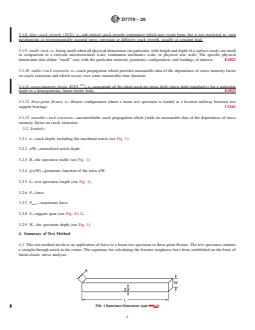
FIG. 1 Specimen Dimension (see 3.33.2)
D7779 − 20
4.2 Notched Beam Method—A straight-through notch is machined in a beam test specimen. The applied force on the notched test
specimen as a function of time and actuator displacement or specimen deflection in three-point flexure, or a combination thereof,
are recorded for analysis. The fracture toughness, K , is calculated from the maximum (fracture) force, the test specimen
Ic
dimensions, the measured notch depth, and the support span of the test fixture. Calculation of strain energy release rate, G, requires
a determination of specimen compliance, and crack length at each load point of the load versus displacement curve. The maximum
G derived from the strain energy release rate versus crack growth curve is recorded.
5. Significance and Use
5.1 This test method may be used for guidance for material development to improve toughness, material comparison, quality
assessment, and characterization.
5.2 The fracture toughness value provides information on the initiation of fracture in graphite containing a straight-through notch;
the information on stress intensity factor beyond fracture toughness as a function of crack extension provides information on the
crack propagation resistance once a fracture crack has been initiated to propagate through the test specimen.
6. Apparatus
6.1 Testing—Test the specimens in a testing machine that has provisions for autographic recording of force applied to the test
specimen versus time and actuator displacement or deflection of the specimen, or both, in the notch plane. The testing machine
shall conform to the requirements of Practice E4.
6.2 Deflection Measurement—The deflection gauge should be capable of resolving 0.001 mm. Practices E2309 cover procedures
and requirements for the calibration and verification of displacement measuring systems.
6.3 Recording Equipment—Provide digital data acquisition for automatically recording the applied force versus displacement.
6.4 Fixtures—Use a three-point test fixture constructed with high stiffness materials (see Fig. A1.2). Choose the outer support span,
S, such that 5 ≤ (S/W) ≤ 10. The outer two rollers shall be free to roll outwards from support locations to minimize friction effects.
The middle flexure roller shall be fixed. The specimen should overhang each of the outer
...