

ASTM D1601-18
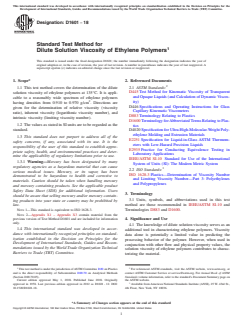
(Test Method)Standard Test Method for Dilute Solution Viscosity of Ethylene Polymers
General Information
- Abstract
SIGNIFICANCE AND USE
4.1 The knowledge of dilute solution viscosity serves as an additional tool in characterizing ethylene polymers. Viscosity data alone is potentially a limited value in predicting the processing behavior of the polymer. However, when used in conjunction with other flow and physical property values, the solution viscosity of ethylene polymers contributes to characterizing the material.
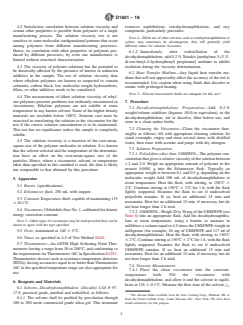
4.2 Satisfactory correlation between solution viscosity and certain other properties is possible from polymers of a single manufacturing process. The solution viscosity test is not sensitive to some molecular configurational patterns that occur among polymers from different manufacturing processes. Hence, its correlation with other properties of polymers produced by different processes, by even one manufacturer, is limited without structural characterization.
4.3 The viscosity of polymer solutions has the potential to be drastically affected by the presence of known or unknown additives in the sample. The use of solution viscosity data where ethylene polymers are known or suspected to contain colorants, carbon black, low molecular weight hydrocarbons, fillers, or other additives needs to be considered.
4.4 The measurement of dilute solution viscosity of ethylene polymers presents problems not ordinarily encountered in viscosimetry. Ethylene polymers are not soluble at room temperature in any known solvent. Some of the higher density materials are insoluble below 100°C. Extreme care must be exercised in transferring the solution to the viscometer for the test if the correct solution concentration is to be maintained. This test has no significance unless the sample is completely soluble.
4.5 The solution viscosity is a function of the root-mean-square size of the polymer molecules in solution. It is known that the solvent selected and the temperature of the determination have an effect on the root-mean-square size of the particles. Hence, where a viscometer, solvent, or temper...
SCOPE
1.1 This test method covers the determination of the dilute solution viscosity of ethylene polymers at 135°C. It is applicable to a reasonably wide spectrum of ethylene polymers having densities from 0.910 to 0.970 g/cm2. Directions are given for the determination of relative viscosity (viscosity ratio), inherent viscosity (logarithmic viscosity number), and intrinsic viscosity (limiting viscosity number).
1.2 The values as stated in SI units are to be regarded as the standard.
1.3 This standard does not purport to address all of the safety concerns, if any, associated with its use. It is the responsibility of the user of this standard to establish appropriate safety, health, and environmental practices and determine the applicability of regulatory limitations prior to use.
1.3.1 Warning—Mercury has been designated by many regulatory agencies as a hazardous material that can cause serious medical issues. Mercury, or its vapor, has been demonstrated to be hazardous to health and corrosive to materials. Caution should be taken when handling mercury and mercury containing products. See the applicable product Safety Data Sheet (SDS) for additional information. Users should be aware that selling mercury and/or mercury containing products into your state or country may be prohibited by law.
Note 1: This standard is equivalent to ISO 1628-3.
Note 2: Appendix X1 – Appendix X3 contain material from the previous version of Test Method D1601 and are included for information only.
1.4 This international standard was developed in accordance with internationally recognized principles on standardization established in the Decision on Principles for the Development of International Standards, Guides and Recommendations issued by the World Trade Organization Technical Barriers to Trade (TBT) Committee.
- Status
- Published
- Publication Date
- 30-Apr-2018
- Technical Committee
- D20 - Plastics
- Drafting Committee
- D20.70 - Analytical Methods
Overview
ASTM D1601-18: Standard Test Method for Dilute Solution Viscosity of Ethylene Polymers is a vital international standard used to determine the dilute solution viscosity of ethylene polymers at 135°C. Published by ASTM International, ASTM D1601-18 helps characterize a wide spectrum of ethylene polymers, particularly those with densities ranging from 0.910 to 0.970 g/cm³. While solution viscosity data alone has limited predictive value for processing behavior, it provides significant insights when used alongside other physical and flow properties.
Understanding the dilute solution viscosity is especially important when evaluating the processability, molecular structure, and general quality of ethylene-based materials. This method is technically equivalent to ISO 1628-3, enhancing its relevance for global users and stakeholders in the polymer and plastics industries.
Key Topics
- Test Applicability: ASTM D1601-18 is designed for ethylene polymers that are not soluble at room temperature and may require temperatures above 100°C for proper dissolution. The standard details procedures for obtaining relative, inherent, and intrinsic viscosity values-important parameters for polymer analysis.
- Sample Preparation: The method covers essential preparation steps, including dissolution in purified and stabilized decahydronaphthalene at elevated temperatures and strict sample handling to ensure complete solubility.
- Interference Considerations: The presence of additives such as colorants, fillers, or low molecular weight hydrocarbons in the polymer sample can dramatically alter viscosity results. Users must evaluate solution viscosity data in context with the sample’s composition.
- Precision and Bias: The standard outlines repeatability and reproducibility considerations for laboratory testing, emphasizing the importance of consistent practices and proper calibration.
- Safety Aspects: The procedure may involve hazardous materials, notably mercury and high-temperature solvents. Strict adherence to appropriate safety, health, and environmental practices is required.
Applications
- Polymer Characterization: Dilute solution viscosity measurements serve as an important characterization tool for branches of the plastics industry focused on ethylene polymers, including quality control of polyethylene products and resins.
- Quality Assurance: By correlating viscosity values with molecular weight and distribution, manufacturers and researchers can assess product consistency and suitability for specific applications.
- Process Development: Although viscosity alone does not predict processing behavior, it provides supporting data when combined with other measurements like melt flow rate or physical testing, aiding in process optimization and product development.
- Comparative Analysis: ASTM D1601-18 is especially valuable when evaluating polymers produced within a single manufacturing process. For products from diverse processes or with varying structural characteristics, additional analysis may be required.
Related Standards
- ISO 1628-3: Equivalent standard for the determination of viscosity number and limiting viscosity number in polyethylenes and polypropylenes.
- ASTM D445: Standard Test Method for Kinematic Viscosity of Transparent and Opaque Liquids.
- ASTM D446: Specifications and Operating Instructions for Glass Capillary Kinematic Viscometers.
- ASTM D883: Terminology Relating to Plastics.
- ASTM D1600: Terminology for Abbreviated Terms Relating to Plastics.
- ASTM D4020: Specification for Ultra-High-Molecular-Weight Polyethylene Molding and Extrusion Materials.
- IEEE/ASTM SI-10: Standard for Use of the International System of Units (SI).
- ASTM E2251: Specification for ASTM Liquid-in-Glass Thermometers with Low-Hazard Precision Liquids.
Using ASTM D1601-18 ensures consistency, reliability, and comparability of dilute solution viscosity data for ethylene polymers, supporting quality control and material development in the plastics industry and beyond. For detailed protocols and compliance requirements, always refer to the complete official ASTM standard publication.
Relations
- Effective Date
- 01-May-2018
- Effective Date
- 01-Apr-2024
- Effective Date
- 01-Feb-2024
- Effective Date
- 01-Nov-2023
- Effective Date
- 01-Nov-2023
- Effective Date
- 01-Jan-2020
- Effective Date
- 01-Aug-2019
- Effective Date
- 15-Apr-2019
- Effective Date
- 01-Feb-2019
- Effective Date
- 01-Dec-2018
- Effective Date
- 01-Nov-2018
- Refers
ASTM D1600-18 - Standard Terminology for Abbreviated Terms Relating to Plastics (Withdrawn 2024) - Effective Date
- 01-Jan-2018
- Refers
ASTM E2935-17 - Standard Practice for Conducting Equivalence Testing in Laboratory Applications - Effective Date
- 01-Oct-2017
- Effective Date
- 15-Aug-2017
- Effective Date
- 15-Dec-2016
Get Certified
Connect with accredited certification bodies for this standard

DIN CERTCO
DIN Group product certification.

Smithers Quality Assessments
US management systems and product certification.
Sponsored listings
Frequently Asked Questions
ASTM D1601-18 is a standard published by ASTM International. Its full title is "Standard Test Method for Dilute Solution Viscosity of Ethylene Polymers". This standard covers: SIGNIFICANCE AND USE 4.1 The knowledge of dilute solution viscosity serves as an additional tool in characterizing ethylene polymers. Viscosity data alone is potentially a limited value in predicting the processing behavior of the polymer. However, when used in conjunction with other flow and physical property values, the solution viscosity of ethylene polymers contributes to characterizing the material. 4.2 Satisfactory correlation between solution viscosity and certain other properties is possible from polymers of a single manufacturing process. The solution viscosity test is not sensitive to some molecular configurational patterns that occur among polymers from different manufacturing processes. Hence, its correlation with other properties of polymers produced by different processes, by even one manufacturer, is limited without structural characterization. 4.3 The viscosity of polymer solutions has the potential to be drastically affected by the presence of known or unknown additives in the sample. The use of solution viscosity data where ethylene polymers are known or suspected to contain colorants, carbon black, low molecular weight hydrocarbons, fillers, or other additives needs to be considered. 4.4 The measurement of dilute solution viscosity of ethylene polymers presents problems not ordinarily encountered in viscosimetry. Ethylene polymers are not soluble at room temperature in any known solvent. Some of the higher density materials are insoluble below 100°C. Extreme care must be exercised in transferring the solution to the viscometer for the test if the correct solution concentration is to be maintained. This test has no significance unless the sample is completely soluble. 4.5 The solution viscosity is a function of the root-mean-square size of the polymer molecules in solution. It is known that the solvent selected and the temperature of the determination have an effect on the root-mean-square size of the particles. Hence, where a viscometer, solvent, or temper... SCOPE 1.1 This test method covers the determination of the dilute solution viscosity of ethylene polymers at 135°C. It is applicable to a reasonably wide spectrum of ethylene polymers having densities from 0.910 to 0.970 g/cm2. Directions are given for the determination of relative viscosity (viscosity ratio), inherent viscosity (logarithmic viscosity number), and intrinsic viscosity (limiting viscosity number). 1.2 The values as stated in SI units are to be regarded as the standard. 1.3 This standard does not purport to address all of the safety concerns, if any, associated with its use. It is the responsibility of the user of this standard to establish appropriate safety, health, and environmental practices and determine the applicability of regulatory limitations prior to use. 1.3.1 Warning—Mercury has been designated by many regulatory agencies as a hazardous material that can cause serious medical issues. Mercury, or its vapor, has been demonstrated to be hazardous to health and corrosive to materials. Caution should be taken when handling mercury and mercury containing products. See the applicable product Safety Data Sheet (SDS) for additional information. Users should be aware that selling mercury and/or mercury containing products into your state or country may be prohibited by law. Note 1: This standard is equivalent to ISO 1628-3. Note 2: Appendix X1 – Appendix X3 contain material from the previous version of Test Method D1601 and are included for information only. 1.4 This international standard was developed in accordance with internationally recognized principles on standardization established in the Decision on Principles for the Development of International Standards, Guides and Recommendations issued by the World Trade Organization Technical Barriers to Trade (TBT) Committee.
SIGNIFICANCE AND USE 4.1 The knowledge of dilute solution viscosity serves as an additional tool in characterizing ethylene polymers. Viscosity data alone is potentially a limited value in predicting the processing behavior of the polymer. However, when used in conjunction with other flow and physical property values, the solution viscosity of ethylene polymers contributes to characterizing the material. 4.2 Satisfactory correlation between solution viscosity and certain other properties is possible from polymers of a single manufacturing process. The solution viscosity test is not sensitive to some molecular configurational patterns that occur among polymers from different manufacturing processes. Hence, its correlation with other properties of polymers produced by different processes, by even one manufacturer, is limited without structural characterization. 4.3 The viscosity of polymer solutions has the potential to be drastically affected by the presence of known or unknown additives in the sample. The use of solution viscosity data where ethylene polymers are known or suspected to contain colorants, carbon black, low molecular weight hydrocarbons, fillers, or other additives needs to be considered. 4.4 The measurement of dilute solution viscosity of ethylene polymers presents problems not ordinarily encountered in viscosimetry. Ethylene polymers are not soluble at room temperature in any known solvent. Some of the higher density materials are insoluble below 100°C. Extreme care must be exercised in transferring the solution to the viscometer for the test if the correct solution concentration is to be maintained. This test has no significance unless the sample is completely soluble. 4.5 The solution viscosity is a function of the root-mean-square size of the polymer molecules in solution. It is known that the solvent selected and the temperature of the determination have an effect on the root-mean-square size of the particles. Hence, where a viscometer, solvent, or temper... SCOPE 1.1 This test method covers the determination of the dilute solution viscosity of ethylene polymers at 135°C. It is applicable to a reasonably wide spectrum of ethylene polymers having densities from 0.910 to 0.970 g/cm2. Directions are given for the determination of relative viscosity (viscosity ratio), inherent viscosity (logarithmic viscosity number), and intrinsic viscosity (limiting viscosity number). 1.2 The values as stated in SI units are to be regarded as the standard. 1.3 This standard does not purport to address all of the safety concerns, if any, associated with its use. It is the responsibility of the user of this standard to establish appropriate safety, health, and environmental practices and determine the applicability of regulatory limitations prior to use. 1.3.1 Warning—Mercury has been designated by many regulatory agencies as a hazardous material that can cause serious medical issues. Mercury, or its vapor, has been demonstrated to be hazardous to health and corrosive to materials. Caution should be taken when handling mercury and mercury containing products. See the applicable product Safety Data Sheet (SDS) for additional information. Users should be aware that selling mercury and/or mercury containing products into your state or country may be prohibited by law. Note 1: This standard is equivalent to ISO 1628-3. Note 2: Appendix X1 – Appendix X3 contain material from the previous version of Test Method D1601 and are included for information only. 1.4 This international standard was developed in accordance with internationally recognized principles on standardization established in the Decision on Principles for the Development of International Standards, Guides and Recommendations issued by the World Trade Organization Technical Barriers to Trade (TBT) Committee.
ASTM D1601-18 is classified under the following ICS (International Classification for Standards) categories: 83.080.20 - Thermoplastic materials. The ICS classification helps identify the subject area and facilitates finding related standards.
ASTM D1601-18 has the following relationships with other standards: It is inter standard links to ASTM D1601-12, ASTM D445-24, ASTM D883-24, ASTM D445-23, ASTM D883-23, ASTM D883-20, ASTM D883-19c, ASTM D883-19a, ASTM D883-19, ASTM D883-18a, ASTM D883-18, ASTM D1600-18, ASTM E2935-17, ASTM D883-17, ASTM D445-16. Understanding these relationships helps ensure you are using the most current and applicable version of the standard.
ASTM D1601-18 is available in PDF format for immediate download after purchase. The document can be added to your cart and obtained through the secure checkout process. Digital delivery ensures instant access to the complete standard document.
Standards Content (Sample)
This international standard was developed in accordance with internationally recognized principles on standardization established in the Decision on Principles for the
Development of International Standards, Guides and Recommendations issued by the World Trade Organization Technical Barriers to Trade (TBT) Committee.
Designation: D1601 − 18
Standard Test Method for
Dilute Solution Viscosity of Ethylene Polymers
This standard is issued under the fixed designation D1601; the number immediately following the designation indicates the year of
original adoption or, in the case of revision, the year of last revision. A number in parentheses indicates the year of last reapproval. A
superscript epsilon (´) indicates an editorial change since the last revision or reapproval.
1. Scope* 2. Referenced Documents
2.1 ASTM Standards:
1.1 This test method covers the determination of the dilute
D445 Test Method for Kinematic Viscosity of Transparent
solution viscosity of ethylene polymers at 135°C. It is appli-
and Opaque Liquids (and Calculation of Dynamic Viscos-
cable to a reasonably wide spectrum of ethylene polymers
ity)
having densities from 0.910 to 0.970 g/cm . Directions are
D446 Specifications and Operating Instructions for Glass
given for the determination of relative viscosity (viscosity
Capillary Kinematic Viscometers
ratio), inherent viscosity (logarithmic viscosity number), and
D883 Terminology Relating to Plastics
intrinsic viscosity (limiting viscosity number).
D1600 Terminology forAbbreviatedTerms Relating to Plas-
1.2 The values as stated in SI units are to be regarded as the
tics
standard.
D4020 Specification for Ultra-High-Molecular-Weight Poly-
ethylene Molding and Extrusion Materials
1.3 This standard does not purport to address all of the
E2251 Specification for Liquid-in-Glass ASTM Thermom-
safety concerns, if any, associated with its use. It is the
eters with Low-Hazard Precision Liquids
responsibility of the user of this standard to establish appro-
E2935 Practice for Conducting Equivalence Testing in
priate safety, health, and environmental practices and deter-
Laboratory Applications
mine the applicability of regulatory limitations prior to use.
IEEE/ASTM SI-10 Standard for Use of the International
1.3.1 Warning—Mercury has been designated by many
System of Units (SI): The Modern Metric System
regulatory agencies as a hazardous material that can cause
2.2 ISO Standards:
serious medical issues. Mercury, or its vapor, has been
ISO 1628-3 Plastics—Determination of Viscosity Number
demonstrated to be hazardous to health and corrosive to
and Limiting Viscosity Number—Part 3: Polyethylenes
materials. Caution should be taken when handling mercury
and Polypropylenes
and mercury containing products. See the applicable product
Safety Data Sheet (SDS) for additional information. Users
3. Terminology
should be aware that selling mercury and/or mercury contain-
3.1 Units, symbols, and abbreviations used in this test
ing products into your state or country may be prohibited by
method are those recommended in IEEE/ASTM SI-10 and
law.
NOTE 1—This standard is equivalent to ISO 1628-3. Terminologies D883 and D1600.
NOTE 2—Appendix X1 – Appendix X3 contain material from the
previous version of Test Method D1601 and are included for information
4. Significance and Use
only.
4.1 The knowledge of dilute solution viscosity serves as an
1.4 This international standard was developed in accor-
additional tool in characterizing ethylene polymers. Viscosity
dance with internationally recognized principles on standard-
data alone is potentially a limited value in predicting the
ization established in the Decision on Principles for the
processing behavior of the polymer. However, when used in
Development of International Standards, Guides and Recom-
conjunction with other flow and physical property values, the
mendations issued by the World Trade Organization Technical
solution viscosity of ethylene polymers contributes to charac-
Barriers to Trade (TBT) Committee.
terizing the material.
1 2
This test method is under the jurisdiction ofASTM Committee D20 on Plastics For referenced ASTM standards, visit the ASTM website, www.astm.org, or
and is the direct responsibility of Subcommittee D20.70 on Analytical Methods contact ASTM Customer Service at service@astm.org. For Annual Book of ASTM
(Section D20.70.05). Standards volume information, refer to the standard’s Document Summary page on
Current edition approved May 1, 2018. Published June 2018. Originally the ASTM website.
approved in 1958. Last previous edition approved in 2012 as D1601 - 12. DOI: Available fromAmerican National Standards Institute (ANSI), 25 W. 43rd St.,
10.1520/D1601-18. 4th Floor, New York, NY 10036.
*A Summary of Changes section appears at the end of this standard
Copyright © ASTM International, 100 Barr Harbor Drive, PO Box C700, West Conshohocken, PA 19428-2959. United States
D1601 − 18
4.2 Satisfactory correlation between solution viscosity and removes naphthalene, tetrahydronaphthalene, and oxy
certain other properties is possible from polymers of a single compounds, particularly peroxides.
manufacturing process. The solution viscosity test is not
NOTE 4—While use of other solvents, such as tetrahydronaphthalene or
sensitive to some molecular configurational patterns that occur
xylene, may sometimes be advantageous, they will generally yield
among polymers from different manufacturing processes.
different values for solution viscosities.
Hence, its correlation with other properties of polymers pro-
6.1.2 Immediately after redistillation of the
duced by different processes, by even one manufacturer, is
decahydronaphthalene, add 0.2 % Tetrakis [methylene 3-(3',5'-
limited without structural characterization.
di-tert-butyl-4'-hydroxphenyl) propionate] methane to inhibit
4.3 The viscosity of polymer solutions has the potential to oxidation during the viscosity determination.
be drastically affected by the presence of known or unknown
6.2 Heat Transfer Medium—Any liquid heat transfer me-
additives in the sample. The use of solution viscosity data
dium that will not appreciably affect the accuracy of the test is
where ethylene polymers are known or suspected to contain
recommended. Use caution when using fluids that discolor or
colorants, carbon black, low molecular weight hydrocarbons,
smoke with prolonged heating.
fillers, or other additives needs to be considered.
NOTE 5—Silicone heat-transfer fluids are adequate for this use .
4.4 The measurement of dilute solution viscosity of ethyl-
ene polymers presents problems not ordinarily encountered in 7. Procedure
viscosimetry. Ethylene polymers are not soluble at room
7.1 Decahydronaphthalene Preparation—Add 0.2 %
temperature in any known solvent. Some of the higher density
weight/volume stabilizer (Irganox 1010 or equivalent), to the
materials are insoluble below 100°C. Extreme care must be
decahydronaphthalene, stir to dissolve, filter before use, and
exercised in transferring the solution to the viscometer for the
store in a clean amber bottle.
test if the correct solution concentration is to be maintained.
7.2 Cleaning the Viscometer—Clean the viscometer thor-
This test has no significance unless the sample is completely
oughly as follows: fill with appropriate cleaning solution, let
soluble.
stand overnight, empty and rinse several times with distilled
4.5 The solution viscosity is a function of the root-mean-
water, then rinse with acetone and purge with dry nitrogen.
square size of the polymer molecules in solution. It is known
7.3 Solution Preparation:
that the solvent selected and the temperature of the determina-
7.3.1 Polyolefins other than UHMWPE—The polymer con-
tion have an effect on the root-mean-square size of the
centrationthatgivesarelativeviscosityofthesolutionbetween
particles. Hence, where a viscometer, solvent, or temperature
1.2 and 2.0. Weigh an appropriate amount of polymer to the
other than specified in this standard is used, the data is likely
nearest 0.0001 g into the Erlenmeyer flask. Typically an
not comparable to that obtained by this procedure.
appropriate weight is between 0.1 and 0.5 g, depending on the
molecular weight Add 100 mL of decahydronaphthalene at
5. Apparatus
room temperature. Heat the flask, with stirring, to 150°C 6
5.1 Burets, (specifications).
2°C. Continue stirring at 150°C 6 2°C for 1 h, with the flask
5.2 Erlenmeyer flask, 250 mL with stopper.
lightly stoppered. Examine the flask to see if undissolved
polyolefin remains. If so, heat an additional 15 min and
5.3 Constant Temperature Bath, capable of maintaining 135
reexamine. Heat for an additional 15 min, if necessary, but do
6 l0.1°C.
not heat longer than 2 h total.
5.4 Viscometer, Ubbelohde Size No. 1, calibrated for kinetic
7.3.2 UHMWPE—Weigh20to30mgoftheUHMWPE(see
energy correction constant.
Note 6) into an appropriate flask. Add the decahydronaphtha-
NOTE 3—Other types of viscometers may be used provided they can be lene at room temperature, using a burette to measure in
shown to agree with the type specified.
millilitersavolumeequalto4.5timestheUHMWPEweightin
milligrams (for example, 26 mg of UHMWPE and 117 ml of
5.5 Oven, maintained at 140 6 5°C.
decahydronaphthalene). Heat the flask, with stirring, to 150°C
5.6 Timer, as specified in 4.5 of Test Method D445.
62°C.Continuestirringat150°C 62°Cfor1h,withtheflask
5.7 Thermometer—An ASTM High Softening Point Ther-
lightly stoppered. Examine the flask to see if undissolved
mometer having a range from 30 to 200°C, and conforming to
UHMWPE remains. If so, heat an additional 15 min and
therequirementsforThermometer16CinSpecificationE2251.
reexamine. Heat for an additional 15 min, if necessary, but do
Thermometric devices such as resistance temperature detectors
not heat longer than 2 h total.
(RTDs),havingaccuraciesequaltoorbetterthanThermometer
7.4 Viscosity Measurement:
16C in the specified temperature range are also appropriate for
7.4.1 Place the clean viscometer into the constant-
use.
temperature bath. Fill the viscometer with
decahydronaphthalene, and allow it and the solvent to equili-
6. Reagents and Materials
brate at 135 6 0.1°C. Measure the flow time of the solvent, t ,
o
6.1 Solvent—Decahydronaphthalene (Decalin) CAS # 97-
17-8, practical grade, purified and redistilled, as follows:
The silicone fluids available from the Dow Corning Corp., Midland, MI, or
6.1.1 The solvent shall be purified by percolation through
from the Union Carbide Corp., Linde Silicones Div., New York, NY, have been
100 to 200 mesh commercial grade silica gel. This treatment found satisfactory for this purpose.
D1601 − 18
TABLE 1 Relative Solution Viscosity
threetimes,andaveragetheresults.Theviscometerneedstobe
A B C D
cleaned if replicate measurements of flow time differ by more Material Average S S r R
r R
UHMWPE No. 1 1.454 0.015 0.049 0.042 0.136
than 0.3 s (see 7.4.3). Remove the decahydronaphthalene from
UHMWPE No. 2 1.653 0.017 0.048 0.047 0.136
theviscometerandthoroughlyrinsetheviscometerwithxylene
A
S = within-laboratory standard deviation for the indicated material. It is obtained
r
at 110 to 120°C or decahydronaphthalene at 135°C. Remove
byfirstpoolingthewithin-laboratorystandarddeviationsofthetestresultsfromall
the xylene or decahydronaphthalene and aspirate dry air or
of the participating laboratories.
nitrogen to dry the viscometer (2 or 3 min). If needed, rinse the 2 2 2 1/2
S 5 f h ss d 1ss d .1ss d j/n g
r 1 2 R
viscometer with a lower boiling nonpolar solvent to enhance
B
S = between-laboratory reproducibility, expressed as standard deviation:
R
drying. It is essential that the viscometer be completely dry.
2 2 1/2
S 5 Sr 1S
f g
R L
7.4.2 Transfer the hot (150°C) polymer solution to the
where S = standard deviation of laboratory means.
viscometer with sufficient quantity to fill to the mark (see Note L
C
r = within-laboratory critical interval between two test results = 2.8 × S .
r
7), allow to equilibrate at 135°C 6 0.1°C, and measure the
D
R = between laboratories critical interval between two test results = 2.8 × S .
R
flow time of the solution, t , in triplicate, and average the
s
results.
7.4.3 Between uses, clean the viscometer by rinsing with
hot xylene or decahydronaphthalene, drying with air or
nitrogen, and storing filled with hot decahydronaphthalene. If
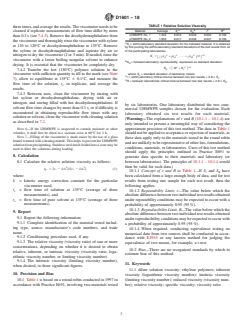
by six laboratories. One laboratory distributed the two com-
solvent flow time changes by more than 0.3 s, or if difficulty is
mercial UHMWPE samples chosen for the evaluation. Each
encountered in obtaining reproducible flow times with any
laboratory obtained six test results for each material.
solutionorsolvent,cleantheviscometerwithcleaningsolution
(Warning—The explanations of r and R (10.1.1 – 10.1.4) are
as described in 7.2.
only intended to present a meaningful way of considering the
approximate precision of this test method. The data in Table 1
NOTE 6—If the UHMWPE is suspected to contain moisture or other
volatiles, it shall first be dried in a vacuum oven at 60°C for 2 h.
shouldnotbeappliedtoacceptanceorrejectionofmaterials,as
NOTE 7—Filling of the viscometer is made easier by the use of a glass
these data apply only to the materials tested in the round robin
funnelwarmedwithaheatingmantle.ThishelpstopreventtheUHMWPE
andareunlikelytoberepresentativeofotherlots,formulations,
solutionfromprecipitating.Stainlesssteelmeshfoldedintoaconemaybe
conditions, materials, or laboratories. Users of this test method
used to filter the solutions during loading.
should apply the principles outlined in Practice E691 to
8. Calculation
generate data specific to their materials and laboratory (or
between laboratories). The principles of 10.1.1 – 10.1.4 would
8.1
...
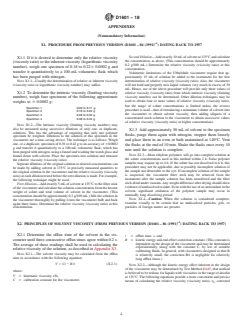
This document is not an ASTM standard and is intended only to provide the user of an ASTM standard an indication of what changes have been made to the previous version. Because
it may not be technically possible to adequately depict all changes accurately, ASTM recommends that users consult prior editions as appropriate. In all cases only the current version
of the standard as published by ASTM is to be considered the official document.
Designation: D1601 − 12 D1601 − 18
Standard Test Method for
Dilute Solution Viscosity of Ethylene Polymers
This standard is issued under the fixed designation D1601; the number immediately following the designation indicates the year of
original adoption or, in the case of revision, the year of last revision. A number in parentheses indicates the year of last reapproval. A
superscript epsilon (´) indicates an editorial change since the last revision or reapproval.
1. Scope*
1.1 This test method covers the determination of the dilute solution viscosity of ethylene polymers at 135°C. It is applicable
to a reasonably wide spectrum of ethylene polymers having densities from 0.910 to 0.970 g/cm . Directions are given for the
determination of relative viscosity (viscosity ratio), inherent viscosity (logarithmic viscosity number), and intrinsic viscosity
(limiting viscosity number) (see number).Appendix X4).
1.2 The values as stated in SI units are to be regarded as the standard.
1.3 This standard does not purport to address all of the safety concerns, if any, associated with its use. It is the responsibility
of the user of this standard to establish appropriate safety and health practices and determine the applicability of regulatory
limitations prior to use.
1.3 This standard does not purport to address all of the safety concerns, if any, associated with its use. It is the responsibility
of the user of this standard to establish appropriate safety, health, and environmental practices and determine the applicability of
regulatory limitations prior to use.
1.3.1 Warning—Mercury has been designated by many regulatory agencies as a hazardous material that can cause serious
medical issues. Mercury, or its vapor, has been demonstrated to be hazardous to health and corrosive to materials. Caution should
be taken when handling mercury and mercury containing products. See the applicable product Safety Data Sheet (SDS) for
additional information. Users should be aware that selling mercury and/or mercury containing products into your state or country
may be prohibited by law.
NOTE 1—This test method standard is technically equivalent to ISO 1628-3.
NOTE 2—Appendix X1 – Appendix X3 contain material from the previous version of Test Method D1601 and are included for information only.
1.4 This international standard was developed in accordance with internationally recognized principles on standardization
established in the Decision on Principles for the Development of International Standards, Guides and Recommendations issued
by the World Trade Organization Technical Barriers to Trade (TBT) Committee.
2. Referenced Documents
2.1 ASTM Standards:
D86 Test Method for Distillation of Petroleum Products and Liquid Fuels at Atmospheric Pressure
D445 Test Method for Kinematic Viscosity of Transparent and Opaque Liquids (and Calculation of Dynamic Viscosity)
D446 Specifications and Operating Instructions for Glass Capillary Kinematic Viscometers
D883 Terminology Relating to Plastics
D1600 Terminology for Abbreviated Terms Relating to Plastics
D4020 Specification for Ultra-High-Molecular-Weight Polyethylene Molding and Extrusion Materials
E1E2251 Specification for ASTM Liquid-in-Glass ThermometersLiquid-in-Glass ASTM Thermometers with Low-Hazard
Precision Liquids
E2935 Practice for Conducting Equivalence Testing in Laboratory Applications
IEEE/ASTM SI-10 Standard for Use of the International System of Units (SI): The Modern Metric System
2.2 ISO Standards:
ISO 1628-3 Plastics—Determination of Viscosity Number and Limiting Viscosity Number—Part 3: Polyethylenes and
Polypropylenes
This test method is under the jurisdiction of ASTM Committee D20 on Plastics and is the direct responsibility of Subcommittee D20.70 on Analytical Methods (Section
D20.70.05).
Current edition approved Aug. 1, 2012May 1, 2018. Published September 2012June 2018. Originally approved in 1958. Last previous edition approved in 20042012 as
D1601 - 99D1601 - 12.(2004). DOI: 10.1520/D1601-12.10.1520/D1601-18.
For referenced ASTM standards, visit the ASTM website, www.astm.org, or contact ASTM Customer Service at service@astm.org. For Annual Book of ASTM Standards
volume information, refer to the standard’s Document Summary page on the ASTM website.
Available from American National Standards Institute (ANSI), 25 W. 43rd St., 4th Floor, New York, NY 10036.
*A Summary of Changes section appears at the end of this standard
Copyright © ASTM International, 100 Barr Harbor Drive, PO Box C700, West Conshohocken, PA 19428-2959. United States
D1601 − 18
3. Terminology
3.1 Units, symbols, and abbreviations used in this test method are those recommended in IEEE/ASTM SI-10 and Terminologies
D883 and D1600 (see also .Appendix X4).
4. Significance and Use
4.1 The knowledge of dilute solution viscosity serves as an additional tool in characterizing ethylene polymers. Viscosity data
alone may be ofis potentially a limited value in predicting the processing behavior of the polymer. However, when used in
conjunction with other flow and physical property values, the solution viscosity of ethylene polymers may contribute to their
characterizations.contributes to characterizing the material.
4.2 Satisfactory correlation between solution viscosity and certain other properties is possible from polymers of a single
manufacturing process. The solution viscosity test is not sensitive to some molecular configurational patterns that may occur
among polymers from different manufacturing processes. Hence, its correlation with other properties of polymers produced by
different processes, by even one manufacturer, may be limited.is limited without structural characterization.
4.3 The viscosity of polymer solutions may has the potential to be drastically affected by the presence of known or unknown
additives in the sample. The use of solution viscosity may be of questionable value data where ethylene polymers are known or
suspected to contain colorants, carbon black, low molecular weight hydrocarbons, fillers, or other additives.additives needs to be
considered.
4.4 The measurement of dilute solution viscosity of ethylene polymers presents problems not ordinarily encountered in
viscosimetry. Ethylene polymers are not soluble at room temperature in any known solvent. Some of the higher density materials
are insoluble below 100°C. Extreme care must be exercised in transferring the solution to the viscometer for the test if the correct
solution concentration is to be maintained. This test has no significance unless the sample is completely soluble.
4.5 The solution viscosity is a function of the root-mean-square size of the polymer molecules in solution. It is known that the
solvent selected and the temperature of the determination have an effect on the root-mean-square size of the particles. Hence, where
a viscometer, solvent, or temperature other than specified in this standard is used, the data may is likely not be comparable to that
obtained by this procedure.
5. Apparatus
5.1 Volumetric Flasks, Burets, 100-mL, grade EXAX or better.(specifications).
5.2 Transfer Pipets,Erlenmeyer flask, Grade EXAX or better.250 mL with stopper.
5.3 Constant Temperature Bath, capable of maintaining 135 6 l0.1°C.
5.4 Viscometer, Ubbelohde Size No. 1, calibrated for kinetic energy correction constant.
NOTE 3—Other types of viscometers may be used provided they can be shown to agree with the type specified.
5.5 Oven, maintained at 140 6 5°C.
5.6 Timer, as specified in 4.5 of Test Method D445.
5.7 Thermometer—An ASTM High Softening Point Thermometer having a range from 30 to 200°C, and conforming to the
requirements for Thermometer 16C in Specification E1E2251. Thermometric devices such as resistance temperature detectors
(RTDs), having accuracies equal to or better than Thermometer 16C in the specified temperature range are also appropriate for use.
6. Reagents and Materials
6.1 Solvent—Decahydronaphthalene,Decahydronaphthalene (Decalin) CAS # 97-17-8, practical grade, purified and redistilled,
as follows:
6.1.1 The solvent shall be purified by percolation through 100 to 200 mesh commercial grade silica gel. This treatment removes
naphthalene, tetrahydronaphthalene, and oxy compounds, particularly peroxides.
6.1.2 The redistilled product shall conform to the following requirements when tested in accordance with Method D86:
ASTM
Standard Distillation
Method D86
Initial boiling point 190°C min
10 mL 191°C min
20 mL 192°C min
80 mL 194°C max
90 mL 195°C max
Dry point 196°C max
NOTE 4—While use of other solvents, such as tetrahydronaphthalene or xylene, may sometimes be advantageous, they will generally yield different
values for solution viscosities.
NOTE 4—While use of other solvents, such as tetrahydronaphthalene or xylene, may sometimes be advantageous, they will generally yield different
values for solution viscosities.
D1601 − 18
6.1.2 Immediately after redistillation of the decahydronaphthalene, add 0.2 % Tetrakis [methylene 3-(3',5'-di-tert-butyl-4'-
hydroxphenyl) propionate] methane to inhibit oxidation during the viscosity determination.
6.2 Heat Transfer Medium—Any liquid heat transfer medium that will not appreciably affect the accuracy of the test may be
used. Care should be exercised in is recommended. Use caution when using fluids that discolor or smoke with prolonged heating.
NOTE 5—Silicone heat-transfer fluids are adequate for this use .
7. Procedure
7.1 Decahydronaphthalene Preparation—Add 0.2 % weight/volume stabilizer (Irganox 1010 or equivalent), to the
decahydronaphthalene, stir to dissolve, filter through fast filter paper, before use, and store in a clean amber bottle.
7.2 Cleaning the Viscometer—Clean the viscometer thoroughly as follows: fill with appropriate cleaning solution, let stand
overnight, empty and rinse several times with distilled water, then rinse with acetone and purge with dry nitrogen.
7.3 Solution Preparation—Preparation: Weigh 20 to 30 mg of the UHMWPE (see Note 6) into the Erlenmeyer flask. Add the
decahydronaphthalene at room temperature, using a burette to measure in milliliters a volume equal to 4.5 times the UHMWPE
weight in milligrams (for example, 26 mg of UHMWPE and 117 ml of decahydronaphthalene). Heat the flask, with stirring, to
150°C 6 2°C. Continue stirring at 150°C 6 2°C for 1 h, with the flask lightly stoppered. Examine the flask to see if undissolved
UHMWPE remains. If so, heat an additional 15 min and reexamine. Heat for an additional 15 min, if necessary, but do not heat
longer than 2 h total.
7.3.1 Polyolefins other than UHMWPE—The polymer concentration that gives a relative viscosity of the solution between 1.2
and 2.0. Weigh an appropriate amount of polymer to the nearest 0.0001 g into the Erlenmeyer flask. Typically an appropriate weight
is between 0.1 and 0.5 g, depending on the molecular weight Add 100 mL of decahydronaphthalene at room temperature. Heat
the flask, with stirring, to 150°C 6 2°C. Continue stirring at 150°C 6 2°C for 1 h, with the flask lightly stoppered. Examine the
flask to see if undissolved polyolefin remains. If so, heat an additional 15 min and reexamine. Heat for an additional 15 min, if
necessary, but do not heat longer than 2 h total.
7.3.2 UHMWPE—Weigh 20 to 30 mg of the UHMWPE (see Note 6) into an appropriate flask. Add the decahydronaphthalene
at room temperature, using a burette to measure in milliliters a volume equal to 4.5 times the UHMWPE weight in milligrams (for
example, 26 mg of UHMWPE and 117 ml of decahydronaphthalene). Heat the flask, with stirring, to 150°C 6 2°C. Continue
stirring at 150°C 6 2°C for 1 h, with the flask lightly stoppered. Examine the flask to see if undissolved UHMWPE remains. If
so, heat an additional 15 min and reexamine. Heat for an additional 15 min, if necessary, but do not heat longer than 2 h total.
7.4 Viscosity Measurement:
7.4.1 Place the clean viscometer into the constant-temperature bath. Fill the viscometer with decahydronaphthalene, and allow
it and the solvent to equilibrate at 135 6 0.1°C. Measure the flow time of the solvent, t , three times, and average the results. The
o
viscometer may have needs to be cleaned if replicate measurements of flow time differ by more than 0.3 s (see 7.4.3). Remove
the decahydronaphthalene from the viscometer with vacuum and thoroughly rinse the viscometer with xylene at 110 to 120°C or
decahydronaphthalene at 135°C. Remove the xylene or decahydronaphthalene with vacuum and aspirate dry air or nitrogen to dry
the viscometer (2 or 3 min). If needed, rinse the viscometer with a lower boiling nonpolar solvent to enhance drying. It is essential
that the viscometer be completely dry.
7.4.2 Transfer the hot (150°C) polymer solution to the viscometer with sufficient quantity to fill to the mark (see Note 7), allow
to equilibrate at 135°C 6 0.1°C, and measure the flow time of the solution, t , in triplicate, and average the results.
s
7.4.3 Between uses, clean the viscometer by rinsing with hot xylene or decahydronaphthalene, drying with air or nitrogen, and
storing filled with hot decahydronaphthalene. If solvent flow time changes by more than 0.3 s, or if difficulty is encountered in
obtaining reproducible flow times with any solution or solvent, clean the viscometer with cleaning solution as described in 7.2.
NOTE 6—If the UHMWPE is suspected to contain moisture or other volatiles, it shall first be dried in a vacuum oven at 60°C for 2 h.
NOTE 7—Filling of the viscometer is made easier by the use of a glass funnel warmed with a heating mantle. This helps to prevent the UHMWPE
solution from precipitating. Stainless steel mesh folded into a cone may be used to filter the solutions during loading.
8. Calculation
8.1 Calculate the relative solution viscosity as follows:
η 5 ~t 2 k/t !/~t 2 k/t ! (1)
r s s o o
2 2
η 5 t 2 k/t / t 2 k/t (1)
~ ! ~ !
r s s o o
where:
k = kinetic energy correction constant for the particular viscometer used,
= flow time of solution at 135°C (average of three measurements), and
t
s
The silicone fluids available from the Dow Corning Corp., Midland, MI, or from the Union Carbide Corp., Linde Silicones Div., New York, NY, have been found
satisfactory for this purpose.
D1601 − 18
t = flow time of pure solvent at 135°C (average of three measurements).
o
9. Report
9.1 Report the following information:
9.1.1 Complete identification of the material tested including type, source, manufacturer’s code numbers, and trade name.
9.1.2 Conditioning procedure used, if any.
9.1.3 The relative viscosity (viscosity ratio) of one or more concentrations, depending on whether it is desired to obtain relative,
inherent, or intrinsic viscosity (viscosity ratio, logarithmic viscosity number, or limiting viscosity number) (see number).Appendix
X4).
9.1.4 The intrinsic viscosity (limiting viscosity number), when desired, to three significant figures (see figures.Appendix X4).
10. Precision and Bias
10.1 Table 1 is based on a round robin conducted in 1997 in accordance with Practice E691, involving two materials tested by
six laboratories. One laboratory distributed the two commercial UHMWPE samples chosen for the evaluation. Each laboratory
obtained six test results for each material. (Warning—The explanations of r and R (10.1.1 – 10.1.4) are only intended to present
a meaningful way of considering the approximate precision of this test method. The data in Table 1 should not be applied to
acceptance or rejection of materials, as these data apply only to the materials tested in the round robin and are unlikely to be
representative of other lots, formulations, conditions, materials, or laboratories. Users of this test method should apply the
principles outlined in Practice E691 to generate data specific to their materials and laboratory (or between laboratories). The
principles of 10.1.1 – 10.1.4 would then be valid for such data.)
NOTE 8—Caution: The explanations of r and R (10.1.1 – 10.1.4) are only intended to present a meaningful way of considering the approximate
precision of this test method. The data in Table 1 should not be applied to acceptance or rejection of materials, as these data apply only to the materials
tested in the round robin and are unlikely to be representative of other lots, formulations, conditions, materials, or laboratories. Users of this test method
should apply the principles outlined in Practice E691 to generate data specific to their materials and laboratory (or between laboratories). The principles
of 10.1.1 – 10.1.4 would then be valid for such data.
10.1.1 Concept of r and R in Table 1—If S and S have been calculated from a large enough body of data, and for test results
r R
from testing one sample for each test result, then the following applies:
10.1.2 Repeatability—Repeatability Limit, r—rThe is the interval representing the critical value below which the absolute
difference between two individual test results for the same material, obtained by the same operator using the same equipment on
the same day in the same laboratory. Two test results shall be judged not equivalent if they differ by more than the obtained under
repeatability conditions may be expected to occur with a probability of approximately 0.95 (95 %).r value for the material.
10.1.3 Reproducibility—Reproducibility Limit, R—RThe is the interval representing the critical value below which the absolute
difference between two individual test results for the same material, obtained by different operators using different equipment in
different laboratories, not necessarily on the same day. Two test results shall be judged not equivalent if they differ by more than
the obtained under reproducibility conditions may be expec
...