

ASTM D1430-22
(Classification)Standard Classification System for Polychlorotrifluoroethylene (PCTFE) Plastics
General Information
- Abstract
ABSTRACT
This classification system covers polychlorotrifluoroethylene (PCTFE) plastics that consist of at least 90% chlorotrifluoroethylene and are suitable for extrusion and for compression and injection molding. The remaining 10% may include chemical modifications, such as co-monomers, but not colorants, fillers, plasticizers, or mechanical blends with other resins. PCTFE materials in powders and pellets are classified into one group. The group is subdivided into classes based on chemical composition: Class 1; Class 2; and Class 3. These classes are subdivided into grades: Grades 1, 2, 3, and 0; Grades 1, 2, and 0; and Grades 1, 2, and 0; respectively. The molding or extrusion material shall be of uniform composition and so compounded as to conform to the requirements of this classification system. The properties shall be determined in accordance with the following test methods: conditioning; zero strength time; test conditions; deformation under load; melting point; dissipation factor and dielectric constant; and specific gravity.
SCOPE
1.1 This classification system covers polychlorotrifluoroethylene (PCTFE) plastics that consist of at least 90 % chlorotrifluoroethylene and are suitable for extrusion and for compression and injection molding. Additional components allow for chemical modifications, such as co-monomers, but not colorants, fillers, plasticizers, or mechanical blends with other resins. This classification system does not cover recycled PCTFE materials.
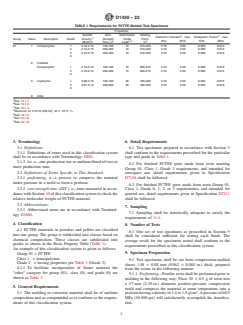
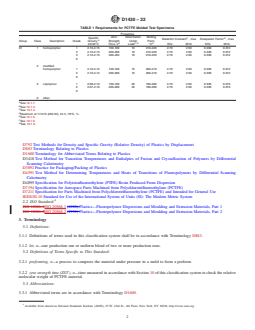
1.2 The physical and electrical properties of parts molded or extruded from PCTFE molding compounds vary with the crystalline content obtained during processing and subsequent annealing. Accordingly, the numerical values listed in Table 1 apply only to the test specimens molded in accordance with Section 8. These values are not applicable as design criteria to semi-finished and finished parts prepared and annealed under other conditions.
1.3 The values stated in SI units as detailed in IEEE/SI-10 are to be regarded as the standard. The values given in parentheses are for information only.
1.4 The following precautionary statement pertains only to the test methods portion, Section 10, of this classification system: This standard does not purport to address all of the safety concerns, if any, associated with its use. It is the responsibility of the user of this standard to establish appropriate safety, health, and environmental practices and determine the applicability of regulatory limitations prior to use.
Note 1: Although this classification system and ISO 20568-1 and ISO 20568-2 differ in approach or detail, data obtained using either are technically equivalent.
1.5 This international standard was developed in accordance with internationally recognized principles on standardization established in the Decision on Principles for the Development of International Standards, Guides and Recommendations issued by the World Trade Organization Technical Barriers to Trade (TBT) Committee.
- Status
- Published
- Publication Date
- 14-Mar-2022
- Technical Committee
- D20 - Plastics
- Drafting Committee
- D20.15 - Thermoplastic Materials
Buy Documents
ASTM D1430-22 - Standard Classification System for Polychlorotrifluoroethylene (PCTFE) Plastics
REDLINE ASTM D1430-22 - Standard Classification System for Polychlorotrifluoroethylene (PCTFE) Plastics
Overview
ASTM D1430-22: Standard Classification System for Polychlorotrifluoroethylene (PCTFE) Plastics establishes a comprehensive system for the classification of PCTFE plastics. These materials must consist of at least 90% chlorotrifluoroethylene, making them suitable for extrusion, compression molding, and injection molding processes. The classification excludes recycled PCTFE and prohibits colorants, fillers, plasticizers, or mechanical blends with other resins. This standard ensures consistent material quality, facilitating reliable performance in both industrial and commercial applications.
Key Topics
Material Composition:
- PCTFE materials must include a minimum of 90% chlorotrifluoroethylene.
- Up to 10% chemical modifications (such as co-monomers) are allowed.
- Additives like colorants, fillers, and plasticizers are not permitted.
Classification Scheme:
- All PCTFE in powder and pellet forms are classified into a single group.
- Within this group, three classes are defined by chemical structure:
- Class 1: Homopolymer
- Class 2: Modified Homopolymer
- Class 3: Copolymer
- Further division occurs by grade, based on property ranges such as zero strength time, melting point, and dielectric constant.
Physical and Electrical Properties:
- Properties such as specific gravity, zero strength time, deformation under load, melting point, dissipation factor, and dielectric constant are measured.
- Testing methods are standardized to ensure data consistency.
Specimen Preparation and Testing:
- Strict instructions are provided for the preparation of test specimens via compression molding.
- Standardized testing conditions and procedural requirements ensure uniformity in results.
Quality Assurance:
- Inspection and certification procedures require statistical control and proper documentation.
- Lot acceptance and periodic inspections are mandatory for compliance.
Applications
ASTM D1430-22’s classification of PCTFE plastics is essential for industries that demand high performance, chemical resistance, and dimensional stability. Key application areas include:
Aerospace and Defense:
- PCTFE’s outstanding chemical resistance and stable dielectric properties make it suitable for components exposed to harsh environments or requiring precise electrical insulation.
- Specifications referenced in ASTM D7194 and D7211 support aerospace and general industrial parts.
Electronics and Instrumentation:
- The material’s low dielectric constant and dissipation factor make PCTFE ideal for insulation in electronic devices and equipment requiring minimal energy loss.
Chemical Processing:
- High purity and excellent barrier properties support use in valves, seals, and gaskets exposed to aggressive chemicals.
Medical and Laboratory Equipment:
- PCTFE’s non-reactive and stable nature benefits environments requiring strict material performance and chemical compatibility.
By defining property standards and testing protocols, ASTM D1430-22 ensures suppliers and end-users can specify, select, and verify PCTFE materials that meet application-specific demands.
Related Standards
Professionals referencing ASTM D1430-22 for PCTFE plastics may also consult these related standards to ensure comprehensive quality and compatibility:
- ASTM D618: Conditioning Plastics for Testing
- ASTM D150: Permittivity and Dissipation Factor (Dielectric Testing)
- ASTM D792: Specific Gravity (Density Testing)
- ASTM D3892: Packaging and Packing of Plastics
- ASTM D7194: Aerospace Parts Machined from PCTFE
- ASTM D7211: General Use Parts Machined from PCTFE
- ASTM D3418 / D4591: Transition Temperatures by Calorimetry
- ISO 20568-1 and ISO 20568-2: Related international standards for fluoropolymer materials
By following ASTM D1430-22 and related standards, organizations can demonstrate compliance with recognized industry benchmarks, fostering material reliability and regulatory acceptance.
Keywords: ASTM D1430-22, PCTFE plastics, polychlorotrifluoroethylene, fluoropolymers, material classification, testing standards, extrusion, compression molding, injection molding, dielectric properties, chemical resistance.
Relations
- Effective Date
- 01-Apr-2024
- Effective Date
- 01-Feb-2024
- Effective Date
- 01-Nov-2023
- Effective Date
- 01-Jan-2020
- Effective Date
- 01-Aug-2019
- Effective Date
- 15-Apr-2019
- Effective Date
- 01-Feb-2019
- Effective Date
- 01-Dec-2018
- Effective Date
- 01-Nov-2018
- Refers
ASTM D1600-18 - Standard Terminology for Abbreviated Terms Relating to Plastics (Withdrawn 2024) - Effective Date
- 01-Jan-2018
- Effective Date
- 15-Aug-2017
- Effective Date
- 01-May-2016
- Effective Date
- 01-Sep-2015
- Effective Date
- 01-May-2015
- Effective Date
- 01-Feb-2014
Buy Documents
ASTM D1430-22 - Standard Classification System for Polychlorotrifluoroethylene (PCTFE) Plastics
REDLINE ASTM D1430-22 - Standard Classification System for Polychlorotrifluoroethylene (PCTFE) Plastics
Get Certified
Connect with accredited certification bodies for this standard

DIN CERTCO
DIN Group product certification.

Smithers Quality Assessments
US management systems and product certification.
Sponsored listings
Frequently Asked Questions
ASTM D1430-22 is a standard published by ASTM International. Its full title is "Standard Classification System for Polychlorotrifluoroethylene (PCTFE) Plastics". This standard covers: ABSTRACT This classification system covers polychlorotrifluoroethylene (PCTFE) plastics that consist of at least 90% chlorotrifluoroethylene and are suitable for extrusion and for compression and injection molding. The remaining 10% may include chemical modifications, such as co-monomers, but not colorants, fillers, plasticizers, or mechanical blends with other resins. PCTFE materials in powders and pellets are classified into one group. The group is subdivided into classes based on chemical composition: Class 1; Class 2; and Class 3. These classes are subdivided into grades: Grades 1, 2, 3, and 0; Grades 1, 2, and 0; and Grades 1, 2, and 0; respectively. The molding or extrusion material shall be of uniform composition and so compounded as to conform to the requirements of this classification system. The properties shall be determined in accordance with the following test methods: conditioning; zero strength time; test conditions; deformation under load; melting point; dissipation factor and dielectric constant; and specific gravity. SCOPE 1.1 This classification system covers polychlorotrifluoroethylene (PCTFE) plastics that consist of at least 90 % chlorotrifluoroethylene and are suitable for extrusion and for compression and injection molding. Additional components allow for chemical modifications, such as co-monomers, but not colorants, fillers, plasticizers, or mechanical blends with other resins. This classification system does not cover recycled PCTFE materials. 1.2 The physical and electrical properties of parts molded or extruded from PCTFE molding compounds vary with the crystalline content obtained during processing and subsequent annealing. Accordingly, the numerical values listed in Table 1 apply only to the test specimens molded in accordance with Section 8. These values are not applicable as design criteria to semi-finished and finished parts prepared and annealed under other conditions. 1.3 The values stated in SI units as detailed in IEEE/SI-10 are to be regarded as the standard. The values given in parentheses are for information only. 1.4 The following precautionary statement pertains only to the test methods portion, Section 10, of this classification system: This standard does not purport to address all of the safety concerns, if any, associated with its use. It is the responsibility of the user of this standard to establish appropriate safety, health, and environmental practices and determine the applicability of regulatory limitations prior to use. Note 1: Although this classification system and ISO 20568-1 and ISO 20568-2 differ in approach or detail, data obtained using either are technically equivalent. 1.5 This international standard was developed in accordance with internationally recognized principles on standardization established in the Decision on Principles for the Development of International Standards, Guides and Recommendations issued by the World Trade Organization Technical Barriers to Trade (TBT) Committee.
ABSTRACT This classification system covers polychlorotrifluoroethylene (PCTFE) plastics that consist of at least 90% chlorotrifluoroethylene and are suitable for extrusion and for compression and injection molding. The remaining 10% may include chemical modifications, such as co-monomers, but not colorants, fillers, plasticizers, or mechanical blends with other resins. PCTFE materials in powders and pellets are classified into one group. The group is subdivided into classes based on chemical composition: Class 1; Class 2; and Class 3. These classes are subdivided into grades: Grades 1, 2, 3, and 0; Grades 1, 2, and 0; and Grades 1, 2, and 0; respectively. The molding or extrusion material shall be of uniform composition and so compounded as to conform to the requirements of this classification system. The properties shall be determined in accordance with the following test methods: conditioning; zero strength time; test conditions; deformation under load; melting point; dissipation factor and dielectric constant; and specific gravity. SCOPE 1.1 This classification system covers polychlorotrifluoroethylene (PCTFE) plastics that consist of at least 90 % chlorotrifluoroethylene and are suitable for extrusion and for compression and injection molding. Additional components allow for chemical modifications, such as co-monomers, but not colorants, fillers, plasticizers, or mechanical blends with other resins. This classification system does not cover recycled PCTFE materials. 1.2 The physical and electrical properties of parts molded or extruded from PCTFE molding compounds vary with the crystalline content obtained during processing and subsequent annealing. Accordingly, the numerical values listed in Table 1 apply only to the test specimens molded in accordance with Section 8. These values are not applicable as design criteria to semi-finished and finished parts prepared and annealed under other conditions. 1.3 The values stated in SI units as detailed in IEEE/SI-10 are to be regarded as the standard. The values given in parentheses are for information only. 1.4 The following precautionary statement pertains only to the test methods portion, Section 10, of this classification system: This standard does not purport to address all of the safety concerns, if any, associated with its use. It is the responsibility of the user of this standard to establish appropriate safety, health, and environmental practices and determine the applicability of regulatory limitations prior to use. Note 1: Although this classification system and ISO 20568-1 and ISO 20568-2 differ in approach or detail, data obtained using either are technically equivalent. 1.5 This international standard was developed in accordance with internationally recognized principles on standardization established in the Decision on Principles for the Development of International Standards, Guides and Recommendations issued by the World Trade Organization Technical Barriers to Trade (TBT) Committee.
ASTM D1430-22 is classified under the following ICS (International Classification for Standards) categories: 83.080.20 - Thermoplastic materials. The ICS classification helps identify the subject area and facilitates finding related standards.
ASTM D1430-22 has the following relationships with other standards: It is inter standard links to ASTM D7194-19(2024), ASTM D883-24, ASTM D883-23, ASTM D883-20, ASTM D883-19c, ASTM D883-19a, ASTM D883-19, ASTM D883-18a, ASTM D883-18, ASTM D1600-18, ASTM D883-17, ASTM D4895-16, ASTM D3892-15, ASTM D4895-15, ASTM D1600-14. Understanding these relationships helps ensure you are using the most current and applicable version of the standard.
ASTM D1430-22 is available in PDF format for immediate download after purchase. The document can be added to your cart and obtained through the secure checkout process. Digital delivery ensures instant access to the complete standard document.
Standards Content (Sample)
This international standard was developed in accordance with internationally recognized principles on standardization established in the Decision on Principles for the
Development of International Standards, Guides and Recommendations issued by the World Trade Organization Technical Barriers to Trade (TBT) Committee.
Designation:D1430 −22
Standard Classification System for
Polychlorotrifluoroethylene (PCTFE) Plastics
This standard is issued under the fixed designation D1430; the number immediately following the designation indicates the year of
original adoption or, in the case of revision, the year of last revision.Anumber in parentheses indicates the year of last reapproval.A
superscript epsilon (´) indicates an editorial change since the last revision or reapproval.
This standard has been approved for use by agencies of the U.S. Department of Defense.
1. Scope* mendations issued by the World Trade Organization Technical
Barriers to Trade (TBT) Committee.
1.1 Thisclassificationsystemcoverspolychlorotrifluoroeth-
ylene (PCTFE) plastics that consist of at least 90% chlorotri-
2. Referenced Documents
fluoroethylene and are suitable for extrusion and for compres-
2.1 ASTM Standards:
sion and injection molding. Additional components allow for
D150Test Methods forAC Loss Characteristics and Permit-
chemical modifications, such as co-monomers, but not
tivity (Dielectric Constant) of Solid Electrical Insulation
colorants, fillers, plasticizers, or mechanical blends with other
D618Practice for Conditioning Plastics for Testing
resins. This classification system does not cover recycled
D621Test Methods for Deformation of Plastics Under Load
PCTFE materials.
(Withdrawn 1994)
1.2 Thephysicalandelectricalpropertiesofpartsmoldedor
D792Test Methods for Density and Specific Gravity (Rela-
extruded from PCTFE molding compounds vary with the
tive Density) of Plastics by Displacement
crystalline content obtained during processing and subsequent
D883Terminology Relating to Plastics
annealing.Accordingly, the numerical values listed in Table 1
D1600TerminologyforAbbreviatedTermsRelatingtoPlas-
apply only to the test specimens molded in accordance with
tics
Section 8. These values are not applicable as design criteria to
D3418Test Method for Transition Temperatures and En-
semi-finished and finished parts prepared and annealed under
thalpies of Fusion and Crystallization of Polymers by
other conditions.
Differential Scanning Calorimetry
D3892Practice for Packaging/Packing of Plastics
1.3 The values stated in SI units as detailed in IEEE/SI-10
D4591Test Method for Determining Temperatures and
are to be regarded as the standard. The values given in
Heats of Transitions of Fluoropolymers by Differential
parentheses are for information only.
Scanning Calorimetry
1.4 The following precautionary statement pertains only to
D4895 Specification for Polytetrafluoroethylene (PTFE)
the test methods portion, Section 10, of this classification
Resin Produced From Dispersion
system: This standard does not purport to address all of the
D7194Specification for Aerospace Parts Machined from
safety concerns, if any, associated with its use. It is the
Polychlorotrifluoroethylene (PCTFE)
responsibility of the user of this standard to establish appro-
D7211Specification for Parts Machined from Polychlorotri-
priate safety, health, and environmental practices and deter-
fluoroethylene (PCTFE) and Intended for General Use
mine the applicability of regulatory limitations prior to use.
IEEE/SI-10Standard for Use of the International System of
NOTE 1—Although this classification system and ISO20568-1 and
Units (SI): The Modern Metric System
ISO20568-2 differ in approach or detail, data obtained using either are 4
2.2 ISO Standard:
technically equivalent.
ISO 20568-1 Plastics—Fluoropolymer Dispersions and
1.5 This international standard was developed in accor-
Moulding and Extrusion Materials, Part 1
dance with internationally recognized principles on standard-
ISO 20568-2 Plastics—Fluoropolymer Dispersions and
ization established in the Decision on Principles for the
Moulding and Extrusion Materials, Part 2
Development of International Standards, Guides and Recom-
For referenced ASTM standards, visit the ASTM website, www.astm.org, or
contact ASTM Customer Service at service@astm.org. For Annual Book of ASTM
ThisclassificationsystemisunderthejurisdictionofASTMCommitteeD20on Standards volume information, refer to the standard’s Document Summary page on
Plastics and is the direct responsibility of Subcommittee D20.15 on Thermoplastic the ASTM website.
Materials (Section D20.15.12). The last approved version of this historical standard is referenced on
Current edition approved March 15, 2022. Published March 2022. Originally www.astm.org.
approved in 1956. Last previous edition approved in 2017 as D1430–17. DOI: Available fromAmerican National Standards Institute (ANSI), 25 W. 43rd St.,
10.1520/D1430-22. 4th Floor, New York, NY 10036, http://www.ansi.org.
*A Summary of Changes section appears at the end of this standard
Copyright © ASTM International, 100 Barr Harbor Drive, PO Box C700, West Conshohocken, PA 19428-2959. United States
D1430−22
TABLE 1 Requirements for PCTFE Molded Test Specimens
Properties
Zero Deformation Melting
Specific
F G
Dielectric Constant , max Dissipation Factor , max
A
Group Class Description Grade Strength Under Point,
Gravity,
B C,D E Khz MHz KHz MHz
23/23°C Time, s Load °C
01 1 homopolymer 1 2.10-2.15 100-199 10 210-220 2.70 2.50 0.030 0.012
2 2.10-2.15 200-299 10 210-220 2.70 2.50 0.030 0.012
3 2.10-2.15 300-450 10 210-220 2.70 2.50 0.030 0.012
2 modified
homopolymer 1 2.10-2.12 100-199 15 200-210 2.70 2.50 0.030 0.012
2 2.10-2.12 200-299 15 200-210 2.70 2.50 0.030 0.012
3 copolymer 1 2.08-2.10 100-199 20 190-200 2.70 2.50 0.035 0.015
2 2.07-2.10 200-299 25 190-200 2.70 2.50 0.035 0.015
0 other
A
See 10.1.7.
B
See 10.1.3.
C
See 10.1.4.
D
Maximum at 1112 N (250 lbf), 24 h, 70°C, %.
E
See 10.1.5.
F
See 10.1.6.
G
See 10.1.6.
3. Terminology 6. Detail Requirements
3.1 Definitions: 6.1 Test specimens prepared in accordance with Section 9
3.1.1 Definitions of terms used in this classification system shall conform to the requirements prescribed for the particular
shall be in accordance with Terminology D883. type and grade in Table 1.
3.1.2 lot, n—one production run or uniform blend of two or
6.2 For finished PCTFE parts made from resin meeting
more production runs.
Group 01, Class 1, Grade 3 requirements, and intended for
3.2 Definitions of Terms Specific to This Standard: aerospace use, detail requirements given in Specification
3.2.1 preforming, n—a process to compress the material D7194 shall be followed.
under pressure in a mold to form a preform.
6.3 For finished PCTFE parts made from resin Group 01,
3.2.2 zero strength time (ZST ), n—time measured in accor-
Class 1, Grade 0, 1, 2, or 3 requirements, and intended for
dancewithSection10ofthisclassificationsystemtocheckthe
general use, detail requirements given in Specification D7211
relative molecular weight of PCTFE material.
shall be followed.
3.3 Abbreviations:
7. Sampling
3.3.1 Abbreviated terms are in accordance with Terminol-
7.1 Sampling shall be statistically adequate to satisfy the
ogy D1600.
requirements of 11.4.
4. Classification
8. Number of Tests
4.1 PCTFE materials in powders and pellets are classified
8.1 One set of test specimens as prescribed in Section 9
into one group. The group is subdivided into classes based on
shall be considered sufficient for testing each batch. The
chemical composition. These classes are subdivided into
average result for the specimens tested shall conform to the
grades as shown in the Basic Property Table (Table 1).
requirements prescribed in this classification system.
An example of this classification system is given as follows:
9. Specimen Preparation
Group 01 = PCTFE
Class 1 = homopolymer
9.1 Test specimens shall be cut from compression-molded
Grade 2 = having properties per Table 1 (Grade 2)
sheets 1.58 6 0.08 mm (0.062 6 0.003 in.) thick, prepared
4.1.1 To facilitate incorporation of future material the
from the resins in the following manner:
“other” category for group (01), class (0), and grade (0) are
9.1.1 Preforming—Powder resin shall be preformed prior to
shown in Table 1.
molding in the following way: Place 30 6 0.5 g of resin into
a 57-mm (2.25-in.) diameter positive-pressure compression
5. General Requirements
mold and compress the material at room temperature into a
5.1 The molding or extrusion material shall be of uniform preformhavingadensityof1.4to1.5g/cm .Apressureof68.9
composition and so compounded as to conform to the require- MPa (10 000 psi) will satisfactorily accomplish the densifica-
ments of this classification system. tion.
D1430−22
9.1.2 Molding—Pelletized resin, granular resin, and pre- 10.1.3.4 Procedure—Insert one end of each notched strip
forms of powder resin shall be molded in the following way: into a specimen holder (Fig.A1.1) and clip a weight of 7.5 6
Place the preform prepared in accordance with 9.1.1 or 30 6 0.1 g on the other end of the strip. The specimen holder and
0.5 g of pelletized or granular resin on a 0.63-mm (0.025-in.) weight shall be at or near room temperature (23 6 10°C).
thick chrome-plated metal plate and cover with a similar plate. Inserttheweightedspecimensintothefurnaces,whichshallbe
Place spacers, 1.91 6 0.03 mm (0.075 6 0.001 in.) thick, at a temperature of 250 6 1°C, and start the timers at the
between the chrome-plated metal plates and far enough apart momentofinsertion.Aseachspecimenbreaksandtheattached
so that they do not interfere with the flow of the resin during weight drops through the bottom of the furnace, stop the
mold
...
This document is not an ASTM standard and is intended only to provide the user of an ASTM standard an indication of what changes have been made to the previous version. Because
it may not be technically possible to adequately depict all changes accurately, ASTM recommends that users consult prior editions as appropriate. In all cases only the current version
of the standard as published by ASTM is to be considered the official document.
Designation: D1430 − 17 D1430 − 22
Standard Classification System for
Polychlorotrifluoroethylene (PCTFE) Plastics
This standard is issued under the fixed designation D1430; the number immediately following the designation indicates the year of
original adoption or, in the case of revision, the year of last revision. A number in parentheses indicates the year of last reapproval. A
superscript epsilon (´) indicates an editorial change since the last revision or reapproval.
This standard has been approved for use by agencies of the U.S. Department of Defense.
1. Scope*
1.1 This classification system covers polychlorotrifluoroethylene (PCTFE) plastics that consist of at least 90 % chlorotrifluoro-
ethylene and are suitable for extrusion and for compression and injection molding. Additional components allow for chemical
modifications, such as co-monomers, but not colorants, fillers, plasticizers, or mechanical blends with other resins. This
classification system does not cover recycled PCTFE materials.
1.2 The physical and electrical properties of parts molded or extruded from PCTFE molding compounds vary with the crystalline
content obtained during processing and subsequent annealing. Accordingly, the numerical values listed in Table 1 apply only to
the test specimens molded in accordance with Section 8. These values are not applicable as design criteria to semi-finished and
finished parts prepared and annealed under other conditions.
1.3 The values stated in SI units as detailed in IEEE/SI-10 are to be regarded as the standard. The values given in parentheses are
for information only.
1.4 The following precautionary statement pertains only to the test methods portion, Section 10, of this classification system:
This standard does not purport to address all of the safety concerns, if any, associated with its use. It is the responsibility of the
user of this standard to establish appropriate safety safety, health, and healthenvironmental practices and determine the
applicability of regulatory limitations prior to use.
NOTE 1—Although this classification system and ISO 12086-1 (1995) and ISO 12086-2 (1995) ISO 20568-1 and ISO 20568-2 differ in approach or detail,
data obtained using either are technically equivalent.
1.5 This international standard was developed in accordance with internationally recognized principles on standardization
established in the Decision on Principles for the Development of International Standards, Guides and Recommendations issued
by the World Trade Organization Technical Barriers to Trade (TBT) Committee.
2. Referenced Documents
2.1 ASTM Standards:
D150 Test Methods for AC Loss Characteristics and Permittivity (Dielectric Constant) of Solid Electrical Insulation
D618 Practice for Conditioning Plastics for Testing
D621 Test Methods for Deformation of Plastics Under Load (Withdrawn 1994)
This classification system is under the jurisdiction of ASTM Committee D20 on Plastics and is the direct responsibility of Subcommittee D20.15 on Thermoplastic
Materials (Section D20.15.12).
Current edition approved March 1, 2017March 15, 2022. Published March 2017March 2022. Originally approved in 1956. Last previous edition approved in 20162017
as D1430 – 11D1430 – 17.(2016). DOI: 10.1520/D1430-17.10.1520/D1430-22.
For referenced ASTM standards, visit the ASTM website, www.astm.org, or contact ASTM Customer Service at service@astm.org. For Annual Book of ASTM Standards
volume information, refer to the standard’s Document Summary page on the ASTM website.
The last approved version of this historical standard is referenced on www.astm.org.
*A Summary of Changes section appears at the end of this standard
Copyright © ASTM International, 100 Barr Harbor Drive, PO Box C700, West Conshohocken, PA 19428-2959. United States
D1430 − 22
TABLE 1 Requirements for PCTFE Molded Test Specimens
Properties
Specific Zero Deformation Melting
F G
Dielectric Constant , max Dissipation Factor , max
A
Group Class Description Grade Strength Under Point,
Gravity,
B C,D E Khz MHz KHz MHz
23/23°C Time, s Load °C
01 1 homopolymer 1 2.10-2.15 100-199 10 210-220 2.70 2.50 0.030 0.012
2 2.10-2.15 200-299 10 210-220 2.70 2.50 0.030 0.012
3 2.10-2.15 300-450 10 210-220 2.70 2.50 0.030 0.012
2 modified
homopolymer 1 2.10-2.12 100-199 15 200-210 2.70 2.50 0.030 0.012
2 2.10-2.12 200-299 15 200-210 2.70 2.50 0.030 0.012
3 copolymer 1 2.08-2.10 100-199 20 190-200 2.70 2.50 0.035 0.015
2 2.07-2.10 200-299 25 190-200 2.70 2.50 0.035 0.015
0 other
A
See 10.1.7.
B
See 10.1.3.
C
See 10.1.4.
D
Maximum at 1112 N (250 lbf), 24 h, 70°C, %.
E
See 10.1.5.
F
See 10.1.6.
G
See 10.1.6.
D792 Test Methods for Density and Specific Gravity (Relative Density) of Plastics by Displacement
D883 Terminology Relating to Plastics
D1600 Terminology for Abbreviated Terms Relating to Plastics
D3418 Test Method for Transition Temperatures and Enthalpies of Fusion and Crystallization of Polymers by Differential
Scanning Calorimetry
D3892 Practice for Packaging/Packing of Plastics
D4591 Test Method for Determining Temperatures and Heats of Transitions of Fluoropolymers by Differential Scanning
Calorimetry
D4895 Specification for Polytetrafluoroethylene (PTFE) Resin Produced From Dispersion
D7194 Specification for Aerospace Parts Machined from Polychlorotrifluoroethylene (PCTFE)
D7211 Specification for Parts Machined from Polychlorotrifluoroethylene (PCTFE) and Intended for General Use
IEEE/SI-10 Standard for Use of the International System of Units (SI): The Modern Metric System
2.2 ISO Standard:
ISO 12086-1ISO 20568-1 (1995) Plastics—Fluoropolymer Dispersions and Moulding and Extrusion Materials, Part 1
ISO 12086-2ISO 20568-2 (1995) Plastics—Fluoropolymer Dispersions and Moulding and Extrusion Materials, Part 2
3. Terminology
3.1 Definitions:
3.1.1 Definitions of terms used in this classification system shall be in accordance with Terminology D883.
3.1.2 lot, n—one production run or uniform blend of two or more production runs.
3.2 Definitions of Terms Specific to This Standard:
3.2.1 preforming, n—a process to compress the material under pressure in a mold to form a preform.
3.2.2 zero strength time (ZST ), n—time measured in accordance with Section 10 of this classification system to check the relative
molecular weight of PCTFE material.
3.3 Abbreviations:
3.3.1 Abbreviated terms are in accordance with Terminology D1600.
Available from American National Standards Institute (ANSI), 25 W. 43rd St., 4th Floor, New York, NY 10036, http://www.ansi.org.
D1430 − 22
4. Classification
4.1 PCTFE materials in powders and pellets are classified into one group. The group is subdivided into classes based on chemical
composition. These classes are subdivided into grades as shown in the Basic Property Table (Table 1).
An example of this classification system is given as follows:
Group 01 = PCTFE
Class 1 = homopolymer
Grade 2 = having properties per Table 1 (Grade 2)
4.1.1 To facilitate incorporation of future material the “other” category for group (01), class (0), and grade (0) are shown in Table
1.
5. General Requirements
5.1 The molding or extrusion material shall be of uniform composition and so compounded as to conform to the requirements of
this classification system.
6. Detail Requirements
6.1 Test specimens prepared in accordance with Section 9 shall conform to the requirements prescribed for the particular type and
grade in Table 1.
6.2 For finished PCTFE parts made from resin meeting Group 01, Class 1, Grade 3 requirements, and intended for aerospace use,
detail requirements given in Specification D7194 shall be followed.
6.3 For finished PCTFE parts made from resin Group 01, Class 1, Grade 0, 1, 2, or 3 requirements, and intended for general use,
detail requirements given in Specification D7211 shall be followed.
7. Sampling
7.1 Sampling shall be statistically adequate to satisfy the requirements of 11.4.
8. Number of Tests
8.1 One set of test specimens as prescribed in Section 9 shall be considered sufficient for testing each batch. The average result
for the specimens tested shall conform to the requirements prescribed in this classification system.
9. Specimen Preparation
9.1 Test specimens shall be cut from compression-molded sheets 1.58 6 0.08 mm (0.062 6 0.003 in.) thick, prepared from the
resins in the following manner:
9.1.1 Preforming—Powder resin shall be preformed prior to molding in the following way: Place 30 6 0.5 g of resin into a 57-mm
(2.25-in.) diameter positive-pressure compression mold and compress the material at room temperature into a preform having a
density of 1.4 to 1.5 g/cm . A pressure of 68.9 MPa (10 000 psi) will satisfactorily accomplish the densification.
9.1.2 Molding—Pelletized resin, granular resin, and preforms of powder resin shall be molded in the following way: Place the
preform prepared in accordance with 9.1.1 or 30 6 0.5 g of pelletized or granular resin on a 0.63-mm (0.025-in.) thick
chrome-plated metal plate and cover with a similar plate. Place spacers, 1.91 6 0.03 mm (0.075 6 0.001 in.) thick, between the
chrome-plated metal plates and far enough apart so that they do not interfere with the flow of the resin during molding. Place the
plates, with spacers and resin in place, between the platens of the press, the platens having been heated to a surface temperature
of 265 6 5°C. Close and continuously load the platens, following the rate of melting so that the plates reach the stops within 3
min after closing the press. Then apply sufficient pressure for 3 min more to mold a sheet of the required thickness. Immediately
after completion of the pressing, relieve the load, remove the plates and plastic sheet together, and at once quench them in cold
water (15 6 5°C) for 5 min, supporting the sandwich in a vertical position in the water. Then strip the 1.58 6 0.08-mm (0.062
6 0.003-in.) thick sheet from the metal plates. This sheet will be approximately 75 cm . Cut specimens from the center section
of each sheet, discarding any imperfectly molded edges.
D1430 − 22
10. Test Methods
10.1 The properties enumerated in this classification system shall be determined in accordance with the following test methods:
10.1.1 Conditioning—For those tests where conditioning is required, the molded test specimens shall be conditioned in accordance
with Procedure A of Practice D618.
10.1.2 Test Conditions—Tests shall be conducted in the standard laboratory atmosph
...