

ASTM F2620-20ae2
(Practice)Standard Practice for Heat Fusion Joining of Polyethylene Pipe and Fittings
General Information
- Abstract
SIGNIFICANCE AND USE
4.1 The procedures described in Sections 7 – 9 are primarily intended for (but not limited to) field joining of polyethylene (PE) pipe and fittings, using suitable equipment and appropriate environmental control procedures. When properly implemented, strong pressure/leak-tight joints are produced. When these joints are destructively tested, the failure occurs outside the fusion joined area.
4.2 Melt characteristics, average molecular weight and molecular weight distribution are influential factors in establishing suitable fusion parameters; therefore, consider the manufacturer’s instructions in the use or development of a specific fusion procedure. See Annex A1.
4.3 The socket fusion, butt fusion, and saddle fusion procedures in this practice are suitable for joining PE gas pipe and fittings, PE water pipe and fittings, and PE general purpose pipes and fittings made to PE product specifications from organizations such as ASTM, AWWA, API, and ISO that are used in pressure, low pressure and non-pressure applications. For gas applications, qualification of the procedure by testing joints made using the procedure in accordance with regulations from the authority having jurisdiction are required.
SCOPE
1.1 This practice describes procedures for making joints with polyethylene (PE) pipe and fittings by means of heat fusion joining in, but not limited to, a field environment. Other suitable heat fusion joining procedures are available from various sources including pipe and fitting manufacturers. This practice does not purport to address all possible heat fusion joining procedures, or to preclude the use of qualified procedures developed by other parties that have been proved to produce reliable heat fusion joints.
1.2 The parameters and procedures are applicable only to joining polyethylene pipe and fittings of related polymer chemistry. They are intended for PE fuel gas pipe in accordance with Specification D2513 and PE potable water, sewer and industrial pipe manufactured in accordance with Specification F714, Specification D3035, and AWWA C901 and C906. Consult with the pipe manufacturers to make sure they approve this procedure for the pipe to be joined (see Appendix X1).
Note 1: The parameters and procedures shown for Section 8. Procedure 2—Butt Fusion, were developed and validated using testing documented in Plastic Pipe Institute (PPI) TR-33. The parameters and procedures shown in Section 9. Procedure 3— Saddle Fusion, were developed and validated using testing documented in PPI TR-41.
Note 2: Information about polyethylene pipe and fittings that have related polymer chemistry is presented in Plastics Pipe Institute (PPI) TR-33 and TR-41.
1.3 Parts that are within the dimensional tolerances given in present ASTM specifications are required to produce sound joints between polyethylene pipe and fittings when using the joining techniques described in this practice.
1.4 The values stated in inch-pound units are to be regarded as standard. The values given in parentheses are mathematical conversions to SI units that are provided for information only and are not considered standard.
1.5 The text of this practice references notes, footnotes, and appendixes which provide explanatory material. These notes and footnotes (excluding those in tables and figures) shall not be considered as requirements of the practice.
1.6 This standard does not purport to address all of the safety concerns, if any, associated with its use. It is the responsibility of the user of this standard to establish appropriate safety, health, and environmental practices and determine the applicability of regulatory limitations prior to use.
1.7 This international standard was developed in accordance with internationally recognized principles on standardization established in the Decision on Principles for the Development of International Standards, Guides and Recommendations issued by the World Trade O...
- Status
- Published
- Publication Date
- 30-Nov-2020
- Technical Committee
- F17 - Plastic Piping Systems
- Drafting Committee
- F17.20 - Joining
Overview
ASTM F2620-20ae2: Standard Practice for Heat Fusion Joining of Polyethylene Pipe and Fittings provides essential procedures for joining polyethylene (PE) pipes and fittings using heat fusion techniques in field and other environments. This internationally recognized ASTM standard is designed to ensure strong, leak-tight joints for applications in gas, water, sewer, and industrial piping systems. Adhering to this standard supports quality assurance and regulatory compliance for polyethylene piping systems by outlining proven methods and best practices for heat fusion joining.
Key Topics
- Heat Fusion Techniques: Covers socket fusion, butt fusion, and saddle fusion methods for joining PE pipes and fittings.
- Material Compatibility: Specifies the procedures are applicable for pipes and fittings made from related polymer chemistries, including those conforming to relevant ASTM, AWWA, and ISO product specifications.
- Equipment Recommendations: Details requirements for heating tools, temperature indicators, and supporting equipment to maintain appropriate heating parameters and ensure reliable joints.
- Operator Qualification: Stresses the importance of proper training and proficiency testing for personnel performing heat fusion joining to ensure consistent, high-quality results.
- Environmental Controls: Recommends environmental management procedures to maintain joint integrity during outdoor or field operations.
- Procedure Validation: Emphasizes the need to consider manufacturer's guidance and, for gas applications, requires procedure qualification testing as per the relevant authority or regulations.
Applications
The ASTM F2620 standard is widely used for:
- PE Gas Pipe Joining: Applied for heat fusion joining of polyethylene pipes in gas distribution networks. Ensures joints meet safety regulations and pass destructive testing, with failure occurring outside the fusion zone.
- PE Water and Sewer Pipe Installation: Used for potable water, sewer, and industrial PE piping systems to guarantee the strength and leak-tightness of joints.
- General Purpose Polyethylene Piping: Suitable for pressure and non-pressure applications, including industrial and municipal infrastructure, where reliable PE pipe joining is essential.
- Field and Site Operations: Designed primarily for field joining scenarios, providing guidance on equipment setup and environmental considerations for on-site installation and repairs.
- Regulatory Compliance and Quality Assurance: Supports compliance with ASTM, AWWA, API, and ISO standards, and facilitates adoption by regulatory authorities overseeing fuel gas and water piping installations.
Related Standards
ASTM F2620-20ae2 references several other ASTM, AWWA, and industry standards to ensure consistency and reliability in PE pipe joining processes, including:
- ASTM D2513: Polyethylene (PE) Gas Pressure Pipe, Tubing, and Fittings
- ASTM F714: Polyethylene (PE) Plastic Pipe (DR-PR) Based on Outside Diameter
- ASTM D3035: Polyethylene (PE) Plastic Pipe (DR-PR) Based on Controlled Outside Diameter
- AWWA C901/C906: Standards for Polyethylene (PE) Pressure Pipe and Fittings for Water Service
- ASTM F1056: Socket Fusion Tools for Use in Socket Fusion Joining of PE Pipes and Fittings
- PPI TR-33 and TR-41: Plastic Pipe Institute technical reports documenting validated procedures for butt and saddle fusion joining
Practical Value
By following ASTM F2620-20ae2, project developers, contractors, and utilities benefit from:
- Strong, Consistent Joints: Appropriately implemented procedures create durable, pressure/leak-tight joints with proven performance.
- Enhanced Safety and Reliability: Defines best practices to maintain operator safety and ensures long-term system integrity.
- Streamlined Operator Training: Clear requirements for skill and qualification enhance workforce competencies and reduce installation errors.
- Regulatory Readiness: Accepted procedures and referenced documentation help organizations meet regulatory guidelines for gas and water systems.
- Compatibility Assurance: Promotes use of PE pipes and fittings within defined tolerances, preventing joint failures due to mismatched or out-of-specification components.
ASTM F2620-20ae2 remains a critical reference for any organization engaged in the installation or maintenance of PE pipe systems, supporting both quality construction and long-term operational success.
Relations
- Effective Date
- 01-Feb-2024
- Effective Date
- 01-Nov-2023
- Refers
ASTM D2513-18 - Standard Specification for Polyethylene (PE) Gas Pressure Pipe, Tubing, and Fittings - Effective Date
- 15-Apr-2018
- Effective Date
- 15-Dec-2016
- Refers
ASTM D2513-16 - Standard Specification for Polyethylene (PE) Gas Pressure Pipe, Tubing, and Fittings - Effective Date
- 01-Dec-2016
- Effective Date
- 01-Mar-2015
- Effective Date
- 01-Aug-2014
- Effective Date
- 25-Apr-2014
- Effective Date
- 25-Apr-2014
- Effective Date
- 01-Mar-2014
- Effective Date
- 01-Jun-2013
- Refers
ASTM D2513-13 - Standard Specification for Polyethylene (PE) Gas Pressure Pipe, Tubing, and Fittings - Effective Date
- 01-Feb-2013
- Effective Date
- 01-Nov-2012
- Effective Date
- 01-Jul-2012
- Effective Date
- 01-Jul-2012
Get Certified
Connect with accredited certification bodies for this standard

Institut za varilstvo d.o.o. (Welding Institute)
Slovenia's leading welding institute since 1952. ISO 3834, EN 1090, pressure equipment certification, NDT personnel, welder qualification. Only IIW Au
Sponsored listings
Frequently Asked Questions
ASTM F2620-20ae2 is a standard published by ASTM International. Its full title is "Standard Practice for Heat Fusion Joining of Polyethylene Pipe and Fittings". This standard covers: SIGNIFICANCE AND USE 4.1 The procedures described in Sections 7 – 9 are primarily intended for (but not limited to) field joining of polyethylene (PE) pipe and fittings, using suitable equipment and appropriate environmental control procedures. When properly implemented, strong pressure/leak-tight joints are produced. When these joints are destructively tested, the failure occurs outside the fusion joined area. 4.2 Melt characteristics, average molecular weight and molecular weight distribution are influential factors in establishing suitable fusion parameters; therefore, consider the manufacturer’s instructions in the use or development of a specific fusion procedure. See Annex A1. 4.3 The socket fusion, butt fusion, and saddle fusion procedures in this practice are suitable for joining PE gas pipe and fittings, PE water pipe and fittings, and PE general purpose pipes and fittings made to PE product specifications from organizations such as ASTM, AWWA, API, and ISO that are used in pressure, low pressure and non-pressure applications. For gas applications, qualification of the procedure by testing joints made using the procedure in accordance with regulations from the authority having jurisdiction are required. SCOPE 1.1 This practice describes procedures for making joints with polyethylene (PE) pipe and fittings by means of heat fusion joining in, but not limited to, a field environment. Other suitable heat fusion joining procedures are available from various sources including pipe and fitting manufacturers. This practice does not purport to address all possible heat fusion joining procedures, or to preclude the use of qualified procedures developed by other parties that have been proved to produce reliable heat fusion joints. 1.2 The parameters and procedures are applicable only to joining polyethylene pipe and fittings of related polymer chemistry. They are intended for PE fuel gas pipe in accordance with Specification D2513 and PE potable water, sewer and industrial pipe manufactured in accordance with Specification F714, Specification D3035, and AWWA C901 and C906. Consult with the pipe manufacturers to make sure they approve this procedure for the pipe to be joined (see Appendix X1). Note 1: The parameters and procedures shown for Section 8. Procedure 2—Butt Fusion, were developed and validated using testing documented in Plastic Pipe Institute (PPI) TR-33. The parameters and procedures shown in Section 9. Procedure 3— Saddle Fusion, were developed and validated using testing documented in PPI TR-41. Note 2: Information about polyethylene pipe and fittings that have related polymer chemistry is presented in Plastics Pipe Institute (PPI) TR-33 and TR-41. 1.3 Parts that are within the dimensional tolerances given in present ASTM specifications are required to produce sound joints between polyethylene pipe and fittings when using the joining techniques described in this practice. 1.4 The values stated in inch-pound units are to be regarded as standard. The values given in parentheses are mathematical conversions to SI units that are provided for information only and are not considered standard. 1.5 The text of this practice references notes, footnotes, and appendixes which provide explanatory material. These notes and footnotes (excluding those in tables and figures) shall not be considered as requirements of the practice. 1.6 This standard does not purport to address all of the safety concerns, if any, associated with its use. It is the responsibility of the user of this standard to establish appropriate safety, health, and environmental practices and determine the applicability of regulatory limitations prior to use. 1.7 This international standard was developed in accordance with internationally recognized principles on standardization established in the Decision on Principles for the Development of International Standards, Guides and Recommendations issued by the World Trade O...
SIGNIFICANCE AND USE 4.1 The procedures described in Sections 7 – 9 are primarily intended for (but not limited to) field joining of polyethylene (PE) pipe and fittings, using suitable equipment and appropriate environmental control procedures. When properly implemented, strong pressure/leak-tight joints are produced. When these joints are destructively tested, the failure occurs outside the fusion joined area. 4.2 Melt characteristics, average molecular weight and molecular weight distribution are influential factors in establishing suitable fusion parameters; therefore, consider the manufacturer’s instructions in the use or development of a specific fusion procedure. See Annex A1. 4.3 The socket fusion, butt fusion, and saddle fusion procedures in this practice are suitable for joining PE gas pipe and fittings, PE water pipe and fittings, and PE general purpose pipes and fittings made to PE product specifications from organizations such as ASTM, AWWA, API, and ISO that are used in pressure, low pressure and non-pressure applications. For gas applications, qualification of the procedure by testing joints made using the procedure in accordance with regulations from the authority having jurisdiction are required. SCOPE 1.1 This practice describes procedures for making joints with polyethylene (PE) pipe and fittings by means of heat fusion joining in, but not limited to, a field environment. Other suitable heat fusion joining procedures are available from various sources including pipe and fitting manufacturers. This practice does not purport to address all possible heat fusion joining procedures, or to preclude the use of qualified procedures developed by other parties that have been proved to produce reliable heat fusion joints. 1.2 The parameters and procedures are applicable only to joining polyethylene pipe and fittings of related polymer chemistry. They are intended for PE fuel gas pipe in accordance with Specification D2513 and PE potable water, sewer and industrial pipe manufactured in accordance with Specification F714, Specification D3035, and AWWA C901 and C906. Consult with the pipe manufacturers to make sure they approve this procedure for the pipe to be joined (see Appendix X1). Note 1: The parameters and procedures shown for Section 8. Procedure 2—Butt Fusion, were developed and validated using testing documented in Plastic Pipe Institute (PPI) TR-33. The parameters and procedures shown in Section 9. Procedure 3— Saddle Fusion, were developed and validated using testing documented in PPI TR-41. Note 2: Information about polyethylene pipe and fittings that have related polymer chemistry is presented in Plastics Pipe Institute (PPI) TR-33 and TR-41. 1.3 Parts that are within the dimensional tolerances given in present ASTM specifications are required to produce sound joints between polyethylene pipe and fittings when using the joining techniques described in this practice. 1.4 The values stated in inch-pound units are to be regarded as standard. The values given in parentheses are mathematical conversions to SI units that are provided for information only and are not considered standard. 1.5 The text of this practice references notes, footnotes, and appendixes which provide explanatory material. These notes and footnotes (excluding those in tables and figures) shall not be considered as requirements of the practice. 1.6 This standard does not purport to address all of the safety concerns, if any, associated with its use. It is the responsibility of the user of this standard to establish appropriate safety, health, and environmental practices and determine the applicability of regulatory limitations prior to use. 1.7 This international standard was developed in accordance with internationally recognized principles on standardization established in the Decision on Principles for the Development of International Standards, Guides and Recommendations issued by the World Trade O...
ASTM F2620-20ae2 is classified under the following ICS (International Classification for Standards) categories: 23.040.20 - Plastics pipes; 23.040.45 - Plastics fittings. The ICS classification helps identify the subject area and facilitates finding related standards.
ASTM F2620-20ae2 has the following relationships with other standards: It is inter standard links to ASTM F714-24, ASTM F3124-23a, ASTM D2513-18, ASTM D2513-16a, ASTM D2513-16, ASTM F3124-15, ASTM D3035-14a, ASTM D2513-14, ASTM D2513-14e1, ASTM D3035-14, ASTM F714-13, ASTM D2513-13, ASTM F714-12a, ASTM D3035-12, ASTM D3035-12e1. Understanding these relationships helps ensure you are using the most current and applicable version of the standard.
ASTM F2620-20ae2 is available in PDF format for immediate download after purchase. The document can be added to your cart and obtained through the secure checkout process. Digital delivery ensures instant access to the complete standard document.
Standards Content (Sample)
This international standard was developed in accordance with internationally recognized principles on standardization established in the Decision on Principles for the
Development of International Standards, Guides and Recommendations issued by the World Trade Organization Technical Barriers to Trade (TBT) Committee.
´2
Designation: F2620 − 20a An American National Standard
Standard Practice for
Heat Fusion Joining of Polyethylene Pipe and Fittings
This standard is issued under the fixed designation F2620; the number immediately following the designation indicates the year of
original adoption or, in the case of revision, the year of last revision. A number in parentheses indicates the year of last reapproval. A
superscript epsilon (´) indicates an editorial change since the last revision or reapproval.
ε NOTE—Table 2 was editorially corrected for clarity in October 2021.
ε NOTE—Table 2 was editorially corrected in March 2022.
1. Scope* 1.5 The text of this practice references notes, footnotes, and
appendixes which provide explanatory material. These notes
1.1 This practice describes procedures for making joints
and footnotes (excluding those in tables and figures) shall not
with polyethylene (PE) pipe and fittings by means of heat
be considered as requirements of the practice.
fusion joining in, but not limited to, a field environment. Other
suitable heat fusion joining procedures are available from 1.6 This standard does not purport to address all of the
various sources including pipe and fitting manufacturers. This safety concerns, if any, associated with its use. It is the
practice does not purport to address all possible heat fusion responsibility of the user of this standard to establish appro-
joining procedures, or to preclude the use of qualified proce- priate safety, health, and environmental practices and deter-
dures developed by other parties that have been proved to
mine the applicability of regulatory limitations prior to use.
produce reliable heat fusion joints.
1.7 This international standard was developed in accor-
dance with internationally recognized principles on standard-
1.2 The parameters and procedures are applicable only to
ization established in the Decision on Principles for the
joining polyethylene pipe and fittings of related polymer
Development of International Standards, Guides and Recom-
chemistry. They are intended for PE fuel gas pipe in accor-
mendations issued by the World Trade Organization Technical
dance with Specification D2513 and PE potable water, sewer
Barriers to Trade (TBT) Committee.
and industrial pipe manufactured in accordance with Specifi-
cation F714, Specification D3035, and AWWA C901 and
2. Referenced Documents
C906. Consult with the pipe manufacturers to make sure they
approve this procedure for the pipe to be joined (see Appendix 2
2.1 ASTM Standards:
X1).
D2513 Specification for Polyethylene (PE) Gas Pressure
NOTE 1—The parameters and procedures shown for Section 8. Proce-
Pipe, Tubing, and Fittings
dure 2—Butt Fusion, were developed and validated using testing docu-
D3035 SpecificationforPolyethylene(PE)PlasticPipe(DR-
mented in Plastic Pipe Institute (PPI) TR-33. The parameters and
PR) Based on Controlled Outside Diameter
procedures shown in Section 9. Procedure 3— Saddle Fusion, were
developed and validated using testing documented in PPI TR-41.
F714 Specification for Polyethylene (PE) Plastic Pipe (DR-
NOTE 2—Information about polyethylene pipe and fittings that have
PR) Based on Outside Diameter
related polymer chemistry is presented in Plastics Pipe Institute (PPI)
F1056 Specification for Socket Fusion Tools for Use in
TR-33 and TR-41.
Socket Fusion Joining Polyethylene Pipe or Tubing and
1.3 Parts that are within the dimensional tolerances given in
Fittings
present ASTM specifications are required to produce sound
F3124 Practice for Data Recording the Procedure used to
joints between polyethylene pipe and fittings when using the
Produce Heat Butt Fusion Joints in Plastic Piping Systems
joining techniques described in this practice.
or Fittings
F3183 Practice for Guided Side Bend Evaluation of Poly-
1.4 The values stated in inch-pound units are to be regarded
ethylene Pipe Butt Fusion Joint
as standard. The values given in parentheses are mathematical
F3190 Practice for Heat Fusion Equipment (HFE) Operator
conversions to SI units that are provided for information only
Qualification on Polyethylene (PE) and Polyamide (PA)
and are not considered standard.
Pipe and Fittings
This practice is under the jurisdiction of ASTM Committee F17 on Plastic
Piping Systems and is the direct responsibility of Subcommittee F17.20 on Joining. For referenced ASTM standards, visit the ASTM website, www.astm.org, or
Current edition approved Dec. 1, 2020. Published October 2021. Originally contact ASTM Customer Service at service@astm.org. For Annual Book of ASTM
approved in 2006. Last previous edition approved in 2020 as F2620 – 20. DOI: Standards volume information, refer to the standard’s Document Summary page on
10.1520/F2620-20AE02. the ASTM website.
*A Summary of Changes section appears at the end of this standard
Copyright © ASTM International, 100 Barr Harbor Drive, PO Box C700, West Conshohocken, PA 19428-2959. United States
´2
F2620 − 20a
2.2 PPI Documents: 3.2 The heat-fusion procedures covered in this practice are
TR-33 Generic Butt Fusion Joining Procedure for Field socket fusion, butt fusion, and saddle fusion.
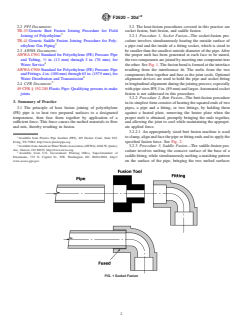
Joining of Polyethylene 3.2.1 Procedure 1, Socket Fusion—The socket-fusion pro-
TR-41 Generic Saddle Fusion Joining Procedure for Poly- cedure involves simultaneously heating the outside surface of
ethylene Gas Piping a pipe end and the inside of a fitting socket, which is sized to
2.3 AWWA Documents: be smaller than the smallest outside diameter of the pipe.After
AWWA C901 Standard for Polyethylene (PE) Pressure Pipe the proper melt has been generated at each face to be mated,
and Tubing, ⁄2 in. (13 mm) through 3 in. (76 mm), for thetwocomponentsarejoinedbyinsertingonecomponentinto
Water Service the other. See Fig. 1.The fusion bond is formed at the interface
AWWA C906 Standard for Polyethylene (PE) Pressure Pipe resulting from the interference fit. The melts from the two
andFittings,4in.(100mm)through63in.(1575mm),for components flow together and fuse as the joint cools. Optional
Water Distribution and Transmission alignment devices are used to hold the pipe and socket fitting
2.4 CFR Document: inlongitudinalalignmentduringthejoiningprocess;especially
49 CFR § 192.285 Plastic Pipe: Qualifying persons to make with pipe sizes IPS 3 in. (89 mm) and larger.Automated socket
joints fusion is not addressed in this procedure.
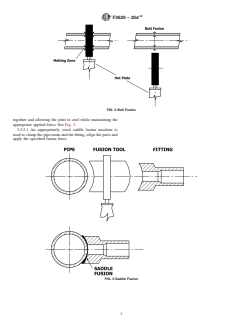
3.2.2 Procedure 2, Butt Fusion—The butt-fusion procedure
3. Summary of Practice
in its simplest form consists of heating the squared ends of two
3.1 The principle of heat fusion joining of polyethylene pipes, a pipe and a fitting, or two fittings, by holding them
(PE) pipe is to heat two prepared surfaces to a designated against a heated plate, removing the heater plate when the
temperature, then fuse them together by application of a proper melt is obtained, promptly bringing the ends together,
sufficient force. This force causes the melted materials to flow and allowing the joint to cool while maintaining the appropri-
and mix, thereby resulting in fusion. ate applied force.
3.2.2.1 An appropriately sized butt fusion machine is used
toclamp,alignandfacethepipeorfittingendsandtoapplythe
Available from Plastics Pipe Institute (PPI), 105 Decker Court, Suite 825,
specified fusion force. See Fig. 2.
Irving, TX 75062, http://www.plasticpipe.org.
Available fromAmerican Water WorksAssociation (AWWA), 6666 W. Quincy
3.2.3 Procedure 3, Saddle Fusion—The saddle-fusion pro-
Ave., Denver, CO 80235, http://www.awwa.org.
cedure involves melting the concave surface of the base of a
Available from U.S. Government Printing Office, Superintendent of
saddle fitting, while simultaneously melting a matching pattern
Documents, 732 N. Capitol St., NW, Washington, DC 20401-0001, http://
www.access.gpo.gov. on the surface of the pipe, bringing the two melted surfaces
FIG. 1 Socket Fusion
´2
F2620 − 20a
FIG. 2 Butt Fusion
together and allowing the joint to cool while maintaining the
appropriate applied force. See Fig. 3.
3.2.3.1 An appropriately sized saddle fusion machine is
used to clamp the pipe main and the fitting, align the parts and
apply the specified fusion force.
FIG. 3 Saddle Fusion
´2
F2620 − 20a
4. Significance and Use high-temperature, non-stick fabric over the heating surfaces.
The heating plate surfaces, coated or uncoated, shall be kept
4.1 TheproceduresdescribedinSections7–9areprimarily
clean and free of contaminants such as dirt, grease and plastic
intended for (but not limited to) field joining of polyethylene
build-up, which may cause excessive sticking and create
(PE) pipe and fittings, using suitable equipment and appropri-
unsatisfactory joints. Most of these contaminants are removed
ate environmental control procedures. When properly
from the hot tool surfaces using a clean, dry, lint-free,
implemented, strong pressure/leak-tight joints are produced.
non-synthetic cloth such as cotton. Do not use synthetic fabrics
When these joints are destructively tested, the failure occurs
which may char and stick to the fusion surface. Some
outside the fusion joined area.
pigments, such as carbon black, may stain a heating surface
4.2 Melt characteristics, average molecular weight and mo-
and probably cannot be removed; such stains will not contami-
lecularweightdistributionareinfluentialfactorsinestablishing
nate the joint interface.
suitable fusion parameters; therefore, consider the manufactur-
6.2.1 After a period of time in service, non-stick coatings or
er’s instructions in the use or development of a specific fusion
fabrics will deteriorate and become less effective. Deteriorated
procedure. See Annex A1.
fabrics shall be replaced, and worn, scratched, or gouged
4.3 The socket fusion, butt fusion, and saddle fusion proce-
non-stick coatings shall be re-coated when they lose effective-
dures in this practice are suitable for joining PE gas pipe and
ness. Heat fusion quality may be adversely affected by dete-
fittings, PE water pipe and fittings, and PE general purpose
riorated non-stick surfaces. Spray-on chemicals, such as non-
pipes and fittings made to PE product specifications from
stick lubricants or oils shall not be applied to heating iron
organizations such as ASTM, AWWA, API, and ISO that are
surfaces as they will contaminate the joint.
used in pressure, low pressure and non-pressure applications.
6.3 TemperatureIndicator—Heating tools shall be equipped
For gas applications, qualification of the procedure by testing
with a thermometer or other built-in temperature indicating
joints made using the procedure in accordance with regulations
device. This device indicates the internal temperature of the
from the authority having jurisdiction are required.
heating iron, which is usually higher than temperature of the
heating tool surfaces. Use a pyrometer, or other temperature
5. Operator Training or Qualification
measuring device, on the first joint of the day and periodically
5.1 Skill and knowledge on the part of the operator are
during the day to verify the temperature of the tool face
required to obtain a good quality joint. This skill and knowl-
surfaces within the pipe or fitting contact area. Select multiple
edge is obtained by making joints in accordance with proven
checkpointstoensureuniformsurfacetemperature.Aninfrared
proceduresundertheguidanceoftrainedorqualifiedoperators.
pyrometer is calibrated by comparison to a calibrated surface
5.2 Evaluate operator proficiency by testing sample joints. pyrometer and adjusted to agree on each heating tool.
NOTE 3—Asignificant temperature variation, that is, cold spots, on the
5.3 The party responsible for the joining of polyethylene
heating tool surfaces may indicate a faulty heating iron which may need
pipe and fittings shall ensure that detailed procedures devel-
to be serviced before it can be used.
oped in conjunction with applicable codes and regulations and
6.4 Cutting pipe—When cutting a PE pipe to length before
the manufacturers of the pipe, fittings, and joining equipment
fusing,thePEpipeshallbecutusingcuttingtoolswhichdonot
involved, including the safety precautions to be followed, are
introduce contamination to the pipe surfaces or the fusion
issued before actual joining operations begin.
equipment.Cuttingshallbeperformedusingtoolssuchashand
5.4 When operator qualification procedures are not defined
saws, reciprocating saws, run-around pipe cutters, guillotine
by the project specification, or regulatory or jurisdictional
cutters, pipe shears, chain saws. Liquid lubricants (for
agency, the use of operator qualification and testing procedures
example, bar or chain oil or other lubricants) transferred to the
per Practice F3190 shall be considered acceptable.
pipe ends during cutting, shall be removed in accordance with
the cleaning procedure in X1.7. In the event water or soap, or
6. Apparatus—General Recommendations
both are used in the cutting process, the pipe surfaces shall be
6.1 Heating Tool—Electric heating tools come in a variety
cleaned using isopropyl alcohol or acetone and allowed to dry
of sizes that match the fusion machines capabilities. They are
prior to facing as moisture or contaminants on the pipe surface
designed with enough wattage and electronic control to main-
could impair joint quality. Additionally, care shall be taken so
tain the specified heater face temperature required in this
that liquid lubricants do not transfer to fusion equipment and
procedure. The range of the heater control shall be larger than
contaminate subsequent joints.
the heating temperature specification (the typical control range
NOTE 4—It is acceptable to wrap a flexible cutting guide such as a tape
is 50 °F (30 °C) above and below the maximum and minimum
or a sheet of flexible material around the pipe and mark around the pipe
required heating tool surface temperatures. Electric heating
to indicate the cutting tool path for a square cut, or to use a miter box.
plates maintain consistent fusion temperatures when provided
6.4.1 After cutting, but before beginning the fusion
with an adequate power source.
procedure, remove chips and shavings from the outside and
6.2 Heating Tool Faces—Heating tools may be made from
inside surfaces.
materials such as aluminum, stainless steel, copper, or copper
alloys. Polyethylene material may stick to hot metal heating
7. Procedure 1—Socket Fusion
surfaces. This sticking may be minimized by applying a
non-stick coating to the heating surfaces or by fitting a 7.1 Apparatus:
´2
F2620 − 20a
7.1.1 Socket Fusion Tools—Socket fusion tools consist of a 7.2.2 Cut the pipe end squarely, and clean the pipe end and
heating tool, heating tool faces, rounding clamps (cold rings), fitting, both inside and outside, by wiping with a clean, dry,
depth gage/chamfer tools, and pipe/fittings made to ASTM lint-free, non-synthetic cloth such as cotton. If this does not
specifications. remove the contamination, refer to X1.7.1.
7.1.2 Heating Tool—In order to obtain a proper melt, it is 7.2.3 Chamfer the outside edge of the pipe end slightly and
necessary for a uniform temperature to be maintained across fix the rounding clamp about the pipe as determined from the
the heating tool faces. An electrical tool shall have sufficient depth gage. (See Note 6.)
wattage and control to maintain the specified surface tempera- 7.2.4 Cleantheheateradaptersbywipingthemwithaclean,
ture of the tool faces. dry, lint-free, non-synthetic cloth such as cotton to remove any
7.1.3 Heating Tool Faces—Consisting of two parts, a male contamination from the surfaces. Push the socket fitting onto
end for the interior socket surface and a female end for the the preheated fitting tool face first, and then push the pipe into
exterior pipe surface. Both parts shall be made to such the pipe-side tool face until the rounding clamps make contact
tolerances as to cause an interference fit. Heating tool faces are with the heating faces.
produced to Specification F1056 dimensions, and are coated 7.2.5 Heat the pipe end and the fitting socket for the time
with a non-stick material to keep melted pipe and fitting required in Table 1.
material from sticking to the face. 7.2.6 At the end of the heating time, simultaneously remove
7.1.4 Alignment Jig—The alignment jig is an optional tool the pipe and fitting straight out from the tool, using a snap
which consists of two sets of devices holding the components action. Immediately insert the pipe straight into the socket of
in alignment to each other. One set of holding devices is fixed, the fitting so the rounding clamp is flush against the end of the
and the other allows longitudinal movement for making the fitting socket. Hold or block the joint in place to cool for the
joint. time specified in Table 1. (For ambient temperatures 100 °F
7.1.5 Rounding Clamps, (cold ring) to maintain roundness and higher, additional cooling time may be needed.)
of the pipe and control the depth of pipe insertion into the 7.2.7 Remove the rounding clamp, and inspect the melt
socket during the joining operation. patternattheendofthesocketforacompleteimpressionofthe
7.1.6 Depth Gage, for proper positioning of the rounding rounding clamp in the melt surface. There shall be no gaps,
clamp on the pipe. voids, or un-bonded areas. Visually inspect for the pipe and
7.1.7 Chamfering Tool, to bevel the end of the pipe. fitting to be correctly aligned. (Fig. 4).
7.2.8 Allow the joint to cool an additional five (5) minutes
NOTE 5—The depth gage and chamfering tool may be combined into a
before exposing the joint to any type of stresses (that is, burial,
single tool.
testing or fusing the other end of the fitting.)
7.1.8 Tubing Cutter, to obtain a square end cut on the pipe.
7.2.9 Allow for extremes in weather when making field
7.1.9 Fitting Puller, an optional tool to assist in the removal
joints. Heating times, dimensional changes, etc., are affected
ofthefittingfromtheheatingtoolandtoholdthefittingduring
by extreme weather conditions.
assembly.
NOTE 6— Some recommend using a 50-60 grit emery or garnet cloth to
7.2 Procedure:
roughen the outside of the pipe and inside of the fitting as a means of
7.2.1 Attach the proper size heater faces to the heating tool,
minimizing any possible skin interface when making the fusion. Sandpa-
and bring the surface temperature of the tool faces to 490 to per is not recommended for this purpose, as it might disintegrate and
contaminate the joint interface. If roughening is performed, first clean the
510 °F (254 to 266 °C). Use a pyrometer, or other temperature
surfaces before roughening with a clean cloth or water. Once the pipe or
measuring device, on the first joint of the day and periodically
fitting surfaces have been roughened and clean material has been exposed,
during the day to verify the temperature of the tool face
water cannot be used to clean the pipe surfaces. Clean dust and particles
surfaces within the pipe or fitting contact area. Select multiple
from the roughened surfaces afterwards by cleaning the pipe or fitting
checkpoints to ensure uniform surface temperature. Heating ends with a clean dry lint-free, non-synthetic cloth such as cotton.
tool thermometers measure the internal temperature of the
8. Procedure 2—Butt Fusion
heating tool, which is typically higher than the surface tem-
perature of the heating tool faces. 8.1 Apparatus:
TABLE 1 Socket Fusion Time Cycles
PE 2406/ PE 2708 PE 3408/ PE 3608/ PE 4710
Pipe Size Heating Time Seconds Cooling Time Seconds Heating Time Seconds Cooling Time Seconds
⁄2 in CTS 6-7 30 6-10 30
⁄4 in CTS 6-7 30 6-10 30
1 in. CTS 9-10 30 9-16 30
1 ⁄4 in. CTS 10–12 30 10-16 30
⁄2 in . IPS 6–7 30 6-10 30
⁄4 in. IPS 8–10 30 8-14 30
1 in. IPS 10-12 30 15-17 30
1 ⁄4 in. IPS 12-14 45 18-21 60
1 ⁄2 in. IPS 14-17 45 20-23 60
2 in. IPS 16-19 45 24-28 60
3 in. IPS 20-24 60 28-32 75
4 in. IPS 24-29 60 32-37 75
´2
F2620 − 20a
sizes to fuse pipe and tubing produced to ASTM and other
industry specifications.
NOTE 7—Afacer is a rotating cutting device used to square-off the pipe
or fitting ends to obtain properly mating fusion surfaces. If so equipped,
facing should continue until a positive mechanical stop on the butt fusion
machine is reached.
8.1.3 Pipe Support Stands—Optional pipe support stands or
racksareusedtosupportthepipeatbothendsofthebuttfusion
machine to assist with pipe loading and alignment.
8.2 Setup:
8.2.1 Butt fusion machine setup parameters are prescribed
in Table 2.
8.2.2 An interfacial pressure (IFP) of 60 psi to 90 psi (0.41
MPa to 0.62 MPa) is used to determine the force required to
butt fuse the pipe components. For manually operated fusion
machines, enough force should be applied to roll the bead back
to the pipe surface.Atorque wrench may be used to apply the
proper force. Manual fusion without a torque wrench has been
FIG. 4 Socket Fusion Example
used successfully by many gas utilities. For hydraulically
operatedfusionmachines,theIFPismultipliedbythepipearea
8.1.1 Heating Tool—The heating tool shall have sufficient
(A ) to obtain the fusion force required in pounds. The fusion
P
area to adequately cover the ends of the size of pipe to be
force required is then divided by the total effective piston area
joined. This electrical tool shall have sufficient wattage and
(TEPA) of the fusion machine carriage to obtain the theoretical
controltomaintainthespecifiedsurfacetemperatureofthetool
fusion pressure (TFP) (See Eq 2). The drag pressure (P )is
D
faces.Itshallalsobeequippedwithheaterfacesthatarecoated
then added to the TFP to obtain the fusion machine gauge
with a non-stick material to prevent sticking to the pipe
pressure(P )inpsigrequiredbythemachine,see(Eq1).(TFP
G
surface.
and IFP are not the same value.) P is found by bringing the
D
8.1.2 Butt Fusion Machine—A Butt Fusion Machine has
facedpipeendswithin2in.(50mm)ofeachotherandincrease
three basic parts: (1) a stationary clamping fixture and a
the pressure on the carriage until it starts moving. Back off the
movable clamping fixture for aligning and holding each of the
pressureuntilthecarriageisbarelymovingandrecordthedrag
two parts to be fused. This may or may not include the power
pressure in psig. The equations used to calculate for the fusion
supply to operate the machine; (2) a facer for simultaneously
machine gage pressure is shown below. These equations only
preparing the ends of the parts to be joined (Note 7); and (3)
apply when using a hydraulic fusion machine.
appropriate inserts for clamping different pipe sizes or fitting
P 5TFP1P (1)
G D
shapes. Butt Fusion Machines are operated manually or hy-
TFP 5 ~A 3 IFP!⁄TEPA (2)
p
draulically. Some have their own power supply and some
require a separate generator. They are available in a variety of A 5 OD 2 t 3t 33.1416 (3)
~ !
p
TABLE 2 Butt Fusion Machine Setup Parameters
Setup Parameter
Required Condition
Manual Butt Hydraulic Butt
Fusion Machine Fusion Machine
Set heating tool temperature and heat to The surface temperature of heating tool faces must be 400 °F to 450 °F (204 °C to 232 °C) in
specified temperature accordance with 8.3.5 for joining all pipe and fittings listed in 1.2. Heating tool face temperature of
††
490 °F to 510 °F (254 °C to 265 °C ) is allowed for pipe sizes up to 8 in IPS SDR 11 as specified in
†
Annex A2 for fuel gas. (See X1.1.)
Install inserts Install inserts Install inserts for the pipe OD or the fitting being fused.
Electric power supply Electric power supply Check field generator for adequate power supply and fuel sufficient to complete the fusion joint.
Manual pressure Set facing pressure As required. Observe butt fusion machine manufacturer’s instructions for setting facing pressure.
Manual pressure Set heating pressure Observe the pipe and butt fusion machine manufacturer’s instructions for setting heating pressures.
Manual pressure Set fusion joining pressure Determine fusion joining pressure for the pipe OD and dimension ratio (DR) using 60 to 90 psi (414 to
621 kPa) interface pressure. Observe pipe and butt fusion machine manufacturer’s instructions to
determine the theoretical fusion joining pressure.
Determine drag pressure Drag pressure is the amount of pressure required to get the carriage to move. Add this pressure to the
theoretical fusion joining pressure to get the actual machine gage pressure to set.
†
Editorially revised in October 2021.
††
Editorially revised in March 2022.
´2
F2620 − 20a
where: 8.3.5 Verify that the heater surface temperatures are in the
specified temperature range 400 °F to 450 °F (204 °C to
P = Fusion Machine Gauge Pressure, psig
G
232 °C). (See Appendix X1.) A pyrometer or other surface
TFP = Theoretical Fusion Pressure, psig
IFP = Interfacial Pressure, 60 psig – 90 psig temperature measuring device shall be used before the first
TEPA = Total Effective Piston Area, in – Supplied by joint of the day and periodically throughout the day to insure
fusion machine manufacturer
proper temperature of the heating tool face.All pyrometers are
P = Fusion Machine Drag Pressure, psig
sensitive to usage techniques. Carefully follow the manufac-
D
A = Pipe Area, in
p turer’s instructions for best results.
OD = Pipe Outside Diameter, in
8.3.5.1 Clean the contact surfaces of the heating tool with a
t = Pipe Wall Thickness, in
clean, dry, lint-free, non-synthetic cloth such as cotton. Place
NOTE 8—Interfacial pressure is used to determine butt fusion joining
the heating tool in the butt fusion machine between the piping
pressure settings for hydraulic butt fusion machines when joining specific
component ends and bring the pipe or fitting ends into full
pipe diameters and DR’s. Interfacial pressure is not the gauge pressure.A
contact with the heating tool at fusion pressure. Briefly ensure
slide rule or a gauge pressure calculator obtained from the machine’s
full contact between piping component ends and the heating
manufacturer can be used as a tool for the calculation.
tool and then reduce the pressure to drag pressure but without
8.3 Procedure:
breaking contact between the piping component ends and the
8.3.1 Clean the inside and outside of the components (pipe
heating tool. (On larger pipe sizes, (14 in. and larger) hold
or pipe and fitting) to be joined with a clean, dry, lint-free,
fusion pressure until a slight melt is observed around the
non-synthetic cloth such as cotton. Remove all foreign matter
circumference of the pipe or fitting before reducing pressure.
from the piping component surfaces where they will be
This normally varies from about 10 s on 14 in. pipe to greater
clamped in the butt fusion machine. If this does not remove the
than 2 min on 36 and larger pipe sizes.)
contamination, refer to X1.7.1.
8.3.5.2 Once the indication of melt is observed around the
8.3.2 If applicable, place pipe support stands at both ends of
circumference of the pipe and pressure has been reduced from
the butt fusion machine and adjust the support stands to align fusion pressure to contact pressure a bead of molten polyeth-
the pipe with the fusion machine centerline. Install the pipes or
ylene will develop between the heater and the pipe or fitting
fittings being joined in the stationary and movable clamps of ends beginning heat soak time. For IPS 14 in pipe sizes and
thebuttfusionmachine.Leaveenoughpipeprotrudingthrough
larger,maintaintheheatsoakforaminimumof4.5minutesfor
the clamps to allow for facing and clamp the pipe or fitting in every inch (25.4 mm) of pipe wall thickness. (example:
the machine.
minimum heat soak time for a pipe with .50 in. (12.7 mm) wall
would be 2 min 15 s). Continue the heat soak time until the
8.3.2.1 Take care when placing pipe or fittings in the butt
melt bead size has developed against both heater faces in
fusion machine. Pipes shall be aligned before the alignment
accordance with Table 3.
clamp is closed. Do not force the pipe into alignment by
8.3.6 When the proper bead size is observed, quickly move
pushing it against the side of an open butt fusion machine
thepipingcomponentendsawayfromtheheatingtool,remove
clamp. Pipes that are freshly cut and molded fittings generally
the heating tool and quickly inspect the pipe ends.
do not have toe-in, and when mated to old-cut pipe or
8.3.6.1 Acceptable melt appears flat and smooth with no
fabricated fittings, removing toe-in can ease adjustment for
unmelted areas. Unacceptable melt appearance is any combi-
high-low alignment.
nation of a concave surface (see Fig. X2.4), unmelted areas, a
8.3.3 Face the piping component ends until the facer bot-
bubbly pock-marked sandpaper-like surface or melted material
toms out on the stops and is locked between the jaws to
sticking to heating tool surfaces . Low strength joints result
establish clean, parallel mating surfaces between the pipe/
from unacceptable melt appearance. Discontinue the joining
fittingends(seeNote7).Movethecarriagetoseparatethepipe
procedure, allow the component ends to cool completely and
ends from the facer, remove the facer and all shavings and
restart from 8.3.1. (See Appendix X2.)
debris from the facing operation by brushing away with a
8.3.6.2 Table 4 presents the maximum time allowed for
clean, dry, lint-free, non-synthetic cloth such as cotton. Bring
opening the carriage, removing the heater, inspecting the
the pipe/fitting ends together at facing pressure. A visual
acceptability of the melt (Note 9), and bringing together the
inspection of this operation should verify a square face,
pipe ends. Do not slam the pipe ends.
perpendicular to the pipe centerline on each pipe end and with
no detectable gap.
NOTE 9—A concave melt surface is caused by unacceptable pressure
during heating.
8.3.4 Check the pipe ends for high-low alignment and
out-of-roundness. If adjustment is needed, adjust the high side
8.3.6.3 The correct fusion pressure rolls both melt beads
down by tightening the high side clamp. Do not loosen the low
over so that they touch the piping component OD surfaces. Do
side clamp or slippage may occur during fusion. Re-face the not use excessive or insufficient force (more than or less than
pipe or fitting ends if excessive adjustment is required (more
the fusion interfacial pressure range). If the components are
than180°rotationoftheclampknob)andremoveanyshavings brought together with excessive force, molten material may be
from the re-facing operation with a clean, dry, lint-free,
pushed out of the joint and cold material brought into contact
non-synthetic cloth such as cotton. The maximum OD high- forming a “cold” joint. If too little force is used, voids and
low misalignment allowed in the butt fusion procedure is to be
weak bonded areas can develop in the joint as molten material
less than 10 % of the pipe minimum wall thickness. cools and contracts.
´2
F2620 − 20a
TABLE 3 Minimum Melt Bead Size
Pipe (OD) [Outside Diameter, in. (mm)] “A” Minimum Bead Size, in. (mm)
<2.37(60) ⁄32 (1)
$ 2.37 (60)# 3.5 (89) ⁄16 (1.5)
> 3.5 (89)# 8.62 (219) ⁄16 (5)
> 8.62 (219)# 12.75 (324) ⁄4 (6)
> 12.75 (324)# 24 (610) ⁄8 (10)
> 24 (610)# 36 (900) ⁄16 (11)
> 36 (900)# 65 (1625) ⁄16 (14)
TABLE 4 Maximum Time to Open, Remove Heater Plate, Inspect Melt, and Close
NOTE 1—Fusion joints made in an enclosed and controlled factory fabrication environment will tolerate and may use longer maximum heater removal
times.
Pipe Wall Thickness, in. (mm)
Field Applications Max. Heater Plate Removal Time, Seconds
1 1
⁄2 in, CTS to 1- ⁄2 in. IPS in manual fusion machines 4
0.17 to 0.36 (5 to 9) 8
>0.36 to 0.55 (9 to 14) 10
>0.55 to 1.18 (14 to 30) 15
>1.18 to 2.5 (30 to 64) 20
>2.5to4.5(64to114) 25
8.3.7 Hold the molten joint immobile under fusion pressure joint and surrounding material have reached ambient air
until sufficiently cooled. Cooling under pressure before re-
temperature. (See Appendix X1.)
moval from the butt fusion machine is important in achieving
NOTE10—Pouringwateronorapplyingwetclothstothejointtoreduce
joint integrity. Maintain fusion pressure against the piping
cooling time is not acceptable. The use of a controlled cooling cycle
component ends for a minimum of 11 minutes per inch (25.4
procedure to reduce cooling time, such as applying conditioned air, is
mm)ofpipewall.Forambienttemperatures100 °Fandhigher,
acceptable only where testing demonstrates that acceptable joints are
additional cooling time may be needed.Avoid high stress such
produced using the controlled cooling cycle procedure.
as pulling, installation or rough handling for an additional 30
8.3.8 Strict adherence by a trained or qualified operator to
min or more after removal from the fusion machine (only 10
the butt fusion procedures and adequate butt fusion process
minutes additional cooling time is required for IPS 1 in. and
controls are the primary means to ensure a quality fusion.
smaller pipe sizes). Do not apply internal pressure until the
´2
F2620 − 20a
Visually inspect and compare the joint against the butt fusion 9.1.2 Saddle Fusion Tool—This tool clamps to the main,
bead visual inspection acceptance guideline in Fig. 5. rounding and supporting the main for good alignment between
the pipe and fitting. It holds the fitting, in correct alignment to
NOTE 11—When butt fusing to molded fittings, the fitting-side bead
the main. It also applies and indicates the proper force during
may display shape irregularities such as minor indentations, deflections,
the fusion process.Asupport or bolster is clamped to IPS 6 in.
ripples, non-uniform bead rollover from molded part cooling and knit
lines, and other surface effects. In such cases, visual evaluation is based
(168 mm) and smaller main pipe opposite the fitting installa-
mainly on the size and shape of the pipe-side bead.
tion area to support the main and assist in rounding the pipe.
NOTE 12—For butt fusions between compatible polyethylene materials
9.1.3 Optional Flexible Heat Shield—A flexible heat resis-
having different polymer characteristics (that is, unimodal to bimodal,
tant metal or insulated fabric pad used to help establish a melt
high density to medium density, pipe to fitting, etc) the fusion bead may
be visually different on either side of the joint. These differences do not
pattern on larger mains before applying heat to the fitting.
affect the integrity of the fused joint.
9.2 Saddle Fusion Terminology:
NOTE 13—Appendix X2 provides examples of unacceptable fusion
joint appearances. 9.2.1 Initial Heat (Bead-up)—The heating step used to
develop an initial melt bead on the main pipe.
9. Procedure 3—Saddle Fusion
9.2.2 Initial Heat Force (Bead-up Force)—The force (lb)
appliedtoestablishaninitialmeltpatternonthemainpipe.The
9.1 Apparatus:
Initial Heat Force is determined by multiplying the fitting base
9.1.1 Heating Tool and Faces—This electrical tool shall
2 2
area (in. ) by the initial interfacial pressure 60 (lb/in. ).
have sufficient wattage and control to maintain the specified
surface temperature of the tool faces. The serrated or smooth 9.2.3 Heat Soak Force—The force (lb) applied after an
faces are matched sets, by pipe size, of concave and convex initial melt pattern is established on the main pipe. The Heat
blocks, which bolt or clamp onto a flat heating tool. The SoakForceistheminimumforce(essentiallyzeropounds)that
heating faces are coated with a non-stick material to prevent ensures that the fitting, heater and main stay in contact with
sticking to the pipe or fitting surfaces. each other.
FIG. 5 Outside Diameter Butt Fusion Bead Guideline
´2
F2620 − 20a
9.2.4 Fusion Force—The force (lb) applied to establish the 9.4 Procedure:
fusion bond between the fitting and the pipe. The fusion Force 9.4.1 Preparation:
is determined by multiplying the fitting projected base area
9.4.1.1 Cleantheinsideandoutsideofthecomponents(pipe
2 2
(in. ) by the fusion interfacial pressure 30 (lb/in. ).
or pipe and fitting) to be joined with a clean, dry, lint-free,
9.2.5 Total Heat Time—Atime that starts when the heater is
non-synthetic cloth such as cotton. Remove all foreign matter
placed on the main pipe and initial heat force is applied and
from the piping component surfaces where they will be
ends when the heater is removed.
clamped in the fusion machine. If this does not remove the
9.2.6 Cool Time—The time required to cool the joint to
contamination, refer to X1.7.1. Install the Saddle Fusion Tool
approximately 120 °F (49 °C). The fusion force must be
on the main according to the manufacturer’s instructions. The
maintained for 5 min on IPS 1 ⁄4 in. (42 mm) or 10 min for all
tool should be centered over a clean, dry location where the
other main sizes, after which the saddle fusion equipment can
fittingwillbefused.Securethetooltothemain.Amainbolster
be removed. The joint must be allowed to cool undisturbed for
or support is recommended under the pipe on IPS 6 in. (168
an additional 30 min before tapping the main or joining to the
mm) and smaller main pipe sizes.
branch saddle.
9.4.1.2 Abrade or scrape the surface of the main, where the
9.2.7 Interfacial Area for Rectangular Base Fittings—The
fitting will be joined, approximately 0.007 in. (.178mm) deep
major width times the major length of the saddle base, without
to remove any oxidation or contamination. This can be done
takingintoaccountthecurvatureofthebaseorsides,minusthe
before or after the Tool is attached to the main. The abraded/
area of the hole in the center of the base.
scraped area must be larger than the area covered by the fitting
9.2.8 Interfacial Area for Round Base Fittings—The radius
base. It is important that the pipe surface be free from any type
of the saddle base squared times π (3.1416) without taking into
of contaminates that may be spread before the scraping or
accountthecurvatureofthebaseorsides,minustheareaofthe
abrading process begins. Marks can be made on the outer
hole in the center of the base.
surface of the pipe to aid in visual indication of abrading/
9.2.9 Fitting Label—The initial heat force, heat soak force
scraping coverage, however the marks should be made with a
and the fusion force will be listed on a fitting label in the lower
non-petroleum based fast drying marker. After abrading/
right hand corner of the fitting for some manufacturer’s saddle
scraping, clean the pipe or fitting ends with a clean, dry,
fusion fittings. This will eliminate the need to calculate the
lint-free, non-synthetic cloth such as cotton. All markings on
fusion forces in the field (for example, 180/0/90). If the label is
the pipe surface should be removed before beginning the heat
not present, the heat and fusion forces need to be calculated.
cycle.
9.4.1.3 Abrade the fusion surface of the fitting with 50 to 60
9.3 Setup:
grit utility cloth; remove all dust and residue with a clean, dry,
9.3.1 Select and install the proper heating tool faces to the
lint-free, non-synthetic cloth such as cotton. Insert the fitting in
heating tool based on the main size and fitting base size.
the Saddle Fusion Tool loosely. Using the Saddle Fusion Tool,
Consult the pipe, fitting or equipment manufacturer’s recom-
movethefittingbaseagainstthemainpipeandapplyabout100
mendations.
lbf to seat the fitting. Secure the fitting in the Saddle Fusion
9.3.2 Plug in the heating tool and bring the heating tool face
Tool.
surfaces to 490 °F to 510 °F (254 °C to 266 °C) (see Table 5).
9.4.2 HeatingProcedureforSmallFittings(<2in.IPS)(see
A pyrometer or other surface temperature measuring device is
used to determine and periodically check the heating tool Table 5):
surface temperature. Heating tool thermometers measure the 9.4.2.1 Clean the heating tool faces with a clean, dry,
internal temperature of the heating tool which is typically lint-free, non-synthetic cloth such as cotton. Place the heating
higher than the surface temperature of the heating tool faces. tool on the main centered beneath the fitting base. Immediately
9.3.3 Install the proper clamps in the Saddle FusionTool for move the fitting against the heater faces, apply the Initial Heat
themainsizetobefused.Installtheproperfittingclampforthe Force (see fitting label), and start the heat time. Apply the
fitting to be joined. Consult the pipe, fitting or equipment Initial Heat Force until melt is first observed on the crown of
manufacturer’s recommendations. the pipe main (Initial Heat is the term used to describe the
TABLE 5 Generic Saddle Fusion Parameters
Heater Adapter Surface Temperature 500 °F ± 10 °F (260 °C ± 6 °C)
Initial Interfacial Pressure 60 psi ± 6 psi (4.14 bar ± 0.41 bar)
Heat Soak Interfacial Pressure 0 psi
Fusion Interfacial Pressure 30 psi ± 3 psi (2.07 bar ± 0.20 bar)
Total Heating Time on Main—1 ⁄4 in. IPS Pressure Main 15 s max
Total Heating Time on Main—2 in. IPS Pressure Main 25 to 35 s max
1 1
Total Heating Time on non-pressure 1 ⁄4 in. IPS, 2 in. IPS mains, and on Look for a ⁄16 in. (1.6 mm) bead around the fitting base
pressure or non-pressure 3 in. IPS and larger mains.
´2
F2620 − 20a
initial heating (bead-up) step to develop a melt bead on the 9.4.4 Fusion and Cooling (see Table 5):
main pipe and usually is 3 to 5 s) and then reduce the force to 9.4.4.1 Whether or not the melt patterns are satisfactory,
the Heat Soak Force (Bead-up force) (see fitting label). press the fitting onto the main pipe very quickly (within 3 s)
Maintain the Heat Soak Force until the Total Heat Time is after removing the heater and apply the Fusion Force (see the
complete. Total Heat Time ends: fitting label). Maintain the Fusion Force on the assembly for 5
(1) When the Total Heating Time expires for a pressurized min on IPS 1 ⁄4 in. (42 mm) and for 10 min on all larger sizes,
IPS 1 ⁄4 in. (42 mm) or IPS 2 in. (63 mm) main, or after which the saddle fusion equipment may be removed.
(2) When a melt bead of about ⁄16 in. (2 mm) is visible all (Fusion Force adjustment may be required during Cool Time,
around the fitting base for a IPS 1 ⁄4 in. (42 mm) or IPS 2 in. but never reduce the Fusion Force during cooling.)
(63 mm) non-pressurized main, or a larger pressurized or 9.4.4.2 Cool the assembly for an additional 30 min before
non-pressurized main, (see Table 5). roughhandling,branchjoiningortappingthemain.(Ifthemelt
9.4.2.2 At the end of theTotal HeatTime, remove the fitting patterns were not satisfactory or if the fusion bead is
unacceptable, cut off the saddle fitting above the base to
from the heater and the heater from the main with a quick
snapping action. Quickly check for a complete and even melt prevent use, relocate to a new section of main, and make a new
saddle fusion using a new fitting.)
pattern on the pipe main and fitting heated surfaces (no
unheated areas).
NOTE 15—These procedures are based on tests conducted under
9.4.3 HeatingProcedureforLargeFittings(>IPS3in.)and
controlledambienttemperatureconditions.Environmentalconditionsona
job site could affect heating and cooling times. Regardless of job site
Large Mains (>IPS 6 in.) (see Table 5):
conditions or ambient temperature, the prescribed heating tool tempera-
9.4.3.1 Place the heating tool on the main centered beneath
ture is required. Do not increase or decrease the heating tool temperature.
the fitting base, and then place the Flexible Heat Shield
When saddle fittings are fused to pipes that are under pressure, it is
between the heating tool and the fitting base. (This step usually
important that the surface melt be obtained quickly without too much heat
requires an assistant to handle the Flexible Heat Shield). penetration without exceeding the time guidelines in Table 5. Excessive
heat penetration could result in pipe rupture from internal pressure.
9.4.3.2 Move the fitting against the Flexible Heat Shield,
9.5 Visual Inspection:
apply Initial Heat Force, and observe melt bead formation on
the main all around the heating tool faces.When a melt bead is 9.5.1 Visually inspect and compare the joint against the
visual inspection guidelines.
first visible on the main all around the heating tool faces, in a
9.5.2 Visual Inspection Guidelines—There shall be three
quick continuous motion, release the Initial Heat Force, raise
beads, a melt bead around the fitting base, a bead on the main
the fitting slightly, remove the Flexible Heat Shield, move the
from the edge of t
...