

ASTM C1883-19
(Practice)Standard Practice for Sampling of Gaseous Enriched Uranium Hexafluoride
General Information
- Abstract
SIGNIFICANCE AND USE
5.1 The standard method for taking representative UF6 sample from a cylinder is collecting from UF6 liquid phase. Homogeneity of material is obtained by the basic indicator, that is, content of uranium isotope. Representativeness of a sample by other indicators such as content of highly volatile admixtures (boron fluoride, silicon fluoride, organic impurities), admixtures generating non-volatile fluorides may not be satisfactory owing to differences between physical properties of admixture and UF6. Nevertheless, such sampling is widely applied during the product quality control due to the fact that liquid phase process is applied when filling transport containers both for feedstock UF6 and enriched one. Refer to Practice C1052 for UF6 liquid phase sampling practice.
5.2 Uranium hexafluoride is normally produced and handled in large (typically 1 to 14-ton) quantities and must, therefore, be characterized by reference to representative samples (see ISO 7195:2005). The samples are used to determine compliance with the applicable commercial Specification C996. The quantities involved, physical properties, chemical reactivity, and hazardous nature of UF6 are such that for representative sampling, specially designed equipment must be used and operated in accordance with the most carefully controlled and stringent procedures. This practice can be used by UF6 enrichers to review the effectiveness of existing procedures or as a guide to the design of equipment and procedures for future use.
5.3 It is emphasized that this practice is not meant to address conventional or nuclear criticality safety issues.
SCOPE
1.1 This practice covers the methods for withdrawing samples of enriched uranium hexafluoride (UF6) during and after a transfer occurring in the gas phase in order to determine compliance with Specification C996. It is applicable to the filling of a transport UF6 container (30B cylinder or 1 m3 vertical container) at a centrifuge enrichment facility that has been fed with UF6 that complies with Specification C787.
1.2 Since UF6 sampling is taken during the filling process, this practice does not address any special additional arrangements that may be agreed upon between the buyer and the seller when the sampled bulk material is being added to residues already present in a container (“heels recycle”). Such arrangements will be based on QA procedures such as traceability of cylinder origin (to prevent, for example, contamination with irradiated material).
1.3 This practice is only applicable when the transfer occurs in the gas phase. When the transfer is performed in the liquid phase, Practice C1052 should apply.
1.4 The scope of this practice does not include provisions for preventing criticality incidents.
1.5 The values stated in SI units are to be regarded as the standard. The values given in parentheses are for information only.
1.6 This standard does not purport to address all of the safety concerns, if any, associated with its use. It is the responsibility of the user of this standard to establish appropriate safety, health, and environmental practices and determine the applicability of regulatory limitations prior to use.
1.7 This international standard was developed in accordance with internationally recognized principles on standardization established in the Decision on Principles for the Development of International Standards, Guides and Recommendations issued by the World Trade Organization Technical Barriers to Trade (TBT) Committee.
- Status
- Published
- Publication Date
- 14-Jun-2019
- Technical Committee
- C26 - Nuclear Fuel Cycle
- Drafting Committee
- C26.02 - Fuel and Fertile Material Specifications
Overview
ASTM C1883-19 is a standard practice published by ASTM International for the sampling of gaseous enriched uranium hexafluoride (UF6) during and after gas-phase transfers. The standard outlines sampling procedures to ensure representative samples are obtained for quality control and compliance testing in uranium enrichment operations. This practice is essential for meeting commercial specifications, such as ASTM C996, and for supporting safe handling, transport, and regulatory compliance of UF6, a critical material in the nuclear fuel cycle.
Key Topics
- Scope of Application: Covers procedures for extracting samples from gas-phase UF6, specifically during transfer and container-filling operations at centrifuge enrichment facilities. The standard applies to commonly used containers, including 30B cylinders and 1 m³ vertical containers.
- Sampling Methods: Describes the process of withdrawing samples, including:
- Continuous on-line mass spectrometric analysis for isotope composition.
- Sequential withdrawals for batch qualification and composite sample preparation.
- Gas-phase container sampling after filling for volatile impurities analysis.
- Material Homogeneity: Emphasizes isotope composition as a key indicator of UF6 homogeneity while acknowledging limitations for volatile and non-volatile admixtures due to differing physical properties.
- Quality Control and Compliance: Ensures alignment with commercial uranium hexafluoride specifications, particularly ASTM C996. The standard integrates methods for indirect determination of impurities, such as boron, silicon, and hydrocarbons using IR spectrometry.
- Safety Considerations: Highlights the hazardous nature of UF6 and associated compounds, underscoring the need for specialized equipment, careful operational controls, and the establishment of safety, health, and environmental practices. Criticality safety is outside the scope of this practice.
Applications
ASTM C1883-19 is crucial for a variety of practical applications within the nuclear fuel cycle:
- Uranium Enrichment Plants: Used by enrichment facilities during the transfer and filling of UF6 to verify that products meet customer and regulatory requirements.
- Quality Assurance Programs: Helps ensure traceability, prevent contamination (especially during “heels recycle” operations), and supports reliable certification of UF6 batches prior to shipping.
- Transport and Storage: Facilitates the safe and compliant transport of enriched UF6 by confirming that each filled container matches key specifications for isotopic content and impurity levels.
- Analytical Laboratories: Supports laboratories analyzing UF6 samples, guiding the collection and handling of representative specimens for isotope and impurity analysis.
- Regulatory Compliance: Serves as a reference for organizations required to adhere to international and national regulations governing the handling and quality of uranium hexafluoride.
Related Standards
Organizations working with ASTM C1883-19 frequently reference related standards to ensure comprehensive quality and safety coverage:
- ASTM C996: Specification for Uranium Hexafluoride Enriched to Less Than 5% U-235
- ASTM C787: Specification for Uranium Hexafluoride for Enrichment
- ASTM C1052: Practice for Bulk Sampling of Liquid Uranium Hexafluoride (applicable to liquid-phase transfers)
- ASTM C761: Test Methods for Chemical, Mass Spectrometric, Spectrochemical, Nuclear, and Radiochemical Analysis of Uranium Hexafluoride
- ASTM C1441, C1842: Test Methods for Analyzing Impurities in UF6
- ASTM C859: Terminology Relating to Nuclear Materials
- ISO 7195:2005: Nuclear energy - Packaging of uranium hexafluoride (UF6) for transport
Practical Value
By following ASTM C1883-19, nuclear facilities, laboratories, and regulatory bodies can:
- Obtain reliable, representative UF6 samples for analysis
- Ensure readiness for safe transport and storage of enriched uranium products
- Maintain consistent product quality aligned with international standards
- Address key operational needs in uranium processing and enrichment, thereby supporting global nuclear energy supply chains
Keywords: uranium hexafluoride sampling, UF6, ASTM C1883-19, nuclear material, uranium enrichment, quality control, gas phase sampling, nuclear standards, isotope analysis, uranium impurities, transport containers, regulatory compliance
Relations
- Effective Date
- 01-Jan-2024
- Effective Date
- 01-Jul-2020
- Effective Date
- 01-Mar-2020
- Effective Date
- 01-Feb-2018
- Effective Date
- 01-Jul-2015
- Effective Date
- 01-Jul-2015
- Effective Date
- 15-Jun-2014
- Effective Date
- 15-Jan-2014
- Effective Date
- 01-Jun-2013
- Effective Date
- 01-May-2013
- Effective Date
- 01-Jun-2011
- Effective Date
- 15-May-2011
- Effective Date
- 01-Nov-2010
- Effective Date
- 01-Oct-2010
- Effective Date
- 01-Aug-2010
Get Certified
Connect with accredited certification bodies for this standard

DNV
DNV is an independent assurance and risk management provider.

Lloyd's Register
Lloyd's Register is a global professional services organisation specialising in engineering and technology.
DNV Energy Systems
Energy and renewable energy certification.
Sponsored listings
Frequently Asked Questions
ASTM C1883-19 is a standard published by ASTM International. Its full title is "Standard Practice for Sampling of Gaseous Enriched Uranium Hexafluoride". This standard covers: SIGNIFICANCE AND USE 5.1 The standard method for taking representative UF6 sample from a cylinder is collecting from UF6 liquid phase. Homogeneity of material is obtained by the basic indicator, that is, content of uranium isotope. Representativeness of a sample by other indicators such as content of highly volatile admixtures (boron fluoride, silicon fluoride, organic impurities), admixtures generating non-volatile fluorides may not be satisfactory owing to differences between physical properties of admixture and UF6. Nevertheless, such sampling is widely applied during the product quality control due to the fact that liquid phase process is applied when filling transport containers both for feedstock UF6 and enriched one. Refer to Practice C1052 for UF6 liquid phase sampling practice. 5.2 Uranium hexafluoride is normally produced and handled in large (typically 1 to 14-ton) quantities and must, therefore, be characterized by reference to representative samples (see ISO 7195:2005). The samples are used to determine compliance with the applicable commercial Specification C996. The quantities involved, physical properties, chemical reactivity, and hazardous nature of UF6 are such that for representative sampling, specially designed equipment must be used and operated in accordance with the most carefully controlled and stringent procedures. This practice can be used by UF6 enrichers to review the effectiveness of existing procedures or as a guide to the design of equipment and procedures for future use. 5.3 It is emphasized that this practice is not meant to address conventional or nuclear criticality safety issues. SCOPE 1.1 This practice covers the methods for withdrawing samples of enriched uranium hexafluoride (UF6) during and after a transfer occurring in the gas phase in order to determine compliance with Specification C996. It is applicable to the filling of a transport UF6 container (30B cylinder or 1 m3 vertical container) at a centrifuge enrichment facility that has been fed with UF6 that complies with Specification C787. 1.2 Since UF6 sampling is taken during the filling process, this practice does not address any special additional arrangements that may be agreed upon between the buyer and the seller when the sampled bulk material is being added to residues already present in a container (“heels recycle”). Such arrangements will be based on QA procedures such as traceability of cylinder origin (to prevent, for example, contamination with irradiated material). 1.3 This practice is only applicable when the transfer occurs in the gas phase. When the transfer is performed in the liquid phase, Practice C1052 should apply. 1.4 The scope of this practice does not include provisions for preventing criticality incidents. 1.5 The values stated in SI units are to be regarded as the standard. The values given in parentheses are for information only. 1.6 This standard does not purport to address all of the safety concerns, if any, associated with its use. It is the responsibility of the user of this standard to establish appropriate safety, health, and environmental practices and determine the applicability of regulatory limitations prior to use. 1.7 This international standard was developed in accordance with internationally recognized principles on standardization established in the Decision on Principles for the Development of International Standards, Guides and Recommendations issued by the World Trade Organization Technical Barriers to Trade (TBT) Committee.
SIGNIFICANCE AND USE 5.1 The standard method for taking representative UF6 sample from a cylinder is collecting from UF6 liquid phase. Homogeneity of material is obtained by the basic indicator, that is, content of uranium isotope. Representativeness of a sample by other indicators such as content of highly volatile admixtures (boron fluoride, silicon fluoride, organic impurities), admixtures generating non-volatile fluorides may not be satisfactory owing to differences between physical properties of admixture and UF6. Nevertheless, such sampling is widely applied during the product quality control due to the fact that liquid phase process is applied when filling transport containers both for feedstock UF6 and enriched one. Refer to Practice C1052 for UF6 liquid phase sampling practice. 5.2 Uranium hexafluoride is normally produced and handled in large (typically 1 to 14-ton) quantities and must, therefore, be characterized by reference to representative samples (see ISO 7195:2005). The samples are used to determine compliance with the applicable commercial Specification C996. The quantities involved, physical properties, chemical reactivity, and hazardous nature of UF6 are such that for representative sampling, specially designed equipment must be used and operated in accordance with the most carefully controlled and stringent procedures. This practice can be used by UF6 enrichers to review the effectiveness of existing procedures or as a guide to the design of equipment and procedures for future use. 5.3 It is emphasized that this practice is not meant to address conventional or nuclear criticality safety issues. SCOPE 1.1 This practice covers the methods for withdrawing samples of enriched uranium hexafluoride (UF6) during and after a transfer occurring in the gas phase in order to determine compliance with Specification C996. It is applicable to the filling of a transport UF6 container (30B cylinder or 1 m3 vertical container) at a centrifuge enrichment facility that has been fed with UF6 that complies with Specification C787. 1.2 Since UF6 sampling is taken during the filling process, this practice does not address any special additional arrangements that may be agreed upon between the buyer and the seller when the sampled bulk material is being added to residues already present in a container (“heels recycle”). Such arrangements will be based on QA procedures such as traceability of cylinder origin (to prevent, for example, contamination with irradiated material). 1.3 This practice is only applicable when the transfer occurs in the gas phase. When the transfer is performed in the liquid phase, Practice C1052 should apply. 1.4 The scope of this practice does not include provisions for preventing criticality incidents. 1.5 The values stated in SI units are to be regarded as the standard. The values given in parentheses are for information only. 1.6 This standard does not purport to address all of the safety concerns, if any, associated with its use. It is the responsibility of the user of this standard to establish appropriate safety, health, and environmental practices and determine the applicability of regulatory limitations prior to use. 1.7 This international standard was developed in accordance with internationally recognized principles on standardization established in the Decision on Principles for the Development of International Standards, Guides and Recommendations issued by the World Trade Organization Technical Barriers to Trade (TBT) Committee.
ASTM C1883-19 is classified under the following ICS (International Classification for Standards) categories: 27.120.30 - Fissile materials and nuclear fuel technology. The ICS classification helps identify the subject area and facilitates finding related standards.
ASTM C1883-19 has the following relationships with other standards: It is inter standard links to ASTM C859-24, ASTM C1052-20, ASTM C787-20, ASTM C761-18, ASTM C996-15, ASTM C787-15, ASTM C859-14a, ASTM C859-14, ASTM C859-13a, ASTM C859-13, ASTM C787-11, ASTM C761-11, ASTM C859-10b, ASTM C996-10, ASTM C859-10a. Understanding these relationships helps ensure you are using the most current and applicable version of the standard.
ASTM C1883-19 is available in PDF format for immediate download after purchase. The document can be added to your cart and obtained through the secure checkout process. Digital delivery ensures instant access to the complete standard document.
Standards Content (Sample)
This international standard was developed in accordance with internationally recognized principles on standardization established in the Decision on Principles for the
Development of International Standards, Guides and Recommendations issued by the World Trade Organization Technical Barriers to Trade (TBT) Committee.
Designation:C1883 −19
Standard Practice for
Sampling of Gaseous Enriched Uranium Hexafluoride
This standard is issued under the fixed designation C1883; the number immediately following the designation indicates the year of
original adoption or, in the case of revision, the year of last revision. A number in parentheses indicates the year of last reapproval. A
superscript epsilon (´) indicates an editorial change since the last revision or reapproval.
1. Scope 2. Referenced Documents
2.1 ASTM Standards:
1.1 This practice covers the methods for withdrawing
C761 Test Methods for Chemical, Mass Spectrometric,
samples of enriched uranium hexafluoride (UF ) during and
Spectrochemical, Nuclear, and RadiochemicalAnalysis of
after a transfer occurring in the gas phase in order to determine
Uranium Hexafluoride
compliance with Specification C996. It is applicable to the
C787 Specification for Uranium Hexafluoride for Enrich-
filling of a transport UF container (30B cylinder or 1 m
ment
vertical container) at a centrifuge enrichment facility that has
C859 Terminology Relating to Nuclear Materials
been fed with UF that complies with Specification C787.
C996 Specification for Uranium Hexafluoride Enriched to
1.2 Since UF sampling is taken during the filling process,
Less Than 5 % U
this practice does not address any special additional arrange-
C1052 Practice for Bulk Sampling of Liquid Uranium
ments that may be agreed upon between the buyer and the
Hexafluoride
seller when the sampled bulk material is being added to
C1441 Test Method for The Analysis of Refrigerant 114,
residues already present in a container (“heels recycle”). Such
Plus Other Carbon-Containing and Fluorine-Containing
arrangements will be based on QA procedures such as trace-
Compounds in Uranium Hexafluoride via Fourier-
ability of cylinder origin (to prevent, for example, contamina-
Transform Infrared (FTIR) Spectroscopy
tion with irradiated material).
C1842 TestMethodforTheAnalysisofBoronandSiliconin
1.3 This practice is only applicable when the transfer occurs Uranium Hexfluoride via Fourier-Transform Infrared
in the gas phase. When the transfer is performed in the liquid (FTIR) Spectroscopy
phase, Practice C1052 should apply. C1838 Practice for Cleaning for 1S and 2S Bottles
2.2 ISO Standards:
1.4 The scope of this practice does not include provisions
ISO 7195:2005 Nuclear energy—Packaging of uranium
for preventing criticality incidents.
hexafluoride (UF ) for transport
1.5 The values stated in SI units are to be regarded as the
standard. The values given in parentheses are for information
3. Terminology
only.
3.1 Terms shall be defined in accordance with Terminology
1.6 This standard does not purport to address all of the
C859, except for the following:
safety concerns, if any, associated with its use. It is the
3.2 Definitions of Terms Specific to This Standard:
responsibility of the user of this standard to establish appro-
3.2.1 container, n—a vessel either holding or receiving by
priate safety, health, and environmental practices and deter-
transfer, the UF to be sampled; it may consist of, for example,
mine the applicability of regulatory limitations prior to use.
a fixed vessel in a UF handling plant or a cylinder to be used
1.7 This international standard was developed in accor-
for the transport of UF .
dance with internationally recognized principles on standard-
3.2.2 sample vessel, n—the small vessel into which the
ization established in the Decision on Principles for the
sample of UF is withdrawn for analysis in the laboratory for
Development of International Standards, Guides and Recom-
characterization. It can be a 1S or 2S bottle or a PCTFE
mendations issued by the World Trade Organization Technical
Barriers to Trade (TBT) Committee.
For referenced ASTM standards, visit the ASTM website, www.astm.org, or
contact ASTM Customer Service at service@astm.org. For Annual Book of ASTM
This practice is under the jurisdiction of ASTM Committee C26 on Nuclear Standards volume information, refer to the standard’s Document Summary page on
Fuel Cycle and is the direct responsibility of Subcommittee C26.02 on Fuel and the ASTM website.
Fertile Material Specifications. Available from International Organization for Standardization (ISO), ISO
Current edition approved June 15, 2019. Published July 2019. DOI: 10.1520/ Central Secretariat, BIBC II, Chemin de Blandonnet 8, CP 401, 1214 Vernier,
C1883-19. Geneva, Switzerland, http://www.iso.org.
Copyright © ASTM International, 100 Barr Harbor Drive, PO Box C700, West Conshohocken, PA 19428-2959. United States
C1883−19
(polychlorotrifluoroethylene)/PTFE (polytetrafluoroethylene) 4.6 Compliance of UF quality with Specification C996 by
pot or tube or any other type of cylinder compatible with UF . content of boron, silicon, and hydrocarbon, chlorocarbons, and
partially substituted halohydrocarbons is confirmed according
4. Summary of Practice
to the results of IR-spectrometry analysis of samples collected
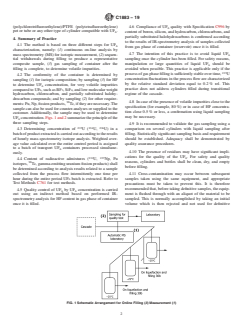
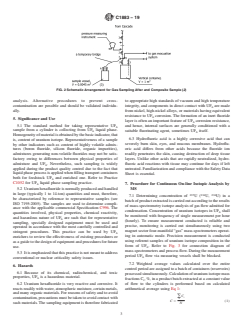
4.1 The method is based on three different steps for UF
from gas phase of container (reservoir) once it is filled.
characterization, namely: (1) continuous on-line analysis by
mass spectrometry (MS) for isotopic measurement, (2) sequen- 4.7 The intention of this practice is to avoid liquid UF
tial withdrawals during filling to produce a representative sampling once the cylinder has been filled. For safety reasons,
composite sample, (3) gas sampling of container after the
manipulation or large quantities of liquid UF should be
filling is complete, to determine volatile impurities.
avoided when possible. This practice is applicable only if the
processofgasphasefillingissufficientlystableovertime, U
4.2 The conformity of the container is determined by
concentration fluctuations in the process flow are characterized
sampling (1) for isotopic composition; by sampling (3) for HF
by the relative standard deviation equal to 0.2 % rel. This
to determine UF concentration, for very volatile impurities
comparedtoUF ,suchasBF ,SiF ,andlowmolecularweight practice does not address cylinders filled during transitional
6 3 4
hydrocarbon, chlorocarbon, and partially substituted halohy- regime of the cascade.
drocarbon compounds; and by sampling (2) for other require-
4.8 In case of the presence of volatile impurities close to the
ments:Pu,Np,fissionproducts, Tc,iftheyarenecessary.The
specification (for example, 80 %) or in case of HF concentra-
sample can also be used for counter-analyses or supplied to the
tion close 0.5 % or less, a confirmation using liquid sampling
customer. Additionally, the sample may be used to determine
may be necessary.
UF concentration.Figs.1and2summarizetheprincipleofthe
three sampling steps.
4.9 It is recommended to validate the gas sampling using a
235 234 236
4.3 Determining concentration of U( U, U) in a comparison on several cylinders with liquid sampling after
batchofproductextractediscarriedoutaccordingtotheresults
filling. Statistically significant sampling basis and requirement
of hourly mass-spectrometry isotope analysis. Weighted aver-
should be established. Adequacy shall be demonstrated by
age value calculated over the entire control period is assigned
quality assurance procedures.
to a batch of transport UF containers processed simultane-
4.10 The presence of residues may have significant impli-
ously.
cations for the quality of the UF . For safety and quality
232 237 6
4.4 Content of radioactive admixtures ( U, Np, Pu
reasons, cylinders and bottles shall be clean, dry, and empty
isotopes, Tc, gamma-emitting uranium fission products) shall
before filling.
be determined according to analysis results related to a sample
collected from the process flow intermittently one time per 4.11 Cross-contamination may occur between subsequent
hour during the entire period UF batch is extracted. Refer to
samples taken using the same equipment, and appropriate
Test Methods C761 for test methods.
precautions must be taken to prevent this. It is therefore
recommended that, before taking definitive samples, the equip-
4.5 Quality control of UF by UF concentration is carried
6 6
ment is flushed through with an aliquot of the material to be
out using an indirect method based on performed IR-
sampled. This is normally accomplished by taking an initial
spectrometry analysis for HF content in gas phase of container
once it is filled. volume which is then rejected and not used for definitive
FIG. 1Schematic Arrangement for Online Filling (3) Measurement (1)
C1883−19
FIG. 2Schematic Arrangement for Gas Sampling After and Composite Sample (2)
analysis. Alternative procedures to prevent cross- to appropriate high standards of vacuum and high temperature
contamination are possible and should be validated individu-
integrity, and components in direct contact with UF are made
ally.
from nickel, high-nickel alloys, or materials having equivalent
resistance to UF corrosion. The formation of an inert fluoride
5. Significance and Use
layer is often an important feature of UF corrosion resistance,
5.1 The standard method for taking representative UF
6 and hence, internal surfaces are generally conditioned with a
sample from a cylinder is collecting from UF liquid phase.
6 suitable fluorinating agent, sometimes UF itself.
Homogeneityofmaterialisobtainedbythebasicindicator,that
6.3 Hydrofluoric acid is a highly corrosive acid that can
is, content of uranium isotope. Representativeness of a sample
severely burn skin, eyes, and mucous membranes. Hydroflu-
by other indicators such as content of highly volatile admix-
oric acid differs from other acids because the fluoride ion
tures (boron fluoride, silicon fluoride, organic impurities),
readily penetrates the skin, causing destruction of deep tissue
admixtures generating non-volatile fluorides may not be satis-
factory owing to differences between physical properties of layers. Unlike other acids that are rapidly neutralized, hydro-
admixture and UF . Nevertheless, such sampling is widely fluoric acid reactions with tissue may continue for days if left
applied during the product quality control due to the fact that
untreated.FamiliarizationandcompliancewiththeSafetyData
liquidphaseprocessisappliedwhenfillingtransportcontainers
Sheet is essential.
both for feedstock UF and enriched one. Refer to Practice
C1052 for UF liquid phase sampling practice.
7. Procedure for Continuous On-line Isotopic Analysis by
5.2 Uraniumhexafluorideisnormallyproducedandhandled MS
in large (typically 1 to 14-ton) quantities and must, therefore,
235 234 236
7.1 Determining concentration of U( U, U) in a
be characterized by reference to representative samples (see
batchofproductextractediscarriedoutaccordingtotheresults
ISO 7195:2005). The samples are used to determine compli-
of mass-spectrometry isotope analysis of gas flow admitted for
ance with the applicable commercial Specification C996. The
condensation. Concentration of uranium isotopes in UF shall
quantities involved, physical properties, chemical reactivity,
be monitored with frequency of single measurement per hour
and hazardous nature of UF are such that for representative
(hourly). To ensure measurement conducted is reliable and
sampling, specially designed equipment must be used and
precise, monitoring is carried out simultaneously using two
operated in accordance with the most carefully controlled and
magnet sector four-manifold “gas” mass-spectrometers operat-
stringent procedures. This practice can be used by UF
ing in automatic mode. Precision measurement is conducted
enrichers to review the effectiveness of existing procedures or
using referent samples of uranium isotope composition in the
as a guide to the design of equipment and procedures for future
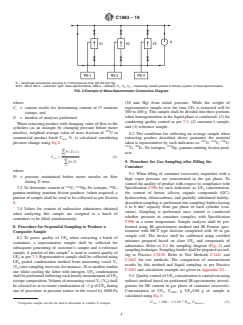
form of UF . Refer to Fig. 3 for connection diagram of
use.
mass-spectrometers and process flow. During the measurement
5.3 Itisemphasizedthatthispracticeisnotmeanttoaddress
period UF flow via measuring vessels shall be blocked.
conventional or nuclear criticality safety issues.
7.2 Weighted average values calculated over the entire
6. Hazards
control period are assigned to a batch of containers (reservoirs)
6.1 Because of its chemical, radiochemical, and toxic
processedsimultaneously.Calculationofuraniumisotopemass
properties, UF is a hazardous material.
fractions C, %, in a product batch extracted at a constant value
i
6.2 Uranium hexafluoride is very reactive and corrosive. It of flow to the cylinders is performed based on calculated
reactsreadilywithwater,atmosphericmoisture,certainmetals, arithmetical average using Eq 1:
and many organic materials. For reasons of safety and to avoid
C
i
(
contamination,precautionsmustbetakentoavoidcontactwith
n
C 5 (1)
such materials.The sampling equipment is therefore fabricated N
C1883−19
K – centrifugal compressor ensuring 5–7 kPa pressure drop (40–50 mm Hg).
MS-1, MS-2, MS-3 – automatic “gas” mass-spectrometers, (MS-3 – fallback). V ,V ,V – measuring vessels placed in delivery system of mass-spectrometers.
1 2 3
FIG. 3Example of Mass-Spectrometer Connection Diagram
where: (30 mm Hg) from initial pressure. While the weight of
th
representative sample over the time UF is extracted will be
C = current results for determining content of i uranium 6
i
300 to 400 g. This sample shall be divided into three portions
isotope, and
when homogenization in the liquid phase is conducted: (1) for
N = number of analyses performed.
conducting quality control as per 7.3;(2) customer’s sample;
When extracting product with changing value of flow to the
and (3) reference sample.
cylinders (as an example by changing pressure before meter
nozzles), weighted average value of mass fraction of Uin
8.2 The conditions for collecting an average sample when
commercial product batch C , %, is calculated considering
extracting product described above guarantee the material
wa
235 234 236
pressure change using Eq 2:
taken is representative by such indicators as: U, U, U,
232 99 237
n U, Tc, Pu isotopes, Np, gamma-emitting fission prod-
Pi·Ti·Ci
ucts.
(
i51
C 5 (2)
wa n
Pi·Ti 9. Procedure for Gas Sampling after Filling the
(
i51
Container
where:
9.1 When filling of container (reservoir), impurities with a
Pi = pressure maintained before meter nozzles on flow
high vapor pressure are concentrated in the gas phase. To
during Ti time.
control the quality of product with respect to compliance with
232 237 99
7.3 To determine content of U, Np, Pu isotopes, Tc, Specification C996 by such indicators as UF concentration,
gamma-emitting uranium fission products (when required) a
the content of boron, silicon, organic compounds (OC):
portion of sample shall be used to be collected as per Section hydrocarbon, chlorocarbons, and partially substituted halohy-
8. drocarbon sampling is performed into sampling bottles having
4to6dm capacity from gas phase of each cylinder (con-
7.4 Values for content of radioactive admixtures obtained
tainer). Sampling is performed once control is conducted
when analyzing this sample are assigned to a batch of
whether pressure in container complies with Specification
containers to be filled simultaneously.
C996 at a room temperature. Sample analysis shall be per-
formed using IR-spectrometry method and IR Fourier spec-
8. Procedure for Sequential Sampling to Produce a
trometer with MCT type detector completed with 10 m gas
Composite Sample
sample cell. The device shall be calibrated using certified
8.1 To prove quality of UF when extracting a batch of
mixtures prepared based on clear UF and compounds of
containers, a representative sample shall be collected for
admixtures. Refer to 9.4 for sampling diagram (Fig. 4) and
subsequent generating of customer’s sample and a reference
samplingtechnique.Samplingbottlesshallbepreparedaccord-
sample. A portion of this sample is used to control quality of
ing to Practice C1838. Refer to Test Methods C1441 and
UF as per 7.3. Representative
...