

ASTM C1052-20
(Practice)Standard Practice for Bulk Sampling of Liquid Uranium Hexafluoride
General Information
- Abstract
SIGNIFICANCE AND USE
5.1 Uranium hexafluoride is normally produced and handled in large (typically 1- to 20-ton) quantities and must, therefore, be characterized by reference to representative samples. The quantities involved, physical properties, chemical reactivity, and hazardous nature of UF6 are such that for representative sampling, specially designed equipment must be used and operated in accordance with the most carefully controlled and stringent procedures. This practice indicates appropriate principles, equipment, and procedures currently in use for bulk sampling of liquid UF6. It is used by UF6 converters, enrichers, and fuel fabricators to review the effectiveness of existing procedures or as a guide to the design of equipment and procedures for future use.
5.2 It is emphasized that this practice is not meant to address conventional or nuclear criticality safety issues.
SCOPE
1.1 This practice covers methods for withdrawing representative samples of liquid uranium hexafluoride (UF6) from bulk quantities of the material. Such samples are then prepared for further analytical testing in accordance with Practices C1689 and C1346. Multiple different methods are used for determining compliance with the applicable commercial specification, for example Specifications C787 and C996. Methods used for compliance to each of these standards can be found in the Referenced Documents section of each respective specification.
1.2 It is assumed that the bulk liquid UF6 being sampled comprises a single quality and quantity of material. This practice does not address any special additional arrangements that might be required for taking proportional or composite samples. When the sampled bulk material is being added to UF6 residues already in a container (“heels recycle”) additional arrangements are required to avoid cross contamination of the bulk UF6, these are addressed in Specifications C787 and C996.
1.3 The number of samples to be taken, their nominal sample weight, and their disposition shall be agreed upon between the parties.
1.4 The scope of this practice does not include provisions for preventing criticality incidents.
1.5 This standard does not purport to address all of the safety concerns, if any, associated with its use. It is the responsibility of the user of this standard to establish appropriate safety, health, and environmental practices and determine the applicability of regulatory limitations prior to use.
1.6 This international standard was developed in accordance with internationally recognized principles on standardization established in the Decision on Principles for the Development of International Standards, Guides and Recommendations issued by the World Trade Organization Technical Barriers to Trade (TBT) Committee.
- Status
- Published
- Publication Date
- 30-Jun-2020
- Technical Committee
- C26 - Nuclear Fuel Cycle
- Drafting Committee
- C26.02 - Fuel and Fertile Material Specifications

Overview
ASTM C1052-20: Standard Practice for Bulk Sampling of Liquid Uranium Hexafluoride provides a systematic approach to the collection of representative samples from bulk quantities of liquid uranium hexafluoride (UF₆). UF₆ is routinely produced and managed in large volumes - typically from 1 to 20 tons - for use in the nuclear fuel cycle. Due to its physical and chemical properties and hazardous nature, it is essential that sampling is conducted using specifically designed equipment and meticulously controlled procedures. This standard outlines established principles, equipment, and methods used for the bulk sampling of liquid UF₆, supporting quality assurance and regulatory compliance in nuclear material handling.
Key Topics
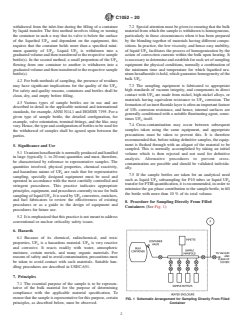
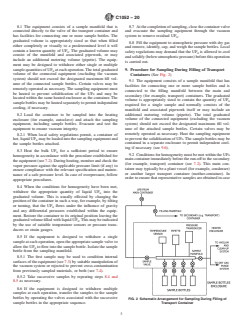
- Representative Bulk Sampling: The standard details methods for taking samples directly from filled UF₆ containers or from the inlet line during the transfer process. Both methods are designed to ensure that the samples accurately reflect the larger bulk material.
- Ensuring Homogeneity: Essential procedures are outlined to guarantee that the sampled UF₆ is homogenous, which is critical to obtaining valid analytical results. Homogenization is typically achieved through proper heating and convection processes.
- Equipment Standards: Equipment in contact with UF₆ must demonstrate high vacuum integrity and be constructed from materials resistant to UF₆ corrosion, such as nickel or high-nickel alloys. Sample bottles and transfer lines must be clean, dry, and free of contaminants.
- Contamination Control: The standard emphasizes steps to prevent cross-contamination between samples, such as initial equipment flushing and careful handling protocols.
- Sample Handling: Subsequent preparation and handling of the UF₆ samples for analysis is referenced to additional ASTM standards, ensuring samples remain representative and uncontaminated.
- Safety Considerations: While the standard notes significant hazards due to UF₆'s chemical reactivity and toxicity, it does not provide explicit safety or criticality control measures. Users are responsible for implementing appropriate safety, health, and environmental practices and complying with relevant regulations.
Applications
ASTM C1052-20 is an essential reference for organizations involved in the nuclear fuel cycle, specifically:
- UF₆ Converters and Enrichers: Quality control, process verification, and shipment validation all rely on collecting representative samples for analytical testing.
- Nuclear Fuel Fabricators: Accurate sampling at every stage ensures compliance with demanding fuel material specifications.
- Analytical Laboratories: Laboratories preparing to analyze UF₆ must follow the standardized sampling and subsampling procedures to maintain traceability and validity of results.
- Equipment Designers: The practice provides guidance for designing and validating equipment intended for the safe and reliable handling and sampling of UF₆.
Related Standards
Organizations adopting ASTM C1052-20 should be aware of several referenced and related standards for comprehensive compliance and best practices:
- ASTM C787: Specification for Uranium Hexafluoride for Enrichment
- ASTM C996: Specification for Uranium Hexafluoride Enriched to Less Than 5% ²³⁵U
- ASTM C1346: Practice for Dissolution of UF₆ from P-10 Tubes
- ASTM C1689: Practice for Subsampling of Uranium Hexafluoride
- ANSI N14.1: Uranium Hexafluoride Packaging for Transport
- ISO 7195: Packaging of Uranium Hexafluoride (UF₆) for Transport
- USEC-651: Uranium Hexafluoride: A Manual of Good Handling Practices
By following ASTM C1052-20, nuclear industry professionals ensure the integrity and safety of bulk UF₆ sampling processes, supporting both internal quality frameworks and external regulatory requirements. This standard is vital for demonstrating due diligence and technical competence in the sampling of uranium hexafluoride.
Relations
- Effective Date
- 01-Jul-2020
- Effective Date
- 01-Jan-2024
- Effective Date
- 01-Mar-2020
- Effective Date
- 01-Mar-2020
- Effective Date
- 01-Feb-2019
- Effective Date
- 01-Jul-2015
- Effective Date
- 01-Jul-2015
- Effective Date
- 15-Jun-2014
- Effective Date
- 15-Jan-2014
- Effective Date
- 01-Jan-2014
- Effective Date
- 01-Jun-2013
- Effective Date
- 01-May-2013
- Effective Date
- 01-Jun-2011
- Effective Date
- 01-Nov-2010
- Effective Date
- 01-Oct-2010
Get Certified
Connect with accredited certification bodies for this standard

DNV
DNV is an independent assurance and risk management provider.

Lloyd's Register
Lloyd's Register is a global professional services organisation specialising in engineering and technology.
DNV Energy Systems
Energy and renewable energy certification.
Sponsored listings
Frequently Asked Questions
ASTM C1052-20 is a standard published by ASTM International. Its full title is "Standard Practice for Bulk Sampling of Liquid Uranium Hexafluoride". This standard covers: SIGNIFICANCE AND USE 5.1 Uranium hexafluoride is normally produced and handled in large (typically 1- to 20-ton) quantities and must, therefore, be characterized by reference to representative samples. The quantities involved, physical properties, chemical reactivity, and hazardous nature of UF6 are such that for representative sampling, specially designed equipment must be used and operated in accordance with the most carefully controlled and stringent procedures. This practice indicates appropriate principles, equipment, and procedures currently in use for bulk sampling of liquid UF6. It is used by UF6 converters, enrichers, and fuel fabricators to review the effectiveness of existing procedures or as a guide to the design of equipment and procedures for future use. 5.2 It is emphasized that this practice is not meant to address conventional or nuclear criticality safety issues. SCOPE 1.1 This practice covers methods for withdrawing representative samples of liquid uranium hexafluoride (UF6) from bulk quantities of the material. Such samples are then prepared for further analytical testing in accordance with Practices C1689 and C1346. Multiple different methods are used for determining compliance with the applicable commercial specification, for example Specifications C787 and C996. Methods used for compliance to each of these standards can be found in the Referenced Documents section of each respective specification. 1.2 It is assumed that the bulk liquid UF6 being sampled comprises a single quality and quantity of material. This practice does not address any special additional arrangements that might be required for taking proportional or composite samples. When the sampled bulk material is being added to UF6 residues already in a container (“heels recycle”) additional arrangements are required to avoid cross contamination of the bulk UF6, these are addressed in Specifications C787 and C996. 1.3 The number of samples to be taken, their nominal sample weight, and their disposition shall be agreed upon between the parties. 1.4 The scope of this practice does not include provisions for preventing criticality incidents. 1.5 This standard does not purport to address all of the safety concerns, if any, associated with its use. It is the responsibility of the user of this standard to establish appropriate safety, health, and environmental practices and determine the applicability of regulatory limitations prior to use. 1.6 This international standard was developed in accordance with internationally recognized principles on standardization established in the Decision on Principles for the Development of International Standards, Guides and Recommendations issued by the World Trade Organization Technical Barriers to Trade (TBT) Committee.
SIGNIFICANCE AND USE 5.1 Uranium hexafluoride is normally produced and handled in large (typically 1- to 20-ton) quantities and must, therefore, be characterized by reference to representative samples. The quantities involved, physical properties, chemical reactivity, and hazardous nature of UF6 are such that for representative sampling, specially designed equipment must be used and operated in accordance with the most carefully controlled and stringent procedures. This practice indicates appropriate principles, equipment, and procedures currently in use for bulk sampling of liquid UF6. It is used by UF6 converters, enrichers, and fuel fabricators to review the effectiveness of existing procedures or as a guide to the design of equipment and procedures for future use. 5.2 It is emphasized that this practice is not meant to address conventional or nuclear criticality safety issues. SCOPE 1.1 This practice covers methods for withdrawing representative samples of liquid uranium hexafluoride (UF6) from bulk quantities of the material. Such samples are then prepared for further analytical testing in accordance with Practices C1689 and C1346. Multiple different methods are used for determining compliance with the applicable commercial specification, for example Specifications C787 and C996. Methods used for compliance to each of these standards can be found in the Referenced Documents section of each respective specification. 1.2 It is assumed that the bulk liquid UF6 being sampled comprises a single quality and quantity of material. This practice does not address any special additional arrangements that might be required for taking proportional or composite samples. When the sampled bulk material is being added to UF6 residues already in a container (“heels recycle”) additional arrangements are required to avoid cross contamination of the bulk UF6, these are addressed in Specifications C787 and C996. 1.3 The number of samples to be taken, their nominal sample weight, and their disposition shall be agreed upon between the parties. 1.4 The scope of this practice does not include provisions for preventing criticality incidents. 1.5 This standard does not purport to address all of the safety concerns, if any, associated with its use. It is the responsibility of the user of this standard to establish appropriate safety, health, and environmental practices and determine the applicability of regulatory limitations prior to use. 1.6 This international standard was developed in accordance with internationally recognized principles on standardization established in the Decision on Principles for the Development of International Standards, Guides and Recommendations issued by the World Trade Organization Technical Barriers to Trade (TBT) Committee.
ASTM C1052-20 is classified under the following ICS (International Classification for Standards) categories: 27.120.30 - Fissile materials and nuclear fuel technology. The ICS classification helps identify the subject area and facilitates finding related standards.
ASTM C1052-20 has the following relationships with other standards: It is inter standard links to ASTM C1052-14, ASTM C859-24, ASTM C996-20, ASTM C787-20, ASTM C1346-19, ASTM C996-15, ASTM C787-15, ASTM C859-14a, ASTM C859-14, ASTM C1346-08(2014), ASTM C859-13a, ASTM C859-13, ASTM C787-11, ASTM C859-10b, ASTM C996-10. Understanding these relationships helps ensure you are using the most current and applicable version of the standard.
ASTM C1052-20 is available in PDF format for immediate download after purchase. The document can be added to your cart and obtained through the secure checkout process. Digital delivery ensures instant access to the complete standard document.
Standards Content (Sample)
This international standard was developed in accordance with internationally recognized principles on standardization established in the Decision on Principles for the
Development of International Standards, Guides and Recommendations issued by the World Trade Organization Technical Barriers to Trade (TBT) Committee.
Designation:C1052 −20
Standard Practice for
Bulk Sampling of Liquid Uranium Hexafluoride
This standard is issued under the fixed designation C1052; the number immediately following the designation indicates the year of
original adoption or, in the case of revision, the year of last revision. A number in parentheses indicates the year of last reapproval. A
superscript epsilon (´) indicates an editorial change since the last revision or reapproval.
1. Scope 2. Referenced Documents
1.1 This practice covers methods for withdrawing represen- 2.1 ASTM Standards:
tative samples of liquid uranium hexafluoride (UF ) from bulk C787 Specification for Uranium Hexafluoride for Enrich-
quantities of the material. Such samples are then prepared for ment
further analytical testing in accordance with Practices C1689 C859 Terminology Relating to Nuclear Materials
and C1346. Multiple different methods are used for determin- C996 Specification for Uranium Hexafluoride Enriched to
ing compliance with the applicable commercial specification, Less Than 5 % U
for example Specifications C787 and C996. Methods used for C1346 Practice for Dissolution of UF from P-10 Tubes
compliance to each of these standards can be found in the C1689 Practice for Subsampling of Uranium Hexafluoride
Referenced Documents section of each respective specifica-
2.2 Other Documents:
tion.
ANSI N14.1 Uranium Hexafluoride: Packaging for Trans-
port
1.2 It is assumed that the bulk liquid UF being sampled
ISO/DIS 7195 Packaging of Uranium Hexafluoride (UF )
comprises a single quality and quantity of material. This
3,4
for Transport
practice does not address any special additional arrangements
USEC-651 Uranium Hexafluoride: A Manual of Good Han-
that might be required for taking proportional or composite
dling Practices
samples. When the sampled bulk material is being added to
UF residues already in a container (“heels recycle”) additional
3. Terminology
arrangements are required to avoid cross contamination of the
3.1 Definitions:
bulk UF , these are addressed in Specifications C787 and
3.1.1 For definitions of terms used in this practice but not
C996.
defined herein, refer to Terminology C859.
1.3 The number of samples to be taken, their nominal
3.2 Definitions of Terms Specific to This Standard:
sample weight, and their disposition shall be agreed upon
3.2.1 container, n—the bulk vessel either holding or receiv-
between the parties.
ing by transfer, the UF to be sampled; it may consist of, for
1.4 The scope of this practice does not include provisions
example, a fixed vessel in a UF handling plant or a cylinder to
for preventing criticality incidents.
be used for the transport of UF .
1.5 This standard does not purport to address all of the
3.2.2 sample bottle, n—the small vessel into which the
safety concerns, if any, associated with its use. It is the
sample of UF is withdrawn for transfer to the laboratory for
responsibility of the user of this standard to establish appro-
characterization.
priate safety, health, and environmental practices and deter-
4. Summary of Practice
mine the applicability of regulatory limitations prior to use.
1.6 This international standard was developed in accor-
4.1 Two methods of withdrawing a sample are described,
dance with internationally recognized principles on standard-
namely: (1) direct withdrawal from a filled container, and (2)
ization established in the Decision on Principles for the
Development of International Standards, Guides and Recom-
For referenced ASTM standards, visit the ASTM website, www.astm.org, or
mendations issued by the World Trade Organization Technical
contact ASTM Customer Service at service@astm.org. For Annual Book of ASTM
Barriers to Trade (TBT) Committee.
Standards volume information, refer to the standard’s Document Summary page on
the ASTM website.
Available from American National Standards Institute (ANSI), 25 W. 43rd St.,
This practice is under the jurisdiction of ASTM Committee C26 on Nuclear 4th Floor, New York, NY 10036, http://www.ansi.org.
Fuel Cycle and is the direct responsibility of Subcommittee C26.02 on Fuel and Available from International Organization for Standardization (ISO), ISO
Fertile Material Specifications. Central Secretariat, BIBC II, Chemin de Blandonnet 8, CP 401, 1214 Vernier,
Current edition approved July 1, 2020. Published August 2020. Originally Geneva, Switzerland, http://www.iso.org.
approved in 1985. Last previous edition approved in 2014 as C1052 – 14. DOI: AvailablefromUnitedStatesEnrichmentCorp.,6903RockledgeDr.,Bethesda,
10.1520/C1052-20. MD 20817.
Copyright © ASTM International, 100 Barr Harbor Drive, PO Box C700, West Conshohocken, PA 19428-2959. United States
C1052−20
withdrawal from the inlet-line during the filling of a container 7.2 Special attention must be given to ensuring that the bulk
by liquid transfer. The first method involves tilting or turning material from which the sample is withdrawn is homogeneous,
the container in such a way that its valve is below the surface particularly in those circumstances when it has been prepared
of the liquefied UF , and dependent on the equipment, this by the blending together of materials having different compo-
requires that the container holds more than a specified mini- sitions. In practice, the low viscosity, and hence easy mobility,
mum quantity of UF . Liquid UF is withdrawn into a of liquid UF facilitates the process of homogenization by the
6 6 6
graduatedvolumeandthentransferredtotherespectivesample action of convection currents within the bulk upon heating. It
bottle(s). In the second method, a small proportion of the UF isnecessarytodetermineandestablishforeachsetofsampling
flowing from one container to another is withdrawn into a equipment the physical conditions, normally a combination of
graduatedvolumeandthentransferredtotherespectivesample the minimum time and temperature for which liquefied ura-
bottle(s). nium hexafluoride is held, which guarantee homogeneity of the
bulk UF .
4.2 For both methods of sampling, the presence of residues
7.3 The sampling equipment is fabricated to appropriate
may have significant implications for the quality of the UF .
high standards of vacuum integrity, and components in direct
For safety and quality reasons, containers and bottles shall be
contact with UF are made from nickel, high-nickel alloys, or
clean, dry, and empty before filling.
materials having equivalent resistance to UF corrosion. The
4.3 Various types of sample bottles are in use and are
formationofaninertfluoridelayerisoftenanimportantfeature
described in detail in the applicable national and international
of UF corrosion resistance, and hence, internal surfaces are
standards, for example,ANSI N14.1 and ISO/DIS 7195. For a
generally conditioned with a suitable fluorinating agent, some-
given type of sample bottle, the detailed configuration, for
times UF itself.
example, valve orientation, terminal fittings, and the like, may
7.4 Cross-contamination may occur between subsequent
vary.Hence,thetypeandconfigurationofbottlestobeusedfor
samples taken using the same equipment, and appropriate
the withdrawal of samples shall be agreed upon between the
precautions must be taken to prevent this. It is therefore
parties.
recommended that, before taking definitive samples, the equip-
ment is flushed through with an aliquot of the material to be
5. Significance and Use
sampled. This is normally accomplished by taking an initial
5.1 Uraniumhexafluorideisnormallyproducedandhandled
volume which is then rejected and not used for definitive
in large (typically 1- to 20-ton) quantities and must, therefore,
analysis. Alternative procedures to prevent cross-
be characterized by reference to representative samples. The
contamination are possible and should be validated individu-
quantities involved, physical properties, chemical reactivity,
ally.
and hazardous nature of UF are such that for representative
7.5 If the sample bottles are taken for an analytical need
sampling, specially designed equipment must be used and
such as liquid UF subsampling for P10 tubes or liquid UF
6 6
operated in accordance with the most carefully controlled and
transfer for FTIR quantification, it is recommended, in order to
stringent procedures. This practice indicates appropriate
minimize the gas phase contribution to the sample bottle, to fill
principles, equipment, and procedures currently in use for bulk
the bottle with more than 10 % of its total volume.
sampling of liquid UF . It is used by UF converters, enrichers,
6 6
and fuel fabricators to review the effectiveness of existing
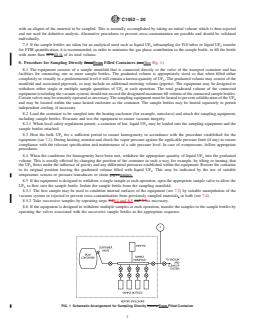
8. Procedure for Sampling Directly From Filled
procedures or as a guide to the design of equipment and
Containers (See Fig. 1)
procedures for future use.
5.2 Itisemphasizedthatthispracticeisnotmeanttoaddress
conventional or nuclear criticality safety issues.
6. Hazards
6.1 Because of its chemical, radiochemical, and toxic
properties, UF is a hazardous material. UF is very reactive
6 6
and corrosive. It
...
This document is not an ASTM standard and is intended only to provide the user of an ASTM standard an indication of what changes have been made to the previous version. Because
it may not be technically possible to adequately depict all changes accurately, ASTM recommends that users consult prior editions as appropriate. In all cases only the current version
of the standard as published by ASTM is to be considered the official document.
Designation: C1052 − 14 C1052 − 20
Standard Practice for
Bulk Sampling of Liquid Uranium Hexafluoride
This standard is issued under the fixed designation C1052; the number immediately following the designation indicates the year of
original adoption or, in the case of revision, the year of last revision. A number in parentheses indicates the year of last reapproval. A
superscript epsilon (´) indicates an editorial change since the last revision or reapproval.
1. Scope
1.1 This practice covers methods for withdrawing representative samples of liquid uranium hexafluoride (UF ) from bulk
quantities of the material. Such samples are then prepared for further analytical testing in accordance with Practices C1689 and
C1346. Multiple different methods are used for determining compliance with the applicable commercial specification, for example
SpecificationSpecifications C787 and Specification C996. Methods used for compliance to each of these standards can be found
in the Referenced Documents section of each respective specification.
1.2 It is assumed that the bulk liquid UF being sampled comprises a single quality and quantity of material. This practice does
not address any special additional arrangements that might be required for taking proportional or composite samples. When the
sampled bulk material is being added to UF residues already in a container (“heels recycle”) additional arrangements are required
to avoid cross contamination of the bulk UF , these are addressed in the appropriate section (8.2) of Specifications C787 and C996.
1.3 The number of samples to be taken, their nominal sample weight, and their disposition shall be agreed upon between the
parties.
1.4 The scope of this practice does not include provisions for preventing criticality incidents.
1.5 This standard does not purport to address all of the safety concerns, if any, associated with its use. It is the responsibility
of the user of this standard to establish appropriate safety safety, health, and healthenvironmental practices and determine the
applicability of regulatory limitations prior to use.
1.6 This international standard was developed in accordance with internationally recognized principles on standardization
established in the Decision on Principles for the Development of International Standards, Guides and Recommendations issued
by the World Trade Organization Technical Barriers to Trade (TBT) Committee.
2. Referenced Documents
2.1 ASTM Standards:
C787 Specification for Uranium Hexafluoride for Enrichment
C859 Terminology Relating to Nuclear Materials
C996 Specification for Uranium Hexafluoride Enriched to Less Than 5 % U
C1346 Practice for Dissolution of UF from P-10 Tubes
C1689 Practice for Subsampling of Uranium Hexafluoride
2.2 Other Documents:
USEC-651 Uranium Hexafluoride: A Manual of Good Handling Practices
ANSI N14.1 Uranium Hexafluoride: Packaging for Transport
3,4
ISO/DIS 7195 Packaging of Uranium Hexafluoride (UF ) for Transport
USEC-651 Uranium Hexafluoride: A Manual of Good Handling Practices
This practice is under the jurisdiction of ASTM Committee C26 on Nuclear Fuel Cycle and is the direct responsibility of Subcommittee C26.02 on Fuel and Fertile
Material Specifications.
Current edition approved Jan. 15, 2014July 1, 2020. Published February 2014August 2020. Originally approved in 1985. Last previous edition approved in 20072014 as
C1052 – 01 (2007).C1052 – 14. DOI: 10.1520/C1052-14.10.1520/C1052-20.
For referenced ASTM standards, visit the ASTM website, www.astm.org, or contact ASTM Customer Service at service@astm.org. For Annual Book of ASTM Standards
volume information, refer to the standard’s Document Summary page on the ASTM website.
Available from United States Enrichment Corp., 6903 Rockledge Dr., Bethesda, MD 20817.
Available from American National Standards Institute (ANSI), 25 W. 43rd St., 4th Floor, New York, NY 10036, http://www.ansi.org.
Available from International Organization for Standardization (ISO), ISO Central Secretariat, BIBC II, Chemin de Blandonnet 8, CP 401, 1214 Vernier, Geneva,
Switzerland, http://www.iso.org.
Copyright © ASTM International, 100 Barr Harbor Drive, PO Box C700, West Conshohocken, PA 19428-2959. United States
C1052 − 20
3. Terminology
3.1 Definitions:
3.1.1 For definitions of terms used in this practice but not defined herein, refer to Terminology C859.
3.2 Definitions of Terms Specific to This Standard:
3.2.1 container—container, n—the bulk vessel either holding or receiving by transfer, the UF to be sampled; it may consist of,
for example, a fixed vessel in a UF handling plant or a cylinder to be used for the transport of UF .
6 6
3.2.2 sample bottle—bottle, n—the small vessel into which the sample of UF is withdrawn for transfer to the laboratory for
characterization.
4. Summary of Practice
4.1 Two methods of withdrawing a sample are described, namely: (1) direct withdrawal from a filled container, and (2)
withdrawal from the inlet-line during the filling of a container by liquid transfer. The first method involves tilting or turning the
container in such a way that its valve is below the surface of the liquefied UF , and dependent on the equipment, this requires that
the container holds more than a specified minimum quantity of UF . Liquid UF is withdrawn into a graduated volume and then
6 6
transferred to the respective sample bottle(s). In the second method, a small proportion of the UF flowing from one container to
another is withdrawn into a graduated volume and then transferred to the respective sample bottle(s).
4.2 For both methods of sampling, the presence of residues may have significant implications for the quality of the UF . For
safety and quality reasons, containers and bottles shall be clean, dry, and empty before filling.
4.3 Various types of sample bottles are in use and are described in detail in the applicable national and international standards,
for example, ANSI N14.1 and ISO/DIS 7195. For a given type of sample bottle, the detailed configuration, for example, valve
orientation, terminal fittings, and the like, may vary. Hence, the type and configuration of bottles to be used for the withdrawal of
samples shall be agreed upon between the parties.
5. Significance and Use
5.1 Uranium hexafluoride is normally produced and handled in large (typically 1- to 20-ton) quantities and must, therefore, be
characterized by reference to representative samples. The quantities involved, physical properties, chemical reactivity, and
hazardous nature of UF are such that for representative sampling, specially designed equipment must be used and operated in
accordance with the most carefully controlled and stringent procedures. This practice indicates appropriate principles, equipment,
and procedures currently in use for bulk sampling of liquid UF . It is used by UF converters, enrichers, and fuel fabricators to
6 6
review the effectiveness of existing procedures or as a guide to the design of equipment and procedures for future use.
5.2 It is emphasized that this practice is not meant to address conventional or nuclear criticality safety issues.
6. Hazards
6.1 Because of its chemical, radiochemical, and toxic properties, UF is a hazardous material. UF is very reactive and
6 6
corrosive. It reacts readily with water, atmospheric moisture, certain metals, and many organic materials. For reasons of safety and
to avoid contamination, precautions must be taken to avoid contact with such materials. Suitable handling procedures are described
in USEC-651.
7. Principles
7.1 The essential purpose of the sample is to be representative of the bulk material for the purpose of determining compliance
with the applicable material specification. To ensure that the sample is representative for this purpose, certain principles, as
described below, must be observed.
7.2 Special attention must be given to ensuring that the bulk material from which the sample is withdrawn is homogeneous,
particularly in those circumstances when it has been prepared by the blending together of materials having different compositions.
In practice, the low viscosity, and hence easy mobility, of liquid UF facilitates the process of homogenization by the action of
convection currents within the bulk upon heating. It is necessary to determine and establish for each set of sampling equipment
the physical conditions, normally a combination of the minimum time and temperature for which liquefied uranium hexafluoride
is held, which guarantee homogeneity of the bulk UF .
7.3 The sampling equipment is fabricated to appropriate high standards of vacuum integrity, and components in direct contact
with UF are made from nickel, high-nickel alloys, or materials having equivalent resistance to UF corrosion. The formation of
6 6
an inert fluoride layer is often an important feature of UF corrosion resistance, and hence, internal surfaces are generally
conditioned with a suitable fluorinating agent, sometimes UF itself.
7.4 Cross-contamination may occur between subsequent samples taken using the same equipment, and appropriate precautions
must be taken to prevent this. It is therefore recommended that, before taking definitive samples, the equipment is flushed through
------------------
...