


ASTM E1131-08(2014)
(Test Method)Standard Test Method for Compositional Analysis by Thermogravimetry
Standard Test Method for Compositional Analysis by Thermogravimetry
SIGNIFICANCE AND USE
5.1 This test method is intended for use in quality control, material screening, and related problem solving where a compositional analysis is desired or a comparison can be made with a known material of the same type.
5.2 The parameters described should be considered as guidelines. They may be altered to suit a particular analysis, provided the changes are noted in the report.
5.3 The proportion of the determined components in a given mixture or blend may indicate specific quality or end use performance characteristics. Particular examples include the following:
5.3.1 Increasing soot (carbon) content of used diesel lubricating oils indicates decreasing effectiveness.
5.3.2 Specific carbon-to-polymer ratio ranges are required in some elastomeric and plastic parts in order to achieve desired mechanical strength and stability.
5.3.3 Some filled elastomeric and plastic products require specific inert content (for example, ash, filler, reinforcing agent, etc.) to meet performance specifications.
5.3.4 The volatile matter, fixed carbon, and ash content of coal and coke are important parameters. The “ranking” of coal increases with increasing carbon content and decreasing volatile and hydrocarbon, (medium volatility) content.
SCOPE
1.1 This test method provides a general technique incorporating thermogravimetry to determine the amount of highly volatile matter, medium volatile matter, combustible material, and ash content of compounds. This test method will be useful in performing a compositional analysis in cases where agreed upon by interested parties.
1.2 This test method is applicable to solids and liquids.
1.3 The temperature range of test is typically room temperature to 1000°C. Composition between 1 and 100 weight % of individual components may be determined.
1.4 This test method utilizes an inert and reactive gas environment.
1.5 The values stated in SI units are to be regarded as standard. No other units of measurement are included in this standard.
1.6 This standard is related ISO 11358 but is more detailed and specific.
1.7 This standard does not purport to address all of the safety concerns, if any, associated with its use. It is the responsibility of the user of this standard to establish appropriate safety and health practices and determine the applicability of regulatory limitations prior to use.
General Information
Relations
Standards Content (Sample)
NOTICE: This standard has either been superseded and replaced by a new version or withdrawn.
Contact ASTM International (www.astm.org) for the latest information
Designation: E1131 − 08 (Reapproved 2014)
Standard Test Method for
Compositional Analysis by Thermogravimetry
This standard is issued under the fixed designation E1131; the number immediately following the designation indicates the year of
original adoption or, in the case of revision, the year of last revision. A number in parentheses indicates the year of last reapproval. A
superscript epsilon (´) indicates an editorial change since the last revision or reapproval.
1. Scope E1582 Practice for Calibration of Temperature Scale for
Thermogravimetry
1.1 This test method provides a general technique incorpo-
E2040 Test Method for Mass Scale Calibration of Thermo-
rating thermogravimetry to determine the amount of highly
gravimetric Analyzers
volatile matter, medium volatile matter, combustible material,
2.2 ISO Standards:
and ash content of compounds. This test method will be useful
ISO 11358 Plastics-Thermogravimetry (TG) of Polymers —
in performing a compositional analysis in cases where agreed
General Principles
upon by interested parties.
1.2 This test method is applicable to solids and liquids. 3. Terminology
3.1 Definitions:
1.3 Thetemperaturerangeoftestistypicallyroomtempera-
ture to 1000°C. Composition between 1 and 100 weight % of 3.1.1 Many of the technical terms used in this test method
are defined in Terminologies E473 and E1142.
individual components may be determined.
1.4 This test method utilizes an inert and reactive gas 3.2 Definitions of Terms Specific to This Standard:
3.2.1 highly volatile matter—moisture, plasticizer, residual
environment.
solvent or other low boiling (200°C or less) components.
1.5 The values stated in SI units are to be regarded as
3.2.2 medium volatile matter—medium volatility materials
standard. No other units of measurement are included in this
such as oil and polymer degradation products. In general, these
standard.
materials degrade or volatilize in the temperature range 200 to
1.6 This standard is related ISO 11358 but is more detailed
750°C.
and specific.
3.2.3 combustible material—oxidizablematerialnotvolatile
1.7 This standard does not purport to address all of the
(in the unoxidized form) at 750°C, or some stipulated tempera-
safety concerns, if any, associated with its use. It is the
ture dependent on material. Carbon is an example of such a
responsibility of the user of this standard to establish appro-
material.
priate safety and health practices and determine the applica-
3.2.4 ash—nonvolatile residues in an oxidizing atmosphere
bility of regulatory limitations prior to use.
which may include metal components, filler content or inert
2. Referenced Documents reinforcing materials.
3.2.5 mass loss plateau—a region of a thermogravimetric
2.1 ASTM Standards:
curve with a relatively constant mass.
D3172 Practice for Proximate Analysis of Coal and Coke
E473 Terminology Relating to Thermal Analysis and Rhe-
4. Summary of Test Method
ology
4.1 This test method is an empirical technique using ther-
E691 Practice for Conducting an Interlaboratory Study to
mogravimetry in which the mass of a substance, heated at a
Determine the Precision of a Test Method
controlled rate in an appropriate environment, is recorded as a
E1142 Terminology Relating to Thermophysical Properties
function of time or temperature. Mass loss over specific
temperature ranges and in a specific atmosphere provide a
ThistestmethodisunderthejurisdictionofASTMCommitteeE37onThermal
compositional analysis of that substance.
Measurements and is the direct responsibility of Subcommittee E37.01 on Calo-
rimetry and Mass Loss.
5. Significance and Use
Current edition approved March 15, 2014. Published April 2014. Originally
5.1 This test method is intended for use in quality control,
approved in 1986. Last previous edition approved in 2008 as E1131 – 08. DOI:
10.1520/E1131-08R14.
material screening, and related problem solving where a
For referenced ASTM standards, visit the ASTM website, www.astm.org, or
contact ASTM Customer Service at service@astm.org. For Annual Book of ASTM
Standards volume information, refer to the standard’s Document Summary page on Available from International Organization for Standardization (ISO), 1, ch. de
the ASTM website. la Voie-Creuse, CP 56, CH-1211 Geneva 20, Switzerland, http://www.iso.org.
Copyright © ASTM International, 100 Barr Harbor Drive, PO Box C700, West Conshohocken, PA 19428-2959. United States
E1131 − 08 (2014)
compositional analysis is desired or a comparison can be made temperature range of this test method; (2) a temperature sensor
with a known material of the same type. toprovideanindicationofthespecimen/furnacetemperatureto
61°C; (3) an electrobalance to continuously measure the
5.2 The parameters described should be considered as
specimen mass with a minimum capacity of 30 mg and a
guidelines. They may be altered to suit a particular analysis,
sensitivity of 61 µg; and (4) a means of sustaining the
provided the changes are noted in the report.
specimen/container under atmosphere control with a purge rate
5.3 Theproportionofthedeterminedcomponentsinagiven
of 10 to 100 6 5 mL/min.
mixture or blend may indicate specific quality or end use
7.1.2 A temperature controller, capable of executing a
performance characteristics. Particular examples include the
specifictemperatureprogrambyoperatingthefurnacebetween
following:
selected temperature limits at a rate of temperature change
5.3.1 Increasing soot (carbon) content of used diesel lubri-
between 10 and 100°C/min constant to within 61 % for a
cating oils indicates decreasing effectiveness.
minimum of 100 min.
5.3.2 Specific carbon-to-polymer ratio ranges are required
7.1.3 A data collection device, to provide a means of
in some elastomeric and plastic parts in order to achieve
acquiring, storing, and displaying measured or calculated
desired mechanical strength and stability.
signals, or both. The minimum output signals required for
5.3.3 Some filled elastomeric and plastic products require
Thermogravimetric analyzers are mass, temperature, and time.
specific inert content (for example, ash, filler, reinforcing
agent, etc.) to meet performance specifications.
NOTE 1—The capability to display the first derivative of the signal may
be useful in the measurement of obscure thermostability ranges.
5.3.4 The volatile matter, fixed carbon, and ash content of
coal and coke are important parameters. The “ranking” of coal
7.1.4 Containers (pans, crucibles, and so forth), which are
increases with increasing carbon content and decreasing vola-
inert to the specimen and which will remain dimensionally
tile and hydrocarbon, (medium volatility) content.
stable within the temperature limits of this test method.
6. Interferences 7.2 Gas flow dontrol device,withthecapabilityofswitching
between inert and reactive gases.
6.1 This test method depends upon distinctive thermostabil-
ity ranges of the determined components as a principle of the
8. Reagents and Materials
test. For this reason, materials which have no well-defined
thermostable range, or whose thermostabilities are the same as
8.1 An inert compressed gas such as argon or nitrogen and
other components, may create interferences. Particular ex-
a reactive compressed gas such as air or oxygen are required
amples include the following:
for this test method.
6.1.1 Oil-filled elastomers have such high molecular weight
8.2 Purity of Purge Gases:
oilsandsuchlowmolecularweightpolymercontentthattheoil
8.2.1 0.01 % maximum total impurity.
and polymer may not be separated based upon temperature
8.2.2 1.0 µg/g water impurity maximum.
stability.
6.1.2 Ash content materials (metals) are slowly oxidized at 8.2.3 1.0 µg/g hydrocarbon impurity maximum.
high temperatures and in an air atmosphere, so that their mass
8.2.4 The inert purge gas must not contain more than 10
increases (or decreases) with time. Under such conditions, a
µg/g oxygen.
specific temperature or time region must be identified for the
measurement of that component.
9. Test Specimen
6.1.3 Polymers, especially neoprene and acrylonitrile buta-
9.1 Specimens are ordinarily measured as received. If some
diene rubber (NBR), carbonize to a considerable extent, giving
heatormechanicaltreatmentisappliedtothespecimenpriorto
low values for the polymer and high values for the carbon.
test, this treatment shall be noted in the report.
Approximate corrections can be made for this if the type of
polymer is known.
9.2 Sincetheapplicablesamplesmaybemixturesorblends,
6.1.4 Certain pigments used in rubber lose weight on
take care to ensure that the analyzed specimen is representative
heating. For example, some pigments exhibit water loss in the
of the sample from which it is taken. If the sample is a liquid,
range 500 to 600°C, resulting in high polymer values. Others,
mixing prior to taking the specimen is sufficient to ensure this
such as calcium carbonate, release carbon dioxide (CO ) upon
consideration. If the sample is a solid, take several specimens
decomposition at 825°C, that may result in high carbon values.
from different areas of the sample and either combine for a
The extent of interference is dependent upon the type and
single determination, or each run separately with the final
quantity of pigment present.
analysis representing an average of the determinations. Note
the number of determinations in the report.
7. Apparatus
7.1 The essential equipment required to provide the mini- 10. Calibration
mum thermogravimetric analyzer capability for this test
10.1 Calibrate the mass signal from the apparatus according
method includes:
to Test Method E2040.
7.1.1 A thermobalance, composed of (1) a furnace to
provide uniform controlled heating or a specimen to a constant 10.2 Calibrate the temperature signal from the apparatus
temperature or at a constant rate within the 25 to 1000°C according to Practice E1582.
E1131 − 08 (2014)
11. Procedure by maintaining the specimen at constant temperature for
several minutes after switching environments.
11.1 Establish the inert (nitrogen) and reactive (air or
oxygen) gases at the desired flow rates. For most analyses, this 11.11 The analysis is complete upon the establishment of a
ratewillbeintherangeof10to100mL/min.Higherflowrates mass loss plateau following the introduction of the reactive
may be used for some analyses, particularly when utilizing gas.
high heating rates.
11.12 Switch to the inert purge gas.
11.2 Switch the purge gas to the inert (nitrogen) gas.
11.13 Calculate and report the sample composition.
11.3 Zero the mass signal r and tare the balance.
12. Calculation
11.4 Open the apparatus to expose the specimen holder.
12.1 Highly volatile matter is represented by a mass loss
11.5 Prepare the specimen as outlined in 9.2 and carefully
measured between the starting temperature and Temperature X
place it in the specimen holder. Typically, a sample mass of 10
(see Fig. 1).Temperature X should be taken in the center of the
to 30 mg shall be used (see Table 1).
first mass loss plateau or, if no resolvable plateau exists, at an
agreed upon temperature value. Suggested values forTempera-
NOTE 2—Specimens smaller than 10 mg may be used if larger
specimens cause instrument fouling or poor reproducibility. ture X are given in Table 2.
12.1.1 Highly volatile matter content may be determined by
11.6 Position the specimen temperature sensor to the same
the following equation:
location used in calibration. (See Section 10.)
W 2 R
11.7 Enclose the specimen holder.
V 5 3100% (1)
W
11.8 Record the initial mass. If the apparatus in use has
where:
provisions for direct percentage measurements, adjust to read
100 %. V = highly volatile matter content, as received basis (%),
W = original specimen mass (mg), and
11.9 Initiate the heating program within the desired tem-
R = mass measured at Temperature X (mg).
perature range. See Table 1 for suggested heating rates and
12.2 Medium volatile matter is represented by the mass loss
temperature ranges. Record the specimen mass change con-
measured from Temperature X to Temperature Y (see Fig. 1).
tinuously over the temperature interval.
Temperature Y should correspond to the mass loss plateau used
11.9.1 The mass loss profile may be expressed in either
for switching atmospheres.
milligrams or mass percent of original specimen mass. Ex-
12.2.1 Medium volatile matter content can be determined
panded scale operation may be useful over selected tempera-
using the following equation:
ture ranges.
11.9.2 If only one or two components of the compositional
R 2 S
O 5 3100% (2)
analysis are desired, specific, more limited temperature ranges
W
may be used. Similarly, several heating rates may be used
where:
during analysis in those regions of greater or lesser interest.
O = medium volatile matter content, as-received basis, %,
Isothermal periods may be necessary for some materials. See
R = mass measured at Temperature X, (mg),
Table 1 for suggested parameters.
S = mass measured at Temperature Y, (mg), and
11.10 Once a mass loss plateau is established in the range
W = original specimen mass, (mg).
600 to 950°C, depending on the material, switch from inert to
12.3 Combustible material content is represented by the
reactive (air or oxygen) environment.
mass loss measured from Temperature Y to Temperature Z (see
11.10.1 Ifadistinctplateauisnotobservedinthisrange,the
Fig. 1). This region corresponds to the mass loss as a result of
atmosphere change is made based on the zero slope indication
the oxidation of carbon to carbon dioxide.
of the recorded first derivative or upon some agreed upon
12.3.1 Combustible material content may be calculated by
temperature. Suggested temperatures for this region are given
the following equation:
in Table 1.
11.10.2 The resolution of this region may be enhanced, S 2 T
C 5 3100% (3)
wherecarbonispresentinlargequantitiesorofspecialinterest, W
TABLE 1 Suggested Compositional Analysis Parameters
Purge Heating Gas
Temperature
Sample Flow Rate
Material Time Rate Switchover
A
Size mg mL/min B
Initial X Y Z
Min °C/min °C
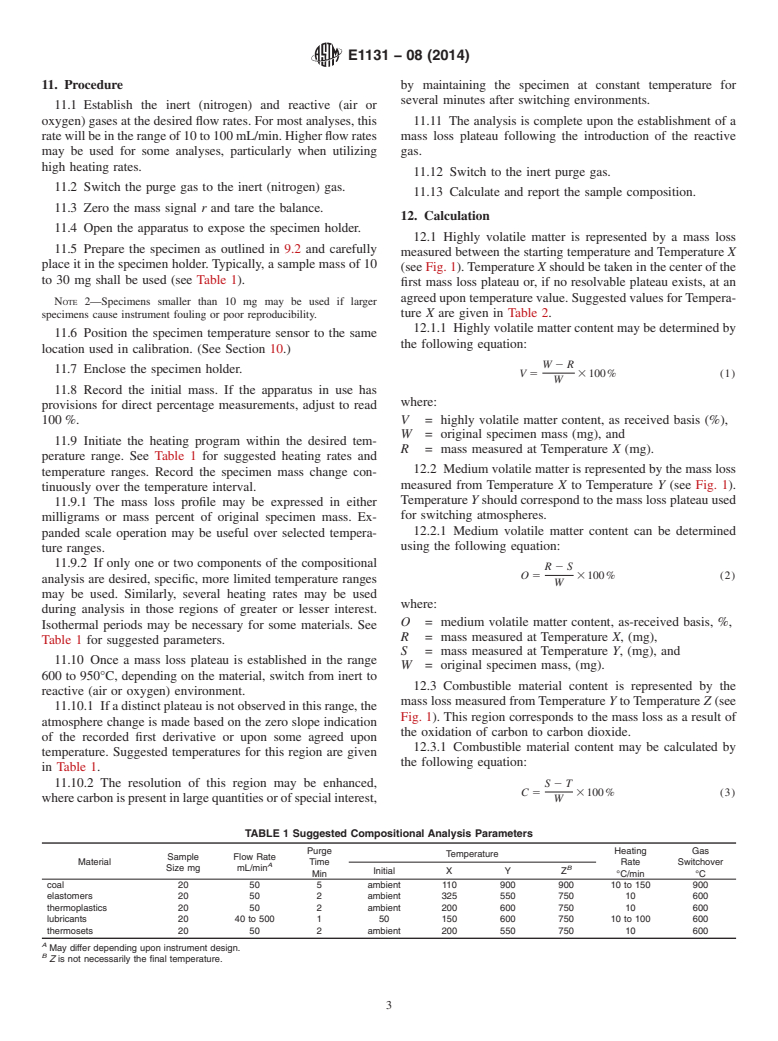
coal 20 50 5 ambient 110 900 900 10 to 150 900
elastomers 20 50 2 ambient 325 550 750 10 600
thermoplastics 20 50 2 ambient 200 600 750 10 600
lubricants 20 40 to 500 1 50 150 600 750 10 to 100 600
thermosets 20 50 2 ambient 200 550 750 10 600
A
May differ depending upon instrument design.
B
Z is not necessarily the final temperature.
E1131 − 08 (2014)
FIG. 1 Sample Thermogravimetric Curve
TABLE 2 Compositional Analysis Interlaboratory Test Parameters
Sample: Rubber, lot 63, approximately 30 % carbon fill
Pretreatment: None
Test Parameters by Material
Apparatus: TG (Model XX)
Purge Gas Preanalysis
Sample
Temperature Range:
...
Questions, Comments and Discussion
Ask us and Technical Secretary will try to provide an answer. You can facilitate discussion about the standard in here.