

ASTM D4506-21
(Test Method)Standard Test Method for Determining In Situ Modulus of Deformation of a Rock Mass Using the Radial Jacking Test
General Information
- Abstract
SIGNIFICANCE AND USE
5.1 Data on the response of a rock mass to in situ loading provides essential information for many purposes in the science of rock mechanics, in the construction of dams, tunnels, bridges, high-rise structures, and other facilities that exert pressure on the foundation material or surrounding rock mass.
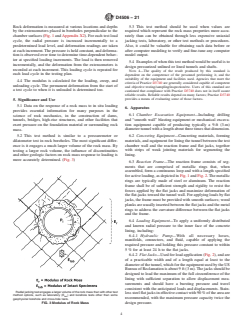
5.2 This test method is similar to a pressuremeter or dilatometer test in rock boreholes. The most significant difference is it engages a much larger volume of the rock mass. By testing a larger rock volume, the influence of discontinuities and other geologic factors on rock mass response to loading is more accurately determined. (Fig. 3)
FIG. 3 Modulus of Rock Mass
Radial jacking test engages a larger volume of the rock mass than with other test method options, such as laboratory (Elab) and borehole tests other than some geophysical borehole and cross-hole tests.
5.3 This test method should be used when values are required which represent the rock mass properties more accurately than can be obtained through less expensive uniaxial jacking tests, laboratory, or other test methods or procedures. Also, it could be valuable for obtaining such data before or after computer modeling to verify and fine-tune any computer model output.
5.4 Examples of when this test method would be useful is to design pressurized unlined or lined tunnels and shafts.
Note 4: The quality of the result produced by this standard is dependent on the competence of the personnel performing it, and the suitability of the equipment and facilities used. Agencies that meet the criteria of Practice D3740 are generally considered capable of competent and objective testing/sampling/inspection/etc. Users of this standard are cautioned that compliance with Practice D3740 does not in itself assure reliable results. Reliable results depend on many factors; Practice D3740 provides a means of evaluating some of those factors.
SCOPE
1.1 This test method is used to determine the in situ modulus of deformation of rock mass by subjecting a test chamber in rock of a circular cross-section to uniformly distributed radial loading; the consequent rock radial displacements are measured at various locations, from which the deformation modulus may be calculated. The radial anisotropic deformability of the rock is taken at enough locations that it can also be determined from the differences between the extensometer readings taken at various locations along and around the test chamber as well with depth from each loading sequence. Information on time-dependent deformation may be obtained as well by holding the loads constant for selected time intervals.
Note 1: Deformations caused by a cylindrical test chamber are not likely uniform even if each steel ring forming the jack is uniformly loaded. Theoretically, the deformations will vary along the cylinder such that it looks like a gaussian probability curve.
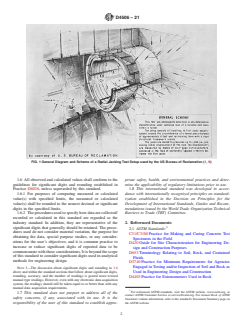
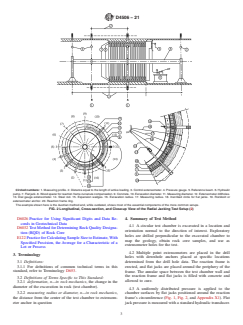
1.2 This test method is based upon the procedures developed by the US Bureau of Reclamation, featuring long extensometers that provide a bottom anchor far enough away from the test zone to be used as a zero reference point (Fig. 1)(1).2 An alternative procedure, the New Austrian method, is also available and is based on a reference bar going down the middle to support posts outside the deflection zone due to the testing loads and shown in Fig. 2 (2). Other than a different method of taking deformation readings, the two field tests are the same. Additional information on radial jacking and data analysis is presented in References (3-8).
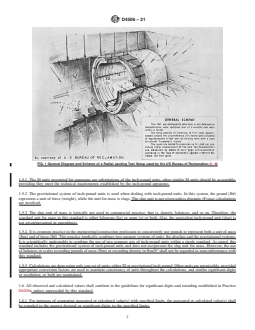
FIG. 1 General Diagram and Scheme of a Radial Jacking Test Setup used by the US Bureau of Reclamation (1, 9)
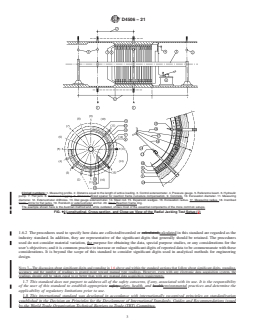
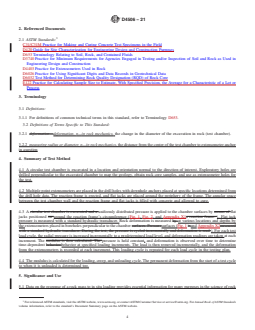
FIG. 2 Longitudinal, Cross-section, and Close-up View of the Radial Jacking Test Setup (2)
Circled numbers: 1. Measuring profile. 2. Distance equal to the length of active loading. 3. Control extensometer. 4. Pressure gauge. 5. Reference beam. 6. Hydraulic pump. 7. Flat jack. 8. W...
- Status
- Published
- Publication Date
- 31-Aug-2021
- Technical Committee
- D18 - Soil and Rock
- Drafting Committee
- D18.12 - Rock Mechanics
Buy Documents
ASTM D4506-21 - Standard Test Method for Determining In Situ Modulus of Deformation of a Rock Mass Using the Radial Jacking Test
REDLINE ASTM D4506-21 - Standard Test Method for Determining In Situ Modulus of Deformation of a Rock Mass Using the Radial Jacking Test
Overview
ASTM D4506-21, titled Standard Test Method for Determining In Situ Modulus of Deformation of a Rock Mass Using the Radial Jacking Test, establishes procedures for evaluating the deformation characteristics of rock masses in their natural environment. This radial jacking test involves subjecting a circular test chamber, excavated in situ, to uniform radial pressure while measuring the resulting displacements of the rock mass. Such data are vital for geotechnical engineering, supporting the safe and efficient design of major infrastructure projects including dams, tunnels, bridges, and high-rise buildings.
Determining the in situ modulus of deformation using this method is particularly valuable as it samples a larger volume of rock than traditional borehole tests, capturing the influence of geological discontinuities and providing a more representative measure of rock mass behavior. This makes ASTM D4506-21 a preferred standard when accurate assessment of rock mass properties is essential for complex engineering projects.
Key Topics
- In Situ Deformation Modulus: Calculation of deformation modulus by applying known radial loads and measuring displacement using extensometers.
- Radial Jacking Test Setup: Parameters for chamber excavation, installation of reaction frames, loading equipment (hydraulic pumps, flat jacks), and displacement measuring systems.
- Volume of Rock Mass Tested: This method engages a significantly larger volume of rock, addressing geological discontinuities more effectively than smaller-scale tests.
- Comparison to Other Tests: The radial jacking test provides results that more accurately reflect the overall rock mass properties compared to laboratory and smaller borehole tests.
- Time-Dependent Deformation: Capability to assess time-dependent behaviors by holding loads at constant intervals to reveal creep or relaxation in the rock mass.
- Data Quality and Reliability: Emphasis on laboratory competence and equipment suitability; adherence to quality assurance practices, such as those in ASTM D3740, is recommended for reliable results.
- Data Recording and Reporting: Guidance on documentation of test setup, geologic conditions, pressure and deformation readings, and comprehensive reporting of results.
Applications
The radial jacking test standard is widely used in the following scenarios:
- Design of Subsurface Structures: For planning the construction of pressurized tunnels, shafts, and underground chambers, where accurate rock mass properties are critical for structural integrity.
- Foundations for Large Structures: Assessment of bedrock suitability under dams, bridges, or skyscrapers, ensuring that foundation materials can withstand anticipated loads.
- Verification and Calibration of Computer Models: In situ data help validate and refine geotechnical numerical models, improving the reliability of design simulations.
- Identifying Rock Mass Discontinuities: The method provides insight into the effects of fault zones, joints, or other geologic features on the deformation resistance of a rock mass.
- Time-Dependent Analysis: Useful for identifying creep or delayed deformation in rocks, which informs long-term stability assessments.
Related Standards
For a comprehensive approach to rock mechanics and geotechnical testing, the following ASTM standards are commonly referenced alongside ASTM D4506-21:
- ASTM D420 – Guide for Site Characterization for Engineering Design and Construction Purposes
- ASTM D3740 – Practice for Minimum Requirements for Agencies Engaged in Testing and/or Inspection of Soil and Rock as Used in Engineering Design and Construction
- ASTM D4403 – Practice for Extensometers Used in Rock
- ASTM D6026 – Practice for Using Significant Digits and Data Records in Geotechnical Data
- ASTM D6032 – Test Method for Determining Rock Quality Designation (RQD) of Rock Core
- ASTM C31/C31M – Practice for Making and Curing Concrete Test Specimens in the Field
- ASTM E122 – Practice for Calculating Sample Size to Estimate, With Specified Precision, the Average for a Characteristic of a Lot or Process
By following ASTM D4506-21 and related rock mechanics standards, engineers and project managers can ensure robust, scientifically valid data underpin critical design decisions for structures built on or within rock masses. Use of in situ modulus testing supports safe, cost-effective, and reliable infrastructure development in the geotechnical and civil engineering fields.
Relations
- Refers
ASTM C31/C31M-24a - Standard Practice for Making and Curing Concrete Test Specimens in the Field - Effective Date
- 01-Apr-2024
- Refers
ASTM C31/C31M-24 - Standard Practice for Making and Curing Concrete Test Specimens in the Field - Effective Date
- 01-Jan-2024
- Effective Date
- 01-Nov-2023
- Effective Date
- 01-Jan-2020
- Effective Date
- 01-Oct-2019
- Effective Date
- 01-Feb-2018
- Refers
ASTM C31/C31M-18 - Standard Practice for Making and Curing Concrete Test Specimens in the Field - Effective Date
- 01-Jan-2018
- Refers
ASTM C31/C31M-15ae1 - Standard Practice for Making and Curing Concrete Test Specimens in the Field - Effective Date
- 15-Nov-2015
- Effective Date
- 01-Aug-2014
- Effective Date
- 15-Aug-2012
- Refers
ASTM C31/C31M-12 - Standard Practice for Making and Curing Concrete Test Specimens in the Field - Effective Date
- 01-Jul-2012
- Effective Date
- 01-May-2012
- Effective Date
- 01-Mar-2012
- Effective Date
- 01-Sep-2011
- Effective Date
- 01-Sep-2011
Buy Documents
ASTM D4506-21 - Standard Test Method for Determining In Situ Modulus of Deformation of a Rock Mass Using the Radial Jacking Test
REDLINE ASTM D4506-21 - Standard Test Method for Determining In Situ Modulus of Deformation of a Rock Mass Using the Radial Jacking Test
Get Certified
Connect with accredited certification bodies for this standard

Zavod za gradbeništvo Slovenije (ZAG) - Inšpekcija
ZAG inspection body for construction products, structures, and materials.
Sponsored listings
Frequently Asked Questions
ASTM D4506-21 is a standard published by ASTM International. Its full title is "Standard Test Method for Determining In Situ Modulus of Deformation of a Rock Mass Using the Radial Jacking Test". This standard covers: SIGNIFICANCE AND USE 5.1 Data on the response of a rock mass to in situ loading provides essential information for many purposes in the science of rock mechanics, in the construction of dams, tunnels, bridges, high-rise structures, and other facilities that exert pressure on the foundation material or surrounding rock mass. 5.2 This test method is similar to a pressuremeter or dilatometer test in rock boreholes. The most significant difference is it engages a much larger volume of the rock mass. By testing a larger rock volume, the influence of discontinuities and other geologic factors on rock mass response to loading is more accurately determined. (Fig. 3) FIG. 3 Modulus of Rock Mass Radial jacking test engages a larger volume of the rock mass than with other test method options, such as laboratory (Elab) and borehole tests other than some geophysical borehole and cross-hole tests. 5.3 This test method should be used when values are required which represent the rock mass properties more accurately than can be obtained through less expensive uniaxial jacking tests, laboratory, or other test methods or procedures. Also, it could be valuable for obtaining such data before or after computer modeling to verify and fine-tune any computer model output. 5.4 Examples of when this test method would be useful is to design pressurized unlined or lined tunnels and shafts. Note 4: The quality of the result produced by this standard is dependent on the competence of the personnel performing it, and the suitability of the equipment and facilities used. Agencies that meet the criteria of Practice D3740 are generally considered capable of competent and objective testing/sampling/inspection/etc. Users of this standard are cautioned that compliance with Practice D3740 does not in itself assure reliable results. Reliable results depend on many factors; Practice D3740 provides a means of evaluating some of those factors. SCOPE 1.1 This test method is used to determine the in situ modulus of deformation of rock mass by subjecting a test chamber in rock of a circular cross-section to uniformly distributed radial loading; the consequent rock radial displacements are measured at various locations, from which the deformation modulus may be calculated. The radial anisotropic deformability of the rock is taken at enough locations that it can also be determined from the differences between the extensometer readings taken at various locations along and around the test chamber as well with depth from each loading sequence. Information on time-dependent deformation may be obtained as well by holding the loads constant for selected time intervals. Note 1: Deformations caused by a cylindrical test chamber are not likely uniform even if each steel ring forming the jack is uniformly loaded. Theoretically, the deformations will vary along the cylinder such that it looks like a gaussian probability curve. 1.2 This test method is based upon the procedures developed by the US Bureau of Reclamation, featuring long extensometers that provide a bottom anchor far enough away from the test zone to be used as a zero reference point (Fig. 1)(1).2 An alternative procedure, the New Austrian method, is also available and is based on a reference bar going down the middle to support posts outside the deflection zone due to the testing loads and shown in Fig. 2 (2). Other than a different method of taking deformation readings, the two field tests are the same. Additional information on radial jacking and data analysis is presented in References (3-8). FIG. 1 General Diagram and Scheme of a Radial Jacking Test Setup used by the US Bureau of Reclamation (1, 9) FIG. 2 Longitudinal, Cross-section, and Close-up View of the Radial Jacking Test Setup (2) Circled numbers: 1. Measuring profile. 2. Distance equal to the length of active loading. 3. Control extensometer. 4. Pressure gauge. 5. Reference beam. 6. Hydraulic pump. 7. Flat jack. 8. W...
SIGNIFICANCE AND USE 5.1 Data on the response of a rock mass to in situ loading provides essential information for many purposes in the science of rock mechanics, in the construction of dams, tunnels, bridges, high-rise structures, and other facilities that exert pressure on the foundation material or surrounding rock mass. 5.2 This test method is similar to a pressuremeter or dilatometer test in rock boreholes. The most significant difference is it engages a much larger volume of the rock mass. By testing a larger rock volume, the influence of discontinuities and other geologic factors on rock mass response to loading is more accurately determined. (Fig. 3) FIG. 3 Modulus of Rock Mass Radial jacking test engages a larger volume of the rock mass than with other test method options, such as laboratory (Elab) and borehole tests other than some geophysical borehole and cross-hole tests. 5.3 This test method should be used when values are required which represent the rock mass properties more accurately than can be obtained through less expensive uniaxial jacking tests, laboratory, or other test methods or procedures. Also, it could be valuable for obtaining such data before or after computer modeling to verify and fine-tune any computer model output. 5.4 Examples of when this test method would be useful is to design pressurized unlined or lined tunnels and shafts. Note 4: The quality of the result produced by this standard is dependent on the competence of the personnel performing it, and the suitability of the equipment and facilities used. Agencies that meet the criteria of Practice D3740 are generally considered capable of competent and objective testing/sampling/inspection/etc. Users of this standard are cautioned that compliance with Practice D3740 does not in itself assure reliable results. Reliable results depend on many factors; Practice D3740 provides a means of evaluating some of those factors. SCOPE 1.1 This test method is used to determine the in situ modulus of deformation of rock mass by subjecting a test chamber in rock of a circular cross-section to uniformly distributed radial loading; the consequent rock radial displacements are measured at various locations, from which the deformation modulus may be calculated. The radial anisotropic deformability of the rock is taken at enough locations that it can also be determined from the differences between the extensometer readings taken at various locations along and around the test chamber as well with depth from each loading sequence. Information on time-dependent deformation may be obtained as well by holding the loads constant for selected time intervals. Note 1: Deformations caused by a cylindrical test chamber are not likely uniform even if each steel ring forming the jack is uniformly loaded. Theoretically, the deformations will vary along the cylinder such that it looks like a gaussian probability curve. 1.2 This test method is based upon the procedures developed by the US Bureau of Reclamation, featuring long extensometers that provide a bottom anchor far enough away from the test zone to be used as a zero reference point (Fig. 1)(1).2 An alternative procedure, the New Austrian method, is also available and is based on a reference bar going down the middle to support posts outside the deflection zone due to the testing loads and shown in Fig. 2 (2). Other than a different method of taking deformation readings, the two field tests are the same. Additional information on radial jacking and data analysis is presented in References (3-8). FIG. 1 General Diagram and Scheme of a Radial Jacking Test Setup used by the US Bureau of Reclamation (1, 9) FIG. 2 Longitudinal, Cross-section, and Close-up View of the Radial Jacking Test Setup (2) Circled numbers: 1. Measuring profile. 2. Distance equal to the length of active loading. 3. Control extensometer. 4. Pressure gauge. 5. Reference beam. 6. Hydraulic pump. 7. Flat jack. 8. W...
ASTM D4506-21 is classified under the following ICS (International Classification for Standards) categories: 93.020 - Earthworks. Excavations. Foundation construction. Underground works. The ICS classification helps identify the subject area and facilitates finding related standards.
ASTM D4506-21 has the following relationships with other standards: It is inter standard links to ASTM C31/C31M-24a, ASTM C31/C31M-24, ASTM D3740-23, ASTM D4403-20, ASTM D3740-19, ASTM D420-18, ASTM C31/C31M-18, ASTM C31/C31M-15ae1, ASTM D653-14, ASTM D4403-12, ASTM C31/C31M-12, ASTM D3740-12a, ASTM D3740-12, ASTM D653-11, ASTM D3740-11. Understanding these relationships helps ensure you are using the most current and applicable version of the standard.
ASTM D4506-21 is available in PDF format for immediate download after purchase. The document can be added to your cart and obtained through the secure checkout process. Digital delivery ensures instant access to the complete standard document.
Standards Content (Sample)
This international standard was developed in accordance with internationally recognized principles on standardization established in the Decision on Principles for the
Development of International Standards, Guides and Recommendations issued by the World Trade Organization Technical Barriers to Trade (TBT) Committee.
Designation: D4506 − 21
Standard Test Method for
Determining In Situ Modulus of Deformation of a Rock Mass
Using the Radial Jacking Test
This standard is issued under the fixed designation D4506; the number immediately following the designation indicates the year of
original adoption or, in the case of revision, the year of last revision. A number in parentheses indicates the year of last reapproval. A
superscript epsilon (´) indicates an editorial change since the last revision or reapproval.
need to be considered in any analyzes or recommendations.
1. Scope*
1.1 This test method is used to determine the in situ
1.4 Testing of the in situ rock deformation behavior is
modulus of deformation of rock mass by subjecting a test limited by the maximum stress range of the reaction frame and
chamber in rock of a circular cross-section to uniformly
the flat jacks.
distributed radial loading; the consequent rock radial displace-
1.5 Units—The values stated in inch-pound units are to be
ments are measured at various locations, from which the
regarded as standard. The values given in parentheses are
deformationmodulusmaybecalculated.Theradialanisotropic
rationalized mathematical conversions to SI units that are
deformability of the rock is taken at enough locations that it
provided for information only and are not considered standard.
can also be determined from the differences between the
Reporting of test results in units other than inch-pound shall
extensometer readings taken at various locations along and
not be regarded as nonconformance with this test method.
around the test chamber as well with depth from each loading
1.5.1 The SI units presented for apparatus are substitutions
sequence. Information on time-dependent deformation may be
of the inch-pound units, other similar SI units should be
obtainedaswellbyholdingtheloadsconstantforselectedtime
acceptable, providing they meet the technical requirements
intervals.
established by the inch-pound apparatus.
NOTE 1—Deformations caused by a cylindrical test chamber are not
1.5.2 The gravitational system of inch-pound units is used
likelyuniformevenifeachsteelringformingthejackisuniformlyloaded.
when dealing with inch-pound units. In this system, the pound
Theoretically, the deformations will vary along the cylinder such that it
looks like a gaussian probability curve.
(lbf) represents a unit of force (weight), while the unit for mass
is slugs. The slug unit is not given unless dynamic (F=ma)
1.2 This test method is based upon the procedures devel-
calculations are involved.
oped by the US Bureau of Reclamation, featuring long exten-
someters that provide a bottom anchor far enough away from
1.5.3 The slug unit of mass is typically not used in com-
the test zone to be used as a zero reference point (Fig. 1)(1). mercial practice; that is, density, balances, and so on.
An alternative procedure, the New Austrian method, is also
Therefore, the standard unit for mass in this standard is either
available and is based on a reference bar going down the
kilogram (kg) or gram (g) or both. Also, the equivalent
middle to support posts outside the deflection zone due to the
inch-pound unit (slug) is not given/presented in parenthesis.
testing loads and shown in Fig. 2(2). Other than a different
1.5.4 It is common practice in the engineering/construction
method of taking deformation readings, the two field tests are
profession to concurrently use pounds to represent both a unit
the same. Additional information on radial jacking and data
of mass (lbm) and of force (lbf). This practice implicitly
analysis is presented in References (3-8).
combines two separate systems of units; the absolute and the
gravitational systems. It is scientifically undesirable to com-
1.3 Applicationofthetestresultsisbeyondthescopeofthis
bine the use of two separate sets of inch-pound units within a
test method, but may be an integral part of some testing
single standard. As stated, this standard includes the gravita-
programs. (See Note 2.)
tional system of inch-pound units and does not use/present the
NOTE 2—For example, in situ stresses around the test tunnel will affect
slug unit for mass. However, the use of balances or scales
the test results, depending on how the test results will be used and may
recording pounds of mass (lbm) or recording density in lbm/ft
shall not be regarded as nonconformance with this standard.
1.5.5 Calculations are done using only one set of units;
ThistestmethodisunderthejurisdictionofASTMCommitteeD18onSoiland
either SI or gravitational inch-pound. Other units are
Rock and is the direct responsibility of Subcommittee D18.12 on Rock Mechanics.
Current edition approved Sept. 1, 2021. Published October 2021. Originally
permissible, provided appropriate conversion factors are used
ɛ1
approved in 1985. Last previous edition approved in 2013 as D4506 – 13 . DOI:
to maintain consistency of units throughout the calculations,
10.1520/D4506-21.
and similar significant digits or resolution, or both are main-
The boldface numbers in parentheses refer to the list of references appended to
this standard. tained.
*A Summary of Changes section appears at the end of this standard
Copyright © ASTM International, 100 Barr Harbor Drive, PO Box C700, West Conshohocken, PA 19428-2959. United States
D4506 − 21
FIG. 1 General Diagram and Scheme of a Radial Jacking Test Setup used by the US Bureau of Reclamation (1, 9)
1.6 All observed and calculated values shall conform to the priate safety, health, and environmental practices and deter-
guidelines for significant digits and rounding established in mine the applicability of regulatory limitations prior to use.
Practice D6026, unless superseded by this standard. 1.8 This international standard was developed in accor-
1.6.1 For purposes of comparing measured or calculated dance with internationally recognized principles on standard-
value(s) with specified limits, the measured or calculated ization established in the Decision on Principles for the
value(s) shall be rounded to the nearest decimal or significant Development of International Standards, Guides and Recom-
digits in the specified limits. mendations issued by the World Trade Organization Technical
1.6.2 Theproceduresusedtospecifyhowdataarecollected/ Barriers to Trade (TBT) Committee.
recorded or calculated in this standard are regarded as the
2. Referenced Documents
industry standard. In addition, they are representative of the
significant digits that generally should be retained. The proce- 3
2.1 ASTM Standards:
dures used do not consider material variation, the purpose for
C31/C31M Practice for Making and Curing Concrete Test
obtaining the data, special purpose studies, or any consider-
Specimens in the Field
ations for the user’s objectives; and it is common practice to
D420 Guide for Site Characterization for Engineering De-
increase or reduce significant digits of reported data to be
sign and Construction Purposes
commensuratewiththeseconsiderations.Itisbeyondthescope
D653 Terminology Relating to Soil, Rock, and Contained
of this standard to consider significant digits used in analytical
Fluids
methods for engineering design.
D3740 Practice for Minimum Requirements for Agencies
Engaged in Testing and/or Inspection of Soil and Rock as
NOTE 3—The discussion about significant digits and rounding in 1.6
above and within the standard sections that follow about significant digits, Used in Engineering Design and Construction
rounding, accuracy, and the number of readings is geared more toward
D4403 Practice for Extensometers Used in Rock
manual type readings. However, even with any electronic data acquisition
system, the readings should still be taken equal to or better than with any
manual data acquisition requirements.
For referenced ASTM standards, visit the ASTM website, www.astm.org, or
1.7 This standard does not purport to address all of the
contact ASTM Customer Service at service@astm.org. For Annual Book of ASTM
safety concerns, if any, associated with its use. It is the
Standards volume information, refer to the standard’s Document Summary page on
responsibility of the user of this standard to establish appro- the ASTM website.
D4506 − 21
Circled numbers: 1. Measuring profile. 2. Distance equal to the length of active loading. 3. Control extensometer. 4. Pressure gauge. 5. Reference beam. 6. Hydraulic
pump. 7. Flat jack. 8. Wood spacer for reaction frame curvature compensation. 9. Concrete. 10. Excavation diameter. 11. Measuring diameter. 12. Extensometer drillholes.
13. Dial gauge extensometer. 14. Steel rod. 15. Expansion wedges. 16. Excavation radius. 17. Measuring radius. 18. Inscribed circle for flat jacks. 19. Rockbolt or
extensometer anchor. 20. Reaction frame ring.
The example shown here is the Austrian method and, while outdated, shows most of the essential components of the more common setups.
FIG. 2 Longitudinal, Cross-section, and Close-up View of the Radial Jacking Test Setup (2)
D6026 Practice for Using Significant Digits and Data Re- 4. Summary of Test Method
cords in Geotechnical Data
4.1 A circular test chamber is excavated in a location and
D6032 Test Method for Determining Rock Quality Designa-
orientation normal to the direction of interest. Exploratory
tion (RQD) of Rock Core
holes are drilled perpendicular to the excavated chamber to
E122 Practice for Calculating Sample Size to Estimate,With
map the geology, obtain rock core samples, and use as
Specified Precision, the Average for a Characteristic of a
extensometer holes for the test.
Lot or Process
4.2 Multiple point extensometers are placed in the drill
3. Terminology
holes with downhole anchors placed at specific locations
3.1 Definitions:
determined from the drill hole data. The reaction frame is
3.1.1 For definitions of common technical terms in this
erected, and flat jacks are placed around the periphery of the
standard, refer to Terminology D653.
frame. The annular space between the test chamber wall and
the reaction frame and flat jacks is filled with concrete and
3.2 Definitions of Terms Specific to This Standard:
allowed to cure.
3.2.1 deformation, n—in rock mechanics, the change in the
diameter of the excavation in rock (test chamber).
4.3 A uniformly distributed pressure is applied to the
3.2.2 measuring radius or diameter, n—in rock mechanics, chamber surfaces by flat jacks positioned around the reaction
the distance from the center of the test chamber to extensom- frame’s circumference (Fig. 1, Fig. 2, and Appendix X1). Flat
eter anchor in question jack pressure is measured with a standard hydraulic transducer.
D4506 − 21
Rock deformation is measured at various locations and depths 5.3 This test method should be used when values are
by the extensometers placed in boreholes perpendicular to the required which represent the rock mass properties more accu-
chamber surfaces (Fig. 1 and Appendix X2). For each test load rately than can be obtained through less expensive uniaxial
cycle, the radial pressure is increased incrementally to a jacking tests, laboratory, or other test methods or procedures.
predetermined load level, and deformation readings are taken Also, it could be valuable for obtaining such data before or
at each increment. The pressure is held constant, and deforma- after computer modeling to verify and fine-tune any computer
tion is observed over time to determine time-dependent behav- model output.
ior at specified loading increments. The load is then removed
5.4 Examplesofwhenthistestmethodwouldbeusefulisto
incrementally, and the deformation from the extensometers is
design pressurized unlined or lined tunnels and shafts.
recorded at each increment. This loading cycle is repeated for
NOTE 4—The quality of the result produced by this standard is
each load cycle in the testing plan.
dependent on the competence of the personnel performing it, and the
suitability of the equipment and facilities used. Agencies that meet the
4.4 The modulus is calculated for the loading, creep, and
criteria of Practice D3740 are generally considered capable of competent
unloading cycle. The permanent deformation from the start of
and objective testing/sampling/inspection/etc. Users of this standard are
a test cycle to when it is unloaded is determined too.
cautioned that compliance with Practice D3740 does not in itself assure
reliable results. Reliable results depend on many factors; Practice D3740
provides a means of evaluating some of those factors.
5. Significance and Use
5.1 Data on the response of a rock mass to in situ loading
6. Apparatus
provides essential information for many purposes in the
6.1 Chamber Excavation Equipment—Including drilling
science of rock mechanics, in the construction of dams,
and “smooth wall” blasting equipment or mechanical excava-
tunnels, bridges, high-rise structures, and other facilities that
tion equipment capable of producing typically a 9-ft (3-m)
exert pressure on the foundation material or surrounding rock
diameter tunnel with a length about three times that dimension.
mass.
6.2 Concreting Equipment—Concreting materials, forming
5.2 This test method is similar to a pressuremeter or
dilatometer test in rock boreholes. The most significant differ- materials, and equipment for lining the tunnel between the test
chamber wall and the reaction frame and flat jacks, together
ence is it engages a much larger volume of the rock mass. By
testing a larger rock volume, the influence of discontinuities with strips of weak jointing materials for segmenting the
lining.
and other geologic factors on rock mass response to loading is
more accurately determined. (Fig. 3)
6.3 Reaction Frame—The reaction frame consists of seg-
ments that are comprised of metallic rings that, when
assembled, form a continuous loop and with a length specified
foractiveloading,asdepictedinFig.1andFig.2.Themetallic
rings are typically made of steel or aluminum. The reaction
frame shall be of sufficient strength and rigidity to resist the
forces applied by the flat jacks and maximize deformation of
the flat-jacks toward the tunnel wall. For applying loads by flat
jacks, the frame must be provided with smooth surfaces; wood
planks are usually inserted between the flat jacks and the metal
rings to address the curvature difference between the flat jacks
and the frame.
6.4 Loading Equipment—To apply a uniformly distributed
and known radial pressure to the inner face of the concrete
lining, including:
6.4.1 Hydraulic Pump—With all necessary hoses,
manifolds, connectors, and fluid, capable of applying the
required pressure and holding this pressure constant to within
5 % for at least 24 h to the flat jacks.
6.4.2 Flat Jacks—Used for load application (Fig. 2), and are
of a practicable width and of a length equal at least to the
diameterofthetunnel,whichfortheequipmentusedbytheUS
Bureau of Reclamation is about 9 ft (3 m).The jacks should be
designed to load the maximum of the full circumference of the
lining with sufficient separation to allow displacement mea-
surements and should have a bursting pressure and travel
consistent with the anticipated loads and displacements. Stain-
Radialjackingtestengagesalargervolumeoftherockmassthanwithothertest
lesssteelflatjacksineffectivecontactwith90 %oftheareaare
method options, such as laboratory (E ) and borehole tests other than some
lab
recommended, with the maximum pressure capacity twice the
geophysical borehole and cross-hole tests.
FIG. 3 Modulus of Rock Mass design pressure.
D4506 − 21
6.5 Load Measuring Equipment—Load measuring equip- 8.1.3 Record the 2-d as well as 3-d geology of the chamber
ment should consist of one or more hydraulic pressure gauges surface, including the nature, spacing, and orientation of
or transducers of a suitable range, capable of measuring the discontinuities such as fractures, joint sets, bedding, foliation,
applied pressure with an accuracy better than 62 %. Measure- or faults.
mentsareusuallymadebyutilizingmechanicalgauges.Careis
8.1.4 Record and protect, per the project plan, any speci-
required to guarantee the reliability of electric transducers and
mens taken for laboratory and index testing, as required.
recording equipment, when used.
8.2 Core and log all instrumentation holes as follows:
6.6 Displacement Measuring Equipment—Displacement
8.2.1 Accurately mark locations for the extensometer holes
measuring equipment to monitor rock movements radial to the
along the longitudinal and periphery of the test chamber,
tunnel should have an accuracy of at least 60.0003 in. (0.1
making sure no interference between loading and measuring
mm) and resolution of at least 0.0001 in. (0.0025 mm).
systems and according to a specific data collection plan. (See
6.6.1 Dial gauges can be used but require someone to enter
Fig. 5.)
the reaction frame area to read them rather than from a safer
8.2.2 Cored Boreholes—Drill the boreholes using diamond
location and adds risks to the dial gauges being disturbed by
core techniques that facilitate obtaining continuous core and
test personnel, visitors, and even rats. Since the chamber area
properly sized for the extensometer instrumentation.
iswithinthereactionframetheremaynotbealotofrisksothis
8.2.3 Core Logged—Completely log the recovered core,
would be a professional judgement decision. Remote cameras
emphasizing fractures and other mechanical non-
onthegagescouldbeused,butthatwouldbealotofadditional
homogeneities, including RQD (Test Method D6032)orany
equipment costs that might be greater than using electronic
other suitable rock indexing or quality designation method.
displacement gauges.
8.2.4 Update geology mapping with drill log data.
6.6.2 Multiple-position (six anchor points) borehole exten-
8.3 Extensometer Instrumentation:
someters utilizing Practice D4403 should be used when pos-
sible. The directions of measurement should be normal to the 8.3.1 Install extensometers with a minimum of six points,
axis of the tunnel. The multiple-position extensometers should
and check the equipment when completed.
be of sufficient length and configured, such that the deepest
8.3.2 Use the geology and drill hole data to plan the
anchorcanbeconsideredazero-referencepoint.Thisisusually
extensometer anchor locations. Modify the depth and locations
at least three test-chamber diameters from the chamber lining.
of extensometer anchors as needed to accommodate special
rock mechanic issues and geologic features found during
NOTE 5—Measurements of movement should be related to a reference
mapping and drilling exploration. Examples of special geo-
anchor rigidly secured in rock or a reference beam, well away from the
logic features would be a shear zone or a fat clay-filled
loading zone’s influence, and therefore considered a zero-deformation
point.
discontinuity or clay layer.
8.3.3 Place two anchors at a depth beyond the tunnel
7. Verification
influence, appropriately spacing the other four anchors as close
to the surface of the tunnel as possible.
7.1 Theequipmentandmeasurementsystemsshouldbepart
8.3.4 Assemble the reaction frame and loading equipment
of the verification, and documentation shall be in accordance
with standard quality assurance procedures. around the periphery of the reaction frame. See Fig. 6.
8.3.5 Fill the annular space between the reaction frame, flat
7.2 The compliance of all equipment and apparatus with the
jacks, and the test chamber wall rock with concrete. See Fig. 7
performance specifications in Section 6 shall be verified.
and Fig. 8.
8. Procedure
NOTE 7—It is considered good practice by some test personnel to make
concrete test cylinders (Test Method C31/C31M) and test them for
8.1 Test Chamber:
strength and modulus values that are recorded for the test site.
8.1.1 Select the test chamber location taking into consider-
8.4 Loading:
ation the rock conditions, particularly the orientation of the
8.4.1 Perform the test with at least three loading and
rock mass elements such as joints, bedding, and foliation in
unloading cycles, a higher maximum pressure being applied at
relationtotheorientationoftheproposedtunneloropeningfor
each cycle. Typically, the maximum pressure applied is 1000
which results are required. Guide D420 can be useful when
psi (7 MPa), depending on expected design loads and the
selecting test sites.
design specifications for the reaction frame and flat jacks.
NOTE 6—The number of test sites or test specimens necessary to obtain
NOTE 8—In order to get the planned load applied to the rock, higher
a specific level of statistical results may be determined using Test Method
pressure is applied to the jacks because of the difference in diameter
E122. However, it may not be economically possible to achieve a
between the rock surface and the ring of jacks. See 9.1.
particular confidence level for some test methods, and professional
judgment may be necessary.
8.4.2 Foreachcycle,increasethepressureatanaveragerate
8.1.2 Excavate the test chamber by smooth wall (pre-split) of 100 psi/min (0.7 MPa/min) to the maximum for the cycle,
blasting techniques to the required diameter for the reaction taking not less than ten intermediate sets, approximately
frame, with a length equal to at least three diameters. See Fig. equally spaced load values, of load-displacement readings in
4. order to define a set of pressure-displacement curves (see Fig.
D4506 − 21
FIG. 4 View of Final Radial Jacking Test Chamber Excavation and After Installation of Extensometers (1) Courtesy of the US Bureau of
Reclamation
9 and Fig. 10). The automation of data recording is recom- 9. Calculatio
...
This document is not an ASTM standard and is intended only to provide the user of an ASTM standard an indication of what changes have been made to the previous version. Because
it may not be technically possible to adequately depict all changes accurately, ASTM recommends that users consult prior editions as appropriate. In all cases only the current version
of the standard as published by ASTM is to be considered the official document.
´1
Designation: D4506 − 13 D4506 − 21
Standard Test Method for
Determining In Situ Modulus of Deformation of a Rock Mass
Using the Radial Jacking Test
This standard is issued under the fixed designation D4506; the number immediately following the designation indicates the year of
original adoption or, in the case of revision, the year of last revision. A number in parentheses indicates the year of last reapproval. A
superscript epsilon (´) indicates an editorial change since the last revision or reapproval.
ε NOTE—Editorial corrections were made throughout in February 2014.
1. Scope*
1.1 This test method is used to determine the in situ modulus of deformation of rock mass by subjecting a test chamber in rock
of a circular cross section cross-section to uniformly distributed radial loading; the consequent rock radial displacements are
measured, measured at various locations, from which elastic or the deformation modulimodulus may be calculated. The radial
anisotropic deformability of the rock is taken at enough locations that it can also be measured and information determined from
the differences between the extensometer readings taken at various locations along and around the test chamber as well with depth
from each loading sequence. Information on time-dependent deformation may be obtained.obtained as well by holding the loads
constant for selected time intervals.
NOTE 1—Deformations caused by a cylindrical test chamber are not likely uniform even if each steel ring forming the jack is uniformly loaded.
Theoretically, the deformations will vary along the cylinder such that it looks like a gaussian probability curve.
1.2 This test method is based upon the procedures developed by the U.S.US Bureau of Reclamation, featuring long extensometers
that provide a bottom anchor far enough away from the test zone to be used as a zero reference point (Fig. 1)(1). An alternative
procedure procedure, the New Austrian method, is also available and is based on a reference bar going down the middle to support
posts outside the deflection zone due to the testing loads and shown in Fig. 2(2). More Other than a different method of taking
deformation readings, the two field tests are the same. Additional information on radial jacking and itsdata analysis is presented
in References (3-8).
1.3 Application of the test results is beyond the scope of this test method, but may be an integral part of some testing programs.
(See Note 2.)
NOTE 2—For example, in situ stresses around the test tunnel will affect the test results, depending on how the test results will be used and may need to
be considered in any analyzes or recommendations.
1.4 Testing of the in situ rock deformation behavior is limited by the maximum stress range of the reaction frame and the flat jacks.
1.5 Units—The values stated in inch-pound units are to be regarded as standard. The values given in parentheses are rationalized
mathematical conversions to SI units that are provided for information only and are not considered standard. Reporting of test
results in units other than inch-pound shall not be regarded as nonconformance with this test method.
This test method is under the jurisdiction of ASTM Committee D18 on Soil and Rock and is the direct responsibility of Subcommittee D18.12 on Rock Mechanics.
Current edition approved Nov. 1, 2013Sept. 1, 2021. Published December 2013October 2021. Originally approved in 1985. Last previous edition approved in 20082013
ɛ1
as D4506 – 08.D4506 – 13 . DOI: 10.1520/D4506-13E01.10.1520/D4506-21.
The boldface numbers in parentheses refer to the list of references appended to this standard.
*A Summary of Changes section appears at the end of this standard
Copyright © ASTM International, 100 Barr Harbor Drive, PO Box C700, West Conshohocken, PA 19428-2959. United States
D4506 − 21
FIG. 1 General Diagram and Scheme of a Radial Jacking Test Setup used by the US Bureau of Reclamation (1, 9)
1.5.1 The SI units presented for apparatus are substitutions of the inch-pound units, other similar SI units should be acceptable,
providing they meet the technical requirements established by the inch-pound apparatus.
1.5.2 The gravitational system of inch-pound units is used when dealing with inch-pound units. In this system, the pound (lbf)
represents a unit of force (weight), while the unit for mass is slugs. The slug unit is not given unless dynamic (F=ma) calculations
are involved.
1.5.3 The slug unit of mass is typically not used in commercial practice; that is, density, balances, and so on. Therefore, the
standard unit for mass in this standard is either kilogram (kg) or gram (g) or both. Also, the equivalent inch-pound unit (slug) is
not given/presented in parenthesis.
1.5.4 It is common practice in the engineering/construction profession to concurrently use pounds to represent both a unit of mass
(lbm) and of force (lbf). This practice implicitly combines two separate systems of units; the absolute and the gravitational systems.
It is scientifically undesirable to combine the use of two separate sets of inch-pound units within a single standard. As stated, this
standard includes the gravitational system of inch-pound units and does not use/present the slug unit for mass. However, the use
of balances or scales recording pounds of mass (lbm) or recording density in lbm/ft shall not be regarded as nonconformance with
this standard.
1.5.5 Calculations are done using only one set of units; either SI or gravitational inch-pound. Other units are permissible, provided
appropriate conversion factors are used to maintain consistency of units throughout the calculations, and similar significant digits
or resolution, or both are maintained.
1.6 All observed and calculated values shall conform to the guidelines for significant digits and rounding established in Practice
D6026., unless superseded by this standard.
1.6.1 For purposes of comparing measured or calculated value(s) with specified limits, the measured or calculated value(s) shall
be rounded to the nearest decimal or significant digits in the specified limits.
D4506 − 21
Circled numbers: 1. Measuring profile. 2. Distance equal to the length of active loading. 3. Control extensometer. 4. Pressure gauge. 5. Reference beam. 6. Hydraulic
pump. 7. Flat jack. 8. Hardwood lagging. 9. Shotcrete.Wood spacer for reaction frame curvature compensation. 9. Concrete. 10. Excavation diameter. 11. Measuring
diameter. 12. Extensometer drillholes. 13. Dial gauge extensometer. 14. Steel rod. 15. Expansion wedges. 16. Excavation radius. 17. Measuring radius. 18. Inscribed
Circle. circle for flat jacks. 19. Rockbolt or extensometer anchor. 20. Steel Reaction frame ring.
The example shown here is the Austrian method and, while outdated, shows most of the essential components of the more common setups.
FIG. 12 Longitudinal, Cross-section, and Close-up View of the Radial Jacking Test Setup (2)
1.6.2 The procedures used to specify how data are collected/recorded or calculated,calculated in this standard are regarded as the
industry standard. In addition, they are representative of the significant digits that generally should be retained. The procedures
used do not consider material variation, the purpose for obtaining the data, special purpose studies, or any considerations for the
user’s objectives; and it is common practice to increase or reduce significant digits of reported data to be commensurate with these
considerations. It is beyond the scope of this standard to consider significant digits used in analytical methods for engineering
design.
NOTE 3—The discussion about significant digits and rounding in 1.6 above and within the standard sections that follow about significant digits, rounding,
accuracy, and the number of readings is geared more toward manual type readings. However, even with any electronic data acquisition system, the
readings should still be taken equal to or better than with any manual data acquisition requirements.
1.7 This standard does not purport to address all of the safety concerns, if any, associated with its use. It is the responsibility
of the user of this standard to establish appropriate safety safety, health, and healthenvironmental practices and determine the
applicability of regulatory limitations prior to use.
1.8 This international standard was developed in accordance with internationally recognized principles on standardization
established in the Decision on Principles for the Development of International Standards, Guides and Recommendations issued
by the World Trade Organization Technical Barriers to Trade (TBT) Committee.
D4506 − 21
2. Referenced Documents
2.1 ASTM Standards:
C31/C31M Practice for Making and Curing Concrete Test Specimens in the Field
D420 Guide for Site Characterization for Engineering Design and Construction Purposes
D653 Terminology Relating to Soil, Rock, and Contained Fluids
D3740 Practice for Minimum Requirements for Agencies Engaged in Testing and/or Inspection of Soil and Rock as Used in
Engineering Design and Construction
D4403 Practice for Extensometers Used in Rock
D6026 Practice for Using Significant Digits and Data Records in Geotechnical Data
D6032 Test Method for Determining Rock Quality Designation (RQD) of Rock Core
E122 Practice for Calculating Sample Size to Estimate, With Specified Precision, the Average for a Characteristic of a Lot or
Process
3. Terminology
3.1 Definitions:
3.1.1 For definitions of common technical terms in this standard, refer to Terminology D653.
3.2 Definitions of Terms Specific to This Standard:
3.2.1 deformation—deformation, n—in rock mechanics, the change in the diameter of the excavation in rock (test chamber).
3.2.2 measuring radius or diameter, n—in rock mechanics, the distance from the center of the test chamber to extensometer anchor
in question
4. Summary of Test Method
4.1 A circular test chamber is excavated in a location and orientation normal to the direction of interest. Exploratory holes are
drilled perpendicular to the excavated chamber to map the geology, obtain rock core samples, and use as extensometer holes for
the test.
4.2 Multiple point extensometers are placed in the drill holes with downhole anchors placed at specific locations determined from
the drill hole data. The reaction frame is erected, and flat jacks are placed around the periphery of the frame. The annular space
between the test chamber wall and the reaction frame and flat jacks is filled with concrete and allowed to cure.
4.3 A circular test chamber is excavated and a uniformly distributed pressure is applied to the chamber surfaces by means of flat
jacks positioned on around the reaction frame’s circumference (Fig. 1, Fig. 2, and Appendix X1a reaction frame. ). Flat jack
pressure is measured with a standard hydraulic transducer. Rock deformation is measured by at various locations and depths by
the extensometers placed in boreholes perpendicular to the chamber surfaces. Pressuresurfaces (Fig. 1 isand Appendix X2measured
with a standard hydraulic transducer. During the test, the pressure is cycled incrementally and deformation is read ). For each test
load cycle, the radial pressure is increased incrementally to a predetermined load level, and deformation readings are taken at each
increment. The modulus is then calculated. The pressure is held constant, and deformation is observed over time to determine
time-dependent behavior.behavior at specified loading increments. The load is then removed incrementally, and the deformation
from the extensometers is recorded at each increment. This loading cycle is repeated for each load cycle in the testing plan.
4.4 The modulus is calculated for the loading, creep, and unloading cycle. The permanent deformation from the start of a test cycle
to when it is unloaded is determined too.
5. Significance and Use
5.1 Data on the response of a rock mass to in situ loading provides essential information for many purposes in the science of rock
For referenced ASTM standards, visit the ASTM website, www.astm.org, or contact ASTM Customer Service at service@astm.org. For Annual Book of ASTM Standards
volume information, refer to the standard’s Document Summary page on the ASTM website.
D4506 − 21
mechanics, in the construction of dams, tunnels, bridges, high-rise structures, and other facilities that exert pressure on the
foundation material or surrounding rock mass.
5.2 This test method is similar to a pressuremeter or dilatometer test in rock boreholes. The most significant difference is it engages
a much larger volume of the rock mass. By testing a larger rock volume, the influence of discontinuities and other geologic factors
on rock mass response to loading is more accurately determined. (Fig. 3)
5.3 In this test method a volume of rock large enough to take into account the influence of discontinuities on the properties of the
rock mass is loaded. This test method should be used when values are required which represent the true rock mass properties more
closelyaccurately than can be obtained through less expensive uniaxial jacking tests tests, laboratory, or other procedures.test
methods or procedures. Also, it could be valuable for obtaining such data before or after computer modeling to verify and fine-tune
any computer model output.
5.4 Examples of when this test method would be useful is to design pressurized unlined or lined tunnels and shafts.
NOTE 4—The quality of the result produced by this standard is dependent on the competence of the personnel performing it, and the suitability of the
equipment and facilities used. Agencies that meet the criteria of Practice D3740 are generally considered capable of competent and objective
testing/sampling/inspection/etc. Users of this standard are cautioned that compliance with Practice D3740 does not in itself assure reliable results. Reliable
results depend on many factors; Practice D3740 provides a means of evaluating some of those factors.
6. Apparatus
6.1 Chamber Excavation Equipment—Including drilling and “smooth wall” blasting equipment or mechanical excavation
equipment capable of producing typically a 9-ft (3-m) diameter tunnel with a length about three times that dimension.
6.2 Concreting Equipment—Concreting materials materials, forming materials, and equipment for lining the tunnel, tunnel
between the test chamber wall and the reaction frame and flat jacks, together with strips of weak jointing materials for segmenting
the lining.
6.3 Reaction Frame—The reaction frame shall be comprised of consists of segments that are comprised of metallic rings that,
Radial jacking test engages a larger volume of the rock mass than with other test method options, such as laboratory (E ) and borehole tests other than some
lab
geophysical borehole and cross-hole tests.
FIG. 3 Modulus of Rock Mass
D4506 − 21
when assembled, form a continuous loop and with a length specified for active loading, as depicted in Fig. 1 and Fig. 2steel rings
. The metallic rings are typically made of steel or aluminum. The reaction frame shall be of sufficient strength and rigidity to resist
the forceforces applied by flat jacks, as depicted inthe flat jacks and maximize deformation Fig. 1. For load applicationof the
flat-jacks toward the tunnel wall. For applying loads by flat jacks, the frame must be provided with smooth surfaces;
hardwoodwood planks are usually inserted between the flat jacks and the metal rings.rings to address the curvature difference
between the flat jacks and the frame.
6.4 Loading Equipment—To apply a uniformly distributed and known radial pressure to the inner face of the concrete lining,
including:
6.4.1 Hydraulic Pump—With all necessary hoses, manifolds, connectors, and fluid, capable of applying the required pressure and
of holding this pressure constant to within 5 % over a period of for at least 24 h.h to the flat jacks.
6.4.2 Flat Jacks—Used for load application (Fig. 12), and are of a practicable width and of a length equal at least to the diameter
of the tunnel (9 ft (3 m)).tunnel, which for the equipment used by the US Bureau of Reclamation is about 9 ft (3 m). The jacks
should be designed to load the maximum of the full circumference of the lining with sufficient separation to allow displacement
measurements,measurements and should have a bursting pressure and travel consistent with the anticipated loads and
displacements. Stainless steel flat jacks in effective contact with 90 % of the area are recommended, with the maximum pressure
capacity twice the design pressure.
6.5 Load Measuring Equipment—Load measuring equipment shallshould consist of one or more hydraulic pressure gagesgauges
or transducers of a suitable range, capable of measuring the applied pressure with an accuracy better than 62 %. Measurements
are usually made by means of mechanical gages. Particular care utilizing mechanical gauges. Care is required to guarantee the
reliability of electric transducers and recording equipment, when used.
6.6 Displacement Measuring Equipment—Displacement measuring equipment to monitor rock movements radial to the tunnel
shallshould have an accuracy of at least 60.0003 in. (0.1 mm) and resolution of at least 0.0001 in. (0.0025 mm). Multiple-position
(six anchor points) extensometers in accordance with Practice D4403 should be used. The directions of measurement should be
normal to the axis of the tunnel. Measurements of movement should be related to reference anchors rigidly secured in rock, well
away from the influence of the loaded zone. The multiple-position extensometers should have the deepest anchor as a reference
situated at least 3 test-chamber diameters from the chamber lining.
6.6.1 Dial gauges can be used but require someone to enter the reaction frame area to read them rather than from a safer location
and adds risks to the dial gauges being disturbed by test personnel, visitors, and even rats. Since the chamber area is within the
reaction frame there may not be a lot of risk so this would be a professional judgement decision. Remote cameras on the gages
could be used, but that would be a lot of additional equipment costs that might be greater than using electronic displacement
gauges.
6.6.2 Multiple-position (six anchor points) borehole extensometers utilizing Practice D4403 should be used when possible. The
directions of measurement should be normal to the axis of the tunnel. The multiple-position extensometers should be of sufficient
length and configured, such that the deepest anchor can be considered a zero-reference point. This is usually at least three
test-chamber diameters from the chamber lining.
NOTE 5—Measurements of movement should be related to a reference anchor rigidly secured in rock or a reference beam, well away from the loading
zone’s influence, and therefore considered a zero-deformation point.
7. Verification
7.1 The compliance of all equipment and apparatus with the performance specifications in Section equipment and 6 shall be
verified. The equipment and measurement systems should be included as part of the verification, and documentation shall be
accomplished in accordance with standard quality assurance proceduresprocedures.
7.2 The compliance of all equipment and apparatus with the performance specifications in Section 6 shall be verified.
8. Procedure
8.1 Test Chamber:
D4506 − 21
8.1.1 Select the test chamber location taking into consideration the rock conditions, particularly the orientation of the rock mass
elements such as joints, bedding, and foliation in relation to the orientation of the proposed tunnel or opening for which results
are required. Guide D420 can be useful when selecting test sites.
NOTE 6—The number of test sites or test specimens necessary to obtain a specific level of statistical results may be determined using Test Method E122.
However, it may not be economically possible to achieve a particular confidence level for some test methods, and professional judgment may be necessary.
8.1.2 Excavate the test chamber by smooth (presplit) wall (pre-split) blasting techniques to the required diameter of 9 ft (3 m),
for the reaction frame, with a length equal to at least three diameters. See Fig. 4.
8.1.3 Record the 2-d as well as 3-d geology of the chamber and specimens taken for index testing, as required. Core and log all
instrumentation holes as follows:surface, including the nature, spacing, and orientation of discontinuities such as fractures, joint
sets, bedding, foliation, or faults.
8.1.3.1 Cored Boreholes—Drill the boreholes using diamond core techniques. Continuous core shall be obtained.
8.1.3.2 Core Logged—Completely log the recovered core, with emphasis on fractures and other mechanical nonhomogeneities.
8.1.4 Accurately mark out and drill the extensometer holes, making sure no interference between loading and measuring systems.
Install six-point extensometers and check the equipment. Place two anchors deep beyond the tunnel influence, appropriately
spacing the other four anchors as close to the surface of the tunnel as possible.Record and protect, per the project plan, any
specimens taken for laboratory and index testing, as required.
8.1.5 Assemble the reaction frame and loading equipment.
FIG. 4 View of Final Radial Jacking Test Chamber Excavation and After Installation of Extensometers (1) Courtesy of the US Bureau of
Reclamation
D4506 − 21
8.1.6 Line the chamber with concrete to fill the space between the frame and the rock.
8.2 Core and log all instrumentation holes as follows:
8.2.1 Accurately mark locations for the extensometer holes along the longitudinal and periphery of the test chamber, making sure
no interference between loading and measuring systems and according to a specific data collection plan. (See Fig. 5.)
8.2.2 Cored Boreholes—Drill the boreholes using diamond core techniques that facilitate obtaining continuous core and properly
sized for the extensometer instrumentation.
8.2.3 Core Logged—Completely log the recovered core, emphasizing fractures and other mechanical non-homogeneities,
including RQD (Test Method D6032) or any other suitable rock indexing or quality designation method.
8.2.4 Update geology mapping with drill log data.
8.3 Extensometer Instrumentation:
8.3.1 Install extensometers with a minimum of six points, and check the equipment when completed.
8.3.2 Use the geology and drill hole data to plan the extensometer anchor locations. Modify the depth and locations of
extensometer anchors as needed to accommodate special rock mechanic issues and geologic features found during mapping and
drilling exploration. Examples of special geologic features would be a shear zone or a fat clay-filled discontinuity or clay layer.
8.3.3 Place two anchors at a depth beyond the tunnel influence, appropriately spacing the other four anchors as close to the surface
of the tunnel as possible.
FIG. 5 Drilling Instrumentation Holes for Radial Jacking Test (1) Courtesy of US Bureau of Reclamation
D4506 − 21
8.3.4 Assemble the reaction frame and loading equipment around the periphery of the reaction frame. See Fig. 6.
8.3.5 Fill the annular space between the reaction frame, flat jacks, and the test chamber wall rock with concrete. See Fig. 7 and
Fig. 8.
NOTE 7—It is considered good practice by some test personnel to make concrete test cylinders (Test Method C31/C31M) and test them for strength and
modulus values that are recorded for the test site.
8.4 Loading:
8.4.1 Perform the test with at least three loading and unloading cycles, a higher maximum pressure being applied at each cycle.
Typically, the maximum pressure applied is 1000 psi (7 MPa), depending on expected design load
...