

ASTM D4403-20
(Practice)Standard Practice for Extensometers Used in Rock
General Information
- Abstract
SIGNIFICANCE AND USE
4.1 Extensometers are widely used in the field of engineering and include most devices used to measure displacements, separation, settlements, convergence, and the like.
4.2 For tunnel instrumentation, extensometers are generally used to measure roof and sidewall movements and to locate the tension arch zone surrounding the tunnel opening.
4.3 Extensometers are also used extensively as safety monitoring devices in tunnels, in underground cavities, on potentially unstable slopes, and in monitoring the performance of rock support systems.
4.4 An extensometer should be selected on the basis of its intended use, the preciseness of the measurement required, the anticipated range of deformation, and the details accompanying the installation. No single instrument is suitable for all applications.
4.5 In applications for construction in rock, precise measurements will usually allow the identification of significant, possibly dangerous, trends in rock movement; however, precise measurement is much less important than the overall pattern of movement.
4.6 Data collection of extensometers can be simple or low tech, such as manual readings at the instrument location, or complex or high tech where there are electronic readings taken at the site and either downloaded at the instrument locations or transmitted to a data collection and analysis center.
4.7 It is important to realize the pros and cons and costs between each type of extensometers. In the case of manual readings, not as much data may be collected, important data may be missed and the person taking the readings may be put in harm’s way and may not be able to safely continue collecting data just when the data is needed the most or becomes more important. Whereas, with electronic data collection as the system becomes more sophisticated, the data collected can be done more safely, provide important data that might be missed, and may allow for real-time data analyses that are timelier and more accurate.
...
SCOPE
1.1 This practice covers the description, application, selection, installation, data collecting, and data reduction of the various types of contact type extensometers used in the field of rock mechanics. Laser or other non-contact extensometers are not covered here.
1.2 Limitations of each type of extensometer system are covered in Section 5.
1.3 The values stated in inch-pound units are to be regarded as the standard. The values given in parentheses are mathematical conversions to SI units that are provided for information only and are not considered standard. Add if appropriate, “Reporting of test results in units other than inch-pound shall not be regarded as nonconformance with this standard.
1.4 All observed and calculated values shall conform to the guidelines for significant digits and rounding established in Practice D6026.
1.4.1 The procedures used to specify how data are collected/recorded or calculated in this standard are regarded as the industry standard. In addition, they are representative of the significant digits that generally should be retained. The procedures used do not consider material variation, purpose for obtaining the data, special purpose studies, or any considerations for the user’s objectives; and it is common practice to increase or reduce significant digits of reported data to be commensurate with these considerations. It is beyond the scope of this standard to consider significant digits used in analysis methods for engineering design.
1.5 The text of this standard references notes and footnotes which provide explanatory material. These notes and footnotes (excluding those in tables and figures) shall not be considered as requirements of the standard.
1.6 This practice offers a set of instructions for performing one or more specific operations. This document cannot replace education or experience and should be used in conjunction with professional judgment. Not all aspec...
- Status
- Published
- Publication Date
- 31-Dec-2019
- Technical Committee
- D18 - Soil and Rock
- Drafting Committee
- D18.23 - Field Instrumentation
Overview
ASTM D4403-20: Standard Practice for Extensometers Used in Rock is an essential guideline developed by ASTM International, specifically addressing the use of contact-type extensometers in rock mechanics applications. This standard comprehensively covers the description, selection, installation, data collection, and data reduction processes for extensometers used in the geotechnical and civil engineering sectors. It provides practical insights for professionals engaged in tunnel instrumentation, rock excavation, slope stability, and underground cavity monitoring, ensuring safe and accurate displacement measurements in rock formations.
Key Topics
Purpose and Significance
- Extensometers are vital for measuring displacement, settlement, convergence, and separation in rock masses.
- Their use is crucial in tunnels, underground excavations, slopes, and rock support systems for identifying potentially hazardous movement patterns.
Selection Criteria
- Choice of extensometer depends on:
- Measurement goals (precision and range)
- Site conditions and installation specifics
- The level of safety required
- Data collection needs (manual vs. automated readings)
- Choice of extensometer depends on:
Types of Extensometers
- Only contact-type extensometers are covered (not laser or non-contact types).
- The standard discusses various types, including:
- Rod extensometers (single-point and multi-point)
- Bar, tape, and wire extensometers
- Joint or crack meters
Data Collection Methods
- Manual readings are simple and cost-effective but may miss critical data and pose safety risks.
- Electronic data collection enables safer, continuous, and more timely acquisition, supporting real-time data analysis.
Precision Requirements
- Needed precision varies with application:
- High precision for in-situ rock testing
- Moderate precision for tunnels and general construction
- Lower precision for large excavations or slopes
- Needed precision varies with application:
Installation and Calibration
- Proper installation by qualified personnel is essential.
- Zero readings, calibration before and after installation, and ongoing verification are emphasized for reliable data.
Observational Best Practices
- Record site and geological conditions, construction events, and temperature effects to interpret measured displacements accurately.
Applications
- Tunnel and Underground Construction
- Monitoring roof and sidewall movement, identifying tension arch zones, and assessing the performance of rock support systems.
- Slope Stability and Landslides
- Tracking movement in potentially unstable slopes to initiate timely safety measures and slope reinforcement.
- Mining and Cavern Monitoring
- Measuring large and small rock mass displacements in mines, ensuring worker and structural safety.
- Dam and Foundation Monitoring
- Assessing deformations in rock foundations beneath dams and heavy structures.
- Safety Monitoring
- Early identification of dangerous trends in rock movement, enabling proactive interventions to prevent failures.
Related Standards
Practitioners using ASTM D4403-20 should be familiar with several interoperable and supporting standards:
- ASTM D653: Terminology relating to soil, rock, and contained fluids.
- ASTM D3740: Minimum requirements for agencies engaged in soil and rock testing for engineering purposes.
- ASTM D6026: Practice for using significant digits in geotechnical data reporting.
Practical Value
Implementing ASTM D4403-20 in geotechnical and civil engineering projects enhances project safety, data reliability, and operational efficiency. By following this standard, agencies ensure that extensometer measurements in rock are accurate, systematic, and tailored to site-specific requirements. Whether installing extensometers in tunnels, slopes, or foundations, this practice standard provides a proven framework for instrumentation, data collection, and interpretation, reducing risk and supporting critical infrastructure safety.
Relations
- Effective Date
- 01-Jan-2020
- Effective Date
- 01-Nov-2023
- Effective Date
- 01-Oct-2019
- Effective Date
- 01-Aug-2014
- Effective Date
- 01-May-2012
- Effective Date
- 01-Mar-2012
- Effective Date
- 01-Sep-2011
- Effective Date
- 01-Sep-2011
- Effective Date
- 01-Mar-2010
- Effective Date
- 01-Jan-2009
- Effective Date
- 01-Dec-2008
- Effective Date
- 01-Nov-2008
- Effective Date
- 01-Mar-2008
- Effective Date
- 15-Dec-2007
- Effective Date
- 01-Nov-2007
Get Certified
Connect with accredited certification bodies for this standard

Zavod za gradbeništvo Slovenije (ZAG) - Inšpekcija
ZAG inspection body for construction products, structures, and materials.
Sponsored listings
Frequently Asked Questions
ASTM D4403-20 is a standard published by ASTM International. Its full title is "Standard Practice for Extensometers Used in Rock". This standard covers: SIGNIFICANCE AND USE 4.1 Extensometers are widely used in the field of engineering and include most devices used to measure displacements, separation, settlements, convergence, and the like. 4.2 For tunnel instrumentation, extensometers are generally used to measure roof and sidewall movements and to locate the tension arch zone surrounding the tunnel opening. 4.3 Extensometers are also used extensively as safety monitoring devices in tunnels, in underground cavities, on potentially unstable slopes, and in monitoring the performance of rock support systems. 4.4 An extensometer should be selected on the basis of its intended use, the preciseness of the measurement required, the anticipated range of deformation, and the details accompanying the installation. No single instrument is suitable for all applications. 4.5 In applications for construction in rock, precise measurements will usually allow the identification of significant, possibly dangerous, trends in rock movement; however, precise measurement is much less important than the overall pattern of movement. 4.6 Data collection of extensometers can be simple or low tech, such as manual readings at the instrument location, or complex or high tech where there are electronic readings taken at the site and either downloaded at the instrument locations or transmitted to a data collection and analysis center. 4.7 It is important to realize the pros and cons and costs between each type of extensometers. In the case of manual readings, not as much data may be collected, important data may be missed and the person taking the readings may be put in harm’s way and may not be able to safely continue collecting data just when the data is needed the most or becomes more important. Whereas, with electronic data collection as the system becomes more sophisticated, the data collected can be done more safely, provide important data that might be missed, and may allow for real-time data analyses that are timelier and more accurate. ... SCOPE 1.1 This practice covers the description, application, selection, installation, data collecting, and data reduction of the various types of contact type extensometers used in the field of rock mechanics. Laser or other non-contact extensometers are not covered here. 1.2 Limitations of each type of extensometer system are covered in Section 5. 1.3 The values stated in inch-pound units are to be regarded as the standard. The values given in parentheses are mathematical conversions to SI units that are provided for information only and are not considered standard. Add if appropriate, “Reporting of test results in units other than inch-pound shall not be regarded as nonconformance with this standard. 1.4 All observed and calculated values shall conform to the guidelines for significant digits and rounding established in Practice D6026. 1.4.1 The procedures used to specify how data are collected/recorded or calculated in this standard are regarded as the industry standard. In addition, they are representative of the significant digits that generally should be retained. The procedures used do not consider material variation, purpose for obtaining the data, special purpose studies, or any considerations for the user’s objectives; and it is common practice to increase or reduce significant digits of reported data to be commensurate with these considerations. It is beyond the scope of this standard to consider significant digits used in analysis methods for engineering design. 1.5 The text of this standard references notes and footnotes which provide explanatory material. These notes and footnotes (excluding those in tables and figures) shall not be considered as requirements of the standard. 1.6 This practice offers a set of instructions for performing one or more specific operations. This document cannot replace education or experience and should be used in conjunction with professional judgment. Not all aspec...
SIGNIFICANCE AND USE 4.1 Extensometers are widely used in the field of engineering and include most devices used to measure displacements, separation, settlements, convergence, and the like. 4.2 For tunnel instrumentation, extensometers are generally used to measure roof and sidewall movements and to locate the tension arch zone surrounding the tunnel opening. 4.3 Extensometers are also used extensively as safety monitoring devices in tunnels, in underground cavities, on potentially unstable slopes, and in monitoring the performance of rock support systems. 4.4 An extensometer should be selected on the basis of its intended use, the preciseness of the measurement required, the anticipated range of deformation, and the details accompanying the installation. No single instrument is suitable for all applications. 4.5 In applications for construction in rock, precise measurements will usually allow the identification of significant, possibly dangerous, trends in rock movement; however, precise measurement is much less important than the overall pattern of movement. 4.6 Data collection of extensometers can be simple or low tech, such as manual readings at the instrument location, or complex or high tech where there are electronic readings taken at the site and either downloaded at the instrument locations or transmitted to a data collection and analysis center. 4.7 It is important to realize the pros and cons and costs between each type of extensometers. In the case of manual readings, not as much data may be collected, important data may be missed and the person taking the readings may be put in harm’s way and may not be able to safely continue collecting data just when the data is needed the most or becomes more important. Whereas, with electronic data collection as the system becomes more sophisticated, the data collected can be done more safely, provide important data that might be missed, and may allow for real-time data analyses that are timelier and more accurate. ... SCOPE 1.1 This practice covers the description, application, selection, installation, data collecting, and data reduction of the various types of contact type extensometers used in the field of rock mechanics. Laser or other non-contact extensometers are not covered here. 1.2 Limitations of each type of extensometer system are covered in Section 5. 1.3 The values stated in inch-pound units are to be regarded as the standard. The values given in parentheses are mathematical conversions to SI units that are provided for information only and are not considered standard. Add if appropriate, “Reporting of test results in units other than inch-pound shall not be regarded as nonconformance with this standard. 1.4 All observed and calculated values shall conform to the guidelines for significant digits and rounding established in Practice D6026. 1.4.1 The procedures used to specify how data are collected/recorded or calculated in this standard are regarded as the industry standard. In addition, they are representative of the significant digits that generally should be retained. The procedures used do not consider material variation, purpose for obtaining the data, special purpose studies, or any considerations for the user’s objectives; and it is common practice to increase or reduce significant digits of reported data to be commensurate with these considerations. It is beyond the scope of this standard to consider significant digits used in analysis methods for engineering design. 1.5 The text of this standard references notes and footnotes which provide explanatory material. These notes and footnotes (excluding those in tables and figures) shall not be considered as requirements of the standard. 1.6 This practice offers a set of instructions for performing one or more specific operations. This document cannot replace education or experience and should be used in conjunction with professional judgment. Not all aspec...
ASTM D4403-20 is classified under the following ICS (International Classification for Standards) categories: 93.020 - Earthworks. Excavations. Foundation construction. Underground works. The ICS classification helps identify the subject area and facilitates finding related standards.
ASTM D4403-20 has the following relationships with other standards: It is inter standard links to ASTM D4403-12, ASTM D3740-23, ASTM D3740-19, ASTM D653-14, ASTM D3740-12a, ASTM D3740-12, ASTM D653-11, ASTM D3740-11, ASTM D3740-10, ASTM D653-09, ASTM D653-08a, ASTM D653-08, ASTM D3740-08, ASTM D653-07f, ASTM D653-07e. Understanding these relationships helps ensure you are using the most current and applicable version of the standard.
ASTM D4403-20 is available in PDF format for immediate download after purchase. The document can be added to your cart and obtained through the secure checkout process. Digital delivery ensures instant access to the complete standard document.
Standards Content (Sample)
This international standard was developed in accordance with internationally recognized principles on standardization established in the Decision on Principles for the
Development of International Standards, Guides and Recommendations issued by the World Trade Organization Technical Barriers to Trade (TBT) Committee.
Designation: D4403 − 20
Standard Practice for
Extensometers Used in Rock
This standard is issued under the fixed designation D4403; the number immediately following the designation indicates the year of
original adoption or, in the case of revision, the year of last revision. A number in parentheses indicates the year of last reapproval. A
superscript epsilon (´) indicates an editorial change since the last revision or reapproval.
1. Scope* with professional judgment. Not all aspects of this guide may
be applicable in all circumstances. This ASTM standard is not
1.1 This practice covers the description, application,
intended to represent or replace the standard of care by which
selection, installation, data collecting, and data reduction of the
the adequacy of a given professional service must be judged,
various types of contact type extensometers used in the field of
nor should this document be applied without consideration of
rock mechanics. Laser or other non-contact extensometers are
a project’s many unique aspects. The word “Standard” in the
not covered here.
title of this document means only that the document has been
1.2 Limitations of each type of extensometer system are
approved through the ASTM consensus process.
covered in Section 5.
1.7 This standard does not purport to address all of the
1.3 The values stated in inch-pound units are to be regarded
safety concerns, if any, associated with its use. It is the
asthestandard.Thevaluesgiveninparenthesesaremathemati-
responsibility of the user of this standard to establish appro-
cal conversions to SI units that are provided for information
priate safety, health, and environmental practices and deter-
only and are not considered standard. Add if appropriate,
mine the applicability of regulatory limitations prior to use.
“Reporting of test results in units other than inch-pound shall
1.8 This international standard was developed in accor-
not be regarded as nonconformance with this standard.
dance with internationally recognized principles on standard-
ization established in the Decision on Principles for the
1.4 All observed and calculated values shall conform to the
Development of International Standards, Guides and Recom-
guidelines for significant digits and rounding established in
mendations issued by the World Trade Organization Technical
Practice D6026.
Barriers to Trade (TBT) Committee.
1.4.1 Theproceduresusedtospecifyhowdataarecollected/
recorded or calculated in this standard are regarded as the
2. Referenced Documents
industry standard. In addition, they are representative of the
significant digits that generally should be retained. The proce-
2.1 ASTM Standards:
dures used do not consider material variation, purpose for
D653 Terminology Relating to Soil, Rock, and Contained
obtaining the data, special purpose studies, or any consider-
Fluids
ations for the user’s objectives; and it is common practice to
D3740 Practice for Minimum Requirements for Agencies
increase or reduce significant digits of reported data to be
Engaged in Testing and/or Inspection of Soil and Rock as
commensuratewiththeseconsiderations.Itisbeyondthescope
Used in Engineering Design and Construction
of this standard to consider significant digits used in analysis
D6026 Practice for Using Significant Digits in Geotechnical
methods for engineering design.
Data
1.5 The text of this standard references notes and footnotes
3. Terminology
which provide explanatory material. These notes and footnotes
(excluding those in tables and figures) shall not be considered 3.1 Definitions—Terms not defined below may appear in
as requirements of the standard. Terminology D653.
1.6 This practice offers a set of instructions for performing
4. Significance and Use
one or more specific operations. This document cannot replace
4.1 Extensometers are widely used in the field of engineer-
education or experience and should be used in conjunction
ing and include most devices used to measure displacements,
separation, settlements, convergence, and the like.
This practice is under the jurisdiction of ASTM Committee D18 on Soil and
Rock and is the direct responsibility of Subcommittee D18.23 on Field Instrumen-
tation. For referenced ASTM standards, visit the ASTM website, www.astm.org, or
Current edition approved Jan. 1, 2020. Published March 2020. Originally contact ASTM Customer Service at service@astm.org. For Annual Book of ASTM
approved in 1984. Last previous edition approved in 2012 as D4403–12. DOI: Standards volume information, refer to the standard’s Document Summary page on
10.1520/D4403-20. the ASTM website.
*A Summary of Changes section appears at the end of this standard
Copyright © ASTM International, 100 Barr Harbor Drive, PO Box C700, West Conshohocken, PA 19428-2959. United States
D4403 − 20
4.2 For tunnel instrumentation, extensometers are generally 5.1.1.1 Precision levels better than 0.0012 in. (0.02 mm) for
used to measure roof and sidewall movements and to locate the measurements used to determine rock properties using in-situ
tension arch zone surrounding the tunnel opening. rock testing (such as plate-jack tests),
5.1.1.2 Precision levels in the range of 0.001 to 0.01 in.
4.3 Extensometers are also used extensively as safety moni-
(0.025 to 0.25 mm) for measurements in underground tunnels
toring devices in tunnels, in underground cavities, on poten-
and general construction in rock,
tially unstable slopes, and in monitoring the performance of
5.1.1.3 Precision levels in the range of 0.01 to 0.04 in. (0.25
rock support systems.
to 1 mm) for larger underground openings or rock slopes, and
4.4 An extensometer should be selected on the basis of its
weak rock or soil conditions,
intended use, the preciseness of the measurement required, the
5.1.1.4 Precision levels in the range of 1% of the expected
anticipated range of deformation, and the details accompany-
range of movement for very large excavations, such as open pit
ing the installation. No single instrument is suitable for all
mines and large moving landslides.
applications.
5.1.2 Greater precision is also required for long-term moni-
4.5 In applications for construction in rock, precise mea-
toring applications, where displacements are typically smaller
surements will usually allow the identification of significant,
than those that occur during construction.
possibly dangerous, trends in rock movement; however, pre-
5.2 Extensometers:
cise measurement is much less important than the overall
5.2.1 Rod Extensometers—Alarge variety of rod extensom-
pattern of movement.
eters are manufactured. They range from simple single-point
4.6 Data collection of extensometers can be simple or low
units to complicated multi-position systems using either a
tech, such as manual readings at the instrument location, or
manual,anelectronic,orcombinationofmanualandelectronic
complex or high tech where there are electronic readings taken
measurement devices. The single-point extensometer is gen-
at the site and either downloaded at the instrument locations or
erally used to detect support system failures. The rod can also
transmitted to a data collection and analysis center.
serve as a safety warning device in hazardous areas. Generally,
4.7 It is important to realize the pros and cons and costs the rod extensometer is read with a depth-measuring instru-
between each type of extensometers. In the case of manual mentsuchasadialgageordepthmicrometer,however,various
readings, not as much data may be collected, important data electrical transducers such as LVDTs (linear variable differen-
may be missed and the person taking the readings may be put tial transformers), linear potentiometers, and vibrating wire
inharm’swayandmaynotbeabletosafelycontinuecollecting displacement transducers have been used where remote,
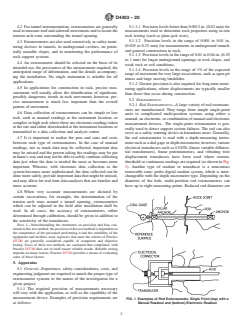
data just when the data is needed the most or becomes more threshold or continuous readings are required (as shown in Fig.
important. Whereas, with electronic data collection as the 1). Another type of readout or transducer is a noncontact
system becomes more sophisticated, the data collected can be removable sonic probe digital readout system, which is inter-
done more safely, provide important data that might be missed, changeable with the depth micrometer type. Depending on the
and may allow for real-time data analyses that are timelier and diameter of the hole, multi-position rod extensometers can
more accurate. have up to eight measuring points. Reduced rod diameters are
4.8 When very accurate measurements are dictated by
certain excavations, for example, the determination of the
tension arch zone around a tunnel opening, extensometers
which can be adjusted in the field after installation shall be
used. In all cases, the accuracy of extensometers, either
determined through calibration, should be given in addition to
the sensitivity of the transducers.
NOTE 1—Notwithstanding the statements on precision and bias con-
tainedinthistestmethod,theprecisionofthistestmethodisdependenton
the competence of the personnel performing it and the suitability of the
equipment and facilities used. Agencies that meet the criteria of Practice
D3740 are generally considered capable of competent and objective
testing. Users of these test methods are cautioned that compliance with
Practice D3740 does not in itself ensure reliable results. Reliable testing
depends on many factors; Practice D3740 provides a means of evaluating
some of those factors.
5. Apparatus
5.1 General—Experience, safety considerations, costs, and
engineering judgment are required to match the proper type of
extensometer systems to the nature of the investigation for a
given project.
5.1.1 The required precision of measurements necessary
will vary with the application, as well as the capability of the
measurement device. Examples of precision requirements are
FIG. 1 Examples of Rod Extensometer, Single Point (top) with a
as follows: Manual Readout and (bottom) Electronic Readout
D4403 − 20
required for multi-position instruments and have reportedly tensioning mechanism may be a spring-loading device or a
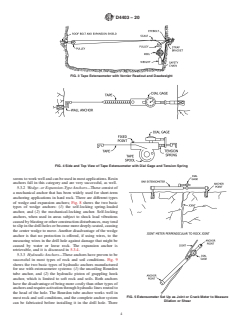
been used effectively to depths of at least 350 ft (107 m). The dead-weight (as shown in Fig. 3 and Fig. 4). The tape and
rod acts as a rigid member and must react in both tension and
readout head are fastened, or stretched in tension, between the
compression. When used in deep applications, friction caused pointstobemeasured.Accuraciesof0.010to0.002in.(0.25to
by drill hole misalignment and rod interference can cause
0.05 mm) can be expected, depending on the length of the tape
erroneous readings. Rods are usually constructed of some type
and the ability to tension the tape to the same value on
of stainless steel or fiberglass. To reduce temperature effects,
subsequentreadings,andprovidedthattemperaturecorrections
something that is typically an issue or concern, rods can be
are made when necessary.
constructed of invar steel, graphite, or composite carbon fiber.
5.2.4 Joint or Crack Meters—One type of a joint or crack
5.2.2 Bar Extensometers—Bar extensometers are generally
meters consists of an extensometer fixed across an exposed
used to measure diametric changes in tunnels. Most bar
rock surface containing a joint (as demonstrated in Fig. 5), and
extensometers consist of spring-loaded, telescopic tubes that
are used to measure displacements along or across joints. The
have fixed adjustment points to cover a range of several feet.
example shown here shows a dial gage, but it could be an
The fixed points are generally spaced at 1 to 4-in. (25 to
electronic or vibrating wire LVDT type transducer that mea-
100mm) increments. A dial gage is used to measure the
sures the displacement as well. The joint movements to be
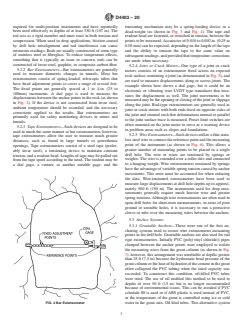
displacements between the anchor points in the rock (as shown
measuredmaybetheopeningorclosingofthejointorslippage
in Fig. 2). If the device is not constructed from invar steel,
along the joint. Rod-type extensometers are generally used as
ambient temperature should be recorded, and the necessary
joint or crack meters with both ends fixed on opposite sides of
corrections applied to the results. Bar extensometers are
the joint and situated such that deformations normal or parallel
primarily used for safety monitoring devices in mines and
to the joint surface trace is measured. Preset limit switches are
tunnels.
often mounted on the joint meter to serve as a warning device
5.2.3 Tape Extensometers—Such devices are designed to be
in problem areas such as slopes and foundations.
used in much the same manner as bar extensometers; however,
5.2.5 Wire Extensometers—Such devices utilize a thin stain-
tape extensometers allow the user to measure much greater
less steel wire to connect the reference point and the measuring
distances, such as found in large tunnels or powerhouse
point of the instrument (as shown in Fig. 6). This allows a
openings. Tape extensometers consist of a steel tape (prefer-
greater number of measuring points to be placed in a single
ably invar steel), a tensioning device to maintain constant
drill hole. The wire or wires are tensioned by springs or
tension, and a readout head. Lengths of tape may be pulled out
weights. The wire is extended over a roller shiv and connected
from the tape spool according to the need. The readout may be
to a hanging weight. Wire extensometers tensioned by springs
a dial gage, a vernier, or another suitable gage. and the
have the advantage of variable spring tension caused by anchor
movements. This error must be accounted for when reducing
the data. Wire-tensioned extensometers have been used to
measure large displacements at drill hole depths up to approxi-
mately 500 ft (150 m). The instruments used for deep mea-
surements generally require much heavier wire and greater
spring tensions.Although wire extensometers are often used in
open drill holes for short-term measurements, in areas of poor
ground or unstable holes, it is necessary to run a protective
sleeve or tube over the measuring wires between the anchors.
5.3 Anchor Systems:
5.3.1 Groutable Anchors—These were one of the first an-
choring systems used to secure wire extensometer measuring
points in the drill hole. Groutable anchors are also used for rod
type extensometers. Initially PVC (poly(vinyl chloride)) pipes
clamped between the anchor points were employed to isolate
the measuring wires from the grout column (as shown in Fig.
7), however, this arrangement was unreliable at depths greater
than 25 ft (7.5 m) because the hydrostatic head pressure of the
groutcolumnortheheatofhydrationofthecementinthegrout
often collapsed the PVC tubing when the rated capacity was
exceeded. To counteract this condition, oil-filled PVC tubes
were tried. The use of oil enabled this method to be used to
depths of over 50 ft (15 m) but is no longer recommended
because of environmental issues. This can be avoided if PVC
schedule 80 is used or if ABS plastic is used instead of PVC,
or the temperature of the grout is controlled using ice or cold
FIG. 2 Bar Extensometer water in the grout mix. Oil filed tubes. This alternative system
D4403 − 20
FIG. 3 Tape Extensometer with Vernier Readout and Deadweight
FIG. 4 Side and Top View of Tape Extensometer with Dial Gage and Tension Spring
seemstoworkwellandcanbeusedinmostapplications.Resin
anchors fall in this category and are very successful, as well.
5.3.2 Wedge- or Expansion-Type Anchors—These consist of
a mechanical anchor that has been widely used for short-term
anchoring applications in hard rock. There are different types
of wedge and expansion anchors; Fig. 8 shows the two basic
types of wedge anchors: (1) the self-locking spring-loaded
anchor, and (2) the mechanical-locking anchor. Self-locking
anchors, when used in areas subject to shock load vibrations
causedbyblastingorotherconstructiondisturbances,maytend
to slip in the drill holes or become more deeply-seated, causing
the center wedge to move.Another disadvantage of the wedge
anchor is that no protection is offered, if using wires, to the
measuring wires in the drill hole against damage that might be
caused by water or loose rock. The expansion anchor is
retrievable, and it is discussed in 5.3.4.
5.3.3 Hydraulic Anchors—These anchors have proven to be
successful in most types of rock and soil conditions. Fig. 9
shows the two basic types of hydraulic anchors manufactured
for use with extensometer systems: (1) the uncoiling Bourdon
tube anchor, and (2) the hydraulic piston of grappling hook
anchor, which is limited to soft rock and soils. Both anchors
have the disadvantage of being more costly than other types of
anchorsandrequireactivationthroughhydrauliclinesroutedto
the head of the hole. The Bourdon tube anchor works well in
FIG. 5 Extensometer Set Up as Joint or Crack Meter to Measure
most rock and soil conditions, and the complete anchor system
Dilation or Shear
can be fabricated before installing it in the drill hole. There
D4403 − 20
of setting rods, and then a cord is pulled to remove the locking
pin, which allows two retaining rings on each anchor to snap
outward and grip the borehole. Up to eight anchors can be
installed at various depths in a 3-in. (76 mm) diameter
borehole. Particularly useful in upward-directed boreholes.
Anchors can only be used with rigid rods and are not likely
affected by blasting.
5.3.6 PackerAnchor—Thistypeofextensometeranchorisa
solution for where it is important that the surrounding strata
between anchors are not affected by grout. The borehole
between each anchor is therefore left open or filled with
compressiblematerialresultingintheanchorsbeinginsensitive
to shear displacements. This not only ensures no interference
but also reduces the amount of grout needed in comparison to
grout able anchors. Packer anchors can be used in rock or soils.
The anchor employs a geotextile bladder that is inflated with
grout. The geotextile allows water to go thru but retain all
solids. Once the grout sets, it forms an effective and stable
anchor.
NOTE 2—There have been other specialized anchor systems developed;
however, these systems have proven to be too costly and unsuccessful for
most applications.
5.4 Extensometer Transducers—These extensometers con-
vert displacements occurring in in situ materials between two
FIG. 6 Wire Extensometers
anchored points to mechanical movements that can be mea-
sured with conventional measuring devices such as dial gages,
LVDTs, strain gages, and the like.
have been other specialized anchor systems developed;
however, these systems have proven to be too costly and 5.4.1 Depth-Measuring Instruments—A dialgage,ora
unsuccessful for most applications.
depth micrometer are the simplest and most commonly used
5.3.4 Retrievable Anchors (see Fig. 10)—These can be a mechanical measuring instruments. Used in conjunction with
mechanical or hydraulic/pneumatic anchor.
extensometers,theyprovidethecheapestandsurestmethodsof
5.3.4.1 The special design of the mechanical anchor allows making accurate measurements. When using the dial gage or
complete system retrievability. The mechanical anchor dis-
depth micrometer, the operator is required to take readings at
cussed here consists of a cylindrical body and three contacting the instrument head; however, local readings may not be
shoes spaced at 120° angle that isis in a collapse configuration
practical or possible due to the instrument location or area
that is smaller than the borehole diameter. Using the installa- conditions.
tion tool and rods, the anchor is placed in the drill hole to the
5.4.2 Electrical Transducers—For remote or continuous
depth required. The anchor is spring-loaded and is actuated
readings, electrical transducers are used rather than dial gages.
from the collar of the hole, and the shoes make immediate
Vibrating Wire Displacement Transducers (VWDT) are often
contact with the borehole walls. The central screw is then
used because of their accuracy, small size, and availability
turned to exert a radial force from the shoes to the drill hole
however, LVDT, potentiometer, and sonic readouts are or have
wall. The anchoring capacity is very high, and the contacting
been used. The advantage of VWDT is that they are very
shoes are designed to adjust to small borehole deformations
stable, can be connected to very long signal cables (1 km+) if
while still exerting the anchoring force. This process is
needed,
...
This document is not an ASTM standard and is intended only to provide the user of an ASTM standard an indication of what changes have been made to the previous version. Because
it may not be technically possible to adequately depict all changes accurately, ASTM recommends that users consult prior editions as appropriate. In all cases only the current version
of the standard as published by ASTM is to be considered the official document.
Designation: D4403 − 12 D4403 − 20
Standard Practice for
Extensometers Used in Rock
This standard is issued under the fixed designation D4403; the number immediately following the designation indicates the year of
original adoption or, in the case of revision, the year of last revision. A number in parentheses indicates the year of last reapproval. A
superscript epsilon (´) indicates an editorial change since the last revision or reapproval.
1. Scope*
1.1 This practice covers the description, application, selection, installation, data collecting, and data reduction of the various
types of contact type extensometers used in the field of rock mechanics. Laser or other non-contact extensometers are not covered
here.
1.2 Limitations of each type of extensometer system are covered in Section 5.
1.3 The values stated in inch-pound units are to be regarded as the standard. The SI values given in parentheses are mathematical
conversions to SI units that are provided for information purposes only.only and are not considered standard. Add if appropriate,
“Reporting of test results in units other than inch-pound shall not be regarded as nonconformance with this standard.
1.4 All observed and calculated values shall conform to the guidelines for significant digits and rounding established in Practice
D6026.
1.4.1 The procedures used to specify how data are collected/recorded or calculated in this standard are regarded as the industry
standard. In addition, they are representative of the significant digits that generally should be retained. The procedures used do not
consider material variation, purpose for obtaining the data, special purpose studies, or any considerations for the user’s objectives;
and it is common practice to increase or reduce significant digits of reported data to be commensurate with these considerations.
It is beyond the scope of this standard to consider significant digits used in analysis methods for engineering design.
1.5 The text of this standard references notes and footnotes which provide explanatory material. These notes and footnotes
(excluding those in tables and figures) shall not be considered as requirements of the standard.
1.6 This practice offers a set of instructions for performing one or more specific operations. This document cannot replace
education or experience and should be used in conjunction with professional judgement.judgment. Not all aspects of this guide may
be applicable in all circumstances. This ASTM standard is not intended to represent or replace the standard of care by which the
adequacy of a given professional service must be judged, nor should this document be applied without consideration of a project’s
many unique aspects. The word “Standard” in the title of this document means only that the document has been approved through
the ASTM consensus process.
1.7 This standard does not purport to address all of the safety concerns, if any, associated with its use. It is the responsibility
of the user of this standard to establish appropriate safety safety, health, and healthenvironmental practices and determine the
applicability of regulatory limitations prior to use.
1.8 This international standard was developed in accordance with internationally recognized principles on standardization
established in the Decision on Principles for the Development of International Standards, Guides and Recommendations issued
by the World Trade Organization Technical Barriers to Trade (TBT) Committee.
2. Referenced Documents
2.1 ASTM Standards:
D653 Terminology Relating to Soil, Rock, and Contained Fluids
D3740 Practice for Minimum Requirements for Agencies Engaged in Testing and/or Inspection of Soil and Rock as Used in
Engineering Design and Construction
D6026 Practice for Using Significant Digits in Geotechnical Data
This practice is under the jurisdiction of ASTM Committee D18 on Soil and Rock and is the direct responsibility of Subcommittee D18.23 on Field Instrumentation.
Current edition approved Aug. 15, 2012Jan. 1, 2020. Published November 2012March 2020. Originally approved in 1984. Last previous edition approved in 20052012
as D4403–84(2005).D4403–12. DOI: 10.1520/D4403-12.10.1520/D4403-20.
For referenced ASTM standards, visit the ASTM website, www.astm.org, or contact ASTM Customer Service at service@astm.org. For Annual Book of ASTM Standards
volume information, refer to the standard’s Document Summary page on the ASTM website.
*A Summary of Changes section appears at the end of this standard
Copyright © ASTM International, 100 Barr Harbor Drive, PO Box C700, West Conshohocken, PA 19428-2959. United States
D4403 − 20
3. Terminology
3.1 Definitions—Terms not defined below may appear in Terminology D653.
3.2 Definitions of terms specific to this standard are included in Section 5.
4. Significance and Use
4.1 Extensometers are widely used in the field of engineering and include most devices used to measure displacements,
separation, settlements, convergence, and the like.
4.2 For tunnel instrumentation, extensometers are generally used to measure roof and sidewall movements and to locate the
tension arch zone surrounding the tunnel opening.
4.3 Extensometers are also used extensively as safety monitoring devices in tunnels, in underground cavities, on potentially
unstable slopes, and in monitoring the performance of rock support systems.
4.4 An extensometer should be selected on the basis of its intended use, the preciseness of the measurement required, the
anticipated range of deformation, and the details accompanying the installation. No single instrument is suitable for all
applications.
4.5 In applications for construction in rock, precise measurements will usually allow the identification of significant, possibly
dangerous, trends in rock movement; however, precise measurement is much less important than the overall pattern of movement.
4.6 Data collection of extensometers can be simple or low tech, such as manual readings at the instrument location, or complex
or high tech where there are electronic readings taken at the site and either downloaded at the instrument locations or transmitted
to a data collection and analysis center.
4.7 It is important to realize the pros and cons and costs between each type of extensometers. In the case of manual readings,
not as much data may be collected, important data may be missed and the person taking the readings may be put in harm’s way
and may not be able to safely continue collecting data just when the data is needed the most or becomes more important. Whereas,
with electronic data collection as the system becomes more sophisticated, the data collected can be done more safely, provide
important data that might be missed, and may allow for real-time data analyses that are timelier and more accurate.
4.8 When very accurate measurements are dictated by certain excavations, for example, the determination of the tension arch
zone around a tunnel opening, extensometers which can be adjusted in the field after installation shall be used. In all cases, the
accuracy of extensometers, either determined through calibration, should be given in addition to the sensitivity of the transducers.
NOTE 1—Notwithstanding the statements on precision and bias contained in this test method, the precision of this test method is dependent on the
competence of the personnel performing it and the suitability of the equipment and facilities used. Agencies that meet the criteria of Practice D3740 are
generally considered capable of competent and objective testing. Users of these test methods are cautioned that compliance with Practice D3740 does
not in itself ensure reliable results. Reliable testing depends on many factors; Practice D3740 provides a means of evaluating some of those factors.
5. Apparatus
5.1 General—Experience Experience, safety considerations, costs, and engineering judgment are required to match the proper
type of extensometer systems to the nature of the investigation for a given project.
5.1.1 In applications for construction in rock, precise measurements will usually allow the identification of significant, possibly
dangerous, trends in rock movement; however, precise measurement is much less important than the overall pattern of movement.
Where measurements are used to determine rock properties (such as in plate-jack tests), accurate measurements involving a high
degree of precision are required. For in-situ rock testing, instrument sensitivity better than 0.0012 in. (0.02 mm) is necessary for
proper interpretation.
5.1.1 Most field measurements related to construction in rock do not require the precision of in-situ testing. Precision in the
range of 0.001 to 0.01 in. (0.025 to 0.25 mm) is typically required and is readily obtainable by several instruments.The required
precision of measurements necessary will vary with the application, as well as the capability of the measurement device. Examples
of precision requirements are as follows:
5.1.1.1 Precision levels better than 0.0012 in. (0.02 mm) for measurements used to determine rock properties using in-situ rock
testing (such as plate-jack tests),
5.1.1.2 Precision levels in the range of 0.001 to 0.01 in. (0.025 to 0.25 mm) for measurements in underground tunnels and
general construction in rock,
5.1.1.3 Precision levels in the range of 0.01 to 0.04 in. (0.25 to 1 mm) for larger underground openings or rock slopes, and weak
rock or soil conditions,
5.1.1.4 Precision levels in the range of 1% of the expected range of movement for very large excavations, such as open pit mines
and large moving landslides.
5.1.3 As the physical size of an underground structure or slope increases, the need for highly precise measurements diminishes.
A precision of 0.01 to 0.04 in. (0.25 to 1.0 mm) is often sufficient. This range of precision is applicable to underground construction
in soil or weak rock. In most hard rock applications, however, an instrument sensitivity on the order of 0.001 in. (0.025 mm) is
preferred.
D4403 − 20
5.1.4 The least precision is required for very large excavations, such as open pit mines and large moving landslides. In such
cases, the deformations are large before failure and, thus, relatively coarse precision is required, on the order of 1 % of the range
where the range may be 3 ft. (1 m) or more.
5.1.2 For long-term monitoring, Greater precision is also required for long-term monitoring applications, where displacements
are typically smaller than those that occur during construction. Therefore, greater precision may be required for the long-term
measurements.
5.2 Extensometers:
5.2.1 Rod Extensometers—A large variety of rod extensometers are manufactured. They range from simple single-point units
to complicated multipoint systems with electrical readout. multi-position systems using either a manual, an electronic, or
combination of manual and electronic measurement devices. The single-point extensometer is generally used to detect support
system failures. The rod can also serve as a safety warning device in hazardous areas. Generally, the rod extensometer is read with
a depth-measuring instrument such as a dial gage or depth micrometer, however, various electrical transducers such as LVDTs
(linear variable differential transformers), linear potentiometers, and microswitches vibrating wire displacement transducers have
been used where remote remote, threshold or continuous readings are required (as shown in Fig. 1). Another type of readout
recently developedor transducer is a noncontact removable sonic probe digital readout system, which is interchangeable with the
depth micrometer type. Multipoint rod extensometers Depending on the diameter of the hole, multi-position rod extensometers can
have up to eight measuring points. Reduced rod diameters are required for multipointmulti-position instruments and have
reportedly been used effectively to depths of at least 150350 ft (45(107 m). The rod acts as a rigid member and must react in both
tension and compression. When used in deep applications, friction caused by drill hole misalignment and rod interference can cause
erroneous readings. Rods are usually constructed of some type of stainless steel or fiberglass. To reduce temperature effects,
something that is typically an issue or concern, rods can be constructed of invar steel, graphite, or composite carbon fiber.
5.2.2 Bar Extensometers—Bar extensometers are generally used to measure diametric changes in tunnels. Most bar
extensometers consist of spring-loaded, telescopic tubes that have fixed adjustment points to cover a range of several feet. The fixed
points are generally spaced at 1 to 4-in. (25 to 100-mm)100mm) increments. A dial gage is used to measure the displacements
between the anchor points in the rock (as shown in Fig. 2). If the device is not constructed from invar steel, ambient temperature
should be recorded, and the necessary corrections applied to the results. Bar extensometers are primarily used for safety monitoring
devices in mines and tunnels.
5.2.3 Tape Extensometers—Such devices are designed to be used in much the same manner as bar extensometers,extensometers;
however, tape extensometers allow the user to measure much greater distances, such as found in large tunnels or powerhouse
openings. Tape extensometers consist of a steel tape (preferably invar steel), a tensioning device to maintain constant tension, and
a readout head. Lengths of tape may be pulled out from the tape spool according to the need. The readout may be a dial gage or
gage, a vernier, or another suitable gage. and the tensioning mechanism may be a spring-loading device or a dead-weight (as shown
in Fig. 3 and Fig. 4). The tape and readout head are fastened, or stretched in tension, between the points to be measured. Accuracies
of 0.010 to 0.002 in. (0.25 to 0.05 mm) can be expected, depending on the length of the tape and the ability to tension the tape
to the same value on subsequent readings, and provided that temperature corrections are made when necessary.
FIG. 1 Rod ExtensometerExamples of Rod Extensometer, Single Point (top) with a Manual Readout and (bottom) Electronic Readout
D4403 − 20
FIG. 2 Bar Extensometer
5.2.4 Joint or Crack Meters—Normally, joint meters consistOne type of a joint or crack meters consists of an extensometer fixed
across thean exposed rock surface ofcontaining a joint (as demonstrated in Fig. 5), and are used to measure displacements along
or across joints. The example shown here shows a dial gage, but it could be an electronic or vibrating wire LVDT type transducer
that measures the displacement as well. The joint movements to be measured may be the opening or closing of the joint or slippage
along the joint. Rod-type extensometers are generally used as joint or crack meters with both ends fixed across the joint. on
opposite sides of the joint and situated such that deformations normal or parallel to the joint surface trace is measured. Preset limit
switches are often mounted on the joint meter to serve as a warning device in problem areas such as slopes and foundations.
5.2.5 Wire Extensometers—Such devices utilize a thin stainless steel wire to connect the reference point and the measuring point
of the instrument (as shown in Fig. 6). This allows a greater number of measuring points to be placed in a single drill hole. The
wire or wires are tensioned by springs or weights. The wire is extended over a roller shiv and connected to a hanging weight. Wire
extensometers tensioned by springs have the advantage of variable spring tension caused by anchor movements. This error must
be accounted for when reducing the data. Wire-tensioned extensometers have been used to measure large displacements at drill
hole depths up to approximately 500 ft (150 m). The instruments used for deep measurements generally require much heavier wire
and greater spring tensions. Although wire extensometers are often used in open drill holes for short-term measurements, in areas
of poor ground or unstable holes, it is necessary to run a protective sleeve or tube over the measuring wires between the anchors.
5.3 Anchor Systems:
5.3.1 Groutable Anchors—These were one of the first anchoring systems used to secure wire extensometer measuring points in
the drill hole. Groutable anchors are also used for rod type extensometers. Initially PVC (poly(vinyl chloride)) pipes clamped
between the anchor points were employed to isolate the measuring wires from the grout column (as shown in Fig. 7), however,
this arrangement was unreliable at depths greater than 25 ft (7.5 m) because the hydrostatic head pressure of the grout column or
the heat of hydration of the cement in the grout often collapsed the PVC tubing. tubing when the rated capacity was exceeded.
To counteract this condition, oil-filled PVC tubes were tried. The use of oil enabled this method to be used to depths of over 50
ft (15 m). As an alternative to this system, liquid-tight flexible steel conduit is used to replace the PVC pipe. m) but is no longer
recommended because of environmental issues. This can be avoided if PVC schedule 80 is used or if ABS plastic is used instead
of PVC, or the temperature of the grout is controlled using ice or cold water in the grout mix. Oil filed tubes. This alternative
system seems to work well and can be used in most applications. Resin anchors fall in this category and are very
successful.successful, as well.
5.3.2 Wedge-Type Wedge- or Expansion-Type Anchors—These consist of a mechanical anchor that has been widely used for
short-term anchoring applications in hard rock. There are different types of wedge and expansion anchors; Fig. 8 shows the two
D4403 − 20
FIG. 3 Tape Extensometer with Vernier Readout and Deadweight
FIG. 4 Side and Top View of Tape Extensometer with Dial Gage and Tension Spring
FIG. 5 Joint MetersExtensometer Set Up as Joint or Crack Meter
to Measure Dilation or Shear
D4403 − 20
FIG. 6 Wire Extensometers
basic types of wedge anchors: (1) the self-locking spring-loaded anchor, and (2) the mechanical-locking anchor. Self-locking
anchors, when used in areas subject to shock load vibrations caused by blasting or other construction disturbances, may tend to
slip in the drill holes or become more deeply-seated, causing the center wedge to move. Another disadvantage of the wedge anchor
is that no protection is offered, if using wires, to the measuring wires in the drill hole against damage that might be caused by water
or loose rock. The expansion anchor is retrievable, and it is discussed in 5.3.4.
5.3.3 Hydraulic Anchors—These anchors have proven to be successful in most types of rock and soil conditions. Fig. 9 shows
the two basic types of hydraulic anchors manufactured for use with extensometer systems: (1) the uncoiling Bourdon tube anchor,
and (2) the hydraulic piston of grappling hook anchor, which is limited to soft rock and soils. Both anchors have the disadvantage
of being rather costly. more costly than other types of anchors and require activation through hydraulic lines routed to the head
of the hole. The Bourdon tube anchor works well in most rock and soil conditions, and the complete anchor system can be
fabricated before installing it in the drill hole. There have been other specialized anchor systems developed,developed; however,
these systems have proven to be too costly and unsuccesfulunsuccessful for most applications.
5.3.4 Retrievable Anchors (see Fig. 10)—These can be a mechanical or hydraulic/pneumatic anchor.
5.3.4.1 The special design of the mechanical anchor allows complete system retrievability. The mechanical anchor discussed
here consists of a cylindrical body and three contacting shoes spaced at 120° angle that isis in a collapse configuration that is
smaller than the borehole diameter. Using the installation tool and rods, the anchor is placed in the drill hole to the depth required.
The anchor is spring-loaded and is actuated from the collar of the hole, and the shoes make immediate contact with the borehole
walls. The central screw is then turned to exert a radial force from the shoes to the drill hole wall. The anchoring capacity is very
high, and the contacting shoes are designed to adjust to small borehole deformations while still exerting the anchoring force. This
process is reversed to then remove the anchors one at a time, starting from closest anchor to the borehole collar.
5.3.4.2 For the retrievable hydraulic anchor the string of sensors is assembled (with variable lengths of connecting rods to enable
positioning of the anchors at the required depths), inserted into the pipe or borehole, and then locked in position by pneumatically
or hydraulically actuating the various anchors, which remain fully expanded throughout the monitoring period. When monitoring
has been completed, the pressure is released, which retracts the anchor pistons and allows removal of the string for further use.
5.3.5 Snap Ring Anchors (see Fig. 11)—This type of anchor is quickly and easily installed in boreholes in hard or competent
rock. Anchors are pushed to the required depth on the end of setting rods, and then a cord is pulled to remove the locking pin, which
allows two retaining rings on each anchor to snap outward and grip the borehole. Up to eight anchors can be installed at various
depths in a 3-in. (76 mm) diameter borehole. Particularly useful in upward-directed boreholes. Anchors can only be used with rigid
rods and are not likely affected by blasting.
5.3.6 Packer Anchor—This type of extensometer anchor is a solution for where it is important that the surrounding strata
between anchors are not affected by grout. The borehole between each anchor is therefore left open or filled with compressible
material resulting in the anchors being insensitive to shear displacements. This not only ensures no interference but also reduces
D4403 − 20
FIG. 7 Grouted Anchor System
FIG. 8 Wedge Anchors
the amount of grout needed in comparison to grout able anchors. Packer anchors can be used in rock or soils. The anchor employs
a geotextile bladder that is inflated with grout. The geotextile allows water to go thru but retain all solids. Once the grout sets, it
forms an effective and stable anchor.
NOTE 2—There have been other specialized anchor systems developed; however, these systems have proven to be too costly and unsuccessful for most
applications.
5.4 Extensometer Transducers—These extensometers convert displacements occurring in in-situ in situ materials between two
anchored points to mechanical movements that can be measured with conventional measuring devices such as dial gages, LVDTs,
strain gages, and the like.
5.4.1 Depth-Measuring Instruments—A dial gage, or a depth micrometer are the simplest and most commonly used mechanical
measuring instruments. Used in conjunction with extensometers, they provide the cheapest and surest methods of making accurate
measurements. When using the dial gage or depth micrometer, the operator is required to take readings at the instrument head,head;
however, local readings may not be practical or possi
...