

ASTM D7940-21
(Practice)Standard Practice for Analysis of Liquefied Natural Gas (LNG) by Fiber-Coupled Raman Spectroscopy
General Information
- Abstract
SIGNIFICANCE AND USE
5.1 The composition of liquefied gaseous fuels (LNG, LPG) is important for custody transfer and production. Compositional determination is used to calculate the heating value, and it is important to ensure regulatory compliance. Compositional determination is also used to optimize the efficiency of liquefied hydrocarbon gas production and ensure the quality of the processed fluids.
5.2 Alternatives to compositional measurement using Raman spectroscopy are described in Test Method D1945, Practice D1946, and Test Method D7833.
5.3 The advantage of this practice over other standards stated in 5.2, is that Raman spectroscopy can determine composition by directly measuring the liquefied natural gas. Unlike chromatography, no vaporization step is necessary. Since incorrect operation of on-line vaporizers can lead to poor precision and accuracy, elimination of the vaporization step offers a significant improvement in the analysis of LNG.
SCOPE
1.1 This practice is for both on-line and laboratory instrument-based determination of composition for liquefied natural gas (LNG) using Raman spectroscopy. Although the procedures in this practice refer specifically to liquids, the basic methodology can also be applied to other light hydrocarbon mixtures in either liquid or gaseous states, provided the data quality objectives and measurement needs are met. From the composition, gas properties such as heating value and the Wobbe index may be calculated. The components commonly determined according to this test method are CH4, C2H6, C3H8, i-C4H10, n-C4H10, iC5H12, n-C5H12. Components heavier than C5 are not measured as part of this practice.
Note 1: Raman spectroscopy does not directly quantify the component percentages of noble gases; however, inert substances can be calculated indirectly by subtracting the sum of the other species from 100 %.
1.2 Units—The values stated in SI units are to be regarded as standard. No other units of measurement are included in this standard.
1.3 This standard does not purport to address all of the safety concerns, if any, associated with its use. It is the responsibility of the user of this standard to establish appropriate safety, health, and environmental practices and determine the applicability of regulatory limitations prior to use.
1.4 This international standard was developed in accordance with internationally recognized principles on standardization established in the Decision on Principles for the Development of International Standards, Guides and Recommendations issued by the World Trade Organization Technical Barriers to Trade (TBT) Committee.
- Status
- Published
- Publication Date
- 31-Oct-2021
- Technical Committee
- D03 - Gaseous Fuels
- Drafting Committee
- D03.12 - On-Line/At-Line Analysis of Gaseous Fuels
Buy Documents
ASTM D7940-21 - Standard Practice for Analysis of Liquefied Natural Gas (LNG) by Fiber-Coupled Raman Spectroscopy
REDLINE ASTM D7940-21 - Standard Practice for Analysis of Liquefied Natural Gas (LNG) by Fiber-Coupled Raman Spectroscopy
Overview
ASTM D7940-21: Standard Practice for Analysis of Liquefied Natural Gas (LNG) by Fiber-Coupled Raman Spectroscopy details the methodology for determining the composition of LNG using fiber-optic based Raman spectroscopy. By directly analyzing the liquid phase, this practice targets both on-line (in situ) and laboratory settings, enabling users in the oil and gas industry to accurately quantify the primary components of LNG without the need for vaporization. The composition can then be used to calculate key properties such as heating value and Wobbe index, both critical for custody transfer, production optimization, and regulatory compliance.
Key Topics
Compositional Analysis Without Vaporization
Unlike traditional techniques like gas chromatography, Raman spectroscopy allows for direct measurement of LNG in its liquid state, eliminating errors and inefficiencies associated with sample vaporization.Quantification of Major Hydrocarbons
The method enables reliable detection and measurement of key hydrocarbons including methane (CH₄), ethane (C₂H₆), propane (C₃H₈), isobutane (i-C₄H₁₀), n-butane (n-C₄H₁₀), isopentane (iC₅H₁₂), and n-pentane (n-C₅H₁₂). Components heavier than C₅ are out of scope.Calculation of Physical Gas Properties
From the compositional data, end-users can accurately determine crucial gas properties:- Heating value
- Wobbe index
- Density
- Other relevant indices based on standardized calculations
Instrument Calibration and Validation
The practice addresses the importance of wavelength and intensity calibration using reference light sources and validated procedures, ensuring ongoing measurement accuracy.Safety and Installation Considerations
Emphasizes the need for compliance with health, safety, and regulatory standards during probe installation and instrument operation, especially given the high pressure, cryogenic temperatures, and potential for explosive atmospheres.
Applications
Energy Content Determination for Custody Transfer
Accurate LNG composition measurement is fundamental for billing and regulatory reporting during transfer of ownership.Production Optimization and Quality Assurance
Real-time or laboratory-based monitoring supports process optimization, quality control, and assurance of product specifications.Regulatory Compliance
Direct analysis helps operators meet international and regional standards for LNG composition and energy content, vital for import/export and taxation.On-Line and Laboratory Measurement
The standard applies to both continuous process analyzers and discrete laboratory analyses, providing flexibility of use.
Related Standards
ASTM D7940-21 references several key international and industry standards to support its methodology and ensure consistency with best practices:
ASTM D1945, D1946, D7833
Traditional gas chromatographic methods for analyzing hydrocarbon gases.ASTM D3588
Practice for calculating heating value, compressibility factor, and relative density of gaseous fuels.ASTM E691
Practice for conducting interlaboratory studies to determine the precision of a test method.ISO 6974-5, ISO 6976:2016(E)
International standards for natural gas composition and calculation of calorific values and related physical properties.BS EN 60079-28, BS EN 60825-1
European standards for optical radiation equipment safety and laser product classification.
Practical Value
By adopting ASTM D7940-21, LNG operators benefit from:
- Improved measurement accuracy and repeatability over techniques requiring vaporization
- Reduced operational complexity and potential for error
- Enhanced capability for in-situ analysis, rapid decision-making, and regulatory compliance
- Alignment with global best practices and supporting standards for LNG analysis
Keywords: LNG analysis, Raman spectroscopy, ASTM D7940-21, LNG composition, custody transfer, natural gas quality, energy content, hydrocarbon quantification, on-line analysis, laboratory practice, gas measurement standards.
Relations
- Effective Date
- 15-Dec-2019
- Effective Date
- 01-Jul-2016
- Effective Date
- 01-Nov-2015
- Effective Date
- 01-May-2013
- Effective Date
- 01-Nov-2012
- Effective Date
- 01-Nov-2011
- Effective Date
- 01-Nov-2011
- Effective Date
- 01-Nov-2011
- Effective Date
- 01-Jan-2010
- Effective Date
- 01-Dec-2008
- Effective Date
- 01-Oct-2008
- Effective Date
- 01-Jun-2006
- Effective Date
- 01-Nov-2005
- Effective Date
- 10-Aug-2003
- Effective Date
- 10-May-2003
Buy Documents
ASTM D7940-21 - Standard Practice for Analysis of Liquefied Natural Gas (LNG) by Fiber-Coupled Raman Spectroscopy
REDLINE ASTM D7940-21 - Standard Practice for Analysis of Liquefied Natural Gas (LNG) by Fiber-Coupled Raman Spectroscopy
Get Certified
Connect with accredited certification bodies for this standard

Element Materials Technology
Materials testing and product certification.

ABS Group Brazil
ABS Group certification services in Brazil.

ABS Quality Evaluations Inc.
American Bureau of Shipping quality certification.
Sponsored listings
Frequently Asked Questions
ASTM D7940-21 is a standard published by ASTM International. Its full title is "Standard Practice for Analysis of Liquefied Natural Gas (LNG) by Fiber-Coupled Raman Spectroscopy". This standard covers: SIGNIFICANCE AND USE 5.1 The composition of liquefied gaseous fuels (LNG, LPG) is important for custody transfer and production. Compositional determination is used to calculate the heating value, and it is important to ensure regulatory compliance. Compositional determination is also used to optimize the efficiency of liquefied hydrocarbon gas production and ensure the quality of the processed fluids. 5.2 Alternatives to compositional measurement using Raman spectroscopy are described in Test Method D1945, Practice D1946, and Test Method D7833. 5.3 The advantage of this practice over other standards stated in 5.2, is that Raman spectroscopy can determine composition by directly measuring the liquefied natural gas. Unlike chromatography, no vaporization step is necessary. Since incorrect operation of on-line vaporizers can lead to poor precision and accuracy, elimination of the vaporization step offers a significant improvement in the analysis of LNG. SCOPE 1.1 This practice is for both on-line and laboratory instrument-based determination of composition for liquefied natural gas (LNG) using Raman spectroscopy. Although the procedures in this practice refer specifically to liquids, the basic methodology can also be applied to other light hydrocarbon mixtures in either liquid or gaseous states, provided the data quality objectives and measurement needs are met. From the composition, gas properties such as heating value and the Wobbe index may be calculated. The components commonly determined according to this test method are CH4, C2H6, C3H8, i-C4H10, n-C4H10, iC5H12, n-C5H12. Components heavier than C5 are not measured as part of this practice. Note 1: Raman spectroscopy does not directly quantify the component percentages of noble gases; however, inert substances can be calculated indirectly by subtracting the sum of the other species from 100 %. 1.2 Units—The values stated in SI units are to be regarded as standard. No other units of measurement are included in this standard. 1.3 This standard does not purport to address all of the safety concerns, if any, associated with its use. It is the responsibility of the user of this standard to establish appropriate safety, health, and environmental practices and determine the applicability of regulatory limitations prior to use. 1.4 This international standard was developed in accordance with internationally recognized principles on standardization established in the Decision on Principles for the Development of International Standards, Guides and Recommendations issued by the World Trade Organization Technical Barriers to Trade (TBT) Committee.
SIGNIFICANCE AND USE 5.1 The composition of liquefied gaseous fuels (LNG, LPG) is important for custody transfer and production. Compositional determination is used to calculate the heating value, and it is important to ensure regulatory compliance. Compositional determination is also used to optimize the efficiency of liquefied hydrocarbon gas production and ensure the quality of the processed fluids. 5.2 Alternatives to compositional measurement using Raman spectroscopy are described in Test Method D1945, Practice D1946, and Test Method D7833. 5.3 The advantage of this practice over other standards stated in 5.2, is that Raman spectroscopy can determine composition by directly measuring the liquefied natural gas. Unlike chromatography, no vaporization step is necessary. Since incorrect operation of on-line vaporizers can lead to poor precision and accuracy, elimination of the vaporization step offers a significant improvement in the analysis of LNG. SCOPE 1.1 This practice is for both on-line and laboratory instrument-based determination of composition for liquefied natural gas (LNG) using Raman spectroscopy. Although the procedures in this practice refer specifically to liquids, the basic methodology can also be applied to other light hydrocarbon mixtures in either liquid or gaseous states, provided the data quality objectives and measurement needs are met. From the composition, gas properties such as heating value and the Wobbe index may be calculated. The components commonly determined according to this test method are CH4, C2H6, C3H8, i-C4H10, n-C4H10, iC5H12, n-C5H12. Components heavier than C5 are not measured as part of this practice. Note 1: Raman spectroscopy does not directly quantify the component percentages of noble gases; however, inert substances can be calculated indirectly by subtracting the sum of the other species from 100 %. 1.2 Units—The values stated in SI units are to be regarded as standard. No other units of measurement are included in this standard. 1.3 This standard does not purport to address all of the safety concerns, if any, associated with its use. It is the responsibility of the user of this standard to establish appropriate safety, health, and environmental practices and determine the applicability of regulatory limitations prior to use. 1.4 This international standard was developed in accordance with internationally recognized principles on standardization established in the Decision on Principles for the Development of International Standards, Guides and Recommendations issued by the World Trade Organization Technical Barriers to Trade (TBT) Committee.
ASTM D7940-21 is classified under the following ICS (International Classification for Standards) categories: 75.060 - Natural gas. The ICS classification helps identify the subject area and facilitates finding related standards.
ASTM D7940-21 has the following relationships with other standards: It is inter standard links to ASTM D4150-19, ASTM D4150-08(2016), ASTM D1946-90(2015)e1, ASTM E691-13, ASTM D7833-12, ASTM E691-11, ASTM D1946-90(2011), ASTM D3588-98(2011), ASTM D1945-03(2010), ASTM D4150-08, ASTM E691-08, ASTM D1946-90(2006), ASTM E691-05, ASTM D4150-03, ASTM D1945-03. Understanding these relationships helps ensure you are using the most current and applicable version of the standard.
ASTM D7940-21 is available in PDF format for immediate download after purchase. The document can be added to your cart and obtained through the secure checkout process. Digital delivery ensures instant access to the complete standard document.
Standards Content (Sample)
This international standard was developed in accordance with internationally recognized principles on standardization established in the Decision on Principles for the
Development of International Standards, Guides and Recommendations issued by the World Trade Organization Technical Barriers to Trade (TBT) Committee.
Designation:D7940 −21
Standard Practice for
Analysis of Liquefied Natural Gas (LNG) by Fiber-Coupled
Raman Spectroscopy
This standard is issued under the fixed designation D7940; the number immediately following the designation indicates the year of
original adoption or, in the case of revision, the year of last revision. A number in parentheses indicates the year of last reapproval. A
superscript epsilon (´) indicates an editorial change since the last revision or reapproval.
1. Scope 2. Referenced Documents
1.1 This practice is for both on-line and laboratory 2.1 ASTM Standards:
instrument-based determination of composition for liquefied D1945 Test Method for Analysis of Natural Gas by Gas
natural gas (LNG) using Raman spectroscopy. Although the Chromatography
procedures in this practice refer specifically to liquids, the D1946 Practice for Analysis of Reformed Gas by Gas
basic methodology can also be applied to other light hydrocar- Chromatography
bon mixtures in either liquid or gaseous states, provided the D3588 Practice for Calculating Heat Value, Compressibility
data quality objectives and measurement needs are met. From Factor, and Relative Density of Gaseous Fuels
the composition, gas properties such as heating value and the D4150 Terminology Relating to Gaseous Fuels
Wobbe index may be calculated. The components commonly D7833 Test Method for Determination of Hydrocarbons and
determinedaccordingtothistestmethodareCH ,C H ,C H , Non-Hydrocarbon Gases in Gaseous Mixtures by Gas
4 2 6 3 8
i-C H , n-C H ,iC H , n-C H . Components heavier than Chromatography
4 10 4 10 5 12 5 12
C5 are not measured as part of this practice. E691 Practice for Conducting an Interlaboratory Study to
Determine the Precision of a Test Method
NOTE1—Ramanspectroscopydoesnotdirectlyquantifythecomponent
percentages of noble gases; however, inert substances can be calculated 2.2 BS EN Standards:
indirectly by subtracting the sum of the other species from 100 %.
BS EN 60079-28 Explosive Atmospheres. Protection of
Equipment and Transmission Systems using Optical Ra-
1.2 Units—The values stated in SI units are to be regarded
diation
as standard. No other units of measurement are included in this
BS EN 60825-1 Safety of Laser Products Part 1: Equipment
standard.
Classification, Requirements and User’s Guide
1.3 This standard does not purport to address all of the
2.3 ISO Standards:
safety concerns, if any, associated with its use. It is the
ISO 6974-5 Natural Gas—Determination of Composition
responsibility of the user of this standard to establish appro-
with Defined Uncertainty by Gas Chromatography, Part 5:
priate safety, health, and environmental practices and deter-
Determination of Nitrogen, Carbon Dioxide and C1 to C5
mine the applicability of regulatory limitations prior to use.
and C6+ Hydrocarbons for a Laboratory and On-line
1.4 This international standard was developed in accor-
Process Application Using Three Columns
dance with internationally recognized principles on standard-
ISO 6976:2016(E) Natural Gas—Calculation of Calorific
ization established in the Decision on Principles for the
Values,Density,RelativeDensityandWobbeIndicesfrom
Development of International Standards, Guides and Recom-
Composition
mendations issued by the World Trade Organization Technical
Barriers to Trade (TBT) Committee.
For referenced ASTM standards, visit the ASTM website, www.astm.org, or
contact ASTM Customer Service at service@astm.org. For Annual Book of ASTM
This practice is under the jurisdiction of ASTM Committee D03 on Gaseous Standards volume information, refer to the standard’s Document Summary page on
Fuels and is the direct responsibility of Subcommittee D03.12 on On-Line/At-Line the ASTM website.
Analysis of Gaseous Fuels. Available from British Standards Institution (BSI), 389 Chiswick High Rd.,
Current edition approved Nov. 1, 2021. Published November 2021. Originally London W4 4AL, U.K., http://www.bsigroup.com.
approved in 2014. Last previous edition approved in 2014 as D7940 – 14. DOI: Available from International Organization for Standardization (ISO), 1, ch. de
10.1520/D7940-21. la Voie-Creuse, CP 56, CH-1211 Geneva 20, Switzerland, http://www.iso.org.
Copyright ©ASTM International, 100 Barr Harbor Drive, PO Box C700, West Conshohocken, PA19428-2959. United States
D7940−21
3. Terminology 3.3.2 IS—industry standard
3.3.3 NIST—NationalInstituteofStandardsandTechnology
3.1 Definitions:FordefinitionsofgeneraltermsusedinD03
Gaseous Fuels standards, refer to Terminology D4150.
3.3.4 NMI—National Metrology Institute
3.2 Definitions of Terms Specific to This Standard:
3.3.5 OH—hydroxyl groups
3.2.1 accumulations, n—the number of exposures co-added
3.4 Abbreviations:
are referred to as accumulations.
3.4.1 GC—Gas chromatograph
3.2.1.1 Discussion—While the exposure time is optimized
to control the amount of light entering the instrument for a 3.4.2 GHV—Gross heating value
single exposure, multiple exposures can be co-added to im-
3.4.3 LNG—Liquefied natural gas
prove signal-to-noise.
3.4.4 LPG—Liquefied petroleum gas
3.2.2 charge-coupled device (CCD), n—silicon based two
3.5 Symbols:
dimensional light sensor characterized by possessing a grid of
3.5.1 λi—incident light
potential energy wells where light-generated free electrons
3.5.2 λs—scatter light
collect and then are read out sequentially.
3.5.3 k—coverage factor for confidence interval
3.2.3 charge-coupled device binning, v—processofcombin-
ing “bins” or pixel wells on the CCD.
4. Summary of Practice
3.2.4 exposure time, n—the exposure time indicates the
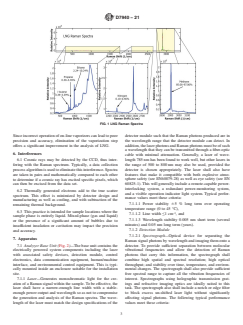
4.1 Measurement of the volume fractions of individual
amount of time allocated for capturing photons.
molecular species contained in a liquid stream of interest such
3.2.4.1 Discussion—The number of electrons is counted at
as LNG is accomplished by obtaining and analyzing Raman
theendoftheallottedexposuretimeviaabinningprocess.The
spectra (Fig. 1). Monochromatic light from a laser is directed
CCD converts photons to electrons over time for a measure-
down a fiber-optic cable through a sample-compatible optic
ment.
probe and into the liquid to be measured. Monochromatic
3.2.5 incident light, λi, n—monochromatic light illuminated
photonsinteractwiththemoleculesoftheliquidviatheRaman
into sample.
effect to produce new photons whose wavelengths have been
3.2.6 Raman scattering effect, n—an energy transfer process
shifted in proportion to vibration frequencies of the molecules.
between photons and molecules.
These new, shifted photons are collected through the same
3.2.6.1 Discussion—In this photon-molecule interaction,
optics that delivered the original monochromatic light and are
scattered light has a different wavelength compared to the
directed down a separate fiber that is connected to a detection
incident wavelength. The Raman wavelength shift spectrum is
module. The detection module contains a spectrograph, which
unique for each molecule because the shift is dependent upon
directs photons of different wavelengths to different pixels on
the molecular bonding structures.
a CCD detector. The CCD pixels integrate the photons falling
on them into a digital signal, whose value is proportional to the
3.2.7 Raman spectroscopy, n—a type of molecular vibration
number of photons.Thus, a spectrum is produced, representing
spectroscopy in which a laser is used to excite virtual energy
a histogram charting the number of photons detected at each
states in the molecules being illuminated, which then decay,
wavelength, corresponding to the number of molecules with
producing new photons that are the sum and difference
particular vibrational frequencies. The spectra can be math-
between the laser and the vibrational frequencies.
ematically processed to yield the molecular composition of the
3.2.7.1 Discussion—These new photons are then collected
liquid. Using standards such as Practice D3588, the energy
and analyzed to determine the vibrational spectrum of the
content, and indices such as the Wobbe index, can be calcu-
molecules.
lated from the composition information.
3.2.8 Raman spectrum, n—plot of intensity against Raman
wavelength shift.
5. Significance and Use
3.2.9 scattered light, λs, n—scattered light as a result of the
5.1 The composition of liquefied gaseous fuels (LNG, LPG)
Raman scattering effect.
is important for custody transfer and production. Composi-
3.2.10 signal strength, n—a measure of the amount of
tional determination is used to calculate the heating value, and
Raman-scattered photons reaching the CCD. it is important to ensure regulatory compliance. Compositional
3.2.10.1 Discussion—Usually some scaled combination of determination is also used to optimize the efficiency of lique-
raw areas of peaks from compounds expected to be present in fied hydrocarbon gas production and ensure the quality of the
LNG. processed fluids.
-1
3.2.11 wavenumber, k or v, [cm ], n—method of specifying
5.2 Alternatives to compositional measurement using Ra-
the number of waves per unit length of optical radiation.
man spectroscopy are described in Test Method D1945, Prac-
3.2.11.1 Discussion—Raman bands are constant wavenum- tice D1946, and Test Method D7833.
ber shifts from the excitation source independent of the
5.3 The advantage of this practice over other standards
wavelength of that source.
stated in 5.2, is that Raman spectroscopy can determine
3.3 Acronyms:
composition by directly measuring the liquefied natural gas.
3.3.1 CCD—charge coupled device Unlike chromatography, no vaporization step is necessary.
D7940−21
FIG. 1LNG Raman Spectra
Sinceincorrectoperationofon-linevaporizerscanleadtopoor detector module such that the Raman photons produced are in
precision and accuracy, elimination of the vaporization step the wavelength range that the detector module can detect. In
offers a significant improvement in the analysis of LNG. addition,thelaserphotonsandRamanphotonsmustbeofsuch
a wavelength that they can be transmitted through a fiber-optic
6. Interferences
cable with minimal attenuation. Generally, a laser of wave-
length 785 nm has been found to work well, but other lasers in
6.1 Cosmic rays may be detected by the CCD, thus inter-
fering with the Raman spectrum. Typically, a data collection the range of 500 to 800 nm may also be used, provided the
detector is chosen appropriately. The laser shall also have
processalgorithmisusedtoeliminatethisinterference.Spectra
are taken in pairs and mathematically compared to each other features that make it compatible with both explosive atmo-
sphere safety (see EN60079-28) as well as eye safety (see EN
to determine if a cosmic ray has excited specific pixels, which
can then be excised from the data set. 60825-1). This will generally include a remote-capable power-
interlocking system, a redundant power-monitoring system,
6.2 Thermally generated electrons add to the true scatter
and a visible operation indicator light system. Typical perfor-
spectrum. This effect is minimized by detector design and
mance values meet these criteria:
manufacturing as well as cooling, and with subtraction of the
7.1.1.1 Power stability 65 % long term over operating
remaining thermal background.
temperature range (0 to 45 °C),
6.3 This practice is intended for sample locations where the
-1
7.1.1.2 Line width ≤1cm , and
sample phase is entirely liquid. Mixed-phase (gas and liquid)
7.1.1.3 Wavelength stability 0.005 nm short term (several
or the presence of a significant amount of bubbles due to
minutes) and 0.05 nm long term (years).
insufficient insulation or cavitation may impact the precision
7.1.2 Detection Module
and accuracy.
7.1.2.1 Spectrograph—Optical device for separating the
7. Apparatus
Raman signal photons by wavelength and imaging them onto a
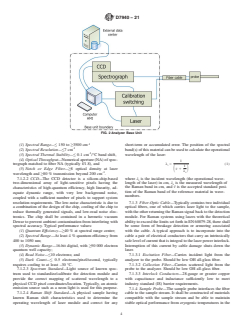
7.1 Analyzer Base Unit (Fig. 2)—The base unit contains the detector. To provide sufficient separation between molecular
electrically powered system components including the laser vibrational frequencies and allow the detection of Raman
with associated safety devices, detection module, control photons that carry this information, the spectrograph shall
electronics, data communication equipment, human/machine combine high spatial and spectral resolution; high optical
interface, and environmental control equipment. This is typi- throughput; and stability over time, temperature, and environ-
cally mounted inside an enclosure suitable for the installation mental changes. The spectrograph shall also provide sufficient
site. free spectral range to capture all the vibration frequencies of
7.1.1 Laser—Generates monochromatic light for the cre- interest. Spectrographs using holographic transmission grat-
ation of a Raman signal within the sample. To be effective, the ings and refractive imaging optics are ideally suited to this
laser shall have a narrow-enough line width with a stable- task. The spectrograph also shall include a notch or edge filter
enough power output and wavelength so as not to compromise to block excess un-shifted laser light without significantly
the generation and analysis of the Raman spectra. The wave- affecting signal photons. The following typical performance
length of the laser must match the design specifications of the values meet these criteria:
D7940−21
FIG. 2Analyzer Base Unit
-1
(1) Spectral Range—≤ 150 to ≥3500 cm short-term or accumulated error. The position of the spectral
-1
(2) Spectral Resolution—≤7cm band(s) of this material can be used to calculate the operational
-1
(3) Spectral Thermal Stability—≤ 0.1 cm /°C band shift, wavelength of the laser:
(4) Optical Throughput—Numericalaperture(NA)ofspec-
λ 5 (1)
trograph matched to fiber NA (typically f/1.8), and
i
v¯ 1
(5) Notch or Edge Filter—≥8 optical density at laser S D
λ
s
-1
wavelength and ≥80 % transmission beyond 200 cm .
7.1.2.2 CCD—The CCD detector is a silicon-chip-based
where λ is the incident wavelength (the operational wave-
i
two-dimensional array of light-sensitive pixels having the length of the laser) in cm, λ is the measured wavelength of
s
the Raman band in cm, and ν¯ is the accepted standard posi-
characteristics of high-quantum efficiency, high linearity, ad-
tion of the Raman band of the reference material in wave-
equate dynamic range, with very low background noise,
numbers.
coupled with a sufficient number of pixels to support system
resolution requirements. The low-noise characteristic is due to 7.1.3 Fiber-Optic Cable—Typically contains two individual
a combination of the design of the chip, cooling of the chip to optical fibers, one of which carries laser light to the sample,
reduce thermally generated signals, and low-read noise elec- with the other returning the Raman signal back to the detection
tronics. The chip shall be contained in a hermetic vacuum module. For Raman systems using lasers with the theoretical
Dewar to prevent ambient contamination from interfering with abilitytoexceedthelimitssetforthinEN60079-28,thereshall
spectral accuracy. Typical performance values:
be some form of breakage detection or armoring associated
(1) Quantum Effıciency—≥40 % at spectral range center; with the cable. A typical approach is to incorporate into the
(2) Spectral Range—At least 4 % quantum efficiency from
cable a pair of electrical conductors that carry an intrinsically
400 to 1050 nm; safelevelofcurrentthatisintegraltothelaserpowerinterlock.
(3) Dynamic Range—16-bit digital, with ≥50 000 electron Interruption of this current by cable damage shuts down the
quantum well capacity; laser.
(4) Read Noise—≤10 electrons; and 7.1.3.1 Excitation Fiber—Carries incident light from the
(5) Dark Count—≤ 0.5 electrons/pixel/second, typically analyzer to the probe. Should be low OH all-glass fiber.
requires cooling to at least –30 °C. 7.1.3.2 Collection Fiber—Carries scattered light from the
7.1.2.3 Spectrum Standard—Light source of known spec- probe to the analyzer. Should be low OH all-glass fiber.
trum used to standardize/calibrate the detection module and 7.1.3.3 Interlock Conductors—28-gauge or greater copper
provide the correct mapping of scattered wavelength to a with capacitance and inductance sufficiently low to meet
physical CCD pixel coordinates/location. Typically, an atomic industry standard (IS) barrier requirements.
emission source such as a neon light is used for this purpose. 7.1.4 Sample Probe—The sample probe interfaces the fiber
7.1.2.4 Raman Shift Standard—A physical sample having cable to the sample stream. It shall be constructed of materials
known Raman shift characteristics used to determine the compatible with the sample stream and be able to maintain
operating wavelength of laser module and correct for any stable optical performance from cryogenic temperatures in the
D7940−21
case of LNG measurement to ambient. The probe contains a 8.2 The probe shall be installed in such a manner that
hermetically sealed window separating the optics from the explosion hazards are eliminated in the event of an explosive
sample stream. The primary functions of the probe are: sample mixture being present, either by limitation of laser
removal of the Raman signal generated by laser light traveling power to below that which can cause ignition, or by interlock,
through the excitation fiber (which would contaminate the in which a physical switch senses when liquid level is about to
sample spectra), imaging the laser light into the sample, fall below the probe and shuts the laser off.
superimposing an image of the collection fiber onto the
8.3 This test method involves the use of a Class IIIb laser,
illuminated sample volume, removing the majority of the
which, if handled improperly, can cause eye damage. Always
unshifted laser light before leaving the probe (again to elimi-
check the emission status of the laser when performing service
nate background signals), and finally, providing efficient deliv-
work and ensure that the laser is either off or personnel are
ery of the excitation light into, and efficient collection of the
wearing appropriate laser protection eyewear.
Raman signal out of, the stream to be measured.
7.1.4.1 Optical Assembly—Collection of lenses and filters
9. Sampling, Test Specimens, and Test Units
constructed to operate from ambient to cryogenic temperatures
9.1 The probe tip shall be mounted in the pipe or vessel
(-190 °C) or ambient to above 150 °C. Shall be vibration- and
containing the liquid to be measured and positioned into the
shock-resistant(100-Gshock,10-Gfullspectralvibrationupto
flow at least 5 cm, or 10 % of the pipe diameter, in from the
500 Hz).
wallofthepipeorcontainer,toensurerepresentativesampling.
7.1.4.2 Housing—Shall be made from a material that is
9.2 The probe should be mounted within 45° of horizontal
chemically and physically compatible with the stream being
such that liquid immersion of the tip is assured.
measured. It is typically 316 stainless steel. The probe shall be
rigid enough to withstand the hydrodynamic forces it will
9.3 The temperature and pressure shall be such as to ensure
experience when installed in the sample stream. It shall
that the sample is in the liquid phase.
incorporate features to hermetically seal the window and fiber
9.4 Theprobeshouldbeengineeredsuchthatitiswithinthe
feed-throughstoisolatetheopticsfromthesampleandambient
fatigue limits of expected vortex shedding induced vibrations.
environment. The housing shall have process-compatible
9.5 The probe window and housing structure shall be
mounting features; typically a flange or compression fitting.
designedtowithstandtheexpectedpressureandtemperatureof
7.1.4.3 Window—The window sealing mechanism shall be
the sample being measured with a reasonable safety factor.
chemically compatible with the materials being analyzed and
shall have a low-fluorescent background so as not to obscure
10. Preparation of Apparatus
spectral features. The window material and construction shall
be able to withstand the sample pressure. Windows are 10.1 The laser module shall be operated within its specified
typically constructed of ultra-pure sapphire for strength,
ambient temperatures range to ensure the stability of the
chemical resistance, and to reduce spectral contamination. It incident light. The method will be successful if the laser
-1
shall be constructed such that it can maintain a hermetic seal
remains stable to 0.1 cm during data collection. The laser
when subjected to a standard 7 J 2.5-cm diameter steel ball shall be allowed sufficient warm up time to reach necessary
impact test (per pressure vessel and hazardous atmosphere
stability (typically in the range of 10 min).
requirements).
10.2 Spectrographs can be sensitive to changes in tempera-
7.1.5 Computer Control System and User Interface—
ture.Aberrationscanoccurasaresultofthermalcontractionor
Typically, a computer subsystem is used to interface with the
expansion. Some combination of the following shall occur: the
CCD, collect spectra, perform calculations, as well as monitor
temperaturesurroundingthespectrographisheldconstant(less
diagnostic sensors and provide a user interface.
than 1 °C change), an automated system is used to track and
7.1.6 Software—Software is used for the following func-
correct for spectral calibration and aberrations, or design
tions:
features are incorporated into the spectrograph opto-mechanics
7.1.6.1 Perform Raman wavelength shift calculations,
to correct passively.
7.1.6.2 Produce spectrum of intensity versus Raman wave-
10.3 Charge Coupled Device (CCD)
length shift,
10.3.1 The CCD should be operated at low temperatures,
7.1.6.3 Determine species present,
typically -30 °C or colder, to minimize thermally generated
7.1.6.4 Calculate relative abundance of species present and
electrons. Generally, 10 min or more are required for detectors
perform calculations of quantities based on these abundances,
to stabilize at the operational temperature.
7.1.6.5 Track key diagnostic factors such as temperatures,
10.3.2 Set Spectral Acqu
...
This document is not an ASTM standard and is intended only to provide the user of an ASTM standard an indication of what changes have been made to the previous version. Because
it may not be technically possible to adequately depict all changes accurately, ASTM recommends that users consult prior editions as appropriate. In all cases only the current version
of the standard as published by ASTM is to be considered the official document.
Designation: D7940 − 14 D7940 − 21
Standard Practice for
Analysis of Liquefied Natural Gas (LNG) by Fiber-Coupled
Raman Spectroscopy
This standard is issued under the fixed designation D7940; the number immediately following the designation indicates the year of
original adoption or, in the case of revision, the year of last revision. A number in parentheses indicates the year of last reapproval. A
superscript epsilon (´) indicates an editorial change since the last revision or reapproval.
1. Scope
1.1 This standard practice is for both on-line and laboratory instrument-based determination of composition for liquefied natural
gas (LNG) using Raman spectroscopy. The Although the procedures in this practice refer specifically to liquids, the basic
methodology can also be applied to other light hydrocarbon mixtures in either liquid or gaseous states, if the needs of the
application are met, although the rest of this practice refers specifically to liquids. provided the data quality objectives and
measurement needs are met. From the composition, gas properties such as heating value and the Wobbe index may be calculated.
The components commonly determined according to this test method are CH , C H , C H , i-C H , n-C H , iC H , n-C H ,
4 2 6 3 8 4 10 4 10 5 12 5 12
neo-C H , N , O . The applicable range of this standard is 200 ppmv to 100 mol %. Components heavier than C5 are not measured
5 12 2 2
as part of this practice.
NOTE 1—Raman spectroscopy does not directly quantify the component percentages of noble gases,gases; however, inerts inert substances can be
calculated indirectly by subtracting the sum of the other species from 100 %.100 %.
1.2 Units—The values stated in SI units are to be regarded as standard. No other units of measurement are included in this
standard.
1.3 This standard does not purport to address all of the safety concerns, if any, associated with its use. It is the responsibility
of the user of this standard to establish appropriate safety safety, health, and healthenvironmental practices and determine the
applicability of regulatory limitations prior to use.
1.4 This international standard was developed in accordance with internationally recognized principles on standardization
established in the Decision on Principles for the Development of International Standards, Guides and Recommendations issued
by the World Trade Organization Technical Barriers to Trade (TBT) Committee.
2. Referenced Documents
2.1 ASTM Standards:
D3588 Practice for Calculating Heat Value, Compressibility Factor, and Relative Density of Gaseous Fuels
D4150 Terminology Relating to Gaseous Fuels
E691 Practice for Conducting an Interlaboratory Study to Determine the Precision of a Test Method
D1945 Test Method for Analysis of Natural Gas by Gas Chromatography
D1946 Practice for Analysis of Reformed Gas by Gas Chromatography
D3588 Practice for Calculating Heat Value, Compressibility Factor, and Relative Density of Gaseous Fuels
This test method practice is under the jurisdiction of ASTM Committee D03 on Gaseous Fuels and is the direct responsibility of Subcommittee D03.12 on
On-Line/At-Line Analysis of Gaseous Fuels.
Current edition approved June 1, 2014Nov. 1, 2021. Published July 2014November 2021. Originally approved in 2014. Last previous edition approved in 2014 as D7940
– 14. DOI: 10.1520/D7940-14.10.1520/D7940-21.
For referenced ASTM standards, visit the ASTM website, www.astm.org, or contact ASTM Customer Service at service@astm.org. For Annual Book of ASTM Standards
volume information, refer to the standard’s Document Summary page on the ASTM website.
Copyright © ASTM International, 100 Barr Harbor Drive, PO Box C700, West Conshohocken, PA 19428-2959. United States
D7940 − 21
D4150 Terminology Relating to Gaseous Fuels
D7833 Test Method for Determination of Hydrocarbons and Non-Hydrocarbon Gases in Gaseous Mixtures by Gas
Chromatography
E691 Practice for Conducting an Interlaboratory Study to Determine the Precision of a Test Method
2.2 BS EN Standards:
BS EN 60079-28 Explosive Atmospheres. Protection of Equipment and Transmission Systems using Optical Radiation
BS EN 60825-1 Safety of Laser Products Part 1: Equipment Classification, Requirements and User’s Guide
2.3 ISO Standards:
ISO 6974-5 Natural Gas—Determination of Composition with Defined Uncertainty by Gas Chromatography, Part 5:
Determination of nitrogen, carbon dioxideNitrogen, Carbon Dioxide and C1 to C5 and C6+ hydrocarbonsHydrocarbons for
a laboratory and on-line process application using three columnsLaboratory and On-line Process Application Using Three
Columns
ISO 6976:2016(E) Natural Gas—Calculation of Calorific Values, Density, Relative Density and Wobbe Indices from
Composition
3. Terminology
3.1 Definitions: Refer toFor definitions D4150 for definitions related to gaseous fuels.of general terms used in D03 Gaseous
Fuels standards, refer to Terminology D4150.
3.2 Definitions of Terms Specific to This Standard:
3.2.1 Accumulations,accumulations, n—while the exposure time is optimized to control the amount of light entering the camera
for a single exposure, multiple exposures can be co-added to improve signal-to-noise. The the number of exposures co-added are
referred to as accumulations.
3.2.1.1 Discussion—
While the exposure time is optimized to control the amount of light entering the instrument for a single exposure, multiple
exposures can be co-added to improve signal-to-noise.
3.2.2 charge-coupled device, device (CCD), n—silicon based two dimensional light sensor characterized by possessing a grid of
potential energy wells where light-generated free electrons collect and then are read out sequentially.
3.2.3 charge-coupled device (CCD) binning, v—process of combining “bins” or pixel wells on the CCD.
3.2.4 Exposure Time,exposure time, n—the CCD converts photons to electrons over time for a measurement. The exposure time
indicates the amount of time allocated for capturing photons. The number of electrons is counted at the end of the allotted exposure
time via a binning process.
3.2.4.1 Discussion—
The number of electrons is counted at the end of the allotted exposure time via a binning process. The CCD converts photons to
electrons over time for a measurement.
3.2.5 incident light, λi, n—monochromatic light illuminated into sample.
3.2.6 Raman Scattering Effect,scattering effect, n—an energy transfer process between photons and molecules. In this
photon-molecule interaction, scattered light has a different wavelength compared to the incident wavelength. The Raman
wavelength shift spectrum is unique for each molecule because the shift is dependent upon the molecular bonding structures.
3.2.6.1 Discussion—
In this photon-molecule interaction, scattered light has a different wavelength compared to the incident wavelength. The Raman
wavelength shift spectrum is unique for each molecule because the shift is dependent upon the molecular bonding structures.
3.2.7 Raman spectroscopy, n—a type of molecular vibration spectroscopy in which a laser is used to excite virtual energy states
in the molecules being illuminated, which then decay, producing new photons that are the sum and difference between the laser
and the vibrational frequencies. These new photons are then collected and analyzed to determine the vibrational spectrum of the
molecules.
3.2.7.1 Discussion—
These new photons are then collected and analyzed to determine the vibrational spectrum of the molecules.
Available from British Standards Institution (BSI), 389 Chiswick High Rd., London W4 4AL, U.K., http://www.bsigroup.com.
Available from International Organization for Standardization (ISO), 1, ch. de la Voie-Creuse, CP 56, CH-1211 Geneva 20, Switzerland, http://www.iso.org.
D7940 − 21
3.2.8 Raman spectrum, n—plot of intensity against Raman wavelength shift.
3.2.9 scattered light, λs—λs, n—scattered light as a result of the Raman scattering effecteffect.
3.2.10 signal strength, n—a measure of the amount of Raman-scattered photons reaching the CCD. Usually some scaled
combination of raw areas of peaks from compounds expected to be present in LNG.
3.2.10.1 Discussion—
Usually some scaled combination of raw areas of peaks from compounds expected to be present in LNG.
-1 -1
3.2.11 wavenumber, k or v, [cm ], n—abbreviated as cm ; method of specifying the wavelength of optical radiation. Raman bands
are constant wavenumber shifts from the excitation source independent of the wavelength of that source. number of waves per unit
length of optical radiation.
3.2.11.1 Discussion—
Raman bands are constant wavenumber shifts from the excitation source independent of the wavelength of that source.
3.3 Acronyms:
3.3.1 CCD—charge coupled device
3.3.2 IS—industry standard
3.3.3 NIST—National Institute of Standards and Technology
3.3.4 NMI—National Metrology Institute
3.3.5 OH—hydroxyl groups
3.4 Acronyms:Abbreviations:
3.4.1 GC—Gas chromatograph
3.4.2 GHV—Gross Heating Valueheating value
3.4.3 LNG—Liquefied natural gas
3.4.4 LPG—Liquefied petroleum gas
3.3.5 NIST—National Institute of Standards and Technology
3.5 Symbols:
3.5.1 λi—incident light
3.5.2 λs—scatter light
3.5.3 k—coverage factor for confidence interval
4. Summary of Practice
4.1 Measurement of the volume fractions of individual molecular species contained in a liquid stream of interest such as LNG is
accomplished by obtaining and analyzing Raman spectra (Fig. 1). Monochromatic light from a laser is directed down a fiber-optic
cable through a sample-compatible probe optic probe and into the liquid to be measured. Monochromatic photons interact with the
molecules of the liquid via the Raman effect to produce new photons whose wavelengths have been shifted in proportion to
vibration frequencies of the molecules. These new, shifted photons are collected through the same optics that delivered the original
monochromatic light and are directed down a separate fiber that is connected to a detection module. The detection module contains
a spectrograph, which directs photons of different wavelengths to different pixels on a CCD detector. The CCD pixels integrate
D7940 − 21
FIG. 1 LNG Raman Spectra
the photons falling on them into a digital signal, whose value is proportional to the number of photons. Thus, a spectrum is
produced, representing a histogram charting the number of photons detected at each wavelength, corresponding to the number of
molecules with particular vibrationvibrational frequencies. The spectra can be mathematically processed to yield the molecular
composition of the liquid. Using standards such as Practice D3588, the energy content, and indices such as the Wobbe index, can
be calculated from the composition information.
5. Significance and Use
5.1 The composition of liquefied gasgaseous fuels (LNG, LPG) is important for custody transfer and production. Compositional
determination is used to calculate the heating value, and it is important to ensure regulatory compliance. Compositional
determination is also used to optimize the efficiency of liquefied hydrocarbon gas production and ensure the quality of the
processed fluids.
5.2 Alternatives to compositional measurement using Raman spectroscopy are described in Test Method D1945, Practice D1946,
and Test Method D7833.
5.3 The advantage of this standardpractice over existingother standards mentionedstated in 5.2 above, , is that Raman spectroscopy
can determine composition by directly measuring the liquefied natural gas. Unlike chromatography, no vaporization step is
necessary. Since incorrect operation of on-line vaporizers can lead to poor precision and accuracy, elimination of the vaporization
step offers a significant improvement in the analysis of LNG.
6. Interferences
6.1 Cosmic rays may be detected by the CCD, thus interfering with the Raman spectrum. Typically, a data collection process and
algorithm is used to eliminate this consideration.interference. Spectra are taken in pairs and mathematically compared to each other
to determine if a cosmic ray has excited specific pixels, which can then be excised from the data setset.
6.2 Thermally generated electrons add to the true scatter spectrum. This effect is minimized by detector design and manufacturing
as well as cooling, and with subtraction of the remaining thermal background is subtracted.background.
6.3 The standardThis practice is intended for sample locations where the sample phase is entirely liquid. Mixed-phase (gas and
liquid) or the presence of a significant amount of bubbles due to insufficient insulation or cavitation may impact the precision and
accuracy.
D7940 − 21
7. Apparatus
7.1 Analyzer Base Unit (Fig. 2)—The base unit contains the electrically powered system components including the laser with
associated safety devices, detection module, control electronics, data communication equipment, human/machine interface, and
environmental control equipment. This is typically mounted inside an enclosure suitable tofor the installation site.
7.1.1 Laser—Generates monochromatic light for the creation of a Raman signal within the sample. To be effective, the laser shall
have a narrow-enough line width with a stable-enough power output and wavelength so as not to compromise the generation and
analysis of the Raman spectra. The wavelength of the laser must match the design specifications of the detector module such that
the Raman photons produced are in the wavelength range that the detector module can detect. In addition, the laser photons and
Raman photons must be of such a wavelength that they can be transmitted through a fiber-optic cable with minimal attenuation.
Generally, a laser of wavelength 785 nm 785 nm has been found to work well, but other lasers in the range of 500 to 800 nm
800 nm may also be possible, providingused, provided the detector is chosen appropriately. The laser shall also have features that
make it compatible with both explosive atmosphere safety (see EN60079-28) as well as eye safety (see EN 60825-1). This will
generally include a remote-capable power-interlocking system, a redundant power-monitoring system, and a visible operation
indicator light system. Typical performance values meet these criteria:
7.1.1.1 Power stability 65 % long term over operating temperature range (0 to 45 °C),
-1
7.1.1.2 Line width ≤1 cm , and
7.1.1.3 Wavelength stability 0.005 nm short term (several minutes) and 0.05 nm long term (years).
7.1.2 Detection ModuleDetection Module
7.1.2.1 Spectrograph—Optical device for separating the Raman signal photons by wavelength and imaging them onto a detector.
To provide sufficient separation between molecular vibrationvibrational frequencies and allow the detection of Raman photons that
carry this information, the spectrograph shall combine high spatial and spectral resolution; high optical throughput; and stability
over time, temperature, and environmental changes. The spectrograph shall also provide sufficient free spectral range to capture
all the vibration frequencies of interest. Spectrographs using holographic transmission gratings and refractive imaging optics are
ideally suited to this task. The spectrograph also shall include a notch or edge filter to block excess un-shifted laser light without
significantly affecting signal photons. The following typical performance values meet these criteria:
-1
(1) Spectral range—Range—≤ 150 to ≥3500 cm
FIG. 2 Analyzer Base Unit
D7940 − 21
-1
(2) Spectral resolution—Resolution—≤7 cm
-1
(3) Spectral thermal stability—Thermal Stability—≤ 0.1 cm /°C band shift,
(4) Optical throughput—Throughput—Numerical aperture (NA) of spectrograph matched to fiber NA (typically f/1.8), and
-1
(5) Notch or edge filter—Edge Filter—≥8 optical density at laser wavelength and ≥80 % transmission beyond 200 cm .
7.1.2.2 CCD—The CCD detector is a silicon-chip-based two-dimensional array of light-sensitive pixels having the characteristics
of high-quantum efficiency, high linearity, adequate dynamic range, with very low background noise, coupled with a sufficient
number of pixels to support system resolution requirements. The low-noise characteristic is due to a combination of the design of
the chip, cooling of the chip to reduce thermally generated signals, and low-read noise electronics. The chip shall be contained in
a hermetic vacuum Dewar to prevent ambient contamination from interfering with spectral accuracy. Typical performance values:
(1) Quantum effıciency—Effıciency—≥40 % at spectral range center;
(2) Spectral range—Range—At least 4 % quantum efficiency from 400 to 1050 nm;
(3) Dynamic range—Range—16-bit digital, with ≥50 000 electron quantum well capacity;
(4) Read noise—Noise—≤10 electrons; and
(5) Dark count—Count—≤ 0.5 electrons/pixel/second, typically requires cooling to at least –30 °C.
7.1.2.3 Spectrum Standard—Light source of known spectrum used to standardize/calibrate the detection module and provide the
correct mapping of scattered wavelength to a physical CCD pixel coordinates/location. Typically, an atomic emission source such
as a neon light is used for this purpose.
7.1.2.4 Raman Shift Standard—A physical sample having known Raman shift characteristics used to determine the operating
wavelength of laser module and correct for any short-term or accumulated error. The position of the spectral band(s) of this
material can be used to calculate the operational wavelength of the laser:
λ 5 (1)
i
v¯ 1
S D
λ
s
where λ is the incident wavelength (the operational wavelength of the laser) in cm, λ is the measured wavelength of the Ra-
i s
man band in cm, and ν¯ is the accepted standard position of the Raman band of the reference material in wavenumbers.
7.1.3 Fiber-Optic Cable—Typically contains two individual optical fibers, one of which carries laser light to the sample, with the
other returning the Raman signal back to the detection module. For Raman systems using lasers with the theoretical ability to
exceed the limits set forth in EN 60079-28, there shall be some form of breakage detection or armoring associated with the cable.
A typical approach is to incorporate into the cable a pair of electrical conductors that carry an intrinsically safe level of current
that is integral to the laser power interlock. Interruption of this current by cable damage shuts down the laser.
7.1.3.1 Excitation Fiber—Carries incident light from the analyzer to the probe. Should be low OH all-glass fiber.
7.1.3.2 Collection Fiber—Carries scattered light from the probe to the analyzer. Should be low OH all-glass fiber.
7.1.3.3 Interlock Conductors—28-gauge or greater copper with capacitance and inductance sufficiently low to meet industry
standard (IS) barrier requirements.
7.1.4 Sample Probe—The sample probe interfaces the fiber cable to the sample stream. It shall be constructed of materials
compatible with the sample stream and be able to maintain stable optical performance from cryogenic temperatures in the case of
LNG measurement to ambient. The probe contains a hermetically sealed window separating the optics from the sample stream.
The primary functions of the probe are: removal of the Raman signal generated by laser light traveling through the excitation fiber
(which would contaminate the sample spectra), imaging the laser light into the sample, superimposing an image of the collection
fiber onto the illuminated sample volume, removing the majority of the unshifted laser light before leaving the probe (again to
eliminate background signals), and finally, providing efficient delivery of the excitation light into, and efficient collection of the
Raman signal out of, the stream to be measured.
7.1.4.1 Optical Assembly—Collection of lenses and filters constructed to operate from ambient to cryogenic temperatures (-190
°C) or ambient to above 150 °C. Shall be vibration- and shock-resistant (100-G shock, 10-G full spectral vibration up to 500 Hz).
7.1.4.2 Housing—Shall be made from a material that is chemically and physically compatible with the stream being measured.
It is typically 316 stainless steel. The probe shall be rigid enough to withstand the hydrodynamic forces it will experience when
D7940 − 21
installed in the sample stream. It shall incorporate features to hermetically seal the window and fiber feed-throughs to isolate the
optics from the sample and ambient environment. The housing shall have process-compatible mounting features; typically a flange
or compression fitting.
7.1.4.3 Window—The window sealing mechanism shall be chemically compatible with the materials being analyzed and shall have
a low-fluorescent background so as not to obscure spectral features. The window material and construction shall be able to
withstand the sample pressure. Windows are typically constructed of ultra-pure sapphire for strength, chemical resistance, and to
reduce spectral contamination. It shall be constructed such that it can maintain a hermetic seal when subjected to a standard 7 J
2.5-cm diameter steel ball impact test (per pressure vessel and hazardous atmosphere requirements).
7.1.5 Computer Control System and User Interface—Typically, a computer subsystem is used to interface with the CCD, collect
spectra, perform calculations, as well as monitor diagnostic sensors and provide a user interface.
7.1.6 Software—Software is used for the following functions:
7.1.6.1 Perform Raman wavelength shift calculations,
7.1.6.2 Produce spectrum of intensity versus Raman wavelength shift,
7.1.6.3 Determine species present,
7.1.6.4 Calculate relative abundance of species present and perform calculations of quantities based on these abundances,
7.1.6.5 Track key diagnostic factors such as temperatures, spectral intensity, and laser power, and
7.1.6.6 Maintain and check instrument calibration and drift.
8. Hazards
8.1 Probes can be installed in sample streams that operate at high pressure and temperature. Extra care should be taken to assure
the probe cannot be accidentally ejected from the stream interface.
8.2 The probe shall be installed in such a manner that explosion hazards are eliminated in the event of an explosive sample mixture
being present, either by limitation of laser power to below that which can cause ignition, or by interlock, in which a physical switch
senses when liquid level is about to fall below the probe and shuts the laser off.
8.3 This test method involves the use of a Class IIIb laser, which, if handled improperly, can cause eye damage. Always check
the emission status of the laser when performing service work and ensure that the laser is either off or personnel are wearing
appropriate laser protection eyewear.
9. Sampling, Test Specimens, and Test Units
9.1 The probe tip shall be mounted in the pipe or vessel containing the liquid to be measured and positioned into the flow at least
2in., 5 cm, or 10 % of the pipe diameter, in from the wall of the pipe or container, to ensure representative sampling.
9.2 The probe should be mounted within 45° of horizontal such that liquid immersion of the tip is assured.
9.3 The temperature and pressure shall be such as to ensure that the sample is in the liquid phase.
9.4 The probe should be engineered such that it is within the fatigue limits of expected vortex shedding induced vibrations.
9.5 The probe window and housing structure shall be designed to withstand the expected pressure and temperature of the sample
being measured with a reasonable safety factor.
10. Preparation of Apparatus
10.1 The laser module shall be operated within its specified ambient temperatures range to ensure the stability of the incident light.
D7940 − 21
-1
T
...