

ASTM D4810-20
(Test Method)Standard Test Method for Hydrogen Sulfide in Natural Gas Using Length-of-Stain Detector Tubes
General Information
- Abstract
SIGNIFICANCE AND USE
5.1 The measurement of hydrogen sulfide in natural gas is important because of gas quality specifications, the corrosive nature of H2S on pipeline materials, and the effects of H2S on utilization equipment.
5.2 This test method provides inexpensive field screening of hydrogen sulfide. The system design is such that it may be used by nontechnical personnel with a minimum of proper training.
SCOPE
1.1 This test method covers a procedure for a rapid and simple field determination of hydrogen sulfide in natural gas pipelines. Available detector tubes provide a total measuring range of 0.5 ppm by volume up to 40 % by volume, although the majority of applications will be on the lower end of this range (that is, under 120 ppm).
1.2 Typically, sulfur dioxide and mercaptans may cause positive interferences. In some cases, nitrogen dioxide can cause a negative interference. Most detector tubes will have a “precleanse” layer designed to remove certain interferences up to some maximum interferent level. Consult manufacturers' instructions for specific interference information.
1.3 Units—The values stated in SI units are to be regarded as the standard.
1.4 This standard does not purport to address all of the safety concerns, if any, associated with its use. It is the responsibility of the user of this standard to establish appropriate safety, health, and environmental practices and determine the applicability of regulatory limitations prior to use.
1.5 This international standard was developed in accordance with internationally recognized principles on standardization established in the Decision on Principles for the Development of International Standards, Guides and Recommendations issued by the World Trade Organization Technical Barriers to Trade (TBT) Committee.
- Status
- Published
- Publication Date
- 14-Dec-2020
- Technical Committee
- D03 - Gaseous Fuels
Buy Documents


ASTM D4810-20 - Standard Test Method for Hydrogen Sulfide in Natural Gas Using Length-of-Stain Detector Tubes
REDLINE ASTM D4810-20 - Standard Test Method for Hydrogen Sulfide in Natural Gas Using Length-of-Stain Detector Tubes
Overview
ASTM D4810-20 is the internationally recognized standard test method for the field determination of hydrogen sulfide (H₂S) in natural gas using length-of-stain detector tubes. Published by ASTM International, this standard outlines a procedure that enables rapid, simple, and cost-effective screening for hydrogen sulfide levels in natural gas pipeline systems. Accurate measurement of H₂S is vital due to its corrosive properties, implications for gas quality specifications, and the potential impacts on utilization equipment.
Key Topics
- Hydrogen Sulfide Measurement: Describes the detection method using a chemical reagent in a sealed glass tube, where H₂S presence is indicated by a visible stain proportional to concentration.
- Field Applicability: The method is designed for on-site use and is suitable for nontechnical personnel with minimal training.
- Range of Measurement: Applicable for H₂S concentrations from as low as 0.5 ppm to 40% by volume, with common usage in the sub-120 ppm range.
- Accuracy and Interferences: While generally reliable within ±25%, potential interferences from sulfur dioxide, mercaptans, and nitrogen dioxide are flagged; most tubes include a precleanse layer but users should consult manufacturer guidance.
- Sampling Procedure: Includes recommendation for sample point selection, handling, and necessary apparatus such as pumps, sampling chambers, and collection bags made of inert materials.
- Safety and Environmental Practices: Emphasizes the responsibility of users to implement appropriate safety, health, and environmental procedures.
Applications
ASTM D4810-20 is widely used in the following practical scenarios:
- Natural Gas Pipeline Operations: Monitoring hydrogen sulfide to ensure compliance with pipeline quality specifications and prevent corrosion of pipeline materials.
- Gas Processing Plants: Onsite field screenings to rapidly assess H₂S content before gas enters processing or distribution.
- Utilities and Distribution Networks: Routine checks and spot testing by field technicians, aiding in safeguarding equipment and ensuring end-user safety.
- Regulatory Compliance: Supporting documentation and data for meeting regional, national, or international gas quality regulations.
- Maintenance and Safety Programs: Facilitating preventative maintenance through the early detection of elevated H₂S levels, thereby reducing the risk of equipment damage and health hazards.
Key advantages of this method include its portability, ease of use, and suitability for quick decision-making in the field.
Related Standards
For a comprehensive approach to natural gas analysis and hydrogen sulfide detection, consider these associated standards:
- ASTM D4150: Terminology Relating to Gaseous Fuels - provides definitions of key terms used in natural gas analysis.
- GPA 2377: Gas Processors Association Standard for Hydrogen Sulfide and Carbon Dioxide in Natural Gas Utilizing Length-of-Stain Tubes - outlines similar procedures and accuracy requirements.
- NIOSH/TC/A-012: Guides requirements for certification of gas detector tube units for occupational safety.
These standards support compatibility, best practices, and quality assurance in natural gas testing regimes.
Adopting ASTM D4810-20 ensures reliable, on-site detection of hydrogen sulfide in natural gas, promoting operational efficiency, regulatory compliance, and the protection of both infrastructure and personnel.
Relations
- Effective Date
- 15-Dec-2019
- Effective Date
- 01-Jul-2016
- Effective Date
- 01-Dec-2008
- Effective Date
- 10-Aug-2003
- Effective Date
- 10-Jun-2000
Buy Documents
ASTM D4810-20 - Standard Test Method for Hydrogen Sulfide in Natural Gas Using Length-of-Stain Detector Tubes
REDLINE ASTM D4810-20 - Standard Test Method for Hydrogen Sulfide in Natural Gas Using Length-of-Stain Detector Tubes
Get Certified
Connect with accredited certification bodies for this standard

Element Materials Technology
Materials testing and product certification.

ABS Group Brazil
ABS Group certification services in Brazil.

ABS Quality Evaluations Inc.
American Bureau of Shipping quality certification.
Sponsored listings
Frequently Asked Questions
ASTM D4810-20 is a standard published by ASTM International. Its full title is "Standard Test Method for Hydrogen Sulfide in Natural Gas Using Length-of-Stain Detector Tubes". This standard covers: SIGNIFICANCE AND USE 5.1 The measurement of hydrogen sulfide in natural gas is important because of gas quality specifications, the corrosive nature of H2S on pipeline materials, and the effects of H2S on utilization equipment. 5.2 This test method provides inexpensive field screening of hydrogen sulfide. The system design is such that it may be used by nontechnical personnel with a minimum of proper training. SCOPE 1.1 This test method covers a procedure for a rapid and simple field determination of hydrogen sulfide in natural gas pipelines. Available detector tubes provide a total measuring range of 0.5 ppm by volume up to 40 % by volume, although the majority of applications will be on the lower end of this range (that is, under 120 ppm). 1.2 Typically, sulfur dioxide and mercaptans may cause positive interferences. In some cases, nitrogen dioxide can cause a negative interference. Most detector tubes will have a “precleanse” layer designed to remove certain interferences up to some maximum interferent level. Consult manufacturers' instructions for specific interference information. 1.3 Units—The values stated in SI units are to be regarded as the standard. 1.4 This standard does not purport to address all of the safety concerns, if any, associated with its use. It is the responsibility of the user of this standard to establish appropriate safety, health, and environmental practices and determine the applicability of regulatory limitations prior to use. 1.5 This international standard was developed in accordance with internationally recognized principles on standardization established in the Decision on Principles for the Development of International Standards, Guides and Recommendations issued by the World Trade Organization Technical Barriers to Trade (TBT) Committee.
SIGNIFICANCE AND USE 5.1 The measurement of hydrogen sulfide in natural gas is important because of gas quality specifications, the corrosive nature of H2S on pipeline materials, and the effects of H2S on utilization equipment. 5.2 This test method provides inexpensive field screening of hydrogen sulfide. The system design is such that it may be used by nontechnical personnel with a minimum of proper training. SCOPE 1.1 This test method covers a procedure for a rapid and simple field determination of hydrogen sulfide in natural gas pipelines. Available detector tubes provide a total measuring range of 0.5 ppm by volume up to 40 % by volume, although the majority of applications will be on the lower end of this range (that is, under 120 ppm). 1.2 Typically, sulfur dioxide and mercaptans may cause positive interferences. In some cases, nitrogen dioxide can cause a negative interference. Most detector tubes will have a “precleanse” layer designed to remove certain interferences up to some maximum interferent level. Consult manufacturers' instructions for specific interference information. 1.3 Units—The values stated in SI units are to be regarded as the standard. 1.4 This standard does not purport to address all of the safety concerns, if any, associated with its use. It is the responsibility of the user of this standard to establish appropriate safety, health, and environmental practices and determine the applicability of regulatory limitations prior to use. 1.5 This international standard was developed in accordance with internationally recognized principles on standardization established in the Decision on Principles for the Development of International Standards, Guides and Recommendations issued by the World Trade Organization Technical Barriers to Trade (TBT) Committee.
ASTM D4810-20 is classified under the following ICS (International Classification for Standards) categories: 75.060 - Natural gas. The ICS classification helps identify the subject area and facilitates finding related standards.
ASTM D4810-20 has the following relationships with other standards: It is inter standard links to ASTM D4150-19, ASTM D4150-08(2016), ASTM D4150-08, ASTM D4150-03, ASTM D4150-00. Understanding these relationships helps ensure you are using the most current and applicable version of the standard.
ASTM D4810-20 is available in PDF format for immediate download after purchase. The document can be added to your cart and obtained through the secure checkout process. Digital delivery ensures instant access to the complete standard document.
Standards Content (Sample)
This international standard was developed in accordance with internationally recognized principles on standardization established in the Decision on Principles for the
Development of International Standards, Guides and Recommendations issued by the World Trade Organization Technical Barriers to Trade (TBT) Committee.
Designation: D4810 − 20
Standard Test Method for
Hydrogen Sulfide in Natural Gas Using Length-of-Stain
Detector Tubes
This standard is issued under the fixed designation D4810; the number immediately following the designation indicates the year of
original adoption or, in the case of revision, the year of last revision. A number in parentheses indicates the year of last reapproval. A
superscript epsilon (´) indicates an editorial change since the last revision or reapproval.
1. Scope 2.2 GPA Standard:
No. 2377-86 Test for Hydrogen Sulfide and Carbon Dioxide
1.1 This test method covers a procedure for a rapid and
in Natural Gas Using Length of Stain
simple field determination of hydrogen sulfide in natural gas
pipelines. Available detector tubes provide a total measuring
3. Terminology
range of 0.5 ppm by volume up to 40 % by volume, although
3.1 Definitions—For definitions of general terms used in
the majority of applications will be on the lower end of this
D03 Gaseous Fuels standards, refer to Terminology D4150.
range (that is, under 120 ppm).
4. Summary of Test Method
1.2 Typically, sulfur dioxide and mercaptans may cause
positive interferences. In some cases, nitrogen dioxide can
4.1 The sample is drawn through a detector tube filled with
cause a negative interference. Most detector tubes will have a
a specially prepared chemical. Any hydrogen sulfide present in
“precleanse” layer designed to remove certain interferences up
the sampling reacts with the chemical to produce a color
to some maximum interferent level. Consult manufacturers’
change or stain. The length of the stain produced in the detector
instructions for specific interference information.
tube, when exposed to a measured volume of sample, is
directly proportional to the amount of hydrogen sulfide present
1.3 Units—The values stated in SI units are to be regarded
in the sample. A hand-operated piston or bellows-type pump is
as the standard.
used to draw a measured volume of sample through the tube at
1.4 This standard does not purport to address all of the
a controlled rate of flow. The length of stain produced is
safety concerns, if any, associated with its use. It is the
converted to ppm (by volume) hydrogen sulfide (H S), by
responsibility of the user of this standard to establish appro-
comparison to a calibration scale supplied by the manufacturer
priate safety, health, and environmental practices and deter-
for each box of detection tubes (higher range tubes have units
mine the applicability of regulatory limitations prior to use.
of percent by volume). The system is direct reading, easily
1.5 This international standard was developed in accor-
portable, and completely suited to making rapid spot checks for
dance with internationally recognized principles on standard-
hydrogen sulfide under field conditions.
ization established in the Decision on Principles for the
5. Significance and Use
Development of International Standards, Guides and Recom-
mendations issued by the World Trade Organization Technical
5.1 The measurement of hydrogen sulfide in natural gas is
Barriers to Trade (TBT) Committee.
important because of gas quality specifications, the corrosive
nature of H S on pipeline materials, and the effects of H S on
2 2
2. Referenced Documents
utilization equipment.
2.1 ASTM Standards:
5.2 This test method provides inexpensive field screening of
D4150 Terminology Relating to Gaseous Fuels
hydrogen sulfide. The system design is such that it may be used
by nontechnical personnel with a minimum of proper training.
6. Apparatus
This test method is under the jurisdiction of ASTM Committee D03 on Gaseous
Fuels and is the direct responsibility of Subcommittee D03.06.03 on Analysis by 6.1 Length-of-Stain Detector Tube and Calibration
Spectroscopy.
Scale—A sealed glass tube with breakoff tips sized to fit the
Current edition approved Dec. 15, 2020. Published January 2021. Originally
tube holder of the pump. The reagent layer inside the tube,
approved in 1988. Last previous edition approved in 2015 as D4810 – 06(2015).
typically a silica gel substrate coated with the active chemicals,
DOI: 10.1520/D4810-20.
For referenced ASTM standards, visit the ASTM website, www.astm.org, or
contact ASTM Customer Service at service@astm.org. For Annual Book of ASTM
Standards volume information, refer to the standard’s Document Summary page on Available from Gas Processors Association (GPA), 6060 American Plaza, Suite
the ASTM website. 700, Tulsa, OK 74135, http://www.gpaglobal.org.
Copyright © ASTM International, 100 Barr Harbor Drive, PO Box C700, West Conshohocken, PA 19428-2959. United States
D4810 − 20
must be specific for hydrogen sulfide and must produce a
distinct color change when exposed to a sample of gas
containing hydrogen sulfide. Any substances known to inter-
fere must be listed in the instructions accompanying the tubes.
A calibration scale should be marked directly on the tube or
other markings which provide for easy interpretation of hydro-
gen sulfide content from a separate calibration scale supplied
with the tubes. The calibration scale shall correlate hydrogen
sulfide concentration to the length of the color stain. Shelf life
of the detector tubes must be a minimum of two years from
date of manufacture when stored according to manufacturers’
recommendations.
6.2 Detector Tube Pump—A hand-operated pump of a
piston or bellows type. It must be capable of drawing 100 cm
per stroke of sample through the detector tube with a volume
3 4
tolerance of 65 cm . It must be specifically designed for use
with detector tubes.
NOTE 1—A detector tube and pump together form a unit and must be
used as such. Each manufacturer calibrates detector tubes to match the
flow characteristics of their specific pump. Crossing brands of pumps and
tubes is not permitted, as considerable loss of system accuracy is likely to
occur. (Note that at least one manufacturer allows extended samples up
to 100 pumpstrokes to obtain lower detection levels. This may be
automated for screening purposes by drawing the sample from an inert
collapsable container by vacuum displacement. The sample flow rate
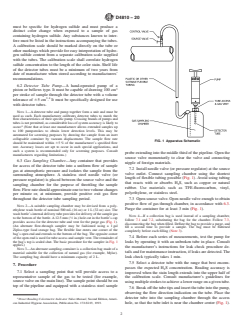
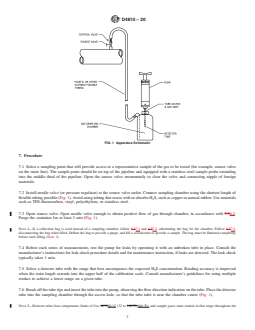
FIG. 1 Apparatus Schematic
should be maintained within 65 % of the manufacturer’s specified flow
rate. Accuracy losses are apt to occur in such special applications, and
such a system is recommended only for screening purposes. Consult
probe extending into the middle third of the pipeline. Open the
manufacturers regarding limitations.)
source valve momentarily to clear the valve and connecting
6.3 Gas Sampling Chamber—Any container that provides
nipple of foreign materials.
for access of the detector tube into a uniform flow of sample
7.2 Install needle valve (or pressure regulator) at the source
gas at atmospheric pressure and isolates the sample from the
valve outlet. Connect sampling chamber using the shortest
surrounding atmosphere. A stainless steel needle valve (or
length of flexible tubing possible (Fig. 1). Avoid using tubing
pressure regulator) is placed between the source valve and the
that reacts with or absorbs H S, such as copper or natural
sampling chamber for the purpose of throttling the sample
rubber. Use materials such as TFE-fluorocarbon, vinyl,
flow. Flow rate should approximate one to two volume changes
polyethylene, or stainless steel.
per minute or, at minimum, provide positive exit gas flow
throughout the detector tube sampling period. 7.3 Open source valve. Open needle valve enough to obtain
positive flow of gas through chamber, in accordance with 6.3.
NOTE 2—A suitable sampling chamber may be devised from a poly-
Purge the container for at least 3 min (Fig. 1).
ethylene wash bottle of nominal 500 mL (16 oz) or 1 L (32 oz) size. The
wash bottle’s internal delivery tube provides for deliver
...
This document is not an ASTM standard and is intended only to provide the user of an ASTM standard an indication of what changes have been made to the previous version. Because
it may not be technically possible to adequately depict all changes accurately, ASTM recommends that users consult prior editions as appropriate. In all cases only the current version
of the standard as published by ASTM is to be considered the official document.
Designation: D4810 − 06 (Reapproved 2015) D4810 − 20
Standard Test Method for
Hydrogen Sulfide in Natural Gas Using Length-of-Stain
Detector Tubes
This standard is issued under the fixed designation D4810; the number immediately following the designation indicates the year of
original adoption or, in the case of revision, the year of last revision. A number in parentheses indicates the year of last reapproval. A
superscript epsilon (´) indicates an editorial change since the last revision or reapproval.
1. Scope
1.1 This test method covers a procedure for a rapid and simple field determination of hydrogen sulfide in natural gas pipelines.
Available detector tubes provide a total measuring range of 0.5 ppm by volume up to 40 % by volume, although the majority of
applications will be on the lower end of this range (that is, under 120 ppm).
1.2 Typically, sulfur dioxide and mercaptans may cause positive interferences. In some cases, nitrogen dioxide can cause a
negative interference. Most detector tubes will have a “precleanse” layer designed to remove certain interferences up to some
maximum interferent level. Consult manufacturers’ instructions for specific interference information.
1.3 Units—The values stated in SI units are to be regarded as the standard.
1.4 This standard does not purport to address all of the safety concerns, if any, associated with its use. It is the responsibility
of the user of this standard to establish appropriate safety safety, health, and healthenvironmental practices and determine the
applicability of regulatory limitations prior to use.
1.5 This international standard was developed in accordance with internationally recognized principles on standardization
established in the Decision on Principles for the Development of International Standards, Guides and Recommendations issued
by the World Trade Organization Technical Barriers to Trade (TBT) Committee.
2. Referenced Documents
2.1 ASTM Standards:
D4150 Terminology Relating to Gaseous Fuels
2.2 Gas Processors Association GPA Standard:
No. 2377-86 Test for Hydrogen Sulfide and Carbon Dioxide in Natural Gas Using Length of Stain Tubes
3. Terminology
3.1 Definitions—For definitions of general terms used in D03 Gaseous Fuels standards, refer to Terminology D4150.
This test method is under the jurisdiction of ASTM Committee D03 on Gaseous Fuels and is the direct responsibility of Subcommittee D03.07 on Analysis of Chemical
Composition of Gaseous Fuels.
Current edition approved Nov. 1, 2015Dec. 15, 2020. Published December 2015January 2021. Originally approved in 1988. Last previous edition approved in 20112015
as D4810 - 06 (2011).D4810 – 06(2015). DOI: 10.1520/D4810-06R15.10.1520/D4810-20.
For referenced ASTM standards, visit the ASTM website, www.astm.org, or contact ASTM Customer Service at service@astm.org. For Annual Book of ASTM Standards
volume information, refer to the standard’s Document Summary page on the ASTM website.
Available from Gas Processors Association, 1812 First National Bank Bldg., Tulsa, OK 74103.Association (GPA), 6060 American Plaza, Suite 700, Tulsa, OK 74135,
http://www.gpaglobal.org.
Copyright © ASTM International, 100 Barr Harbor Drive, PO Box C700, West Conshohocken, PA 19428-2959. United States
D4810 − 20
4. Summary of Test Method
4.1 The sample is drawn through a detector tube filled with a specially prepared chemical. Any hydrogen sulfide present in the
sampling reacts with the chemical to produce a color change or stain. The length of the stain produced in the detector tube, when
exposed to a measured volume of sample, is directly proportional to the amount of hydrogen sulfide present in the sample. A
hand-operated piston or bellows-type pump is used to draw a measured volume of sample through the tube at a controlled rate of
flow. The length of stain produced is converted to ppm (by volume) hydrogen sulfide (H S), by comparison to a calibration scale
supplied by the manufacturer for each box of detection tubes (higher range tubes have units of percent by volume). The system
is direct reading, easily portable, and completely suited to making rapid spot checks for hydrogen sulfide under field conditions.
5. Significance and Use
5.1 The measurement of hydrogen sulfide in natural gas is important because of the gas quality specifications, the corrosive nature
of H S on pipeline materials, and the effects of H S on utilization equipment.
2 2
5.2 This test method provides inexpensive field screening of hydrogen sulfide. The system design is such that it may be used by
nontechnical personnel with a minimum of proper training.
6. Apparatus
6.1 Length-of-Stain Detector Tube and Calibration Scale—A sealed glass tube with breakoff tips sized to fit the tube holder of the
pump. The reagent layer inside the tube, typically a silica gel substrate coated with the active chemicals, must be specific for
hydrogen sulfide and must produce a distinct color change when exposed to a sample of gas containing hydrogen sulfide. Any
substances known to interfere must be listed in the instructions accompanying the tubes. A calibration scale should be marked
directly on the tube or other markings which provide for easy interpretation of hydrogen sulfide content from a separate calibration
scale supplied with the tubes. The calibration scale shall correlate hydrogen sulfide concentration to the length of the color stain.
Shelf life of the detector tubes must be a minimum of two years from date of manufacture when stored according to manufacturers’
recommendations.
6.2 Detector Tube Pump—A hand-operated pump of a piston or bellows type. It must be capable of drawing 100 cm per stroke
3 4
of sample through the detector tube with a volume tolerance of 65 cm . It must be specifically designed for use with detector
tubes.
NOTE 1—A detector tube and pump together form a unit and must be used as such. Each manufacturer calibrates detector tubes to match the flow
characteristics of their specific pump. Crossing brands of pumps and tubes is not permitted, as considerable loss of system accuracy is likely to occur.
(Note that at least one manufacturer allows extended samples up to 100 pumpstrokes to obtain lower detection levels. This may be automated for screening
purposes by drawing the sample from an inert collapsable container by vacuum displacement. The sample flow rate should be maintained within 65 %
of the manufacturer’s specified flow rate. Accuracy losses are apt to occur in such special applications, and such a system is recommended only for
screening purposes. Consult manufacturers regarding limitations.)
6.3 Gas Sampling Chamber—Any container that provides for access of the detector tube into a uniform flow of sample gas at
atmospheric pressure and isolates the sample from the surrounding atmosphere. A stainless steel needle valve (or pressure
regulator) is placed between the source valve and the sampling chamber for the purpose of throttling the sample flow. Flow rate
should approximate one to two volume changes per minute or, at minimum, provide positive exit gas flow throughout the detector
tube sampling period.
NOTE 2—A suitable sampling chamber may be devised from a polyethylene wash bottle of nominal 500-mL (16-oz) or 1-L (32-oz)500 mL (16 oz) or 1 L
(32 oz) size. The wash bottle’s internal delivery tube provides for delivery of the sample gas to the bottom of the bottle. A 12.5-mm12.5 mm ( ⁄2-in.) in.)
hole cut in the bottle’s cap provides access for the detector tube and vent for the purge gas (Fig. 1). (An alternate flow-through sampler may be fashioned
using a 1-gal1 gal Ziploc-type food storage bag. The flexible line enters one corner of the bag’s open end and extends to the bottom of the bag. The
opposite corner of the open end is used for tube access and sample vent. The remainder of the bag’s top is sealed shut. The basic procedure for the sampler
in Fig. 1 applies.)
NOTE 3—An alternate sampling container is a col
...