

ASTM D2663-14(2019)e1
(Test Method)Standard Test Methods for Carbon Black-Dispersion in Rubber
General Information
- Abstract
SIGNIFICANCE AND USE
5.1 Visual dispersion ratings correlate with certain important physical properties of the compound. A rating of 5 indicates a state of dispersion developing near maximum properties, while a rating of 1 would indicate a state of dispersion developing considerably depressed properties. Normally, the visual dispersion ratings indicate the following levels of compound quality:
Visual Dispersion Rating
Classification
4 to 5
High
3 to 4
Intermediate
2 to 3
Low
1 to 2
Very low
SCOPE
1.1 These test methods cover the degree of dispersion of carbon black in rubber. Four test methods are described as follows:
Sections
Test Method A-Visual Inspection
3 – 11
Test Method B-Agglomerate Count
12 – 22
Test Method C-Microroughness Measurement
with Profilometer
23 – 33
Test Method D-Microroughness Measurement with IFM
34 – 42
1.2 The values stated in SI units are to be regarded as standard. No other units of measurement are included in this standard.
1.3 This standard does not purport to address all of the safety concerns, if any, associated with its use. It is the responsibility of the user of this standard to establish appropriate safety, health, and environmental practices and determine the applicability of regulatory limitations prior to use.
1.4 This international standard was developed in accordance with internationally recognized principles on standardization established in the Decision on Principles for the Development of International Standards, Guides and Recommendations issued by the World Trade Organization Technical Barriers to Trade (TBT) Committee.
- Status
- Published
- Publication Date
- 30-Apr-2019
- Technical Committee
- D24 - Carbon Black
- Drafting Committee
- D24.71 - Carbon Black Testing in Rubber
Overview
ASTM D2663-14(2019)e1 outlines standard test methods for evaluating the degree of dispersion of carbon black in rubber compounds. Developed by ASTM International, this standard plays a crucial role in quality control, material performance, and ensuring consistent product properties in various rubber products. By offering a suite of test methods, it assists manufacturers, research facilities, and quality inspectors in determining the degree of carbon black dispersion, which correlates strongly with desirable physical properties in the final compound.
Key Topics
Four Test Methods Covered:
- Visual Inspection (Test Method A): Provides qualitative visual ratings compared to photographic standards on a scale from 1 (very low) to 5 (high).
- Agglomerate Count (Test Method B): Quantitative analysis using microscopy to determine the percentage of black dispersed below a specified size.
- Microroughness Measurement with Profilometer (Test Method C): Quantitative surface assessment using a stylus to gauge fine surface irregularities caused by carbon black agglomerates.
- Microroughness Measurement with IFM (Test Method D): Advanced quantitative technique utilizing interference microscopy for precise surface characterization.
Dispersion Rating Scale:
- Ratings from 1 to 5 are provided, correlating to very low to high dispersion, directly influencing compound quality.
Correlation with Physical Properties:
- Improved dispersion is linked to enhanced tensile strength, abrasion resistance, and overall durability of the rubber compound.
Applicability to Compound Types:
- Test methods apply to both vulcanized and unvulcanized rubber, with specific procedures outlined for sample preparation and testing.
SI Units as Standard:
- All measurements are reported in SI units for global consistency.
Applications
ASTM D2663 is essential across industries where rubber compounds are utilized, including:
- Automotive:
- Ensures optimal carbon black dispersion in tires, seals, and hoses for enhanced durability and safety.
- Industrial Products:
- Supports quality control in conveyor belts, gaskets, and vibration dampeners where rubber performance is critical.
- Research and Development:
- Assists R&D teams in optimizing mixing and compounding processes for new rubber materials.
- Quality Assurance:
- Provides standardized procedures for lab technicians and inspectors to assess material uniformity and predict end-product performance.
Proper application of these test methods helps manufacturers control critical variables in rubber production, resulting in products with predictable and high-performance attributes.
Related Standards
Manufacturers and laboratories often use ASTM D2663 alongside other important standards to ensure robust rubber quality management, such as:
- ASTM D3182: Practice for conducting mixing and preparation of standard rubber compounds and vulcanized sheets.
- ASTM D4483: Practice for evaluating and reporting precision for test methods in the rubber and carbon black industries.
Conclusion
By following ASTM D2663-14(2019)e1, product developers, manufacturers, and quality control professionals can accurately gauge the dispersion of carbon black in rubber, making it a cornerstone standard for the rubber industry. Ensuring correct dispersion levels not only meets regulatory and industry requirements but also aligns with international trade principles as highlighted by adherence to WTO Technical Barriers to Trade (TBT) Committee guidelines. Adoption of these test methods improves product reliability, enhances customer satisfaction, and supports global competitiveness in the manufacturing of high-quality rubber products.
Get Certified
Connect with accredited certification bodies for this standard

DIN CERTCO
DIN Group product certification.

Smithers Quality Assessments
US management systems and product certification.
Sponsored listings
Frequently Asked Questions
ASTM D2663-14(2019)e1 is a standard published by ASTM International. Its full title is "Standard Test Methods for Carbon Black-Dispersion in Rubber". This standard covers: SIGNIFICANCE AND USE 5.1 Visual dispersion ratings correlate with certain important physical properties of the compound. A rating of 5 indicates a state of dispersion developing near maximum properties, while a rating of 1 would indicate a state of dispersion developing considerably depressed properties. Normally, the visual dispersion ratings indicate the following levels of compound quality: Visual Dispersion Rating Classification 4 to 5 High 3 to 4 Intermediate 2 to 3 Low 1 to 2 Very low SCOPE 1.1 These test methods cover the degree of dispersion of carbon black in rubber. Four test methods are described as follows: Sections Test Method A-Visual Inspection 3 – 11 Test Method B-Agglomerate Count 12 – 22 Test Method C-Microroughness Measurement with Profilometer 23 – 33 Test Method D-Microroughness Measurement with IFM 34 – 42 1.2 The values stated in SI units are to be regarded as standard. No other units of measurement are included in this standard. 1.3 This standard does not purport to address all of the safety concerns, if any, associated with its use. It is the responsibility of the user of this standard to establish appropriate safety, health, and environmental practices and determine the applicability of regulatory limitations prior to use. 1.4 This international standard was developed in accordance with internationally recognized principles on standardization established in the Decision on Principles for the Development of International Standards, Guides and Recommendations issued by the World Trade Organization Technical Barriers to Trade (TBT) Committee.
SIGNIFICANCE AND USE 5.1 Visual dispersion ratings correlate with certain important physical properties of the compound. A rating of 5 indicates a state of dispersion developing near maximum properties, while a rating of 1 would indicate a state of dispersion developing considerably depressed properties. Normally, the visual dispersion ratings indicate the following levels of compound quality: Visual Dispersion Rating Classification 4 to 5 High 3 to 4 Intermediate 2 to 3 Low 1 to 2 Very low SCOPE 1.1 These test methods cover the degree of dispersion of carbon black in rubber. Four test methods are described as follows: Sections Test Method A-Visual Inspection 3 – 11 Test Method B-Agglomerate Count 12 – 22 Test Method C-Microroughness Measurement with Profilometer 23 – 33 Test Method D-Microroughness Measurement with IFM 34 – 42 1.2 The values stated in SI units are to be regarded as standard. No other units of measurement are included in this standard. 1.3 This standard does not purport to address all of the safety concerns, if any, associated with its use. It is the responsibility of the user of this standard to establish appropriate safety, health, and environmental practices and determine the applicability of regulatory limitations prior to use. 1.4 This international standard was developed in accordance with internationally recognized principles on standardization established in the Decision on Principles for the Development of International Standards, Guides and Recommendations issued by the World Trade Organization Technical Barriers to Trade (TBT) Committee.
ASTM D2663-14(2019)e1 is classified under the following ICS (International Classification for Standards) categories: 83.040.20 - Rubber compounding ingredients. The ICS classification helps identify the subject area and facilitates finding related standards.
ASTM D2663-14(2019)e1 is available in PDF format for immediate download after purchase. The document can be added to your cart and obtained through the secure checkout process. Digital delivery ensures instant access to the complete standard document.
Standards Content (Sample)
This international standard was developed in accordance with internationally recognized principles on standardization established in the Decision on Principles for the
Development of International Standards, Guides and Recommendations issued by the World Trade Organization Technical Barriers to Trade (TBT) Committee.
´1
Designation: D2663 − 14 (Reapproved 2019)
Standard Test Methods for
Carbon Black—Dispersion in Rubber
This standard is issued under the fixed designation D2663; the number immediately following the designation indicates the year of
original adoption or, in the case of revision, the year of last revision.Anumber in parentheses indicates the year of last reapproval.A
superscript epsilon (´) indicates an editorial change since the last revision or reapproval.
ε NOTE—Corrected 2.2 editorially in May 2021.
1. Scope 2.2 ASTM Adjuncts:
Carbon Black Dispersion Standards
1.1 These test methods cover the degree of dispersion of
Carbon Black Dispersion Chart
carbon black in rubber. Four test methods are described as
follows:
TEST METHOD A—VISUAL INSPECTION
Sections
Test Method A—Visual Inspection 3–11
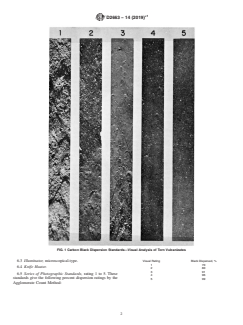
3. Scope
Test Method B—Agglomerate Count 12–22
3.1 Test Method A is a qualitative visual test method.
Test Method C—Microroughness Measurement
with Profilometer 23–33
Ratings are made against a set of standard photographs (Fig.
Test Method D—Microroughness Measurement with IFM 34–42
1), andtheresultsareexpressedonanumericalscale.Thistest
1.2 The values stated in SI units are to be regarded as
methodcannotbeusedforcompoundsthatcontainfillersother
standard. No other units of measurement are included in this
than carbon black.
standard.
4. Summary of Test Method
1.3 This standard does not purport to address all of the
safety concerns, if any, associated with its use. It is the
4.1 The compound rubber is torn or cut to expose a fresh
responsibility of the user of this standard to establish appro- surface for examination by the eye, aided preferably by a hand
priate safety, health, and environmental practices and deter-
lens or a low-power binocular microscope. The dispersion
mine the applicability of regulatory limitations prior to use. level of the carbon black is compared against a series of five
1.4 This international standard was developed in accor-
photographic standards and then rated numerically from 1
dance with internationally recognized principles on standard- (very low) to 5 (high) (see Fig. 1).
ization established in the Decision on Principles for the
5. Significance and Use
Development of International Standards, Guides and Recom-
mendations issued by the World Trade Organization Technical
5.1 Visual dispersion ratings correlate with certain impor-
Barriers to Trade (TBT) Committee.
tant physical properties of the compound. A rating of 5
indicates a state of dispersion developing near maximum
2. Referenced Documents
properties, while a rating of 1 would indicate a state of
dispersion developing considerably depressed properties.
2.1 ASTM Standards:
D3182PracticeforRubber—Materials,Equipment,andPro- Normally, the visual dispersion ratings indicate the following
levels of compound quality:
cedures for Mixing Standard Compounds and Preparing
Standard Vulcanized Sheets
Visual Dispersion Rating Classification
D4483Practice for Evaluating Precision for Test Method
4to5 High
StandardsintheRubberandCarbonBlackManufacturing
3 to 4 Intermediate
Industries
2to3 Low
1 to 2 Very low
6. Apparatus
These test methods are under the jurisdiction of ASTM Committee D24 on
Carbon Black and are the direct responsibility of Subcommittee D24.71 on Carbon
6.1 Sharp Knife or Razor Blade.
Black Testing in Rubber.
Current edition approved May 1, 2019. Published June 2019. Originally
6.2 Hand Lens (10×) or binocular microscope (10 to 20×).
approved in 1967. Last previous edition approved in 2014 as D2663–14. DOI:
10.1520/D2663-14R19E01.
2 3
For referenced ASTM standards, visit the ASTM website, www.astm.org, or Available from ASTM International Headquarters. Order Adjunct No.
contact ASTM Customer Service at service@astm.org. For Annual Book of ASTM ADJD266302-E-PDF. Original adjunct produced in 1967.
Standards volume information, refer to the standard’s Document Summary page on Available from ASTM International Headquarters. Order Adjunct No.
the ASTM website. ADJD266301-E-PDF. Original adjunct produced in 1967.
Copyright © ASTM International, 100 Barr Harbor Drive, PO Box C700, West Conshohocken, PA 19428-2959. United States
´1
D2663 − 14 (2019)
FIG. 1 Carbon Black Dispersion Standards—Visual Analysis of Torn Vulcanizates
6.3 Illuminator, microscopical-type.
Visual Rating Black Dispersed, %
6.4 Knife Heater.
6.5 Series of Photographic Standards, rating 1 to 5. These
standards give the following percent dispersion ratings by the
Agglomerate Count Method:
´1
D2663 − 14 (2019)
7. Test Specimen is best prepared by individual operators, since dispersion
requirements may vary greatly for different types of com-
7.1 Vulcanized Compounds—Use a slab of rubber about
pounds. The control sample should represent a minimum
2mm in thickness. Tear it so that a fresh surface is exposed.
acceptable dispersion level for the type of compound being
The tear may be initiated by a small cut. The most nearly flat
rated. Because it can be observed side by side with unknown
part of the tear is used for rating.
samples under identical conditions, a control compound is
7.2 Unvulcanized Compounds—Unvulcanized rubber may
more accurate than the photographic standards in discerning
be examined as follows:
small deviations from what is considered the norm for a
7.2.1 Ifthespecimencontainscuringagents,sheetitoutand
specific type of compound. Prepare a fresh surface on the
cure in a press to form a vulcanized slab about 2 mm in
control as often as necessary to ensure cleanliness.
thickness. Mill and cure in accordance with Practice D3182.
Then proceed as in 7.1.
10. Report
7.2.2 If the specimen contains no curatives, add the appro-
10.1 Ratings:
priate materials with a minimum of mixing. Then cure and
10.1.1 List all ratings, including those on any control
proceed as above.
compound, on the basis of the 1 to 5 scale defined by the
7.2.3 If the specimen contains no curatives and a dispersion
standard photographs. Use fractional ratings when necessary.
evaluation with no further mixing is required, the compound
10.1.2 Average the ratings on different specimens of the
must first be compressed to remove most of the air holes. To
same compound as well as the ratings of different operators.
accomplish this, press the rubber into a slab between thin
Report the final average values.
sheets of plastic in a mold at a pressure of about 1.03 kPa for
10.2 Compound Identification:
5 min at 105°C. Care should be taken to avoid excessive flow
10.2.1 Formulation—Whenever possible list the following:
during this step. The surface to be examined is formed with a
10.2.1.1 Carbon black, type and loading,
smooth cutting stroke using a sharp, hot knife (a standard type
10.2.1.2 Other fillers, type and loading,
knife heater may be employed). The most nearly smooth and
10.2.1.3 Polymer type, and
flat part of the cut surface is used for rating.
10.2.1.4 Extender oil, type and loading.
10.2.2 Mixing—Describe the mixing of the compound in
8. Number of Tests
terms of one or more of the following:
8.1 Preferably more than one test (on different tears) should
10.2.2.1 Standard mixing procedure,
be made for each specimen. If convenient, more than one
10.2.2.2 Type of equipment,
operator should rate the samples.
10.2.2.3 Masterbatch,
10.2.2.4 Finished compound (vulcanized), and
9. Procedure
10.2.2.5 Finished compound (unvulcanized).
9.1 Examine the prepared specimens under a hand lens or
binocular microscope (the latter being preferred), with oblique
11. Precision and Bias
illumination to accentuate surface detail. Keep the magnifica-
11.1 No statement is made about either the precision or the
tion and lighting conditions constant for all specimens.
bias of Test Method A since the result is qualitative and not
9.2 Comparethesizeandfrequencyofcarbonagglomerates
applicable to statistical treatment.
inthespecimens(showingupassurfacebumpsordepressions)
TEST METHOD B—AGGLOMERATE COUNT
to the photographic standards. Then assign the most closely
matched numerical rating to each compound being rated. In
12. Scope
borderlinecases,usefractionalratings,forexample,3 ⁄2would
indicate a rating between 3 and 4. In cases of dissimilarity in
12.1 TestMethodBisaquantitativetestmethod.Dispersion
thesizeandfrequencyoftheagglomeratesinthespecimenand
is evaluated by measuring with a light microscope the percent-
those of the standards, the operator shall assign the rating that
age area covered by black agglomerates in microtomed sec-
in his judgment is most applicable. Certain compounds (for
tions of the compound. Since this test method involves direct
example,NRandIR)areparticularlypronetoverysmallblack
measurement, it is quantitative and more accurate than the
agglomerations which are difficult to resolve by the Visual
visual test method. The test is applicable to the analysis of
Inspection Method. In instances of high agglomerate
carbonblackdispersionincompoundsthatcontainotherfillers.
frequency, the surface of stocks of this type may show a
general roughness or fine pebbled appearance. Differences are 13. Summary of Test Method
best resolved at somewhat higher magnification (for example,
13.1 The compounded rubber is microtomed into sections
20×, binocular microscope). If at all possible, examine com-
sufficiently thin to permit observation of the carbon agglom-
pounds of this type also by the agglomerate count method, at
erates by transmitted light, with the aid of a light microscope.
least until sufficient experience is gained to recognize disper-
The total cross-sectional area of all agglomerates 5 µm or
sion differences with the Visual Inspection Method.
larger is counted, and from the known content of carbon black
9.3 In comparing a series of different compounds, it is also in the stock, the percentage of carbon black below the 5-µm
desirable to rate the specimens side by side rather than one at size is calculated and expressed as “Percentage of Carbon
a time. This use of a control compound is also advisable. This Black Dispersed.”
´1
D2663 − 14 (2019)
FIG. 2 Rotary Microtome with Cryogenic Attachment for Sectioning Rubber Specimens
14. Significance and Use 15. Apparatus
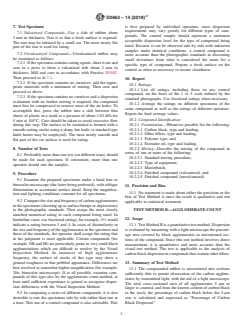
14.1 Certainimportantphysicalpropertiesofthecompound 15.1 Microtome—A rotary microtome capable of produc-
are influenced significantly by the degree of carbon black ing sections from samples up to 3 mm in cross-section and 1
dispersion within the compound (for example, tensile strength cm in length. Tungsten carbide knives are recommended. (See
and abrasion resistance). The correlation of these properties Fig. 2.)
with the percentage dispersion determined by theAgglomerate
15.2 Cryogenic Cooling Unit—A cryogenic cooling attach-
Count Method approximates the following pattern for many 6
ment for the above rotary microtome capable of cooling the
types of black loaded rubber compounds:
sample to –160°C. (See Fig. 2.)
Dispersion, % Classification
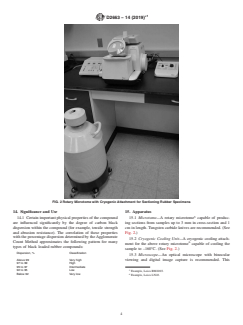
15.3 Microscope—An optical microscope with binocular
Above 99 Very high
viewing and digital image capture is recommended. This
97 to 99 High
95 to 97 Intermediate
92 to 95 Low 5
Example, Leica RM2265.
Below 92 Very low 6
Example, Leica LN22.
´1
D2663 − 14 (2019)
FIG. 3 Light Microscope Equipped with Digital Camera and Computer System
should include a movable specimen stage and white light 2-mm sheets are used, they should first be cut down to a
source with variable intensity. Lenses should include two 10× thickness of about 2 to 3 mm.
widefieldeyepiecesandobjectivesintherangefrom6to10×.
17.2 Unvulcanized Compounds—For rubbers of high un-
Taking into account microscope tube corrections, objectives
saturation(forexample,OE-SBR,NR,andBR),dustsmallbits
should be selected so that magnifications in the range from 75
(enoughsubsequentlytoformbuttonsabout10mmindiameter
to 100× are available. (See Fig. 3.)
and about 2 to 3-mm deep) thoroughly with dicumyl peroxide.
15.4 Computer—Acomputer should be available and inter- Cure in a button mold under high pressure at about 155°C.
facedtothedigitalcameraonthemicroscopetocapturedigital OE-SBR rubbers require about 30 to 60-min cure. BR requires
photomicrographs of the specimens. (See Fig. 3.) about 10 to 15-min cure. After cure, scrape off the excess
peroxide from the sample surface and proceed with sectioning
15.5 Image Analysis Software—Suitable image analysis
inthestandardmanner,takingcarenottoparedownbelowthe
software to allow thresholding of the captured micrographs,
cured surface layer.
conversionofthethresholdedimagetobinaryandareafraction
17.2.1 For IIR, satisfactory surface cures can be obtained
determinationfromthebinaryimages.Examplesofthistypeof
with a mixture of 1 part tetramethylthiuram disulfide (TMTD),
software include, but are not limited to, Image J, ImagePro,
1partmercaptobenzothiazole(MBT),1partsulfur,and5parts
NIH Image, IDL, and NIST Lispix.
zinc oxide, with a cure of 1 h at 155°C. Other alternative
15.6 Razor Blades.
approaches for curing high unsaturation polymers without
actually mixing in curatives are (1) high-energy radiation and
15.7 Sable Brushes (00).
(2) chemical treatment with sulfur monochloride. However,
15.8 Microscope Slides and Cover Glasses.
before using either of these latter methods, the stock should be
pressed out to eliminate most of the air holes. Cure in
16. Reagents and Materials
accordance with Practice D3182.
16.1 Liquid Nitrogen.
18. Test Specimen
16.2 Organic Solvents—Appropriateorganicliquidtoaidin
flattening section onto the glass microscope slides. Examples
18.1 Cut out a specimen approximately 1 cm long, 1 cm
include xylenes, toluene, and methanol.
wide, and approximately 2-mm deep.
18.2 Cut the square block into a trapezoidal shape that will
17. Sampling
fit the sample chuck on the rotary microtome.
17.1 Vulcanizates—Specimens may be cut from standard
test sheets (about 2-mm thick) or from pieces of actual cured
articles. Vulcanized samples must be employed because of the
A special mold containing several circular cavities that are approximately
solvent used to uncurl the thin sections. If pieces other than 10mm in diameter and 3 mm deep.
´1
D2663 − 14 (2019)
18.3 Prepare one specimen block for each different com- 19.6 Repeat steps 19.4 and 19.5 until a sufficient number of
pound to be examined. sections have been brushed out. Then cover the sections with
cover glasses or another glass microscope slide, and seal with
19. Procedure
tape, or a bit of cement at each corner.
19.1 Microtome Preparation—Turn on the rotary
19.7 Preparing for Counting—Inspect the sections for qual-
microtome, insert the knife into the microtome and adjust to
ity under the light microscope, and select one that is relatively
the correct cutting angle (see microtome manufacturer instruc-
free of wrinkles, holes, and knife marks. Also avoid sections
tions). Fill the liquid nitrogen dewar and attach to the cryo-
that are very thin as some of the clumps of carbon black may
genicchamberonthemicrotome.Coolthemicrotomechamber
be brushed out. If the sections are too thick or have too many
and knife holder.
wrinkles, holes or knife marks, adjust the microtome accord-
ingly and produce additional sections.
19.2 Sample Preparation—Insert the prepared specimen
block into the microtome chuck and insert the chuck into the
19.8 Oncegoodsectionsareobtained,removethespecimen
microtomesuchthatthelongaxisofthespecimenisparallelto
from the microtome and measure the length and width of the
the cutting direction. Cool the sample to approximately 50°C
faced block where the sections were obtained. The product of
below the elastomer glass transition temperature.
thesedimensionsistheareabeforeswelling.Also,measurethe
length and width of a few of the sections mounted on the glass
19.3 Microtome Operation—Manually advance the speci-
slides. Average these dimensions and their product is the
men so that the cutting face almost reaches the knife. At this
section area after swelling. Record this value along with the
point, with the advance set in increments of 5 to 10 µm, start
sample area before swelling.
microtoming until the specimen is faced level and full-size
sections are being cut.
19.9 Micrograph Acquisition—Place the slides in the light
microscope in transmission mode and select the magnification.
19.4 Cutting Thin Sections—After facing is complete, set
Magnification should be in the range from 75 to 100× but the
the microtome control to the appropriate thickness depending
exact figure is left to the discretion of the individual operator,
on the carbon black loading. For standard elastomer com-
based on the specifications of his own particular microscope
pounds a thickness of 1 to 2 µm is a good starting point. Cut 4
and lens system. Within the limits of 75 to 100×, the percent
to 5 sections, which will likely roll up, and allow the sections
to collect on the back side of the knife and knife holder. dispersion rating on a given section will not change
significantly, provided that sampling is adequate. However,
19.5 Mounting Sections on Microscope Slides—Using a
magnification should be kept constant in comparing and
clean,drysablebrushtransferasectionfromtheknifeblockto
classifying agglomerate size within different samples. Adjust
a clean microscope slide placed on the edge of the microtome
thelightingandexposureconditionstoobtaingoodimagesand
cryo-chamber.Thesectionwillbecurledupinasmalltightroll
acquire ten non-overlapping images showing the carbon black
and should adhere to the brush with static electricity. Using a
agglomerates in the elastomer matrix (Fig. 4). Save the
secondsablebrush,addafewdropsoftheorganicliquidtothe
micrographs in a non-lossy (uncompressed image in order not
section. With careful manipulation of the solvent wet brush,
to lose micrograph information) file format.
unrollandspreadthesectionoutflatontheslide.Anadditional
brush or small pointed stick may be helpful to roll out the 19.10 Micrograph Analysis—Inanappropriateimageanaly-
section. Continue brushing gently to remove all wrinkles. sissoftwarepackage,openthefirstmicrograph.Toanalyzethe
Small amounts of additional solvent may be added as needed. images, the first step is to threshold the image such that the
FIG. 4 Left: Light micrograph showing the carbon black agglomerates (dark regions) in a rubber sample. Right: The binary image pro-
duced from the micrograph after thresholding to isolate the carbon black agglomerates
´1
D2663 − 14 (2019)
carbon black aggregates are isolated from the background 21.2 Measured Area Fraction Values—Report the average
(usuallybrownincolor).Careshouldbetakentominimizethe agglomerate area fraction to the nearest 0.1 %.
numberofdefects(knifemarks,folds,etc.)thatareincludedin
21.3 Compound Identification—Whenever possible list per-
theareaselectedbythethresholdoperation.Oncethethreshold
tinent information regarding the following:
is complete, a binary image will be generated (Fig. 4). Using
21.3.1 Formulation:
the appropriate software tool, the agglomerates greater than 5
21.3.1.1 Carbon black, type and loading,
µm in size should be counted and a total area fraction of these
21.3.1.2 Other fillers, type and loading,
agglomerates calculated. Repeat this analysis for each image
21.3.1.3 Polymer type, and
and average the ten area fraction values together to obtain the
21.3.1.4 Extender oil, type and loading.
overall agglomerate area fraction.
21.3.2 Mixing—Describe the mixing of the compound in
terms of one or more of the following:
20. Calculation and Interpretation of Results
21.3.2.1 A standard mixing procedure,
20.1 Percent Dispersion—Calculate the percent dispersion, 21.3.2.2 Type of equipment,
representing the percentage of carbon black that has been 21.3.2.3 Masterbatch, and
dispersed below the 5-µm agglomerate size, as follows: 21.3.2.4 Finished compound.
Dispersion, % 5100 2 SU/L
22. Precision and Bias
where:
22.1 Due to limited use, a precision and bias statement for
U = agglomerate area fraction. (This represents an average Test Method B cannot be determined.
of the ten area fraction measurements on the sections.
TEST METHOD C—MICROROUGHNESS
See Note 1.)
MEASUREMENT WITH PROFILOMETER
NOTE1—Mostagglomeratesarenotcomposedentirelyofcarbonblack.
They may contain substantial amounts of polymer or extender oil. In
23. Scope
extreme cases, where U is very large, negative dispersion ratings are
therefore possible. Such stocks are extremely poor and may simply be
23.1 Test Method C is a quantitative test method. The cut
classified at a “0” or “no dispersion” rating. It must also be assumed that
surface of a rubber specimen is traced with a stylus which
the absolute level of all the percent dispersion values is probably higher
measures the amount of roughness caused by carbon black
than reported. There is no satisfactory test method presently available for
agglomerates. This test method is applicable to rubber com-
determining the precise amount of carbon black in each agglomerate.
poundscontainingalltypesofcarbonblacksoverawiderange
of loadings.
S = area swelling factor from the action of the solvent used
24. Summary of Test Method
to uncurl the sections (a ratio of the section area after
swelling to the area before swelling), and
24.1 The compounded rubber is cut to expose a fresh
L = volume percentage of black in the compound.
internal surface. This surface is traced with a fine stylus
Formaximumaccuracy,theblackvolumepercentagecanbe
(2.5-µm radius tip, 200-mg force) which measures a roughness
calculated from the following expression:
factor based on the number and average height of the surface
irregularities (protrusions or depressions) caused by carbon
densityofcompound 3massofblack
L 5 3100
1 black agglomerates. The measured roughness factor is used to
densityofblack 3totalmassofcompound
deriveadispersionindexwhichisexpressedonthesamescale
However, when dealing with hydrocarbon rubbers, for prac-
(0 to 100) as Test Method B. The percent dispersion values
tical purposes the density of the carbon black can simply be
obtained byTest Method B are used to establish the dispersion
considered as being twice that of the polymer and oil, and the
index scale for different rubber formulations.
weight contribution of the curing agents can be disregarded.
25. Significance and Use
Then, the volume percentage of black can be calculated from
the following simplified expression where:
25.1 Certainimportant
...