

ASTM F1121-87(2019)
(Specification)Standard Specification for International Shore Connections for Marine Fire Applications
General Information
- Abstract
ABSTRACT
This specification covers the design and manufacture of international shore connections to be used with marine fire fighting systems during an emergency when a stricken ship has a system failure. International shore connections are portable universal couplings that permit connection of shipboard fire main systems between one ship and another or between a shore facility and a ship when their respective system threading is mismatched. Both the ship and the facility are expected to have a fitting such that in an emergency can be attached to their respective fire hose and bolted together to permit charging the ship's system. It must be portable to accommodate hose to hose connection and allow assistance from any position. The international shore connection may be machined from forgings, castings, plate or bar stock, or may be fabricated out of more than one piece. The material shall be brass, bronze, or other suitable corrosion-resistant material. When fabricated out of more than one piece, the flange may be steel and the coupling a corrosion-resistant material. Nuts, bolts, and washers shall be a corrosion-resistant material.
SCOPE
1.1 This specification covers the design and manufacture of international shore connections to be used with marine fire fighting systems during an emergency when a stricken ship has a system failure.
1.2 International shore connections are portable universal couplings that permit connection of shipboard firemain systems between one ship and another or between a shore facility and a ship when their respective system threading is mismatched. Both the ship and the facility are expected to have a fitting such that in an emergency can be attached to their respective fire hose and bolted together to permit charging the ship's system. It must be portable to accommodate hose to hose connection and allow assistance from any position.
1.3 The international shore connection is required by international treaty2,3 to be carried onboard all passenger and cargo vessels of 500 gross tons or more, regardless of firemain size, engaged in international voyages, and is recommended for all vessels that would be expected to render assistance. It is also intended to be provided at shore facilities that would be used to supply water to a ship’s firemain system.
1.4 Fabrication either on board a vessel, in a shipyard, or other shore facility is not precluded by this specification.
1.5 The values stated in inch-pound units are to be regarded as standard. The values given in parentheses are mathematical conversions to SI units that are provided for information only and are not considered standard.
1.6 This international standard was developed in accordance with internationally recognized principles on standardization established in the Decision on Principles for the Development of International Standards, Guides and Recommendations issued by the World Trade Organization Technical Barriers to Trade (TBT) Committee.
- Status
- Published
- Publication Date
- 30-Nov-2019
- Technical Committee
- F25 - Ships and Marine Technology
- Drafting Committee
- F25.11 - Machinery and Piping Systems


Overview
ASTM F1121-87(2019), Standard Specification for International Shore Connections for Marine Fire Applications, sets requirements for the design and manufacture of portable universal couplings used to connect marine fire fighting systems during emergencies on ships. International shore connections are critical components designed to allow firemain systems of a ship in distress to be linked with another vessel or a shore-based firemain, especially when their system threading is incompatible. Universally recognized and required by international convention, this standard ensures emergency readiness and cross-compatibility for marine fire safety.
Key Topics
Scope and Use: This specification applies to international shore connections that serve as standardized, portable fittings. They facilitate rapid connection between shipboard firemain systems or between vessel and shore-based firefighting infrastructure, enabling seamless water supply during emergencies.
Mandatory Compliance: International treaty mandates that all passenger and cargo ships of 500 gross tons or more, engaged in international voyages, carry at least one compliant international shore connection. Shore facilities serving such vessels are also expected to be equipped accordingly.
Design Requirements:
- Must be portable for flexible hose-to-hose connection and use from any position.
- Manufactured as a single piece or assembled from multiple pieces.
- Key materials include brass, bronze, or other approved corrosion-resistant metals; optional use of steel for flanges if combined with a corrosion-resistant coupling.
Component and Assembly Features:
- Includes a flat-faced flange and threaded coupling.
- Supplied with corrosion-resistant nuts, bolts, and washers.
- Flange gasket must be suitable for seawater service at relevant pressures.
Quality and Inspection:
- Each unit undergoes visual and dimensional inspection to ensure adherence to specifications.
- Appropriate packaging and long-term preservation requirements protect the component during storage and transport.
Applications
- Emergency Ship Response: This standard enables quick, reliable connections between fire main systems on different ships or between a shore facility and a vessel, crucial when a shipboard system fails during fire emergencies.
- International Marine Compliance: All registered passenger and cargo vessels meeting the gross tonnage threshold on international voyages must carry international shore connections, ensuring global interoperability and regulatory compliance.
- Port and Terminal Safety: Shore facilities that supply water to ship firemains rely on standardized shore connections for immediate assistance, contributing to enhanced port safety and emergency preparedness.
- Vessel Assistance: Ships that provide firefighting support to others benefit from compatibility, flexibility, and rapid deployment afforded by these standardized couplings.
Related Standards
For comprehensive marine fire safety and equipment compatibility, consider referencing additional standards and regulations, including:
- SOLAS Chapter II-2, Regulation 19: International Convention for the Safety of Life at Sea requirements on firefighting arrangements, including international shore connection specifications.
- IMO Assembly Resolutions: Additional regulatory context on fire safety systems and emergency preparedness.
- ASTM F1000 Series: Related specifications for marine piping and fire systems.
- Other National and International Standards: Such as IEC, ISO, and classification society rules governing marine safety and firefighting equipment.
Adherence to ASTM F1121-87(2019) promotes the safety of vessels, crews, and cargo, ensuring standardized, effective emergency response capabilities worldwide in line with international maritime regulations.
Relations
- Effective Date
- 01-Dec-2019
Get Certified
Connect with accredited certification bodies for this standard

DNV
DNV is an independent assurance and risk management provider.

Lloyd's Register
Lloyd's Register is a global professional services organisation specialising in engineering and technology.

FSC International
Forest Stewardship Council certification.
Sponsored listings
Frequently Asked Questions
ASTM F1121-87(2019) is a technical specification published by ASTM International. Its full title is "Standard Specification for International Shore Connections for Marine Fire Applications". This standard covers: ABSTRACT This specification covers the design and manufacture of international shore connections to be used with marine fire fighting systems during an emergency when a stricken ship has a system failure. International shore connections are portable universal couplings that permit connection of shipboard fire main systems between one ship and another or between a shore facility and a ship when their respective system threading is mismatched. Both the ship and the facility are expected to have a fitting such that in an emergency can be attached to their respective fire hose and bolted together to permit charging the ship's system. It must be portable to accommodate hose to hose connection and allow assistance from any position. The international shore connection may be machined from forgings, castings, plate or bar stock, or may be fabricated out of more than one piece. The material shall be brass, bronze, or other suitable corrosion-resistant material. When fabricated out of more than one piece, the flange may be steel and the coupling a corrosion-resistant material. Nuts, bolts, and washers shall be a corrosion-resistant material. SCOPE 1.1 This specification covers the design and manufacture of international shore connections to be used with marine fire fighting systems during an emergency when a stricken ship has a system failure. 1.2 International shore connections are portable universal couplings that permit connection of shipboard firemain systems between one ship and another or between a shore facility and a ship when their respective system threading is mismatched. Both the ship and the facility are expected to have a fitting such that in an emergency can be attached to their respective fire hose and bolted together to permit charging the ship's system. It must be portable to accommodate hose to hose connection and allow assistance from any position. 1.3 The international shore connection is required by international treaty2,3 to be carried onboard all passenger and cargo vessels of 500 gross tons or more, regardless of firemain size, engaged in international voyages, and is recommended for all vessels that would be expected to render assistance. It is also intended to be provided at shore facilities that would be used to supply water to a ship’s firemain system. 1.4 Fabrication either on board a vessel, in a shipyard, or other shore facility is not precluded by this specification. 1.5 The values stated in inch-pound units are to be regarded as standard. The values given in parentheses are mathematical conversions to SI units that are provided for information only and are not considered standard. 1.6 This international standard was developed in accordance with internationally recognized principles on standardization established in the Decision on Principles for the Development of International Standards, Guides and Recommendations issued by the World Trade Organization Technical Barriers to Trade (TBT) Committee.
ABSTRACT This specification covers the design and manufacture of international shore connections to be used with marine fire fighting systems during an emergency when a stricken ship has a system failure. International shore connections are portable universal couplings that permit connection of shipboard fire main systems between one ship and another or between a shore facility and a ship when their respective system threading is mismatched. Both the ship and the facility are expected to have a fitting such that in an emergency can be attached to their respective fire hose and bolted together to permit charging the ship's system. It must be portable to accommodate hose to hose connection and allow assistance from any position. The international shore connection may be machined from forgings, castings, plate or bar stock, or may be fabricated out of more than one piece. The material shall be brass, bronze, or other suitable corrosion-resistant material. When fabricated out of more than one piece, the flange may be steel and the coupling a corrosion-resistant material. Nuts, bolts, and washers shall be a corrosion-resistant material. SCOPE 1.1 This specification covers the design and manufacture of international shore connections to be used with marine fire fighting systems during an emergency when a stricken ship has a system failure. 1.2 International shore connections are portable universal couplings that permit connection of shipboard firemain systems between one ship and another or between a shore facility and a ship when their respective system threading is mismatched. Both the ship and the facility are expected to have a fitting such that in an emergency can be attached to their respective fire hose and bolted together to permit charging the ship's system. It must be portable to accommodate hose to hose connection and allow assistance from any position. 1.3 The international shore connection is required by international treaty2,3 to be carried onboard all passenger and cargo vessels of 500 gross tons or more, regardless of firemain size, engaged in international voyages, and is recommended for all vessels that would be expected to render assistance. It is also intended to be provided at shore facilities that would be used to supply water to a ship’s firemain system. 1.4 Fabrication either on board a vessel, in a shipyard, or other shore facility is not precluded by this specification. 1.5 The values stated in inch-pound units are to be regarded as standard. The values given in parentheses are mathematical conversions to SI units that are provided for information only and are not considered standard. 1.6 This international standard was developed in accordance with internationally recognized principles on standardization established in the Decision on Principles for the Development of International Standards, Guides and Recommendations issued by the World Trade Organization Technical Barriers to Trade (TBT) Committee.
ASTM F1121-87(2019) is classified under the following ICS (International Classification for Standards) categories: 47.020.30 - Piping systems. The ICS classification helps identify the subject area and facilitates finding related standards.
ASTM F1121-87(2019) has the following relationships with other standards: It is inter standard links to ASTM F1121-87(2015). Understanding these relationships helps ensure you are using the most current and applicable version of the standard.
ASTM F1121-87(2019) is available in PDF format for immediate download after purchase. The document can be added to your cart and obtained through the secure checkout process. Digital delivery ensures instant access to the complete standard document.
Standards Content (Sample)
This international standard was developed in accordance with internationally recognized principles on standardization established in the Decision on Principles for the
Development of International Standards, Guides and Recommendations issued by the World Trade Organization Technical Barriers to Trade (TBT) Committee.
Designation: F1121 −87 (Reapproved 2019) An American National Standard
Standard Specification for
International Shore Connections for Marine Fire
Applications
This standard is issued under the fixed designation F1121; the number immediately following the designation indicates the year of
original adoption or, in the case of revision, the year of last revision. A number in parentheses indicates the year of last reapproval. A
superscript epsilon (´) indicates an editorial change since the last revision or reapproval.
1. Scope Development of International Standards, Guides and Recom-
mendations issued by the World Trade Organization Technical
1.1 This specification covers the design and manufacture of
Barriers to Trade (TBT) Committee.
international shore connections to be used with marine fire
fighting systems during an emergency when a stricken ship has
2. Ordering Information
a system failure.
2.1 The purchase order or inquiry for an international shore
1.2 International shore connections are portable universal
connection shall include the following as applicable:
couplingsthatpermitconnectionofshipboardfiremainsystems
2.1.1 Material of construction.
between one ship and another or between a shore facility and
2.1.2 Title, number, and latest revision of this specification.
a ship when their respective system threading is mismatched.
2.1.3 Maximum operating pressure (psig) (when above 150
Both the ship and the facility are expected to have a fitting such
psig, see 4.2).
that in an emergency can be attached to their respective fire
2.1.4 Preservation (coating) requirements (if any, see 7.2).
hose and bolted together to permit charging the ship’s system.
2.1.5 Diameterandthreadingtobeprovidedinthecoupling.
It must be portable to accommodate hose to hose connection
and allow assistance from any position.
3. Materials and Manufacture
1.3 The international shore connection is required by inter-
2,3
3.1 The international shore connection may be machined
national treaty to be carried onboard all passenger and cargo
from forgings, castings, plate or bar stock, or may be fabricated
vessels of 500 gross tons or more, regardless of firemain size,
out of more than one piece.
engaged in international voyages, and is recommended for all
vessels that would be expected to render assistance. It is also
3.2 The material shall be brass, bronze, or other suitable
intended to be provided at shore facilities that would be used to
corrosion-resistant material. When fabricated out of more than
supply water to a ship’s firemain system.
one piece, the flange may be steel and the coupling a
corrosion-resistant material. Aluminum shall not be used.
1.4 Fabrication either on board a vessel, in a shipyard, or
other shore facility is not precluded by this specification.
3.3 Nuts, bolts, and washers shall be a corrosion-resistant
1.5 The values stated in inch-pound units are to be regarded material.
as standard. The values given in parentheses are mathematical
conversions to SI units that are provided for information only 4. Other Requirements
and are not considered standard.
4.1 Design:
1.6 This international standard was developed in accor-
4.1.1 The connection shall consist of a flat face flange and a
dance with internationally recognized principles on standard-
threaded coupling. Threading shall be specified by the pur-
ization established in the Decision on Principles for the
chaser.
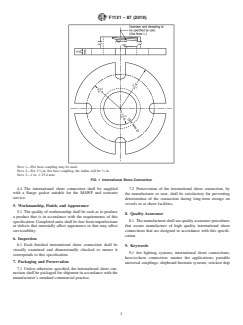
4.1.2 The dimensions of the international shore connection
shall be in accordance with Fig. 1.
This specification is under the jurisdiction of ASTM Committee F25 on Ships
4.2 The maximum allowable working pressure (MAWP)
and Marine Technology and is the direct responsibility of Subcommittee F25.11 on
shall be at least 150 psig (1 N/mm ).
Machinery and Piping Systems.
Current edition approved Dec. 1, 2019. Published
...