

ASTM E1582-21
(Test Method)Standard Test Method for Temperature Calibration of Thermogravimetric Analyzers
General Information
- Abstract
SIGNIFICANCE AND USE
5.1 Thermogravimetric analyzers are used to characterize a broad range of materials. In most cases, one of the desired values to be assigned in thermogravimetric measurements is the temperature at which significant changes in specimen mass occur. Therefore, the temperature axis (abscissa) of all apparent-mass-change curves must be calibrated accurately, either by direct reading of a temperature sensor, or by adjusting the programmer temperature to match the actual temperature over the temperature range of interest. In the latter case, this is accomplished by the use of either melting point or magnetic transition standards.
5.2 This test method permits interlaboratory comparison and intralaboratory correlation of instrumental temperature scale data.
SCOPE
1.1 This test method describe the temperature calibration of thermogravimetric analyzers over the temperature range from 25 °C to 1500 °C and is applicable to commercial and custom-built apparatus. This calibration may be accomplished by the use of either melting point standards or magnetic transition standards.
1.2 The weight change curve in thermogravimetry results from a number of influences, some of which are characteristic of the specimen holder assembly and atmosphere rather than the specimen. The variations from instrument to instrument occur in the point of measurement of the temperature, the nature of the material, its size and packing, the geometry and composition of the specimen container, the geometry and design of the furnace, and the accuracy and sensitivity of the temperature sensor and displaying scales. These all contribute to differences in measured temperatures, which may exceed 20 °C. In addition, some sample holder assemblies will show variations of measured temperature with sample size or heating/cooling rate, or both. Since it is neither practical nor advisable to standardize sample holders or thermobalance geometries, instruments may be calibrated by measurement of the deviation of a melting or magnetic (Curie point) transition temperature from the standard reference temperature. This deviation can be applied as a correction term to subsequent measurements.
1.3 This test method assumes that the indicated temperature of the instrument is linear over the range defined by a two-point calibration and that this linearity has been verified. These two calibration temperatures should be as close to the experimental measurements to be made as possible.
1.4 This test method describes two procedures for temperature calibration of thermogravimetric analyzers using any type balance. Procedure A uses melting point standards for calibration. Procedure B uses magnetic transition standards for calibration.
1.5 The data generated by these procedures can be used to correct the temperature scale of the instrument by either a positive or negative amount using either a one- or two-point temperature calibration procedure.
1.6 The values stated in SI units are to be regarded as standard. No other units of measurement are included in this standard.
1.7 This standard does not purport to address all of the safety concerns, if any, associated with its use. It is the responsibility of the user of this standard to establish appropriate safety, health, and environmental practices and determine the applicability of regulatory limitations prior to use.
1.8 This international standard was developed in accordance with internationally recognized principles on standardization established in the Decision on Principles for the Development of International Standards, Guides and Recommendations issued by the World Trade Organization Technical Barriers to Trade (TBT) Committee.
- Status
- Published
- Publication Date
- 30-Jun-2021
- Technical Committee
- E37 - Thermal Measurements
- Drafting Committee
- E37.01 - Calorimetry and Mass Loss
Buy Documents
ASTM E1582-21 - Standard Test Method for Temperature Calibration of Thermogravimetric Analyzers
REDLINE ASTM E1582-21 - Standard Test Method for Temperature Calibration of Thermogravimetric Analyzers
Overview
ASTM E1582-21 is the standard test method for temperature calibration of thermogravimetric analyzers (TGA). Thermogravimetric analyzers are instrumental in characterizing material properties by measuring changes in mass as a function of temperature. Accurate temperature calibration is essential because it ensures that the temperature axis of thermogravimetric data reliably corresponds to the true sample temperature, leading to more precise detection of significant mass changes in specimens.
This standard details calibration for TGAs over a wide temperature range (25 °C to 1500 °C) using either melting point standards or magnetic transition standards. ASTM E1582-21 supports both commercial and custom-built thermogravimetric analyzers and establishes procedures to facilitate interlaboratory and intralaboratory consistency.
Key Topics
- Temperature Calibration Methods: The standard covers two main procedures:
- Procedure A: Uses melting point standards.
- Procedure B: Uses magnetic transition (Curie point) standards.
- Instrumentation Variability: Recognizes sources of variability such as sample holder geometry, atmosphere composition, sample size, and heating rates.
- Calibration Range: Applicable for temperature measurement from 25 °C to 1500 °C.
- Correction of Temperature Readings: Outlines the use of one-point or two-point calibration corrections to ensure linearity and accuracy in temperature measurement.
- Documentation and Reporting: Specifies the details to be reported, including reference materials, instrument configuration, calibration procedures, and environmental conditions.
- Precision and Bias: Provides guidelines for assessing repeatability and reproducibility in calibration results.
Applications
Thermogravimetric analyzers are widely used in:
- Materials Characterization: Accurate temperature calibration allows for the reliable determination of transition points such as melting, decomposition, or magnetic transition in polymers, metals, ceramics, and composites.
- Quality Control: Ensures consistent production quality in industries relying on thermogravimetric analysis by standardizing temperature calibration procedures.
- Research and Development: Assists laboratories in comparing data across different instruments or facilities, supporting innovative new material development.
- Compliance and Certification: Helps organizations meet regulatory and industry requirements for calibration and measurement procedures, enhancing both internal and external audit readiness.
Related Standards
The following ASTM standards are referenced or relevant to temperature calibration of thermogravimetric analyzers:
- ASTM E2040: Test Method for Mass Scale Calibration of Thermogravimetric Analyzers
- ASTM E967: Test Method for Temperature Calibration of Differential Scanning Calorimeters and Differential Thermal Analyzers
- ASTM E473: Terminology Relating to Thermal Analysis and Rheology
- ASTM E1142: Terminology Relating to Thermophysical Properties
- ASTM E691: Practice for Conducting an Interlaboratory Study to Determine the Precision of a Test Method
Practical Value
Implementing ASTM E1582-21 ensures that thermogravimetric analyzers provide accurate, reproducible temperature data essential for reliable material analysis. The standard enables:
- Consistent calibration across a variety of instruments
- Reliable detection of material transition temperatures
- Enhanced comparability of test results within and between laboratories
- Improved compliance with international standards for thermal analysis
By following ASTM E1582-21, laboratories and manufacturing facilities can maintain high standards of accuracy and quality when performing thermogravimetric measurements, ultimately contributing to better product performance and material research outcomes.
Relations
- Effective Date
- 01-Oct-2023
- Effective Date
- 01-Oct-2023
- Refers
ASTM E2040-19 - Standard Test Method for Mass Scale Calibration of Thermogravimetric Analyzers - Effective Date
- 01-Dec-2019
- Effective Date
- 01-May-2015
- Effective Date
- 15-Aug-2014
- Effective Date
- 15-Aug-2014
- Effective Date
- 01-Apr-2014
- Refers
ASTM E2040-08(2014) - Standard Test Method for Mass Scale Calibration of Thermogravimetric Analyzers - Effective Date
- 15-Mar-2014
- Effective Date
- 15-Feb-2014
- Effective Date
- 01-May-2013
- Effective Date
- 01-Sep-2012
- Effective Date
- 01-Nov-2011
- Effective Date
- 01-Aug-2011
- Effective Date
- 15-Jun-2011
- Effective Date
- 15-Jun-2011
Buy Documents
ASTM E1582-21 - Standard Test Method for Temperature Calibration of Thermogravimetric Analyzers
REDLINE ASTM E1582-21 - Standard Test Method for Temperature Calibration of Thermogravimetric Analyzers
Get Certified
Connect with accredited certification bodies for this standard

BSMI (Bureau of Standards, Metrology and Inspection)
Taiwan's standards and inspection authority.
Sponsored listings
Frequently Asked Questions
ASTM E1582-21 is a standard published by ASTM International. Its full title is "Standard Test Method for Temperature Calibration of Thermogravimetric Analyzers". This standard covers: SIGNIFICANCE AND USE 5.1 Thermogravimetric analyzers are used to characterize a broad range of materials. In most cases, one of the desired values to be assigned in thermogravimetric measurements is the temperature at which significant changes in specimen mass occur. Therefore, the temperature axis (abscissa) of all apparent-mass-change curves must be calibrated accurately, either by direct reading of a temperature sensor, or by adjusting the programmer temperature to match the actual temperature over the temperature range of interest. In the latter case, this is accomplished by the use of either melting point or magnetic transition standards. 5.2 This test method permits interlaboratory comparison and intralaboratory correlation of instrumental temperature scale data. SCOPE 1.1 This test method describe the temperature calibration of thermogravimetric analyzers over the temperature range from 25 °C to 1500 °C and is applicable to commercial and custom-built apparatus. This calibration may be accomplished by the use of either melting point standards or magnetic transition standards. 1.2 The weight change curve in thermogravimetry results from a number of influences, some of which are characteristic of the specimen holder assembly and atmosphere rather than the specimen. The variations from instrument to instrument occur in the point of measurement of the temperature, the nature of the material, its size and packing, the geometry and composition of the specimen container, the geometry and design of the furnace, and the accuracy and sensitivity of the temperature sensor and displaying scales. These all contribute to differences in measured temperatures, which may exceed 20 °C. In addition, some sample holder assemblies will show variations of measured temperature with sample size or heating/cooling rate, or both. Since it is neither practical nor advisable to standardize sample holders or thermobalance geometries, instruments may be calibrated by measurement of the deviation of a melting or magnetic (Curie point) transition temperature from the standard reference temperature. This deviation can be applied as a correction term to subsequent measurements. 1.3 This test method assumes that the indicated temperature of the instrument is linear over the range defined by a two-point calibration and that this linearity has been verified. These two calibration temperatures should be as close to the experimental measurements to be made as possible. 1.4 This test method describes two procedures for temperature calibration of thermogravimetric analyzers using any type balance. Procedure A uses melting point standards for calibration. Procedure B uses magnetic transition standards for calibration. 1.5 The data generated by these procedures can be used to correct the temperature scale of the instrument by either a positive or negative amount using either a one- or two-point temperature calibration procedure. 1.6 The values stated in SI units are to be regarded as standard. No other units of measurement are included in this standard. 1.7 This standard does not purport to address all of the safety concerns, if any, associated with its use. It is the responsibility of the user of this standard to establish appropriate safety, health, and environmental practices and determine the applicability of regulatory limitations prior to use. 1.8 This international standard was developed in accordance with internationally recognized principles on standardization established in the Decision on Principles for the Development of International Standards, Guides and Recommendations issued by the World Trade Organization Technical Barriers to Trade (TBT) Committee.
SIGNIFICANCE AND USE 5.1 Thermogravimetric analyzers are used to characterize a broad range of materials. In most cases, one of the desired values to be assigned in thermogravimetric measurements is the temperature at which significant changes in specimen mass occur. Therefore, the temperature axis (abscissa) of all apparent-mass-change curves must be calibrated accurately, either by direct reading of a temperature sensor, or by adjusting the programmer temperature to match the actual temperature over the temperature range of interest. In the latter case, this is accomplished by the use of either melting point or magnetic transition standards. 5.2 This test method permits interlaboratory comparison and intralaboratory correlation of instrumental temperature scale data. SCOPE 1.1 This test method describe the temperature calibration of thermogravimetric analyzers over the temperature range from 25 °C to 1500 °C and is applicable to commercial and custom-built apparatus. This calibration may be accomplished by the use of either melting point standards or magnetic transition standards. 1.2 The weight change curve in thermogravimetry results from a number of influences, some of which are characteristic of the specimen holder assembly and atmosphere rather than the specimen. The variations from instrument to instrument occur in the point of measurement of the temperature, the nature of the material, its size and packing, the geometry and composition of the specimen container, the geometry and design of the furnace, and the accuracy and sensitivity of the temperature sensor and displaying scales. These all contribute to differences in measured temperatures, which may exceed 20 °C. In addition, some sample holder assemblies will show variations of measured temperature with sample size or heating/cooling rate, or both. Since it is neither practical nor advisable to standardize sample holders or thermobalance geometries, instruments may be calibrated by measurement of the deviation of a melting or magnetic (Curie point) transition temperature from the standard reference temperature. This deviation can be applied as a correction term to subsequent measurements. 1.3 This test method assumes that the indicated temperature of the instrument is linear over the range defined by a two-point calibration and that this linearity has been verified. These two calibration temperatures should be as close to the experimental measurements to be made as possible. 1.4 This test method describes two procedures for temperature calibration of thermogravimetric analyzers using any type balance. Procedure A uses melting point standards for calibration. Procedure B uses magnetic transition standards for calibration. 1.5 The data generated by these procedures can be used to correct the temperature scale of the instrument by either a positive or negative amount using either a one- or two-point temperature calibration procedure. 1.6 The values stated in SI units are to be regarded as standard. No other units of measurement are included in this standard. 1.7 This standard does not purport to address all of the safety concerns, if any, associated with its use. It is the responsibility of the user of this standard to establish appropriate safety, health, and environmental practices and determine the applicability of regulatory limitations prior to use. 1.8 This international standard was developed in accordance with internationally recognized principles on standardization established in the Decision on Principles for the Development of International Standards, Guides and Recommendations issued by the World Trade Organization Technical Barriers to Trade (TBT) Committee.
ASTM E1582-21 is classified under the following ICS (International Classification for Standards) categories: 17.200.20 - Temperature-measuring instruments. The ICS classification helps identify the subject area and facilitates finding related standards.
ASTM E1582-21 has the following relationships with other standards: It is inter standard links to ASTM E473-23b, ASTM E1142-23b, ASTM E2040-19, ASTM E1142-15, ASTM E1142-14b, ASTM E473-14, ASTM E1142-14a, ASTM E2040-08(2014), ASTM E1142-14, ASTM E691-13, ASTM E1142-12, ASTM E691-11, ASTM E1142-11b, ASTM E1142-11a, ASTM E473-11a. Understanding these relationships helps ensure you are using the most current and applicable version of the standard.
ASTM E1582-21 is available in PDF format for immediate download after purchase. The document can be added to your cart and obtained through the secure checkout process. Digital delivery ensures instant access to the complete standard document.
Standards Content (Sample)
This international standard was developed in accordance with internationally recognized principles on standardization established in the Decision on Principles for the
Development of International Standards, Guides and Recommendations issued by the World Trade Organization Technical Barriers to Trade (TBT) Committee.
Designation: E1582 − 21
Standard Test Method for
Temperature Calibration of Thermogravimetric Analyzers
This standard is issued under the fixed designation E1582; the number immediately following the designation indicates the year of
original adoption or, in the case of revision, the year of last revision. A number in parentheses indicates the year of last reapproval. A
superscript epsilon (´) indicates an editorial change since the last revision or reapproval.
1. Scope* 1.5 The data generated by these procedures can be used to
correct the temperature scale of the instrument by either a
1.1 This test method describe the temperature calibration of
positive or negative amount using either a one- or two-point
thermogravimetric analyzers over the temperature range from
temperature calibration procedure.
25 °C to 1500 °C and is applicable to commercial and
custom-built apparatus. This calibration may be accomplished 1.6 The values stated in SI units are to be regarded as
by the use of either melting point standards or magnetic standard. No other units of measurement are included in this
transition standards. standard.
1.7 This standard does not purport to address all of the
1.2 The weight change curve in thermogravimetry results
safety concerns, if any, associated with its use. It is the
from a number of influences, some of which are characteristic
responsibility of the user of this standard to establish appro-
of the specimen holder assembly and atmosphere rather than
priate safety, health, and environmental practices and deter-
the specimen. The variations from instrument to instrument
mine the applicability of regulatory limitations prior to use.
occur in the point of measurement of the temperature, the
1.8 This international standard was developed in accor-
nature of the material, its size and packing, the geometry and
dance with internationally recognized principles on standard-
composition of the specimen container, the geometry and
ization established in the Decision on Principles for the
design of the furnace, and the accuracy and sensitivity of the
Development of International Standards, Guides and Recom-
temperature sensor and displaying scales. These all contribute
mendations issued by the World Trade Organization Technical
to differences in measured temperatures, which may exceed
Barriers to Trade (TBT) Committee.
20 °C. In addition, some sample holder assemblies will show
variations of measured temperature with sample size or
2. Referenced Documents
heating/cooling rate, or both. Since it is neither practical nor
advisable to standardize sample holders or thermobalance
2.1 ASTM Standards:
geometries, instruments may be calibrated by measurement of
E473 Terminology Relating to Thermal Analysis and Rhe-
the deviation of a melting or magnetic (Curie point) transition
ology
temperature from the standard reference temperature. This
E691 Practice for Conducting an Interlaboratory Study to
deviation can be applied as a correction term to subsequent
Determine the Precision of a Test Method
measurements.
E967 Test Method for Temperature Calibration of Differen-
tial Scanning Calorimeters and Differential Thermal Ana-
1.3 This test method assumes that the indicated temperature
lyzers
oftheinstrumentislinearovertherangedefinedbyatwo-point
E1142 Terminology Relating to Thermophysical Properties
calibration and that this linearity has been verified. These two
E2040 Test Method for Mass Scale Calibration of Thermo-
calibration temperatures should be as close to the experimental
gravimetric Analyzers
measurements to be made as possible.
1.4 This test method describes two procedures for tempera-
3. Terminology
ture calibration of thermogravimetric analyzers using any type
3.1 Definitions—Technical terms used in this document are
balance. Procedure A uses melting point standards for calibra-
defined in Terminologies E473 and E1142, including Celsius,
tion. Procedure B uses magnetic transition standards for
Curie temperature, derivative, Kelvin, magnetic
calibration.
transformation, onset point, thermogravimetry, thermogravi-
metric analyzer, and thermomagnitometry.
ThistestmethodisunderthejurisdictionofASTMCommitteeE37onThermal
Measurements and is the direct responsibility of Subcommittee E37.01 on Calo-
rimetry and Mass Loss. For referenced ASTM standards, visit the ASTM website, www.astm.org, or
Current edition approved July 1, 2021. Published July 2021. Originally approved contact ASTM Customer service at service@astm.org. For Annual Book of ASTM
in 1993. Last previous edition approved in 2017 as E1582 – 17. DOI: 10.1520/ Standards volume information, refer to the standard’s Document Summary page on
E1582-21. the ASTM website.
*A Summary of Changes section appears at the end of this standard
Copyright © ASTM International, 100 Barr Harbor Drive, PO Box C700, West Conshohocken, PA 19428-2959. United States
E1582 − 21
over the temperature range of interest. In the latter case, this is
accomplished by the use of either melting point or magnetic
transition standards.
5.2 This test method permits interlaboratory comparison
and intralaboratory correlation of instrumental temperature
scale data.
6. Interferences
6.1 Thereferencemetalsaresensitivetoimpuritiesandmay
FIG. 1 Magnetic Reference Temperature
oxidizeatelevatedtemperatures.Allrunsshallbeconductedin
an oxygen-free inert purge gas of the same type to be used in
the experimental procedures.
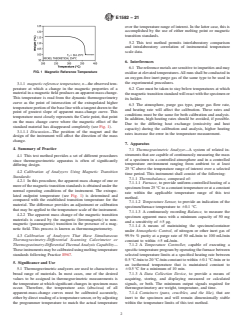
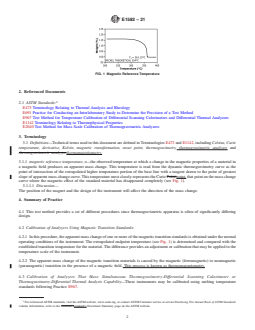
3.1.1 magnetic reference temperature, n—the observed tem-
perature at which a change in the magnetic properties of a
6.2 Care must be taken to stay below temperatures at which
material in a magnetic field produces an apparent mass change.
themagnetictransitionstandardwillreactwiththespecimenor
This temperature is read from the dynamic thermogravimetry
its holder.
curve as the point of intersection of the extrapolated higher
6.3 The atmosphere, purge gas type, purge gas flow rate,
temperatureportionofthebaselinewithatangentdrawntothe
and heating rate will affect the calibration. These rates and
point of greatest slope of apparent mass-change curve. This
conditions must be the same for both calibration and analysis.
temperature most closely represents the Curie point, that point
In addition, high heating rates should be avoided, if possible.
on the mass change curve where the magnetic effect of the
Due to the differing heat exchange (emissivity and heat
standard material has disappeared completely (see Fig. 1).
capacity) during the calibration and analysis, higher heating
3.1.1.1 Discussion—The position of the magnet and the
rates increase the error in the temperature measurement.
design of the instrument will affect the direction of the mass
change.
7. Apparatus
4. Summary of Practice
7.1 Thermogravimetric Analyzer—A system of related in-
struments that are capable of continuously measuring the mass
4.1 This test method provides a set of different procedures
of a specimen in a controlled atmosphere and in a controlled
since thermogravimetric apparatus is often of significantly
temperature environment ranging from ambient to at least
differing design.
25 °C above the temperature range of interest over a selected
4.2 Calibration of Analyzers Using Magnetic Transition
time period. This instrument shall consist of the following:
Standards:
7.1.1 Thermobalance, composed of:
4.2.1 In this procedure, the apparent mass change of one or
7.1.1.1 Furnace, to provide uniform controlled heating of a
more of the magnetic transition standards is obtained under the
specimen from 25 °C to a constant temperature or at a constant
normal operating conditions of the instrument. The extrapo-
rate within the applicable temperature range of this test
lated endpoint temperature (see Fig. 1) is determined and
method.
compared with the established transition temperature for the
7.1.1.2 Temperature Sensor, to provide an indication of the
material. The difference provides an adjustment or calibration
specimen/furnace temperature to 60.1 °C.
that may be applied to the temperature scale of the instrument.
7.1.1.3 A continuously recording Balance, to measure the
4.2.2 The apparent mass change of the magnetic transition
specimen apparent mass with a minimum capacity of 50 mg
materials is caused by the magnetic (ferromagnetic) to non-
and a sensitivity of 65 µg.
magnetic (paramagnetic) transition in the presence of a mag-
7.1.1.4 A means of maintaining the specimen/container
netic field. This process is known as thermomagnetometry.
under Atmospheric Control, of nitrogen or other inert gas of
4.3 Calibration of Analyzers That Have Simultaneous
99.9+ % purity at a purge rate of 50 mL/min to 100 mL/min
Thermogravimetry-Differential Scanning Calorimeter or
constant to within 65 mL/min.
Thermogravimetry-Differential Thermal Analysis Capability—
7.1.2 A Temperature Controller, capable of executing a
Theseinstrumentsmaybecalibratedusingmeltingtemperature
specifictemperatureprogrambyoperatingthefurnacebetween
standards following Practice E967.
selected temperature limits at a specified heating rate between
0.5 °C⁄min to 20 °C⁄min constant to within 60.1 °C⁄min or to
5. Significance and Use
an isothermal temperature that is maintained constant to
5.1 Thermogravimetric analyzers are used to characterize a 60.5 °C for a minimum of 10 min.
broad range of materials. In most cases, one of the desired 7.1.3 A Data Collection Device, to provide a means of
values to be assigned in thermogravimetric measurements is acquiring, storing, and displaying measured or calculated
the temperature at which significant changes in specimen mass signals, or both. The minimum output signals required for
occur. Therefore, the temperature axis (abscissa) of all thermogravimetery are weight, temperature, and time.
apparent-mass-change curves must be calibrated accurately, 7.1.4 Containers (pans, crucibles, and the like), that are
eitherbydirectreadingofatemperaturesensor,orbyadjusting inert to the specimen and will remain dimensionally stable
the programmer temperature to match the actual temperature within the temperature limits of this test method.
E1582 − 21
A,B,C
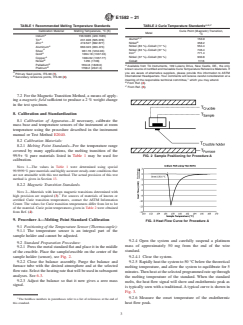
TABLE 1 Recommended Melting Temperature Standards TABLE 2 Curie Temperature Standards
Curie Point (Magnetic) Transition,
Calibration Material Melting Temperature, °C (K)
Metal
°C
A
Indium 156.5985 (429.7485)
A,C
A
Alumel 153.9
Tin 231.928 (505.078)
B
A
Nickel 358.2
Zinc 419.527 (692.677)
A
Nickel (83 %)–Cobalt (17 %) 554.4
Aluminum 660.323 (933.473)
A
Nickel (63 %)–Cobalt (37 %) 746.4
Silver 961.78 (1234.93)
C
A
Iron 771.4
Gold 1064.18 (1337.33)
A
Nickel (37 %)–Cobalt (63 %) 930.8
Copper 1084.62 (1357.77)
B
Cobalt 1116
Nickel 1455 (1728)
B
Palladium 1554.8 (1828.0) A
Available from TA Instruments, 109 Lukens Drive, New Castle, DE., the only
B
Platinum 1768.2 (2041.3)
known source of certified and traceable Curie Temperature Reference Materials. If
A
you are aware of alternative suppliers, please provide this information to ASTM
Primary fixed points, ITS-90 (1).
B
International Headquarters. Your comments will receive careful consideration at a
Secondary reference points, ITS-90 (2).
meeting of the responsible technical committee, which you may attend.
B
From Ref. (4).
C
From Ref. (5).
7.2 For the Magnetic Transition Method, a means of apply-
ing a magnetic field sufficient to producea2% weight change
in the test specimen.
8. Calibration and Standardization
8.1 Calibration of Apparatus—If necessary, calibrate the
mass base and temperature sensors of the instrument at room
temperature using the procedure described in the instrument
manual or Test Method E2040.
8.2 Calibration Materials:
8.2.1 Melting Point Standards—For the temperature range
covered by many applications, the melting transition of the
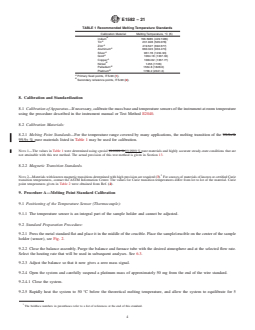
99.9+ % pure materials listed in Table 1 may be used for
FIG. 2 Sample Positioning for Procedure A
calibration.
NOTE 1—The values in Table 1 were determined using special
99.9999 % pure materials and highly accurate steady-state conditions that
are not attainable with this test method. The actual precision of this test
method is given in Section 13.
8.2.2 Magnetic Transition Standards.
NOTE 2—Materials with known magnetic transitions determined with
high precision are required (3). For sources of materials of known or
certified Curie transiti
...
This document is not an ASTM standard and is intended only to provide the user of an ASTM standard an indication of what changes have been made to the previous version. Because
it may not be technically possible to adequately depict all changes accurately, ASTM recommends that users consult prior editions as appropriate. In all cases only the current version
of the standard as published by ASTM is to be considered the official document.
Designation: E1582 − 17 E1582 − 21
Standard Test Method for
Temperature Calibration of Thermogravimetric Analyzers
This standard is issued under the fixed designation E1582; the number immediately following the designation indicates the year of
original adoption or, in the case of revision, the year of last revision. A number in parentheses indicates the year of last reapproval. A
superscript epsilon (´) indicates an editorial change since the last revision or reapproval.
1. Scope*
1.1 This test method describe the temperature calibration of thermogravimetric analyzers over the temperature range from 25 °C
to 1500 °C and is applicable to commercial and custom-built apparatus. This calibration may be accomplished by the use of either
melting point standards or magnetic transition standards.
1.2 The weight change curve in thermogravimetry results from a number of influences, some of which are characteristic of the
specimen holder assembly and atmosphere rather than the specimen. The variations from instrument to instrument occur in the
point of measurement of the temperature, the nature of the material, its size and packing, the geometry and composition of the
specimen container, the geometry and design of the furnace, and the accuracy and sensitivity of the temperature sensor and
displaying scales. These all contribute to differences in measured temperatures, which may exceed 20 °C. 20 °C. In addition, some
sample holder assemblies will show variations of measured temperature with sample size or heating/cooling rate, or both. Since
it is neither practical nor advisable to standardize sample holders or thermobalance geometries, instruments may be calibrated by
measurement of the deviation of a melting or magnetic (Curie Point)point) transition temperature from the standard reference
temperature. This deviation can be applied as a correction term to subsequent measurements.
1.3 This test method assumes that the indicated temperature of the instrument is linear over the range defined by a two-point
calibration and that this linearity has been verified. These two calibration temperatures should be as close to the experimental
measurements to be made as possible.
1.4 This test method describes two procedures for temperature calibration of thermogravimetric analyzers using any type balance.
Procedure A uses melting point standards for calibration. Procedure B uses magnetic transition standards for calibration.
1.5 The data generated by these procedures can be used to correct the temperature scale of the instrument by either a positive or
negative amount using either a one- or two-point temperature calibration procedure.
1.6 The values stated in SI units are to be regarded as standard. No other units of measurement are included in this standard.
1.7 This standard does not purport to address all of the safety concerns, if any, associated with its use. It is the responsibility
of the user of this standard to establish appropriate safety, health, and environmental practices and determine the applicability of
regulatory limitations prior to use.
1.8 This international standard was developed in accordance with internationally recognized principles on standardization
established in the Decision on Principles for the Development of International Standards, Guides and Recommendations issued
by the World Trade Organization Technical Barriers to Trade (TBT) Committee.
This test method is under the jurisdiction of ASTM Committee E37 on Thermal Measurements and is the direct responsibility of Subcommittee E37.01 on Calorimetry
and Mass Loss.
Current edition approved Oct. 1, 2017July 1, 2021. Published October 2017July 2021. Originally approved in 1993. Last previous edition approved in 20142017 as
E1582 – 14.E1582 – 17. DOI: 10.1520/E1582-17.10.1520/E1582-21.
*A Summary of Changes section appears at the end of this standard
Copyright © ASTM International, 100 Barr Harbor Drive, PO Box C700, West Conshohocken, PA 19428-2959. United States
E1582 − 21
FIG. 1 Magnetic Reference Temperature
2. Referenced Documents
2.1 ASTM Standards:
E473 Terminology Relating to Thermal Analysis and Rheology
E691 Practice for Conducting an Interlaboratory Study to Determine the Precision of a Test Method
E967 Test Method for Temperature Calibration of Differential Scanning Calorimeters and Differential Thermal Analyzers
E1142 Terminology Relating to Thermophysical Properties
E2040 Test Method for Mass Scale Calibration of Thermogravimetric Analyzers
3. Terminology
3.1 Definitions—Technical terms used in this document are defined in Terminologies E473 and E1142, including Celsius, Curie
temperature, derivative, Kelvin, magnetic transformation, onset point, thermogravimetry, thermogravimetric analyzer, and
thermogravimetric analyzer.thermomagnitometry.
3.1.1 magnetic reference temperature, n—the observed temperature at which a change in the magnetic properties of a material in
a magnetic field produces an apparent mass change. This temperature is read from the dynamic thermogravimetry curve as the
point of intersection of the extrapolated higher temperature portion of the base line with a tangent drawn to the point of greatest
slope of apparent mass-change curve. This temperature most closely represents the Curie Point,point, that point on the mass change
curve where the magnetic effect of the standard material has disappeared completely (see Fig. 1).
3.1.1.1 Discussion—
The position of the magnet and the design of the instrument will affect the direction of the mass change.
4. Summary of Practice
4.1 This test method provides a set of different procedures since thermogravimetric apparatus is often of significantly differing
design.
4.2 Calibration of Analyzers Using Magnetic Transition Standards:
4.2.1 In this procedure, the apparent mass change of one or more of the magnetic transition standards is obtained under the normal
operating conditions of the instrument. The extrapolated endpoint temperature (see Fig. 1) is determined and compared with the
established transition temperature for the material. The difference provides an adjustment or calibration that may be applied to the
temperature scale of the instrument.
4.2.2 The apparent mass change of the magnetic transition materials is caused by the magnetic (ferromagnetic) to nonmagnetic
(paramagnetic) transition in the presence of a magnetic field. This process is known as thermomagnetometry.
4.3 Calibration of Analyzers That Have Simultaneous Thermogravimetry-Differential Scanning Calorimeter or
Thermogravimetry-Differential Thermal Analysis Capability—These instruments may be calibrated using melting temperature
standards following Practice E967.
For referenced ASTM standards, visit the ASTM website, www.astm.org, or contact ASTM Customer service at service@astm.org. For Annual Book of ASTM Standards
volume information, refer to the standard’sstandard’s Document Summary page on the ASTM website.
E1582 − 21
5. Significance and Use
5.1 Thermogravimetric analyzers are used to characterize a broad range of materials. In most cases, one of the desired values to
be assigned in thermogravimetric measurements is the temperature at which significant changes in specimen mass occur.
Therefore, the temperature axis (abscissa) of all apparent-mass-change curves must be calibrated accurately, either by direct
reading of a temperature sensor, or by adjusting the programmer temperature to match the actual temperature over the temperature
range of interest. In the latter case, this is accomplished by the use of either melting point or magnetic transition standards.
5.2 This test method permits interlaboratory comparison and intralaboratory correlation of instrumental temperature scale data.
6. Interferences
6.1 The reference metals are sensitive to impurities and may oxidize at elevated temperatures. All runs shall be conducted in an
oxygen-free inert purge gas of the same type to be used in the experimental procedures.
6.2 Care must be taken to stay below temperatures at which the magnetic transition standard will react with the specimen or its
holder.
6.3 The atmosphere, purge gas type, purge gas flow rate, and heating rate will affect the calibration. These rates and conditions
must be the same for both calibration and analysis. In addition, high heating rates should be avoided, if possible. Due to the
differing heat exchange (emissivity and heat capacity) during the calibration and analysis, higher heating rates increase the error
in the temperature measurement.
7. Apparatus
7.1 Thermogravimetric Analyzer—A system of related instruments that are capable of continuously measuring the mass of a
specimen in a controlled atmosphere and in a controlled temperature environment ranging from ambient to at least 25 °C 25 °C
above the temperature range of interest over a selected time period. This instrument shall consist of the following:
7.1.1 Thermobalance, composed of:
7.1.1.1 Furnace, to provide uniform controlled heating of a specimen from 25 °C to a constant temperature or at a constant rate
within the applicable temperature range of this test method.
7.1.1.2 Temperature Sensor, to provide an indication of the specimen/furnace temperature to 60.1 °C.
7.1.1.3 A continuously recording Balance, to measure the specimen apparent mass with a minimum capacity of 50 mg and a
sensitivity of 65 μg.
7.1.1.4 A means of maintaining the specimen/container under Atmospheric Control, of nitrogen or other inert gas of 99.9 +%
99.9+ % purity at a purge rate of 50 mL/min to 100 mL/min constant to within 65 mL/min.
7.1.2 A Temperature Controller, capable of executing a specific temperature program by operating the furnace between selected
temperature limits at a specified heating rate between 0.50.5 °C °C/min ⁄min to 2020 °C °C/min ⁄min constant to within
60.160.1 °C °C/min ⁄min or to an isothermal temperature that is maintained constant to 60.5 °C 60.5 °C for a minimum of 10
min.
7.1.3 A Data Collection Device, to provide a means of acquiring, storing, and displaying measured or calculated signals, or both.
The minimum output signals required for thermogravimetery are weight, temperature, and time.
7.1.4 Containers (pans, crucibles, and the like), that are inert to the specimen and will remain dimensionally stable within the
temperature limits of this test method.
7.2 For the Magnetic Transition Method, a means of applying a magnetic field sufficient to produce a 2 % weight change in the
test specimen.
E1582 − 21
TABLE 1 Recommended Melting Temperature Standards
Calibration Material Melting Temperature, °C (K)
A
Indium 156.5985 (429.7485)
A
Tin 231.928 (505.078)
A
Zinc 419.527 (692.677)
A
Aluminum 660.323 (933.473)
A
Silver 961.78 (1234.93)
A
Gold 1064.18 (1337.33)
A
Copper 1084.62 (1357.77)
B
Nickel 1455 (1728)
B
Palladium 1554.8 (1828.0)
B
Platinum 1768.2 (2041.3)
A
Primary fixed points, ITS-90 (1).
B
Secondary reference points, ITS-90 (2).
8. Calibration and Standardization
8.1 Calibration of Apparatus—If necessary, calibrate the mass base and temperature sensors of the instrument at room temperature
using the procedure described in the instrument manual or Test Method E2040.
8.2 Calibration Materials:
8.2.1 Melting Point Standards—For the temperature range covered by many applications, the melting transition of the 99.9+%
99.9+ % pure materials listed in Table 1 may be used for calibration.
NOTE 1—The values in Table 1 were determined using special 99.9999 % 99.9999 % pure materials and highly accurate steady-state conditions that are
not attainable with this test method. The actual precision of this test method is given in Section 13.
8.2.2 Magnetic Transition Standards.
NOTE 2—Materials with known magnetic transitions determined with high precision are required (3). For sources of materials of known or certified Curie
transition temperatures, contact the ASTM Information Center. The values for Curie transition temperatures differ from lot to lot of the material. Curie
point temperatures given in Table 2 were obtained from Ref. (4).
9. Procedure A—Melting Point Standard Calibration
9.1 Positioning of the Temperature Sensor (Thermocouple):
9.1.1 The temperature sensor is an integral part of the sample holder and cannot be adjusted.
9.2 Standard Preparation Procedure:
9.2.1 Press the metal standard flat and place it in the middle of the crucible. Place the sample/crucible on the center of the sample
holder (sensor), see Fig. 2.
9.2.2 Close the balance assembly. Purge the balance and furnace tube with the desired atmosphere and at the selected flow rate.
Select the heating rate that will be used in subsequent analyses. See 6.3.
9.2.3 Adjust the balance so that it now gives a ze
...