

ASTM E1867-22
(Test Method)Standard Test Methods for Temperature Calibration of Dynamic Mechanical Analyzers
General Information
- Abstract
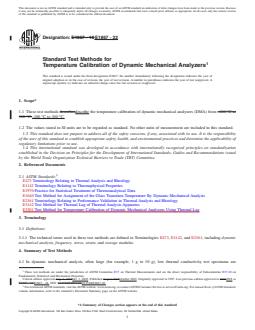
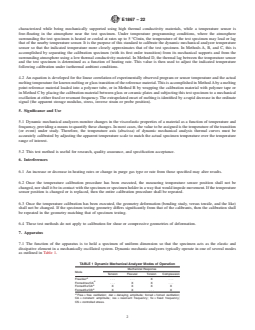
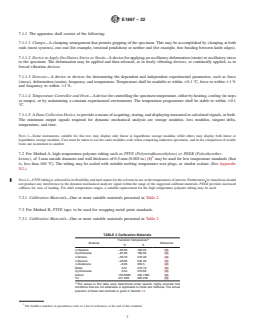
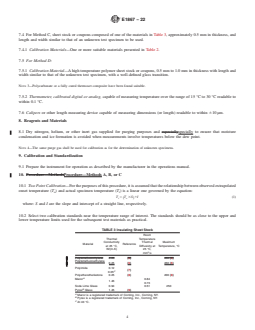
SIGNIFICANCE AND USE
5.1 Dynamic mechanical analyzers monitor changes in the viscoelastic properties of a material as a function of temperature and frequency, providing a means to quantify these changes. In most cases, the value to be assigned is the temperature of the transition (or event) under study. Therefore, the temperature axis (abscissa) of dynamic mechanical analysis thermal curves must be accurately calibrated by adjusting the apparent temperature scale to match the actual specimen temperature over the temperature range of interest.
5.2 This test method is useful for research, quality assurance, and specification acceptance.
SCOPE
1.1 These test methods describe the temperature calibration of dynamic mechanical analyzers (DMA) from –100 °C to 300 °C.
1.2 The values stated in SI units are to be regarded as standard. No other units of measurement are included in this standard.
1.3 This standard does not purport to address all of the safety concerns, if any, associated with its use. It is the responsibility of the user of this standard to establish appropriate safety, health, and environmental practices and determine the applicability of regulatory limitations prior to use.
1.4 This international standard was developed in accordance with internationally recognized principles on standardization established in the Decision on Principles for the Development of International Standards, Guides and Recommendations issued by the World Trade Organization Technical Barriers to Trade (TBT) Committee.
- Status
- Published
- Publication Date
- 30-Sep-2022
- Technical Committee
- E37 - Thermal Measurements
- Drafting Committee
- E37.10 - Fundamental, Statistical and Mechanical Properties
Buy Documents
ASTM E1867-22 - Standard Test Methods for Temperature Calibration of Dynamic Mechanical Analyzers
REDLINE ASTM E1867-22 - Standard Test Methods for Temperature Calibration of Dynamic Mechanical Analyzers
Overview
ASTM E1867-22: Standard Test Methods for Temperature Calibration of Dynamic Mechanical Analyzers establishes procedures for the precise temperature calibration of dynamic mechanical analyzers (DMA) over the range of –100 °C to 300 °C. Accurate temperature calibration of DMA instruments is essential to ensure reliable measurement of viscoelastic properties in materials research, quality assurance, and compliance testing. This standard defines methods that correct the indicated temperature to match the actual specimen temperature, thereby minimizing measurement errors due to thermal lag or instrument configuration.
Key Topics
- Temperature Calibration Methods: ASTM E1867-22 outlines several approaches for calibrating DMA temperature readings, including methods that account for specimen geometry, encapsulation, and heating rates. It covers one-point and two-point calibration options based on the reference material’s melting or transition points.
- Specimen Preparation: The standard provides guidance for specimen encapsulation using materials such as PTFE tubing or tape and the selection of reference calibration materials. It details preparations to avoid factors like moisture condensation or improper thermal contact that could affect accuracy.
- Instrument Requirements: The DMA apparatus must permit precise mechanical oscillation and accurate temperature control, and be capable of measuring and recording key data such as storage modulus, loss modulus, temperature, and time.
- Thermal Lag Corrections: ASTM E1867-22 recognizes and provides procedures for compensating thermal lag-the difference between the temperature measured at the sensor and the actual specimen temperature at varying heating rates.
- Standardized Reporting: The standard requires detailed reporting of calibration conditions, material sources, equipment configuration, and calculation results to facilitate reproducibility and traceability.
Applications
- Research and Development: Enables material scientists to accurately characterize temperature-dependent viscoelastic transitions such as the glass transition or melting point, helping in polymer development, composites research, and thermal analysis.
- Quality Assurance and Compliance: Provides a standardized calibration process for QA labs needing accredited thermal analysis data, ensuring compliance with industry regulations and product specifications.
- Industrial Testing: Applied in manufacturing environments to support acceptance testing of polymer, elastomer, and composite materials, where precise thermal analysis underpins product reliability.
- Calibration Services: Used by third-party calibration and metrology service providers to validate dynamic mechanical analysis equipment in accordance with international best practices.
- Instrument Validation: Assists vendors and users in establishing ongoing calibration intervals and verifying instrument performance against recognized reference materials.
Related Standards
- ASTM E473: Terminology Relating to Thermal Analysis and Rheology, providing essential terms used throughout ASTM E1867-22.
- ASTM E1142: Terminology Relating to Thermophysical Properties, supporting the correct use of temperature and property terms.
- ASTM E1640: Test Method for Assignment of the Glass Transition Temperature by Dynamic Mechanical Analysis, often referenced for glass transition determination within calibration procedures.
- ASTM E1970: Practice for Statistical Treatment of Thermoanalytical Data, providing guidelines for data analysis and regression methods.
- ASTM E3142: Test Method for Thermal Lag of Thermal Analysis Apparatus, directly related to thermal lag corrections prescribed in ASTM E1867-22.
- ASTM E3301: Test Method for Temperature Calibration of Dynamic Mechanical Analyzers Using Thermal Lag, equivalent to Method D in this standard.
Practical Value
Implementing ASTM E1867-22 enhances the accuracy of dynamic mechanical analysis data across diverse temperatures, supporting high confidence in research outcomes and conformity to industry and regulatory benchmarks. Accurate temperature calibration minimizes data variability, optimizes material characterization, and strengthens the credibility of laboratory and production-scale thermal analysis results.
Keywords: temperature calibration, dynamic mechanical analyzer, DMA, thermal analysis, viscoelastic properties, ASTM E1867-22, instrument validation, quality assurance.
Relations
- Effective Date
- 01-Oct-2023
- Effective Date
- 01-Oct-2023
- Effective Date
- 15-Mar-2018
- Effective Date
- 15-Jan-2018
- Effective Date
- 01-Sep-2015
- Effective Date
- 01-May-2015
- Effective Date
- 15-Aug-2014
- Effective Date
- 15-Aug-2014
- Effective Date
- 01-Apr-2014
- Effective Date
- 15-Feb-2014
- Effective Date
- 01-Mar-2013
- Effective Date
- 01-Sep-2012
- Effective Date
- 01-Aug-2011
- Effective Date
- 01-Aug-2011
- Effective Date
- 15-Jun-2011
Buy Documents
ASTM E1867-22 - Standard Test Methods for Temperature Calibration of Dynamic Mechanical Analyzers
REDLINE ASTM E1867-22 - Standard Test Methods for Temperature Calibration of Dynamic Mechanical Analyzers
Get Certified
Connect with accredited certification bodies for this standard

BSMI (Bureau of Standards, Metrology and Inspection)
Taiwan's standards and inspection authority.
Sponsored listings
Frequently Asked Questions
ASTM E1867-22 is a standard published by ASTM International. Its full title is "Standard Test Methods for Temperature Calibration of Dynamic Mechanical Analyzers". This standard covers: SIGNIFICANCE AND USE 5.1 Dynamic mechanical analyzers monitor changes in the viscoelastic properties of a material as a function of temperature and frequency, providing a means to quantify these changes. In most cases, the value to be assigned is the temperature of the transition (or event) under study. Therefore, the temperature axis (abscissa) of dynamic mechanical analysis thermal curves must be accurately calibrated by adjusting the apparent temperature scale to match the actual specimen temperature over the temperature range of interest. 5.2 This test method is useful for research, quality assurance, and specification acceptance. SCOPE 1.1 These test methods describe the temperature calibration of dynamic mechanical analyzers (DMA) from –100 °C to 300 °C. 1.2 The values stated in SI units are to be regarded as standard. No other units of measurement are included in this standard. 1.3 This standard does not purport to address all of the safety concerns, if any, associated with its use. It is the responsibility of the user of this standard to establish appropriate safety, health, and environmental practices and determine the applicability of regulatory limitations prior to use. 1.4 This international standard was developed in accordance with internationally recognized principles on standardization established in the Decision on Principles for the Development of International Standards, Guides and Recommendations issued by the World Trade Organization Technical Barriers to Trade (TBT) Committee.
SIGNIFICANCE AND USE 5.1 Dynamic mechanical analyzers monitor changes in the viscoelastic properties of a material as a function of temperature and frequency, providing a means to quantify these changes. In most cases, the value to be assigned is the temperature of the transition (or event) under study. Therefore, the temperature axis (abscissa) of dynamic mechanical analysis thermal curves must be accurately calibrated by adjusting the apparent temperature scale to match the actual specimen temperature over the temperature range of interest. 5.2 This test method is useful for research, quality assurance, and specification acceptance. SCOPE 1.1 These test methods describe the temperature calibration of dynamic mechanical analyzers (DMA) from –100 °C to 300 °C. 1.2 The values stated in SI units are to be regarded as standard. No other units of measurement are included in this standard. 1.3 This standard does not purport to address all of the safety concerns, if any, associated with its use. It is the responsibility of the user of this standard to establish appropriate safety, health, and environmental practices and determine the applicability of regulatory limitations prior to use. 1.4 This international standard was developed in accordance with internationally recognized principles on standardization established in the Decision on Principles for the Development of International Standards, Guides and Recommendations issued by the World Trade Organization Technical Barriers to Trade (TBT) Committee.
ASTM E1867-22 is classified under the following ICS (International Classification for Standards) categories: 17.200.20 - Temperature-measuring instruments. The ICS classification helps identify the subject area and facilitates finding related standards.
ASTM E1867-22 has the following relationships with other standards: It is inter standard links to ASTM E1142-23b, ASTM E473-23b, ASTM E1640-13(2018), ASTM E3142-18, ASTM E2161-15, ASTM E1142-15, ASTM E473-14, ASTM E1142-14b, ASTM E1142-14a, ASTM E1142-14, ASTM E2161-13, ASTM E1142-12, ASTM E1970-11, ASTM E1142-11b, ASTM E1142-11a. Understanding these relationships helps ensure you are using the most current and applicable version of the standard.
ASTM E1867-22 is available in PDF format for immediate download after purchase. The document can be added to your cart and obtained through the secure checkout process. Digital delivery ensures instant access to the complete standard document.
Standards Content (Sample)
This international standard was developed in accordance with internationally recognized principles on standardization established in the Decision on Principles for the
Development of International Standards, Guides and Recommendations issued by the World Trade Organization Technical Barriers to Trade (TBT) Committee.
Designation: E1867 − 22
Standard Test Methods for
Temperature Calibration of Dynamic Mechanical Analyzers
This standard is issued under the fixed designation E1867; the number immediately following the designation indicates the year of
original adoption or, in the case of revision, the year of last revision. A number in parentheses indicates the year of last reapproval. A
superscript epsilon (´) indicates an editorial change since the last revision or reapproval.
1. Scope* Mechanical Analyzers Using Thermal Lag
1.1 These test methods describe the temperature calibration
3. Terminology
of dynamic mechanical analyzers (DMA) from –100 °C to
300 °C.
3.1 Definitions:
3.1.1 The technical terms used in these test methods are
1.2 The values stated in SI units are to be regarded as
defined in Terminologies E473, E1142, and E2161, including
standard. No other units of measurement are included in this
dynamic mechanical analysis, frequency, stress, strain, and
standard.
storage modulus.
1.3 This standard does not purport to address all of the
safety concerns, if any, associated with its use. It is the
4. Summary of Test Methods
responsibility of the user of this standard to establish appro-
4.1 In dynamic mechanical analysis, often large (for
priate safety, health, and environmental practices and deter-
mine the applicability of regulatory limitations prior to use. example, 1 g to 10 g), low thermal conductivity test specimens
are characterized while being mechanically supported using
1.4 This international standard was developed in accor-
dance with internationally recognized principles on standard- high thermal conductivity materials, while a temperature sen-
sor is free-floating in the atmosphere near the test specimen.
ization established in the Decision on Principles for the
Development of International Standards, Guides and Recom- Under temperature programming conditions, where the atmo-
sphere surrounding the test specimen is heated or cooled at
mendations issued by the World Trade Organization Technical
Barriers to Trade (TBT) Committee. rates up to 5 °C/min, the temperature of the test specimen may
lead or lag that of the nearby temperature sensor. It is the
2. Referenced Documents
purpose of this standard to calibrate the dynamic mechanical
analyzer temperature sensor so that the indicated temperature
2.1 ASTM Standards:
more closely approximates that of the test specimen. In
E473 Terminology Relating to Thermal Analysis and Rhe-
Methods A, B, and C, this is accomplished by separating the
ology
calibration specimen (with its first order transition) from its
E1142 Terminology Relating to Thermophysical Properties
mechanical supports and from the surrounding atmosphere
E1970 PracticeforStatisticalTreatmentofThermoanalytical
using a low thermal conductivity material. In Method D, the
Data
thermal lag between the temperature sensor and the test
E1640 Test Method for Assignment of the Glass Transition
specimenisdeterminedasafunctionofheatingrate.Thisvalue
Temperature By Dynamic Mechanical Analysis
is then used to adjust the indicated temperature following
E2161 Terminology Relating to Performance Validation in
calibration under isothermal ambient conditions.
Thermal Analysis and Rheology
E3142 Test Method for Thermal Lag of Thermal Analysis
4.2 An equation is developed for the linear correlation of
Apparatus
experimentally observed program or sensor temperature and
E3301 Test Method forTemperature Calibration of Dynamic
the actual melting temperature for known melting or glass
transition of the reference material. This is accomplished in
Method A by a melting point reference material loaded into a
These test methods are under the jurisdiction of ASTM Committee E37 on
polymer tube, or in Method B by wrapping the calibration
ThermalMeasurementsandarethedirectresponsibilityofSubcommitteeE37.10on
material with polymer tape or in Method C by placing the
Fundamental, Statistical and Mechanical Properties.
calibration material between glass or ceramic plates and
Current edition approved Oct. 1, 2022. Published October 2022. Originally
subjecting this test specimen to a mechanical oscillation at
approved in 1997. Last previous edition approved in 2018 as E1867 – 18. DOI:
10.1520/E1867-22.
either fixed or resonant frequency. The extrapolated onset of
For referenced ASTM standards, visit the ASTM website, www.astm.org, or
melting is identified by a rapid decrease in the ordinate signal
contact ASTM Customer Service at service@astm.org. For Annual Book of ASTM
(the apparent storage modulus, stress, inverse strain or probe
Standards volume information, refer to the standard’s Document Summary page on
the ASTM website. position).
*A Summary of Changes section appears at the end of this standard
Copyright © ASTM International, 100 Barr Harbor Drive, PO Box C700, West Conshohocken, PA 19428-2959. United States
E1867 − 22
5. Significance and Use applied and then released, as in freely vibrating devices, or
continually applied, as in forced vibration devices.
5.1 Dynamic mechanical analyzers monitor changes in the
7.1.1.3 Detector—A device or devices for determining the
viscoelastic properties of a material as a function of tempera-
dependent and independent experimental parameters, such as
ture and frequency, providing a means to quantify these
force(stress),deformation(strain),frequency,andtemperature.
changes. In most cases, the value to be assigned is the
Temperature shall be readable to within 60.1 °C, force to
temperature of the transition (or event) under study. Therefore,
within 61 % and frequency to within 61%.
thetemperatureaxis(abscissa)ofdynamicmechanicalanalysis
7.1.1.4 Temperature Controller and Oven—A device for
thermal curves must be accurately calibrated by adjusting the
controlling the specimen temperature, either by heating, cool-
apparent temperature scale to match the actual specimen
ing (in steps or ramps), or by maintaining a constant experi-
temperature over the temperature range of interest.
mental environment. The temperature programmer shall be
5.2 This test method is useful for research, quality
stable to within 60.1 °C.
assurance, and specification acceptance.
7.1.1.5 A Data Collection Device, to provide a means of
acquiring, storing, and displaying measured or calculated
6. Interferences
signals, or both. The minimum output signals required for
6.1 An increase or decrease in heating rates or change in
dynamic mechanical analysis are storage modulus, loss
purge gas type or rate from those specified may alter results.
modulus, tangent delta, temperature, and time.
6.2 Once the temperature calibration procedure has been
NOTE 1—Some instruments, suitable for this test, may display only
executed, the measuring temperature sensor position shall not
linearorlogarithmicstoragemoduluswhileothersmaydisplaybothlinear
or logarithmic storage modulus. Care must be taken to use the same
be changed, nor shall it be in contact with the specimen or
modulus scale when comparing unknown specimens, and in the compari-
specimen holder in a way that would impede movement. If the
son of results from one instrument to another.
temperature sensor position is changed or is replaced, then the
7.2 ForMethodA,high-temperaturepolymertubingsuchas
entire calibration procedure shall be repeated.
PTFE (Polytetrafluoroethylene) or PEEK (Polyetherether-
6.3 Once the temperature calibration has been executed, the
ketone), of 3-mm outside diameter and wall thickness of
geometry deformation (bending study, versus tensile, and the
0.5-mm (0.002 in.) (1) may be used for low temperature
like) shall not be changed. If the specimen testing geometry
standards (that is, less than 160 °C). The tubing may be sealed
differs significantly from that of the calibrants, then the
withsuitablemeltingtemperaturewaxplugs,orsimilarsealant.
calibration shall be repeated in the geometry matching that of
(See Appendix X2.)
specimen testing.
NOTE 2—PTFE tubing is selected for its flexibility and inert nature for
6.4 These test methods do not apply to calibration for shear
the solvents in use at the temperatures of interest. Furthermore, its
or compressive geometries of deformation.
transitionsshouldnotproduceanyinterferenceinthedynamicmechanical
analyzer signal within the range of the suggested calibrant materials.
7. Apparatus
PEEK provides increased stiffness for ease of loading. For other tempera-
ture ranges, a suitable replacement for the high temperature polymer
7.1 The function of the apparatus is to hold a specimen of
tubing may be used.
uniform dimension so that the specimen acts as the elastic and
7.2.1 Calibration Materials—One or more suitable materi-
dissipative element in a mechanically oscillated system. Dy-
als presented in Table 2.
namic mechanic analyzers typically operate in one of several
modes as outlined in Table 1.
7.3 For Method B, PTFE tape, to be used for wrapping
7.1.1 The apparatus shall consist of the following:
metal point standards.
7.1.1.1 Clamps—Aclamping arrangement that permits grip-
ping of the specimen. This may be accomplished by clamping
at both ends (most systems), one end (for example, torsional
The boldface numbers in parentheses refer to a list of references at the end of
pendulum) or neither end (for example, free bending between
this standard.
knife edges).
7.1.1.2 Device to Apply Oscillatory Stress or Strain—A
TABLE 2 Calibration Materials
device for applying an oscillatory deformation (strain) or
A
Transition Temperature
oscillatory stress to the specimen. The deformation may be
Material Reference
°C K
n-Heptane –90.56 182.65 (2)
TABLE 1 Dynamic Mechanical Analyzer Modes of Operation
Cyclohexane –87.06 186.09 (3)
n-Octane –56.76 216.39 (4)
Mechanical Response
Mode n-Decane –26.66 246.49 (4)
Tension Flexural Torsion Compression
n-Dodecane –9.65 263.5 (4)
A
Free/dec . . X . Water 0.01 273.16 (5)
A
Forced/res/CA . X X . Cyclohexane 6.54 279.69 (3)
A
Forced/fix/CA XX X X Indium 156.5985 495.7485 (5)
A
Forced/fix/CS X X . X Tin 231.928 505.078 (5)
A A
Free = free oscillation; dec = decaying amplitude; forced = forced oscillation; The values in this table were determined under special, highly accurate test
CA = constant amplitude; res = resonant frequency; fix = fixed frequency; conditions that are not attainable or applicable to these test methods. The actual
CS = controlled stress. precision of these test methods is given in Section 14.
E1867 − 22
7.3.1 Calibration Materials—One or more suitable materi- where: S and I are the slope and intercept of a straight line,
als presented in Table 2. respectively.
7.4 For Method C, sheet stock or coupons composed of one
10.2 Select two calibration standards near the temperature
of the materials in Table 3, approximately 0.5 mm in thickness,
range of interest. The standards should be as close to the upper
and length and width similar to that of an unknown test
and lower temperature limits used for the subsequent test
specimen to be used.
materials as practical.
7.4.1 Calibration Materials—One or more suitable materi-
NOTE 5—The purpose of the polymer encapsulation is to provide
als presented in Table 2.
thermal resistance between the test specimen and the environment similar
7.5 For Method D: to that offered by polymer test specimens. In some testing geometries it
may be possible to perform the test directly on the metal melting point
7.5.1 Calibration Material—A high temperature polymer
reference materials without encapsulation. (See Appendix X1.)
sheet stock or coupons, 0.5 mm to 1.0 mm in thickness with
length and width similar to that of the unknown test specimen, 10.3 Method A—Calibration Using Materials that are Liq-
with a well-defined glass transition.
uids at Ambient Temperature and where the melting tempera-
ture does not exceed 100 °C. (See Appendix X2.)
NOTE3—Polycarbonateorafullycuredthermosetcompositehavebeen
10.3.1 Fill the polymer tubing with the calibration material.
found suitable.
Calibrant must extend to the ends of the clamping geometry
7.5.2 Thermometer, calibrated digital or analog, capable of
and must have uniform dimensions with respect to width.
measuring temperature over the range of 15 °C to 30 °C
10.3.2 Mount the specimen in accordance with the proce-
readable to within 0.1 °C.
dure recommended by the manufacturer.
7.6 Calipers or other length measuring device capable of
measuring dimensions (or length) readable to within 610 µm.
NOTE 6—For specimen clamping arrangements where the specimen is
not gripped on either end (for example, free bending between knife edges)
8. Reagents and Materials the specimen must be rigid enough at the test start temperature to sustain
initial loading. Alternatively, the calibration specimen, without
8.1 Dry nitrogen, helium, or other inert gas supplied for
encapsulation, can be placed between the knife edge and a substrate.
purging purposes and specially to ensure that moisture conden-
10.3.3 Maximum strain amplitude shall be within the linear
sation and ice formation is avoided when measurements
viscoelastic range of the specimens to be subsequently ana-
involve temperatures below the dew point.
lyzed. Strains of less than 1 % are recommended and shall not
NOTE 4—The same purge gas shall be used for calibration as for the
exceed 3 %.
determination of unknown specimens.
10.3.4 Equilibrate the test specimen for 5 min at a tempera-
ture 30 °C below the anticipated transition temperature.
9. Calibration and Standardization
10.3.5 Conduct the calibration experiments at the heating
9.1 Prepare the instrument for operation as described by the
rate of interest, preferably 1 °C⁄min but no greater than
manufacturer in the operations manual.
5 °C⁄min and a frequency of 1 Hz from 30 °C below to 20 °C
above the anticipated melting temperature of the calibration
10. Procedure—Methods A, B, or C
material. Other heating rates and frequencies may be used but
10.1 Two Point Calibration—For the purposes of this
shall be reported. (See Appendix X1.)
procedure,itisassumedthattherelationshipbetweenobserved
extrapolated onset temperature (T ) and actual specimen tem-
NOTE 7—Calibration for temperature shall be performed under the
o
perature (T) is a linear one governed by the equation: conditions of heating rate and frequency at which the unknown specimens
t
will be tested. This test method does not address the issues of frequency
T 5 T 3S 1I (1)
~ !
t o
affects for polymeric transitions (such as the upwards shift of glass
transition temperature with increasing frequency), and will only compen-
sate for thermal lag within the measuring device.
TABLE 3 Insulating Sheet Stock
10.4 Method B—Calibration Where the Material is a Solid
Room
Thermal Temperature
at Ambient Temperature:
Conductivity Thermal Maximum
Material Reference
10.4.1 The calibration material must extend to the ends of
at 25 °C, Diffusivity at Temperature, °C
W/(m-K) 25 °C, the clamping geometry and must have uniform dimensions
mm /s
with respect to the width and thickness. Wrap the calibration
Polytetrafluoroethylene
material with polytetrafluoroethylene tape to a thickness of
0.25 (6) 260 (6)
0.5 mm. Other thicknesses may be used but shall be reported.
Polyimide 0.12
(7)
C
0.35
10.4.2 Mount the wrapped specimen into the apparatus
Polyetheretherketone 0.25 (8) 200 (8)
according to the procedure recommended by the manufacturer
A
Macor 0.84
1.46
as described in the operations manual.
0.73
Soda Lime Glass 0.94 0.51 250
B
Pyrex Glass 1.45 (9) NOTE 8—For specimen clamping arrangements where the specime
...
This document is not an ASTM standard and is intended only to provide the user of an ASTM standard an indication of what changes have been made to the previous version. Because
it may not be technically possible to adequately depict all changes accurately, ASTM recommends that users consult prior editions as appropriate. In all cases only the current version
of the standard as published by ASTM is to be considered the official document.
Designation: E1867 − 18 E1867 − 22
Standard Test Methods for
Temperature Calibration of Dynamic Mechanical Analyzers
This standard is issued under the fixed designation E1867; the number immediately following the designation indicates the year of
original adoption or, in the case of revision, the year of last revision. A number in parentheses indicates the year of last reapproval. A
superscript epsilon (´) indicates an editorial change since the last revision or reapproval.
1. Scope*
1.1 These test methods describesdescribe the temperature calibration of dynamic mechanical analyzers (DMA) from –100 °C to
300 °C.–100 °C to 300 °C.
1.2 The values stated in SI units are to be regarded as standard. No other units of measurement are included in this standard.
1.3 This standard does not purport to address all of the safety concerns, if any, associated with its use. It is the responsibility
of the user of this standard to establish appropriate safety, health, and environmental practices and determine the applicability of
regulatory limitations prior to use.
1.4 This international standard was developed in accordance with internationally recognized principles on standardization
established in the Decision on Principles for the Development of International Standards, Guides and Recommendations issued
by the World Trade Organization Technical Barriers to Trade (TBT) Committee.
2. Referenced Documents
2.1 ASTM Standards:
E473 Terminology Relating to Thermal Analysis and Rheology
E1142 Terminology Relating to Thermophysical Properties
E1970 Practice for Statistical Treatment of Thermoanalytical Data
E1640 Test Method for Assignment of the Glass Transition Temperature By Dynamic Mechanical Analysis
E2161 Terminology Relating to Performance Validation in Thermal Analysis and Rheology
E3142 Test Method for Thermal Lag of Thermal Analysis Apparatus
E3301 Test Method for Temperature Calibration of Dynamic Mechanical Analyzers Using Thermal Lag
3. Terminology
3.1 Definitions:
3.1.1 The technical terms used in these test methods are defined in Terminologies E473, E1142, and E2161, including dynamic
mechanical analysis, frequency, stress, strain, and storage modulus.
4. Summary of Test Methods
4.1 In dynamic mechanical analysis, often large (for example, 1 g to 10 g), low thermal conductivity test specimens are
These test methods are under the jurisdiction of ASTM Committee E37 on Thermal Measurements and are the direct responsibility of Subcommittee E37.10 on
Fundamental, Statistical and Mechanical Properties.
Current edition approved Aug. 1, 2018Oct. 1, 2022. Published August 2018October 2022. Originally approved in 1997. Last previous edition approved in 20162018 as
E1867 – 16.E1867 – 18. DOI: 10.1520/E1867-18.10.1520/E1867-22.
For referenced ASTM standards, visit the ASTM website, www.astm.org, or contact ASTM Customer Service at service@astm.org. For Annual Book of ASTM Standards
volume information, refer to the standard’s Document Summary page on the ASTM website.
*A Summary of Changes section appears at the end of this standard
Copyright © ASTM International, 100 Barr Harbor Drive, PO Box C700, West Conshohocken, PA 19428-2959. United States
E1867 − 22
characterized while being mechanically supported using high thermal conductivity materials, while a temperature sensor is
free-floating in the atmosphere near the test specimen. Under temperature programming conditions, where the atmosphere
surrounding the test specimen is heated or cooled at rates up to 5 °C/min, the temperature of the test specimen may lead or lag
that of the nearby temperature sensor. It is the purpose of this standard to calibrate the dynamic mechanical analyzer temperature
sensor so that the indicated temperature more closely approximates that of the test specimen. In Methods A, B, and C, this is
accomplished by separating the calibration specimen (with its first order transition) from its mechanical supports and from the
surrounding atmosphere using a low thermal conductivity material. In Method D, the thermal lag between the temperature sensor
and the test specimen is determined as a function of heating rate. This value is then used to adjust the indicated temperature
following calibration under isothermal ambient conditions.
4.2 An equation is developed for the linear correlation of experimentally observed program or sensor temperature and the actual
melting temperature for known melting or glass transition of the reference material. This is accomplished in Method A by a melting
point reference material loaded into a polymer tube, or in Method B by wrapping the calibration material with polymer tape or
in Method C by placing the calibration material between glass or ceramic plates and subjecting this test specimen to a mechanical
oscillation at either fixed or resonant frequency. The extrapolated onset of melting is identified by a rapid decrease in the ordinate
signal (the apparent storage modulus, stress, inverse strain or probe position).
5. Significance and Use
5.1 Dynamic mechanical analyzers monitor changes in the viscoelastic properties of a material as a function of temperature and
frequency, providing a means to quantify these changes. In most cases, the value to be assigned is the temperature of the transition
(or event) under study. Therefore, the temperature axis (abscissa) of dynamic mechanical analysis thermal curves must be
accurately calibrated by adjusting the apparent temperature scale to match the actual specimen temperature over the temperature
range of interest.
5.2 This test method is useful for research, quality assurance, and specification acceptance.
6. Interferences
6.1 An increase or decrease in heating rates or change in purge gas type or rate from those specified may alter results.
6.2 Once the temperature calibration procedure has been executed, the measuring temperature sensor position shall not be
changed, nor shall it be in contact with the specimen or specimen holder in a way that would impede movement. If the temperature
sensor position is changed or is replaced, then the entire calibration procedure shall be repeated.
6.3 Once the temperature calibration has been executed, the geometry deformation (bending study, versus tensile, and the like)
shall not be changed. If the specimen testing geometry differs significantly from that of the calibrants, then the calibration shall
be repeated in the geometry matching that of specimen testing.
6.4 These test methods do not apply to calibration for shear or compressive geometries of deformation.
7. Apparatus
7.1 The function of the apparatus is to hold a specimen of uniform dimension so that the specimen acts as the elastic and
dissipative element in a mechanically oscillated system. Dynamic mechanic analyzers typically operate in one of several modes
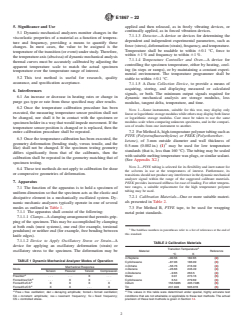
as outlined in Table 1.
TABLE 1 Dynamic Mechanical Analyzer Modes of Operation
Mechanical Response
Mode
Tension Flexural Torsion Compression
A
Free/dec . . . . . . X . . .
A
Forced/res/CA . . . X X . . .
A
Forced/fix/CA X X X X
A
Forced/fix/CS X X . . . X
A
Free = free oscillation; dec = decaying amplitude; forced = forced oscillation;
CA = constant amplitude; res = resonant frequency; fix = fixed frequency;
CS = controlled stress.
E1867 − 22
7.1.1 The apparatus shall consist of the following:
7.1.1.1 Clamps—A clamping arrangement that permits gripping of the specimen. This may be accomplished by clamping at both
ends (most systems), one end (for example, torsional pendulum) or neither end (for example, free bending between knife edges).
7.1.1.2 Device to Apply Oscillatory Stress or Strain—A device for applying an oscillatory deformation (strain) or oscillatory stress
to the specimen. The deformation may be applied and then released, as in freely vibrating devices, or continually applied, as in
forced vibration devices.
7.1.1.3 Detector—A device or devices for determining the dependent and independent experimental parameters, such as force
(stress), deformation (strain), frequency, and temperature. Temperature shall be readable to within 60.1 °C, force to within 61 %
and frequency to within 61 %.
7.1.1.4 Temperature Controller and Oven—A device for controlling the specimen temperature, either by heating, cooling (in steps
or ramps), or by maintaining a constant experimental environment. The temperature programmer shall be stable to within 60.1
°C.
7.1.1.5 A Data Collection Device, to provide a means of acquiring, storing, and displaying measured or calculated signals, or both.
The minimum output signals required for dynamic mechanical analysis are storage modulus, loss modulus, tangent delta,
temperature, and time.
NOTE 1—Some instruments, suitable for this test, may display only linear or logarithmic storage modulus while others may display both linear or
logarithmic storage modulus. Care must be taken to use the same modulus scale when comparing unknown specimens, and in the comparison of results
from one instrument to another.
7.2 For Method A, high-temperature polymer tubing such as PTFE (Polytetrafluoroethylene) or PEEK (Polyetherether-
ketone), of 3-mm outside diameter and wall thickness of 0.5-mm (0.002 in.) (1) may be used for low temperature standards (that
is, less than 160 °C). The tubing may be sealed with suitable melting temperature wax plugs, or similar sealant. (See Appendix
X2.)
NOTE 2—PTFE tubing is selected for its flexibility and inert nature for the solvents in use at the temperatures of interest. Furthermore, its transitions should
not produce any interference in the dynamic mechanical analyzer signal within the range of the suggested calibrant materials. PEEK provides increased
stiffness for ease of loading. For other temperature ranges, a suitable replacement for the high temperature polymer tubing may be used.
7.2.1 Calibration Materials—One or more suitable materials presented in Table 2.
7.3 For Method B, PTFE tape, to be used for wrapping metal point standards.
7.3.1 Calibration Materials—One or more suitable materials presented in Table 2.
TABLE 2 Calibration Materials
A
Transition Temperature
Material Reference
°C K
n-Heptane –90.56 182.65 (2)
Cyclohexane –87.06 186.09 (3)
n-Octane –56.76 216.39 (4)
n-Decane –26.66 246.49 (4)
n-Dodecane –9.65 263.5 (4)
Water 0.01 273.16 (5)
Cyclohexane 6.54 279.69 (3)
Indium 156.5985 495.7485 (5)
Tin 231.928 505.078 (5)
A
The values in this table were determined under special, highly accurate test
conditions that are not attainable or applicable to these test methods. The actual
precision of these test methods is given in Section 14.
The boldface numbers in parentheses refer to a list of references at the end of this standard.
E1867 − 22
7.4 For Method C, sheet stock or coupons composed of one of the materials in Table 3, approximately 0.5 mm in thickness, and
length and width similar to that of an unknown test specimen to be used.
7.4.1 Calibration Materials—One or more suitable materials presented in Table 2.
7.5 For Method D:
7.5.1 Calibration Material—A high temperature polymer sheet stock or coupons, 0.5 mm to 1.0 mm in thickness with length and
width similar to that of the unknown test specimen, with a well-defined glass transition.
NOTE 3—Polycarbonate or a fully cured thermoset composite have been found suitable.
7.5.2 Thermometer, calibrated digital or analog, capable of measuring temperature over the range of 15 °C to 30 °C readable to
within 0.1 °C.
7.6 Calipers or other length measuring device capable of measuring dimensions (or length) readable to within 610 μm.
8. Reagents and Materials
8.1 Dry nitrogen, helium, or other inert gas supplied for purging purposes and especiallyspecially to ensure that moisture
condensation and ice formation is avoided when measurements involve temperatures below the dew point.
NOTE 4—The same purge gas shall be used for calibration as for the determination of unknown specimens.
9. Calibration and Standardization
9.1 Prepare the instrument for operation as described by the manufacturer in the operations manual.
10. Precedure—MethodsProcedure—Methods A, B, or C
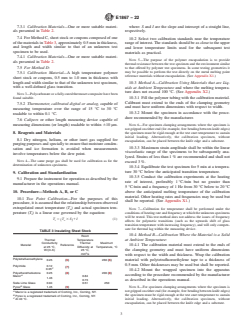
10.1 Two Point Calibration—For the purposes of this procedure, it is assumed that the relationship between observed extrapolated
onset temperature (T ) and actual specimen temperature (T ) is a linear one governed by the equation:
o t
T 5 ~T 3S!1I (1)
t o
where: S and I are the slope and intercept of a straight line, respectively.
10.2 Select two calibration standards near the temperature range of interest. The standards should be as close to the upper and
lower temperature limits used for the subsequent test materials as practical.
TABLE 3 Insulating Sheet Stock
Room
Thermal Temperature
Conductivity Thermal Maximum
Material Reference
at 25 °C, Diffusivity at Temperature, °C
W/(m-K) 25 °C,
mm /s
Polytetrafluorothylene 0.25 (6) 260 (6)
Polytetrafluoroethylene
0.25 (6) 260 (6)
Polyimide 0.12
(7)
C
0.35
Polyetheretherketone 0.25 (8) 200 (8)
A
Macor 0.84
1.46
0.73
Soda Lime Glass 0.94 0.51 250
B
Pyrex Glass 1.45 (9)
A
Macor is a registered trademark of Corning, Inc., Corning, NY.
B
Pyrex is a registered trademark of Corning, Inc., Corning, NY.
C
At 40 °C.
E1867 − 22
NOTE 5—The purpose of the polymer encapsulation is to provide thermal resistance between the test specimen and the environment similar to that offered
by polymer test specimens. In some testing geometries it may be possible to perform the test directly on the metal melting point reference materials
without encapsulation. (See Appendix X1.)
10.3 Method A—Calibration Using Materials that are Liquids at Ambient Temperature and where the melting temperature does
not exceed 100 °C. (See Appendix X2.)
10.3.1 Fill the polymer tubing with the calibration material. Calibrant must extend to the ends of the clamping geometry and must
have uniform dimensions with respect to width.
10.3.2 Mount the specimen in accordance with the procedure recommended by the manufacturer.
NOTE 6—For specimen clamping arrangements where the specimen is not gripped on either end (for example, free bending between knife edges) the
specimen must be rigid enough at the test start temperature to sustain initial loading. Alternatively, the calibration specimen, without encapsulation, can
be placed between the knife edge and a substrate.
10.3.3 Maximum strain amplitude shall be within the linear viscoelastic range of the specimens to be subsequently analyzed.
Strains of less than 1 % are recommended and shall not exceed 3 %.
10.3.4 Equilibrate the test specimen for 5 min at a temperature 30 °C below the anticipated transition temperature.
10.3.5 Conduct the calibration experiments at the heating rate of interest, preferably 11 °C °C/min ⁄min but no greater than 55 °C
°C/min ⁄min and a frequency of 1 Hz from 30 °C 30 °C below to 20 °C 20 °C above the anticipated melting temperature of the
calibration material. Other heating rates and frequencies may be used but shall be reported. (See Appendix X1.)
NOTE 7—Calibration for temperature shall be performed under the conditions of heating rate and frequency at which the unknown specimens will be
tested. This test method does not address the issues of frequency affects for polymeric transitions (such as the upwards shift of glass transition temperature
with increasing frequency), and will only compensate for thermal lag within the measuring device.
10.4 Method B—Calibration Where the Material is a Solid at Ambient Temperature:
10.4.1 The calibration material must extend to the ends of the clamping geometry and must have uniform dimensions with respect
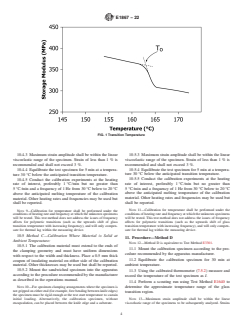
FIG. 1 Transition Temperature
E1867 − 22
to the width and thickness. Wrap the calibration material with polytetrafluoroethylene tape to a thickness of 0.5 mm. 0.5 mm. Other
thicknesses may be used but
...