

ASTM F887-23
(Specification)Standard Specifications for Personal Climbing Equipment
General Information
- Abstract
SCOPE
Table of Contents
Section Title
Section/Paragraph
Scope
1
Referenced Documents
2
Terminology
3
Significance and Use
4
Pole and Tree Climbers
Classification
5
Ordering Information
6
Pole and Tree Climbers
7
Climber Gaffs
8
Climber Straps
9
Climber Pads
10
Climber Footplates
11
Body Belts, Positioning Devices and Wood Pole Fall Restriction Devices (WPFRD)
Classification
12
Ordering Information
13
Two Dee Body Belts, Auxiliary Positioning Belts, and Four Dee Body Belts
14
Two Dee Body Belts
14.1
Auxiliary Positioning Belts and Four Dee Body Belts
14.2
Positioning Devices
15
Wood Pole Fall Restriction Device (WPFRD)
16
Arborist Saddle
17
Harnesses
Classification
18
Ordering Information
18.2
Sizing
18.3
Marking
18.4
Energy Absorbing Lanyards
Classification
19
Ordering Information
20
Energy Absorbing Lanyards
21
Qualification Testing
After Exposure to an Electric Arc
22
Hardware Requirements
23
Test Equipment
24
Qualification Testing
25
Body Belts, Four Dee Body Belts, and Auxiliary Positioning Belts
25.1
Positioning Devices
25.2
WPFRD
25.3
Arborist Saddle
25.4
Harness
25.5
Energy Absorbers
25.6
Instructions
26
Guarantee and Rejection
27
Keywords
28
1.1 This standard covers the specifications and qualification testing of the following:
Climbers,
Climber straps,
Climber Pads,
Climber Footplates,
Body Belts,
Work Positioning Devices with Locking Snaphooks/Carabiners,
Wood Pole Fall Restriction Devices (WPFRD),
Arborist Saddle,
Harnesses,
Energy Absorbing Lanyards.
These devices are used by workers in the climbing of poles, trees, towers, and other structures. Minimum performance criteria for harnesses and energy absorbing lanyards in arresting a fall after exposure to electric arcs are included for workers who may be exposed to thermal hazards of momentary electric arcs or flame.
1.2 Equipment may fall within one of the following categories:
1.2.1 Fall (Travel) Restraint—Prevents a user from reaching a fall hazard (allow 0 fall distance).
1.2.2 Work Positioning—Allows a 2 ft maximum free fall distance.
1.2.3 Fall Arrest—Allows a 6 ft maximum free fall distance with a maximum arrest force of 1800 lb.
Note 1: Under certain conditions and with the use of equipment designed for such conditions, a 12-ft free-fall distance with a maximum arrest force of 1800 lb is allowed.
1.2.4 Suspension—Allows 0 free-fall distance while supporting the user’s weight.
1.2.5 Fall Restriction—to prevent or limit free fall from a work position or while ascending/descending a wood pole.
1.3 Three types of climbers, (Types A, B, and C) and two types of climber straps, Types (A and B) are covered.
1.4 Two types of body belts, (Types A and B) are covered.
1.5 Eight types of work positioning devices: three positioning straps, (Types A, B, and C), three adjustable-positioning lanyards, (Types A, B and C) and two nonadjustable positioning lanyards, (Types A and B) are covered.
1.6 Two types of WPFRD, (Types A and AB) are covered.
1.7 Arborist saddle, (Type A) Work Positioning and Suspension are covered.
1.8 Two types of harnesses, (Types A and B) are covered.
1.9 Two types of energy absorbing lanyards, (Types A and B) are covered.
1.10 The values stated in United States customary units are to be regarded as standard. The values given in parentheses are mathematical conversions to SI units that are provided for information only and are not considered standard.
1.11 The following safety hazards caveat pertains only to the test method portions, 9.2, 10.3, 11.2, 14.1.4, 15.3, 15.4, 16.2, 17.2, 18.4, 21.2, 22, 23, and 25 of ...
- Status
- Published
- Publication Date
- 31-Oct-2023
- Technical Committee
- F18 - Electrical Protective Equipment for Workers
- Drafting Committee
- F18.15 - Worker Personal Equipment
Overview
ASTM F887-23, published by ASTM International, outlines the standard specifications and qualification testing for personal climbing equipment. This standard is widely referenced for ensuring the safety, durability, and performance of gear used by workers climbing poles, trees, towers, and similar structures. It is essential for occupational safety in industries such as utilities, telecommunications, and arboriculture.
ASTM F887-23 covers a wide range of components-including climbers, body belts, work positioning devices, harnesses, arborist saddles, wood pole fall restriction devices (WPFRDs), energy-absorbing lanyards, and all associated hardware. The document also defines test methods, performance criteria, and labeling requirements, particularly for equipment used in environments potentially exposed to electric arcs or flames.
Key Topics
Device Types: The standard addresses several equipment types, including:
- Climbers and climber straps
- Climber pads and footplates
- Body belts (two-dee and four-dee types)
- Work positioning devices
- Wood Pole Fall Restriction Devices (WPFRD)
- Arborist saddles
- Full body harnesses
- Energy absorbing lanyards
Performance Categories: Equipment falling under ASTM F887-23 typically supports one or more of the following functions:
- Fall Restraint: Prevents reaching a fall hazard (0 fall distance)
- Work Positioning: Allows a maximum 2 ft free fall
- Fall Arrest: Allows up to a 6 ft free fall, with a 1800 lb maximum arrest force (up to 12 ft in special cases)
- Suspension: Supports the user’s weight without free fall
- Fall Restriction: Limits or prevents free fall during ascent/descent
Qualification & Testing: The standard specifies uniform procedures for testing equipment before and after exposure to hazards such as electric arcs, ensuring ongoing reliability in hazardous environments.
Material & Marking Requirements: Manufacturers must ensure materials meet specific performance and safety standards. All product markings must include critical data-such as type, size, right/left designation, and date of manufacture.
Applications
ASTM F887-23 is crucial for:
- Lineworkers and Utility Workers: Personal climbing equipment conforming to ASTM F887-23 is used by workers maintaining or repairing power lines, telephone poles, and transmission towers, where fall protection and work positioning are critical.
- Arborists: Tree care professionals rely on arborist saddles, harnesses, and climbers, as specified under this standard, for safe ascent, positioning, and descent.
- Telecommunications: Workers installing or maintaining telecom equipment on poles or towers use belts, harnesses, and lanyards verified to ASTM F887-23 to minimize the risk of injuries from falls.
- Industrial Safety: Any industry with elevated or vertical work sites-including construction and maintenance in plants-applies this standard to select and inspect compliant safety gear.
Related Standards
Several key standards are referenced within ASTM F887-23, ensuring comprehensive guidance on personal protective equipment:
- ASTM F819: Terminology Relating to Electrical Protective Equipment for Workers
- ASTM F1959/F1959M: Test Method for Determining Arc Rating of Materials
- ANSI Z359 Series: Standards for fall protection, including definitions, lanyards, full body harnesses, connecting components, and self-retracting devices
- ANSI 05.1: Wood Poles Specification and Dimensions
- CSA O15: Wood Utility Poles and Reinforcing Stubs
By using climbing equipment that complies with ASTM F887-23, both employers and workers can confidently address regulatory and safety requirements for fall protection, minimizing workplace incidents and ensuring personal security at height. Applying this standard is integral for any organization prioritizing worker safety in climbing applications.
Relations
- Effective Date
- 01-Nov-2023
- Effective Date
- 01-Mar-2024
- Refers
ASTM F1959/F1959M-24 - Standard Test Method for Determining the Arc Rating of Materials for Clothing - Effective Date
- 01-Jan-2024
- Effective Date
- 01-Dec-2023
- Refers
ASTM F1959/F1959M-23 - Standard Test Method for Determining the Arc Rating of Materials for Clothing - Effective Date
- 01-Oct-2023
Frequently Asked Questions
ASTM F887-23 is a technical specification published by ASTM International. Its full title is "Standard Specifications for Personal Climbing Equipment". This standard covers: SCOPE Table of Contents Section Title Section/Paragraph Scope 1 Referenced Documents 2 Terminology 3 Significance and Use 4 Pole and Tree Climbers Classification 5 Ordering Information 6 Pole and Tree Climbers 7 Climber Gaffs 8 Climber Straps 9 Climber Pads 10 Climber Footplates 11 Body Belts, Positioning Devices and Wood Pole Fall Restriction Devices (WPFRD) Classification 12 Ordering Information 13 Two Dee Body Belts, Auxiliary Positioning Belts, and Four Dee Body Belts 14 Two Dee Body Belts 14.1 Auxiliary Positioning Belts and Four Dee Body Belts 14.2 Positioning Devices 15 Wood Pole Fall Restriction Device (WPFRD) 16 Arborist Saddle 17 Harnesses Classification 18 Ordering Information 18.2 Sizing 18.3 Marking 18.4 Energy Absorbing Lanyards Classification 19 Ordering Information 20 Energy Absorbing Lanyards 21 Qualification Testing After Exposure to an Electric Arc 22 Hardware Requirements 23 Test Equipment 24 Qualification Testing 25 Body Belts, Four Dee Body Belts, and Auxiliary Positioning Belts 25.1 Positioning Devices 25.2 WPFRD 25.3 Arborist Saddle 25.4 Harness 25.5 Energy Absorbers 25.6 Instructions 26 Guarantee and Rejection 27 Keywords 28 1.1 This standard covers the specifications and qualification testing of the following: Climbers, Climber straps, Climber Pads, Climber Footplates, Body Belts, Work Positioning Devices with Locking Snaphooks/Carabiners, Wood Pole Fall Restriction Devices (WPFRD), Arborist Saddle, Harnesses, Energy Absorbing Lanyards. These devices are used by workers in the climbing of poles, trees, towers, and other structures. Minimum performance criteria for harnesses and energy absorbing lanyards in arresting a fall after exposure to electric arcs are included for workers who may be exposed to thermal hazards of momentary electric arcs or flame. 1.2 Equipment may fall within one of the following categories: 1.2.1 Fall (Travel) Restraint—Prevents a user from reaching a fall hazard (allow 0 fall distance). 1.2.2 Work Positioning—Allows a 2 ft maximum free fall distance. 1.2.3 Fall Arrest—Allows a 6 ft maximum free fall distance with a maximum arrest force of 1800 lb. Note 1: Under certain conditions and with the use of equipment designed for such conditions, a 12-ft free-fall distance with a maximum arrest force of 1800 lb is allowed. 1.2.4 Suspension—Allows 0 free-fall distance while supporting the user’s weight. 1.2.5 Fall Restriction—to prevent or limit free fall from a work position or while ascending/descending a wood pole. 1.3 Three types of climbers, (Types A, B, and C) and two types of climber straps, Types (A and B) are covered. 1.4 Two types of body belts, (Types A and B) are covered. 1.5 Eight types of work positioning devices: three positioning straps, (Types A, B, and C), three adjustable-positioning lanyards, (Types A, B and C) and two nonadjustable positioning lanyards, (Types A and B) are covered. 1.6 Two types of WPFRD, (Types A and AB) are covered. 1.7 Arborist saddle, (Type A) Work Positioning and Suspension are covered. 1.8 Two types of harnesses, (Types A and B) are covered. 1.9 Two types of energy absorbing lanyards, (Types A and B) are covered. 1.10 The values stated in United States customary units are to be regarded as standard. The values given in parentheses are mathematical conversions to SI units that are provided for information only and are not considered standard. 1.11 The following safety hazards caveat pertains only to the test method portions, 9.2, 10.3, 11.2, 14.1.4, 15.3, 15.4, 16.2, 17.2, 18.4, 21.2, 22, 23, and 25 of ...
SCOPE Table of Contents Section Title Section/Paragraph Scope 1 Referenced Documents 2 Terminology 3 Significance and Use 4 Pole and Tree Climbers Classification 5 Ordering Information 6 Pole and Tree Climbers 7 Climber Gaffs 8 Climber Straps 9 Climber Pads 10 Climber Footplates 11 Body Belts, Positioning Devices and Wood Pole Fall Restriction Devices (WPFRD) Classification 12 Ordering Information 13 Two Dee Body Belts, Auxiliary Positioning Belts, and Four Dee Body Belts 14 Two Dee Body Belts 14.1 Auxiliary Positioning Belts and Four Dee Body Belts 14.2 Positioning Devices 15 Wood Pole Fall Restriction Device (WPFRD) 16 Arborist Saddle 17 Harnesses Classification 18 Ordering Information 18.2 Sizing 18.3 Marking 18.4 Energy Absorbing Lanyards Classification 19 Ordering Information 20 Energy Absorbing Lanyards 21 Qualification Testing After Exposure to an Electric Arc 22 Hardware Requirements 23 Test Equipment 24 Qualification Testing 25 Body Belts, Four Dee Body Belts, and Auxiliary Positioning Belts 25.1 Positioning Devices 25.2 WPFRD 25.3 Arborist Saddle 25.4 Harness 25.5 Energy Absorbers 25.6 Instructions 26 Guarantee and Rejection 27 Keywords 28 1.1 This standard covers the specifications and qualification testing of the following: Climbers, Climber straps, Climber Pads, Climber Footplates, Body Belts, Work Positioning Devices with Locking Snaphooks/Carabiners, Wood Pole Fall Restriction Devices (WPFRD), Arborist Saddle, Harnesses, Energy Absorbing Lanyards. These devices are used by workers in the climbing of poles, trees, towers, and other structures. Minimum performance criteria for harnesses and energy absorbing lanyards in arresting a fall after exposure to electric arcs are included for workers who may be exposed to thermal hazards of momentary electric arcs or flame. 1.2 Equipment may fall within one of the following categories: 1.2.1 Fall (Travel) Restraint—Prevents a user from reaching a fall hazard (allow 0 fall distance). 1.2.2 Work Positioning—Allows a 2 ft maximum free fall distance. 1.2.3 Fall Arrest—Allows a 6 ft maximum free fall distance with a maximum arrest force of 1800 lb. Note 1: Under certain conditions and with the use of equipment designed for such conditions, a 12-ft free-fall distance with a maximum arrest force of 1800 lb is allowed. 1.2.4 Suspension—Allows 0 free-fall distance while supporting the user’s weight. 1.2.5 Fall Restriction—to prevent or limit free fall from a work position or while ascending/descending a wood pole. 1.3 Three types of climbers, (Types A, B, and C) and two types of climber straps, Types (A and B) are covered. 1.4 Two types of body belts, (Types A and B) are covered. 1.5 Eight types of work positioning devices: three positioning straps, (Types A, B, and C), three adjustable-positioning lanyards, (Types A, B and C) and two nonadjustable positioning lanyards, (Types A and B) are covered. 1.6 Two types of WPFRD, (Types A and AB) are covered. 1.7 Arborist saddle, (Type A) Work Positioning and Suspension are covered. 1.8 Two types of harnesses, (Types A and B) are covered. 1.9 Two types of energy absorbing lanyards, (Types A and B) are covered. 1.10 The values stated in United States customary units are to be regarded as standard. The values given in parentheses are mathematical conversions to SI units that are provided for information only and are not considered standard. 1.11 The following safety hazards caveat pertains only to the test method portions, 9.2, 10.3, 11.2, 14.1.4, 15.3, 15.4, 16.2, 17.2, 18.4, 21.2, 22, 23, and 25 of ...
ASTM F887-23 is classified under the following ICS (International Classification for Standards) categories: 97.220.40 - Outdoor and water sports equipment. The ICS classification helps identify the subject area and facilitates finding related standards.
ASTM F887-23 has the following relationships with other standards: It is inter standard links to ASTM F887-20, ASTM F1959/F1959M-24a, ASTM F1959/F1959M-24, ASTM F1959/F1959M-23a, ASTM F1959/F1959M-23. Understanding these relationships helps ensure you are using the most current and applicable version of the standard.
ASTM F887-23 is available in PDF format for immediate download after purchase. The document can be added to your cart and obtained through the secure checkout process. Digital delivery ensures instant access to the complete standard document.
Standards Content (Sample)
This international standard was developed in accordance with internationally recognized principles on standardization established in the Decision on Principles for the
Development of International Standards, Guides and Recommendations issued by the World Trade Organization Technical Barriers to Trade (TBT) Committee.
Designation: F887 − 23
Standard Specifications for
Personal Climbing Equipment
This standard is issued under the fixed designation F887; the number immediately following the designation indicates the year of original
adoption or, in the case of revision, the year of last revision. A number in parentheses indicates the year of last reapproval. A superscript
epsilon (´) indicates an editorial change since the last revision or reapproval.
1. Scope*
Table of Contents
Section/
Table of Contents Section Title
Paragraph
Section/
Section Title
Guarantee and Rejection 27
Paragraph
Keywords 28
Scope 1
Referenced Documents 2
1.1 This standard covers the specifications and qualification
Terminology 3
testing of the following:
Significance and Use 4
Pole and Tree Climbers
Climbers,
Classification 5
Climber straps,
Ordering Information 6
Climber Pads,
Pole and Tree Climbers 7
Climber Gaffs 8 Climber Footplates,
Climber Straps 9
Body Belts,
Climber Pads 10
Work Positioning Devices with Locking Snaphooks/
Climber Footplates 11
Body Belts, Positioning Devices and Wood Pole Fall Carabiners,
Restriction Devices (WPFRD)
Wood Pole Fall Restriction Devices (WPFRD),
Classification 12
Arborist Saddle,
Ordering Information 13
Two Dee Body Belts, Auxiliary Positioning Belts, and 14
Harnesses,
Four Dee Body Belts
Energy Absorbing Lanyards.
Two Dee Body Belts 14.1
These devices are used by workers in the climbing of poles,
Auxiliary Positioning Belts and Four Dee Body Belts 14.2
Positioning Devices 15
trees, towers, and other structures. Minimum performance
Wood Pole Fall Restriction Device (WPFRD) 16
criteria for harnesses and energy absorbing lanyards in arrest-
Arborist Saddle 17
Harnesses ing a fall after exposure to electric arcs are included for
Classification 18
workers who may be exposed to thermal hazards of momentary
Ordering Information 18.2
electric arcs or flame.
Sizing 18.3
Marking 18.4
1.2 Equipment may fall within one of the following catego-
Energy Absorbing Lanyards
Classification 19 ries:
Ordering Information 20
1.2.1 Fall (Travel) Restraint—Prevents a user from reaching
Energy Absorbing Lanyards 21
a fall hazard (allow 0 fall distance).
Qualification Testing
After Exposure to an Electric Arc 22
1.2.2 Work Positioning—Allows a 2 ft maximum free fall
Hardware Requirements 23
distance.
Test Equipment 24
Qualification Testing 25
1.2.3 Fall Arrest—Allows a 6 ft maximum free fall distance
Body Belts, Four Dee Body Belts, and Auxiliary 25.1
with a maximum arrest force of 1800 lb.
Positioning Belts
Positioning Devices 25.2
NOTE 1—Under certain conditions and with the use of equipment
WPFRD 25.3
designed for such conditions, a 12-ft free-fall distance with a maximum
Arborist Saddle 25.4
Harness 25.5
arrest force of 1800 lb is allowed.
Energy Absorbers 25.6
1.2.4 Suspension—Allows 0 free-fall distance while sup-
Instructions 26
porting the user’s weight.
1.2.5 Fall Restriction—to prevent or limit free fall from a
work position or while ascending/descending a wood pole.
This standard is under the jurisdiction of ASTM Committee F18 on Electrical
Protective Equipment for Workers and are the direct responsibility of Subcommittee
1.3 Three types of climbers, (Types A, B, and C) and two
F18.15 on Worker Personal Equipment.
Current edition approved Nov. 1, 2023. Published December 2023. Originally
types of climber straps, Types (A and B) are covered.
approved in 1984. Last previous edition approved in 2020 as F887 – 20. DOI:
10.1520/F0887-23. 1.4 Two types of body belts, (Types A and B) are covered.
*A Summary of Changes section appears at the end of this standard
Copyright © ASTM International, 100 Barr Harbor Drive, PO Box C700, West Conshohocken, PA 19428-2959. United States
F887 − 23
1.5 Eight types of work positioning devices: three position- Z359.14-2021 Safety Requirements for Self-Retracting De-
ing straps, (Types A, B, and C), three adjustable-positioning vices for Personal Fall Arrest and Rescue Systems
lanyards, (Types A, B and C) and two nonadjustable position-
2.4 CSA Standard:
ing lanyards, (Types A and B) are covered.
CAN/CSA 015 Wood Utility Poles and Reinforcing Stubs
1.6 Two types of WPFRD, (Types A and AB) are covered.
3. Terminology
1.7 Arborist saddle, (Type A) Work Positioning and Suspen-
3.1 Definitions:
sion are covered.
3.1.1 adjustable positioning lanyard (APL), n—a compo-
1.8 Two types of harnesses, (Types A and B) are covered.
nent of a work positioning or fall restriction system (may be
1.9 Two types of energy absorbing lanyards, (Types A and
used for applications such as transitioning past an obstruction
B) are covered.
during ascent or descent).
1.10 The values stated in United States customary units are
3.1.2 afterflame, n—persistent flaming of a material after the
to be regarded as standard. The values given in parentheses are ignition source has been removed.
mathematical conversions to SI units that are provided for
3.1.2.1 Discussion—In arc testing, a visible flaming on or
information only and are not considered standard.
near a test specimen which persists after the arc exposure has
ended. The afterflame ceases when flaming is no longer visible.
1.11 The following safety hazards caveat pertains only to
the test method portions, 9.2, 10.3, 11.2, 14.1.4, 15.3, 15.4,
3.1.3 afterflame time, n—Refer to Terminology F819 for
16.2, 17.2, 18.4, 21.2, 22, 23, and 25 of this standard: This
definition.
standard does not purport to address all of the safety concerns,
3.1.3.1 Discussion—In arc testing, the length of time, in
if any, associated with its use. It is the responsibility of the user
seconds, for which a specimen continues to exhibit a visible
of this standard to establish appropriate safety, health, and
flaming as determined by a time display video recording of the
environmental practices and determine the applicability of
specimen during arc testing.
regulatory limitations prior to use.
3.1.4 arborist saddle, n—an arrangement of straps, fittings
1.12 This international standard was developed in accor-
and buckles or other elements in the form of a waist belt with
dance with internationally recognized principles on standard-
a low attachment suitably arranged to support the body in a
ization established in the Decision on Principles for the
sitting position. The saddle may or may not include individual
Development of International Standards, Guides and Recom-
leg straps or a rigid batten seat section.
mendations issued by the World Trade Organization Technical
3.1.5 arc gap, n—Refer to Terminology F819 for definition.
Barriers to Trade (TBT) Committee.
3.1.6 attachment element, n—part or parts of an assembly
intended for the load bearing connection of other components.
2. Referenced Documents
3.1.7 attachment point, n—specific connecting point on an
2.1 ASTM Standards:
assembly for load bearing connection to other components,
F819 Terminology Relating to Electrical Protective Equip-
consisting of one or more attachment elements.
ment for Workers
F1959/F1959M Test Method for Determining the Arc Rating 3.1.8 auxiliary positioning belt, n—a modular device made
of Materials for Clothing up of straps, pads, buckles, and attachment points for fastening
3 to a waist body belt.
2.2 ANSI Standard:
3.1.8.1 Discussion—An auxiliary positioning belt is used
ANSI 05.1 Wood Poles – Specification and Dimensions
for attachment to a two ring body belt and intended for work
2.3 ANSI/ASSE/ASSP Standards:
positioning or fall restriction while transitioning past obstruc-
Z359.0-2018 Definitions and Nomenclature Used for Fall
tions during an ascent or descent and for support for a two ring
Protection and Fall Arrest
body belt.
Z359.3-2019 Safety Requirements for Lanyards and Posi-
3.1.9 billet, n—the free (buckle hole) end of a belt or strap
tioning Lanyards
as opposed to the buckle end, which is designed to pass
Z359.11-2021 Safety Requirements for Full Body Harnesses
through the buckle for closing.
Z359.12-2019 Connecting Components for Personal Fall
3.1.10 body belt (two or four dee), n—an element of a work
Arrest Systems
positioning system with two or four connection points consist-
Z359.13-2013 Personal Energy Absorbers and Energy Ab-
ing of straps, pads, buckles, and rings that allow a user to work
sorbing Lanyards
freely with both hands (see Fig. 1).
3.1.10.1 Discussion—The width of the back section of a
body belt is directly related to and can vary dependent on the
For referenced ASTM standards, visit the ASTM website, www.astm.org, or
number of dee rings that will be accommodated, for example,
contact ASTM Customer Service at service@astm.org. For Annual Book of ASTM
Standards volume information, refer to the standard’s Document Summary page on two dee rings, four dee rings, or more.
the ASTM website.
Available from American National Standards Institute (ANSI), 25 W. 43rd St.,
4th Floor, New York, NY 10036, http://www.ansi.org.
4 5
Available from the American National Standards Institute, ANSI, 25 W. 43rd Available from Canadian Standards Association (CSA), 178 Rexdale Blvd.,
St., 4th Floor, New York, NY 10036. Toronto, ON M9W 1R3, Canada, http://www.csagroup.org.
F887 − 23
FIG. 1 Dee Ring Configurations for 4 Dee Body Belts
3.1.11 body belt attachment, n—a system of straps and 3.1.22 fall restraint, n—a fall protection system which
buckles which allow the harness wearer to use a body belt in prevents the user from falling any distance.
conjunction with the harness. 3.1.22.1 Discussion—Fall restraint systems prevent the user
from falling any distance while performing work tasks on a
3.1.12 climber, n—device used to assist in ascending and
horizontal surface.
descending wood poles or trees. Climbers generally consist of
leg iron, gaff, sleeves, straps, and pads. 3.1.23 fall restriction, n—the act of preventing or limiting
free fall from a work position, or while ascending or descend-
3.1.13 dee-ring, D-ring, n—an element which allows for
ing a wood pole.
attaching a connecting device such as a carabiner or snaphook.
3.1.24 fastening and adjusting element, n—devices that
3.1.14 design test, n—for F887 applicable fall protection
enable an assembly to be fastened and allow adjustment to be
equipment, a test conducted on a sample or group of samples to
made to meet sizing requirements of the user.
represent how the design of product will perform during use.
Design tests are used to qualify new products or revisions to 3.1.25 full body harness, n—a component with a design of
existing product to this standard and are not required for each straps which is fastened about the person in a manner so as to
production batch as long as the design remains unchanged with contain the torso and distribute the fall arrest forces over at
respect to strength, function or performance. least the upper thighs, pelvis, chest, and shoulders with means
for attaching it to other components or sub-systems.
3.1.15 distorted, v—Refer to Terminology F819 for defini-
tion. 3.1.26 gaff, n—a component of a pole or tree climber
attached to the climber shank, similar to a spur, which is
3.1.16 dripping, n—as related to the burning of a textile,
shaped to permit the secure penetration of the pole or tree
liquefied material that separates and falls from a textile.
trunk.
3.1.16.1 Discussion—in electric arc testing of fall protec-
tion equipment or devices, a material response evidenced by 3.1.27 gate/keeper, n—a component of the snaphook/
flowing of the fiber polymer, the fabric, or the fabric coating, carabiner, that locks the snaphook/carabiner in a closed posi-
and the evidence of droplets from the material, that character- tion by a spring and a separate locking mechanism (see Fig. 2).
izes overall performance relative to reducing the transfer of
3.1.27.1 Discussion—The gate/keeper is the closing mecha-
heat that is sufficient to cause a second-degree burn.
nism on the open end of the snaphook/carabiner which
3.1.17 electric arc ignition, n—as related to electric arc
prevents the snaphook/carabiner from inadvertently opening up
exposure, a response that causes the ignition of the material
during use in an elevated workplace.
which is accompanied by heat and light, and then subsequent
3.1.28 hardware, connectors, n—attaching components
burning (see 22.6.1).
used to couple components of a fall protection system together.
3.1.18 electrode, n—Refer to Terminology F819 for defini- 3.1.28.1 Discussion—Hardware, connectors may be inde-
tion. pendent components of a system or may be integral elements of
a component, hybrid component, subsystem or system used for
3.1.19 element, n—an integral part of a constituent,
fall protection.
component, hybrid component, sub-system or system.
(Webbing, attachments and fittings are examples of elements.) 3.1.29 leg iron, n—a component of a pole or tree climber.
The base or frame of the climber consisting of a shank and
3.1.20 energy absorbing lanyard, n—a lanyard containing a
stirrup section. (see Fig. 3 for illustration of a leg iron with
component whose primary function is to dissipate energy and
attached gaff and sleeve).
limit deceleration forces which the system imposes on the body
during fall arrest. 3.1.30 length adjusting device (LAD), n—a device that
provides the means to adjust the effective length of a lanyard.
3.1.21 fall arrest, n—the action or event of stopping a free
fall or the instant where the downward free fall has been 3.1.31 load bearing component or assembly, or both, n—a
stopped. (See ANSI/ASSP Z359.0-2018.) component (such as webbing, adjuster, ring, buckle, etc.) or
F887 − 23
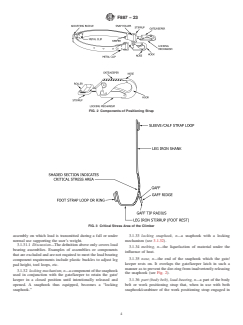
FIG. 2 Components of Positioning Strap
FIG. 3 Critical Stress Area of the Climber
assembly on which load is transmitted during a fall or under 3.1.33 locking snaphook, n—a snaphook with a locking
normal use supporting the user’s weight. mechanism (see 3.1.32).
3.1.31.1 Discussion—The definition above only covers load
3.1.34 melting, n—the liquefaction of material under the
bearing assemblies. Examples of assemblies or components
influence of heat.
that are excluded and are not required to meet the load bearing
3.1.35 nose, n—the end of the snaphook which the gate/
component requirements include plastic buckles to adjust leg
keeper rests on. It overlaps the gate/keeper latch in such a
pad height, tool loops, etc.
manner as to prevent the dee-ring from inadvertently releasing
3.1.32 locking mechanism, n—a component of the snaphook
the snaphook (see Fig. 2).
used in conjunction with the gate/keeper to retain the gate/
keeper in a closed position until intentionally released and 3.1.36 part (body belt), load-bearing, n—a part of the body
opened. A snaphook thus equipped, becomes a “locking belt or work positioning strap that, when in use with both
snaphook.” snaphook/carabiner of the work positioning strap engaged in
F887 − 23
one dee-ring of the body belt, will be required to support all or 3.1.45.1 Discussion—Primary positioning devices are used
part of the mass of the user. This includes all the material in the in work positioning as the support member between primary
work positioning strap, and, in the case of the body belt, the dee rings or connection points on a body belt to maintain a user
material to which the dee-rings are directly fastened, and the in the hands free work position.
material of the buckle strap that passes across the wearer’s
3.1.46 secondary dee ring, D-ring (body belt),
abdomen.
n—connection point on each side of the body belt, used to
3.1.36.1 Discussion—This definition and the strength re-
maintain fall protection while transitioning above/below ob-
quirements described in 15.3.2 are designed to ensure that the
stacles (see Fig. 1).
buckle strap is strong enough to withstand certain emergency
3.1.46.1 Discussion—Secondary dee rings are used on each
conditions, but are not to be construed as approval of attaching
side of the four dee ring body belt in a stacked or tandem
both snaphooks to the same dee-ring when working aloft.
position at the discretion of the user or using company’s work
OSHA Subpart M (1926.502) prohibits working with two
practice.
load-bearing snaphooks in the same dee-ring unless snaphooks
3.1.47 secondary positioning device, n—a flexible line of
are of the locking type and designed for such application.
rope or webbing that utilizes a connecting link at both ends and
3.1.37 part, load bearing, (Type A and B harness), n—a
may include an adjustable length device for transitioning or
component of a harness to which arrest forces are directly
traversing obstacles.
transmitted in the event of a fall.
3.1.47.1 Discussion—Secondary work positioning devices
3.1.38 part, load bearing, (positioning/restrict/suspension),
are a component of a climbing system used to maintain fall
n—a component of the unit to which body weight forces are protection when transitioning over/under obstacles.
directly transmitted in the event of a fall.
3.1.48 stirrup, climber, n—the footrest of the pole or tree
3.1.39 permanent deformation, n—a deformation occurring climber.
beyond the yield point so that the structure will not return to its
3.1.49 stirrup, snaphook/dee-ring, n—the closed rectangu-
original dimensions after removal of the applied force.
lar portion of the work positioning strap snaphook, or body belt
3.1.40 positioning lanyard, n—a component of a climbing
dee-ring (see Fig. 2 and Fig. 5), that accepts the strap or belt
system consisting of a flexible line of rope or webbing material in a permanent manner.
generally with a connecting link at each end and may incor-
3.1.50 suspension, n—the act of supporting a user’s body
porate a length adjusting device to allow for adjustability.
weight, including equipment, for the purpose of accessing a
3.1.41 protector, gaff, n—a cap or guard designed to cover
work location with one or two points of contact.
the points of pole or tree gaffs to protect the gaffs from damage,
3.1.51 wood pole fall restriction device (WPFRD), n—a
from injuring people or from damaging equipment.
device that when properly adjusted and combined with other
3.1.42 positioning, n—the act of supporting the user’s body subcomponents and elements, allows the climber to remain at
with a work positioning system for the purpose of working
his or her work position with both hands free, and that
with hands free.
performs a fall restriction function if the climber loses contact
between his or her gaffs and the pole.
3.1.43 positioning system, n—a combination of work posi-
3.1.51.1 Discussion—Warning—Units are not tested on
tioning equipment defined by this standard intended for use in
trees or structures other than wood poles and it is up to the end
supporting a user in a work position on an elevated vertical
user to do an evaluation for compatibility to use on such
surface with both hands free (i.e. climber, body belt or arborist
structures. There are devices present on the market that are
saddle, WPFRD & APL etc.)
specifically designed for trees.
3.1.44 primary dee-ring (body belt), n—main connection
3.1.52 work positioning, n—the act of supporting the body
point on each side of the body belt.
with a positioning system for the purpose of working with
3.1.44.1 Discussion—Primary dee rings serve as the con-
hands free. (See ANSI/ASSP Z359.0-2018.)
nection point used to maintain a user in a hands free work
position (see Fig. 1 and Fig. 4).
4. Significance and Use
3.1.45 primary positioning device, n—a flexible line of rope
or webbing that utilizes a connecting link at both ends and may 4.1 The following personal tools or equipment covered by
include an adjustable length device. this standard are:
FIG. 4 Body Belt Nomenclature
F887 − 23
4.5.1 For this type of protective equipment, it is common
practice and the responsibility of the manufacturer to provide
instructions regarding proper use, care and maintenance of the
equipment and for the user’s employer to provide training in
and procedures for the safe use of such equipment.
POLE AND TREE CLIMBERS
5. Classification
5.1 Climbers covered under this standard shall be desig-
nated as Type A, B, or C, as follows:
FIG. 5 Typical Body Belt Dee-Ring
5.1.1 Type A—Fixed length, non-adjustable, with perma-
nently attached gaffs.
5.1.2 Type B—Adjustable length, with permanently attached
4.1.1 Climbers and climber straps used to ascend and
gaffs.
descend poles and trees.
5.1.3 Type C—Adjustable length, with replaceable and in-
4.1.2 Body belts and positioning devices utilized for work
terchangeable gaffs.
positioning on poles, ladders, or structures.
5.2 Climber straps covered under this standard shall be
4.1.3 WPFRD and adjustable positioning lanyards are used
designated as Type A or B, as follows:
as components of a work positioning and fall restriction system
5.2.1 Type A—One-piece straps that pass through the loops
and utilized in conjunction with a body belt.
or rings on climbers and buckle one end to the other.
4.1.4 Arborist saddle is intended for work positioning and
5.2.2 Type B—Two-piece ankle or bottom straps made so
suspension (ascent and descent) primarily in trees. The arborist
that each section can be attached to the climber ring, leaving
saddle is not intended for use in fall arrest (see Fig. 6).
the buckle end free to engage with the free billet end of the
4.1.5 Full body harnesses and energy absorbing lanyards
other piece.
utilized in preventing and arresting falls.
4.2 Test methods included in this standard are intended to
6. Ordering Information
provide uniform test procedures.
6.1 Orders for equipment under this standard shall include
4.3 Snaphooks and carabiners utilized in fall protection
the following information:
systems.
6.1.1 Nomenclature,
4.3.1 All products being marked as meeting the require-
6.1.2 Type,
ments of this standard shall utilize locking snaphooks or
6.1.3 Material,
carabiners in accordance with Section 23. Locking snaphooks
6.1.4 Size, and
and carabiners are designed to prevent rollout from occurring
6.1.5 Gaff type (pole or tree).
while being able to be operated with one hand during use.
6.2 The listing of equipment, types, and sizes is not intended
4.4 Illustrations are furnished only to amplify the text. They
to mean that all shall necessarily be available from the
are not to be considered restrictive as to specific design details,
manufacturer; this listing signifies only that, if made, the
except where so stated.
equipment, types, and sizes shall conform to the details of this
standard.
4.5 Except for the restrictions set forth in this standard
because of design limitations, the use and maintenance of this
equipment is beyond the scope of the standard. 7. Pole and Tree Climbers
7.1 Sizes:
7.1.1 Type A shall be available in sizes from 14 in. to 22 in.
(355.6 mm to 558.8 mm) in ⁄2 in. (12.7 mm) graduations.
7.1.2 Types B and C shall be available with the size
adjustment capability of 14 ⁄4 in. to 21 in. (374.7 mm to
533.4 mm) by increments of ⁄4 in. (6.4 mm).
7.1.3 Adjustable climbers shall be equipped with positive
locking, length-adjusting sections that can be double locked
securely to the leg iron, permitting full compliance with
standards established for fixed length climbers.
7.2 Materials and Properties—Leg irons manufactured uti-
lizing quality alloy steel, aluminum or titanium alloys shall
meet the performance requirements of this standard. SAE
4140, SAE 8630 and SAE 8640 steel alloys with quenched and
tempered structure, 2014 T6 aluminum alloy and Ti6AL4V
FIG. 6 Arborist Saddles, Shown in Typical Suspension Applica-
tions titanium alloy are commonly used.
F887 − 23
TABLE 1 Typical Material Properties for Climbers
tion through any part of the climber shall not exceed 0.100 in.
For Fixed Gaff For Replaceable (2.5 mm) excluding measurement error after removal of the
A
Climbers Gaff Climbers
load (see Fig. 7).
Steel:
7.6.1.2 Fatigue Test—When tested at room temperature
A
Elongation in 2 in. (5 cm), min 14 % 14 %
A (approx. 68 °F (20 °C)), the climber as a minimum shall
Hardness 23 to 38 HRC 32 to 40 HRC
B B
243 to 353 HB 300 to 375 HB withstand without failure 100 000 cycles of a 300 lb (1334.5 N)
A
Yield strength, min, psi (MPa) 118 000 (815) 130 000 (895)
load. The load must be applied parallel to the shank at the
Aluminum:
center of the stirrup section with sleeve in position. The
Elongation in 2 in. (5 cm), min . 10 %
B
Hardness . 125 to 140 HB climber equipped with a pole gaff shall be held in the climbing
Yield Strength, min, psi (MPa) . 65 000 (450)
position by the gaff and at the top of the climber with the
Titanium:
longest sleeve manufactured extended to provide maximum
Elongation in 2 in. (5 cm), min . 10 %
Hardness . 30 to 40 HRC
length. The gaff must be supported by a rigid surface so that the
B
286 to 371 HB
gaff will not penetrate the support. Failure shall be considered
Yield Strength, min, psi (MPa) . 120 000 (828)
as any condition which renders the climber non-useable (see
A
Data from Federal Specification RR-C-430 C. (Cancelled)
Fig. 8).
B
Brinell hardness number with 3000 kg load, 10 mm ball.
7.6.1.3 Ductility Test—(a) Leg iron: The leg iron shall
withstand without fracture or cracking, a 180 degree bend
about a mandrel near the midpoint of the shank area. Mandrel
size shall be based upon the minimum allowable bend radius
7.2.1 Materials other than those stated herein are permitted
specified for the leg iron shank material, thickness and hard-
only when it can be demonstrated by testing that all applicable
ness properties. (b) Gaff: The gaff shall withstand, without
performance requirements of this standard are met and that the
fracture, a cold bend in a direction away from the leg iron. The
durability, reliability and other properties pertinent to the
center of the bend shall be approximately ⁄8 in.(16 mm) from
intended uses have been evaluated and determined suitable by
the tip of the gaff. Permanent deflection of the tip of ⁄8 in.
testing. Any restrictions on the use of such leg irons shall be
(9.5 mm) with respect to the straight outer edge of the upper
marked on the leg iron.
section shall be produced.
7.3 Processing—If required, manufacturers shall use a heat
7.6.1.4 Plane Test—This test may be used to determine that
treatment to provide the required characteristics of the leg iron.
the gaff is correctly shaped and sharpened to properly penetrate
Overheating shall be avoided. Scaling, pitting, and surface
the pole. Place the climber on a flat, soft pine or cedar board.
decarburization shall be removed on the inside critical section
Holding it upright with the shank parallel to the board surface,
of the leg iron from 2 in. (50.8 mm) below the gaff to 6 in.
but with no pressure on the stirrup, push the climber forward
(152.4 mm) above the gaff (see Fig. 3).
along the board as shown in Fig. 9a. If the gaff is properly
7.4 Design—The design of the climber shall be such that the
shaped and sharpened and if the gaff angle with the wood is
maximum tensile stress at the point where maximum stress
sufficient, the gaff point will dig into the wood and begin to
occurs when subjected to a fluctuating bending force of 300 lbf
hold within a distance of approximately 1 in. (2.54 cm). If the
(1.34 kN) applied to the center of the stirrup section with
climber gaff slides along the wood without digging in, or
sleeve in position shall be as indicated in the table below. The
merely leaves a mark or groove in the wood as shown in Fig.
climber shall be held in the climbing position by the gaff and
9b. the gaff is either not properly sharpened and shaped or the
at the top of the climber with the sleeve extended to provide a
gaff angle is too small. The gaff angle is built into the climber
16 in. (406.4 mm) length.
Leg Iron Max Tensile Stress, psi (MPa)
Type A—Steel 27 000 (185)
Type B—Aluminum 9 000 (60)
Type C—Titanium 27 000 (185)
7.5 Finish—Leg irons shall be free of surface cracks and
seams. Materials used for leg irons shall be finished with a
rust-resistant or corrosion-resistant coating as applicable.
7.6 Testing, Inspection and Marking:
7.6.1 Testing:
7.6.1.1 Deformation Test—The purpose for this test is to aid
in the elimination of climber failure in the event it is used in an
unusual manner such as descending a pole with large steps. The
climber shall be held rigidly in the climbing position with the
top of the shank parallel to a mounting fixture, the stirrup freely
suspended and perpendicular to the fixture. The climber
equipped with a pole gaff must also be mounted at the gaff tip
in a rigid surface to prevent gaff penetration. Gradually apply
a static load of 750 lbf (3.3 kN) at the center of the stirrup and
parallel to the fixture and hold for 3 min. Maximum deforma- FIG. 7 Deformation Test Fixtures
F887 − 23
8. Climber Gaffs
8.1 Sizes—Pole gaffs shall measure at least 1 ⁄16 in.
(36.5 mm) on the underside. Tree gaffs shall measure not more
1 1
than 3 ⁄2 in. (88.9 mm), nor less than 2 ⁄4 in. (57.2 mm) on the
underside. Gaff design shall be as shown in Fig. 11.
8.2 Material—All gaffs shall be forged of forging-quality
steel having the properties listed in Table 2.
8.3 Finish:
8.3.1 All fins or burrs shall be removed from the cutting
edges of gaff.
8.3.2 All gaffs shall be finished with a rust-resistant coating.
8.4 Inspection:
8.4.1 All gaffs shall be subjected to careful inspection by the
manufacturer. When requested, the manufacturer shall certify
that the gaffs meet all requirements set forth in this standard.
8.4.2 The size and shape of gaffs shall be checked with a
gauge available from the same manufacturer.
NOTE 2—Replaceable gaffs, whether pole or tree, fit only the climber
iron of the particular manufacturer.
9. Climber Straps
9.1 Sizes—Climber straps shall have a minimum nominal
FIG. 8 Fatigue Test Fixture width of 1 in. (25.4 mm) and must meet the strength criteria of
9.2. The length shall be not less than 22 in. (55.9 cm) for the
calf strap, or 24 in. (61 cm) for the one-piece ankle strap.
Two-piece ankle straps shall be not less than 24 in. (61 cm) in
length.
by the manufacturer and should be between 11 and 17 degrees
with the climber placed parallel to the surface of the wood.
9.2 Material and Properties:
7.6.1.5 Pole Cut Out Test—This test shall be performed on
9.2.1 Leather used in the manufacture of climber straps shall
a section of a treated (that is, creosote, penta, etc.) pole in an
be top grain cowhide and shall have a breaking strength of not
area that is free from knots and checks. Place the climber on
less than 450 lbf/in. (78.9 kN/m) of width with buckle holes.
your leg holding the sleeve with your hand. With your leg at an
The buckle holding strength of leather shall be not less than
approximate 30° angle to the pole and your foot about 12 in.
200 lbf (0.89 kN) static load when determined as follows:
(30.5 cm) off the ground. Lightly jab the gaff into the pole to
9.2.1.1 Punch a hole ⁄16 in. (4.76 mm) in diameter, centrally
a depth of approximately ⁄4 in. (6.4 mm). Keep enough
located in a 1 in. (25.4 mm) wide piece of strap, 1 in.
pressure on the stirrup to keep the gaff in the pole but not so
(25.4 mm) from the end of the test piece. Into this hole, fit the
much as to cause the gaff to penetrate any deeper (see Fig.
tongue of a 1 in. assembled buckle of the design to be supplied
10a). Push the climber and your hand closer to the pole by
with the climber strap. Apply the load to the buckle and to the
moving your knee until the strap loop of the climber sleeve is
free end of the strap. The buckle tongue shall not tear the
against the pole. Make certain the strap loop is held against the
leather under the specified static load of 200 lbf (0.89 kN).
pole with pressure from your leg. Gradually exert full pressure
9.2.2 The leather shall show no cracking on the grain side
of your foot straight down on the stirrup without raising your
when bent slowly over a ⁄2 in. (12.7 mm) diameter mandrel,
other foot off the floor or ground, so as to maintain balance if
grain side out, through an angle of 180°. The leather shall not
the gaff does not hold (see Fig. 10b). The tip of the gaff shall
show piping or wrinkling of the grain side when bent over a
cut into the wood and hold (dig itself in) in a distance of not
mandrel 1 in. (25.4 mm) in diameter, with the grain side in,
more than 2 in. (5.1 cm), measured from the point of gaff entry
through an angle of 180°.
into the pole to the bottom of the cut on the pole surface.
9.2.3 Fabric used in the manufacture of climber straps shall
7.6.2 All climbers shall be subjected to careful inspection
have a breaking strength of not less than 600 lbf ⁄in.
by the manufacturer. When requested, the manufacturer shall (105.1 kN ⁄m) of width with buckle holes. Construction shall
provide certification that the climbers meet all requirements set
be a minimum of four plies of thickness of folded nylon, or of
forth in this standard.
woven nylon, or equivalent material, constructed in such a way
7.6.3 Completed climbers shall be permanently marked by that no raw edges are exposed. Folded fabric shall be impreg-
nated with neoprene or its equivalent, so that the plies or
the manufacturer with the manufacturer’s name, ASTM F887
standard, size (if fixed size), right or left, and the month and strands are not readily separable, except by chemical means.
year of manufacture. Right or left markings shall be in a visible 9.2.4 The buckle holding strength of the finished strap shall
area (that is, toe, stirrup) not covered by other equipment. be not less than 300 lbf (1.34 kN) static load without evidence
F887 − 23
FIG. 9 a & b Plane Test
FIG. 10 a & b Pole Cut Out Test
NOTE 1—Degree of angle of the gaff, measured as shown, shall range from 11° to 17°, and the point of the gaff shall be a minimum of ⁄8 in. (9.6 mm)
above the lowest point of the climber stirrup. Tree gaffs are excluded from this requirement. The inside flat surface of the gaff at the tip shall be finished
with a radius of approximately ⁄4 in. (6.4 mm) in accordance with the gage profile.
FIG. 11 Gaff Design
TABLE 2 Properties of Steel Alloy Acceptable for Gaffs
of failure. Buckle tear shall be in the direction of load
application when tested to failure. Elongation in 2 in. (5 cm), min 12 %
A
Hardness (tip) 45 to 55 HRC
B
9.3 Hardware—Buckle frames shall be of welded wire or
421 to 546 HB
Yield strength, psi (MPa) 212 000 (1460)
forged construction. Tongues shall be of an adequate gage wire
A
to meet the strength criteria of 9.2. There may be a variation of no more than three points in the Rockwell Hardness
readings taken from the tip of the gaff to a point 1 ⁄4 in. (3.2 cm) back from the tip
9.4 Design—Buckle holes in the climber straps shall not
on the fixed gaff climber, 1 in. (2.5 cm) from the tip on replaceable gaff climbers.
B
Brinell hardness number with 3000 kg load, 10 mm ball.
exceed ⁄16 in. (4.76 mm) in diameter. Straps shall be riveted to
the buckles by at least two rivets, with the strap keeper
centered between the rivets. The completed assembly shall
F887 − 23
meet the strength requirements of 9.2. Buckle pads or chafes 10.3.4 Sleeve retaining straps shall be capable of withstand-
may be added when desired. ing a direct pull of 175 lbf (0.78 kN) (see Fig. 12a).
10.3.5 Sleeve retaining straps in place within the climber
10. Climber Pads
sleeve shall be capable of withstanding a direct pull of 700 lbf
10.1 Climber pad assemblies are intended for use with the
(3.12 kN) (see Fig. 12b).
climber to enhance comfort.
11. Climber Footplates
10.2 Hook and Loop Fastener style wrap pads covered
under this standard cover the function of both the climber strap
11.1 Climber footplate assemblies are intended for use with
and pad.
the climber to enhance comfort.
10.3 Materials—Materials used in the manufacture of pads
11.2 Materials and Properties—Materials used in the manu-
shall be of a type that will result in a finished product capable
facture of footplates shall be of a type that will result in a
of meeting the requirements for this section outlined below.
finished product capable of meeting the requirements for this
10.3.1 Wrap style pads shall maintain a minimum wrap that
section outlined below. Material used in the manufacture of
shall not release at a force of less than 1000 lbf (4.4 kN) when
footplates must maintain its integrity and resist permanent
statically tested.
deformation under normal use conditions for the expected life
10.3.2 Wrap style pads must display a minimum wrap
of the product.
location warning. Warning must be permanently attached (label
or marking).
11.3 Removable—Footplates if removable shall be equipped
10.3.3 Sleeve retaining straps (see Fig. 12a) shall be a
with positive locking fasteners to secure the footplates to the
minimum of 1 in. (25.4 mm) in width. Leather sleeve retaining
climber stirrup.
straps shall have a breaking strength of not less than 450 lbf/in.
(78.9 kN/m) of width. Finished fabric sleeve retaining straps 11.4 Articulation—Footplates may swivel slightly on the
climber stirrup to allow for ease of movement when working
shall have a breaking strength of not less than 600 lbf ⁄in.
(105.1 kN ⁄m) of width. aloft.
FIG. 12 a & b Sleeve Retaining Straps on Hook and Loop Fastener Wrap Style Pads
F887 − 23
11.5 Shape—Shape must be smaller than the outsole of a 12.3.1 Type A—Equipment for use on dry, wet, and conduit-
standard climbing boot while providing sufficient support to covered poles as described in this standard.
the outsole.
12.3.2 Type AB—Equipment is for use on dry, wet, conduit-
covered, and icy poles as described in this standard.
11.6 Non–Skid—Bottom surfaces of the footplate must be as
a minimum 90 % covered by a rubber sole or an equivalent
12.4 Arborist saddle covered under this standard shall be
non-skid coating. designated as Type A, as follows:
12.4.1 Type A—Equipment for use in work positioning and
11.7 Steel footplates are not intended for and may not be
suspension.
used on aluminum climbers unless provisions are implemented
to prevent premature wear on the climber.
13. Ordering Information
11.8 Footplates shall be permanently marked by the manu-
13.1 Orders for equipment under this standard should in-
facturer with the manufacturer’s name, month and year of
clude the following information:
manufacture and designated as right and left.
13.1.1 Nomenclature,
11.9 Finish—Footplates shall be free of surface cracks and
13.1.2 Type,
seams. All steel or ferrous material footplates shall be finished
13.1.3 Style,
with a rust-resistant coating.
13.1.4 Material, and
13.1.5 Size.
BODY BELTS, POSITIONING DEVICES, AND WOOD
POLE FALL RESTRICTION DEVICES (WPFRD)
13.2 The listing of equipment, types, styles, and sizes is not
intended to mean that all shall necessarily be available from the
12. Classification
manufacturer. The listing signifies only that, if made, the
12.1 Body belts covered under this standard shall be desig-
equipment, types, styles, and sizes shall conform to the details
nated as Type A or B, as follows:
of this standard.
12.1.1 Type A—Belt with dee-ring piece in fixed position.
12.1.2 Type B—Belt with dee-ring piece that has limited
14. Two Dee Body Belts, Auxiliary Positioning Belts, and
freedom of movement.
Four Dee Body Belts
12.2 Positioning devices covered under this standard shall
14.1 Two Dee Body Belts:
be designated as follows:
14.1.1 Sizes—The “dee” measurement will be the nominal
12.2.1 Positioning Straps:
distance from the heel or bar of one dee ring to the heel or bar
12.2.1.1 Type A—Adjustable length, with tongue buckle.
of the other dee ring (see Fig. 13). Body belts shall be marked
12.2.1.2 Type B—Adjustable length, with friction buckle.
with the “dee” sizes since the dee size is the most critical. Body
12.2.1.3 Type C—Nonadjustable length strap.
belts are normally furnished in the combination belt strap and
12.2.2 Adjustable Positioning Lanyard:
dee sizes listed in Table 3 (see Fig. 14), however, belt strap
12.2.2.1 Type A—Adjustable length rope lanyard with
measurements may vary on different style belts and with
Length Adjusting Device (LAD).
different manufacturers.
12.2.2.2 Type B—Web (woven nylon) lanyard with friction
14.1.2 Materials:
buckle.
14.1.2.1 Leather—Top grain leather or leather substitute
12.2.2.3 Type C—6 ft to 10 ft retractable web (see ANSI/
may be used in the manufacture, but shall not be used alone as
ASSE Z359.14-2021).
a load bearing component of the assembly.
12.2.3 Nonadjustable Positioning Lanyard:
14.1.2.2 Fabric—Plied fabric used in the manufacture of
12.2.3.1 Type A—Nonadjustable Rope Lanyard (see ANSI/
load bearing parts shall be constructed in such a way that no
ASSP Z359.3-2019).
raw edges are exposed. Plied fabric shall be impregnated with
12.2.3.2 Type B—Nonadjustable Web Lanyard (see ANSI/
neoprene, or its equivalent, so that the plies are not readily
ASSP Z359.3-2019).
separable, except by chemical means. If webbing is used, it
12.3 WPFRD covered under this standard shall be desig- need not be impregnated.
nated as Type A or AB as follows: 14.1.3 Design:
FIG. 13 “Dee” Measurement
F887 − 23
TABLE 3 Available Body Belts Listed by Dee Size With
pockets (see Fig. 4 and Fig. 13). On shifting dee belts, the
Corresponding Belt Strap Size
measurement for pocket tabs shall be taken when the dee ring
Center Hole No. of
Dee Size Min Max section is centered.
Tool
14.1.3.2 Belt Straps—Belt straps shall be made of fabric
in. cm in. cm in. cm in. cm
Loops
described in 14.1.2. Buckle holes shall be spaced on 1 in.
D18 46 32 81 36 91 40 102 3
D19 48 33 84 37 94 41 104 3
(25.4 mm) centers, round or oval, to accommodate the tongue
D20 51 34 86 38 97 42 107 3
of the belt buckle. Buckle holes shall be shaped not in excess
D21 53 36 91 40 102 44 112 4
1 1 3
of ⁄4 in. (6.3 mm) in diameter if round, or ⁄4 in. by ⁄8 in.
D22 56 37 94 41 104 45 114 4
D23 58 38 97 42 107 46 117 4 (6.3 mm by 9.5 mm) if oval shaped, the greater dimension to be
D24 61 40 102 44 112 48 122 4
in the direction of the length of the strap. For grommet
D25 64 41 104 45 114 49 124 4
construction, holes shall be no larger than No. 2 grommet. No
D26 66 42 107 46 117 50 127 4
D27 69 44 112 48 122 52 132 4
hole shall be permitted within 4 in. (101.6 mm) of the end of
D28 71 45 114 49 124 53 135 4
the strap. The nominal body strap width shall be 1 ⁄4 in. (44.5
D29 74 46 117 50 127 54 137 4
mm) (see Fig. 15).
D30 76 47 119 51 130 55 140 4
14.1.3.3 Tool Loops—Tool loops shall be so situated on the
body of the belt that 4 in. (101.6 mm) of the body belt in the
center of the back, measuring from dee-ring to dee-ring, shall
be free of tool loops and any other attachments (see Fig. 4).
The material may be either leather or fabric ⁄8 in. (3.18 mm)
thick, 1 in. (25.4 mm) nominal width, with the loops having a
maximum diameter of 1 ⁄4 in. (44.4 mm) and a minimum
diameter of ⁄4 in. (19.1 mm).
14.1.3.4 Dee-Rings and Buckles—Shall meet the applicable
requirements specified in Section 23. Additionally, the dee ring
strap and the belt shall not pass through or attach to that part of
the dee ring to which a connecting device such as a carabiner
or snaphook will be engaged. The Dee rings shall be installed
in the body belt in such a manner that vertical travel in the
assembly is prevented.
14.1.3.5 Liners for Dee-Rings—Suitable copper, steel, or
equivalent liners shall be used around the bar of dee rings to
prevent wear.
14.1.3.6 Stitching and Thread—All stitching shall be of
nylon or equivalent thread and shall be lock stitched, not less
X— Distance from waist or top of hip bone to where body belt is worn.
than three nor more than seven stitches to the inch. The thread
Y— Measurement is from front of hip bone around the back to the front of the
other hip bone. This measurement is the Dee size. shall have a minimum breaking strength of 42 lbf (186.83 N).
Stitching parallel to an edge shall be approximately ⁄16 in.
FIG. 14 A Method Showing Where to Measure to Determine Cor-
(4.8 mm) from the edge of the narrowest member caught by the
rect “Dee” Size for a Body Belt
thread.
14.1.4 Materials Test Method:
14.1.3.1 Body P
...
This document is not an ASTM standard and is intended only to provide the user of an ASTM standard an indication of what changes have been made to the previous version. Because
it may not be technically possible to adequately depict all changes accurately, ASTM recommends that users consult prior editions as appropriate. In all cases only the current version
of the standard as published by ASTM is to be considered the official document.
Designation: F887 − 20 F887 − 23
Standard Specifications for
Personal Climbing Equipment
This standard is issued under the fixed designation F887; the number immediately following the designation indicates the year of original
adoption or, in the case of revision, the year of last revision. A number in parentheses indicates the year of last reapproval. A superscript
epsilon (´) indicates an editorial change since the last revision or reapproval.
1. Scope*
Table of Contents
Section/
Section Title
Paragraph
Scope 1
Referenced Documents 2
Terminology 3
Significance and Use 4
Pole and Tree Climbers
Classification 5
Ordering Information 6
Pole and Tree Climbers 7
Climber Gaffs 8
Climber Straps 9
Climber Pads 10
Climber Footplates 11
Body Belts, Positioning Devices and Wood Pole Fall
Restriction Devices (WPFRD)
Classification 12
Ordering Information 13
Two Dee Body Belts, Auxiliary Positioning Belts, and 14
Four Dee Body Belts
Two Dee Body Belts 14.1
Auxiliary Positioning Belts and Four Dee Body Belts 14.2
Positioning Devices 15
Wood Pole Fall Restriction Device (WPFRD) 16
Arborist Saddle 17
Harnesses
Classification 18
Ordering Information 18.2
Sizing 18.3
Marking 18.4
Energy Absorbing Lanyards
Classification 19
Ordering Information 20
Energy Absorbing Lanyards 21
Qualification Testing
After Exposure to an Electric Arc 22
Hardware Requirements 23
Test Equipment 24
Qualification Testing 25
Body Belts, Four Dee Body Belts, and Auxiliary 25.1
Positioning Belts
Positioning Devices 25.2
WPFRD 25.3
This standard is under the jurisdiction of ASTM Committee F18 on Electrical Protective Equipment for Workers and are the direct responsibility of Subcommittee F18.15
on Worker Personal Equipment.
Current edition approved Feb. 15, 2020Nov. 1, 2023. Published April 2020December 2023. Originally approved in 1984. Last previous edition approved in 20182020 as
F887 – 18.F887 – 20. DOI: 10.1520/F0887-20.10.1520/F0887-23.
*A Summary of Changes section appears at the end of this standard
Copyright © ASTM International, 100 Barr Harbor Drive, PO Box C700, West Conshohocken, PA 19428-2959. United States
F887 − 23
Table of Contents
Section/
Section Title
Paragraph
Arborist Saddle 25.4
Harness 25.5
Energy Absorbers 25.6
Instructions 26
Guarantee and Rejection 27
Keywords 28
1.1 This standard covers the specifications and qualification testing of the following:
Climbers,
Climber straps,
Climber Pads,
Climber Footplates,
Body Belts,
Work Positioning Devices with Locking Snaphooks/Carabiners,
Wood Pole Fall Restriction Devices (WPFRD),
Arborist Saddle,
Harnesses,
Energy Absorbing Lanyards.
These devices are used by workers in the climbing of poles, trees, towers, and other structures. Minimum performance criteria
for harnesses and energy absorbing lanyards in arresting a fall after exposure to electric arcs are included for workers who may
be exposed to thermal hazards of momentary electric arcs or flame.
1.2 Equipment may fall within one of the following categories:
1.2.1 Fall (Travel) Restraint—Prevents a user from reaching a fall hazard (allow 0 fall distance).
1.2.2 Work Positioning—Allows a 2 ft maximum free fall distance.
1.2.3 Fall Arrest—Allows a 6 ft maximum free fall distance with a maximum arrest force of 1800 lb.
NOTE 1—Under certain conditions and with the use of equipment designed for such conditions, a 12-ft free-fall distance with a maximum arrest force
of 1800 lb is allowed.
1.2.4 Suspension—Allows 0 free-fall distance while supporting the user’s weight.
1.2.5 Fall Restriction—to prevent or limit free fall from a work position or while ascending/descending a wood pole.
1.3 Three types of climbers, (Types A, B, and C) and two types of climber straps, Types (A and B) are covered.
1.4 Two types of body belts, (Types A and B) are covered.
1.5 Eight types of work positioning devices: three positioning straps, (Types A, B, and C), three adjustable-positioning lanyards,
(Types A, B and C) and two nonadjustable positioning lanyards, (Types A and B) are covered.
1.6 Two types of WPFRD, (Types A and AB) are covered.
1.7 Arborist saddle, (Type A) Work Positioning and Suspension are covered.
1.8 Two types of harnesses, (Types A and B) are covered.
1.9 Two types of energy absorbing lanyards, (Types A and B) are covered.
F887 − 23
1.10 The values stated in United States customary units are to be regarded as standard. The values given in parentheses are
mathematical conversions to SI units that are provided for information only and are not considered standard.
1.11 The following safety hazards caveat pertains only to the test method portions, 9.2, 10.3, 11.2, 14.1.4, 15.3, 15.4, 16.2, 17.2,
18.4, 21.2, 22, 23, and 25 of this standard: This standard does not purport to address all of the safety concerns, if any, associated
with its use. It is the responsibility of the user of this standard to establish appropriate safety, health, and environmental practices
and determine the applicability of regulatory limitations prior to use.
1.12 This international standard was developed in accordance with internationally recognized principles on standardization
established in the Decision on Principles for the Development of International Standards, Guides and Recommendations issued
by the World Trade Organization Technical Barriers to Trade (TBT) Committee.
2. Referenced Documents
2.1 ASTM Standards:
F819 Terminology Relating to Electrical Protective Equipment for Workers
F1959/F1959M Test Method for Determining the Arc Rating of Materials for Clothing
2.2 ANSI Standard:
ANSI 05.1 Wood Poles – Specification and Dimensions
2.3 ANSI/ASSE/ASSP Standards:
Z359.0-2018 Definitions and Nomenclature Used for Fall Protection and Fall Arrest
Z359.3-2019 Safety Requirements for Lanyards and Positioning Lanyards
Z359.11-2014Z359.11-2021 Safety Requirements for Full Body Harnesses
Z359.12-2019 Connecting Components for Personal Fall Arrest Systems
Z359.13-2013 Personal Energy Absorbers and Energy Absorbing Lanyards
Z359.14-2014Z359.14-2021 Safety Requirements for Self-Retracting Devices for Personal Fall Arrest and Rescue Systems
2.4 CSA Standard:
CAN/CSA 015 Wood Utility Poles and Reinforcing Stubs
3. Terminology
3.1 Definitions:
3.1.1 adjustable positioning lanyard (APL), n—a component of a work positioning or fall restriction system (may be used for
applications such as transitioning past an obstruction during ascent or descent).
3.1.2 afterflame, n—persistent flaming of a material after the ignition source has been removed.
3.1.2.1 Discussion—
In arc testing, a visible flaming on or near a test specimen which persists after the arc exposure has ended. The afterflame ceases
when flaming is no longer visible.
3.1.3 afterflame time, n—Refer to Terminology F819 for definition.
3.1.3.1 Discussion—
In arc testing, the length of time, in seconds, for which a specimen continues to exhibit a visible flaming as determined by a time
display video recording of the specimen during arc testing.
3.1.4 arborist saddle, n—an arrangement of straps, fittings and buckles or other elements in the form of a waist belt with a low
attachment suitably arranged to support the body in a sitting position. The saddle may or may not include individual leg straps or
a rigid batten seat section.
3.1.5 arc gap, n—Refer to Terminology F819 for definition.
3.1.6 attachment element, n—part or parts of an assembly intended for the load bearing connection of other components.
For referenced ASTM standards, visit the ASTM website, www.astm.org, or contact ASTM Customer Service at service@astm.org. For Annual Book of ASTM Standards
volume information, refer to the standard’s Document Summary page on the ASTM website.
Available from American National Standards Institute (ANSI), 25 W. 43rd St., 4th Floor, New York, NY 10036, http://www.ansi.org.
Available from the American National Standards Institute, ANSI, 25 W. 43rd St., 4th Floor, New York, NY 10036.
Available from Canadian Standards Association (CSA), 178 Rexdale Blvd., Toronto, ON M9W 1R3, Canada, http://www.csagroup.org.
F887 − 23
3.1.7 attachment point, n—specific connecting point on an assembly for load bearing connection to other components, consisting
of one or more attachment elements.
3.1.8 auxiliary positioning belt, n—a modular device made up of straps, pads, buckles, and attachment points for fastening to a
waist body belt.
3.1.8.1 Discussion—
An auxiliary positioning belt is used for attachment to a two ring body belt and intended for work positioning or fall restriction
while transitioning past obstructions during an ascent or descent and for support for a two ring body belt.
3.1.9 billet, n—the free (buckle hole) end of a belt or strap as opposed to the buckle end, which is designed to pass through the
buckle for closing.
3.1.10 body belt (two or four dee), n—an element of a work positioning system with two or four connection points consisting of
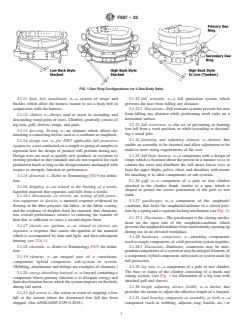
straps, pads, buckles, and rings that allow a user to work freely with both hands (see Fig. 1).
3.1.10.1 Discussion—
The width of the back section of a body belt is directly related to and can vary dependent on the number of dee rings that will be
accommodated, for example, two dee rings, four dee rings, or more.
3.1.11 body belt attachment, n—a system of straps and buckles which allow the harness wearer to use a body belt in conjunction
with the harness.
3.1.12 climber, n—device used to assist in ascending and descending wood poles or trees. Climbers generally consist of leg iron,
gaff, sleeves, straps, and pads.
3.1.13 dee-ring, D-ring, n—an element which allows for attaching a connecting device such as a carabiner or snaphook.
3.1.14 design test, n—for F887 applicable fall protection equipment, a test conducted on a sample or group of samples to represent
how the design of product will perform during use. Design tests are used to qualify new products or revisions to existing product
to this standard and are not required for each production batch as long as the design remains unchanged with respect to strength,
function or performance.
3.1.15 distorted, v—Refer to Terminology F819 for definition.
3.1.16 dripping, n—as related to the burning of a textile, liquefied material that separates and falls from a textile.
3.1.16.1 Discussion—
in electric arc testing of fall protection equipment or devices, a material response evidenced by flowing of the fiber polymer, the
fabric, or the fabric coating, and the evidence of droplets from the material, that characterizes overall performance relative to
reducing the transfer of heat that is sufficient to cause a second-degree burn.
FIG. 1 Dee Ring Configurations for 4 Dee Body Belts
F887 − 23
3.1.17 electric arc ignition, n—as related to electric arc exposure, a response that causes the ignition of the material which is
accompanied by heat and light, and then subsequent burning (see 22.6.1).
3.1.18 electrode, n—Refer to Terminology F819 for definition.
3.1.19 element, n—an integral part of a constituent, component, hybrid component, sub-system or system. (Webbing, attachments
and fittings are examples of elements.)
3.1.20 energy absorbing lanyard, n—a lanyard containing a component whose primary function is to dissipate energy and limit
deceleration forces which the system imposes on the body during fall arrest.
3.1.21 fall arrest, n—the action or event of stopping a free fall or the instant where the downward free fall has been stopped. (See
ANSI/ASSP Z359.0-2018.)
3.1.22 fall restraint, n—a fall protection system which prevents the user from falling any distance.
3.1.22.1 Discussion—
Fall restraint systems prevent the user from falling any distance while performing work tasks on a horizontal surface.
3.1.23 fall restriction, n—the act of preventing or limiting free fall from a work position, or while ascending or descending a wood
pole.
3.1.24 fastening and adjusting element, n—devices that enable an assembly to be fastened and allow adjustment to be made to
meet sizing requirements of the user.
3.1.25 full body harness, n—a component with a design of straps which is fastened about the person in a manner so as to contain
the torso and distribute the fall arrest forces over at least the upper thighs, pelvis, chest, and shoulders with means for attaching
it to other components or sub-systems.
3.1.26 gaff, n—a component of a pole or tree climber attached to the climber shank, similar to a spur, which is shaped to permit
the secure penetration of the pole or tree trunk.
3.1.27 gate/keeper, n—a component of the snaphook/carabiner, that locks the snaphook/carabiner in a closed position by a spring
and a separate locking mechanism (see Fig. 2).
3.1.27.1 Discussion—
FIG. 2 Components of Positioning Strap
F887 − 23
The gate/keeper is the closing mechanism on the open end of the snaphook/carabiner which prevents the snaphook/carabiner from
inadvertently opening up during use in an elevated workplace.
3.1.28 hardware, connectors, n—attaching components used to couple components of a fall protection system together.
3.1.28.1 Discussion—
Hardware, connectors may be independent components of a system or may be integral elements of a component, hybrid
component, subsystem or system used for fall protection.
3.1.29 leg iron, n—a component of a pole or tree climber. The base or frame of the climber consisting of a shank and stirrup
section. (see Fig. 3 for illustration of a leg iron with attached gaff and sleeve).
3.1.30 length adjusting device (LAD), n—a device that provides the means to adjust the effective length of a lanyard.
3.1.31 load bearing component or assembly, or both, n—a component (such as webbing, adjuster, ring, buckle, etc.) or assembly
on which load is transmitted during a fall or under normal use supporting the user’s weight.
3.1.31.1 Discussion—
The definition above only covers load bearing assemblies. Examples of assemblies or components that are excluded and are not
required to meet the load bearing component requirements include plastic buckles to adjust leg pad height, tool loops, etc.
3.1.32 locking mechanism, n—a component of the snaphook used in conjunction with the gate/keeper to retain the gate/keeper in
a closed position until intentionally released and opened. A snaphook thus equipped, becomes a “locking snaphook.”
3.1.33 locking snaphook, n—a snaphook with a locking mechanism (see 3.1.313.1.32).
3.1.34 melting, n—the liquefaction of material under the influence of heat.
3.1.35 nose, n—the end of the snaphook which the gate/keeper rests on. It overlaps the gate/keeper latch in such a manner as to
prevent the dee-ring from inadvertently releasing the snaphook (see Fig. 2).
3.1.36 part (body belt), load-bearing, n—a part of the body belt or work positioning strap that, when in use with both
snaphook/carabiner of the work positioning strap engaged in one dee-ring of the body belt, will be required to support all or part
FIG. 3 Critical Stress Area of the Climber
F887 − 23
of the mass of the user. This includes all the material in the work positioning strap, and, in the case of the body belt, the material
to which the dee-rings are directly fastened, and the material of the buckle strap that passes across the wearer’s abdomen.
3.1.36.1 Discussion—
This definition and the strength requirements described in 15.3.2 are designed to ensure that the buckle strap is strong enough to
withstand certain emergency conditions, but are not to be construed as approval of attaching both snaphooks to the same dee-ring
when working aloft. OSHA Subpart M (1926.502) prohibits working with two load-bearing snaphooks in the same dee-ring unless
snaphooks are of the locking type and designed for such application.
3.1.37 part, load bearing, (Type A and B harness), n—a component of a harness to which arrest forces are directly transmitted in
the event of a fall.
3.1.38 part, load bearing, (positioning/restrict/suspension), n—a component of the unit to which body weight forces are directly
transmitted in the event of a fall.
3.1.39 permanent deformation, n—a deformation occurring beyond the yield point so that the structure will not return to its
original dimensions after removal of the applied force.
3.1.40 positioning lanyard, n—a component of a climbing system consisting of a flexible line of rope or webbing generally with
a connecting link at each end and may incorporate a length adjusting device to allow for adjustability.
3.1.41 protector, gaff, n—a cap or guard designed to cover the points of pole or tree gaffs to protect the gaffs from damage, from
injuring people or from damaging equipment.
3.1.42 positioning, n—the act of supporting the user’s body with a work positioning system for the purpose of working with hands
free.
3.1.43 positioning system, n—a combination of work positioning equipment defined by this standard intended for use in supporting
a user in a work position on an elevated vertical surface with both hands free (i.e. climber, body belt or arborist saddle, WPFRD
& APL etc.)
3.1.44 primary dee-ring (body belt), n—main connection point on each side of the body belt.
3.1.44.1 Discussion—
Primary dee rings serve as the connection point used to maintain a user in a hands free work position (see Fig. 1 and Fig. 4).
3.1.45 primary positioning device, n—a flexible line of rope or webbing that utilizes a connecting link at both ends and may
include an adjustable length device.
3.1.45.1 Discussion—
Primary positioning devices are used in work positioning as the support member between primary dee rings or connection points
on a body belt to maintain a user in the hands free work position.
3.1.46 secondary dee ring, D-ring (body belt), n—connection point on each side of the body belt, used to maintain fall protection
while transitioning above/below obstacles (see Fig. 1).
3.1.46.1 Discussion—
Secondary dee rings are used on each side of the four dee ring body belt in a stacked or tandem position at the discretion of the
user or using company’s work practice.
FIG. 4 Body Belt Nomenclature
F887 − 23
3.1.47 secondary positioning device, n—a flexible line of rope or webbing that utilizes a connecting link at both ends and may
include an adjustable length device for transitioning or traversing obstacles.
3.1.47.1 Discussion—
Secondary work positioning devices are a component of a climbing system used to maintain fall protection when transitioning
over/under obstacles.
3.1.48 stirrup, climber, n—the footrest of the pole or tree climber.
3.1.49 stirrup, snaphook/dee-ring, n—the closed rectangular portion of the work positioning strap snaphook, or body belt dee-ring
(see Fig. 2 and Fig. 5), that accepts the strap or belt material in a permanent manner.
3.1.50 suspension, n—the act of supporting a user’s body weight, including equipment, for the purpose of accessing a work
location with one or two points of contact.
3.1.51 wood pole fall restriction device (WPFRD), n—a device that when properly adjusted and combined with other
subcomponents and elements, allows the climber to remain at his or her work position with both hands free, and that performs a
fall restriction function if the climber loses contact between his or her gaffs and the pole.
3.1.51.1 Discussion—
Warning—Units are not tested on trees or structures other than wood poles and it is up to the end user to do an evaluation for
compatibility to use on such structures. There are devices present on the market that are specifically designed for trees.
3.1.52 work positioning, n—the act of supporting the body with a positioning system for the purpose of working with hands free.
(See ANSI/ASSP Z359.0-2018.)
4. Significance and Use
4.1 The following personal tools or equipment covered by this standard are:
4.1.1 Climbers and climber straps used to ascend and descend poles and trees.
4.1.2 Body belts and positioning devices utilized for work positioning on poles, ladders, or structures.
4.1.3 WPFRD and adjustable positioning lanyards are used as components of a work positioning and fall restriction system and
utilized in conjunction with a body belt.
4.1.4 Arborist saddle is intended for work positioning and suspension (ascent and descent) primarily in trees. The arborist saddle
is not intended for use in fall arrest (See(see Fig. 6).
4.1.5 Full body harnesses and energy absorbing lanyards utilized in preventing and arresting falls.
4.2 Test methods included in this standard are intended to provide uniform test procedures.
FIG. 5 Typical Body Belt Dee-Ring
F887 − 23
FIG. 6 Arborist Saddles, Shown in Typical Suspension Applications
4.3 Snaphooks and carabiners utilized in fall protection systems.
4.3.1 All products being marked as meeting the requirements of this standard shall utilize locking snaphooks or carabiners in
accordance with Section 23. Locking snaphooks and carabiners are designed to prevent rollout from occurring while being able
to be operated with one hand during use.
4.4 Illustrations are furnished only to amplify the text. They are not to be considered restrictive as to specific design details, except
where so stated.
4.5 Except for the restrictions set forth in this standard because of design limitations, the use and maintenance of this equipment
is beyond the scope of the standard.
4.5.1 For this type of protective equipment, it is common practice and the responsibility of the manufacturer to provide instructions
regarding proper use, care and maintenance of the equipment and for the user’s employer to provide training in and procedures
for the safe use of such equipment.
POLE AND TREE CLIMBERS
5. Classification
5.1 Climbers covered under this standard shall be designated as Type A, B, or C, as follows:
5.1.1 Type A—Fixed length, non-adjustable, with permanently attached gaffs.
5.1.2 Type B—Adjustable length, with permanently attached gaffs.
5.1.3 Type C—Adjustable length, with replaceable and interchangeable gaffs.
5.2 Climber straps covered under this standard shall be designated as Type A or B, as follows:
5.2.1 Type A—One-piece straps that pass through the loops or rings on climbers and buckle one end to the other.
5.2.2 Type B—Two-piece ankle or bottom straps made so that each section can be attached to the climber ring, leaving the buckle
end free to engage with the free billet end of the other piece.
6. Ordering Information
6.1 Orders for equipment under this standard shall include the following information:
6.1.1 Nomenclature,
F887 − 23
6.1.2 Type,
6.1.3 Material,
6.1.4 Size, and
6.1.5 Gaff type (pole or tree).
6.2 The listing of equipment, types, and sizes is not intended to mean that all shall necessarily be available from the manufacturer;
this listing signifies only that, if made, the equipment, types, and sizes shall conform to the details of this standard.
7. Pole and Tree Climbers
7.1 Sizes:
7.1.1 Type A shall be available in sizes from 14 to 22 in. (355.6 to 558.8 mm) 14 in. to 22 in. (355.6 mm to 558.8 mm) in ⁄2 in.
(12.7 mm) in. (12.7 mm) graduations.
7.1.2 Types B and C shall be available with the size adjustment capability of 14 ⁄4 to 21 in. (374.7 to 533.4 mm) in. to 21 in.
(374.7 mm to 533.4 mm) by increments of ⁄4 in. (6.4 mm). in. (6.4 mm).
7.1.3 Adjustable climbers shall be equipped with positive locking, length-adjusting sections that can be double locked securely
to the leg iron, permitting full compliance with standards established for fixed length climbers.
7.2 Materials and Properties—Leg irons manufactured utilizing quality alloy steel, aluminum or titanium alloys shall meet the
performance requirements of this standard. SAE 4140, SAE 8630 and SAE 8640 steel alloys with quenched and tempered
structure, 2014 T6 aluminum alloy and Ti6AL4V titanium alloy are commonly used.
7.2.1 Materials other than those stated herein are permitted only when it can be demonstrated by testing that all applicable
performance requirements of this standard are met and that the durability, reliability and other properties pertinent to the intended
uses have been evaluated and determined suitable by testing. Any restrictions on the use of such leg irons shall be marked on the
leg iron.
7.3 Processing—If required, manufacturers shall use a heat treatment to provide the required characteristics of the leg iron.
Overheating shall be avoided. Scaling, pitting, and surface decarburization shall be removed on the inside critical section of the
leg iron from 2 in. (50.8 mm) below the gaff to 6 in. (152.4 mm) above the gaff (see Fig. 3).
7.4 Design—The design of the climber shall be such that the maximum tensile stress at the point where maximum stress occurs
when subjected to a fluctuating bending force of 300 lbf (1.34 kN) applied to the center of the stirrup section with sleeve in position
TABLE 1 Typical Material Properties for Climbers
For Fixed Gaff For Replaceable
A
Climbers Gaff Climbers
Steel:
A
Elongation in 2 in. (5 cm), min 14 % 14 %
A
Hardness 23 to 38 HRC 32 to 40 HRC
B B
243 to 353 HB 300 to 375 HB
A
Yield strength, min, psi (MPa) 118 000 (815) 130 000 (895)
Aluminum:
Elongation in 2 in. (5 cm), min . 10 %
B
Hardness . 125 to 140 HB
Yield Strength, min, psi (MPa) . 65 000 (450)
Titanium:
Elongation in 2 in. (5 cm), min . 10 %
Hardness . 30 to 40 HRC
B
286 to 371 HB
Yield Strength, min, psi (MPa) . 120 000 (828)
A
Data from Federal Specification RR-C-430 C. (Cancelled)
B
Brinell hardness number with 3000-kg load, 10-mm3000 kg load, 10 mm ball.
F887 − 23
shall be as indicated in the table below. The climber shall be held in the climbing position by the gaff and at the top of the climber
with the sleeve extended to provide a 16 in. (406.4 mm) length.
Leg Iron Max Tensile Stress, psi (MPa)
Type A—Steel 27 000 (185)
Type B—Aluminum 9 000 (60)
Type C—Titanium 27 000 (185)
7.5 Finish—Leg irons shall be free of surface cracks and seams. Materials used for leg irons shall be finished with a rust-resistant
or corrosion-resistant coating as applicable.
7.6 Testing, Inspection and Marking:
7.6.1 Testing:
7.6.1.1 Deformation Test—The purpose for this test is to aid in the elimination of climber failure in the event it is used in an
unusual manner such as descending a pole with large steps. The climber shall be held rigidly in the climbing position with the top
of the shank parallel to a mounting fixture, the stirrup freely suspended and perpendicular to the fixture. The climber equipped with
a pole gaff must also be mounted at the gaff tip in a rigid surface to prevent gaff penetration. Gradually apply a static load of 750
lbf (3.3 kN) at the center of the stirrup and parallel to the fixture and hold for 3 min. Maximum deformation through any part of
the climber shall not exceed 0.100 in. (2.5 mm) excluding measurement error after removal of the load. Seeload (see Fig. 7.).
7.6.1.2 Fatigue Test—When tested at room temperature (approx. 68°F (20°C)),68 °F (20 °C)), the climber as a minimum shall
withstand without failure 100 000 cycles of a 300 lb (1334.5 N) load. The load must be applied parallel to the shank at the center
of the stirrup section with sleeve in position. The climber equipped with a pole gaff shall be held in the climbing position by the
gaff and at the top of the climber with the longest sleeve manufactured extended to provide maximum length. The gaff must be
supported by a rigid surface so that the gaff will not penetrate the support. Failure shall be considered as any condition which
renders the climber non-useable. Seenon-useable (see Fig. 8.).
7.6.1.3 Ductility Test—(a) Leg iron: The leg iron shall withstand without fracture or cracking, a 180 degree bend about a mandrel
near the midpoint of the shank area. Mandrel size shall be based upon the minimum allowable bend radius specified for the leg
iron shank material, thickness and hardness properties. (b) Gaff: The gaff shall withstand, without fracture, a cold bend in a
direction away from the leg iron. The center of the bend shall be approximately ⁄85/8 in.(16 mm) in.(16 mm) from the tip of the
gaff. Permanent deflection of the tip of ⁄83/8 in. (9.5 mm) in. (9.5 mm) with respect to the straight outer edge of the upper section
shall be produced.
7.6.1.4 Plane Test—This test may be used to determine that the gaff is correctly shaped and sharpened to properly penetrate the
pole. Place the climber on a flat, soft pine or cedar board. Holding it upright with the shank parallel to the board surface, but with
FIG. 7 Deformation Test Fixtures
F887 − 23
FIG. 8 Fatigue Test Fixture
no pressure on the stirrup, push the climber forward along the board as shown in Fig. 9a. If the gaff is properly shaped and
sharpened and if the gaff angle with the wood is sufficient, the gaff point will dig into the wood and begin to hold within a distance
of approximately 1 in. (2.54 cm). If the climber gaff slides along the wood without digging in, or merely leaves a mark or groove
in the wood as shown in Fig. 9b. the gaff is either not properly sharpened and shaped or the gaff angle is too small. The gaff angle
is built into the climber by the manufacturer and should be between 11 and 17 degrees with the climber placed parallel to the
surface of the wood.
7.6.1.5 Pole Cut Out Test—This test shall be performed on a section of a treated (that is, creosote, penta, etc.) pole in an area that
is free from knots and checks. Place the climber on your leg holding the sleeve with your hand. With your leg at an approximate
30° angle to the pole and your foot about 12 in. (30.5 cm) off the ground. Lightly jab the gaff into the pole to a depth of
approximately ⁄4 in. (6.4 mm). Keep enough pressure on the stirrup to keep the gaff in the pole but not so much as to cause the
gaff to penetrate any deeper. Seedeeper (see Fig. 10a.a). Push the climber and your hand closer to the pole by moving your knee
until the strap loop of the climber sleeve is against the pole. Make certain the strap loop is held against the pole with pressure from
your leg. Gradually exert full pressure of your foot straight down on the stirrup without raising your other foot off the floor or
ground, so as to maintain balance if the gaff does not hold. Seehold (see Fig. 10b.b). The tip of the gaff shall cut into the wood
and hold (dig itself in) in a distance of not more than 2 in. (5.1 cm), measured from the point of gaff entry into the pole to the
bottom of the cut on the pole surface.
FIG. 9 a & b Plane Test
F887 − 23
FIG. 10 a & b Pole Cut Out Test
7.6.2 All climbers shall be subjected to careful inspection by the manufacturer. When requested, the manufacturer shall provide
certification that the climbers meet all requirements set forth in this standard.
7.6.3 Completed climbers shall be permanently marked by the manufacturer with the manufacturer’s name, ASTM F887F887
standard, size (if fixed size), right or left, and the month and year of manufacture. Right or left markings shall be in a visible area
(that is, toe, stirrup) not covered by other equipment.
8. Climber Gaffs
8.1 Sizes—Pole gaffs shall measure at least 1 ⁄16 in. (36.5 mm) (36.5 mm) on the underside. Tree gaffs shall measure not more than
1 1
3 ⁄2 in. (88.9 mm), nor less than 2 ⁄4 in. (57.2 mm) on the underside. Gaff design shall be as shown in Fig. 11.
8.2 Material—All gaffs shall be forged of forging-quality steel having the properties listed in Table 2.
8.3 Finish:
8.3.1 All fins or burrs shall be removed from the cutting edges of gaff.
8.3.2 All gaffs shall be finished with a rust-resistant coating.
8.4 Inspection:
NOTE 1—Degree of angle of the gaff, measured as shown, shall range from 11° to 17°, and the point of the gaff shall be a minimum of ⁄8 in. (9.6 mm)
above the lowest point of the climber stirrup. Tree gaffs are excluded from this requirement. The inside flat surface of the gaff at the tip shall be finished
with a radius of approximately ⁄4 in. (6.4 mm) in accordance with the gage profile.
FIG. 11 Gaff Design
F887 − 23
TABLE 2 Properties of Steel Alloy Acceptable for Gaffs
Elongation in 2 in. (5 cm), min 12 %
A
Hardness (tip) 45 to 55 HRC
B
421 to 546 HB
Yield strength, psi (MPa) 212 000 (1460)
A
There may be a variation of no more than three points in the Rockwell Hardness
readings taken from the tip of the gaff to a point 1 ⁄4 in. (3.2 cm) back from the tip
on the fixed gaff climber, 1 in. (2.5 cm) from the tip on replaceable gaff climbers.
B
Brinell hardness number with 3000-kg load, 10-mm3000 kg load, 10 mm ball.
8.4.1 All gaffs shall be subjected to careful inspection by the manufacturer. When requested, the manufacturer shall certify that
the gaffs meet all requirements set forth in this standard.
8.4.2 The size and shape of gaffs shall be checked with a gauge available from the same manufacturer.
NOTE 2—Replaceable gaffs, whether pole or tree, fit only the climber iron of the particular manufacturer.
9. Climber Straps
9.1 Sizes—Climber straps shall behave a minimum nominal width of 1 in. (25.4 mm) in width. and must meet the strength criteria
of 9.2. The length shall be not less than 22 in. (55.9 cm) for the calf strap, or 24 in. (61 cm) for the one-piece ankle strap. Two-piece
ankle straps shall be not less than 24 in. (61 cm) in length.
9.2 Material and Properties:
9.2.1 Leather used in the manufacture of climber straps shall be top grain cowhide and shall have a breaking strength of not less
than 450 lbf/in. (78.9 kN/m) of width with buckle holes. The buckle holding strength of leather shall be not less than 200 lbf (0.89
kN) static load when determined as follows:
9.2.1.1 Punch a hole ⁄16 in. (4.76 mm) in diameter, centrally located in a 1 in. (25.4 mm) 1 in. (25.4 mm) wide piece of strap, 1
in. (25.4 mm) 1 in. (25.4 mm) from the end of the test piece. Into this hole, fit the tongue of a 1 in. assembled buckle of the design
to be supplied with the climber strap. Apply the load to the buckle and to the free end of the strap. The buckle tongue shall not
tear the leather under the specified static load of 200 lbf (0.89 kN).200 lbf (0.89 kN).
9.2.2 The leather shall show no cracking on the grain side when bent slowly over a ⁄2 in. (12.7 mm) diameter mandrel, grain side
out, through an angle of 180°. The leather shall not show piping or wrinkling of the grain side when bent over a mandrel 1 in. (25.4
mm) in diameter, with the grain side in, through an angle of 180°.
9.2.3 Fabric used in the manufacture of climber straps shall have a breaking strength of not less than 600600 lbf lbf/in.⁄in.
(105.1 kN (105.1 kN/m) ⁄m) of width with buckle holes. Construction shall be a minimum of four plies of thickness of folded
nylon, or of woven nylon, or equivalent material, constructed in such a way that no raw edges are exposed. Folded fabric shall
be impregnated with neoprene or its equivalent, so that the plies or strands are not readily separable, except by chemical means.
9.2.4 The buckle holding strength of the finished strap shall be not less than 300 lbf (1.34 kN) static load without evidence of
failure. Buckle tear shall be in the direction of load application when tested to failure.
9.3 Hardware—Buckle frames shall be of welded wire or forged construction. Tongues shall be of an adequate gage wire to meet
the strength criteria of 9.2.
9.4 Design—Buckle holes in the climber straps shall not exceed ⁄16 in. (4.76 mm) in diameter. Straps shall be riveted to the
buckles by at least two rivets, with the strap keeper centered between the rivets. The completed assembly shall meet the strength
requirements of 9.2. Buckle pads or chafes may be added when desired.
10. Climber Pads
10.1 Climber pad assemblies are intended for use with the climber to enhance comfort.
F887 − 23
10.2 Hook and Loop Fastener style wrap pads covered under this standard cover the function of both the climber strap and pad.
10.3 Materials—Materials used in the manufacture of pads shall be of a type that will result in a finished product capable of
meeting the requirements for this section outlined below.
10.3.1 Wrap style pads shall maintain a minimum wrap that shall not release at a force of less than 1000 lbf (4.4 kN) when
statically tested.
10.3.2 Wrap style pads must display a minimum wrap location warning. Warning must be permanently attached (label or marking).
10.3.3 Sleeve retaining straps (see Fig. 12a) shall be a minimum of 1 in. (25.4 mm) in width. Leather sleeve retaining straps shall
have a breaking strength of not less than 450 lbf/in. (78.9 kN/m) of width. Finished fabric sleeve retaining straps shall have a
breaking strength of not less than 600600 lbf lbf/in.⁄in. (105.1 kN (105.1 kN/m) ⁄m) of width.
10.3.4 Sleeve retaining straps shall be capable of withstanding a direct pull of 175 lbf (0.78 kN). (SeekN) (see Fig. 12a).
10.3.5 Sleeve retaining straps in place within the climber sleeve shall be capable of withstanding a direct pull of 700 lbf (3.12 kN)
(see Fig. 12b).
11. Climber Footplates
11.1 Climber footplate assemblies are intended for use with the climber to enhance comfort.
11.2 Materials and Properties—Materials used in the manufacture of footplates shall be of a type that will result in a finished
FIG. 12 a & b Sleeve Retaining Straps on Hook and Loop Fastener Wrap Style Pads
F887 − 23
product capable of meeting the requirements for this section outlined below. Material used in the manufacture of footplates must
maintain its integrity and resist permanent deformation under normal use conditions for the expected life of the product.
11.3 Removable—Footplates if removable shall be equipped with positive locking fasteners to secure the footplates to the climber
stirrup.
11.4 Articulation—Footplates may swivel slightly on the climber stirrup to allow for ease of movement when working aloft.
11.5 Shape—Shape must be smaller than the outsole of a standard climbing boot while providing sufficient support to the outsole.
11.6 Non–Skid—Bottom surfaces of the footplate must be as a minimum 90 % covered by a rubber sole or an equivalent non-skid
coating.
11.7 Steel footplates are not intended for and may not be used on aluminum climbers unless provisions are implemented to prevent
premature wear on the climber.
11.8 Footplates shall be permanently marked by the manufacturer with the manufacturer’s name, month and year of manufacture
and designated as right and left.
11.9 Finish—Footplates shall be free of surface cracks and seams. All steel or ferrous material footplates shall be finished with
a rust-resistant coating.
BODY BELTS, POSITIONING DEVICES, AND WOOD POLE FALL RESTRICTION DEVICES (WPFRD)
12. Classification
12.1 Body belts covered under this standard shall be designated as Type A or B, as follows:
12.1.1 Type A—Belt with dee-ring piece in fixed position.
12.1.2 Type B—Belt with dee-ring piece that has limited freedom of movement.
12.2 Positioning devices covered under this standard shall be designated as follows:
12.2.1 Positioning Straps:
12.2.1.1 Type A—Adjustable length, with tongue buckle.
12.2.1.2 Type B—Adjustable length, with friction buckle.
12.2.1.3 Type C—Nonadjustable length strap.
12.2.2 Adjustable Positioning Lanyard:
12.2.2.1 Type A—Adjustable length rope lanyard with Length Adjusting Device (LAD).
12.2.2.2 Type B—Web (woven nylon) lanyard with friction buckle.
12.2.2.3 Type C—66 ft to 10 ft retractable web (see ANSI/ASSE Z359.14-2014).Z359.14-2021).
12.2.3 Nonadjustable Positioning Lanyard:
12.2.3.1 Type A—Nonadjustable Rope Lanyard (see ANSI/ASSP Z359.3-2019).
12.2.3.2 Type B—Nonadjustable Web Lanyard (see ANSI/ASSP Z359.3-2019).
F887 − 23
12.3 WPFRD covered under this standard shall be designated as Type A or AB as follows:
12.3.1 Type A—Equipment for use on dry, wet, and conduit-covered poles as described in this standard.
12.3.2 Type AB—Equipment is for use on dry, wet, conduit-covered, and icy poles as described in this standard.
12.4 Arborist saddle covered under this standard shall be designated as Type A, as follows:
12.4.1 Type A—Equipment for use in work positioning and suspension.
13. Ordering Information
13.1 Orders for equipment under this standard should include the following information:
13.1.1 Nomenclature,
13.1.2 Type,
13.1.3 Style,
13.1.4 Material, and
13.1.5 Size.
13.2 The listing of equipment, types, styles, and sizes is not intended to mean that all shall necessarily be available from the
manufacturer. The listing signifies only that, if made, the equipment, types, styles, and sizes shall conform to the details of this
standard.
14. Two Dee Body Belts, Auxiliary Positioning Belts, and Four Dee Body Belts
14.1 Two Dee Body Belts:
14.1.1 Sizes—The “ dee” “dee” measurement will be the nominal distance from the heel or bar of one dee ring to the heel or bar
of the other dee ring (see Fig. 13). Body belts shall be marked with the “dee” sizes since the dee size is the most critical. Body
belts are normally furnished in the combination belt strap and dee sizes listed in Table 3 (see Fig. 14), however, belt strap
measurements may vary on different style belts and with different manufacturers.
14.1.2 Materials:
14.1.2.1 Leather—Top grain leather or leather substitute may be used in the manufacture, but shall not be used alone as a load
bearing component of the assembly.
14.1.2.2 Fabric—Plied fabric used in the manufacture of load bearing parts shall be constructed in such a way that no raw edges
are exposed. Plied fabric shall be impregnated with neoprene, or its equivalent, so that the plies are not readily separable, except
by chemical means. If webbing is used, it need not be impregnated.
FIG. 13 “Dee” Measurement
F887 − 23
TABLE 3 Available Body Belts Listed by Dee Size With
Corresponding Belt Strap Size
Center Hole No. of
Dee Size Min Max
Tool
in. cm in. cm in. cm in. cm
Loops
D18 46 32 81 36 91 40 102 3
D19 48 33 84 37 94 41 104 3
D20 51 34 86 38 97 42 107 3
D21 53 36 91 40 102 44 112 4
D22 56 37 94 41 104 45 114 4
D23 58 38 97 42 107 46 117 4
D24 61 40 102 44 112 48 122 4
D25 64 41 104 45 114 49 124 4
D26 66 42 107 46 117 50 127 4
D27 69 44 112 48 122 52 132 4
D28 71 45 114 49 124 53 135 4
D29 74 46 117 50 127 54 137 4
D30 76 47 119 51 130 55 140 4
X— Distance from waist or top of hip bone to where body belt is worn.
Y— Measurement is from front of hip bone around the back to the front of the
other hip bone. This measurement is the Dee size.
FIG. 14 A Method Showing Where to Measure to Determine Correct “ Dee” “Dee” Size for a Body Belt
14.1.3 Design:
14.1.3.1 Body Pad—The cushion part of the body belt shall contain no exposed rivets on the inside and shall be at least 3 in. 3 in.
(76.2 mm) in width. The belt shall have pocket tabs extending at least 1 ⁄2 in. (38.1 mm) down, and with the point of attachment
at least 3 in. (76.2 mm) back of inside of the circle of dee-rings on each side for attachment of plier or tool pockets (see Fig. 4
and Fig. 13). On shifting dee belts, the measurement for pocket tabs shall be taken when the dee ring section is centered.
14.1.3.2 Belt Straps—Belt straps shall be made of fabric described in 14.1.2. Buckle holes shall be spaced on 1 in. (25.4 mm)
(25.4 mm) centers, round or oval, to accommodate the tongue of the belt buckle. Buckle holes shall be shaped not in excess of
1 1 3
⁄4 in. (6.3 mm) in diameter if round, or ⁄4 in. by ⁄8 in. (6.3(6.3 mm by 9.5 mm) if oval shaped, the greater dimension to be in the
direction of the length of the strap. For grommet construction, holes shall be no larger than No. 2 grommet. No hole shall be
permitted within 4 in. (101.6 mm) of the end of the strap. The nominal body strap width shall be 1 ⁄4 in. (44.5 mm) (see Fig. 15).
14.1.3.3 Tool Loops—Tool loops shall be so situated on the body of the belt
...