

ASTM D1938-19
(Test Method)Standard Test Method for Tear-Propagation Resistance (Trouser Tear) of Plastic Film and Thin Sheeting by a Single-Tear Method
General Information
- Abstract
SIGNIFICANCE AND USE
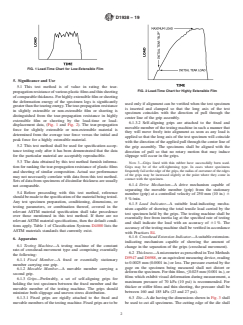
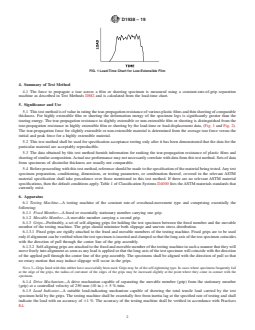
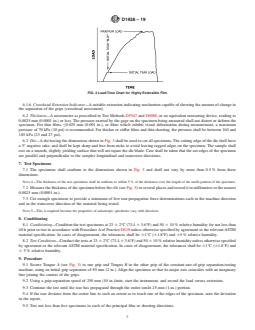
5.1 This test method is of value in rating the tear-propagation resistance of various plastic films and thin sheeting of comparable thickness. For highly extensible film or sheeting the deformation energy of the specimen legs is significantly greater than the tearing energy. The tear-propagation resistance in slightly extensible or non-extensible film or sheeting is distinguished from the tear-propagation resistance in highly extensible film or sheeting by the load-time or load-displacement data, (Fig. 1 and Fig. 2). The tear-propagation force for slightly extensible or non-extensible material is determined from the average tear force versus the initial and peak force for a highly extensible material.
FIG. 1 Load-Time Chart for Low-Extensible Film
FIG. 2 Load-Time Chart for Highly Extensible Film
5.2 This test method shall be used for specification acceptance testing only after it has been demonstrated that the data for the particular material are acceptably reproducible.
5.3 The data obtained by this test method furnish information for ranking the tear-propagation resistance of plastic films and sheeting of similar composition. Actual use performance may not necessarily correlate with data from this test method. Sets of data from specimens of dissimilar thickness are usually not comparable.
5.4 Before proceeding with this test method, reference should be made to the specification of the material being tested. Any test specimen preparation, conditioning, dimensions, or testing parameters, or combination thereof, covered in the relevant ASTM material specification shall take precedence over those mentioned in this test method. If there are no relevant ASTM material specifications, then the default conditions apply. Table 1 of Classification Systems D4000 lists the ASTM materials standards that currently exist.
SCOPE
1.1 This test method covers the determination of the force necessary to propagate a tear in plastic film and thin sheeting (thickness of 1 mm (0.04 in.) or less) by a single-tear method. The method is not applicable for film or sheeting material where brittle failures occur during testing.
Note 1: Film has been arbitrarily defined as sheeting having nominal thickness not greater than 0.25 mm (0.010 in.).
1.2 Constant-Rate-of-Grip Separation Test—This test method employs a constant rate of separation of the grips holding the test specimen.
1.2.1 Specimen extension may be measured in this test method by grip separation.
1.3 The values stated in SI units are to be regarded as standard. The values given in parentheses are provided for information only.
1.4 This standard does not purport to address all of the safety concerns, if any, associated with its use. It is the responsibility of the user of this standard to establish appropriate safety, health, and environmental practices and determine the applicability of regulatory limitations prior to use.
Note 2: This standard is similar to ISO 6383-1, but is not considered technically equivalent. The specimen size for ISO 6383-1 is larger, and the method specifies different test speeds.
1.5 This international standard was developed in accordance with internationally recognized principles on standardization established in the Decision on Principles for the Development of International Standards, Guides and Recommendations issued by the World Trade Organization Technical Barriers to Trade (TBT) Committee.
- Status
- Published
- Publication Date
- 31-Mar-2019
- Technical Committee
- D20 - Plastics
- Drafting Committee
- D20.19 - Film, Sheeting, and Molded Products
Buy Documents
ASTM D1938-19 - Standard Test Method for Tear-Propagation Resistance (Trouser Tear) of Plastic Film and Thin Sheeting by a Single-Tear Method
REDLINE ASTM D1938-19 - Standard Test Method for Tear-Propagation Resistance (Trouser Tear) of Plastic Film and Thin Sheeting by a Single-Tear Method
Overview
ASTM D1938-19 is a widely recognized standard test method developed by ASTM International for evaluating the tear-propagation resistance of plastic film and thin sheeting. Often referred to as the "trouser tear test," this method measures the force required to continue a tear in flexible plastic materials, providing essential data for material selection, quality control, and product specification. The standard is applicable to films and thin sheeting up to 1 mm in thickness, except for materials that experience brittle failure during testing.
Keywords: tear-propagation resistance, trouser tear method, plastic film, thin sheeting, ASTM D1938, single-tear method, quality control, material testing.
Key Topics
Purpose of the Test Method
- Measures the force needed to propagate a tear in plastic films and sheeting using a single-tear (trouser tear) technique.
- Distinguishes tear behavior between highly extensible and less extensible (or non-extensible) materials.
Test Procedure Highlights
- Utilizes a constant-rate-of-grip separation test machine.
- Specimen extension is typically measured by grip separation.
- Reports both initial and peak tear-propagation forces, depending on material extensibility.
- Test specimens are conditioned under standardized temperature and humidity before testing.
Data Reproducibility and Ranking
- The method is most valuable for comparing the tear resistance of materials of similar thickness and composition.
- Not intended for materials with dissimilar thicknesses or those prone to brittle failure during the test.
- Requires demonstration of acceptable reproducibility of data before use in official specification or acceptance testing.
Material Considerations
- Film is defined for test purposes as material with a nominal thickness of 0.25 mm (0.010 in.) or less, though the standard applies to sheeting up to 1 mm thick.
- Reference to applicable ASTM material specifications takes precedence over general test conditions.
Applications
Practical uses of ASTM D1938-19:
- Quality Control: Manufacturers employ this test to ensure batch-to-batch consistency and compliance with performance requirements for plastics used in packaging, construction, agriculture, and consumer goods.
- Material Development: Engineers and material scientists use data from this test to select films and sheeting formulations with optimal tear resistance for specific applications, including food packaging, liners, bags, and wraps.
- Specification Compliance: The method supports material specifications and performance standards for procurement and product development, helping to assure regulatory and customer requirements are met.
- Comparative Analysis: Provides a basis for ranking tear strength among different types of plastic films and thin sheetings of comparable composition and thickness.
Related Standards
- ASTM D618: Practice for Conditioning Plastics for Testing - Specifies standardized environmental conditions for sample preparation.
- ASTM D882: Test Method for Tensile Properties of Thin Plastic Sheeting - Focuses on other mechanical properties such as tensile strength and elongation.
- ASTM D4000: Classification System for Specifying Plastic Materials - Reference for identifying relevant ASTM material specifications.
- ASTM D5947 & D6988: Methods for Measuring Physical Dimensions and Thickness of Plastic Films - Critical for accurate specimen preparation.
- ISO 6383-1: Film and Sheeting-Determination of Tear Resistance, Trouser Tear Method - International equivalent with differing sample sizes and test speeds; not technically identical to ASTM D1938-19.
Conclusion
ASTM D1938-19 is an essential standard for assessing the tear-propagation resistance of plastic films and thin sheeting. By adhering to this standardized method, organizations can ensure reliable quality, make informed material choices, and meet industry requirements for durable, flexible plastic products. For best results, users should always consult applicable material specifications and consider reproducibility of test data across different materials and laboratories.
Relations
- Effective Date
- 01-Apr-2019
- Effective Date
- 01-Feb-2024
- Effective Date
- 01-Nov-2023
- Effective Date
- 01-Jan-2020
- Effective Date
- 01-Aug-2019
- Effective Date
- 15-Apr-2019
- Effective Date
- 01-Feb-2019
- Effective Date
- 01-Dec-2018
- Effective Date
- 01-Nov-2018
- Effective Date
- 15-Aug-2017
- Effective Date
- 01-Jun-2014
- Effective Date
- 01-May-2014
- Effective Date
- 01-May-2013
- Effective Date
- 01-May-2013
- Effective Date
- 15-Nov-2012
Buy Documents
ASTM D1938-19 - Standard Test Method for Tear-Propagation Resistance (Trouser Tear) of Plastic Film and Thin Sheeting by a Single-Tear Method
REDLINE ASTM D1938-19 - Standard Test Method for Tear-Propagation Resistance (Trouser Tear) of Plastic Film and Thin Sheeting by a Single-Tear Method
Get Certified
Connect with accredited certification bodies for this standard

DIN CERTCO
DIN Group product certification.

Smithers Quality Assessments
US management systems and product certification.
Sponsored listings
Frequently Asked Questions
ASTM D1938-19 is a standard published by ASTM International. Its full title is "Standard Test Method for Tear-Propagation Resistance (Trouser Tear) of Plastic Film and Thin Sheeting by a Single-Tear Method". This standard covers: SIGNIFICANCE AND USE 5.1 This test method is of value in rating the tear-propagation resistance of various plastic films and thin sheeting of comparable thickness. For highly extensible film or sheeting the deformation energy of the specimen legs is significantly greater than the tearing energy. The tear-propagation resistance in slightly extensible or non-extensible film or sheeting is distinguished from the tear-propagation resistance in highly extensible film or sheeting by the load-time or load-displacement data, (Fig. 1 and Fig. 2). The tear-propagation force for slightly extensible or non-extensible material is determined from the average tear force versus the initial and peak force for a highly extensible material. FIG. 1 Load-Time Chart for Low-Extensible Film FIG. 2 Load-Time Chart for Highly Extensible Film 5.2 This test method shall be used for specification acceptance testing only after it has been demonstrated that the data for the particular material are acceptably reproducible. 5.3 The data obtained by this test method furnish information for ranking the tear-propagation resistance of plastic films and sheeting of similar composition. Actual use performance may not necessarily correlate with data from this test method. Sets of data from specimens of dissimilar thickness are usually not comparable. 5.4 Before proceeding with this test method, reference should be made to the specification of the material being tested. Any test specimen preparation, conditioning, dimensions, or testing parameters, or combination thereof, covered in the relevant ASTM material specification shall take precedence over those mentioned in this test method. If there are no relevant ASTM material specifications, then the default conditions apply. Table 1 of Classification Systems D4000 lists the ASTM materials standards that currently exist. SCOPE 1.1 This test method covers the determination of the force necessary to propagate a tear in plastic film and thin sheeting (thickness of 1 mm (0.04 in.) or less) by a single-tear method. The method is not applicable for film or sheeting material where brittle failures occur during testing. Note 1: Film has been arbitrarily defined as sheeting having nominal thickness not greater than 0.25 mm (0.010 in.). 1.2 Constant-Rate-of-Grip Separation Test—This test method employs a constant rate of separation of the grips holding the test specimen. 1.2.1 Specimen extension may be measured in this test method by grip separation. 1.3 The values stated in SI units are to be regarded as standard. The values given in parentheses are provided for information only. 1.4 This standard does not purport to address all of the safety concerns, if any, associated with its use. It is the responsibility of the user of this standard to establish appropriate safety, health, and environmental practices and determine the applicability of regulatory limitations prior to use. Note 2: This standard is similar to ISO 6383-1, but is not considered technically equivalent. The specimen size for ISO 6383-1 is larger, and the method specifies different test speeds. 1.5 This international standard was developed in accordance with internationally recognized principles on standardization established in the Decision on Principles for the Development of International Standards, Guides and Recommendations issued by the World Trade Organization Technical Barriers to Trade (TBT) Committee.
SIGNIFICANCE AND USE 5.1 This test method is of value in rating the tear-propagation resistance of various plastic films and thin sheeting of comparable thickness. For highly extensible film or sheeting the deformation energy of the specimen legs is significantly greater than the tearing energy. The tear-propagation resistance in slightly extensible or non-extensible film or sheeting is distinguished from the tear-propagation resistance in highly extensible film or sheeting by the load-time or load-displacement data, (Fig. 1 and Fig. 2). The tear-propagation force for slightly extensible or non-extensible material is determined from the average tear force versus the initial and peak force for a highly extensible material. FIG. 1 Load-Time Chart for Low-Extensible Film FIG. 2 Load-Time Chart for Highly Extensible Film 5.2 This test method shall be used for specification acceptance testing only after it has been demonstrated that the data for the particular material are acceptably reproducible. 5.3 The data obtained by this test method furnish information for ranking the tear-propagation resistance of plastic films and sheeting of similar composition. Actual use performance may not necessarily correlate with data from this test method. Sets of data from specimens of dissimilar thickness are usually not comparable. 5.4 Before proceeding with this test method, reference should be made to the specification of the material being tested. Any test specimen preparation, conditioning, dimensions, or testing parameters, or combination thereof, covered in the relevant ASTM material specification shall take precedence over those mentioned in this test method. If there are no relevant ASTM material specifications, then the default conditions apply. Table 1 of Classification Systems D4000 lists the ASTM materials standards that currently exist. SCOPE 1.1 This test method covers the determination of the force necessary to propagate a tear in plastic film and thin sheeting (thickness of 1 mm (0.04 in.) or less) by a single-tear method. The method is not applicable for film or sheeting material where brittle failures occur during testing. Note 1: Film has been arbitrarily defined as sheeting having nominal thickness not greater than 0.25 mm (0.010 in.). 1.2 Constant-Rate-of-Grip Separation Test—This test method employs a constant rate of separation of the grips holding the test specimen. 1.2.1 Specimen extension may be measured in this test method by grip separation. 1.3 The values stated in SI units are to be regarded as standard. The values given in parentheses are provided for information only. 1.4 This standard does not purport to address all of the safety concerns, if any, associated with its use. It is the responsibility of the user of this standard to establish appropriate safety, health, and environmental practices and determine the applicability of regulatory limitations prior to use. Note 2: This standard is similar to ISO 6383-1, but is not considered technically equivalent. The specimen size for ISO 6383-1 is larger, and the method specifies different test speeds. 1.5 This international standard was developed in accordance with internationally recognized principles on standardization established in the Decision on Principles for the Development of International Standards, Guides and Recommendations issued by the World Trade Organization Technical Barriers to Trade (TBT) Committee.
ASTM D1938-19 is classified under the following ICS (International Classification for Standards) categories: 83.140.10 - Films and sheets. The ICS classification helps identify the subject area and facilitates finding related standards.
ASTM D1938-19 has the following relationships with other standards: It is inter standard links to ASTM D1938-14, ASTM D883-24, ASTM D883-23, ASTM D883-20, ASTM D883-19c, ASTM D883-19a, ASTM D883-19, ASTM D883-18a, ASTM D883-18, ASTM D883-17, ASTM E4-14, ASTM E177-14, ASTM E177-13, ASTM E691-13, ASTM D883-12e1. Understanding these relationships helps ensure you are using the most current and applicable version of the standard.
ASTM D1938-19 is available in PDF format for immediate download after purchase. The document can be added to your cart and obtained through the secure checkout process. Digital delivery ensures instant access to the complete standard document.
Standards Content (Sample)
This international standard was developed in accordance with internationally recognized principles on standardization established in the Decision on Principles for the
Development of International Standards, Guides and Recommendations issued by the World Trade Organization Technical Barriers to Trade (TBT) Committee.
Designation: D1938 − 19
Standard Test Method for
Tear-Propagation Resistance (Trouser Tear) of Plastic Film
and Thin Sheeting by a Single-Tear Method
This standard is issued under the fixed designation D1938; the number immediately following the designation indicates the year of
original adoption or, in the case of revision, the year of last revision. A number in parentheses indicates the year of last reapproval. A
superscript epsilon (´) indicates an editorial change since the last revision or reapproval.
1. Scope* 2. Referenced Documents
1.1 This test method covers the determination of the force
2.1 ASTM Standards:
necessary to propagate a tear in plastic film and thin sheeting
D618 Practice for Conditioning Plastics for Testing
(thickness of 1 mm (0.04 in.) or less) by a single-tear method.
D882 Test Method for Tensile Properties of Thin Plastic
The method is not applicable for film or sheeting material
Sheeting
where brittle failures occur during testing.
D883 Terminology Relating to Plastics
D4000 Classification System for Specifying Plastic Materi-
NOTE 1—Film has been arbitrarily defined as sheeting having nominal
als
thickness not greater than 0.25 mm (0.010 in.).
D5947 Test Methods for Physical Dimensions of Solid
1.2 Constant-Rate-of-Grip Separation Test—This test
Plastics Specimens
method employs a constant rate of separation of the grips
D6988 GuideforDeterminationofThicknessofPlasticFilm
holding the test specimen.
Test Specimens
1.2.1 Specimen extension may be measured in this test
E4 Practices for Force Verification of Testing Machines
method by grip separation.
E177 Practice for Use of the Terms Precision and Bias in
1.3 The values stated in SI units are to be regarded as
ASTM Test Methods
standard. The values given in parentheses are provided for
E691 Practice for Conducting an Interlaboratory Study to
information only.
Determine the Precision of a Test Method
1.4 This standard does not purport to address all of the
2.2 ISO Standard:
safety concerns, if any, associated with its use. It is the
ISO 6383-1 Film and Sheeting—Determination of Tear Re-
responsibility of the user of this standard to establish appro-
sistance Part 1 Trouser Tear Method
priate safety, health, and environmental practices and deter-
mine the applicability of regulatory limitations prior to use.
3. Terminology
NOTE 2—This standard is similar to ISO 6383-1, but is not considered
3.1 Definitions—For definitions of terms used in this test
technicallyequivalent.ThespecimensizeforISO6383-1islarger,andthe
method, refer to Terminology D883.
method specifies different test speeds.
1.5 This international standard was developed in accor-
4. Summary of Test Method
dance with internationally recognized principles on standard-
ization established in the Decision on Principles for the 4.1 The force to propagate a tear across a film or sheeting
Development of International Standards, Guides and Recom- specimen is measured using a constant-rate-of-grip separation
mendations issued by the World Trade Organization Technical machine as described in Test Methods D882 and is calculated
Barriers to Trade (TBT) Committee. from the load-time chart.
1 2
This test method is under the jurisdiction ofASTM Committee D20 on Plastics For referenced ASTM standards, visit the ASTM website, www.astm.org, or
and is the direct responsibility of Subcommittee D20.19 on Film, Sheeting, and contact ASTM Customer Service at service@astm.org. For Annual Book of ASTM
Molded Products. Standards volume information, refer to the standard’s Document Summary page on
Current edition approved April 1, 2019. Published May 2019. Originally the ASTM website.
approved in 1962. Last previous edition approved in 2014 as D1938 – 14. DOI: Available from American National Standards Institute (ANSI), 25 W. 43rd St.,
10.1520/D1938-19. 4th Floor, New York, NY 10036, http://www.ansi.org.
*A Summary of Changes section appears at the end of this standard
Copyright © ASTM International, 100 Barr Harbor Drive, PO Box C700, West Conshohocken, PA 19428-2959. United States
D1938 − 19
FIG. 1 Load-Time Chart for Low-Extensible Film
5. Significance and Use
5.1 This test method is of value in rating the tear-
FIG. 2 Load-Time Chart for Highly Extensible Film
propagationresistanceofvariousplasticfilmsandthinsheeting
of comparable thickness. For highly extensible film or sheeting
the deformation energy of the specimen legs is significantly
used only if alignment can be verified when the test specimen
greater than the tearing energy.The tear-propagation resistance
is inserted and clamped so that the long axis of the test
in slightly extensible or non-extensible film or sheeting is
specimen coincides with the direction of pull through the
distinguished from the tear-propagation resistance in highly
center line of the grip assembly.
extensible film or sheeting by the load-time or load-
6.1.3.2 Self-aligning grips are attached to the fixed and
displacement data, (Fig. 1 and Fig. 2). The tear-propagation
movable member of the testing machine in such a manner that
force for slightly extensible or non-extensible material is
they will move freely into alignment as soon as any load is
determined from the average tear force versus the initial and
applied so that the long axis of the test specimen will coincide
peak force for a highly extensible material.
with the direction of the applied pull through the center line of
5.2 This test method shall be used for specification accep-
the grip assembly. The specimens shall be aligned with the
tance testing only after it has been demonstrated that the data
direction of pull so that no rotary motion that may induce
for the particular material are acceptably reproducible.
slippage will occur in the grips.
5.3 The data obtained by this test method furnish informa-
NOTE 3—Grips lined with thin rubber have successfully been used.
tion for ranking the tear-propagation resistance of plastic films Grips may be of the self-tightening type. In cases where specimens
frequently fail at the edge of the grips, the radius of curvature of the edges
and sheeting of similar composition. Actual use performance
of the grips may be increased slightly at the point where they come in
may not necessarily correlate with data from this test method.
contact with the specimen.
Sets of data from specimens of dissimilar thickness are usually
6.1.4 Drive Mechanism—A drive mechanism capable of
not comparable.
separating the movable member (grip) from the stationary
5.4 Before proceeding with this test method, reference
member (grip) at a controlled velocity of 250 mm (10 in.) 6
shouldbemadetothespecificationofthematerialbeingtested.
5 %⁄min.
Any test specimen preparation, conditioning, dimensions, or
6.1.5 Load Indicator—A suitable load-indicating mecha-
testing parameters, or combination thereof, covered in the
nism capable of showing the total tensile load carried by the
relevant ASTM material specification shall take precedence
test specimen held by the grips. The testing machine shall be
over those mentioned in this test method. If there are no
essentially free from inertia lag at the specified rate of testing
relevantASTM material specifications, then the default condi-
and shall indicate the load with an accuracy of 61 %. The
tions apply. Table 1 of Classification Systems D4000 lists the
accuracy of the testing machine shall be verified in accordance
ASTM materials standards that currently exist.
with Practices E4.
6.1.6 Crosshead Extension Indicator—Asuitable extension-
6. Apparatus
indicating mechanism capable of showing the amount of
6.1 Testing Machine—A testing machine of the constant
change in the separation of the grips (crosshead movement).
rate-of crosshead-movement type and comprising essentially
6.2 Thickness—Amicrometer as prescribed inTest Methods
the following:
D5947 and D6988, or an equivalent measuring device, reading
6.1.1 Fixed Member—A fixed or essentially stationary
to 0.0025 mm (0.0001 in.) or less. The pressure exerted by the
member carrying one grip.
gage on the specimen being measured shall not distort or
6.1.2 Movable Member—A movable member carrying a
deform the specimen. For thin films,≤0.025 mm (0.001 in.), or
second grip.
films which exhibit visual deformation during measurement, a
6.1.3 Grips—Preferably, a set of self-aligning grips for
maximum pressure of 70 kPa (10 psi) is recommended. For
holding the test specimen between the fixed member and the
thicker or stiffer films and thin sheeting, the pressure shall be
movable member of the testing machine. The grips should
between 160 and 185 kPa (23 and 27 psi).
minimize both slippage and uneven stress distribution.
6.1.3.1 Fixed grips are rigidly attached to the fixed and 6.3 Die—Adie having the dimensions shown in Fig. 3 shall
movable members of the testing machine. Fixed grips are to be be used to cut all specimens. The cutting edge of the die shall
D1938 − 19
Align the specimen so that its major axis coincides with an
imaginary line joining the centers of the grips.
9.2 Using a grip-separation speed of 250 mm (10 in.)/min,
start the instrument, and record the load versus extension.
9.3 Continue the test until the tear has propagated through
the entire unslit 25-mm (1-in.) portion.
9.4 If the tear deviates from the center line to such an extent
as to reach one of the edges of the specimen, note the deviation
in the report.
9.5 Test not less than five specimens in each of the principal
film or sheeting directions.
FIG. 3 Single-Tear Specimen
10. Calculation
10.1 For thin films and sheeting that have load-time charts
characterized by
...
This document is not an ASTM standard and is intended only to provide the user of an ASTM standard an indication of what changes have been made to the previous version. Because
it may not be technically possible to adequately depict all changes accurately, ASTM recommends that users consult prior editions as appropriate. In all cases only the current version
of the standard as published by ASTM is to be considered the official document.
Designation: D1938 − 14 D1938 − 19
Standard Test Method for
Tear-Propagation Resistance (Trouser Tear) of Plastic Film
and Thin Sheeting by a Single-Tear Method
This standard is issued under the fixed designation D1938; the number immediately following the designation indicates the year of
original adoption or, in the case of revision, the year of last revision. A number in parentheses indicates the year of last reapproval. A
superscript epsilon (´) indicates an editorial change since the last revision or reapproval.
1. Scope*
1.1 This test method covers the determination of the force necessary to propagate a tear in plastic film and thin sheeting
(thickness of 1 mm (0.04 in.) or less) by a single-tear method. The method is not applicable for film or sheeting material where
brittle failures occur during testing.
NOTE 1—Film has been arbitrarily defined as sheeting having nominal thickness not greater than 0.25 mm (0.010 in.).
1.2 Constant-Rate-of-Grip Separation Test—This test method employs a constant rate of separation of the grips holding the test
specimen.
1.2.1 Specimen extension may be measured in this test method by grip separation.
1.3 The values stated in SI units are to be regarded as standard. The values given in parentheses are provided for information
only.
1.4 This standard does not purport to address all of the safety concerns, if any, associated with its use. It is the responsibility
of the user of this standard to establish appropriate safety safety, health, and healthenvironmental practices and determine the
applicability of regulatory limitations prior to use.
NOTE 2—This standard is similar to ISO 6383-1, but is not considered technically equivalent. The specimen size for ISO 6383-1 is larger, and the
method specifies different test speeds.
1.5 This international standard was developed in accordance with internationally recognized principles on standardization
established in the Decision on Principles for the Development of International Standards, Guides and Recommendations issued
by the World Trade Organization Technical Barriers to Trade (TBT) Committee.
2. Referenced Documents
2.1 ASTM Standards:
D618 Practice for Conditioning Plastics for Testing
D882 Test Method for Tensile Properties of Thin Plastic Sheeting
D883 Terminology Relating to Plastics
D4000 Classification System for Specifying Plastic Materials
D5947 Test Methods for Physical Dimensions of Solid Plastics Specimens
D6988 Guide for Determination of Thickness of Plastic Film Test Specimens
E4 Practices for Force Verification of Testing Machines
E177 Practice for Use of the Terms Precision and Bias in ASTM Test Methods
E691 Practice for Conducting an Interlaboratory Study to Determine the Precision of a Test Method
2.2 ISO Standard:
ISO 6383-1 Film and Sheeting—Determination of Tear Resistance Part 1 Trouser Tear Method
3. Terminology
3.1 Definitions: Definitions—For definitions of terms used in this test method, refer to Terminology D883.
This test method is under the jurisdiction of ASTM Committee D20 on Plastics and is the direct responsibility of Subcommittee D20.19 on Film, Sheeting, and Molded
Products.
Current edition approved Dec. 1, 2014April 1, 2019. Published December 2014May 2019. Originally approved in 1962. Last previous edition approved in 20082014 as
D1938 – 08.14. DOI: 10.1520/D1938-14.10.1520/D1938-19.
For referenced ASTM standards, visit the ASTM website, www.astm.org, or contact ASTM Customer Service at service@astm.org. For Annual Book of ASTM Standards
volume information, refer to the standard’s Document Summary page on the ASTM website.
Available from American National Standards Institute (ANSI), 25 W. 43rd St., 4th Floor, New York, NY 10036, http://www.ansi.org.
*A Summary of Changes section appears at the end of this standard
Copyright © ASTM International, 100 Barr Harbor Drive, PO Box C700, West Conshohocken, PA 19428-2959. United States
D1938 − 19
FIG. 1 Load-Time Chart for Low-Extensible Film
4. Summary of Test Method
4.1 The force to propagate a tear across a film or sheeting specimen is measured using a constant-rate-of-grip separation
machine as described in Test Methods D882 and is calculated from the load-time chart.
5. Significance and Use
5.1 This test method is of value in rating the tear-propagation resistance of various plastic films and thin sheeting of comparable
thickness. For highly extensible film or sheeting the deformation energy of the specimen legs is significantly greater than the
tearing energy. The tear-propagation resistance in slightly extensible or non-extensible film or sheeting is distinguished from the
tear-propagation resistance in highly extensible film or sheeting by the load-time or load-displacement data, (Fig. 1 and Fig. 2).
The tear-propagation force for slightly extensible or non-extensible material is determined from the average tear force versus the
initial and peak force for a highly extensible material.
5.2 This test method shall be used for specification acceptance testing only after it has been demonstrated that the data for the
particular material are acceptably reproducible.
5.3 The data obtained by this test method furnish information for ranking the tear-propagation resistance of plastic films and
sheeting of similar composition. Actual use performance may not necessarily correlate with data from this test method. Sets of data
from specimens of dissimilar thickness are usually not comparable.
5.4 Before proceeding with this test method, reference should be made to the specification of the material being tested. Any test
specimen preparation, conditioning, dimensions, or testing parameters, or combination thereof, covered in the relevant ASTM
material specification shall take precedence over those mentioned in this test method. If there are no relevant ASTM material
specifications, then the default conditions apply. Table 1 of Classification Systems D4000 lists the ASTM materials standards that
currently exist.
6. Apparatus
6.1 Testing Machine—A testing machine of the constant rate-of crosshead-movement type and comprising essentially the
following:
6.1.1 Fixed Member—A fixed or essentially stationary member carrying one grip.
6.1.2 Movable Member—A movable member carrying a second grip.
6.1.3 Grips—Preferably, a set of self-aligning grips for holding the test specimen between the fixed member and the movable
member of the testing machine. The grips should minimize both slippage and uneven stress distribution.
6.1.3.1 Fixed grips are rigidly attached to the fixed and movable members of the testing machine. Fixed grips are to be used
only if alignment can be verified when the test specimen is inserted and clamped so that the long axis of the test specimen coincides
with the direction of pull through the center line of the grip assembly.
6.1.3.2 Self-aligning grips are attached to the fixed and movable member of the testing machine in such a manner that they will
move freely into alignment as soon as any load is applied so that the long axis of the test specimen will coincide with the direction
of the applied pull through the center line of the grip assembly. The specimens shall be aligned with the direction of pull so that
no rotary motion that may induce slippage will occur in the grips.
NOTE 3—Grips lined with thin rubber have successfully been used. Grips may be of the self-tightening type. In cases where specimens frequently fail
at the edge of the grips, the radius of curvature of the edges of the grips may be increased slightly at the point where they come in contact with the
specimen.
6.1.4 Drive Mechanism—A drive mechanism capable of separating the movable member (grip) from the stationary member
(grip) at a controlled velocity of 250 mm (10 in.) 6 5 % ⁄min.
6.1.5 Load Indicator—A suitable load-indicating mechanism capable of showing the total tensile load carried by the test
specimen held by the grips. The testing machine shall be essentially free from inertia lag at the specified rate of testing and shall
indicate the load with an accuracy of 61 %. The accuracy of the testing machine shall be verified in accordance with Practices
E4.
D1938 − 19
FIG. 2 Load-Time Chart for Highly Extensible Film
6.1.6 Crosshead Extension Indicator—A suitable extension-indicating mechanism capable of showing the amount of change in
the separation of the grips (crosshead movement).
6.2 Thickness—A micrometer as prescribed in Test Methods D5947 and D6988, or an equivalent measuring device, reading to
0.0025 mm (0.0001 in.) or less. The pressure exerted by the gage on the specimen being measured shall not distort or deform the
specimen. For thin films, ≤0.025 mm (0.001 in.), or films which exhibit visual deformation during measurement, a maximum
pressure of 70 kPa (10 psi) is recommended. For thicker or stiffer films and thin sheeting, the pressure shall be between 160 and
185 kPa (23 and 27 psi).
6.3 Die—A die having the dimensions shown in Fig. 3 shall be used to cut all specimens. The cutting edge of the die shall have
a 5° negative rake, and shall be kept sharp and free from nicks to avoid leaving ragged edges on the specimen. The sample shall
rest on a smooth, slightly yielding surface that will not injure the die blade. Care shall be taken that the cut edges of the specimen
are parallel and perpendicular to the samples longitudinal and transverse directions.
7. Test Specimens
7.1 The specimens shall conform to the dimensions shown in Fig. 3 and shall not vary by more than 0.5 % from these
dimensions.
NOTE 4—The thickness of the test specimens shall be uniform to within 5 % of the thickness over the length of the unslit portion of the specimen.
7.2 Measure the thickness of the specimen below the slit (see Fig. 3) in several places and record it in millimetres to the nearest
0.0025 mm (0.0001 in.).
7.3 Cut enough specimens to provide a minimum of five tear-propagation force determinations each in the machine direction
and in the transverse direction of the material being tested.
NOTE 5—This is required because the properties of anisotropic specimens vary with direction.
8. Conditioning
8.1 Conditioning—Condition the test specimens at 23 6 2°C (73.4 6 3.6°F) and 50 6 10 % relative humidity for not less than
40 h prior to test in accordance with Procedure A of Practice D618 unless otherwise specified by agreement or the relevant ASTM
material specification. In cases of disagreement, the tolerances shall be 61°C (61.8°F) and 65 % relative humidity.
8.2 Test Conditions—Conduct the tests at 23 6 2°C (73.4 6 3.6°F) and 50 6 10 % relative humidity unless otherwise specified
by agreement or the relevant ASTM material specification. In cases of disagreement, the tolerances shall be 61°C (61.8°F) and
6 5 % relative humidity.
9. Procedure
9.1 Secure Tongue A (see Fig. 3) in one grip and Tongue B in the other grip of the constant-rate-of-grip separation-tes
...