

ASTM D4208-19
(Test Method)Standard Test Method for Total Chlorine in Coal by the Oxygen Vessel Combustion/Ion Selective Electrode Method
General Information
- Abstract
SIGNIFICANCE AND USE
5.1 The purpose of this test method is to measure the total chlorine content of coal. The chlorine content of coals may be useful in the evaluation of slagging problems, corrosion in engineering processes, and in the total analysis of coal and coke. When coal samples are combusted in accordance with this method, the chlorine is quantitatively retained and is representative of the total chlorine content of the whole coal.
SCOPE
1.1 This test method covers the analysis of total chlorine in coal.
1.2 Units—The values stated in SI units are to be regarded as standard. No other units of measurement are included in this standard.
1.3 This standard does not purport to address all of the safety concerns, if any, associated with its use. It is the responsibility of the user of this standard to establish appropriate safety, health, and environmental practices and determine the applicability of regulatory limitations prior to use.
1.4 This international standard was developed in accordance with internationally recognized principles on standardization established in the Decision on Principles for the Development of International Standards, Guides and Recommendations issued by the World Trade Organization Technical Barriers to Trade (TBT) Committee.
- Status
- Published
- Publication Date
- 31-Oct-2019
- Technical Committee
- D05 - Coal and Coke
- Drafting Committee
- D05.21 - Methods of Analysis
Buy Documents
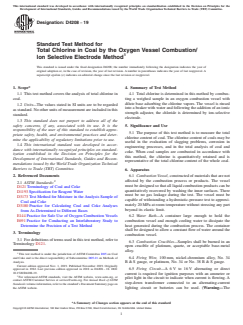
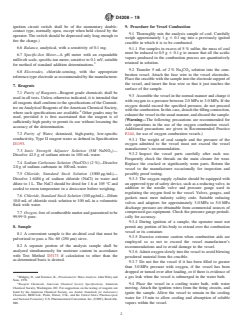
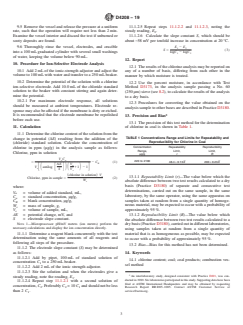

ASTM D4208-19 - Standard Test Method for Total Chlorine in Coal by the Oxygen Vessel Combustion/Ion Selective Electrode Method
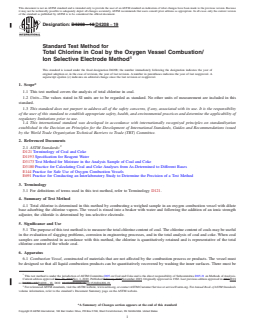
REDLINE ASTM D4208-19 - Standard Test Method for Total Chlorine in Coal by the Oxygen Vessel Combustion/Ion Selective Electrode Method
Overview
ASTM D4208-19: Standard Test Method for Total Chlorine in Coal by the Oxygen Vessel Combustion/Ion Selective Electrode Method provides a precise laboratory procedure for the quantification of total chlorine content in coal and coal products. Issued by ASTM International, this standard outlines analytical steps using oxygen vessel combustion followed by chloride determination through an ion-selective electrode. Determining total chlorine in coal is essential for quality control, process optimization, and environmental compliance in various industries involving coal and coke.
Key Topics
- Quantitative Total Chlorine Analysis: This method ensures total retention and accurate measurement of chlorine present in coal samples.
- Testing Procedure:
- Combustion of prepared coal in an oxygen vessel
- Collection and dissolution of combustion byproducts
- Analysis of resulting solution with a chloride ion-selective electrode
- Precision and Reproducibility: The method is characterized by high repeatability and inter-laboratory reproducibility within defined concentration ranges.
- Use of SI Units: The test exclusively specifies SI units to ensure global consistency of results.
- Safety Considerations: The standard emphasizes the need for appropriate laboratory safety, health, and environmental practices, particularly when handling high-pressure oxygen systems and reagents.
- Sample Preparation: Proper pulverization of coal and simultaneous moisture analysis are required for accurate reporting and conversions.
Applications
ASTM D4208-19 is widely used in several sectors that require knowledge of chlorine content in coal and coke:
- Power Generation: Chlorine levels are directly related to potential slagging and corrosion in boilers and associated equipment, thereby informing maintenance and operational decisions.
- Coal Quality Testing: The method supports the comprehensive analysis required for coal grading, trading, and regulatory compliance.
- Environmental Compliance: Chlorine testing helps plants ensure emissions control and adherence to environmental regulations.
- Process Optimization: Monitoring and controlling chlorine in feedstocks reduces operational risks and extends equipment lifespan.
- Research and Development: Laboratories involved in fuel research or material analysis utilize this standardized approach for reproducibility and comparability of results.
Related Standards
Several ASTM standards are commonly referenced or used alongside ASTM D4208-19 for coal and coke analysis:
- ASTM D121: Terminology of Coal and Coke - provides definitions for terms used in coal analysis.
- ASTM D1193: Specification for Reagent Water - outlines the purity requirements for water used in laboratory testing.
- ASTM D3173: Test Method for Moisture in the Analysis Sample of Coal and Coke - used for determining and reporting on a dry basis.
- ASTM D3180: Practice for Calculating Coal and Coke Analyses from As-Determined to Different Bases - standardizes conversions to various reporting formats.
- ASTM E144: Practice for Safe Use of Oxygen Combustion Vessels - essential for safety in operation during oxygen vessel combustion.
Practical Value
Employing ASTM D4208-19 for total chlorine testing in coal enables:
- Consistent and precise results critical for industrial quality assurance and regulatory reporting
- Early detection of potential process issues related to corrosive elements in raw materials
- Harmonized laboratory practices that support global trade and operational collaboration in fuel industries
By following this standardized methodology, laboratories and coal users can be confident in the reliability of their chlorine measurements, supporting safer, more efficient, and more environmentally responsible operations.
Relations
- Effective Date
- 01-Nov-2019
- Effective Date
- 01-Mar-2024
- Effective Date
- 01-Dec-2023
- Effective Date
- 01-Feb-2020
- Effective Date
- 01-Sep-2015
- Effective Date
- 01-Jan-2015
- Effective Date
- 01-Dec-2014
- Effective Date
- 01-Dec-2014
- Effective Date
- 01-May-2013
- Effective Date
- 01-Apr-2012
- Effective Date
- 01-Dec-2011
- Effective Date
- 01-Nov-2011
- Effective Date
- 01-Apr-2011
- Effective Date
- 01-Oct-2009
- Effective Date
- 01-Feb-2009
Buy Documents
ASTM D4208-19 - Standard Test Method for Total Chlorine in Coal by the Oxygen Vessel Combustion/Ion Selective Electrode Method
REDLINE ASTM D4208-19 - Standard Test Method for Total Chlorine in Coal by the Oxygen Vessel Combustion/Ion Selective Electrode Method
Get Certified
Connect with accredited certification bodies for this standard

Element Materials Technology
Materials testing and product certification.

ABS Group Brazil
ABS Group certification services in Brazil.

ABS Quality Evaluations Inc.
American Bureau of Shipping quality certification.
Sponsored listings
Frequently Asked Questions
ASTM D4208-19 is a standard published by ASTM International. Its full title is "Standard Test Method for Total Chlorine in Coal by the Oxygen Vessel Combustion/Ion Selective Electrode Method". This standard covers: SIGNIFICANCE AND USE 5.1 The purpose of this test method is to measure the total chlorine content of coal. The chlorine content of coals may be useful in the evaluation of slagging problems, corrosion in engineering processes, and in the total analysis of coal and coke. When coal samples are combusted in accordance with this method, the chlorine is quantitatively retained and is representative of the total chlorine content of the whole coal. SCOPE 1.1 This test method covers the analysis of total chlorine in coal. 1.2 Units—The values stated in SI units are to be regarded as standard. No other units of measurement are included in this standard. 1.3 This standard does not purport to address all of the safety concerns, if any, associated with its use. It is the responsibility of the user of this standard to establish appropriate safety, health, and environmental practices and determine the applicability of regulatory limitations prior to use. 1.4 This international standard was developed in accordance with internationally recognized principles on standardization established in the Decision on Principles for the Development of International Standards, Guides and Recommendations issued by the World Trade Organization Technical Barriers to Trade (TBT) Committee.
SIGNIFICANCE AND USE 5.1 The purpose of this test method is to measure the total chlorine content of coal. The chlorine content of coals may be useful in the evaluation of slagging problems, corrosion in engineering processes, and in the total analysis of coal and coke. When coal samples are combusted in accordance with this method, the chlorine is quantitatively retained and is representative of the total chlorine content of the whole coal. SCOPE 1.1 This test method covers the analysis of total chlorine in coal. 1.2 Units—The values stated in SI units are to be regarded as standard. No other units of measurement are included in this standard. 1.3 This standard does not purport to address all of the safety concerns, if any, associated with its use. It is the responsibility of the user of this standard to establish appropriate safety, health, and environmental practices and determine the applicability of regulatory limitations prior to use. 1.4 This international standard was developed in accordance with internationally recognized principles on standardization established in the Decision on Principles for the Development of International Standards, Guides and Recommendations issued by the World Trade Organization Technical Barriers to Trade (TBT) Committee.
ASTM D4208-19 is classified under the following ICS (International Classification for Standards) categories: 75.160.10 - Solid fuels. The ICS classification helps identify the subject area and facilitates finding related standards.
ASTM D4208-19 has the following relationships with other standards: It is inter standard links to ASTM D4208-18, ASTM D121-15(2024), ASTM D3180-15(2023), ASTM E144-14(2020), ASTM D121-15, ASTM D3180-15, ASTM E144-14, ASTM E144-14e1, ASTM E691-13, ASTM D3180-12, ASTM E144-94(2011), ASTM E691-11, ASTM D3173-11, ASTM D121-09a, ASTM D121-09. Understanding these relationships helps ensure you are using the most current and applicable version of the standard.
ASTM D4208-19 is available in PDF format for immediate download after purchase. The document can be added to your cart and obtained through the secure checkout process. Digital delivery ensures instant access to the complete standard document.
Standards Content (Sample)
This international standard was developed in accordance with internationally recognized principles on standardization established in the Decision on Principles for the
Development of International Standards, Guides and Recommendations issued by the World Trade Organization Technical Barriers to Trade (TBT) Committee.
Designation: D4208 − 19
Standard Test Method for
Total Chlorine in Coal by the Oxygen Vessel Combustion/
Ion Selective Electrode Method
This standard is issued under the fixed designation D4208; the number immediately following the designation indicates the year of
original adoption or, in the case of revision, the year of last revision.Anumber in parentheses indicates the year of last reapproval.A
superscript epsilon (´) indicates an editorial change since the last revision or reapproval.
1. Scope* 4. Summary of Test Method
1.1 This test method covers the analysis of total chlorine in 4.1 Total chlorine is determined in this method by combus-
coal. ting a weighed sample in an oxygen combustion vessel with
dilute base adsorbing the chlorine vapors. The vessel is rinsed
1.2 Units—The values stated in SI units are to be regarded
into a beaker with water and following the addition of an ionic
asstandard.Nootherunitsofmeasurementareincludedinthis
strength adjuster, the chloride is determined by ion-selective
standard.
electrode.
1.3 This standard does not purport to address all of the
safety concerns, if any, associated with its use. It is the
5. Significance and Use
responsibility of the user of this standard to establish appro-
5.1 The purpose of this test method is to measure the total
priate safety, health, and environmental practices and deter-
chlorine content of coal. The chlorine content of coals may be
mine the applicability of regulatory limitations prior to use.
useful in the evaluation of slagging problems, corrosion in
1.4 This international standard was developed in accor-
engineering processes, and in the total analysis of coal and
dance with internationally recognized principles on standard-
coke. When coal samples are combusted in accordance with
ization established in the Decision on Principles for the
this method, the chlorine is quantitatively retained and is
Development of International Standards, Guides and Recom-
representative of the total chlorine content of the whole coal.
mendations issued by the World Trade Organization Technical
Barriers to Trade (TBT) Committee.
6. Apparatus
2. Referenced Documents 6.1 Combustion Vessel, constructed of materials that are not
2 affected by the combustion process or products. The vessel
2.1 ASTM Standards:
must be designed so that all liquid combustion products can be
D121Terminology of Coal and Coke
quantitatively recovered by washing the inner surfaces. There
D1193Specification for Reagent Water
must be no gas leakage during the test. The vessel must be
D3173Test Method for Moisture in theAnalysis Sample of
capable of withstanding a hydrostatic-pressure test to approxi-
Coal and Coke
mately 20MPa at room temperature without stressing any part
D3180Practice for Calculating Coal and Coke Analyses
beyond its elastic limit.
from As-Determined to Different Bases
E144Practice for Safe Use of Oxygen Combustion Vessels
6.2 Water Bath—A container large enough to hold the
E691Practice for Conducting an Interlaboratory Study to combustion vessel and enough cooling water to dissipate the
Determine the Precision of a Test Method heat generated during the combustion process. The container
shall be designed to allow a constant flow of water around the
3. Terminology
combustion vessel.
3.1 Fordefinitionsoftermsusedinthistestmethod,referto
6.3 Combustion Crucibles—Samples shall be burned in an
Terminology D121.
open crucible of platinum, quartz, or acceptable base-metal
alloy.
This test method is under the jurisdiction of ASTM Committee D05 on Coal
6.4 Firing Wire, 100mm, nickel-chromium alloy, No. 34
and Coke and is the direct responsibility of Subcommittee D05.21 on Methods of
Analysis.
B&S gauge, or platinum, No. 34 or No. 38 B&S gauge.
Current edition approved Nov. 1, 2019. Published November 2019. Originally
6.5 Firing Circuit—A 6V to 16V alternating or direct
approved in 1982. Last previous edition approved in 2018 as D4208–18. DOI:
10.1520/D4208-19.
current is required for ignition purposes with an ammeter or
For referenced ASTM standards, visit the ASTM website, www.astm.org, or
pilot light in the circuit to indicate when current is flowing.A
contact ASTM Customer Service at service@astm.org. For Annual Book of ASTM
step-down transformer connected to an alternating-current
Standards volume information, refer to the standard’s Document Summary page on
the ASTM website. lighting circuit or batteries can be used. (Warning—The
*A Summary of Changes section appears at the end of this standard
Copyright © ASTM International, 100 Barr Harbor Drive, PO Box C700, West Conshohocken, PA 19428-2959. United States
D4208 − 19
ignition circuit switch shall be of the momentary double- 9. Procedure for Vessel Combustion
contact type, normally open, except when held closed by the
9.1 Thoroughly mix the analysis sample of coal. Carefully
operator. The switch should be depressed only long enough to
weigh approximately 1g 6 0.1mg into a previously ignited
fire the charge.)
crucible in which it is to be combusted.
6.6 Balance, analytical, with a sensitivity of 0.1mg.
9.1.1 For samples in excess of 5% sulfur, the mass of coal
must be reduced to 0.5g 6 0.1g to ensure that all the acidic
6.7 Specific-Ion Meter—A pH meter with an expandable
vapors produced in the combustion process are quantitatively
millivolt scale, specific-ion meter, sensitive to 0.1mV, suitable
retained in solution.
for method of standard addition determinations.
9.2 Transfer 5 mL of 2% Na CO solution into the com-
2 3
6.8 Electrodes, chloride-sensing, with the appropriate
bustion vessel. Attach the fuse wire to the vessel electrodes.
reference-typeelectrodeasrecommendedbythemanufacturer.
Placethecruciblewiththesampleintotheelectrodesupportof
the vessel, and insert the fuse wire so that it just touches the
7. Reagents
surface of the sample.
7.1 Purity of Reagents—Reagent grade chemicals shall be
9.3 Assemble the vessel in the normal manner and charge it
used in all tests. Unless otherwise indicated, it is intended that
with oxygen to a pressure between 2.0MPa to 3.0MPa. If the
all reagents shall conform to the specifications of the Commit-
oxygen should exceed the specified pressure, do not proceed
tee onAnalytical Reagents of theAmerican Chemical Society,
withthecombustion.Inthiscase,detachthefillingconnection,
where such specifications are available. Other grades may be
exhaustthevesselintheusualmanner,anddiscardthesample.
used, provided it is first ascertained that the reagent is of
(Warning—The following precautions are recommended for
sufficiently high purity to permit its use without lessening the
safe operations in the use of the oxygen combustion vessel.
accuracy of the determination.
Additional precautions are given in Recommended Practice
7.2 Purity of Water, deionized, high-purity, low-specific
E144, for use of oxygen combustion vessels.)
conductivity, Type II reagent water as defined in Specification
9.3.1 The weight of coal sample and the pressure of the
D1193.
oxygen admitted to the vessel must not exceed the vessel
manufacturer’s recommendation.
7.3 Ionic Strength Adjuster Solution (5M NaNO )—
9.3.2 Inspect the vessel parts carefully after each use.
Dissolve 42.5 g of sodium nitrate in 100 mL water.
Frequently check the threads on the main closure for wear.
7.4 Sodium Carbonate Solution (Na CO)(2%)—Dissolve
2 3
Replace the cracked or significantly worn parts. Return the
2.0g of sodium carbonate in 100mL water.
vessel to the manufacturer occasionally for inspection and
possibly proof testing.
7.5 Chloride, Standard Stock Solution (1000 µg⁄mL)—
9.3.3 The oxygen supply cylinder should be equipped with
Dissolve 1.6486g of sodium chloride (NaCl) in water and
an approved type of safety device, such as a reducing valve, in
dilute to 1L. The NaCl should be dried for 1h at 105°C and
addition to the needle valve and pressure gauge used in
cooled to room temperature in a desiccator before weighing.
regulating the oxygen feed to the vessel. Valves, gauges, and
7.6 Chloride, Standard Stock Solution (100 µg/mL)—Dilute
gaskets must meet industry safety code. Suitable reducing
10.0 mL of chloride stock solution to 100 mL in a volumetric
valves and adaptors for approximately 3.0MPa to 5.0MPa
flask with water.
discharge pressure are obtainable from commercial sources of
7.7 Oxygen,freeofcombustiblematterandguaranteedtobe compressed-gas equipment. Check the pressure gauge periodi-
cally for accuracy.
99.99% pure.
9.3.4 During ignition of a sample, the operator must not
8. Sample permit any portion of his body to extend over the combustion
vessel or its container.
8.1 A convenient sample is the air-dried coal that must be
9.3.5 Exercise extreme caution when combustion aids are
pulverized to pass a No. 60 (250µm) sieve.
emplo
...
This document is not an ASTM standard and is intended only to provide the user of an ASTM standard an indication of what changes have been made to the previous version. Because
it may not be technically possible to adequately depict all changes accurately, ASTM recommends that users consult prior editions as appropriate. In all cases only the current version
of the standard as published by ASTM is to be considered the official document.
Designation: D4208 − 18 D4208 − 19
Standard Test Method for
Total Chlorine in Coal by the Oxygen Vessel Combustion/
Ion Selective Electrode Method
This standard is issued under the fixed designation D4208; the number immediately following the designation indicates the year of
original adoption or, in the case of revision, the year of last revision. A number in parentheses indicates the year of last reapproval. A
superscript epsilon (´) indicates an editorial change since the last revision or reapproval.
1. Scope*
1.1 This test method covers the analysis of total chlorine in coal.
1.2 Units—The values stated in SI units are to be regarded as standard. No other units of measurement are included in this
standard.
1.3 This standard does not purport to address all of the safety concerns, if any, associated with its use. It is the responsibility
of the user of this standard to establish appropriate safety, health, and environmental practices and determine the applicability of
regulatory limitations prior to use.
1.4 This international standard was developed in accordance with internationally recognized principles on standardization
established in the Decision on Principles for the Development of International Standards, Guides and Recommendations issued
by the World Trade Organization Technical Barriers to Trade (TBT) Committee.
2. Referenced Documents
2.1 ASTM Standards:
D121 Terminology of Coal and Coke
D1193 Specification for Reagent Water
D3173 Test Method for Moisture in the Analysis Sample of Coal and Coke
D3180 Practice for Calculating Coal and Coke Analyses from As-Determined to Different Bases
E144 Practice for Safe Use of Oxygen Combustion Vessels
E691 Practice for Conducting an Interlaboratory Study to Determine the Precision of a Test Method
3. Terminology
3.1 For definitions of terms used in this test method, refer to Terminology D121.
4. Summary of Test Method
4.1 Total chlorine is determined in this method by combusting a weighed sample in an oxygen combustion vessel with dilute
base adsorbing the chlorine vapors. The vessel is rinsed into a beaker with water and following the addition of an ionic strength
adjuster, the chloride is determined by ion-selective electrode.
5. Significance and Use
5.1 The purpose of this test method is to measure the total chlorine content of coal. The chlorine content of coals may be useful
in the evaluation of slagging problems, corrosion in engineering processes, and in the total analysis of coal and coke. When coal
samples are combusted in accordance with this method, the chlorine is quantitatively retained and is representative of the total
chlorine content of the whole coal.
6. Apparatus
6.1 Combustion Vessel, constructed of materials that are not affected by the combustion process or products. The vessel must
be designed so that all liquid combustion products can be quantitatively recovered by washing the inner surfaces. There must be
This test method is under the jurisdiction of ASTM Committee D05 on Coal and Coke and is the direct responsibility of Subcommittee D05.21 on Methods of Analysis.
Current edition approved Dec. 15, 2018Nov. 1, 2019. Published February 2019November 2019. Originally approved in 1982. Last previous edition approved in 20132018
as D4208 – 13.D4208 – 18. DOI: 10.1520/D4208-18.10.1520/D4208-19.
For referenced ASTM standards, visit the ASTM website, www.astm.org, or contact ASTM Customer Service at service@astm.org. For Annual Book of ASTM Standards
volume information, refer to the standard’s Document Summary page on the ASTM website.
*A Summary of Changes section appears at the end of this standard
Copyright © ASTM International, 100 Barr Harbor Drive, PO Box C700, West Conshohocken, PA 19428-2959. United States
D4208 − 19
no gas leakage during the test. The vessel must be capable of withstanding a hydrostatic-pressure test to approximately 20 MPa
at room temperature without stressing any part beyond its elastic limit.
6.2 Water Bath—A container large enough to hold the combustion vessel and enough cooling water to dissipate the heat
generated during the combustion process. The container shall be designed to allow a constant flow of water around the combustion
vessel.
6.3 Combustion Crucibles—Samples shall be burned in an open crucible of platinum, quartz, or acceptable base-metal alloy.
6.4 Firing Wire, 100 mm, nickel-chromium alloy, No. 34 B & S gauge, or platinum, No. 34 or No. 38 B & S gauge.
6.5 Firing Circuit—A 6 V to 16 V alternating or direct current is required for ignition purposes with an ammeter or pilot light
in the circuit to indicate when current is flowing. A step-down transformer connected to an alternating-current lighting circuit or
batteries can be used. (Warning—The ignition circuit switch shall be of the momentary double-contact type, normally open,
except when held closed by the operator. The switch should be depressed only long enough to fire the charge.)
6.6 Balance, analytical, with a sensitivity of 0.1 mg.
6.7 Specific-Ion Meter—A pH meter with an expandable millivolt scale, specific-ion meter, sensitive to 0.1 mV, suitable for
method of standard addition determinations.
6.8 Electrodes, chloride-sensing, with the appropriate reference-type electrode as recommended by the manufacturer.
7. Reagents
7.1 Purity of Reagents—Reagent grade chemicals shall be used in all tests. Unless otherwise indicated, it is intended that all
reagents shall conform to the specifications of the Committee on Analytical Reagents of the American Chemical Society, where
such specifications are available. Other grades may be used, provided it is first ascertained that the reagent is of sufficiently high
purity to permit its use without lessening the accuracy of the determination.
7.2 Purity of Water, deionized, high-purity, low-specific conductivity, Type II reagent water as defined in Specification D1193.
7.3 Ionic Strength Adjuster Solution (5M NaNO )—Dissolve 42.5 g of sodium nitrate in 100 mL water.
7.4 Sodium Carbonate Solution (Na CO ) (2 %)—Dissolve 2.0 g of sodium carbonate in 100 mL water.
2 3
7.5 Chloride, Standard Stock Solution (1000 μg ⁄mL)—Dissolve 1.6486 g of sodium chloride (NaCl) in water and dilute to 1 L.
The NaCl should be dried for 1 h at 105 °C and cooled to room temperature in a desiccator before weighing.
7.6 Chloride, Standard Stock Solution (100 μg/mL)—Dilute 10.0 mL of chloride stock solution to 100 mL in a volumetric flask
with water.
7.7 Oxygen, free of combustible matter and guaranteed to be 99.99 % pure.
8. Sample
8.1 A convenient sample is the air-dried coal that must be pulverized to pass a No. 60 (250 μm) sieve.
8.2 A separate portion of the analysis sample shall be analyzed simultaneously for moisture content in accordance with Test
Method D3173 if calculation to other than the as-determined basis is desired.
9. Procedure for Vessel Combustion
9.1 Thoroughly mix the analysis sample of coal. Carefully weigh approximately 1 g 6 0.1 mg into a previously ignited crucible
in which it is to be combusted.
9.1.1 For samples in excess of 5 % sulfur, the mass of coal must be reduced to 0.5 g 6 0.1 g to ensure that all the acidic vapors
produced in the combustion process are quantitatively retained in solution.
9.2 Transfer 5 mL of 2 % Na CO solution into the combustion vessel. Attach the fuse wire to the vessel electrodes. Place the
2 3
crucible with the sample into the electrode support of the vessel, and insert the fuse wire so that it just touches the surface of the
sample.
9.3 Assemble the vessel in the normal manner and charge it with oxygen to a pressure between 2.0 MPa to 3.0 MPa. If the
oxygen should exceed the specified pressure, do not proceed with the combustion. In this case, detach the filling connection,
exhaust the vessel in the usual manner, and discard the sample. (Warning—The following precautions are recommended for safe
operations in the use of the oxygen combustion vessel. Additional precautions are given in Recommended Practice E144, for use
of oxygen combustion vessels.)
Midgley, D., and Torrance, K., Potentiometric Water Analysis, John Wiley and Sons, 1978.
Reagent Chemicals, American Chemical Society Specifications, American Chemical Society, Washington, DC. For suggestions on the testing of reagents not listed by
the American Chemical Society, see Analar Standards for Laboratory Chemicals, BDH Ltd., Poole, Dorset, U.K., and the United States Pharmacopeia and National
Formulary, U.S. Pharmaceutical Convention, Inc. (USPC), Rockville, MD.
D4208 − 19
9.3.1 The weight of coal sample and the pressure of the oxygen admitted to the vessel must not exceed the vessel manufacturer’s
recommendation.
9.3.2 Inspect the vessel parts carefully after each use. Frequently check the threads on the main closure for wear. Replace the
cracked or significantly worn parts.
...