

ASTM D6619-00(2023)
(Practice)Standard Practice for Incorporating Pigments by High Speed Dispersion
General Information
- Abstract
SIGNIFICANCE AND USE
3.1 High speed dispersion is a commonly used dispersion method in the coatings industry. For the purpose of this practice, “high speed” would normally be understood to be a range of RPM between 3 000 and 10 000. This practice provides a reference for its use, so that a producer and user can standardize on an incorporation technique. This will minimize differences in the millbase, and allow the interested parties to concentrate on the physical, chemical, or optical methods to be run.
SCOPE
1.1 This practice covers the dispersion of pigments using a laboratory size high-speed impeller mill. It is similar in technical content to ISO 8780-3.
Note 1: This practice is restricted to mill bases of moderately high viscosity due to either high vehicle concentration or high pigment concentration, or both, which can produce high shear force. It is not intended to provide a means of formulating either pilot plant or full-scale mill base compositions (scaling up the process from laboratory equipment to factory mills is not simple).
1.2 This standard does not purport to address all of the safety concerns, if any, associated with its use. It is the responsibility of the user of this standard to establish appropriate safety, health, and environmental practices and determine the applicability of regulatory limitations prior to use.
1.3 This international standard was developed in accordance with internationally recognized principles on standardization established in the Decision on Principles for the Development of International Standards, Guides and Recommendations issued by the World Trade Organization Technical Barriers to Trade (TBT) Committee.
- Status
- Published
- Publication Date
- 31-May-2023
- Technical Committee
- D01 - Paint and Related Coatings, Materials, and Applications
- Drafting Committee
- D01.24 - Physical Properties of Liquid Paints & Paint Materials


Overview
ASTM D6619-00(2023) - Standard Practice for Incorporating Pigments by High Speed Dispersion provides guidance on the laboratory dispersion of pigments using a high-speed impeller mill. This standard is widely used in the coatings industry to ensure consistent dispersion processes, enabling producers and users to standardize incorporation techniques for pigments in mill bases with moderately high viscosity. The practice targets laboratory-scale dispersion and serves as a reference, minimizing variations in millbase properties and allowing focus on subsequent physical, chemical, or optical analyses.
Key Topics
- High Speed Dispersion: Defines “high speed” as impeller rotational speeds between 3,000 and 10,000 RPM. This enables the development of high shear forces necessary for effective pigment dispersion in viscous systems.
- Equipment Specifications: Describes the use of a laboratory high-speed impeller mill with a horizontal disk stirrer and adjustable drive unit. Both vessel and disk geometries are standardized to allow reproducibility.
- Mill Base Composition: Emphasizes the importance of achieving a toroidal flow pattern to ensure effective mixing and dispersion. Focuses on the use of high pigment or vehicle concentrations to increase viscosity and shear.
- Testing Protocols: Details procedures for pre-mixing, dispersion, stabilization, and deaeration. Emphasizes the need for agreement on all key parameters, including vehicle systems and temperature control.
- User Responsibilities: Reminds users to establish appropriate safety, health, and environmental practices and to ensure compliance with relevant regulatory limitations.
Applications
ASTM D6619-00(2023) is instrumental in the coatings and paint formulation industries, as well as any laboratory environment where pigment dispersion is performed. Its practical applications include:
- Standardizing Laboratory Testing: Enables meaningful comparison between pigment samples by reducing procedural variability.
- Quality Control: Supports consistent millbase preparation, providing reliable samples for physical, chemical, or optical assessment.
- Research and Development: Facilitates reproducible sample creation during formulation studies or evaluation of new pigment/vehicle systems.
- Training and Competency: Provides a reference method for instruction and skill development in pigment dispersion techniques.
Note: This standard is intended for laboratory-scale preparations and is not designed for direct scale-up to pilot plant or industrial mills due to differences in process dynamics and equipment.
Related Standards
- ISO 8780-3: Pigments and Extenders - Methods of Dispersion for Assessment of Dispersion Characteristics - Dispersion Using a High Speed Impeller Mill. This ISO standard is technically similar to ASTM D6619 and may be referenced for additional guidance.
- Other ASTM Standards in Paint and Coating Testing: ASTM’s Committee D01 on Paint and Related Coatings, Materials, and Applications provides a comprehensive framework for coatings testing and characterization, including related standards on physical properties of paints and millbase materials.
- WTO TBT Principles: Developed in line with internationally recognized principles under the World Trade Organization Technical Barriers to Trade (TBT) Committee.
Practical Value
- Improves Laboratory Reproducibility: By following a standardized high speed dispersion method, laboratories worldwide can achieve comparable pigment dispersion results.
- Enables Objective Evaluation: Minimizes the impact of the dispersion method itself, allowing focus on assessing the inherent properties of pigments and coatings.
- Supports Industry Compliance: Helps organizations align with international best practices in coatings formulation and pigment evaluation.
For more detailed technical guidance and to access the official standard, visit the ASTM website.
Frequently Asked Questions
ASTM D6619-00(2023) is a standard published by ASTM International. Its full title is "Standard Practice for Incorporating Pigments by High Speed Dispersion". This standard covers: SIGNIFICANCE AND USE 3.1 High speed dispersion is a commonly used dispersion method in the coatings industry. For the purpose of this practice, “high speed” would normally be understood to be a range of RPM between 3 000 and 10 000. This practice provides a reference for its use, so that a producer and user can standardize on an incorporation technique. This will minimize differences in the millbase, and allow the interested parties to concentrate on the physical, chemical, or optical methods to be run. SCOPE 1.1 This practice covers the dispersion of pigments using a laboratory size high-speed impeller mill. It is similar in technical content to ISO 8780-3. Note 1: This practice is restricted to mill bases of moderately high viscosity due to either high vehicle concentration or high pigment concentration, or both, which can produce high shear force. It is not intended to provide a means of formulating either pilot plant or full-scale mill base compositions (scaling up the process from laboratory equipment to factory mills is not simple). 1.2 This standard does not purport to address all of the safety concerns, if any, associated with its use. It is the responsibility of the user of this standard to establish appropriate safety, health, and environmental practices and determine the applicability of regulatory limitations prior to use. 1.3 This international standard was developed in accordance with internationally recognized principles on standardization established in the Decision on Principles for the Development of International Standards, Guides and Recommendations issued by the World Trade Organization Technical Barriers to Trade (TBT) Committee.
SIGNIFICANCE AND USE 3.1 High speed dispersion is a commonly used dispersion method in the coatings industry. For the purpose of this practice, “high speed” would normally be understood to be a range of RPM between 3 000 and 10 000. This practice provides a reference for its use, so that a producer and user can standardize on an incorporation technique. This will minimize differences in the millbase, and allow the interested parties to concentrate on the physical, chemical, or optical methods to be run. SCOPE 1.1 This practice covers the dispersion of pigments using a laboratory size high-speed impeller mill. It is similar in technical content to ISO 8780-3. Note 1: This practice is restricted to mill bases of moderately high viscosity due to either high vehicle concentration or high pigment concentration, or both, which can produce high shear force. It is not intended to provide a means of formulating either pilot plant or full-scale mill base compositions (scaling up the process from laboratory equipment to factory mills is not simple). 1.2 This standard does not purport to address all of the safety concerns, if any, associated with its use. It is the responsibility of the user of this standard to establish appropriate safety, health, and environmental practices and determine the applicability of regulatory limitations prior to use. 1.3 This international standard was developed in accordance with internationally recognized principles on standardization established in the Decision on Principles for the Development of International Standards, Guides and Recommendations issued by the World Trade Organization Technical Barriers to Trade (TBT) Committee.
ASTM D6619-00(2023) is classified under the following ICS (International Classification for Standards) categories: 87.060.10 - Pigments and extenders. The ICS classification helps identify the subject area and facilitates finding related standards.
ASTM D6619-00(2023) is available in PDF format for immediate download after purchase. The document can be added to your cart and obtained through the secure checkout process. Digital delivery ensures instant access to the complete standard document.
Standards Content (Sample)
This international standard was developed in accordance with internationally recognized principles on standardization established in the Decision on Principles for the
Development of International Standards, Guides and Recommendations issued by the World Trade Organization Technical Barriers to Trade (TBT) Committee.
Designation: D6619 − 00 (Reapproved 2023)
Standard Practice for
Incorporating Pigments by High Speed Dispersion
This standard is issued under the fixed designation D6619; the number immediately following the designation indicates the year of
original adoption or, in the case of revision, the year of last revision. A number in parentheses indicates the year of last reapproval. A
superscript epsilon (´) indicates an editorial change since the last revision or reapproval.
1. Scope differences in the millbase, and allow the interested parties to
concentrate on the physical, chemical, or optical methods to be
1.1 This practice covers the dispersion of pigments using a
run.
laboratory size high-speed impeller mill. It is similar in
technical content to ISO 8780-3.
4. Apparatus
NOTE 1—This practice is restricted to mill bases of moderately high
4.1 High-speed Impeller Mill, consisting of a cylindrical
viscosity due to either high vehicle concentration or high pigment
concentration, or both, which can produce high shear force. It is not vessel and a horizontal disk stirrer blade driven by a motor. A
intended to provide a means of formulating either pilot plant or full-scale
disk with a serrated edge is commonly used.
mill base compositions (scaling up the process from laboratory equipment
4.1.1 Drive Unit—The power rating of the drive unit shall
to factory mills is not simple).
be sufficient to maintain the peripheral speed of the disk at an
1.2 This standard does not purport to address all of the
agreed value. A reduced rotational speed shall be available for
safety concerns, if any, associated with its use. It is the
pre-mixing in accordance with 6.2. The motor of the drive unit
responsibility of the user of this standard to establish appro-
shall be mounted on a stand together with the impeller shaft so
priate safety, health, and environmental practices and deter-
that its height can be adjusted. There shall be a clamping device
mine the applicability of regulatory limitations prior to use.
for the vessel at the foot of the stand, such that the impeller
1.3 This international standard was developed in accor-
shaft is concentric with the vessel.
dance with internationally recognized principles on standard-
4.1.2 Disk and Vessel:
ization established in the Decision on Principles for the
4.1.2.1 The diameters of the vessel and the disk shall be
Development of International Standards, Guides and Recom-
such that there is adequate clearance between the disk periph-
mendations issued by the World Trade Organization Technical
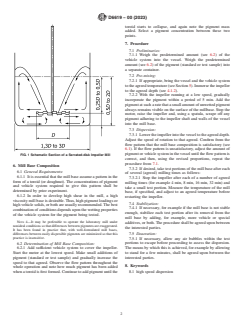
ery and the walls of the vessel (see Fig. 1). If the disk is
Barriers to Trade (TBT) Committee.
serrated, it shall be mounted so that the direction of movement
of the serrations is such that the mill base flows in the
2. Referenced Documents
directions shown in Fig. 1.
2.1 ISO Standards: 4.1.2.2 The degree of dispersion achieved will depend on
the type of disk used. Fig. 1 shows only one type.
ISO 8780-3 Pigments and Extenders—Methods of Disper-
sion for Assessment of Dispersion Characteristics— 4.1.2.3 The type and diameter of the disk, the geometry of
Dispersion Using a High Speed Impeller Mill the vessel, and the speed of the disk shall be agreed upon and
recorded in the test report.
3. Significance and Use
NOTE 2—A vessel with a double wall to allow circulation of a liquid to
3.1 High speed dispersion is a commonly used dispersion control the temperature should be employed, if necessary. A lid with a
central aperture may also be provided.
method in the coatings industry. For the purpose of this
NOTE 3—The diameter of a vessel used in an industrial scale mill is
practice, “high speed” would normally be understood to be a
normally two to three times the diameter of the impeller, or sometimes
range of RPM between 3 000 and 10 000. This practice
even greater. The vessel/disk geometry and the disk speed specified make
provides a reference for its use, so that a producer and user can
allowance for the small diameter of a laboratory disk.
standardize on an incorporation technique. This will minimize
5. Vehicle System
5.1 The vehicle system shall be agreed upon between the
This practice is under the jurisdiction of ASTM Committee D01 on Paint and
interested parties. Agreement will be necessary on the vehicle,
Related Coatings, Materials, and Applications and is the direct responsibility of
the solvent, the concentration of the vehicle in the solvent, as
Subcommittee D01.24 on Physical Properties of Liquid Paints & Paint Materials.
Current edition approved June 1, 2023. Published July 2023. Originally approved
well as any critical temperature sensitivity or rheological
in 2000. Last previous edition approved in 2016 as D6619 – 00 (2016). DOI:
properties (for example viscosity) of the vehicle system. The
10.1520/D6619-00R23.
same batch of vehicle system shall be used for all tests in the
Available from American National Standards Institute (ANSI), 25 W. 43rd St.,
4th Floor, New York, NY 10036, http://www.ansi.org. same series.
Copyright © ASTM International, 100 Barr Harbor Drive, PO Box C700, West Consh
...