

ASTM D618-21
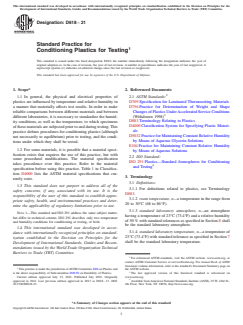
(Practice)Standard Practice for Conditioning Plastics for Testing
General Information
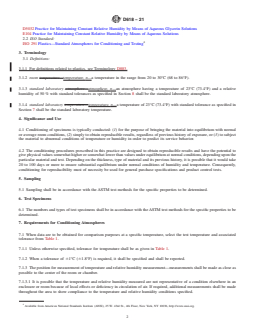
- Abstract
SIGNIFICANCE AND USE
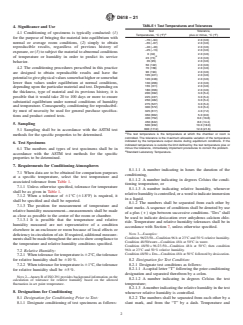
4.1 Conditioning of specimens is typically conducted: (1) for the purpose of bringing the material into equilibrium with normal or average room conditions, (2) simply to obtain reproducible results, regardless of previous history of exposure, or (3) to subject the material to abnormal conditions of temperature or humidity in order to predict its service behavior.
4.2 The conditioning procedures prescribed in this practice are designed to obtain reproducible results and have the potential to give physical values somewhat higher or somewhat lower than values under equilibrium at normal conditions, depending upon the particular material and test. Depending on the thickness, type of material and its previous history, it is possible that it would take 20 to 100 days or more to ensure substantial equilibrium under normal conditions of humidity and temperature. Consequently, conditioning for reproducibility must of necessity be used for general purchase specifications and product control tests.
SCOPE
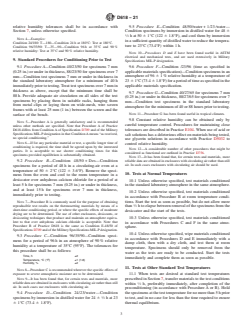
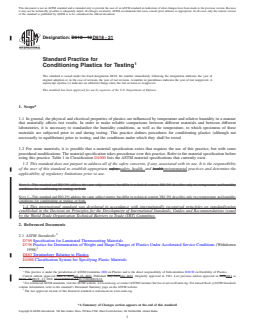
1.1 In general, the physical and electrical properties of plastics are influenced by temperature and relative humidity in a manner that materially affects test results. In order to make reliable comparisons between different materials and between different laboratories, it is necessary to standardize the humidity conditions, as well as the temperature, to which specimens of these materials are subjected prior to and during testing. This practice defines procedures for conditioning plastics (although not necessarily to equilibrium) prior to testing, and the conditions under which they shall be tested.
1.2 For some materials, it is possible that a material specification exists that requires the use of this practice, but with some procedural modifications. The material specification takes precedence over this practice. Refer to the material specification before using this practice. Table 1 in Classification D4000 lists the ASTM material specifications that currently exist.
1.3 This standard does not purport to address all of the safety concerns, if any, associated with its use. It is the responsibility of the user of this standard to establish appropriate safety, health, and environmental practices and determine the applicability of regulatory limitations prior to use.
Note 1: This standard and ISO 291 address the same subject matter, but differ in technical content. ISO 291 describes only two temperature and humidity conditions for conditioning or testing, or both.
1.4 This international standard was developed in accordance with internationally recognized principles on standardization established in the Decision on Principles for the Development of International Standards, Guides and Recommendations issued by the World Trade Organization Technical Barriers to Trade (TBT) Committee.
- Status
- Published
- Publication Date
- 14-Jul-2021
- Technical Committee
- D20 - Plastics
- Drafting Committee
- D20.50 - Durability of Plastics

Overview
ASTM D618-21: Standard Practice for Conditioning Plastics for Testing outlines critical procedures for preparing plastic specimens prior to laboratory testing. Issued by ASTM International, this standard ensures that plastic materials are brought to defined temperature and humidity conditions to achieve reliable, reproducible test results. Given that the physical and electrical properties of plastics are significantly influenced by environmental factors, ASTM D618-21 provides detailed guidance for standardizing pre-test environments, which is essential for effective quality control, performance evaluation, and interlaboratory comparisons.
Key Topics
Conditioning Objectives: ASTM D618-21 addresses three primary purposes for conditioning plastics:
- Bringing materials to equilibrium with normal or average room conditions
- Securing reproducible test results regardless of prior history or exposure
- Subjecting specimens to controlled abnormal conditions (temperature and humidity) to predict service behavior
Standard Conditions: The standard specifies that material properties can vary based on environmental parameters. To minimize discrepancies:
- Standard laboratory atmosphere: 23°C (73.4°F) and 50% relative humidity, with defined tolerances
- Controlled time durations depending on specimen thickness
Procedures: Multiple conditioning procedures are described, including:
- Conditioning at standard laboratory conditions for different durations based on thickness
- Exposure to elevated humidity or temperature, immersion in water, or use of desiccators for specific tests or material requirements
Designation System: A standardized nomenclature is provided for documenting the conditioning and test conditions, promoting clarity in reports and data analysis.
Reproducibility: Due to variability in materials and exposure history, equilibrium may require 20 to 100 days or more, making standardized conditioning critical for purchase specifications and product control.
Applications
The practical value of ASTM D618-21 is evident across multiple plastics testing scenarios, especially where accurate, comparable data are vital:
- Material Comparison: Enables reliable property comparisons between different plastics or product batches by eliminating environmental influence as a variable.
- Quality Assurance: Applied in production quality control to standardize test results, regardless of prior specimen history.
- Product Qualification: Used by manufacturers and third-party testers to meet regulatory or customer requirements for product certification and compliance.
- Research and Development: Supports reproducible experimental conditions for innovation and new materials testing.
- Interlaboratory Studies: Facilitates consistency across testing locations, essential for multi-site manufacturing or collaboration.
Related Standards
When using ASTM D618-21, consider the following related standards and references for plastics testing and laboratory environmental controls:
- ASTM D709: Specification for Laminated Thermosetting Materials
- ASTM D883: Terminology Relating to Plastics
- ASTM D4000: Classification System for Specifying Plastic Materials
- ASTM D5032: Practice for Maintaining Constant Relative Humidity by Means of Aqueous Glycerin Solutions
- ASTM E104: Practice for Maintaining Constant Relative Humidity by Means of Aqueous Solutions
- ISO 291: Plastics - Standard Atmospheres for Conditioning and Testing (note: ISO 291 and ASTM D618-21 differ in their technical content and specific conditions)
Conclusion
ASTM D618-21 plays a foundational role in plastics testing by defining how specimens should be conditioned for accurate and reproducible results. By adhering to this standard, laboratories, manufacturers, and quality assurance professionals can ensure consistency, reliability, and comparability in plastics testing outcomes, supporting more robust product development and market acceptance.
Relations
- Effective Date
- 01-Feb-2024
- Effective Date
- 01-Nov-2023
- Effective Date
- 30-Sep-2023
- Effective Date
- 01-Jan-2020
- Effective Date
- 01-Aug-2019
- Effective Date
- 15-Apr-2019
- Effective Date
- 01-Mar-2019
- Effective Date
- 01-Feb-2019
- Effective Date
- 01-Dec-2018
- Effective Date
- 01-Nov-2018
- Effective Date
- 15-Aug-2017
- Effective Date
- 01-Mar-2016
- Effective Date
- 01-Nov-2013
- Effective Date
- 15-Nov-2012
- Effective Date
- 01-May-2012
Get Certified
Connect with accredited certification bodies for this standard

IMQ S.p.A. (Certification)
Italian electrical product certification.

SLG Prüf- und Zertifizierungs GmbH
German testing and certification body.

UL Solutions
Global safety science company with testing, inspection and certification.
Sponsored listings
Frequently Asked Questions
ASTM D618-21 is a standard published by ASTM International. Its full title is "Standard Practice for Conditioning Plastics for Testing". This standard covers: SIGNIFICANCE AND USE 4.1 Conditioning of specimens is typically conducted: (1) for the purpose of bringing the material into equilibrium with normal or average room conditions, (2) simply to obtain reproducible results, regardless of previous history of exposure, or (3) to subject the material to abnormal conditions of temperature or humidity in order to predict its service behavior. 4.2 The conditioning procedures prescribed in this practice are designed to obtain reproducible results and have the potential to give physical values somewhat higher or somewhat lower than values under equilibrium at normal conditions, depending upon the particular material and test. Depending on the thickness, type of material and its previous history, it is possible that it would take 20 to 100 days or more to ensure substantial equilibrium under normal conditions of humidity and temperature. Consequently, conditioning for reproducibility must of necessity be used for general purchase specifications and product control tests. SCOPE 1.1 In general, the physical and electrical properties of plastics are influenced by temperature and relative humidity in a manner that materially affects test results. In order to make reliable comparisons between different materials and between different laboratories, it is necessary to standardize the humidity conditions, as well as the temperature, to which specimens of these materials are subjected prior to and during testing. This practice defines procedures for conditioning plastics (although not necessarily to equilibrium) prior to testing, and the conditions under which they shall be tested. 1.2 For some materials, it is possible that a material specification exists that requires the use of this practice, but with some procedural modifications. The material specification takes precedence over this practice. Refer to the material specification before using this practice. Table 1 in Classification D4000 lists the ASTM material specifications that currently exist. 1.3 This standard does not purport to address all of the safety concerns, if any, associated with its use. It is the responsibility of the user of this standard to establish appropriate safety, health, and environmental practices and determine the applicability of regulatory limitations prior to use. Note 1: This standard and ISO 291 address the same subject matter, but differ in technical content. ISO 291 describes only two temperature and humidity conditions for conditioning or testing, or both. 1.4 This international standard was developed in accordance with internationally recognized principles on standardization established in the Decision on Principles for the Development of International Standards, Guides and Recommendations issued by the World Trade Organization Technical Barriers to Trade (TBT) Committee.
SIGNIFICANCE AND USE 4.1 Conditioning of specimens is typically conducted: (1) for the purpose of bringing the material into equilibrium with normal or average room conditions, (2) simply to obtain reproducible results, regardless of previous history of exposure, or (3) to subject the material to abnormal conditions of temperature or humidity in order to predict its service behavior. 4.2 The conditioning procedures prescribed in this practice are designed to obtain reproducible results and have the potential to give physical values somewhat higher or somewhat lower than values under equilibrium at normal conditions, depending upon the particular material and test. Depending on the thickness, type of material and its previous history, it is possible that it would take 20 to 100 days or more to ensure substantial equilibrium under normal conditions of humidity and temperature. Consequently, conditioning for reproducibility must of necessity be used for general purchase specifications and product control tests. SCOPE 1.1 In general, the physical and electrical properties of plastics are influenced by temperature and relative humidity in a manner that materially affects test results. In order to make reliable comparisons between different materials and between different laboratories, it is necessary to standardize the humidity conditions, as well as the temperature, to which specimens of these materials are subjected prior to and during testing. This practice defines procedures for conditioning plastics (although not necessarily to equilibrium) prior to testing, and the conditions under which they shall be tested. 1.2 For some materials, it is possible that a material specification exists that requires the use of this practice, but with some procedural modifications. The material specification takes precedence over this practice. Refer to the material specification before using this practice. Table 1 in Classification D4000 lists the ASTM material specifications that currently exist. 1.3 This standard does not purport to address all of the safety concerns, if any, associated with its use. It is the responsibility of the user of this standard to establish appropriate safety, health, and environmental practices and determine the applicability of regulatory limitations prior to use. Note 1: This standard and ISO 291 address the same subject matter, but differ in technical content. ISO 291 describes only two temperature and humidity conditions for conditioning or testing, or both. 1.4 This international standard was developed in accordance with internationally recognized principles on standardization established in the Decision on Principles for the Development of International Standards, Guides and Recommendations issued by the World Trade Organization Technical Barriers to Trade (TBT) Committee.
ASTM D618-21 is classified under the following ICS (International Classification for Standards) categories: 29.035.20 - Plastics and rubber insulating materials. The ICS classification helps identify the subject area and facilitates finding related standards.
ASTM D618-21 has the following relationships with other standards: It is inter standard links to ASTM D883-24, ASTM D883-23, ASTM D756-93, ASTM D883-20, ASTM D883-19c, ASTM D883-19a, ASTM D5032-19, ASTM D883-19, ASTM D883-18a, ASTM D883-18, ASTM D883-17, ASTM D709-16, ASTM D709-13, ASTM D883-12e1, ASTM D4000-12. Understanding these relationships helps ensure you are using the most current and applicable version of the standard.
ASTM D618-21 is available in PDF format for immediate download after purchase. The document can be added to your cart and obtained through the secure checkout process. Digital delivery ensures instant access to the complete standard document.
Standards Content (Sample)
This international standard was developed in accordance with internationally recognized principles on standardization established in the Decision on Principles for the
Development of International Standards, Guides and Recommendations issued by the World Trade Organization Technical Barriers to Trade (TBT) Committee.
Designation: D618 − 21
Standard Practice for
Conditioning Plastics for Testing
This standard is issued under the fixed designation D618; the number immediately following the designation indicates the year of
original adoption or, in the case of revision, the year of last revision. A number in parentheses indicates the year of last reapproval. A
superscript epsilon (´) indicates an editorial change since the last revision or reapproval.
This standard has been approved for use by agencies of the U.S. Department of Defense.
1. Scope* 2. Referenced Documents
1.1 In general, the physical and electrical properties of 2.1 ASTM Standards:
D709 Specification for Laminated Thermosetting Materials
plastics are influenced by temperature and relative humidity in
D756 Practice for Determination of Weight and Shape
a manner that materially affects test results. In order to make
ChangesofPlasticsUnderAcceleratedServiceConditions
reliable comparisons between different materials and between
(Withdrawn 1998)
different laboratories, it is necessary to standardize the humid-
D883 Terminology Relating to Plastics
ity conditions, as well as the temperature, to which specimens
D4000 Classification System for Specifying Plastic Materi-
ofthesematerialsaresubjectedpriortoandduringtesting.This
als
practice defines procedures for conditioning plastics (although
D5032 Practice for Maintaining Constant Relative Humidity
not necessarily to equilibrium) prior to testing, and the condi-
by Means of Aqueous Glycerin Solutions
tions under which they shall be tested.
E104 Practice for Maintaining Constant Relative Humidity
1.2 For some materials, it is possible that a material speci-
by Means of Aqueous Solutions
fication exists that requires the use of this practice, but with
2.2 ISO Standard:
some procedural modifications. The material specification
ISO 291 Plastics—Standard Atmospheres for Conditioning
takes precedence over this practice. Refer to the material
and Testing
specification before using this practice. Table 1 in Classifica-
tion D4000 lists the ASTM material specifications that cur-
3. Terminology
rently exist.
3.1 Definitions:
1.3 This standard does not purport to address all of the
3.1.1 For definitions related to plastics, see Terminology
safety concerns, if any, associated with its use. It is the
D883.
responsibility of the user of this standard to establish appro-
3.1.2 room temperature, n—a temperature in the range from
priate safety, health, and environmental practices and deter-
20 to 30°C (68 to 86°F).
mine the applicability of regulatory limitations prior to use.
3.1.3 standard laboratory atmosphere, n—an atmosphere
NOTE 1—This standard and ISO 291 address the same subject matter,
having a temperature of 23°C (73.4°F) and a relative humidity
but differ in technical content. ISO 291 describes only two temperature
of 50 % with standard tolerances as specified in Section 8 shall
and humidity conditions for conditioning or testing, or both.
be the standard laboratory atmosphere.
1.4 This international standard was developed in accor-
3.1.4 standard laboratory temperature, n—a temperature of
dance with internationally recognized principles on standard-
23°C (73.4°F) with standard tolerance as specified in Section 7
ization established in the Decision on Principles for the
shall be the standard laboratory temperature.
Development of International Standards, Guides and Recom-
mendations issued by the World Trade Organization Technical
Barriers to Trade (TBT) Committee.
For referenced ASTM standards, visit the ASTM website, www.astm.org, or
contact ASTM Customer Service at service@astm.org. For Annual Book of ASTM
Standards volume information, refer to the standard’s Document Summary page on
This practice is under the jurisdiction ofASTM Committee D20 on Plastics and the ASTM website.
is the direct responsibility of Subcommittee D20.50 on Durability of Plastics. The last approved version of this historical standard is referenced on
Current edition approved July 15, 2021. Published July 2021. Originally www.astm.org.
approved in 1941. Last previous edition approved in 2013 as D618 - 13. DOI: Available from American National Standards Institute (ANSI), 25 W. 43rd St.,
10.1520/D0618-21. 4th Floor, New York, NY 10036, http://www.ansi.org.
*A Summary of Changes section appears at the end of this standard
Copyright © ASTM International, 100 Barr Harbor Drive, PO Box C700, West Conshohocken, PA 19428-2959. United States
D618 − 21
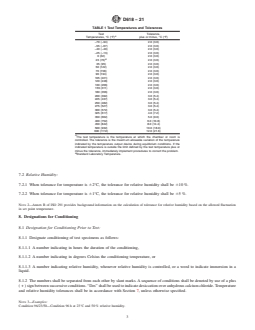
TABLE 1 Test Temperatures and Tolerances
4. Significance and Use
Test Tolerance,
4.1 Conditioning of specimens is typically conducted: (1)
A
Temperatures, °C (°F) plus or minus, °C (°F)
for the purpose of bringing the material into equilibrium with
−70 (−94) 2.0 (3.6)
normal or average room conditions, (2) simply to obtain
−55 (−67) 2.0 (3.6)
−40 (−40) 2.0 (3.6)
reproducible results, regardless of previous history of
−25 (−13) 2.0 (3.6)
exposure, or (3) to subject the material to abnormal conditions
0 (32) 2.0 (3.6)
B
of temperature or humidity in order to predict its service
23 (73) 2.0 (3.6)
35 (95) 2.0 (3.6)
behavior.
50 (122) 2.0 (3.6)
4.2 The conditioning procedures prescribed in this practice 70 (158) 2.0 (3.6)
90 (194) 2.0 (3.6)
are designed to obtain reproducible results and have the
105 (221) 2.0 (3.6)
potentialtogivephysicalvaluessomewhathigherorsomewhat
120 (248) 2.0 (3.6)
lower than values under equilibrium at normal conditions, 130 (266) 2.0 (3.6)
155 (311) 2.0 (3.6)
depending upon the particular material and test. Depending on
180 (356) 2.0 (3.6)
the thickness, type of material and its previous history, it is
200 (392) 3.0 (5.4)
possible that it would take 20 to 100 days or more to ensure 225 (437) 3.0 (5.4)
250 (482) 3.0 (5.4)
substantial equilibrium under normal conditions of humidity
275 (527) 3.0 (5.4)
and temperature. Consequently, conditioning for reproducibil-
300 (572) 3.0 (5.4)
ity must of necessity be used for general purchase specifica- 325 (617) 4.0 (7.2)
350 (662) 5.0 (9.0)
tions and product control tests.
400 (752) 6.0 (10.8)
450 (842) 8.0 (14.4)
5. Sampling
500 (932) 10.0 (18.0)
600 (1112) 12.0 (21.6)
5.1 Sampling shall be in accordance with the ASTM test
A
The test temperature is the temperature at which the chamber or room is
methods for the specific properties to be determined.
controlled. The tolerance is the maximum allowable variation of the temperature
indicated by the temperature output device during equilibrium conditions. If the
6. Test Specimens
indicated temperature is outside the limit defined by the test temperature plus or
minus the tolerance, immediately implement procedures to correct the problem.
6.1 The numbers and types of test specimens shall be in
B
Standard Laboratory Temperature.
accordance with the ASTM test methods for the specific
properties to be determined.
7. Requirements for Conditioning Atmospheres
8.1.1.1 A number indicating in hours the duration of the
7.1 When data are to be obtained for comparison purposes
conditioning,
at a specific temperature, select the test temperature and
8.1.1.2 A number indicating in degrees Celsius the condi-
associated tolerance from Table 1.
tioning temperature, or
7.1.1 Unless otherwise specified, tolerance for temperature
8.1.1.3 A number indicating relative humidity, whenever
shall be as given in Table 1.
relativehumidityiscontrolled,orawordtoindicateimmersion
7.1.2 When a tolerance of 61°C (61.8°F) is required, it
in a liquid.
shall be specified and shall be reported.
8.1.2 The numbers shall be separated from each other by
7.1.3 The position for measurement of temperature and
slant marks. A sequence of conditions shall be denoted by use
relative humidity measurement—measurements shall be made
of a plus ( + ) sign between successive conditions. “Des” shall
as close as possible to the center of the room or chamber.
be used to indicate desiccation over anhydrous calcium chlo-
7.1.3.1 It is possible that the temperature and relative
ride. Temperature and relative humidity tolerances shall be in
humidity measured are not representative of a condition
accordance with Section 7, unless otherwise specified.
elsewhere in an enclosure or room because of local effects or
NOTE 3—Examples:
deficiency in circulation of air. If required, additional measure-
Condition 96/23/50—Condition 96 h at 23°C and 50 % relative humidity.
mentsshallbemadethroughouttheareatoshowcomplianceto
Condition 48/50/water—Condition 48 h at 50°C in water.
the temperature and relative humidity conditions specified.
Condition 48/50 + 96 ⁄23 ⁄50—Condition 48 h at 50°C; then condition
96 h at 23°C and 50 % relative humidity.
7.2 Relative Humidity:
Condition 48/50 + Des—Condition 48 h at 50°C followed by desiccation.
7.2.1 Whentolerancefortemperatureis 62°C,thetolerance
8.2 Designation for Test Condition:
for relative humidity shall be 610 %.
8.2.1 Designate test conditions as follows:
7.2.2 Whentolerancefortemperatureis 61°C,thetolerance
for relative humidity shall be 65%. 8.2.1.1 Acapital letter “T” following the prior conditioning
designation and separated therefrom by a colon.
NOTE 2—Annex B of ISO 291 provides background information on the
8.2.1.2 A number indicating in degrees Celsius the test
calculation of tolerance for relative humidity based on the allowed
temperature;
fluctuation in set point temperature.
8.2.1.3 Anumber indicating the relative humidity in the test
8. Designations for Conditioning
whenever relative humidity is controlled.
8.1 Designation for Conditioning Prior to Test: 8.2.2 The numbers s
...
This document is not an ASTM standard and is intended only to provide the user of an ASTM standard an indication of what changes have been made to the previous version. Because
it may not be technically possible to adequately depict all changes accurately, ASTM recommends that users consult prior editions as appropriate. In all cases only the current version
of the standard as published by ASTM is to be considered the official document.
Designation: D618 − 13 D618 − 21
Standard Practice for
Conditioning Plastics for Testing
This standard is issued under the fixed designation D618; the number immediately following the designation indicates the year of
original adoption or, in the case of revision, the year of last revision. A number in parentheses indicates the year of last reapproval. A
superscript epsilon (´) indicates an editorial change since the last revision or reapproval.
This standard has been approved for use by agencies of the U.S. Department of Defense.
1. Scope*
1.1 In general, the physical and electrical properties of plastics are influenced by temperature and relative humidity in a manner
that materially affects test results. In order to make reliable comparisons between different materials and between different
laboratories, it is necessary to standardize the humidity conditions, as well as the temperature, to which specimens of these
materials are subjected prior to and during testing. This practice defines procedures for conditioning plastics (although not
necessarily to equilibrium) prior to testing, and the conditions under which they shall be tested.
1.2 For some materials, it is possible that a material specification exists that requires the use of this practice, but with some
procedural modifications. The material specification takes precedence over this practice. Refer to the material specification before
using this practice. Table 1 in Classification D4000 lists the ASTM material specifications that currently exist.
1.3 This standard does not purport to address all of the safety concerns, if any, associated with its use. It is the responsibility
of the user of this standard to establish appropriate safety safety, health, and healthenvironmental practices and determine the
applicability of regulatory limitations prior to use.
NOTE 1—This standard and ISO 291 address the same subject matter, but differ in technical content. ISO 291 describes only two temperature and humidity
conditions for conditioning or testing, or both.
NOTE 1—This standard and ISO 291 address the same subject matter, but differ in technical content. ISO 291 describes only two temperature and humidity
conditions for conditioning or testing, or both.
1.4 This international standard was developed in accordance with internationally recognized principles on standardization
established in the Decision on Principles for the Development of International Standards, Guides and Recommendations issued
by the World Trade Organization Technical Barriers to Trade (TBT) Committee.
2. Referenced Documents
2.1 ASTM Standards:
D709 Specification for Laminated Thermosetting Materials
D756 Practice for Determination of Weight and Shape Changes of Plastics Under Accelerated Service Conditions (Withdrawn
1998)
D883 Terminology Relating to Plastics
D4000 Classification System for Specifying Plastic Materials
This practice is under the jurisdiction of ASTM Committee D20 on Plastics and is the direct responsibility of Subcommittee D20.50 on Durability of Plastics.
Current edition approved June 1, 2013July 15, 2021. Published July 2013July 2021. Originally approved in 1941. Last previous edition approved in 20082013 as
D618 - 08.D618 - 13. DOI: 10.1520/D0618-13.10.1520/D0618-21.
For referenced ASTM standards, visit the ASTM website, www.astm.org, or contact ASTM Customer Service at service@astm.org. For Annual Book of ASTM Standards
volume information, refer to the standard’s Document Summary page on the ASTM website.
The last approved version of this historical standard is referenced on www.astm.org.
*A Summary of Changes section appears at the end of this standard
Copyright © ASTM International, 100 Barr Harbor Drive, PO Box C700, West Conshohocken, PA 19428-2959. United States
D618 − 21
D5032 Practice for Maintaining Constant Relative Humidity by Means of Aqueous Glycerin Solutions
E104 Practice for Maintaining Constant Relative Humidity by Means of Aqueous Solutions
2.2 ISO Standard:
ISO 291 Plastics—Standard Atmospheres for Conditioning and Testing
3. Terminology
3.1 Definitions:
3.1.1 For definitions related to plastics, see Terminology D883.
3.1.2 room temperature—temperature, n—a temperature in the range from 20 to 30°C (68 to 86°F).
3.1.3 standard laboratory atmosphere—atmosphere, n—an atmosphere having a temperature of 23°C (73.4°F) and a relative
humidity of 50 % with standard tolerances as specified in Section 8 shall be the standard laboratory atmosphere.
3.1.4 standard laboratory temperature—temperature, n—a temperature of 23°C (73.4°F) with standard tolerance as specified in
Section 7 shall be the standard laboratory temperature.
4. Significance and Use
4.1 Conditioning of specimens is typically conducted: (1) for the purpose of bringing the material into equilibrium with normal
or average room conditions, (2) simply to obtain reproducible results, regardless of previous history of exposure, or (3) to subject
the material to abnormal conditions of temperature or humidity in order to predict its service behavior.
4.2 The conditioning procedures prescribed in this practice are designed to obtain reproducible results and have the potential to
give physical values somewhat higher or somewhat lower than values under equilibrium at normal conditions, depending upon the
particular material and test. Depending on the thickness, type of material and its previous history, it is possible that it would take
20 to 100 days or more to ensure substantial equilibrium under normal conditions of humidity and temperature. Consequently,
conditioning for reproducibility must of necessity be used for general purchase specifications and product control tests.
5. Sampling
5.1 Sampling shall be in accordance with the ASTM test methods for the specific properties to be determined.
6. Test Specimens
6.1 The numbers and types of test specimens shall be in accordance with the ASTM test methods for the specific properties to be
determined.
7. Requirements for Conditioning Atmospheres
7.1 When data are to be obtained for comparison purposes at a specific temperature, select the test temperature and associated
tolerance from Table 1.
7.1.1 Unless otherwise specified, tolerance for temperature shall be as given in Table 1.
7.1.2 When a tolerance of 61°C (61.8°F) is required, it shall be specified and shall be reported.
7.1.3 The position for measurement of temperature and relative humidity measurement—measurements shall be made as close as
possible to the center of the room or chamber.
7.1.3.1 It is possible that the temperature and relative humidity measured are not representative of a condition elsewhere in an
enclosure or room because of local effects or deficiency in circulation of air. If required, additional measurements shall be made
throughout the area to show compliance to the temperature and relative humidity conditions specified.
Available from American National Standards Institute (ANSI), 25 W. 43rd St., 4th Floor, New York, NY 10036, http://www.ansi.org.
D618 − 21
TABLE 1 Test Temperatures and Tolerances
Test Tolerance,
A
Temperatures, °C (°F) plus or minus, °C (°F)
−70 (−94) 2.0 (3.6)
−55 (−67) 2.0 (3.6)
−40 (−40) 2.0 (3.6)
−25 (−13) 2.0 (3.6)
0 (32) 2.0 (3.6)
B
23 (73) 2.0 (3.6)
35 (95) 2.0 (3.6)
50 (122) 2.0 (3.6)
70 (158) 2.0 (3.6)
90 (194) 2.0 (3.6)
105 (221) 2.0 (3.6)
120 (248) 2.0 (3.6)
130 (266) 2.0 (3.6)
155 (311) 2.0 (3.6)
180 (356) 2.0 (3.6)
200 (392) 3.0 (5.4)
225 (437) 3.0 (5.4)
250 (482) 3.0 (5.4)
275 (527) 3.0 (5.4)
300 (572) 3.0 (5.4)
325 (617) 4.0 (7.2)
350 (662) 5.0 (9.0)
400 (752) 6.0 (10.8)
450 (842) 8.0 (14.4)
500 (932) 10.0 (18.0)
600 (1112) 12.0 (21.6)
A
The test temperature is the temperature at which the chamber or room is
controlled. The tolerance is the maximum allowable variation of the temperature
indicated by the temperature output device during equilibrium conditions. If the
indicated temperature is outside the limit defined by the test temperature plus or
minus the tolerance, immediately implement procedures to correct the problem.
B
Standard Laboratory Temperature.
7.2 Relative Humidity:
7.2.1 When tolerance for temperature is 62°C, the tolerance for relative humidity shall be 610 %.
7.2.2 When tolerance for temperature is 61°C, the tolerance for relative humidity shall be 65 %.
NOTE 2—Annex B of ISO 291 provides background information on the calculation of tolerance for relative humidity based on the allowed fluctuation
in set point temperature.
8. Designations for Conditioning
8.1 Designation for Conditioning Prior to Test:
8.1.1 Designate conditioning of test specimens as follows:
8.1.1.1 A number indicating in hours the duration of the conditioning,
8.1.1.2 A number indicating in degrees Celsius the conditioning temperature, or
8.1.1.3 A number indicating relative humidity, whenever relative humidity is controlled, or a word to indicate immersion in a
liquid.
8.1.2 The numbers shall be separated from each other by slant marks. A sequence of conditions shall be denoted by use of a plus
( + ) sign between successive conditions. “Des” shall be used to indicate desiccation over anhydrous calcium chloride. Temperature
and relative humidity tolerances shall be in accordance with Section 7, unless otherwise specified.
NOTE 3—Examples:
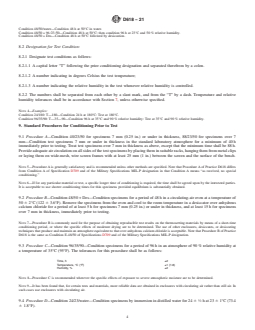
Condition 96/23/50—Condition 96 h at 23°C and 50 % relative humidity.
D618 − 21
Condition 48/50/water—Condition 48 h at 50°C in water.
Condition 48/50 + 96 ⁄23 ⁄50—Condition 48 h at 50°C; then condition 96 h at 23°C and 50 % relative humidity.
Condition 48/50 + Des—Condition 48 h at 50°C followed by desiccation.
8.2 Designation for Test Condition:
8.2.1 Designate test conditions as follows:
8.2.1.1 A capital letter “T” foll
...