


ASTM E1497-05
(Practice)Standard Practice for Safe Use of Water-Miscible Metal Removal Fluids
Standard Practice for Safe Use of Water-Miscible Metal Removal Fluids
SIGNIFICANCE AND USE
Use of this practice will improve management and control of metal removal fluids. The proper management and use will reduce dermal and other occupational hazards associated with these fluids.
4.1.1 Guide E 2148 covers information on how to use documents related to health and safety of metalworking and metal removal fluids, including this document. Documents referenced in Guide E 2148 are grouped as applicable to producers, to users, or to all.
SCOPE
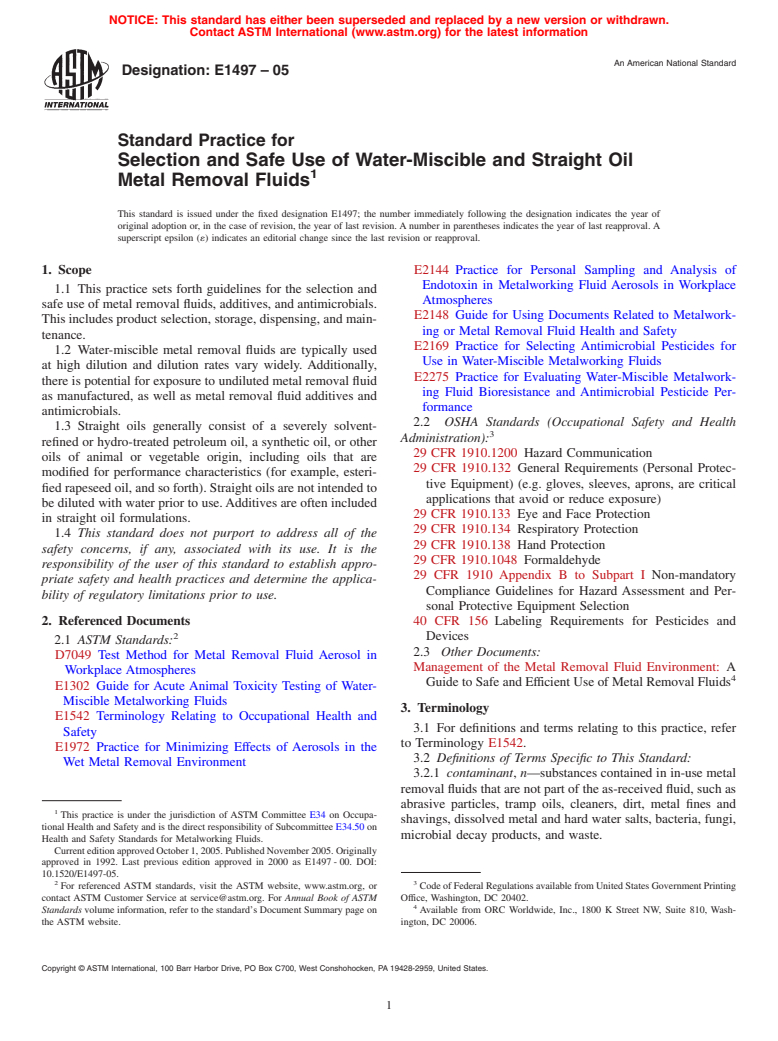
1.1 This practice sets forth guidelines for the selection and safe use of metal removal fluids, additives, and antimicrobials. This includes product selection, storage, dispensing, and maintenance.
1.2 Water-miscible metal removal fluids are typically used at high dilution and dilution rates vary widely. Additionally, there is potential for exposure to undiluted metal removal fluid as manufactured, as well as metal removal fluid additives and antimicrobials.
1.3 Straight oils generally consist of a severely solvent-refined or hydro-treated petroleum oil, a synthetic oil, or other oils of animal or vegetable origin, including oils that are modified for performance characteristics (for example, esterified rapeseed oil, and so forth). Straight oils are not intended to be diluted with water prior to use. Additives are often included in straight oil formulations.
This standard does not purport to address all of the safety concerns, if any, associated with its use. It is the responsibility of the user of this standard to establish appropriate safety and health practices and determine the applicability of regulatory limitations prior to use.
General Information
Relations

Standards Content (Sample)
NOTICE: This standard has either been superseded and replaced by a new version or withdrawn.
Contact ASTM International (www.astm.org) for the latest information
An American National Standard
Designation:E1497–05
Standard Practice for
Selection and Safe Use of Water-Miscible and Straight Oil
1
Metal Removal Fluids
This standard is issued under the fixed designation E1497; the number immediately following the designation indicates the year of
original adoption or, in the case of revision, the year of last revision. A number in parentheses indicates the year of last reapproval. A
superscript epsilon (´) indicates an editorial change since the last revision or reapproval.
1. Scope E2144 Practice for Personal Sampling and Analysis of
Endotoxin in Metalworking Fluid Aerosols in Workplace
1.1 This practice sets forth guidelines for the selection and
Atmospheres
safe use of metal removal fluids, additives, and antimicrobials.
E2148 Guide for Using Documents Related to Metalwork-
This includes product selection, storage, dispensing, and main-
ing or Metal Removal Fluid Health and Safety
tenance.
E2169 Practice for Selecting Antimicrobial Pesticides for
1.2 Water-miscible metal removal fluids are typically used
Use in Water-Miscible Metalworking Fluids
at high dilution and dilution rates vary widely. Additionally,
E2275 Practice for Evaluating Water-Miscible Metalwork-
there is potential for exposure to undiluted metal removal fluid
ing Fluid Bioresistance and Antimicrobial Pesticide Per-
as manufactured, as well as metal removal fluid additives and
formance
antimicrobials.
2.2 OSHA Standards (Occupational Safety and Health
1.3 Straight oils generally consist of a severely solvent-
3
Administration):
refined or hydro-treated petroleum oil, a synthetic oil, or other
29 CFR 1910.1200 Hazard Communication
oils of animal or vegetable origin, including oils that are
29 CFR 1910.132 General Requirements (Personal Protec-
modified for performance characteristics (for example, esteri-
tive Equipment) (e.g. gloves, sleeves, aprons, are critical
fied rapeseed oil, and so forth). Straight oils are not intended to
applications that avoid or reduce exposure)
be diluted with water prior to use.Additives are often included
29 CFR 1910.133 Eye and Face Protection
in straight oil formulations.
29 CFR 1910.134 Respiratory Protection
1.4 This standard does not purport to address all of the
29 CFR 1910.138 Hand Protection
safety concerns, if any, associated with its use. It is the
29 CFR 1910.1048 Formaldehyde
responsibility of the user of this standard to establish appro-
29 CFR 1910 Appendix B to Subpart I Non-mandatory
priate safety and health practices and determine the applica-
Compliance Guidelines for Hazard Assessment and Per-
bility of regulatory limitations prior to use.
sonal Protective Equipment Selection
2. Referenced Documents
40 CFR 156 Labeling Requirements for Pesticides and
2
Devices
2.1 ASTM Standards:
2.3 Other Documents:
D7049 Test Method for Metal Removal Fluid Aerosol in
Management of the Metal Removal Fluid Environment: A
Workplace Atmospheres
4
Guide to Safe and Efficient Use of Metal Removal Fluids
E1302 Guide for Acute Animal Toxicity Testing of Water-
Miscible Metalworking Fluids
3. Terminology
E1542 Terminology Relating to Occupational Health and
3.1 For definitions and terms relating to this practice, refer
Safety
to Terminology E1542.
E1972 Practice for Minimizing Effects of Aerosols in the
3.2 Definitions of Terms Specific to This Standard:
Wet Metal Removal Environment
3.2.1 contaminant, n—substances contained in in-use metal
removal fluids that are not part of the as-received fluid, such as
abrasive particles, tramp oils, cleaners, dirt, metal fines and
1
This practice is under the jurisdiction of ASTM Committee E34 on Occupa-
shavings, dissolved metal and hard water salts, bacteria, fungi,
tional Health and Safety and is the direct responsibility of Subcommittee E34.50 on
microbial decay products, and waste.
Health and Safety Standards for Metalworking Fluids.
CurrenteditionapprovedOctober1,2005.PublishedNovember2005.Originally
approved in 1992. Last previous edition approved in 2000 as E1497 - 00. DOI:
10.1520/E1497-05.
2 3
For referenced ASTM standards, visit the ASTM website, www.astm.org, or CodeofFederalRegulationsavailablefromUnitedStatesGovernmentPrinting
contact ASTM Customer Service at service@astm.org. For Annual Book of ASTM Office, Washington, DC 20402.
4
Standards volume information, refer to the standard’s Document Summary page on Available from ORC Worldwide, Inc., 1800 K Street NW, Suite 810, Wash-
the ASTM website. ington, DC 20006.
Copyright © ASTM International, 100 Barr Harbor Drive, PO Box C700, West Conshohocken, PA 19428-2959, United States.
1
---------------------- Page: 1 ----------------------
E1497–05
3.2.2 control, v—to prevent, eliminate or reduce hazards 3.2.11 wet metal removal fluid environment, n—the work-
related to use of metal removal fluids in metal removal place environment
...
Questions, Comments and Discussion
Ask us and Technical Secretary will try to provide an answer. You can facilitate discussion about the standard in here.