

ASTM F482-09(2020)
(Practice)Standard Practice for Corrosion of Aircraft Metals by Total Immersion in Maintenance Chemicals
General Information
- Abstract
SIGNIFICANCE AND USE
3.1 This practice not only provides information on the accumulated effects of corrosion at specific time periods under a given set of conditions, but also provides information on the initial rate of corrosion of virgin metal, the corrosion rate of metal per unit time after long exposure, and the initial corrosion rate of virgin metal after long exposure of the corroding fluid to metal. The test also provides a means of determining the direction corrosion will take with time, although causes for increase or decrease in the corrosiveness and corrodibility of media and metal (such as passive film formation or destruction, depletion of corrosive contaminate, and so forth) as a function of time are not given.
SCOPE
1.1 This practice covers the determination of the corrosiveness of tank-type aircraft maintenance chemicals on aircraft metals and the corrodibility of metals in these maintenance chemicals with time. The determination is made under conditions of total immersion by a combination of weight change measurements and visual qualitative determinations of change.
1.2 The values stated in SI units are to be regarded as the standard. The values given in parentheses are for information only.
1.3 This standard does not purport to address all of the safety concerns, if any, associated with its use. It is the responsibility of the user of this standard to establish appropriate safety, health, and environmental practices and determine the applicability of regulatory limitations prior to use. For specific precautions, see Section 6.
1.4 This international standard was developed in accordance with internationally recognized principles on standardization established in the Decision on Principles for the Development of International Standards, Guides and Recommendations issued by the World Trade Organization Technical Barriers to Trade (TBT) Committee.
- Status
- Published
- Publication Date
- 31-Oct-2020
- Technical Committee
- F07 - Aerospace and Aircraft
- Drafting Committee
- F07.07 - Qualification Testing of Aircraft Cleaning Materials
Overview
ASTM F482-09(2020) is the internationally recognized standard practice for determining the corrosion of aircraft metals by total immersion in maintenance chemicals. Developed by ASTM International, this standard outlines methods for assessing the effects of tank-type cleaning solutions and maintenance chemicals on aircraft metals during exposure. It is essential for aircraft maintenance, safety, and material qualification processes, providing clear guidelines on how to measure both the corrosiveness of the chemical solutions and the corrodibility of various metals over time.
Key Topics
- Corrosion Determination: The standard details how to assess accumulated corrosion effects, initial and sustained corrosion rates, and changes in the corrosion direction over time by immersing metal specimens in maintenance chemicals.
- Test Methods: Includes procedures for specimen preparation, conditioning, immersion testing, weight change measurements, and visual inspection for corrosion.
- Test Apparatus: Specifies suitable containers, condensation systems, agitation mechanisms, and temperature controls to ensure consistent and reliable testing.
- Reporting: Outlines the required data for reporting, including chemical and alloy identification, testing conditions, results for corrosion rates, weight losses, and qualitative observations.
Applications
ASTM F482-09(2020) has a wide range of practical applications in the aerospace and aviation industries, particularly regarding aircraft safety, regulatory compliance, and material longevity:
- Material and Chemical Qualification: Used by manufacturers and maintenance organizations to ensure that cleaning and maintenance chemicals do not induce unacceptable levels of corrosion on aircraft parts.
- Safety and Compliance: Assists in meeting safety, health, and environmental regulations by identifying chemicals and procedures that may present risks.
- Product Development: Supports the design and selection of safer, longer-lasting maintenance chemicals and corrosion-resistant materials for use in aircraft and related equipment.
- Corrosion Monitoring: Offers a systematic approach for ongoing evaluation of chemical effects and the early detection of corrosion trends in operational environments.
Related Standards
ASTM F482-09(2020) references several key ASTM standards that are integral to its procedures and applications:
- ASTM D235: Specification for Mineral Spirits (Petroleum Spirits).
- ASTM D329: Specification for Acetone.
- ASTM D1193: Specification for Reagent Water.
- ASTM E1: Specification for ASTM Liquid-in-Glass Thermometers.
These referenced documents ensure consistency in testing materials and accuracy in measurement for corrosion resistance evaluations.
Practical Value
Adopting ASTM F482-09(2020) provides significant benefits to aviation companies, chemical manufacturers, and regulatory bodies by:
- Enhancing Aircraft Safety: Reducing unexpected maintenance caused by chemical-induced corrosion.
- Extending Component Life: Enabling the selection of chemicals and materials that minimize corrosion risk.
- Improving Maintenance Practices: Establishing evidence-based procedures for the evaluation and use of maintenance chemicals.
- Supporting Regulatory Compliance: Aligning with internationally recognized standards fosters global acceptance and efficient quality assurance processes.
Keywords
Aircraft metals, corrosion of aircraft metals, total immersion testing, maintenance chemicals, corrosion resistance, aircraft cleaning materials, ASTM F482, corrosion rate measurement, aerospace standard, tank-type chemicals, material qualification, aviation maintenance safety.
Relations
- Effective Date
- 01-May-2013
- Effective Date
- 01-Nov-2007
- Effective Date
- 01-Jun-2007
- Effective Date
- 01-Jun-2007
- Effective Date
- 01-Jun-2007
- Effective Date
- 01-Mar-2006
- Effective Date
- 01-Nov-2005
- Effective Date
- 01-Nov-2003
- Effective Date
- 10-May-2003
- Effective Date
- 10-Dec-2002
- Effective Date
- 10-Dec-2002
- Effective Date
- 10-Oct-2001
- Effective Date
- 10-Oct-2001
- Effective Date
- 10-Oct-2001
- Effective Date
- 10-Dec-1999
Get Certified
Connect with accredited certification bodies for this standard

BUREAU VERITAS Certification Germany
Bureau Veritas certification in Germany.

Element Materials Technology
Materials testing and product certification.

AQMS Ltd.
AQMS provides ISO certification to SMEs across the UK.
Sponsored listings
Frequently Asked Questions
ASTM F482-09(2020) is a standard published by ASTM International. Its full title is "Standard Practice for Corrosion of Aircraft Metals by Total Immersion in Maintenance Chemicals". This standard covers: SIGNIFICANCE AND USE 3.1 This practice not only provides information on the accumulated effects of corrosion at specific time periods under a given set of conditions, but also provides information on the initial rate of corrosion of virgin metal, the corrosion rate of metal per unit time after long exposure, and the initial corrosion rate of virgin metal after long exposure of the corroding fluid to metal. The test also provides a means of determining the direction corrosion will take with time, although causes for increase or decrease in the corrosiveness and corrodibility of media and metal (such as passive film formation or destruction, depletion of corrosive contaminate, and so forth) as a function of time are not given. SCOPE 1.1 This practice covers the determination of the corrosiveness of tank-type aircraft maintenance chemicals on aircraft metals and the corrodibility of metals in these maintenance chemicals with time. The determination is made under conditions of total immersion by a combination of weight change measurements and visual qualitative determinations of change. 1.2 The values stated in SI units are to be regarded as the standard. The values given in parentheses are for information only. 1.3 This standard does not purport to address all of the safety concerns, if any, associated with its use. It is the responsibility of the user of this standard to establish appropriate safety, health, and environmental practices and determine the applicability of regulatory limitations prior to use. For specific precautions, see Section 6. 1.4 This international standard was developed in accordance with internationally recognized principles on standardization established in the Decision on Principles for the Development of International Standards, Guides and Recommendations issued by the World Trade Organization Technical Barriers to Trade (TBT) Committee.
SIGNIFICANCE AND USE 3.1 This practice not only provides information on the accumulated effects of corrosion at specific time periods under a given set of conditions, but also provides information on the initial rate of corrosion of virgin metal, the corrosion rate of metal per unit time after long exposure, and the initial corrosion rate of virgin metal after long exposure of the corroding fluid to metal. The test also provides a means of determining the direction corrosion will take with time, although causes for increase or decrease in the corrosiveness and corrodibility of media and metal (such as passive film formation or destruction, depletion of corrosive contaminate, and so forth) as a function of time are not given. SCOPE 1.1 This practice covers the determination of the corrosiveness of tank-type aircraft maintenance chemicals on aircraft metals and the corrodibility of metals in these maintenance chemicals with time. The determination is made under conditions of total immersion by a combination of weight change measurements and visual qualitative determinations of change. 1.2 The values stated in SI units are to be regarded as the standard. The values given in parentheses are for information only. 1.3 This standard does not purport to address all of the safety concerns, if any, associated with its use. It is the responsibility of the user of this standard to establish appropriate safety, health, and environmental practices and determine the applicability of regulatory limitations prior to use. For specific precautions, see Section 6. 1.4 This international standard was developed in accordance with internationally recognized principles on standardization established in the Decision on Principles for the Development of International Standards, Guides and Recommendations issued by the World Trade Organization Technical Barriers to Trade (TBT) Committee.
ASTM F482-09(2020) is classified under the following ICS (International Classification for Standards) categories: 49.025.05 - Ferrous alloys in general; 49.025.15 - Non-ferrous alloys in general. The ICS classification helps identify the subject area and facilitates finding related standards.
ASTM F482-09(2020) has the following relationships with other standards: It is inter standard links to ASTM E1-13, ASTM E1-07, ASTM D329-07, ASTM D329-07e1, ASTM D235-02(2007), ASTM D1193-06, ASTM E1-05, ASTM E1-03a, ASTM E1-03, ASTM D235-02, ASTM D329-02, ASTM E1-98, ASTM E1-98e1, ASTM E1-01, ASTM D235-99. Understanding these relationships helps ensure you are using the most current and applicable version of the standard.
ASTM F482-09(2020) is available in PDF format for immediate download after purchase. The document can be added to your cart and obtained through the secure checkout process. Digital delivery ensures instant access to the complete standard document.
Standards Content (Sample)
This international standard was developed in accordance with internationally recognized principles on standardization established in the Decision on Principles for the
Development of International Standards, Guides and Recommendations issued by the World Trade Organization Technical Barriers to Trade (TBT) Committee.
Designation: F482 − 09 (Reapproved 2020)
Standard Practice for
Corrosion of Aircraft Metals by Total Immersion in
Maintenance Chemicals
This standard is issued under the fixed designation F482; the number immediately following the designation indicates the year of original
adoption or, in the case of revision, the year of last revision. A number in parentheses indicates the year of last reapproval. A superscript
epsilon (´) indicates an editorial change since the last revision or reapproval.
1. Scope 3. Significance and Use
3.1 This practice not only provides information on the
1.1 This practice covers the determination of the corrosive-
accumulated effects of corrosion at specific time periods under
ness of tank-type aircraft maintenance chemicals on aircraft
a given set of conditions, but also provides information on the
metals and the corrodibility of metals in these maintenance
initial rate of corrosion of virgin metal, the corrosion rate of
chemicals with time. The determination is made under condi-
metal per unit time after long exposure, and the initial
tions of total immersion by a combination of weight change
corrosion rate of virgin metal after long exposure of the
measurements and visual qualitative determinations of change.
corroding fluid to metal. The test also provides a means of
1.2 The values stated in SI units are to be regarded as the
determining the direction corrosion will take with time, al-
standard. The values given in parentheses are for information
though causes for increase or decrease in the corrosiveness and
only.
corrodibility of media and metal (such as passive film forma-
tion or destruction, depletion of corrosive contaminate, and so
1.3 This standard does not purport to address all of the
forth) as a function of time are not given.
safety concerns, if any, associated with its use. It is the
responsibility of the user of this standard to establish appro-
4. Apparatus
priate safety, health, and environmental practices and deter-
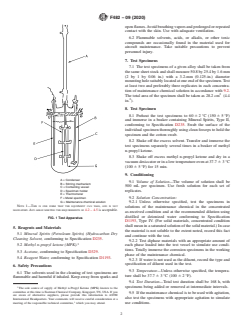
4.1 Wide-Mouth Glass Jar or Flask of suitable sizes (3000
mine the applicability of regulatory limitations prior to use.
to 4000 mL), capable of accommodating a reflux condenser, a
For specific precautions, see Section 6.
thermometer, and a specimen support system. Fig. 1 shows a
1.4 This international standard was developed in accor-
typical arrangement, but any array meeting the provisions of
dance with internationally recognized principles on standard-
4.2 – 4.5 is acceptable.
ization established in the Decision on Principles for the
4.1.1 If agitation is required, use an apparatus capable of
Development of International Standards, Guides and Recom-
accepting a stirring mechanism, such as a magnetic stirrer or
mendations issued by the World Trade Organization Technical
impeller. Choose the glass jar or flask such that the specimens
Barriers to Trade (TBT) Committee.
will remain fully immersed in a vertical position during the
test, and the ratio of area of immersed metal to volume of
2. Referenced Documents
solution will be in accordance with 9.1.
2.1 ASTM Standards:
4.2 Specimen-Supporting Device—a glass or fluorocarbon
D235 Specification for Mineral Spirits (Petroleum Spirits)
plastic supporting system designed to keep the specimen fully
(Hydrocarbon Dry Cleaning Solvent)
immersed while assuring free contact with the corroding
D329 Specification for Acetone
solution, and designed to physically isolate the specimens from
D1193 Specification for Reagent Water
each other.
E1 Specification for ASTM Liquid-in-Glass Thermometers
4.3 Condenser—a glass reflux condenser of the water-
cooled type, having a condenser jacket 200 to 300 mm in
length.
This practice is under the jurisdiction of ASTM Committee F07 on Aerospace
4.4 Constant-Temperature Device—Use any suitable regu-
and Aircraft and is the direct responsibility of Subcommittee F07.07 on Qualifica-
tion Testing of Aircraft Cleaning Materials.
lated heating device (mantle, hot plate, or bath) to maintain the
Current edition approved Nov. 1, 2020. Published December 2020. Originally
solution at the required temperature.
published in 1977. Last previous edition approved in 2014 as F482 – 09(2014).
DOI: 10.1520/F0482-09R20.
4.5 Thermometer—an ASTM 75-mm (3-in.) immersion
For referenced ASTM standards, visit the ASTM website, www.astm.org, or
thermometer having a range from −18 to 150 °C (0 to 302 °F)
contact ASTM Customer Service at service@astm.org. For Annual Book of ASTM
and conforming to requirements for Thermometer 1F in accor-
Standards volume information, refer to the standard’s Document Summary page on
the ASTM website. dance with Specification E1.
Copyright © ASTM International, 100 Barr Harbor Drive, PO Box C700, West Conshohocken, PA 19428-2959. United States
F482 − 09 (2020)
open flames. Avoid breathing vapors and prolonged or repeated
contact with the skin. Use with adequate ventilation.
6.2 Flammable solvents, acids, or alkalis, or other toxic
compounds are occasionally found in the material used for
aircraft maintenance. Take suitable precautions to prevent
personnel injury.
7. Test Specimens
7.1 The test specimens of a given alloy shall be taken from
the same sheet stock and shall measure 50.8 by 25.4 by 1.6 mm
(2 by 1 by 0.06 in.) with a 3.2-mm (0.125-in.) diameter
mounting hole suitably located at one end of the specimen. Test
at least two and preferably three replicates in each concentra-
tion of maintenance chemical solution in accordance with 9.2.
The total area of the specimen shall be taken as 28.2 cm (4.4
in. ).
8. Test Specimen
8.1 Preheat the test specimens to 60 6 2 °C (150 6 5 °F)
and immerse in a beaker containing Mineral Spirits, Type II,
conforming to Specification D235. Swab the surface of the
individual specimen thoroughly using clean forceps to hold the
specimen and the cotton swab.
8.2 Shake off the excess solvent. Transfer and immerse the
test specimens separately several times in a beaker of methyl
n-propyl ketone.
8.3 Shake off excess methyl n-propyl ketone and dry in a
vacuum desiccator or in a low temperature oven at 37.7 6 3 °C
(100 6 5 °F) for 15 min.
9. Conditioning
A = Condenser
9.1 Volume of Solution—The volume of solution shall be
B = Stirring mechanism
500 mL per specimen. Use fresh solution for each set of
C = Containing vessel
D = Specimen holder
replicates.
E = Thermometer
9.2 Solution Concentration:
F = Metal specimen
G = Maintenance chemical solution
9.2.1 Unless otherwise specified, test the specimens in
NOTE 1—THIS IS ONE FORM THAT THE EQUIPMENT CAN TAKE, AND IS NOT
solutions of the maintenance chemical in the concentrated
MANDATORY. ANY ARRAY MEETING THE REQUIREMENTS OF 4.2 – 4.5 is acceptable.
as-received condition and at the recommended dilution using
distilled or deionized water conforming to Specification
FIG. 1 Test Apparatus
D1193, Type IV. (For solid materials, concentrated condition
shall mean in a saturated solution of the solid material.) In case
5. Reagents and Materials
the material is not soluble to the extent noted, record this fact
5.1 Mineral Spirits (Petroleum Spirits) (Hydrocarbon Dry
and continue with the test.
Cleaning Solvent, conforming to Specification D235.
9.2.2 Test diphase materials with an appropriate amount of
5.2 Methyl n-propyl ketone (MPK). each phase loaded into the test vessel to simulate use condi-
tions. Totally immerse the corrosion specimens in the working
5.3 Acetone, conforming to Specification D329.
phase of the maintenance chemical.
5.4 Reagent Water, conforming to Specification D1193.
9.2.3 If water is not used as the diluent, record the type and
specification of diluent used in the test.
6. Safety Precautions
9.3 Temperature—Unless otherwise specified, the tempera-
6.1 The solvents used in the cleaning of test specimens are
ture shall be 37.7 6 3 °C (100 6 2 °F).
flammable and harmful if inhaled. Keep away from sparks and
9.4 Test Duration—Total test duration shall be 168 h, with
3 specimens being added or removed at intermediate intervals.
The sole source of supply of Methyl n-Propyl Ketone (MPK) known to the
committee at this time is Eastman Chemical Company, Kingsport, TN, USA. If you
9.5 If the maintenance chemical is to be used with agitation,
are aware of alternative suppliers, please provide this information to ASTM
also test the specimens with appropriate agitation to simulate
International Headquarters. Your comments will receive careful consideration at a
meeting of the responsible technical committee, which you may attend. use conditions.
F482 − 09 (2020)
10. Procedure 10.6.2.4 Pitting, and
10.6.2.5 Presence of selective or localized attack.
10.1 Weigh four of five specimens (S , S , S , and S ) of the
1 2 3 4
10.6.3 If any corrosion deposits remain, remove these prod-
same alloy to the nearest 0.1 mg. Record the weights S W , S
1 1 2
ucts from S in accordance with Annex A1 and Annex A2.
W , S W , S W . Retain the fifth specimen of each alloy for
1 3 1 4 1
Rinse with distilled water conforming to Specification D1193,
comparison purposes.
Type IV followed by acetone conforming to Specification
10.2 Immerse three of the specimens (S , S , and S ) in the
1 2 3
D329 and dry.
test solution using only specimens of the same alloy in the
10.6.4 Weigh to the nearest 0.1 mg and calculate the weight
containing vessel. Retain S for use in accordance with 10.5.
loss as W . If the specimen has been treated in accordance with
Annex A1 and
...