

ASTM F1864-21
(Test Method)Standard Test Method for Dust Erosion Resistance of Optical and Infrared Transparent Materials and Coatings
General Information
- Abstract
SIGNIFICANCE AND USE
5.1 All materials on exterior aircraft surfaces are subject to abrasion from airborne particles of various sizes and shapes. Transparent materials are particularly vulnerable to abrasion, since their performance is based on their ability to transmit light with a minimal amount of scatter. Scratches, pitting, and coating removal and delamination as a result of abrasion may increase scatter, reduce transmission, and degrade the performance of transparent materials. Visually transparent materials are required for pilot and air crew enclosures, such as canopies, windshields, and viewpoints. Materials transparent in the IR region (8 to 12 μm) are required for tracking, targeting, and navigational instrumentation.
5.2 This test method is intended to provide a calibrated and repeatable means of determining the relative abrasion resistance of materials and coatings for optical and IR transparent materials and coatings. The test parameters for this test method can be directly related to dust cloud densities and velocities to which transparent materials are exposed in the field.
SCOPE
1.1 This test method covers the resistance of transparent plastics and coatings used in aerospace windscreens, canopies, and viewports to surface erosion as a result of dust impingement. This test method simulates flight through a defined particle cloud environment by means of independent control of particle size, velocity, impact angle, mass loading, and test duration.
1.2 This standard does not purport to address all of the safety concerns, if any, associated with its use. It is the responsibility of the user of this standard to establish appropriate safety, health, and environmental practices and determine the applicability of regulatory limitations prior to use.
1.3 This international standard was developed in accordance with internationally recognized principles on standardization established in the Decision on Principles for the Development of International Standards, Guides and Recommendations issued by the World Trade Organization Technical Barriers to Trade (TBT) Committee.
- Status
- Published
- Publication Date
- 30-Apr-2021
- Technical Committee
- F07 - Aerospace and Aircraft
- Drafting Committee
- F07.08 - Transparent Enclosures and Materials
Buy Documents
ASTM F1864-21 - Standard Test Method for Dust Erosion Resistance of Optical and Infrared Transparent Materials and Coatings
REDLINE ASTM F1864-21 - Standard Test Method for Dust Erosion Resistance of Optical and Infrared Transparent Materials and Coatings
Overview
ASTM F1864-21 - Standard Test Method for Dust Erosion Resistance of Optical and Infrared Transparent Materials and Coatings provides a reliable and repeatable test procedure to evaluate the resistance of transparent plastics and coatings to surface erosion caused by dust impingement. This standard, developed by ASTM International, is particularly relevant for aerospace applications, where optical clarity and transmission performance are essential for pilot enclosures, windshields, canopies, and infrared (IR) transparent instrumentation windows.
The test simulates environmental conditions that materials may face during flight through dust clouds, allowing independent control of factors such as dust particle size, velocity, impact angle, mass loading, and test duration. The ultimate goal is to ensure that optical and IR transparent materials maintain their performance, resist surface abrasion, and have reliable durability for safety-critical aerospace components.
Key Topics
- Scope: Covers transparent plastics and coatings exposed to dust erosion, primarily for components like windscreens, canopies, and viewports in aerospace settings.
- Test Environment Simulation: The procedure enables accurate simulation of real-world dust cloud densities and velocities, closely reflecting operational wear scenarios.
- Measurement Criteria:
- Optically Transparent Materials: Evaluated by changes in haze and luminous transmittance.
- IR Transparent Materials: Evaluated by changes in IR spectral transmission, typically in the 8 to 12 μm wavelength range.
- Control Parameters: Independent adjustment of dust properties including particle size distribution, particle velocity, angle of impact, and mass flow rate.
- Precision and Repeatability: Provides standardized conditions for reproducible assessment and comparison of material performance under dust erosion.
Applications
ASTM F1864-21 is primarily applied in the aerospace industry to qualify and screen materials intended for use in high-visibility and infrared-transmitting components. Practical uses include:
- Aircraft Windshields, Canopies, and Viewports: Ensures long-term optical clarity and structural integrity under repeated exposure to abrasive environments.
- Infrared Sensor Windows: Protects the optical quality crucial for systems such as tracking and targeting sensors, and navigation instruments.
- Material and Coating Development: Offers material manufacturers and R&D teams a reference procedure to test and improve the abrasion resistance of new transparent materials or protective coatings.
- Qualification Testing: Assists regulatory compliance and customer specification fulfillment by demonstrating that materials meet industry standards for durability in dusty operational environments.
Related Standards
ASTM F1864-21 references multiple complementary standards for sample preparation, measurement, and apparatus calibration, including:
- ASTM D618: Practice for Conditioning Plastics for Testing
- ASTM D1003: Test Method for Haze and Luminous Transmittance of Transparent Plastics
- ASTM D1193: Specification for Reagent Water
- ASTM E11: Specification for Woven Wire Test Sieve Cloth and Test Sieves
- ASTM E168: Practices for General Techniques of Infrared Quantitative Analysis
These referenced standards ensure consistent specimen preparation, environmental conditioning, and data collection-further increasing the reliability of dust erosion testing as specified in ASTM F1864-21.
Keywords: ASTM F1864-21, dust erosion resistance, optical transparent materials, infrared transparent coatings, aerospace standards, abrasion resistance, windscreen testing, canopy testing, IR window durability, haze measurement, luminous transmittance, infrared transmission, ASTM standards for transparent plastics
Relations
- Effective Date
- 01-Oct-2013
- Refers
ASTM D1003-11e1 - Standard Test Method for Haze and Luminous Transmittance of Transparent Plastics - Effective Date
- 15-Apr-2011
- Refers
ASTM D1003-11 - Standard Test Method for Haze and Luminous Transmittance of Transparent Plastics - Effective Date
- 15-Apr-2011
- Effective Date
- 01-May-2009
- Effective Date
- 01-Nov-2008
- Refers
ASTM D1003-07 - Standard Test Method for Haze and Luminous Transmittance of Transparent Plastics - Effective Date
- 01-Nov-2007
- Effective Date
- 01-Mar-2006
- Effective Date
- 01-Mar-2006
- Effective Date
- 01-Nov-2005
- Effective Date
- 01-May-2004
- Refers
ASTM E168-99(2004) - Standard Practices for General Techniques of Infrared Quantitative Analysis - Effective Date
- 01-Feb-2004
- Effective Date
- 10-May-2001
- Effective Date
- 10-May-2001
- Effective Date
- 10-Nov-2000
- Refers
ASTM D1003-00 - Standard Test Method for Haze and Luminous Transmittance of Transparent Plastics - Effective Date
- 10-Jun-2000
Buy Documents
ASTM F1864-21 - Standard Test Method for Dust Erosion Resistance of Optical and Infrared Transparent Materials and Coatings
REDLINE ASTM F1864-21 - Standard Test Method for Dust Erosion Resistance of Optical and Infrared Transparent Materials and Coatings
Get Certified
Connect with accredited certification bodies for this standard

BUREAU VERITAS Certification Germany
Bureau Veritas certification in Germany.

Element Materials Technology
Materials testing and product certification.

AQMS Ltd.
AQMS provides ISO certification to SMEs across the UK.
Sponsored listings
Frequently Asked Questions
ASTM F1864-21 is a standard published by ASTM International. Its full title is "Standard Test Method for Dust Erosion Resistance of Optical and Infrared Transparent Materials and Coatings". This standard covers: SIGNIFICANCE AND USE 5.1 All materials on exterior aircraft surfaces are subject to abrasion from airborne particles of various sizes and shapes. Transparent materials are particularly vulnerable to abrasion, since their performance is based on their ability to transmit light with a minimal amount of scatter. Scratches, pitting, and coating removal and delamination as a result of abrasion may increase scatter, reduce transmission, and degrade the performance of transparent materials. Visually transparent materials are required for pilot and air crew enclosures, such as canopies, windshields, and viewpoints. Materials transparent in the IR region (8 to 12 μm) are required for tracking, targeting, and navigational instrumentation. 5.2 This test method is intended to provide a calibrated and repeatable means of determining the relative abrasion resistance of materials and coatings for optical and IR transparent materials and coatings. The test parameters for this test method can be directly related to dust cloud densities and velocities to which transparent materials are exposed in the field. SCOPE 1.1 This test method covers the resistance of transparent plastics and coatings used in aerospace windscreens, canopies, and viewports to surface erosion as a result of dust impingement. This test method simulates flight through a defined particle cloud environment by means of independent control of particle size, velocity, impact angle, mass loading, and test duration. 1.2 This standard does not purport to address all of the safety concerns, if any, associated with its use. It is the responsibility of the user of this standard to establish appropriate safety, health, and environmental practices and determine the applicability of regulatory limitations prior to use. 1.3 This international standard was developed in accordance with internationally recognized principles on standardization established in the Decision on Principles for the Development of International Standards, Guides and Recommendations issued by the World Trade Organization Technical Barriers to Trade (TBT) Committee.
SIGNIFICANCE AND USE 5.1 All materials on exterior aircraft surfaces are subject to abrasion from airborne particles of various sizes and shapes. Transparent materials are particularly vulnerable to abrasion, since their performance is based on their ability to transmit light with a minimal amount of scatter. Scratches, pitting, and coating removal and delamination as a result of abrasion may increase scatter, reduce transmission, and degrade the performance of transparent materials. Visually transparent materials are required for pilot and air crew enclosures, such as canopies, windshields, and viewpoints. Materials transparent in the IR region (8 to 12 μm) are required for tracking, targeting, and navigational instrumentation. 5.2 This test method is intended to provide a calibrated and repeatable means of determining the relative abrasion resistance of materials and coatings for optical and IR transparent materials and coatings. The test parameters for this test method can be directly related to dust cloud densities and velocities to which transparent materials are exposed in the field. SCOPE 1.1 This test method covers the resistance of transparent plastics and coatings used in aerospace windscreens, canopies, and viewports to surface erosion as a result of dust impingement. This test method simulates flight through a defined particle cloud environment by means of independent control of particle size, velocity, impact angle, mass loading, and test duration. 1.2 This standard does not purport to address all of the safety concerns, if any, associated with its use. It is the responsibility of the user of this standard to establish appropriate safety, health, and environmental practices and determine the applicability of regulatory limitations prior to use. 1.3 This international standard was developed in accordance with internationally recognized principles on standardization established in the Decision on Principles for the Development of International Standards, Guides and Recommendations issued by the World Trade Organization Technical Barriers to Trade (TBT) Committee.
ASTM F1864-21 is classified under the following ICS (International Classification for Standards) categories: 49.040 - Coatings and related processes used in aerospace industry. The ICS classification helps identify the subject area and facilitates finding related standards.
ASTM F1864-21 has the following relationships with other standards: It is inter standard links to ASTM E11-13, ASTM D1003-11e1, ASTM D1003-11, ASTM E11-09e1, ASTM D618-08, ASTM D1003-07, ASTM E168-06, ASTM D1193-06, ASTM D618-05, ASTM E11-04, ASTM E168-99(2004), ASTM E11-01, ASTM E11-95, ASTM D618-00, ASTM D1003-00. Understanding these relationships helps ensure you are using the most current and applicable version of the standard.
ASTM F1864-21 is available in PDF format for immediate download after purchase. The document can be added to your cart and obtained through the secure checkout process. Digital delivery ensures instant access to the complete standard document.
Standards Content (Sample)
This international standard was developed in accordance with internationally recognized principles on standardization established in the Decision on Principles for the
Development of International Standards, Guides and Recommendations issued by the World Trade Organization Technical Barriers to Trade (TBT) Committee.
Designation: F1864 − 21
Standard Test Method for
Dust Erosion Resistance of Optical and Infrared Transparent
Materials and Coatings
This standard is issued under the fixed designation F1864; the number immediately following the designation indicates the year of
original adoption or, in the case of revision, the year of last revision.Anumber in parentheses indicates the year of last reapproval.A
superscript epsilon (´) indicates an editorial change since the last revision or reapproval.
1. Scope 3. Terminology
3.1 Definitions of Terms Specific to This Standard:
1.1 This test method covers the resistance of transparent
plastics and coatings used in aerospace windscreens, canopies,
3.1.1 mass loading, n—the mass of dust per unit of total
and viewports to surface erosion as a result of dust impinge-
exposed surface area (including the sample holder) that im-
ment. This test method simulates flight through a defined
pinges on the specimens.
particlecloudenvironmentbymeansofindependentcontrolof
3.1.2 mean IR transmission, n—for the purposes of this
particle size, velocity, impact angle, mass loading, and test
standard, the average percentage of light transmitted by a
duration.
material in the 8 to 12µm bandwidth.
1.2 This standard does not purport to address all of the
3.1.3 sweep time, n—the time required for one translation
safety concerns, if any, associated with its use. It is the
pass.
responsibility of the user of this standard to establish appro-
priate safety, health, and environmental practices and deter- 3.1.4 translation pass, n—the translation of the specimen
mine the applicability of regulatory limitations prior to use. platformfromtheverticalorhorizontallimittothecorrespond-
1.3 This international standard was developed in accor- ing vertical or horizontal limit.
dance with internationally recognized principles on standard-
3.1.5 translation cycle, n—the translation of the specimen
ization established in the Decision on Principles for the
platformfromtheverticalorhorizontallimittothecorrespond-
Development of International Standards, Guides and Recom-
ingverticalorhorizontallimitandbacktotheinitialverticalor
mendations issued by the World Trade Organization Technical
horizontal limit. Two translation passes are equivalent to one
Barriers to Trade (TBT) Committee.
translation cycle.
3.2 Symbols:
2. Referenced Documents
2.1 ASTM Standards:
A = reference surface area of specimen platform (cm ),
D618Practice for Conditioning Plastics for Testing
s
C = simulated cloud concentration (g/m ),
D1003Test Method for Haze and Luminous Transmittance
c
h = percent haze before exposure,
of Transparent Plastics o
h = percent haze after exposure,
D1193Specification for Reagent Water e
m˙ = rate of particle mass impacting the reference surface
p
E11Specification forWovenWireTest Sieve Cloth andTest
area (g/min),
Sieves
m˙ = incremental mass loading (g/cm ),
i
E168Practices for General Techniques of Infrared Quanti-
m = total mass loading (g/cm ),
T
tative Analysis
N = number of increments,
V = particle impact velocity (m/s),
p
t = sweep time(s),
s
T = optical or mean infrared (IR) transmission after expo-
This test method is under the jurisdiction of ASTM Committee F07 on
e
Aerospace andAircraft and is the direct responsibility of Subcommittee F07.08 on
sure (%),
Transparent Enclosures and Materials.
T = optical or mean IR transmission before exposure (%),
o
Current edition approved May 1, 2021. Published May 2021. Originally
α = impact angle (normal incidence=90°),
approved in 1998. Last previous edition approved in 2016 as F1864–16. DOI:
∆t = exposure time (min) for loading increment i,
10.1520/F1864-21. i
φ = incremental dust load (g/cm ) for loading increment i,
For referenced ASTM standards, visit the ASTM website, www.astm.org, or
i
contact ASTM Customer Service at service@astm.org. For Annual Book of ASTM
Standards volume information, refer to the standard’s Document Summary page on
Φ = total dust load (g/cm ),
the ASTM website.
Copyright © ASTM International, 100 Barr Harbor Drive, PO Box C700, West Conshohocken, PA 19428-2959. United States
F1864 − 21
coating removal and delamination as a result of abrasion may
∆h = change in percent haze, and
increase scatter, reduce transmission, and degrade the perfor-
∆T = change in optical or IR transmission.
mance of transparent materials. Visually transparent materials
4. Summary of Test Method
arerequiredforpilotandaircrewenclosures,suchascanopies,
windshields, and viewpoints. Materials transparent in the IR
4.1 This test method consists of: (1) measuring and record-
region (8 to 12 µm) are required for tracking, targeting, and
ing the light transmission properties, at visual or infrared
navigational instrumentation.
wavelengths, of test coupons; (2) mounting the coupons in a
test fixture; (3) exposing the coupons to a dust particle stream;
5.2 This test method is intended to provide a calibrated and
and (4) remeasuring the light transmission properties to deter-
repeatable means of determining the relative abrasion resis-
mine changes in these properties.
tance of materials and coatings for optical and IR transparent
materialsandcoatings.Thetestparametersforthistestmethod
4.2 The dust particle stream simulates flight at a specified
can be directly related to dust cloud densities and velocities to
velocitythroughadustcloudofspecifieddensity.Simulationis
which transparent materials are exposed in the field.
accomplished through control of particle size distribution,
mean particle velocity, particle mass flow rate, and angle of
6. Apparatus
impact.
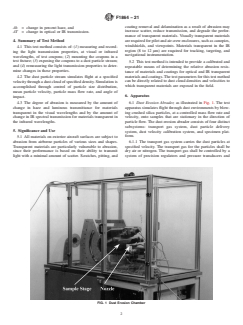
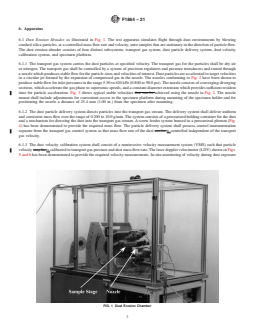
4.3 The degree of abrasion is measured by the amount of 6.1 Dust Erosion Abrader, as illustrated in Fig. 1. The test
change in haze and luminous transmittance for materials apparatus simulates flight through dust environments by blow-
transparent in the visual wavelengths and by the amount of ing crushed silica particles, at a controlled mass flow rate and
change in IR spectral transmission for materials transparent in velocity, onto samples that are stationary in the direction of
the infrared wavelengths. particle flow.The dust erosion abrader consists of four distinct
subsystems: transport gas system, dust particle delivery
5. Significance and Use
system, dust velocity calibration system, and specimen plat-
form.
5.1 All materials on exterior aircraft surfaces are subject to
abrasion from airborne particles of various sizes and shapes. 6.1.1 The transport gas system carries the dust particles at
Transparent materials are particularly vulnerable to abrasion, specified velocity. The transport gas for the particles shall be
since their performance is based on their ability to transmit dry air or nitrogen. The transport gas shall be controlled by a
light with a minimal amount of scatter. Scratches, pitting, and system of precision regulators and pressure transducers and
FIG. 1 Dust Erosion Chamber
F1864 − 21
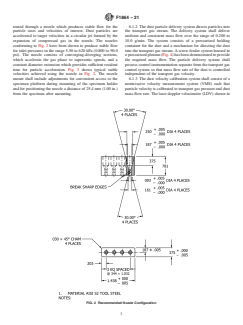
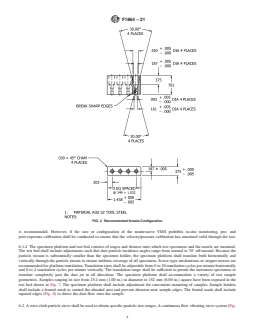
routed through a nozzle which produces stable flow for the 6.1.2 The dust particle delivery system directs particles into
particle sizes and velocities of interest. Dust particles are the transport gas stream. The delivery system shall deliver
accelerated to target velocities in a circular jet formed by the uniform and consistent mass flow over the range of 0.200 to
expansion of compressed gas in the nozzle. The nozzles 10.0 g/min. The system consists of a pressurized holding
conforming to Fig. 2 have been shown to produce stable flow container for the dust and a mechanism for directing the dust
for inlet pressures in the range 5.50 to 620 kPa (0.800 to 90.0 into the transport gas stream.Ascrew feeder system housed in
psi). The nozzle consists of converging-diverging sections, apressurizedplenum(Fig.4)hasbeendemonstratedtoprovide
which accelerate the gas phase to supersonic speeds, and a the required mass flow. The particle delivery system shall
constant diameter extension which provides sufficient resident possesscontrolinstrumentationseparatefromthetransportgas
time for particle acceleration. Fig. 3 shows typical stable control system so that mass flow rate of the dust is controlled
velocities achieved using the nozzle in Fig. 2. The nozzle independent of the transport gas velocity.
mount shall include adjustments for convenient access to the 6.1.3 The dust velocity calibration system shall consist of a
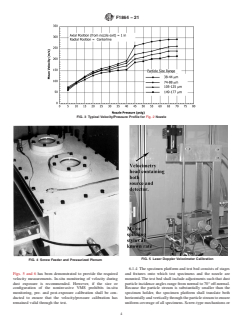
specimen platform during mounting of the specimen holder noninvasive velocity measurement system (VMS) such that
and for positioning the nozzle a distance of 25.4 mm (1.00 in.) particlevelocityiscalibratedtotransportgaspressureanddust
from the specimen after mounting. massflowrate.Thelaserdopplervelocimeter(LDV)shownin
FIG. 2 Recommended Nozzle Configuration
F1864 − 21
FIG. 3 Typical Velocity/Pressure Profile for Fig. 2 Nozzle
FIG. 5 Laser Doppler Velocimeter Calibration
FIG. 4 Screw Feeder and Pressurized Plenum
6.1.4 The specimen platform and test bed consists of stages
Figs. 5 and 6 has been demonstrated to provide the required and fixtures onto which test specimens and the nozzle are
velocity measurements. In-situ monitoring of velocity during mounted.The test bed shall include adjustments such that dust
dust exposure is recommended. However, if the size or particle incidence angles range from normal to 70° off-normal.
configuration of the noninvasive VMS prohibits in-situ Because the particle stream is substantially smaller than the
monitoring, pre- and post-exposure calibration shall be con- specimen holder, the specimen platform shall translate both
ducted to ensure that the velocity/pressure calibration has horizontallyandverticallythroughtheparticlestreamtoensure
remained valid through the test. uniformcoverageofallspecimens.Screw-typemechanismsor
F1864 − 21
mask to control the abraded area and prevent abrasion near
sample edges. The frontal mask shall include tapered edges
(Fig. 8) to direct the dust flow onto the sample.
6.2 A wire-cloth particle sieve shall be used to obtain
specific particle-size ranges.Acontinuous flow vibrating sieve
system (Fig. 9) is recommended for optimum and efficient
sieving of bulk sand. Sieve nominal dimensions and permis-
sible variations shall comply with the U.S.A. Standard Test
Sieves Standard Series as detailed in Specification E11.
6.3 Integrating Sphere Photoelectric Photometer, as de-
scribed in Test Method D1003, shall be used to measure the
light transmitted and scattered by the abraded surface of
optically transparent materials and coatings.
6.4 Fourier Transform Infrared (FTIR) Spectrometer shall
FIG. 6 Laser Doppler Power Supply and Instrumentation
be used to measure the IR transmission properties of IR
transparent materials and coatings. The spectrometer shall be
stepper motors are recommended for platform translation.
capable of measuring percent transmission in the 8 to 12µm
Translation rates shall be adjustable from 0 to 30 translation bandwidth. A number of self-contained commercial FTIR
cyclesperminutehorizontallyand0to4translationcyclesper
systems existing on the market have been demonstrated to
minute vertically. The translation range shall be sufficient to providetherequiredmeasurements.Spectrometersusedinthis
permittheoutermostspecimenstotranslatecompletelypastthe
test method shall comply with applicable sections of Practice
dust jet in all directions. The specimen platform shall accom-
E168.
modateavarietyoftestsamplegeometries.Samplesrangingin
size from 25.4 mm (1.00 in.) in diameter to 152 mm (6.00 in.)
7. Materials and Reagents
square have been exposed in the test bed shown in Fig. 7. The
7.1 Purity of Water—Unless otherwise indicated, references
specimen platform shall include adjustment for convenient
to water shall be understood to mean reagent water as defined
mounting of samples. Sample holders shall include a frontal
by Type II of Specification D1193.
7.2 Crushed Silica Sand—Thedustparticlesshallconsistof
crushed silica sand. The sand shall be dry, nonclogging, and
have corners and edges that have not been rounded by other
than the crushing process. Bulk dust particle sizes shall be
uniformly distributed in the range 10 to 250 µm.
7.3 Compressed Air or Nitrogen—Thetransportgasshallbe
dry and pressurized to a minimum of 827 kPa (120 psi) at the
source.
FIG. 7 Dust Erosion Test Bed with Programmable Stepper Mo-
tors FIG. 8 Typical Frontal Mask
F1864 − 21
8.4 For each exposure condition, prepare and test a mini-
mum of three samples.
8.5 Forstoragepurposes,wrapsamplesinlint-freetissueor
other suitable materials to prevent scratching or marring of the
surface.
9. Preparation of Apparatus
9.1 Identify the distribution of dust particles to be used in
theexposureandsievethebulksandtothedesireddistribution.
Follow the operating directions of automated sieving equip-
ment if used. (Warning—Sieving of the bulk sand can create
small airborne dust particles that can irritate the nose, throat,
and lungs. Wear a breathing mask appropriate for the particle
size being sieved to minimize the hazard of inhaling airborne
dust particles.)
9.2 Fill the pressurized holding chamber with the dust
required for the exposure run.
9.2.1 Iftheholdingcontainerrequiressimplereplenishment
of dust, remove the chamber lid and add the required amount
of dust. Check all pressure seals for damage, and replace if
damaged or worn. Carefully replace the lid, ensuring the
chamber is adequately sealed.
9.2.2 If the subsequent exposure run requires exchanging
dust sizes, remove the chamber lid and remove the dust from
the previous run. Thoroughly clean all chamber and delivery
system components (disassemble if necessary) to remove all
FIG. 9 Continuous Flow Vibrating Sieve
traces of the previous dust. Wipe holding chamber surfaces
with a lint-free towel dampened with isopropyl alcohol solu-
7.4 Isopropyl Alcohol Solution—Mix isopropyl alcohol
tion. Add the required amount of dust for the next exposure
(C H OH) with water in a volumetric ratio of 1:1.
3 7 run.Che
...
This document is not an ASTM standard and is intended only to provide the user of an ASTM standard an indication of what changes have been made to the previous version. Because
it may not be technically possible to adequately depict all changes accurately, ASTM recommends that users consult prior editions as appropriate. In all cases only the current version
of the standard as published by ASTM is to be considered the official document.
Designation: F1864 − 16 F1864 − 21
Standard Test Method for
Dust Erosion Resistance of Optical and Infrared Transparent
Materials and Coatings
This standard is issued under the fixed designation F1864; the number immediately following the designation indicates the year of
original adoption or, in the case of revision, the year of last revision. A number in parentheses indicates the year of last reapproval. A
superscript epsilon (´) indicates an editorial change since the last revision or reapproval.
1. Scope
1.1 This test method covers the resistance of transparent plastics and coatings used in aerospace windscreens, canopies, and
viewports to surface erosion as a result of dust impingement. This test method simulates flight through a defined particle cloud
environment by means of independent control of particle size, velocity, impact angle, mass loading, and test duration.
1.2 This standard does not purport to address all of the safety concerns, if any, associated with its use. It is the responsibility
of the user of this standard to establish appropriate safety safety, health, and healthenvironmental practices and determine the
applicability of regulatory limitations prior to use.
1.3 This international standard was developed in accordance with internationally recognized principles on standardization
established in the Decision on Principles for the Development of International Standards, Guides and Recommendations issued
by the World Trade Organization Technical Barriers to Trade (TBT) Committee.
2. Referenced Documents
2.1 ASTM Standards:
D618 Practice for Conditioning Plastics for Testing
D1003 Test Method for Haze and Luminous Transmittance of Transparent Plastics
D1193 Specification for Reagent Water
E11 Specification for Woven Wire Test Sieve Cloth and Test Sieves
E168 Practices for General Techniques of Infrared Quantitative Analysis
3. Terminology
3.1 Definitions of Terms Specific to This Standard:
3.1.1 mass loading, n—the mass of dust per unit of total exposed surface area (including the sample holder) that impinges on the
specimens.
3.1.2 mean IR transmission, n—for the purposes of this standard, the average percentage of light transmitted by a material in the
8-8 to 12-μm12 μm bandwidth.
3.1.3 sweep time, n—the time required for one translation pass.
This test method is under the jurisdiction of ASTM Committee F07 on Aerospace and Aircraft and is the direct responsibility of Subcommittee F07.08 on Transparent
Enclosures and Materials.
Current edition approved April 1, 2016May 1, 2021. Published April 2016May 2021. Originally approved in 1998. Last previous edition approved in 20102016 as
F1864 – 05 (2010).F1864 – 16. DOI: 10.1520/F1864-16.10.1520/F1864-21.
For referenced ASTM standards, visit the ASTM website, www.astm.org, or contact ASTM Customer Service at service@astm.org. For Annual Book of ASTM Standards
volume information, refer to the standard’s Document Summary page on the ASTM website.
Copyright © ASTM International, 100 Barr Harbor Drive, PO Box C700, West Conshohocken, PA 19428-2959. United States
F1864 − 21
3.1.4 translation pass, n—the translation of the specimen platform from the vertical or horizontal limit to the corresponding
vertical or horizontal limit.
3.1.5 translation cycle, n—the translation of the specimen platform from the vertical or horizontal limit to the corresponding
vertical or horizontal limit and back to the initial vertical or horizontal limit. Two translation passes are equivalent to one
translation cycle.
3.2 Symbols:
A = reference surface area of specimen platform (cm ),
s
C = simulated cloud concentration (g/m ),
c
h = percent haze before exposure,
o
h = percent haze after exposure,
e
m˙ = rate of particle mass impacting the reference surface area (g/min),
p
m˙ = incremental mass loading (g/cm ),
i
m = total mass loading (g/cm ),
T
N = number of increments,
V = particle impact velocity (m/s),
p
t = sweep time(s),
s
T = optical or mean infrared (IR) transmission after exposure (%),
e
T = optical or mean IR transmission before exposure (%),
o
α = impact angle (normal incidence = 90°),
Δt = exposure time (min) for loading increment i,
i
φ = incremental dust load (g/cm ) for loading increment i,
i
Φ = total dust load (g/cm ),
Δh = change in percent haze, and
ΔT = change in optical or IR transmission.
4. Summary of Test Method
4.1 This test method consists of: (1) measuring and recording the light transmission properties, at visual or infrared wavelengths,
of test coupons; (2) mounting the coupons in a test fixture; (3) exposing the coupons to a dust particle stream; and (4) remeasuring
the light transmission properties to determine changes in these properties.
4.2 The dust particle stream simulates flight at a specified velocity through a dust cloud of specified density. Simulation is
accomplished through control of particle size distribution, mean particle velocity, particle mass flow rate, and angle of impact.
4.3 The degree of abrasion is measured by the amount of change in haze and luminous transmittance for materials transparent in
the visual wavelengths and by the amount of change in IR spectral transmission for materials transparent in the infrared
wavelengths.
5. Significance and Use
5.1 All materials on exterior aircraft surfaces are subject to abrasion from airborne particles of various sizes and shapes.
Transparent materials are particularly vulnerable to abrasion, since their performance is based on their ability to transmit light with
a minimal amount of scatter. Scratches, pitting, and coating removal and delamination as a result of abrasion may increase scatter,
reduce transmission, and degrade the performance of transparent materials. Visually transparent materials are required for pilot and
air crew enclosures, such as canopies, windshields, and viewpoints. Materials transparent in the IR region (8 to 12 μm) are required
for tracking, targeting, and navigational instrumentation.
5.2 This test method is intended to provide a calibrated and repeatable means of determining the relative abrasion resistance of
materials and coatings for optical and IR transparent materials and coatings. The test parameters for this test method can be directly
related to dust cloud densities and velocities to which transparent materials are exposed in the field.
F1864 − 21
6. Apparatus
6.1 Dust Erosion Abrader, as illustrated in Fig. 1. The test apparatus simulates flight through dust environments by blowing
crushed silica particles, at a controlled mass flow rate and velocity, onto samples that are stationary in the direction of particle flow.
The dust erosion abrader consists of four distinct subsystems: transport gas system, dust particle delivery system, dust velocity
calibration system, and specimen platform.
6.1.1 The transport gas system carries the dust particles at specified velocity. The transport gas for the particles shall be dry air
or nitrogen. The transport gas shall be controlled by a system of precision regulators and pressure transducers and routed through
a nozzle which produces stable flow for the particle sizes and velocities of interest. Dust particles are accelerated to target velocities
in a circular jet formed by the expansion of compressed gas in the nozzle. The nozzles conforming to Fig. 2 have been shown to
produce stable flow for inlet pressures in the range 5.50 to 620 kPa (0.800 to 90.0 psi). The nozzle consists of converging-diverging
sections, which accelerate the gas phase to supersonic speeds, and a constant diameter extension which provides sufficient resident
time for particle acceleration. Fig. 3 shows typical stable velocities that can be achieved using the nozzle in Fig. 2. The nozzle
mount shall include adjustments for convenient access to the specimen platform during mounting of the specimen holder and for
positioning the nozzle a distance of 25.4 mm (1.00 in.) from the specimen after mounting.
6.1.2 The dust particle delivery system directs particles into the transport gas stream. The delivery system shall deliver uniform
and consistent mass flow over the range of 0.200 to 10.0 g/min. The system consists of a pressurized holding container for the dust
and a mechanism for directing the dust into the transport gas stream. A screw feeder system housed in a pressurized plenum (Fig.
4) has been demonstrated to provide the required mass flow. The particle delivery system shall possess control instrumentation
separate from the transport gas control system so that mass flow rate of the dust can be is controlled independent of the transport
gas velocity.
6.1.3 The dust velocity calibration system shall consist of a noninvasive velocity measurement system (VMS) such that particle
velocity may be is calibrated to transport gas pressure and dust mass flow rate. The laser doppler velocimeter (LDV) shown in Figs.
5 and 6 has been demonstrated to provide the required velocity measurements. In-situ monitoring of velocity during dust exposure
FIG. 1 Dust Erosion Chamber
F1864 − 21
FIG. 2 Recommended Nozzle Configuration
is recommended. However, if the size or configuration of the noninvasive VMS prohibits in-situ monitoring, pre- and
post-exposure calibration shall be conducted to ensure that the velocity/pressure calibration has remained valid through the test.
6.1.4 The specimen platform and test bed consists of stages and fixtures onto which test specimens and the nozzle are mounted.
The test bed shall include adjustments such that dust particle incidence angles range from normal to 70° off-normal. Because the
particle stream is substantially smaller than the specimen holder, the specimen platform shall translate both horizontally and
vertically through the particle stream to ensure uniform coverage of all specimens. Screw-type mechanisms or stepper motors are
recommended for platform translation. Translation rates shall be adjustable from 0 to 30 translation cycles per minute horizontally
and 0 to 4 translation cycles per minute vertically. The translation range shall be sufficient to permit the outermost specimens to
translate completely past the dust jet in all directions. The specimen platform shall accommodate a variety of test sample
geometries. Samples ranging in size from 25.4 mm (1.00 in.) in diameter to 152 mm (6.00 in.) square have been exposed in the
test bed shown in Fig. 7. The specimen platform shall include adjustment for convenient mounting of samples. Sample holders
shall include a frontal mask to control the abraded area and prevent abrasion near sample edges. The frontal mask shall include
tapered edges (Fig. 8) to direct the dust flow onto the sample.
6.2 A wire-cloth particle sieve shall be used to obtain specific particle-size ranges. A continuous flow vibrating sieve system (Fig.
F1864 − 21
FIG. 3 Typical Velocity/Pressure Profile for Fig. 2 Nozzle
FIG. 4 Screw Feeder and Pressurized Plenum
9) is recommended for optimum and efficient sieving of bulk sand. Sieve nominal dimensions and permissible variations
shall comply with the U.S.A. Standard Test Sieves Standard Series as detailed in Specification E11.
6.3 Integrating Sphere Photoelectric Photometer, as described in Test Method D1003, shall be used to measure the light
transmitted and scattered by the abraded surface of optically transparent materials and coatings.
6.4 Fourier Transform Infrared (FTIR) Spectrometer shall be used to measure the IR transmission properties of IR transparent
F1864 − 21
FIG. 5 Laser Doppler Velocimeter Calibration
FIG. 6 Laser Doppler Power Supply and Instrumentation
materials and coatings. The spectrometer shall be capable of measuring percent transmission in the 8-8 to 12-μm12 μm bandwidth.
A number of self-contained commercial FTIR systems existing on the market have been demonstrated to provide the required
measurements. Spectrometers used in this test method shall comply with applicable sections of Practice E168.
7. Materials and Reagents
7.1 Purity of Water—Unless otherwise indicated, references to water shall be understood to mean reagent water as defined by Type
II of Specification D1193.
7.2 Crushed Silica Sand—The dust particles shall consist of crushed silica sand. The sand shall be dry, nonclogging, and have
corners and edges that have not been rounded by other than the crushing process. Bulk dust particle sizes shall be uniformly
distributed in the range 10 to 250 μm.
F1864 − 21
FIG. 7 Dust Erosion Test Bed with Programmable Stepper Motors
FIG. 8 Typical Frontal Mask
7.3 Compressed Air or Nitrogen—The transport gas shall be dry and pressurized to a minimum of 827 kPa (120 psi) at the source.
7.4 Isopropyl Alcohol Solution—Mix isopropyl alcohol (C H OH) with water in a volumetric ratio of 1:1.
3 7
8. Test Specimens
8.1 Optically Transparent Materials—Test specimens shall be clean flat samples of the material or substrate/coating system to be
F1864 − 21
FIG. 9 Continuous Flow Vibrating Sieve
evaluated. Sample dimensions, including thickness, shall be of any convenient dimension that can be accommodated by the
2 2
specimen platform and test bed, with a minimum exposed surface area of 363 mm (0.750 in. ). Samples ranging in size from 25.4
to 152 mm (1.00 to 6.00 in.) square have been found to accommodate most test requirements. Sides of samples shall be
substantially plane and parallel. Edge chipping and coating delamination resulting from sample fabrication or preparation shall not
extend into the unmasked portion of the sample.
8.2 IR Transparent Materials—Test specimens shall be clean flat samples of the material or substrate/coating system to be
evaluated. Sample dimensions, including thickness, may be of any convenient dimension that can be accommodated by the
2 2
specimen platform and test bed, with a minimum exposed surface area of 363 mm (0.750 in. ). Samples 25.4 mm (1.00 in.) in
diameter have been found to be suitable for most test requirements. Edge chipping and coating delamination resulting from sample
fabrication or preparation shall not extend into the unmasked portion of the sample.
8.3 Apply specimen ID numbers to the edges of specimens using a permanent marker suitable for the material being exp
...