


ASTM D4169-22
(Practice)Standard Practice for Performance Testing of Shipping Containers and Systems
Standard Practice for Performance Testing of Shipping Containers and Systems
SIGNIFICANCE AND USE
4.1 This practice provides a guide for the evaluation of shipping units in accordance with a uniform system, using established test methods at levels representative of those occurring in actual distribution. The recommended test levels are based on available information on the shipping and handling environment, and current industry/government practice and experience (1-13).6 The tests should be performed sequentially on the same containers in the order given. For use as a performance test, this practice requires that the shipping unit tested remain unopened until the sequence of tests are completed. If used for other purposes, such as package development, it may be useful to open and inspect shipping units at various times throughout the sequence. This may, however, prohibit evaluating the influence of the container closure on container performance.
4.2 For Distribution Cycle 18, as referred to in MIL-STD-2073–1, the use of this practice is defined in subsequent sections identified as DC-18.
SCOPE
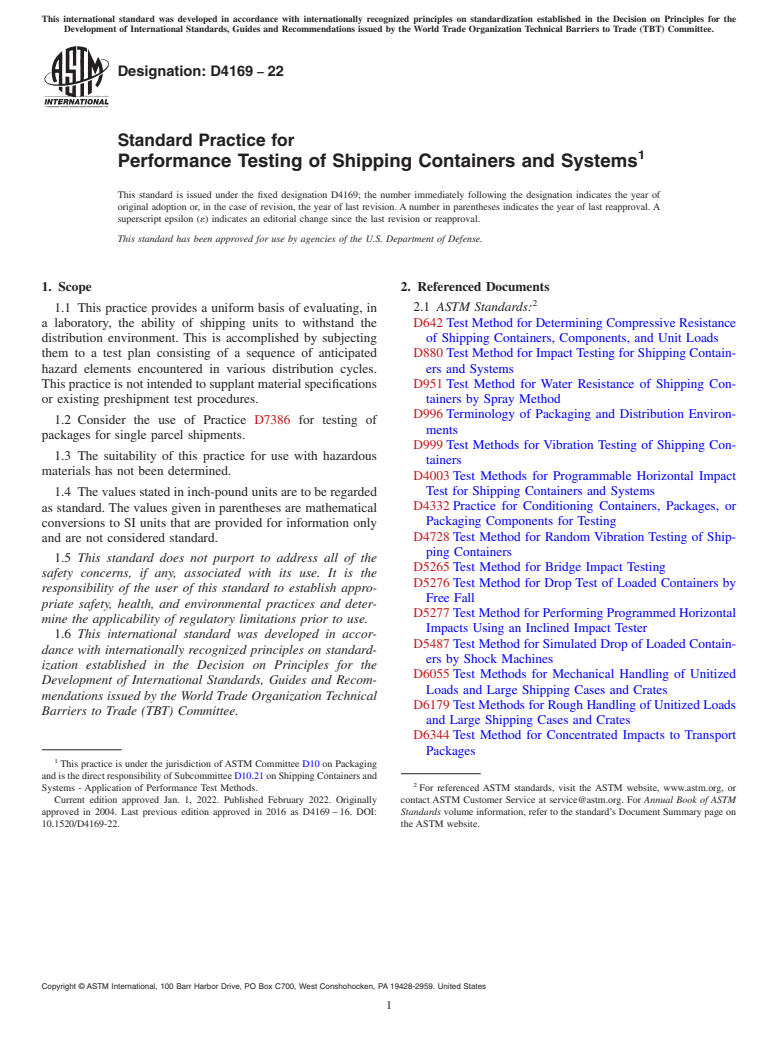
1.1 This practice provides a uniform basis of evaluating, in a laboratory, the ability of shipping units to withstand the distribution environment. This is accomplished by subjecting them to a test plan consisting of a sequence of anticipated hazard elements encountered in various distribution cycles. This practice is not intended to supplant material specifications or existing preshipment test procedures.
1.2 Consider the use of Practice D7386 for testing of packages for single parcel shipments.
1.3 The suitability of this practice for use with hazardous materials has not been determined.
1.4 The values stated in inch-pound units are to be regarded as standard. The values given in parentheses are mathematical conversions to SI units that are provided for information only and are not considered standard.
1.5 This standard does not purport to address all of the safety concerns, if any, associated with its use. It is the responsibility of the user of this standard to establish appropriate safety, health, and environmental practices and determine the applicability of regulatory limitations prior to use.
1.6 This international standard was developed in accordance with internationally recognized principles on standardization established in the Decision on Principles for the Development of International Standards, Guides and Recommendations issued by the World Trade Organization Technical Barriers to Trade (TBT) Committee.
General Information
- Status
- Historical
- Publication Date
- 31-Dec-2021
- Technical Committee
- D10 - Packaging
- Current Stage
Relations
- Replaced By
ASTM D4169-23 - Standard Practice for Performance Testing of Shipping Containers and Systems - Effective Date
- 01-Dec-2023
- Effective Date
- 01-Dec-2023
- Effective Date
- 01-Oct-2023
- Effective Date
- 01-Aug-2019
- Effective Date
- 01-Aug-2019
- Effective Date
- 01-Sep-2017
- Refers
ASTM D951-17 - Standard Test Method for Water Resistance of Shipping Containers by Spray Method - Effective Date
- 01-Sep-2017
- Effective Date
- 01-May-2017
- Effective Date
- 01-Apr-2016
- Effective Date
- 01-Oct-2015
- Effective Date
- 01-Oct-2015
- Effective Date
- 01-Apr-2014
- Effective Date
- 15-Mar-2013
- Effective Date
- 01-Apr-2012
- Refers
ASTM D4728-06(2012) - Standard Test Method for Random Vibration Testing of Shipping Containers - Effective Date
- 01-Apr-2012


ASTM D4169-22 - Standard Practice for Performance Testing of Shipping Containers and Systems


REDLINE ASTM D4169-22 - Standard Practice for Performance Testing of Shipping Containers and Systems


ASTM D4169-22 - Standard Practice for Performance Testing of Shipping Containers and Systems
Frequently Asked Questions
ASTM D4169-22 is a standard published by ASTM International. Its full title is "Standard Practice for Performance Testing of Shipping Containers and Systems". This standard covers: SIGNIFICANCE AND USE 4.1 This practice provides a guide for the evaluation of shipping units in accordance with a uniform system, using established test methods at levels representative of those occurring in actual distribution. The recommended test levels are based on available information on the shipping and handling environment, and current industry/government practice and experience (1-13).6 The tests should be performed sequentially on the same containers in the order given. For use as a performance test, this practice requires that the shipping unit tested remain unopened until the sequence of tests are completed. If used for other purposes, such as package development, it may be useful to open and inspect shipping units at various times throughout the sequence. This may, however, prohibit evaluating the influence of the container closure on container performance. 4.2 For Distribution Cycle 18, as referred to in MIL-STD-2073–1, the use of this practice is defined in subsequent sections identified as DC-18. SCOPE 1.1 This practice provides a uniform basis of evaluating, in a laboratory, the ability of shipping units to withstand the distribution environment. This is accomplished by subjecting them to a test plan consisting of a sequence of anticipated hazard elements encountered in various distribution cycles. This practice is not intended to supplant material specifications or existing preshipment test procedures. 1.2 Consider the use of Practice D7386 for testing of packages for single parcel shipments. 1.3 The suitability of this practice for use with hazardous materials has not been determined. 1.4 The values stated in inch-pound units are to be regarded as standard. The values given in parentheses are mathematical conversions to SI units that are provided for information only and are not considered standard. 1.5 This standard does not purport to address all of the safety concerns, if any, associated with its use. It is the responsibility of the user of this standard to establish appropriate safety, health, and environmental practices and determine the applicability of regulatory limitations prior to use. 1.6 This international standard was developed in accordance with internationally recognized principles on standardization established in the Decision on Principles for the Development of International Standards, Guides and Recommendations issued by the World Trade Organization Technical Barriers to Trade (TBT) Committee.
SIGNIFICANCE AND USE 4.1 This practice provides a guide for the evaluation of shipping units in accordance with a uniform system, using established test methods at levels representative of those occurring in actual distribution. The recommended test levels are based on available information on the shipping and handling environment, and current industry/government practice and experience (1-13).6 The tests should be performed sequentially on the same containers in the order given. For use as a performance test, this practice requires that the shipping unit tested remain unopened until the sequence of tests are completed. If used for other purposes, such as package development, it may be useful to open and inspect shipping units at various times throughout the sequence. This may, however, prohibit evaluating the influence of the container closure on container performance. 4.2 For Distribution Cycle 18, as referred to in MIL-STD-2073–1, the use of this practice is defined in subsequent sections identified as DC-18. SCOPE 1.1 This practice provides a uniform basis of evaluating, in a laboratory, the ability of shipping units to withstand the distribution environment. This is accomplished by subjecting them to a test plan consisting of a sequence of anticipated hazard elements encountered in various distribution cycles. This practice is not intended to supplant material specifications or existing preshipment test procedures. 1.2 Consider the use of Practice D7386 for testing of packages for single parcel shipments. 1.3 The suitability of this practice for use with hazardous materials has not been determined. 1.4 The values stated in inch-pound units are to be regarded as standard. The values given in parentheses are mathematical conversions to SI units that are provided for information only and are not considered standard. 1.5 This standard does not purport to address all of the safety concerns, if any, associated with its use. It is the responsibility of the user of this standard to establish appropriate safety, health, and environmental practices and determine the applicability of regulatory limitations prior to use. 1.6 This international standard was developed in accordance with internationally recognized principles on standardization established in the Decision on Principles for the Development of International Standards, Guides and Recommendations issued by the World Trade Organization Technical Barriers to Trade (TBT) Committee.
ASTM D4169-22 is classified under the following ICS (International Classification for Standards) categories: 55.040 - Packaging materials and accessories. The ICS classification helps identify the subject area and facilitates finding related standards.
ASTM D4169-22 has the following relationships with other standards: It is inter standard links to ASTM D4169-23, ASTM D999-08(2023), ASTM D5276-19(2023), ASTM D6055-96(2019), ASTM D4003-98(2019)e1, ASTM D5276-98(2017), ASTM D951-17, ASTM D6344-04(2017), ASTM D7386-16, ASTM D999-08(2015), ASTM D4003-98(2015), ASTM D6055-96(2014), ASTM D4332-13, ASTM D7386-12, ASTM D4728-06(2012). Understanding these relationships helps ensure you are using the most current and applicable version of the standard.
ASTM D4169-22 is available in PDF format for immediate download after purchase. The document can be added to your cart and obtained through the secure checkout process. Digital delivery ensures instant access to the complete standard document.
Standards Content (Sample)
This international standard was developed in accordance with internationally recognized principles on standardization established in the Decision on Principles for the
Development of International Standards, Guides and Recommendations issued by the World Trade Organization Technical Barriers to Trade (TBT) Committee.
Designation: D4169 − 22
Standard Practice for
Performance Testing of Shipping Containers and Systems
This standard is issued under the fixed designation D4169; the number immediately following the designation indicates the year of
original adoption or, in the case of revision, the year of last revision.Anumber in parentheses indicates the year of last reapproval.A
superscript epsilon (´) indicates an editorial change since the last revision or reapproval.
This standard has been approved for use by agencies of the U.S. Department of Defense.
1. Scope 2. Referenced Documents
2.1 ASTM Standards:
1.1 This practice provides a uniform basis of evaluating, in
a laboratory, the ability of shipping units to withstand the D642TestMethodforDeterminingCompressiveResistance
distribution environment. This is accomplished by subjecting of Shipping Containers, Components, and Unit Loads
them to a test plan consisting of a sequence of anticipated D880Test Method for ImpactTesting for Shipping Contain-
hazard elements encountered in various distribution cycles. ers and Systems
Thispracticeisnotintendedtosupplantmaterialspecifications D951Test Method for Water Resistance of Shipping Con-
or existing preshipment test procedures. tainers by Spray Method
D996Terminology of Packaging and Distribution Environ-
1.2 Consider the use of Practice D7386 for testing of
ments
packages for single parcel shipments.
D999Test Methods for Vibration Testing of Shipping Con-
1.3 The suitability of this practice for use with hazardous
tainers
materials has not been determined.
D4003Test Methods for Programmable Horizontal Impact
Test for Shipping Containers and Systems
1.4 Thevaluesstatedininch-poundunitsaretoberegarded
D4332Practice for Conditioning Containers, Packages, or
as standard. The values given in parentheses are mathematical
Packaging Components for Testing
conversions to SI units that are provided for information only
D4728Test Method for Random Vibration Testing of Ship-
and are not considered standard.
ping Containers
1.5 This standard does not purport to address all of the
D5265Test Method for Bridge Impact Testing
safety concerns, if any, associated with its use. It is the
D5276Test Method for Drop Test of Loaded Containers by
responsibility of the user of this standard to establish appro-
Free Fall
priate safety, health, and environmental practices and deter-
D5277Test Method for Performing Programmed Horizontal
mine the applicability of regulatory limitations prior to use.
Impacts Using an Inclined Impact Tester
1.6 This international standard was developed in accor-
D5487Test Method for Simulated Drop of Loaded Contain-
dance with internationally recognized principles on standard-
ers by Shock Machines
ization established in the Decision on Principles for the
D6055Test Methods for Mechanical Handling of Unitized
Development of International Standards, Guides and Recom-
Loads and Large Shipping Cases and Crates
mendations issued by the World Trade Organization Technical
D6179Test Methods for Rough Handling of Unitized Loads
Barriers to Trade (TBT) Committee.
and Large Shipping Cases and Crates
D6344Test Method for Concentrated Impacts to Transport
Packages
This practice is under the jurisdiction ofASTM Committee D10 on Packaging
andisthedirectresponsibilityofSubcommitteeD10.21onShippingContainersand
Systems - Application of Performance Test Methods. For referenced ASTM standards, visit the ASTM website, www.astm.org, or
Current edition approved Jan. 1, 2022. Published February 2022. Originally contact ASTM Customer Service at service@astm.org. For Annual Book of ASTM
approved in 2004. Last previous edition approved in 2016 as D4169–16. DOI: Standards volume information, refer to the standard’s Document Summary page on
10.1520/D4169-22. the ASTM website.
Copyright © ASTM International, 100 Barr Harbor Drive, PO Box C700, West Conshohocken, PA 19428-2959. United States
D4169 − 22
D6653Test Methods for Determining the Effects of High 3.2.7.2 large shipping unit, n—for DC-18, a large shipping
Altitude on Packaging Systems by Vacuum Method unit is defined as one having at least one edge dimension or
D7386Practice for Performance Testing of Packages for diameterover60in.(1.52m)oragrossweightinexcessof100
Single Parcel Delivery Systems lb(45kg),oritisonethathasagrossweightexceeding100lb
F1327Terminology Relating to Barrier Materials for Medi- (45 kg) and is secured to a base or to the base of a shipping
cal Packaging (Withdrawn 2007) unit.
2.2 Military Standards: 3.2.8 test plan, n—a specific listing of the test sequence to
MIL-STD-810FEnvironmental Test Methods
be followed to simulate the hazards anticipated during the
MIL-STD-2073–1 DOD Standard Practice for Military distribution cycle of a shipping unit. Included will be the test
Packaging
intensity and number of sequential tests to be conducted. See
8.5.
2.3 Association of American Railroads Standards:
General Information Bulletin No. 2Rules and Procedures
3.2.9 test schedule, n—the specific procedure to be used,
for Testing of New Loading and Bracing Methods or
including the three assurance level intensities, and a reference
Materials to the test method that is the basis of the schedule.
3.2.9.1 Discussion—Thepurposeofthescheduleistosimu-
3. Terminology
late the forces occurring during any hazard element of the
distribution cycle. See Section 9.
3.1 Definitions—General definitions for the packaging and
distribution environments are found in Terminology D996. 3.2.10 total velocity change, (∆V), n—thesumoftheimpact
and rebound velocities.
3.2 Definitions of Terms Specific to This Standard:
3.2.1 acceptance criteria, n—the acceptable quality level 3.3 Abbreviations:
that must be met after the shipping unit has been subjected to
3.3.1 TOFC—trailer on flatcar.
the test plan. See Section 7.
3.3.2 COFC—container on flatcar.
3.2.2 assurance level, n—theleveloftestintensitybasedon
3.3.3 TL—truckload.
its probability of occurring in a typical distribution cycle.
3.3.4 CL—carload.
3.2.2.1 Discussion—Level I is a high level of test intensity
3.3.5 LTL—less than truckload.
andhasalowprobabilityofoccurrence.LevelIIIisalowlevel
of test intensity, but has a correspondingly high probability of
4. Significance and Use
occurrence. Level II is between these extremes. For Distribu-
4.1 This practice provides a guide for the evaluation of
tion Cycle 18 (DC–18), see MIL-STD-2073–1 for definitions
shipping units in accordance with a uniform system, using
of military levels of protection.
established test methods at levels representative of those
3.2.3 coeffıcient of restitution, n—the ratio of the rebound
occurring in actual distribution. The recommended test levels
velocity to the impact velocity.
are based on available information on the shipping and
3.2.4 distribution cycle (DC), n—the sequential listing of
handling environment, and current industry/government prac-
the test schedules employed to simulate the hazard elements 6
tice and experience (1-13). The tests should be performed
expectedtooccurforaspecificroutingofashippingunitfrom
sequentially on the same containers in the order given. For use
production to consumption. See Table 1.
as a performance test, this practice requires that the shipping
3.2.5 feeder aircraft, n—small, potentially non-pressurized
unit tested remain unopened until the sequence of tests are
aircraft used to transport express packages.
completed. If used for other purposes, such as package
development, it may be useful to open and inspect shipping
3.2.6 hazard element, n—a specific event that occurs in a
units at various times throughout the sequence. This may,
distribution cycle that may pose a hazard to a shipping unit.
however, prohibit evaluating the influence of the container
Theelementwillusuallybesimulatedbyasingletestschedule.
closure on container performance.
See Section 9.
3.2.7 shipping unit, n—the smallest complete unit that will 4.2 For Distribution Cycle 18, as referred to in MIL-STD-
2073–1, the use of this practice is defined in subsequent
be subjected to the distribution environment, for example, a
shipping container and its contents. sections identified as DC-18.
3.2.7.1 small shipping unit, n—for DC-18, a small shipping
5. Test Specimen
unit is defined as one having no edge dimension or diameter
5.1 Test specimens consist of representative samples of
over 60 in. (1.52 m) and a gross weight of 100 lb (45 kg) or
complete shipping units, including actual contents. Products
less.
with blemishes or minor defects may be used if the defective
component is not to be studied by the test and if the defect is
3 documented in the report. Dummy test loads are acceptable if
The last approved version of this historical standard is referenced on
testingtheactualproductmightbehazardous.Ifadummyload
www.astm.org.
Available from DLA Document Services, Building 4/D, 700 Robbins Ave.,
Philadelphia, PA 19111-5094, http://quicksearch.dla.mil.
5 6
Available fromAssociation ofAmerican Railroads (AAR), 425 Third St., SW, The boldface numbers in parentheses refer to a list of references at the end of
Washington, DC 20024, http://www.aar.org. this standard.
D4169 − 22
TABLE 1 Distribution Cycles
Performance Test Schedule Sequence
(see Section 9 for Test Schedule definition)
DC Distribution Cycle
First Second Third Fourth Fifth Sixth Seventh
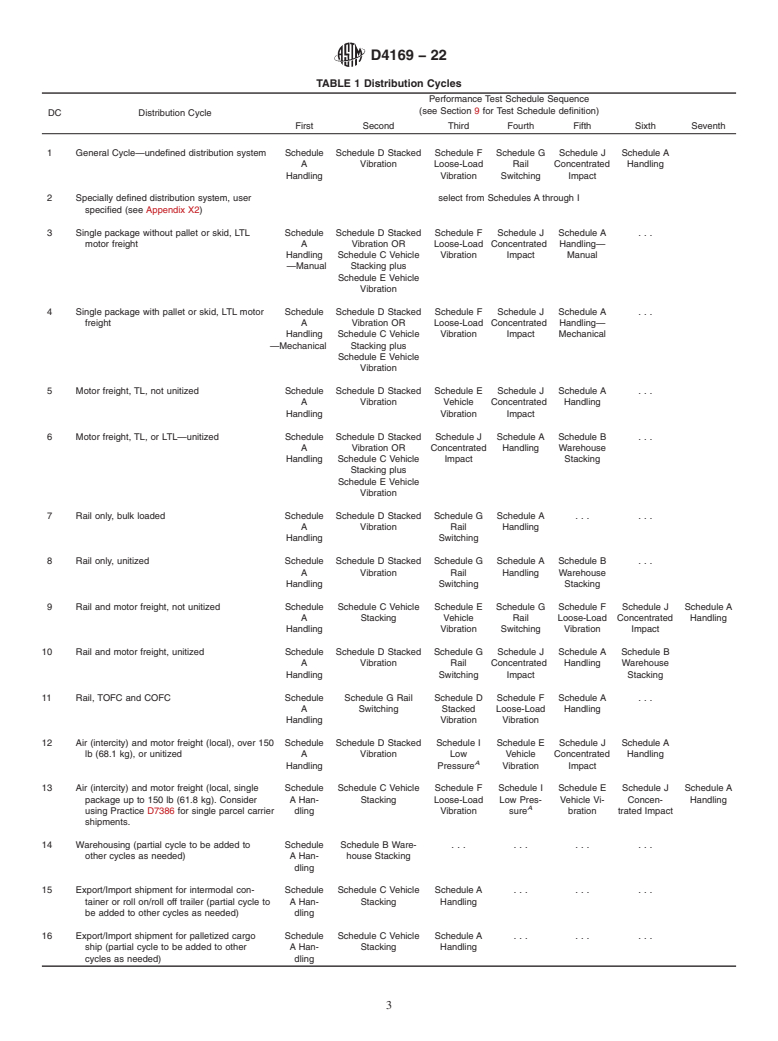
1 General Cycle—undefined distribution system Schedule Schedule D Stacked Schedule F Schedule G Schedule J Schedule A
A Vibration Loose-Load Rail Concentrated Handling
Handling Vibration Switching Impact
2 Specially defined distribution system, user select from Schedules A through I
specified (see Appendix X2)
3 Single package without pallet or skid, LTL Schedule Schedule D Stacked Schedule F Schedule J Schedule A .
motor freight A Vibration OR Loose-Load Concentrated Handling—
Handling Schedule C Vehicle Vibration Impact Manual
—Manual Stacking plus
Schedule E Vehicle
Vibration
4 Single package with pallet or skid, LTL motor Schedule Schedule D Stacked Schedule F Schedule J Schedule A .
freight A Vibration OR Loose-Load Concentrated Handling—
Handling Schedule C Vehicle Vibration Impact Mechanical
—Mechanical Stacking plus
Schedule E Vehicle
Vibration
5 Motor freight, TL, not unitized Schedule Schedule D Stacked Schedule E Schedule J Schedule A .
A Vibration Vehicle Concentrated Handling
Handling Vibration Impact
6 Motor freight, TL, or LTL—unitized Schedule Schedule D Stacked Schedule J Schedule A Schedule B .
A Vibration OR Concentrated Handling Warehouse
Handling Schedule C Vehicle Impact Stacking
Stacking plus
Schedule E Vehicle
Vibration
7 Rail only, bulk loaded Schedule Schedule D Stacked Schedule G Schedule A . .
A Vibration Rail Handling
Handling Switching
8 Rail only, unitized Schedule Schedule D Stacked Schedule G Schedule A Schedule B .
A Vibration Rail Handling Warehouse
Handling Switching Stacking
9 Rail and motor freight, not unitized Schedule Schedule C Vehicle Schedule E Schedule G Schedule F Schedule J Schedule A
A Stacking Vehicle Rail Loose-Load Concentrated Handling
Handling Vibration Switching Vibration Impact
10 Rail and motor freight, unitized Schedule Schedule D Stacked Schedule G Schedule J Schedule A Schedule B
A Vibration Rail Concentrated Handling Warehouse
Handling Switching Impact Stacking
11 Rail, TOFC and COFC Schedule Schedule G Rail Schedule D Schedule F Schedule A .
A Switching Stacked Loose-Load Handling
Handling Vibration Vibration
12 Air (intercity) and motor freight (local), over 150 Schedule Schedule D Stacked Schedule I Schedule E Schedule J Schedule A
lb (68.1 kg), or unitized A Vibration Low Vehicle Concentrated Handling
A
Handling Pressure Vibration Impact
13 Air (intercity) and motor freight (local, single Schedule Schedule C Vehicle Schedule F Schedule I Schedule E Schedule J Schedule A
package up to 150 lb (61.8 kg). Consider A Han- Stacking Loose-Load Low Pres- Vehicle Vi- Concen- Handling
A
using Practice D7386 for single parcel carrier dling Vibration sure bration trated Impact
shipments.
14 Warehousing (partial cycle to be added to Schedule Schedule B Ware- . . . .
other cycles as needed) A Han- house Stacking
dling
15 Export/Import shipment for intermodal con- Schedule Schedule C Vehicle Schedule A . . .
tainer or roll on/roll off trailer (partial cycle to A Han- Stacking Handling
be added to other cycles as needed) dling
16 Export/Import shipment for palletized cargo Schedule Schedule C Vehicle Schedule A . . .
ship (partial cycle to be added to other A Han- Stacking Handling
cycles as needed) dling
D4169 − 22
TABLE 1 Continued
Performance Test Schedule Sequence
(see Section 9 for Test Schedule definition)
DC Distribution Cycle
First Second Third Fourth Fifth Sixth Seventh
17 Export/Import shipment for break bulk cargo Schedule Schedule C Vehicle Schedule A . . .
ship (partial cycle to be added to other A Stacking Handling
cycles as needed) Handling
Non-Commercial Government shipments in
18 Refer to Annex A1 for Test Schedules applying to DC-18.
accordance with MIL-STD-2073–1
A
This high altitude, non-pressurized transport simulation test may be deleted from this distribution cycle when testing shipping units that contain primary packages that
have a porous material.
is used, it should be instrumented to determine if the fragility atmosphere whenever possible. If not possible, conduct the
level of the actual product has been exceeded. Take care to tests as soon after removal from the conditioning atmosphere
duplicate the load characteristics of the actual product, and as practicable. Recondition the shipping units as necessary
avoid unnecessary prehandling. during the test plan. For atmospheres other than the standard
conditioning atmosphere, the user must determine the appro-
5.2 Care must be taken to ensure that no degradation has
priate compressive load factor for warehouse and vehicle
occurred to either the product or the package if the test
stacking,asthefactorsgivenin11.2arebasedontestingunder
packages have been shipped to the test site. If any doubt exists
the standard test atmosphere.
as to the condition of the package, repack the product in new
packaging material before testing.
7. Acceptance Criteria
5.3 The number of test replications depends on the desired
7.1 Acceptance criteria must be established prior to testing
objectives of the testing and the availability of duplicate
and should consider the required condition of the product at
products and shipping containers. Replicate testing is recom-
receipt. The organizations conducting the test may choose any
mended to improve the reliability of the test results.
acceptance criteria suitable for their purpose. It is advisable to
compare the type and quantity of damage that occurred to the
6. Conditioning
test specimens with the damage that occurs during actual
6.1 Ifthedistributioncyclecontainsclimaticconditionsthat
distribution and handling or with test results of similar con-
have an effect on the performance characteristics of the
tainers whose shipping history is known.
product,shippingcontainer,orcomponentssuchascushioning,
7.2 In many cases, the acceptance criteria can be the
use one of the following procedures. (It should be noted that
following:
differentatmosphericconditionsarelikelytoexistbetweenthe
Criterion 1—Product is damage-free.
origin and destination points of a distribution cycle, particu-
Criterion 2—Package is intact.
larly for export/import cycles.)
Criterion 3—Both criteria 1 and 2.
6.1.1 Conduct the test at standard conditions and compen-
Often,thismeansthattheshippingcontaineranditscontents
sate for the effects of any climatic condition. Condition the
aresuitablefornormalsaleanduseatthecompletionofthetest
shipping units to a standard atmosphere of 73.4 6 2°F (23 6
cycle. Detailed acceptance criteria may allow for accepting
1°C) and 50 6 2% relative humidity. Condition fiberboard
specified damage to a product or its package. The form and
containers in accordance with Practice D4332. The same
content of acceptance criteria may vary widely, in accordance
atmospheric condition should be used for any assurance level.
with the particular situation. Methods may range from simple
A conditioning period of 72 h, or sufficient time to reach
pass-fail judgments to highly quantitative scoring or analysis
equilibrium of all parts of the package and product is recom-
systems.
mended. Tests should be conducted in the conditioned atmo-
sphere whenever possible. If not possible, conduct the tests as
8. Procedure
soon after removal from the conditioning atmosphere as
8.1 Define Shipping Unit—Describe shipping unit in terms
practicable. Recondition the shipping units to the standard
ofsize,weight,andformofconstruction.See3.2.7.Determine
atmosphere as necessary during the test plan.
whether the container will be manually or mechanically
6.1.2 Insomecircumstances,itmaybenecessarytoconduct
handled.
some or all of the tests at special climatic conditions, such as
thosegiveninPracticeD4332,orTestMethodD951,orothers 8.2 Establish Assurance Level—Specify a level of test
(salt, spray, water immersion, humidity, or temperature). The intensity. The level should be one of three pre-established
sameclimaticconditionshouldbeusedforanyassurancelevel. assurance levels. This must be pre-established based on the
A conditioning period should be provided which will allow product value, the desired level of anticipated damage that can
sufficient time to reach equilibrium of all parts of the package be tolerated, the number of units to be shipped, knowledge of
and product. Tests should be conducted in the conditioned the shipping environment, or other criteria.Assurance Level II
D4169 − 22
is suggested unless conditions dictate otherwise. Assurance
A Handling—manual and drop, impact, 10
LevelIprovidesamoreseveretestthanII.AssuranceLevelIII
mechanical stability
provides a less severe test than II. The assurance level may be
B Warehouse Stacking compression 11
varied between schedules (see Sections 10–15) if such
C Vehicle Stacking compression 11
D Stacked Vibration vibration 12
variations are known to occur. The test levels used should be
E Vehicle Vibration vibration 12
reported. See Section 18.
F Loose Load Vibration repetitive shock 13
G Rail Switching longitudinal shock 14
8.3 Determine Acceptance Criteria—Acceptance criteria
H Environmental Hazard cyclic exposure 15
are related to the desired condition of the product and package
I Low Pressure Hazard vacuum 16
J Concentrated Impact impact 17
at the end of the distribution cycle. See Section 7.
8.4 Select Distribution Cycle—Select a Distribution Cycle
10. Schedule A—Handling—Manual and Mechanical
from the available standard distribution cycles compiled in
10.1 There are two types of handling hazard element,
Table 1. Use the DC that most closely correlates with the
manual and mechanical. The manual handling test should be
projected distribution. When the distribution is undefined, the
general distribution cycle DC-1 should be selected. When the used for single containers, smaller packages, and any shipping
container that can be handled manually, up to a weight of 200
anticipated distribution is well understood, a special distribu-
tion cycle DC-2 may be specified. In using DC-2, the user lb (90.7 kg). Mechanical handling should be used for unitized
loads, large cases and crates, and any shipping container or
selects test schedules from Section 9 and specifies the test
sequence (see Appendix X2 for more details). For purposes of system that will be handled by mechanical means. Manual and
mechanical handling are described further in 10.2 and 10.3.
DC-3andDC-13,thebottomofasinglepackageisthesurface
on which the package rests in its most stable orientation. The
10.2 Manual Handling—The test levels and the test method
identified bottom should be utilized for purposes of determin-
for this schedule of the distribution cycle are intended to
ing the starting orientation of each test schedule within the
determine the ability of the shipping unit to withstand the
above stated distribution cycles.
hazards occurring during manual handlings, such as loading,
8.5 Write Test Plan—Prepare a test plan by using the
unloading, stacking, sorting, or palletizing. The main hazards
sequence presented in Table 1 for the distribution cycle
from these operations are the impacts caused by dropping or
selected. Obtain the test intensities from the referenced sched-
throwing. Size, weight, and shape of the shipping unit will
ules. The test plan intensity details must take into account the affect the intensity of these hazards. Several test method
assurance levels selected as well as the physical description of
options are permitted, including free fall and simulated drop
the shipping unit. Table 1 thus leads to a detailed test plan test using shock machines. While these test methods produce
consistingoftheexactsequenceinwhichtheshippingunitwill
similar results, the shock machine method produces more
be subjected to the test inputs. The test schedules associated control of orientations of impact; see Test Method D5487 for
with each element reference the existing ASTM test methods
limitations of the shock machine method.
for clarification of the equipment and techniques to be used to
10.2.1 For long narrow packages that are mechanically
conduct the test.
sorted, another hazard to be simulated is bridge impact
8.5.1 Sample test plans are provided in Appendix X1.
(10.2.4).
8.6 Select Samples for Test—See Section 5. 10.2.2 Mechanical handling (10.3) may be used when it is
anticipated that handling will be by mechanical means only.
8.7 Condition Samples—See Section 6.
10.2.3 For the free-fall and shock machine tests, recom-
8.8 Perform Tests—Perform tests as directed in reference
mended drop heights, the number of drops, the sequence of
ASTM standards and as further modified in the special
drops, and the shipping unit orientation at impact are as
instructions for each test schedule.
follows:
8.9 Evaluate Results—Evaluate results to determine if the
Test Methods—D5276, D5487.
shipping units meet the acceptance criteria. See Section 7. Conditioning—See Section 6.
Drop Height, in. (mm)
8.10 Document Test Results—Document test results by re-
Shipping Weight, lb (kg) Assurance Level
porting each step. See Section 18.
I II III
8.11 Monitor Shipments—When possible, obtain feedback
0 to 20 (0 to 9.1) 24 (610) 15 (381) 9 (229)
by monitoring shipments of the container that was tested to
20 to 40 (9.1 to 18.1) 21 (533) 13 (330) 8 (203)
ensure that the type and quantity of damage obtained by the 40 to 60 (18.1 to 27.2) 18 (457) 12 (305) 7 (178)
60 to 80 (27.2 to 36.3) 15 (381) 10 (254) 6 (152)
laboratorytestingcorrelateswiththedamagethatoccursinthe
80 to 100 (36.3 to 45.4) 12 (305) 9 (229) 5 (127)
distribution cycle. This information is very useful for the
100 to 200 (45.4 to 90.7) 10 (254) 7 (178) 4 (102)
planning of subsequent tests of similar shipping containers.
Number of
Impacts at Impact Orientation
Specified First Sequence of Distribution Cycle
9. Hazard Elements and Test Schedules
Height
Box Bag or Sack Cylindrical Container
9.1 Hazard Elements and Test Schedules are categorized as
follows:
One top face top
Schedule Hazard Element Test Section Two adjacent bottom edges two sides two sides 90° apart
D4169 − 22
10.3.1.2 Crane Handling—(Conduct this test only if cranes
Two diagonally opposite both ends bottom edges 90°
bottom corners apart
areusedforhandlinginthedistributionprocess.)Onedropflat
One bottom opposite face bottom
on bottom and one drop on base edge in accordance with
Method D of Test Methods D6179. Use the same drop heights
Number of
versus shipping unit weight as in 10.3.1.1.
Impacts at Impact Orientation
10.3.1.3 Side Impact Test—Impact all four sides of the
Specified Second Sequence of Distribution Cycle
shippingunitinaccordancewithTestMethodD880,Procedure
Height
Box Bag or Sack Cylindrical Container
B.Alternately,useTestMethodD4003MethodBusingashort
duration programmer, assuming the coefficient of restitution is
One vertical edge face top
Two adjacent side faces two sides two sides 90° apart 0.0 and the total velocity change is equivalent to the specified
Two one top corner and one both ends bottom edges 90°
impact velocity.
adjacent top edge apart
One see Note 1 see Note 1 see Note 1 Assurance Level Impact Velocity ft/s(m/s)
NOTE 1—On the last impact of the last manual handling sequence in a I 5.75(1.75)
II 4.0(1.22)
distributioncycle,theimpactshouldbemadeat twicethespecifiedheight
III 3.0(0.91)
or equivalent velocity change. (This is the final (sixth) drop in the
sequence, not an additional drop.) The drop should be in the impact
10.3.1.4 Tip Test—In accordance with Method F of Test
orientation most likely for a drop to occur, usually the largest face or the
Methods D6179.
bottom.Fordistributioncycleswhereanydroporientationispossible(that
10.3.1.5 TipoverTest—InaccordancewithMethodGofTest
is, shipments by means of carriers that mechanically sort packages), this
Methods D6179 if shipping unit fails Tip Test above.
dropshouldbeinthemostcriticalordamage-proneorientation,asdefined
10.3.2 Unitized Loads—Perform the following tests se-
in Test Method D5276.
NOTE2—Theequivalentvelocitychangecorrespondingtothespecified quences as appropriate for the method of truck handling:
drop height used for the shock machine method shall be calculated as
Test Methods—D880, D4003, D6055, D6179.
specified in Test Method D5487.
Conditioning—See Section 6.
10.3.2.1 All Methods of Truck Handling—Pick up, transport
10.2.4 Bridge Impact Test:
around test course, and set down in accordance with Test
Test Method—D5265.
Methods D6055, Method A for fork lift, Method B for spade
Conditioning—See Section 6.
lift, Method C for clamp, and Method D for pull pack.
10.2.4.1 Conduct bridge impacts on long, narrow shipping
Assurance Level Cycles (Round Trips)
units which have a length of at least 36 in. (915 mm) and each
of the other two dimensions are 20% or less of the longest
I8
dimension.
II 5
III 3
10.2.4.2 These tests are required only once in any test
schedule sequence.
(1) For shipments by means of less-than-truckload (LTL),
simulate transfer terminal handling by performing fork lift
10.3 Mechanical Handling—The test levels and the test
truck transport over a floor hazard described as follows: a
method for this schedule of the distribution cycle are intended
modified nominal 2 by 6 in. board with one edge beveled full
to determine the ability of large and heavy shipping units,
height at 45° (see Fig. 1) shall be placed on the course in a
single packages with pallet or skid, and unitized loads to
position where both lift truck wheels on one side must pass
withstand the mechanical handling hazards that occur during
over it during each handling sequence, and a second modified
loading, unloading, sorting, or stacking. For large shipping
nominal2by6in.boardshallbeplacedonthecourseafterthe
cases and crates and any single package with pallet or skid,
90° turn in such a position that both lift truck wheels on the
different test methods are used versus unit loads. For various
oppositesidemustpassoveritduringeachhandlingsequence.
types of unit loads, test methods also vary, depending on the
10.3.2.2 All Methods of Truck Handling—Impact all four
method of truck handling: fork, clamp, spade, or pull/pack.
sides of the shipping unit in accordance with Test Method
10.3.1 Large Shipping Cases and Crates and Single Pack-
D880 Procedure B. Alternately, use Test Method D4003,
ages with Pallet or Skid—Perform the following test se-
Method B using a short duration programmer, assuming the
quences:
coefficient of restitution is 0.0 and the total velocity change is
Test Methods—D6179, D880, D4003.
equivalent to the specified impact velocity.
Conditioning—See Section 6.
10.3.1.1 Fork Lift Truck Handling—One rotational flat drop
from each opposite base edge in accordance with Method C of
Test Methods D6179 and one rotational drop on each of two
diagonallyoppositebasecornersinaccordancewithMethodB
of Test Methods D6179.
Drop Height, in. (mm)
Assurance Level
Gross Weight, lb (kg) I II III
0 to 500 (0 to 226.8) 12 (305) 9 (229) 6 (152)
Over 500 (226.8) 9 (229) 6 (152) 3 (076)
FIG. 1 Floor Hazard
D4169 − 22
where:
Assurance Level Impact Velocity ft/s(m/s)
F = factor given above for compression package (construc-
p
I 5.75 (1.75)
tion Type 3),
II 4.0 (1.22)
III 3.0 (0.91) P = fraction of load supported by product,
F = factor given above for appropriate container
10.3.2.3 Fork Lift Truck Handling—One rotational flat drop c
construction, and
from each opposite base edge in accordance with Method C of
C = fraction of load supported by container.
Test Methods D6179.
If a full pallet load is tested, F factors may be reduced by
Drop Height, in. (mm)
Assurance Level
30%.
Gross Weight, lb (kg) I II III
11.3 For warehouse stacking and vehicle stacking made up
0 to 500 (0 to 226.8) 12 (305) 9 (229) 6 (152)
of identical shipping units, load the shipping unit to the
Over 500 (226.8) 9 (229) 6 (152) 3 (76)
computed load value, as calculated below. Remove the load
11. Schedule B—Warehouse Stacking and Schedule
within 3 s after reaching the specified value.
C—Vehicle Stacking
H 2 h
L 5 M 3J 3F (2)
11.1 Thetestlevelsandthetestmethodsfortheseschedules
h
of a distribution cycle are intended to determine the ability of
where:
theshippingunittowithstandthecompressiveloadsthatoccur
L = computed load, lbf or N,
during warehouse storage or vehicle transport. The required
M = mass of one shipping unit or individual container, lb or
loading must consider the effects of length of time in storage,
kg,
thealignmentorstackingpatternofthecontainer,variabilityin
J = 1 lbf/lb or 9.8 N/kg,
container strength, moisture content, temperature, previous
H = maximumheightofstackinstorageortransitvehicle(if
handling and transportation, method of load support, and
vehicle stack height is unknown, use 108 in. (2.7 m)),
vibration. The minimum required loads for typical shipping
in. or m,
units which include the combined effects of the above factors
h = heightofshippingunitorindividualcontainer,in.orm,
arerecommendedbelowforScheduleB—WarehouseStacking
and
and Schedule C—Vehicle Stacking (select test levels for either
F = a factor to account for the combined effect of the
warehouse or vehicle stacking as defined in the distribution
individual factors described above.
cycle):
11.4 For vehicle stacking made up of mixed commodities
Test Method—D642.
and shipped in an LTLor small package delivery environment,
Conditioning—73.4 6 2°F (23 6 1°C), 50 6 2% relative
loadtheshippingunittothecomputedloadvalue,ascalculated
humidity in accordance with Practice D4332.
below. Remove the load within 3 s after reaching the specified
11.2 Use the following test levels:
value. If the average shipping density factor (M) for the
f
F Factors Assurance Level
specific distribution system is not known, use a value of 10
Schedule Schedule
3 3
lb/ft (160 kg/m ).
B—Warehouse C—Vehicle
Shipping Unit Construction I II III I II III
l 3w 3h H 2 h
L 5 M 3J 3 3F (3)
f
1. Corrugated, fiberboard, or plastic 8.0 4.5 3.0 10.0 7.0 5.0 K h
container that may or may not
have stress–bearing interior where:
packaging using these materials,
L = computed load, lbf or N,
and where the product does not
M = shipping density factor, lb/ft or kg/m3,
support any of the load.
f
J = 1 lbf/lb or 9.8 N/kg,
2. Corrugated, fiberboard, or plastic 4.5 3.0 2.0 6.0 4.5 3.0
H = maximum height of stack in transit vehicle (if vehicle
container that has stress-bearing
stack height is unknown, use 108 in.(2.7 m)), in. or m,
interior packaging with rigid
inserts such as wood.
see Note 3,
h = height of shipping unit or individual container, in. or
3. Containers constructed of materials 3.0 2.0 1.5 4.0 3.0 2.0
m,
other than corrugated, fiberboard,
or plastic that are not l = length of shipping unit or individual container, in. or
temperature or humidity sensitive
m,
or where the product supports
w = widthofshippingunitorindividualcontainer,in.orm,
the load directly, for example,
3 3 3 3
K = 1728 in. /ft or1m /m , and
compression package.
F = a factor to account for the combined effect of the
4. If the product supports a known
individual factors described above.
portion of the load, the F factor is
NOTE 3—The value for H, when unknown, is reduced to 54 in. (1.4 m)
calculated in the following
from108in.(2.7m)forpackagesunder30lb(13.6kg)and2.0ft (0.056
manner:
m ) or less in size when applied to a vehicle stacking hazard element in
F 5 P F 1C F (1)
~ !
~ ! LTL shipments.
p c
D4169 − 22
12. Schedule D—Stacked Vibration and Schedule Recommended intensities and durations for the random tests
E—Vehicle Vibration are given in 12.4, and those for sine tests are given in 12.5.
12.1 The test levels and test methods for these distribution 12.3 Schedule E—Vehicle Vibration—Perform the test for
cycles are intended to determine the shipping units ability to each possible shipping orientation (up to three axes). Recom-
withstand the vertical vibration environment during transport mendedintensitiesanddurationsfortherandomtestsaregiven
and the dynamic compression forces resulting from vehicle in 12.4, and those for sine tests are given in 12.5.
stacking. The test levels and methods account for the
12.4 Random Test Option:
magnitude, frequency range, duration and direction of vibra-
Test Method—D4728.
tion. Select the Schedule D—Stacked Vibration or Schedule
Conditioning—See Section 6.
E—Vehicle Vibration (no stacking) test as defined by the
12.4.1 ThepowerspectraldensitiesinTables2-4,asdefined
distribution cycle. Test methods for sine and random vibration
by their mode of transport, frequency and amplitude
are permitted testing options.The two methods are not equiva-
breakpoints, and test durations are recommended.
lent and will not necessarily produce the same results. The
12.4.1.1 Conducting the Truck Profile test is recommended
random test method results in a better simulation of actual
for Distribution Cycles 1, 3, 4, 5 and 6.
transport vibration environments, and is the preferred method
12.4.1.2 Conducting the Rail Profile test is recommended
forqualification.Thesinetestmethodisoftenusedasameans
for Distribution Cycles 7, 8 and 11.
of determining and observing system resonances and can be
12.4.1.3 A 60 min test using the Truck Profile followed by
used in conjunction with the random method.
a 120 min test using the Rail Profile is recommended for
12.2 Schedule D—Stacked Vibration—Perform the test Distribution Cycles 9 and 10.
along the vertical axis with the load in the normal shipping 12.4.1.4 A 60 min test using the Truck Profile followed by
orientation or with the predetermined bottom orientation (as a 120 min test using the Air Profile is recommended for
specified in DC-3) facing down. It is permissible to use a Distribution Cycles 12 and 13.
concentrateddeadloadtosimulateanupperunitloadormixed 12.4.2 If more detailed information is available on the
commodities. The concentrated load may be calculated from transport vibration environment or the shipping unit damage
the formulas in 11.3 and 11.4, with the F factor set equal to 1. history, it is recommended that the procedure be modified to
TABLE 2 TRUCK—Power Spectral Density Levels
Power Spectral Density Level, G /Hz
Frequency
High Level Medium Level Low Level
1 0.00072 0.00072 0.0004
3 0.030 0.018 0.010
4 0.030 0.018 0.010
6 0.0012 0.00072 0.00040
12 0.0012 0.00072 0.00040
16 0.0060 0.0036 0.0020
25 0.0060 0.0036 0.0020
30 0.0012 0.00072 0.00040
40 0.0060 0.0036 0.0020
80 0.0060 0.0036 0.0020
100 0.00060 0.00036 0.00020
200 0.000030 0.000018 0.000010
Overall G 0.70 0.54 0.40
rms
D4169 − 22
TABLE 3 RAIL—Power Spectral Density Levels
Power Spectral Density Level G /Hz
Frequency Assurance Level
I II III
1 0.00002 0.00001 0.000005
2 0.002 0.001 0.0005
50 0.002 0.001 0.0005
90 0.0008 0.0004 0.0002
200 0.00002 0.00001 0.000005
Overall G 0.41 0.29 0.2
rms
use such information. The test time required to reproduce Low Level Time = 0.67 × 60 = 40 minutes
shipping damage is dependent on the mode of failure, as well Medium Level Time = 0.25 × 60 = 15 minutes
as the vibration level. Test durations ranging from 30 min to 6 High Level Time = 0.08 × 60 = 5 minutes
h have been used successfully for different product or package (2)Rounding rule will be in effect. Any duration value
types. A 3 h (180 min) duration is reasonable to use in the equal to or less than 0.5 round down; equal to or greater than
absence of specific shipping or testing experience. 0.6 round up.
12.4.2.1 FortheTruckProfiletest,itisrecommendedtouse (3) For a 3 hour (180 minutes) duration, a total of 120
acombinationofallthreeTestLevels(low,medium,andhigh) minutes of Low Level, 45 minutes of Medium Level, and 15
for a better simulation of actual truck vibration environments. minutes of High Level vibration will be required in one
TheTruck test should be performed ina1h(60 min) loop that orientation.Thesedurationvaluesarenotdirectcorrelationsto
can be repeated for longer duration simulations. The recom- the flight time of the aircraft.
mendedtestdurationsfortherandomvibrationtruckprofileare
(4)The air vibration profile is not compressed and uses
as follows: actualactivevibrationdatausingconstructedprobabilitybased
Low Level for 40 minutes. on CL of 99, 95, and 90 % respectively.
Medium Level for 15 minutes.
12.4.2.3 For vibration tests when more than one shipping
High Level for 5 minutes.
orientation is possible, the total duration should be distributed
12.4.2.2 For theAir Profile test, it is recommended to use a
evenly between the orientations tested.
combination of all three Test Levels (low, medium, and high)
NOTE 4—When conducting the Truck and Air Profiles, Assurance
for a better simulation of actual air vibration environments.
Levels I, II, and III are not used.
The air test should be performed ina2h (120 min) duration,
in three 40 minute loops that can be adjusted for other time 12.5 Sine Test Option:
duration simulations. The recommended test durations for the Test Method—D999, Method B or C.
random air profile are as follows: Conditioning—See Section 6.
Low Level for 27 minutes. Special Instructions—Dwelltimeisforeachnotedproduct
Medium Level for 10 minutes. or package resonance up to four discrete resonances. If more
High Level for 3 minutes. than four resonances are noted, test at the four frequencies
(1)If duration varies from 120 minutes use the following where the greatest response is noted. In frequency sweeps it is
formula to calculate duration loop: advisable to consider the frequency ranges normally encoun-
Example—CalculatingVibration duration loop for 3 hour tered in the type of transportation being considered. The
duration (180 minutes): resonant frequency(ies) may shift during test due to changing
D4169 − 22
TABLE 4 AIR—Power Spectral Density Levels
Power Spectral Density Level (G /Hz)
Frequency (Hz)
High Level Medium Level Low Level
1 0.001 0.0006 0.0003
2 0.01 0.006 0.003
42 0.0001 0.00006 0.00003
50 0.0005 0.0003 0.00015
120 0.0005 0.0003 0.00015
200 0.000025 0.000015 0.0000075
Overall G 0.29 0.22 0.16
rms
characteristics of the container system. It is suggested that the Special Instructions—Dwell time distributed 50% along
dwell frequency be varied slightly during the test to detect any normalverticalshippingaxisorwiththepredeterminedbottom
shift and to continue testing at the frequency of maximum
orientation (as specified in DC-3 and DC-13) facing down and
response. Use the following test levels:
remaining 50% evenly along all other possible shipping
Amplitude orientations:
Dwell
Assurance Frequency Range, (O-Peak), g
Time,
Assurance Level Dwell Time, min
Level Hz
min
Rail Truck
I60
II 40
I 3 to 100 0.25 0.5 15
III 30
II 3 to 100 0.25 0.5 10
III 3 to 100 0.25 0.5 5
14. Schedule G—Simulated Rail Switching
13. Schedule F—Loose Load Vibration
14.1 The test levels and test methods for this schedule are
13.1 The test levels and the test method for this schedule of
intended to determine the ability of the shipping unit to
the distribution cycle are intended to determine the ability of
withstand the acceleration levels and compressive forces that
the shipping unit to withstand the repetitive shocks occurring
might occur during rail switching operations.
duringtransportationofbulkorlooseloads.Thetestlevelsand
Test Methods—D4003, Test Method A; or D5277.
test method account for amplitude, direction, and duration of
Conditioning—See Section 6.
the repetitive shocks.
Special Instructions—Four impacts shall be performed.
13.2 Use the following test levels:
For railcars with standard draft gear, shock durations of 40 6
Test Method—D999, Method A1 or A2.
10 ms shall be used, as measured on the floor of the carriage.
Conditioning—See Section 6.
D4169 − 22
Forrailcarswithlong–traveldraftgear,shockdurationsof300
Assurance Level Temperature, °F (°C) Water Spray Duration, h
6 50 ms shall be used. Reference Association of American
I 160±5(71±2) 16
Railroads, General Information Bulletin No. 2.
55±5(13±2) X 2
Note that Test Method D5277 is used for standard draft
–5±5(–21±2) 2
125±5(52±2) X 2
gear only.
55±5(13±2) X 2
Refer to Test Methods D4003 or D5277 for specific
32±5(0±2) 16
instructions on how to instrument and conduct the test.
160±5(71±2) 4
55±5(13±2) X 2
14.2 Procedure—Load shipping unit on carriage against
–65±5(–54±2) 2
160±5(71±2) 16
bulkhead. Use a backload equivalent to a minimum of 3 ft
55±5(13±2) X 2
lineal (0.9 m) of cargo. The package used as backload in
–65±5(–54±2) 2
contact with the test package must be identical to the test 40±5(4±2) 3
160±5(71±2) 16
package.
II 160±5(71±2) 14
14.3 Test Levels—Allow the carriage to impact a cushioned
55±5(13±2) X 2
barrierinaccordancewiththefollowingtable.AssuranceLevel
160±5(71±2) 4
Ishallbeusedforopen-toprailcarloadtests.AssuranceLevel
32±5(0±2) 2
55±5(13±2) X 2
II shall be used for boxcar load tests for non-hazardous
The cyclic sequence shall be repeated on three
materials and for TOFC/COFC load tests for non-hazardous
consecutive days. At the end of the three day period, the
materials. There is no Assurance Level III for this Test unit pack being tested shall then set overnight
160±5(71±2) 16
Schedule.
14.3.1 If known, container impact surfaces should be the
III Not applicable
same as occur in actual shipment. If the shipping orientation is
15.3 Durationtimeshallbemeasuredstartingthemomentat
not known, or if more than one orientation is possible, the first
which temperature setting is changed to next condition.
three impacts should be on that test specimen surface which is
15.4 When specified in the contract, this test should be
deemed to be most sensitive to damage. For the fourth impact,
performed as part of the complete distribution cycle for the
rotate the specimen 180° on the carriage.
smallest complete shipping unit, as part of the contract.
Assurance Impact Velocity
Level Number
mph (m/s)
16. Schedule I—Low Pressure (High Altitude) Hazard
I 1 4(±0.5) 1.79(±0.22)
16.1 Thisscheduleisintendedtoprovidefortheanticipated
2 6 (± 0.5) 2.68 (± 0.22)
3 8 (± 0.5) 3.58 (± 0.22)
reduction in pressure when packaged products are transported
4 (rotate 180°) 8 (± 0.5) 3.58 (± 0.22)
by means of certain modes of transport, such as feeder aircraft
or by ground over mountain passes. This test shall be con-
II 1 4 (± 0.5) 1.79 (± 0.22)
2 6 (± 0.5) 2.68 (± 0.22)
ducted in accordance with levels described in Test Method
3 6 (± 0.5) 2.68 (± 0.22)
D6653.Thistestshouldbeincludedforproductsandpackages
4 (rotate 180°) 6 (± 0.5) 2.68 (± 0.22)
that could be sensitive to a low pressure environment, for
14.4 Procedure Modification—If more detailed information
example, sealed flexible non-porous packages, liquid
is available on backload or shock characteristics it is recom-
containers, or porous packages that may be packed in such a
mended that the above procedure be modified to use such
manner as to be adversely affected by low pressure environ-
information.
ments. This test may be del
...
This document is not an ASTM standard and is intended only to provide the user of an ASTM standard an indication of what changes have been made to the previous version. Because
it may not be technically possible to adequately depict all changes accurately, ASTM recommends that users consult prior editions as appropriate. In all cases only the current version
of the standard as published by ASTM is to be considered the official document.
Designation: D4169 − 16 D4169 − 22
Standard Practice for
Performance Testing of Shipping Containers and Systems
This standard is issued under the fixed designation D4169; the number immediately following the designation indicates the year of
original adoption or, in the case of revision, the year of last revision. A number in parentheses indicates the year of last reapproval. A
superscript epsilon (´) indicates an editorial change since the last revision or reapproval.
This standard has been approved for use by agencies of the U.S. Department of Defense.
1. Scope*Scope
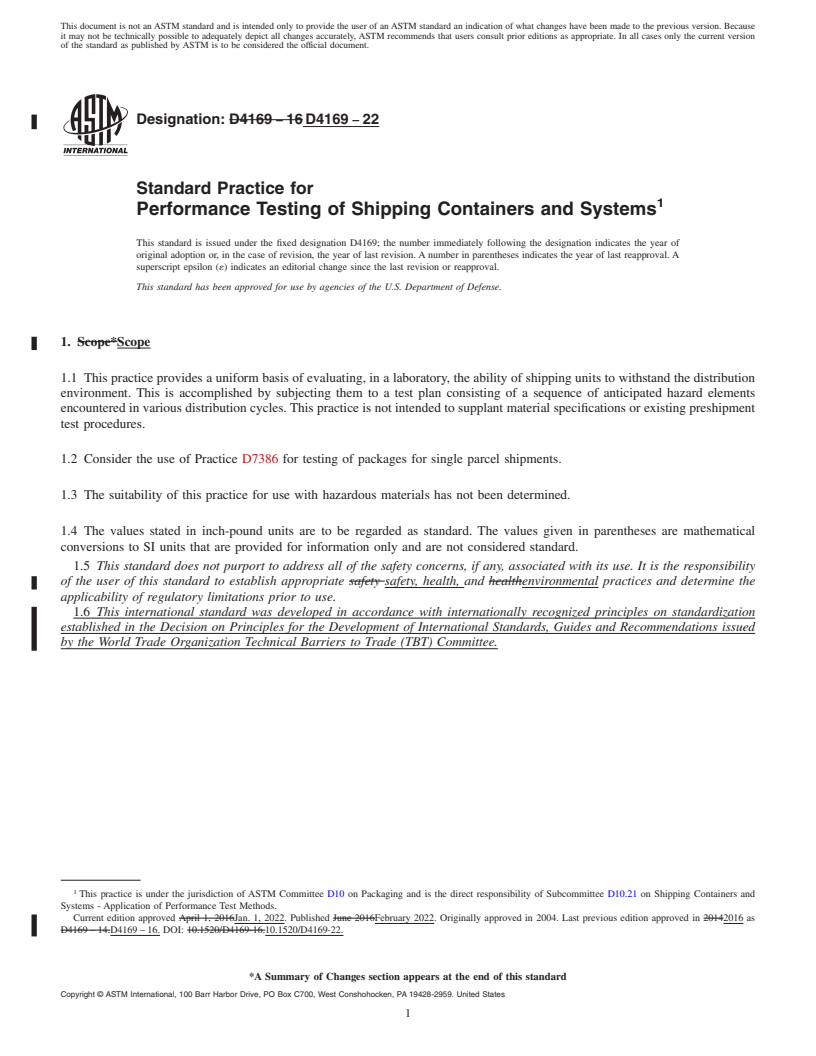
1.1 This practice provides a uniform basis of evaluating, in a laboratory, the ability of shipping units to withstand the distribution
environment. This is accomplished by subjecting them to a test plan consisting of a sequence of anticipated hazard elements
encountered in various distribution cycles. This practice is not intended to supplant material specifications or existing preshipment
test procedures.
1.2 Consider the use of Practice D7386 for testing of packages for single parcel shipments.
1.3 The suitability of this practice for use with hazardous materials has not been determined.
1.4 The values stated in inch-pound units are to be regarded as standard. The values given in parentheses are mathematical
conversions to SI units that are provided for information only and are not considered standard.
1.5 This standard does not purport to address all of the safety concerns, if any, associated with its use. It is the responsibility
of the user of this standard to establish appropriate safety safety, health, and healthenvironmental practices and determine the
applicability of regulatory limitations prior to use.
1.6 This international standard was developed in accordance with internationally recognized principles on standardization
established in the Decision on Principles for the Development of International Standards, Guides and Recommendations issued
by the World Trade Organization Technical Barriers to Trade (TBT) Committee.
This practice is under the jurisdiction of ASTM Committee D10 on Packaging and is the direct responsibility of Subcommittee D10.21 on Shipping Containers and
Systems - Application of Performance Test Methods.
Current edition approved April 1, 2016Jan. 1, 2022. Published June 2016February 2022. Originally approved in 2004. Last previous edition approved in 20142016 as
D4169 – 14.D4169 – 16. DOI: 10.1520/D4169-16.10.1520/D4169-22.
*A Summary of Changes section appears at the end of this standard
Copyright © ASTM International, 100 Barr Harbor Drive, PO Box C700, West Conshohocken, PA 19428-2959. United States
D4169 − 22
2. Referenced Documents
2.1 ASTM Standards:
D642 Test Method for Determining Compressive Resistance of Shipping Containers, Components, and Unit Loads
D880 Test Method for Impact Testing for Shipping Containers and Systems
D951 Test Method for Water Resistance of Shipping Containers by Spray Method
D996 Terminology of Packaging and Distribution Environments
D999 Test Methods for Vibration Testing of Shipping Containers
D4003 Test Methods for Programmable Horizontal Impact Test for Shipping Containers and Systems
D4332 Practice for Conditioning Containers, Packages, or Packaging Components for Testing
D4728 Test Method for Random Vibration Testing of Shipping Containers
D5265 Test Method for Bridge Impact Testing
D5276 Test Method for Drop Test of Loaded Containers by Free Fall
D5277 Test Method for Performing Programmed Horizontal Impacts Using an Inclined Impact Tester
D5487 Test Method for Simulated Drop of Loaded Containers by Shock Machines
D6055 Test Methods for Mechanical Handling of Unitized Loads and Large Shipping Cases and Crates
D6179 Test Methods for Rough Handling of Unitized Loads and Large Shipping Cases and Crates
D6344 Test Method for Concentrated Impacts to Transport Packages
D6653 Test Methods for Determining the Effects of High Altitude on Packaging Systems by Vacuum Method
D7386 Practice for Performance Testing of Packages for Single Parcel Delivery Systems
F1327 Terminology Relating to Barrier Materials for Medical Packaging (Withdrawn 2007)
2.2 Military Standards:
MIL-STD-810F Environmental Test Methods
MIL-STD-2073–1 DOD Standard Practice for Military Packaging
2.3 Association of American Railroads Standards:
General Information Bulletin No. 2 Rules and Procedures for Testing of New Loading and Bracing Methods or Materials
3. Terminology
3.1 Definitions—General definitions for the packaging and distribution environments are found in Terminology D996.
3.2 Definitions of Terms Specific to This Standard:
3.2.1 acceptance criteria—criteria, n—the acceptable quality level that must be met after the shipping unit has been subjected to
the test plan. See Section 7.
3.2.2 assurance level—level, n—the level of test intensity based on its probability of occurring in a typical distribution cycle.
3.2.2.1 Discussion—
Level I is a high level of test intensity and has a low probability of occurrence. Level III is a low level of test intensity, but has
a correspondingly high probability of occurrence. Level II is between these extremes. For Distribution Cycle 18 (DC–18), see
MIL-STD-2073–1 for definitions of military levels of protection.
3.2.3 coeffıcient of restitution—restitution, n—the ratio of the rebound velocity to the impact velocity.
3.2.4 distribution cycle (DC)—(DC), n—the sequential listing of the test schedules employed to simulate the hazard elements
expected to occur for a specific routing of a shipping unit from production to consumption. See Table 1.
3.2.5 feeder aircraft—aircraft, n—small, potentially non-pressurized aircraft used to transport express packages.
3.2.6 hazard element—element, n—a specific event that occurs in a distribution cycle that may pose a hazard to a shipping unit.
The element will usually be simulated by a single test schedule. See Section 9.
For referenced ASTM standards, visit the ASTM website, www.astm.org, or contact ASTM Customer Service at service@astm.org. For Annual Book of ASTM Standards
volume information, refer to the standard’s Document Summary page on the ASTM website.
The last approved version of this historical standard is referenced on www.astm.org.
Available from Standardization Documents Order Desk, DODSSP, Bldg. 4, Section D, DLA Document Services, Building 4/D, 700 Robbins Ave., Philadelphia, PA
19111-5098, http://dodssp.daps.dla.mil.19111-5094, http://quicksearch.dla.mil.
Available from Association of American Railroads (AAR), 425 Third St., SW, Washington, DC 20024, http://www.aar.org.
D4169 − 22
TABLE 1 Distribution Cycles
Performance Test Schedule Sequence
(see Section 9 for Test Schedule definition)
DC Distribution Cycle
DC Distribution Cycle First Second Third Fourth Fifth SixthSeventh
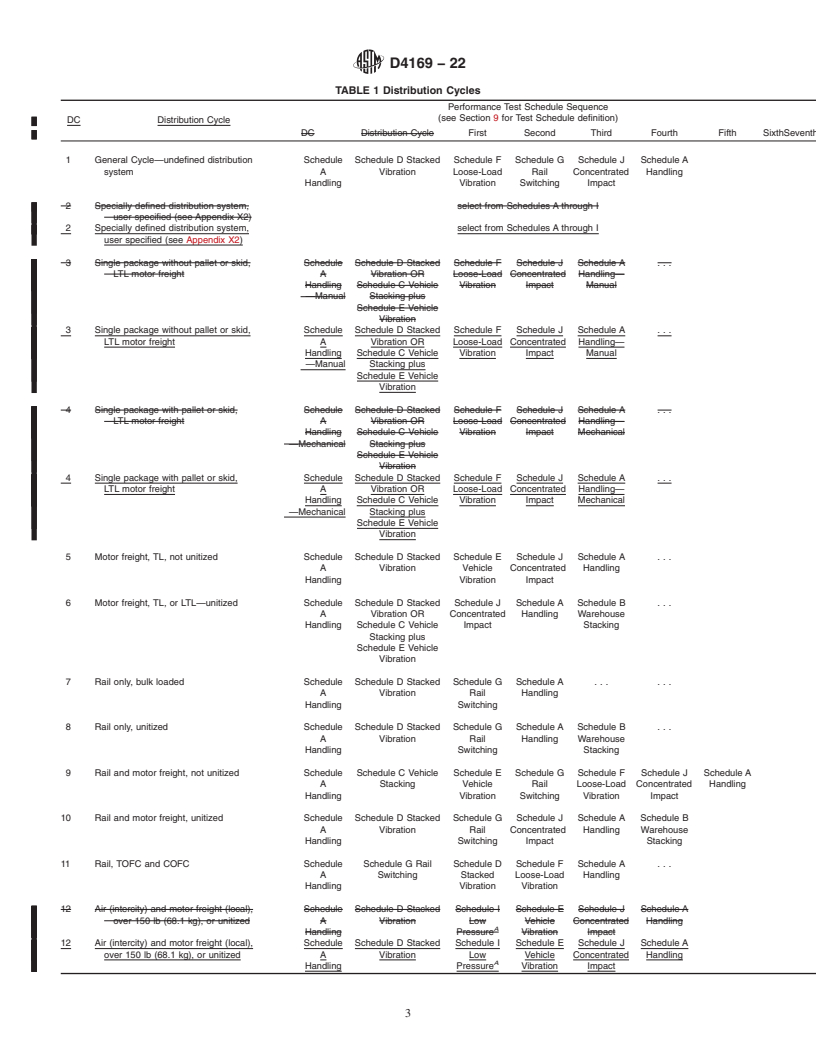
1 General Cycle—undefined distribution Schedule Schedule D Stacked Schedule F Schedule G Schedule J Schedule A
system A Vibration Loose-Load Rail Concentrated Handling
Handling Vibration Switching Impact
2 Specially defined distribution system, select from Schedules A through I
user specified (see Appendix X2)
2 Specially defined distribution system, select from Schedules A through I
user specified (see Appendix X2)
3 Single package without pallet or skid, Schedule Schedule D Stacked Schedule F Schedule J Schedule A . . .
LTL motor freight A Vibration OR Loose-Load Concentrated Handling—
Handling Schedule C Vehicle Vibration Impact Manual
—Manual Stacking plus
Schedule E Vehicle
Vibration
3 Single package without pallet or skid, Schedule Schedule D Stacked Schedule F Schedule J Schedule A . . .
LTL motor freight A Vibration OR Loose-Load Concentrated Handling—
Handling Schedule C Vehicle Vibration Impact Manual
—Manual Stacking plus
Schedule E Vehicle
Vibration
4 Single package with pallet or skid, Schedule Schedule D Stacked Schedule F Schedule J Schedule A . . .
LTL motor freight A Vibration OR Loose-Load Concentrated Handling—
Handling Schedule C Vehicle Vibration Impact Mechanical
—Mechanical Stacking plus
Schedule E Vehicle
Vibration
4 Single package with pallet or skid, Schedule Schedule D Stacked Schedule F Schedule J Schedule A . . .
LTL motor freight A Vibration OR Loose-Load Concentrated Handling—
Handling Schedule C Vehicle Vibration Impact Mechanical
—Mechanical Stacking plus
Schedule E Vehicle
Vibration
5 Motor freight, TL, not unitized Schedule Schedule D Stacked Schedule E Schedule J Schedule A . . .
A Vibration Vehicle Concentrated Handling
Handling Vibration Impact
6 Motor freight, TL, or LTL—unitized Schedule Schedule D Stacked Schedule J Schedule A Schedule B . . .
A Vibration OR Concentrated Handling Warehouse
Handling Schedule C Vehicle Impact Stacking
Stacking plus
Schedule E Vehicle
Vibration
7 Rail only, bulk loaded Schedule Schedule D Stacked Schedule G Schedule A . . . . . .
A Vibration Rail Handling
Handling Switching
8 Rail only, unitized Schedule Schedule D Stacked Schedule G Schedule A Schedule B . . .
A Vibration Rail Handling Warehouse
Handling Switching Stacking
9 Rail and motor freight, not unitized Schedule Schedule C Vehicle Schedule E Schedule G Schedule F Schedule J Schedule A
A Stacking Vehicle Rail Loose-Load Concentrated Handling
Handling Vibration Switching Vibration Impact
10 Rail and motor freight, unitized Schedule Schedule D Stacked Schedule G Schedule J Schedule A Schedule B
A Vibration Rail Concentrated Handling Warehouse
Handling Switching Impact Stacking
11 Rail, TOFC and COFC Schedule Schedule G Rail Schedule D Schedule F Schedule A . . .
A Switching Stacked Loose-Load Handling
Handling Vibration Vibration
12 Air (intercity) and motor freight (local), Schedule Schedule D Stacked Schedule I Schedule E Schedule J Schedule A
over 150 lb (68.1 kg), or unitized A Vibration Low Vehicle Concentrated Handling
A
Handling Pressure Vibration Impact
12 Air (intercity) and motor freight (local), Schedule Schedule D Stacked Schedule I Schedule E Schedule J Schedule A
over 150 lb (68.1 kg), or unitized A Vibration Low Vehicle Concentrated Handling
A
Handling Pressure Vibration Impact
D4169 − 22
TABLE 1 Continued
Performance Test Schedule Sequence
(see Section 9 for Test Schedule definition)
DC Distribution Cycle
DC Distribution Cycle First Second Third Fourth Fifth SixthSeventh
13 Air (intercity) and motor freight (local, Schedule Schedule C Vehicle Schedule F Schedule I Schedule E Schedule J Schedule A
single package up to 150 lb (61.8 kg). A Han- Stacking Loose-Load Low Pres- Vehicle Vi- Concen- Handling
A
Consider using Practice D7386 dling Vibration sure bration trated Impact
for single parcel carrier shipments.
13 Air (intercity) and motor freight (local, Schedule Schedule C Vehicle Schedule F Schedule I Schedule E Schedule J Schedule A
single package up to 150 lb (61.8 kg). A Han- Stacking Loose-Load Low Pres- Vehicle Vi- Concen- Handling
A
Consider using Practice D7386 dling Vibration sure bration trated Impact
for single parcel carrier shipments.
14 Warehousing (partial cycle to be added to Schedule Schedule B Ware- . . . . . . . . . . . .
other cycles as needed) A Han- house Stacking
dling
15 Export/Import shipment for intermodal Schedule Schedule C Vehicle Schedule A . . . . . . . . .
container or roll on/roll off trailer (partial A Han- Stacking Handling
cycle to be added to other cycles as dling
needed)
15 Export/Import shipment for intermodal Schedule Schedule C Vehicle Schedule A . . . . . . . . .
container or roll on/roll off trailer (partial A Han- Stacking Handling
cycle to be added to other cycles as dling
needed)
16 Export/Import shipment for palletized cargo Schedule Schedule C Vehicle Schedule A . . . . . . . . .
ship (partial cycle to be added to A Han- Stacking Handling
other cycles as needed) dling
16 Export/Import shipment for palletized cargo Schedule Schedule C Vehicle Schedule A . . . . . . . . .
ship (partial cycle to be added to A Han- Stacking Handling
other cycles as needed) dling
17 Export/Import shipment for break bulk Schedule Schedule C Vehicle Schedule A . . . . . . . . .
cargo ship (partial cycle to be added A Han- Stacking Handling
to other cycles as needed) dling
17 Export/Import shipment for break bulk Schedule Schedule C Vehicle Schedule A . . . . . . . . .
cargo ship (partial cycle to be added A Han- Stacking Handling
to other cycles as needed) dling
Non-Commercial Government shipments
18 Refer to Annex A1 for Test Schedules applying to DC-18.
per MIL-STD-2073-1
Non-Commercial Government shipments
18 Refer to Annex A1 for Test Schedules applying to DC-18.
in accordance with MIL-STD-2073–1
A
This high altitude, non-pressurized transport simulation test may be deleted from this distribution cycle when testing shipping units that contain primary packages that
have a porous material.
3.2.7 shipping unit—unit, n—the smallest complete unit that will be subjected to the distribution environment, for example, a
shipping container and its contents.
3.2.7.1 small shipping unit—unit, n—for DC-18, a small shipping unit is defined as one having no edge dimension or diameter
over 60 in. (1.52 m) and a gross weight of 100 lb (45 kg) or less.
3.2.7.2 large shipping unit—unit, n—for DC-18, a large shipping unit is defined as one having at least one edge dimension or
diameter over 60 in. (1.52 m) or a gross weight in excess of 100 lb (45 kg), or it is one that has a gross weight exceeding 100 lb
(45 kg) and is secured to a base or to the base of a shipping unit.
3.2.8 test plan—plan, n—a specific listing of the test sequence to be followed to simulate the hazards anticipated during the
distribution cycle of a shipping unit. Included will be the test intensity and number of sequential tests to be conducted. See 8.5.
3.2.9 test schedule—schedule, n—the specific procedure to be used, including the three assurance level intensities, and a reference
to the test method that is the basis of the schedule.
3.2.9.1 Discussion—
The purpose of the schedule is to simulate the forces occurring during any hazard element of the distribution cycle. See Section
9.
D4169 − 22
3.2.10 total velocity change, (ΔV)—), n—the sum of the impact and rebound velocities.
3.3 Abbreviations:
3.3.1 TOFC—trailer on flatcar.
3.3.2 COFC—container on flatcar.
3.3.3 TL—truckload.
3.3.4 CL—carload.
3.3.5 LTL—less than truckload.
4. Significance and Use
4.1 This practice provides a guide for the evaluation of shipping units in accordance with a uniform system, using established test
methods at levels representative of those occurring in actual distribution. The recommended test levels are based on available
information on the shipping and handling environment, and current industry/government practice and experience (1-13). The tests
should be performed sequentially on the same containers in the order given. For use as a performance test, this practice requires
that the shipping unit tested remain unopened until the sequence of tests are completed. If used for other purposes, such as package
development, it may be useful to open and inspect shipping units at various times throughout the sequence. This may, however,
prohibit evaluating the influence of the container closure on container performance.
4.2 For Distribution Cycle 18, as referred to in MIL-STD-2073–1, the use of this practice is defined in subsequent sections
identified as DC-18.
5. Test Specimen
5.1 Test specimens consist of representative samples of complete shipping units, including actual contents. Products with
blemishes or minor defects may be used if the defective component is not to be studied by the test and if the defect is documented
in the report. Dummy test loads are acceptable if testing the actual product might be hazardous. If a dummy load is used, it should
be instrumented to determine if the fragility level of the actual product has been exceeded. Take care to duplicate the load
characteristics of the actual product, and avoid unnecessary prehandling.
5.2 Care must be taken to ensure that no degradation has occurred to either the product or the package if the test packages have
been shipped to the test site. If any doubt exists as to the condition of the package, repack the product in new packaging material
before testing.
5.3 The number of test replications depends on the desired objectives of the testing and the availability of duplicate products and
shipping containers. Replicate testing is recommended to improve the reliability of the test results.
6. Conditioning
6.1 If the distribution cycle contains climatic conditions that have an effect on the performance characteristics of the product,
shipping container, or components such as cushioning, use one of the following procedures. (It should be noted that different
atmospheric conditions are likely to exist between the origin and destination points of a distribution cycle, particularly for
export/import cycles.)
6.1.1 Conduct the test at standard conditions and compensate for the effects of any climatic condition. Condition the shipping units
to a standard atmosphere of 73.4 6 2°F (23 6 1°C) and 50 6 2 % relative humidity. Condition fiberboard containers in accordance
with Practice D4332. The same atmospheric condition should be used for any assurance level. A conditioning period of 72 h, or
sufficient time to reach equilibrium of all parts of the package and product is recommended. Tests should be conducted in the
The boldface numbers in parentheses refer to a list of references at the end of this practice.standard.
D4169 − 22
conditioned atmosphere whenever possible. If not possible, conduct the tests as soon after removal from the conditioning
atmosphere as practicable. Recondition the shipping units to the standard atmosphere as necessary during the test plan.
6.1.2 In some circumstances, it may be necessary to conduct some or all of the tests at special climatic conditions, such as those
given in Practice D4332, or Test Method D951, or others (salt, spray, water immersion, humidity, or temperature). The same
climatic condition should be used for any assurance level. A conditioning period should be provided which will allow sufficient
time to reach equilibrium of all parts of the package and product. Tests should be conducted in the conditioned atmosphere
whenever possible. If not possible, conduct the tests as soon after removal from the conditioning atmosphere as practicable.
Recondition the shipping units as necessary during the test plan. For atmospheres other than the standard conditioning atmosphere,
the user must determine the appropriate compressive load factor for warehouse and vehicle stacking, as the factors given in 11.2
are based on testing under the standard test atmosphere.
7. Acceptance Criteria
7.1 Acceptance criteria must be established prior to testing and should consider the required condition of the product at receipt.
The organizations conducting the test may choose any acceptance criteria suitable for their purpose. It is advisable to compare the
type and quantity of damage that occurred to the test specimens with the damage that occurs during actual distribution and handling
or with test results of similar containers whose shipping history is known.
7.2 In many cases, the acceptance criteria can be the following:
Criterion 1—Product is damage-free.
Criterion 1—Product is damage-free.
Criterion 2—Package is intact.
Criterion 3—Both criteria 1 and 2.
Criterion 2—Package is intact.
Criterion 3—Both criteria 1 and 2.
Often, this means that the shipping container and its contents are suitable for normal sale and use at the completion of the test
cycle. Detailed acceptance criteria may allow for accepting specified damage to a product or its package. The form and content
of acceptance criteria may vary widely, in accordance with the particular situation. Methods may range from simple pass-fail
judgments to highly quantitative scoring or analysis systems.
8. Procedure
8.1 Define Shipping Unit—Describe shipping unit in terms of size, weight, and form of construction. See 3.2.7. Determine whether
the container will be manually or mechanically handled.
8.2 Establish Assurance Level—Specify a level of test intensity. The level should be one of three pre-established assurance levels.
This must be pre-established based on the product value, the desired level of anticipated damage that can be tolerated, the number
of units to be shipped, knowledge of the shipping environment, or other criteria. Assurance Level II is suggested unless conditions
dictate otherwise. Assurance Level I provides a more severe test than II. Assurance Level III provides a less severe test than II.
The assurance level may be varied between schedules (see Sections 10 – 15) if such variations are known to occur. The test levels
used should be reported. See Section 18.
8.3 Determine Acceptance Criteria—Acceptance criteria are related to the desired condition of the product and package at the end
of the distribution cycle. See Section 7.
8.4 Select Distribution Cycle—Select a Distribution Cycle from the available standard distribution cycles compiled in Table 1. Use
the DC that most closely correlates with the projected distribution. When the distribution is undefined, the general distribution
cycle DC-1 should be selected. When the anticipated distribution is well understood, a special distribution cycle DC-2 may be
specified. In using DC-2, the user selects test schedules from Section 9 and specifies the test sequence (see Appendix X2 for more
details). For purposes of DC-3 and DC-13, the bottom of a single package is the surface on which the package rests in its most
stable orientation. The identified bottom should be utilized for purposes of determining the starting orientation of each test schedule
within the above stated distribution cycles.
8.5 Write Test Plan—Prepare a test plan by using the sequence presented in Table 1 for the distribution cycle selected. Obtain the
test intensities from the referenced schedules. The test plan intensity details must take into account the assurance levels selected
as well as the physical description of the shipping unit. Table 1 thus leads to a detailed test plan consisting of the exact sequence
D4169 − 22
in which the shipping unit will be subjected to the test inputs. The test schedules associated with each element reference the
existing ASTM test methods for clarification of the equipment and techniques to be used to conduct the test.
8.5.1 Sample test plans are provided in Appendix X1.
8.6 Select Samples for Test—See Section 5.
8.7 Condition Samples—See Section 6.
8.8 Perform Tests—Perform tests as directed in reference ASTM standards and as further modified in the special instructions for
each test schedule.
8.9 Evaluate Results—Evaluate results to determine if the shipping units meet the acceptance criteria. See Section 7.
8.10 Document Test Results—Document test results by reporting each step. See Section 18.
8.11 Monitor Shipments—When possible, obtain feedback by monitoring shipments of the container that was tested to ensure that
the type and quantity of damage obtained by the laboratory testing correlates with the damage that occurs in the distribution cycle.
This information is very useful for the planning of subsequent tests of similar shipping containers.
9. Hazard Elements and Test Schedules
9.1 Hazard Elements and Test Schedules are categorized as follows:
Schedule Hazard Element Test Section
A Handling—manual and mechanical drop, impact, stability 10
B Warehouse Stacking compression 11
C Vehicle Stacking compression 11
D Stacked Vibration vibration 12
E Vehicle Vibration vibration 12
F Loose Load Vibration repetitive shock 13
G Rail Switching longitudinal shock 14
H Environmental Hazard cyclic exposure 15
I Low Pressure Hazard vacuum 16
J Concentrated Impact impact 17
10. Schedule A—Handling—Manual and Mechanical:Mechanical
10.1 There are two types of handling hazard element, manual and mechanical. The manual handling test should be used for single
containers, smaller packages, and any shipping container that can be handled manually, up to a weight of 200 lb (90.7 kg).
Mechanical handling should be used for unitized loads, large cases and crates, and any shipping container or system that will be
handled by mechanical means. Manual and mechanical handling are described further in 10.2 and 10.3.
10.2 Manual Handling—The test levels and the test method for this schedule of the distribution cycle are intended to determine
the ability of the shipping unit to withstand the hazards occurring during manual handlings, such as loading, unloading, stacking,
sorting, or palletizing. The main hazards from these operations are the impacts caused by dropping or throwing. Size, weight, and
shape of the shipping unit will affect the intensity of these hazards. Several test method options are permitted, including free fall
and simulated drop test using shock machines. While these test methods produce similar results, the shock machine method
produces more control of orientations of impact; see Test Method D5487 for limitations of the shock machine method.
10.2.1 For long narrow packages that are mechanically sorted, another hazard to be simulated is bridge impact (10.2.4).
10.2.2 Mechanical handling (10.3) may be used when it is anticipated that handling will be by mechanical means only.
10.2.3 For the free-fall and shock machine tests, recommended drop heights, the number of drops, the sequence of drops, and the
shipping unit orientation at impact are as follows:
Test Method D5276, D5487.
Test Methods—D5276, D5487.
D4169 − 22
Conditioning—See Section 6.
Conditioning—See Section 6.
Drop Height, in. (mm)
Shipping Weight, lb (kg) Assurance Level
I II III
0 to 20 (0 to 9.1) 24 (610) 15 (381) 9 (229)
20 to 40 (9.1 to 18.1) 21 (533) 13 (330) 8 (203)
40 to 60 (18.1 to 27.2) 18 (457) 12 (305) 7 (178)
60 to 80 (27.2 to 36.3) 15 (381) 10 (254) 6 (152)
80 to 100 (36.3 to 45.4) 12 (305) 9 (229) 5 (127)
100 to 200 (45.4 to 90.7) 10 (254) 7 (178) 4 (102)
Number of Impacts at Impact Orientation -
Specified Height First Sequence of Distribution Cycle
Number of Impacts at Impact Orientation
Specified Height First Sequence of Distribution Cycle
Box Bag or Sack Cylindrical Container
One top face top
Two adjacent bottom edges two sides two sides 90° apart
Two diagonally opposite bottom both ends bottom edges 90° apart
corners
One bottom opposite face bottom
Number of Impacts at Impact Orientation -
Specified Height Second Sequence of Distribution Cycle
Number of Impacts at Impact Orientation
Specified Height Second Sequence of Distribution Cycle
Box Bag or Sack Cylindrical Container
One vertical edge face top
Two adjacent side faces two sides two sides 90° apart
Two one top corner and one both ends bottom edges 90° apart
adjacent top edge
One see Note 1 see Note 1 see Note 1
NOTE 1—On the last impact of the last manual handling sequence in a distribution cycle, the impact should be made at twice the specified height or
equivalent velocity change. (This is the final (sixth) drop in the sequence, not an additional drop.) The drop should be in the impact orientation most likely
for a drop to occur, usually the largest face or the bottom. For distribution cycles where any drop orientation is possible (that is, shipments via by means
of carriers that mechanically sort packages), this drop should be in the most critical or damage-prone orientation, as defined in Test Method D5276.
NOTE 2—The equivalent velocity change corresponding to the specified drop height used for the shock machine method shall be calculated as specified
in Test Method D5487.
10.2.4 Bridge Impact Test:
Test Method—D5265.
Conditioning—See Section 6.
10.2.4.1 Conduct bridge impacts on long, narrow shipping units which have a length of at least 36 in. (915 mm) and each of the
other two dimensions are 20 % or less of the longest dimension.
10.2.4.2 These tests are required only once in any test schedule sequence.
10.3 Mechanical Handling—The test levels and the test method for this schedule of the distribution cycle are intended to
determine the ability of large and heavy shipping units, single packages with pallet or skid, and unitized loads to withstand the
mechanical handling hazards that occur during loading, unloading, sorting, or stacking. For large shipping cases and crates and any
single package with pallet or skid, different test methods are used versus unit loads. For various types of unit loads, test methods
also vary, depending on the method of truck handling: fork, clamp, spade, or pull/pack.
10.3.1 Large Shipping Cases and Crates and Single Packages with Pallet or Skid—Perform the following test sequences:
Test Method—D6179, D880, D4003.
Conditioning—See Section 6.
D4169 − 22
Test Methods—D6179, D880, D4003.
Conditioning—See Section 6.
10.3.1.1 Fork Lift Truck Handling—One rotational flat drop from each opposite base edge in accordance with Method C of Test
Methods D6179 and one rotational drop on each of two diagonally opposite base corners in accordance with Method B of Test
Methods D6179.
Drop Height, in. (mm)
Assurance Level
Gross Weight, lb (kg) I II III
0 to 500 (0 to 226.8) 12 (305) 9 (229) 6 (152)
Over 500 (226.8) 9 (229) 6 (152) 3 (076)
10.3.1.2 Crane Handling—(Conduct this test only if cranes are used for handling in the distribution process.) One drop flat on
bottom and one drop on base edge in accordance with Method D of Test Methods D6179. Use the same drop heights versus
shipping unit weight as in 10.3.1.1.
10.3.1.3 Side Impact Test—Impact all four sides of the shipping unit in accordance with Test Method D880, Procedure B.
Alternately, use Test Method D4003 Method B using a short duration programmer, assuming the coefficient of restitution is 0.0
and the total velocity change is equivalent to the specified impact velocity.
Assurance Level Impact Velocity ft/s(m/s)
I 5.75(1.75)
II 4.0(1.22)
III 3.0(0.91)
10.3.1.4 Tip Test—In accordance with Method F of Test Methods D6179.
10.3.1.5 Tipover Test—In accordance with Method G of Test Methods D6179 if shipping unit fails Tip Test above.
10.3.2 Unitized Loads—Perform the following tests sequences as appropriate for the method of truck handling:
Test Method—D880, D4003, D6055, D6179.
Conditioning—See Section 6.
Test Methods—D880, D4003, D6055, D6179.
Conditioning—See Section 6.
10.3.2.1 All Methods of Truck Handling—Pick up, transport around test course, and set down in accordance with Test Methods
D6055, Method A for fork lift, Method B for spade lift, Method C for clamp, and Method D for pull pack.
Assurance Level Cycles (Round Trips)
I 8
II 5
III 3
(1) For shipments via by means of less-than-truckload (LTL), simulate transfer terminal handling by performing fork lift truck
transport over a floor hazard described as follows: a modified nominal 2 by 6 in. board with one edge beveled full height at 45°
(see Fig. 1) shall be placed on the course in a position where both lift truck wheels on one side must pass over it during each
FIG. 1 Floor Hazard
D4169 − 22
handling sequence, and a second modified nominal 2 by 6 in. board shall be placed on the course after the 90° turn in such a
position that both lift truck wheels on the opposite side must pass over it during each handling sequence.
10.3.2.2 All Methods of Truck Handling—Impact all four sides of the shipping unit in accordance with Test Method D880
Procedure B. Alternately, use Test Method D4003, Method B using a short duration programmer, assuming the coefficient of
restitution is 0.0 and the total velocity change is equivalent to the specified impact velocity.
Assurance Level Impact Velocity ft/s(m/s)
I 5.75 (1.75)
II 4.0 (1.22)
III 3.0 (0.91)
10.3.2.3 Fork Lift Truck Handling—One rotational flat drop from each opposite base edge in accordance with Method C of Test
Methods D6179.
Drop Height, in. (mm)
Assurance Level
Gross Weight, lb (kg) I II III
0 to 500 (0 to 226.8) 12 (305) 9 (229) 6 (152)
Over 500 (226.8) 9 (229) 6 (152) 3 (76)
11. Schedule B—Warehouse Stacking and Schedule C—Vehicle Stacking:Stacking
11.1 The test levels and the test methods for these schedules of a distribution cycle are intended to determine the ability of the
shipping unit to withstand the compressive loads that occur during warehouse storage or vehicle transport. The required loading
must consider the effects of length of time in storage, the alignment or stacking pattern of the container, variability in container
strength, moisture content, temperature, previous handling and transportation, method of load support, and vibration. The
minimum required loads for typical shipping units which include the combined effects of the above factors are recommended
below for Schedule B—Warehouse Stacking and Schedule C—Vehicle Stacking (select test levels for either warehouse or vehicle
stacking as defined in the distribution cycle):
Test MethodD642.
Conditioning—73.4 6 2°F (23 6 1°C), 50 6 2 % relative humidity in accordance with Practice D4332.
Test Method—D642.
Conditioning—73.4 6 2°F (23 6 1°C), 50 6 2 % relative humidity in accordance with Practice D4332.
11.2 Use the following test levels:
F Factors Assurance Level
Schedule B—Warehouse Schedule C—Vehicle
Shipping Unit Construction I II III I II III
1. Corrugated, fiberboard, or plastic container that may or may not have 8.0 4.5 3.0 10.0 7.0 5.0
stress–bearing interior packaging using these materials, and where the product
does not support any of the load.
2. Corrugated, fiberboard, or plastic container that has stress-bearing interior 4.5 3.0 2.0 6.0 4.5 3.0
packaging with rigid inserts such as wood.
3. Containers constructed of materials other than corrugated, fiberboard, or plastic 3.0 2.0 1.5 4.0 3.0 2.0
that are not temperature or humidity sensitive or where the product supports the
load directly, for example, compression package.
4. If the product supports a known portion of the load, the F factor is calculated in
the following manner:
F 5 P~F !1C F (1)
~ !
p c
where:
F = factor given above for compression package (construction Type 3),
p
P = fraction of load supported by product,
F = factor given above for appropriate container construction, and
c
D4169 − 22
C = fraction of load supported by container.
If a full pallet load is tested, F factors may be reduced by 30 %.
11.3 For warehouse stacking and vehicle stacking made up of identical shipping units, load the shipping unit to the computed load
value, as calculated below. Remove the load within 3 s after reaching the specified value.
H 2 h
L 5 M 3J 3F (2)
h
where:
L = computed load, lbf or N,
M = mass of one shipping unit or individual container, lb or kg,
J = 1 lbf/lb or 9.8 N/kg,
H = maximum height of stack in storage or transit vehicle (if vehicle stack height is unknown, use 108 in.(2.7 m)), in. or m,
H = maximum height of stack in storage or transit vehicle (if vehicle stack height is unknown, use 108 in. (2.7 m)), in. or m,
h = height of shipping unit or individual container, in. or m, and
F = a factor to account for the combined effect of the individual factors described above.
11.4 For vehicle stacking made up of mixed commodities and shipped in an LTL or small package delivery environment, load the
shipping unit to the computed load value, as calculated below. Remove the load within 3 s after reaching the specified value. If
3 3
the average shipping density factor (M ) for the specific distribution system is not known, use a value of 10 lb/ft (160 kg/m ).
f
l 3w 3h H 2 h
L 5 M 3J 3 3F (3)
f
K h
where:
L = computed load, lbf or N,
M = shipping density factor, lb/ft or kg/m3,
f
J = 1 lbf/lb or 9.8 N/kg,
H = maximum height of stack in transit vehicle (if vehicle stack height is unknown, use 108 in.(2.7 m)), in. or m, see Note 3,
h = height of shipping unit or individual container, in. or m,
l = length of shipping unit or individual container, in. or m,
w = width of shipping unit or individual container, in. or m,
3 3 3 3
K = 1728 in. /ft or 1 m /m , and
F = a factor to account for the combined effect of the individual factors described above.
3 3
NOTE 3—The value for H, when unknown, is reduced to 54 in. (1.4 m) from 108 in. (2.7 m) for packages under 30 lb (13.6 kg) and 2.0 ft (0.056 m )
or less in size when applied to a vehicle stacking hazard element in LTL shipments.
12. Schedule D—Stacked Vibration and Schedule E—Vehicle Vibration:Vibration
12.1 The test levels and test methods for these distribution cycles are intended to determine the shipping units ability to withstand
the vertical vibration environment during transport and the dynamic compression forces resulting from vehicle stacking. The test
levels and methods account for the magnitude, frequency range, duration and direction of vibration. Select the Schedule
D—Stacked Vibration or Schedule E—Vehicle Vibration (no stacking) test as defined by the distribution cycle. Test methods for
sine and random vibration are permitted testing options. The two methods are not equivalent and will not necessarily produce the
same results. The random test method results in a better simulation of actual transport vibration environments, and is the preferred
method for qualification. The sine test method is often used as a means of determining and observing system resonances and can
be used in conjunction with the random method.
12.2 Schedule D—Stacked Vibration—Perform the test along the vertical axis with the load in the normal shipping orientation or
with the predetermined bottom orientation (as specified in DC-3) facing down. It is permissible to use a concentrated dead load
to simulate an upper unit load or mixed commodities. The concentrated load may be calculated from the formulas in 11.3 and 11.4,
with the F factor set equal to 1. Recommended intensities and durations for the random tests are given in 12.4, and those for sine
tests are given in 12.5.
12.3 Schedule E—Vehicle Vibration—Perform the test for each possible shipping orientation (up to three axes). Recommended
intensities and durations for the random tests are given in 12.4, and those for sine tests are given in 12.5.
D4169 − 22
12.4 Random Test Option:Random Test Option:
Test Method D4728.
Test Method—D4728.
Conditioning—See Section 6.
Conditioning—See Section 6.
12.4.1 The power spectral densities in Tables 2-4, as defined by their mode of transport, frequency and amplitude breakpoints, and
test durations are recommended.
12.4.1.1 Conducting the Truck Profile test is recommended for Distribution Cycles 1, 3, 4, 5 and 6.
12.4.1.2 Conducting the Rail Profile test is recommended for Distribution Cycles 7, 8 and 11.
12.4.1.3 A 60 min test using the Truck Profile followed by a 120 min test using the Rail Profile is recommended for Distribution
Cycles 9 and 10.
12.4.1.4 A 60 min test using the Truck Profile followed by a 120 min test using the Air Profile is recommended for Distribution
Cycles 12 and 13.
12.4.2 If more detailed information is available on the transport vibration environment or the shipping unit damage history, it is
recommended that the procedure be modified to use such information. The test time required to reproduce shipping damage is
dependent on the mode of failure, as well as the vibration level. Test durations ranging from 30 min to 6 h have been used
successfully for different product or package types. A 3 h (180 min) duration is reasonable to use in the absence of specific shipping
or testing experience.
TABLE 2 TRUCK—Power Spectral Density Levels
Power Spectral Density Level, G /Hz
Frequency
High Level Medium Level Low Level
1 0.00072 0.00072 0.0004
3 0.030 0.018 0.010
4 0.030 0.018 0.010
6 0.0012 0.00072 0.00040
12 0.0012 0.00072 0.00040
16 0.0060 0.0036 0.0020
25 0.0060 0.0036 0.0020
30 0.0012 0.00072 0.00040
40 0.0060 0.0036 0.0020
80 0.0060 0.0036 0.0020
100 0.00060 0.00036 0.00020
200 0.000030 0.000018 0.000010
Overall G 0.70 0.54 0.40
rms
D4169 − 22
TABLE 3 RAIL—Power Spectral Density Levels
Power Spectral Density Level G /Hz
Frequency Assurance Level
I II III
1 0.00002 0.00001 0.000005
2 0.002 0.001 0.0005
50 0.002 0.001 0.0005
90 0.0008 0.0004 0.0002
200 0.00002 0.00001 0.000005
Overall G 0.41 0.29 0.2
rms
12.4.2.1 For the Truck Profile test, it is recommended to use a combination of all three Test Levels (low, medium, and high) for
a better simulation of actual truck vibration environments. The Truck test should be performed in a 1 h (60 min) loop that can be
repeated for longer duration simulations. The recommended test durations for the random vibration truck profile are as follows:
Low Level for 40 minutes.
Medium Level for 15 minutes.
High Level for 5 minutes.
12.4.2.2 For the Air Profile test, it is recommended to use a combination of all three Test Levels (low, medium, and high) for a
better simulation of actual air vibration environments. The air test should be performed in a 2 h (120 min) duration, in three 40
minute loops that can be adjusted for other time duration simulations. The recommended test durations for the random air profile
are as follows:
Low Level for 27 minutes.
Medium Level for 10 minutes.
High Level for 3 minutes.
(1) If duration varies from 120 minutes use the following formula to calculate duration loop:
Example—Calculating Vibration duration loop for 3 hour duration (180 minutes):
Low Level Time = 0.67 × 60 = 40 minutes
Medium Level Time = 0.25 × 60 = 15 minutes
High Level Time = 0.08 × 60 = 5 minutes
(2) Rounding rule will be in effect. Any duration value equal to or less than 0.5 round down; equal to or greater than 0.6 round
up.
(3) For a 3 hour (180 minutes) duration, a total of 120 minutes of Low Level, 45 minutes of Medium Level, and 15 minutes
of High Level vibration will be required in one orientation. These duration values are not direct correlations to the flight time of
the aircraft.
(4) The air vibration profile is not compressed and uses actual active vibration data using constructed probability based on CL
of 99, 95, and 90 % respectively.
12.4.2.3 For vehicle vibration tests when more than one shipping orientation is possible, the total duration should be distributed
evenly between the orientations tested.
D4169 − 22
TABLE 4 AIR—Power Spectral Density Levels
Power Spectral Density Level G /Hz
Frequency
Frequency (Hz)
Assurance Level
Power Spectral Density Level (G /Hz)
High Level Medium Level Low Level
I II III
1 0.001 0.0006 0.0003
2 0.0004 0.0002 0.0001
2 0.01 0.006 0.003
42 0.0001 0.00006 0.00003
12 0.02 0.01 0.005
50 0.0005 0.0003 0.00015
100 0.02 0.01 0.005
120 0.0005 0.0003 0.00015
300 0.00002 0.00001 0.000005
200 0.000025 0.000015 0.0000075
Overall G 1.49 1.05 0.74
rms
Overall G 0.29 0.22 0.16
rms
NOTE 4—When conducting the Truck Profile, and Air Profiles, Assurance Levels I, II, and III are not used.
12.5 Sine Test Option:Sine Test Option:
Test Methods D999, Method B or C.
Test Method—D999, Method B or C.
Conditioning—See Section 6.
Special Instructions—Dwell time is for each noted product or package resonance up to four discrete resonances. If more than
four resonances are noted, test at the four frequencies where the greatest response is noted. In frequency sweeps it is advisable to
consider the frequency ranges normally encountered in the type of transportation being considered. The resonant frequency(ies)
may shift during test due to changing characteristics of the container system. It is suggested that the dwell frequency be varied
slightly during the test to detect any shift and to continue testing at the frequency of maximum response. Use the following test
levels:
Conditioning—See Section 6.
Special Instructions—Dwell time is for each noted product or package resonance up to four discrete resonances. If more than
four resonances are noted, test at the four frequencies where the greatest response is noted. In frequency sweeps it is advisable to
consider the frequency ranges
...
NOTICE: This standard has either been superseded and replaced by a new version or withdrawn.
Contact ASTM International (www.astm.org) for the latest information
Designation: D4169 − 22
Standard Practice for
Performance Testing of Shipping Containers and Systems
This standard is issued under the fixed designation D4169; the number immediately following the designation indicates the year of
original adoption or, in the case of revision, the year of last revision. A number in parentheses indicates the year of last reapproval. A
superscript epsilon (´) indicates an editorial change since the last revision or reapproval.
This standard has been approved for use by agencies of the U.S. Department of Defense.
1. Scope 2. Referenced Documents
1.1 This practice provides a uniform basis of evaluating, in 2.1 ASTM Standards:
a laboratory, the ability of shipping units to withstand the D642 Test Method for Determining Compressive Resistance
distribution environment. This is accomplished by subjecting of Shipping Containers, Components, and Unit Loads
them to a test plan consisting of a sequence of anticipated D880 Test Method for Impact Testing for Shipping Contain-
hazard elements encountered in various distribution cycles. ers and Systems
This practice is not intended to supplant material specifications D951 Test Method for Water Resistance of Shipping Con-
or existing preshipment test procedures. tainers by Spray Method
D996 Terminology of Packaging and Distribution Environ-
1.2 Consider the use of Practice D7386 for testing of
ments
packages for single parcel shipments.
D999 Test Methods for Vibration Testing of Shipping Con-
1.3 The suitability of this practice for use with hazardous
tainers
materials has not been determined.
D4003 Test Methods for Programmable Horizontal Impact
1.4 The values stated in inch-pound units are to be regarded Test for Shipping Containers and Systems
D4332 Practice for Conditioning Containers, Packages, or
as standard. The values given in parentheses are mathematical
conversions to SI units that are provided for information only Packaging Components for Testing
D4728 Test Method for Random Vibration Testing of Ship-
and are not considered standard.
ping Containers
1.5 This standard does not purport to address all of the
D5265 Test Method for Bridge Impact Testing
safety concerns, if any, associated with its use. It is the
D5276 Test Method for Drop Test of Loaded Containers by
responsibility of the user of this standard to establish appro-
Free Fall
priate safety, health, and environmental practices and deter-
D5277 Test Method for Performing Programmed Horizontal
mine the applicability of regulatory limitations prior to use.
Impacts Using an Inclined Impact Tester
1.6 This international standard was developed in accor-
D5487 Test Method for Simulated Drop of Loaded Contain-
dance with internationally recognized principles on standard-
ers by Shock Machines
ization established in the Decision on Principles for the
D6055 Test Methods for Mechanical Handling of Unitized
Development of International Standards, Guides and Recom-
Loads and Large Shipping Cases and Crates
mendations issued by the World Trade Organization Technical
D6179 Test Methods for Rough Handling of Unitized Loads
Barriers to Trade (TBT) Committee.
and Large Shipping Cases and Crates
D6344 Test Method for Concentrated Impacts to Transport
Packages
This practice is under the jurisdiction of ASTM Committee D10 on Packaging
and is the direct responsibility of Subcommittee D10.21 on Shipping Containers and
Systems - Application of Performance Test Methods. For referenced ASTM standards, visit the ASTM website, www.astm.org, or
Current edition approved Jan. 1, 2022. Published February 2022. Originally contact ASTM Customer Service at service@astm.org. For Annual Book of ASTM
approved in 2004. Last previous edition approved in 2016 as D4169 – 16. DOI: Standards volume information, refer to the standard’s Document Summary page on
10.1520/D4169-22. the ASTM website.
Copyright © ASTM International, 100 Barr Harbor Drive, PO Box C700, West Conshohocken, PA 19428-2959. United States
D4169 − 22
D6653 Test Methods for Determining the Effects of High 3.2.7.2 large shipping unit, n—for DC-18, a large shipping
Altitude on Packaging Systems by Vacuum Method unit is defined as one having at least one edge dimension or
D7386 Practice for Performance Testing of Packages for diameter over 60 in. (1.52 m) or a gross weight in excess of 100
Single Parcel Delivery Systems lb (45 kg), or it is one that has a gross weight exceeding 100 lb
F1327 Terminology Relating to Barrier Materials for Medi- (45 kg) and is secured to a base or to the base of a shipping
cal Packaging (Withdrawn 2007) unit.
2.2 Military Standards:
3.2.8 test plan, n—a specific listing of the test sequence to
MIL-STD-810F Environmental Test Methods be followed to simulate the hazards anticipated during the
MIL-STD-2073–1 DOD Standard Practice for Military
distribution cycle of a shipping unit. Included will be the test
Packaging intensity and number of sequential tests to be conducted. See
8.5.
2.3 Association of American Railroads Standards:
General Information Bulletin No. 2 Rules and Procedures
3.2.9 test schedule, n—the specific procedure to be used,
for Testing of New Loading and Bracing Methods or
including the three assurance level intensities, and a reference
Materials
to the test method that is the basis of the schedule.
3.2.9.1 Discussion—The purpose of the schedule is to simu-
3. Terminology
late the forces occurring during any hazard element of the
distribution cycle. See Section 9.
3.1 Definitions—General definitions for the packaging and
distribution environments are found in Terminology D996.
3.2.10 total velocity change, (ΔV), n—the sum of the impact
and rebound velocities.
3.2 Definitions of Terms Specific to This Standard:
3.2.1 acceptance criteria, n—the acceptable quality level
3.3 Abbreviations:
that must be met after the shipping unit has been subjected to 3.3.1 TOFC—trailer on flatcar.
the test plan. See Section 7.
3.3.2 COFC—container on flatcar.
3.2.2 assurance level, n—the level of test intensity based on
3.3.3 TL—truckload.
its probability of occurring in a typical distribution cycle.
3.3.4 CL—carload.
3.2.2.1 Discussion—Level I is a high level of test intensity
3.3.5 LTL—less than truckload.
and has a low probability of occurrence. Level III is a low level
of test intensity, but has a correspondingly high probability of
4. Significance and Use
occurrence. Level II is between these extremes. For Distribu-
4.1 This practice provides a guide for the evaluation of
tion Cycle 18 (DC–18), see MIL-STD-2073–1 for definitions
shipping units in accordance with a uniform system, using
of military levels of protection.
established test methods at levels representative of those
3.2.3 coeffıcient of restitution, n—the ratio of the rebound
occurring in actual distribution. The recommended test levels
velocity to the impact velocity.
are based on available information on the shipping and
3.2.4 distribution cycle (DC), n—the sequential listing of
handling environment, and current industry/government prac-
the test schedules employed to simulate the hazard elements 6
tice and experience (1-13). The tests should be performed
expected to occur for a specific routing of a shipping unit from
sequentially on the same containers in the order given. For use
production to consumption. See Table 1.
as a performance test, this practice requires that the shipping
3.2.5 feeder aircraft, n—small, potentially non-pressurized
unit tested remain unopened until the sequence of tests are
aircraft used to transport express packages.
completed. If used for other purposes, such as package
development, it may be useful to open and inspect shipping
3.2.6 hazard element, n—a specific event that occurs in a
units at various times throughout the sequence. This may,
distribution cycle that may pose a hazard to a shipping unit.
however, prohibit evaluating the influence of the container
The element will usually be simulated by a single test schedule.
closure on container performance.
See Section 9.
4.2 For Distribution Cycle 18, as referred to in MIL-STD-
3.2.7 shipping unit, n—the smallest complete unit that will
be subjected to the distribution environment, for example, a 2073–1, the use of this practice is defined in subsequent
sections identified as DC-18.
shipping container and its contents.
3.2.7.1 small shipping unit, n—for DC-18, a small shipping
5. Test Specimen
unit is defined as one having no edge dimension or diameter
5.1 Test specimens consist of representative samples of
over 60 in. (1.52 m) and a gross weight of 100 lb (45 kg) or
complete shipping units, including actual contents. Products
less.
with blemishes or minor defects may be used if the defective
component is not to be studied by the test and if the defect is
documented in the report. Dummy test loads are acceptable if
The last approved version of this historical standard is referenced on
testing the actual product might be hazardous. If a dummy load
www.astm.org.
Available from DLA Document Services, Building 4/D, 700 Robbins Ave.,
Philadelphia, PA 19111-5094, http://quicksearch.dla.mil.
5 6
Available from Association of American Railroads (AAR), 425 Third St., SW, The boldface numbers in parentheses refer to a list of references at the end of
Washington, DC 20024, http://www.aar.org. this standard.
D4169 − 22
TABLE 1 Distribution Cycles
Performance Test Schedule Sequence
(see Section 9 for Test Schedule definition)
DC Distribution Cycle
First Second Third Fourth Fifth Sixth Seventh
1 General Cycle—undefined distribution system Schedule Schedule D Stacked Schedule F Schedule G Schedule J Schedule A
A Vibration Loose-Load Rail Concentrated Handling
Handling Vibration Switching Impact
2 Specially defined distribution system, user select from Schedules A through I
specified (see Appendix X2)
3 Single package without pallet or skid, LTL Schedule Schedule D Stacked Schedule F Schedule J Schedule A . . .
motor freight A Vibration OR Loose-Load Concentrated Handling—
Handling Schedule C Vehicle Vibration Impact Manual
—Manual Stacking plus
Schedule E Vehicle
Vibration
4 Single package with pallet or skid, LTL motor Schedule Schedule D Stacked Schedule F Schedule J Schedule A . . .
freight A Vibration OR Loose-Load Concentrated Handling—
Handling Schedule C Vehicle Vibration Impact Mechanical
—Mechanical Stacking plus
Schedule E Vehicle
Vibration
5 Motor freight, TL, not unitized Schedule Schedule D Stacked Schedule E Schedule J Schedule A . . .
A Vibration Vehicle Concentrated Handling
Handling Vibration Impact
6 Motor freight, TL, or LTL—unitized Schedule Schedule D Stacked Schedule J Schedule A Schedule B . . .
A Vibration OR Concentrated Handling Warehouse
Handling Schedule C Vehicle Impact Stacking
Stacking plus
Schedule E Vehicle
Vibration
7 Rail only, bulk loaded Schedule Schedule D Stacked Schedule G Schedule A . . . . . .
A Vibration Rail Handling
Handling Switching
8 Rail only, unitized Schedule Schedule D Stacked Schedule G Schedule A Schedule B . . .
A Vibration Rail Handling Warehouse
Handling Switching Stacking
9 Rail and motor freight, not unitized Schedule Schedule C Vehicle Schedule E Schedule G Schedule F Schedule J Schedule A
A Stacking Vehicle Rail Loose-Load Concentrated Handling
Handling Vibration Switching Vibration Impact
10 Rail and motor freight, unitized Schedule Schedule D Stacked Schedule G Schedule J Schedule A Schedule B
A Vibration Rail Concentrated Handling Warehouse
Handling Switching Impact Stacking
11 Rail, TOFC and COFC Schedule Schedule G Rail Schedule D Schedule F Schedule A . . .
A Switching Stacked Loose-Load Handling
Handling Vibration Vibration
12 Air (intercity) and motor freight (local), over 150 Schedule Schedule D Stacked Schedule I Schedule E Schedule J Schedule A
lb (68.1 kg), or unitized A Vibration Low Vehicle Concentrated Handling
A
Handling Pressure Vibration Impact
13 Air (intercity) and motor freight (local, single Schedule Schedule C Vehicle Schedule F Schedule I Schedule E Schedule J Schedule A
package up to 150 lb (61.8 kg). Consider A Han- Stacking Loose-Load Low Pres- Vehicle Vi- Concen- Handling
A
using Practice D7386 for single parcel carrier dling Vibration sure bration trated Impact
shipments.
14 Warehousing (partial cycle to be added to Schedule Schedule B Ware- . . . . . . . . . . . .
other cycles as needed) A Han- house Stacking
dling
15 Export/Import shipment for intermodal con- Schedule Schedule C Vehicle Schedule A . . . . . . . . .
tainer or roll on/roll off trailer (partial cycle to A Han- Stacking Handling
be added to other cycles as needed) dling
16 Export/Import shipment for palletized cargo Schedule Schedule C Vehicle Schedule A . . . . . . . . .
ship (partial cycle to be added to other A Han- Stacking Handling
cycles as needed) dling
D4169 − 22
TABLE 1 Continued
Performance Test Schedule Sequence
(see Section 9 for Test Schedule definition)
DC Distribution Cycle
First Second Third Fourth Fifth Sixth Seventh
17 Export/Import shipment for break bulk cargo Schedule Schedule C Vehicle Schedule A . . . . . . . . .
ship (partial cycle to be added to other A Stacking Handling
cycles as needed) Handling
Non-Commercial Government shipments in
18 Refer to Annex A1 for Test Schedules applying to DC-18.
accordance with MIL-STD-2073–1
A
This high altitude, non-pressurized transport simulation test may be deleted from this distribution cycle when testing shipping units that contain primary packages that
have a porous material.
is used, it should be instrumented to determine if the fragility atmosphere whenever possible. If not possible, conduct the
level of the actual product has been exceeded. Take care to tests as soon after removal from the conditioning atmosphere
duplicate the load characteristics of the actual product, and as practicable. Recondition the shipping units as necessary
avoid unnecessary prehandling. during the test plan. For atmospheres other than the standard
conditioning atmosphere, the user must determine the appro-
5.2 Care must be taken to ensure that no degradation has
priate compressive load factor for warehouse and vehicle
occurred to either the product or the package if the test
stacking, as the factors given in 11.2 are based on testing under
packages have been shipped to the test site. If any doubt exists
the standard test atmosphere.
as to the condition of the package, repack the product in new
packaging material before testing.
7. Acceptance Criteria
5.3 The number of test replications depends on the desired
7.1 Acceptance criteria must be established prior to testing
objectives of the testing and the availability of duplicate
and should consider the required condition of the product at
products and shipping containers. Replicate testing is recom-
receipt. The organizations conducting the test may choose any
mended to improve the reliability of the test results.
acceptance criteria suitable for their purpose. It is advisable to
compare the type and quantity of damage that occurred to the
6. Conditioning
test specimens with the damage that occurs during actual
6.1 If the distribution cycle contains climatic conditions that
distribution and handling or with test results of similar con-
have an effect on the performance characteristics of the
tainers whose shipping history is known.
product, shipping container, or components such as cushioning,
7.2 In many cases, the acceptance criteria can be the
use one of the following procedures. (It should be noted that
following:
different atmospheric conditions are likely to exist between the
Criterion 1—Product is damage-free.
origin and destination points of a distribution cycle, particu-
Criterion 2—Package is intact.
larly for export/import cycles.)
Criterion 3—Both criteria 1 and 2.
6.1.1 Conduct the test at standard conditions and compen-
Often, this means that the shipping container and its contents
sate for the effects of any climatic condition. Condition the
are suitable for normal sale and use at the completion of the test
shipping units to a standard atmosphere of 73.4 6 2°F (23 6
cycle. Detailed acceptance criteria may allow for accepting
1°C) and 50 6 2 % relative humidity. Condition fiberboard
specified damage to a product or its package. The form and
containers in accordance with Practice D4332. The same
content of acceptance criteria may vary widely, in accordance
atmospheric condition should be used for any assurance level.
with the particular situation. Methods may range from simple
A conditioning period of 72 h, or sufficient time to reach
pass-fail judgments to highly quantitative scoring or analysis
equilibrium of all parts of the package and product is recom-
systems.
mended. Tests should be conducted in the conditioned atmo-
sphere whenever possible. If not possible, conduct the tests as
8. Procedure
soon after removal from the conditioning atmosphere as
8.1 Define Shipping Unit—Describe shipping unit in terms
practicable. Recondition the shipping units to the standard
of size, weight, and form of construction. See 3.2.7. Determine
atmosphere as necessary during the test plan.
whether the container will be manually or mechanically
6.1.2 In some circumstances, it may be necessary to conduct
handled.
some or all of the tests at special climatic conditions, such as
those given in Practice D4332, or Test Method D951, or others 8.2 Establish Assurance Level—Specify a level of test
(salt, spray, water immersion, humidity, or temperature). The intensity. The level should be one of three pre-established
same climatic condition should be used for any assurance level. assurance levels. This must be pre-established based on the
A conditioning period should be provided which will allow product value, the desired level of anticipated damage that can
sufficient time to reach equilibrium of all parts of the package be tolerated, the number of units to be shipped, knowledge of
and product. Tests should be conducted in the conditioned the shipping environment, or other criteria. Assurance Level II
D4169 − 22
is suggested unless conditions dictate otherwise. Assurance
A Handling—manual and drop, impact, 10
Level I provides a more severe test than II. Assurance Level III
mechanical stability
provides a less severe test than II. The assurance level may be
B Warehouse Stacking compression 11
varied between schedules (see Sections 10 – 15) if such
C Vehicle Stacking compression 11
D Stacked Vibration vibration 12
variations are known to occur. The test levels used should be
E Vehicle Vibration vibration 12
reported. See Section 18.
F Loose Load Vibration repetitive shock 13
G Rail Switching longitudinal shock 14
8.3 Determine Acceptance Criteria—Acceptance criteria
H Environmental Hazard cyclic exposure 15
are related to the desired condition of the product and package
I Low Pressure Hazard vacuum 16
J Concentrated Impact impact 17
at the end of the distribution cycle. See Section 7.
8.4 Select Distribution Cycle—Select a Distribution Cycle
10. Schedule A—Handling—Manual and Mechanical
from the available standard distribution cycles compiled in
10.1 There are two types of handling hazard element,
Table 1. Use the DC that most closely correlates with the
manual and mechanical. The manual handling test should be
projected distribution. When the distribution is undefined, the
used for single containers, smaller packages, and any shipping
general distribution cycle DC-1 should be selected. When the
anticipated distribution is well understood, a special distribu- container that can be handled manually, up to a weight of 200
lb (90.7 kg). Mechanical handling should be used for unitized
tion cycle DC-2 may be specified. In using DC-2, the user
selects test schedules from Section 9 and specifies the test loads, large cases and crates, and any shipping container or
system that will be handled by mechanical means. Manual and
sequence (see Appendix X2 for more details). For purposes of
DC-3 and DC-13, the bottom of a single package is the surface mechanical handling are described further in 10.2 and 10.3.
on which the package rests in its most stable orientation. The
10.2 Manual Handling—The test levels and the test method
identified bottom should be utilized for purposes of determin-
for this schedule of the distribution cycle are intended to
ing the starting orientation of each test schedule within the
determine the ability of the shipping unit to withstand the
above stated distribution cycles.
hazards occurring during manual handlings, such as loading,
8.5 Write Test Plan—Prepare a test plan by using the
unloading, stacking, sorting, or palletizing. The main hazards
sequence presented in Table 1 for the distribution cycle
from these operations are the impacts caused by dropping or
selected. Obtain the test intensities from the referenced sched- throwing. Size, weight, and shape of the shipping unit will
ules. The test plan intensity details must take into account the
affect the intensity of these hazards. Several test method
assurance levels selected as well as the physical description of options are permitted, including free fall and simulated drop
the shipping unit. Table 1 thus leads to a detailed test plan
test using shock machines. While these test methods produce
consisting of the exact sequence in which the shipping unit will similar results, the shock machine method produces more
be subjected to the test inputs. The test schedules associated
control of orientations of impact; see Test Method D5487 for
with each element reference the existing ASTM test methods limitations of the shock machine method.
for clarification of the equipment and techniques to be used to
10.2.1 For long narrow packages that are mechanically
conduct the test.
sorted, another hazard to be simulated is bridge impact
8.5.1 Sample test plans are provided in Appendix X1.
(10.2.4).
8.6 Select Samples for Test—See Section 5. 10.2.2 Mechanical handling (10.3) may be used when it is
anticipated that handling will be by mechanical means only.
8.7 Condition Samples—See Section 6.
10.2.3 For the free-fall and shock machine tests, recom-
8.8 Perform Tests—Perform tests as directed in reference
mended drop heights, the number of drops, the sequence of
ASTM standards and as further modified in the special
drops, and the shipping unit orientation at impact are as
instructions for each test schedule.
follows:
8.9 Evaluate Results—Evaluate results to determine if the Test Methods—D5276, D5487.
shipping units meet the acceptance criteria. See Section 7.
Conditioning—See Section 6.
Drop Height, in. (mm)
8.10 Document Test Results—Document test results by re-
Shipping Weight, lb (kg) Assurance Level
porting each step. See Section 18.
I II III
8.11 Monitor Shipments—When possible, obtain feedback
0 to 20 (0 to 9.1) 24 (610) 15 (381) 9 (229)
by monitoring shipments of the container that was tested to
20 to 40 (9.1 to 18.1) 21 (533) 13 (330) 8 (203)
40 to 60 (18.1 to 27.2) 18 (457) 12 (305) 7 (178)
ensure that the type and quantity of damage obtained by the
60 to 80 (27.2 to 36.3) 15 (381) 10 (254) 6 (152)
laboratory testing correlates with the damage that occurs in the
80 to 100 (36.3 to 45.4) 12 (305) 9 (229) 5 (127)
distribution cycle. This information is very useful for the
100 to 200 (45.4 to 90.7) 10 (254) 7 (178) 4 (102)
planning of subsequent tests of similar shipping containers.
Number of
Impacts at Impact Orientation
Specified First Sequence of Distribution Cycle
9. Hazard Elements and Test Schedules
Height
Box Bag or Sack Cylindrical Container
9.1 Hazard Elements and Test Schedules are categorized as
follows:
One top face top
Schedule Hazard Element Test Section Two adjacent bottom edges two sides two sides 90° apart
D4169 − 22
10.3.1.2 Crane Handling—(Conduct this test only if cranes
Two diagonally opposite both ends bottom edges 90°
bottom corners apart
are used for handling in the distribution process.) One drop flat
One bottom opposite face bottom
on bottom and one drop on base edge in accordance with
Method D of Test Methods D6179. Use the same drop heights
Number of
versus shipping unit weight as in 10.3.1.1.
Impacts at Impact Orientation
10.3.1.3 Side Impact Test—Impact all four sides of the
Specified Second Sequence of Distribution Cycle
Height shipping unit in accordance with Test Method D880, Procedure
Box Bag or Sack Cylindrical Container
B. Alternately, use Test Method D4003 Method B using a short
duration programmer, assuming the coefficient of restitution is
One vertical edge face top
Two adjacent side faces two sides two sides 90° apart 0.0 and the total velocity change is equivalent to the specified
Two one top corner and one both ends bottom edges 90°
impact velocity.
adjacent top edge apart
Assurance Level Impact Velocity ft/s(m/s)
One see Note 1 see Note 1 see Note 1
I 5.75(1.75)
NOTE 1—On the last impact of the last manual handling sequence in a
II 4.0(1.22)
distribution cycle, the impact should be made at twice the specified height
III 3.0(0.91)
or equivalent velocity change. (This is the final (sixth) drop in the
sequence, not an additional drop.) The drop should be in the impact
10.3.1.4 Tip Test—In accordance with Method F of Test
orientation most likely for a drop to occur, usually the largest face or the
Methods D6179.
bottom. For distribution cycles where any drop orientation is possible (that
10.3.1.5 Tipover Test—In accordance with Method G of Test
is, shipments by means of carriers that mechanically sort packages), this
Methods D6179 if shipping unit fails Tip Test above.
drop should be in the most critical or damage-prone orientation, as defined
in Test Method D5276. 10.3.2 Unitized Loads—Perform the following tests se-
quences as appropriate for the method of truck handling:
NOTE 2—The equivalent velocity change corresponding to the specified
drop height used for the shock machine method shall be calculated as
Test Methods—D880, D4003, D6055, D6179.
specified in Test Method D5487.
Conditioning—See Section 6.
10.3.2.1 All Methods of Truck Handling—Pick up, transport
10.2.4 Bridge Impact Test:
around test course, and set down in accordance with Test
Test Method—D5265.
Methods D6055, Method A for fork lift, Method B for spade
Conditioning—See Section 6.
lift, Method C for clamp, and Method D for pull pack.
10.2.4.1 Conduct bridge impacts on long, narrow shipping
Assurance Level Cycles (Round Trips)
units which have a length of at least 36 in. (915 mm) and each
of the other two dimensions are 20 % or less of the longest
I 8
dimension.
II 5
III 3
10.2.4.2 These tests are required only once in any test
schedule sequence.
(1) For shipments by means of less-than-truckload (LTL),
simulate transfer terminal handling by performing fork lift
10.3 Mechanical Handling—The test levels and the test
truck transport over a floor hazard described as follows: a
method for this schedule of the distribution cycle are intended
modified nominal 2 by 6 in. board with one edge beveled full
to determine the ability of large and heavy shipping units,
height at 45° (see Fig. 1) shall be placed on the course in a
single packages with pallet or skid, and unitized loads to
position where both lift truck wheels on one side must pass
withstand the mechanical handling hazards that occur during
over it during each handling sequence, and a second modified
loading, unloading, sorting, or stacking. For large shipping
nominal 2 by 6 in. board shall be placed on the course after the
cases and crates and any single package with pallet or skid,
90° turn in such a position that both lift truck wheels on the
different test methods are used versus unit loads. For various
opposite side must pass over it during each handling sequence.
types of unit loads, test methods also vary, depending on the
10.3.2.2 All Methods of Truck Handling—Impact all four
method of truck handling: fork, clamp, spade, or pull/pack.
sides of the shipping unit in accordance with Test Method
10.3.1 Large Shipping Cases and Crates and Single Pack-
D880 Procedure B. Alternately, use Test Method D4003,
ages with Pallet or Skid—Perform the following test se-
Method B using a short duration programmer, assuming the
quences:
coefficient of restitution is 0.0 and the total velocity change is
Test Methods—D6179, D880, D4003.
equivalent to the specified impact velocity.
Conditioning—See Section 6.
10.3.1.1 Fork Lift Truck Handling—One rotational flat drop
from each opposite base edge in accordance with Method C of
Test Methods D6179 and one rotational drop on each of two
diagonally opposite base corners in accordance with Method B
of Test Methods D6179.
Drop Height, in. (mm)
Assurance Level
Gross Weight, lb (kg) I II III
0 to 500 (0 to 226.8) 12 (305) 9 (229) 6 (152)
Over 500 (226.8) 9 (229) 6 (152) 3 (076)
FIG. 1 Floor Hazard
D4169 − 22
where:
Assurance Level Impact Velocity ft/s(m/s)
F = factor given above for compression package (construc-
p
I 5.75 (1.75)
tion Type 3),
II 4.0 (1.22)
III 3.0 (0.91) P = fraction of load supported by product,
F = factor given above for appropriate container
c
10.3.2.3 Fork Lift Truck Handling—One rotational flat drop
construction, and
from each opposite base edge in accordance with Method C of
C = fraction of load supported by container.
Test Methods D6179.
If a full pallet load is tested, F factors may be reduced by
Drop Height, in. (mm)
Assurance Level
30 %.
Gross Weight, lb (kg) I II III
11.3 For warehouse stacking and vehicle stacking made up
0 to 500 (0 to 226.8) 12 (305) 9 (229) 6 (152)
of identical shipping units, load the shipping unit to the
Over 500 (226.8) 9 (229) 6 (152) 3 (76)
computed load value, as calculated below. Remove the load
11. Schedule B—Warehouse Stacking and Schedule
within 3 s after reaching the specified value.
C—Vehicle Stacking
H 2 h
L 5 M 3J 3F (2)
11.1 The test levels and the test methods for these schedules
h
of a distribution cycle are intended to determine the ability of
where:
the shipping unit to withstand the compressive loads that occur
L = computed load, lbf or N,
during warehouse storage or vehicle transport. The required
M = mass of one shipping unit or individual container, lb or
loading must consider the effects of length of time in storage,
kg,
the alignment or stacking pattern of the container, variability in
J = 1 lbf/lb or 9.8 N/kg,
container strength, moisture content, temperature, previous
H = maximum height of stack in storage or transit vehicle (if
handling and transportation, method of load support, and
vehicle stack height is unknown, use 108 in. (2.7 m)),
vibration. The minimum required loads for typical shipping
in. or m,
units which include the combined effects of the above factors
h = height of shipping unit or individual container, in. or m,
are recommended below for Schedule B—Warehouse Stacking
and
and Schedule C—Vehicle Stacking (select test levels for either
F = a factor to account for the combined effect of the
warehouse or vehicle stacking as defined in the distribution
individual factors described above.
cycle):
11.4 For vehicle stacking made up of mixed commodities
Test Method—D642.
and shipped in an LTL or small package delivery environment,
Conditioning—73.4 6 2°F (23 6 1°C), 50 6 2 % relative
load the shipping unit to the computed load value, as calculated
humidity in accordance with Practice D4332.
below. Remove the load within 3 s after reaching the specified
11.2 Use the following test levels:
value. If the average shipping density factor (M ) for the
f
F Factors Assurance Level
specific distribution system is not known, use a value of 10
Schedule Schedule
3 3
lb/ft (160 kg/m ).
B—Warehouse C—Vehicle
Shipping Unit Construction I II III I II III
l 3w 3h H 2 h
L 5 M 3J 3 3F (3)
f
1. Corrugated, fiberboard, or plastic 8.0 4.5 3.0 10.0 7.0 5.0 K h
container that may or may not
have stress–bearing interior where:
packaging using these materials,
L = computed load, lbf or N,
and where the product does not
M = shipping density factor, lb/ft or kg/m3,
support any of the load.
f
J = 1 lbf/lb or 9.8 N/kg,
2. Corrugated, fiberboard, or plastic 4.5 3.0 2.0 6.0 4.5 3.0
H = maximum height of stack in transit vehicle (if vehicle
container that has stress-bearing
stack height is unknown, use 108 in.(2.7 m)), in. or m,
interior packaging with rigid
inserts such as wood. see Note 3,
h = height of shipping unit or individual container, in. or
3. Containers constructed of materials 3.0 2.0 1.5 4.0 3.0 2.0
m,
other than corrugated, fiberboard,
l = length of shipping unit or individual container, in. or
or plastic that are not
temperature or humidity sensitive
m,
or where the product supports
w = width of shipping unit or individual container, in. or m,
the load directly, for example,
3 3 3 3
K = 1728 in. /ft or 1 m /m , and
compression package.
F = a factor to account for the combined effect of the
4. If the product supports a known
individual factors described above.
portion of the load, the F factor is
NOTE 3—The value for H, when unknown, is reduced to 54 in. (1.4 m)
calculated in the following
from 108 in. (2.7 m) for packages under 30 lb (13.6 kg) and 2.0 ft (0.056
manner:
m ) or less in size when applied to a vehicle stacking hazard element in
F 5 P~F !1C F (1)
~ !
p c LTL shipments.
D4169 − 22
12. Schedule D—Stacked Vibration and Schedule Recommended intensities and durations for the random tests
E—Vehicle Vibration are given in 12.4, and those for sine tests are given in 12.5.
12.1 The test levels and test methods for these distribution 12.3 Schedule E—Vehicle Vibration—Perform the test for
cycles are intended to determine the shipping units ability to each possible shipping orientation (up to three axes). Recom-
withstand the vertical vibration environment during transport mended intensities and durations for the random tests are given
and the dynamic compression forces resulting from vehicle in 12.4, and those for sine tests are given in 12.5.
stacking. The test levels and methods account for the
12.4 Random Test Option:
magnitude, frequency range, duration and direction of vibra-
Test Method—D4728.
tion. Select the Schedule D—Stacked Vibration or Schedule
Conditioning—See Section 6.
E—Vehicle Vibration (no stacking) test as defined by the
12.4.1 The power spectral densities in Tables 2-4, as defined
distribution cycle. Test methods for sine and random vibration
by their mode of transport, frequency and amplitude
are permitted testing options. The two methods are not equiva-
breakpoints, and test durations are recommended.
lent and will not necessarily produce the same results. The
12.4.1.1 Conducting the Truck Profile test is recommended
random test method results in a better simulation of actual
for Distribution Cycles 1, 3, 4, 5 and 6.
transport vibration environments, and is the preferred method
12.4.1.2 Conducting the Rail Profile test is recommended
for qualification. The sine test method is often used as a means
for Distribution Cycles 7, 8 and 11.
of determining and observing system resonances and can be
12.4.1.3 A 60 min test using the Truck Profile followed by
used in conjunction with the random method.
a 120 min test using the Rail Profile is recommended for
12.2 Schedule D—Stacked Vibration—Perform the test Distribution Cycles 9 and 10.
along the vertical axis with the load in the normal shipping 12.4.1.4 A 60 min test using the Truck Profile followed by
orientation or with the predetermined bottom orientation (as a 120 min test using the Air Profile is recommended for
specified in DC-3) facing down. It is permissible to use a Distribution Cycles 12 and 13.
concentrated dead load to simulate an upper unit load or mixed 12.4.2 If more detailed information is available on the
commodities. The concentrated load may be calculated from transport vibration environment or the shipping unit damage
the formulas in 11.3 and 11.4, with the F factor set equal to 1. history, it is recommended that the procedure be modified to
TABLE 2 TRUCK—Power Spectral Density Levels
Power Spectral Density Level, G /Hz
Frequency
High Level Medium Level Low Level
1 0.00072 0.00072 0.0004
3 0.030 0.018 0.010
4 0.030 0.018 0.010
6 0.0012 0.00072 0.00040
12 0.0012 0.00072 0.00040
16 0.0060 0.0036 0.0020
25 0.0060 0.0036 0.0020
30 0.0012 0.00072 0.00040
40 0.0060 0.0036 0.0020
80 0.0060 0.0036 0.0020
100 0.00060 0.00036 0.00020
200 0.000030 0.000018 0.000010
Overall G 0.70 0.54 0.40
rms
D4169 − 22
TABLE 3 RAIL—Power Spectral Density Levels
Power Spectral Density Level G /Hz
Frequency Assurance Level
I II III
1 0.00002 0.00001 0.000005
2 0.002 0.001 0.0005
50 0.002 0.001 0.0005
90 0.0008 0.0004 0.0002
200 0.00002 0.00001 0.000005
Overall G 0.41 0.29 0.2
rms
use such information. The test time required to reproduce Low Level Time = 0.67 × 60 = 40 minutes
shipping damage is dependent on the mode of failure, as well Medium Level Time = 0.25 × 60 = 15 minutes
as the vibration level. Test durations ranging from 30 min to 6 High Level Time = 0.08 × 60 = 5 minutes
h have been used successfully for different product or package (2) Rounding rule will be in effect. Any duration value
types. A 3 h (180 min) duration is reasonable to use in the equal to or less than 0.5 round down; equal to or greater than
absence of specific shipping or testing experience. 0.6 round up.
12.4.2.1 For the Truck Profile test, it is recommended to use (3) For a 3 hour (180 minutes) duration, a total of 120
a combination of all three Test Levels (low, medium, and high) minutes of Low Level, 45 minutes of Medium Level, and 15
for a better simulation of actual truck vibration environments. minutes of High Level vibration will be required in one
The Truck test should be performed in a 1 h (60 min) loop that orientation. These duration values are not direct correlations to
can be repeated for longer duration simulations. The recom- the flight time of the aircraft.
mended test durations for the random vibration truck profile are (4) The air vibration profile is not compressed and uses
as follows: actual active vibration data using constructed probability based
Low Level for 40 minutes. on CL of 99, 95, and 90 % respectively.
Medium Level for 15 minutes.
12.4.2.3 For vibration tests when more than one shipping
High Level for 5 minutes.
orientation is possible, the total duration should be distributed
12.4.2.2 For the Air Profile test, it is recommended to use a
evenly between the orientations tested.
combination of all three Test Levels (low, medium, and high)
NOTE 4—When conducting the Truck and Air Profiles, Assurance
for a better simulation of actual air vibration environments.
Levels I, II, and III are not used.
The air test should be performed in a 2 h (120 min) duration,
in three 40 minute loops that can be adjusted for other time 12.5 Sine Test Option:
duration simulations. The recommended test durations for the Test Method—D999, Method B or C.
random air profile are as follows: Conditioning—See Section 6.
Low Level for 27 minutes. Special Instructions—Dwell time is for each noted product
Medium Level for 10 minutes. or package resonance up to four discrete resonances. If more
High Level for 3 minutes. than four resonances are noted, test at the four frequencies
(1) If duration varies from 120 minutes use the following where the greatest response is noted. In frequency sweeps it is
formula to calculate duration loop: advisable to consider the frequency ranges normally encoun-
Example—Calculating Vibration duration loop for 3 hour tered in the type of transportation being considered. The
duration (180 minutes): resonant frequency(ies) may shift during test due to changing
D4169 − 22
TABLE 4 AIR—Power Spectral Density Levels
Power Spectral Density Level (G /Hz)
Frequency (Hz)
High Level Medium Level Low Level
1 0.001 0.0006 0.0003
2 0.01 0.006 0.003
42 0.0001 0.00006 0.00003
50 0.0005 0.0003 0.00015
120 0.0005 0.0003 0.00015
200 0.000025 0.000015 0.0000075
Overall G 0.29 0.22 0.16
rms
characteristics of the container system. It is suggested that the Special Instructions—Dwell time distributed 50 % along
dwell frequency be varied slightly during the test to detect any
normal vertical shipping axis or with the predetermined bottom
shift and to continue testing at the frequency of maximum
orientation (as specified in DC-3 and DC-13) facing down and
response. Use the following test levels:
remaining 50 % evenly along all other possible shipping
Amplitude orientations:
Dwell
Assurance Frequency Range, (O-Peak), g
Time, Assurance Level Dwell Time, min
Level Hz
min
Rail Truck
I 60
II 40
I 3 to 100 0.25 0.5 15
III 30
II 3 to 100 0.25 0.5 10
III 3 to 100 0.25 0.5 5
14. Schedule G—Simulated Rail Switching
13. Schedule F—Loose Load Vibration
14.1 The test levels and test methods for this schedule are
13.1 The test levels and the test method for this schedule of
intended to determine the ability of the shipping unit to
the distribution cycle are intended to determine the ability of
withstand the acceleration levels and compressive forces that
the shipping unit to withstand the repetitive shocks occurring
might occur during rail switching operations.
during transportation of bulk or loose loads. The test levels and
Test Methods—D4003, Test Method A; or D5277.
test method account for amplitude, direction, and duration of
Conditioning—See Section 6.
the repetitive shocks.
Special Instructions—Four impacts shall be performed.
13.2 Use the following test levels:
For railcars with standard draft gear, shock durations of 40 6
Test Method—D999, Method A1 or A2.
10 ms shall be used, as measured on the floor of the carriage.
Conditioning—See Section 6.
D4169 − 22
For railcars with long–travel draft gear, shock durations of 300
Assurance Level Temperature, °F (°C) Water Spray Duration, h
6 50 ms shall be used. Reference Association of American
I 160 ± 5 (71 ± 2) 16
Railroads, General Information Bulletin No. 2.
55 ± 5 (13 ± 2) X 2
Note that Test Method D5277 is used for standard draft
–5 ± 5 (–21 ± 2) 2
125 ± 5 (52 ± 2) X 2
gear only.
55 ± 5 (13 ± 2) X 2
Refer to Test Methods D4003 or D5277 for specific
32 ± 5 (0 ± 2) 16
instructions on how to instrument and conduct the test. 160 ± 5 (71 ± 2) 4
55 ± 5 (13 ± 2) X 2
14.2 Procedure—Load shipping unit on carriage against –65 ± 5 (–54 ± 2) 2
160 ± 5 (71 ± 2) 16
bulkhead. Use a backload equivalent to a minimum of 3 ft
55 ± 5 (13 ± 2) X 2
lineal (0.9 m) of cargo. The package used as backload in
–65 ± 5 (–54 ± 2) 2
contact with the test package must be identical to the test
40 ± 5 (4 ± 2) 3
160 ± 5 (71 ± 2) 16
package.
II 160 ± 5 (71 ± 2) 14
14.3 Test Levels—Allow the carriage to impact a cushioned
55 ± 5 (13 ± 2) X 2
barrier in accordance with the following table. Assurance Level
160 ± 5 (71 ± 2) 4
I shall be used for open-top rail car load tests. Assurance Level 32 ± 5 (0 ± 2) 2
55 ± 5 (13 ± 2) X 2
II shall be used for boxcar load tests for non-hazardous
The cyclic sequence shall be repeated on three
materials and for TOFC/COFC load tests for non-hazardous
consecutive days. At the end of the three day period, the
materials. There is no Assurance Level III for this Test unit pack being tested shall then set overnight
160 ± 5 (71 ± 2) 16
Schedule.
14.3.1 If known, container impact surfaces should be the
III Not applicable
same as occur in actual shipment. If the shipping orientation is
15.3 Duration time shall be measured starting the moment at
not known, or if more than one orientation is possible, the first
which temperature setting is changed to next condition.
three impacts should be on that test specimen surface which is
15.4 When specified in the contract, this test should be
deemed to be most sensitive to damage. For the fourth impact,
performed as part of the complete distribution cycle for the
rotate the specimen 180° on the carriage.
smallest complete shipping unit, as part of the contract.
Assurance Impact Velocity
Level Number mph (m/s)
16. Schedule I—Low Pressure (High Altitude) Hazard
I 1 4 (± 0.5) 1.79 (± 0.22)
16.1 This schedule is intended to provide for the anticipated
2 6 (± 0.5) 2.68 (± 0.22)
3 8 (± 0.5) 3.58 (± 0.22)
reduction in pressure when packaged products are transported
4 (rotate 180°) 8 (± 0.5) 3.58 (± 0.22)
by means of certain modes of transport, such as feeder aircraft
or by ground over mountai
...
Questions, Comments and Discussion
Ask us and Technical Secretary will try to provide an answer. You can facilitate discussion about the standard in here.
Loading comments...