

ASTM D4675-14a(2022)
(Guide)Standard Guide for Selection and Use of Flat Strapping Materials1
General Information
- Abstract
SIGNIFICANCE AND USE
4.1 This guide is intended to assist the user in selecting strapping material(s) and application method(s) for evaluation when subjected to handling, transit, and storage tests. It describes general load, unit and package types, strapping properties, strapping performance, weight considerations, shear planes, component frictional characteristics, and geometry.
SCOPE
1.1 This guide1 covers information on flat strapping materials (steel and nonmetallic) for the prospective user wanting initial guidance in selecting a strapping material and information on suggested application methods for use in packaging (closing, reinforcing, baling, bundling, unitizing, or palletizing), and loading applications (load unitization and securement to transport vehicle). The use applies to handling, securement, storage, and distribution systems.
1.2 Carrier associations have established certain packaging and loading requirements that (in some cases) specify the type of strap, the minimum size or strength, the type of joint or seal, and the number of straps, seals, and joints that must be used for particular types of shipments or under certain conditions. Users should consult with their carriers initially to determine if there are applicable published requirements. Individual carriers may establish their own requirements. (See 2.2.)
1.3 Limitations—This guide is not intended to give specific information as to how strapping must be used in any particular packaging or loading situation. Rather, it is intended to be informational in nature and is offered as a starting point for the testing of strapping being considered by the user. Thorough user testing is essential, as is a review of pertinent regulations that can influence strap selection (size and type), and application methods.
1.4 The values stated in inch-pound units are to be regarded as standard. The values given in parentheses are mathematical conversions to SI units that are provided for information only and are not considered standard.
1.5 This standard does not purport to address all of the safety concerns, if any, associated with its use. It is the responsibility of the user of this standard to establish appropriate safety, health, and environmental practices and determine the applicability of regulatory limitations prior to use.
1.6 This international standard was developed in accordance with internationally recognized principles on standardization established in the Decision on Principles for the Development of International Standards, Guides and Recommendations issued by the World Trade Organization Technical Barriers to Trade (TBT) Committee.
- Status
- Published
- Publication Date
- 30-Sep-2022
- Technical Committee
- D10 - Packaging
- Drafting Committee
- D10.25 - Palletizing and Unitizing of Loads
Overview
ASTM D4675-14a(2022), Standard Guide for Selection and Use of Flat Strapping Materials provides comprehensive guidance for selecting and applying flat strapping materials in packaging and load securement. Issued by ASTM International, this standard covers both steel and nonmetallic straps, helping users choose appropriate strapping material and application methods to safeguard products during handling, transit, and storage. The guide addresses properties of different strap types, performance characteristics, application techniques, and relevant safety considerations. It serves as an essential resource for anyone responsible for packaging, reinforcing, bundling, unitizing, palletizing, or securing loads for transportation and warehousing.
Key Topics
- Material Types: Guidance covers both steel strapping (regular-duty, heavy-duty, and specialized lifting methods) and nonmetallic options such as polypropylene, nylon, polyester, and cord strapping.
- Performance Properties: Key properties include tensile strength, elongation, energy-to-break, retained tension, notch sensitivity, and environmental resistance (moisture, temperature, UV).
- Application Methods: The guide details usage in closing packages, reinforcing, baling, bundling, load unitization, and securement to transport vehicles.
- Packaging and Loading Considerations: Considers load types (rigid, expanding, shrinking), package geometry, stacking, unitization, and specific shipping requirements.
- Safety Guidelines: Emphasizes personal protective equipment, safe cutting and handling techniques, and risk assessment for strapping operations.
- Carrier and Regulatory Requirements: Encourages consultation with carriers for compliance with packaging and loading rules, as associations or individual transporters may mandate specific strap types, sizes, and configurations.
- Strap Tension and Joint Methods: Discusses importance of correct tension, various joining methods (seals, buckles, welds), and the matching of tools and seals to strapping types.
- Strap Failure Evaluation: Advises on testing and evaluating joints and overall system strength to avoid failures that can lead to product damage or safety incidents.
Applications
ASTM D4675-14a(2022) is widely used in industries where secure transport and storage of goods are essential. Practical applications include:
- Packaging: Closing, reinforcing, bundling, and baling various goods such as fiberboard boxes, lumber, metals, and food products.
- Palletizing and Unitizing: Binding multiple units into stable loads for ease of handling with forklifts, cranes, or conveyors.
- Load Securement: Securing loads to transport vehicles (trucks, railcars, ships) to prevent shifting during transit and meet regulatory requirements.
- Storage: Stabilizing loads to maintain integrity during stacking and storage in warehouses or distribution centers.
- Specialized Lifting: Use of certified Unit Strap Lifting Method (USLM) for overhead lifting of heavy loads, primarily at ports or heavy manufacturing sites.
- General Industrial: Applications range from appliance packaging and construction products to bundled pipes, beverage containers, and agricultural goods.
Related Standards
Following are related standards and documents often referenced for additional specifications, definitions, and testing procedures:
- ASTM D3950: Specification for Strapping, Nonmetallic (and Joining Methods)
- ASTM D3953: Specification for Strapping, Flat Steel and Seals
- ASTM D4169: Practice for Performance Testing of Shipping Containers and Systems
- ASTM D996: Terminology Relating to Packaging and Distribution Environments
- ISTA Pre-Shipment Test Procedures: For evaluating packaged goods in transit
- Uniform Freight Classification Code, Rule 41
- National Motor Freight Classification, Item 222
- Association of American Railroads (AAR) Loading Rules
- International Guidelines for Packing Cargo Transport Units (CTU Code)
These documents, when used in conjunction with ASTM D4675-14a, support best practices and compliance in packaging and load securement.
Practical Value
Adhering to ASTM D4675-14a ensures more effective, safe, and compliant packaging and shipping, reducing the risks of transport damage, product loss, or injury. Following its guidance helps companies meet carrier and regulatory demands, optimize material usage, and enhance overall logistics efficiency in the global supply chain.
Relations
- Refers
ASTM D4169-23e1 - Standard Practice for Performance Testing of Shipping Containers and Systems - Effective Date
- 01-Dec-2023
- Effective Date
- 01-Dec-2023
- Effective Date
- 01-Jul-2023
- Effective Date
- 01-Sep-2017
- Effective Date
- 15-Mar-2016
- Effective Date
- 01-Nov-2014
- Effective Date
- 01-Apr-2013
- Effective Date
- 01-Nov-2012
- Effective Date
- 01-Nov-2012
- Effective Date
- 01-Aug-2011
- Effective Date
- 01-Dec-2010
- Effective Date
- 01-Oct-2010
- Effective Date
- 15-Aug-2010
- Effective Date
- 01-Jan-2010
- Effective Date
- 01-Nov-2009
Get Certified
Connect with accredited certification bodies for this standard

BRCGS (Brand Reputation Compliance Global Standards)
Global food safety and quality standards owner.
Sponsored listings
Frequently Asked Questions
ASTM D4675-14a(2022) is a guide published by ASTM International. Its full title is "Standard Guide for Selection and Use of Flat Strapping Materials<sup>1</sup>". This standard covers: SIGNIFICANCE AND USE 4.1 This guide is intended to assist the user in selecting strapping material(s) and application method(s) for evaluation when subjected to handling, transit, and storage tests. It describes general load, unit and package types, strapping properties, strapping performance, weight considerations, shear planes, component frictional characteristics, and geometry. SCOPE 1.1 This guide1 covers information on flat strapping materials (steel and nonmetallic) for the prospective user wanting initial guidance in selecting a strapping material and information on suggested application methods for use in packaging (closing, reinforcing, baling, bundling, unitizing, or palletizing), and loading applications (load unitization and securement to transport vehicle). The use applies to handling, securement, storage, and distribution systems. 1.2 Carrier associations have established certain packaging and loading requirements that (in some cases) specify the type of strap, the minimum size or strength, the type of joint or seal, and the number of straps, seals, and joints that must be used for particular types of shipments or under certain conditions. Users should consult with their carriers initially to determine if there are applicable published requirements. Individual carriers may establish their own requirements. (See 2.2.) 1.3 Limitations—This guide is not intended to give specific information as to how strapping must be used in any particular packaging or loading situation. Rather, it is intended to be informational in nature and is offered as a starting point for the testing of strapping being considered by the user. Thorough user testing is essential, as is a review of pertinent regulations that can influence strap selection (size and type), and application methods. 1.4 The values stated in inch-pound units are to be regarded as standard. The values given in parentheses are mathematical conversions to SI units that are provided for information only and are not considered standard. 1.5 This standard does not purport to address all of the safety concerns, if any, associated with its use. It is the responsibility of the user of this standard to establish appropriate safety, health, and environmental practices and determine the applicability of regulatory limitations prior to use. 1.6 This international standard was developed in accordance with internationally recognized principles on standardization established in the Decision on Principles for the Development of International Standards, Guides and Recommendations issued by the World Trade Organization Technical Barriers to Trade (TBT) Committee.
SIGNIFICANCE AND USE 4.1 This guide is intended to assist the user in selecting strapping material(s) and application method(s) for evaluation when subjected to handling, transit, and storage tests. It describes general load, unit and package types, strapping properties, strapping performance, weight considerations, shear planes, component frictional characteristics, and geometry. SCOPE 1.1 This guide1 covers information on flat strapping materials (steel and nonmetallic) for the prospective user wanting initial guidance in selecting a strapping material and information on suggested application methods for use in packaging (closing, reinforcing, baling, bundling, unitizing, or palletizing), and loading applications (load unitization and securement to transport vehicle). The use applies to handling, securement, storage, and distribution systems. 1.2 Carrier associations have established certain packaging and loading requirements that (in some cases) specify the type of strap, the minimum size or strength, the type of joint or seal, and the number of straps, seals, and joints that must be used for particular types of shipments or under certain conditions. Users should consult with their carriers initially to determine if there are applicable published requirements. Individual carriers may establish their own requirements. (See 2.2.) 1.3 Limitations—This guide is not intended to give specific information as to how strapping must be used in any particular packaging or loading situation. Rather, it is intended to be informational in nature and is offered as a starting point for the testing of strapping being considered by the user. Thorough user testing is essential, as is a review of pertinent regulations that can influence strap selection (size and type), and application methods. 1.4 The values stated in inch-pound units are to be regarded as standard. The values given in parentheses are mathematical conversions to SI units that are provided for information only and are not considered standard. 1.5 This standard does not purport to address all of the safety concerns, if any, associated with its use. It is the responsibility of the user of this standard to establish appropriate safety, health, and environmental practices and determine the applicability of regulatory limitations prior to use. 1.6 This international standard was developed in accordance with internationally recognized principles on standardization established in the Decision on Principles for the Development of International Standards, Guides and Recommendations issued by the World Trade Organization Technical Barriers to Trade (TBT) Committee.
ASTM D4675-14a(2022) is classified under the following ICS (International Classification for Standards) categories: 55.040 - Packaging materials and accessories. The ICS classification helps identify the subject area and facilitates finding related standards.
ASTM D4675-14a(2022) has the following relationships with other standards: It is inter standard links to ASTM D4169-23e1, ASTM D4169-23, ASTM D3950-23, ASTM D3950-17, ASTM D3950-16, ASTM D4169-14, ASTM D3953-13, ASTM D3953-12, ASTM D3950-12a, ASTM D3950-11, ASTM D996-10a, ASTM D3950-10b, ASTM D3950-10a, ASTM D3950-10, ASTM D4169-09. Understanding these relationships helps ensure you are using the most current and applicable version of the standard.
ASTM D4675-14a(2022) is available in PDF format for immediate download after purchase. The document can be added to your cart and obtained through the secure checkout process. Digital delivery ensures instant access to the complete standard document.
Standards Content (Sample)
This international standard was developed in accordance with internationally recognized principles on standardization established in the Decision on Principles for the
Development of International Standards, Guides and Recommendations issued by the World Trade Organization Technical Barriers to Trade (TBT) Committee.
Designation: D4675 − 14a (Reapproved 2022)
Standard Guide for
Selection and Use of Flat Strapping Materials
This standard is issued under the fixed designation D4675; the number immediately following the designation indicates the year of
original adoption or, in the case of revision, the year of last revision.Anumber in parentheses indicates the year of last reapproval.A
superscript epsilon (´) indicates an editorial change since the last revision or reapproval.
This standard has been approved for use by agencies of the U.S. Department of Defense.
INTRODUCTION
This guide covers two common categories of flat strapping materials: steel and nonmetallic.Within
each of these two broad categories there are distinct types that lend themselves in differing degrees to
particular applications.
The goal of this guide is to help the user focus on the desired elements of performance or service,
and the unique properties of each strapping material in order to judge which of these strapping
products is best suited for the intended strapping application. For further information, consult with
your strapping supplier, your carrier, and any packaging/loading regulations applicable to your
products. It is of particular importance, for both safety and satisfactory performance, that the user
informs the strapping supplier of all intended uses and usage conditions that may differ from industry
custom and practice or from intended strapping applications. Likewise, the user needs to inform the
strapping supplier of any practice of the user’s carrier that the user believes may differ from any
requirement or recommendation of the carrier’s association or of any applicableASTM or regulatory
provisions. The user also should inform the strapping supplier of the following expected conditions:
load, unit, or package characteristics (rigid, expanding, shrinking, or combination); severity of
handling; nature of transport equipment; storage conditions (stacking height and weight); exposure to
environmental conditions; extreme temperatures (particularly if prolonged outdoor exposure is
anticipated); exposure to chemicals; exposure to abrasive surfaces; and exposure to sharp or pointed
objectsthatcancausenicks,scratches,orholesinthestrapping.Thereareothermaterialsnotcovered
by this guide, which may also offer acceptable solutions or may be used in conjunction with flat
strappingtoprovideacceptablesolutionsfortheuser’sintendedapplication.Examplesofaccessories,
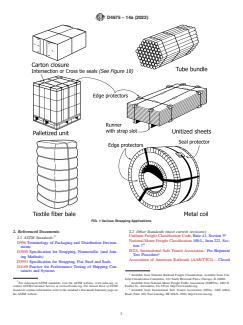
such as, edge protectors, seal protectors, etc. are shown in Fig. 1.
Strapping may be recyclable but must never be reused. Contact your supplier for further
information.
Table of Contents
Section
Introduction
List of Figures
List of Tables
1. Scope
2. Referenced Documents
3. Terminology
4. Significance and Use
5. Safety Hazard Guidelines
6. General Considerations
7. General Uses
8. Strap Tension
9. Packaging Design
10. Load, Unit, and Package Securement Configuration
11. Strap Selection
12. Joining Methods and Properties
13. Coatings, Finishes, and Resistance to Deterioration of Physical Properties
14. Environmental Considerations
15. Lubrication
16. Equipment for Strapping Application
17. Strap Application
18. Testing and Evaluation
Copyright © ASTM International, 100 Barr Harbor Drive, PO Box C700, West Conshohocken, PA 19428-2959. United States
D4675 − 14a (2022)
Table of Contents
Section
19. Evaluation of Strap Failure
20. Keywords
Supplementary Requirements
Disclaimer and Contact Information
List of Figures
Title Figure No.
Various Strapping Applications 1
Strap Cutting Techniques 2
Correct and Incorrect Applied Strapping 3
Notch Joint with Seals 4
Crimp Joint with Seals 5
Sealless Interlocking Joints 6
Loop Joint Secured to Stake Pocket 7
Loop Joint Placement 8
Buckle Styles 9
Crimp Joint Seals 10
Overlap Sealless Joints 11
Feedwheel Hand Tool Tensioning Application 12
Snap-On (Open) and Semi-Open Seals 13
Windlass Type Hand Tool Application 14
Thread-On (Closed) and Push Type (Overlap) Seals 15
Push Type Hand Tool Application 16
Nested Stack (Magazine Feed) Seal 17
Combination Tension and Seal-Feed Hand Tool Application 18
Intersection or Cross Tie Seal 19
Various Strapping Take-Up and Tensioning Methods 20
Corrugated Fiberboard Box Strap Placement S1.1
Cleated-Panel Box Strap Placement S1.2
Nailed Wood Boxes Strap Placement S1.3
Wire Bound Box Strap Placement S1.4
List of Tables
Title Table No.
Strapping Applications Commonly Used for Packaging, Unitization, and Load Securement 1
Examples of Different Package Types 2
Appropriate Strapping Use as a Function of Environmental Conditions 3
Potential Causes for Strap Failure 4
Suggested Minimum Sizes of Steel and Nonmetallic Strapping for Corrugated Fiberboard Boxes S1.1
Suggested Minimum Sizes of Flat Steel Strapping for Cleated-Panel Boxes S1.2
Suggested Minimum Sizes of Flat Steel Strapping for Nailed Wood Boxes S1.3
Weight of Contents Versus Length of Top Cleat S1.4
1. Scope 1.3 Limitations—This guide is not intended to give specific
information as to how strapping must be used in any particular
1.1 This guide covers information on flat strapping mate-
packaging or loading situation. Rather, it is intended to be
rials (steel and nonmetallic) for the prospective user wanting
informationalinnatureandisofferedasastartingpointforthe
initial guidance in selecting a strapping material and informa-
testing of strapping being considered by the user. Thorough
tion on suggested application methods for use in packaging
user testing is essential, as is a review of pertinent regulations
(closing, reinforcing, baling, bundling, unitizing, or
that can influence strap selection (size and type), and applica-
palletizing), and loading applications (load unitization and
tion methods.
securement to transport vehicle). The use applies to handling,
securement, storage, and distribution systems. 1.4 The values stated in inch-pound units are to be regarded
as standard. The values given in parentheses are mathematical
1.2 Carrier associations have established certain packaging
conversions to SI units that are provided for information only
and loading requirements that (in some cases) specify the type
and are not considered standard.
ofstrap,theminimumsizeorstrength,thetypeofjointorseal,
1.5 This standard does not purport to address all of the
andthenumberofstraps,seals,andjointsthatmustbeusedfor
safety concerns, if any, associated with its use. It is the
particulartypesofshipmentsorundercertainconditions.Users
responsibility of the user of this standard to establish appro-
should consult with their carriers initially to determine if there
priate safety, health, and environmental practices and deter-
are applicable published requirements. Individual carriers may
mine the applicability of regulatory limitations prior to use.
establish their own requirements. (See 2.2.)
1.6 This international standard was developed in accor-
dance with internationally recognized principles on standard-
ThisguideisunderthejurisdictionofASTMCommitteeD10onPackagingand
is the direct responsibility of Subcommittee D10.25 on Palletizing and Unitizing of
ization established in the Decision on Principles for the
Loads.
Development of International Standards, Guides and Recom-
Current edition approved Oct. 1, 2022. Published October 2022. Originally
mendations issued by the World Trade Organization Technical
approved in 1987. Last previous edition approved in 2014 as D4675–14a. DOI:
10.1520/D4675-14AR22. Barriers to Trade (TBT) Committee.
D4675 − 14a (2022)
FIG. 1 Various Strapping Applications
2. Referenced Documents 2.2 Other Standards (most current revisions):
2 Uniform Freight Classification Code,Rule 41, Section 9
2.1 ASTM Standards:
National Motor Freight Classification100-L, Item 222, Sec-
D996Terminology of Packaging and Distribution Environ-
tion 7
ments
ISTA, International Safe TransitAssociation, Pre-Shipment
D3950Specification for Strapping, Nonmetallic (and Join-
Test Procedure
ing Methods)
Association of American Railroads (AAR/TTCI)—Closed
D3953Specification for Strapping, Flat Steel and Seals
D4169Practice for Performance Testing of Shipping Con-
tainers and Systems
Available from National Railroad Freight Classification, available from Uni-
form Classification Committee, 222 South Riverside Plaza, Chicago, IL 60606.
2 4
For referenced ASTM standards, visit the ASTM website, www.astm.org, or Available from National Motor Freight TrafficAssociation (NMFTA), 1001 N.
contact ASTM Customer Service at service@astm.org. For Annual Book of ASTM Fairfax St., Alexandria, VA 22314, http://www.nmfta.org.
Standards volume information, refer to the standard’s Document Summary page on Available from International Safe Transit Association (ISTA), 1400 Abbot
the ASTM website. Road, Suite 160, East Lansing, MI 48823–1900, http://www.ista.org.
D4675 − 14a (2022)
Car Loading Methods and Open Top Loading Rules 3.2.9 initial applied tension (IAT), n—highest amount of
IMO/ILO/UN ECEGuidelines for Packing or Cargo Trans- stressinducedintothestrapwhilethetensioningmechanismis
port Units (CTUs) still engaged.
Driver’s Handbook on Cargo Securement
3.2.10 initial retained tension (IRT), n—the stress that
remains in the strap immediately after completion of the joint
3. Terminology
and removal of the tensioning equipment.
3.2.11 joint effıciencies, n—joint strength divided by the
3.1 Definitions—For general definitions of packaging and
minimum breaking strength of the strap, expressed as a
distribution environments see Terminology D996.
percentage (For minimum acceptable percentage values, see
3.2 Definitions of Terms Specific to This Standard: The
Section 12, and Specifications D3950 and D3953.)
following refers to the characteristics and properties of strap-
3.2.12 joint strength, n—the highest longitudinal tension
ping materials. These can be objectively measured to some
(strain) that must be applied to cause a strap joint to fail. A
extent and are used to rank the relative effectiveness of
failure at the gripper marks (outside of the joint) made by the
different strapping materials in different applications. The
hand tool, strapping head, or tensile tester specimen holding
definitions given here are for the purposes of this guide only
grippers is not to be considered the strength of the joint.
and do not necessarily reflect general usage orASTM standard
definitions. Some properties are common to both steel and 3.2.13 lubrication, n—an intentionally applied substance on
nonmetallic strapping. Other properties pertain to just steel
the strap surface that lowers the coefficient of friction.
strapping or to nonmetallic strapping only.
3.2.14 mechanism, n—device used in application of
3.2.1 break strength, n—thelongitudinaltensileforcethatis
strapping, such as tensioner and sealer, combination tool, or
applied to cause a strap to rupture. (See Specifications D3950
power strapping equipment.
and D3953.)
3.2.15 moisture sensitivity, n—thedegreetowhichmechani-
3.2.2 chemical contamination, n—exposure to chemicals
cal properties degrade due to the presence of moisture or
which may degrade the strap’s physical properties. (See Sec-
moisture vapor. (See Section 13.)
tion 13).
3.2.16 notch sensitivity, n—the measure of a strapping
3.2.3 corner break strength, n—the reduced break strength material’s ability to resist tearing or breaking due to a nick or
due to the strapping being bent around a corner or edge. (See cut.
Specification D3953.)
3.2.17 settling tolerance, n—the ability of a strap to remain
tautwhenusedtoconfineadimensionallyshrinkingload,unit,
3.2.4 dead stretch (creep), n—strain (elongation) resulting
or package.
from constant tensional stresses over time.
3.2.18 shear plane, n—thecontactsurfaceareabetweentwo
3.2.5 ductility in bending (resistance to “work hardening”),
itemsatwhichtheymoverelativetooneanotherwhenparallel
n—refers to the ability of steel strapping to deform without
and opposing forces are applied to these areas. The parallel
rupture under the tensile stress resulting from bending, or its
application of forces causes the items to slide against one
resistancetoworkhardening.Itistheoppositeof“brittleness.”
another.
Ductility is related to corner break strength and closely
3.2.19 system strength, n—the strength of an applied strap
associated to strength and elongation. (See Specification
D3953.) (closed loop) including both the strap and joining method.
3.2.20 temperature sensitivity, n—the degree to which the
3.2.6 elongation at break, n—the increase in strapping
mechanical properties degrade due to extreme low or high
length (strain) when the tensional loading (stress) gets high
temperatures.
enough to cause strap failure. (See Specifications D3950 and
D3953.)
3.2.21 tension transmission, n—the ability of strapping to
slide around a corner/edge during tensioning.
3.2.7 energy-to-break, n—the energy/force (total area under
3.2.22 ultraviolet (U.V.) light resistance, n—the degree to
the stress-strain curve), resulting from strength and elongation
properties required to break a strap. which the mechanical properties degrade due to ultraviolet ray
exposure. U.V. inhibitors are available for all types of nonme-
3.2.8 environmental resistant properties, n—the ability of
tallic strapping.
steel or nonmetallic strapping to withstand degradation from
3.2.23 unit strap lifting method (USLM), n—a specialized
(but not limited to) exposure to sunlight, low and high
application for overhead lifting and transport of large and
humidity, and caustic chemicals.
heavyloads,units,orpackagesprimarilyatportfacilities.(See
Table 1.)
6 3.2.24 yield point, n—the stress at which a material begins
Available fromAssociation ofAmerican Railroads, Transportation Technology
to deform physically. Prior to reaching the yield point, the
Center,Inc.(AAR/TTCI),55500DotRoadPueblo,CO81001,http://www.aar.com.
Available from International Maritime Organization, Publishing Service, 4
material will deform elastically and will return to its original
Albert Embankment, London, SE1 7SR, United Kingdom, http://www.imo.org.
shapewhentheappliedstressisremoved.Oncetheyieldpoint
Available from Driver’s Handbook on Cargo Securement, 1200 New Jersey
is passed, some fraction of the deformation will be permanent
Avenue, SE, Suite W60-300, Washington, DC 20590, http://www.fmcsa.dot.gov/
documents/cargo/cargosecurement-16-04.pdf. and non-reversible.
D4675 − 14a (2022)
TABLE 1 Strapping Applications Commonly Used for Packaging, Unitization, and Load Securement
For guidance purposes only. The strapping types and sizes indicated for specific applications are typical. The table is not intended to recommend or specify.
Specification D3953 for Strapping Flat Steel and Seals Specification D3950 for Strapping Nonmetallic (and Joining Methods)
Hand or Machine Applied Hand Applied Hand or Machine Applied
Type I Steel Type IA Bonded,
Type I Steel Type I Steel Type I Bonded Type II
Regular Duty Woven, or Composite Type III Nylon Type IV Polyester
Regular Duty Heavy Duty Rayon Cord Polypropylene
High Strength Polyester Cord
High Tensile Good Tensile
Moderate Tensile High Tensile Good Tensile Strength Moderate Tensile Low Tensile Moderate Tensile
Strength Strength
Strength Strength Moderate Strength Strength Strength
Moderate Moderate
Low Elongation Low Elongation Elongation Moderate High Elongation Good Elongation
Industry Product
Elongation Elongation
High Retained High Retained Good Retained Elongation Low Retained Good Retained
High Retained Good Retained
Tension Tension Tension Good Notch Tension Tension
Tension Tension
Well suited for Well suited for High Energy-to-Break Sensitivity Good Tension Good Tension
Well suited for High Energy-to-
rigid and rigid and Good Notch Well suited for Recovery Recovery
rigid and Break
moderate moderate Sensitivity shrinking, rigid, Well suited for Well suited for
moderate Well suited for
expanding units expanding units Well suited for and moderate shrinking and shrinking, rigid,
expanding units shrinking, rigid,
Not well suited for Not well suited for shrinking, rigid, and expanding expanding and expanding
Not well suited for and expanding
shrinking units. shrinking units. expanding units. units. units. units.
shrinking units. units.
3 1 7 7 5
Appliances ⁄8”& ⁄2 ” ⁄16 ” ⁄16 ” ⁄8 ”
3 1 3 1 3 3
Carton Closure ⁄16 ”, ⁄4”& ⁄8 ” ⁄4”& ⁄8 ” ⁄8 ”
5 3 5 3 5 3
Flat Glass ⁄8”& ⁄4 ” ⁄8”& ⁄4 ” ⁄8”& ⁄4 ”
3 5 3 1 5 3 7 7 1 5 3
PVC Pipe ⁄4 ” ⁄8”& ⁄4 ” ⁄2 ”, ⁄8”& ⁄4 ” ⁄16 ” ⁄16 ” ⁄2 ”, ⁄8”& ⁄4 ”
Food Products in Wood
3 5 3 5
⁄4 ” ⁄8”& ⁄4 ” ⁄8 ”
Bins
1 1
Hay Bailing ⁄2 ” ⁄2 ”
3 3
Cotton ⁄4 ” ⁄4 ”
1 5 3 1
Tobacco ⁄2 ”, ⁄8”& ⁄4 ” ⁄2 ”
Fibers
5 3 5 3 1 5 3 5 3
⁄8”& ⁄4 ” ⁄8”& ⁄4 ” ⁄2 ”, ⁄8”& ⁄4 ” ⁄8”& ⁄4 ”
(Manmade & Natural)
3 3
PET Bottles ⁄8 ” ⁄8 ”
3 3
Cans ⁄8 ” ⁄8 ”
7 1 7 1
Glass Bottles ⁄16”& ⁄2 ” ⁄16”& ⁄2 ”
3 7 7
KD Boxes ⁄8 ” ⁄16 ” ⁄16 ”
3 5 3 7 7
Corrugated Sheet Bundles ⁄8 ”, ⁄8”& ⁄4 ” ⁄16 ” ⁄16 ”
7 1 7 1
Signature Logs ⁄16”& ⁄2 ” ⁄16”& ⁄2 ”
3 1
Magazines 5 mm, ⁄16”& ⁄4 ”
3 1
Newspapers 5 mm, ⁄16”& ⁄4 ”
1 5 1 5 7 1 5
Palletized Printed Loads ⁄2”& ⁄8 ” ⁄2”& ⁄8 ” ⁄16 ”, ⁄2”& ⁄8 ”
1 1 5
Brick ⁄2 ” ⁄2 ” ⁄8 ”
1 5 1 5 5 3
Block/Pavers ⁄2”& ⁄8 ” ⁄2”& ⁄8 ” ⁄8”& ⁄4 ”
Roof Tiles ⁄16 ”
5 3 1 5 3 5 3 5 3 1 5 3
Lumber ⁄8”& ⁄4 ” ⁄2 ”, ⁄8”& ⁄4 ” ⁄8”& ⁄4 ” ⁄8 ”, ⁄4 ”, 1” & 1 ⁄4 ” ⁄8”& ⁄4 ”
3 3 5 3 3
Hardwoods ⁄4 ” ⁄4 ” ⁄8”& ⁄4 ” ⁄4”&1”
5 3 5 3 5 3 5
Hardboard Siding ⁄8”& ⁄4 ” ⁄8”& ⁄4 ” ⁄8”& ⁄4 ” ⁄8 ”
5 3 5 3 5 3 5 3 5
Pressure Treated Lumber ⁄8”& ⁄4 ” ⁄8”& ⁄4 ” ⁄8”& ⁄4 ” ⁄8”& ⁄4 ” ⁄8 ”
3 3 5 3 5
Landscape Timbers ⁄4 ” ⁄4 ” ⁄8 ”, ⁄4”&1” ⁄8 ”
Flakeboard, MDF, OSB,
5 5 5 3 5 3
⁄8 ” ⁄8 ” ⁄8”& ⁄4 ” ⁄8”& ⁄4 ”
Particleboard & Plywood
3 1 5 3 1 5 3
I-Joists, LVL, PSL & LSL ⁄4”&1 ⁄4 ” ⁄8 ”, ⁄4 ”, 1” & 1 ⁄4 ” ⁄8”& ⁄4 ”
Engineered
Panel Forest Graphic
Wood Masonry Corrugated Bevarage Agriculture General
Products Products Arts
Products
D4675 − 14a (2022)
TABLE 1 Continued
For guidance purposes only. The strapping types and sizes indicated for specific applications are typical. The table is not intended to recommend or specify.
Specification D3953 for Strapping Flat Steel and Seals Specification D3950 for Strapping Nonmetallic (and Joining Methods)
Hand or Machine Applied Hand Applied Hand or Machine Applied
Type I Steel Type IA Bonded,
Type I Steel Type I Steel Type I Bonded Type II
Regular Duty Woven, or Composite Type III Nylon Type IV Polyester
Regular Duty Heavy Duty Rayon Cord Polypropylene
High Strength Polyester Cord
High Tensile Good Tensile
Moderate Tensile High Tensile Good Tensile Strength Moderate Tensile Low Tensile Moderate Tensile
Strength Strength
Strength Strength Moderate Strength Strength Strength
Moderate Moderate
Low Elongation Low Elongation Elongation Moderate High Elongation Good Elongation
Industry Product
Elongation Elongation
High Retained High Retained Good Retained Elongation Low Retained Good Retained
High Retained Good Retained
Tension Tension Tension Good Notch Tension Tension
Tension Tension
Well suited for Well suited for High Energy-to-Break Sensitivity Good Tension Good Tension
Well suited for High Energy-to-
rigid and rigid and Good Notch Well suited for Recovery Recovery
rigid and Break
moderate moderate Sensitivity shrinking, rigid, Well suited for Well suited for
moderate Well suited for
expanding units expanding units Well suited for and moderate shrinking and shrinking, rigid,
expanding units shrinking, rigid,
Not well suited for Not well suited for shrinking, rigid, and expanding expanding and expanding
Not well suited for and expanding
shrinking units. shrinking units. expanding units. units. units. units.
shrinking units. units.
3 1
Paper Rolls ⁄8”& ⁄2 ”
3 1 3 1 3 3
Copy Paper in Cartons ⁄16 ”, ⁄4”& ⁄8 ” ⁄4”& ⁄8 ” ⁄8 ”
5 3
⁄8 ”, ⁄4 ”, 1” &
3 1
Aluminum Ingots ⁄4”&1 ⁄4 ”
1 ⁄4 ”
3 3 1
Aluminum Billets ⁄4 ” ⁄4 ”, 1” & 1 ⁄4 ”
5 3 1 5 3 5
Aluminum Extrusions ⁄8”& ⁄4 ” ⁄2 ”, ⁄8”& ⁄4 ” ⁄8 ”
5 3 5 3
Scrap Aluminum ⁄8”& ⁄4 ” ⁄8”& ⁄4 ”
3 1 5 3 3
Aluminum Rod ⁄4”&1 ⁄4 ” ⁄8 ”, ⁄4”&1” ⁄4”&1”
1 3 1 3
Coiled Cooper Rod 1 ⁄4 ” ⁄4 ”, 1” & 1 ⁄4 ” ⁄4”&1”
1 3 1 5 3
Steel Wire 1 ⁄4 ” ⁄4 ”, 1” & 1 ⁄4 ” ⁄8”& ⁄4 ”
3 1 5 3 1 3
Steel Structural Shapes ⁄4”&1 ⁄4 ” ⁄8 ”, ⁄4 ”, 1”, & 1 ⁄4 ” ⁄4”&1”
5 3 1
Cut-to-Length Flat Sheet ⁄8 ”, ⁄4 ”, 1” & 1 ⁄4
5 3 1 5 3 1
⁄8 ”, ⁄4”&1 ⁄4 ” ⁄8 ”, ⁄4 ”, 1” & 1 ⁄4 ”
Stock ”
5 3 1 5 3 1 3
Steel Tubing ⁄8 ”, ⁄4”&1 ⁄4 ” ⁄8 ”, ⁄4 ”, 1” & 1 ⁄4 ” ⁄4”&1”
1 5 3 5 3 1 3 1 5 3
Steel Coils ⁄2 ”, ⁄8”& ⁄4 ” ⁄8 ”, ⁄4”&1 ⁄4 ” ⁄4 ”, 1”, & 1 ⁄4 ” ⁄8 ”, ⁄4”&1”
3 1 3 1
Truck & Railcar Unitization ⁄4”&1 ⁄4 ” ⁄4 ”, 1” & 1 ⁄4 ”
Truck Tie Down 1 ⁄4”&2”
3 1 1 1
Railcar Doorway Protection ⁄4”&1 ⁄4”1 ⁄4”&1 ⁄2 ”
3 1
Open Top Railcar Tie Down ⁄4 ”, 1 ⁄4”&2”
Unit Strap Lifting Method 1 ⁄4 ” USLM
Load
Metals Paper
Securement
D4675 − 14a (2022)
4. Significance and Use (5)Use one hand to hold the strap firmly against the load,
unit, or package. Never place your hand on or near the seal
4.1 This guide is intended to assist the user in selecting
while cutting the strap. (See Fig. 2.)
strapping material(s) and application method(s) for evaluation
5.2.2 Always wear proper Personal Protective Equipment
when subjected to handling, transit, and storage tests. It
(PPE) such as gloves, eye protection, steel toe safety shoes,
describes general load, unit and package types, strapping
etc., when working with steel or nonmetallic strapping.
properties, strapping performance, weight considerations,
shear planes, component frictional characteristics, and geom-
5.3 Excessive tensioning may cause strap breakage.Always
etry.
position yourself to one side of strap being tensioned. Never
stand directly in-line of a strap being tensioned.
5. Safety Hazard Guidelines
5.4 Strapping Tools—Read and understand all instructions
5.1 Safety guidelines need to be followed to avoid personal
before operating any tool.
injury or death. Examples of safety guidelines are presented
5.4.1 Never operate the tool in such a manner that could
below. Users should consider engaging an individual qualified
resultinalossofbalanceorlossofcontrolofthetool,theload,
by training to conduct a risk assessment on all strapping
unit, or package secured by the strap.
applications to determine best safety practices.
5.4.2 Never extend the length of the handle on a manual
5.2 Strap Cutting—Whenstrapsareundertensionalloading,
tensioner, or exceed the manufacturer’s recommended maxi-
thereleaseofthistensionwillproduceahazardwhentheloose
mum air pressure on pneumatic tensioners to gain increased
ends snap free after being intentionally or accidentally cut,
strap tension. To do so could result in sudden strap failure or
frayed, or otherwise released. Contents under restraint or the
breakage of the tensioner. This could result in serious or fatal
strapitself,orboth,mayspringtowardorfallupontheoperator
injury to the operator.
orabystanderwhenstraptensionissuddenlyreleased. Cutting
5.5 Seals and Joints—An improperly formed strap joint can
tensioned strap is hazardous.Usecautionandfollowapproved
result in premature failure and an unstable load, unit, or
safety procedures. (See Fig. 2.)
package. (See Section 12.)
5.2.1 Strap Cutting Techniques:
(1)Wear safety gloves and eye protection when working
5.6 Strapping Alignment—Apply strapping perpendicular to
with steel or nonmetallic strapping.
any edge (corner). A strap being applied and tensioned at an
(2)Keep a safe distance away from the danger zone. (See
angle (edge loaded) may induce strap failure. Eventually the
the Gray Area in Fig. 2.) When tensioned straps that secure a
strap could shift to proper alignment position, resulting in a
load, unit, or package are cut the contents could shift or fall.
loose strap and product shift. (See 17.1.)
Bystanders need to be in an area where they will not be struck
5.7 Improper Use—Use strapping only as intended by the
by flying or flailing strap ends when the strapping is being cut.
supplier and consistent with all applicable regulations,
(3)Never stand under a strapped load, unit, or package.
standards, warnings, and instructions.
Neverstanddirectlyinfrontofaload,unit,orpackagesecured
5.7.1 Drilling, Punching, or Nailing—Never drill holes in
by a strap being cut.
strapping. Never punch strapping with nails, staples, or other
(4)Stand to one side of the strap being cut.
sharp objects. This may cause premature strap failure that
could result in serious or fatal injury.Attempting to nail/staple
through steel strapping may present a hazard, such as strap
failureorrichochetingofanail/staple.Fornail-onapplications,
use Type 2 steel strapping that has pre-punched holes.
5.7.2 Pulling or Dragging—Never use strapping as a means
of pulling or dragging any load, unit, or package.
5.7.3 Lifting—Never use strapping as a means of lifting
unless using the Unit Strap Lifting Method (USLM) system.
(See 5.9 to 5.9.6.)
5.8 Reuse—Never reuse steel or nonmetallic strapping,
since the mechanical properties of strapping may be altered by
tensioning, during handling/shipping, or after having been
applied in the first instance.
5.9 Unit Strap Lifting Method (USLM)—Beforeconsidering
a USLM application, consult your USLM system vendor and
transportation or Port Regulatory Authorities for application
rules and specifications. The following warnings are in addi-
tion to the previously listed safety hazards. (See 5.2 through
5.8.)
5.9.1 Compliance and Training—Compliance with all
FIG. 2 Strap Cutting Techniques safety aspects of USLM application is critical to protect
D4675 − 14a (2022)
personnel. Always train all users before using the USLM or 6.3 Cord Strapping (Type I and IA)—Cord strapping con-
handling USLM loads. sists of two basic types: Rayon (Type I) and Polyester (Type
IA).
5.9.2 Specified Strapping, Tools, and Seals—Always use
correctly marked USLM steel strapping and seals. (See Speci-
6.3.1 Rayoncordstrap(TypeI)isabondednon-wovencord
fication D3953.) Crimp type seals must be used and be applied
strap. It is a soft strapping product that possesses good knot
with a crimp type sealer.The strapping must be applied so that
strength. Compared to polyester cord strapping, rayon cord
the USLM markings are visible.
strapping has a lower tensile strength (stress) and greater
5.9.3 Lifting Capacity—Consult transport company or Port
amount of elongation (strain). Rayon cord strapping does
Authority Regulations, and your USLM system supplier to
elongate at low tensile stress, thus possessing good elastic
determine the lifting capacity of strapping. Never exceed the
characteristics.Rayonstrappingisnotwaterresistantandloses
calculated lifting capacity.
strengthwhensubjectedtomoisture.Assuch,itshouldbeused
5.9.4 Damaged or Used Straps or Seals—Never use dam-
primarily in environmentally controlled applications.
aged or used USLM strap or seals.
6.3.2 Polyester cord strapping (Type IA) is made from
5.9.5 Stand Clear—Before lifting, be sure all personnel are
polyester multi-filament yarns that are either woven together
away from the load, unit, or package. Never stand underneath
(Woven), bonded with a plastic binder (Bonded), or encased in
or near a load, unit, or package being lifted.
a polypropylene extrusion (Composite), and has high energy-
5.9.6 System Audit—USLMsystemsrequireperiodicperfor-
to-break for a given cross section. Heavy duty and extra heavy
mance audits. Consult your USLM system vendor for guid-
duty polyester cord strappings are suggested for applications
ance.
wherebreakstrength,elongationrecovery,andhighenergy-to-
breakareoverridingconsiderations.Polyestercordstrappingis
GENERAL CONSIDERATIONS
more resistant to weathering and moisture than rayon cord
strapping.Usesteelbuckleswheremaximumjointefficiencyis
6. General Properties of Strap Types
required. Cord strapping may also be joined with a hand tied
6.1 Steel Strapping—Standard specifications for steel strap-
knot for general bundling purposes and low tension applica-
ping are found in Specification D3953. There are two types of
tions. Knotting is not recommended for high tension applica-
steel strapping — Type 1, Flat Strapping: Power Machine and
tions.
Hand Application; classified into Regular-Duty, Regular-Duty
6.4 Extruded Strapping (Smooth and Embossed) (Type II,
High-Strength, Heavy-Duty, and USLM (Unit Strap Lifting
III, IV)—Extrudednonmetallicstrappingconsistsofthreebasic
Method)andType2:Nail-On.Ofallthetypesofbanding,steel
types: polypropylene (Type II), nylon (Type III), and polyester
strapping has the highest tensile strength (ksi) and break
(Type IV). All three extruded nonmetallic strapping types can
strength(lbf)foragivencross-sectionalarea,andisresistantto
be either smooth (no texture) or embossed (textured).
tension decay from creep. It is better suited for use with
expanding and rigid loads, units, or packages because steel
6.4.1 Polypropylene (Type II)—Polypropylene strapping is
strap, which virtually does not stretch, cannot recover and stay
made from either of two closely related materials: polypropyl-
tight on dimensionally shrinking loads, units, or packages.
ene homopolymer, or polypropylene copolymer. While these
6.1.1 Regular duty strapping is suggested for lighter duty,
materials have excellent resistance to moisture, they are the
lower tension applications.
least heat-resistant of all the common strapping materials and
6.1.2 Regular duty high strength strapping is suggested for also have the greatest tension decay or creep of any of the
applications where high strength alone is the overriding con- common strapping materials. Of the nonmetallic strapping
sideration.
materials, they are the most easily heat sealed or friction
6.1.3 Heavy duty strapping is suggested for applications welded. (See Fig. 11.) They tend to be more suitable for light
where both break strength and elongation are overriding to medium duty packaging and unitizing applications.
considerations.
6.4.2 Nylon (Type III)—Nylon strapping has the highest
6.1.4 USLM strapping is suggested for overhead lifting and
elongation recovery of all nonmetallic strapping materials, and
transportoflargeandheavyloads,units,orpackagesprimarily
that,combinedwitharelativelylowdeadstretch(creep),gives
at port facilities.
it the highest amount of retained tension on shrinking loads,
6.1.5 Nail-On strapping suggested applications are to rein- units, or packages. Where severe settling is the major
forceproductstoavoidskewing,maintainpositionbyconnect-
consideration,nylonwouldbethepreferredstrappingmaterial.
ing individual units or dunnage during shipping, reinforce the
In terms of tensile strength, it is between polypropylene and
corners and joints of packaging, and for use in light duty
polyester strapping material. It has the best cold temperature
hanging or suspension applications.
performance of all the nonmetallic strap types. Nylon strap is
hygroscopic (sponge-like) and is the most susceptible to
6.2 Nonmetallic Strapping—Standard specifications for
degradation from moisture fluctuations.
nonmetallic strapping are found in Specification D3950.There
6.4.3 Polyester (Type IV)—Polyester strapping has the low-
are two broad classifications of nonmetallic strapping: Cord
strapping and Extruded strapping.There are two types of Cord est elongation in the working range and the least amount of
tension decay or creep of all the nonmetallic strappings. It is
strapping (Type I and Type IA). There are three types of
Extruded strap (Type II, III, and IV). more suitable for rigid and expanding loads. Like steel
D4675 − 14a (2022)
strapping, polyester strapping has excellent elongation recov- 8.1.3 Restricts or eliminates longitudinal, lateral, and verti-
ery characteristics, but does not stretch much during applica- cal movement of products within loads, units, or packages
tion. Because strapping cannot recover more than it stretched (cargo).
during application and while on the load, unit, or package,
PACKAGING DESIGN
polyester strapping is not generally used when a considerable
amount of dimensional shrinking occurs. Polyester strapping
9. Distribution
exhibits relatively good resistance to the effects of extreme
temperatures and moisture.
9.1 Identify receiver(s)/consignee(s), their location(s), and
their shipping point(s)/consignor(s).
7. General Uses
9.2 Determinetheneedsandrequirementsofthereceiver(s).
7.1 Toexpeditehandling,strappingmaybeusedtosecurea
This will provide information on handling equipment and
handling base (skids, platforms, pallets, runners, spacers, etc.)
practices, storage practices/conditions, and possible specific
on loads, units, or packages. For example,2×4 runners
requirements of individual users.
strapped to a concrete or steel slab to allow forklift or
9.3 Determine applicable transportation modes: air, water,
crane/cable handling or to secure other packaging materials
rail, or truck. This will further define the shipping conditions
(battens, stiffeners, wrappings, etc.) in position. (See Fig. 1.)
and applicable rules/regulations. (See 2.2.)
7.2 Strapping may be used for load securement to or within
9.4 Contact potential carriers within each transportation
a transport vehicle. When used for this purpose, strapping is
mode, and determine if there are any general or specific rules
applied under tension to restrain or control the movement of
and regulations.
lading,andthusmustaccommodatein-transitshocksorirregu-
lar movements. National and international regulations provide
9.5 The carriers can, and should be asked to provide
guidelines or minimum requirements, or both. (See 2.2.)
information as to the type of equipment that will best suit
specific needs.
7.3 Strapping may be used for lifting only if applied using
the Unit Strap Lifting Method (USLM). Consult transportation
10. Load, Unit, and Package Securement Configuration
orPortRegulatoryAuthoritiesandaUSLMsystemsupplierfor
(See 2.2)
applicationrequirements.USLMisasystemforliftingunitized
loads with specialized lifting gear and USLM steel strapping
10.1 Generally, the “ideal” configuration is one that:
and seals, applied with specialized tensioners and sealers.
10.1.1 Canbesafelyhandledinallstagesofthedistribution
USLM is used on a variety of bulk cargos such as, wood pulp,
system,
logs, and aluminum billets.
10.1.2 Protects the security of the contents,
10.1.3 Meets all the requirements of the receiver(s),
7.4 Strapping also may be used to provide security against
accidental loss or theft of the contents or to indicate pilferage. 10.1.4 Secures easily onto transportation equipment,
10.1.5 Maximizes the use of space in warehouses and
7.5 Strapping functions best when all resultant forces act
transportation equipment,
directly parallel to, and in-line with, the direction of the strap.
10.1.6 Meets all national, international packaging and ship-
(See Fig. 3.)
ping regulations (see 2.2), and
8. Strap Tension 10.1.7 Can be easily assembled and disassembled.
8.1 Strapping primarily functions under tension. Strap ten- 10.2 Theconfigurationoftheload,unit,orpackageneedsto
sion basically: be such that it maintains as low a center of gravity as practical
8.1.1 Imposes circumferential (peripheral) compressive for maximum stability during handling, transit, and storage.
forces to resist a change in configuration. For example, tubing
secured in a hexagonal or round unit, scrap paper secured in
11. Strap Selection
bales, etc. (See Fig. 1.)
11.1 Strap size, type, placement, and the number of straps
8.1.2 Increases the frictional forces between the adjacent
required are all a function of the work to be done. (See Table
surfaces within the load, unit, or package. For example, forces
1andTable2.)Theworktobedoneisdeterminedbyanumber
between cartons on a pallet. (See Fig. 1.)
of factors, including (but not limited to):
(1)The number and direction of the shear planes,
(2)Friction of contact surfaces between all shear planes,
(3)Size, shape, and weight of load, unit, or package,
(4)Susceptibility of load, unit, or package to be damaged
by strapping,
(5)Stacking pattern, height, and weight,
(6)Warehouse stacking conditions,
(7)Expected severity of handling,
(8)Mode of transportation,
(9)Nature of transport equipment,
FIG. 3 Correct and Incorrect Applied Strapping (10)Shipping routes,
D4675 − 14a (2022)
TABLE 2 Examples of Different Package Types
sheets. A function of tensioned strapping is to maintain load,
Package Content Type Examples unit, or package integrity by limiting movement between
Natural and synthetic fibers
contacting surfaces. Friction will also help reduce the loss of
Compressed scrap paper
integrity caused by multiple shear planes. In cargo securement
Corrugated fiberboard sheets
Expanding
Pressure treated lumber bundles applications, the coefficient of friction also plays an important
Concrete reinforcing mesh
role.
Compressed coils of metal rods
Powders in cartons, bags, or other
12. Joining Methods and Properties
soft containers
Jars or cans packed with corrugated
12.1 Joints—Joints are generally lower in strength than the
Settling separator sheets
parent strap. It is therefore very important that all elements
Green or wet lumber bundles that will
lose moisture
contributing to form the joint be compatible. Some examples
Brick cube when handled or shipped
(but not limited to) are:
Concrete or metal slabs at ambient
temperature 12.1.1 Strap—Size, type, coating/finish, and lubricity do
Rigid
Exterior grade plywood
affect the selection of the joining method.
Cold Rolled steel
12.1.2 Joining Method—Must be compatible with strap and
sealing mechanism. Seals for steel strap and the different types
of nonmetallic strap, although similar, are not interchangeable.
(11) Intended method of unloading and handling by
Never use a seal designed for use with steel strapping on
recipient(s),
nonmetallic strapping or vice versa. Specific buckles for
(12) Removal and disposal of strapping including
nonmetallic strapping are also only for use on specific types of
environmental, sustainability, and safety considerations,
strappingandaregenerallynotinterchangeable.Alwaysensure
(13)Exposure to extreme low and high temperatures,
that the joint method selected is intended for the type of
(14)Exposure to environmental conditions, (particularly if
strapping being used.
prolonged outdoor exposure is anticipated)
12.1.3 Joining Mechanism—Must be compatible with type
(15)Exposure to chemicals,
of strap and seal (if used) and needs to be in good mechanical
(16)Exposure to abrasive surfaces, and
condition. Joining mechanisms for steel and nonmetallic
(17)Exposure to sharp or pointed objects that can cause
strapping, although similar, are not interchangeable.
nicks, scratches, or holes in strapping.
12.1.4 Tension Mechanism—Must be compatible with the
11.2 Contents of a strapped load, unit, or package have a type of strap and joint.
tendency to react in one of three ways. They can expand, 12.1.5 Operator Technique—Combine above elements to-
remain rigid, or settle (shrink). Contents may appear to be one gether to ensure that the joint is properly formed. Always
type and later, with different conditions, exhibit the character- follow manufacturer’s instructions.
isticofanothertype.Strappingselectionmustaccommodateall 12.1.6 Periodic Testing of Joints—To ensure that all ele-
anticipated content reactions. (See Table 2.) mentsofthesystemarefunctioningproperly,testsamplejoints
as often as deemed necessary. Joints should be taken from the
11.3 Shear Planes—The number of shear planes within a
actual application. A joint may have all the appearances of a
load, unit, or package should have some bearing on strap
good seal, but could possess less than the required strength.
selection and placement. Generally, more restraint is required
to maintain integrity when there are more shear planes within 12.2 Joint Types—The four basic types of strap joints are
a load, unit, or package. Supplementary materials such as edge overlap, buckle, intersection, and loop.
protectors and dado cut battens may be used to augment the 12.2.1 Overlap Joint—This is the most common type of
strap’s effectiveness. (See Fig. 1.) joint and is made by joining two ends of strapping around a
load, unit, or package for securement. (See Figs. 4, 5, 6, and
11.3.1 Examples of Flat Surface Shear Planes Are:
11.3.1.1 Multiple horizontal only; for example, plywood 11.)
sheeting, 12.2.2 Buckle Joint—This type of joint is made by joining
11.3.1.2 Multiple horizontal and unidirectional vertical; for nonmetallic strapping around a load, unit, or package for
example, dimensional lumber, and securement by threading the two strap ends into a buckle. (See
11.3.1.3 Multiple horizontal and bidirectional vertical; for Fig. 9.)
example, brick cube. 12.2.3 Intersection Joint—The joining of two steel straps
11.3.2 Curved Surface Shear Planes—Cylindrical objects whichcrossatrightanglesforpurposesofmaintainingrelative
that are not stacked vertically have a complex (curved) shear position. (See Fig. 19.)
plane that tends to restrict sliding in the horizontal direction 12.2.4 Loop Joint—The joining of one end of strapping to
only. If cylindrical objects are stacked vertically, the shear thestrappingitself,normallytoencircleananchorfixture.(See
planes are multiple in all directions. Fig. 7.)
11.4 Coeffıcient of Friction—The coefficient of friction of 12.3 Joint strength is expressed by joint efficiency (see
thecontactsurfacesisalsoamajorconsideration.Forexample, 3.2.12). A strapping joint will usually be something less than
abundleofrough-cut2×4’sdoesnotrequireasmuchrestraint 100 % of actual strap break strength. Joint efficiency of
as an identical bundle of smoothly planed2×4’s.A similar different types of joints on different types of strapping varies
example would be dry steel sheets versus heavily oiled steel greatly. Specification D3953 specifies the minimum joint
D4675 − 14a (2022)
efficiency for Type I steel strapping to be 45 % (single notch), 12.6.1 Crimp Joint and Seals—For steel strapping, friction
75 % (double notch, crimp, and sealless), and 90 % (USLM is developed in a crimp joint by pairs of deformations on the
crimp). Specification D3950 specifies the minimum joint top edges of the seals and the overlapped strap ends. (See Fig.
efficiency for nonmetallic strapping to be 45 % for Type I and 5.) Since the strap is not cut, the maximum potential joint
TypeIAGrades1and2,TypeII,TypeIII,andTypeIV,and55 strength can approach the parent strap strength. The finish on
% for Type IA Grades 3, 4, 5, 6, and 7. All of the minimum the strap will affect its lubricity, and consequently, the number
joint efficiencies are based on joint strength as a percentage of of crimp pairs or amount of deformation required. (See Fig.
the minimum break strength of the strap. Other standards or 5A.)
regulations may specify higher or lower minimum required 12.6.2 Some styles of crimp seals are available with a
joint efficiencies. knurled, scored, or grit (abrasive material) on the internal
surface of the seal that augments the friction to provide higher
12.4 Steel and nonmetallic strapping are made from mate-
jointstrengthsonlubricatedsteelstrapping.(SeeFig.5Bforan
rials with fundamentally different characteristics. Therefore,
example of a grit seal.)
different joining methods are used.
12.6.3 Crimp joints tend to fail by slipping, but may allow
JOINTS FOR STEEL STRAPPING some retention value to be maintained after slipping occurs.
This is the “slip and hold” or “controlled slip” characteristic.
12.5 Overlap Notch Joints for Type 1 Steel Strapping:
12.5.1 Notch Joint and Seals for Strapping (see Fig. 4): 12.7 Overlap Spot Welded Joints for Type I Steel Strapping:
12.7.1 Theminimumjointstrengthis75%oftheminimum
12.5.2 A notch joint is a mechanical interlocking of the
overlapping strap ends that are within a seal. The interlocking break strength of the strap.
consists of tabs that are formed in pairs on either side by
12.8 Overlap Interlocking Joint for Type I Steel Strapping:
shearingandbendingpartiallythroughthesealandstrapedges.
12.8.1 Sometimes referred to as sealless or keylock joint.
12.5.3 Sealing mechanisms may be designed to form either
Overlapping ends are aligned and simultaneously
...