

ASTM E2730-22
(Guide)Standard Guide for Calibration and Use of Thermocouple Reference Junction Probes in Evaluation of Electronic Reference Junction Compensation Circuits
General Information
- Abstract
SIGNIFICANCE AND USE
5.1 Many electronic instruments that are designed to be used with thermocouples use some method of reference junction compensation. In many industrial applications it may be impractical to use a physical ice bath as a temperature reference in a thermocouple circuit. The instrument must therefore be able to measure the temperature at the point of electrical connection of the thermocouple and either add or subtract voltage to give a corrected equivalent of what that thermocouple would indicate had there physically been 0 °C reference junctions present in the circuit. There are two types of instruments that generally apply these techniques: electronic thermometer readouts that use a thermocouple as the sensor, and calibrators designed to calibrate these digital thermometer readouts. Additionally, the probe and circuit described in this guide can be used with a voltmeter to emulate a thermometer or a voltage source to calibrate temperature-indicating instrumentation. In all cases the probe must be calibrated if traceability or an uncertainty analysis, or both, is required.
SCOPE
1.1 This guide covers methods of calibration and use of thermocouple reference junction probes (cold junction compensation probes) in the evaluation of electronic reference junction compensation circuits. Their use with instruments that measure only voltage is also covered.
1.2 The values stated in SI units are to be regarded as standard. The values given in parentheses after SI units are provided for information only and are not considered standard.
1.3 This standard does not purport to address all of the safety concerns, if any, associated with its use. It is the responsibility of the user of this standard to establish appropriate safety, health, and environmental practices and determine the applicability of regulatory limitations prior to use.
1.4 This international standard was developed in accordance with internationally recognized principles on standardization established in the Decision on Principles for the Development of International Standards, Guides and Recommendations issued by the World Trade Organization Technical Barriers to Trade (TBT) Committee.
- Status
- Published
- Publication Date
- 30-Apr-2022
- Technical Committee
- E20 - Temperature Measurement
- Drafting Committee
- E20.14 - Thermocouples - Testing
Buy Documents
ASTM E2730-22 - Standard Guide for Calibration and Use of Thermocouple Reference Junction Probes in Evaluation of Electronic Reference Junction Compensation Circuits
REDLINE ASTM E2730-22 - Standard Guide for Calibration and Use of Thermocouple Reference Junction Probes in Evaluation of Electronic Reference Junction Compensation Circuits
Overview
ASTM E2730-22 is the internationally recognized standard guide that establishes best practices for the calibration and use of thermocouple reference junction probes (also known as cold junction compensation probes) in the evaluation of electronic reference junction compensation circuits. These probes are essential in calibrating and verifying temperature measurement instruments using thermocouples, where accurate reference junction compensation is required for reliable readings.
Many industrial and laboratory temperature measurement systems rely on electronic compensation rather than physical reference points like ice baths. This standard provides guidance on calibration methods and practical use of reference junction probes to ensure traceability, accuracy, and uncertainty analysis in temperature data.
Key Topics
- Reference Junction Compensation: Focuses on electrical correction techniques to simulate conditions equivalent to a 0 °C physical reference junction within a thermocouple circuit.
- Calibration Methods: Describes procedures for calibrating reference junction probes using ice baths, water triple point cells, or variable temperature sources.
- Use in Measurement and Calibration Systems: Details three primary application modes for reference junction probes, covering their use as measurement devices, in calibration of compensation circuits, and in simulators or voltage source verification.
- Uncertainty and Traceability: Emphasizes the importance of maintaining calibrated probes for traceability and accurate uncertainty analysis in measurement systems.
- Reporting and Documentation: Highlights requirements for clear presentation of calibration errors, corrections, and associated uncertainties.
Applications
ASTM E2730-22 is used in a variety of practical applications, including:
- Industrial Process Control: Supporting electronic temperature measurements in environments where traditional ice baths are impractical, ensuring reliable compensation in thermocouple circuits.
- Calibration Laboratories: Providing guidance for calibrating and verifying digital thermometer readouts and thermocouple calibrators using reference junction probes.
- Quality Assurance: Enabling traceable and repeatable calibration of temperature measurement instruments used in regulated or safety-critical industries.
- Instrumentation Development: Assisting manufacturers in validating the accuracy of electronic reference junction compensation circuits in new thermometer readouts or calibration equipment.
- Metrology: Supporting accurate uncertainty analysis in temperature measurements by providing methods to estimate and correct for errors introduced by reference junction probes.
The standard covers the use of reference junction probes with both thermocouple-readout instruments and devices that measure voltage only, such as voltmeters or calibrators. This ensures broad applicability across industries where high-precision temperature measurement is essential.
Related Standards
- ASTM E220: Test Method for Calibration of Thermocouples by Comparison Techniques.
- ASTM E230/E230M: Specification for Temperature-Electromotive Force (emf) Tables for Standardized Thermocouples.
- ASTM E344: Terminology Relating to Thermometry and Hydrometry.
- ASTM E563: Practice for Preparation and Use of an Ice-Point Bath as a Reference Temperature.
- ASTM E1129/E1129M and E1684/E1684M: Specifications for Thermocouple Connectors.
- ASTM E1750: Guide for Use of Water Triple Point Cells.
- ASTM E2623: Practice for Reporting Thermometer Calibrations.
- NIST Monograph 175: Temperature-Electromotive Force Reference Functions and Tables.
- BIPM JCGM 100:2008: Evaluation of Measurement Data - Guide to the Expression of Uncertainty in Measurement.
Summary
Adhering to ASTM E2730-22 is vital for any organization or laboratory seeking to ensure the accuracy, traceability, and reliability of thermocouple-based temperature measurement and calibration systems. By following standardized calibration methods and proper documentation, users can meet rigorous industry and regulatory requirements while maintaining high measurement confidence.
Relations
- Effective Date
- 01-Dec-2023
- Effective Date
- 01-Nov-2023
- Effective Date
- 01-Nov-2023
- Effective Date
- 01-May-2023
- Effective Date
- 01-Sep-2019
- Effective Date
- 01-Apr-2018
- Effective Date
- 01-Nov-2016
- Effective Date
- 01-May-2016
- Effective Date
- 01-Dec-2015
- Effective Date
- 01-Dec-2015
- Effective Date
- 01-Sep-2014
- Effective Date
- 01-Nov-2013
- Effective Date
- 01-May-2013
- Effective Date
- 01-May-2012
- Effective Date
- 15-May-2011
Buy Documents
ASTM E2730-22 - Standard Guide for Calibration and Use of Thermocouple Reference Junction Probes in Evaluation of Electronic Reference Junction Compensation Circuits
REDLINE ASTM E2730-22 - Standard Guide for Calibration and Use of Thermocouple Reference Junction Probes in Evaluation of Electronic Reference Junction Compensation Circuits
Get Certified
Connect with accredited certification bodies for this standard

BSMI (Bureau of Standards, Metrology and Inspection)
Taiwan's standards and inspection authority.
Sponsored listings
Frequently Asked Questions
ASTM E2730-22 is a guide published by ASTM International. Its full title is "Standard Guide for Calibration and Use of Thermocouple Reference Junction Probes in Evaluation of Electronic Reference Junction Compensation Circuits". This standard covers: SIGNIFICANCE AND USE 5.1 Many electronic instruments that are designed to be used with thermocouples use some method of reference junction compensation. In many industrial applications it may be impractical to use a physical ice bath as a temperature reference in a thermocouple circuit. The instrument must therefore be able to measure the temperature at the point of electrical connection of the thermocouple and either add or subtract voltage to give a corrected equivalent of what that thermocouple would indicate had there physically been 0 °C reference junctions present in the circuit. There are two types of instruments that generally apply these techniques: electronic thermometer readouts that use a thermocouple as the sensor, and calibrators designed to calibrate these digital thermometer readouts. Additionally, the probe and circuit described in this guide can be used with a voltmeter to emulate a thermometer or a voltage source to calibrate temperature-indicating instrumentation. In all cases the probe must be calibrated if traceability or an uncertainty analysis, or both, is required. SCOPE 1.1 This guide covers methods of calibration and use of thermocouple reference junction probes (cold junction compensation probes) in the evaluation of electronic reference junction compensation circuits. Their use with instruments that measure only voltage is also covered. 1.2 The values stated in SI units are to be regarded as standard. The values given in parentheses after SI units are provided for information only and are not considered standard. 1.3 This standard does not purport to address all of the safety concerns, if any, associated with its use. It is the responsibility of the user of this standard to establish appropriate safety, health, and environmental practices and determine the applicability of regulatory limitations prior to use. 1.4 This international standard was developed in accordance with internationally recognized principles on standardization established in the Decision on Principles for the Development of International Standards, Guides and Recommendations issued by the World Trade Organization Technical Barriers to Trade (TBT) Committee.
SIGNIFICANCE AND USE 5.1 Many electronic instruments that are designed to be used with thermocouples use some method of reference junction compensation. In many industrial applications it may be impractical to use a physical ice bath as a temperature reference in a thermocouple circuit. The instrument must therefore be able to measure the temperature at the point of electrical connection of the thermocouple and either add or subtract voltage to give a corrected equivalent of what that thermocouple would indicate had there physically been 0 °C reference junctions present in the circuit. There are two types of instruments that generally apply these techniques: electronic thermometer readouts that use a thermocouple as the sensor, and calibrators designed to calibrate these digital thermometer readouts. Additionally, the probe and circuit described in this guide can be used with a voltmeter to emulate a thermometer or a voltage source to calibrate temperature-indicating instrumentation. In all cases the probe must be calibrated if traceability or an uncertainty analysis, or both, is required. SCOPE 1.1 This guide covers methods of calibration and use of thermocouple reference junction probes (cold junction compensation probes) in the evaluation of electronic reference junction compensation circuits. Their use with instruments that measure only voltage is also covered. 1.2 The values stated in SI units are to be regarded as standard. The values given in parentheses after SI units are provided for information only and are not considered standard. 1.3 This standard does not purport to address all of the safety concerns, if any, associated with its use. It is the responsibility of the user of this standard to establish appropriate safety, health, and environmental practices and determine the applicability of regulatory limitations prior to use. 1.4 This international standard was developed in accordance with internationally recognized principles on standardization established in the Decision on Principles for the Development of International Standards, Guides and Recommendations issued by the World Trade Organization Technical Barriers to Trade (TBT) Committee.
ASTM E2730-22 is classified under the following ICS (International Classification for Standards) categories: 17.200.20 - Temperature-measuring instruments. The ICS classification helps identify the subject area and facilitates finding related standards.
ASTM E2730-22 has the following relationships with other standards: It is inter standard links to ASTM E344-23, ASTM E1750-23, ASTM E230/E230M-23a, ASTM E230/E230M-23, ASTM E344-19, ASTM E344-18, ASTM E344-16, ASTM E1750-10(2016), ASTM E1684/E1684M-15, ASTM E1129/E1129M-15, ASTM E1129/E1129M-14, ASTM E220-13, ASTM E344-13, ASTM E344-12, ASTM E230/E230M-11. Understanding these relationships helps ensure you are using the most current and applicable version of the standard.
ASTM E2730-22 is available in PDF format for immediate download after purchase. The document can be added to your cart and obtained through the secure checkout process. Digital delivery ensures instant access to the complete standard document.
Standards Content (Sample)
This international standard was developed in accordance with internationally recognized principles on standardization established in the Decision on Principles for the
Development of International Standards, Guides and Recommendations issued by the World Trade Organization Technical Barriers to Trade (TBT) Committee.
Designation: E2730 − 22 An American National Standard
Standard Guide for
Calibration and Use of Thermocouple Reference Junction
Probes in Evaluation of Electronic Reference Junction
Compensation Circuits
This standard is issued under the fixed designation E2730; the number immediately following the designation indicates the year of
original adoption or, in the case of revision, the year of last revision. A number in parentheses indicates the year of last reapproval. A
superscript epsilon (´) indicates an editorial change since the last revision or reapproval.
1. Scope E1129/E1129M Specification for Thermocouple Connectors
E1684/E1684M Specification for Miniature Thermocouple
1.1 This guide covers methods of calibration and use of
Connectors
thermocouple reference junction probes (cold junction com-
E1750 Guide for Use of Water Triple Point Cells
pensation probes) in the evaluation of electronic reference
E2623 Practice for Reporting Thermometer Calibrations
junction compensation circuits.Their use with instruments that
measure only voltage is also covered. 2.2 Other References:
NIST Monograph 175 Temperature-Electromotive Force
1.2 The values stated in SI units are to be regarded as
Reference Functions and Tables for the Letter-Designated
standard. The values given in parentheses after SI units are
Thermocouple Types Based on the ITS-90
provided for information only and are not considered standard.
BIPM JCGM 100:2008 Evaluation of Measurement Data—
1.3 This standard does not purport to address all of the 4
Guide to the Expression of Uncertainty in Measurement
safety concerns, if any, associated with its use. It is the
responsibility of the user of this standard to establish appro-
3. Terminology
priate safety, health, and environmental practices and deter-
3.1 Definitions:
mine the applicability of regulatory limitations prior to use.
3.1.1 ThedefinitionsgiveninTerminologyE344shallapply
1.4 This international standard was developed in accor-
to this guide.
dance with internationally recognized principles on standard-
3.2 Definitions of Terms Specific to This Standard:
ization established in the Decision on Principles for the
Development of International Standards, Guides and Recom-
3.2.1 correction, n—an offset value added to the result of a
mendations issued by the World Trade Organization Technical
measurement to obtain a correct result.
Barriers to Trade (TBT) Committee.
NOTE 1—This definition is from Test Method E220.
2. Referenced Documents
3.2.2 referencejunctioncompensation,n—theelectricalcor-
2.1 ASTM Standards: rection of the indication of a thermocouple such that the
E220 Test Method for Calibration of Thermocouples By corrected indication is equivalent to the emf or temperature the
Comparison Techniques instrument would indicate if the reference junctions were
E230/E230M Specification for Temperature-Electromotive physically maintained at 0 °C.
Force (emf) Tables for Standardized Thermocouples
3.2.3 reference junction probe, n—a probe constructed from
E344 Terminology Relating to Thermometry and Hydrom-
thermocouple materials and high purity copper wire for the
etry
purposeofservingasthereferencejunctionforathermocouple
E563 Practice for Preparation and Use of an Ice-Point Bath
assembly;referencejunctionprobesmaybeconstructedaspart
as a Reference Temperature
of the measuring probe or they can be manufactured separately
and later attached to thermocouple sensors via plugs or other
connection types.
This guide is under the jurisdiction of ASTM Committee E20 on Temperature
Measurement and is the direct responsibility of Subcommittee E20.14 on Thermo-
3.2.4 UUT, n—Unit Under Test.
couples - Testing.
Current edition approved May 1, 2022. Published May 2022. Originally
approved in 2010. Last previous edition approved in 2021 as E2730 – 21.
DOI:10.1520/E2730-22.
2 3
For referenced ASTM standards, visit the ASTM website, www.astm.org, or Available from National Institute of Standards and Technology (NIST), 100
contact ASTM Customer Service at service@astm.org. For Annual Book of ASTM Bureau Dr., Stop 1070, Gaithersburg, MD 20899-1070, USA, http://www.nist.gov.
Standards volume information, refer to the standard’s Document Summary page on Available from Pavillon de Breteuil, F-92312 Sèvres Cedex, FRANCE,
the ASTM website. https://www.bipm.org/.
Copyright © ASTM International, 100 Barr Harbor Drive, PO Box C700, West Conshohocken, PA 19428-2959. United States
E2730 − 22
4. Summary of Guide 6. Reagents
6.1 Laboratory or commercially produced distilled water is
4.1 Calibration of a Reference Junction Probe (RJP) con-
required to create an accurate ice bath. Clean tap water can be
sists of establishing the emf error in the RJP relative to the
used in cases where high accuracy is not a requirement; in this
applicable thermocouple reference function by placing the
case the temperature of the bath should be measured directly.
measuring junction and the reference junctions at known
Chlorine, fluorine, and other chemicals such as dissolved salts
temperatures while measuring the voltage with a digital volt-
inthewateroricewilldepresstheicepointandtheamountcan
meter (DVM). Three methods are described for establishing
be significant in some measurements. See Practice E563 for
the two known temperatures and thus the temperature differ-
further guidance.
ence. For the temperature measurement, many devices such as
Standard Platinum Resistance Thermometers (SPRTs), Plati-
7. Procedure
num Resistance Thermometers (PRTs), thermistors, or
7.1 Calibration of RJP (Methods A, B, or C):
thermocouples, and a variety of readout instruments are
7.1.1 Reference Point Temperature Source:
suitable, depending on the required accuracy. The measured
7.1.1.1 Method A: Ice Bath Method—Prepare the reference
voltage at the copper leads indicates the emf associated with
point temperature source using an ice-point bath in accordance
the temperature difference of the references. Error is deter-
with Practice E563. Refer to Fig. 1.
minedbycomparingtheobservedemftothecalculatedemffor
NOTE 5—Be careful to closely follow the guidelines in Practice E563
the known temperature difference. The emf error is then
forestablishingandmaintaininganIcePointReferenceassignificanterror
applied as a correction. The corrected emf can then be
can occur over time without proper maintenance.
converted to temperature.
7.1.1.2 Method B: Triple Point of Water (TPW) Cell
NOTE 2—In particular, cold work should be avoided in the sections of
Method—Prepare the reference point temperature source using
copper and thermocouple wire that pass from the top of the ice bath to
a triple point of water cell in accordance with Guide E1750.
ambient temperature continuing on to the terminal connection. Careful
Refer to Fig. 2.
design of the RJP, with supporting sleeve and strain relief, can minimize
cold work in these sections.
NOTE6—BecarefultocloselyfollowtheguidelinesinGuideE1750for
establishing and maintaining a TPW cell as significant error can occur
4.2 Use of the calibrated RJP consists of applying the
over time without proper maintenance.
corrections obtained during calibration appropriately for the
7.1.1.3 Method C: Variable Temperature Source Method—
mode of use. Three modes of use with corresponding applica-
Prepare the reference point temperature source using a variable
tion equations are described.
temperature source (calibration bath or dryblock calibrator) set
NOTE3—Homogeneityisassumedinboththethermocoupleandcopper
to 0.0 °C and verify using a reference thermometer. Refer to
wires. Care should be taken to minimize the stress induced over time and
Fig. 3.
during use on both sets of wire. Cold work in particular should be avoided
7.1.2 Prepare the room temperature source using a variable
in the sections of the copper and thermocouple wire from a distance 5 cm
temperature source (calibration bath or dry-block calibrator)
(2 in.) below the top of the ice/water mixture to a distance 5 cm (2 in.)
above the top of the ice-point bath. set to 25 °C and verify using a reference thermometer. The
temperature of 25 °C is nominal; in actual testing the tempera-
NOTE 4—Proper operation of the measuring instruments is not de-
scribed in this guide. To ensure correct results, the operator must
tureofthebathshouldbesetascloseaspossibletotheambient
understand and apply proper technique in the use of all measuring
room temperature. Throughout this procedure 25 °C will be
instruments involved.
used to designate the ambient temperature. There are many
cases where the terminal ends may be at a temperature higher
5. Significance and Use
than ambient temperature. Connections inside an instrument or
5.1 Many electronic instruments that are designed to be controlboxcanreachtemperaturesof40 °Corhigher.TheRJP
used with thermocouples use some method of reference junc-
can be calibrated at multiple temperatures and the resulting
tion compensation. In many industrial applications it may be RJP correction can be modeled as a first- or second-order
impractical to use a physical ice bath as a temperature
polynomial correction versus RJP temperature.
reference in a thermocouple circuit. The instrument must 7.1.3 Weld, solder, or braze the thermocouple wire ends of
therefore be able to measure the temperature at the point of the RJP together to create a thermocouple measuring junction
electrical connection of the thermocouple and either add or and then insert it into a protective sheath. Twisting or crimping
subtract voltage to give a corrected equivalent of what that the wires is acceptable if a reliable electrical connection can be
thermocouple would indicate had there physically been 0 °C achieved. The measuring junction should be electrically iso-
reference junctions present in the circuit. There are two types lated from the sheath. All fluxes or chemicals that may have
of instruments that generally apply these techniques: electronic been used should be thoroughly removed.
thermometer readouts that use a thermocouple as the sensor, 7.1.4 Place the measuring junction and protective sheath in
and calibrators designed to calibrate these digital thermometer the temperature source that has been stabilized at 25 °C
readouts. Additionally, the probe and circuit described in this nominal. Place the reference junction probe in the reference
guide can be used with a voltmeter to emulate a thermometer point temperature source. Both the sheath and probe should be
or a voltage source to calibrate temperature-indicating instru- sufficiently immersed to make stem conduction error negli-
mentation. In all cases the probe must be calibrated if trace- gible. (Warning—The individual positive and negative con-
ability or an uncertainty analysis, or both, is required. nections must be electrically isolated from each other and the
E2730 − 22
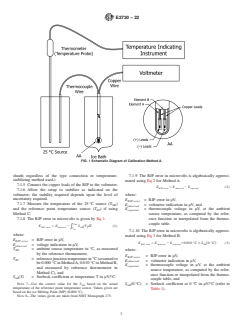
FIG. 1 Schematic Diagram of Calibration Method A
sheath regardless of the type connection or temperature- 7.1.9 The RJP error in microvolts is algebraically approxi-
stabilizing method used.) mated using Eq 2 for Method A.
7.1.5 Connect the copper leads of the RJP to the voltmeter.
E 5 E 2 E (2)
RJP error observed expected
7.1.6 Allow the setup to stabilize as indicated on the
voltmeter; the stability required depends upon the level of
where:
uncertainty required.
E = RJP error in µV,
RJP error
7.1.7 Measure the temperature of the 25 °C source (T )
MJ E = voltmeter indication in µV, and
observed
and the reference point temperature source (T ) if using E = thermocouple voltage in µV, at the ambient
RJ
expected
Method C.
source temperature, as computed by the refer-
7.1.8 The RJP error in microvolts is given by Eq 1. ence function or interpolated from the thermo-
T couple table.
MJ
E 5 E 2 S T dT (1)
* ~ !
RJP error observed AB
T
RJ
7.1.10 The RJP error in microvolts is algebraically approxi-
where:
mated using Eq 3 for Method B.
E = RJP error in µV,
RJP error
E 5 E 2 E 10.010 °C 3S ~0 °C! (3)
RJP error observed expected AB
E = voltage indication in µV,
observed
T = ambient source temperature in °C, as measured
MJ where:
by the reference thermometer,
E = RJP error in µV,
RJP error
T = referencejunctiontemperaturein°C(assumedto
RJ
E = voltmeter indication in µV,
observed
be0.000 °CinMethodA,0.010 °CinMethodB,
E = thermocouple voltage in µV, at the ambient
expected
and measured by reference thermometer in
source temperature, as computed by the refer-
Method C), and
ence function or interpolated from the thermo-
S (T) = Seebeck coefficient at temperature T in µV/°C.
AB
couple table, and
S (0 °C) = Seebeck coefficient at 0 °C in µV/°C (refer to
NOTE 7—Use the correct value for the S based on the actual
AB
AB
temperature of the reference point temperature source. Values given are
Table 1).
based on the ice Melting Point (MP) (0.000 °C).
NOTE 8—The values given are taken from NIST Monograph 175.
...
This document is not an ASTM standard and is intended only to provide the user of an ASTM standard an indication of what changes have been made to the previous version. Because
it may not be technically possible to adequately depict all changes accurately, ASTM recommends that users consult prior editions as appropriate. In all cases only the current version
of the standard as published by ASTM is to be considered the official document.
Designation: E2730 − 21 E2730 − 22 An American National Standard
Standard Guide for
Calibration and Use of Thermocouple Reference Junction
Probes in Evaluation of Electronic Reference Junction
Compensation Circuits
This standard is issued under the fixed designation E2730; the number immediately following the designation indicates the year of
original adoption or, in the case of revision, the year of last revision. A number in parentheses indicates the year of last reapproval. A
superscript epsilon (´) indicates an editorial change since the last revision or reapproval.
1. Scope
1.1 This guide covers methods of calibration and use of thermocouple reference junction probes (cold junction compensation
probes) in the evaluation of electronic reference junction compensation circuits. Their use with instruments that measure only
voltage is also covered.
1.2 The values stated in SI units are to be regarded as standard. The values given in parentheses after SI units are provided for
information only and are not considered standard.
1.3 This standard does not purport to address all of the safety concerns, if any, associated with its use. It is the responsibility
of the user of this standard to establish appropriate safety, health, and environmental practices and determine the applicability of
regulatory limitations prior to use.
1.4 This international standard was developed in accordance with internationally recognized principles on standardization
established in the Decision on Principles for the Development of International Standards, Guides and Recommendations issued
by the World Trade Organization Technical Barriers to Trade (TBT) Committee.
2. Referenced Documents
2.1 ASTM Standards:
E220 Test Method for Calibration of Thermocouples By Comparison Techniques
E230/E230M Specification for Temperature-Electromotive Force (emf) Tables for Standardized Thermocouples
E344 Terminology Relating to Thermometry and Hydrometry
E563 Practice for Preparation and Use of an Ice-Point Bath as a Reference Temperature
E1129/E1129M Specification for Thermocouple Connectors
E1684/E1684M Specification for Miniature Thermocouple Connectors
E1750 Guide for Use of Water Triple Point Cells
E2623 Practice for Reporting Thermometer Calibrations
2.2 Other References:
NIST Monograph 175 Temperature-Electromotive Force Reference Functions and Tables for the Letter-Designated Thermo-
couple Types Based on the ITS-90
This guide is under the jurisdiction of ASTM Committee E20 on Temperature Measurement and is the direct responsibility of Subcommittee E20.14 on Thermocouples
- Testing.
Current edition approved May 1, 2021May 1, 2022. Published July 2021May 2022. Originally approved in 2010. Last previous edition approved in 20152021 as
ε2
E2730 – 10 (2015)E2730 – 21. . DOI:10.1520/E2730-21. DOI:10.1520/E2730-22.
For referenced ASTM standards, visit the ASTM website, www.astm.org, or contact ASTM Customer Service at service@astm.org. For Annual Book of ASTM Standards
volume information, refer to the standard’s Document Summary page on the ASTM website.
Available from National Institute of Standards and Technology (NIST), 100 Bureau Dr., Stop 1070, Gaithersburg, MD 20899-1070, USA, http://www.nist.gov.
Copyright © ASTM International, 100 Barr Harbor Drive, PO Box C700, West Conshohocken, PA 19428-2959. United States
E2730 − 22
BIPM JCGM 100:2008 Evaluation of Measurement Data—Guide to the Expression of Uncertainty in Measurement
3. Terminology
3.1 Definitions:
3.1.1 The definitions given in Terminology E344 shall apply to this guide.
3.2 Definitions of Terms Specific to This Standard:
3.2.1 correction, n—an offset value added to the result of a measurement to obtain a correct result.
NOTE 1—This definition is from Test Method E220.
3.2.2 reference junction compensation, n—the electrical correction of the indication of a thermocouple such that the corrected
indication is equivalent to the emf or temperature the instrument would indicate if the reference junctions were physically
maintained at 0 °C.
3.2.3 reference junction probe, n—a probe constructed from thermocouple materials and high purity copper wire for the purpose
of serving as the reference junction for a thermocouple assembly; reference junction probes may be constructed as part of the
measuring probe or they can be manufactured separately and later attached to thermocouple sensors via plugs or other connection
types.
3.2.4 UUT, n—Unit Under Test.
4. Summary of Guide
4.1 Calibration of a Reference Junction Probe (RJP) consists of establishing the emf error in the RJP relative to the applicable
thermocouple reference function by placing the measuring junction and the reference junctions at known temperatures while
measuring the voltage with a digital voltmeter (DVM) or potentiometer. (DVM). Three methods are described for establishing the
two known temperatures and thus the temperature difference. For the temperature measurement, many devices such as Standard
Platinum Resistance Thermometers (SPRTs), Platinum Resistance Thermometers (PRTs), thermistors, or thermocouples, and a
variety of readout instruments are suitable, depending on the required accuracy. The measured voltage at the copper leads indicates
the emf associated with the temperature difference of the references. Error is determined by comparing the observed emf to the
calculated emf for the known temperature difference. The emf error is then applied as a correction. The corrected emf can then
be converted to temperature.
NOTE 2—In particular, cold work should be avoided in the sections of copper and thermocouple wire that pass from the top of the ice bath to ambient
temperature continuing on to the terminal connection. Careful design of the RJP, with supporting sleeve and strain relief, can minimize cold work in these
sections.
4.2 Use of the calibrated RJP consists of applying the corrections obtained during calibration appropriately for the mode of use.
Three modes of use with corresponding application equations are described.
NOTE 3—Homogeneity is assumed in both the thermocouple and copper wires. Care should be taken to minimize the stress induced over time and during
use on both sets of wire. Cold work in particular should be avoided in the sections of the copper and thermocouple wire from a distance 5 cm (2 in.)
below the top of the ice/water mixture to a distance 5 cm (2 in.) above the top of the ice-point bath.
NOTE 4—Proper operation of the measuring instruments is not described in this guide. To ensure correct results, the operator must understand and apply
proper technique in the use of all measuring instruments involved.
5. Significance and Use
5.1 Many electronic instruments that are designed to be used with thermocouples use some method of reference junction
compensation. In many industrial applications it may be impractical to use a physical ice bath as a temperature reference in a
thermocouple circuit. The instrument must therefore be able to measure the temperature at the point of electrical connection of the
thermocouple and either add or subtract voltage to give a corrected equivalent of what that thermocouple would indicate had there
Available from Pavillon de Breteuil, F-92312 Sèvres Cedex, FRANCE, https://www.bipm.org/.
E2730 − 22
physically been 0 °C reference junctions present in the circuit. There are two types of instruments that generally apply these
techniques: electronic thermometer readouts that use a thermocouple as the sensor, and calibrators designed to calibrate these
digital thermometer readouts. Additionally, the probe and circuit described in this guide can be used with a voltmeter to emulate
a thermometer or a voltage source to calibrate temperature-indicating instrumentation. In all cases the probe must be calibrated if
traceability or an uncertainty analysis, or both, is required.
6. Reagents
6.1 Laboratory or commercially produced distilled water is required to create an accurate ice bath. Clean tap water can be used
in cases where high accuracy is not a requirement; in this case the temperature of the bath should be measured directly. Chlorine,
fluorine, and other chemicals such as dissolved salts in the water or ice will depress the ice point and the amount can be significant
in some measurements. See Practice E563 for further guidance.
7. Procedure
7.1 Calibration of RJP (Methods A, B, or C):
7.1.1 Reference Point Temperature Source:
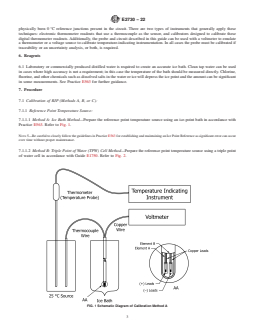
7.1.1.1 Method A: Ice Bath Method—Prepare the reference point temperature source using an ice-point bath in accordance with
Practice E563. Refer to Fig. 1.
NOTE 5—Be careful to closely follow the guidelines in Practice E563 for establishing and maintaining an Ice Point Reference as significant error can occur
over time without proper maintenance.
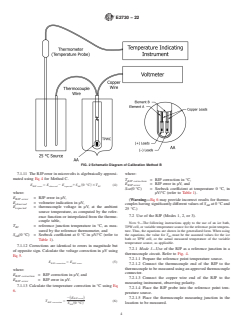
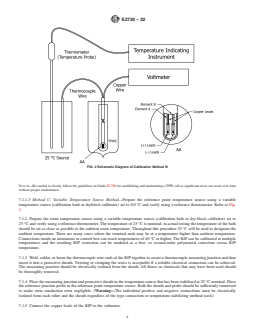
7.1.1.2 Method B: Triple Point of Water (TPW) Cell Method—Prepare the reference point temperature source using a triple point
of water cell in accordance with Guide E1750. Refer to Fig. 2.
FIG. 1 Schematic Diagram of Calibration Method A
E2730 − 22
FIG. 2 Schematic Diagram of Calibration Method B
NOTE 6—Be careful to closely follow the guidelines in Guide E1750 for establishing and maintaining a TPW cell as significant error can occur over time
without proper maintenance.
7.1.1.3 Method C: Variable Temperature Source Method—Prepare the reference point temperature source using a variable
temperature source (calibration bath or dryblock calibrator) set to 0.0 °C and verify using a reference thermometer. Refer to Fig.
3.
7.1.2 Prepare the room temperature source using a variable temperature source (calibration bath or dry-block calibrator) set to
25 °C and verify using a reference thermometer. The temperature of 25 °C is nominal; in actual testing the temperature of the bath
should be set as close as possible to the ambient room temperature. Throughout this procedure 25 °C will be used to designate the
ambient temperature. There are many cases where the terminal ends may be at a temperature higher than ambient temperature.
Connections inside an instrument or control box can reach temperatures of 40 °C or higher. The RJP can be calibrated at multiple
temperatures and the resulting RJP correction can be modeled as a first- or second-order polynomial correction versus RJP
temperature.
7.1.3 Weld, solder, or braze the thermocouple wire ends of the RJP together to create a thermocouple measuring junction and then
insert it into a protective sheath. Twisting or crimping the wires is acceptable if a reliable electrical connection can be achieved.
The measuring junction should be electrically isolated from the sheath. All fluxes or chemicals that may have been used should
be thoroughly removed.
7.1.4 Place the measuring junction and protective sheath in the temperature source that has been stabilized at 25 °C nominal. Place
the reference junction probe in the reference point temperature source. Both the sheath and probe should be sufficiently immersed
to make stem conduction error negligible. (Warning—The individual positive and negative connections must be electrically
isolated from each other and the sheath regardless of the type connection or temperature-stabilizing method used.)
7.1.5 Connect the copper leads of the RJP to the voltmeter.
E2730 − 22
FIG. 3 Schematic Diagram of Calibration Method C
7.1.6 Allow the setup to stabilize as indicated on the voltmeter; the stability required depends upon the level of uncertainty
required.
7.1.7 Measure the temperature of the 25 °C source (T ) and the reference point temperature source (T ) if using Method C.
MJ RJ
7.1.8 The RJP error in microvolts is given by Eq 1.
T
MJ
E 5 E 2 S ~T!dT (1)
*
RJP error observed AB
T
RJ
where:
E = RJP error in μV,
RJP error
E = voltage indication in μV,
observed
T = ambient source temperature in °C, as measured by the reference thermometer,
MJ
T = reference junction temperature in °C (assumed to be 0.000 °C in Method A, 0.010 °C in Method B, and measured
RJ
by reference thermometer in Method C), and
S (T) = Seebeck coefficient at temperature T in μV/°C.
AB
NOTE 7—Use the correct value for the S based on the actual temperature of the reference point temperature source. Values given are based on the ice
AB
Melting Point (MP) (0.000 °C).
NOTE 8—The values given are taken from NIST Monograph 175.
E2730 − 22
TABLE 1 Seebeck Coefficients at 0 °C for Some Common
A
Thermocouple Types
Calibration Type S (0 °C) in μV/ °C
AB
E 58.666
J 50.382
K 39.456
N 25.929
T 38.748
R 5.290
S 5.403
B 0.102
A
Source—Specification E230/E230M.
7.1.9 The RJP error in microvolts is algebraically approximated using Eq 2 for Method A.
E 5 E 2 E (2)
RJP error observed expected
where:
E = RJP error in μV,
RJP error
E = voltmeter indication in μV, and
observed
E = thermocouple voltage in μV, at the ambient source temperature, as computed by the reference function or
expected
interpolated from
...