

ASTM A1022/A1022M-22a
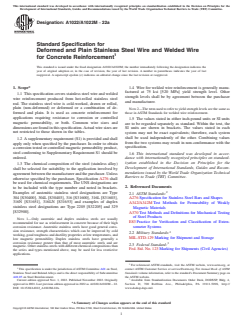
(Specification)Standard Specification for Deformed and Plain Stainless Steel Wire and Welded Wire for Concrete Reinforcement
General Information
- Abstract
ABSTRACT
This specification covers stainless steel wire and welded wire reinforcements from hot-rolled stainless steel rod to be used as concrete reinforcement with corrosion resistant and magnetic permeability properties. The material shall be cold-worked, drawn or rolled, and plain or deformed. Materials shall adhere to deformation requirements. Tensile, yield, and weld shear strengths shall be measured. Bend tests shall also be performed. Dimensional requirements and permissible variations in width, length, weight, density, cross-sectional area, diameter, and average spacings of wires are specified. Guidelines for sampling, inspection, rejection, retest, certification, and packaging are given.
SCOPE
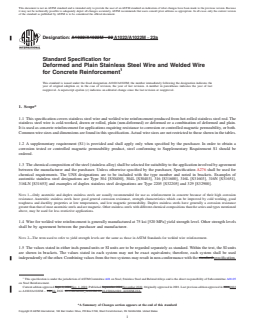
1.1 This specification covers stainless steel wire and welded wire reinforcement produced from hot-rolled stainless steel rod. The stainless steel wire is cold-worked, drawn or rolled, plain (non-deformed) or deformed or a combination of deformed and plain. It is used as concrete reinforcement for applications requiring resistance to corrosion or controlled magnetic permeability, or both. Common wire sizes and dimensions are found in this specification. Actual wire sizes are not restricted to those shown in the tables.
1.2 A supplementary requirement (S1) is provided and shall apply only when specified by the purchaser. In order to obtain a corrosion tested or controlled magnetic permeability product, steel conforming to Supplementary Requirement S1 should be ordered.
1.3 The chemical composition of the steel (stainless alloy) shall be selected for suitability to the application involved by agreement between the manufacturer and the purchaser. Unless otherwise specified by the purchaser, Specification A276 shall be used for chemical requirements. The UNS designations are to be included with the type number and noted in brackets. Examples of austenitic stainless steel designations are Type 304 [S30400], 304L [S30403], 316 [S31600], 316L [S31603], 316N [S31651], 316LN [S31653] and examples of duplex stainless steel designations are Type 2205 [S32205] and 329 [S32900].
Note 1: Only austenitic and duplex stainless steels are usually recommended for use as reinforcement in concrete because of their high corrosion resistance. Austenitic stainless steels have good general corrosion resistance, strength characteristics which can be improved by cold working, good toughness and ductility properties at low temperatures, and low magnetic permeability. Duplex stainless steels have generally a corrosion resistance greater than that of most austenitic steels and are magnetic. Other stainless steels with different chemical compositions than the series and types mentioned above, may be used for less restrictive applications.
1.4 Wire for welded wire reinforcement is generally manufactured at 75 ksi [520 MPa] yield strength level. Other strength levels shall be by agreement between the purchaser and manufacturer.
Note 2: The term used to refer to yield strength levels are the same as those in ASTM Standards for welded wire reinforcement.
1.5 The values stated in either inch-pound units or SI units are to be regarded separately as standard. Within the text, the SI units are shown in brackets. The values stated in each system may not be exact equivalents; therefore, each system shall be used independently of the other. Combining values from the two systems may result in non-conformance with the specification.
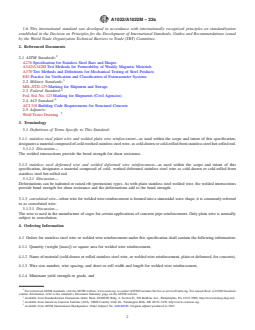
1.6 This international standard was developed in accordance with internationally recognized principles on standardization established in the Decision on Principles for the Development of International Standards, Guides and Recommendations issued by the World Trade Organization Technical Barriers to Trade (TBT) Committee.
- Status
- Published
- Publication Date
- 31-Oct-2022
- Technical Committee
- A01 - Steel, Stainless Steel and Related Alloys
- Drafting Committee
- A01.05 - Steel Reinforcement
Buy Documents
ASTM A1022/A1022M-22a - Standard Specification for Deformed and Plain Stainless Steel Wire and Welded Wire for Concrete Reinforcement
REDLINE ASTM A1022/A1022M-22a - Standard Specification for Deformed and Plain Stainless Steel Wire and Welded Wire for Concrete Reinforcement
Overview
ASTM A1022/A1022M-22a is a standard specification published by ASTM International for deformed and plain stainless steel wire and welded wire used in concrete reinforcement. This specification addresses both plain and deformed wire products manufactured from hot-rolled stainless steel rod, designed for applications where corrosion resistance and controlled magnetic permeability are essential. The standard outlines both inch-pound and SI units and provides key requirements for material selection, mechanical performance, dimensional tolerances, and product identification.
Key Topics
Material Scope and Selection
- Covers stainless steel wire and welded wire reinforcement (WWR) for concrete, in both deformed and plain forms.
- Materials are produced from hot-rolled stainless steel rod by cold-working (drawing or rolling).
- Chemical composition of stainless alloys should be agreed upon by manufacturer and purchaser, often referencing ASTM A276.
- Common types include austenitic (e.g., 304, 316 series) and duplex stainless steels, known for their corrosion resistance and physical strengths.
Mechanical and Physical Properties
- Specifies requirements for tensile strength, yield strength (typically starting at 75 ksi / 520 MPa for welded wire), and weld shear strength.
- Outlines minimum reduction in area and performance under standardized bend tests.
- Deformation requirements apply to deformed wire, including symmetry, spacing, minimum height, and number of deformation lines.
- Both plain and deformed wire are subject to strict dimensional tolerances and permissible variations across diameter, cross-sectional area, and spacing.
Testing and Quality Assurance
- Details mandatory tests: tension, bend, and weld shear strength.
- Sampling and inspection requirements are defined for both pre- and post-assembly phases.
- Provides procedures for retesting, rejection, and rehearing in the event of non-conformance.
- Addresses appearance and surface quality, especially in products exposed to weathering.
Packaging and Certification
- Guidance for packaging and marking is included, ensuring safe transport and handling.
- Requires clear identification of product properties, sizes, and conformance to the standard in delivery documentation.
Applications
Typical Usage Scenarios
- Used in reinforced concrete structures where a high level of durability and corrosion resistance is needed, such as:
- Maritime and coastal structures
- Bridges and parking garages
- Water treatment facilities
- Structures exposed to deicing chemicals or harsh environments
- Essential for projects with stringent requirements on magnetic permeability for sensitive installations or equipment.
Value and Practical Benefits
- Enhances the longevity and service life of concrete by minimizing steel corrosion.
- Provides options for controlled or low-magnetic permeability in critical applications.
- Offers dimensional versatility - a wide range of wire sizes and custom spacing configurations to meet diverse engineering and construction requirements.
Related Standards
- ASTM A276 - Specification for Stainless Steel Bars and Shapes; referenced for chemical composition.
- ASTM A342/A342M - Test Methods for Permeability of Weakly Magnetic Materials.
- ASTM A370 - Test Methods and Definitions for Mechanical Testing of Steel Products.
- ACI 318 - Building Code Requirements for Structural Concrete.
- MIL-STD-129, Fed. Std. No. 123 - Standards for marking shipments and storage.
For construction professionals, engineers, and specifiers, ASTM A1022/A1022M-22a establishes a clear standard for the quality, performance, and suitability of stainless steel wire reinforcement, ensuring safe, sustainable, and high-performing concrete structures in demanding environments.
Relations
- Effective Date
- 01-Mar-2024
- Effective Date
- 01-Jul-2019
- Refers
ASTM A370-17a - Standard Test Methods and Definitions for Mechanical Testing of Steel Products - Effective Date
- 15-Nov-2017
- Effective Date
- 01-Jan-2017
- Effective Date
- 01-Nov-2015
- Effective Date
- 15-May-2014
- Effective Date
- 15-Nov-2013
- Effective Date
- 01-Nov-2013
- Effective Date
- 01-May-2013
- Refers
ASTM A370-12a - Standard Test Methods and Definitions for Mechanical Testing of Steel Products - Effective Date
- 15-Oct-2012
- Refers
ASTM A342/A342M-04(2012) - Standard Test Methods for Permeability of Feebly Magnetic Materials - Effective Date
- 01-May-2012
- Effective Date
- 15-Mar-2012
- Refers
ASTM A370-11a - Standard Test Methods and Definitions for Mechanical Testing of Steel Products - Effective Date
- 15-Nov-2011
- Effective Date
- 15-Jun-2010
- Effective Date
- 01-Jun-2010
Buy Documents
ASTM A1022/A1022M-22a - Standard Specification for Deformed and Plain Stainless Steel Wire and Welded Wire for Concrete Reinforcement
REDLINE ASTM A1022/A1022M-22a - Standard Specification for Deformed and Plain Stainless Steel Wire and Welded Wire for Concrete Reinforcement
Get Certified
Connect with accredited certification bodies for this standard

Element Materials Technology
Materials testing and product certification.

Inštitut za kovinske materiale in tehnologije
Institute of Metals and Technology. Materials testing, metallurgical analysis, NDT.
Sponsored listings
Frequently Asked Questions
ASTM A1022/A1022M-22a is a technical specification published by ASTM International. Its full title is "Standard Specification for Deformed and Plain Stainless Steel Wire and Welded Wire for Concrete Reinforcement". This standard covers: ABSTRACT This specification covers stainless steel wire and welded wire reinforcements from hot-rolled stainless steel rod to be used as concrete reinforcement with corrosion resistant and magnetic permeability properties. The material shall be cold-worked, drawn or rolled, and plain or deformed. Materials shall adhere to deformation requirements. Tensile, yield, and weld shear strengths shall be measured. Bend tests shall also be performed. Dimensional requirements and permissible variations in width, length, weight, density, cross-sectional area, diameter, and average spacings of wires are specified. Guidelines for sampling, inspection, rejection, retest, certification, and packaging are given. SCOPE 1.1 This specification covers stainless steel wire and welded wire reinforcement produced from hot-rolled stainless steel rod. The stainless steel wire is cold-worked, drawn or rolled, plain (non-deformed) or deformed or a combination of deformed and plain. It is used as concrete reinforcement for applications requiring resistance to corrosion or controlled magnetic permeability, or both. Common wire sizes and dimensions are found in this specification. Actual wire sizes are not restricted to those shown in the tables. 1.2 A supplementary requirement (S1) is provided and shall apply only when specified by the purchaser. In order to obtain a corrosion tested or controlled magnetic permeability product, steel conforming to Supplementary Requirement S1 should be ordered. 1.3 The chemical composition of the steel (stainless alloy) shall be selected for suitability to the application involved by agreement between the manufacturer and the purchaser. Unless otherwise specified by the purchaser, Specification A276 shall be used for chemical requirements. The UNS designations are to be included with the type number and noted in brackets. Examples of austenitic stainless steel designations are Type 304 [S30400], 304L [S30403], 316 [S31600], 316L [S31603], 316N [S31651], 316LN [S31653] and examples of duplex stainless steel designations are Type 2205 [S32205] and 329 [S32900]. Note 1: Only austenitic and duplex stainless steels are usually recommended for use as reinforcement in concrete because of their high corrosion resistance. Austenitic stainless steels have good general corrosion resistance, strength characteristics which can be improved by cold working, good toughness and ductility properties at low temperatures, and low magnetic permeability. Duplex stainless steels have generally a corrosion resistance greater than that of most austenitic steels and are magnetic. Other stainless steels with different chemical compositions than the series and types mentioned above, may be used for less restrictive applications. 1.4 Wire for welded wire reinforcement is generally manufactured at 75 ksi [520 MPa] yield strength level. Other strength levels shall be by agreement between the purchaser and manufacturer. Note 2: The term used to refer to yield strength levels are the same as those in ASTM Standards for welded wire reinforcement. 1.5 The values stated in either inch-pound units or SI units are to be regarded separately as standard. Within the text, the SI units are shown in brackets. The values stated in each system may not be exact equivalents; therefore, each system shall be used independently of the other. Combining values from the two systems may result in non-conformance with the specification. 1.6 This international standard was developed in accordance with internationally recognized principles on standardization established in the Decision on Principles for the Development of International Standards, Guides and Recommendations issued by the World Trade Organization Technical Barriers to Trade (TBT) Committee.
ABSTRACT This specification covers stainless steel wire and welded wire reinforcements from hot-rolled stainless steel rod to be used as concrete reinforcement with corrosion resistant and magnetic permeability properties. The material shall be cold-worked, drawn or rolled, and plain or deformed. Materials shall adhere to deformation requirements. Tensile, yield, and weld shear strengths shall be measured. Bend tests shall also be performed. Dimensional requirements and permissible variations in width, length, weight, density, cross-sectional area, diameter, and average spacings of wires are specified. Guidelines for sampling, inspection, rejection, retest, certification, and packaging are given. SCOPE 1.1 This specification covers stainless steel wire and welded wire reinforcement produced from hot-rolled stainless steel rod. The stainless steel wire is cold-worked, drawn or rolled, plain (non-deformed) or deformed or a combination of deformed and plain. It is used as concrete reinforcement for applications requiring resistance to corrosion or controlled magnetic permeability, or both. Common wire sizes and dimensions are found in this specification. Actual wire sizes are not restricted to those shown in the tables. 1.2 A supplementary requirement (S1) is provided and shall apply only when specified by the purchaser. In order to obtain a corrosion tested or controlled magnetic permeability product, steel conforming to Supplementary Requirement S1 should be ordered. 1.3 The chemical composition of the steel (stainless alloy) shall be selected for suitability to the application involved by agreement between the manufacturer and the purchaser. Unless otherwise specified by the purchaser, Specification A276 shall be used for chemical requirements. The UNS designations are to be included with the type number and noted in brackets. Examples of austenitic stainless steel designations are Type 304 [S30400], 304L [S30403], 316 [S31600], 316L [S31603], 316N [S31651], 316LN [S31653] and examples of duplex stainless steel designations are Type 2205 [S32205] and 329 [S32900]. Note 1: Only austenitic and duplex stainless steels are usually recommended for use as reinforcement in concrete because of their high corrosion resistance. Austenitic stainless steels have good general corrosion resistance, strength characteristics which can be improved by cold working, good toughness and ductility properties at low temperatures, and low magnetic permeability. Duplex stainless steels have generally a corrosion resistance greater than that of most austenitic steels and are magnetic. Other stainless steels with different chemical compositions than the series and types mentioned above, may be used for less restrictive applications. 1.4 Wire for welded wire reinforcement is generally manufactured at 75 ksi [520 MPa] yield strength level. Other strength levels shall be by agreement between the purchaser and manufacturer. Note 2: The term used to refer to yield strength levels are the same as those in ASTM Standards for welded wire reinforcement. 1.5 The values stated in either inch-pound units or SI units are to be regarded separately as standard. Within the text, the SI units are shown in brackets. The values stated in each system may not be exact equivalents; therefore, each system shall be used independently of the other. Combining values from the two systems may result in non-conformance with the specification. 1.6 This international standard was developed in accordance with internationally recognized principles on standardization established in the Decision on Principles for the Development of International Standards, Guides and Recommendations issued by the World Trade Organization Technical Barriers to Trade (TBT) Committee.
ASTM A1022/A1022M-22a is classified under the following ICS (International Classification for Standards) categories: 77.140.20 - Stainless steels. The ICS classification helps identify the subject area and facilitates finding related standards.
ASTM A1022/A1022M-22a has the following relationships with other standards: It is inter standard links to ASTM A370-24, ASTM A370-19, ASTM A370-17a, ASTM A370-17, ASTM A370-15, ASTM A370-14, ASTM A370-13, ASTM A276-13a, ASTM A276-13, ASTM A370-12a, ASTM A342/A342M-04(2012), ASTM A370-12, ASTM A370-11a, ASTM A370-10, ASTM E83-10a. Understanding these relationships helps ensure you are using the most current and applicable version of the standard.
ASTM A1022/A1022M-22a is available in PDF format for immediate download after purchase. The document can be added to your cart and obtained through the secure checkout process. Digital delivery ensures instant access to the complete standard document.
Standards Content (Sample)
This international standard was developed in accordance with internationally recognized principles on standardization established in the Decision on Principles for the
Development of International Standards, Guides and Recommendations issued by the World Trade Organization Technical Barriers to Trade (TBT) Committee.
Designation:A1022/A1022M −22a
Standard Specification for
Deformed and Plain Stainless Steel Wire and Welded Wire
for Concrete Reinforcement
This standard is issued under the fixed designation A1022/A1022M; the number immediately following the designation indicates the
year of original adoption or, in the case of revision, the year of last revision. A number in parentheses indicates the year of last
reapproval. A superscript epsilon (´) indicates an editorial change since the last revision or reapproval.
1. Scope* 1.4 Wire for welded wire reinforcement is generally manu-
factured at 75 ksi [520 MPa] yield strength level. Other
1.1 Thisspecificationcoversstainlesssteelwireandwelded
strength levels shall be by agreement between the purchaser
wire reinforcement produced from hot-rolled stainless steel
and manufacturer.
rod. The stainless steel wire is cold-worked, drawn or rolled,
plain (non-deformed) or deformed or a combination of de-
NOTE 2—The term used to refer to yield strength levels are the same as
those in ASTM Standards for welded wire reinforcement.
formed and plain. It is used as concrete reinforcement for
applications requiring resistance to corrosion or controlled
1.5 The values stated in either inch-pound units or SI units
magnetic permeability, or both. Common wire sizes and
are to be regarded separately as standard. Within the text, the
dimensionsarefoundinthisspecification.Actualwiresizesare
SI units are shown in brackets. The values stated in each
not restricted to those shown in the tables.
system may not be exact equivalents; therefore, each system
shall be used independently of the other. Combining values
1.2 Asupplementary requirement (S1) is provided and shall
from the two systems may result in non-conformance with the
apply only when specified by the purchaser. In order to obtain
specification.
acorrosiontestedorcontrolledmagneticpermeabilityproduct,
steel conforming to Supplementary Requirement S1 should be
1.6 This international standard was developed in accor-
ordered.
dance with internationally recognized principles on standard-
ization established in the Decision on Principles for the
1.3 The chemical composition of the steel (stainless alloy)
Development of International Standards, Guides and Recom-
shall be selected for suitability to the application involved by
mendations issued by the World Trade Organization Technical
agreementbetweenthemanufacturerandthepurchaser.Unless
Barriers to Trade (TBT) Committee.
otherwise specified by the purchaser, Specification A276 shall
be used for chemical requirements. The UNS designations are
2. Referenced Documents
to be included with the type number and noted in brackets.
Examples of austenitic stainless steel designations are Type
2.1 ASTM Standards:
304 [S30400], 304L [S30403], 316 [S31600], 316L [S31603],
A276Specification for Stainless Steel Bars and Shapes
316N [S31651], 316LN [S31653] and examples of duplex
A342/A342MTest Methods for Permeability of Weakly
stainless steel designations are Type 2205 [S32205] and 329
Magnetic Materials
[S32900].
A370Test Methods and Definitions for Mechanical Testing
of Steel Products
NOTE 1—Only austenitic and duplex stainless steels are usually
E83Practice for Verification and Classification of Exten-
recommended for use as reinforcement in concrete because of their high
corrosion resistance. Austenitic stainless steels have good general corro-
someter Systems
sion resistance, strength characteristics which can be improved by cold
2.2 Military Standards:
working,goodtoughnessandductilitypropertiesatlowtemperatures,and
MIL-STD-129Marking for Shipment and Storage
low magnetic permeability. Duplex stainless steels have generally a
corrosion resistance greater than that of most austenitic steels and are
2.3 Federal Standard:
magnetic.Otherstainlesssteelswithdifferentchemicalcompositionsthan
Fed.Std.No.123Marking for Shipments (Civil Agencies)
the series and types mentioned above, may be used for less restrictive
applications.
For referenced ASTM standards, visit the ASTM website, www.astm.org, or
This specification is under the jurisdiction ofASTM Committee A01 on Steel, contact ASTM Customer Service at service@astm.org. For Annual Book of ASTM
Stainless Steel and RelatedAlloys and is the direct responsibility of Subcommittee Standards volume information, refer to the standard’s Document Summary page on
A01.05 on Steel Reinforcement. the ASTM website.
Current edition approved Nov. 1, 2022. Published November 2022. Originally Available from Standardization Documents Order Desk, DODSSP, Bldg. 4,
approved in 2001. Last previous edition approved in 2022 as A1022/A1022M – 22. Section D, 700 Robbins Ave., Philadelphia, PA 19111-5098, http://
DOI: 10.1520/A1022_A1022M-22A. www.dodssp.daps.mil.
*A Summary of Changes section appears at the end of this standard
Copyright © ASTM International, 100 Barr Harbor Drive, PO Box C700, West Conshohocken, PA 19428-2959. United States
A1022/A1022M−22a
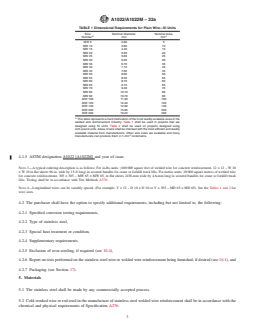
TABLE 1 Dimensional Requirements for Plain Wire—SI Units
2.4 ACI Standard:
ACI318Building Code Requirements for Structural Con- Size Nominal Diameter, Nominal Area,
A 2
Number mm mm
crete
MW 5 2.50 5
2.5 Adjuncts:
MW 10 3.60 10
WeldTesterDrawing
MW 15 4.40 15
MW 20 5.00 20
MW 25 5.60 25
3. Terminology
MW 30 6.20 30
3.1 Definitions of Terms Specific to This Standard: MW 35 6.70 35
MW 40 7.10 40
3.1.1 stainless steel plain wire and welded plain wire
MW 45 7.60 45
reinforcement—as used within the scope and intent of this
MW 50 8.00 50
specification, designates a material composed of cold-worked MW 55 8.40 55
MW 60 8.70 60
stainlesssteelwire,ascold-drawnorcold-rolledfromstainless
MW 65 9.10 65
steel hot-rolled rod.
MW 70 9.40 70
3.1.1.1 Discussion—The welded intersections provide the MW 80 10.10 80
MW 90 10.70 90
bond strength for shear resistance.
MW 100 11.30 100
MW 120 12.40 120
3.1.2 stainless steel deformed wire and welded deformed
MW 130 12.90 130
wire reinforcement—as used within the scope and intent of this
MW 200 15.95 200
specification, designates a material composed of cold- worked
MW 290 19.22 290
deformedstainlesssteelwireascold-drawnorcold-rolledfrom
A
Thistablerepresentsahardmetricationofthemostreadilyavailablesizesinthe
stainless steel hot-rolled rod. welded wire reinforcement industry. Table 1 shall be used in projects that are
designed using SI units: Table 2 shall be used on projects designed using
3.1.2.1 Discussion—Deformationscanbeindentedorraised
inch-poundunits.Areasofwireshallbecheckedwiththemostefficientandreadily
rib(protrusion)types.Aswithplainstainlesssteelweldedwire,
available material from manufacturers. Other wire sizes are available and many
the welded intersections provide bond strength for shear manufacturers can produce them in 1-mm increments.
resistance and the deformations add to the bond strength.
3.1.3 convoluted wire—when wire for welded wire rein-
forcement is formed into a sinusoidal wave shape, it is
commonly referred to as convoluted wire.
12–D10×D10orV×305–MD65×MD 65). See the Tables 1 and
3.1.3.1 Discussion—The wire is used in the manufacture of
2 for wire sizes.
cages for certain applications of concrete pipe reinforcement.
4.2 Thepurchasershallhavetheoptiontospecifyadditional
Only plain wire is normally subject to convolution.
requirements, including but not limited to, the following:
4.2.1 Specified corrosion testing requirements,
4. Ordering Information
4.2.2 Type of stainless steel,
4.1 Orders for stainless steel wire or welded wire reinforce-
4.2.3 Special heat treatment or condition,
ment under this specification shall contain the following
4.2.4 Supplementary requirements,
information:
4.2.5 Exclusion of over-steeling, if required (see 10.4),
4.1.1 Quantity (weight [mass]) or square area for welded
4.2.6 Reportontestsperformedonthestainlesssteelwireor
wire reinforcement,
welded wire reinforcement being furnished, if desired (see
4.1.2 Name of material (cold-drawn or rolled stainless steel
16.1), and
wire, or welded wire reinforcement, plain or deformed, for
4.2.7 Packaging (see Section 17).
concrete),
4.1.3 Wire size number, wire spacing, and sheet or roll
5. Materials
width and length for welded wire reinforcement,
5.1 The stainless steel shall be made by any commercially
4.1.4 Minimum yield strength or grade, and
4.1.5 ASTM designation A1022 [A1022M] and year of accepted process.
issue.
5.2 Cold-worked wire or rod used in the manufacture of
stainless steel welded wire reinforcement shall be in accor-
NOTE 3—Atypical ordering description is as follows: For in-lbs units:
(100000 square feet of welded wire for concrete reinforcement, 12 × 12 dance with the chemical and physical requirements of Speci-
–W10×W10inflatsheets96-in.wideby15-ftlong)insecuredbundles
fication A276.
for crane or forklift truck lifts. For metric units: 10000 square metres of
welded wire for concrete reinforcement, 305 × 305 – MW 65 × MW 65,
6. Manufacture
in flat sheets 2438-mm wide by 4.6-mm long in secured bundles for crane
or forklift truck lifts. Testing shall be in accordance with Test Methods
6.1 Stainless steel wire for welded wire reinforcement shall
A370.
be cold worked, either drawn or rolled from steel rod that is
NOTE4—Longitudinalwirescanbevariablyspaced.(Forexample,V×
rolledfromproperlyidentifiedheatsofmold-castorstrand-cast
steel.
Available from American Concrete Institute (ACI), 38800 Country Club Dr.,
6.2 The wire or rod shall be assembled into welded wire
Farmington Hills, MI 48331-3439, http://www.concrete.org.
reinforcement by automatic machines or by other suitable
Available from ASTM International Headquarters. Order Adjunct No.
ADJA0185. Original adjunct produced in 1967. mechanical means which will assure accurate spacing and
A1022/A1022M−22a
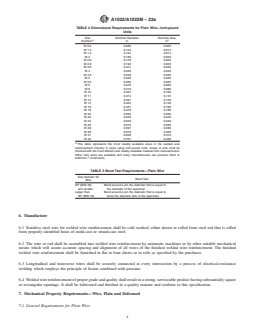
TABLE 2 Dimensional Requirements for Plain Wire—Inch-pound
7.1.2 Specimens for mechanical properties testing shall be
Units
fullwiresectionsandshallbeobtainedfromendsofwirecoils
Size Nominal Diameter, Nominal Area,
as drawn. The specimens shall be of sufficient length to
A 2
Number in. in
perform testing described in Test Methods A370.
W 0.5 0.080 0.005
7.1.3 If any test specimen exhibits obvious isolated imper-
W 1.2 0.124 0.012
W 1.4 0.134 0.014 fections not representative of the product, it shall be discarded
W 2 0.160 0.020
and another specimen substituted.
W 2.5 0.178 0.025
7.1.4 Tension Test:
W 2.9 0.192 0.029
W 3.5 0.211 0.035 7.1.4.1 When tested as described in Test Methods and
W 4 0.226 0.040
Definitions A370, the material, except as specified in 7.1.4.2
W 4.5 0.239 0.045
shall conform to the tensile property requirements in Table 5,
W 5 0.252 0.050
W 5.5 0.265 0.055 based on the nominal area of the wire.
W 6 0.276 0.060
7.1.4.2 When required by the purchaser, the yield strength
W 8 0.319 0.080
shall be determined as described in Test Methods and Defini-
W 10 0.357 0.100
W 11 0.374 0.110
tions A370 at an extension of 0.5 % of gage length or by the
W 12 0.391 0.120
offset method (0.2 %). For determining the yield strength use
W 14 0.422 0.140
a Class B-1 extensometer as described in Practice E83.
W 16 0.451 0.160
W 18 0.479 0.180
7.1.4.3 For wire to be used in the manufacture of welded
W 20 0.505 0.200
wire reinforcement, the tensile and yield strength properties
W 22 0.529 0.220
shall conform to the requirements given in Table 6, based on
W 24 0.533 0.240
W 26 0.575 0.260
the nominal area of the wire.
W 28 0.597 0.280
7.1.4.4 Yield strength shall be measured at extension under
W 30 0.618 0.300
W 31 0.628 0.310 load and shall not be required to exhibit a definite yield point
W 45 0.757 0.450
as evidenced by a distinct arrest or halt in the load indication
A
This table represents the most readily available sizes in the welded wire
gauge of the tensile testing machine prior to reaching ultimate
reinforcement industry in sizes using inch-pound units. Areas of wire shall be
tensile load. The purchaser shall have the option to accept this
checked with the most efficient and readily available material from manufacturers.
feature as sufficient evidence of compliance with the specified
Other wire sizes are available and many manufacturers can produce them in
0.0015-in. increments.
minimum yield strength tests covered in this specification.
7.1.5 Bend Test—The bend test specimen shall be bent at
room temperature through 90º without cracking on the outside
TABLE 3 Bend Test Requirements—Plain Wire
ofthebentportionvisibletoapersonwithnormalorcorrected
Size Number Of
vision, as prescribed in Table 3.
Bend Test
Wire
7.1.6 Reduction of Area—Shall be determined as described
W7 [MW 45] Bend around a pin the diameter that is equal to
inTest Methods and Definitions A370.The wire shall conform
and smaller the diameter of the specimen
Larger than Bend around a pin the diameter that is equal to
to the reduction of area requirements in Tables 5 and 6.
W7 [MW 45] twice the diameter (2d) of the specimen
7.1.7 Permissible Variation in Wire Diameter:
7.1.7.1 The permissible variation in wire diameter shall
conform to the requirements in Table 4.
7.1.7.2 Thedifferencebetweenthemaximumandminimum
alignment of all wires of the finished welded wire reinforce-
diameters, as measured on any given cross section of the wire,
ment. The finished welded wire reinforcement shall be fur-
shall not exceed the tolerances listed in Table 4 for the given
nished in flat or bent sheets or in rolls as specified by the
wire size.
purchaser.
7.2 General Requirements for Deformed Wire:
6.3 Longitudinal and transverse wires shall be securely
7.2.1 When deformed wire is ordered by size number, the
connected at every intersection by a process of electrical-
relation between size number, diameter, and area shown in
resistance welding which employs the principle of fusion
Tables 7 and 8 shall apply.
combined with pressure.
7.2.2 Specimens for mechanical properties testing shall be
6.4 Welded wire reinforcement of proper grade and quality
fullwiresectionsandshallbeobtainedfromendsofwirecoils
shallresultinastrong,serviceableproducthavingsubstantially
asrolled.Thespecimensshallbeofsufficientlengthtoperform
square or rectangular openings. It shall be fabricated and
testing described in Test Methods A370.
finished in a quality manner and conform to this specification.
7.2.3 If any test specimen exhibits obvious isolated imper-
fections not representative of the product, it shall be discarded
7. Mechanical Property Requirements—Wire, Plain and
and another specimen substituted.
Deformed
7.2.4 Deformation Criteria:
7.1 General Requirements for Plain Wire: 7.2.4.1 Deformations shall be spaced along the wire at a
7.1.1 When plain wire is ordered by size number, the substantially uniform distance and shall be symmetrically
relation between size number, diameter, and area shown in dispersed around the perimeter. The deformations on all
Tables 1 and 2 shall apply. longitudinallinesofthewireshallbesimilarinsizeandshape.
A1022/A1022M−22a
TABLE 4 Permissible Variation in Wire Diameter—Plain Wire
Permissible Variation Plus and Minus, Maximum Permissible Out-of-Round,
Size Number, in-lbs. [SI] Nominal Diameter, in. [mm]
A
in. [mm] in. [mm]
SmallerthanW5[MW32] Under 0.252 [6.4] 0.003 [0.08] 0.003 [0.08]
W 5 [MW 32] to W 12 [MW 77], incl 0.252 [6.4] to 0.391 [9.93], incl 0.004 [0.10] 0.004 [0.10]
Over W 12 [MW 77] to W 20 [MW 130], Over 0.391 [9.93] to 0.505 [12.83], incl 0.006 [0.15] 0.006 [0.15]
incl
Over W 20 [MW 130] Over 0.505 [12.83] 0.008 [0.20] 0.008 [0.20]
A
Out-of-round is the difference between maximum and minimum diameters of the wire, measured at the same transverse cross section.
TABLE 5 Tension Test Requirements—Plain Wire
Grade 70 [485] Grade 72.5 [500] Grade 75 [515] Grade 77.5 [533] Grade 80[550]
Tensile strength, min, psi [MPa] 80 000 [550] 82 500 [568] 85 000 [585] 87 500 [603] 90 000 [620]
Yield strength, min, psi [MPa] 70 000 [485] 72 500 [500] 75 000 [515] 77 500 [533] 80 000 [550]
A A A A A
Reduction of area, min, % 30 30 30 30 30
A
For material testing over 100 000 psi [690 MPa] tensile strength, the reduction of area shall be not less than 25 %.
TABLE 6 Tension Test Requirements—Plain Wire for Welded Reinforcement
Size W 1.2 [MW 8] and Larger
Grade 65 [450] Grade 70 [485] Grade 72.5 [500] Grade 75 [515] Grade 77.5 [533] Grade 80 [550]
Tensile strength, min, psi [MPa] 75 000 [515] 80 000 [550] 82 500 [568] 85 000 [585] 87 500 [603] 90 000 [620]
Yield strength, min, psi [MPa] 65 000 [450] 70 000 [485] 72 500 [500] 75 000 [515] 77 500 [533] 80 000 [550]
A A A A A A
Reduction of area, min, % 30 30 30 30 30 30
Smaller than Size W 1.2 [MW 8]
Grade 56 [385]
Tensile strength, min, psi [MPa] 70 000 [485]
Yield strength, min, psi [MPa] 56 000 [385]
A
Reduction of area, min, % 30
A
For material testing over 100 000 psi [690 MPa] tensile strength, the reduction of area shall be not less than 25 %.
Aminimumof25%ofthetotalsurfaceareashallbedeformed deformations on any side of the wire specimens. A measured
by measurable deformations. length of the wire specimen shall be considered the distance
7.2.4.2 Deformed wire shall have two or more lines of from a point on a deformation to a corresponding point on any
deformations. otherdeformationinthesamelineofdeformationsonthewire.
7.2.4.3 The average longitudinal spacing of deformations 7.2.4.7 The minimum average height of deformations shall
shall be not less than 3.5 nor more than 5.5 deformations per 1 be determined from measurements made on not less than two
in. [25 mm] in each line of deformations on the wire. typical deformations from each line of deformations on the
7.2.4.4 Theminimumaverageheightofthecenteroftypical wire.Measurementsshallbemadeatthecenterofindentations
deformations based on the nominal wire diameters shown in or raised ribs.
Tables 7 and 8 shall be as follows: 7.2.5 Tension Test:
7.2.5.1 When tested as described in Test Methods and
Wire Sizes Minimum Average Height of Deformations,
Percent of Nominal Wire Diameter
Definitions A370, the material, except as specified in 7.2.5.2
D 3 [MD 19] and smaller 4
shall conform to the tensile property requirements in Table 9,
LargerthanD3[MD19]
4 ⁄2
based on nominal area of wire.
through D 10 [MD 65]
Larger than D 10 [MD 65] 5
7.2.5.2 When required by the purchaser, the yield strength
7.2.4.5 The deformations shall be placed with respect to the shall be determined as described in Test Methods and Defini-
tions A370 at an extension of 0.5% of gage length or by the
axis of the wire so that the included angle is not less than 45º;
or if deformations are curvilinear, the angle formed by the offset method (0.2 %). For determining the yield strength use
a Class B-1 extensometer as described in Practice E83.
transverseaxisofthedeformationandthewireaxisshallbenot
lessthan45º.Wherethelineofdeformationsformsanincluded 7.2.5.3 For wire to be used in the manufacture of welded
angle with the axis of the wire from 45º to 70º inclusive, the wire reinforcement, the tensile and yield strength properties
deformationsshallalternatelyreverseindirectiononeachside, shall conform to the requirements given in Table 10, based on
or those on one side shall be reversed in direction from those the nominal area of the wire.
on the opposite side. Where the included angle is over 70º, a 7.2.5.4 Yield strength shall be measured at extension under
reversal in direction is not required. load and shall not be required to exhibit a definite yield point
7.2.4.6 The average spacing of deformations shall be deter- as evidenced by a distinct arrest or halt in the load indication
mined by dividing a measured length of the wire specimen by gauge of the tensile testing machine prior to reaching ultimate
the number of individual deformations in any one row of tensile load. The purchaser shall have the option to accept this
A1022/A1022M−22a
TABLE 7 Dimensional Requirements for Deformed Wire for Concrete Reinforcement in SI Units
Nominal Dimensions Deformation Requirements
Minimum Average
Deformed Unit Mass, Diameter, Cross-Sectional
D [in X 100] Height of
A,B,C D 2E
Wire Size kg/m mm Area, mm
F,G
Deformations, mm
MD 25 [D 3.9] 0.1962 5.60 25 0.25
MD 30 [D 4.6] 0.2355 6.20 30 0.28
MD 35 [D 5.4] 0.2747 6.70 35 0.30
MD 40 [D 6.2] 0.3140 7.10 40 0.32
MD 45 [D 7.0] 0.3532 7.60 45 0.34
MD 50 [D 7.7] 0.3925 8.00 50 0.36
MD 55 [D 8.5] 0.4317 8.40 55 0.38
MD 60 [D 9.3] 0.4709 8.70 60 0.39
MD 65 [D 10.1] 0.5102 9.10 65 0.46
MD 70 [D 10.8] 0.5494 9.40 70 0.47
MD 80 [D 12.4] 0.6279 10.10 80 0.50
MD 90 [D 13.9] 0.7065 10.70 90 0.54
MD 100 [D 15.5] 0.7849 11.30 100 0.57
MD 120 [D 18.6] 0.9419 12.40 120 0.62
MD 130 [D 20.1] 1.0204 12.90 130 0.64
MD 200 [D 31.0] 1.5700 15.95 200 0.80
MD 290 [D 45.0] 2.2700 19.22 290 0.96
A
The number following the prefix indicates the nominal cross-sectional area of the deformed wire in square millimetres.
B
For sizes other than those shown above, the Size Number shall be the number of square millimetres in the nominal area of the deformed wire cross section, prefixed
by the letters MD.
C
These sizes represent the most readily available sizes in the welded wire reinforcement industry. Other wire sizes are available and many manufacturers can produce
them in 1 mm increments.
D
The nominal diameter of a deformed wire is equivalent to the diameter of a plain wire having the same mass per metre as the deformed wire.
E -6
The cross-sect
...
This document is not an ASTM standard and is intended only to provide the user of an ASTM standard an indication of what changes have been made to the previous version. Because
it may not be technically possible to adequately depict all changes accurately, ASTM recommends that users consult prior editions as appropriate. In all cases only the current version
of the standard as published by ASTM is to be considered the official document.
Designation: A1022/A1022M − 22 A1022/A1022M − 22a
Standard Specification for
Deformed and Plain Stainless Steel Wire and Welded Wire
for Concrete Reinforcement
This standard is issued under the fixed designation A1022/A1022M; the number immediately following the designation indicates the
year of original adoption or, in the case of revision, the year of last revision. A number in parentheses indicates the year of last
reapproval. A superscript epsilon (´) indicates an editorial change since the last revision or reapproval.
1. Scope*
1.1 This specification covers stainless steel wire and welded wire reinforcement produced from hot-rolled stainless steel rod. The
stainless steel wire is cold-worked, drawn or rolled, plain (non-deformed) or deformed or a combination of deformed and plain.
It is used as concrete reinforcement for applications requiring resistance to corrosion or controlled magnetic permeability, or both.
Common wire sizes and dimensions are found in this specification. Actual wire sizes are not restricted to those shown in the tables.
1.2 A supplementary requirement (S1) is provided and shall apply only when specified by the purchaser. In order to obtain a
corrosion tested or controlled magnetic permeability product, steel conforming to Supplementary Requirement S1 should be
ordered.
1.3 The chemical composition of the steel (stainless alloy) shall be selected for suitability to the application involved by agreement
between the manufacturer and the purchaser. Unless otherwise specified by the purchaser, Specification A276 shall be used for
chemical requirements. The UNS designations are to be included with the type number and noted in brackets. Examples of
austenitic stainless steel designations are Type 304 [S30400], 304L [S30403], 316 [S31600], 316L [S31603], 316N [S31651],
316LN [S31653] and examples of duplex stainless steel designations are Type 2205 [S32205] and 329 [S32900].
NOTE 1—Only austenitic and duplex stainless steels are usually recommended for use as reinforcement in concrete because of their high corrosion
resistance. Austenitic stainless steels have good general corrosion resistance, strength characteristics which can be improved by cold working, good
toughness and ductility properties at low temperatures, and low magnetic permeability. Duplex stainless steels have generally a corrosion resistance
greater than that of most austenitic steels and are magnetic. Other stainless steels with different chemical compositions than the series and types mentioned
above, may be used for less restrictive applications.
1.4 Wire for welded wire reinforcement is generally manufactured at 75 ksi [520 MPa] yield strength level. Other strength levels
shall be by agreement between the purchaser and manufacturer.
NOTE 2—The term used to refer to yield strength levels are the same as those in ASTM Standards for welded wire reinforcement.
1.5 The values stated in either inch-pound units or SI units are to be regarded separately as standard. Within the text, the SI units
are shown in brackets. The values stated in each system may not be exact equivalents; therefore, each system shall be used
independently of the other. Combining values from the two systems may result in non-conformance with the standard.specification.
This specification is under the jurisdiction of ASTM Committee A01 on Steel, Stainless Steel and Related Alloys and is the direct responsibility of Subcommittee A01.05
on Steel Reinforcement.
Current edition approved Sept. 1, 2022Nov. 1, 2022. Published September 2022November 2022. Originally approved in 2001. Last previous edition approved in 20162022
as A1022/A1022M – 16b.22. DOI: 10.1520/A1022_A1022M-22.10.1520/A1022_A1022M-22A.
*A Summary of Changes section appears at the end of this standard
Copyright © ASTM International, 100 Barr Harbor Drive, PO Box C700, West Conshohocken, PA 19428-2959. United States
A1022/A1022M − 22a
1.6 This international standard was developed in accordance with internationally recognized principles on standardization
established in the Decision on Principles for the Development of International Standards, Guides and Recommendations issued
by the World Trade Organization Technical Barriers to Trade (TBT) Committee.
2. Referenced Documents
2.1 ASTM Standards:
A276 Specification for Stainless Steel Bars and Shapes
A342/A342M Test Methods for Permeability of Weakly Magnetic Materials
A370 Test Methods and Definitions for Mechanical Testing of Steel Products
E83 Practice for Verification and Classification of Extensometer Systems
2.2 Military Standards:
MIL-STD-129 Marking for Shipment and Storage
2.3 Federal Standard:
Fed. Std. No. 123 Marking for Shipments (Civil Agencies)
2.4 ACI Standard:
ACI 318 Building Code Requirements for Structural Concrete
2.5 Adjuncts:
Weld Tester Drawing
3. Terminology
3.1 Definitions of Terms Specific to This Standard:
3.1.1 stainless steel plain wire and welded plain wire reinforcement—as used within the scope and intent of this specification,
designates a material composed of cold-worked stainless steel wire, as cold-drawn or cold-rolled from stainless steel hot-rolled rod.
3.1.1.1 Discussion—
The welded intersections provide the bond strength for shear resistance.
3.1.2 stainless steel deformed wire and welded deformed wire reinforcement—as used within the scope and intent of this
specification, designates a material composed of cold- worked deformed stainless steel wire as cold-drawn or cold-rolled from
stainless steel hot-rolled rod.
3.1.2.1 Discussion—
Deformations can be indented or raised rib (protrusion) types. As with plain stainless steel welded wire, the welded intersections
provide bond strength for shear resistance and the deformations add to the bond strength.
3.1.3 convoluted wire—when wire for welded wire reinforcement is formed into a sinusoidal wave shape, it is commonly referred
to as convoluted wire.
3.1.3.1 Discussion—
The wire is used in the manufacture of cages for certain applications of concrete pipe reinforcement. Only plain wire is normally
subject to convolution.
4. Ordering Information
4.1 Orders for stainless steel wire or welded wire reinforcement under this specification shall contain the following information:
4.1.1 Quantity (weight [mass]) or square area for welded wire reinforcement,
4.1.2 Name of material (cold-drawn or rolled stainless steel wire, or welded wire reinforcement, plain or deformed, for concrete),
4.1.3 Wire size number, wire spacing, and sheet or roll width and length for welded wire reinforcement,
4.1.4 Minimum yield strength or grade, and
For referenced ASTM standards, visit the ASTM website, www.astm.org, or contact ASTM Customer Service at service@astm.org. For Annual Book of ASTM Standards
volume information, refer to the standard’s Document Summary page on the ASTM website.
Available from Standardization Documents Order Desk, DODSSP, Bldg. 4, Section D, 700 Robbins Ave., Philadelphia, PA 19111-5098, http://www.dodssp.daps.mil.
Available from American Concrete Institute (ACI), 38800 Country Club Dr., Farmington Hills, MI 48331-3439, http://www.concrete.org.
Available from ASTM International Headquarters. Order Adjunct No. ADJA0185. Original adjunct produced in 1967.
A1022/A1022M − 22a
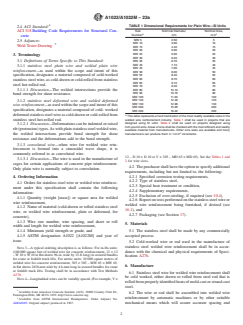
TABLE 1 Dimensional Requirements for Plain Wire—SI Units
Size Nominal Diameter, Nominal Area,
A 2
Number mm mm
MW 5 2.50 5
MW 10 3.60 10
MW 15 4.40 15
MW 20 5.00 20
MW 25 5.60 25
MW 30 6.20 30
MW 35 6.70 35
MW 40 7.10 40
MW 45 7.60 45
MW 50 8.00 50
MW 55 8.40 55
MW 60 8.70 60
MW 65 9.10 65
MW 70 9.40 70
MW 80 10.10 80
MW 90 10.70 90
MW 100 11.30 100
MW 120 12.40 120
MW 130 12.90 130
MW 200 15.95 200
MW 290 19.22 290
A
This table represents a hard metrication of the most readily available sizes in the
welded wire reinforcement industry. Table 1 shall be used in projects that are
designed using SI units: Table 2 shall be used on projects designed using
inch-pound units. Areas of wire shall be checked with the most efficient and readily
available material from manufacturers. Other wire sizes are available and many
manufacturers can produce them in 1-mm increments.
4.1.5 ASTM designation A1022 [A1022M] and year of issue.
NOTE 3—A typical ordering description is as follows: For in-lbs units: (100 000 square feet of welded wire for concrete reinforcement, 12 × 12 – W 10
× W 10 in flat sheets 96-in. wide by 15-ft long) in secured bundles for crane or forklift truck lifts. For metric units: 10 000 square metres of welded wire
for concrete reinforcement, 305 × 305 – MW 65 × MW 65, in flat sheets 2438-mm wide by 4.6-mm long in secured bundles for crane or forklift truck
lifts. Testing shall be in accordance with Test Methods A370.
NOTE 4—Longitudinal wires can be variably spaced. (For example, V × 12 – D 10 × D 10 or V × 305 – MD 65 × MD 65). See the Tables 1 and 2 for
wire sizes.
4.2 The purchaser shall have the option to specify additional requirements, including but not limited to, the following:
4.2.1 Specified corrosion testing requirements,
4.2.2 Type of stainless steel,
4.2.3 Special heat treatment or condition,
4.2.4 Supplementary requirements,
4.2.5 Exclusion of over-steeling, if required (see 10.4),
4.2.6 Report on tests performed on the stainless steel wire or welded wire reinforcement being furnished, if desired (see 16.1), and
4.2.7 Packaging (see Section 17).
5. Materials
5.1 The stainless steel shall be made by any commercially accepted process.
5.2 Cold-worked wire or rod used in the manufacture of stainless steel welded wire reinforcement shall be in accordance with the
chemical and physical requirements of Specification A276.
A1022/A1022M − 22a
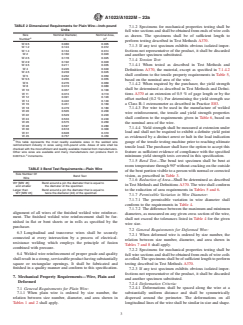
TABLE 2 Dimensional Requirements for Plain Wire—Inch-pound
Units
Size Nominal Diameter, Nominal Area,
A 2
Number in. in
W 0.5 0.080 0.005
W 1.2 0.124 0.012
W 1.4 0.134 0.014
W 2 0.160 0.020
W 2.5 0.178 0.025
W 2.9 0.192 0.029
W 3.5 0.211 0.035
W 4 0.226 0.040
W 4.5 0.239 0.045
W 5 0.252 0.050
W 5.5 0.265 0.055
W 6 0.276 0.060
W 8 0.319 0.080
W 10 0.357 0.100
W 11 0.374 0.110
W 12 0.391 0.120
W 14 0.422 0.140
W 16 0.451 0.160
W 18 0.479 0.180
W 20 0.505 0.200
W 22 0.529 0.220
W 24 0.533 0.240
W 26 0.575 0.260
W 28 0.597 0.280
W 30 0.618 0.300
W 31 0.628 0.310
W 45 0.757 0.450
A
This table represents the most readily available sizes in the welded wire
reinforcement industry in sizes using inch-pound units. Areas of wire shall be
checked with the most efficient and readily available material from manufacturers.
Other wire sizes are available and many manufacturers can produce them in
0.0015-in. increments.
TABLE 3 Bend Test Requirements—Plain Wire
Size Number Of
Bend Test
Wire
W7 [MW 45] Bend around a pin the diameter that is equal to
and smaller the diameter of the specimen
Larger than Bend around a pin the diameter that is equal to
W7 [MW 45] twice the diameter (2d) of the specimen
6. Manufacture
6.1 Stainless steel wire for welded wire reinforcement shall be cold worked, either drawn or rolled from steel rod that is rolled
from properly identified heats of mold-cast or strand-cast steel.
6.2 The wire or rod shall be assembled into welded wire reinforcement by automatic machines or by other suitable mechanical
means which will assure accurate spacing and alignment of all wires of the finished welded wire reinforcement. The finished
welded wire reinforcement shall be furnished in flat or bent sheets or in rolls as specified by the purchaser.
6.3 Longitudinal and transverse wires shall be securely connected at every intersection by a process of electrical-resistance
welding which employs the principle of fusion combined with pressure.
6.4 Welded wire reinforcement of proper grade and quality shall result in a strong, serviceable product having substantially square
or rectangular openings. It shall be fabricated and finished in a quality manner and conform to this specification.
7. Mechanical Property Requirements—Wire, Plain and Deformed
7.1 General Requirements for Plain Wire:
A1022/A1022M − 22a
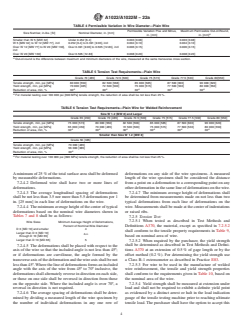
TABLE 4 Permissible Variation in Wire Diameter—Plain Wire
Permissible Variation Plus and Minus, Maximum Permissible Out-of-Round,
Size Number, in-lbs. [SI] Nominal Diameter, in. [mm]
A
in. [mm] in. [mm]
Smaller than W 5 [MW 32] Under 0.252 [6.4] 0.003 [0.08] 0.003 [0.08]
W 5 [MW 32] to W 12 [MW 77], incl 0.252 [6.4] to 0.391 [9.93], incl 0.004 [0.10] 0.004 [0.10]
Over W 12 [MW 77] to W 20 [MW 130], Over 0.391 [9.93] to 0.505 [12.83], incl 0.006 [0.15] 0.006 [0.15]
incl
Over W 20 [MW 130] Over 0.505 [12.83] 0.008 [0.20] 0.008 [0.20]
A
Out-of-round is the difference between maximum and minimum diameters of the wire, measured at the same transverse cross section.
7.1.1 When plain wire is ordered by size number, the relation between size number, diameter, and area shown in Tables 1 and 2
shall apply.
7.1.2 Specimens for mechanical properties testing shall be full wire sections and shall be obtained from ends of wire coils as
drawn. The specimens shall be of sufficient length to perform testing described in Test Methods A370.
7.1.3 If any test specimen exhibits obvious isolated imperfections not representative of the product, it shall be discarded and
another specimen substituted.
7.1.4 Tension Test:
7.1.4.1 When tested as described in Test Methods and Definitions A370, the material, except as specified in 7.1.4.2 shall conform
to the tensile property requirements in Table 5, based on the nominal area of the wire.
7.1.4.2 When required by the purchaser, the yield strength shall be determined as described in Test Methods and Definitions A370
at an extension of 0.5 % of gage length or by the offset method (0.2 %). For determining the yield strength use a Class B-1
extensometer as described in Practice E83.
7.1.4.3 For wire to be used in the manufacture of welded wire reinforcement, the tensile and yield strength properties shall
conform to the requirements given in Table 6, based on the nominal area of the wire.
7.1.4.4 Materials Yield strength shall be measured at extension under load and shall not be required to exhibit a definite yield point
as evidenced by a distinct arrest or halt in the load indication gauge of the tensile testing machine prior to reaching ultimate tensile
load. The purchaser shall have the option to accept this feature as sufficient evidence of compliance with the specified minimum
yield strength tests covered in this specification.
7.1.5 Bend Test—The bend test specimen shall be bent at room temperature through 90º without cracking on the outside of the
bent portion visible to a person with normal or corrected vision, as prescribed in Table 3.
7.1.6 Reduction of Area—Shall be determined as described in Test Methods and Definitions A370. The wire shall conform to the
reduction of area requirements in Tables 5 and 6.
7.1.7 Permissible Variation in Wire Diameter:
7.1.7.1 The permissible variation in wire diameter shall conform to the requirements in Table 4.
7.1.7.2 The difference between the maximum and minimum diameters, as measured on any given cross section of the wire, shall
not exceed the tolerances listed in Table 4 for the given wire size.
7.2 General Requirements for Deformed Wire:
7.2.1 When deformed wire is ordered by size number, the relation between size number, diameter, and area shown in Tables 7 and
8 shall apply.
7.2.2 Specimens for mechanical properties testing shall be full wire sections and shall be obtained from ends of wire coils as
rolled. The specimens shall be of sufficient length to perform testing described in Test Methods A370.
A1022/A1022M − 22a
TABLE 5 Tension Test Requirements—Plain Wire
Grade 70 [485] Grade 72.5 [500] Grade 75 [515] Grade 77.5 [533] Grade 80[550]
Tensile strength, min, psi [MPa] 80 000 [550] 82 500 [568] 85 000 [585] 87 500 [603] 90 000 [620]
Yield strength, min, psi [MPa] 70 000 [485] 72 500 [500] 75 000 [515] 77 500 [533] 80 000 [550]
A A A A A
Reduction of area, min, % 30 30 30 30 30
A
For material testing over 100 000 psi [690 MPa] tensile strength, the reduction of area shall be not less than 25 %.
TABLE 6 Tension Test Requirements—Plain Wire for Welded Reinforcement
Size W 1.2 [MW 8] and Larger
Grade 65 [450] Grade 70 [485] Grade 72.5 [500] Grade 75 [515] Grade 77.5 [533] Grade 80 [550]
Tensile strength, min, psi [MPa] 75 000 [515] 80 000 [550] 82 500 [568] 85 000 [585] 87 500 [603] 90 000 [620]
Yield strength, min, psi [MPa] 65 000 [450] 70 000 [485] 72 500 [500] 75 000 [515] 77 500 [533] 80 000 [550]
A A A A A A
Reduction of area, min, % 30 30 30 30 30 30
Smaller than Size W 1.2 [MW 8]
Grade 56 [385]
Tensile strength, min, psi [MPa] 70 000 [485]
Yield strength, min, psi [MPa] 56 000 [385]
A
Reduction of area, min, % 30
A
For material testing over 100 000 psi [690 MPa] tensile strength, the reduction of area shall be not less than 25 %.
TABLE 7 Dimensional Requirements for Deformed Wire for Concrete Reinforcement in SI Units
Nominal Dimensions Deformation Requirements
Minimum Average
Deformed Unit Mass, Diameter, Cross-Sectional
D [in X 100] Height of
A,B,C D 2E
Wire Size kg/m mm Area, mm
F,G
Deformations, mm
MD 25 [D 3.9] 0.1962 5.60 25 0.25
MD 30 [D 4.6] 0.2355 6.20 30 0.28
MD 35 [D 5.4] 0.2747 6.70 35 0.30
MD 40 [D 6.2] 0.3140 7.10 40 0.32
MD 45 [D 7.0] 0.3532 7.60 45 0.34
MD 50 [D 7.7] 0.3925 8.00 50 0.36
MD 55 [D 8.5] 0.4317 8.40 55 0.38
MD 60 [D 9.3] 0.4709 8.70 60 0.39
MD 65 [D 10.1] 0.5102 9.10 65 0.46
MD 70 [D 10.8] 0.5494 9.40 70 0.47
MD 80 [D 12.4] 0.6279 10.10 80 0.50
MD 90 [D 13.9] 0.7065 10.70 90 0.54
MD 100 [D 15.5] 0.7849 11.30 100 0.57
MD 120 [D 18.6] 0.9419 12.40 120 0.62
MD 130 [D 20.1] 1.0204 12.90 130 0.64
MD 200 [D 31.0] 1.5700 15.95 200 0.80
MD 290 [D 45.0] 2.2700 19.22 290 0.96
A
The number following the prefix indicates the nominal cross-sectional area of the deformed wire in square millimetres.
B
For sizes other than those shown above, the Size Number shall be the number of square millimetres in the nominal area of the deformed wire cross section, prefixed
by the letters MD.
C
These sizes represent the most readily available sizes in the welded wire reinforcement industry. Other wire sizes are available and many manufacturers can produce
them in 1 mm increments.
D
The nominal diameter of a deformed wire is equivalent to the diameter of a plain wire having the same mass per metre as the deformed wire.
E -6
The cross-sectional area is based on the nominal diameter. The area in square millimetres may be calculated by dividing the unit mass in kg/mm by 7.849 × 10 (mass
of 1 mm of steel) or by dividing the unit mass in kg/m by 0.007849 (mass of steel 1 mm square and 1 m long).
F
Measurements shall be made as described in 7.2.4.7.
G
See 7.2.4.6 for average longitudinal number of deformations per unit length.
7.2.3 If any test specimen exhibits obvious isolated imperfections not representative of the product, it shall be discarded and
another specimen substituted.
7.2.4 Deformation Criteria:
7.2.4.1 Deformations shall be spaced along the wire at a substantially uniform distance and shall be symmetrically
disposeddispersed around the perimeter. The deformations on all longitudinal lines of the wire shall be similar in size and shape.
A minimum of 25 % of the total surface area shall be deformed by measurable deformations.
7.2.4.2 Deformed wire shall have two or more lines of deformations.
A1022/A1022M − 22a
TABLE 8 Dimensional Requirements for Deformed Wire for Concrete Reinforcement in in.-lb Units
Nominal Dimensions Deformation Requirements
Minimum Average
Deformed Unit Weight, Diameter, Cross-Sectional
Height of
A,B,C D E
Wire Size lb/ft in. Area, in.
F,G
Deformations, in.
D 1 0.034 0.113 0.01 0.0045
D 2 0.068 0.159 0.02 0.0063
D 3 0.102 0.195 0.03 0.0078
D 4 0.136 0.225 0.04 0.0101
D 5 0.170 0.252 0.05 0.0113
D 6 0.204 0.276 0.06 0.0124
D 7 0.238 0.299 0.07 0.0134
D 8 0.272 0.319 0.08 0.0143
D 9 0.306 0.338 0.09 0.0152
D 10 0.340 0.356 0.10 0.0160
D 11 0.374 0.374 0.11 0.0187
D 12 0.408 0.390 0.12 0.0195
D 13 0.442 0.406 0.13 0.0203
D 14 0.476 0.422 0.14 0.0211
D 15 0.510 0.437 0.15 0.0218
D 16 0.544 0.451 0.16 0.0225
D 17 0.578 0.465 0.17 0.0232
D 18 0.612 0.478 0.18 0.0239
D 19 0.646 0.491 0.19 0.0245
D 20 0.680 0.504 0.20 0.0252
D 21 0.714 0.517 0.21 0.0259
D 22 0.748 0.529 0.22 0.0265
D 23 0.782 0.541 0.23 0.0271
D 24 0.816 0.553 0.24 0.0277
D 25 0.850 0.564 0.25 0.0282
D 26 0.884 0.575 0.26 0.0288
D 27 0.918 0.586 0.27 0.0293
D 28 0.952 0.597 0.28 0.0299
D 29 0.986 0.608 0.29 0.0304
D 30 1.020 0.618 0.30 0.0309
D 31 1.054 0.628 0.31 0.0314
D 45 1.530 0.757 0.45 0.0379
A
The number following the prefix indicates the nominal cross-sectional area of the deformed wire in square inches multiplied by 100.
B
For sizes other than those shown above, the Size Number shall be the number of one hundredths of a square inch in the nominal area of the deformed wire cross section,
prefixed by the D.
C
These sizes represent the most readily available sizes in the welded wire reinforcement industry. Other wire sizes are available and many manufacturers can produce
them in 0.0015-in. increments.
D
The nominal diameter of a deformed wire is equivalent to the diameter of a plain wire having the same weight per foot as the deformed wire.
E 3
The cross-sectional area is based on the nominal diameter. The area in square inches may be calculated by dividing the weight in pounds by 0.2833 (weight of 1 in.
of steel) or by dividing the weight per linear foot of specimen in pounds by 3.4 (weight of steel 1 in. square and 1 foot long).
F
Measurements shall be made as described in 7.2.4.7.
G
See 7.2.4.6 for average longitudinal number of deformations per unit length.
7.2.4.3 The average longitudinal spacing of deformations shall be not less than 3.5 nor more than 5.5 deformations per 1 in. [25
m
...