

ASTM A965/A965M-23
(Specification)Standard Specification for Steel Forgings, Austenitic, for Pressure and High Temperature Parts
General Information
- Abstract
ABSTRACT
This specification covers austenitic stainless steel forgings for pressure and high temperature parts such as boilers, pressure vessels, and associated equipment. The grades covered here are F304, F304H, F304L, F304N, F304LN, F309H, F310, F310H, F316, F316H, F316L, F316N, F316LN, F321, F321H, F347, F347H, F348, F348H, FXM-19, FXM-11, and F46. Materials shall be produced by melting, forging, and rough machining, and shall be furnished by heat treatment in solution treated condition (solution annealing and quenching in water, oil, or a polymer water solution). Stainless steel specimens shall undergo heat and product analyses to evaluate the conformance of individual grades to specified elemental chemical compositions. Forgings shall also be examined for the adherence of each grade to required grain sizes and mechanical properties, which include tensile strength, yield strength, elongation, and reduction of area.
SCOPE
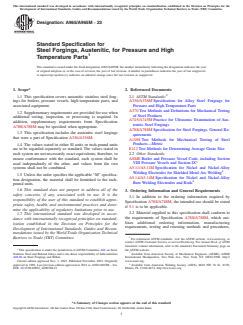
1.1 This specification covers austenitic stainless steel forgings for boilers, pressure vessels, high temperature parts, and associated equipment.
1.2 Supplementary requirements are provided for use when additional testing, inspection, or processing is required. In addition, supplementary requirements from Specification A788/A788M may be specified when appropriate.
1.3 This specification includes the austenitic steel forgings that were a part of Specification A336/A336M.
1.4 The values stated in either SI units or inch-pound units are to be regarded separately as standard. The values stated in each system are not necessarily exact equivalents; therefore, to ensure conformance with the standard, each system shall be used independently of the other, and values from the two systems shall not be combined.
1.5 Unless the order specifies the applicable “M” specification designation, the material shall be furnished to the inch-pound units.
1.6 This standard does not purport to address all of the safety concerns, if any, associated with its use. It is the responsibility of the user of this standard to establish appropriate safety, health, and environmental practices and determine the applicability of regulatory limitations prior to use.
1.7 This international standard was developed in accordance with internationally recognized principles on standardization established in the Decision on Principles for the Development of International Standards, Guides and Recommendations issued by the World Trade Organization Technical Barriers to Trade (TBT) Committee.
- Status
- Published
- Publication Date
- 31-Oct-2023
- Technical Committee
- A01 - Steel, Stainless Steel and Related Alloys
- Drafting Committee
- A01.06 - Steel Forgings and Billets
Buy Documents
ASTM A965/A965M-23 - Standard Specification for Steel Forgings, Austenitic, for Pressure and High Temperature Parts
REDLINE ASTM A965/A965M-23 - Standard Specification for Steel Forgings, Austenitic, for Pressure and High Temperature Parts
Overview
ASTM A965/A965M-23 is the internationally recognized standard specification for austenitic stainless steel forgings used in pressure-containing and high-temperature service. Issued by ASTM International, this standard covers the requirements for forged parts that are essential for applications such as boilers, pressure vessels, and related equipment. The specification includes a broad range of grades, such as F304, F316, FXM-19, F347, and several others, each tailored for specific performance needs in demanding environments.
This document outlines mechanical properties, chemical composition, heat treatment, grain size, and supplementary requirements to ensure quality and safety in the fabrication of critical components operating under pressure and high temperatures.
Key Topics
- Material Grades: Includes multiple grades of austenitic stainless steel such as F304, F304L, F304H, F310, F316, FXM-19, F321, F347, F46, among others.
- Heat Treatment: All forgings must be supplied in the solution-annealed and quenched condition, using water, oil, or polymer water solutions for rapid cooling.
- Mechanical Properties: Requirements for tensile strength, yield strength, elongation, and reduction of area, ensuring forged parts meet rigorous mechanical performance standards.
- Chemical Composition: Specific elemental limits for carbon, manganese, phosphorus, sulfur, silicon, nickel, chromium, molybdenum, and other elements are defined for each grade.
- Testing and Inspection: Includes procedures for heat and product analyses, mechanical testing, grain size determination (ASTM E112), and optional ultrasonic inspection (ASTM A745/A745M).
- Marking and Certification: Forgings must be properly marked as per ASTM A788/A788M, with detailed certifications available upon request.
Applications
The ASTM A965/A965M-23 standard is widely used across various industries that require reliable, high-performance austenitic stainless steel forgings for critical pressure and heat applications. Typical uses include:
- Boilers and Heat Exchangers: Forgings in these systems must withstand high temperatures and pressure cycles while maintaining structural stability and corrosion resistance.
- Pressure Vessels: Ensures vessels can safely contain pressurized gases or liquids, critical in power plants, chemical processing, and refineries.
- Petrochemical and Chemical Processing Equipment: Austenitic stainless steel forgings are essential for components exposed to aggressive media and thermal cycling.
- Power Generation: Components such as steam turbine casings and high-temperature piping benefit from the standard’s rigorous property requirements.
- Industrial Equipment: Any pressure-containing parts in demanding environments, such as manifolds, valve bodies, and flanges.
Related Standards
When applying ASTM A965/A965M-23, other relevant standards and specifications often come into play:
- ASTM A788/A788M: General requirements for steel forgings, supplementing ordering, testing, and certification procedures.
- ASTM A336/A336M: Relates to alloy steel forgings for pressure and high-temperature parts, some grades of which are now covered by A965/A965M.
- ASTM A370 / ASTM A1058: Test methods for mechanical testing of steel products, detailing specimen preparation and evaluation.
- ASTM A745/A745M: Practice for ultrasonic examination of austenitic steel forgings to detect internal flaws.
- ASTM E112: Standard test methods for determining average grain size.
- ASME Boiler and Pressure Vessel Code: Provides design and safety requirements for pressure components, often referenced in conjunction with ASTM standards.
Summary
ASTM A965/A965M-23 sets the benchmark for austenitic stainless steel forgings in pressure and high-temperature applications. By adhering to its stringent material, heat treatment, and testing requirements, manufacturers and end-users can ensure the safety, reliability, and long-term performance of critical components in a wide range of industrial sectors. This standard is essential for those involved in specifying, producing, or inspecting forged stainless steel parts for pressure vessel and high-temperature service.
Relations
- Effective Date
- 01-Nov-2023
- Effective Date
- 01-Mar-2024
- Effective Date
- 01-Nov-2023
- Effective Date
- 15-Sep-2023
- Effective Date
- 01-May-2021
- Effective Date
- 01-Nov-2023
- Referred By
ASTM A745/A745M-20 - Standard Practice for Ultrasonic Examination of Austenitic Steel Forgings - Effective Date
- 01-Nov-2023
- Effective Date
- 01-Nov-2023
Buy Documents
ASTM A965/A965M-23 - Standard Specification for Steel Forgings, Austenitic, for Pressure and High Temperature Parts
REDLINE ASTM A965/A965M-23 - Standard Specification for Steel Forgings, Austenitic, for Pressure and High Temperature Parts
Get Certified
Connect with accredited certification bodies for this standard

Element Materials Technology
Materials testing and product certification.

Inštitut za kovinske materiale in tehnologije
Institute of Metals and Technology. Materials testing, metallurgical analysis, NDT.
Sponsored listings
Frequently Asked Questions
ASTM A965/A965M-23 is a technical specification published by ASTM International. Its full title is "Standard Specification for Steel Forgings, Austenitic, for Pressure and High Temperature Parts". This standard covers: ABSTRACT This specification covers austenitic stainless steel forgings for pressure and high temperature parts such as boilers, pressure vessels, and associated equipment. The grades covered here are F304, F304H, F304L, F304N, F304LN, F309H, F310, F310H, F316, F316H, F316L, F316N, F316LN, F321, F321H, F347, F347H, F348, F348H, FXM-19, FXM-11, and F46. Materials shall be produced by melting, forging, and rough machining, and shall be furnished by heat treatment in solution treated condition (solution annealing and quenching in water, oil, or a polymer water solution). Stainless steel specimens shall undergo heat and product analyses to evaluate the conformance of individual grades to specified elemental chemical compositions. Forgings shall also be examined for the adherence of each grade to required grain sizes and mechanical properties, which include tensile strength, yield strength, elongation, and reduction of area. SCOPE 1.1 This specification covers austenitic stainless steel forgings for boilers, pressure vessels, high temperature parts, and associated equipment. 1.2 Supplementary requirements are provided for use when additional testing, inspection, or processing is required. In addition, supplementary requirements from Specification A788/A788M may be specified when appropriate. 1.3 This specification includes the austenitic steel forgings that were a part of Specification A336/A336M. 1.4 The values stated in either SI units or inch-pound units are to be regarded separately as standard. The values stated in each system are not necessarily exact equivalents; therefore, to ensure conformance with the standard, each system shall be used independently of the other, and values from the two systems shall not be combined. 1.5 Unless the order specifies the applicable “M” specification designation, the material shall be furnished to the inch-pound units. 1.6 This standard does not purport to address all of the safety concerns, if any, associated with its use. It is the responsibility of the user of this standard to establish appropriate safety, health, and environmental practices and determine the applicability of regulatory limitations prior to use. 1.7 This international standard was developed in accordance with internationally recognized principles on standardization established in the Decision on Principles for the Development of International Standards, Guides and Recommendations issued by the World Trade Organization Technical Barriers to Trade (TBT) Committee.
ABSTRACT This specification covers austenitic stainless steel forgings for pressure and high temperature parts such as boilers, pressure vessels, and associated equipment. The grades covered here are F304, F304H, F304L, F304N, F304LN, F309H, F310, F310H, F316, F316H, F316L, F316N, F316LN, F321, F321H, F347, F347H, F348, F348H, FXM-19, FXM-11, and F46. Materials shall be produced by melting, forging, and rough machining, and shall be furnished by heat treatment in solution treated condition (solution annealing and quenching in water, oil, or a polymer water solution). Stainless steel specimens shall undergo heat and product analyses to evaluate the conformance of individual grades to specified elemental chemical compositions. Forgings shall also be examined for the adherence of each grade to required grain sizes and mechanical properties, which include tensile strength, yield strength, elongation, and reduction of area. SCOPE 1.1 This specification covers austenitic stainless steel forgings for boilers, pressure vessels, high temperature parts, and associated equipment. 1.2 Supplementary requirements are provided for use when additional testing, inspection, or processing is required. In addition, supplementary requirements from Specification A788/A788M may be specified when appropriate. 1.3 This specification includes the austenitic steel forgings that were a part of Specification A336/A336M. 1.4 The values stated in either SI units or inch-pound units are to be regarded separately as standard. The values stated in each system are not necessarily exact equivalents; therefore, to ensure conformance with the standard, each system shall be used independently of the other, and values from the two systems shall not be combined. 1.5 Unless the order specifies the applicable “M” specification designation, the material shall be furnished to the inch-pound units. 1.6 This standard does not purport to address all of the safety concerns, if any, associated with its use. It is the responsibility of the user of this standard to establish appropriate safety, health, and environmental practices and determine the applicability of regulatory limitations prior to use. 1.7 This international standard was developed in accordance with internationally recognized principles on standardization established in the Decision on Principles for the Development of International Standards, Guides and Recommendations issued by the World Trade Organization Technical Barriers to Trade (TBT) Committee.
ASTM A965/A965M-23 is classified under the following ICS (International Classification for Standards) categories: 77.140.20 - Stainless steels. The ICS classification helps identify the subject area and facilitates finding related standards.
ASTM A965/A965M-23 has the following relationships with other standards: It is inter standard links to ASTM A965/A965M-21a, ASTM A370-24, ASTM A336/A336M-23, ASTM A370-23, ASTM A336/A336M-21, ASTM A182/A182M-23, ASTM A745/A745M-20, ASTM A788/A788M-23. Understanding these relationships helps ensure you are using the most current and applicable version of the standard.
ASTM A965/A965M-23 is available in PDF format for immediate download after purchase. The document can be added to your cart and obtained through the secure checkout process. Digital delivery ensures instant access to the complete standard document.
Standards Content (Sample)
This international standard was developed in accordance with internationally recognized principles on standardization established in the Decision on Principles for the
Development of International Standards, Guides and Recommendations issued by the World Trade Organization Technical Barriers to Trade (TBT) Committee.
Designation: A965/A965M − 23
Standard Specification for
Steel Forgings, Austenitic, for Pressure and High
Temperature Parts
This standard is issued under the fixed designation A965/A965M; the number immediately following the designation indicates the year
of original adoption or, in the case of revision, the year of last revision. A number in parentheses indicates the year of last reapproval.
A superscript epsilon (´) indicates an editorial change since the last revision or reapproval.
1. Scope* 2. Referenced Documents
1.1 This specification covers austenitic stainless steel forg- 2.1 ASTM Standards:
ings for boilers, pressure vessels, high temperature parts, and A336/A336M Specification for Alloy Steel Forgings for
associated equipment. Pressure and High-Temperature Parts
A370 Test Methods and Definitions for Mechanical Testing
1.2 Supplementary requirements are provided for use when
of Steel Products
additional testing, inspection, or processing is required. In
A745/A745M Practice for Ultrasonic Examination of Aus-
addition, supplementary requirements from Specification
tenitic Steel Forgings
A788/A788M may be specified when appropriate.
A788/A788M Specification for Steel Forgings, General Re-
1.3 This specification includes the austenitic steel forgings
quirements
that were a part of Specification A336/A336M.
A1058 Test Methods for Mechanical Testing of Steel
Products—Metric
1.4 The values stated in either SI units or inch-pound units
are to be regarded separately as standard. The values stated in E112 Test Methods for Determining Average Grain Size
2.2 Other Standards:
each system are not necessarily exact equivalents; therefore, to
ensure conformance with the standard, each system shall be ASME Boiler and Pressure Vessel Code, including Section
VIII Pressure Vessels and Section IX
used independently of the other, and values from the two
systems shall not be combined. A5.11/A5.11M Specification for Nickel and Nickel-Alloy
Welding Electrodes for Shielded Metal Arc Welding
1.5 Unless the order specifies the applicable “M” specifica-
A5.14/A5.14M Specification for Nickel and Nickel-Alloy
tion designation, the material shall be furnished to the inch-
Bare Welding Electrodes and Rods
pound units.
1.6 This standard does not purport to address all of the 3. Ordering Information and General Requirements
safety concerns, if any, associated with its use. It is the
3.1 In addition to the ordering information required by
responsibility of the user of this standard to establish appro-
Specification A788/A788M, the intended use should be stated
priate safety, health, and environmental practices and deter-
if 5.1 is to be applicable.
mine the applicability of regulatory limitations prior to use.
3.2 Material supplied to this specification shall conform to
1.7 This international standard was developed in accor-
the requirements of Specification A788/A788M, which out-
dance with internationally recognized principles on standard-
lines additional ordering information, manufacturing
ization established in the Decision on Principles for the
requirements, testing and retesting methods and procedures,
Development of International Standards, Guides and Recom-
mendations issued by the World Trade Organization Technical
Barriers to Trade (TBT) Committee.
For referenced ASTM standards, visit the ASTM website, www.astm.org, or
contact ASTM Customer Service at service@astm.org. For Annual Book of ASTM
Standards volume information, refer to the standard’s Document Summary page on
This specification is under the jurisdiction of ASTM Committee A01 on Steel, the ASTM website.
Stainless Steel and Related Alloys and is the direct responsibility of Subcommittee Available from American Society of Mechanical Engineers (ASME), ASME
A01.06 on Steel Forgings and Billets. International Headquarters, Two Park Ave., New York, NY 10016-5990, http://
Current edition approved Nov. 1, 2023. Published November 2023. Originally www.asme.org.
approved in 1996. Last previous edition approved in 2021 as A965/A965M – 21a. Available from American Welding Society (AWS), 8669 NW 36 St., #130,
DOI: 10.1520/A0965_A0965M-23. Miami, FL 33166-6672, http://www.aws.org.
*A Summary of Changes section appears at the end of this standard
Copyright © ASTM International, 100 Barr Harbor Drive, PO Box C700, West Conshohocken, PA 19428-2959. United States
A965/A965M − 23
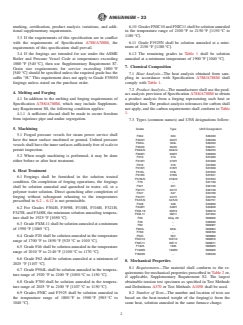
marking, certification, product analysis variations, and addi- 6.10 Grades FNIC10 and FNIC11 shall be solution annealed
tional supplementary requirements. in the temperature range of 2100 °F to 2150 °F [1150 °C to
1180 °C].
3.3 If the requirements of this specification are in conflict
with the requirements of Specification A788/A788M, the 6.11 Grade F1925N shall be solution annealed at a mini-
mum of 2150 °F [1180 °C].
requirements of this specification shall prevail.
6.12 The remaining grades in Table 1 shall be solution
3.4 If the forgings are intended for use under the ASME
annealed at a minimum temperature of 1900 °F [1040 °C].
Boiler and Pressure Vessel Code at temperatures exceeding
1000 °F [540 °C], then use Supplementary Requirement S7.
7. Chemical Composition
Grain size requirements for service exceeding 1000 °F
[540 °C] should be specified unless the required grade has the 7.1 Heat Analysis—The heat analysis obtained from sam-
suffix “H.” This requirement does not apply to Grade F35030 pling in accordance with Specification A788/A788M shall
forgings unless stated on the purchase order. comply with Table 1.
7.2 Product Analysis—The manufacturer shall use the prod-
4. Melting and Forging
uct analysis provision of Specification A788/A788M to obtain
a product analysis from a forging representing each heat or
4.1 In addition to the melting and forging requirements of
multiple heat. The product analysis tolerances for carbon shall
Specification A788/A788M, which may include Supplemen-
not apply, and the carbon requirements shall conform to Table
tary Requirement S8, the following condition applies:
1.
4.1.1 A sufficient discard shall be made to secure freedom
from injurious pipe and undue segregation.
7.3 Types (common names) and UNS designations follow:
5. Machining
Grade Type UNS Designation
5.1 Forged pressure vessels for steam power service shall
F304 304 S30400
F304H 304H S30409
have the inner surface machined or ground. Unfired pressure
F304L 304L S30403
vessels shall have the inner surfaces sufficiently free of scale to
F304N 304N S30451
permit inspection.
F304LN 304LN S30453
F309H 309H S30909
5.2 When rough machining is performed, it may be done
F310 310 S31000
either before or after heat treatment. F310H 310H S31009
F316 316 S31600
F316H 316H S31609
6. Heat Treatment
F316L 316L S31603
F316N 316N S31651
6.1 Forgings shall be furnished in the solution treated
F316LN 316LN S31653
condition. On completion of forging operations, the forgings
F70 . S31730
F321 321 S32100
shall be solution annealed and quenched in water, oil, or a
F321H 321H S32109
polymer water solution. Direct quenching after completion of
F347 347 S34700
forging without subsequent reheating to the temperatures F347H 347H S34709
F347LN 347LN S34751
prescribed in 6.2 – 6.12 is not permissible.
F348 348 S34800
F348H 348H S34809
6.2 For Grades F304H, F309H, F310H, F316H, F321H,
FXM-19 XM19 S20910
F347H, and F348H, the minimum solution annealing tempera-
FXM-11 XM11 S21904
ture shall be 1925 °F [1050 °C].
F20 Alloy 20 N08020
F46 . S30600
6.3 Grade FXM-11 shall be solution annealed at a minimum
F62 . N08367
F904L 904L N08904
of 1950 °F [1065 °C].
F700 . N08700
6.4 Grade F20 shall be solution annealed in the temperature FNIC NIC N08800
FNIC10 NIC10 N08810
range of 1700 °F to 1850 °F [925 °C to 1010 °C].
FNIC11 NIC11 N08811
F1925 1925 N08925
6.5 Grade F46 shall be solution annealed in the temperature
F1925N 1925N N08926
range of 2010 °F to 2140 °F [1100 °C to 1170 °C].
F35030 . S35030
6.6 Grade F62 shall be solution annealed at a minimum of
8. Mechanical Properties
2025 °F [1107 °C].
8.1 Requirements—The material shall conform to the re-
6.7 Grade F904L shall be solution annealed in the tempera-
quirements for mechanical properties prescribed in Table 2 or,
ture range of 1920 °F to 2100 °F [1050 °C to 1150 °C].
if applicable, Supplementary Requirement S2. The largest
6.8 Grade F700 shall be solution annealed in the tempera-
obtainable tension test specimen as specified in Test Methods
ture range of 2025 °F to 2100 °F [1107 °C to 1150 °C].
and Definitions A370 or Test Methods A1058 shall be used.
6.9 Grades FNIC and F1925 shall be solution annealed in 8.2 Number of Tests—The number and location of tests are
the temperature range of 1800 °F to 1900 °F [985 °C to based on the heat-treated weight of the forging(s) from the
1040 °C]. same heat, solution annealed in the same furnace charge.
A965/A965M − 23
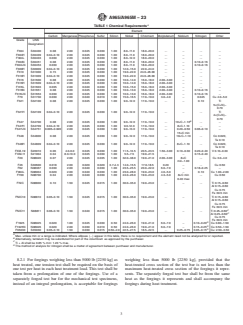
A
TABLE 1 Chemical Requirements
Element
Carbon Manganese Phosphorus Sulfur Silicon Nickel Chromium Molybdenum Niobium Nitrogen Other
Grade UNS
Designation
F304 S30400 0.08 2.00 0.045 0.030 1.00 8.0–11.0 18.0–20.0 . . . .
F304H S30409 0.04–0.10 2.00 0.045 0.030 1.00 8.0–11.0 18.0–20.0 . . . .
F304L S30403 0.030 2.00 0.045 0.030 1.00 8.0–12.0 18.0–20.0 . . . .
F304N S30451 0.08 2.00 0.045 0.030 1.00 8.0–11.0 18.0–20.0 . . 0.10–0.16 .
F304LN S30453 0.030 2.00 0.045 0.030 1.00 8.0–11.0 18.0–20.0 . . 0.10–0.16 .
F309H S30909 0.04–0.10 2.00 0.045 0.030 1.00 12.0–15.0 22.0–24.0 . . . .
F310 S31000 0.15 2.00 0.045 0.030 1.00 19.0–22.0 24.0–26.00 . . . .
F310H S31009 0.04–0.10 2.00 0.045 0.030 1.00 19.0–22.0 24.0–26.00 . . . .
F316 S31600 0.08 2.00 0.045 0.030 1.00 10.0–14.0 16.0–18.0 2.00–3.00 . . .
F316H S31609 0.04–0.10 2.00 0.045 0.030 1.00 10.0–14.0 16.0–18.0 2.00–3.00 . . .
F316L S31603 0.035 2.00 0.040 0.030 1.00 10.0–15.0 16.0–18.0 2.00–3.00 . . .
F316N S31651 0.08 2.00 0.045 0.030 1.00 10.0–13.0 16.0–18.0 2.00–3.00 . 0.10–0.16 .
F316LN S31653 0.030 2.00 0.045 0.030 1.00 10.0–13.0 16.0–18.0 2.00–3.00 . 0.10–0.16 .
F70 S31730 0.030 2.00 0.040 0.010 1.00 15.0–16.5 17.0–19.0 3.0–4.0 . 0.045 Cu 4.0–5.0
F321 S32100 0.08 2.00 0.045 0.030 1.00 9.0–12.0 17.0–19.0 . . 0.10 Ti
5×(C+N)–
0.70
F321H S32109 0.04–0.10 2.00 0.045 0.030 1.00 9.0–12.0 17.0–19.0 . . . Ti
4×(C+N)–
0.70
B
F347 S34700 0.08 2.00 0.045 0.030 1.00 9.0–12.0 17.0–19.0 . 10×C–1.10 . .
F347H S34709 0.04–0.10 2.00 0.045 0.030 1.00 9.0-12.0 17.0–19.0 . 8×C-1.10 . .
F347LN S34751 0.005–0.020 2.00 0.045 0.030 1.00 9.0–13.0 17.0–19.0 . 0.20–0.50 0.06–0.10 .
15×C min
F348 S34800 0.08 2.00 0.045 0.030 1.00 9.0–12.0 17.0–19.0 . 10×C–1.10 . Co 0.020,
Ta 0.10
F348H S34809 0.04–0.10 2.00 0.045 0.030 1.00 9.0–12.0 17.0–19.0 . 8×C–1.10 . Co 0.020,
Ta 0.10
FXM-19 S20910 0.06 4.0-6.0 0.045 0.030 1.00 11.5–13.5 20.5–23.5 1.50–3.00 0.10–0.30 0.20–0.40 V 0.10–0.30
FXM-11 S2
...
This document is not an ASTM standard and is intended only to provide the user of an ASTM standard an indication of what changes have been made to the previous version. Because
it may not be technically possible to adequately depict all changes accurately, ASTM recommends that users consult prior editions as appropriate. In all cases only the current version
of the standard as published by ASTM is to be considered the official document.
Designation: A965/A965M − 21a A965/A965M − 23
Standard Specification for
Steel Forgings, Austenitic, for Pressure and High
Temperature Parts
This standard is issued under the fixed designation A965/A965M; the number immediately following the designation indicates the year
of original adoption or, in the case of revision, the year of last revision. A number in parentheses indicates the year of last reapproval.
A superscript epsilon (´) indicates an editorial change since the last revision or reapproval.
1. Scope*
1.1 This specification covers austenitic stainless steel forgings for boilers, pressure vessels, high temperature parts, and associated
equipment.
1.2 Supplementary requirements are provided for use when additional testing, inspection, or processing is required. In addition,
supplementary requirements from Specification A788/A788M may be specified when appropriate.
1.3 This specification includes the austenitic steel forgings that were a part of Specification A336/A336M.
1.4 The values stated in either SI units or inch-pound units are to be regarded separately as standard. The values stated in each
system are not necessarily exact equivalents; therefore, to ensure conformance with the standard, each system shall be used
independently of the other, and values from the two systems shall not be combined.
1.5 Unless the order specifies the applicable “M” specification designation, the material shall be furnished to the inch-pound units.
1.6 This standard does not purport to address all of the safety concerns, if any, associated with its use. It is the responsibility
of the user of this standard to establish appropriate safety, health, and environmental practices and determine the applicability of
regulatory limitations prior to use.
1.7 This international standard was developed in accordance with internationally recognized principles on standardization
established in the Decision on Principles for the Development of International Standards, Guides and Recommendations issued
by the World Trade Organization Technical Barriers to Trade (TBT) Committee.
2. Referenced Documents
2.1 ASTM Standards:
A336/A336M Specification for Alloy Steel Forgings for Pressure and High-Temperature Parts
A370 Test Methods and Definitions for Mechanical Testing of Steel Products
A745/A745M Practice for Ultrasonic Examination of Austenitic Steel Forgings
A788/A788M Specification for Steel Forgings, General Requirements
A1058 Test Methods for Mechanical Testing of Steel Products—Metric
E112 Test Methods for Determining Average Grain Size
This specification is under the jurisdiction of ASTM Committee A01 on Steel, Stainless Steel and Related Alloys and is the direct responsibility of Subcommittee A01.06
on Steel Forgings and Billets.
Current edition approved Nov. 1, 2021Nov. 1, 2023. Published November 2021November 2023. Originally approved in 1996. Last previous edition approved in 2021 as
A965/A965MA965/A965M – 21a.-21. DOI: 10.1520/A0965_A0965M-21A.10.1520/A0965_A0965M-23.
For referenced ASTM standards, visit the ASTM website, www.astm.org, or contact ASTM Customer Service at service@astm.org. For Annual Book of ASTM Standards
volume information, refer to the standard’s Document Summary page on the ASTM website.
*A Summary of Changes section appears at the end of this standard
Copyright © ASTM International, 100 Barr Harbor Drive, PO Box C700, West Conshohocken, PA 19428-2959. United States
A965/A965M − 23
2.2 Other Standards:
ASME Boiler and Pressure Vessel Code, including Section VIII Pressure Vessels and Section IX
A5.11/A5.11M Specification for Nickel and Nickel-Alloy Welding Electrodes for Shielded Metal Arc Welding
A5.14/A5.14M Specification for Nickel and Nickel-Alloy Bare Welding Electrodes and Rods
3. Ordering Information and General Requirements
3.1 In addition to the ordering information required by Specification A788/A788M, the intended use should be stated if 5.1 is to
be applicable.
3.2 Material supplied to this specification shall conform to the requirements of Specification A788/A788M, which outlines
additional ordering information, manufacturing requirements, testing and retesting methods and procedures, marking, certification,
product analysis variations, and additional supplementary requirements.
3.3 If the requirements of this specification are in conflict with the requirements of Specification A788/A788M, the requirements
of this specification shall prevail.
3.4 If the forgings are intended for use under the ASME Boiler and Pressure Vessel Code at temperatures exceeding 1000 °F
[540 °C], then use Supplementary Requirement S7. Grain size requirements for service exceeding 1000 °F [540 °C] should be
specified unless the required grade has the suffix “H.” This requirement does not apply to Grade F35030 forgings unless stated on
the purchase order.
4. Melting and Forging
4.1 In addition to the melting and forging requirements of Specification A788/A788M, which may include Supplementary
Requirement S8, the following condition applies:
4.1.1 A sufficient discard shall be made to secure freedom from injurious pipe and undue segregation.
5. Machining
5.1 Forged pressure vessels for steam power service shall have the inner surface machined or ground. Unfired pressure vessels
shall have the inner surfaces sufficiently free of scale to permit inspection.
5.2 When rough machining is performed, it may be done either before or after heat treatment.
6. Heat Treatment
6.1 Forgings shall be furnished in the solution treated condition. On completion of forging operations, the forgings shall be
solution annealed and quenched in water, oil, or a polymer water solution. Direct quenching after completion of forging without
subsequent reheating to the temperatures prescribed in 6.2 – 6.12 is not permissible.
6.2 For Grades F304H, F309H, F310H, F316H, F321H, F347H, and F348H, the minimum solution annealing temperature shall
be 1925 °F [1050 °C].
6.3 Grade FXM-11 shall be solution annealed at a minimum of 1950 °F [1065 °C].
6.4 Grade F20 shall be solution annealed in the temperature range of 1700 °F to 1850 °F [925 °C to 1010 °C].
6.5 Grade F46 shall be solution annealed in the temperature range of 2010 °F to 2140 °F [1100 °C to 1170 °C].
Available from American Society of Mechanical Engineers (ASME), ASME International Headquarters, Two Park Ave., New York, NY 10016-5990, http://
www.asme.org.
Available from American Welding Society (AWS), 8669 NW 36 St., #130, Miami, FL 33166-6672, http://www.aws.org.
A965/A965M − 23
6.6 Grade F62 shall be solution annealed at a minimum of 2025 °F [1107 °C].
6.7 Grade F904L shall be solution annealed in the temperature range of 1920 °F to 2100 °F [1050 °C to 1150 °C].
6.8 Grade F700 shall be solution annealed in the temperature range of 2025 °F to 2100 °F [1107 °C to 1150 °C].
6.9 Grades FNIC and F1925 shall be solution annealed in the temperature range of 1800 °F to 1900 °F [985 °C to 1040 °C].
6.10 Grades FNIC10 and FNIC11 shall be solution annealed in the temperature range of 2100 °F to 2150 °F [1150 °C to 1180 °C].
6.11 Grade F1925N shall be solution annealed at a minimum of 2150 °F [1180 °C].
6.12 The remaining grades in Table 1 shall be solution annealed at a minimum temperature of 1900 °F [1040 °C].
7. Chemical Composition
7.1 Heat Analysis—The heat analysis obtained from sampling in accordance with Specification A788/A788M shall comply with
Table 1.
7.2 Product Analysis—The manufacturer shall use the product analysis provision of Specification A788/A788M to obtain a
product analysis from a forging representing each heat or multiple heat. The product analysis tolerances for carbon shall not apply,
and the carbon requirements shall conform to Table 1.
7.3 Types (common names) and UNS designations follow:
Grade Type UNS Designation
F304 304 S30400
F304H 304H S30409
F304L 304L S30403
F304N 304N S30451
F304LN 304LN S30453
F309H 309H S30909
F310 310 S31000
F310H 310H S31009
F316 316 S31600
F316H 316H S31609
F316L 316L S31603
F316N 316N S31651
F316LN 316LN S31653
F70 . S31730
F321 321 S32100
F321H 321H S32109
F347 347 S34700
F347H 347H S34709
F347LN 347LN S34751
F348 348 S34800
F348H 348H S34809
FXM-19 XM19 S20910
FXM-11 XM11 S21904
F20 Alloy 20 N08020
F46 . S30600
F62 . N08367
F904L 904L N08904
F700 . N08700
FNIC NIC N08800
FNIC10 NIC10 N08810
FNIC11 NIC11 N08811
F1925 1925 N08925
F1925N 1925N N08926
F35030 . S35030
A965/A965M − 23
A
TABLE 1 Chemical Requirements
Element
Carbon Manganese Phosphorus Sulfur Silicon Nickel Chromium Molybdenum Niobium Nitrogen Other
Grade UNS
Designation
F304 S30400 0.08 2.00 0.045 0.030 1.00 8.0–11.0 18.0–20.0 . . . .
F304H S30409 0.04–0.10 2.00 0.045 0.030 1.00 8.0–11.0 18.0–20.0 . . . .
F304L S30403 0.030 2.00 0.045 0.030 1.00 8.0–12.0 18.0–20.0 . . . .
F304N S30451 0.08 2.00 0.045 0.030 1.00 8.0–11.0 18.0–20.0 . . 0.10–0.16 .
F304LN S30453 0.030 2.00 0.045 0.030 1.00 8.0–11.0 18.0–20.0 . . 0.10–0.16 .
F309H S30909 0.04–0.10 2.00 0.045 0.030 1.00 12.0–15.0 22.0–24.0 . . . .
F310 S31000 0.15 2.00 0.045 0.030 1.00 19.0–22.0 24.0–26.00 . . . .
F310H S31009 0.04–0.10 2.00 0.045 0.030 1.00 19.0–22.0 24.0–26.00 . . . .
F316 S31600 0.08 2.00 0.045 0.030 1.00 10.0–14.0 16.0–18.0 2.00–3.00 . . .
F316H S31609 0.04–0.10 2.00 0.045 0.030 1.00 10.0–14.0 16.0–18.0 2.00–3.00 . . .
F316L S31603 0.035 2.00 0.040 0.030 1.00 10.0–15.0 16.0–18.0 2.00–3.00 . . .
F316N S31651 0.08 2.00 0.045 0.030 1.00 10.0–13.0 16.0–18.0 2.00–3.00 . 0.10–0.16 .
F316LN S31653 0.030 2.00 0.045 0.030 1.00 10.0–13.0 16.0–18.0 2.00–3.00 . 0.10–0.16 .
F70 S31730 0.030 2.00 0.040 0.010 1.00 15.0–16.5 17.0–19.0 3.0–4.0 . 0.045 Cu 4.0–5.0
F321 S32100 0.08 2.00 0.045 0.030 1.00 9.0–12.0 17.0–19.0 . . 0.10 Ti
5×(C+N)–
0.70
F321H S32109 0.04–0.10 2.00 0.045 0.030 1.00 9.0–12.0 17.0–19.0 . . . Ti
4×(C+N)–
0.70
B
F347 S34700 0.08 2.00 0.045 0.030 1.00 9.0–12.0 17.0–19.0 . 10×C–1.10 . .
F347H S34709 0.04–0.10 2.00 0.045 0.030 1.00 9.0-12.0 17.0–19.0 . 8×C-1.10 . .
F347LN S34751 0.005–0.020 2.00 0.045 0.030 1.00 9.0–13.0 17.0–19.0 . 0.20–0.50 0.06–0.10 .
15×C min
F348 S34800 0.08 2.00 0.045 0.030 1.00 9.0–12.0 17.0–19.0 . 10×C–1.10 . Co 0.020,
Ta 0.10
F348H S34809 0.04–0.10 2.00 0.045 0.030 1.00 9.0–12.0 17.0–19.0 . 8×C–1.10 . Co 0.020,
Ta 0.10
FXM-19 S20910 0.06 4.0-6.0 0.045 0.030 1.00 11.5–13.5 20.5–23.5 1.50–3.00 0.10–0.30 0.20–0.40 V 0.10–0.30
FXM-11 S21904 0.04 8.0-10.0 0.045 0.030 1.00 5.5–7.5 19.0–21.5 . . 0.15–0.40 .
F20 N08020 0.07 2.00 0.045 0.035 1.00 32.0–38.0 19.0–21.0 2.00–3.00 8×C . Cu 3.0–4.0
min–1.00
F46 S30600 0.018 2.00 0.020 0.020 3.7-4.3 14.0–15.5 17.0-18.5 0.20 . . Cu 0.50
F62 N08367 0.030 2.00 0.040 0.030 1.00 23.5–25.5 20.0–22.0 6.0–7.0 . 0.18–0.25 .
F904L N08904 0.020 2.00 0.040 0.030 1.00 23.0–28.0 19.0–23.0 4.0–5.0 . 0.10 Cu 1.00–2.00
F700 N08700 0.04 2.00 0.040 0.030 1.00 24.0–26.0 19.0–23.0 4.3–5.0 8×C min . Cu 0.50
0.40 max
FNIC N08800 0.10 1.50 0.045 0.015 1.00 30.0–35.0 19.0–23.0 . . . Ti 0.15–0.60
Al 0.15–0.60
Cu 0.75
Fe 39.5 min
FNIC10 N08810 0.05–0.10 1.50 0.045 0.015 1.00 30.0–35.0 19.0–23.0 . . . Ti 0.15–0.60
Al 0.15–0.60
Cu 0.75
Fe 39.5 min
C
FNIC11 N08811 0.06–0.10 1.50 0.040 0.015 1.0
...