

ASTM F2143-24
(Test Method)Standard Test Method for Performance of Refrigerated Buffet and Preparation Tables
General Information
- Abstract
SIGNIFICANCE AND USE
5.1 The power test is used to confirm that the buffet/preparation table is operating properly prior to further testing.
5.2 Buffet/preparation table energy consumption is a precise indicator of buffet/preparation table energy performance under the test loading condition and under a simulated overnight operating condition. This information enables the food service operator to consider energy performance when selecting a buffet/preparation table.
5.3 Production capacity is used by food service operators to choose a buffet/preparation table that matches their food output requirements.
SCOPE
1.1 This test method covers evaluation of the energy consumption of refrigerated buffet and preparation tables. The food service operator can use this evaluation to select a refrigerated buffet and preparation table and understand its energy performance.
1.2 This test method is applicable to electric self-contained refrigerators used for holding and displaying refrigerated food in an open area.
1.3 The refrigerated buffet and preparation table can be evaluated with respect to the following (where applicable):
1.3.1 Maximum power, or maximum current draw (10.1),
1.3.2 Thermostat calibration (10.4), and
1.3.3 Energy consumption (10.5).
1.4 The values stated in inch-pound units are to be regarded as standard. The SI units given in parentheses are for information only.
1.5 This standard does not purport to address all of the safety concerns, if any, associated with its use. It is the responsibility of the user of this standard to establish appropriate safety, health, and environmental practices and determine the applicability of regulatory limitations prior to use.
1.6 This international standard was developed in accordance with internationally recognized principles on standardization established in the Decision on Principles for the Development of International Standards, Guides and Recommendations issued by the World Trade Organization Technical Barriers to Trade (TBT) Committee.
- Status
- Published
- Publication Date
- 14-Jan-2024
- Technical Committee
- F26 - Food Service Equipment
- Drafting Committee
- F26.06 - Productivity and Energy Protocol
Buy Documents
ASTM F2143-24 - Standard Test Method for Performance of Refrigerated Buffet and Preparation Tables
REDLINE ASTM F2143-24 - Standard Test Method for Performance of Refrigerated Buffet and Preparation Tables
Overview
ASTM F2143-24 - Standard Test Method for Performance of Refrigerated Buffet and Preparation Tables provides a comprehensive approach for evaluating the energy consumption and performance of electric, self-contained refrigerated buffet and preparation tables. Developed by ASTM International, this standard is essential for manufacturers, testing laboratories, and food service operators seeking to assess, compare, and select equipment based on precise energy performance metrics, production capacity, and proper operational validation.
This internationally recognized method contributes to energy efficiency, regulatory compliance, and informed equipment selection across commercial food service environments.
Key Topics
Energy Consumption Evaluation
- Measures the operating power and total energy consumption of refrigerated buffet and preparation tables under controlled conditions.
- Evaluates performance during both active and simulated overnight (standby) operation periods.
Production Capacity
- Assesses the maximum volumetric storage of the buffet/preparation table for typical use scenarios, supporting equipment choice based on food output requirements.
Operational Validation
- Confirms proper operation prior to further testing through a power test, as well as thermostat calibration for effective temperature maintenance.
Data Collection and Reporting
- Standardizes measurement protocols for ambient temperature, humidity, water and air temperatures in test pans, and compressor run time.
- Requires comprehensive reporting of power metrics, temperature maintenance, defrost cycles, and physical setup.
Applicable Equipment
- Covers electric self-contained refrigerators with open-top or open condiment rail designs, commonly used for food display and preparation in commercial settings.
Applications
ASTM F2143-24 has practical applications within the commercial food service equipment industry, including:
Food Service Operators
- Enables informed purchasing decisions by providing clear indicators of energy efficiency and production capacity.
- Assists in selecting refrigeration units tailored to menu and operational requirements.
Manufacturers
- Offers a benchmark for product development and quality assurance, ensuring equipment meets recognized energy performance standards.
- Facilitates marketing claims regarding energy efficiency and environmental impact.
Testing Laboratories
- Provides a reproducible method for third-party energy and performance verification, essential for certification and compliance purposes.
Regulators and Inspectors
- Supports enforcement of energy consumption regulations and aids in compliance with health and environmental standards.
Energy Management Professionals
- Supplies quantifiable data for energy optimization programs and sustainability initiatives within food service operations.
Related Standards
Several national and international standards intersect or complement ASTM F2143-24, including:
- ANSI/NSF 7: Commercial Refrigerators and Freezers, specifying general performance and sanitation requirements.
- ANSI/ASHRAE 72: Method of Testing Open Refrigerators for Food Stores, detailing testing protocols for commercial refrigeration.
- ASHRAE Guideline 2: Engineering Analysis of Experimental Data, supporting analysis and interpretation of test data.
- U.S. FDA Food Code: Regulatory guidance for safe storage and handling of refrigerated foods.
Keywords: refrigerated buffet tables, preparation tables, energy consumption, performance test method, food service equipment, production capacity, commercial refrigeration, ASTM F2143, energy efficiency, testing standard.
Relations
- Replaces
ASTM F2143-16 - Standard Test Method for Performance of Refrigerated Buffet and Preparation Tables - Effective Date
- 15-Jan-2024
- Effective Date
- 15-Jan-2024
- Effective Date
- 15-Jan-2024
Buy Documents
ASTM F2143-24 - Standard Test Method for Performance of Refrigerated Buffet and Preparation Tables
REDLINE ASTM F2143-24 - Standard Test Method for Performance of Refrigerated Buffet and Preparation Tables
Frequently Asked Questions
ASTM F2143-24 is a standard published by ASTM International. Its full title is "Standard Test Method for Performance of Refrigerated Buffet and Preparation Tables". This standard covers: SIGNIFICANCE AND USE 5.1 The power test is used to confirm that the buffet/preparation table is operating properly prior to further testing. 5.2 Buffet/preparation table energy consumption is a precise indicator of buffet/preparation table energy performance under the test loading condition and under a simulated overnight operating condition. This information enables the food service operator to consider energy performance when selecting a buffet/preparation table. 5.3 Production capacity is used by food service operators to choose a buffet/preparation table that matches their food output requirements. SCOPE 1.1 This test method covers evaluation of the energy consumption of refrigerated buffet and preparation tables. The food service operator can use this evaluation to select a refrigerated buffet and preparation table and understand its energy performance. 1.2 This test method is applicable to electric self-contained refrigerators used for holding and displaying refrigerated food in an open area. 1.3 The refrigerated buffet and preparation table can be evaluated with respect to the following (where applicable): 1.3.1 Maximum power, or maximum current draw (10.1), 1.3.2 Thermostat calibration (10.4), and 1.3.3 Energy consumption (10.5). 1.4 The values stated in inch-pound units are to be regarded as standard. The SI units given in parentheses are for information only. 1.5 This standard does not purport to address all of the safety concerns, if any, associated with its use. It is the responsibility of the user of this standard to establish appropriate safety, health, and environmental practices and determine the applicability of regulatory limitations prior to use. 1.6 This international standard was developed in accordance with internationally recognized principles on standardization established in the Decision on Principles for the Development of International Standards, Guides and Recommendations issued by the World Trade Organization Technical Barriers to Trade (TBT) Committee.
SIGNIFICANCE AND USE 5.1 The power test is used to confirm that the buffet/preparation table is operating properly prior to further testing. 5.2 Buffet/preparation table energy consumption is a precise indicator of buffet/preparation table energy performance under the test loading condition and under a simulated overnight operating condition. This information enables the food service operator to consider energy performance when selecting a buffet/preparation table. 5.3 Production capacity is used by food service operators to choose a buffet/preparation table that matches their food output requirements. SCOPE 1.1 This test method covers evaluation of the energy consumption of refrigerated buffet and preparation tables. The food service operator can use this evaluation to select a refrigerated buffet and preparation table and understand its energy performance. 1.2 This test method is applicable to electric self-contained refrigerators used for holding and displaying refrigerated food in an open area. 1.3 The refrigerated buffet and preparation table can be evaluated with respect to the following (where applicable): 1.3.1 Maximum power, or maximum current draw (10.1), 1.3.2 Thermostat calibration (10.4), and 1.3.3 Energy consumption (10.5). 1.4 The values stated in inch-pound units are to be regarded as standard. The SI units given in parentheses are for information only. 1.5 This standard does not purport to address all of the safety concerns, if any, associated with its use. It is the responsibility of the user of this standard to establish appropriate safety, health, and environmental practices and determine the applicability of regulatory limitations prior to use. 1.6 This international standard was developed in accordance with internationally recognized principles on standardization established in the Decision on Principles for the Development of International Standards, Guides and Recommendations issued by the World Trade Organization Technical Barriers to Trade (TBT) Committee.
ASTM F2143-24 is classified under the following ICS (International Classification for Standards) categories: 97.040.50 - Small kitchen appliances. The ICS classification helps identify the subject area and facilitates finding related standards.
ASTM F2143-24 has the following relationships with other standards: It is inter standard links to ASTM F2143-16, ASTM F2916-19, ASTM F2687-13(2019). Understanding these relationships helps ensure you are using the most current and applicable version of the standard.
ASTM F2143-24 is available in PDF format for immediate download after purchase. The document can be added to your cart and obtained through the secure checkout process. Digital delivery ensures instant access to the complete standard document.
Standards Content (Sample)
This international standard was developed in accordance with internationally recognized principles on standardization established in the Decision on Principles for the
Development of International Standards, Guides and Recommendations issued by the World Trade Organization Technical Barriers to Trade (TBT) Committee.
Designation: F2143 − 24 An American National Standard
Standard Test Method for
Performance of Refrigerated Buffet and Preparation Tables
This standard is issued under the fixed designation F2143; the number immediately following the designation indicates the year of
original adoption or, in the case of revision, the year of last revision. A number in parentheses indicates the year of last reapproval. A
superscript epsilon (´) indicates an editorial change since the last revision or reapproval.
1. Scope 2.2 ASHRAE Guideline:
ASHRAE Guideline 2-1986 (RA90) Engineering Analysis
1.1 This test method covers evaluation of the energy con-
of Experimental Data
sumption of refrigerated buffet and preparation tables. The
2.3 ANSI/ASHRAE Standards:
food service operator can use this evaluation to select a
ANSI/ASHRAE 72-2014 Method of Testing Open Refrig-
refrigerated buffet and preparation table and understand its
erators for Food Stores
energy performance.
2.4 Food and Drug Administration, U.S. Public Health
1.2 This test method is applicable to electric self-contained
Service Regulation:
refrigerators used for holding and displaying refrigerated food
Food Code, 1999
in an open area.
1.3 The refrigerated buffet and preparation table can be
3. Terminology
evaluated with respect to the following (where applicable):
3.1 Definitions:
1.3.1 Maximum power, or maximum current draw (10.1),
3.1.1 production capacity, n—maximum volumetric storage
3 3
1.3.2 Thermostat calibration (10.4), and
capacity (ft (m )) at which the refrigerated buffet and prepa-
1.3.3 Energy consumption (10.5).
ration table’s open display area can hold using a specified
container filled to ⁄2 in. of the container rim.
1.4 The values stated in inch-pound units are to be regarded
3.1.2 refrigerated buffet and preparation table, n—buffet/
as standard. The SI units given in parentheses are for informa-
preparation table herein, equipment designed with a refriger-
tion only.
ated open top or open condiment rail.
1.5 This standard does not purport to address all of the
3.1.3 refrigerated buffet table or unit, n—equipment de-
safety concerns, if any, associated with its use. It is the
signed with mechanical refrigeration that is intended to receive
responsibility of the user of this standard to establish appro-
refrigerated food and maintain food product temperatures and
priate safety, health, and environmental practices and deter-
is intended for customer service such as a salad bar. A unit may
mine the applicability of regulatory limitations prior to use.
or may not be equipped with a lower refrigerated compart-
1.6 This international standard was developed in accor-
ment.
dance with internationally recognized principles on standard-
3.1.4 refrigerated food preparation unit, n—equipment de-
ization established in the Decision on Principles for the
signed with a refrigerated open top or open condiment rail such
Development of International Standards, Guides and Recom-
as refrigerated sandwich units, pizza preparation tables, and
mendations issued by the World Trade Organization Technical
similar equipment. The unit may or may not be equipped with
Barriers to Trade (TBT) Committee.
a lower refrigerated compartment.
2. Referenced Documents
3.1.5 self-contained refrigerator, n—a refrigerator whose
condensing unit is attached as an integral component of the
2.1 NSF Standard: 6
unit.
ANSI/NSF 7 Commercial Refrigerators and Freezers
Available from American Society of Heating, Refrigerating, and Air-
This test method is under the jurisdiction of ASTM Committee F26 on Food Conditioning Engineers, Inc. (ASHRAE), 1791 Tullie Circle, NE, Atlanta, GA
Service Equipment and is the direct responsibility of Subcommittee F26.06 on 30329, http://www.ashrae.org.
Productivity and Energy Protocol. Available from American National Standards Institute (ANSI), 25 W. 43rd St.,
Current edition approved Jan. 15, 2024. Published February 2024. Originally 4th Floor, New York, NY 10036, http://www.ansi.org.
approved in 2001. Last previous edition approved in 2016 as F2143 – 16. DOI: Available from National Technical Information Service (NTIS), 5285 Port
10.1520/F2143-24. Royal Rd., Springfield, VA 22161, http://www.ntis.gov.
2 6
Available from NSF International, P.O. Box 130140, 789 N. Dixboro Rd., Ann Available from National Technical Information Service (NTIS), 5301 Shawnee
Arbor, MI 48113-0140, http://www.nsf.org. Rd., Alexandria, VA 22312, http://www.ntis.gov.
Copyright © ASTM International, 100 Barr Harbor Drive, PO Box C700, West Conshohocken, PA 19428-2959. United States
F2143 − 24
3.1.6 storage refrigerator or freezer, n—a refrigerator or 6. Apparatus
freezer designed for cold storage of nonfrozen or frozen foods.
6.1 Analytical Balance Scale, for measuring weights up to
3.1.7 storage capacity, n—maximum volumetric storage
25 lb, with a resolution of 0.01 lb and an uncertainty of 0.01 lb.
3 3
capacity (ft (m )) as determined by the manufacturer at which
6.2 Pans, for holding water. Standard 4-in. (102-mm) deep
the refrigerated buffet or preparation table’s storage component
GN ⁄6-size pans shall be used in this test method. Pans shall
can hold food.
have nominal dimensions of 6 × 6 ⁄16 × 4 in. (162 × 176 × 102
3.1.8 test method, n—a definitive procedure for the
mm). Metal pans shall be used. If alternate pans are used, they
identification, measurement, and evaluation of one or more
shall conform as closely as possible to the pans described in
qualities, characteristics, or properties of a material, product,
6.2. All alternate pans must be metal in material, and any
system, or service that produces test results.
deviations from 6.2 must be reported. The weight of the pan
shall be 0.70 6 0.07 lb. The buffet/preparation table manufac-
3.1.9 uncertainty, n—measure of systematic and precision
turer may provide alternative pans if the unit is designed
errors in specified instrumentation or measure of repeatability
specifically to only be used with the alternative pans. If
of a reported test result.
alternative pans are used, they shall have nominal dimensions
as close to that of the standard pans as is available. All pans
4. Summary of Test Method
must be equipped with thermocouples for temperature mea-
4.1 Power is determined to confirm that the buffet/
surement. An example of a typical setup is shown in Fig. 1. The
preparation table is operating within 5 % of the manufacturer’s
thermocouple lead shall be long enough to allow connection to
rated power.
the monitoring device while the pans are in the storage
4.2 Buffet/preparation table energy consumption is deter-
refrigerator.
mined with the upper lid in the raised position while the unit is
6.3 Electronic Humidity Sensor, for measuring the relative
used to maintain the temperature of water being held in the
humidity within the test environment with a range of 25 to 45
refrigerated rail and with the upper lid in the lowered position
% and an uncertainty of 62 %.
without any pans in the refrigerated rail.
6.4 Thermocouple Probe, capable of immersion with a
4.3 Production capacity is determined by measuring the
range of 30° to 50°F and an uncertainty of 62°F. Preferably
amount of water that the refrigerated rail can hold, using a
industry standard type T or type K thermocouples.
specified container filled to ⁄2 in. of the container rim.
6.5 Power Meter, for measuring the electrical energy con-
sumption of a buffet/preparation table, shall have a resolution
5. Significance and Use
of at least 1 W and a maximum uncertainty no greater than
5.1 The power test is used to confirm that the buffet/
1.5 % of the measured value for any demand greater than 100
preparation table is operating properly prior to further testing.
W. For any demand less than 100 W, the meter shall have a
5.2 Buffet/preparation table energy consumption is a precise
resolution of at least 1 W and a maximum uncertainty no
indicator of buffet/preparation table energy performance under
greater than 10 %.
the test loading condition and under a simulated overnight
6.6 Air Velocity Meter, for measuring air velocity around the
operating condition. This information enables the food service
buffet/preparation table with an uncertainty of 610 % at 100
operator to consider energy performance when selecting a
ft/min (0.51 m/s) and capable of measuring air velocities at 50
buffet/preparation table.
ft/min (0.25 m/s).
5.3 Production capacity is used by food service operators to
7. Reagents and Materials
choose a buffet/preparation table that matches their food output
requirements. 7.1 Water—Distilled water shall be used.
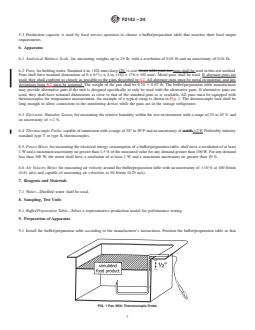
FIG. 1 Pan With Thermocouple Probe
F2143 − 24
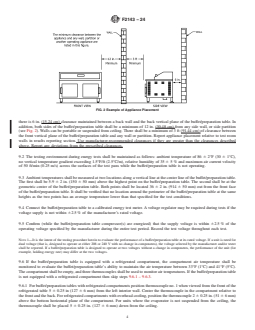
FIG. 2 Example of Appliance Placement
8. Sampling, Test Units tests if the voltage supply is not within 62.5 % of the
manufacturer’s rated voltage.
8.1 Buffet/Preparation Table—Select a representative pro-
duction model for performance testing.
9.5 Confirm (while the buffet/preparation table compres-
sor(s) are energized) that the supply voltage is within 62.5 %
9. Preparation of Apparatus
of the operating voltage specified by the manufacturer during
9.1 Install the buffet/preparation table according to the
the entire test period. Record the test voltage throughout each
manufacturer’s instructions. Position the buffet/preparation
test.
table so that there is 6 in. (15.24 cm) clearance maintained
NOTE 1—It is the intent of the testing procedure herein to evaluate the
between a back wall and the back vertical plane of the
performance of a buffet/preparation table at its rated voltage. If a unit is
buffet/preparation table. In addition, both sides of the buffet/
rated for dual voltage (that is, designed to operate at either 208 or 240 V
preparation table shall be a minimum of 12 in. (30.48 cm) from
with no change in components), the voltage selected by the manufacturer
any side wall, or side partition (see Fig. 2). Walls can be
and/or tester shall be reported. If a buffet/preparation table is designed to
portable or suspended from ceiling. There shall be a minimum
operate at two voltages without a change in components, the performance
of the unit (for example, holding energy rate) may differ at the two
of 3 ft (91.44 cm) of clearance between the front vertical plane
voltages.
of the buffet/preparation table and any wall or partition. Report
appliance placement relative to test room walls in results
9.6 If the buffet/preparation table is equipped with a refrig-
reporting section. Use manufacturer-recommended clearances
erated compartment, the compartment air temperature shall be
if they are greater than the clearances described above. Report
monitored to evaluate the buffet/preparation table’s ability to
any deviations from the prescribed clearances.
maintain the air temperature between 33°F (1°C) and 41°F
(5°C). The compartment shall be empty, and three thermo-
9.2 The testing environment during energy tests shall be
couples shall be used to monitor air temperatures. If the
maintained as follows: ambient temperature of 86 6 2°F (30 6
1°C), no vertical temperature gradient exceeding 1.5°F/ft buffet/preparation table is not equipped with a refrigerated
compartment then skip steps 9.6.1 – 9.6.3.
(2.5°C/m), relative humidity of 35 6 5 % and maximum air
current velocity of 50 ft/min (0.25 m/s) across the surfaces of
9.6.1 For buffet/preparation tables with refrigerated com-
the test pans while the buffet/preparation table is not operating.
partments position thermocouple no. 1 when viewed from the
front of the refrigerated table 5 6 0.25 in (127 6 6 mm) from
9.3 Ambient temperatures shall be measured at two loca-
the left interior wall. Center the thermocouple in the compart-
tions along a vertical line at the center line of the buffet/
ment relative to the front and the back. For refrigerated
preparation table. The first shall be 5.9 6 2 in. (150 6 50 mm)
compartments with overhead cooling, position the thermo-
above the highest point on the buffet/preparation table. The
couple 2 6 0.25 in. (51 6 6 mm) above the bottom horizontal
second shall be at the geometric center of the buffet/preparation
plane of the compartment. For units where the evaporator is not
table. Both points shall be located 36 6 2 in. (914 6 50 mm)
out from the front face of the buffet/preparation table. It shall suspended from the ceiling, the thermocouple shall be placed 5
6 0.25 in. (127 6 6 mm) down from the ceiling.
be verified that no location around the perimeter of the
buffet/preparation table at the same heights as the two points
9.6.2 Position thermocouple no. 2 centered front-to-back,
has an average temperature lower than that specified for the test
top-to-bottom, and left-to-right.
conditions.
9.6.3 Position thermocouple no. 3 when viewed from the
front of the refrigerated table 5 6 0.25 in. (127 6 6 mm) from
9.4 Connect the buffet/preparation table to a calibrated
energy test meter. A voltage regulator may be required during the right interior wall and 5 6 0.25 in. (127 6 6 mm) above the
F2143 − 24
internal floor of the compartmen
...
This document is not an ASTM standard and is intended only to provide the user of an ASTM standard an indication of what changes have been made to the previous version. Because
it may not be technically possible to adequately depict all changes accurately, ASTM recommends that users consult prior editions as appropriate. In all cases only the current version
of the standard as published by ASTM is to be considered the official document.
Designation: F2143 − 16 F2143 − 24 An American National Standard
Standard Test Method for
Performance of Refrigerated Buffet and Preparation Tables
This standard is issued under the fixed designation F2143; the number immediately following the designation indicates the year of
original adoption or, in the case of revision, the year of last revision. A number in parentheses indicates the year of last reapproval. A
superscript epsilon (´) indicates an editorial change since the last revision or reapproval.
1. Scope
1.1 This test method covers evaluation of the energy consumption of refrigerated buffet and preparation tables. The food service
operator can use this evaluation to select a refrigerated buffet and preparation table and understand its energy performance.
1.2 This test method is applicable to electric self-contained refrigerators used for holding and displaying refrigerated food in an
open area.
1.3 The refrigerated buffet and preparation table can be evaluated with respect to the following (where applicable):
1.3.1 Maximum power, or maximum current draw (10.1),
1.3.2 Thermostat calibration (10.4), and
1.3.3 Energy consumption (10.5).
1.4 The values stated in inch-pound units are to be regarded as standard. The SI units given in parentheses are for information only.
1.5 This standard does not purport to address all of the safety concerns, if any, associated with its use. It is the responsibility
of the user of this standard to establish appropriate safety and healthsafety, health, and environmental practices and determine
the applicability of regulatory limitations prior to use.
1.6 This international standard was developed in accordance with internationally recognized principles on standardization
established in the Decision on Principles for the Development of International Standards, Guides and Recommendations issued
by the World Trade Organization Technical Barriers to Trade (TBT) Committee.
2. Referenced Documents
2.1 NSF Standard:
ANSI/NSF 7 Commercial Refrigerators and Freezers
2.2 ASHRAE Guideline:
ASHRAE Guideline 2-1986 (RA90) Engineering Analysis of Experimental Data
2.3 ANSI/ASHRAE Standards:
ANSI/ASHRAE 72-2014 Method of Testing Open Refrigerators for Food Stores
This test method is under the jurisdiction of ASTM Committee F26 on Food Service Equipment and is the direct responsibility of Subcommittee F26.06 on Productivity
and Energy Protocol.
Current edition approved May 1, 2016Jan. 15, 2024. Published August 2016February 2024. Originally approved in 2001. Last previous edition approved in 20102016 as
F2143 – 04 (2010). DOI: 10.1520/F2143-16.16. DOI: 10.1520/F2143-24.
Available from NSF International, P.O. Box 130140, 789 N. Dixboro Rd., Ann Arbor, MI 48113-0140, http://www.nsf.org.
Available from American Society of Heating, Refrigerating, and Air-Conditioning Engineers, Inc. (ASHRAE), 1791 Tullie Circle, NE, Atlanta, GA 30329,
http://www.ashrae.org.
Available from American National Standards Institute (ANSI), 25 W. 43rd St., 4th Floor, New York, NY 10036, http://www.ansi.org.
Copyright © ASTM International, 100 Barr Harbor Drive, PO Box C700, West Conshohocken, PA 19428-2959. United States
F2143 − 24
2.4 Food and Drug Administration, U.S. Public Health Service Regulation:
Food Code, 1999
3. Terminology
3.1 Definitions:
3 3
3.1.1 production capacity, n—maximum volumetric storage capacity (ft (m )) at which the refrigerated buffet and preparation
table’s open display area can hold using a specified container filled to ⁄2 in. of the container rim.
3.1.2 refrigerated buffet and preparation table, n—buffet/preparation table herein, equipment designed with a refrigerated open top
or open condiment rail.
3.1.3 refrigerated buffet table or unit, n—equipment designed with mechanical refrigeration that is intended to receive refrigerated
food and maintain food product temperatures and is intended for customer service such as a salad bar. A unit may or may not be
equipped with a lower refrigerated compartment.
3.1.4 refrigerated food preparation unit, n—equipment designed with a refrigerated open top or open condiment rail such as
refrigerated sandwich units, pizza preparation tables, and similar equipment. The unit may or may not be equipped with a lower
refrigerated compartment.
3.1.5 self-contained refrigerator, n—a refrigerator whose condensing unit is attached as an integral component of the unit.
3.1.6 storage refrigerator or freezer, n—a refrigerator or freezer designed for cold storage of nonfrozen or frozen foods.
3 3
3.1.7 storage capacity, n—maximum volumetric storage capacity (ft (m )) as determined by the manufacturer at which the
refrigerated buffet or preparation table’s storage component can hold food.
3.1.8 test method, n—a definitive procedure for the identification, measurement, and evaluation of one or more qualities,
characteristics, or properties of a material, product, system, or service that produces test results.
3.1.9 uncertainty, n—measure of systematic and precision errors in specified instrumentation or measure of repeatability of a
reported test result.
4. Summary of Test Method
4.1 Power is determined to confirm that the buffet/preparation table is operating within 5 % of the manufacturer’s rated power.
4.2 Buffet/preparation table energy consumption is determined with the upper lid in the raised position while the unit is used to
maintain the temperature of water being held in the refrigerated rail and with the upper lid in the lowered position without any
pans in the refrigerated rail.
4.3 Production capacity is determined by measuring the amount of water that the refrigerated rail can hold, using a specified
container filled to ⁄2 in. of the container rim.
5. Significance and Use
5.1 The power test is used to confirm that the buffet/preparation table is operating properly prior to further testing.
5.2 Buffet/preparation table energy consumption is a precise indicator of buffet/preparation table energy performance under the
test loading condition and under a simulated overnight operating condition. This information enables the food service operator to
consider energy performance when selecting a buffet/preparation table.
Available from National Technical Information Service (NTIS), 5285 Port Royal Rd., Springfield, VA 22161, http://www.ntis.gov.
Available from National Technical Information Service (NTIS), 5301 Shawnee Rd., Alexandria, VA 22312, http://www.ntis.gov.
F2143 − 24
5.3 Production capacity is used by food service operators to choose a buffet/preparation table that matches their food output
requirements.
6. Apparatus
6.1 Analytical Balance Scale, for measuring weights up to 25 lb, with a resolution of 0.01 lb and an uncertainty of 0.01 lb.
6.2 Pans, for holding water. Standard 4-in. (102-mm) deep GN ⁄6-size steam table pans are pans shall be used in this test method.
Pans shall have nominal dimensions of 6 × 6 ⁄16 × 4 in. (162 × 176 × 102 mm). Metal pans shall be used. If alternate pans are
used, they shall conform as closely as possible to the pans described in 6.2. All alternate pans must be metal in material, and any
deviations from 6.2 must be reported. The weight of the pan shall be 0.70 6 0.07 lb. The buffet/preparation table manufacturer
may provide alternative pans if the unit is designed specifically to only be used with the alternative pans. If alternative pans are
used, they shall have nominal dimensions as close to that of the standard pans as is available. All pans must be equipped with
thermocouples for temperature measurement. An example of a typical setup is shown in Fig. 1. The thermocouple lead shall be
long enough to allow connection to the monitoring device while the pans are in the storage refrigerator.
6.3 Electronic Humidity Sensor, for measuring the relative humidity within the test environment with a range of 25 to 45 % and
an uncertainty of 62 %.
6.4 Thermocouple Probe, capable of immersion with a range of 30° to 50°F and an uncertainty of 61°F.62°F. Preferably industry
standard type T or type K thermocouples.
6.5 Power Meter, for measuring the electrical energy consumption of a buffet/preparation table, shall have a resolution of at least
1 W and a maximum uncertainty no greater than 1.5 % of the measured value for any demand greater than 100 W. For any demand
less than 100 W, the meter shall have a resolution of at least 1 W and a maximum uncertainty no greater than 10 %.
6.6 Air Velocity Meter, for measuring air velocity around the buffet/preparation table with an uncertainty of 610 % at 100 ft/min
(0.51 m/s) and capable of measuring air velocities at 50 ft/min (0.25 m/s).
7. Reagents and Materials
7.1 Water—Distilled water shall be used.
8. Sampling, Test Units
8.1 Buffet/Preparation Table—Select a representative production model for performance testing.
9. Preparation of Apparatus
9.1 Install the buffet/preparation table according to the manufacturer’s instructions. Position the buffet/preparation table so that
FIG. 1 Pan With Thermocouple Probe
F2143 − 24
FIG. 2 Example of Appliance Placement
there is 6 in. (15.24 cm) clearance maintained between a back wall and the back vertical plane of the buffet/preparation table. In
addition, both sides of the buffet/preparation table shall be a minimum of 12 in. (30.48 cm) from any side wall, or side partition
(see Fig. 2). Walls can be portable or suspended from ceiling. There shall be a minimum of 3 ft (91.44 cm) of clearance between
the front vertical plane of the buffet/preparation table and any wall or partition. Report appliance placement relative to test room
walls in results reporting section. Use manufacturer-recommended clearances if they are greater than the clearances described
above. Report any deviations from the prescribed clearances.
9.2 The testing environment during energy tests shall be maintained as follows: ambient temperature of 86 6 2°F (30 6 1°C),
no vertical temperature gradient exceeding 1.5°F/ft (2.5°C/m), relative humidity of 35 6 5 % and maximum air current velocity
of 50 ft/min (0.25 m/s) across the surfaces of the test pans while the buffet/preparation table is not operating.
9.3 Ambient temperatures shall be measured at two locations along a vertical line at the center line of the buffet/preparation table.
The first shall be 5.9 6 2 in. (150 6 50 mm) above the highest point on the buffet/preparation table. The second shall be at the
geometric center of the buffet/preparation table. Both points shall be located 36 6 2 in. (914 6 50 mm) out from the front face
of the buffet/preparation table. It shall be verified that no location around the perimeter of the buffet/preparation table at the same
heights as the two points has an average temperature lower than that specified for the test conditions.
9.4 Connect the buffet/preparation table to a calibrated energy test meter. A voltage regulator may be required during tests if the
voltage supply is not within 62.5 % of the manufacturer’s rated voltage.
9.5 Confirm (while the buffet/preparation table compressor(s) are energized) that the supply voltage is within 62.5 % of the
operating voltage specified by the manufacturer during the entire test period. Record the test voltage throughout each test.
NOTE 1—It is the intent of the testing procedure herein to evaluate the performance of a buffet/preparation table at its rated voltage. If a unit is rated for
dual voltage (that is, designed to operate at either 208 or 240 V with no change in components), the voltage selected by the manufacturer and/or tester
shall be reported. If a buffet/preparation table is designed to operate at two voltages without a change in components, the performance of the unit (for
example, holding energy rate) may differ at the two voltages.
9.6 If the buffet/preparation table is equipped with a refrigerated compartment, the compartment air temperature shall be
monitored to evaluate the buffet/preparation table’s ability to maintain the air temperature between 33°F (1°C) and 41°F (5°C).
The compartment shall be empty, and three thermocouples shall be used to monitor air temperatures. If the buffet/preparation table
is not equipped with a refrigerated compartment then skip steps 9.6.1 – 9.6.3.
9.6.1 For buffet/preparation tables with refrigerated compartments position thermocouple no. 1 when viewed from the front of the
refrigerated table 5 6 0.25 in (127 6 6 mm) from the left interior wall. Center the thermocouple in the compartment relative to
the front and the back. For refrigerated compartments with overhead cooling, position the thermocouple 2 6 0.25 in. (51 6 6 mm)
above the bottom horizontal plane of the compartment. For units where the evaporator is not suspended from the ceiling, the
thermocouple shall be placed 5 6 0.25 in. (127 6 6 mm) down from the ceiling.
F2143 − 24
9.6.2 Position thermocouple no. 2 centered front-to-back, top-to-bottom, and left-to-right.
9.6.3 Position thermocouple no. 3 when viewed from the front of the refrigerated table 5 6 0.25 in. (127 6 6 mm) from the right
interior wall and 5 6 0.25 in. (127 6 6 mm) above the internal floor of the compartment. Center the thermocouple in the
compartment relative t
...