

ASTM F2140-11(2019)
(Test Method)Standard Test Method for Performance of Hot Food Holding Cabinets
General Information
- Abstract
SIGNIFICANCE AND USE
5.1 The energy input rate and thermostat calibration tests are used to confirm that the hot food holding cabinet is operating properly prior to further testing.
5.2 Preheat energy and time can be useful to food service operators to manage energy demands and to know how quickly the hot food holding cabinet can be ready for operation.
5.3 Energy consumption (idle energy rate) can be used by the food service operator to estimate energy consumption during operating periods.
5.4 Energy consumption (idle energy rate) with the water device can be used by the food service operator to estimate energy consumption during operating periods with the humidity device.
5.5 The relative humidity percentage can be used by operators to select a hot food holding cabinet that will meet their food-holding needs.
5.6 The temperature uniformity can be used by operators to choose a hot food cabinet that meets their food-holding needs.
SCOPE
1.1 This test method evaluates the preheat energy consumption and idle energy consumption of hot food holding cabinets. The food service operator can use this evaluation to select a hot food holding cabinet and understand its energy performance, temperature uniformity, and relative humidity (if applicable). A hot food holding cabinet is described as a commercial kitchen appliance that is used to hold hot food (usually no greater than 200°F) that has been cooked in a separate appliance at a specified temperature.
1.2 This test method is applicable to electric hot food holding cabinets.
1.3 The hot food holding cabinet can be evaluated with respect to the following (where applicable):
1.3.1 Energy input rate (10.2),
1.3.2 Temperature calibration (10.3),
1.3.3 Preheat energy consumption and time (10.4),
1.3.4 Energy consumption (idle energy rate) (10.5),
1.3.5 Energy consumption with water (humidity pan) device and relative humidity (if applicable) (10.5) and
1.3.6 Temperature uniformity (10.5).
1.4 The values stated in inch-pound units are to be regarded as standard.
1.5 This standard does not purport to address all of the safety concerns, if any, associated with its use. It is the responsibility of the user of this standard to establish appropriate safety, health, and environmental practices and determine the applicability of regulatory limitations prior to use.
1.6 This international standard was developed in accordance with internationally recognized principles on standardization established in the Decision on Principles for the Development of International Standards, Guides and Recommendations issued by the World Trade Organization Technical Barriers to Trade (TBT) Committee.
- Status
- Published
- Publication Date
- 30-Apr-2019
- Technical Committee
- F26 - Food Service Equipment
- Drafting Committee
- F26.06 - Productivity and Energy Protocol
Overview
ASTM F2140-11(2019), Standard Test Method for Performance of Hot Food Holding Cabinets, provides rigorous procedures for measuring the energy performance, temperature uniformity, and relative humidity of electric hot food holding cabinets. Developed by ASTM, this test method is vital for food service operators and manufacturers seeking objective data to guide the selection, operation, and comparison of commercial hot food holding cabinets. Assessing preheat energy consumption, idle energy rate, and performance with or without humidity features, this standard supports energy management, product specification, and quality assurance in commercial kitchens.
Key Topics
Energy Performance Evaluation
The standard details how to measure preheat energy consumption and idle energy consumption (both dry and with humidity). Understanding these rates enables operators to estimate cabinet energy demands during warming periods and regular operation.Thermostat Calibration and Temperature Uniformity
Procedures include confirming the calibration of the hot food holding cabinet’s thermostat at 150°F and verifying the temperature consistency throughout the holding cavity, which is critical for maintaining food safety and quality.Relative Humidity Measurement
If the cabinet includes a humidity-generating device (water pan), the test method prescribes how to assess relative humidity and its impact on both energy consumption and food holding performance.Standardized Test Environment
The method specifies the need for carefully controlled ambient temperatures and proper instrumentation (thermocouples, watt-hour meters) to ensure reliable, repeatable results across laboratories.
Applications
ASTM F2140-11(2019) is widely applied in:
Commercial Kitchen Equipment Procurement
Food service operators use the results of this standard to compare different hot food holding cabinets and select models that suit their operational energy efficiency needs, retherm capabilities, and product holding requirements.Regulatory Compliance and Certification
Manufacturers and certification bodies apply these test procedures to demonstrate compliance with industry expectations or to verify product performance for listing and labeling.Product Development and Quality Control
Appliance manufacturers rely on this standard to refine product designs, validate innovations (such as improved insulation or humidity controls), and assure thermal performance.Operational Energy Management
Kitchens can use idle energy consumption data to forecast utility needs and optimize cabinet usage schedules, supporting cost containment and sustainability initiatives.
Related Standards
NSF/ANSI 4 - Commercial Cooking, Rethermalization, and Powered Hot Food Holding and Transport Equipment
Specifies sanitation and performance requirements for commercial food equipment, offering complementary guidelines.ASHRAE Guideline 2 - Engineering Analysis of Experimental Data
References methodologies for data acquisition and analysis relevant to temperature and energy measurements.International Standardization Principles (WTO TBT Committee)
ASTM F2140-11(2019) was developed following internationally recognized principles, supporting harmonization in global trade.
Practical Value
By following ASTM F2140-11(2019), foodservice professionals gain access to standardized, comparable data on cabinet efficiency and temperature management. This supports smarter purchasing, efficient operation, and enhanced food safety. Adoption of this standard promotes transparency across manufacturers and empowers operators to make informed, energy-conscious decisions.
Keywords: hot food holding cabinet, ASTM F2140, energy consumption, idle energy rate, commercial kitchen equipment, temperature uniformity, relative humidity, energy efficiency, food safety, performance testing
Relations
- Effective Date
- 01-May-2019
- Referred By
ASTM F2202-02(2020) - Standard Specification for Slow Cook/Hold Ovens and Hot Food Holding Cabinets - Effective Date
- 01-May-2019
- Effective Date
- 01-May-2019
- Effective Date
- 01-May-2019
- Effective Date
- 01-May-2019
Frequently Asked Questions
ASTM F2140-11(2019) is a standard published by ASTM International. Its full title is "Standard Test Method for Performance of Hot Food Holding Cabinets". This standard covers: SIGNIFICANCE AND USE 5.1 The energy input rate and thermostat calibration tests are used to confirm that the hot food holding cabinet is operating properly prior to further testing. 5.2 Preheat energy and time can be useful to food service operators to manage energy demands and to know how quickly the hot food holding cabinet can be ready for operation. 5.3 Energy consumption (idle energy rate) can be used by the food service operator to estimate energy consumption during operating periods. 5.4 Energy consumption (idle energy rate) with the water device can be used by the food service operator to estimate energy consumption during operating periods with the humidity device. 5.5 The relative humidity percentage can be used by operators to select a hot food holding cabinet that will meet their food-holding needs. 5.6 The temperature uniformity can be used by operators to choose a hot food cabinet that meets their food-holding needs. SCOPE 1.1 This test method evaluates the preheat energy consumption and idle energy consumption of hot food holding cabinets. The food service operator can use this evaluation to select a hot food holding cabinet and understand its energy performance, temperature uniformity, and relative humidity (if applicable). A hot food holding cabinet is described as a commercial kitchen appliance that is used to hold hot food (usually no greater than 200°F) that has been cooked in a separate appliance at a specified temperature. 1.2 This test method is applicable to electric hot food holding cabinets. 1.3 The hot food holding cabinet can be evaluated with respect to the following (where applicable): 1.3.1 Energy input rate (10.2), 1.3.2 Temperature calibration (10.3), 1.3.3 Preheat energy consumption and time (10.4), 1.3.4 Energy consumption (idle energy rate) (10.5), 1.3.5 Energy consumption with water (humidity pan) device and relative humidity (if applicable) (10.5) and 1.3.6 Temperature uniformity (10.5). 1.4 The values stated in inch-pound units are to be regarded as standard. 1.5 This standard does not purport to address all of the safety concerns, if any, associated with its use. It is the responsibility of the user of this standard to establish appropriate safety, health, and environmental practices and determine the applicability of regulatory limitations prior to use. 1.6 This international standard was developed in accordance with internationally recognized principles on standardization established in the Decision on Principles for the Development of International Standards, Guides and Recommendations issued by the World Trade Organization Technical Barriers to Trade (TBT) Committee.
SIGNIFICANCE AND USE 5.1 The energy input rate and thermostat calibration tests are used to confirm that the hot food holding cabinet is operating properly prior to further testing. 5.2 Preheat energy and time can be useful to food service operators to manage energy demands and to know how quickly the hot food holding cabinet can be ready for operation. 5.3 Energy consumption (idle energy rate) can be used by the food service operator to estimate energy consumption during operating periods. 5.4 Energy consumption (idle energy rate) with the water device can be used by the food service operator to estimate energy consumption during operating periods with the humidity device. 5.5 The relative humidity percentage can be used by operators to select a hot food holding cabinet that will meet their food-holding needs. 5.6 The temperature uniformity can be used by operators to choose a hot food cabinet that meets their food-holding needs. SCOPE 1.1 This test method evaluates the preheat energy consumption and idle energy consumption of hot food holding cabinets. The food service operator can use this evaluation to select a hot food holding cabinet and understand its energy performance, temperature uniformity, and relative humidity (if applicable). A hot food holding cabinet is described as a commercial kitchen appliance that is used to hold hot food (usually no greater than 200°F) that has been cooked in a separate appliance at a specified temperature. 1.2 This test method is applicable to electric hot food holding cabinets. 1.3 The hot food holding cabinet can be evaluated with respect to the following (where applicable): 1.3.1 Energy input rate (10.2), 1.3.2 Temperature calibration (10.3), 1.3.3 Preheat energy consumption and time (10.4), 1.3.4 Energy consumption (idle energy rate) (10.5), 1.3.5 Energy consumption with water (humidity pan) device and relative humidity (if applicable) (10.5) and 1.3.6 Temperature uniformity (10.5). 1.4 The values stated in inch-pound units are to be regarded as standard. 1.5 This standard does not purport to address all of the safety concerns, if any, associated with its use. It is the responsibility of the user of this standard to establish appropriate safety, health, and environmental practices and determine the applicability of regulatory limitations prior to use. 1.6 This international standard was developed in accordance with internationally recognized principles on standardization established in the Decision on Principles for the Development of International Standards, Guides and Recommendations issued by the World Trade Organization Technical Barriers to Trade (TBT) Committee.
ASTM F2140-11(2019) is classified under the following ICS (International Classification for Standards) categories: 97.040.50 - Small kitchen appliances. The ICS classification helps identify the subject area and facilitates finding related standards.
ASTM F2140-11(2019) has the following relationships with other standards: It is inter standard links to ASTM F2140-11, ASTM F2202-02(2020), ASTM F2687-13(2019), ASTM F2916-19, ASTM F2875-10(2020). Understanding these relationships helps ensure you are using the most current and applicable version of the standard.
ASTM F2140-11(2019) is available in PDF format for immediate download after purchase. The document can be added to your cart and obtained through the secure checkout process. Digital delivery ensures instant access to the complete standard document.
Standards Content (Sample)
This international standard was developed in accordance with internationally recognized principles on standardization established in the Decision on Principles for the
Development of International Standards, Guides and Recommendations issued by the World Trade Organization Technical Barriers to Trade (TBT) Committee.
Designation: F2140 − 11 (Reapproved 2019) An American National Standard
Standard Test Method for
Performance of Hot Food Holding Cabinets
This standard is issued under the fixed designation F2140; the number immediately following the designation indicates the year of
original adoption or, in the case of revision, the year of last revision.Anumber in parentheses indicates the year of last reapproval.A
superscript epsilon (´) indicates an editorial change since the last revision or reapproval.
1. Scope 2. Referenced Documents
1.1 This test method evaluates the preheat energy consump- 2.1 ASHRAE Document:
tion and idle energy consumption of hot food holding cabinets.
ASHRAE Guideline 2—1986 (RA90) “Engineering Analy-
Thefoodserviceoperatorcanusethisevaluationtoselectahot sis of Experimental Data”
food holding cabinet and understand its energy performance,
2.2 NSF Standard:
temperatureuniformity,andrelativehumidity(ifapplicable).A
NSF/ANSI 4 - 2009 Commercial Cooking,
hot food holding cabinet is described as a commercial kitchen
Rethermalization, and Powered Hot Food Holding and
appliance that is used to hold hot food (usually no greater than
Transport Equipment
200°F) that has been cooked in a separate appliance at a
specified temperature. 3. Terminology
3.1 Definitions:
1.2 This test method is applicable to electric hot food
3.1.1 cook-and-hold appliance, n—a multiple-mode appli-
holding cabinets.
ance intended for cooking food that may be used to hold the
1.3 The hot food holding cabinet can be evaluated with
temperature of the food that has been cooked in the same
respect to the following (where applicable):
appliance.
1.3.1 Energy input rate (10.2),
3.1.2 drawer warmer, n—an appliance that consists of one
1.3.2 Temperature calibration (10.3),
or more heated drawers and that is designed to hold hot food
1.3.3 Preheat energy consumption and time (10.4),
that has been cooked in a separate appliance at a specified
1.3.4 Energy consumption (idle energy rate) (10.5),
temperature.
1.3.5 Energyconsumptionwithwater(humiditypan)device
3.1.3 energy input rate, n—peak rate at which a hot food
and relative humidity (if applicable) (10.5) and
holding cabinet consumes energy (kW), typically reflected
1.3.6 Temperature uniformity (10.5).
during preheat.
1.4 The values stated in inch-pound units are to be regarded
3.1.4 heated glass merchandising cabinets, n—an appliance
as standard.
with a heated compartment that is designed to display and
maintain the temperature of hot food that has been cooked in a
1.5 This standard does not purport to address all of the
separate appliance.
safety concerns, if any, associated with its use. It is the
3.1.5 heater cycle, n—a complete sequence of the heat
responsibility of the user of this standard to establish appro-
source energizing, de-energizing, and energizing during the
priate safety, health, and environmental practices and deter-
idle test. Heater cycle applies to snap-action style controls.
mine the applicability of regulatory limitations prior to use.
Proportional style controls may not exhibit clear energized/de-
1.6 This international standard was developed in accor-
energized sequences.
dance with internationally recognized principles on standard-
ization established in the Decision on Principles for the
3.1.6 holding cavity, n—that portion of the appliance in
Development of International Standards, Guides and Recom-
which food products are held.
mendations issued by the World Trade Organization Technical
3.1.7 hot food holding cabinet, n—a heated, fully-enclosed
Barriers to Trade (TBT) Committee.
compartment, with one or more solid or transparent doors, that
is designed to maintain the temperature of hot food that has
This test method is under the jurisdiction of ASTM Committee F26 on Food
Service Equipment and is the direct responsibility of Subcommittee F26.06 on Available from American Society of Heating, Refrigerating, and Air-
Productivity and Energy Protocol. Conditioning Engineers, Inc. (ASHRAE), 1791 Tullie Circle, NE, Atlanta, GA
Current edition approved May 1, 2019. Published June 2019. Originally 30329,http://www.ashrae.org.
approved in 2001. Last previous edition approved in 2011 as F2140–11. DOI: Available from NSF International, P.O. Box 130140, 789 N. Dixboro Rd.,Ann
10.1520/F2140-11R19. Arbor, MI 48113-0140, http://www.nsf.org.
Copyright © ASTM International, 100 Barr Harbor Drive, PO Box C700, West Conshohocken, PA 19428-2959. United States
F2140 − 11 (2019)
been cooked in a separate appliance. Does not refer to heated 5.2 Preheat energy and time can be useful to food service
glass merchandising cabinets, drawer warmers or cook-and- operatorstomanageenergydemandsandtoknowhowquickly
hold appliances. the hot food holding cabinet can be ready for operation.
3.1.8 idle energy rate—dry, n—the rate of energy consumed
5.3 Energy consumption (idle energy rate) can be used by
(kW) by the hot food holding cabinet while “idling” the
the food service operator to estimate energy consumption
holding cavity at the control set point without using the
during operating periods.
humidity generating device, if applicable.
5.4 Energy consumption (idle energy rate) with the water
3.1.9 idle energy rate—wet, n—therateofenergyconsumed
device can be used by the food service operator to estimate
(kW) by the hot food holding cabinet while “idling” the
energy consumption during operating periods with the humid-
holding cavity at the control set point while generating
ity device.
humidity, if applicable.
5.5 The relative humidity percentage can be used by opera-
3.1.10 preheat energy, n—amount of energy consumed by
tors to select a hot food holding cabinet that will meet their
the hot food holding cabinet while preheating the cabinet from
food-holding needs.
ambient room temperature (75 6 2.5°F) to 150°F, with the
5.6 The temperature uniformity can be used by operators to
control(s) set to a calibrated 150°F.
choose a hot food cabinet that meets their food-holding needs.
3.1.11 preheat rate, n—average rate (°F/min) at which the
hot food holding cabinet is heated from ambient temperature
6. Apparatus
(75 6 2.5°F) to 150°F, with the control(s) set to a calibrated
6.1 Data Acquisition System, for measuring energy and
150°F.
temperatures, capable of multiple channel displays updating at
3.1.12 preheat time, n—time required for the hot food
least every 2 s.
holding cabinet to preheat from ambient room temperature (75
6.2 Humidity Measuring Device,withanoperatingtempera-
62.5°F)to150°F,withthecontrol(s)settoacalibrated150°F.
ture range of 60 to 180°F, with an accuracy of 62% relative
3.1.13 thermal cycle, n—a complete sequence of center-
humidity.
cabinet peak to low to peak temperatures during the idle test.
6.3 Stop Watch, with a 1-s resolution.
Thethermalcyclecanbeusedinplaceofthethermalcyclefor
units with proportional controls. 6.4 Thermocouple(s), calibrated exposed junction industry
standard type thermocouple probes, with a range of 0 to 250°F
3.1.14 uncertainty, n—measure of systematic and precision
and an uncertainty of 61°F.
errors in specified instrumentation or measure of repeatability
of a reported test result.
6.5 Watt-Hour Meter, for measuring the electrical energy
3.1.15 water device, n—a humidity pan or similar water- consumption of a hot food holding cabinet, shall have a
resolution of at least 10 W·h and a maximum uncertainty no
holding vessel, which is filled with water, that is built into the
cabinet. greater than 1.5% of the measured value for any demand
greaterthan100W.Foranydemandlessthan100W,themeter
4. Summary of Test Method
shall have a resolution of at least 10 W·h and a maximum
4.1 The hot food holding cabinet is connected to the
uncertainty no greater than 10%.
appropriate metered energy source, and energy input rate is
7. Reagents and Materials
determined to confirm that the appliance is operating within
5% of the nameplate energy input rate.
7.1 Aluminum Sheet Pans,measuring18×26×1in.forthe
idle tests. (Pans measuring 13 × 18 × 1 in. may be used for
4.2 Theaccuracyofthehotfoodholdingcabinet’stempera-
smaller units if the larger pans do not fit).
ture control is checked at 150°F and adjusted as necessary to
within 65°F.
8. Sampling, Test Units
4.3 The amount of energy and time required to preheat the
8.1 Hot Food Holding Cabinet—Select a representative
hot food holding cabinet to 150°F, based on a calibrated 150°F
production model for performance testing.
set point, is determined.
9. Preparation of Apparatus
4.4 The rate of idle energy consumption is determined with
thehotfoodholdingcabinetsettomaintain150°Fwithnofood 9.1 Install the hot food holding cabinets according to the
load and no humidity generation.
manufacturer’s instructions in an appropriate space. All sides
of the hot food holding cabinets shall be a minimum of 3 ft
4.5 The rate of idle energy consumption with water device
fromanysidewall,sidepartition,orotheroperatingappliance.
and relative humidity (if applicable) with no food load.
Theassociatedheatingorcoolingsystemforthespaceshallbe
4.6 The degree of temperature stratification at 150°F is
capable of maintaining an ambient temperature of 75 6 2.5°F
determined.
within the testing environment.
5. Significance and Use
9.2 Connect the hot food holding cabinet to a calibrated
5.1 The energy input rate and thermostat calibration tests energy test meter. A voltage regulator may be required during
are used to confirm that the hot food holding cabinet is tests if the voltage supply is not within 62.5% of the
operating properly prior to further testing. manufacturer’s nameplate voltage.
F2140 − 11 (2019)
9.3 Confirm (while the elements are energized) that the
supply voltage is within 62.5% of the operating voltage
specified by the manufacturer. Record the test voltage for each
test.
NOTE 1—It is the intent of the testing procedure herein to evaluate the
performance of a hot food holding cabinet at its rated electric voltage. If
an electric unit is rated dual voltage (that is, designed to operate at either
208 or 240 V with no change in components), the voltage selected by the
manufacturer and/or tester shall be reported. If a hot food holding cabinet
is designed to operate at two voltages without a change in the resistance
of the heating elements, the performance of the unit (for example, preheat
time) may differ at the two voltages.
9.4 Assure that the hot food holding cabinet’s vent (if
applicable) is closed for all tests.
9.5 For the preheat test and the idle test, each tested cabinet
will have a minimum of three thermocouples regardless of the
physical size of the unit, as described in NSF/ANSI 4 - 2009:
Thermocouple #1: (when facing the front of the unit) 5.0
6 0.25 in. (127 6 6.0 mm) from the left interior wall, 5.0 6
0.25 in. (127 6 6.0 mm) down from the ceiling, and centered
front-to-back.
Thermocouple # 2:centeredfront-to-back,centeredtop-to
bottom, centered left-to-right.
Thermocouple #3: (when facing the unit) 5.0 6 0.25 in.
(127 6 6.0 mm) from the right interior wall, 5.0 6 0.25 in.
(127 6 6.0 mm) above the internal floor of the unit, and
centered front-to-back.
9.5.1 If interior spatial constraints prohibit the placement of
thermocouples as specified above, alternate locations shall be
selected to comply with the intent of the standard.
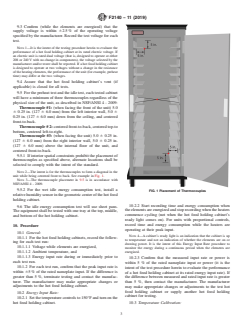
NOTE 2—The intent is for the thermocouples to form a diagonal in the
unit while being centered front to back. See example in Fig. 1.
NOTE 3—The thermocouple placement in 9.5 is in accordance with
NSF/ANSI 4 - 2009.
9.5.2 For the wet idle energy consumption test, install a
FIG. 1 Placement of Thermocouples
relativehumiditysensorinthegeometriccenterofthehotfood
holding cabinet.
10.2.2 Start recording time and energy consumption when
9.6 The idle energy consumption test will use sheet pans.
theelementsareenergizedandstoprecordingwhentheheaters
The equipment shall be tested with one tray at the top, middle,
commence cycling (not when the hot food holding cabinet’s
and bottom of the hot holding cabinet.
ready light comes on). For units with proportional controls,
record time and energy consumption while the heaters are
10. Procedure
operating at their peak input.
10.1 General:
NOTE 4—A cabinet’s ready light is an indication that the cabinet is up
10.1.1 For the hot food holding cabinets, record the follow-
to temperature and not an indication of whether the elements are on or
ing for each test run:
drawing power. It is the intent
...