

ASTM B924-02(2022)
(Specification)Standard Specification for Seamless and Welded Nickel Alloy Condenser and Heat Exchanger Tubes With Integral Fins
General Information
- Abstract
ABSTRACT
This specification covers seamless and welded nickel alloy tubing with either or both external and internal surfaces have been modified by cold forming. The cold forming process produces an enhanced surface for improved heat transfer in the tubing that makes these ideal for use in surface condensers, evaporators, heat exchangers and other similar heat transfer apparatus. The material properties and manufacturing conditions of the seamless and welded materials should conform accordingly.
SCOPE
1.1 This specification2 describes seamless and welded nickel alloy tubing on which the external or internal surface, or both, has been modified by a cold forming process to produce an integral enhanced surface, for improved heat transfer. The tubes are used in surface condensers, evaporators, heat exchangers and similar heat transfer apparatus in unfinned end diameters up to and including 1 in. (25.4 mm).
1.2 The values stated in inch-pound units are to be regarded as standard. The values given in parentheses are mathematical conversions to SI units that are provided for information only and are not considered standard.
1.3 The following precautionary statement pertains to the test method portion only: Section 10 of this specification. This standard does not purport to address all of the safety concerns, if any, associated with its use. It is the responsibility of the user of this standard to become familiar with all hazards including those identified in the appropriate Safety Data Sheet (SDS) for this product/material as provided by the manufacturer, to establish appropriate safety, health, and environmental practices, and determine the applicability of regulatory requirements prior to use.
1.4 This international standard was developed in accordance with internationally recognized principles on standardization established in the Decision on Principles for the Development of International Standards, Guides and Recommendations issued by the World Trade Organization Technical Barriers to Trade (TBT) Committee.
- Status
- Published
- Publication Date
- 30-Sep-2022
- Technical Committee
- B02 - Nonferrous Metals and Alloys
- Drafting Committee
- B02.07 - Refined Nickel and Cobalt and Their Alloys
Overview
ASTM B924-02(2022) is a comprehensive standard specification published by ASTM International for seamless and welded nickel alloy condenser and heat exchanger tubes with integral fins. This specification sets forth the requirements for tubing whose external or internal surfaces, or both, have been modified through a cold forming process to produce an integral enhanced (finned) surface. These enhancements significantly improve heat transfer, making the tubes particularly suitable for demanding applications in surface condensers, evaporators, and heat exchangers. The standard provides guidelines for material selection, manufacturing processes, dimensions, testing, inspection, and certification, ensuring consistent quality and performance.
Key Topics
- Material Types: Outlines requirements for both seamless and welded nickel alloy tubes.
- Surface Enhancement: Details specifications for tubes with integral external and/or internal fins formed by cold working, engineered for improved thermal performance.
- Dimensional Standards: Provides precise tolerances for outside diameter, wall thickness, and length for both finned and plain sections.
- Manufacturing Requirements: Considers aspects such as temper (as-finned, stress relief annealed), alloy grade, and surface configurations as agreed upon between purchaser and supplier.
- Testing and Inspection: Mandates nondestructive electromagnetic (eddy current) testing, pneumatic or hydrostatic pressure testing, and physical inspections to ensure tube integrity and adherence to specification.
- Certification: Requires documentation, including certified test reports detailing conformance with material properties, manufacturing practices, and all testing requirements.
Applications
ASTM B924-02(2022) is essential in industries where efficient heat transfer and corrosion resistance are critical. Typical applications include:
- Surface Condensers: Used in power generation plants and industrial processes, where rapid condensation of steam or other vapors is required.
- Evaporators: Essential in refrigeration and chemical processing, allowing for effective heat exchange during phase changes.
- Heat Exchangers: Widely used in HVAC, petrochemical, and power industry settings where robust heat transfer is necessary in demanding environments.
- Other Heat Transfer Equipment: Applicable to any equipment reliant on highly conductive, corrosion-resistant tubing, with integral fins maximizing thermal efficiency.
The combination of seamless or welded construction and nickel alloy materials ensures excellent mechanical strength, superior corrosion resistance, and long service life in harsh operating conditions.
Related Standards
ASTM B924-02(2022) references and aligns with several key ASTM specifications to ensure compatibility and comprehensive quality assurance. Relevant standards include:
- ASTM B829: General requirements for seamless nickel and nickel alloy pipe and tube (for seamless tube compliance).
- ASTM B751: General requirements for welded nickel and nickel alloy tubes (for welded tube compliance).
- ASTM B163, B167, B407, B423, B444, B468, B515, B516, B622, B626, B674, B676, B677, B690, B704, B729: Specific standards governing a range of nickel and nickel alloy tube types used as base materials.
- ASTM E426, E571: Practices for electromagnetic (eddy-current) examination techniques for quality assurance.
- ASTM A941, B899: Terminology standards for steel, non-ferrous metals, and alloys to ensure consistent definitions and communication.
Practical Value
Compliance with ASTM B924-02(2022) ensures:
- Enhanced Heat Transfer: Cold-formed fins substantially increase surface area, improving thermal performance.
- Reliability & Safety: Rigorous testing and inspection requirements minimize risk of tube failure in critical systems.
- Material Traceability & Certification: Mandatory reporting and documentation facilitate quality control and procurement transparency.
- Global Acceptance: Developed in accordance with WTO Technical Barriers to Trade (TBT) principles, supporting international trade and standardization.
By selecting nickel alloy condenser and heat exchanger tubes produced to ASTM B924-02(2022), manufacturers and end users can ensure durability, efficiency, and compliance with global best practices in heat transfer applications.
Relations
- Effective Date
- 01-Apr-2024
- Effective Date
- 01-Mar-2024
- Refers
ASTM B622-23 - Standard Specification for Seamless Nickel and Nickel-Cobalt Alloy Pipe and Tube - Effective Date
- 01-Dec-2023
- Effective Date
- 01-Nov-2023
- Effective Date
- 01-Nov-2023
- Effective Date
- 01-Nov-2019
- Effective Date
- 01-Nov-2019
- Effective Date
- 01-Jul-2019
- Effective Date
- 01-Apr-2019
- Effective Date
- 01-Apr-2019
- Effective Date
- 01-Nov-2018
- Effective Date
- 01-Nov-2018
- Effective Date
- 01-Nov-2018
- Effective Date
- 01-Nov-2018
- Effective Date
- 01-Sep-2017
Get Certified
Connect with accredited certification bodies for this standard

Element Materials Technology
Materials testing and product certification.

Inštitut za kovinske materiale in tehnologije
Institute of Metals and Technology. Materials testing, metallurgical analysis, NDT.
Sponsored listings
Frequently Asked Questions
ASTM B924-02(2022) is a technical specification published by ASTM International. Its full title is "Standard Specification for Seamless and Welded Nickel Alloy Condenser and Heat Exchanger Tubes With Integral Fins". This standard covers: ABSTRACT This specification covers seamless and welded nickel alloy tubing with either or both external and internal surfaces have been modified by cold forming. The cold forming process produces an enhanced surface for improved heat transfer in the tubing that makes these ideal for use in surface condensers, evaporators, heat exchangers and other similar heat transfer apparatus. The material properties and manufacturing conditions of the seamless and welded materials should conform accordingly. SCOPE 1.1 This specification2 describes seamless and welded nickel alloy tubing on which the external or internal surface, or both, has been modified by a cold forming process to produce an integral enhanced surface, for improved heat transfer. The tubes are used in surface condensers, evaporators, heat exchangers and similar heat transfer apparatus in unfinned end diameters up to and including 1 in. (25.4 mm). 1.2 The values stated in inch-pound units are to be regarded as standard. The values given in parentheses are mathematical conversions to SI units that are provided for information only and are not considered standard. 1.3 The following precautionary statement pertains to the test method portion only: Section 10 of this specification. This standard does not purport to address all of the safety concerns, if any, associated with its use. It is the responsibility of the user of this standard to become familiar with all hazards including those identified in the appropriate Safety Data Sheet (SDS) for this product/material as provided by the manufacturer, to establish appropriate safety, health, and environmental practices, and determine the applicability of regulatory requirements prior to use. 1.4 This international standard was developed in accordance with internationally recognized principles on standardization established in the Decision on Principles for the Development of International Standards, Guides and Recommendations issued by the World Trade Organization Technical Barriers to Trade (TBT) Committee.
ABSTRACT This specification covers seamless and welded nickel alloy tubing with either or both external and internal surfaces have been modified by cold forming. The cold forming process produces an enhanced surface for improved heat transfer in the tubing that makes these ideal for use in surface condensers, evaporators, heat exchangers and other similar heat transfer apparatus. The material properties and manufacturing conditions of the seamless and welded materials should conform accordingly. SCOPE 1.1 This specification2 describes seamless and welded nickel alloy tubing on which the external or internal surface, or both, has been modified by a cold forming process to produce an integral enhanced surface, for improved heat transfer. The tubes are used in surface condensers, evaporators, heat exchangers and similar heat transfer apparatus in unfinned end diameters up to and including 1 in. (25.4 mm). 1.2 The values stated in inch-pound units are to be regarded as standard. The values given in parentheses are mathematical conversions to SI units that are provided for information only and are not considered standard. 1.3 The following precautionary statement pertains to the test method portion only: Section 10 of this specification. This standard does not purport to address all of the safety concerns, if any, associated with its use. It is the responsibility of the user of this standard to become familiar with all hazards including those identified in the appropriate Safety Data Sheet (SDS) for this product/material as provided by the manufacturer, to establish appropriate safety, health, and environmental practices, and determine the applicability of regulatory requirements prior to use. 1.4 This international standard was developed in accordance with internationally recognized principles on standardization established in the Decision on Principles for the Development of International Standards, Guides and Recommendations issued by the World Trade Organization Technical Barriers to Trade (TBT) Committee.
ASTM B924-02(2022) is classified under the following ICS (International Classification for Standards) categories: 77.120.40 - Nickel, chromium and their alloys. The ICS classification helps identify the subject area and facilitates finding related standards.
ASTM B924-02(2022) has the following relationships with other standards: It is inter standard links to ASTM B516-24, ASTM A941-24, ASTM B622-23, ASTM B704-23, ASTM B167-23, ASTM B676-19, ASTM B626-19, ASTM E571-19, ASTM B829-19, ASTM B751-19, ASTM B163-18, ASTM B751-08(2018), ASTM B829-18, ASTM B516-18, ASTM A941-17. Understanding these relationships helps ensure you are using the most current and applicable version of the standard.
ASTM B924-02(2022) is available in PDF format for immediate download after purchase. The document can be added to your cart and obtained through the secure checkout process. Digital delivery ensures instant access to the complete standard document.
Standards Content (Sample)
This international standard was developed in accordance with internationally recognized principles on standardization established in the Decision on Principles for the
Development of International Standards, Guides and Recommendations issued by the World Trade Organization Technical Barriers to Trade (TBT) Committee.
Designation:B924 −02 (Reapproved 2022)
Standard Specification for
Seamless and Welded Nickel Alloy Condenser and Heat
Exchanger Tubes With Integral Fins
This standard is issued under the fixed designation B924; the number immediately following the designation indicates the year of
original adoption or, in the case of revision, the year of last revision. A number in parentheses indicates the year of last reapproval. A
superscript epsilon (´) indicates an editorial change since the last revision or reapproval.
1. Scope 2. Referenced Documents
2.1 ASTM Standards:
1.1 This specification describes seamless and welded
A941 TerminologyRelatingtoSteel,StainlessSteel,Related
nickel alloy tubing on which the external or internal surface, or
Alloys, and Ferroalloys
both, has been modified by a cold forming process to produce
B163 Specification for Seamless Nickel and Nickel Alloy
an integral enhanced surface, for improved heat transfer. The
Condenser and Heat-Exchanger Tubes
tubes are used in surface condensers, evaporators, heat ex-
B167 Specification for Standard Specification for Nickel-
changers and similar heat transfer apparatus in unfinned end
Chromium-Aluminum Alloys (UNS N06699) Nickel-
diameters up to and including 1 in. (25.4 mm).
Chromium-Iron Alloys (UNS N06600, N06601, N06603,
N06690,N06693,N06025,N06045,andN06696)Nickel-
1.2 The values stated in inch-pound units are to be regarded
Chromium-Cobalt-Molybdenum Alloy (UNS N06617)
as standard. The values given in parentheses are mathematical
Nickel-Iron-Chromium-Tungsten Alloy (UNS N06674)
conversions to SI units that are provided for information only
and Nickel-Chromium-Molybdenum-Copper Alloy (UNS
and are not considered standard.
N06235) Seamless Pipe and Tube
1.3 The following precautionary statement pertains to the
B407 Specification for Nickel-Iron-Chromium Alloy Seam-
test method portion only: Section 10 of this specification. This
less Pipe and Tube
standard does not purport to address all of the safety concerns,
B423 Specification for Nickel-Iron-Chromium-
if any, associated with its use. It is the responsibility of the user
Molybdenum-Copper Alloy Seamless Pipe and Tube
of this standard to become familiar with all hazards including
B444 Specification for Nickel-Chromium-Molybdenum-
those identified in the appropriate Safety Data Sheet (SDS) for ColumbiumAlloys (UNS N06625 and UNS N06852) and
Nickel-Chromium-Molybdenum-Silicon Alloy (UNS
this product/material as provided by the manufacturer, to
N06219) Pipe and Tube
establish appropriate safety, health, and environmental
B468 Specification for Welded UNS N08020 Alloy Tubes
practices, and determine the applicability of regulatory re-
B515 SpecificationforWeldedNickel-Iron-ChromiumAlloy
quirements prior to use.
Tubes
1.4 This international standard was developed in accor-
B516 Specification for Welded Nickel-Chromium-
dance with internationally recognized principles on standard-
Aluminum Alloy (UNS N06699) and Nickel-Chromium-
ization established in the Decision on Principles for the
Iron Alloy (UNS N06600, UNS N06601, UNS N06603,
Development of International Standards, Guides and Recom-
UNS N06025, UNS N06045, UNS N06690, and UNS
mendations issued by the World Trade Organization Technical
N06693) Tubes
Barriers to Trade (TBT) Committee.
B622 Specification for Seamless Nickel and Nickel-Cobalt
Alloy Pipe and Tube
B626 Specification for Welded Nickel and Nickel-Cobalt
Alloy Tube
B674 Specification for Nickel-Iron-Chromium-
Molybdenum and Iron-Nickel-Chromium-Molybdenum-
Copper Welded Tube
This specification is under the jurisdiction of ASTM Committee B02 on
Nonferrous Metals and Alloys and is the direct responsibility of Subcommittee
B02.07 on Refined Nickel and Cobalt and Their Alloys.
Current edition approved Oct. 1, 2022. Published November 2022. Originally
approved in 2002. Last previous edition approved in 2017 as B924 – 02 (2017). For referenced ASTM standards, visit the ASTM website, www.astm.org, or
DOI: 10.1520/B0924-02R22. contact ASTM Customer Service at service@astm.org. For Annual Book of ASTM
For ASME Boiler and Pressure Vessel Code applications, see related Specifi- Standards volume information, refer to the standard’s Document Summary page on
cation SB-924 in Section II of that Code. the ASTM website.
Copyright © ASTM International, 100 Barr Harbor Drive, PO Box C700, West Conshohocken, PA 19428-2959. United States
B924−02 (2022)
B676 Specification for UNS N08367 Welded Tube
B677 Specification for Nickel-Iron-Chromium-
Molybdenum and Iron-Nickel-Chromium-Molybdenum-
Copper Seamless Pipe and Tube
B690 Specification for Iron-Nickel-Chromium-
Molybdenum Alloy Seamless Pipe and Tube
B704 Specification for Welded Nickel Alloy Tubes
B729 Specification for Seamless Nickel-Iron-Chromium-
Molybdenum-Copper Nickel Alloy Pipe and Tube
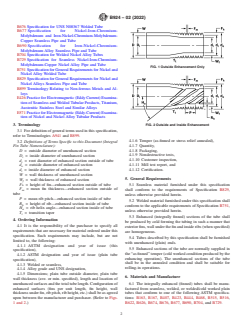
FIG. 1Outside Enhancement Only
B751 Specification for General Requirements for Nickel and
Nickel Alloy Welded Tube
B829 Specification for General Requirements for Nickel and
Nickel Alloys Seamless Pipe and Tube
B899 Terminology Relating to Non-ferrous Metals and Al-
loys
E426 Practice for Electromagnetic (Eddy Current) Examina-
tion of Seamless and Welded Tubular Products, Titanium,
Austenitic Stainless Steel and Similar Alloys
E571 PracticeforElectromagnetic(Eddy-Current)Examina-
tion of Nickel and Nickel Alloy Tubular Products
3. Terminology FIG. 2Outside and Inside Enhancement
3.1 For definition of general terms used in this specification,
refer to Terminologies A941 and B899.
4.1.6 Temper (as-finned or stress relief annealed),
3.2 Definitions of Terms Specific to this Document (Integral
4.1.7 Quantity,
Fin Tube Nomenclature):
4.1.8 Packaging,
D = outside diameter of unenhanced section
4.1.9 Nondestructive tests,
D = inside diameter of unenhanced section
i
4.1.10 Customer inspection,
d = root diameter of enhanced section outside of tube
r
4.1.11 Mill test report, and
d = outside diameter of enhanced section
o
4.1.12 Certification.
d = inside diameter of enhanced section
i
W = wall thickness of unenhanced section
5. General Requirements
W = wall thickness of enhanced section
f
F = height of fin—enhanced section outside of tube
5.1 Seamless material furnished under this specification
h
F = mean fin thickness—enhanced section outside of
m shall conform to the requirements of Specification B829,
tube
unless otherwise provided herein.
P = mean rib pitch—enhanced section inside of tube
5.2 Welded material furnished under this specification shall
R = height of rib—enhanced section inside of tube
h
conform to the applicable requirements of Specification B751,
H = rib helix angle—enhanced section inside of tube
a
unless otherwise provided herein.
T = transition taper
t
5.3 Enhanced (integrally finned) sections of the tube shall
4. Ordering Information
be produced by cold forming the tubing in such a manner that
4.1 It is the responsibility of the purchaser to specify all exterior fins, wall under the fin and inside ribs (when specified)
requirements that are necessary for material ordered under this
are homogeneous.
specification. Such requirements may include, but are not
5.4 Tubes described by this specification shall be furnished
limited to, the following:
with unenhanced (plain) ends.
4.1.1 ASTM designation and year of issue (this
5.5 Enhanced sections of the tube are normally supplied in
specification),
the “as finned” temper (cold worked condition produced by the
4.1.2 ASTM designation and year of issue (plain tube
enhancing operation). The unenhanced sections of the tube
specification),
shall be in the annealed condition and shall be suitable for
4.1.3 Welded or seamless,
rolling-in operations.
4.1.4 Alloy grade and UNS designation,
4.1.5 Dimensions; plain tube outside diameter, plain tube
6. Materials and Manufacture
wall thickness (ave. or min. specified), length and location of
unenhancedsurfacesandthetotaltubelength.Configurationof 6.1 The integrally enhanced (finned) tubes shall be manu-
enhanced surfaces (fins per unit length, fin height, wall factured from seamless, welded, or welded/cold worked plain
thicknessunderfin,ribpitch,ribheight,etc.)shallbeasagreed tubes that conform to one of the following ASTM specifica-
upon between the manufacturer and purchaser. (Refer to Figs. tions: B163, B167, B407, B423, B444, B468, B515, B516,
1 and 2.) B622, B626, B674, B676, B677, B690, B704, and B729.
B924−02 (2022)
7. Temper Tubes causing irrelevant signals because of visible and identi-
fiable handling marks (rough fin tip, notches in the fin) shall be
7.1 The tube after enhancing shall normally be supplied in
considered to conform, provided the wall thickness in the
the as-finned temper. When specified by the purchaser, for
enhanced and unenhanced areas is not less than the minimum
bending, coiling or other fabricating operations, enhanced
specified.
portions of the tube may be stress relief annealed or solution
10.1.1.5 Tubes causing relevant signals because of injurious
annealed.
defects (incomplete welds, splits, embedded debris, broken
7.2 Heat treatment of enhanced sections and bend areas, or
tool impressions, ID defects) that reduce the wall thickness
both, shall be in accordance with the governing plain tube
below the minimum specified shall be rejected. If, after retest
specification.
and examination, no source for the reject signal can be
discerned, the tube shall be rejected.
8. Chemical Composition
10.1.2 Pneumatic Test—When examined with this method,
8.1 The tubing specified shall conform to the chemical
each tube shall withstand a minimum internal air pressure of
requirements prescribed in the governing plain tube specifica-
250 psi (1.72 MPa), for a minimum of 5 s, without showing
tion.
evidence of leakage. The test method used shall permit easy
detection of any leakage either by placing the tube under water
9. Tensile Requirements
or by using the pressure differential method as follows:
9.1 The tube prior to the finning operation, and unenhanced
10.1.2.1 Air Underwater Pressure Test—Each tube shall be
portions of the finned tube, shall conform to the requirements
tested in accordance with Specification B751 except using test
for tensile properties prescribed in the governing plain tube
pressure specified in 10.1.2.
specification.
10.1.2.2 Pressure Differential Test—Procedure and accep-
tance criteria shall be agreed upon between the manufac
...