

ASTM F1510-21
(Specification)Standard Specification for Rotary Positive Displacement Pumps, Ships Use
General Information
- Abstract
ABSTRACT
This specification defines the requirements for rotary positive displacement pumps for shipboard use. This specification does not include pumps for hydraulic service or cargo unloading applications. Pumps under this specification include the following types and classes: Type II, Type III, Type IV, Type V, Type VIII, Type X, Type XI, Class A, Class B, Class CD, Class CH, Class DD, Class DH, Class G, Class LM, Class LA, Class M, and Class W. Pump component parts such as casings, heads, and covers; shafts; rotors; rotor housings, liners, and disks; glands; bedplates and brackets; timing gears; fasteners (studs, bolts, screws, and nuts); O-rings and other elastomers; gaskets; and vanes and shoes, shall be constructed of the specified materials. General requirements for: (1) service life, (2) operation during inclinations, (3) environmental vibration, (4) internally excited vibration levels, (5) airborne noise level, (6) driver, (7) reduction gears, (8) mounting of horizontal and vertical pumps, (9) seating surface, (10) face mounted motors, (11) couplings, (12) direction of rotation, and (13) inlet and outlet connections, are detailed. Pump design and construction requirements for the following are specified: (1) flanges, (2) pump casing, (3) radial and thrust bearings, (4) rolling contact bearings, (5) mechanical shaft seals, (6) backup packing box, (7) pump head or end covers, (8) rotors and timing gears, and (9) fasteners. The pump shall meet the required rated capacity. Requirements for (1) painting and coating and (2) testing including hydrostatic test, mechanical running test, and performance test are also specified.
SCOPE
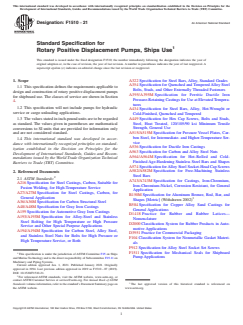
1.1 This specification defines the requirements applicable to design and construction of rotary positive displacement pumps for shipboard use. The classes of service are shown in Section 4.
1.2 This specification will not include pumps for hydraulic service or cargo unloading applications.
1.3 The values stated in inch-pound units are to be regarded as standard. The values given in parentheses are mathematical conversions to SI units that are provided for information only and are not considered standard.
1.4 This international standard was developed in accordance with internationally recognized principles on standardization established in the Decision on Principles for the Development of International Standards, Guides and Recommendations issued by the World Trade Organization Technical Barriers to Trade (TBT) Committee.
- Status
- Published
- Publication Date
- 31-Dec-2020
- Technical Committee
- F25 - Ships and Marine Technology
- Drafting Committee
- F25.11 - Machinery and Piping Systems
Buy Documents
ASTM F1510-21 - Standard Specification for Rotary Positive Displacement Pumps, Ships Use
REDLINE ASTM F1510-21 - Standard Specification for Rotary Positive Displacement Pumps, Ships Use
Overview
ASTM F1510-21: Standard Specification for Rotary Positive Displacement Pumps, Ships Use sets comprehensive requirements for the design, construction, and performance of rotary positive displacement pumps specifically intended for shipboard applications. Developed by ASTM International, this standard excludes pumps used for hydraulic service and cargo unloading, instead focusing on those essential for shipboard fluid transfer tasks. The specification outlines necessary material standards, performance benchmarks, classification categories, installation, testing procedures, and crucial safety and operational requirements, thus ensuring reliability and durability of pumps in marine environments.
Key Topics
Pump Types and Classes
The standard covers various pump types, including screws (with or without timing gears), impellers, external and internal gears, vanes, and sliding shoe pumps. Classes encompass a broad range of service fluids, such as clean and dirty fuels, lube oils, contaminated seawater, bromine, and others relevant to shipboard operations.Material Requirements
Details are provided for approved materials used in the construction of casings, heads, covers, shafts, rotors, bearings, fasteners, seals, O-rings, and gaskets. The standard references other ASTM specifications to define acceptable metals, alloys, elastomers, and gasket materials appropriate for the expected chemical and mechanical environments.Design and Construction
Key design aspects include mounting arrangements, alignment tolerances, flange connections, use of guards on rotating parts, mechanical shaft sealing, bearing requirements, and compatibility with specified service conditions such as vibration, inclination, and noise.Testing and Performance
The standard mandates hydrostatic pressure tests, mechanical running tests, and periodic endurance and noise tests to verify integrity and operational capacity. Certification of test data, technical documentation, and proper packaging for shipping and storage is also required to ensure consistent quality and traceability.Ordering and Documentation
Detailed guidance on the data and documentation to be provided with orders, including capacity, pressure, mounting, driver specifications, and required manuals and test reports.
Applications
Marine Shipboard Use
Rotary positive displacement pumps covered by ASTM F1510-21 are primarily used across various shipboard systems for fluid transfer, bilge evacuation, fuel handling, lubrication, cleaning agents, and contaminated seawater management.Naval and Commercial Vessels
These pumps are critical for reliable operation in both naval and commercial marine vessels, supporting engine operation, fuel transfer, lubricating oil management, firefighting systems, and waste handling.Safety and Reliability
By adhering to ASTM F1510-21, shipbuilds and maintenance teams guarantee equipment meets high safety, noise, vibration, shock, and longevity standards-a necessity for harsh marine environments.Specification and Procurement
The standard streamlines specification, procurement, and acceptance processes by defining clear criteria for pump selection, testing, and certification, reducing project risks during new constructions or retrofits.
Related Standards
- ASTM F1511 - Specification for Mechanical Seals for Shipboard Pump Applications
- ASME B16.5 - Pipe Flanges and Flanged Fittings
- API 676 - Positive Displacement Pumps-Rotary
- MIL-STD-167 - Vibration
- MIL-STD-740 - Airborne and Structureborne Noise
- AGMA 390.03 - Gear Classification, Materials, and Measurement
- ABMA 9 & 11 - Load Ratings and Fatigue Life for Bearings
- ASTM Material Specifications (e.g., A395/A536 for cast iron, A193/A194 for fasteners, D2000 for gasket and O-ring materials)
Practical Value
By establishing clear, internationally recognized benchmarks, ASTM F1510-21 is an essential tool for shipbuilders, marine engineers, procurement specialists, and maintenance personnel. Adoption of this standard ensures shipboard rotary positive displacement pumps will deliver reliable, efficient, and safe performance across their intended service life, supporting both regulatory compliance and operational excellence in the maritime sector.
Relations
- Effective Date
- 01-Mar-2024
- Effective Date
- 01-Oct-2023
- Effective Date
- 01-May-2020
- Effective Date
- 01-May-2020
- Effective Date
- 01-May-2020
- Effective Date
- 01-Jan-2020
- Effective Date
- 01-Sep-2019
- Effective Date
- 01-May-2019
- Effective Date
- 01-May-2019
- Effective Date
- 01-Sep-2018
- Effective Date
- 01-May-2018
- Effective Date
- 01-Nov-2017
- Effective Date
- 01-Jun-2017
- Effective Date
- 01-May-2017
- Effective Date
- 01-May-2017
Buy Documents
ASTM F1510-21 - Standard Specification for Rotary Positive Displacement Pumps, Ships Use
REDLINE ASTM F1510-21 - Standard Specification for Rotary Positive Displacement Pumps, Ships Use
Get Certified
Connect with accredited certification bodies for this standard

DNV
DNV is an independent assurance and risk management provider.

Lloyd's Register
Lloyd's Register is a global professional services organisation specialising in engineering and technology.

FSC International
Forest Stewardship Council certification.
Sponsored listings
Frequently Asked Questions
ASTM F1510-21 is a technical specification published by ASTM International. Its full title is "Standard Specification for Rotary Positive Displacement Pumps, Ships Use". This standard covers: ABSTRACT This specification defines the requirements for rotary positive displacement pumps for shipboard use. This specification does not include pumps for hydraulic service or cargo unloading applications. Pumps under this specification include the following types and classes: Type II, Type III, Type IV, Type V, Type VIII, Type X, Type XI, Class A, Class B, Class CD, Class CH, Class DD, Class DH, Class G, Class LM, Class LA, Class M, and Class W. Pump component parts such as casings, heads, and covers; shafts; rotors; rotor housings, liners, and disks; glands; bedplates and brackets; timing gears; fasteners (studs, bolts, screws, and nuts); O-rings and other elastomers; gaskets; and vanes and shoes, shall be constructed of the specified materials. General requirements for: (1) service life, (2) operation during inclinations, (3) environmental vibration, (4) internally excited vibration levels, (5) airborne noise level, (6) driver, (7) reduction gears, (8) mounting of horizontal and vertical pumps, (9) seating surface, (10) face mounted motors, (11) couplings, (12) direction of rotation, and (13) inlet and outlet connections, are detailed. Pump design and construction requirements for the following are specified: (1) flanges, (2) pump casing, (3) radial and thrust bearings, (4) rolling contact bearings, (5) mechanical shaft seals, (6) backup packing box, (7) pump head or end covers, (8) rotors and timing gears, and (9) fasteners. The pump shall meet the required rated capacity. Requirements for (1) painting and coating and (2) testing including hydrostatic test, mechanical running test, and performance test are also specified. SCOPE 1.1 This specification defines the requirements applicable to design and construction of rotary positive displacement pumps for shipboard use. The classes of service are shown in Section 4. 1.2 This specification will not include pumps for hydraulic service or cargo unloading applications. 1.3 The values stated in inch-pound units are to be regarded as standard. The values given in parentheses are mathematical conversions to SI units that are provided for information only and are not considered standard. 1.4 This international standard was developed in accordance with internationally recognized principles on standardization established in the Decision on Principles for the Development of International Standards, Guides and Recommendations issued by the World Trade Organization Technical Barriers to Trade (TBT) Committee.
ABSTRACT This specification defines the requirements for rotary positive displacement pumps for shipboard use. This specification does not include pumps for hydraulic service or cargo unloading applications. Pumps under this specification include the following types and classes: Type II, Type III, Type IV, Type V, Type VIII, Type X, Type XI, Class A, Class B, Class CD, Class CH, Class DD, Class DH, Class G, Class LM, Class LA, Class M, and Class W. Pump component parts such as casings, heads, and covers; shafts; rotors; rotor housings, liners, and disks; glands; bedplates and brackets; timing gears; fasteners (studs, bolts, screws, and nuts); O-rings and other elastomers; gaskets; and vanes and shoes, shall be constructed of the specified materials. General requirements for: (1) service life, (2) operation during inclinations, (3) environmental vibration, (4) internally excited vibration levels, (5) airborne noise level, (6) driver, (7) reduction gears, (8) mounting of horizontal and vertical pumps, (9) seating surface, (10) face mounted motors, (11) couplings, (12) direction of rotation, and (13) inlet and outlet connections, are detailed. Pump design and construction requirements for the following are specified: (1) flanges, (2) pump casing, (3) radial and thrust bearings, (4) rolling contact bearings, (5) mechanical shaft seals, (6) backup packing box, (7) pump head or end covers, (8) rotors and timing gears, and (9) fasteners. The pump shall meet the required rated capacity. Requirements for (1) painting and coating and (2) testing including hydrostatic test, mechanical running test, and performance test are also specified. SCOPE 1.1 This specification defines the requirements applicable to design and construction of rotary positive displacement pumps for shipboard use. The classes of service are shown in Section 4. 1.2 This specification will not include pumps for hydraulic service or cargo unloading applications. 1.3 The values stated in inch-pound units are to be regarded as standard. The values given in parentheses are mathematical conversions to SI units that are provided for information only and are not considered standard. 1.4 This international standard was developed in accordance with internationally recognized principles on standardization established in the Decision on Principles for the Development of International Standards, Guides and Recommendations issued by the World Trade Organization Technical Barriers to Trade (TBT) Committee.
ASTM F1510-21 is classified under the following ICS (International Classification for Standards) categories: 47.020.30 - Piping systems. The ICS classification helps identify the subject area and facilitates finding related standards.
ASTM F1510-21 has the following relationships with other standards: It is inter standard links to ASTM A193/A193M-24, ASTM D3951-18(2023), ASTM A27/A27M-20, ASTM A159-83(2020), ASTM A194/A194M-20, ASTM F104-11(2020), ASTM A27/A27M-19, ASTM A536-84(2019)e1, ASTM A564/A564M-19, ASTM A322-13(2018)e1, ASTM D3951-18, ASTM A743/A743M-17, ASTM F912-11(2017), ASTM A354-17, ASTM A354-17e2. Understanding these relationships helps ensure you are using the most current and applicable version of the standard.
ASTM F1510-21 is available in PDF format for immediate download after purchase. The document can be added to your cart and obtained through the secure checkout process. Digital delivery ensures instant access to the complete standard document.
Standards Content (Sample)
This international standard was developed in accordance with internationally recognized principles on standardization established in the Decision on Principles for the
Development of International Standards, Guides and Recommendations issued by the World Trade Organization Technical Barriers to Trade (TBT) Committee.
Designation: F1510 −21 An American National Standard
Standard Specification for
Rotary Positive Displacement Pumps, Ships Use
This standard is issued under the fixed designation F1510; the number immediately following the designation indicates the year of
original adoption or, in the case of revision, the year of last revision. A number in parentheses indicates the year of last reapproval. A
superscript epsilon (´) indicates an editorial change since the last revision or reapproval.
1. Scope A322 Specification for Steel Bars, Alloy, Standard Grades
A354 Specification for Quenched and TemperedAlloy Steel
1.1 This specification defines the requirements applicable to
Bolts, Studs, and Other Externally Threaded Fasteners
design and construction of rotary positive displacement pumps
A395/A395M Specification for Ferritic Ductile Iron
for shipboard use. The classes of service are shown in Section
Pressure-Retaining Castings for Use at ElevatedTempera-
4.
tures
1.2 This specification will not include pumps for hydraulic
A434 Specification for Steel Bars, Alloy, Hot-Wrought or
service or cargo unloading applications.
Cold-Finished, Quenched and Tempered
1.3 The values stated in inch-pound units are to be regarded A449 Specification for Hex Cap Screws, Bolts and Studs,
Steel, Heat Treated, 120/105/90 ksi Minimum Tensile
as standard. The values given in parentheses are mathematical
conversions to SI units that are provided for information only Strength, General Use
A515/A515M Specification for Pressure Vessel Plates, Car-
and are not considered standard.
bon Steel, for Intermediate- and Higher-Temperature Ser-
1.4 This international standard was developed in accor-
vice
dance with internationally recognized principles on standard-
A536 Specification for Ductile Iron Castings
ization established in the Decision on Principles for the
A563 Specification for Carbon and Alloy Steel Nuts
Development of International Standards, Guides and Recom-
A564/A564M Specification for Hot-Rolled and Cold-
mendations issued by the World Trade Organization Technical
Finished Age-Hardening Stainless Steel Bars and Shapes
Barriers to Trade (TBT) Committee.
A574 Specification forAlloy Steel Socket-Head Cap Screws
A582/A582M Specification for Free-Machining Stainless
2. Referenced Documents
Steel Bars
2.1 ASTM Standards:
A743/A743M Specification for Castings, Iron-Chromium,
A216 Specification for Steel Castings, Carbon, Suitable for
Iron-Chromium-Nickel, Corrosion Resistant, for General
Fusion Welding, for High-Temperature Service
Application
A27/A27M Specification for Steel Castings, Carbon, for
B150M Specification for Aluminum Bronze, Rod, Bar, and
General Application
Shapes [Metric] (Withdrawn 2002)
A36/A36M Specification for Carbon Structural Steel
B584 Specification for Copper Alloy Sand Castings for
A48/A48M Specification for Gray Iron Castings
General Applications
A159 Specification for Automotive Gray Iron Castings
D1418 Practice for Rubber and Rubber Latices—
A193/A193M Specification for Alloy-Steel and Stainless
Nomenclature
Steel Bolting for High Temperature or High Pressure
D2000 Classification System for Rubber Products in Auto-
Service and Other Special Purpose Applications
motive Applications
A194/A194M Specification for Carbon Steel, Alloy Steel,
D3951 Practice for Commercial Packaging
and Stainless Steel Nuts for Bolts for High Pressure or
F104 Classification System for Nonmetallic Gasket Materi-
High Temperature Service, or Both
als
F912 Specification for Alloy Steel Socket Set Screws
F1511 Specification for Mechanical Seals for Shipboard
This specification is under the jurisdiction of ASTM Committee F25 on Ships
Pump Applications
and Marine Technology and is the direct responsibility of Subcommittee F25.11 on
Machinery and Piping Systems.
Current edition approved Jan. 1, 2021. Published January 2021. Originally
approved in 1994. Last previous edition approved in 2019 as F1510 – 07 (2019).
DOI: 10.1520/F1510-21.
For referenced ASTM standards, visit the ASTM website, www.astm.org, or
contact ASTM Customer Service at service@astm.org. For Annual Book of ASTM
Standards volume information, refer to the standard’s Document Summary page on The last approved version of this historical standard is referenced on
the ASTM website. www.astm.org.
Copyright © ASTM International, 100 Barr Harbor Drive, PO Box C700, West Conshohocken, PA 19428-2959. United States
F1510 − 21
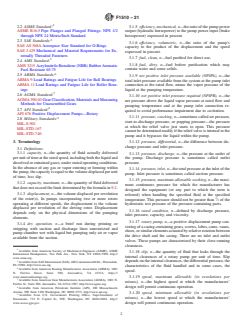
2.2 ASME Standard: 3.1.5 effıciency, mechanical, n—the ratio of the pump power
ASME B16.5 Pipe Flanges and Flanged Fittings: NPS 1/2 output (hydraulic horsepower) to the pump power input (brake
through NPS 24 Metric/Inch Standard horsepower) expressed in percent.
2.3 SAE Standards:
3.1.6 effıciency, volumetric, n—the ratio of the pump’s
SAE AS 568A Aerospace Size Standard for O-Rings
capacity to the product of the displacement and the speed
SAE J 429 Mechanical and Material Requirements for Ex-
expressed in percent.
ternally Threaded Fasteners
3.1.7 fuel, clean, n—fuel purified for direct use.
2.4 AMS Standard:
3.1.8 fuel, dirty, n—fuel before purification which may
AMS 3215 Acrylonitrile Butadiene (NBR) RubberAromatic
contain water and some solids.
Fuel Resistant 65-75
2.5 ABMA Standards:
3.1.9 net positive inlet pressure available (NPIPA), n—the
ABMA 9 Load Ratings and Fatigue Life for Ball Bearings
total inlet pressure available from the system at the pump inlet
ABMA 11 Load Ratings and Fatigue Life for Roller Bear-
connection at the rated flow, minus the vapor pressure of the
ings
liquid at the pumping temperature.
2.6 AGMA Standard:
3.1.10 net positive inlet pressure required (NPIPR), n—the
AGMA390.03 GearClassification,MaterialsandMeasuring
net pressure above the liquid vapor pressure at rated flow and
Methods for Unassembled Gears
pumping temperature and at the pump inlet connection re-
2.7 API Standard:
quired to avoid performance impairment due to cavitation.
API 676 Positive Displacement Pumps—Rotary
3.1.11 pressure, cracking, n—sometimescalledsetpressure,
2.8 Military Standards:
start-to-discharge pressure, or popping pressure—the pressure
MIL-S-901
at which the relief valve just starts to open. This pressure
MIL-STD-167
cannotbedeterminedreadilyifthereliefvalveisinternaltothe
MIL-STD-740
pump and it bypasses the liquid within the pump.
3. Terminology
3.1.12 pressure, differential, n—the difference between dis-
charge pressure and inlet pressure.
3.1 Definitions:
3.1.1 capacity, n—the quantity of fluid actually delivered 3.1.13 pressure, discharge, n—the pressure at the outlet of
perunitoftimeattheratedspeed,includingboththeliquidand
the pump. Discharge pressure is sometimes called outlet
dissolvedorentrainedgases,understatedoperatingconditions. pressure.
In the absence of any gas or vapor entering or forming within
3.1.14 pressure, inlet, n—thetotalpressureattheinletofthe
thepump,thecapacityisequaltothevolumedisplacedperunit
pump. Inlet pressure is sometimes called suction pressure.
of time, less slip.
3.1.15 pressure, maximum allowable working, n—the maxi-
3.1.2 capacity, maximum, n—the quantity of fluid delivered
mum continuous pressure for which the manufacturer has
thatdoesnotexceedthelimitdeterminedbytheformulain9.2.
designed the equipment (or any part to which the term is
3.1.3 displacement, n—the volume displaced per revolution
referred) when handling the specified fluid at the specified
of the rotor(s). In pumps incorporating two or more rotors
temperature. This pressure should not be greater than ⁄3 of the
operating at different speeds, the displacement is the volume
hydrostatic test pressure of the pressure containing parts.
displaced per revolution of the driving rotor. Displacement
3.1.16 rated condition, n—defined by discharge pressure,
depends only on the physical dimensions of the pumping
inlet pressure, capacity, and viscosity.
elements.
3.1.17 rotary pump, n—a positive displacement pump con-
3.1.4 dry operation, n—a brief run during priming or
sistingofacasingcontaininggears,screws,lobes,cams,vanes,
stripping with suction and discharge lines unrestricted and
shoes,orsimilarelementsactuatedbyrelativerotationbetween
pump chamber wet with liquid but pumping only air or vapor
the drive shaft and the casing. There are no inlet and outlet
available from the suction.
valves. These pumps are characterized by their close running
clearances.
Available from American Society of Mechanical Engineers (ASME), ASME
3.1.18 slip, n—the quantity of fluid that leaks through the
International Headquarters, Two Park Ave., New York, NY 10016-5990, http://
internal clearances of a rotary pump per unit of time. Slip
www.asme.org.
Available from SAE International (SAE), 400 Commonwealth Dr.,Warrendale, dependsontheinternalclearances,thedifferentialpressure,the
PA 15096, http://www.sae.org.
characteristics of the fluid handled and in some cases, the
Available from American Bearing Manufacturers Association (ABMA), 1001
speed.
N. Fairfax Street, Suite 500, Alexandria, VA 22314, https://
www.americanbearings.org.
3.1.19 speed, maximum allowable (in revolutions per
Available from American Gear Manufacturers Association (AGMA), 1001 N.
minute), n—the highest speed at which the manufacturers’
Fairfax St., Suite 500, Alexandria, VA 22314-1587, http://www.agma.org.
design will permit continuous operation.
Available from American Petroleum Institute (API), 200 Massachusetts
Avenue, NW Suite 1100 Washington, DC 20001-5571, http://www.api.org.
3.1.20 speed, minimum allowable (in revolutions per
Available from U.S. Government Printing Office, Superintendent of
minute), n—the lowest speed at which the manufacturers’
Documents, 732 N. Capitol St., NW, Washington, DC 20401-0001, http://
www.access.gpo.gov. design will permit continuous operation.
F1510 − 21
3.1.21 speed, rated, n—the number of revolutions per min- 5.1.10 Relief valve cracking pressure and full-flow bypass
ute of the driving rotor required to meet the rated conditions. pressure,
5.1.11 Packaging and boxing requirements (immediate use,
3.1.22 suction lift, n—a term used to define a pump’s
domestic; storage, domestic; overseas),
capability to induce a partial vacuum at the pump inlet.
5.1.12 Quantity of pumps,
3.1.23 temperature, maximum allowable, n—the maximum
5.1.13 Quantity of drawings,
continuous temperature for which the manufacturer has de-
5.1.14 Quantity of technical manuals,
signedtheequipment(oranyparttowhichthetermisreferred)
5.1.15 Quantity of test reports,
when handling the specified fluid at the specified pressure.
5.1.16 Performance test, if required,
5.1.17 Certified data required, and
4. Classification
5.1.18 Instruction plates and locations, if required.
4.1 Pumps will be classified as follows:
4.1.1 Types:
6. Materials
4.1.1.1 Type II—Screws with timing gears.
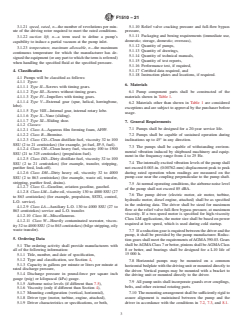
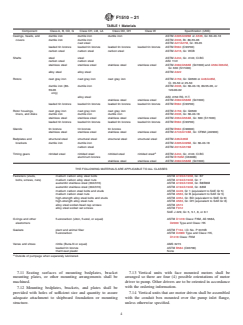
4.1.1.2 Type III—Screws without timing gears. 6.1 Pump component parts shall be constructed of the
materials shown in Table 1.
4.1.1.3 Type IV—Impellers with timing gears.
4.1.1.4 Type V—External gear (spur, helical, herringbone,
6.2 Materials other than shown in Table 1 are considered
lobe).
exceptions and are subject to approval by the purchaser before
4.1.1.5 Type VIII—Internal gear, internal rotary lobe.
usage.
4.1.1.6 Type X—Vane (sliding).
4.1.1.7 Type XI—Sliding shoe.
7. General Requirements
4.1.2 Classes:
7.1 Pumps shall be designed for a 20-year service life.
4.1.2.1 Class A—Aqueous film forming foam, AFFF.
4.1.2.2 Class B—Bromine.
7.2 Pumps shall be capable of sustained operation during
4.1.2.3 Class CD—Clean distillate fuel, viscosity 32 to 100
inclinations up to 45° in any direction.
SSU (2 to 21 centistokes) (for example, jet fuel, JP-5, fuel).
7.3 The pumps shall be capable of withstanding environ-
4.1.2.4 Class CH—Clean heavy fuel, viscosity 100 to 1500
mental vibration induced by shipboard machinery and equip-
SSU (21 to 325 centistokes) (propulsion fuel).
ment in the frequency range from 4 to 25 Hz.
4.1.2.5 Class DD—Dirty distillate fuel, viscosity 32 to 100
7.4 The internally excited vibration levels of the pump shall
SSU (2 to 21 centistokes) (for example, transfer, stripping,
not exceed 0.003-in. (0.00762-mm) displacement peak to peak
purifier feed, leak-off).
during rated operation when readings are measured on the
4.1.2.6 Class DH—Dirty heavy oil, viscosity 32 to 4000
pump case near the coupling perpendicular to the pump shaft.
SSU (2 to 863 centistokes) (for example, waste oil, transfer,
stripping, purifier feed, drains).
7.5 At normal operating conditions, the airborne noise level
4.1.2.7 Class G—Gasoline, aviation gasoline, gasohol.
of the pump shall not exceed 85 dBA.
4.1.2.8 Class LM—Lube oil, viscosity 130 to 4000 SSU (27
7.6 The pump driver (electric motor, air motor, turbine,
to 863 centistokes) (for example, propulsion, SSTG, control,
hydraulic motor, diesel engine, attached) shall be as specified
L.O. service).
in the ordering data. The driver shall be sized for maximum
4.1.2.9 Class LA—Auxiliary L.O. 130 to 4000 SSU (27 to
flow at the relief valve full-flow bypass pressure, at maximum
863 centistokes) service and L.O. transfer.
viscosity. If a two-speed motor is specified for high-viscosity
4.1.2.10 Class M—Miscellaneous.
Class LM applications, the motor size shall be based on power
4.1.2.11 Class W—Heavily contaminated seawater, viscos-
required at low speed, which is used during cold startup.
ity 32 to 4000 SSU (2 to 863 centistokes) (bilge stripping, oily
waste transfer). 7.7 Ifareductiongearisrequiredbetweenthedriverandthe
pump, it shall be provided by the pump manufacturer. Reduc-
5. Ordering Data
tion gears shall meet the requirements ofAGMA390.03. Gears
shallbeAGMAClass7orbetter,pinionsshallbeAGMAClass
5.1 The ordering activity shall provide manufacturers with
8 or better, and bearings shall be designed for a L10 life of
all of the following information:
15 000 h.
5.1.1 Title, number, and date of specification,
5.1.2 Type and classification, see Section 4,
7.8 Horizontal pumps may be mounted on a common
5.1.3 Capacity in gallons per minute or litres per minute at
horizontal bedplate with the driving unit or mounted directly to
rated discharge pressure,
the driver. Vertical pumps may be mounted with a bracket to
5.1.4 Discharge pressure in pound-force per square inch
the driving unit or mounted directly to the driver.
gauge (psig) or kilopascal (kPa) gauge.
7.9 All pump units shall incorporate guards over couplings,
5.1.5 Airborne noise levels (if different than 7.5),
belts, and other external rotating parts.
5.1.6 Viscosity (only if different than Section 4),
5.1.7 Mounting configuration (vertical, horizontal), 7.10 The mounting arrangement shall be sufficiently rigid to
5.1.8 Driver type (motor, turbine, engine, attached), assure alignment is maintained between the pump and the
5.1.9 Driver characteristics or specifications, or both, driver in accordance with the conditions in 7.2, 7.3, and 8.1.
F1510 − 21
TABLE 1 Materials
Component Class A, B, CD, G Class CH, LM, LA Class DD, DH Class W Specification (UNS)
Casings, heads, and ductile iron ductile iron ductile iron ASTM A395/A395M or A536, Gr. 60-40-18
covers ductile iron ductile iron ASTM A536, Br. 80-55-06
cast steel ASTM A27/A27M, Gr. 65-35
leaded tin bronze leaded tin bronze leaded tin bronze leaded tin bronze ASTM B584 (C93700)
carbon steel carbon steel carbon steel ASTM A216, Gr. WCB
Shafts steel steel ASTM A434, Gr. 4140, Cl.BC
carbon steel carbon steel AISI 1141
stainless steel stainless steel stainless steel stainless steel ASTM A582/A582M (S41600) and A564/A564M,
Gr. 630 (S17400)
alloy steel alloy steel ASTM A322
Rotors cast gray iron cast gray iron cast gray iron ASTM A159, Gr. G3500 or A48/A48M,
Cl. 35-50 or 25-50
ductile iron (80- ductile iron ASTM A536, Gr. 60-40-18, 80-55-06, or
55-06 120-90-02
only)
alloy steel AISI 4150 RS, H.T.
stainless steel stainless steel ASTM A582/A582M (S41600)
leaded tin bronze leaded tin bronze leaded tin bronze leaded tin bronze ASTM B584 (C93700)
Rotor housings, cast gray iron cast gray iron cast gray iron ASTM A159, Gr. G3500
liners, and disks ductile iron ductile iron ductile iron ASTM A536, Gr. 60-40-18
stainless steel stainless steel stainless steel stainless steel ASTM A564/A564M, Gr. 630 (S17400)
leaded tin bronze leaded tin bronze leaded tin bronze leaded tin bronze ASTM B584 (C93700)
Glands tin bronze tin bronze tin bronze ASTM B584 (C90300)
stainless steel stainless steel stainless steel stainless steel ASTM A743/A743M, Gr. CF8M (J92900)
Bedplates and structural steel structural steel structural steel structural steel ASTM A36/A36M
brackets ductile iron ductile iron ASTM A395/A395M, Gr. 60-40-18
carbon steel ASTM A515/A515M
A
Timing gears nitrided steel nitrided steel nitrided steel nitrided steel ASTM A434, Gr. 4140, Cl.BC
aluminum bronze ASTM B150M (C63000)
stainless steel stainless steel ASTM A582/A582M (S41600)
THE FOLLOWING MATERIALS ARE APPLICABLE TO ALL CLASSES
Fasteners (studs, medium carbon alloy steel bolts ASTM A193/A193M,Gr.B7
bolts, screws, nuts) medium carbon alloy steel nuts ASTM A194/A194M,Gr.7
austenitic stainless steel (304/316) ASTM A193/A193M, Gr. B8/B8M
austenitic stainless steel (304/316) ASTM A194/A194M, Gr. 8/8M
medium carbon steel bolts and studs ASTM A449, Gr 1 (equivalent to SAE Gr 5)
medium carbon steel nuts ASTM A563, Gr B (equivalent to SAE Gr 5)
high-strength alloy s
...
This document is not an ASTM standard and is intended only to provide the user of an ASTM standard an indication of what changes have been made to the previous version. Because
it may not be technically possible to adequately depict all changes accurately, ASTM recommends that users consult prior editions as appropriate. In all cases only the current version
of the standard as published by ASTM is to be considered the official document.
Designation: F1510 − 07 (Reapproved 2019) F1510 − 21 An American National Standard
Standard Specification for
Rotary Positive Displacement Pumps, Ships Use
This standard is issued under the fixed designation F1510; the number immediately following the designation indicates the year of
original adoption or, in the case of revision, the year of last revision. A number in parentheses indicates the year of last reapproval. A
superscript epsilon (´) indicates an editorial change since the last revision or reapproval.
1. Scope
1.1 This specification defines the requirements applicable to design and construction of rotary positive displacement pumps for
shipboard use. The classes of service are shown in Section 4.
1.2 This specification will not include pumps for hydraulic service or cargo unloading applications.
1.3 The values stated in inch-pound units are to be regarded as standard. The values given in parentheses are mathematical
conversions to SI units that are provided for information only and are not considered standard.
1.4 This international standard was developed in accordance with internationally recognized principles on standardization
established in the Decision on Principles for the Development of International Standards, Guides and Recommendations issued
by the World Trade Organization Technical Barriers to Trade (TBT) Committee.
2. Referenced Documents
2.1 ASTM Standards:
A216 Specification for Steel Castings, Carbon, Suitable for Fusion Welding, for High-Temperature Service
A27/A27M Specification for Steel Castings, Carbon, for General Application
A36/A36M Specification for Carbon Structural Steel
A48/A48M Specification for Gray Iron Castings
A53/A53M Specification for Pipe, Steel, Black and Hot-Dipped, Zinc-Coated, Welded and Seamless
A159 Specification for Automotive Gray Iron Castings
A193/A193M Specification for Alloy-Steel and Stainless Steel Bolting for High Temperature or High Pressure Service and Other
Special Purpose Applications
A194/A194M Specification for Carbon Steel, Alloy Steel, and Stainless Steel Nuts for Bolts for High Pressure or High
Temperature Service, or Both
A322 Specification for Steel Bars, Alloy, Standard Grades
A354 Specification for Quenched and Tempered Alloy Steel Bolts, Studs, and Other Externally Threaded Fasteners
A395/A395M Specification for Ferritic Ductile Iron Pressure-Retaining Castings for Use at Elevated Temperatures
A434 Specification for Steel Bars, Alloy, Hot-Wrought or Cold-Finished, Quenched and Tempered
A449 Specification for Hex Cap Screws, Bolts and Studs, Steel, Heat Treated, 120/105/90 ksi Minimum Tensile Strength,
General Use
A515/A515M Specification for Pressure Vessel Plates, Carbon Steel, for Intermediate- and Higher-Temperature Service
This specification is under the jurisdiction of ASTM Committee F25 on Ships and Marine Technology and is the direct responsibility of Subcommittee F25.11 on
Machinery and Piping Systems.
Current edition approved Dec. 1, 2019Jan. 1, 2021. Published January 2020January 2021. Originally approved in 1994. Last previous edition approved in 20132019 as
F1510 – 07 (2013).(2019). DOI: 10.1520/F1510-07R19.10.1520/F1510-21.
For referenced ASTM standards, visit the ASTM website, www.astm.org, or contact ASTM Customer Service at service@astm.org. For Annual Book of ASTM Standards
volume information, refer to the standard’sstandard’s Document Summary page on the ASTM website.
Copyright © ASTM International, 100 Barr Harbor Drive, PO Box C700, West Conshohocken, PA 19428-2959. United States
F1510 − 21
A536 Specification for Ductile Iron Castings
A563 Specification for Carbon and Alloy Steel Nuts
A564/A564M Specification for Hot-Rolled and Cold-Finished Age-Hardening Stainless Steel Bars and Shapes
A574 Specification for Alloy Steel Socket-Head Cap Screws
A582/A582M Specification for Free-Machining Stainless Steel Bars
A743/A743M Specification for Castings, Iron-Chromium, Iron-Chromium-Nickel, Corrosion Resistant, for General Application
B150M Specification for Aluminum Bronze, Rod, Bar, and Shapes [Metric] (Withdrawn 2002)
B584 Specification for Copper Alloy Sand Castings for General Applications
D1418 Practice for Rubber and Rubber Latices—Nomenclature
D2000 Classification System for Rubber Products in Automotive Applications
D3951 Practice for Commercial Packaging
F104 Classification System for Nonmetallic Gasket Materials
F912 Specification for Alloy Steel Socket Set Screws
F1511 Specification for Mechanical Seals for Shipboard Pump Applications
2.2 ASME Standard:
ASME B16.5 Pipe Flanges and Flanged Fittings: NPS 1/2 through NPS 24 Metric/Inch Standard
2.3 SAE Standards:
SAE AS 568A Aerospace Size Standard for O-Rings
SAE J 429 Mechanical and Material Requirements for Externally Threaded Fasteners
2.4 AMS Standard:
AMS 3215 Acrylonitrile Butadiene (NBR) Rubber Aromatic Fuel Resistant 65-75
2.5 ABMA Standards:
ABMA 9 Load Ratings and Fatigue Life for Ball Bearings
ABMA 11 Load Ratings and Fatigue Life for Roller Bearings
2.6 AGMA Standard:
AGMA 390.03 Gear Classification, Materials and Measuring Methods for Unassembled Gears
2.7 API Standard:
API 676 Positive Displacement Pumps—Rotary
2.8 Military Standards:
MIL-S-901
MIL-STD-167
MIL-STD-740
3. Terminology
3.1 Definitions:
3.1.1 capacity, n—the quantity of fluid actually delivered per unit of time at the rated speed, including both the liquid and dissolved
or entrained gases, under stated operating conditions. In the absence of any gas or vapor entering or forming within the pump, the
capacity is equal to the volume displaced per unit of time, less slip.
3.1.2 capacity, maximum, n—the quantity of fluid delivered that does not exceed the limit determined by the formula in 9.2.
3.1.3 displacement, n—the volume displaced per revolution of the rotor(s). In pumps incorporating two or more rotors operating
at different speeds, the displacement is the volume displaced per revolution of the driving rotor. Displacement depends only on the
physical dimensions of the pumping elements.
3.1.4 dry operation, n—a brief run during priming or stripping with suction and discharge lines unrestricted and pump chamber
wet with liquid but pumping only air or vapor available from the suction.
The last approved version of this historical standard is referenced on www.astm.org.
Available from American Society of Mechanical Engineers (ASME), ASME International Headquarters, Two Park Ave., New York, NY 10016-5990, http://
www.asme.org.
Available from SAE International (SAE), 400 Commonwealth Dr., Warrendale, PA 15096, http://www.sae.org.
Available from American Bearing Manufacturers Association (ABMA), 1001 N. Fairfax Street, Suite 500, Alexandria, VA 22314, https://www.americanbearings.org.
Available from American Gear Manufacturers Association (AGMA), 1001 N. Fairfax St., Suite 500, Alexandria, VA 22314-1587, http://www.agma.org.
Available from American Petroleum Institute (API), 1220 L. St., NW, 200 Massachusetts Avenue, NW Suite 1100 Washington, DC 20005-4070,20001-5571,
http://www.api.org.
Available from U.S. Government Printing Office, Superintendent of Documents, 732 N. Capitol St., NW, Washington, DC 20401-0001, http://www.access.gpo.gov.
F1510 − 21
3.1.5 effıciency, mechanical, n—the ratio of the pump power output (hydraulic horsepower) to the pump power input (brake
horsepower) expressed in percent.
3.1.6 effıciency, volumetric, n—the ratio of the pump’s capacity to the product of the displacement and the speed expressed in
percent.
3.1.7 fuel, clean, n—fuel purified for direct use.
3.1.8 fuel, dirty, n—fuel before purification which may contain water and some solids.
3.1.9 net positive inlet pressure available (NPIPA), n—the total inlet pressure available from the system at the pump inlet
connection at the rated flow, minus the vapor pressure of the liquid at the pumping temperature.
3.1.10 net positive inlet pressure required (NPIPR), n—the net pressure above the liquid vapor pressure at rated flow and pumping
temperature and at the pump inlet connection required to avoid performance impairment due to cavitation.
3.1.11 pressure, cracking, n—sometimes called set pressure, start-to-discharge pressure, or popping pressure—the pressure at
which the relief valve just starts to open. This pressure cannot be determined readily if the relief valve is internal to the pump and
it bypasses the liquid within the pump.
3.1.12 pressure, differential, n—the difference between discharge pressure and inlet pressure.
3.1.13 pressure, discharge, n—the pressure at the outlet of the pump. Discharge pressure is sometimes called outlet pressure.
3.1.14 pressure, inlet, n—the total pressure at the inlet of the pump. Inlet pressure is sometimes called suction pressure.
3.1.15 pressure, maximum allowable working, n—the maximum continuous pressure for which the manufacturer has designed the
equipment (or any part to which the term is referred) when handling the specified fluid at the specified temperature. This pressure
should not be greater than ⁄3 of the hydrostatic test pressure of the pressure containing parts.
3.1.16 rated condition, n—defined by discharge pressure, inlet pressure, capacity, and viscosity.
3.1.17 rotary pump, n—a positive displacement pump consisting of a casing containing gears, screws, lobes, cams, vanes, shoes,
or similar elements actuated by relative rotation between the drive shaft and the casing. There are no inlet and outlet valves. These
pumps are characterized by their close running clearances.
3.1.18 slip, n—the quantity of fluid that leaks through the internal clearances of a rotary pump per unit of time. Slip depends on
the internal clearances, the differential pressure, the characteristics of the fluid handled and in some cases, the speed.
3.1.19 speed, maximum allowable (in revolutions per minute), n—the highest speed at which the manufacturers’ design will permit
continuous operation.
3.1.20 speed, minimum allowable (in revolutions per minute), n—the lowest speed at which the manufacturers’ design will permit
continuous operation.
3.1.21 speed, rated, n—the number of revolutions per minute of the driving rotor required to meet the rated conditions.
3.1.22 suction lift, n—a term used to define a pump’s capability to induce a partial vacuum at the pump inlet.
3.1.23 temperature, maximum allowable, n—the maximum continuous temperature for which the manufacturer has designed the
equipment (or any part to which the term is referred) when handling the specified fluid at the specified pressure.
F1510 − 21
4. Classification
4.1 Pumps will be classified as follows:
4.1.1 Types:
4.1.1.1 Type II—Screws with timing gears.
4.1.1.2 Type III—Screws without timing gears.
4.1.1.3 Type IV—Impellers with timing gears.
4.1.1.4 Type V—External gear (spur, helical, herringbone, lobe).
4.1.1.5 Type VIII—Internal gear, internal rotary lobe.
4.1.1.6 Type X—Vane (sliding).
4.1.1.7 Type XI—Sliding shoe.
4.1.2 Classes:
4.1.2.1 Class A—Aqueous film forming foam, AFFF.
4.1.2.2 Class B—Bromine.
4.1.2.3 Class CD—Clean distillate fuel, viscosity 32 to 100 SSU (2 to 21 centistokes) (for example, jet fuel, JP-5, fuel).
4.1.2.4 Class CH—Clean heavy fuel, viscosity 100 to 1500 SSU (21 to 325 centistokes) (propulsion fuel).
4.1.2.5 Class DD—Dirty distillate fuel, viscosity 32 to 100 SSU (2 to 21 centistokes) (for example, transfer, stripping, purifier
feed, leak-off).
4.1.2.6 Class DH—Dirty heavy oil, viscosity 32 to 4000 SSU (2 to 863 centistokes) (for example, waste oil, transfer, stripping,
purifier feed, drains).
4.1.2.7 Class G—Gasoline, aviation gasoline, gasohol.
4.1.2.8 Class LM—Lube oil, viscosity 130 to 4000 SSU (27 to 863 centistokes) (for example, propulsion, SSTG, control, L.O.
service).
4.1.2.9 Class LA—Auxiliary L.O. 130 to 4000 SSU (27 to 863 centistokes) service and L.O. transfer.
4.1.2.10 Class M—Miscellaneous.
4.1.2.11 Class W—Heavily contaminated seawater, viscosity 32 to 4000 SSU (2 to 863 centistokes) (bilge stripping, oily waste
transfer).
5. Ordering Data
5.1 The ordering activity shall provide manufacturers with all of the following information:
5.1.1 Title, number, and date of specification,
5.1.2 Type and classification, see Section 4,
5.1.3 Capacity in gallons per minute or litres per minute at rated discharge pressure,
F1510 − 21
5.1.4 Discharge pressure in pound-force per square inch gauge (psig) or kilopascal (kPa) gauge.
5.1.5 Airborne noise levels (if different than 7.5),
5.1.6 Viscosity (only if different than Section 4),
5.1.7 Mounting configuration (vertical, horizontal),
5.1.8 Driver type (motor, turbine, engine, attached),
5.1.9 Driver characteristics or specifications, or both,
5.1.10 Relief valve cracking pressure and full-flow bypass pressure,
5.1.11 Packaging and boxing requirements (immediate use, domestic; storage, domestic; overseas),
5.1.12 Quantity of pumps,
5.1.13 Quantity of drawings,
5.1.14 Quantity of technical manuals,
5.1.15 Quantity of test reports,
5.1.16 Performance test, if required,
5.1.17 Certified data required, and
5.1.18 Instruction plates and locations, if required.
6. Materials
6.1 Pump component parts shall be constructed of the materials shown in Table 1.
6.2 Materials other than shown in Table 1 are considered exceptions and are subject to approval by the purchaser before usage.
7. General Requirements
7.1 Pumps shall be designed for a 20-year service life.
7.2 Pumps shall be capable of sustained operation during inclinations up to 45° in any direction.
7.3 The pumps shall be capable of withstanding environmental vibration induced by shipboard machinery and equipment in the
frequency range from 4 to 25 Hz.
7.4 The internally excited vibration levels of the pump shall not exceed 0.003-in. (0.00762-mm) displacement peak to peak during
rated operation when readings are measured on the pump case near the coupling perpendicular to the pump shaft.
7.5 At normal operating conditions, the airborne noise level of the pump shall not exceed 85 dBA.
7.6 The pump driver (electric motor, air motor, turbine, hydraulic motor, diesel engine, attached) shall be as specified in the
ordering data. The driver shall be sized for maximum flow at the relief valve full-flow bypass pressure, at maximum viscosity. If
a two-speed motor is specified for high-viscosity Class LM applications, the motor size shall be based on power required at low
speed, which is used during cold startup.
F1510 − 21
TABLE 1 Materials
Component Class A, B, CD, G Class CH, LM, LA Class DD, DH Class W Specification (UNS)
Casings, heads, and ductile iron ductile iron ductile iron ASTM A395/A395M or A536, Gr. 60-40-18
covers ductile iron ductile iron ASTM A536, Br. 80-55-06
cast steel ASTM A27/A27M, Gr. 65-35
leaded tin bronze leaded tin bronze leaded tin bronze leaded tin bronze ASTM B584 (C93700)
carbon steel carbon steel carbon steel ASTM A53/A53M
carbon steel carbon steel carbon steel ASTM A216, Gr. WCB
Shafts steel steel ASTM A434, Gr. 4140, Cl.BC
carbon steel carbon steel AISI 1141
stainless steel stainless steel stainless steel stainless steel ASTM A582/A582M (S41600) and A564/A564M,
Gr. 630 (S17400)
alloy steel alloy steel ASTM A322
Rotors cast gray iron cast gray iron cast gray iron ASTM A159, Gr. G3500 or A48/A48M,
Cl. 35-50 or 25-50
ductile iron (80- ductile iron ASTM A536, Gr. 60-40-18, 80-55-06, or
55-06 120-90-02
only)
alloy steel AISI 4150 RS, H.T.
stainless steel stainless steel ASTM A582/A582M (S41600)
leaded tin bronze leaded tin bronze leaded tin bronze leaded tin bronze ASTM B584 (C93700)
Rotor housings, cast gray iron cast gray iron cast gray iron ASTM A159, Gr. G3500
liners, and disks ductile iron ductile iron ductile iron ASTM A536, Gr. 60-40-18
stainless steel stainless steel stainless steel stainless steel ASTM A564/A564M, Gr. 630 (S17400)
leaded tin bronze leaded tin bronze leaded tin bronze leaded tin bronze ASTM B584 (C93700)
Glands tin bronze tin bronze tin bronze ASTM B584 (C90300)
stainless steel stainless steel stainless steel stainless steel ASTM A743/A743M, Gr. CF8M (J92900)
Bedplates and structural steel structural steel structural steel structural steel ASTM A36/A36M
brackets ductile iron ductile iron ASTM A395/A395M 5, Gr. 60-40-18
brackets ductile iron ductile iron ASTM A395/A395M, Gr. 60-40-18
carbon steel ASTM A515/A515M
A
Timing gears nitrided steel nitrided steel nitrided steel nitrided steel ASTM A434, Gr. 4140, Cl.BC
aluminum bronze ASTM B150M (C63000)
stainless steel stainless steel ASTM A582/A582M (S41600)
THE FOLLOWING MATERIALS ARE APPLICABLE TO ALL CLASSES
Fasteners (studs, medium carbon alloy steel bolts ASTM A193/A193M, Gr. B7
bolts, screws, nuts) medium carbon alloy steel nuts ASTM A194/A194M, Gr. 7
austenitic stainless steel (304/316) ASTM A193/A193M, Gr. B8/B8M
austenitic stainless steel (304/316) ASTM A194/A194M, Gr. 8/8M
medium carbon steel bolts and studs ASTM A449, Gr 1 (equivalent to SAE Gr 5)
medium carbon steel nuts ASTM A563, Gr B (equivalent to SAE Gr 5)
high-strength alloy steel bolts and studs ASTM A354, Gr. BD (equivalent to SAE Gr 8)
high-strength alloy steel nuts ASTM A563, Gr. DH (equivalent to SAE Gr 8)
alloy steel socket-head cap screws ASTM A574
alloy steel socket set screws ASTM F912
SAE J 429, Gr. 5, 5.1, 8, or 8.1
O-rings and other fluorocarbon (viton, fluorel, or equal) ASTM D1418 Class: FKM, AS 568A,
elastomers D2000 Type and Class: HK
Gaskets plant and animal fiber ASTM F104, I.D. No. P 3313B
fluorocarbon ASTM D2000 Type and Class: HK,
D1418 Class: FKM
Vanes and shoes nitrile (Buna-N or equal) AMS 3215
leaded tin bronze ASTM B584 (C93700)
thermoset plastic None
A
Outside of pumpage when separately lubricated.
7.7 If a
...