

ASTM E2769-22
(Test Method)Standard Test Method for Elastic Modulus by Thermomechanical Analysis Using Three-Point Bending and Controlled Rate of Loading
General Information
- Abstract
SIGNIFICANCE AND USE
5.1 This test method provides a means of characterizing the mechanical behavior of materials using very small amounts of material including thermoplastic and thermoset polymers, composites, and metals.
5.2 The data obtained may be used for research and development and establishment of optimum processing conditions. The data are not intended for use in design or for predicting performance.
Note 2: This test method may not be suitable for anisotropic materials.
SCOPE
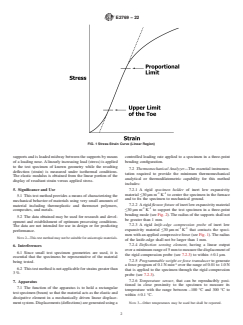
1.1 This test method describes the use of linear controlled-rate-of-loading in three-point bending to determine the elastic modulus of isotropic specimens in the form of rectangular bars using a thermomechanical analyzer (TMA).
Note 1: This method is intended to provide results similar to those of Test Methods D790 or D5934 but is performed on a thermomechanical analyzer using smaller test specimens. Until the user demonstrates equivalence, the results of this method shall be considered independent and unrelated to those of Test Methods D790 or D5934.
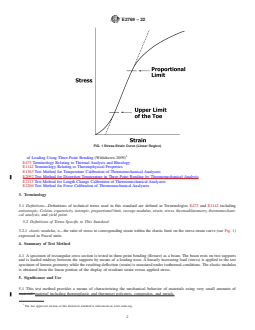
1.2 This test method provides a means for determining the elastic modulus within the linear region of the stress-strain curves (see Fig. 1). This test is conducted under isothermal temperature conditions from –100 °C to 300 °C.
FIG. 1 Stress-Strain Curve (Linear Region)
1.3 Typical test specimens are in the form of thin strips 0.5 mm in thickness, 1.5 mm in width, and 6 mm in length. The size of the test specimen is limited by the distance between the supports used in the three-point bending mode of operation, commonly 0.5 cm.
1.4 The values stated in SI units are to be regarded as standard. No other units of measurement are included in this standard.
1.5 This standard does not purport to address all of the safety concerns, if any, associated with its use. It is the responsibility of the user of this standard to establish appropriate safety, health, and environmental practices and determine the applicability of regulatory limitations prior to use.
1.6 This international standard was developed in accordance with internationally recognized principles on standardization established in the Decision on Principles for the Development of International Standards, Guides and Recommendations issued by the World Trade Organization Technical Barriers to Trade (TBT) Committee.
- Status
- Published
- Publication Date
- 31-Jan-2022
- Technical Committee
- E37 - Thermal Measurements
- Drafting Committee
- E37.10 - Fundamental, Statistical and Mechanical Properties
Buy Documents
ASTM E2769-22 - Standard Test Method for Elastic Modulus by Thermomechanical Analysis Using Three-Point Bending and Controlled Rate of Loading
REDLINE ASTM E2769-22 - Standard Test Method for Elastic Modulus by Thermomechanical Analysis Using Three-Point Bending and Controlled Rate of Loading
Overview
ASTM E2769-22 is the Standard Test Method for Elastic Modulus by Thermomechanical Analysis Using Three-Point Bending and Controlled Rate of Loading. Developed by ASTM International, this standard describes procedures for determining the elastic modulus of isotropic materials-such as thermoplastic and thermoset polymers, composites, and metals-using small specimen sizes, under controlled temperature conditions. The method utilizes a thermomechanical analyzer (TMA) in a three-point bending configuration to precisely measure the mechanical behavior within the elastic region of the stress-strain curve.
This test method is particularly valuable in research and development, quality control, and defining optimal processing conditions, as it enables material characterization with minimal sample material requirements.
Key Topics
- Elastic Modulus Measurement: Provides a reliable procedure to determine the ratio of stress to strain within the elastic (linear) region of materials, expressed in SI units.
- Three-Point Bending with TMA: Utilizes a three-point bending setup in a thermomechanical analyzer, suitable for specimens as small as 0.5 mm thick by 1.5 mm wide and 6 mm long.
- Controlled Rate of Loading: Employs a linear, controlled increase in load to measure deflection accurately and ensure results reflect the true mechanical response of the material.
- Isothermal Testing Range: Covers a broad isothermal temperature range from –100 °C to 300 °C, allowing the study of temperature-dependent mechanical properties.
- Small Sample Requirements: Well-suited to applications where only very limited material is available.
- Applicability Limitations: Designed for isotropic samples; not suitable for highly anisotropic reinforced materials unless reporting on the direction of reinforcement relative to the specimen.
- Precision and Repeatability: Emphasizes careful calibration, specimen conditioning, and standardized measurements to ensure within-laboratory repeatability and between-laboratory reproducibility.
Applications
ASTM E2769-22 is widely used for:
- Material Research and Development: Helps scientists and engineers characterize new polymers, composites, and metals with precision using only small quantities of material.
- Quality Control: Supports consistent monitoring of elastic modulus during production, ensuring batch-to-batch uniformity.
- Process Optimization: Assists in establishing optimal processing parameters by revealing how elastic modulus changes with factors such as polymer curing or thermal cycling.
- Thermomechanical Analysis: Enables the comparison of mechanical properties at various temperatures across –100 °C to 300 °C, important for end-use environments.
- Academic Studies: Useful in studies of structure-property relationships in materials science and engineering curricula.
- Product Development: Facilitates rapid screening and benchmarking of candidate materials with minimal waste.
Note: The data generated by this standard is not intended for final product design or performance prediction but for research, development, and process control purposes.
Related Standards
ASTM E2769-22 references and complements several other ASTM and international standards, including:
- ASTM D618 - Practice for Conditioning Plastics for Testing
- ASTM D790 - Test Methods for Flexural Properties of Plastics and Electrical Insulating Materials
- ASTM D5934 - Test Method for Modulus of Elasticity for Rigid and Semi-Rigid Plastics
- ASTM E473 - Terminology Relating to Thermal Analysis and Rheology
- ASTM E1142 - Terminology Relating to Thermophysical Properties
- ASTM E1363 - Test Method for Temperature Calibration of Thermomechanical Analyzers
- ASTM E2092 - Test Method for Distortion Temperature in Three-Point Bending by Thermomechanical Analysis
- ASTM E2113 - Test Method for Length Change Calibration of Thermomechanical Analyzers
- ASTM E2206 - Test Method for Force Calibration of Thermomechanical Analyzers
Practical Value
By specifying a reproducible and robust technique for elastic modulus determination, ASTM E2769-22 supports materials innovation and process improvement while efficiently utilizing limited material resources. The standard ensures consistency and comparability in mechanical property testing, which is critical for industries relying on accurate material characterization. Keywords: ASTM E2769-22, elastic modulus, thermomechanical analysis, three-point bending, modulus of elasticity, stress-strain, materials testing, polymers, composites, metals, quality control.
Relations
- Effective Date
- 01-Nov-2023
- Effective Date
- 01-Oct-2023
- Effective Date
- 01-Oct-2023
- Effective Date
- 01-Dec-2018
- Effective Date
- 01-Jun-2018
- Effective Date
- 01-Jul-2017
- Refers
ASTM E1363-16 - Standard Test Method for Temperature Calibration of Thermomechanical Analyzers - Effective Date
- 01-Dec-2016
- Effective Date
- 01-Dec-2015
- Effective Date
- 01-Dec-2015
- Effective Date
- 01-May-2015
- Effective Date
- 15-Aug-2014
- Effective Date
- 15-Aug-2014
- Effective Date
- 01-Apr-2014
- Effective Date
- 15-Feb-2014
- Effective Date
- 01-Sep-2013
Buy Documents
ASTM E2769-22 - Standard Test Method for Elastic Modulus by Thermomechanical Analysis Using Three-Point Bending and Controlled Rate of Loading
REDLINE ASTM E2769-22 - Standard Test Method for Elastic Modulus by Thermomechanical Analysis Using Three-Point Bending and Controlled Rate of Loading
Get Certified
Connect with accredited certification bodies for this standard

IMQ S.p.A. (Certification)
Italian electrical product certification.

SLG Prüf- und Zertifizierungs GmbH
German testing and certification body.

UL Solutions
Global safety science company with testing, inspection and certification.
Sponsored listings
Frequently Asked Questions
ASTM E2769-22 is a standard published by ASTM International. Its full title is "Standard Test Method for Elastic Modulus by Thermomechanical Analysis Using Three-Point Bending and Controlled Rate of Loading". This standard covers: SIGNIFICANCE AND USE 5.1 This test method provides a means of characterizing the mechanical behavior of materials using very small amounts of material including thermoplastic and thermoset polymers, composites, and metals. 5.2 The data obtained may be used for research and development and establishment of optimum processing conditions. The data are not intended for use in design or for predicting performance. Note 2: This test method may not be suitable for anisotropic materials. SCOPE 1.1 This test method describes the use of linear controlled-rate-of-loading in three-point bending to determine the elastic modulus of isotropic specimens in the form of rectangular bars using a thermomechanical analyzer (TMA). Note 1: This method is intended to provide results similar to those of Test Methods D790 or D5934 but is performed on a thermomechanical analyzer using smaller test specimens. Until the user demonstrates equivalence, the results of this method shall be considered independent and unrelated to those of Test Methods D790 or D5934. 1.2 This test method provides a means for determining the elastic modulus within the linear region of the stress-strain curves (see Fig. 1). This test is conducted under isothermal temperature conditions from –100 °C to 300 °C. FIG. 1 Stress-Strain Curve (Linear Region) 1.3 Typical test specimens are in the form of thin strips 0.5 mm in thickness, 1.5 mm in width, and 6 mm in length. The size of the test specimen is limited by the distance between the supports used in the three-point bending mode of operation, commonly 0.5 cm. 1.4 The values stated in SI units are to be regarded as standard. No other units of measurement are included in this standard. 1.5 This standard does not purport to address all of the safety concerns, if any, associated with its use. It is the responsibility of the user of this standard to establish appropriate safety, health, and environmental practices and determine the applicability of regulatory limitations prior to use. 1.6 This international standard was developed in accordance with internationally recognized principles on standardization established in the Decision on Principles for the Development of International Standards, Guides and Recommendations issued by the World Trade Organization Technical Barriers to Trade (TBT) Committee.
SIGNIFICANCE AND USE 5.1 This test method provides a means of characterizing the mechanical behavior of materials using very small amounts of material including thermoplastic and thermoset polymers, composites, and metals. 5.2 The data obtained may be used for research and development and establishment of optimum processing conditions. The data are not intended for use in design or for predicting performance. Note 2: This test method may not be suitable for anisotropic materials. SCOPE 1.1 This test method describes the use of linear controlled-rate-of-loading in three-point bending to determine the elastic modulus of isotropic specimens in the form of rectangular bars using a thermomechanical analyzer (TMA). Note 1: This method is intended to provide results similar to those of Test Methods D790 or D5934 but is performed on a thermomechanical analyzer using smaller test specimens. Until the user demonstrates equivalence, the results of this method shall be considered independent and unrelated to those of Test Methods D790 or D5934. 1.2 This test method provides a means for determining the elastic modulus within the linear region of the stress-strain curves (see Fig. 1). This test is conducted under isothermal temperature conditions from –100 °C to 300 °C. FIG. 1 Stress-Strain Curve (Linear Region) 1.3 Typical test specimens are in the form of thin strips 0.5 mm in thickness, 1.5 mm in width, and 6 mm in length. The size of the test specimen is limited by the distance between the supports used in the three-point bending mode of operation, commonly 0.5 cm. 1.4 The values stated in SI units are to be regarded as standard. No other units of measurement are included in this standard. 1.5 This standard does not purport to address all of the safety concerns, if any, associated with its use. It is the responsibility of the user of this standard to establish appropriate safety, health, and environmental practices and determine the applicability of regulatory limitations prior to use. 1.6 This international standard was developed in accordance with internationally recognized principles on standardization established in the Decision on Principles for the Development of International Standards, Guides and Recommendations issued by the World Trade Organization Technical Barriers to Trade (TBT) Committee.
ASTM E2769-22 is classified under the following ICS (International Classification for Standards) categories: 29.035.20 - Plastics and rubber insulating materials. The ICS classification helps identify the subject area and facilitates finding related standards.
ASTM E2769-22 has the following relationships with other standards: It is inter standard links to ASTM E2092-23, ASTM E473-23b, ASTM E1142-23b, ASTM E2092-18a, ASTM E2092-18, ASTM D790-17, ASTM E1363-16, ASTM D790-15e1, ASTM D790-15, ASTM E1142-15, ASTM E1142-14b, ASTM E473-14, ASTM E1142-14a, ASTM E1142-14, ASTM E2092-13. Understanding these relationships helps ensure you are using the most current and applicable version of the standard.
ASTM E2769-22 is available in PDF format for immediate download after purchase. The document can be added to your cart and obtained through the secure checkout process. Digital delivery ensures instant access to the complete standard document.
Standards Content (Sample)
This international standard was developed in accordance with internationally recognized principles on standardization established in the Decision on Principles for the
Development of International Standards, Guides and Recommendations issued by the World Trade Organization Technical Barriers to Trade (TBT) Committee.
Designation: E2769 − 22
Standard Test Method for
Elastic Modulus by Thermomechanical Analysis Using
Three-Point Bending and Controlled Rate of Loading
This standard is issued under the fixed designation E2769; the number immediately following the designation indicates the year of
original adoption or, in the case of revision, the year of last revision. A number in parentheses indicates the year of last reapproval. A
superscript epsilon (´) indicates an editorial change since the last revision or reapproval.
1. Scope* 2. Referenced Documents
2.1 ASTM Standards:
1.1 This test method describes the use of linear controlled-
D618 Practice for Conditioning Plastics for Testing
rate-of-loading in three-point bending to determine the elastic
D790 Test Methods for Flexural Properties of Unreinforced
modulus of isotropic specimens in the form of rectangular bars
and Reinforced Plastics and Electrical Insulating Materi-
using a thermomechanical analyzer (TMA).
als
NOTE 1—This method is intended to provide results similar to those of
D5934 Test Method for Determination of Modulus of Elas-
Test Methods D790 or D5934 but is performed on a thermomechanical
ticity for Rigid and Semi-Rigid Plastic Specimens by
analyzer using smaller test specimens. Until the user demonstrates
Controlled Rate of Loading Using Three-Point Bending
equivalence, the results of this method shall be considered independent
(Withdrawn 2009)
and unrelated to those of Test Methods D790 or D5934.
E473 Terminology Relating to Thermal Analysis and Rhe-
1.2 This test method provides a means for determining the
ology
elastic modulus within the linear region of the stress-strain
E1142 Terminology Relating to Thermophysical Properties
curves (see Fig. 1). This test is conducted under isothermal
E1363 Test Method for Temperature Calibration of Thermo-
temperature conditions from –100 °C to 300 °C.
mechanical Analyzers
E2092 Test Method for Distortion Temperature in Three-
1.3 Typical test specimens are in the form of thin strips
Point Bending by Thermomechanical Analysis
0.5 mminthickness,1.5 mminwidth,and6 mminlength.The
E2113 Test Method for Length Change Calibration of Ther-
size of the test specimen is limited by the distance between the
momechanical Analyzers
supports used in the three-point bending mode of operation,
E2206 Test Method for Force Calibration of Thermome-
commonly 0.5 cm.
chanical Analyzers
1.4 The values stated in SI units are to be regarded as
standard. No other units of measurement are included in this 3. Terminology
standard.
3.1 Definitions—Definitions of technical terms used in this
standard are defined in Terminologies E473 and E1142 includ-
1.5 This standard does not purport to address all of the
ing anisotropic, Celsius, expansivity, isotropic, proportional
safety concerns, if any, associated with its use. It is the
limit, storage modulus, strain, stress, thermodilatometry, ther-
responsibility of the user of this standard to establish appro-
momechanical analysis, and yield point.
priate safety, health, and environmental practices and deter-
mine the applicability of regulatory limitations prior to use.
3.2 Definitions of Terms Specific to This Standard:
1.6 This international standard was developed in accor-
3.2.1 elastic modulus, n—the ratio of stress to correspond-
dance with internationally recognized principles on standard- ing strain within the elastic limit on the stress-strain curve (see
ization established in the Decision on Principles for the
Fig. 1) expressed in Pascal units.
Development of International Standards, Guides and Recom-
4. Summary of Test Method
mendations issued by the World Trade Organization Technical
Barriers to Trade (TBT) Committee.
4.1 A specimen of rectangular cross section is tested in
three-point bending (flexure) as a beam.The beam rests on two
1 2
ThistestmethodisunderthejurisdictionofASTMCommitteeE37onThermal For referenced ASTM standards, visit the ASTM website, www.astm.org, or
Measurements and is the direct responsibility of Subcommittee E37.10 on contact ASTM Customer Service at service@astm.org. For Annual Book of ASTM
Fundamental, Statistical and Mechanical Properties. Standards volume information, refer to the standard’s Document Summary page on
Current edition approved Feb. 1, 2022. Published September 2022. Originally the ASTM website.
approved in 2011. Last previous version approved in 2018 as E2769 – 18. DOI: The last approved version of this historical standard is referenced on
10.1520/E2769-22. www.astm.org.
*A Summary of Changes section appears at the end of this standard
Copyright © ASTM International, 100 Barr Harbor Drive, PO Box C700, West Conshohocken, PA 19428-2959. United States
E2769 − 22
FIG. 1 Stress-Strain Curve (Linear Region)
supports and is loaded midway between the supports by means controlled loading rate applied to a specimen in a three-point
of a loading nose.Alinearly increasing load (stress) is applied bending configuration.
to the test specimen of known geometry while the resulting
7.2 Thermomechanical Analyzer—The essential instrumen-
deflection (strain) is measured under isothermal conditions.
tation required to provide the minimum thermomechanical
The elastic modulus is obtained from the linear portion of the
analytical or thermodilatometric capability for this method
display of resultant strain versus applied stress.
includes:
5. Significance and Use 7.2.1 A rigid specimen holder of inert low expansivity
-1 -1
material ≤30 µm m K to center the specimen in the furnace
5.1 This test method provides a means of characterizing the
and to fix the specimen to mechanical ground.
mechanical behavior of materials using very small amounts of
7.2.2 Arigid flexure fixture of inert low expansivity material
material including thermoplastic and thermoset polymers,
-1 -1
≤30 µm m K to support the test specimen in a three-point
composites, and metals.
bending mode (see Fig. 2). The radius of the supports shall not
5.2 The data obtained may be used for research and devel-
be greater than 1 mm.
opment and establishment of optimum processing conditions.
7.2.3 A rigid knife-edge compression probe of inert low
The data are not intended for use in design or for predicting
-1 -1
expansivity material ≤30 µm m K that contacts the speci-
performance.
men with an applied compressive force (see Fig. 1).The radius
NOTE2—Thistestmethodmaynotbesuitableforanisotropicmaterials.
of the knife-edge shall not be larger than 1 mm.
7.2.4 Deflection sensing element, having a linear output
6. Interferences
overaminimumrangeof5 mmtomeasurethedisplacementof
6.1 Since small test specimen geometries are used, it is
the rigid compression probe (see 7.2.3) to within 60.1 µm.
essential that the specimens be representative of the material
7.2.5 Programmable weight or force transducer to generate
being tested.
-1
a force program of 0.1 N min over the range of 0.01 to 1.0 N
6.2 Thistestmethodisnotapplicableforstrainsgreaterthan
that is applied to the specimen through the rigid compression
3%.
probe (see 7.2.3).
7.2.6 Temperature sensor, that can be reproducibly posi-
7. Apparatus
tioned in close proximity to the specimen to measure its
7.1 The function of the apparatus is to hold a rectangular
temperature with the range between –100 °C and 300 °C to
test specimen (beam) so that the material acts as the elastic and
within 60.1 °C.
dissipative element in a mechanically driven linear displace-
mentsystem.Displacements(deflections)aregeneratedusinga NOTE 3—Other temperatures may be used but shall be reported.
E2769 − 22
7.5 A high modulus (>2 GPa) beam reference material, 0.5
mm in thickness or greater of approximately the same width
and length as the test specimen.
8. Hazards
8.1 Toxic or corrosive effluents, or both, may be released
when heating some materials and could be harmful to person-
nel and apparatus.
9. Test Specimens
9.1 The test specimens used in this test method are ordinar-
ilyintheformofrectangularbeamswithaspectratiosof1:3:12
for thickness or specimen depth (d), width (b), and length (l),
depending upon the modulus of the sample and length of the
support span (L).
NOTE 6—Other specimen and support dimensions may be used but care
must be taken that the support length to specimen thickness ratio (L/d)be
greater than 10.
NOTE 7—The specimen shall be long enough to allow overhanging on
each end of at least 10 % of the support span, that is l≥ 1.2 L.
NOTE 8—For precise results, the surfaces need to be smooth and
parallel. Twisting of the specimen will diminish precision.
9.2 This test method assumes that the material is isotropic.
Should the specimen be anisotropic, such as in reinforced
composites, the direction of the reinforcing agent shall be
FIG. 2 Flexure Support Geometry
reported relative to the specimen dimensions.
9.3 Replicate determinations are required. Sufficient test
specimens for replicated determinations shall be prepared for
7.2.7 Temperature programmer and furnace capable of
each sample.
temperature programming the test specimen from –100 °C to
-1
300 °C at a linear rate of at least 20 6 1 °C min and holding
10. Calibration
isothermally to within 61 °C.
10.1 Calibrate the temperature measurement system of the
7.2.8 Means of sustaining an environment around the speci-
-1 apparatus according toTest Method E1363 using a heating rate
men of inert gas at a purge rate of 50 mL min 65%.
-1
of 1 6 0.1 °C min .
NOTE 4—Typically, inert purge gases that inhibit specimen oxidation
10.2 Calibrate the deflection display of the apparatus ac-
are greater than 99.9 % pure nitrogen, helium or argon. Dry gases are
cording to Test Method E2113.
recommended for all experiments unless the effect of moisture is part of
the study.
10.3 Calibrate the force display of the apparatus according
7.2.9 A data collection device to provide a means of
to Test Method E2206.
acquiring, storing, and displaying measured or calculated
signals, or both. The minimum output signals required are a 11. Conditioning
change in linear dimension change, applied force, temperature
11.1 Polymeric test specimens shall be conditioned at 23 6
and time.
2 °C and 50 6 10 % relative humidity f
...
This document is not an ASTM standard and is intended only to provide the user of an ASTM standard an indication of what changes have been made to the previous version. Because
it may not be technically possible to adequately depict all changes accurately, ASTM recommends that users consult prior editions as appropriate. In all cases only the current version
of the standard as published by ASTM is to be considered the official document.
Designation: E2769 − 18 E2769 − 22
Standard Test Method for
Elastic Modulus by Thermomechanical Analysis Using
Three-Point Bending and Controlled Rate of Loading
This standard is issued under the fixed designation E2769; the number immediately following the designation indicates the year of
original adoption or, in the case of revision, the year of last revision. A number in parentheses indicates the year of last reapproval. A
superscript epsilon (´) indicates an editorial change since the last revision or reapproval.
1. Scope*
1.1 This test method describes the use of linear controlled-rate-of-loading in three-point bending to determine the elastic modulus
of isotropic specimens in the form of rectangular bars using a thermomechanical analyzer (TMA).
NOTE 1—This method is intended to provide results similar to those of Test Methods D790 or D5934 but is performed on a thermomechanical analyzer
using smaller test specimens. Until the user demonstrates equivalence, the results of this method shall be considered independent and unrelated to those
of Test Methods D790 or D5934.
1.2 This test method provides a means for determining the elastic modulus within the linear region of the stress-strain curves (see
Fig. 1). This test is conducted under isothermal temperature conditions from –100 °C to 300 °C.
1.3 Typical test specimens are in the form of thin strips 0.5 mm in thickness, 1.5 mm in width, and 6 mm in length. The size of
the test specimen is limited by the distance between the supports used in the three-point bending mode of operation, commonly
0.5 cm.
1.4 The values stated in SI units are to be regarded as standard. No other units of measurement are included in this standard.
1.5 This standard does not purport to address all of the safety concerns, if any, associated with its use. It is the responsibility
of the user of this standard to establish appropriate safety, health, and environmental practices and determine the applicability of
regulatory limitations prior to use.
1.6 This international standard was developed in accordance with internationally recognized principles on standardization
established in the Decision on Principles for the Development of International Standards, Guides and Recommendations issued
by the World Trade Organization Technical Barriers to Trade (TBT) Committee.
2. Referenced Documents
2.1 ASTM Standards:
D618 Practice for Conditioning Plastics for Testing
D790 Test Methods for Flexural Properties of Unreinforced and Reinforced Plastics and Electrical Insulating Materials
D5934 Test Method for Determination of Modulus of Elasticity for Rigid and Semi-Rigid Plastic Specimens by Controlled Rate
This test method is under the jurisdiction of ASTM Committee E37 on Thermal Measurements and is the direct responsibility of Subcommittee E37.10 on Fundamental,
Statistical and Mechanical Properties.
Current edition approved June 1, 2018Feb. 1, 2022. Published June 2018September 2022. Originally approved in 2011. Last previous version approved in 20162018 as
E2769 – 16.18. DOI: 10.1520/E2769-18.10.1520/E2769-22.
For referenced ASTM standards, visit the ASTM website, www.astm.org, or contact ASTM Customer Service at service@astm.org. For Annual Book of ASTM Standards
volume information, refer to the standard’s Document Summary page on the ASTM website.
*A Summary of Changes section appears at the end of this standard
Copyright © ASTM International, 100 Barr Harbor Drive, PO Box C700, West Conshohocken, PA 19428-2959. United States
E2769 − 22
FIG. 1 Stress-Strain Curve (Linear Region)
of Loading Using Three-Point Bending (Withdrawn 2009)
E473 Terminology Relating to Thermal Analysis and Rheology
E1142 Terminology Relating to Thermophysical Properties
E1363 Test Method for Temperature Calibration of Thermomechanical Analyzers
E2092 Test Method for Distortion Temperature in Three-Point Bending by Thermomechanical Analysis
E2113 Test Method for Length Change Calibration of Thermomechanical Analyzers
E2206 Test Method for Force Calibration of Thermomechanical Analyzers
3. Terminology
3.1 Definitions—Definitions of technical terms used in this standard are defined in Terminologies E473 and E1142 including
anisotropic, Celsius, expansivity, isotropic, proportional limit, storage modulus, strain, stress, thermodilatometry, thermomechani-
cal analysis, and yield point.
3.2 Definitions of Terms Specific to This Standard:
3.2.1 elastic modulus, n—the ratio of stress to corresponding strain within the elastic limit on the stress-strain curve (see Fig. 1)
expressed in Pascal units.
4. Summary of Test Method
4.1 A specimen of rectangular cross section is tested in three-point bending (flexure) as a beam. The beam rests on two supports
and is loaded midway between the supports by means of a loading nose. A linearly increasing load (stress) is applied to the test
specimen of known geometry while the resulting deflection (strain) is measured under isothermal conditions. The elastic modulus
is obtained from the linear portion of the display of resultant strain versus applied stress.
5. Significance and Use
5.1 This test method provides a means of characterizing the mechanical behavior of materials using very small amounts of
material. material including thermoplastic and thermoset polymers, composites, and metals.
The last approved version of this historical standard is referenced on www.astm.org.
E2769 − 22
5.2 The data obtained may be used for quality control, research and development and establishment of optimum processing
conditions. The data are not intended for use in design or for predicting performance.
NOTE 2—This test method may not be suitable for anisotropic materials.
6. Interferences
6.1 Since small test specimen geometries are used, it is essential that the specimens be representative of the material being tested.
6.2 This test method is not applicable for strains greater than 3 %.
7. Apparatus
7.1 The function of the apparatus is to hold a rectangular test specimen (beam) so that the material acts as the elastic and
dissipative element in a mechanically driven linear displacement system. Displacements (deflections) are generated using a
controlled loading rate applied to a specimen in a three-point bending configuration.
7.2 Thermomechanical Analyzer—The essential instrumentation required to provide the minimum thermomechanical analytical or
thermodilatometric capability for this method includes:
-1 -1
7.2.1 A rigid specimen holder of inert low expansivity material ≤30 μm m K to center the specimen in the furnace and to fix
the specimen to mechanical ground.
-1 -1
7.2.2 A rigid flexure fixture of inert low expansivity material ≤30 μm m K to support the test specimen in a three-point bending
mode (see Fig. 2). The radius of the supports shall not be greater than 1 mm.
-1 -1
7.2.3 A rigid knife-edge compression probe of inert low expansivity material ≤30 μm m K that contacts the specimen with an
applied compressive force (see Fig. 1). The radius of the knife-edge shall not be larger than 1 mm.
FIG. 2 Flexure Support Geometry
E2769 − 22
7.2.4 Deflection sensing element, having a linear output over a minimum range of 5 mm to measure the displacement of the rigid
compression probe (see 7.2.3) to within 60.1 μm.
-1
7.2.5 Programmable weight or force transducer to generate a force program of 0.1 N min over the range of 0.01 to 1.0 N that
is applied to the specimen through the rigid compression probe (see 7.2.3).
7.2.6 Temperature sensor, that can be reproducibly positioned in close proximity to the specimen to measure its temperature with
the range between –100 °C and 300 °C to within 60.1 °C.
NOTE 3—Other temperatures may be used but shall be reported.
7.2.7 Temperature programmer and furnace capable of temperature programming the test specimen from –100 °C to 300 °C at
-1
a linear rate of at least 20 6 1 °C min and holding isothermally to within 61 °C.
-1
7.2.8 Means of sustaining an environment around the specimen of inert gas at a purge rate of 50 mL min 6 5 %.
NOTE 4—Typically, inert purge gases that inhibit specimen oxidation are greater than 99.9 % pure nitrogen, helium or argon. Dry gases are recommended
for all experiments unless the effect of moisture is part of the study.
7.2.9 A data collection device to provide a means of acquiring, storing, and displaying measured or calculated signals, or both.
The minimum output signals required are a change in linear dimension change, applied force, temperature and time.
7.2.10 While not required, it is convenient to have the capability for continuous calculation and display of stress and strain
resulting from the measurements of dimension change and force.
7.3 Auxiliary instrumentation considered necessary or useful in conducting this method includes:
7.3.1 Cooling capability to provide isothermal subambient temperatures.
7.4 Micrometer, calipers, film gage or other length-measuring device capable of measuring length of 0.01 mm to 20 mm with a
precision of 60.001 mm (61 μm).
NOTE 5—Propagation of uncertainties shows that the largest source of error in this determination is the accuracy with which the test specimen thickness
is measured. Care should be taken to ensure the best precision and accuracy in this measurement.
7.5 A high modulus (>2 GPa) beam reference material, 0.5 mm in thickness or greater of approximately the same width and length
as the test specimen.
8. Hazards
8.1 Toxic or corrosive effluents, or both, may be released when heating some materials and could be harmful to personnel and
apparatus.
9. Test Specimens
9.1 The test specimens used in this test method are ordinarily in the form of rectangular beams with aspect ratios of 1:3:12 for
thickness or specimen depth (d), width (b), and length (l), depending upon the modulus of the sample and length of the support
span (L).
NOTE 6—Other specimen and support dimensions may be used but care must be taken that the support length to specimen thickness ratio (L/d) be greater
than 10.
NOTE 7—The specimen shall be long enough to allow overhanging on each end of at least 10 % of the support span, that is l ≥ 1.2 L.
NOTE 8—For precise results, the surfaces need to be smooth and parallel. Twisting of the specimen will diminish precision.
E2769 − 22
9.2 This test method assumes that the material is isotropic. Should the specimen be anisotropic, such as in reinforced composites,
the direction of the reinforcing agent shall be reported relative to the specimen dimensions.
9.3 Replicate determinations are required. Sufficient test specime
...