


ASTM D8364/D8364M-21
(Specification)Standard Specification for Geosynthetic Cementitious Composite Mat (GCCM) Materials
Standard Specification for Geosynthetic Cementitious Composite Mat (GCCM) Materials
SCOPE
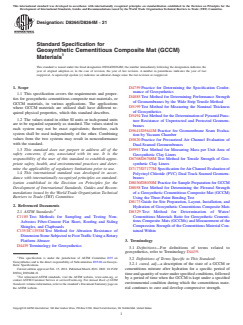
1.1 This specification covers the requirements and properties for geosynthetic cementitious composite mat materials, or GCCM materials, in various applications. The applications where GCCM materials are utilized shall have different required physical properties, which this standard describes.
1.2 The values stated in either SI units or inch-pound units are to be regarded separately as standard. The values stated in each system may not be exact equivalents; therefore, each system shall be used independently of the other. Combining values from the two systems may result in nonconformance with the standard.
1.3 This standard does not purport to address all of the safety concerns, if any, associated with its use. It is the responsibility of the user of this standard to establish appropriate safety, health, and environmental practices and determine the applicability of regulatory limitations prior to use.
1.4 This international standard was developed in accordance with internationally recognized principles on standardization established in the Decision on Principles for the Development of International Standards, Guides and Recommendations issued by the World Trade Organization Technical Barriers to Trade (TBT) Committee.
General Information
- Status
- Published
- Publication Date
- 14-Feb-2021
- Technical Committee
- D35 - Geosynthetics
- Drafting Committee
- D35.06 - Geosynthetic Specifications
Relations
- Effective Date
- 01-Feb-2024
- Effective Date
- 01-Nov-2023
- Effective Date
- 01-May-2020
- Effective Date
- 01-Apr-2020
- Effective Date
- 01-Apr-2020
- Refers
ASTM D5199-12(2019) - Standard Test Method for Measuring the Nominal Thickness of Geosynthetics - Effective Date
- 15-Jun-2019
- Effective Date
- 01-May-2019
- Effective Date
- 01-Jun-2018
- Effective Date
- 15-Apr-2018
- Effective Date
- 01-Feb-2018
- Effective Date
- 01-Aug-2017
- Effective Date
- 01-Jul-2017
- Effective Date
- 01-Jul-2017
- Effective Date
- 01-Jul-2016
- Effective Date
- 01-Jan-2016
Overview
ASTM D8364/D8364M-21: Standard Specification for Geosynthetic Cementitious Composite Mat (GCCM) Materials provides comprehensive guidelines for the specification, classification, and use of geosynthetic cementitious composite mats in a variety of engineering and construction applications. Established by ASTM International, this standard defines essential physical properties, performance criteria, and classification types to ensure quality, durability, and appropriate application of GCCM materials in the field.
GCCMs are innovative materials composed of cementitious elements encapsulated between geosynthetic layers. Once hydrated, these mats harden to form a durable, flexible, and erosion-resistant layer. This standard helps stakeholders ensure compliance with international quality and safety practices.
Key Topics
Classification by Type and Application:
GCCMs are grouped into Type I, Type II, and Type III based on durability, strength, and expected environmental load exposure. Each type features specific requirements for thickness, mass, flexural strength, compressive strength, abrasion resistance, and tensile strength, ensuring suitability for various conditions.Physical and Mechanical Property Requirements:
The standard outlines test methods for verifying thickness, mass per unit area, flexural and tensile strengths, abrasion resistance, freeze-thaw durability, and more. These properties are crucial for ensuring the longevity and performance of GCCMs.Sampling, Inspection, and Quality Assurance:
Guidance is provided for sample preparation (per ASTM D8030/D8030M), factory control test frequency, and on-site inspection procedures to maintain quality through manufacturing to installation.Ordering and Product Marking:
When procuring GCCMs, necessary details-such as type, thickness, roll width/length-should be specified. Manufacturer's identification, product code, size, and date of manufacture must be clearly marked.Safety and Regulatory Compliance:
The standard emphasizes the user's responsibility for implementing appropriate safety, health, and environmental measures as well as adherence to regional regulations.
Applications
GCCM materials specified in ASTM D8364/D8364M-21 are widely used for:
Erosion and Sediment Control:
Installation on slopes, channels, and embankments to provide a robust, impermeable, and long-lasting barrier against soil erosion and stormwater runoff.Slope and Embankment Protection:
Used for protecting slopes with varying angles and substrate conditions; certain types are intended for steeper or less stable substrates.Channel and Culvert Lining:
Employed in water conveyance systems, such as drainage channels and culverts, to prevent erosion, control flow, and reinforce hydraulic structures.Berm Protection and Armoring:
Reinforcement of berms and containment areas against impact, abrasion, and high flow velocities.Remediation and Overlay:
Applied to existing concrete or hydraulic structures for restoration and enhanced durability.
Correct GCCM type selection and installation practices-guided by this standard and related ASTM practices-are vital for maximizing performance and safety in civil engineering projects.
Related Standards
For comprehensive quality and conformance, ASTM D8364/D8364M-21 incorporates or references several related standards, including:
- ASTM D4759: Specification conformance for geosynthetics
- ASTM D5993: Measuring mass per unit area
- ASTM D5199: Nominal thickness determination
- ASTM D8058: Flexural strength by three-point bending
- ASTM D6768/D6768M: Tensile strength of geosynthetic clay liners
- ASTM D8030/D8030M: Sample preparation for GCCM
- ASTM D8173: Guide for installation and hydration of GCCMs
Other referenced practices and test methods cover seam evaluation, abrasion resistance, puncture resistance, and freeze-thaw performance.
Keywords: geosynthetic cementitious composite mat, GCCM, ASTM D8364, erosion control, slope protection, channel lining, abrasion resistance, tensile strength, quality assurance, geosynthetics standards.

Get Certified
Connect with accredited certification bodies for this standard

Control Union Certifications
Global certification for agriculture and sustainability.

Bureau Veritas Bangladesh
Bureau Veritas certification services in Bangladesh.

ECOCERT France
Leader in organic and sustainability certification worldwide.
Sponsored listings
Frequently Asked Questions
ASTM D8364/D8364M-21 is a technical specification published by ASTM International. Its full title is "Standard Specification for Geosynthetic Cementitious Composite Mat (GCCM) Materials". This standard covers: SCOPE 1.1 This specification covers the requirements and properties for geosynthetic cementitious composite mat materials, or GCCM materials, in various applications. The applications where GCCM materials are utilized shall have different required physical properties, which this standard describes. 1.2 The values stated in either SI units or inch-pound units are to be regarded separately as standard. The values stated in each system may not be exact equivalents; therefore, each system shall be used independently of the other. Combining values from the two systems may result in nonconformance with the standard. 1.3 This standard does not purport to address all of the safety concerns, if any, associated with its use. It is the responsibility of the user of this standard to establish appropriate safety, health, and environmental practices and determine the applicability of regulatory limitations prior to use. 1.4 This international standard was developed in accordance with internationally recognized principles on standardization established in the Decision on Principles for the Development of International Standards, Guides and Recommendations issued by the World Trade Organization Technical Barriers to Trade (TBT) Committee.
SCOPE 1.1 This specification covers the requirements and properties for geosynthetic cementitious composite mat materials, or GCCM materials, in various applications. The applications where GCCM materials are utilized shall have different required physical properties, which this standard describes. 1.2 The values stated in either SI units or inch-pound units are to be regarded separately as standard. The values stated in each system may not be exact equivalents; therefore, each system shall be used independently of the other. Combining values from the two systems may result in nonconformance with the standard. 1.3 This standard does not purport to address all of the safety concerns, if any, associated with its use. It is the responsibility of the user of this standard to establish appropriate safety, health, and environmental practices and determine the applicability of regulatory limitations prior to use. 1.4 This international standard was developed in accordance with internationally recognized principles on standardization established in the Decision on Principles for the Development of International Standards, Guides and Recommendations issued by the World Trade Organization Technical Barriers to Trade (TBT) Committee.
ASTM D8364/D8364M-21 is classified under the following ICS (International Classification for Standards) categories: 59.080.70 - Geotextiles. The ICS classification helps identify the subject area and facilitates finding related standards.
ASTM D8364/D8364M-21 has the following relationships with other standards: It is inter standard links to ASTM D4439-24, ASTM D5820-95(2023), ASTM D6768/D6768M-20, ASTM C1353/C1353M-20, ASTM C1353/C1353M-20e1, ASTM D5199-12(2019), ASTM D6768/D6768M-19, ASTM D6768/D6768M-18, ASTM D4439-18, ASTM D5820-95(2018), ASTM D4439-17, ASTM D8058-17e1, ASTM D8058-17, ASTM D5641/D5641M-16, ASTM D8030/D8030M-16. Understanding these relationships helps ensure you are using the most current and applicable version of the standard.
ASTM D8364/D8364M-21 is available in PDF format for immediate download after purchase. The document can be added to your cart and obtained through the secure checkout process. Digital delivery ensures instant access to the complete standard document.
Standards Content (Sample)
This international standard was developed in accordance with internationally recognized principles on standardization established in the Decision on Principles for the
Development of International Standards, Guides and Recommendations issued by the World Trade Organization Technical Barriers to Trade (TBT) Committee.
Designation:D8364/D8364M −21
Standard Specification for
Geosynthetic Cementitious Composite Mat (GCCM)
Materials
This standard is issued under the fixed designation D8364/D8364M; the number immediately following the designation indicates the
year of original adoption or, in the case of revision, the year of last revision. A number in parentheses indicates the year of last
reapproval. A superscript epsilon (´) indicates an editorial change since the last revision or reapproval.
1. Scope D4759 Practice for Determining the Specification Confor-
mance of Geosynthetics
1.1 This specification covers the requirements and proper-
D4885 Test Method for Determining Performance Strength
ties for geosynthetic cementitious composite mat materials, or
of Geomembranes by the Wide Strip Tensile Method
GCCM materials, in various applications. The applications
D5199 Test Method for Measuring the Nominal Thickness
where GCCM materials are utilized shall have different re-
of Geosynthetics
quired physical properties, which this standard describes.
D5494 Test Method for the Determination of Pyramid Punc-
1.2 The values stated in either SI units or inch-pound units
ture Resistance of Unprotected and Protected Geomem-
are to be regarded separately as standard. The values stated in
branes
each system may not be exact equivalents; therefore, each
D5641/D5641M Practice for Geomembrane Seam Evalua-
system shall be used independently of the other. Combining
tion by Vacuum Chamber
values from the two systems may result in nonconformance
D5820 Practice for Pressurized Air Channel Evaluation of
with the standard.
Dual-Seamed Geomembranes
1.3 This standard does not purport to address all of the D5993 Test Method for Measuring Mass per Unit Area of
safety concerns, if any, associated with its use. It is the
Geosynthetic Clay Liners
responsibility of the user of this standard to establish appro- D6768/D6768M Test Method for Tensile Strength of Geo-
priate safety, health, and environmental practices and deter-
synthetic Clay Liners
mine the applicability of regulatory limitations prior to use. D7177/D7177M Specification forAir Channel Evaluation of
1.4 This international standard was developed in accor-
Polyvinyl Chloride (PVC) Dual Track Seamed Geomem-
dance with internationally recognized principles on standard- branes
ization established in the Decision on Principles for the
D8030/D8030M Practice for Sample Preparation for GCCM
Development of International Standards, Guides and Recom-
D8058 Test Method for Determining the Flexural Strength
mendations issued by the World Trade Organization Technical of a Geosynthetic Cementitious Composite Mat (GCCM)
Barriers to Trade (TBT) Committee.
Using the Three-Point Bending Test
D8173 Guide for Site Preparation, Layout, Installation, and
2. Referenced Documents
Hydration of Geosynthetic Cementitious Composite Mats
D8329 Test Method for Determination of Water/
2.1 ASTM Standards:
Cementitious Materials Ratio for Geosynthetic Cementi-
C1185 Test Methods for Sampling and Testing Non-
tious Composite Mats (GCCMs) and Measurement of the
Asbestos Fiber-Cement Flat Sheet, Roofing and Siding
Compression Strength of the Cementitious Material Con-
Shingles, and Clapboards
tained Within
C1353/C1353M Test Method for Abrasion Resistance of
Dimension Stone Subjected to FootTraffic Using a Rotary
Platform Abraser 3. Terminology
D4439 Terminology for Geosynthetics
3.1 Definitions—For definitions of terms related to
geosynthetics, refer to Terminology D4439.
This specification is under the jurisdiction of ASTM Committee D35 on
3.2 Definitions of Terms Specific to This Standard:
Geosynthetics and is the direct responsibility of Subcommittee D35.06 on Geosyn-
3.2.1 cured, adj—a description of the state of a GCCM or
thetic Specifications.
cementitious mixture after hydration for a specific period of
Current edition approved Feb. 15, 2021. Published March 2021. DOI: 10.1520/
D8364_D8364M-21.
timeandquantityofwaterunderspecifiedconditions,followed
For referenced ASTM standards, visit the ASTM website, www.astm.org, or
by a period of time when the GCCM is kept under a specified
contact ASTM Customer Service at service@astm.org. For Annual Book of ASTM
environmental condition during which the cementitious mate-
Standards volume information, refer to the standard’s Document Summary page on
the ASTM website. rial continues to cure and develop compressive strength.
Copyright © ASTM International, 100 Barr Harbor Drive, PO Box C700, West Conshohocken, PA 19428-2959. United States
D8364/D8364M−21
3.2.2 uncured, adj—a description of the state of a GCCM or shall be required to limit movement of the GCCM under wind
cementitious mixture prior to hydration. or hydraulic loading conditions or when the recommended
slope angle or length is exceeded.
4. Classification of GCCM Materials in Applications
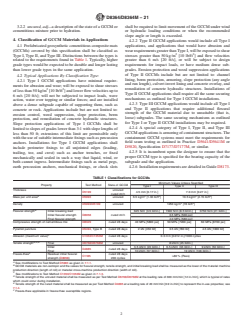
4.2.2 Type II GCCM applications would include all Type I
4.1 Prefabricated geosynthetic cementitious composite mats applications, and applications that would have abrasion and
(GCCMs) covered by this specification shall be classified as wearrequirementsgreaterthanTypeI,willbeexposedtoshear
2 2
Type I, Type II, and Type III. Distinctions between the types is stresses greater than 50 kg⁄m [10 lb/ft ] and flow velocities
related to the requirements found in Table 1. Typically, higher
greater than 6 m/s [20 ft/s], or will be subject to design
grade types would be expected to be durable and longer lasting requirements for impact loads, or have medium dense sub-
than lower grade types in the same application.
grades. Erosion protection and weed suppression applications
of Type II GCCMs include but are not limited to: channel
4.2 Typical Applications By Classification Type:
lining, berm protection, armoring, slope protection (any angle
4.2.1 Type I GCCM applications have minimal require-
and run length), culvert invert lining and concrete overlay, and
ments for abrasion and wear; will be exposed to shear stresses
2 2 remediation of concrete hydraulic structures. Installations of
of less than 50 kg/m [10 lb/ft ] and lower flow velocities up to
Type II GCCM applications shall require all the same securing
6 m/s [20 ft/s]; will not be subjected to impact loads, wave
mechanisms as outlined for Type I GCCM installations.
action, water over topping or similar forces; and are installed
4.2.3 Type III GCCM applications would include all Type I
above a dense subgrade capable of supporting them, such as
and Type II applications that require additional flexural
concrete or rock. Applications include but are not limited to:
strength of the GCCM material due to unsuitable (that is,
erosion control, weed suppression, slope protection, berm
loose) subgrades. The same securing mechanisms as outlined
protection, and remediation of concrete hydraulic structures.
for Type I or Type II GCCM installations may be required.
Slope protection applications of Type I GCCMs shall be
4.2.4 A special category of Type I, Type II, and Type III
limited to slopes of grades lower than 3:1 with slope lengths of
GCCM applications is armoring of containment structures.The
less than 50 ft; extensions of this limit are permissible only
containment GCCM systems must meet the requirements for
with the use of suitable intermediate fixings such as percussion
field seam testing as outlined in Practice D5641/D5641M or
anchors. Installations for Type I GCCM applications shall
D5820, Specification D7177/D7177M, or similar.
include perimeter fixings to all unjointed edges (leading,
4.2.5 It is incumbent upon the designer to ensure that the
trailing, toe, and crest) such as anchor trenches, or fixed
proper GCCM type is specified for the bearing capacity of the
mechanically and sealed in such a way that liquid, wind, or
subgrade and the application.
both cannot ingress. Intermediate fixings such as metal pegs,
earth percussion anchors, mechanical fixings, or check slots 4.2.6 Installation requirements are detailed in Guide D8173.
TABLE 1 Classifications for GCCMs
Minimum Values Unless Specified
Property Test Method State of GCCM
Type I Type II Type III
Thickness uncured
D5199 4.5 mm [0.17 in.] 7.0 mm [0.27 in.]
cured 24 h
A 2 2 2 2
Mass per unit area D5993 uncured 6.5 kg/m [1.33 lb/ft ] 10.5 kg/m [2.15 lb/ft ]
3 3
Density D5993/D5199 uncured 1250 kg/m [78 lb/ft ]
B
Flexural strength Initial breaking load 625 N/m [3.5 lbf/in.] 1500 N/m [8.5 lbf/in.] 3750 N/m [21 lbf/in.]
Initial flexural strength D8058 cured 24 h 3.5 MPa [500 psi]
Final flexural strength 4.0 MPa [580 psi]
Compressive strength of cementitious mix D8329 cured 28 days 40 MPa [5800 psi] 50 MPa [7200 psi] 60 MPa
...
Questions, Comments and Discussion
Ask us and Technical Secretary will try to provide an answer. You can facilitate discussion about the standard in here.
Loading comments...