

ASTM F3373-21
(Specification)Standard Specification for Polyethylene (PE) Electrofusion Fittings for Outside Diameter Controlled Crosslinked Polyethylene (PEX) Pipe
General Information
- Abstract
SCOPE
1.1 This specification covers polyethylene (PE 4710) electrofusion fittings for use with outside diameter-controlled crosslinked polyethylene (PEX) pipe, covered by Specifications F2788/F2788M, F2905/F2905M and F2968/F2968M. As stated in these PEX pipe standards, the PEX pipes joined to these PE 4710 electrofusion fittings have an HDB of 1250 psi or 1600 psi at 73 °F (23 °C) per Test Method D2837. Requirements for all metric-sized and inch-sized fittings for use with PEX pipe, made in accordance to these three pipe standards, are specified in Specification F2829/F2829M.
1.2 The maximum allowable operating temperature of electrofusion fittings made in accordance with this standard is limited to the highest temperature at which the HDB of the PE 4710 has been determined. When joined to PEX pipe having a higher temperature HDB, the maximum use temperature for the PE/PEX joint is limited to the elevated temperature HDB rating of the PE material in the fitting
Note 1: PEX and PE 4710 materials can have different elevated temperature ratings, and when joined together, the lower maximum elevated temperature rating will limit the maximum operating temperature. Per Table 1, the required PE 4710 material must have an HDB at 140 °F (60 °C), but may have an HDB at 180 °F (82 °C). PEX pipes generally have HDB ratings at 180 °F (82 °C) or 200 °F (93 °C) or both. When joined to PEX pipe, PE 4710 electrofusion fittings made in accordance with this standard may limit the maximum operating temperature to 140 °F (60 °C) where the PE 4710 material used does not have an optional higher temperature HDB rating.
1.3 Requirements for materials, workmanship, and qualification testing performance are included. The PE electrofusion fitting manufacturer shall assure that fittings produced in accordance with this specification comply with all the requirements of this specification. If a PEX pipe manufacturer deems that their pipe is suitable for joining to polyethylene (PE) electrofusion fittings, the PEX pipe manufacturer shall qualify their PEX pipe by testing joints made with these PE electrofusion fittings, and assuring that the joints meet the performance requirements of this specification.
1.4 The values stated in inch-pound units are to be regarded as standard. The values given in parentheses are mathematical conversions to SI units that are provided for information only and are not considered standard.
1.5 The following safety hazards caveat pertains only to the test method portion, Section 9, of this specification: This standard does not purport to address all of the safety concerns, if any, associated with its use. It is the responsibility of the user of this standard to establish appropriate safety, health, and environmental practices and determine the applicability of regulatory limitations prior to use.
1.6 This international standard was developed in accordance with internationally recognized principles on standardization established in the Decision on Principles for the Development of International Standards, Guides and Recommendations issued by the World Trade Organization Technical Barriers to Trade (TBT) Committee.
- Status
- Published
- Publication Date
- 30-Apr-2021
- Technical Committee
- F17 - Plastic Piping Systems
- Drafting Committee
- F17.10 - Fittings
Buy Documents
ASTM F3373-21 - Standard Specification for Polyethylene (PE) Electrofusion Fittings for Outside Diameter Controlled Crosslinked Polyethylene (PEX) Pipe
REDLINE ASTM F3373-21 - Standard Specification for Polyethylene (PE) Electrofusion Fittings for Outside Diameter Controlled Crosslinked Polyethylene (PEX) Pipe
Overview
ASTM F3373-21 is the standard specification for polyethylene (PE 4710) electrofusion fittings used for joining outside diameter-controlled crosslinked polyethylene (PEX) pipes. Developed by ASTM International, this standard ensures that electrofusion fittings are compatible with specific PEX pipe specifications and are suitable for applications requiring high durability and reliable joint performance. The standard applies to both metric-sized and inch-sized fittings and addresses criteria for material quality, fusion compatibility, mechanical strength, and safe operating conditions.
Key Topics
- Scope: Covers PE 4710 electrofusion fittings for PEX pipes governed by ASTM F2788/F2788M, F2905/F2905M, and F2968/F2968M standards.
- Material Requirements: Specifies that fittings must use PE 4710 compounds meeting ASTM D3350 with appropriate HDB and HDS ratings, ensuring durability and performance.
- Performance Criteria:
- Hydraulic burst and sustained pressure requirements
- Tensile strength for joint integrity
- Impact resistance and joint integrity for saddle-type fittings
- Testing protocols for qualification, including pressure, tensile, and crush tests
- Compatibility: Clearly defines that the maximum operating temperature of the joint is limited by the lower of the PE or PEX material ratings.
- Workmanship and Quality Control: Stipulates requirements for uniformity, absence of defects, and in-plant quality control checks.
- Product Marking: Guides proper product labelling for traceability, identification, and suitability verification.
- Measurement Standards: Uses inch-pound as standard; SI conversions provided for information.
Applications
PE electrofusion fittings meeting ASTM F3373-21 are commonly used in:
- Municipal Water Distribution: Reliable joining methods for potable water systems where pressure performance and durability are critical.
- Oil and Gas: Suitable for PEX pipelines in oil, gas, and gas distribution applications that require high strength and secure joints.
- Industrial Piping: Used in process industries where secure, leak-proof, and durable PEX-to-PEX joints are needed.
- Construction and Plumbing: Acceptance in commercial and residential plumbing applications for safe, long-lasting piping systems.
This standard helps manufacturers, engineers, and installers ensure the compatibility and safe use of PE 4710 electrofusion fittings with approved PEX pipes. By following ASTM F3373-21, stakeholders can optimize system integrity, achieve reliable fusion joints, and ensure compliance with industry regulations.
Related Standards
- ASTM F2788/F2788M: Specification for metric and inch-sized crosslinked polyethylene (PEX) pipe.
- ASTM F2829/F2829M: Specification for fittings for PEX pipe.
- ASTM F2905/F2905M: PEX line pipe for oil and gas applications.
- ASTM F2968/F2968M: PEX pipe for gas distribution.
- ASTM D2837: Method for obtaining hydrostatic design basis (HDB).
- ASTM D3350: Specification for polyethylene plastics pipe and fittings materials.
- ISO 13954: Peel decohesion test for polyethylene electrofusion assemblies.
Practical Value
Adherence to ASTM F3373-21 helps:
- Ensure system reliability by using fittings that meet rigorous material and performance qualifications.
- Minimize installation risks via clear requirements on joint integrity, pressure rating, and allowable operating temperature.
- Enable tracing and quality assurance through mandatory product marking and documentation.
- Facilitate regulatory compliance for projects involving water or gas distribution.
- Provide end-users and installers with confidence in the long-term performance of PE/PEX piping systems joined by electrofusion.
This standard positions itself as a key resource for professionals committed to safe and high-performance plastic piping system installations.
Relations
- Effective Date
- 01-Apr-2024
- Effective Date
- 01-Apr-2020
- Effective Date
- 01-Mar-2020
- Effective Date
- 01-Feb-2020
- Effective Date
- 01-Nov-2019
- Effective Date
- 01-Aug-2019
- Effective Date
- 15-Apr-2019
- Effective Date
- 01-Jan-2019
- Effective Date
- 01-Sep-2018
- Effective Date
- 01-Feb-2018
- Refers
ASTM D1600-18 - Standard Terminology for Abbreviated Terms Relating to Plastics (Withdrawn 2024) - Effective Date
- 01-Jan-2018
- Effective Date
- 15-Nov-2017
- Effective Date
- 01-Aug-2017
- Effective Date
- 01-Feb-2017
- Effective Date
- 15-Nov-2016
Buy Documents
ASTM F3373-21 - Standard Specification for Polyethylene (PE) Electrofusion Fittings for Outside Diameter Controlled Crosslinked Polyethylene (PEX) Pipe
REDLINE ASTM F3373-21 - Standard Specification for Polyethylene (PE) Electrofusion Fittings for Outside Diameter Controlled Crosslinked Polyethylene (PEX) Pipe
Get Certified
Connect with accredited certification bodies for this standard

Institut za varilstvo d.o.o. (Welding Institute)
Slovenia's leading welding institute since 1952. ISO 3834, EN 1090, pressure equipment certification, NDT personnel, welder qualification. Only IIW Au
Sponsored listings
Frequently Asked Questions
ASTM F3373-21 is a technical specification published by ASTM International. Its full title is "Standard Specification for Polyethylene (PE) Electrofusion Fittings for Outside Diameter Controlled Crosslinked Polyethylene (PEX) Pipe". This standard covers: SCOPE 1.1 This specification covers polyethylene (PE 4710) electrofusion fittings for use with outside diameter-controlled crosslinked polyethylene (PEX) pipe, covered by Specifications F2788/F2788M, F2905/F2905M and F2968/F2968M. As stated in these PEX pipe standards, the PEX pipes joined to these PE 4710 electrofusion fittings have an HDB of 1250 psi or 1600 psi at 73 °F (23 °C) per Test Method D2837. Requirements for all metric-sized and inch-sized fittings for use with PEX pipe, made in accordance to these three pipe standards, are specified in Specification F2829/F2829M. 1.2 The maximum allowable operating temperature of electrofusion fittings made in accordance with this standard is limited to the highest temperature at which the HDB of the PE 4710 has been determined. When joined to PEX pipe having a higher temperature HDB, the maximum use temperature for the PE/PEX joint is limited to the elevated temperature HDB rating of the PE material in the fitting Note 1: PEX and PE 4710 materials can have different elevated temperature ratings, and when joined together, the lower maximum elevated temperature rating will limit the maximum operating temperature. Per Table 1, the required PE 4710 material must have an HDB at 140 °F (60 °C), but may have an HDB at 180 °F (82 °C). PEX pipes generally have HDB ratings at 180 °F (82 °C) or 200 °F (93 °C) or both. When joined to PEX pipe, PE 4710 electrofusion fittings made in accordance with this standard may limit the maximum operating temperature to 140 °F (60 °C) where the PE 4710 material used does not have an optional higher temperature HDB rating. 1.3 Requirements for materials, workmanship, and qualification testing performance are included. The PE electrofusion fitting manufacturer shall assure that fittings produced in accordance with this specification comply with all the requirements of this specification. If a PEX pipe manufacturer deems that their pipe is suitable for joining to polyethylene (PE) electrofusion fittings, the PEX pipe manufacturer shall qualify their PEX pipe by testing joints made with these PE electrofusion fittings, and assuring that the joints meet the performance requirements of this specification. 1.4 The values stated in inch-pound units are to be regarded as standard. The values given in parentheses are mathematical conversions to SI units that are provided for information only and are not considered standard. 1.5 The following safety hazards caveat pertains only to the test method portion, Section 9, of this specification: This standard does not purport to address all of the safety concerns, if any, associated with its use. It is the responsibility of the user of this standard to establish appropriate safety, health, and environmental practices and determine the applicability of regulatory limitations prior to use. 1.6 This international standard was developed in accordance with internationally recognized principles on standardization established in the Decision on Principles for the Development of International Standards, Guides and Recommendations issued by the World Trade Organization Technical Barriers to Trade (TBT) Committee.
SCOPE 1.1 This specification covers polyethylene (PE 4710) electrofusion fittings for use with outside diameter-controlled crosslinked polyethylene (PEX) pipe, covered by Specifications F2788/F2788M, F2905/F2905M and F2968/F2968M. As stated in these PEX pipe standards, the PEX pipes joined to these PE 4710 electrofusion fittings have an HDB of 1250 psi or 1600 psi at 73 °F (23 °C) per Test Method D2837. Requirements for all metric-sized and inch-sized fittings for use with PEX pipe, made in accordance to these three pipe standards, are specified in Specification F2829/F2829M. 1.2 The maximum allowable operating temperature of electrofusion fittings made in accordance with this standard is limited to the highest temperature at which the HDB of the PE 4710 has been determined. When joined to PEX pipe having a higher temperature HDB, the maximum use temperature for the PE/PEX joint is limited to the elevated temperature HDB rating of the PE material in the fitting Note 1: PEX and PE 4710 materials can have different elevated temperature ratings, and when joined together, the lower maximum elevated temperature rating will limit the maximum operating temperature. Per Table 1, the required PE 4710 material must have an HDB at 140 °F (60 °C), but may have an HDB at 180 °F (82 °C). PEX pipes generally have HDB ratings at 180 °F (82 °C) or 200 °F (93 °C) or both. When joined to PEX pipe, PE 4710 electrofusion fittings made in accordance with this standard may limit the maximum operating temperature to 140 °F (60 °C) where the PE 4710 material used does not have an optional higher temperature HDB rating. 1.3 Requirements for materials, workmanship, and qualification testing performance are included. The PE electrofusion fitting manufacturer shall assure that fittings produced in accordance with this specification comply with all the requirements of this specification. If a PEX pipe manufacturer deems that their pipe is suitable for joining to polyethylene (PE) electrofusion fittings, the PEX pipe manufacturer shall qualify their PEX pipe by testing joints made with these PE electrofusion fittings, and assuring that the joints meet the performance requirements of this specification. 1.4 The values stated in inch-pound units are to be regarded as standard. The values given in parentheses are mathematical conversions to SI units that are provided for information only and are not considered standard. 1.5 The following safety hazards caveat pertains only to the test method portion, Section 9, of this specification: This standard does not purport to address all of the safety concerns, if any, associated with its use. It is the responsibility of the user of this standard to establish appropriate safety, health, and environmental practices and determine the applicability of regulatory limitations prior to use. 1.6 This international standard was developed in accordance with internationally recognized principles on standardization established in the Decision on Principles for the Development of International Standards, Guides and Recommendations issued by the World Trade Organization Technical Barriers to Trade (TBT) Committee.
ASTM F3373-21 is classified under the following ICS (International Classification for Standards) categories: 23.040.20 - Plastics pipes. The ICS classification helps identify the subject area and facilitates finding related standards.
ASTM F3373-21 has the following relationships with other standards: It is inter standard links to ASTM F1473-24, ASTM F412-20, ASTM F2968/F2968M-20, ASTM F2905/F2905M-20, ASTM F2905/F2905M-19, ASTM F2788/F2788M-19a, ASTM F2788/F2788M-19, ASTM F412-19, ASTM D1599-18, ASTM F2788/F2788M-18, ASTM D1600-18, ASTM F2788/F2788M-17, ASTM F412-17a, ASTM F412-17, ASTM F412-16a. Understanding these relationships helps ensure you are using the most current and applicable version of the standard.
ASTM F3373-21 is available in PDF format for immediate download after purchase. The document can be added to your cart and obtained through the secure checkout process. Digital delivery ensures instant access to the complete standard document.
Standards Content (Sample)
This international standard was developed in accordance with internationally recognized principles on standardization established in the Decision on Principles for the
Development of International Standards, Guides and Recommendations issued by the World Trade Organization Technical Barriers to Trade (TBT) Committee.
Designation:F3373 −21 An American National Standard
Standard Specification for
Polyethylene (PE) Electrofusion Fittings for Outside
Diameter Controlled Crosslinked Polyethylene (PEX) Pipe
This standard is issued under the fixed designation F3373; the number immediately following the designation indicates the year of
original adoption or, in the case of revision, the year of last revision. A number in parentheses indicates the year of last reapproval. A
superscript epsilon (´) indicates an editorial change since the last revision or reapproval.
1. Scope* 1.4 The values stated in inch-pound units are to be regarded
as standard. The values given in parentheses are mathematical
1.1 This specification covers polyethylene (PE 4710) elec-
conversions to SI units that are provided for information only
trofusion fittings for use with outside diameter-controlled
and are not considered standard.
crosslinked polyethylene (PEX) pipe, covered by Specifica-
1.5 The following safety hazards caveat pertains only to the
tions F2788/F2788M, F2905/F2905M and F2968/F2968M.As
test method portion, Section 9, of this specification: This
stated in these PEX pipe standards, the PEX pipes joined to
standard does not purport to address all of the safety concerns,
these PE 4710 electrofusion fittings have an HDB of 1250 psi
if any, associated with its use. It is the responsibility of the user
or 1600 psi at 73 °F (23 °C) per Test Method D2837. Require-
of this standard to establish appropriate safety, health, and
ments for all metric-sized and inch-sized fittings for use with
environmental practices and determine the applicability of
PEX pipe, made in accordance to these three pipe standards,
regulatory limitations prior to use.
are specified in Specification F2829/F2829M.
1.6 This international standard was developed in accor-
1.2 The maximum allowable operating temperature of elec-
dance with internationally recognized principles on standard-
trofusion fittings made in accordance with this standard is
ization established in the Decision on Principles for the
limited to the highest temperature at which the HDB of the PE
Development of International Standards, Guides and Recom-
4710 has been determined. When joined to PEX pipe having a
mendations issued by the World Trade Organization Technical
higher temperature HDB, the maximum use temperature for
Barriers to Trade (TBT) Committee.
the PE/PEX joint is limited to the elevated temperature HDB
rating of the PE material in the fitting
2. Referenced Documents
NOTE 1—PEX and PE 4710 materials can have different elevated
2.1 ASTM Standards:
temperature ratings, and when joined together, the lower maximum
D638 Test Method for Tensile Properties of Plastics
elevated temperature rating will limit the maximum operating tempera-
D1598 Test Method for Time-to-Failure of Plastic Pipe
ture. Per Table 1, the required PE 4710 material must have an HDB at
Under Constant Internal Pressure
140 °F (60 °C), but may have an HDB at 180 °F (82 °C). PEX pipes
generally have HDB ratings at 180 °F (82 °C) or 200 °F (93 °C) or both. D1599 Test Method for Resistance to Short-Time Hydraulic
When joined to PEX pipe, PE 4710 electrofusion fittings made in
Pressure of Plastic Pipe, Tubing, and Fittings
accordance with this standard may limit the maximum operating tempera-
D1600 Terminology forAbbreviatedTerms Relating to Plas-
ture to 140 °F (60 °C) where the PE 4710 material used does not have an
tics
optional higher temperature HDB rating.
D2837 Test Method for Obtaining Hydrostatic Design Basis
1.3 Requirements for materials, workmanship, and qualifi-
forThermoplasticPipeMaterialsorPressureDesignBasis
cation testing performance are included. The PE electrofusion
for Thermoplastic Pipe Products
fitting manufacturer shall assure that fittings produced in
D3350 Specification for Polyethylene Plastics Pipe and Fit-
accordance with this specification comply with all the require-
tings Materials
ments of this specification. If a PEX pipe manufacturer deems
F412 Terminology Relating to Plastic Piping Systems
that their pipe is suitable for joining to polyethylene (PE)
F905 Practice for Qualification of Polyethylene Saddle-
electrofusion fittings, the PEX pipe manufacturer shall qualify
Fused Joints
their PEX pipe by testing joints made with these PE electro-
F1473 Test Method for Notch Tensile Test to Measure the
fusion fittings, and assuring that the joints meet the perfor-
Resistance to Slow Crack Growth of Polyethylene Pipes
mance requirements of this specification.
and Resins
This specification is under the jurisdiction ofASTM Committee F17 on Plastic
Piping Systems and is the direct responsibility of Subcommittee F17.10 on Fittings. For referenced ASTM standards, visit the ASTM website, www.astm.org, or
Current edition approved May 1, 2021. Published May 2021. Originally contact ASTM Customer Service at service@astm.org. For Annual Book of ASTM
approved in 2020. Last previous edition approved in 2020 as F3373–20. DOI: Standards volume information, refer to the standard’s Document Summary page on
10.1520/F3373–21 the ASTM website.
*A Summary of Changes section appears at the end of this standard
Copyright © ASTM International, 100 Barr Harbor Drive, PO Box C700, West Conshohocken, PA 19428-2959. United States
F3373−21
TABLE 1 Specification D3350 Classification Requirements and
3.2.1 electrofusion, n—a heat fusion joining process for
Properties of Polyethylene Electrofusion Fitting Materials
fittings that have a heat source as an integral part of the fitting.
Physical Properties Cell Classification and Properties for
Joining occurs when, in accordance with a specified procedure,
PE 4710 Material
electric energy is applied to the heat source during the
Density 4
procedure.
Melt Index 4
Flexural Modulus >5
3.2.2 fusion interface, n—the surface in the heat fusion
Tensile Strength >5
processwheretheplasticmaterialsoftheproductsbeingjoined
Slow Crack Growth Resistance ( Test 7
Method F1473) bond together.
Hydrostatic Strength Classification 4
3.2.3 fusion zone length, n—the total length of the melted
Specification D3350 Additive Code C or E
Minimum HDB at 73 °F (23 °C), psi 1600 (11.03) material in the fitting cross-section under evaluation.
(MPa)
Minimum HDS at 73 °F (23 °C), psi 1000 (6.95)
4. Materials and Manufacture
(MPa)
Minimum HDB at 140 °F (60 °C), psi 1000 (6.95)
4.1 Material requirements—PE 4710 compounds suitable
(MPa)
for use in the manufacture of electrofusion fittings under this
Minimum HDB at 180 °F (82 °C), psi 800 (5.51)
(MPa) – if applicable specification shall meet the classification requirements of
Specification D3350 as shown in Table 1, and shall meet the
Specification D3350 requirements for brittleness temperature,
thermal stability and tensile elongation. The material com-
F2788/F2788M Specification for Metric and Inch-sized
pound shall also have HDB and HDS ratings at 73 °F (23 °C)
Crosslinked Polyethylene (PEX) Pipe
and HDB ratings at 140 °F (60 °C) or higher in accordance
F2829/F2829M Specification for Metric- and Inch-Sized
with Test Method D2837 and PPI TR-3 policies, and these PE
Fittings for Crosslinked Polyethylene (PEX) Pipe
material compounds shall be listed by a listing agency, such as
F2905/F2905M Specification for Crosslinked Polyethylene
PPI in TR-4, as PE4710 in accordance with policies and
(PEX) Line Pipe For Oil and Gas ProducingApplications
procedures no less restrictive than those in PPI TR-3.
F2968/F2968M Specification for Crosslinked Polyethylene
4.2 Additive Classes—PE 4710 compounds meeting Speci-
(PEX) Pipe for Gas Distribution Applications
3 fication D3350 code C, shall have 2.0 to 3.0 percent carbon
2.2 PPI Standards:
black. PE 4710 compounds meeting Specification D3350 code
PPI TN-17 Crosslinked Polyethylene (PEX) Tubing Piping
E shall be colored with UV stabilizer.
Materials or Pipe
4.3 Rework Material—Clean polyethylene material that met
PPI TR-3 HDB/HDS/PDB/SDB/MRS/CRS Policies - Poli-
cies and Procedures for Developing Hydrostatic Design 4.1 and 4.2 before processing, free of any wire or
contaminants, and generated from the fitting manufacturer’s
Basis (HDB), Hydrostatic Design Stresses (HDS), Pres-
sure Design Basis (PDB), Strength Design Basis (SDB), own production, shall be acceptable for use by the same
manufacturer, provided that the fittings produced conform to
Minimum Required Strength (MRS), and Categorized
Required Strength (CRS) Ratings for Thermoplastic therequirementsofthisspecification.Reworkmaterialshallbe
blended with virgin material that complies with 4.1 and 4.2.
PPI TR-4 HDB/HDS/SDB/PDB/MRS/CRS Listed
Materials, PPI Listing of Hydrostatic Design Basis
4.4 Heating Mechanism—The heat mechanism shall be of
(HDB), Hydrostatic Design Stress (HDS), Strength De-
materials and design not detrimental to the performance of the
sign Basis (SDB), Pressure Design Basis (PDB), Mini-
fitting or the pipe to which it is intended to be joined. Heating
mum Required Strength (MRS), Categorized Required
mechanisms, such as wires or materials other than
Strength (CRS) Ratings for Thermoplastic Piping Materi-
polyethylene, shall not exit the fitting in an area exposed to
als or Pipe
internal pressure. Heat mechanisms shall be of a design that
2.3 ISO Standards:
ensuresthatwireterminationsaretowardtheouteredgesofthe
ISO 13954 Plastics pipe and fittings – Peel decohesion test
fusionzonelengthandawayfromthepressurecontainingarea.
for polyethylene (PE) electrofusion assemblies of nominal
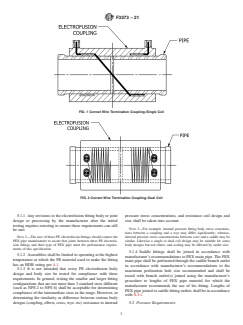
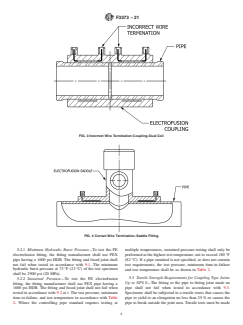
Examplesofacceptableandunacceptablewireterminationsare
diameter greater than or equal to 90 mm
shown in Figs. 1-5.
3. Terminology
5. Performance Requirements
3.1 Definitions—Definitions are in accordance with Termi-
5.1 The following requirements are for electrofusion fitting
nology F412, and abbreviations are in accordance with Termi-
joint designs, single or dual coil, and body designs that have
nology D1600, unless otherwise specified.
been joined using the fitting manufacturer’s recommended
joining procedures. Each PE electrofusion fitting body size,
3.2 Definitions of Terms Specific to This Standard:
bodydesignandjointdesignshallmeettherequirementsinthis
section when joined to PEX pipe that complies with Specifi-
Available from Plastics Pipe Institute (PPI), 105 Decker Court, Suite 825,
cation F2788/F2788M, F2905/F2905M or F2968/F2968M.
Irving, TX 75062, http://www.plasticpipe.org.
Fittings intended for use in the distribution of natural gas or
Available from International Organization for Standardization (ISO), ISO
liquid petroleum gas shall also meet the requirements of
Central Secretariat, BIBC II, Chemin de Blandonnet 8, CP 401, 1214 Vernier,
Geneva, Switzerland, http://www.iso.org. Specification F2968/F2968M.
F3373−21
FIG. 1Correct Wire Termination Coupling–Single Coil
FIG. 2Correct Wire Termination Coupling–Dual Coil
5.1.1 Any revisions to the electrofusion fitting body or joint pressure stress concentrations, and resistance coil design and
design or processing by the manufacturer after the initial size shall be taken into account.
testing requires retesting to ensure these requirements can still
NOTE 3—For example, internal pressure fitting body stress concentra-
be met.
tions between a coupling and a wye may differ significantly; whereas,
internal pressure stress concentrations between a tee and a saddle may be
NOTE 2—The user of these PE electrofusion fittings should contact the
similar. Likewise a single or dual coil design may be suitable for some
PEX pipe manufacturer to assure that joints between these PE electrofu-
sion fittings and their type of PEX pipe meet the performance require- body designs but not others, and scaling may be affected by outlet size.
ments of this specification.
5.1.4 Saddle fittings shall be joined in accordance with
5.1.2 Assemblies shall be limited to operating at the highest
manufacturer’s recommendations to PEX main pipe. The PEX
temperature at which the PE material used to make the fitting
main pipe shall be perforated through the saddle branch outlet
has an HDB rating per 4.1.
in accordance with manufacturer’s recommendations to the
5.1.3 It is not intended that every PE electrofusion body
maximum perforation hole size recommended and shall be
design and body size be tested for compliance with these
tested with branch outlet(s) joined using the manufacturer’s
requirements. In general, testing the smaller and larger fitting
procedure to lengths of PEX pipe material for which the
configurations that are not more than 3 standard sizes different
manufacturer recommends the use of his fitting. Lengths of
(such as NPS 2 to NPS 6) shall be acceptable for determining
PEX pipe joined to saddle fitting outlets shall be in accordance
compliance of the intermediate sizes in the range. However, in
with 8.3.1.
determining the similarity or difference between various body
designs (coupling, elbow, cross, wye, etc) resistance to internal 5.2 Pressure Requirements:
F3373−21
FIG. 3Incorrect Wire Termination Coupling–Dual Coil
FIG. 4Correct Wire Termination–Saddle Fitting
5.2.1 Minimum Hydraulic Burst Pressure—To test the PE multiple temperatures, sustained pressure testing shall only be
electrofusion fitting, the fitting manufacturer shall use PEX
performed at the highest test temperature, not to exceed 180 °F
pipe having a 1600 psi HDB. The fitting and fused joint shall
(82 °C). If a pipe standard is not specified, or does not contain
not fail when tested in accordance with 9.1. The minimum
test requirements, the test pressure, minimum time-to-failure
hydraulic burst pressure at 73 °F (23 °C) of the test specimen
and test temperature shall be as shown in Table 2.
shall be 2900 psi (20 MPa).
5.3 Tensile Strength Requirements for Coupling Type Joints
5.2.2 Sustained Pressure—To test the PE electrofusion
Up to NPS 8—The fitting or the pipe to fitting joint made on
fitting, the fitting manufacturer shall use PEX pipe having a
pipe shall not fail when tested in accordance with 9.3.
1600 psi HDB. The fitting and fused joint shall not fail when
Specimens shall be subjected to a tensile stress that causes the
tested in accordance with 9.2 at t. The test pressure, minimum
pipe to yield to an elongation no less than 25 % or causes the
time-to-failure, and test temperature in accordance with Table
2. Where the controlling pipe standard requires testing at pipe to break outside the joint area. Tensile tests must be made
F3373−21
FIG. 5Incorrect Wire Termination Saddle–Single Coil
TABLE 2 Sustained Pressure Test Requirements
of the joint crush test portion of 9.4.1. All other performance
PEX with HDB of 1600 psi at 73 °F requirements in Section 5 and 9.4.1 shall be satisfied by testing
(23 °C)
to the requirements using the methods described in Section 9.
Test Test Hoop Minimum
Condition
Temperature °F Stress psi Average Time
A 6. Dimensions and Permissible Variations
(°C) Before Failure
Hours
6.1 Dimension and tolerances of electrofusion fittings must
1 176 (80) 750 (5170) 200
be such that heat fusion is possible to outside diameter (OD)
2 176 (80) 640 (4415) 1200
controlled PEX pipes that comply with Specifications F2788/
A
Test temperature tolerance±4°F(±2°C).Testpressure tolerance ± 5 psi (± 35
kPa); test pressure hoop stress values are rounded to the nearest 5 psi or 5 kPa. F2788M, F2905/F2905M and F2968/F2968M, such that the
Table 2 conditions are based on PE validation requirements per PPI TR-3 with
joints will satisfy the performance requirements in Section 5.
Condition 2 being 85 % of Condition 1 hoop stress and six times greater minimum
average time before failure.
6.2 Becauseofthevaryingdesignsforelectrofusionfittings,
the actual spread of dimensions may be quite different from
manufacturer to manufacturer. A table of dimensions and
tolerances encompassing these differences would be meaning-
on specimens as joined, not on straps cut from the specimen.
less and without value and, therefore, is omitted from this
Yieldingmustbemeasuredonlyinthepipe,independentofthe
specification.
fitting or joint.
6.3 The manufacturer shall furnish to the user the electrical
5.3.1 Equipment needed to conduct full-scale tensile tests
resistance, critical dimensions, and tolerances of his fittings.
for sizes larger than NPS 8 is not readily available; therefore,
This information must include at least the following dimen-
tensile tests for these sizes shall be tested in accordance with
sions and tolerances:
Annex A2. The tests performed in Annex A2 also qualify the
6.3.1 Inside diameter of each electrofusion joint connection,
fitting design for the joint crush test portion of 5.5.
6.3.2 Operating temperature joining limits, and
5.4 Impact Resistance (Saddle Type Joints Only)—The joint
6.3.3 Operating pressure limits of the fitting.
madeonthespecimenshallnotfailwhenimpactedwithaforce
NOTE 4—There are other items that fall beyond the scope of this
sufficient to break the body or other portion of the specimen.
specification, which would be of interest to the user for proper application
Tests of 500 ft-lb or higher impact with no failures noted shall
of the fittings and is recommended as additional information to be
be considered as a “pass” impact test. The device for testing
furnished. A few of these are: (1) maximum pipe out of round allowed at
and the methods shall be as defined in Practice F905.
joint area; (2) minimum/maximum pipe SDR capability of the fitting, and
(3) for saddles intended for use on a live main, the maximum allowable
5.5 Joint Integrity Tests—(Couplings and Saddle Type
line pressure when making the joint.
Joints)—The joint made on the specimen shall meet the
requirements in 9.4 and 9.5 of this specification, when tested in
7. Workmanship, Finish, and Appearance
accordance with 9.4.
7.1 The manufacture of these fittings shall be in accordance
5.5.1 Equipment needed to perform crush testing to the
with good commercial practice so as to produce fittings
proceduredescribedin9.4.1forNPS8andlargerisnotreadily
meeting the requirements of this specification.
available, or can be hazardous to operate safely; therefore, an
optionalalternativetocrushtestsforcoupling-typejoints8IPS 7.2 The fittings shall be homogeneous throughout, except
and larger is included as mandatory information in AnnexA2. where a heating coil or electrical connectors are incorporated,
Tests performed in Annex A2 qualify the fitting design in lieu and free of cracks, holes, foreign inclusions, or injurious
F3373−21
defects such as gouges, dents, cuts, etc. The fittings shall be as 9.1.2 Test the specimens in accordance with Test Method
uniform as commercially practicable in opacity, density, and D1599.
other physical properties.Any heating coils, connecting cables,
9.1.3 Failure of the fitting or joint shall constitute specimen
connectors, and related electrical power source shall be de-
failure.Thetestequipment,procedures,andfailuresdefinitions
signed to prevent electrical shock to the user.
shall be as specified in Test Method D1599.
9.1.4 Failure of any one of the four specimens shall consti-
8. Specimen Preparation
tute failure of the test. Failure of one of the four specimens
8.1 Conditioning: tested is cause for retest of four additional specimens, joined at
8.1.1 Unless otherwise specified, condition the specimens the failed specimen’s joining temperature. Failure of any of
these four additional specimens constitutes a failure of the test.
(pipe and fittings) prior to joining at the minimum pipe
temperature allowable for fusion as recommended by the
9.2 Sustained Pressure Test:
manufacturer, for not less than 16 h and make the fusion joint
9.2.1 Select four fittings at random and prepare specimens
at that temperature for those tests where conditioning is
in accordance with Section 8 of this specification. From the
required.
four specimens, condition two specimens each in accordance
8.1.2 Unless otherwise specified, condition the specimens
with 8.1.1 and 8.1.2 and 8.1.3.
(pipe and fittings) prior to joining at the maximum pipe
9.2.2 Test the specimens in accordance with Test Method
temperature allowable for fusion as recommended by the
D1598.Theassembliesaretobesubjectedtopipefiberstresses
manufacturer, for not less than 16 h and make the fusion joint
and minimum test periods in accordance with the requirements
at that temperature for those tests where conditioning is
of Table 2 for the pipe material type being tested with the
required.
electrofusion fitting.
8.1.3 After conditioning per 8.1.1 and 8.1.2, condition
specimens at 73 °F 6 4 °F (23 °C 6 2 °C) for not less than 16
9.2.3 Failure of the fitting or joint shall constitute specimen
h prior to testing. failure.
9.2.4 Failure of any one of the four specimens shall consti-
8.2 Test Conditions—Conduct the tests at the Standard
tute failure of the test. Failure of one of the four specimens
LaboratoryTemperatureof73 °F 64 °F(23 °C 62 °C)unless
tested is cause for retest of four additional specimens, joined at
otherwise specified.
the failed-specimens-joining temperature. Failure of any of
8.3 Preparation of Specimens for Testing:
these four additional specimens constitutes a failure of the test.
8.3.1 Prepare test specimens so that the minimum length of
unreinforced PEX pipe on one side of any fitting is equal to 9.3 Tensile Strength Test (Coupling Only):
three times the diameter of the pipe, but in no case less than 12
9.3.1 Select four fittings at random and prepare specimens
in. (304 mm). It is permissible to test multiple fittings together
in accordance with Section 8 with the exception that it is
provided they are separated by a minimum distance equal to
permissible, on pipe sizes above 4 in. (102 mm) IPS, if limits
three times the diameter of the pipe, but in no case less than 12
of tensile machine will not allow 25 % elongation with pipe
in. (304 mm).
specimens of three-pipe diameters, to test with free pipe
8.3.2 Using the manufacturer’s recommended joining
lengths of 20 in. (304 mm) minimum. From the four
procedures, fuse all fitting outlets with to the appropriate size
specimens, condition two specimens each in accordance with
pipe.
8.1.1, 8.1.2 and 8.1.3.
8.3.3 Saddle fitting specimens conditioned per 8.1.2 for
9.3.2 TestthespecimensusingtheapparatusofTestMethod
quick burst testing per 9.1 or sustained pressure testing per 9.2,
D638.Test at a pull rate of 0.20 in. (5.0 mm) per min, 6 25 %.
shall be joined to pipe that is under pressure. Before, during
9.3.3 Failure of the fitting or joint as defined in 5.3, shall
and after joining, the pipe shall be pressurized to no less than
constitute specimen failure.
the maximum allowable operating pressure of the pipe system
9.3.4 Failure of any one of the four specimens shall consti-
or fitting, whichever is lowest, when being prepared for those
tute failure of the test. Failure of one of the four specimens
tests.The pipe shall be left under pressure for a time period not
tested is cause for retest of four additional specimens, joined at
less than recommended by the manufacturer for cooling in the
the failed specimens joining temperature. Failure of any of
field prior to testing. It shall be acceptable to join saddle joint
these four additional specimens constitutes a failure of the test.
specimens for mechanical/destructive type tests such as impact
per5.4orcrushtestsper9.4,orspecimensconditionedforcold
9.4 Joint Integrity Tests—Illustrationsofjointcrushtestsfor
temperature joining per 8.1.1, may be made on pressurized or
couplings and saddles are offered in 9.4.1 and 9.4.2 as test
unpressured pipe.
methods that are useful as an evaluation of bonding strength
between the pipe and fitting.Alternately, the fusion evaluation
9. Test Methods
test (FET) offered in 9.4.3 and 9.4.4 may be used in lieu of the
crush test. Similar test evaluations as specified in the contract
9.1 Minimum Hydraulic Burst Pressure Test:
or purchase order and as agreed upon by the purchaser and
9.1.1 Select four fittings at random and prepare specimens
manufacturerareofequalvalueinperformingsuchevaluations
in accordance with Section 8. From the four specimens,
and may be substituted with such agreement.
condition two specimens each in accordance with 8.1.1 and
8.1.2 and 8.1.3. 9.4.1 Joint Crush Test (Coupling Only):
F3373−21
9.4.1.1 Select four fittings at random and prepare specimens a full-wrap single piece saddle are to be tested as in 9.4 socket
in accordance with Section 8. From the four specimens, type joints (Fig. 7 and Fig. 8).
condition two specimens each in accordance with 8.1.1, 8.1.2,
9.4.2.4 Tighten the jaws of the vise on
...
This document is not an ASTM standard and is intended only to provide the user of an ASTM standard an indication of what changes have been made to the previous version. Because
it may not be technically possible to adequately depict all changes accurately, ASTM recommends that users consult prior editions as appropriate. In all cases only the current version
of the standard as published by ASTM is to be considered the official document.
Designation: F3373 − 20 F3373 − 21 An American National Standard
Standard Specification for
Polyethylene (PE) Electrofusion Fittings for Outside
Diameter Controlled Crosslinked Polyethylene (PEX) Pipe
This standard is issued under the fixed designation F3373; the number immediately following the designation indicates the year of
original adoption or, in the case of revision, the year of last revision. A number in parentheses indicates the year of last reapproval. A
superscript epsilon (´) indicates an editorial change since the last revision or reapproval.
1. Scope Scope*
1.1 This specification covers polyethylene (PE 4710) electrofusion fittings for use with outside diameter-controlled crosslinked
polyethylene (PEX) pipe, covered by Specifications F2788/F2788M, F2905/F2905M and F2968/F2968M. As stated in these PEX
pipe standards, the PEX pipes joined to these PE 4710 electrofusion fittings have an HDB of 1250 psi or 1600 psi at 73 °F (23 °C)
per Test Method D2837. Requirements for all metric-sized and inch-sized fittings for use with PEX pipe, made in accordance to
these three pipe standards, are specified in Specification F2829/F2829M.
1.2 The maximum allowable operating temperature of electrofusion fittings made in accordance with this standard is limited to
the highest temperature at which the HDB of the PE 4710 has been determined. When joined to PEX pipe having a higher
temperature HDB, the maximum use temperature for the PE/PEX joint is limited to the elevated temperature HDB rating of the
PE material in the fitting
NOTE 1—PEX and PE 4710 materials can have different elevated temperature ratings, and when joined together, the lower maximum elevated temperature
rating will limit the maximum operating temperature. Per Table 1, the required PE 4710 material must have an HDB at 140 °F (60 °C), but may have
an HDB at 180 °F (82 °C). PEX pipes generally have HDB ratings at 180 °F (82 °C) or 200 °F (93 °C) or both. When joined to PEX pipe, PE 4710
electrofusion fittings made in accordance with this standard may limit the maximum operating temperature to 140 °F (60 °C) where the PE 4710 material
used does not have an optional higher temperature HDB rating.
1.3 Requirements for materials, workmanship, and qualification testing performance are included. The PE electrofusion fitting
manufacturer shall assure that fittings produced in accordance with this specification comply with all the requirements of this
specification. If a PEX pipe manufacturer deems that their pipe is suitable for joining to polyethylene (PE) electrofusion fittings,
the PEX pipe manufacturer shall qualify their PEX pipe by testing joints made with these PE electrofusion fittings, and assuring
that the joints meet the performance requirements of this specification.
1.4 The values stated in inch-pound units are to be regarded as standard. The values given in parentheses are mathematical
conversions to SI units that are provided for information only and are not considered standard.
1.5 The following safety hazards caveat pertains only to the test method portion, Section 9, of this specification: This standard
does not purport to address all of the safety concerns, if any, associated with its use. It is the responsibility of the user of this
standard to establish appropriate safety, health, and environmental practices and determine the applicability of regulatory
limitations prior to use.
1.6 This international standard was developed in accordance with internationally recognized principles on standardization
established in the Decision on Principles for the Development of International Standards, Guides and Recommendations issued
by the World Trade Organization Technical Barriers to Trade (TBT) Committee.
This specification is under the jurisdiction of ASTM Committee F17 on Plastic Piping Systems and is the direct responsibility of Subcommittee F17.10 on Fittings.
Current edition approved June 1, 2020May 1, 2021. Published July 2020May 2021. Originally approved in 2020. Last previous edition approved in 2020 as F3373–20.
DOI: 10.1520/F3373–2010.1520/F3373–21
*A Summary of Changes section appears at the end of this standard
Copyright © ASTM International, 100 Barr Harbor Drive, PO Box C700, West Conshohocken, PA 19428-2959. United States
F3373 − 21
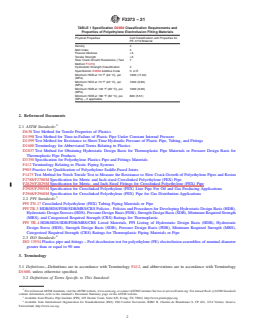
TABLE 1 Specification D3350 Classification Requirements and
Properties of Polyethylene Electrofusion Fitting Materials
Physical Properties Cell Classification and Properties for
PE 4710 Material
Density 4
Melt Index 4
Flexural Modulus >5
Tensile Strength >5
Slow Crack Growth Resistance ( Test 7
Method F1473)
Hydrostatic Strength Classification 4
Specification D3350 Additive Code C or E
Minimum HDB at 73 °F (23 °C), psi 1600 (11.03)
(MPa)
Minimum HDS at 73 °F (23 °C), psi 1000 (6.95)
(MPa)
Minimum HDB at 140 °F (60 °C), psi 1000 (6.95)
(MPa)
Minimum HDB at 180 °F (82 °C), psi 800 (5.51)
(MPa) – if applicable
2. Referenced Documents
2.1 ASTM Standards:
D638 Test Method for Tensile Properties of Plastics
D1598 Test Method for Time-to-Failure of Plastic Pipe Under Constant Internal Pressure
D1599 Test Method for Resistance to Short-Time Hydraulic Pressure of Plastic Pipe, Tubing, and Fittings
D1600 Terminology for Abbreviated Terms Relating to Plastics
D2837 Test Method for Obtaining Hydrostatic Design Basis for Thermoplastic Pipe Materials or Pressure Design Basis for
Thermoplastic Pipe Products
D3350 Specification for Polyethylene Plastics Pipe and Fittings Materials
F412 Terminology Relating to Plastic Piping Systems
F905 Practice for Qualification of Polyethylene Saddle-Fused Joints
F1473 Test Method for Notch Tensile Test to Measure the Resistance to Slow Crack Growth of Polyethylene Pipes and Resins
F2788/F2788M Specification for Metric and Inch-sized Crosslinked Polyethylene (PEX) Pipe
F2829/F2829M Specification for Metric- and Inch-Sized Fittings for Crosslinked Polyethylene (PEX) Pipe
F2905/F2905M Specification for Crosslinked Polyethylene (PEX) Line Pipe For Oil and Gas Producing Applications
F2968/F2968M Specification for Crosslinked Polyethylene (PEX) Pipe for Gas Distribution Applications
2.2 PPI Standards:
PPI TN-17 Crosslinked Polyethylene (PEX) Tubing Piping Materials or Pipe
PPI TR-3 HDB/HDS/PDB/SDB/MRS/CRS Policies - Policies and Procedures for Developing Hydrostatic Design Basis (HDB),
Hydrostatic Design Stresses (HDS), Pressure Design Basis (PDB), Strength Design Basis (SDB), Minimum Required Strength
(MRS), and Categorized Required Strength (CRS) Ratings for Thermoplastic
PPI TR-4 HDB/HDS/SDB/PDB/MRS/CRS Listed Materials, PPI Listing of Hydrostatic Design Basis (HDB), Hydrostatic
Design Stress (HDS), Strength Design Basis (SDB), Pressure Design Basis (PDB), Minimum Required Strength (MRS),
Categorized Required Strength (CRS) Ratings for Thermoplastic Piping Materials or Pipe
2.3 ISO Standards:
ISO 13954 Plastics pipe and fittings – Peel decohesion test for polyethylene (PE) electrofusion assemblies of nominal diameter
greater than or equal to 90 mm
3. Terminology
3.1 Definitions—Definitions are in accordance with Terminology F412, and abbreviations are in accordance with Terminology
D1600, unless otherwise specified.
3.2 Definitions of Terms Specific to This Standard:
For referenced ASTM standards, visit the ASTM website, www.astm.org, or contact ASTM Customer Service at service@astm.org. For Annual Book of ASTM Standards
volume information, refer to the standard’s Document Summary page on the ASTM website.
Available from Plastics Pipe Institute (PPI), 105 Decker Court, Suite 825, Irving, TX 75062, http://www.plasticpipe.org.
Available from International Organization for Standardization (ISO), ISO Central Secretariat, BIBC II, Chemin de Blandonnet 8, CP 401, 1214 Vernier, Geneva,
Switzerland, http://www.iso.org.
F3373 − 21
3.2.1 electrofusion, n—a heat fusion joining process for fittings that have a heat source as an integral part of the fitting. Joining
occurs when, in accordance with a specified procedure, electric energy is applied to the heat source during the procedure.
3.2.2 fusion interface, n—the surface in the heat fusion process where the plastic materials of the products being joined bond
together.
3.2.3 fusion zone length, n—the total length of the melted material in the fitting cross-section under evaluation.
4. Materials and Manufacture
4.1 Material requirements—PE 4710 compounds suitable for use in the manufacture of electrofusion fittings under this
specification shall meet the classification requirements of Specification D3350 as shown in Table 1, and shall meet the Specification
D3350 requirements for brittleness temperature, thermal stability and tensile elongation. The material compound shall also have
HDB and HDS ratings at 73 °F (23 °C) and HDB ratings at 140 °F (60 °C) or higher in accordance with Test Method D2837 and
PPI TR-3 policies, and these PE material compounds shall be listed by a listing agency, such as PPI in TR-4, as PE4710 in
accordance with policies and procedures no less restrictive than those in PPI TR-3.
4.2 Additive Classes—PE 4710 compounds meeting Specification D3350 code C, shall have 2.0 to 3.0 percent carbon black. PE
4710 compounds meeting Specification D3350 code E shall be colored with UV stabilizer.
4.3 Rework Material—Clean polyethylene material that met 4.1 and 4.2 before processing, free of any wire or contaminants, and
generated from the fitting manufacturer’s own production, shall be acceptable for use by the same manufacturer, provided that the
fittings produced conform to the requirements of this specification. Rework material shall be blended with virgin material that
complies with 4.1 and 4.2.
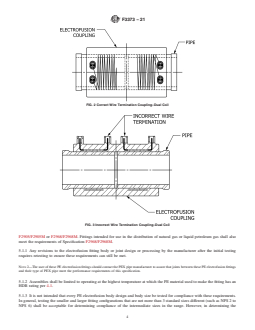
4.4 Heating Mechanism—The heat mechanism shall be of materials and design not detrimental to the performance of the fitting
or the pipe to which it is intended to be joined. Heating mechanisms, such as wires or materials other than polyethylene, shall not
exit the fitting in an area exposed to internal pressure. Heat mechanisms shall be of a design that ensures that wire terminations
are toward the outer edges of the fusion zone length and away from the pressure containing area. Examples of acceptable and
unacceptable wire terminations are shown in Figs. 1-5.
5. Performance Requirements
5.1 The following requirements are for electrofusion fitting joint designs, single or dual coil, and body designs that have been
joined using the fitting manufacturer’s recommended joining procedures. Each PE electrofusion fitting body size, body design and
joint design shall meet the requirements in this section when joined to PEX pipe that complies with Specification F2788/F2788M,
FIG. 1 Correct Wire Termination Coupling–Single Coil
F3373 − 21
FIG. 2 Correct Wire Termination Coupling–Dual Coil
FIG. 3 Incorrect Wire Termination Coupling–Dual Coil
F2905/F2905M or F2968/F2968M. Fittings intended for use in the distribution of natural gas or liquid petroleum gas shall also
meet the requirements of Specification F2968/F2968M.
5.1.1 Any revisions to the electrofusion fitting body or joint design or processing by the manufacturer after the initial testing
requires retesting to ensure these requirements can still be met.
NOTE 2—The user of these PE electrofusion fittings should contact the PEX pipe manufacturer to assure that joints between these PE electrofusion fittings
and their type of PEX pipe meet the performance requirements of this specification.
5.1.2 Assemblies shall be limited to operating at the highest temperature at which the PE material used to make the fitting has an
HDB rating per 4.1.
5.1.3 It is not intended that every PE electrofusion body design and body size be tested for compliance with these requirements.
In general, testing the smaller and larger fitting configurations that are not more than 3 standard sizes different (such as NPS 2 to
NPS 6) shall be acceptable for determining compliance of the intermediate sizes in the range. However, in determining the
F3373 − 21
FIG. 4 Correct Wire Termination–Saddle Fitting
FIG. 5 Incorrect Wire Termination Saddle–Single Coil
similarity or difference between various body designs (coupling, elbow, cross, wye, etc) resistance to internal pressure stress
concentrations, and resistance coil design and size shall be taken into account.
NOTE 3—For example, internal pressure fitting body stress concentrations between a coupling and a wye may differ significantly; whereas, internal
pressure stress concentrations between a tee and a saddle may be similar. Likewise a single or dual coil design may be suitable for some body designs
but not others, and scaling may be affected by outlet size.
5.1.4 Saddle fittings shall be joined in accordance with manufacturer’s recommendations to PEX main pipe. The PEX main pipe
shall be perforated through the saddle branch outlet in accordance with manufacturer’s recommendations to the maximum
perforation hole size recommended and shall be tested with branch outlet(s) joined using the manufacturer’s procedure to lengths
of PEX pipe material for which the manufacturer recommends the use of his fitting. Lengths of PEX pipe joined to saddle fitting
outlets shall be in accordance with 8.3.1.
5.2 Pressure Requirements:
5.2.1 Minimum Hydraulic Burst Pressure—To test the PE electrofusion fitting, the fitting manufacturer shall use PEX pipe having
F3373 − 21
a 1600 psi HDB. The fitting and fused joint shall not fail when tested in accordance with 9.19.1. The minimum hydraulic burst
pressure at 73 °F (23 °C) of the test specimen shall be 2900 psi (20 MPa).
5.2.2 Sustained Pressure—To test the PE electrofusion fitting, the fitting manufacturer shall use PEX pipe having a 1600 psi HDB.
The fitting and fused joint shall not fail when tested in accordance with 9.2 at t. The test pressure, minimum time-to-failure, and
test temperature in accordance with Table 2. Where the controlling pipe standard requires testing at multiple temperatures,
sustained pressure testing shall only be performed at the highest test temperature, not to exceed 180 °F (82 °C). If a pipe standard
is not specified, or does not contain test requirements, the test pressure, minimum time-to-failure and test temperature shall be as
shown in Table 2.
5.3 Tensile Strength Requirements for Coupling Type Joints Up to NPS 8—The fitting or the pipe to fitting joint made on pipe shall
not fail when tested in accordance with 9.3. Specimens shall be subjected to a tensile stress that causes the pipe to yield to an
elongation no less than 25 % or causes the pipe to break outside the joint area. Tensile tests must be made on specimens as joined,
not on straps cut from the specimen. Yielding must be measured only in the pipe, independent of the fitting or joint.
5.3.1 Equipment needed to conduct full-scale tensile tests for sizes larger than NPS 8 is not readily available; therefore, tensile
tests for these sizes shall be tested in accordance with Annex A2. The tests performed in Annex A2 also qualify the fitting design
for the joint crush test portion of 5.5.
5.4 Impact Resistance (Saddle Type Joints Only)—The joint made on the specimen shall not fail when impacted with a force
sufficient to break the body or other portion of the specimen. Tests of 500 ft-lb or higher impact with no failures noted shall be
considered as a “pass” impact test. The device for testing and the methods shall be as defined in Practice F905.
5.5 Joint Integrity Tests—(Couplings and Saddle Type Joints)—The joint made on the specimen shall meet the requirements in 9.4
and 9.5 of this specification, when tested in accordance with 9.4.
5.5.1 Equipment needed to perform crush testing to the procedure described in 9.4.1 for NPS 8 and larger is not readily available,
or can be hazardous to operate safely; therefore, an optional alternative to crush tests for coupling-type joints 8 IPS and larger is
included as mandatory information in Annex A2. Tests performed in Annex A2 qualify the fitting design in lieu of the joint crush
test portion of 9.4.1. All other performance requirements in Section 5 and 9.4.1 shall be satisfied by testing to the requirements
using the methods described in Section 9.
6. Dimensions and Permissible Variations
6.1 Dimension and tolerances of electrofusion fittings must be such that heat fusion is possible to outside diameter (OD) controlled
PEX pipes that comply with Specifications F2788/F2788M, F2905/F2905M and F2968/F2968M, such that the joints will satisfy
the performance requirements in Section 5.
6.2 Because of the varying designs for electrofusion fittings, the actual spread of dimensions may be quite different from
manufacturer to manufacturer. A table of dimensions and tolerances encompassing these differences would be meaningless and
without value and, therefore, is omitted from this specification.
6.3 The manufacturer shall furnish to the user the electrical resistance, critical dimensions, and tolerances of his fittings. This
information must include at least the following dimensions and tolerances:
TABLE 2 Sustained Pressure Test Requirements
PEX with HDB of 1600 psi at 73 °F
(23 °C)
Test Test Hoop Minimum
Condition
Temperature °F Stress psi Average Time
A
(°C) Before Failure
Hours
1 176 (80) 750 (5170) 200
2 176 (80) 640 (4415) 1200
A
Test temperature tolerance ± 4 °F (± 2 °C). Test pressure tolerance ± 5 psi (± 35
kPa); test pressure hoop stress values are rounded to the nearest 5 psi or 5 kPa.
Table 2 conditions are based on PE validation requirements per PPI TR-3 with
Condition 2 being 85 % of Condition 1 hoop stress and six times greater minimum
average time before failure.
F3373 − 21
6.3.1 Inside diameter of each electrofusion joint connection,
6.3.2 Operating temperature joining limits, and
6.3.3 Operating pressure limits of the fitting.
NOTE 4—There are other items that fall beyond the scope of this specification, which would be of interest to the user for proper application of the fittings
and is recommended as additional information to be furnished. A few of these are: (1) maximum pipe out of round allowed at joint area; (2)
minimum/maximum pipe SDR capability of the fitting, and (3) for saddles intended for use on a live main, the maximum allowable line pressure when
making the joint.
7. Workmanship, Finish, and Appearance
7.1 The manufacture of these fittings shall be in accordance with good commercial practice so as to produce fittings meeting the
requirements of this specification.
7.2 The fittings shall be homogeneous throughout, except where a heating coil or electrical connectors are incorporated, and free
of cracks, holes, foreign inclusions, or injurious defects such as gouges, dents, cuts, etc. The fittings shall be as uniform as
commercially practicable in opacity, density, and other physical properties. Any heating coils, connecting cables, connectors, and
related electrical power source shall be designed to prevent electrical shock to the user.
8. Specimen Preparation
8.1 Conditioning:
8.1.1 Unless otherwise specified, condition the specimens (pipe and fittings) prior to joining at the minimum pipe temperature
allowable for fusion as recommended by the manufacturer, for not less than 16 h and make the fusion joint at that temperature for
those tests where conditioning is required.
8.1.2 Unless otherwise specified, condition the specimens (pipe and fittings) prior to joining at the maximum pipe temperature
allowable for fusion as recommended by the manufacturer, for not less than 16 h and make the fusion joint at that temperature for
those tests where conditioning is required.
8.1.3 After conditioning per 8.1.1 and 8.1.2, condition specimens at 7373 °F 6 4 °F (23(23 °C 6 2 °C) for not less than 16 h prior
to testing.
8.2 Test Conditions—Conduct the tests at the Standard Laboratory Temperature of 7373 °F 6 4°F (234 °F (23 °C 6 2°C)2 °C)
unless otherwise specified.
8.3 Preparation of Specimens for Testing:
8.3.1 Prepare test specimens so that the minimum length of unreinforced PEX pipe on one side of any fitting is equal to three times
the diameter of the pipe, but in no case less than 12 in. (304 mm). It is permissible to test multiple fittings together provided they
are separated by a minimum distance equal to three times the diameter of the pipe, but in no case less than 12 in. (304 mm).
8.3.2 Using the manufacturer’s recommended joining procedures, fuse all fitting outlets with to the appropriate size pipe.
8.3.3 Saddle fitting specimens conditioned per 8.1.2 for quick burst testing per 9.1 or sustained pressure testing per 9.2, shall be
joined to pipe that is under pressure. Before, during and after joining, the pipe shall be pressurized to no less than the maximum
allowable operating pressure of the pipe system or fitting, whichever is lowest, when being prepared for those tests. The pipe shall
be left under pressure for a time period not less than recommended by the manufacturer for cooling in the field prior to testing.
It shall be acceptable to join saddle joint specimens for mechanical/destructive type tests such as impact per 5.4 or crush tests per
9.4, or specimens conditioned for cold temperature joining per 8.1.1, may be made on pressurized or unpressured pipe.
9. Test Methods
9.1 Minimum Hydraulic Burst Pressure Test:
F3373 − 21
9.1.1 Select four fittings at random and prepare specimens in accordance with Section 8. From the four specimens, condition two
specimens each in accordance with 8.1.1 and 8.1.2 and 8.1.3.
9.1.2 Test the specimens in accordance with Test Method D1599.
9.1.3 Failure of the fitting or joint shall constitute specimen failure. The test equipment, procedures, and failures definitions shall
be as specified in Test Method D1599.
9.1.4 Failure of any one of the four specimens shall constitute failure of the test. Failure of one of the four specimens tested is
cause for retest of four additional specimens, joined at the failed specimen’s joining temperature. Failure of any of these four
additional specimens constitutes a failure of the test.
9.2 Sustained Pressure Test:
9.2.1 Select four fittings at random and prepare specimens in accordance with Section 8 of this specification. From the four
specimens, condition two specimens each in accordance with 8.1.1 and 8.1.2 and 8.1.3.
9.2.2 Test the specimens in accordance with Test Method D1598. The assemblies are to be subjected to pipe fiber stresses and
minimum test periods in accordance with the requirements of Table 2 for the pipe material type being tested with the electrofusion
fitting.
9.2.3 Failure of the fitting or joint shall constitute specimen failure.
9.2.4 Failure of any one of the four specimens shall constitute failure of the test. Failure of one of the four specimens tested is
cause for retest of four additional specimens, joined at the failed-specimens-joining temperature. Failure of any of these four
additional specimens constitutes a failure of the test.
9.3 Tensile Strength Test (Coupling Only):
9.3.1 Select four fittings at random and prepare specimens in accordance with Section 8 with the exception that it is permissible,
on pipe sizes above 4 in. (102 mm) IPS, if limits of tensile machine will not allow 25 % elongation with pipe specimens of
three-pipe diameters, to test with free pipe lengths of 20 in. (304 mm) minimum. From the four specimens, condition two
specimens each in accordance with 8.1.1, 8.1.2 and 8.1.3.
9.3.2 Test the specimens using the apparatus of Test Method D638. Test at a pull rate of 0.20 in. (5.0 mm) per min, 6 25 %.
9.3.3 Failure of the fitting or joint as defined in 5.3, shall constitute specimen failure.
9.3.4 Failure of any one of the four specimens shall constitute failure of the test. Failure of one of the four specimens tested is
cause for retest of four additional specimens, joined at the failed specimens joining temperature. Failure of any of these four
additional specimens constitutes a failure of the test.
9.4 Joint Integrity Tests—Illustrations of joint crush tests for couplings and saddles are offered in 9.4.1 and 9.4.2 as test methods
that are useful as an evaluation of bonding strength between the pipe and fitting. Alternately, the fusion evaluation test (FET)
offered in 9.4.3 and 9.4.4 may be used in lieu of the crush test. Similar test evaluations as specified in the contract or purchase
order and as agreed upon by the purchaser and manufacturer are of equal value in performing such evaluations and may be
substituted with such agreement.
9.4.1 Joint Crush Test (Coupling Only):
9.4.1.1 Select four fittings at random and prepare specimens in accordance with Section 8. From the four specimens, condition
two specimens each in accordance with 8.1.1, 8.1.2, and 8.1.3.
NOTE 5—It is permissible to utilize in joint integrity testing, specimens from the quick-burst tests conducted in 9.1 after visually determining that neither
the joint area nor the pipe seg
...