

ASTM D4546-21
(Test Method)Standard Test Methods for One-Dimensional Swell or Collapse of Soils
General Information
- Abstract
SIGNIFICANCE AND USE
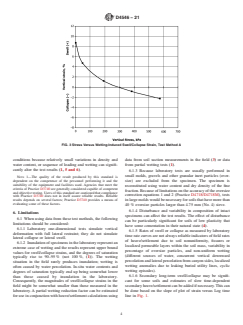
5.1 The wetting-induced swell/collapse strains measured from Test Methods A and B can be used to develop estimates of heave or settlement of a confined soil profile (1-4).4 They can also be used to estimate the magnitudes of the swell pressure (Fig. 3) and the free swell strain (percent swell under a pressure of 1 kPa (20 lbf/ft2)). The load-induced strains after wetting from Test Method C can be used to estimate stress-induced settlement following wetting-induced heave or settlement. Selection of test method, loading, and inundation sequences should, as closely as possible, simulate field conditions because relatively small variations in density and water content, or sequence of loading and wetting can significantly alter the test results (1, 5 and 6).
FIG. 3 Stress Versus Wetting-Induced Swell/Collapse Strain, Test Method A
Note 1: The quality of the result produced by this standard is dependent on the competence of the personnel performing it and the suitability of the equipment and facilities used. Agencies that meet the criteria of Practice D3740 are generally considered capable of competent and objective testing. Users of this standard are cautioned that compliance with Practice D3740 does not in itself assure reliable results. Reliable results depends on several factors; Practice D3740 provides a means of evaluating some of these factors.
SCOPE
1.1 This standard covers two laboratory test methods for measuring the magnitude of one-dimensional wetting-induced swell or collapse of unsaturated soils and one method for measuring load-induced compression subsequent to wetting-induced deformation.
1.1.1 Test Method A is a procedure for measuring one-dimensional wetting-induced swell or hydrocompression (collapse) of reconstituted specimens simulating field condition of compacted fills. The magnitude of swell pressure (the minimum vertical stress required to prevent swelling), and free swell (percent swell under a pressure of 1 kPa or 20 lbf/ft2) can also be determined from the results of Test Method A.
1.1.2 Test Method B is a procedure for measuring one-dimensional wetting-induced swell or collapse deformation of intact specimens obtained from a natural deposit or from an existing compacted fill. The magnitude of swell pressure and free swell can also be determined from the results of Test Method B.
1.1.3 Test Method C is a procedure for measuring load-induced strains on a reconstituted or intact specimen after the specimen has undergone wetting-induced swell or collapse deformation.
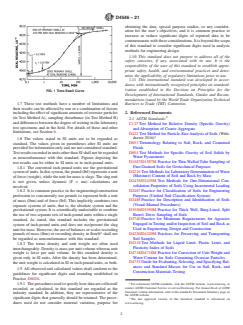
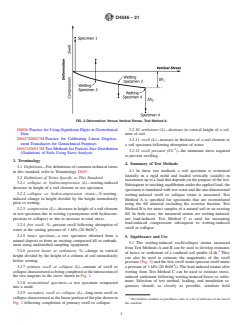
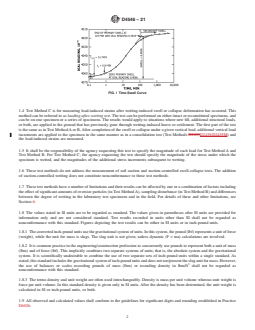
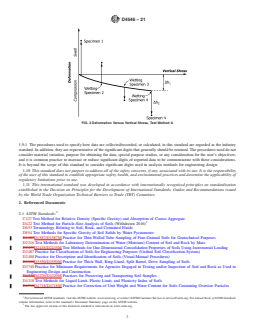
1.2 In Test Method A, a series of reconstituted specimens duplicating compaction condition of the fine fraction of the soil in the field (excluding the oversize particles) are assembled in consolidometer units. Different loads corresponding to different fill depths are applied to different specimens and each specimen is given access to free water until the process of primary swell or collapse is completed (Fig. 1) under a constant vertical total stress (Fig. 2). The resulting swell or collapse deformations are measured. This test method can be referred to as wetting-after-loading tests on multiple reconstituted specimens. The data from these tests can be used to estimate one-dimensional ground surface heave or settlement that can occur due to full wetting after fill construction. In addition, the magnitude of swell pressure and the magnitude of free swell can be interpreted from the test results.
FIG. 1 Time-Swell Curve
FIG. 2 Deformation Versus Vertical Stress, Test Method A
1.3 Test Method B is commonly used for measuring one-dimensional wetting-induced swell or hydrocompression of individual intact samples. This method can be referred to as single-point wetting-after-loading test. The vertical pressure at wetting for the specimen is chosen equal to the vertical in-situ stress (overburden stress plus structural stress, if any) corresponding to the sampling depth. The test result ind...
- Status
- Published
- Publication Date
- 31-Mar-2021
- Technical Committee
- D18 - Soil and Rock
- Drafting Committee
- D18.05 - Strength and Compressibility of Soils
Overview
ASTM D4546-21, "Standard Test Methods for One-Dimensional Swell or Collapse of Soils," is a key standard published by ASTM International for geotechnical testing. This standard outlines laboratory procedures to assess the wetting-induced swell or collapse behaviors of unsaturated soils and to measure load-induced compression after such volume changes. Accurate evaluation of soil swell, collapse, and settlement is fundamental for safe and effective design and construction of foundations, earthworks, and infrastructure, especially in areas where soil volume change due to moisture fluctuations can impact stability.
These test methods provide essential data for estimating the potential ground surface heave or settlement under changing moisture or load conditions. The procedures are designed to closely simulate expected field conditions and are widely used in geotechnical engineering, construction, and soil research projects.
Key Topics
Test Methods:
- Test Method A: Determines one-dimensional swell or collapse (hydrocompression) of reconstituted specimens replicating compacted field fills.
- Test Method B: Measures wetting-induced deformation of intact specimens from natural deposits or existing fills.
- Test Method C: Evaluates load-induced strains post wetting-induced deformation on either intact or reconstituted samples.
Measured Parameters:
- Swell Pressure: The minimum vertical stress required to prevent swelling.
- Free Swell Strain: Percent swell under a nominal pressure (1 kPa).
- Settlement/Heave: Vertical displacement of soil layers following wetting or applied load.
Field Simulation:
Testing procedures are selected to replicate field conditions (density, water content, load sequence), as lab variations can significantly influence results.Sample Handling:
Proper sampling, preservation, and preparation of soil specimens are highlighted to ensure reliable and representative results.Limitations:
Laboratory results often represent upper-bound volume changes since field wetting is rarely as thorough as lab inundation. The presence of oversize particles and sampling disturbance can influence accuracy.
Applications
Geotechnical Engineering:
Used in foundation design, assessment of potential for ground heave or collapse, slope stability, and the evaluation of earth embankments and fills.Construction Planning:
Provides data for anticipating and mitigating volume changes in soils due to moisture influx post-construction, preventing damage to roads, building foundations, retaining walls, and buried utilities.Site Investigation:
Assists engineers and geologists in identifying expansive or collapsible soils, enabling informed site selection and design modifications.Remediation Projects:
Informs design of ground modification or stabilization techniques where problematic soils are present.
Related Standards
- ASTM D2435/D2435M: Test methods for one-dimensional consolidation properties of soils using incremental loading.
- ASTM D2216: Laboratory determination of water (moisture) content of soil and rock.
- ASTM D2487/D2488: Practices for classification and identification of soils.
- ASTM D3740: Practice for minimum requirements for agencies engaged in soil and rock testing.
- ASTM D4718/D4718M: Practice for correction of unit weight and water content for soils containing oversize particles.
- ASTM D4318: Test methods for liquid limit, plastic limit, and plasticity index of soils.
Practical Value
ASTM D4546-21 provides a rigorous framework for evaluating soil response to wetting and loading, mitigating construction risks in expansive or collapsible soils. By delivering standardized procedures and data interpretation guidelines, it supports reliable geotechnical characterization crucial for civil engineering, infrastructure design, and land development. Adherence to ASTM D4546-21 helps ensure safety, performance, and long-term durability of projects affected by soil volume changes.
Relations
- Effective Date
- 01-Feb-2024
- Effective Date
- 01-Jan-2024
- Effective Date
- 01-Nov-2023
- Effective Date
- 01-Nov-2023
- Effective Date
- 01-Oct-2019
- Effective Date
- 01-Mar-2019
- Effective Date
- 15-Dec-2017
- Effective Date
- 15-Dec-2017
- Effective Date
- 15-Jul-2017
- Refers
ASTM D4318-17 - Standard Test Methods for Liquid Limit, Plastic Limit, and Plasticity Index of Soils - Effective Date
- 01-Jun-2017
- Effective Date
- 01-Jun-2017
- Effective Date
- 01-Apr-2017
- Effective Date
- 15-Nov-2015
- Effective Date
- 01-Jul-2015
- Effective Date
- 01-May-2015
Get Certified
Connect with accredited certification bodies for this standard

Zavod za gradbeništvo Slovenije (ZAG) - Inšpekcija
ZAG inspection body for construction products, structures, and materials.
Sponsored listings
Frequently Asked Questions
ASTM D4546-21 is a standard published by ASTM International. Its full title is "Standard Test Methods for One-Dimensional Swell or Collapse of Soils". This standard covers: SIGNIFICANCE AND USE 5.1 The wetting-induced swell/collapse strains measured from Test Methods A and B can be used to develop estimates of heave or settlement of a confined soil profile (1-4).4 They can also be used to estimate the magnitudes of the swell pressure (Fig. 3) and the free swell strain (percent swell under a pressure of 1 kPa (20 lbf/ft2)). The load-induced strains after wetting from Test Method C can be used to estimate stress-induced settlement following wetting-induced heave or settlement. Selection of test method, loading, and inundation sequences should, as closely as possible, simulate field conditions because relatively small variations in density and water content, or sequence of loading and wetting can significantly alter the test results (1, 5 and 6). FIG. 3 Stress Versus Wetting-Induced Swell/Collapse Strain, Test Method A Note 1: The quality of the result produced by this standard is dependent on the competence of the personnel performing it and the suitability of the equipment and facilities used. Agencies that meet the criteria of Practice D3740 are generally considered capable of competent and objective testing. Users of this standard are cautioned that compliance with Practice D3740 does not in itself assure reliable results. Reliable results depends on several factors; Practice D3740 provides a means of evaluating some of these factors. SCOPE 1.1 This standard covers two laboratory test methods for measuring the magnitude of one-dimensional wetting-induced swell or collapse of unsaturated soils and one method for measuring load-induced compression subsequent to wetting-induced deformation. 1.1.1 Test Method A is a procedure for measuring one-dimensional wetting-induced swell or hydrocompression (collapse) of reconstituted specimens simulating field condition of compacted fills. The magnitude of swell pressure (the minimum vertical stress required to prevent swelling), and free swell (percent swell under a pressure of 1 kPa or 20 lbf/ft2) can also be determined from the results of Test Method A. 1.1.2 Test Method B is a procedure for measuring one-dimensional wetting-induced swell or collapse deformation of intact specimens obtained from a natural deposit or from an existing compacted fill. The magnitude of swell pressure and free swell can also be determined from the results of Test Method B. 1.1.3 Test Method C is a procedure for measuring load-induced strains on a reconstituted or intact specimen after the specimen has undergone wetting-induced swell or collapse deformation. 1.2 In Test Method A, a series of reconstituted specimens duplicating compaction condition of the fine fraction of the soil in the field (excluding the oversize particles) are assembled in consolidometer units. Different loads corresponding to different fill depths are applied to different specimens and each specimen is given access to free water until the process of primary swell or collapse is completed (Fig. 1) under a constant vertical total stress (Fig. 2). The resulting swell or collapse deformations are measured. This test method can be referred to as wetting-after-loading tests on multiple reconstituted specimens. The data from these tests can be used to estimate one-dimensional ground surface heave or settlement that can occur due to full wetting after fill construction. In addition, the magnitude of swell pressure and the magnitude of free swell can be interpreted from the test results. FIG. 1 Time-Swell Curve FIG. 2 Deformation Versus Vertical Stress, Test Method A 1.3 Test Method B is commonly used for measuring one-dimensional wetting-induced swell or hydrocompression of individual intact samples. This method can be referred to as single-point wetting-after-loading test. The vertical pressure at wetting for the specimen is chosen equal to the vertical in-situ stress (overburden stress plus structural stress, if any) corresponding to the sampling depth. The test result ind...
SIGNIFICANCE AND USE 5.1 The wetting-induced swell/collapse strains measured from Test Methods A and B can be used to develop estimates of heave or settlement of a confined soil profile (1-4).4 They can also be used to estimate the magnitudes of the swell pressure (Fig. 3) and the free swell strain (percent swell under a pressure of 1 kPa (20 lbf/ft2)). The load-induced strains after wetting from Test Method C can be used to estimate stress-induced settlement following wetting-induced heave or settlement. Selection of test method, loading, and inundation sequences should, as closely as possible, simulate field conditions because relatively small variations in density and water content, or sequence of loading and wetting can significantly alter the test results (1, 5 and 6). FIG. 3 Stress Versus Wetting-Induced Swell/Collapse Strain, Test Method A Note 1: The quality of the result produced by this standard is dependent on the competence of the personnel performing it and the suitability of the equipment and facilities used. Agencies that meet the criteria of Practice D3740 are generally considered capable of competent and objective testing. Users of this standard are cautioned that compliance with Practice D3740 does not in itself assure reliable results. Reliable results depends on several factors; Practice D3740 provides a means of evaluating some of these factors. SCOPE 1.1 This standard covers two laboratory test methods for measuring the magnitude of one-dimensional wetting-induced swell or collapse of unsaturated soils and one method for measuring load-induced compression subsequent to wetting-induced deformation. 1.1.1 Test Method A is a procedure for measuring one-dimensional wetting-induced swell or hydrocompression (collapse) of reconstituted specimens simulating field condition of compacted fills. The magnitude of swell pressure (the minimum vertical stress required to prevent swelling), and free swell (percent swell under a pressure of 1 kPa or 20 lbf/ft2) can also be determined from the results of Test Method A. 1.1.2 Test Method B is a procedure for measuring one-dimensional wetting-induced swell or collapse deformation of intact specimens obtained from a natural deposit or from an existing compacted fill. The magnitude of swell pressure and free swell can also be determined from the results of Test Method B. 1.1.3 Test Method C is a procedure for measuring load-induced strains on a reconstituted or intact specimen after the specimen has undergone wetting-induced swell or collapse deformation. 1.2 In Test Method A, a series of reconstituted specimens duplicating compaction condition of the fine fraction of the soil in the field (excluding the oversize particles) are assembled in consolidometer units. Different loads corresponding to different fill depths are applied to different specimens and each specimen is given access to free water until the process of primary swell or collapse is completed (Fig. 1) under a constant vertical total stress (Fig. 2). The resulting swell or collapse deformations are measured. This test method can be referred to as wetting-after-loading tests on multiple reconstituted specimens. The data from these tests can be used to estimate one-dimensional ground surface heave or settlement that can occur due to full wetting after fill construction. In addition, the magnitude of swell pressure and the magnitude of free swell can be interpreted from the test results. FIG. 1 Time-Swell Curve FIG. 2 Deformation Versus Vertical Stress, Test Method A 1.3 Test Method B is commonly used for measuring one-dimensional wetting-induced swell or hydrocompression of individual intact samples. This method can be referred to as single-point wetting-after-loading test. The vertical pressure at wetting for the specimen is chosen equal to the vertical in-situ stress (overburden stress plus structural stress, if any) corresponding to the sampling depth. The test result ind...
ASTM D4546-21 is classified under the following ICS (International Classification for Standards) categories: 93.020 - Earthworks. Excavations. Foundation construction. Underground works. The ICS classification helps identify the subject area and facilitates finding related standards.
ASTM D4546-21 has the following relationships with other standards: It is inter standard links to ASTM D4753-24, ASTM D6027/D6027M-24, ASTM D854-23, ASTM D3740-23, ASTM D3740-19, ASTM D2216-19, ASTM D2487-17e1, ASTM D2487-17, ASTM D2488-17, ASTM D4318-17, ASTM D4318-17e1, ASTM D3550/D3550M-17, ASTM D1587/D1587M-15, ASTM D6027/D6027M-15, ASTM D4753-15. Understanding these relationships helps ensure you are using the most current and applicable version of the standard.
ASTM D4546-21 is available in PDF format for immediate download after purchase. The document can be added to your cart and obtained through the secure checkout process. Digital delivery ensures instant access to the complete standard document.
Standards Content (Sample)
This international standard was developed in accordance with internationally recognized principles on standardization established in the Decision on Principles for the
Development of International Standards, Guides and Recommendations issued by the World Trade Organization Technical Barriers to Trade (TBT) Committee.
Designation: D4546 − 21
Standard Test Methods for
One-Dimensional Swell or Collapse of Soils
This standard is issued under the fixed designation D4546; the number immediately following the designation indicates the year of
original adoption or, in the case of revision, the year of last revision. A number in parentheses indicates the year of last reapproval. A
superscript epsilon (´) indicates an editorial change since the last revision or reapproval.
1. Scope* addition, the magnitude of swell pressure and the magnitude of
free swell can be interpreted from the test results.
1.1 This standard covers two laboratory test methods for
1.3 Test Method B is commonly used for measuring one-
measuring the magnitude of one-dimensional wetting-induced
dimensional wetting-induced swell or hydrocompression of
swell or collapse of unsaturated soils and one method for
individual intact samples. This method can be referred to as
measuring load-induced compression subsequent to wetting-
single-point wetting-after-loading test. The vertical pressure at
induced deformation.
wetting for the specimen is chosen equal to the vertical in-situ
1.1.1 Test Method A is a procedure for measuring one-
stress (overburden stress plus structural stress, if any) corre-
dimensional wetting-induced swell or hydrocompression (col-
sponding to the sampling depth. The test result indicates the
lapse) of reconstituted specimens simulating field condition of
amount of heave or hydrocompression that can result when the
compacted fills. The magnitude of swell pressure (the mini-
soil at a given fill depth is wetted from the current moisture
mum vertical stress required to prevent swelling), and free
condition to full inundation condition. If intact specimens from
swell (percent swell under a pressure of 1 kPa or 20 lbf/ft ) can
various depths are tested, the swell or collapse strain data can
also be determined from the results of Test Method A.
be used to estimate heave or settlement of the ground surface.
1.1.2 Test Method B is a procedure for measuring one-
If the objective of the test is to measure swell pressure for an
dimensional wetting-induced swell or collapse deformation of
expansive soil, a series of intact specimens from a given depth
intact specimens obtained from a natural deposit or from an
zone can be wetted under a range of pressures (similar to Test
existing compacted fill. The magnitude of swell pressure and
Method A) and the results interpreted to determine the magni-
free swell can also be determined from the results of Test
tude of the swell pressure.
Method B.
1.1.3 Test Method C is a procedure for measuring load-
1.4 Test Method C is for measuring load-induced strains
induced strains on a reconstituted or intact specimen after the after wetting-induced swell or collapse deformation has oc-
specimen has undergone wetting-induced swell or collapse
curred.This method can be referred to as loading-after-wetting
deformation.
test. The test can be performed on either intact or reconstituted
specimens, and can be on one specimen or a series of
1.2 In Test Method A, a series of reconstituted specimens
specimens. The results would apply to situations where new
duplicatingcompactionconditionofthefinefractionofthesoil
fill, additional structural loads, or both, are applied to the
in the field (excluding the oversize particles) are assembled in
ground that has previously gone through wetting-induced
consolidometer units. Different loads corresponding to differ-
heave or settlement. The first part of the test is the same as in
ent fill depths are applied to different specimens and each
Test Method A or B. After completion of the swell or collapse
specimen is given access to free water until the process of
under a given vertical load, additional vertical load increments
primary swell or collapse is completed (Fig. 1) under a
are applied to the specimen in the same manner as in a
constant vertical total stress (Fig. 2). The resulting swell or
consolidation test (Test Methods D2435/D2435M) and the
collapse deformations are measured. This test method can be
load-induced strains are measured.
referred to as wetting-after-loading tests on multiple reconsti-
tuted specimens. The data from these tests can be used to 1.5 It shall be the responsibility of the agency requesting
estimate one-dimensional ground surface heave or settlement this test to specify the magnitude of each load for Test Method
that can occur due to full wetting after fill construction. In A and Test Method B. For Test Method C, the agency
requesting the test should specify the magnitude of the stress
under which the specimen is wetted, and the magnitudes of the
additional stress increments subsequent to wetting.
These test methods are under the jurisdiction ofASTM Committee D18 on Soil
and Rock and are the direct responsibility of Subcommittee D18.05 on Strength and
1.6 These test methods do not address the measurement of
Compressibility of Soils.
soil suction and suction-controlled swell-collapse tests. The
Current edition approved April 1, 2021. Published April 2021. Originally
ɛ1
addition of suction-controlled wetting does not constitute
approved in 1985. Last previous edition approved in 2014 as D4546 – 14 . DOI:
10.1520/D4546-21. nonconformance to these test methods.
*A Summary of Changes section appears at the end of this standard
Copyright © ASTM International, 100 Barr Harbor Drive, PO Box C700, West Conshohocken, PA 19428-2959. United States
D4546 − 21
obtaining the data, special purpose studies, or any consider-
ation for the user’s objectives; and it is common practice to
increase or reduce significant digits of reported data to be
commensuratewiththeseconsiderations.Itisbeyondthescope
of this standard to consider significant digits used in analysis
methods for engineering design.
1.10 This standard does not purport to address all of the
safety concerns, if any, associated with its use. It is the
responsibility of the user of this standard to establish appro-
priate safety, health, and environmental practices and deter-
mine the applicability of regulatory limitations prior to use.
1.11 This international standard was developed in accor-
dance with internationally recognized principles on standard-
ization established in the Decision on Principles for the
FIG. 1 Time-Swell Curve
Development of International Standards, Guides and Recom-
mendations issued by the World Trade Organization Technical
1.7 These test methods have a number of limitations and
Barriers to Trade (TBT) Committee.
their results can be affected by one or a combination of factors
2. Referenced Documents
including the effect of significant amounts of oversize particles
(in Test Method A), sampling disturbance (in Test Method B)
2.1 ASTM Standards:
and differences between the degree of wetting in the laboratory
C127 Test Method for Relative Density (Specific Gravity)
test specimens and in the field. For details of these and other
and Absorption of Coarse Aggregate
limitations, see Section 6.
D422 Test Method for Particle-SizeAnalysis of Soils (With-
drawn 2016)
1.8 The values stated in SI units are to be regarded as
D653 Terminology Relating to Soil, Rock, and Contained
standard. The values given in parentheses after SI units are
Fluids
provided for information only and are not considered standard.
D854 Test Methods for Specific Gravity of Soil Solids by
TestresultsrecordedinunitsotherthanSIshallnotberegarded
Water Pycnometer
as nonconformance with this standard. Figures depicting the
D1587/D1587M Practice for Thin-Walled Tube Sampling of
test results can be either in SI units or in inch-pound units.
Fine-Grained Soils for Geotechnical Purposes
1.8.1 The converted inch-pound units use the gravitational
D2216 Test Methods for Laboratory Determination of Water
systemofunits.Inthissystem,thepound(lbf)representsaunit
(Moisture) Content of Soil and Rock by Mass
offorce(weight),whiletheunitformassisslugs.Theslugunit
D2435/D2435M Test Methods for One-Dimensional Con-
is not given, unless dynamic (F = ma) calculations are
solidation Properties of Soils Using Incremental Loading
involved.
D2487 Practice for Classification of Soils for Engineering
1.8.2 It is common practice in the engineering/construction
Purposes (Unified Soil Classification System)
profession to concurrently use pounds to represent both a unit
D2488 Practice for Description and Identification of Soils
of mass (lbm) and of force (lbf). This implicitly combines two
(Visual-Manual Procedures)
separate systems of units; that is, the absolute system and the
D3550/D3550M Practice for Thick Wall, Ring-Lined, Split
gravitational system. It is scientifically undesirable to combine
Barrel, Drive Sampling of Soils
the use of two separate sets of inch-pound units within a single
D3740 Practice for Minimum Requirements for Agencies
standard. As stated, this standard includes the gravitational
Engaged in Testing and/or Inspection of Soil and Rock as
system of inch-pound units and does not use/present the slug
Used in Engineering Design and Construction
unit for mass. However, the use of balances or scales recording
D4220/D4220M Practices for Preserving and Transporting
pounds of mass (lbm) or recording density in lbm/ft shall not
Soil Samples
be regarded as nonconformance with this standard.
D4318 Test Methods for Liquid Limit, Plastic Limit, and
1.8.3 The terms density and unit weight are often used
Plasticity Index of Soils
interchangeably. Density is mass per unit volume whereas unit
D4718/D4718M Practice for Correction of Unit Weight and
weight is force per unit volume. In this standard density is
Water Content for Soils Containing Oversize Particles
given only in SI units. After the density has been determined,
D4753 Guide for Evaluating, Selecting, and Specifying Bal-
the unit weight is calculated in SI or inch-pound units, or both.
ances and Standard Masses for Use in Soil, Rock, and
1.9 All observed and calculated values shall conform to the
Construction Materials Testing
guidelines for significant digits and rounding established in
Practice D6026.
1.9.1 Theproceduresusedtospecifyhowdataarecollected/
For referenced ASTM standards, visit the ASTM website, www.astm.org, or
contact ASTM Customer Service at service@astm.org. For Annual Book of ASTM
recorded, or calculated, in this standard are regarded as the
Standards volume information, refer to the standard’s Document Summary page on
industry standard. In addition, they are representative of the
the ASTM website.
significant digits that generally should be retained. The proce-
The last approved version of this historical standard is referenced on
dures used do not consider material variation, purpose for www.astm.org.
D4546 − 21
FIG. 2 Deformation Versus Vertical Stress, Test Method A
D6026 Practice for Using Significant Digits in Geotechnical 3.2.10 settlement (L)—decrease in vertical height of a col-
Data umn of soil.
D6027/D6027M Practice for Calibrating Linear Displace-
3.2.11 swell (L)—increase in thickness of a soil element or
ment Transducers for Geotechnical Purposes
a soil specimen following absorption of water.
D6913/D6913M Test Methods for Particle-Size Distribution
-2
3.2.12 swell pressure (FL )—the minimum stress required
(Gradation) of Soils Using Sieve Analysis
to prevent swelling.
3. Terminology
4. Summary of Test Methods
3.1 Definitions—For definitions of common technical terms
4.1 In these test methods a soil specimen is restrained
in this standard, refer to Terminology D653.
laterally in a rigid mold and loaded vertically (axially) in
3.2 Definitions of Terms Specific to This Standard:
increments up to a load that depends on the purpose of the test.
3.2.1 collapse or hydrocompression (L)—wetting-induced
Subsequent to reaching equilibrium under the applied load, the
decrease in height of a soil element or test specimen.
specimen is inundated with test water and the one-dimensional
3.2.2 collapse or hydrocompression strain—%-wetting-
wetting-induced swell or collapse strain is measured. Test
induced change in height divided by the height immediately
Method A is specified for specimens that are reconstituted
prior to wetting.
using the fill material excluding the oversize fraction. Test
Method B is for intact samples of a natural soil or an existing
3.2.3 compression (L)—decrease in height of a soil element
fill. In both cases, the measured strains are wetting-induced,
or test specimen due to wetting (synonymous with hydrocom-
not load-induced. Test Method C is used for measuring
pression or collapse) or due to increase in total stress.
load-induced compression subsequent to wetting-induced
3.2.4 free swell, %—percent swell following absorption of
swell or collapse.
water at the seating pressure of 1 kPa (20 lbf/ft ).
3.2.5 intact specimen—a test specimen obtained from a
5. Significance and Use
natural deposit or from an existing compacted fill or embank-
5.1 The wetting-induced swell/collapse strains measured
ment using undisturbed sampling equipment.
from Test Methods A and B can be used to develop estimates
3.2.6 percent heave or settlement, %—change in vertical 4
of heave or settlement of a confined soil profile (1-4). They
height divided by the height of a column of soil immediately
can also be used to estimate the magnitudes of the swell
before wetting.
pressure (Fig. 3) and the free swell strain (percent swell under
3.2.7 primary swell or collapse (L)—amount of swell or a pressure of 1 kPa (20 lbf/ft )). The load-induced strains after
collapse characterized as being completed at the intersection of
wetting from Test Method C can be used to estimate stress-
the two tangents to the curve shown in Fig. 1. induced settlement following wetting-induced heave or settle-
ment. Selection of test method, loading, and inundation se-
3.2.8 reconstituted specimen—a test specimen compacted
quences should, as closely as possible, simulate field
into a mold.
3.2.9 secondary swell or collapse (L)—long-term swell or
collapsecharacterizedasthelinearportionoftheplotshownin
The boldface numbers in parentheses refer to a list of references at the end of
Fig. 1 following completion of primary swell or collapse. this standard.
D4546 − 21
FIG. 3 Stress Versus Wetting-Induced Swell/Collapse Strain, Test Method A
conditions because relatively small variations in density and data from soil suction measurements in the field (3) or data
water content, or sequence of loading and wetting can signifi- from partial wetting tests (1).
cantly alter the test results (1, 5 and 6).
6.1.3 Because laboratory tests are usually performed in
small molds, gravels and other granular inert particles (over-
NOTE 1—The quality of the result produced by this standard is
dependent on the competence of the personnel performing it and the
size) are excluded from the specimen. The specimen is
suitability of the equipment and facilities used. Agencies that meet the
reconstituted using water content and dry density of the fine
criteria of Practice D3740 are generally considered capable of competent
fraction. Because of limitations on the accuracy of the oversize
and objective testing. Users of this standard are cautioned that compliance
correction equations 1 and 2 (Practice D4718/D4718M), tests
with Practice D3740 does not in itself assure reliable results. Reliable
results depends on several factors; Practice D3740 provides a means of inlargemoldswouldbenecessaryforsoilsthathavemorethan
evaluating some of these factors.
40 % oversize particles larger than 4.75 mm (No. 4) sieve.
6.1.4 Disturbance and variability in composition of intact
6. Limitations
specimens can affect the test results. The effect of disturbance
6.1 When using data from these test methods, the following
can be particularly significant for soils of low plasticity that
limitations should be considered:
have some cementation in their natural state (4).
6.1.1 Laboratory one-dimensional tests simulate vertical
6.1.5 Rates of swell or collapse as measured by laboratory
deformation with full lateral restraint; they do not simulate
time rate curves are not always reliable indicators of field rates
lateral collapse or lateral swell.
of heave/settlement due to soil nonuniformity, fissures or
6.1.2 Inundation of specimens in the laboratory represent an
localized permeable layers within the soil mass, variability in
extreme case of wetting and the results represent upper bound
percentage of oversize particles, and non-uniform wetting
values for swell/collapse strains, and the degrees of saturation
(different sources of water, concurrent vertical downward
typically rise to 90–95 % (not 100 %, (1)). The wetting
percolationandlateralpercolationfromcanyonsides,localized
situation in the field rarely produces inundation; wetting is
wetting anomalies due to leaking buried utility lines, cyclic
often caused by water percolation. In-situ water contents and
wetting episodes).
degrees of saturation typically end up being somewhat lower
6.1.6 Secondary long-term swell/collapse may be signifi-
than those caused by inundation in the laboratory.
Consequently, the magnitudes of swell/collapse strains in the cant for some soils and estimates of slow time-dependent
field might be somewhat smaller than those measured in the secondaryheave/settlementcanbeaddedifnecessary.Thiscan
laboratory. A partial wetting reduction factor can be estimated be done based on the slope of plot of strain versus Log time
for use in conjunction with heave/settlement calculations using line in Fig. 1.
D4546 − 21
6.1.7 Any differences between the chemical content of the besmoothgroundandfineenoughtominimizeintrusionofsoil
field water and the water used in the laboratory tests might into the disk if filter paper is not used, and shall reduce false
influence the amount of heave/settlement in the field. displacements caused by seating of the specimen against the
6.1.8 For reliable test results, the stress path and the wetting surface of porous disk. Errors due to such false displacements
sequence should as closely as possible simulate field condi- may be significant, especially if displacements and applied
tions. Because the shape of the wetting-induced strain versus vertical pressures are small.
vertical stress curves (Figs. 3-5) depend on the stress path and
NOTE 2—A suitable pore size is 10 µm if filter paper is not used.
the wetting sequence (1, 5, and 6), loading-after-wetting tests
7.2.1 Porous disks shall be air-dried. New porous disks
on a single specimen (Test Method C) should not be expected
should be boiled in water for about 10 minutes before
to give results applicable to wetting-after-loading cases (Test
air-drying to ambient temperatures. Immediately after each
Methods A and B).
use, clean the porous disks with a non-abrasive brush and wash
or boil to remove any soil particles.
7. Apparatus
7.2.2 Porous disks shall fit close to the consolidometer ring
7.1 Consolidometer—A suitable device for applying axial
to avoid extrusion or punching of the soil specimen under high
loads to the specimen. The device shall be capable of main-
vertical pressures. Suitable porous disk dimensions are de-
taining the specified loads for long periods of time with a
scribed in Test Methods D2435/D2435M.
precision of 60.5 % of the applied load.
7.2.3 If filter paper is used with porous disks, the paper
7.1.1 Specimen Ring—The consolidation ring holding the
should be included when the system is being calibrated in both
specimen shall be fabricated to a tolerance of at least 0.1 %.
dry and wet conditions (see Section 9).
The ring shall be stiff enough to prevent significant lateral
NOTE 3—Filter paper is not recommended because of its high com-
deformation of the specimen throughout the test. The rigidity
pressibility after wetting.
of the ring shall be such that, under hydrostatic stress condi-
7.3 Plastic Wrap, Aluminum Foil, or Moist Filter Paper, a
tions in the specimen, the change in diameter of the ring will
loose fitting cover to enclose the specimen, ring, and porous
not exceed 0.04 % of the diameter under the greatest load
stones prior to inundating the specimen, used to minimize
applied. The ring shall be made of a material that is noncor-
evaporation from the specimen.
rosive in relation to the soil or pore fluid. The inner surface
shall be highly polished or shall be coated with a low-friction
7.4 Micrometer or Other Suitable Device—To measure the
material.
inside diameter of the mold and the height of the specimen to
7.1.2 Minimum Specimen Diameter—The minimum speci-
the nearest 0.025 mm (0.001 in.).
men diameter or inside diameter of the specimen ring shall be
7.5 Deformation Indicator—To measure the axial deforma-
50 mm (2.00 in.).
tion of the specimen with a resolution of 0.0025 mm (0.0001
7.1.3 Minimum Specimen Height—The minimum initial
in.) or better. Practice D6027/D6027M provides details on the
specimen height shall be 20 mm (0.8 in.), but shall be not less
evaluation of displacement transducers
than six times the maximum particle diameter in the soil.
7.6 Balances—The balance(s) shall be suitable for deter-
7.1.4 Minimum Specimen Diameter-to-Height Ratio—The
mining the mass of the specimen plus the containment ring and
minimum specimen diameter-to-height ratio shall be 2.5.
for making the water content measurements. The balance(s)
7.2 Porous Disks—The porous disks shall be of silicon
shall be selected as discussed in Guide D4753. The mass of
carbide, aluminum oxide, or other material of similar stiffness
specimensshallbedeterminedtoatleastfoursignificantdigits.
that is not corroded by the specimen or pore fluid. The disks
7.7 Drying Oven, in accordance with Test Methods D2216.
shall be fine enough that the soil will not penetrate into their
pores, but have sufficient hydraulic conductivity so as not to 7.8 Water Content Containers, in accordance with Test
impedetheflowofwaterfromthespecimen.Porousdisksshall Methods D2216.
FIG. 4 Deformation Versus Vertical Stress, Single-Point Test Method B
D4546 − 21
FIG. 5 Deformation Versus Vertical Stress, Loading-after-Wetting Test Method C
7.9 Environment—Unless otherwise specified by the re- immediately, they should be handled and shipped in accor-
questing agency, the standard test temperature shall be in the dance with Practices D4220/D4220M, Group D.
range of 22 6 5°C. In addition, the temperature of the
8.4 Drilling with drilling fluid should be avoided to prevent
consolidometer, test specimen, and submersion reservoir shall
any changes in sample’s water content and density.
not vary more than 62°C throughout the duration of the test.
8.5 Containers for storage of extruded samples may be
Normally, this control is accomplished by performing the test
either cardboard or metal and should be approximately 25 mm
inaroomwitharelativelyconstanttemperature.Ifsucharoom
(1 in.) greater in diameter and 40 to 50 mm (1.5 to 2.0 in.)
is not available, the apparatus shall be placed in an insulated
greater in length than the sample to be encased.
chamber or other device that maintains the temperature within
the tolerance specified above. The apparatus should be located
8.6 Soil samples stored in containers should be completely
in an area that does not have direct exposure to sunlight.
sealed in wax.The temperature of the wax should be 8 to 14°C
(15 to 25°F) above the melting point when applied to the soil
7.10 Test Water—Water used to inundate the specimens
sample; wax that is too hot will penetrate pores and cracks in
shall be similar in c
...
This document is not an ASTM standard and is intended only to provide the user of an ASTM standard an indication of what changes have been made to the previous version. Because
it may not be technically possible to adequately depict all changes accurately, ASTM recommends that users consult prior editions as appropriate. In all cases only the current version
of the standard as published by ASTM is to be considered the official document.
´1
Designation: D4546 − 14 D4546 − 21
Standard Test Methods for
One-Dimensional Swell or Collapse of Soils
This standard is issued under the fixed designation D4546; the number immediately following the designation indicates the year of
original adoption or, in the case of revision, the year of last revision. A number in parentheses indicates the year of last reapproval. A
superscript epsilon (´) indicates an editorial change since the last revision or reapproval.
ε NOTE—Editorially updated units of measurement statement in April 2018.
1. Scope*
1.1 This standard covers two laboratory test methods for measuring the magnitude of one-dimensional wetting-induced swell or
collapse of unsaturated soils and one method for measuring load-induced compression subsequent to wetting-induced deformation.
1.1.1 Test Method A is a procedure for measuring one-dimensional wetting-induced swell or hydrocompression (collapse) of
reconstituted specimens simulating field condition of compacted fills. The magnitude of swell pressure (the minimum vertical
stress required to prevent swelling), and free swell (percent swell under a pressure of 1 kPa or 20 lbf/ft ) can also be determined
from the results of Test Method A.
1.1.2 Test Method B is a procedure for measuring one-dimensional wetting-induced swell or collapse deformation of intact
specimens obtained from a natural deposit or from an existing compacted fill. The magnitude of swell pressure and free swell can
also be determined from the results of Test Method B.
1.1.3 Test Method C is a procedure for measuring load-induced strains on a reconstituted or intact specimen after the specimen
has undergone wetting-induced swell or collapse deformation.
1.2 In Test Method A, a series of reconstituted specimens duplicating compaction condition of the fine fraction of the soil in the
field (excluding the oversize particles) are assembled in consolidometer units. Different loads corresponding to different fill depths
are applied to different specimens and each specimen is given access to free water until the process of primary swell or collapse
is completed (Fig. 1) under a constant vertical total stress (Fig. 2). The resulting swell or collapse deformations are measured. This
test method can be referred to as wetting-after-loading tests on multiple reconstituted specimens. The data from these tests can be
used to estimate one-dimensional ground surface heave or settlement that can occur due to full wetting after fill construction. In
addition, the magnitude of swell pressure and the magnitude of free swell can be interpreted from the test results.
1.3 Test Method B is commonly used for measuring one-dimensional wetting-induced swell or hydrocompression of individual
intact samples. This method can be referred to as single-point wetting-after-loading test. The vertical pressure at wetting for the
specimen is chosen equal to the vertical in-situ stress (overburden stress plus structural stress, if any) corresponding to the sampling
depth. The test result indicates the amount of heave or hydrocompression that can result when the soil at a given fill depth is wetted
from the current moisture condition to full inundation condition. If intact specimens from various depths are tested, the swell or
collapse strain data can be used to estimate heave or settlement of the ground surface. If the objective of the test is to measure swell
pressure for an expansive soil, a series of intact specimens from a given depth zone can be wetted under a range of pressures
(similar to Test Method A) and the results interpreted to determine the magnitude of the swell pressure.
These test methods are under the jurisdiction of ASTM Committee D18 on Soil and Rock and are the direct responsibility of Subcommittee D18.05 on Strength and
Compressibility of Soils.
Current edition approved March 1, 2014April 1, 2021. Published April 2014April 2021. Originally approved in 1985. Last previous edition approved in 20082014 as
ɛ1
D4546 – 08.D4546 – 14 . DOI: 10.1520/D4546-14E01.10.1520/D4546-21.
*A Summary of Changes section appears at the end of this standard
Copyright © ASTM International, 100 Barr Harbor Drive, PO Box C700, West Conshohocken, PA 19428-2959. United States
D4546 − 21
FIG. 1 Time-Swell Curve
1.4 Test Method C is for measuring load-induced strains after wetting-induced swell or collapse deformation has occurred. This
method can be referred to as loading-after-wetting test. The test can be performed on either intact or reconstituted specimens, and
can be on one specimen or a series of specimens. The results would apply to situations where new fill, additional structural loads,
or both, are applied to the ground that has previously gone through wetting-induced heave or settlement. The first part of the test
is the same as in Test Method A or B. After completion of the swell or collapse under a given vertical load, additional vertical load
increments are applied to the specimen in the same manner as in a consolidation test (Test Methods D2435D2435/D2435M) and
the load-induced strains are measured.
1.5 It shall be the responsibility of the agency requesting this test to specify the magnitude of each load for Test Method A and
Test Method B. For Test Method C, the agency requesting the test should specify the magnitude of the stress under which the
specimen is wetted, and the magnitudes of the additional stress increments subsequent to wetting.
1.6 These test methods do not address the measurement of soil suction and suction-controlled swell-collapse tests. The addition
of suction-controlled wetting does not constitute nonconformance to these test methods.
1.7 These test methods have a number of limitations and their results can be affected by one or a combination of factors including
the effect of significant amounts of oversize particles (in Test Method A), sampling disturbance (in Test Method B) and differences
between the degree of wetting in the laboratory test specimens and in the field. For details of these and other limitations, see
Section 6.
1.8 The values stated in SI units are to be regarded as standard. The values given in parentheses after SI units are provided for
information only and are not considered standard. Test results recorded in units other than SI shall not be regarded as
nonconformance with this standard. Figures depicting the test results can be either in SI units or in inch-pound units.
1.8.1 The converted inch-pound units use the gravitational system of units. In this system, the pound (lbf) represents a unit of force
(weight), while the unit for mass is slugs. The slug unit is not given, unless dynamic (F = ma) calculations are involved.
1.8.2 It is common practice in the engineering/construction profession to concurrently use pounds to represent both a unit of mass
(lbm) and of force (lbf). This implicitly combines two separate systems of units; that is, the absolute system and the gravitational
system. It is scientifically undesirable to combine the use of two separate sets of inch-pound units within a single standard. As
stated, this standard includes the gravitational system of inch-pound units and does not use/present the slug unit for mass. However,
the use of balances or scales recording pounds of mass (lbm) or recording density in lbm/ft shall not be regarded as
nonconformance with this standard.
1.8.3 The terms density and unit weight are often used interchangeably. Density is mass per unit volume whereas unit weight is
force per unit volume. In this standard density is given only in SI units. After the density has been determined, the unit weight is
calculated in SI or inch-pound units, or both.
1.9 All observed and calculated values shall conform to the guidelines for significant digits and rounding established in Practice
D6026.
D4546 − 21
FIG. 2 Deformation Versus Vertical Stress, Test Method A
1.9.1 The procedures used to specify how data are collected/recorded, or calculated, in this standard are regarded as the industry
standard. In addition, they are representative of the significant digits that generally should be retained. The procedures used do not
consider material variation, purpose for obtaining the data, special purpose studies, or any consideration for the user’s objectives;
and it is common practice to increase or reduce significant digits of reported data to be commensurate with these considerations.
It is beyond the scope of this standard to consider significant digits used in analysis methods for engineering design.
1.10 This standard does not purport to address all of the safety concerns, if any, associated with its use. It is the responsibility
of the user of this standard to establish appropriate safety, health, and environmental practices and determine the applicability of
regulatory limitations prior to use.
1.11 This international standard was developed in accordance with internationally recognized principles on standardization
established in the Decision on Principles for the Development of International Standards, Guides and Recommendations issued
by the World Trade Organization Technical Barriers to Trade (TBT) Committee.
2. Referenced Documents
2.1 ASTM Standards:
C127 Test Method for Relative Density (Specific Gravity) and Absorption of Coarse Aggregate
D422 Test Method for Particle-Size Analysis of Soils (Withdrawn 2016)
D653 Terminology Relating to Soil, Rock, and Contained Fluids
D854 Test Methods for Specific Gravity of Soil Solids by Water Pycnometer
D1587D1587/D1587M Practice for Thin-Walled Tube Sampling of Fine-Grained Soils for Geotechnical Purposes
D2216 Test Methods for Laboratory Determination of Water (Moisture) Content of Soil and Rock by Mass
D2435D2435/D2435M Test Methods for One-Dimensional Consolidation Properties of Soils Using Incremental Loading
D2487 Practice for Classification of Soils for Engineering Purposes (Unified Soil Classification System)
D2488 Practice for Description and Identification of Soils (Visual-Manual Procedures)
D3550D3550/D3550M Practice for Thick Wall, Ring-Lined, Split Barrel, Drive Sampling of Soils
D3740 Practice for Minimum Requirements for Agencies Engaged in Testing and/or Inspection of Soil and Rock as Used in
Engineering Design and Construction
D4220D4220/D4220M Practices for Preserving and Transporting Soil Samples
D4318 Test Methods for Liquid Limit, Plastic Limit, and Plasticity Index of Soils
D4718D4718/D4718M Practice for Correction of Unit Weight and Water Content for Soils Containing Oversize Particles
For referenced ASTM standards, visit the ASTM website, www.astm.org, or contact ASTM Customer Service at service@astm.org. For Annual Book of ASTM Standards
volume information, refer to the standard’s Document Summary page on the ASTM website.
The last approved version of this historical standard is referenced on www.astm.org.
D4546 − 21
D4753 Guide for Evaluating, Selecting, and Specifying Balances and Standard Masses for Use in Soil, Rock, and Construction
Materials Testing
D6026 Practice for Using Significant Digits in Geotechnical Data
D6027D6027/D6027M Practice for Calibrating Linear Displacement Transducers for Geotechnical Purposes
D6913D6913/D6913M Test Methods for Particle-Size Distribution (Gradation) of Soils Using Sieve Analysis
3. Terminology
3.1 Definitions—For definitions of common technical terms in this standard, refer to Terminology D653.
3.2 Definitions of Terms Specific to This Standard:
3.2.1 collapse or hydrocompression (L)—wetting-induced decrease in height of a soil element or test specimen.
3.2.2 collapse or hydrocompression strain—%-wetting-induced change in height divided by the height immediately prior to
wetting.
3.2.3 compression (L)—decrease in height of a soil element or test specimen due to wetting (synonymous with hydrocompression
or collapse) or due to increase in total stress.
3.2.4 free swell, %—percent swell following absorption of water at the seating pressure of 1 kPa (20 lbf/ft ).
3.2.5 intact specimen—a test specimen obtained from a natural deposit or from an existing compacted fill or embankment using
undisturbed sampling equipment.
3.2.6 percent heave or settlement, %—change in vertical height divided by the height of a column of soil immediately before
wetting.
3.2.7 primary swell or collapse (L)—amount of swell or collapse characterized as being completed at the intersection of the two
tangents to the curve shown in Fig. 1.
3.2.8 reconstituted specimen—a test specimen compacted into a mold.
3.2.9 secondary swell or collapse (L)—long-term swell or collapse characterized as the linear portion of the plot shown in Fig.
1 following completion of primary swell or collapse.
3.2.10 settlement (L)—decrease in vertical height of a column of soil.
3.2.11 swell (L)—increase in thickness of a soil element or a soil specimen following absorption of water.
-2
3.2.12 swell pressure (FL )—the minimum stress required to prevent swelling.
4. Summary of Test Methods
4.1 In these test methods a soil specimen is restrained laterally in a rigid mold and loaded vertically (axially) in increments up
to a load that depends on the purpose of the test. Subsequent to reaching equilibrium under the applied load, the specimen is
inundated with test water and the one-dimensional wetting-induced swell or collapse strain is measured. Test Method A is specified
for specimens that are reconstituted using the fill material excluding the oversize fraction. Test Method B is for intact samples of
a natural soil or an existing fill. In both cases, the measured strains are wetting-induced, not load-induced. Test Method C is used
for measuring load-induced compression subsequent to wetting-induced swell or collapsecollapse.
5. Significance and Use
5.1 The wetting-induced swell/collapse strains measured from Test Methods A and B can be used to develop estimates of heave
D4546 − 21
or settlement of a confined soil profile (1 and 1-24). They can also be used to estimate the magnitudes of the swell pressure (Fig.
3) and the free swell strain. strain (percent swell under a pressure of 1 kPa (20 lbf/ft )). The load-induced strains after wetting from
Test Method C can be used to estimate stress-induced settlement following wetting-induced heave or settlement. Selection of test
method, loading, and inundation sequences should, as closely as possible, simulate field conditions because relatively small
variations in density and water content, or sequence of loading and wetting can significantly alter the test results (1, 35 and 46).
NOTE 1—The quality of the result produced by this standard is dependent on the competence of the personnel performing it and the suitability of the
equipment and facilities used. Agencies that meet the criteria of Practice D3740 are generally considered capable of competent and objective testing. Users
of this standard are cautioned that compliance with Practice D3740 does not in itself assure reliable results. Reliable results depends on several factors;
Practice D3740 provides a means of evaluating some of these factors.
6. Limitations
6.1 When using data from these test methods, the following limitations should be considered:
6.1.1 Laboratory one-dimensional tests simulate vertical deformation with full lateral restraint; they do not simulate lateral
collapse or lateral swell.
6.1.2 Inundation of specimens in the laboratory represent an extreme case of wetting and the results represent upper bound values
for swell/collapse strains, and the degrees of saturation typically rise to 90–95 % (not 100 %, (1)). The wetting situation in the field
rarely produces inundation; wetting is often caused by water percolation. In-situ water contents and degrees of saturation typically
end up being somewhat lower than those caused by inundation in the laboratory. Consequently, the magnitudes of swell/collapse
strains in the field might be somewhat smaller than those measured in the laboratory. Partial wetting tests can be performed for
estimating a A partial wetting reduction factor can be estimated for use in conjunction with heave/settlement calculations using data
from soil suction measurements in the field (13,) 2, and or data from partial wetting tests (51).
6.1.3 Because laboratory tests are usually performed in small molds, gravels and other granular inert particles (oversize) are
excluded from the specimen. The specimen is reconstituted using water content and dry density of the fine fraction. Because of
FIG. 3 Stress Versus Wetting-Induced Swell/Collapse Strain, Test Method A
The boldface numbers in parentheses refer to a list of references at the end of this standard.
D4546 − 21
limitations on the accuracy of the oversize correction equations 1 and 2 (Practice D4718D4718/D4718M), tests in large molds
would be necessary for soils that have more than 40 % oversize particles larger than 4.75 mm (No. 4) sieve.
6.1.4 Disturbance and variability in composition of intact specimens can affect the test results. The effect of disturbance can be
particularly significant for soils of low plasticity that have some cementation in their natural state (54).
6.1.5 Rates of swell or collapse as measured by laboratory time rate curves are not always reliable indicators of field rates of
heave/settlement due to soil nonuniformity, fissures or localized permeable layers within the soil mass, variability in percentage
of oversize particles, and non-uniform wetting (different sources of water, concurrent vertical downward percolation and lateral
percolation from canyon sides, localized wetting anomalies due to leaking buried utility lines, cyclic wetting episodes).
6.1.6 Secondary long-term swell/collapse may be significant for some soils and estimates of slow time-dependent secondary
heave/settlement can be added if necessary. This can be done based on the slope of plot of strain versus Log time line in Fig. 1.
6.1.7 Any differences between the chemical content of the field water and the water used in the laboratory tests might influence
the amount of heave/settlement in the field.
6.1.8 For reliable test results, the stress path and the wetting sequence should as closely as possible simulate field conditions.
Because the shape of the wetting-induced strain versus vertical stress curves (Figs. 3-5) depend on the stress path and the wetting
sequence (1, 35, and 46), loading-after-wetting tests on a single specimen (Test Method C) should not be expected to give results
applicable to wetting-after-loading cases (Test Methods A and B)B).
7. Apparatus
7.1 Consolidometer—A suitable device for applying axial loads to the specimen. The device shall be capable of maintaining the
specified loads for long periods of time with a precision of 60.5 % of the applied load.
7.1.1 Specimen Ring—The consolidation ring holding the specimen shall be fabricated to a tolerance of at least 0.1 %. The ring
shall be stiff enough to prevent significant lateral deformation of the specimen throughout the test. The rigidity of the ring shall
be such that, under hydrostatic stress conditions in the specimen, the change in diameter of the ring will not exceed 0.04 % of the
diameter under the greatest load applied. The ring shall be made of a material that is noncorrosive in relation to the soil or pore
fluid. The inner surface shall be highly polished or shall be coated with a low-friction material.
7.1.2 Minimum Specimen Diameter—The minimum specimen diameter or inside diameter of the specimen ring shall be 50 mm
(2.00 in.).
7.1.3 Minimum Specimen Height—The minimum initial specimen height shall be 20 mm (0.8 in.), but shall be not less than six
times the maximum particle diameter in the soil.
7.1.4 Minimum Specimen Diameter-to-Height Ratio—The minimum specimen diameter-to-height ratio shall be 2.5.
7.2 Porous Disks—The porous disks shall be of silicon carbide, aluminum oxide, or other material of similar stiffness that is not
FIG. 4 Deformation Versus Vertical Stress, Single-Point Test Method B
D4546 − 21
FIG. 5 Deformation Versus Vertical Stress, Loading-after-Wetting Test Method C
corroded by the specimen or pore fluid. The disks shall be fine enough that the soil will not penetrate into their pores, but have
sufficient hydraulic conductivity so as not to impede the flow of water from the specimen. Porous disks shall be smooth ground
and fine enough to minimize intrusion of soil into the disk if filter paper is not used, and shall reduce false displacements caused
by seating of the specimen against the surface of porous disk. Errors due to such false displacements may be significant, especially
if displacements and applied vertical pressures are small.
NOTE 2—A suitable pore size is 10 μm if filter paper is not used.
7.2.1 Porous disks shall be air-dried. New porous disks should be boiled in water for about 10 minutes before air-drying to ambient
temperatures. Immediately after each use, clean the porous disks with a non-abrasive brush and wash or boil to remove any soil
particles.
7.2.2 Porous disks shall fit close to the consolidometer ring to avoid extrusion or punching of the soil specimen under high vertical
pressures. Suitable porous disk dimensions are described in Test Methods D2435D2435/D2435M.
7.2.3 If filter paper is used with porous disks, the paper should be included when the system is being calibrated in both dry and
wet conditions (see Section 9).
NOTE 3—Filter paper is not recommended because of its high compressibility after wetting.
7.3 Plastic Wrap, Aluminum Foil, or Moist Filter Paper, a loose fitting cover to enclose the specimen, ring, and porous stones prior
to inundating the specimen, used to minimize evaporation from the specimen.
7.4 Micrometer or Other Suitable Device—To measure the inside diameter of the mold and the height of the specimen to the
nearest 0.025 mm (0.001 in.).
7.5 Deformation Indicator—To measure the axial deformation of the specimen with a resolution of 0.0025 mm (0.0001 in.) or
better. Practice D6027D6027/D6027M provides details on the evaluation of displacement transducers
7.6 Balances—The balance(s) shall be suitable for determining the mass of the specimen plus the containment ring and for making
the water content measurements. The balance(s) shall be selected as discussed in Guide D4753. The mass of specimens shall be
determined to at least four significant digits.
7.7 Drying Oven, in accordance with Test Methods D2216.
7.8 Water Content Containers, in accordance with Test Methods D2216.
7.9 Environment—Unless otherwise specified by the requesting agency, the standard test temperature shall be in the range of 22
6 5°C. In addition, the temperature of the consolidometer, test specimen, and submersion reservoir shall not vary more than 62°C
D4546 − 21
throughout the duration of the test. Normally, this control is accomplished by performing the test in a room with a relatively
constant temperature. If such a room is not available, the apparatus shall be placed in an insulated chamber or other device that
maintains the temperature within the tolerance specified above. The apparatus should be located in an area that does not have direct
exposure to sunlight.
7.10 Test Water—Water used to inundate the specimens shall be similar in composition to the water that is the main source of
wetting in the field. In the absence of the field water, the test should be performed with potable tap water.
7.11 Miscellaneous Equipment—Including timing device, spatulas, knives, and wire saws, used in preparing the specimen.
Including devices for evacuating the water surrounding the mold at the end of the test before the specimen is unloaded and removed
for weighing and oven-drying.
8. Sampling and Storage of Naturally Occurring Soils
8.1 Disturbance of the intact samples can greatly influence results and should be minimized. Practice D1587D1587/D1587M and
Practice D3550D3550/D3550M cover procedures and apparatus that may be used to obtain satisfactory intact samples. Practices
D4220D4220/D4220M covers procedures for preserving and transporting soil samples.
8.2 Storage in sa
...