

ASTM D1544-04(2023)
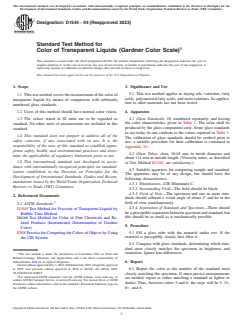
(Test Method)Standard Test Method for Color of Transparent Liquids (Gardner Color Scale)
General Information
- Abstract
SIGNIFICANCE AND USE
3.1 This test method applies to drying oils, varnishes, fatty acids, polymerized fatty acids, and resin solutions. Its application to other materials has not been tested.
SCOPE
1.1 This test method covers the measurement of the color of transparent liquids by means of comparison with arbitrarily numbered glass standards.
1.2 Users of this method should have normal color vision.
1.3 The values stated in SI units are to be regarded as standard. No other units of measurement are included in this standard.
1.4 This standard does not purport to address all of the safety concerns, if any, associated with its use. It is the responsibility of the user of this standard to establish appropriate safety, health, and environmental practices and determine the applicability of regulatory limitations prior to use.
1.5 This international standard was developed in accordance with internationally recognized principles on standardization established in the Decision on Principles for the Development of International Standards, Guides and Recommendations issued by the World Trade Organization Technical Barriers to Trade (TBT) Committee.
- Status
- Published
- Publication Date
- 30-Jun-2023
- Technical Committee
- D01 - Paint and Related Coatings, Materials, and Applications
- Drafting Committee
- D01.26 - Optical Properties


Overview
ASTM D1544-04(2023) is the internationally recognized standard test method for determining the color of transparent liquids using the Gardner color scale. Developed by ASTM International, this method is widely used in the chemical, coatings, and related industries for quality control and specification compliance. The procedure measures the color of transparent liquids-such as drying oils, varnishes, fatty acids, polymerized fatty acids, and resin solutions-by comparison against numbered glass reference standards.
This test method is essential for maintaining product consistency and ensuring compliance with industry requirements. Note that its use with other materials outside the specified list has not been validated.
Key Topics
- Gardner Color Scale: Utilizes 18 arbitrarily numbered glass standards with defined chromaticity and transmittance values for color comparison.
- Sample Compatibility: Specifically designed for transparent liquids; not validated for opaque or non-specified substances.
- Visual Comparison: Relies on human vision-users must have normal color perception to accurately match samples to standards.
- Apparatus Requirements:
- Glass standards and clear glass tubes for sample holding
- Apparatus for simultaneous viewing under controlled illumination (CIE Illuminant C) and a black surrounding field
- Capability for close, side-by-side sample and standard comparison
- Reporting: Results are reported as the closest Gardner standard number, noting any observable differences in hue. Greater precision is achieved by specifying if a sample is lighter or darker than a reference.
Applications
The ASTM D1544 standard test method is widely applied in various sectors, including:
- Paints and Coatings: Ensures transparent finishing products meet specified color standards.
- Oils and Varnishes: Confirms batch-to-batch consistency in drying oils and varnishes for both industrial and consumer markets.
- Fatty Acids and Resins: Measures the color of fatty acids, polymerized fatty acids, and resin solutions to conform with required appearance specifications.
- Quality Control: Used during manufacture, product development, and quality assurance to detect deviations or contamination.
- Regulatory Compliance: Provides standardized results for international trade and regulatory documentation.
This method plays a critical role in guaranteeing product consistency, supporting both customer satisfaction and regulatory compliance for transparent liquid chemicals.
Related Standards
Organizations often use ASTM D1544 in conjunction with relevant standards for a comprehensive assessment of transparent liquids:
- ASTM D1545: Test Method for Viscosity of Transparent Liquids by Bubble Time Method
- ASTM D6166: Test Method for Color of Pine Chemicals and Related Products (Instrumental Determination of Gardner Color)
- ASTM E308: Practice for Computing the Colors of Objects Using the CIE System
These related standards provide additional procedures for viscosity measurement and instrumental color evaluation, complementing the visual Gardner color determination.
By following the ASTM D1544-04(2023) Standard Test Method for Color of Transparent Liquids (Gardner Color Scale), manufacturers and laboratories can ensure consistent and reliable color measurement, supporting product quality and compliance in global markets.
Relations
- Effective Date
- 01-May-2017
- Effective Date
- 01-Apr-2015
- Refers
ASTM D1545-13 - Standard Test Method for Viscosity of Transparent Liquids by Bubble Time Method - Effective Date
- 01-Feb-2013
- Effective Date
- 01-Nov-2012
- Effective Date
- 01-Jul-2012
- Effective Date
- 01-Feb-2012
- Effective Date
- 01-Dec-2008
- Effective Date
- 01-Jul-2008
- Refers
ASTM D1545-07 - Standard Test Method for Viscosity of Transparent Liquids by Bubble Time Method - Effective Date
- 01-Jul-2007
- Effective Date
- 01-Dec-2006
- Effective Date
- 10-Jul-2003
- Effective Date
- 10-Aug-2001
- Effective Date
- 10-Aug-2001
- Effective Date
- 10-Oct-1998
Get Certified
Connect with accredited certification bodies for this standard

BSMI (Bureau of Standards, Metrology and Inspection)
Taiwan's standards and inspection authority.
Sponsored listings
Frequently Asked Questions
ASTM D1544-04(2023) is a standard published by ASTM International. Its full title is "Standard Test Method for Color of Transparent Liquids (Gardner Color Scale)". This standard covers: SIGNIFICANCE AND USE 3.1 This test method applies to drying oils, varnishes, fatty acids, polymerized fatty acids, and resin solutions. Its application to other materials has not been tested. SCOPE 1.1 This test method covers the measurement of the color of transparent liquids by means of comparison with arbitrarily numbered glass standards. 1.2 Users of this method should have normal color vision. 1.3 The values stated in SI units are to be regarded as standard. No other units of measurement are included in this standard. 1.4 This standard does not purport to address all of the safety concerns, if any, associated with its use. It is the responsibility of the user of this standard to establish appropriate safety, health, and environmental practices and determine the applicability of regulatory limitations prior to use. 1.5 This international standard was developed in accordance with internationally recognized principles on standardization established in the Decision on Principles for the Development of International Standards, Guides and Recommendations issued by the World Trade Organization Technical Barriers to Trade (TBT) Committee.
SIGNIFICANCE AND USE 3.1 This test method applies to drying oils, varnishes, fatty acids, polymerized fatty acids, and resin solutions. Its application to other materials has not been tested. SCOPE 1.1 This test method covers the measurement of the color of transparent liquids by means of comparison with arbitrarily numbered glass standards. 1.2 Users of this method should have normal color vision. 1.3 The values stated in SI units are to be regarded as standard. No other units of measurement are included in this standard. 1.4 This standard does not purport to address all of the safety concerns, if any, associated with its use. It is the responsibility of the user of this standard to establish appropriate safety, health, and environmental practices and determine the applicability of regulatory limitations prior to use. 1.5 This international standard was developed in accordance with internationally recognized principles on standardization established in the Decision on Principles for the Development of International Standards, Guides and Recommendations issued by the World Trade Organization Technical Barriers to Trade (TBT) Committee.
ASTM D1544-04(2023) is classified under the following ICS (International Classification for Standards) categories: 17.180.20 - Colours and measurement of light. The ICS classification helps identify the subject area and facilitates finding related standards.
ASTM D1544-04(2023) has the following relationships with other standards: It is inter standard links to ASTM E308-17, ASTM E308-15, ASTM D1545-13, ASTM D6166-12, ASTM E308-12, ASTM D1545-07(2012), ASTM E308-08, ASTM D6166-08, ASTM D1545-07, ASTM E308-06, ASTM D6166-97(2003), ASTM E308-01, ASTM E308-99, ASTM D1545-98. Understanding these relationships helps ensure you are using the most current and applicable version of the standard.
ASTM D1544-04(2023) is available in PDF format for immediate download after purchase. The document can be added to your cart and obtained through the secure checkout process. Digital delivery ensures instant access to the complete standard document.
Standards Content (Sample)
This international standard was developed in accordance with internationally recognized principles on standardization established in the Decision on Principles for the
Development of International Standards, Guides and Recommendations issued by the World Trade Organization Technical Barriers to Trade (TBT) Committee.
Designation: D1544 − 04 (Reapproved 2023)
Standard Test Method for
Color of Transparent Liquids (Gardner Color Scale)
This standard is issued under the fixed designation D1544; the number immediately following the designation indicates the year of
original adoption or, in the case of revision, the year of last revision. A number in parentheses indicates the year of last reapproval. A
superscript epsilon (´) indicates an editorial change since the last revision or reapproval.
This standard has been approved for use by agencies of the U.S. Department of Defense.
1. Scope 3. Significance and Use
3.1 This test method applies to drying oils, varnishes, fatty
1.1 This test method covers the measurement of the color of
acids, polymerized fatty acids, and resin solutions. Its applica-
transparent liquids by means of comparison with arbitrarily
tion to other materials has not been tested.
numbered glass standards.
1.2 Users of this method should have normal color vision.
4. Apparatus
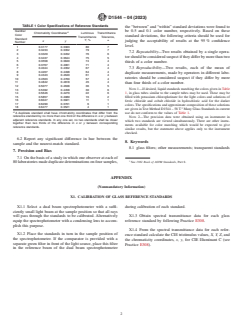
4.1 Glass Standards, 18, numbered separately, and having
1.3 The values stated in SI units are to be regarded as
the color characteristics given in Table 1. The color shall be
standard. No other units of measurement are included in this
produced by the glass components only. Some glass standards
standard.
in use today do not conform to the values reported in Table 1.
1.4 This standard does not purport to address all of the
The calibration of glass standards should be verified prior to
safety concerns, if any, associated with its use. It is the
use; a suitable procedure for their calibration is contained in
responsibility of the user of this standard to establish appro-
Appendix X1.
priate safety, health, and environmental practices and deter-
4.2 Glass Tubes, clear, 10.65 mm in inside diameter and
mine the applicability of regulatory limitations prior to use.
about 114 mm in outside length. (Viscosity tubes, as described
1.5 This international standard was developed in accor-
in Test Method D1545, are satisfactory.)
dance with internationally recognized principles on standard-
4.3 Suitable apparatus for comparing sample and standard.
ization established in the Decision on Principles for the
The apparatus may be of any design, but should have the
Development of International Standards, Guides and Recom-
following characteristics:
mendations issued by the World Trade Organization Technical
4.3.1 Illumination—CIE Illuminant C.
Barriers to Trade (TBT) Committee.
4.3.2 Surrounding Field—The field should be black.
4.3.3 Field of View—The specimen and one or more stan-
2. Referenced Documents
dards should subtend a visual angle of about 2° and be in the
field of view simultaneously.
2.1 ASTM Standards:
4.3.4 Separation of Standard and Specimen—There should
D1545 Test Method for Viscosity of Transparent Liquids by
be a perceptible separation between specimen and standard, but
Bubble Time Method
this should be as small as is mechanically possible.
D6166 Test Method for Color of Pine Chemicals and Re-
lated Products (Instrumental Determination of Gardner
5. Procedure
Color)
5.1 Fill a glass tube with the material under test. If the
E308 Practice for Computing the Colors of Objects by Using
material is perceptibly cloudy, first filter it.
the CIE System
5.2 Compare with glass standards, determining which stan-
dard most closely matches the specimen in brightness and
1 saturation. Ignore hue differences.
This test method is under the jurisdiction of Committee D01 on Paint and
Related Coatings, Materials, and Applications and is the direct responsibility of
Subcommittee D01.26 on Optical Properties.
6. Report
Current edition approved July 1, 2023. Published July 2023. Originally approved
6.1 Report the color as the number of the standard most
in 1958. Last previous edition approved in 2018 as D1544 – 04 (2018). DOI:
10.1520/D1544-04R23.
closely matching the specimen. If more precise measurements
For referenced ASTM standards, visit the ASTM website, www.astm.org, or
are needed, report as either matching a standard or lighter or
contact ASTM Customer Service at service@astm.org. For Annual Book of ASTM
darker. Thus, between colors 5 and 6, the steps will be 5, 5+,
Standards volume information, refer to the standard’s Document Summary page on
the ASTM website. 6−, and 6.
Copyright © ASTM International, 100 Barr Harbor Drive, PO Box C700, West Conshohocken, PA 19428-2959. United States
D1544 − 04 (2023)
TABLE 1 Color Specifications of Reference Standards
the “between” and “within” standard deviations were found to
Gardner be 0.5 and 0.1 color number, respectively. Based on these
A
Chromatici
...