

ASTM C1181/C1181M-17
(Test Method)Standard Test Methods for Compressive Creep of Chemical-Resistant Polymer Machinery Grouts
General Information
- Abstract
SIGNIFICANCE AND USE
4.1 These test methods provide a means of measuring the total compressive deflection of chemical-resistant, machinery-grout materials under a sustained load at the test temperature. Test stress and temperature can be selected to simulate anticipated use conditions. For the purposes of these tests, creep is considered to be the compressive deflection in cm per cm [inches per inch], which occurs after the initial loading of the specimen at laboratory temperature. The results do not necessarily correlate for different specimen thicknesses. No correlation has been established to actual-use conditions.
SCOPE
1.1 These test methods cover a quantitative, comparative test for compressive creep of chemical-resistant grouting materials under a sustained load at a test temperature. Constant load is maintained using a bolt and spring washers. Measurements are made at laboratory temperature after exposure periods at the selected test temperature.
1.2 Test Method A outlines the molding techniques for an unbonded test specimen. Test Method B covers the molding techniques for a bonded test specimen.
1.3 The values stated in either SI units or inch-pound units are to be regarded separately as standard. The values stated in each system may not be exact equivalents; therefore, each system shall be used independently of the other. Combining values from the two systems may result in non-conformance with the standard.
1.4 This standard does not purport to address all of the safety concerns, if any, associated with its use. It is the responsibility of the user of this standard to establish appropriate safety, health, and environmental practices and determine the applicability of regulatory limitations prior to use.
1.5 This international standard was developed in accordance with internationally recognized principles on standardization established in the Decision on Principles for the Development of International Standards, Guides and Recommendations issued by the World Trade Organization Technical Barriers to Trade (TBT) Committee.
- Status
- Published
- Publication Date
- 14-Dec-2017
- Technical Committee
- C09 - Concrete and Concrete Aggregates
- Drafting Committee
- C09.41 - Hydraulic Cement Grouts
Buy Documents

ASTM C1181/C1181M-17 - Standard Test Methods for Compressive Creep of Chemical-Resistant Polymer Machinery Grouts
REDLINE ASTM C1181/C1181M-17 - Standard Test Methods for Compressive Creep of Chemical-Resistant Polymer Machinery Grouts
Overview
ASTM C1181/C1181M-17 - Standard Test Methods for Compressive Creep of Chemical-Resistant Polymer Machinery Grouts provides a recognized, standardized means to evaluate the compressive creep properties of chemical-resistant polymer grouts used in machinery foundations and industrial settings. This standard supports comparative and quantitative analysis by specifying procedures to measure total compressive deflection under sustained load and controlled temperature. By simulating service conditions, users can assess a grout material's ability to resist permanent deformation over extended periods.
The test methods covered ensure the reliability and performance of polymer grouts, which are critical for maintaining alignment and stability of machinery in aggressive chemical environments. Both SI and inch-pound measurement systems are supported.
Key Topics
- Compressive Creep Measurement: Procedures to quantify compressive deflection per unit length of grout samples after applying a sustained load at a specific temperature.
- Specimen Preparation: Guidelines for molding bonded and unbonded test specimens to ensure testing consistency.
- Test Method A: Molding techniques for unbonded specimens.
- Test Method B: Molding techniques for bonded specimens.
- Testing Environment: Specimens are tested at laboratory temperature after exposure to a predetermined elevated temperature to simulate application scenarios.
- Equipment: Requirements for apparatus such as steel loading plates, high-strength bolts, spring washers, compression machines, depth micrometers, and ovens with controlled temperature.
- Data Reporting: Instructions for documenting temperature, load, test conditions, measurements, and graphical representation of creep over time.
- Dual Units: Use of both International System of Units (SI) and inch-pound, which must not be mixed within a single analysis.
Applications
ASTM C1181/C1181M-17 is valuable for industries where chemical-resistant polymer machinery grouts are critical, including:
- Petrochemical plants: Assessing the long-term durability of grout under pumps, compressors, and rotating equipment exposed to chemicals.
- Power generation: Evaluating grout performance beneath turbines and other critical equipment.
- Wastewater treatment: Ensuring the permanence and stability of machinery bases in aggressive environments.
- Industrial flooring and process plants: Verifying the mechanical stability of equipment supports subjected to thermal and mechanical stresses.
- Quality control and product development: Providing manufacturers and material engineers with reliable data on compressive creep, supporting grout selection for demanding projects.
By applying this standard, engineers and facility managers can make informed choices about grout materials, reducing the risk of foundation settlement, misalignment, or costly downtime.
Related Standards
When employing ASTM C1181/C1181M-17, consider its relationship to other relevant ASTM standards, including:
- ASTM C904: Terminology Relating to Chemical-Resistant Nonmetallic Materials
- Standards for physical property testing, chemical resistance, or durability of polymer materials as specified by ASTM Committee C09 on Concrete and Concrete Aggregates
Consult the specific manufacturer’s instructions and consider regulatory requirements for safety, health, and environmental practices when using this and related standards. Review previous versions or related test methods for comprehensive project documentation and compliance in line with international best practices.
Keywords: compressive creep, chemical-resistant, polymer machinery grout, ASTM C1181, compressive deflection, sustained load, industrial grout testing, bonded specimen, unbonded specimen, foundation stability, machinery alignment, comparative testing methods
Relations
- Effective Date
- 15-Dec-2017
- Refers
ASTM C904-01(2018) - Standard Terminology Relating to Chemical-Resistant Nonmetallic Materials - Effective Date
- 01-Nov-2018
- Refers
ASTM C904-01(2012) - Standard Terminology Relating to Chemical-Resistant Nonmetallic Materials - Effective Date
- 01-Aug-2012
Buy Documents
ASTM C1181/C1181M-17 - Standard Test Methods for Compressive Creep of Chemical-Resistant Polymer Machinery Grouts
REDLINE ASTM C1181/C1181M-17 - Standard Test Methods for Compressive Creep of Chemical-Resistant Polymer Machinery Grouts
Get Certified
Connect with accredited certification bodies for this standard

DIN CERTCO
DIN Group product certification.

Smithers Quality Assessments
US management systems and product certification.
Sponsored listings
Frequently Asked Questions
ASTM C1181/C1181M-17 is a standard published by ASTM International. Its full title is "Standard Test Methods for Compressive Creep of Chemical-Resistant Polymer Machinery Grouts". This standard covers: SIGNIFICANCE AND USE 4.1 These test methods provide a means of measuring the total compressive deflection of chemical-resistant, machinery-grout materials under a sustained load at the test temperature. Test stress and temperature can be selected to simulate anticipated use conditions. For the purposes of these tests, creep is considered to be the compressive deflection in cm per cm [inches per inch], which occurs after the initial loading of the specimen at laboratory temperature. The results do not necessarily correlate for different specimen thicknesses. No correlation has been established to actual-use conditions. SCOPE 1.1 These test methods cover a quantitative, comparative test for compressive creep of chemical-resistant grouting materials under a sustained load at a test temperature. Constant load is maintained using a bolt and spring washers. Measurements are made at laboratory temperature after exposure periods at the selected test temperature. 1.2 Test Method A outlines the molding techniques for an unbonded test specimen. Test Method B covers the molding techniques for a bonded test specimen. 1.3 The values stated in either SI units or inch-pound units are to be regarded separately as standard. The values stated in each system may not be exact equivalents; therefore, each system shall be used independently of the other. Combining values from the two systems may result in non-conformance with the standard. 1.4 This standard does not purport to address all of the safety concerns, if any, associated with its use. It is the responsibility of the user of this standard to establish appropriate safety, health, and environmental practices and determine the applicability of regulatory limitations prior to use. 1.5 This international standard was developed in accordance with internationally recognized principles on standardization established in the Decision on Principles for the Development of International Standards, Guides and Recommendations issued by the World Trade Organization Technical Barriers to Trade (TBT) Committee.
SIGNIFICANCE AND USE 4.1 These test methods provide a means of measuring the total compressive deflection of chemical-resistant, machinery-grout materials under a sustained load at the test temperature. Test stress and temperature can be selected to simulate anticipated use conditions. For the purposes of these tests, creep is considered to be the compressive deflection in cm per cm [inches per inch], which occurs after the initial loading of the specimen at laboratory temperature. The results do not necessarily correlate for different specimen thicknesses. No correlation has been established to actual-use conditions. SCOPE 1.1 These test methods cover a quantitative, comparative test for compressive creep of chemical-resistant grouting materials under a sustained load at a test temperature. Constant load is maintained using a bolt and spring washers. Measurements are made at laboratory temperature after exposure periods at the selected test temperature. 1.2 Test Method A outlines the molding techniques for an unbonded test specimen. Test Method B covers the molding techniques for a bonded test specimen. 1.3 The values stated in either SI units or inch-pound units are to be regarded separately as standard. The values stated in each system may not be exact equivalents; therefore, each system shall be used independently of the other. Combining values from the two systems may result in non-conformance with the standard. 1.4 This standard does not purport to address all of the safety concerns, if any, associated with its use. It is the responsibility of the user of this standard to establish appropriate safety, health, and environmental practices and determine the applicability of regulatory limitations prior to use. 1.5 This international standard was developed in accordance with internationally recognized principles on standardization established in the Decision on Principles for the Development of International Standards, Guides and Recommendations issued by the World Trade Organization Technical Barriers to Trade (TBT) Committee.
ASTM C1181/C1181M-17 is classified under the following ICS (International Classification for Standards) categories: 83.080.01 - Plastics in general. The ICS classification helps identify the subject area and facilitates finding related standards.
ASTM C1181/C1181M-17 has the following relationships with other standards: It is inter standard links to ASTM C1181-00(2012), ASTM C904-01(2018), ASTM C904-01(2012). Understanding these relationships helps ensure you are using the most current and applicable version of the standard.
ASTM C1181/C1181M-17 is available in PDF format for immediate download after purchase. The document can be added to your cart and obtained through the secure checkout process. Digital delivery ensures instant access to the complete standard document.
Standards Content (Sample)
This international standard was developed in accordance with internationally recognized principles on standardization established in the Decision on Principles for the
Development of International Standards, Guides and Recommendations issued by the World Trade Organization Technical Barriers to Trade (TBT) Committee.
Designation: C1181/C1181M − 17
Standard Test Methods for
Compressive Creep of Chemical-Resistant Polymer
Machinery Grouts
ThisstandardisissuedunderthefixeddesignationC1181/C1181M;thenumberimmediatelyfollowingthedesignationindicatestheyear
of original adoption or, in the case of revision, the year of last revision. A number in parentheses indicates the year of last reapproval.
A superscript epsilon (´) indicates an editorial change since the last revision or reapproval.
1. Scope* 3. Terminology
1.1 These test methods cover a quantitative, comparative 3.1 Definitions—For definitions of terms used in these test
test for compressive creep of chemical-resistant grouting methods, see Terminology C904.
materials under a sustained load at a test temperature. Constant
4. Significance and Use
load is maintained using a bolt and spring washers. Measure-
ments are made at laboratory temperature after exposure
4.1 These test methods provide a means of measuring the
periods at the selected test temperature.
total compressive deflection of chemical-resistant, machinery-
grout materials under a sustained load at the test temperature.
1.2 Test Method A outlines the molding techniques for an
Test stress and temperature can be selected to simulate antici-
unbonded test specimen. Test Method B covers the molding
pated use conditions. For the purposes of these tests, creep is
techniques for a bonded test specimen.
considered to be the compressive deflection in cm per cm
1.3 The values stated in either SI units or inch-pound units
[inches per inch], which occurs after the initial loading of the
are to be regarded separately as standard. The values stated in
specimen at laboratory temperature. The results do not neces-
each system may not be exact equivalents; therefore, each
sarily correlate for different specimen thicknesses. No correla-
system shall be used independently of the other. Combining
tion has been established to actual-use conditions.
values from the two systems may result in non-conformance
with the standard.
5. Apparatus
1.4 This standard does not purport to address all of the
5.1 Steel Loading Plates—Steel plates, as described, are
safety concerns, if any, associated with its use. It is the
used for loading the grout during the test. They may, also, be
responsibility of the user of this standard to establish appro-
part of the mold used to cast the grout specimen.
priate safety, health, and environmental practices and deter-
5.1.1 Two steel plates are required for each test specimen.
mine the applicability of regulatory limitations prior to use.
The plates shall be 11 to 13 cm [4 ⁄4 to 5 in.] square by 25 mm
1.5 This international standard was developed in accor-
[1 in.] thick. A 30-mm [1 ⁄8-in.] diameter hole shall be drilled
dance with internationally recognized principles on standard-
in the center of the plates. The edges of the plates and holes
ization established in the Decision on Principles for the
shall be deburred.
Development of International Standards, Guides and Recom-
5.1.2 One of the steel plates shall have four 6-mm [ ⁄4-in.]
mendations issued by the World Trade Organization Technical
measuringholes(oneineachcorner)withthecenter13mm[ ⁄2
Barriers to Trade (TBT) Committee.
in.] in from each edge.
2. Referenced Documents
5.2 Bolt Assembly— A 25-mm [1-in.] diameter by 19 cm
[7.5 in.] long, high-strength steel bolt, and nut, flat washers,
2.1 ASTM Standards:
and spring washers are used to maintain the test load.
C904 Terminology Relating to Chemical-Resistant Nonme-
tallic Materials
5.3 Belleville Spring Washers—Four washers are required
for each test. These shall be high carbon steel with dimensions
1 1
of 2.9 by 5.7 cm [1 ⁄8 by 2 ⁄4 in.] outside diameter by 4.0-mm
These test methods are under the jurisdiction of ASTM Committee C09 on
[0.159-in.] thickness, with 1.0-mm [0.039-in.] dish. These
ConcreteandConcreteAggregatesandarethedirectresponsibilityofSubcommittee
C09.41 on Hydraulic Cement Grouts.
washers will have an approximate spring rate of 27 300 kg/cm
Current edition approved Dec. 15, 2017. Published January 2018. Originally
[153 000 lb/in.] and a rated load of 2630 kg [5793 lb] when
approved in 1991. Last previous edition approved in 2012 as C1181 – 00 (2012).
flattened.
DOI: 10.1520/C1181-17.
For referenced ASTM standards, visit the ASTM website, www.astm.org, or
5.4 Grout Mold, suitable to cast the 10-cm [4-in.] diameter
contact ASTM Customer Service at service@astm.org. For Annual Book of ASTM
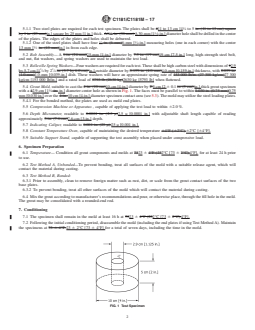
by5cm[2 6 0.1 in.] thick grout specimen with a 2.9-cm
Standards volume information, refer to the standard’s Document Summary page on
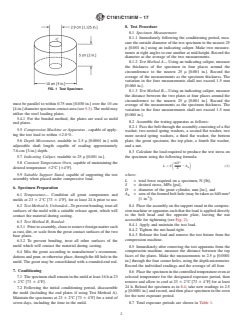
the ASTM website. [1 ⁄8-in.] diameter center hole as shown in Fig. 1. The faces
*A Summary of Changes section appears at the end of this standard
Copyright © ASTM International, 100 Barr Harbor Drive, PO Box C700, West Conshohocken, PA 19428-2959. United States
C1181/C1181M − 17
8. Test Procedure
8.1 Specimen Measurement:
8.1.1 Immediately following the conditioning period, mea-
sure the outside diameter of the test specimen to the nearest 25
µ [0.001 in.] using an indicating caliper. Make two measure-
ments at right angles to one another at mid-height. Record the
diameter as the average of the two measurements.
8.1.2 Test Method A— Using an indicating caliper, measure
the thickness of the specimen in four places around the
circumference to the nearest 25 µ [0.001 in.]. Record the
average of the measurements as the specimen thickness. The
variation in the four measurements shall not exceed 1.5 mm
[0.060 in.].
FIG. 1 Test Specimen
8.1.3 Test Method B— Using an indicating caliper, measure
the distance between the two plates at four places around the
circumference to the nearest 25 µ [0.001 in.]. Record the
must be parallel to within 0.75 mm [0.030 in.] over the 10 cm
average of the measurements as the specimen thickness. The
[4-in.] diameter specimen contact area (see 5.3).The mold may
variation in the four measurements shall not exceed 1.5 mm
utilize the steel loading plates.
[0.060 in.].
5.4.1 For the bonded method, the plates are used as mold
8.2 Assemble the testing apparatus as follows:
end plates.
8.2.1 Pass the bolt through the assembly consisting of a flat
5.5 Compression Machine or Apparatus , capable of apply-
washer, two ne
...
This document is not an ASTM standard and is intended only to provide the user of an ASTM standard an indication of what changes have been made to the previous version. Because
it may not be technically possible to adequately depict all changes accurately, ASTM recommends that users consult prior editions as appropriate. In all cases only the current version
of the standard as published by ASTM is to be considered the official document.
Designation: C1181 − 00 (Reapproved 2012) C1181/C1181M − 17
Standard Test Methods for
Compressive Creep of Chemical-Resistant Polymer
Machinery Grouts
This standard is issued under the fixed designation C1181;C1181/C1181M; the number immediately following the designation indicates
the year of original adoption or, in the case of revision, the year of last revision. A number in parentheses indicates the year of last
reapproval. A superscript epsilon (´) indicates an editorial change since the last revision or reapproval.
1. Scope Scope*
1.1 These test methods cover a quantitative, comparative test for compressive creep of chemical-resistant grouting materials
under a sustained load at a test temperature. Constant load is maintained using a bolt and spring washers. Measurements are made
at laboratory temperature after exposure periods at the selected test temperature.
1.2 Test Method A outlines the molding techniques for an unbonded test specimen. Test Method B covers the molding
techniques for a bonded test specimen.
1.3 The values stated in either SI units or inch-pound units are to be regarded separately as standard. The values given in
parentheses are mathematical conversions to SI units that are provided for information only and are not considered stated in each
system may not be exact equivalents; therefore, each system shall be used independently of the other. Combining values from the
two systems may result in non-conformance with the standard.
1.4 This standard does not purport to address all of the safety concerns, if any, associated with its use. It is the responsibility
of the user of this standard to establish appropriate safety safety, health, and healthenvironmental practices and determine the
applicability of regulatory limitations prior to use.
1.5 This international standard was developed in accordance with internationally recognized principles on standardization
established in the Decision on Principles for the Development of International Standards, Guides and Recommendations issued
by the World Trade Organization Technical Barriers to Trade (TBT) Committee.
2. Referenced Documents
2.1 ASTM Standards:
C904 Terminology Relating to Chemical-Resistant Nonmetallic Materials
3. Terminology
3.1 Definitions—For definitions of terms used in these test methods, see Terminology C904.
4. Significance and Use
4.1 These test methods provide a means of measuring the total compressive deflection of chemical-resistant, machinery-grout
materials under a sustained load at the test temperature. Test stress and temperature can be selected to simulate anticipated use
conditions. For the purposes of these tests, creep is considered to be the compressive deflection in inches per inch, cm per cm
[inches per inch], which occurs after the initial loading of the specimen at laboratory temperature. The results do not necessarily
correlate for different specimen thicknesses. No correlation has been established to actual-use conditions.
5. Apparatus
5.1 Steel Loading Plates—Steel plates, as described, are used for loading the grout during the test. They may, also, be part of
the mold used to cast the grout specimen.
These test methods are under the jurisdiction of ASTM Committee C09 on Concrete and Concrete Aggregates and are the direct responsibility of Subcommittee C09.41
on Hydraulic Cement Grouts.
Current edition approved Aug. 1, 2012Dec. 15, 2017. Published September 2012January 2018. Originally approved in 1991. Last previous edition approved in 20052012
as C1181 – 00 (2005).(2012). DOI: 10.1520/C1181-00R12.10.1520/C1181-17.
For referenced ASTM standards, visit the ASTM website, www.astm.org, or contact ASTM Customer Service at service@astm.org. For Annual Book of ASTM Standards
volume information, refer to the standard’s Document Summary page on the ASTM website.
*A Summary of Changes section appears at the end of this standard
Copyright © ASTM International, 100 Barr Harbor Drive, PO Box C700, West Conshohocken, PA 19428-2959. United States
C1181/C1181M − 17
5.1.1 Two steel plates are required for each test specimen. The plates shall be 411 to 13 cm [4 ⁄4 to 5 in. (11 to 13 cm) square
1 1
by 1 in. (25 mm)in.] square by 25 mm [1 in.] thick. A1 ⁄8-in. (30-mm) A 30-mm [1 ⁄8-in.] diameter hole shall be drilled in the center
of the plates. The edges of the plates and holes shall be deburred.
1 1
5.1.2 One of the steel plates shall have four ⁄4-in. (6-mm)6-mm [ ⁄4-in.] measuring holes (one in each corner) with the center
13 mm [ ⁄2 in. (13 mm)in.] in from each edge.
5.2 Bolt Assembly— A 1-in. (24-mm)25-mm [1-in.] diameter by 7.5 in. (19 cm)19 cm [7.5 in.] long, high-strength steel bolt,
and nut, flat washers, and spring washers are used to maintain the test load.
5.3 Belleville Spring Washers—Four washers are required for each test. These shall be high carbon steel with dimensions of 12.9
1 1
by 5.7 cm [1 ⁄8 by 2 ⁄4 in. (5.7 by 6.0 cm) in.] outside diameter by 0.159-in. (4.0-mm)4.0-mm [0.159-in.] thickness, with 0.039-in.
(1.0-mm)1.0-mm [0.039-in.] dish. These washers will have an approximate spring rate of 153 000 lb/in. (27 300 kg/cm)27 300
kg/cm [153 000 lb/in.] and a rated load of 5793 lb (2630 kg)2630 kg [5793 lb] when flattened.
5.4 Grout Mold, suitable to cast the 4-in. (10-cm)10-cm [4-in.] diameter by 2 5 cm [2 6 0.1 in. (5 cm) in.] thick grout specimen
with a 12.9-cm [1 ⁄8-in.-in.] diameter center hole as shown in Fig. 1. The faces must be parallel to within 0.030 in. (0.75 mm)0.75
mm [0.030 in.] over the 4-in. 10 cm [4-in.] diameter specimen contact area (see 5.3). The mold may utilize the steel loading plates.
5.4.1 For the bonded method, the plates are used as mold end plates.
5.5 Compression Machine or Apparatus , capable of applying the test load to within 62.0 %.
5.6 Depth Micrometer, readable to 0.0001 in. (2.5 μ)2.5 μ [0.0001 in.] with adjustable shaft length capable of reading
approximately 3-in. (7.6-cm)7.6-cm [3-in.] depth.
5.7 Indicating Caliper, readable to 0.001 in. (25 μ).25 μ [0.001 in.].
5.8 Constant Temperature Oven, capable of maintaining the desired temperature 64°F (62°C).62°C [64°F].
5.9 Suitable Support Stand, capable of supporting the test assembly when placed under compressive load.
6. Specimen Preparation
6.1 Temperature— Condition all grout components and molds at 7323 6 4°F (232°C [73 6 2°C),4°F], for at least 24 h prior
to use.
6.2 Test Method A, Unbonded—To prevent bonding, treat all surfaces of the mold with a suitable release agent, which will
contact the material during casting.
6.3 Test Method B, Bonded:
6.3.1 Prior to assembly, clean to remove foreign matter such as rust, dirt, or scale from the grout contact surfaces of the two
base plates.
6.3.2 To prevent bonding, treat all other surfaces of the mold which will co
...