

ASTM D2619-21
(Test Method)Standard Test Method for Hydrolytic Stability of Hydraulic Fluids (Beverage Bottle Method)
General Information
- Abstract
SIGNIFICANCE AND USE
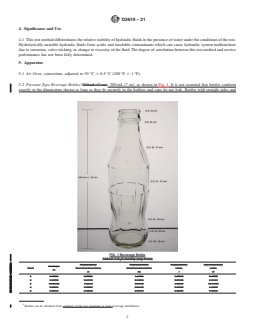
4.1 This test method differentiates the relative stability of hydraulic fluids in the presence of water under the conditions of the test. Hydrolytically unstable hydraulic fluids form acidic and insoluble contaminants which can cause hydraulic system malfunctions due to corrosion, valve sticking, or change in viscosity of the fluid. The degree of correlation between this test method and service performance has not been fully determined.
SCOPE
1.1 This test method2 covers the determination of the hydrolytic stability of petroleum or synthetic-based hydraulic fluids.
Note 1: Water-based or water-emulsion fluids can be evaluated by this test method, but they are run “as is.” Additional water is not added to the 100 g sample. In these cases, the person requesting the test needs to let the test operator know that water is present.
1.2 The values stated in SI units are to be regarded as the standard. The English units given in parentheses are provided for information only.
1.3 This standard does not purport to address all of the safety concerns, if any, associated with its use. It is the responsibility of the user of this standard to establish appropriate safety, health, and environmental practices and determine the applicability of regulatory limitations prior to use. Specific warning statements are given in 3.1, 6.1, 6.3, 6.9 and Annex A1.
1.4 This international standard was developed in accordance with internationally recognized principles on standardization established in the Decision on Principles for the Development of International Standards, Guides and Recommendations issued by the World Trade Organization Technical Barriers to Trade (TBT) Committee.
- Status
- Published
- Publication Date
- 30-Apr-2021
- Technical Committee
- D02 - Petroleum Products, Liquid Fuels, and Lubricants
- Drafting Committee
- D02.N0 - Hydraulic Fluids
Buy Documents
ASTM D2619-21 - Standard Test Method for Hydrolytic Stability of Hydraulic Fluids (Beverage Bottle Method)
REDLINE ASTM D2619-21 - Standard Test Method for Hydrolytic Stability of Hydraulic Fluids (Beverage Bottle Method)
Overview
ASTM D2619-21 is the internationally recognized standard test method for determining the hydrolytic stability of hydraulic fluids, using the beverage bottle method. Developed by ASTM International, this method is essential for evaluating how petroleum or synthetic-based hydraulic fluids react when exposed to water under controlled test conditions. Hydrolytic stability is crucial because hydrolytically unstable fluids can generate acidic and insoluble contaminants. These byproducts may lead to corrosion, valve sticking, fluctuations in fluid viscosity, and eventual hydraulic system malfunctions.
While the correlation between laboratory test results and actual service performance is still being refined, this standard provides a consistent and reproducible approach for assessing and comparing the relative hydrolytic stability of different hydraulic fluids.
Key Topics
- Test Scope: Applies to petroleum and synthetic-based hydraulic fluids. Water-based and water-emulsion fluids may also be tested "as is."
- Methodology: The test involves mixing a sample of the hydraulic fluid with water in a sealed pressure-type beverage bottle, adding a copper strip, and rotating the mixture at 93 °C for 48 hours.
- Evaluation: After testing, the following parameters are measured:
- Change in acid number of the fluid, indicating acidic contamination.
- Acidity of the water layer.
- Weight change of the copper specimen, showing potential corrosion.
- Visual appearance of the copper strip.
- Reproducibility: The method has established precision and repeatability criteria, making it suitable for quality control and product comparison.
- Units: Results are expressed in SI units (with English units provided for reference).
Applications
ASTM D2619-21 is widely used in the lubrication and hydraulic fluid industries, research labs, and quality control environments. Key applications include:
- Hydraulic Fluid Development: Supports research and formulation of stable hydraulic fluids by evaluating their resistance to hydrolytic breakdown.
- Quality Assurance: Enables manufacturers and end-users to assess incoming raw materials, finished products, and competitive fluids for hydrolytic stability.
- Specification Compliance: Frequently required in procurement specifications and for systems operating under high temperature and moisture exposure conditions.
- Root Cause Analysis: Useful for troubleshooting fluid-related failures-such as corrosion, deposit formation, or changes in viscosity-by linking them to hydrolytic instability.
- Regulatory & Industry Standards Compliance: Assists in meeting requirements for hydraulic systems in industries including automotive, aerospace, manufacturing, and heavy equipment.
Related Standards
For comprehensive assessment and compatibility, ASTM D2619-21 is often used alongside other key ASTM standards for hydraulic fluid testing:
- ASTM D130: Test Method for Corrosiveness to Copper from Petroleum Products by Copper Strip Test
- ASTM D664: Test Method for Acid Number of Petroleum Products by Potentiometric Titration
- ASTM D974: Test Method for Acid and Base Number by Color-Indicator Titration
These related standards provide additional insights into fluid corrosivity, acid content, and overall chemical stability.
Keywords: hydrolytic stability, beverage bottle method, hydraulic fluid, ASTM D2619-21, copper corrosion, acid number, quality control, lubrication, fluid testing, petroleum fluids, synthetic hydraulic fluid, fluid stability standard.
Relations
- Effective Date
- 01-May-2017
- Effective Date
- 01-Dec-2014
- Effective Date
- 15-Apr-2012
- Effective Date
- 15-May-2011
- Effective Date
- 15-May-2011
- Effective Date
- 01-Nov-2010
- Effective Date
- 01-Mar-2009
- Effective Date
- 01-Nov-2007
- Effective Date
- 01-Jul-2007
- Effective Date
- 01-Nov-2006
- Effective Date
- 01-Nov-2006
- Effective Date
- 01-Nov-2006
- Effective Date
- 01-Jan-2006
- Effective Date
- 01-Nov-2004
- Effective Date
- 01-May-2004
Buy Documents
ASTM D2619-21 - Standard Test Method for Hydrolytic Stability of Hydraulic Fluids (Beverage Bottle Method)
REDLINE ASTM D2619-21 - Standard Test Method for Hydrolytic Stability of Hydraulic Fluids (Beverage Bottle Method)
Get Certified
Connect with accredited certification bodies for this standard

Element Materials Technology
Materials testing and product certification.

ABS Group Brazil
ABS Group certification services in Brazil.

ABS Quality Evaluations Inc.
American Bureau of Shipping quality certification.
Sponsored listings
Frequently Asked Questions
ASTM D2619-21 is a standard published by ASTM International. Its full title is "Standard Test Method for Hydrolytic Stability of Hydraulic Fluids (Beverage Bottle Method)". This standard covers: SIGNIFICANCE AND USE 4.1 This test method differentiates the relative stability of hydraulic fluids in the presence of water under the conditions of the test. Hydrolytically unstable hydraulic fluids form acidic and insoluble contaminants which can cause hydraulic system malfunctions due to corrosion, valve sticking, or change in viscosity of the fluid. The degree of correlation between this test method and service performance has not been fully determined. SCOPE 1.1 This test method2 covers the determination of the hydrolytic stability of petroleum or synthetic-based hydraulic fluids. Note 1: Water-based or water-emulsion fluids can be evaluated by this test method, but they are run “as is.” Additional water is not added to the 100 g sample. In these cases, the person requesting the test needs to let the test operator know that water is present. 1.2 The values stated in SI units are to be regarded as the standard. The English units given in parentheses are provided for information only. 1.3 This standard does not purport to address all of the safety concerns, if any, associated with its use. It is the responsibility of the user of this standard to establish appropriate safety, health, and environmental practices and determine the applicability of regulatory limitations prior to use. Specific warning statements are given in 3.1, 6.1, 6.3, 6.9 and Annex A1. 1.4 This international standard was developed in accordance with internationally recognized principles on standardization established in the Decision on Principles for the Development of International Standards, Guides and Recommendations issued by the World Trade Organization Technical Barriers to Trade (TBT) Committee.
SIGNIFICANCE AND USE 4.1 This test method differentiates the relative stability of hydraulic fluids in the presence of water under the conditions of the test. Hydrolytically unstable hydraulic fluids form acidic and insoluble contaminants which can cause hydraulic system malfunctions due to corrosion, valve sticking, or change in viscosity of the fluid. The degree of correlation between this test method and service performance has not been fully determined. SCOPE 1.1 This test method2 covers the determination of the hydrolytic stability of petroleum or synthetic-based hydraulic fluids. Note 1: Water-based or water-emulsion fluids can be evaluated by this test method, but they are run “as is.” Additional water is not added to the 100 g sample. In these cases, the person requesting the test needs to let the test operator know that water is present. 1.2 The values stated in SI units are to be regarded as the standard. The English units given in parentheses are provided for information only. 1.3 This standard does not purport to address all of the safety concerns, if any, associated with its use. It is the responsibility of the user of this standard to establish appropriate safety, health, and environmental practices and determine the applicability of regulatory limitations prior to use. Specific warning statements are given in 3.1, 6.1, 6.3, 6.9 and Annex A1. 1.4 This international standard was developed in accordance with internationally recognized principles on standardization established in the Decision on Principles for the Development of International Standards, Guides and Recommendations issued by the World Trade Organization Technical Barriers to Trade (TBT) Committee.
ASTM D2619-21 is classified under the following ICS (International Classification for Standards) categories: 75.120 - Hydraulic fluids. The ICS classification helps identify the subject area and facilitates finding related standards.
ASTM D2619-21 has the following relationships with other standards: It is inter standard links to ASTM D664-11a(2017), ASTM D974-14e1, ASTM D974-12, ASTM D974-11, ASTM D664-11, ASTM D130-10, ASTM D664-09, ASTM D974-07, ASTM D664-07, ASTM D664-06a, ASTM D664-06ae1, ASTM D974-06, ASTM D664-06, ASTM D974-04, ASTM D130-04. Understanding these relationships helps ensure you are using the most current and applicable version of the standard.
ASTM D2619-21 is available in PDF format for immediate download after purchase. The document can be added to your cart and obtained through the secure checkout process. Digital delivery ensures instant access to the complete standard document.
Standards Content (Sample)
This international standard was developed in accordance with internationally recognized principles on standardization established in the Decision on Principles for the
Development of International Standards, Guides and Recommendations issued by the World Trade Organization Technical Barriers to Trade (TBT) Committee.
Designation: D2619 − 21
Standard Test Method for
Hydrolytic Stability of Hydraulic Fluids (Beverage Bottle
Method)
This standard is issued under the fixed designation D2619; the number immediately following the designation indicates the year of
original adoption or, in the case of revision, the year of last revision. A number in parentheses indicates the year of last reapproval. A
superscript epsilon (´) indicates an editorial change since the last revision or reapproval.
1. Scope* D974 Test Method for Acid and Base Number by Color-
2 Indicator Titration
1.1 This test method covers the determination of the
hydrolytic stability of petroleum or synthetic-based hydraulic
3. Summary of Test Method
fluids.
3.1 A copper test specimen and 75 g of test fluid plus 25 g
NOTE 1—Water-based or water-emulsion fluids can be evaluated by this
test method, but they are run “as is.”Additional water is not added to the of water (or 100 g of a water-containing fluid) are sealed in a
100 g sample. In these cases, the person requesting the test needs to let the
pressure-type beverage bottle. The bottle is rotated, end for
test operator know that water is present.
end,for48 hinanovenat93 °C(200 °F).Layersareseparated
1.2 The values stated in SI units are to be regarded as the
and the weight change of the copper specimen is measured.
standard. The English units given in parentheses are provided
The acid number change of the fluid and acidity of the water
for information only.
layer are determined. (Warning—In addition to other
precautions, because this test method involves the use of a
1.3 This standard does not purport to address all of the
glass bottle that may contain approximately 200 kPa (2 atm) of
safety concerns, if any, associated with its use. It is the
air and water vapor at temperatures up to 93 °C, a full face
responsibility of the user of this standard to establish appro-
shield and heavy woven fabric gloves should be worn when
priate safety, health, and environmental practices and deter-
handling or working with the heated and sealed sample
mine the applicability of regulatory limitations prior to use.
container.)
Specific warning statements are given in 3.1, 6.1, 6.3, 6.9 and
Annex A1.
4. Significance and Use
1.4 This international standard was developed in accor-
4.1 This test method differentiates the relative stability of
dance with internationally recognized principles on standard-
hydraulic fluids in the presence of water under the conditions
ization established in the Decision on Principles for the
of the test. Hydrolytically unstable hydraulic fluids form acidic
Development of International Standards, Guides and Recom-
mendations issued by the World Trade Organization Technical and insoluble contaminants which can cause hydraulic system
malfunctions due to corrosion, valve sticking, or change in
Barriers to Trade (TBT) Committee.
viscosity of the fluid. The degree of correlation between this
2. Referenced Documents
test method and service performance has not been fully
determined.
2.1 ASTM Standards:
D130 Test Method for Corrosiveness to Copper from Petro-
5. Apparatus
leum Products by Copper Strip Test
5.1 Air Oven, convection, adjusted to 93 °C 6 0.5 °C
D664 Test Method for Acid Number of Petroleum Products
(200 °F 6 1 °F).
by Potentiometric Titration
5.2 Pressure-Type Beverage Bottles, 200 mL (7 oz), as
shown in Fig. 1. It is not essential that bottles conform exactly
This test method is under the jurisdiction of ASTM Committee D02 on
to the dimensions shown as long as they fit securely in the
Petroleum Products, Liquid Fuels, and Lubricantsand is the direct responsibility of
holders and caps do not leak. Bottles with straight sides and a
Subcommittee D02.N0 on Hydraulic Fluids.
Current edition approved May 1, 2021. Published June 2021. Originally narrower neck are also marketed for this application but there
approved in 1967. Last previous edition approved in 2014 as D2619 – 09 (2014).
are some reports of breakage during use as the copper coupon
DOI: 10.1520/D2619-21.
will move with greater velocity during the rotation.The curved
This test method is a modification of Federal Test Method Standard No. 791a,
sides help to slow the movement of the coupon.
Method 3457 for Hydrolytic Stability.
For referenced ASTM standards, visit the ASTM website, www.astm.org, or
contact ASTM Customer Service at service@astm.org. For Annual Book of ASTM
Standards volume information, refer to the standard’s Document Summary page on Bottles can be obtained from suppliers of the test apparatus or from beverage
the ASTM website. distributors.
*A Summary of Changes section appears at the end of this standard
Copyright © ASTM International, 100 Barr Harbor Drive, PO Box C700, West Conshohocken, PA 19428-2959. United States
D2619 − 21
6.6 pH Paper.
6.7 Filter Paper, Whatman No. 41.
6.8 Anhydrous Sodium Sulfate (Na SO ).
2 4
6.9 1,1,1-Trichloroethane (optional–for use when the test
fluid is a phosphate ester). (Warning—Harmful if inhaled,
high concentrations may cause unconsciousness or death;
contact may cause skin irritations and dermatitis, may produce
toxic vapors if burned, eye irritant; see A1.2.)
7. Procedure
7.1 Fill the pressure beverage bottle with distilled water and
allow to stand overnight. Drain and rinse with fresh distilled
water, but do not dry.
7.2 Determine the total acid number of the test fluid in
accordance with Test Method D664 or D974.
7.3 Weigh 75 g of test fluid and 25 g of distilled water (or in
the case of water-containing fluids, 100 g of the test fluid) to
0.5 g into the beverage bottle.
7.4 Polish the copper test specimen (including the edges) to
a clean surface with the steel wool and wash with n-heptane.
(Warning—see 6.1.) Dry and weigh to 0.2 mg. Immediately
immerse the copper specimen in the fluid in the beverage
bottle.Avoid specimen contact by handling the cleaned copper
test strip with cotton gloves or filter paper.
7.5 Prepare a disk of the inert seal and place in a new bottle
cap. Seal the bottle using the cap with the gasket. Invert the
bottle for 5 min to check for leakage. If it leaks, start over in
7.3 with a fresh sample.
7.6 Place the bottle in the rotating mechanism in the oven
FIG. 1 Beverage Bottle
adjusted to 93 °C 6 0.5 °C (200 °F 6 1 °F). Allow to rotate,
end for end, at 5 r⁄min for 48 h.
5.3 Capping Press, for bottles.
7.7 Remove the bottle from the oven and place on an
insulated surface, allowing it to cool for approximately 1 h.
5.4 Rotating Mechanism, for holding bottles and rotating
end over end at 5 r⁄min in oven.
7.8 Open the bottle and decant the contents (except for the
5.5 Filtration Assembly and Filter Flask. copper specimen) into a 125 mL separatory funnel. Allow the
layers to separate and remove the aqueous layer to a beaker
5.6 Vacuum source, for filtration.
(Note 2).
5.7 Separatory Funnel, 125 mL.
NOTE 2—For water-containing fluids, there will be no separation, and
so this step should be bypassed. Certain other fluids may emulsify with
5.8 Balance, sensitive to 0.2 mg.
water and not separate during this step. In either of these cases, no
5.9 Caps, for sealing bottles. determination of water acidity will be conducted and a remark should be
inserted into the test report to this effect. If the fluid sample is heavier than
5.10 Inert Seal, for cap gasket, 0.127 mm (0.005 in.) thick
water, drain the fluid from the separatory funnel, remove the water wash,
fluorocarbon seal.
and return the fluid to the separatory funnel for repeated water washes.
7.9 Washtheoillayerwith25 mLportionsofdistilledwater
6. Reagents and Materials
(inverting the separatory funnel several times to allow for
6.1 n-Heptane. (Warning— Flammable, harmful if inhaled,
sufficient washing), repeating until the washings have the same
skin irritant on repeated contact, aspiration hazard; see A1.1.)
pH as the distilled water, but perform no more than five washes
(formostsamples,threeareadequate).Addthesewaterwashes
6.2 Phenolphthalein, 1 % alcoholic solution.
to the beaker from 7.8 and set aside for the water acidity
6.3 Potassium Hydroxide (KOH), 0.1N aqueous solution
determination in 7.12. Dry the washed fluid with anhydrous
standardized to within 0.0005N.(Warning—Caustic.)
sodium sulfate or by vacuum dehydration (Note 3), or both.
6.4 Copper Strip (QQ-C-576A), 16-22 B and S gage,
NOTE 3—Mechanical stirring for 1 h with the anhydrous sodium sulfate
13 mm by 51 mm.
dries the fluid efficiently.Add sufficient sodium sulfate with swirling until
6.5 Steel Wool, medium fine. it no longer forms clumps in the fluid.
D2619 − 21
7.10 Afterstirring,allowthefluidtostand1 hsothesodium
F = weight change, mg/cm .
sulfatesolidscansettle.Thefluidmaybehazyatthispoint,but
7.14 E shall be determined from the following equation:
if no visible solids are present, filtration is not necessary.
E 5 2ab12bc12ac (3)
Remove a sample (either by decantation or by using a pipet),
being careful that no solids are transferred, and determine the
where:
total acid number of the fluid in accordance with the same test
a = length, cm,
method that was used in 7.2. If solids have not settled enough
b = thickness, cm, and
to allow removal of a solid-free sample, filter the material
c = width, cm.
throughfilterpapertoremovethesolidsanddeterminethetotal
acid number of the filtered fluid in accordance with the same
8. Report
test method that was used in 7.2. The acid number of the dried
8.1 The report shall include the following:
fluid is compared to that of the original fluid (determined in
8.1.1 Acid number change of fluid in milligrams of KOH
7.2) and the change recorded.
per gram,
7.11 Rinse the copper test specimen and beverage bottle
8.1.2 Total acidity of water in milligrams of KOH, or if this
with distilled water and n-heptane into the combined water
could not be determined because no separation occurred, a
washes (in the beaker from 7.8) and then transfer to the
remark to this effect.
separatory funnel. Wash the aqueous phase with one 50 mL
8.1.3 Weight change of copper strip in milligrams per
portion ofn-heptane. Inversion of the separatory funnel several
square centimetre, and
times allows for sufficient washing. Allow the layers to
8.1.4 Appearance of strip as per the instructions in Test
separate.
Method D130.
7.12 Transfer the entire aqueous layer to an Erlenmeyer
9. Precision and Bias
flask. Determine total acidity by adding 1.0 mL of phenol-
9.1 The precision of this test method is based on an
phthalein solution and titrating rapidly with 0.1N KOH solu-
interlaboratory study of D2619-95 (Note 4), Standard Test
tion to the appearance of a pink phenolphthalein end point
Method for Hydrolytic Stability of Hydraulic Fluids, con-
which persists fo
...
This document is not an ASTM standard and is intended only to provide the user of an ASTM standard an indication of what changes have been made to the previous version. Because
it may not be technically possible to adequately depict all changes accurately, ASTM recommends that users consult prior editions as appropriate. In all cases only the current version
of the standard as published by ASTM is to be considered the official document.
Designation: D2619 − 09 (Reapproved 2014) D2619 − 21
Standard Test Method for
Hydrolytic Stability of Hydraulic Fluids (Beverage Bottle
Method)
This standard is issued under the fixed designation D2619; the number immediately following the designation indicates the year of
original adoption or, in the case of revision, the year of last revision. A number in parentheses indicates the year of last reapproval. A
superscript epsilon (´) indicates an editorial change since the last revision or reapproval.
1. Scope Scope*
1.1 This test method covers the determination of the hydrolytic stability of petroleum or synthetic-based hydraulic fluids.
NOTE 1—Water-based or water-emulsion fluids can be evaluated by this test method, but they are run “as is.” Additional water is not added to the 100 g
sample. In these cases, the person requesting the test needs to let the test operator know that water is present.
1.2 The values stated in SI units are to be regarded as the standard. The English units given in parentheses are provided for
information only.
1.3 This standard does not purport to address all of the safety concerns, if any, associated with its use. It is the responsibility
of the user of this standard to establish appropriate safety safety, health, and healthenvironmental practices and determine the
applicability of regulatory limitations prior to use. Specific warning statements are given in 3.1, 6.1, 6.3, 6.9 and Annex A1.
1.4 This international standard was developed in accordance with internationally recognized principles on standardization
established in the Decision on Principles for the Development of International Standards, Guides and Recommendations issued
by the World Trade Organization Technical Barriers to Trade (TBT) Committee.
2. Referenced Documents
2.1 ASTM Standards:
D130 Test Method for Corrosiveness to Copper from Petroleum Products by Copper Strip Test
D664 Test Method for Acid Number of Petroleum Products by Potentiometric Titration
D974 Test Method for Acid and Base Number by Color-Indicator Titration
3. Summary of Test Method
3.1 A copper test specimen and 75 g of test fluid plus 25 g of water (or 100 g of a water-containing fluid) are sealed in a
pressure-type beverage bottle. The bottle is rotated, end for end, for 48 h in an oven at 93 °C (200 °F). Layers are separated and
the weight change of the copper specimen is measured. The acid number change of the fluid and acidity of the water layer are
determined. (Warning—In addition to other precautions, because this test method involves the use of a glass bottle that may
contain approximately 200 kPa (2 atm) of air and water vapor at temperatures up to 93 °C, a full face shield and heavy woven
fabric gloves should be worn when handling or working with the heated and sealed sample container.)
This test method is under the jurisdiction of ASTM Committee D02 on Petroleum Products, Liquid Fuels, and Lubricantsand is the direct responsibility of Subcommittee
D02.N0 on Hydraulic Fluids.
Current edition approved Oct. 1, 2014May 1, 2021. Published November 2014June 2021. Originally approved in 1967. Last previous edition approved in 20092014 as
D2619 – 09.D2619 – 09 (2014). DOI: 10.1520/D2619-09R14.10.1520/D2619-21.
This test method is a modification of Federal Test Method Standard No. 791a, Method 3457 for Hydrolytic Stability.
For referenced ASTM standards, visit the ASTM website, www.astm.org, or contact ASTM Customer Service at service@astm.org. For Annual Book of ASTM Standards
volume information, refer to the standard’s Document Summary page on the ASTM website.
*A Summary of Changes section appears at the end of this standard
Copyright © ASTM International, 100 Barr Harbor Drive, PO Box C700, West Conshohocken, PA 19428-2959. United States
D2619 − 21
4. Significance and Use
4.1 This test method differentiates the relative stability of hydraulic fluids in the presence of water under the conditions of the test.
Hydrolytically unstable hydraulic fluids form acidic and insoluble contaminants which can cause hydraulic system malfunctions
due to corrosion, valve sticking, or change in viscosity of the fluid. The degree of correlation between this test method and service
performance has not been fully determined.
5. Apparatus
5.1 Air Oven, convection, adjusted to 93 °C 6 0.5 °C (200 °F 6 1 °F).
5.2 Pressure-Type Beverage Bottles, 200 mL (7 oz). 200 mL (7 oz), as shown in Fig. 1. It is not essential that bottles conform
exactly to the dimensions shown as long as they fit securely in the holders and caps do not leak. Bottles with straight sides and
FIG. 1 Beverage Bottle
TABLE 2 H O Acidity (mg KOH)
Repeatability Reproducibility Repeatability Reproducibility
Average,
Fluid Standard Deviation, Standard Deviation, Limit, Limit,
X¯
s s r R
r R
1 2.3267 0.5684 1.1103 1.5916 3.1088
2 0.3458 0.2156 0.4694 0.6038 1.3143
3 15.2358 1.4479 3.6158 4.0542 10.1244
4 0.6025 0.3282 0.5146 0.9190 1.4409
5 0.6533 0.2929 0.4413 0.8202 1.2355
Bottles can be obtained from suppliers of the test apparatus or from beverage distributors.
D2619 − 21
a narrower neck are also marketed for this application but there are some reports of breakage during use as the copper coupon will
move with greater velocity during the rotation. The curved sides help to slow the movement of the coupon.
5.3 Capping Press, for bottles.
5.4 Rotating Mechanism, for holding bottles and rotating end over end at 5 r ⁄min in oven.
5.5 Büchner FunnelFiltration Assembly and Filter Flask.
5.6 Water Aspirator.Vacuum source, for filtration.
5.7 Typewriter Brush.
5.7 Separatory Funnel, 125 mL.
5.8 Balance, sensitive to 0.2 mg.
5.9 Caps, for sealing bottles.
5.10 Inert Seal, for cap gasket, 0.127 mm (0.005 in.) thick fluorocarbon seal.
6. Reagents and Materials
6.1 n-Heptane. (Warning— Flammable, harmful if inhaled, skin irritant on repeated contact, aspiration hazard; see A1.1.)
6.2 Phenolphthalein, 1 % alcoholic solution.
6.3 Potassium Hydroxide (KOH), 0.1 N aqueous solution standardized to within 0.0005 N. (Warning—Caustic.)
6.4 Copper Strip (QQ-C-576A), 16-22 B and S gage, 13 mm by 51 mm.
6.5 Steel Wool, grade 1-medium medium fine.
6.6 LitmuspH Paper.
6.7 Filter Paper, Whatman No. 41.
6.8 Anhydrous Sodium Sulfate (Na SO ).
2 4
6.9 1,1,1-Trichloroethane (optional–for use when the test fluid is a phosphate ester). (Warning—Harmful if inhaled, high
concentrations may cause unconsciousness or death; contact may cause skin irritations and dermatitis, may produce toxic vapors
if burned, eye irritant; see A1.2.)
7. Procedure
7.1 Fill the pressure beverage bottle with distilled water and allow to stand overnight. Drain and rinse with fresh distilled water,
but do not dry.
7.2 Determine the total acid number of the test fluid in accordance with Test Method D664 or D974.
7.3 Weigh 75 g of test fluid and 25 g of distilled water (or in the case of water-containing fluids, 100 g of the test fluid) to 0.5 g
into the beverage bottle.
D2619 − 21
7.4 Polish the copper test specimen (including the edges) to a clean surface with the steel wool and wash with n-heptane.
(Warning—see 6.1.) Dry and weigh to 0.2 mg. Immediately immerse the copper specimen in the fluid in the beverage bottle. Avoid
specimen contact by handling the cleaned copper test strip with cotton gloves or filter paper.
7.5 Prepare a disk of the inert seal and place in a new bottle cap. Seal the bottle using the cap with the gasket. Invert the bottle
for 5 min to check for leakage. If it leaks, start over in 7.3 with a fresh sample.
7.6 Place the bottle in the rotating mechanism in the oven adjusted to 93 °C 6 0.5 °C (200 °F 6 1 °F). Allow to rotate, end for
end, at 5 r ⁄min for 48 h.
7.7 Remove the bottle from the oven and place on an insulated surface until cool.surface, allowing it to cool for approximately
1 h.
7.8 Open the bottle and decant the contents (except for the copper specimen) into a 125 mL separatory funnel. Allow the layers
to separate and remove the aqueous layer to a beaker (Note 2). Wash the oil layer with 25 mL portions of distilled water, repeating
until the washings are neutral to litmus paper. Save the combined water washings. Dry the washed fluid with anhydrous sodium
sulfate or by vacuum dehydration (Note 3), or both. Filter the fluid through filter paper to remove the sodium sulfate solids.
NOTE 2—For water-containing fluids, there will be no separation, and so this step should be bypassed. Certain other fluids may emulsify with water and
not separate during this step. In either of these cases, no determination of water acidity will be conducted and a remark should be inserted into the test
report to this effect. If the fluid sample is heavier than water, drain the fluid from the separatory funnel, remove the water wash, and return the fluid to
the separatory funnel for repeated water washes.
NOTE 3—Mechanical stirring for 1 h with the anhydrous sodium sulfate dries the fluid efficiently. Add sufficient sodium sulfate with swirling until it no
longer forms clumps in the fluid.
7.9 Wash the oil layer with 25 mL portions of distilled water (inverting the separatory funnel several times to allow for sufficient
washing), repeating until the washings have the same pH as the distilled water, but perform no more than five washes (for most
samples, three are adequate). Add these water washes to the beaker from 7.8 and set aside for the water acidity determination in
7.12. Dry the washed fluid with anhydrous sodium sulfate or by vacuum dehydration (Note 3), or both.
NOTE 3—Mechanical stirring for 1 h with the anhydrous sodium sulfate dries the fluid efficiently. Add sufficient sodium sulfate with swirling until it no
longer forms clumps in the fluid.
7.10 Determine the After stirring, allow the fluid to stand 1 h so the sodium sulfate solids can settle. The fluid may be hazy at this
point, but if no visible solids are present, filtration is not necessary. Remove a sample (either by decantation or by using a pipet),
being careful that no solids are transferred, and determine the total acid number of the fluid in accordance with the same test
method that was used in 7.2. If solids have not settled enough to allow removal of a solid-free sample, filter the material through
filter paper to remove the solids and determine the total acid number of the filtered fluid in accordance with Test Methodthe same
D974test method that was used in 7.2. The acid number of the filtereddried fluid is compared to that of the original fluid
(determined in 7.2) and the change recorded.
7.11 Rinse the copper test specimen and beverage bottle with distilled water and n-heptane into the combined water washes (in
the beaker from 7.8) and then returntransfer to the separatory funnel. Separate the layers and wash the Wash the aqueous phase
with one 50 mL portion of n-heptane. Inversion of the separatory funnel several times allows for sufficient washing. Allow the
layers to separate.
7.12 Transfer the water entire aqueous layer to an EhrlenmeyerErlenmeyer flask. Determine total acidity by adding 1.0 mL of
phenolphthalein solution and titrating rapidly with 0.1 N KOH solution to the appearance of a pink phenolphthalein end point
which persists for 15 s. (Occasionally the solution will turn pink when the phenolphthalein is added. In that case, no titration or
calculation is necessary and water acidity should be reported as zero.) Calculate the water layer acidity as follows:
Total Acidity, mg KOH 5 A 2 B N 356,100 mg/Eq 1 L/1000 mL (1)
@~ ! # ~ !
D2619 − 21
where:
A = KOH solution required for titration of the sample, mL,
B = KOH solution required for titration of the blank, mL, and
N = normality of KOH solution.
On occasion, a test fluid may contain relatively large amounts of h
...