

ASTM D2070-24
(Test Method)Standard Test Method for Thermal Stability of Hydraulic Oils
General Information
- Abstract
SIGNIFICANCE AND USE
5.1 Thermal stability characterizes physical and chemical property changes which may adversely affect an oil's lubricating performance. This test method evaluates the thermal stability of a hydraulic oil in the presence of copper and steel at 135 °C. No correlation of the test to field service has been made.
SCOPE
1.1 This test method2 is designed primarily to evaluate the thermal stability of hydrocarbon based hydraulic oils although oxidation may occur during the test.
1.2 The values stated in SI units are to be regarded as standard.
1.3 This standard does not purport to address all of the safety concerns, if any, associated with its use. It is the responsibility of the user of this standard to establish appropriate safety, health, and environmental practices and determine the applicability of regulatory limitations prior to use.
1.4 This international standard was developed in accordance with internationally recognized principles on standardization established in the Decision on Principles for the Development of International Standards, Guides and Recommendations issued by the World Trade Organization Technical Barriers to Trade (TBT) Committee.
- Status
- Published
- Publication Date
- 29-Feb-2024
- Technical Committee
- D02 - Petroleum Products, Liquid Fuels, and Lubricants
- Drafting Committee
- D02.N0 - Hydraulic Fluids
Overview
ASTM D2070-24: Standard Test Method for Thermal Stability of Hydraulic Oils is an international standard developed by ASTM International. This method is essential for evaluating the thermal stability of hydrocarbon-based hydraulic oils, particularly under conditions that may impact their lubricating performance and longevity. The procedure assesses how hydraulic oils respond to high temperatures, specifically in the presence of copper and steel, by analyzing changes in physical and chemical properties. This insight helps identify potential oil degradation, sludging, and corrosion risks that could affect the efficiency and reliability of hydraulic systems.
Key Topics
- Thermal Stability Evaluation: The test measures the tendency of hydraulic oils to form sludge and experience color changes when exposed to 135 °C in contact with copper and steel rods for an extended period (168 hours).
- Oil Degradation Assessment: Oil samples are visually inspected and analyzed for sludge formation, which is a key indicator of thermal instability and oxidation.
- Copper and Steel Interaction: The test simulates real-world scenarios where hydraulic fluids interact with system metals, helping gauge potential corrosion or material compatibility issues.
- Reporting and Repeatability: The standard prescribes methods for quantifying sludge formation and rating visual changes, ensuring consistent reporting and enabling comparison across products and labs.
Applications
Applying ASTM D2070-24 helps manufacturers, formulators, and end-users of hydraulic oils achieve several practical outcomes:
- Quality Control: Ensures produced hydraulic fluids meet required thermal stability standards for demanding industrial and mobile hydraulic equipment.
- Product Development: Assists in formulating oils with enhanced thermal and oxidation stability, reducing risks of sludge and varnish formation within hydraulic systems.
- Comparative Benchmarking: Provides a standardized approach for comparing the thermal stability performance of various hydraulic oil formulations or brands.
- System Reliability: Helps predict and mitigate issues related to oil degradation, metal corrosion, and sludge build-up-common causes of system failure or maintenance challenges.
- Regulatory and Procurement Compliance: Supports conformance to international best practices and may be referenced in procurement specifications or regulatory documents.
Related Standards
Several other ASTM standards complement the use of ASTM D2070-24 in evaluating hydraulic oils:
- ASTM D4057: Practice for Manual Sampling of Petroleum and Petroleum Products. Ensures representative oil samples for accurate testing.
- ASTM D4175: Terminology Relating to Petroleum Products, Liquid Fuels, and Lubricants. Provides common definitions to ensure clarity and uniform interpretation of results.
- Copper Development Association UNS C11000: Specifies copper material for testing, ensuring consistency in results.
- AISI W-1: Defines the steel used in the thermal stability test.
Conclusion
ASTM D2070-24 is a vital test method for determining the thermal stability of hydraulic oils, focusing on sludge formation and metal interaction under elevated temperatures. Its application helps organizations maintain high-quality lubrication standards, minimize maintenance issues, and optimize hydraulic system reliability. This standard is widely recognized and referenced across the hydraulic fluid industry, supporting regulatory compliance and operational excellence. For more detailed procedures or to obtain the standard, visit the ASTM International website.
Relations
- Effective Date
- 01-Mar-2024
- Referred By
ASTM D8029-23 - Standard Specification for Biodegradable, Low Aquatic Toxicity Hydraulic Fluids - Effective Date
- 01-Mar-2024
- Effective Date
- 01-Mar-2024
- Effective Date
- 01-Mar-2024
Get Certified
Connect with accredited certification bodies for this standard

Element Materials Technology
Materials testing and product certification.

ABS Group Brazil
ABS Group certification services in Brazil.

ABS Quality Evaluations Inc.
American Bureau of Shipping quality certification.
Sponsored listings
Frequently Asked Questions
ASTM D2070-24 is a standard published by ASTM International. Its full title is "Standard Test Method for Thermal Stability of Hydraulic Oils". This standard covers: SIGNIFICANCE AND USE 5.1 Thermal stability characterizes physical and chemical property changes which may adversely affect an oil's lubricating performance. This test method evaluates the thermal stability of a hydraulic oil in the presence of copper and steel at 135 °C. No correlation of the test to field service has been made. SCOPE 1.1 This test method2 is designed primarily to evaluate the thermal stability of hydrocarbon based hydraulic oils although oxidation may occur during the test. 1.2 The values stated in SI units are to be regarded as standard. 1.3 This standard does not purport to address all of the safety concerns, if any, associated with its use. It is the responsibility of the user of this standard to establish appropriate safety, health, and environmental practices and determine the applicability of regulatory limitations prior to use. 1.4 This international standard was developed in accordance with internationally recognized principles on standardization established in the Decision on Principles for the Development of International Standards, Guides and Recommendations issued by the World Trade Organization Technical Barriers to Trade (TBT) Committee.
SIGNIFICANCE AND USE 5.1 Thermal stability characterizes physical and chemical property changes which may adversely affect an oil's lubricating performance. This test method evaluates the thermal stability of a hydraulic oil in the presence of copper and steel at 135 °C. No correlation of the test to field service has been made. SCOPE 1.1 This test method2 is designed primarily to evaluate the thermal stability of hydrocarbon based hydraulic oils although oxidation may occur during the test. 1.2 The values stated in SI units are to be regarded as standard. 1.3 This standard does not purport to address all of the safety concerns, if any, associated with its use. It is the responsibility of the user of this standard to establish appropriate safety, health, and environmental practices and determine the applicability of regulatory limitations prior to use. 1.4 This international standard was developed in accordance with internationally recognized principles on standardization established in the Decision on Principles for the Development of International Standards, Guides and Recommendations issued by the World Trade Organization Technical Barriers to Trade (TBT) Committee.
ASTM D2070-24 is classified under the following ICS (International Classification for Standards) categories: 75.120 - Hydraulic fluids. The ICS classification helps identify the subject area and facilitates finding related standards.
ASTM D2070-24 has the following relationships with other standards: It is inter standard links to ASTM D2070-23, ASTM D8029-23, ASTM D8324-21, ASTM D6158-23. Understanding these relationships helps ensure you are using the most current and applicable version of the standard.
ASTM D2070-24 is available in PDF format for immediate download after purchase. The document can be added to your cart and obtained through the secure checkout process. Digital delivery ensures instant access to the complete standard document.
Standards Content (Sample)
This international standard was developed in accordance with internationally recognized principles on standardization established in the Decision on Principles for the
Development of International Standards, Guides and Recommendations issued by the World Trade Organization Technical Barriers to Trade (TBT) Committee.
Designation: D2070 − 24
Standard Test Method for
Thermal Stability of Hydraulic Oils
This standard is issued under the fixed designation D2070; the number immediately following the designation indicates the year of
original adoption or, in the case of revision, the year of last revision. A number in parentheses indicates the year of last reapproval. A
superscript epsilon (´) indicates an editorial change since the last revision or reapproval.
1. Scope* 3. Terminology
1.1 This test method is designed primarily to evaluate the 3.1 Definitions:
thermal stability of hydrocarbon based hydraulic oils although 3.1.1 For definitions of terms used in this test method, refer
oxidation may occur during the test. to Terminology D4175.
1.2 The values stated in SI units are to be regarded as
4. Summary of Test Method
standard.
4.1 A beaker containing test oil, copper and steel rods is
1.3 This standard does not purport to address all of the
placed in an aluminum block in an electric gravity convection
safety concerns, if any, associated with its use. It is the
oven for 168 h at a test temperature of 135 °C. At the
responsibility of the user of this standard to establish appro-
completion of the test, the copper and steel rods are rated
priate safety, health, and environmental practices and deter-
visually for discoloration and the oil is analyzed for the
mine the applicability of regulatory limitations prior to use.
quantity of sludge.
1.4 This international standard was developed in accor-
dance with internationally recognized principles on standard-
5. Significance and Use
ization established in the Decision on Principles for the
5.1 Thermal stability characterizes physical and chemical
Development of International Standards, Guides and Recom-
property changes which may adversely affect an oil’s lubricat-
mendations issued by the World Trade Organization Technical
ing performance. This test method evaluates the thermal
Barriers to Trade (TBT) Committee.
stability of a hydraulic oil in the presence of copper and steel
at 135 °C. No correlation of the test to field service has been
2. Referenced Documents
made.
2.1 ASTM Standards:
D4057 Practice for Manual Sampling of Petroleum and
6. Apparatus
Petroleum Products
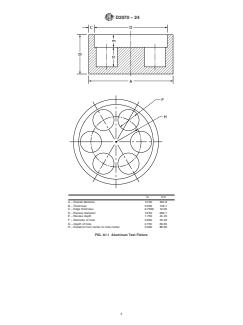
6.1 An aluminum block with equally spaced holes is used.
D4175 Terminology Relating to Petroleum Products, Liquid
An example is described in Fig. A1.1 and Fig. A1.2 of Annex
Fuels, and Lubricants
A1.
2.2 Copper Development Association Standard
6.2 Electric gravity convection oven capable of maintaining
UNS C11000 Electrolytic Tough Pitch Copper
the aluminum block at a test temperature of 135 °C 6 1 °C.
2.3 American Iron and Steel Institute Standard (AISI)
6.2.1 Calibrated thermocouple and temperature indicator
W-1 Carbon Tool Steel
centered in aluminum block.
6.3 250 mL Griffin beakers of borosilicate glass.
This test method is under the jurisdiction of ASTM Committee D02 on
6.4 Copper test specimens are to be UNS C11000, 99.9 %
Petroleum Products, Liquid Fuels, and Lubricants and is the direct responsibility of
pure electrolytic tough pitch copper, 6.35 mm in diameter by
Subcommittee D02.N0 on Hydraulic Fluids.
6,7
7.6 cm in length (0.25 in. by 3.0 in.).
Current edition approved March 1, 2024. Published March 2024. Originally
approved in 1991. Last previous edition approved in 2023 as D2070 – 23. DOI:
6.5 Steel test specimens are to be AISI W-1 1 % carbon
10.1520/D2070-24.
steel, 6.35 mm in diameter 7.6 cm in length (0.25 in. by
This procedure was adopted from the Fives Cincinnati Thermal Stability Test
6,7
3.0 in.).
Procedure “A”, Fives Cincinnati Manual 10-SP-89050.
For referenced ASTM standards, visit the ASTM website, www.astm.org, or
contact ASTM Customer Service at service@astm.org. For Annual Book of ASTM
Standards volume information, refer to the standard’s Document Summary page on The sole source of supply of the apparatus known to the committee at this time
the ASTM website. is Metaspec Services LLC, San Antonio, TX, www.metaspec.com,
Available from Copper Development Assoc., Inc., 260 Madison Ave., New sales@metaspec.com.
York, NY 10016, http://www.copper.org. If you are aware of alternative suppliers, please provide this information to
Available from American Iron and Steel Institute (AISI), 25 Massachusetts ASTM International Headquarters. Your comments will receive careful consider-
Ave., NW, Suite 800, Washington, DC 20001, http://www.steel.org. ation at a meeting of the responsible technical committee, which you may attend.
*A Summary of Changes section appears at the end of this standard
Copyright © ASTM International, 100 Barr Harbor Drive, PO Box C700, West Conshohocken, PA 19428-2959. United States
D2070 − 24
6.6 Silicon carbide abrasive 320 grit CAMI-grade with cloth 9.2 Place the beaker and its contents in the pre-heated
backing or its equivalent, metalworking aluminum oxide abra- aluminum block test fixture in the oven.
sive cloth coated backing.
9.3 Maintain the test fixture at 135 °C 6 1 °C for 168 h.
6.7 Crocus cloth. Start the time when the test sample is placed in the oven.
8,7
6.8 41 Whatman filter paper. 9.4 Keep the oven doors closed during the entire test period.
9,7
Monitor the temperature continuously via thermocouple that
6.9 Millipore filter, 8 μm Type SC.
fits snugly in the hole in the center of the test block.
6.10 Millipore glass filter holder, equivalent to size of filter
9.5 At the completion of 168 h, remove the beakers from the
paper in 6.9.
oven and allow to cool to room temperature for approximately
6.11 Fives Cincinnati Lubricant Heat Test Standards Color
1 h before proceeding. Individually remove the rods from the
10,7
Chart.
oil sample. Remove any loose sludge clinging to the rods with
a plastic or rubber policeman and return the sludge to the oil.
7. Reagents
9.6 Copper Rod Analysis—Wash the rod with heptane to
7.1 Reagent Grade Heptane—(Warning—Flammable.
remove all oil and allow to air dry. Discard the heptane wash.
Health hazard.)
Make a visual evaluation of the condition of the rod against the
7.2 Reagent Grade Acetone—(Warning—Flammable. Fives Cincinnati color chart (available from Fives Cincinnati )
Health hazard.) and record.
9.7 Steel Rod Analysis—Wash the steel rod with heptane to
8. Preparation of Catalyst Rods
remove all oil and allow to air dry. Discard the heptane wash.
8.1 Handle the rods at all times using forceps or clean cotton Make a visual evaluation of the rod against the Fives Cincin-
gloves.
nati color chart and record.
8.2 Polish the steel and copper catalyst rods prior to use. 9.8 For each sample, dry a 41 Whatman filter for 1 h in an
Use only new rods for each test. Do not re-use rods.
oven at 70 °C and cool in a desiccator for 1 h. Weigh
immediately to the nearest 0.1 mg. Vacuum filter at a nominal
8.3 Preliminary Preparation—Polish the rods with the 320
26664 Pa (200 mm Hg or 200 Torr) pressure through the
grit abrasive cloth while rotating the rods in a drill chuck at
pre-weighed 41 Whatman filter. Do not rinse the beaker at this
1700 r ⁄min to 1800 r ⁄min, unless using rods purchased from
time. Remove the oil filtrate and set aside. Replace the filter
supplier pre-polished according to Test Method D2070. Polish
flask with a clean one and wash all rem
...
This document is not an ASTM standard and is intended only to provide the user of an ASTM standard an indication of what changes have been made to the previous version. Because
it may not be technically possible to adequately depict all changes accurately, ASTM recommends that users consult prior editions as appropriate. In all cases only the current version
of the standard as published by ASTM is to be considered the official document.
Designation: D2070 − 23 D2070 − 24
Standard Test Method for
Thermal Stability of Hydraulic Oils
This standard is issued under the fixed designation D2070; the number immediately following the designation indicates the year of
original adoption or, in the case of revision, the year of last revision. A number in parentheses indicates the year of last reapproval. A
superscript epsilon (´) indicates an editorial change since the last revision or reapproval.
1. Scope*
1.1 This test method is designed primarily to evaluate the thermal stability of hydrocarbon based hydraulic oils although
oxidation may occur during the test.
1.2 The values stated in SI units are to be regarded as standard. No other units of measurement are included in this standard.
1.3 This standard does not purport to address all of the safety concerns, if any, associated with its use. It is the responsibility
of the user of this standard to establish appropriate safety, health, and environmental practices and determine the applicability of
regulatory limitations prior to use.
1.4 This international standard was developed in accordance with internationally recognized principles on standardization
established in the Decision on Principles for the Development of International Standards, Guides and Recommendations issued
by the World Trade Organization Technical Barriers to Trade (TBT) Committee.
2. Referenced Documents
2.1 ASTM Standards:
D4057 Practice for Manual Sampling of Petroleum and Petroleum Products
D4175 Terminology Relating to Petroleum Products, Liquid Fuels, and Lubricants
2.2 Copper Development Association Standard
UNS C11000 Electrolytic Tough Pitch Copper
2.3 American Iron and Steel Institute Standard (AISI)
W-1 Carbon Tool Steel
3. Terminology
3.1 Definitions:
3.1.1 For definitions of terms used in this test method, refer to Terminology D4175.
4. Summary of Test Method
4.1 A beaker containing test oil, copper and steel rods is placed in an aluminum block in an electric gravity convection oven for
This test method is under the jurisdiction of ASTM Committee D02 on Petroleum Products, Liquid Fuels, and Lubricants and is the direct responsibility of Subcommittee
D02.N0 on Hydraulic Fluids.
Current edition approved July 1, 2023March 1, 2024. Published August 2023March 2024. Originally approved in 1991. Last previous edition approved in 20162023 as
ɛ1
D2070 – 16D2070 – 23. . DOI: 10.1520/D2070-23.10.1520/D2070-24.
This procedure was adopted from the Fives Cincinnati Thermal Stability Test Procedure “A”, Fives Cincinnati Manual 10-SP-89050.
For referenced ASTM standards, visit the ASTM website, www.astm.org, or contact ASTM Customer Service at service@astm.org. For Annual Book of ASTM Standards
volume information, refer to the standard’s Document Summary page on the ASTM website.
Available from Copper Development Assoc., Inc., 260 Madison Ave., New York, NY 10016, http://www.copper.org.
Available from American Iron and Steel Institute (AISI), 25 Massachusetts Ave., NW, Suite 800, Washington, DC 20001, http://www.steel.org.
*A Summary of Changes section appears at the end of this standard
Copyright © ASTM International, 100 Barr Harbor Drive, PO Box C700, West Conshohocken, PA 19428-2959. United States
D2070 − 24
168 h at a test temperature of 135 °C. At the completion of the test, the copper and steel rods are rated visually for discoloration
and the oil is analyzed for the quantity of sludge.
5. Significance and Use
5.1 Thermal stability characterizes physical and chemical property changes which may adversely affect an oil’s lubricating
performance. This test method evaluates the thermal stability of a hydraulic oil in the presence of copper and steel at 135 °C. No
correlation of the test to field service has been made.
6. Apparatus
6.1 An aluminum block with equally spaced holes is used. An example is described in Fig. A1.1 and Fig. A1.2 of Annex A1.
6.2 Electric gravity convection oven capable of maintaining the aluminum block at a test temperature of 135 °C 6 1 °C.
6.2.1 Calibrated thermocouple and temperature indicator centered in aluminum block.
6.3 250 mL Griffin beakers of borosilicate glass.
6.4 Copper test specimens are to be UNS C11000, 99.9 % pure electrolytic tough pitch copper, 6.35 mm in diameter by 7.6 cm
6,7
in length (0.25 in. by 3.0 in.).
6,7
6.5 Steel test specimens are to be AISI W-1 1 % carbon steel, 6.35 mm in diameter 7.6 cm in length (0.25 in. by 3.0 in.).
6.6 Silicon carbide abrasive 000 320320 grit CAMI-grade with cloth backing or its equivalent, metalworking aluminum oxide
abrasive cloth coated backing.
6.7 Crocus cloth.
8,7
6.8 41 Whatman filter paper,paper. 47 mm diameter.
9,7
6.9 Millipore filter, 8 μm Type SC, 47 mm diameter.SC.
6.10 Millipore glass filter holder, 47 mm, Cat #XX10.04700 or equivalent.equivalent to size of filter paper in 6.9.
10,7
6.11 Fives Cincinnati Lubricant Heat Test Standards Color Chart.
7. Reagents
7.1 Reagent Grade Heptane—(Warning—Flammable. Health hazard.)
7.2 Reagent Grade Acetone—(Warning—Flammable. Health hazard.)
8. Preparation of ApparatusCatalyst Rods
8.1 Handle the rods at all times using forceps or clean cotton gloves.
The sole source of supply of the apparatus known to the committee at this time is Metaspec LLC, 790 W. Mayfield Blvd., San Antonio, TX 78211,
metaspec@earthlink.net.Services LLC, San Antonio, TX, www.metaspec.com, sales@metaspec.com.
If you are aware of alternative suppliers, please provide this information to ASTM International Headquarters. Your comments will receive careful consideration at a
meeting of the responsible technical committee, which you may attend.
The sole source of supply of the apparatus known to the committee at this time is Whatman Ltd., part of GE Healthcare, http://www.whatman.com.
The sole source of supply of the apparatus known to the committee at this time is EMD Millipore Corp., 290 Concord Rd., Billerica, MA 01821;
http://www.EMDmillipore.com.
The sole source of supply of the apparatus known to the committee at this time is Fives Cincinnati, 2200 Litton Ln., Hebron, KY 41048; http://www.fivesmsi.com.
D2070 − 24
8.2 Polish the steel and copper catalyst rods prior to use. Use only new rods for each test. Do not re-use rods.
8.3 CatalystPreliminary Preparation—Clean the steel and copper catalyst rods, whether new or previously used, prior to use.
Clean the Polish the rods with the 320 grit abrasive cloth while rotating the rods in a drill chuck at 1700 r ⁄min to 1800 r ⁄min. Clean
⁄min, unless using rods purchased from supplier pre-polished according to Test Method D2070. Polish the surface until it has a
bright copper or steel appearance. Discard rods when diameter is less than 6.2 mm.
8.4 Final Preparation—Prepare surface finally with a crocus cloth. cloth while rotating the rods in a drill chuck as indicated above.
Remove all grind marks. Finish the rods to a lightly polished surface finish.
8.5 WashRinse the rods individually with acetone and air dry on completion of the polishing operation.operation, then
immediately place into the test beaker followed by the test oil.
NOTE 1—If rods cannot be placed into the test beaker, then covered with the test oil immediately, completely polished rods may be stored for up to 24 h
in high-purity sulfur-free solvent such as isooctane. Once removed from the solvent, rinse the rods individually with acetone, air dry, then immediately
place into the test beaker foll
...