

ASTM D1049-98(2022)
(Specification)Standard Specification for Rubber Insulating Covers
General Information
- Abstract
ABSTRACT
This specification covers acceptance testing of rubber insulating covers for use as portable protective devices for protection of workers from accidental contact with live electrical conductors, apparatus, or circuits. It includes insulator hoods, dead-end protectors, line hose connectors, cable end covers, and miscellaneous covers. The electrical, physical, and chemical requirements of this specification shall apply also to any new or modified styles of covers that may be developed for specific purposes. The covers shall be of three types: Type I – non-resistant to ozone, made from a high-grade cis-1,4-polyisoprene rubber compound of natural or synthetic origin, properly vulcanized; Type II - ozone resistant, made of any elastomer or combination of elastomeric compounds; and Type III - ozone-resistant, made of any combination of elastomer and thermoplastic polymer, elastic in nature. Electrical proof, ozone resistance, chemical, and physical tests shall be conducted on each of the covers to determine its acceptability. The cover material shall conform to the tensile strength requirements, the accelerated aging, and for Type I covers, the determination of rubber polymer. Each cover shall withstand the specified ac proof-test voltage (rms value) or the dc proof-test voltage (average value).
SCOPE
1.1 This specification covers acceptance testing of rubber insulating covers for use as portable protective devices for protection of workers from accidental contact with live electrical conductors, apparatus, or circuits. It includes insulator hoods, dead-end protectors, line hose connectors, cable end covers, and miscellaneous covers. The electrical, physical, and chemical requirements of this specification shall apply also to any new or modified styles of covers that may be developed for specific purposes.
1.2 Three types of covers, differing in chemical and physical characteristics, are provided, and are designated as Type I, non-resistant to ozone, and Type II and Type III, resistant to ozone.
1.3 Five classes of covers, differing in electrical characteristics, are provided, and are designated as Class 0, Class 1, Class 2, Class 3, and Class 4.
1.4 Five styles of covers, differing in design characteristics, are provided, and are designated as Style A, Style B, Style C, Style D, and Style E.
Note 1: Because of the use requirements some covers are semi-rigid and others flexible. The flexible devices should remain suitably flexible for application and removal through normal temperatures of − 29 °C to 54.5 °C (−20 °F to 130 °F).
1.5 This standard does not purport to address all of the safety concerns, if any, associated with its use. It is the responsibility of the user of this standard to establish appropriate safety, health, and environmental practices and determine the applicability of regulatory limitations prior to use. See 18.2 for a specific cautionary statement.
1.6 This international standard was developed in accordance with internationally recognized principles on standardization established in the Decision on Principles for the Development of International Standards, Guides and Recommendations issued by the World Trade Organization Technical Barriers to Trade (TBT) Committee.
- Status
- Published
- Publication Date
- 31-May-2022
- Technical Committee
- F18 - Electrical Protective Equipment for Workers
- Drafting Committee
- F18.25 - Insulating Cover-Up Equipment
Overview
ASTM D1049-98(2022) is the standard specification developed by ASTM International for rubber insulating covers used as portable protective devices. These covers are essential for safeguarding workers against accidental contact with live electrical conductors, apparatus, and circuits. The standard details requirements and acceptance testing for various types and styles of insulating covers, ensuring that they provide reliable protection in the field. The document addresses the classification, electrical, chemical, and physical properties that such covers must meet, and applies not only to current designs but also to future developments using new materials or technologies.
Key Topics
Types of Covers:
- Type I: Non-resistant to ozone; composed of high-grade cis-1,4-polyisoprene rubber (natural or synthetic), properly vulcanized.
- Type II: Ozone-resistant; made from any elastomer or a combination of elastomeric compounds.
- Type III: Ozone-resistant; consists of any combination of elastomer and thermoplastic polymer, elastic in nature.
Classes and Styles:
- Classes: Based on electrical characteristics - Class 0, 1, 2, 3, and 4.
- Styles: Based on design/application - Style A (insulator hoods), Style B (dead-end protectors), Style C (line hose connectors), Style D (cable end covers), and Style E (miscellaneous covers).
Testing Requirements:
- Electrical proof, ozone resistance, chemical, and physical property evaluations.
- Covers are tested for tensile strength, accelerated aging, and voltage withstand capacity (AC and DC proof-test voltages).
- Ozone and corona exposure tests confirm durability and safety in harsh environments.
Marking and Traceability:
- Each insulating cover must be clearly and permanently marked with manufacturer identification, standard reference, type, and class for traceability and proper selection in the field.
Applications
The practical value of ASTM D1049 lies in its widespread application for worker safety in industries dealing with electrical power distribution, maintenance, and construction. Rubber insulating covers play a critical role in:
- Utility and Power Distribution: Used by lineworkers and utility crews for live-line work and maintenance of energized systems by providing temporary insulation of exposed conductors and apparatus.
- Industrial Electrical Maintenance: Applied in facilities where equipment must remain energized during maintenance, ensuring that workers are protected from live parts.
- Portable Protective Equipment: Versatile use as removable and reusable devices, allowing for flexibility in varied work environments and temporary installations.
- New Equipment Development: The standard guides manufacturers in developing innovative insulating covers, ensuring compatibility with evolving safety practices and electrical system designs.
Related Standards
For comprehensive implementation and compliance, ASTM D1049-98(2022) references and aligns with other relevant standards, including:
- ASTM D297: Test Methods for Chemical Analysis of Rubber Products.
- ASTM D412: Test Methods for Tension (Tensile Properties) of Vulcanized Rubber and Thermoplastic Elastomers.
- ASTM D573: Test Method for Rubber - Deterioration in an Air Oven.
- ANSI C84.1: American National Standard for Electric Power Systems and Equipment - Voltage Ratings.
By adhering to ASTM D1049-98(2022), organizations ensure compliance with globally recognized safety and quality protocols for rubber insulating covers, advancing workplace electrical safety and supporting harmonization with international trade principles, such as those outlined by the WTO Technical Barriers to Trade (TBT) Committee.
Keywords: ASTM D1049, rubber insulating covers, electrical safety, portable protective equipment, acceptance testing, worker protection, live electrical conductors, utility safety standards.
Get Certified
Connect with accredited certification bodies for this standard

IMQ S.p.A. (Certification)
Italian electrical product certification.

SLG Prüf- und Zertifizierungs GmbH
German testing and certification body.

UL Solutions
Global safety science company with testing, inspection and certification.
Sponsored listings
Frequently Asked Questions
ASTM D1049-98(2022) is a technical specification published by ASTM International. Its full title is "Standard Specification for Rubber Insulating Covers". This standard covers: ABSTRACT This specification covers acceptance testing of rubber insulating covers for use as portable protective devices for protection of workers from accidental contact with live electrical conductors, apparatus, or circuits. It includes insulator hoods, dead-end protectors, line hose connectors, cable end covers, and miscellaneous covers. The electrical, physical, and chemical requirements of this specification shall apply also to any new or modified styles of covers that may be developed for specific purposes. The covers shall be of three types: Type I – non-resistant to ozone, made from a high-grade cis-1,4-polyisoprene rubber compound of natural or synthetic origin, properly vulcanized; Type II - ozone resistant, made of any elastomer or combination of elastomeric compounds; and Type III - ozone-resistant, made of any combination of elastomer and thermoplastic polymer, elastic in nature. Electrical proof, ozone resistance, chemical, and physical tests shall be conducted on each of the covers to determine its acceptability. The cover material shall conform to the tensile strength requirements, the accelerated aging, and for Type I covers, the determination of rubber polymer. Each cover shall withstand the specified ac proof-test voltage (rms value) or the dc proof-test voltage (average value). SCOPE 1.1 This specification covers acceptance testing of rubber insulating covers for use as portable protective devices for protection of workers from accidental contact with live electrical conductors, apparatus, or circuits. It includes insulator hoods, dead-end protectors, line hose connectors, cable end covers, and miscellaneous covers. The electrical, physical, and chemical requirements of this specification shall apply also to any new or modified styles of covers that may be developed for specific purposes. 1.2 Three types of covers, differing in chemical and physical characteristics, are provided, and are designated as Type I, non-resistant to ozone, and Type II and Type III, resistant to ozone. 1.3 Five classes of covers, differing in electrical characteristics, are provided, and are designated as Class 0, Class 1, Class 2, Class 3, and Class 4. 1.4 Five styles of covers, differing in design characteristics, are provided, and are designated as Style A, Style B, Style C, Style D, and Style E. Note 1: Because of the use requirements some covers are semi-rigid and others flexible. The flexible devices should remain suitably flexible for application and removal through normal temperatures of − 29 °C to 54.5 °C (−20 °F to 130 °F). 1.5 This standard does not purport to address all of the safety concerns, if any, associated with its use. It is the responsibility of the user of this standard to establish appropriate safety, health, and environmental practices and determine the applicability of regulatory limitations prior to use. See 18.2 for a specific cautionary statement. 1.6 This international standard was developed in accordance with internationally recognized principles on standardization established in the Decision on Principles for the Development of International Standards, Guides and Recommendations issued by the World Trade Organization Technical Barriers to Trade (TBT) Committee.
ABSTRACT This specification covers acceptance testing of rubber insulating covers for use as portable protective devices for protection of workers from accidental contact with live electrical conductors, apparatus, or circuits. It includes insulator hoods, dead-end protectors, line hose connectors, cable end covers, and miscellaneous covers. The electrical, physical, and chemical requirements of this specification shall apply also to any new or modified styles of covers that may be developed for specific purposes. The covers shall be of three types: Type I – non-resistant to ozone, made from a high-grade cis-1,4-polyisoprene rubber compound of natural or synthetic origin, properly vulcanized; Type II - ozone resistant, made of any elastomer or combination of elastomeric compounds; and Type III - ozone-resistant, made of any combination of elastomer and thermoplastic polymer, elastic in nature. Electrical proof, ozone resistance, chemical, and physical tests shall be conducted on each of the covers to determine its acceptability. The cover material shall conform to the tensile strength requirements, the accelerated aging, and for Type I covers, the determination of rubber polymer. Each cover shall withstand the specified ac proof-test voltage (rms value) or the dc proof-test voltage (average value). SCOPE 1.1 This specification covers acceptance testing of rubber insulating covers for use as portable protective devices for protection of workers from accidental contact with live electrical conductors, apparatus, or circuits. It includes insulator hoods, dead-end protectors, line hose connectors, cable end covers, and miscellaneous covers. The electrical, physical, and chemical requirements of this specification shall apply also to any new or modified styles of covers that may be developed for specific purposes. 1.2 Three types of covers, differing in chemical and physical characteristics, are provided, and are designated as Type I, non-resistant to ozone, and Type II and Type III, resistant to ozone. 1.3 Five classes of covers, differing in electrical characteristics, are provided, and are designated as Class 0, Class 1, Class 2, Class 3, and Class 4. 1.4 Five styles of covers, differing in design characteristics, are provided, and are designated as Style A, Style B, Style C, Style D, and Style E. Note 1: Because of the use requirements some covers are semi-rigid and others flexible. The flexible devices should remain suitably flexible for application and removal through normal temperatures of − 29 °C to 54.5 °C (−20 °F to 130 °F). 1.5 This standard does not purport to address all of the safety concerns, if any, associated with its use. It is the responsibility of the user of this standard to establish appropriate safety, health, and environmental practices and determine the applicability of regulatory limitations prior to use. See 18.2 for a specific cautionary statement. 1.6 This international standard was developed in accordance with internationally recognized principles on standardization established in the Decision on Principles for the Development of International Standards, Guides and Recommendations issued by the World Trade Organization Technical Barriers to Trade (TBT) Committee.
ASTM D1049-98(2022) is classified under the following ICS (International Classification for Standards) categories: 29.035.20 - Plastics and rubber insulating materials. The ICS classification helps identify the subject area and facilitates finding related standards.
ASTM D1049-98(2022) is available in PDF format for immediate download after purchase. The document can be added to your cart and obtained through the secure checkout process. Digital delivery ensures instant access to the complete standard document.
Standards Content (Sample)
This international standard was developed in accordance with internationally recognized principles on standardization established in the Decision on Principles for the
Development of International Standards, Guides and Recommendations issued by the World Trade Organization Technical Barriers to Trade (TBT) Committee.
Designation: D1049 −98 (Reapproved 2022)
Standard Specification for
Rubber Insulating Covers
This standard is issued under the fixed designation D1049; the number immediately following the designation indicates the year of
original adoption or, in the case of revision, the year of last revision.Anumber in parentheses indicates the year of last reapproval.A
superscript epsilon (´) indicates an editorial change since the last revision or reapproval.
This standard has been approved for use by agencies of the U.S. Department of Defense.
1. Scope mendations issued by the World Trade Organization Technical
Barriers to Trade (TBT) Committee.
1.1 This specification covers acceptance testing of rubber
insulating covers for use as portable protective devices for
2. Referenced Documents
protection of workers from accidental contact with live elec-
2.1 ASTM Standards:
trical conductors, apparatus, or circuits. It includes insulator
D297Test Methods for Rubber Products—ChemicalAnaly-
hoods, dead-end protectors, line hose connectors, cable end
sis
covers, and miscellaneous covers.The electrical, physical, and
D412TestMethodsforVulcanizedRubberandThermoplas-
chemical requirements of this specification shall apply also to
tic Elastomers—Tension
anynewormodifiedstylesofcoversthatmaybedevelopedfor
D573Test Method for Rubber—Deterioration in an Air
specific purposes.
Oven
1.2 Threetypesofcovers,differinginchemicalandphysical
characteristics, are provided, and are designated as Type I,
3. Terminology
non-resistant to ozone, and Type II and Type III, resistant to
3.1 Definitions of Terms Specific to This Standard:
ozone.
3.1.1 breakdown—the electrical discharge or arc occurring
1.3 Five classes of covers, differing in electrical
betweentheelectrodesandthroughtheequipmentbeingtested.
characteristics, are provided, and are designated as Class 0,
3.1.2 flashover—the electrical discharge or arc occurring
Class 1, Class 2, Class 3, and Class 4.
between electrodes and over or around, but not through, the
1.4 Five styles of covers, differing in design characteristics,
equipment being tested.
are provided, and are designated as Style A, Style B, Style C,
3.1.3 ozone—a very active form of oxygen that may be
Style D, and Style E.
produced by corona, arcing, or ultraviolet rays.
NOTE 1—Because of the use requirements some covers are semi-rigid
3.1.4 ozone cutting and checking—the cutting action pro-
andothersflexible.Theflexibledevicesshouldremainsuitablyflexiblefor
ducedbyozoneonrubberundermechanicalstressintoaseries
application and removal through normal temperatures of−29°C to
of interlacing cracks.
54.5°C (−20°F to 130°F).
3.1.5 rubber—a generic term that includes elastomers and
1.5 This standard does not purport to address all of the
elastomeric compounds, regardless of origin.
safety concerns, if any, associated with its use. It is the
responsibility of the user of this standard to establish appro-
3.1.6 user—asusedin4.3.1,theentityemployingtheactual
priate safety, health, and environmental practices and deter-
worker(s) using the equipment; if no separate employer, then
mine the applicability of regulatory limitations prior to use.
the individual.
See 18.2 for a specific cautionary statement.
3.1.7 voltage, maximum use—the ac voltage (rms) rating of
1.6 This international standard was developed in accor-
theprotectiveequipmentthatdesignatesthemaximumnominal
dance with internationally recognized principles on standard-
design voltage of the energized system that may be safely
ization established in the Decision on Principles for the
worked. The nominal design voltage is equal to the phase to
Development of International Standards, Guides and Recom-
phase voltage on multiphase circuits.
3.1.7.1 Discussion—If there is no multiphase exposure in a
system area and the voltage exposure is limited to phase
This specification is under the jurisdiction of ASTM Committee F18 on
Electrical Protective Equipment for Workers and is the direct responsibility of
Subcommittee F18.25 on Insulating Cover-Up Equipment. This standard replaces
ANSI Standard J6.2, which is no longer available. For referenced ASTM standards, visit the ASTM website, www.astm.org, or
Current edition approved June 1, 2022. Published July 2022. Originally contact ASTM Customer Service at service@astm.org. For Annual Book of ASTM
published in 1949 as D1049–49T. Last previous edition approved in 2017 as Standards volume information, refer to the standard’s Document Summary page on
D1049–98(2017). DOI: 10.1520/D1049-98R22. the ASTM website.
Copyright © ASTM International, 100 Barr Harbor Drive, PO Box C700, West Conshohocken, PA 19428-2959. United States
D1049 − 98 (2022)
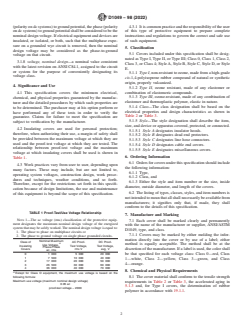
(polarityondcsystems)togroundpotential,thephase(polarity 4.3.1 Itiscommonpracticeandtheresponsibilityoftheuser
ondcsystems)togroundpotentialshallbeconsideredtobethe of this type of protective equipment to prepare complete
nominaldesignvoltage.Ifelectricalequipmentanddevicesare instructions and regulations to govern the correct and safe use
insulated, or isolated, or both, such that the multiphase expo- of such equipment.
sure on a grounded wye circuit is removed, then the nominal
5. Classification
design voltage may be considered as the phase-to-ground
5.1 Covers included under this specification shall be desig-
voltage on that circuit.
nated as Type I, Type II, or Type III; Class 0, Class 1, Class 2,
3.1.8 voltage, nominal design—a nominal value consistent
Class 3, or Class 4; StyleA, Style B, Style C, Style D, or Style
with the latest revision onANSI C84.1, assigned to the circuit
E.
or system for the purpose of conveniently designating its
5.1.1 Type I,non-resistanttoozone,madefromahigh-grade
voltage class.
cis-1,4-polyisoprene rubber compound of natural or synthetic
origin, properly vulcanized.
4. Significance and Use
5.1.2 Type II, ozone resistant, made of any elastomer or
combination of elastomeric compounds.
4.1 This specification covers the minimum electrical,
5.1.3 Type III, ozone-resistant, made of any combination of
chemical, and physical properties guaranteed by the manufac-
elastomer and thermoplastic polymer, elastic in nature.
turer and the detailed procedures by which such properties are
5.1.4 Class—The class designation shall be based on the
to be determined. The purchaser may at his option perform or
electrical properties and design characteristics as shown in
have performed any of these tests in order to verify the
Table 2 or Table 3.
guarantee. Claims for failure to meet the specification are
5.1.5 Style—The style designation shall describe the item,
subject to verification by the manufacturer.
size, and device or apparatus covered, protected, or connected.
4.2 Insulating covers are used for personal protection;
5.1.5.1 Style A designates insulator hoods.
therefore, when authorizing their use, a margin of safety shall
5.1.5.2 Style B designates dead end protectors.
be provided between the maximum voltage at which they are
5.1.5.3 Style C designates line hose connectors.
used and the proof-test voltage at which they are tested. The
5.1.5.4 Style D designates cable end covers.
relationship between proof-test voltage and the maximum
5.1.5.5 Style E designates miscellaneous covers.
voltage at which insulating covers shall be used is shown in
6. Ordering Information
Table 1.
6.1 Ordersforcoversunderthisspecificationshouldinclude
4.3 Work practices vary from user to user, depending upon
the following information:
many factors. These may include, but are not limited to,
6.1.1 Type,
operating system voltages, construction design, work proce-
6.1.2 Class, and
dures and techniques, weather conditions, and so forth.
6.1.3 Either the style and item number or the size, inside
Therefore, except for the restrictions set forth in this specifi-
diameter, outside diameter, and length of the covers.
cation because of design limitations, the use and maintenance
6.2 The listing of types, classes, styles, and item numbers is
of this equipment is beyond the scope of this specification.
notintendedtomeanthatallshallnecessarilybeavailablefrom
manufacturers; it signifies only that, if made, they shall
conform to the details of this specification.
TABLE 1 Proof-Test/Use Voltage Relationship
7. Manufacture and Marking
NOTE 1—The ac voltage (rms) classification of the protective equip-
7.1 Each cover shall be marked clearly and permanently
ment designates the maximum nominal design voltage of the energized
with the name of the manufacturer or supplier, ANSI/ASTM
systemthatmaybesafelyworked.Thenominaldesignvoltageisequalto:
D1049, type, and class.
1. The phase to phase on multiphase circuits or
7.1.1 Covers may be marked by either molding the infor-
2. The phase to ground voltage on single phase grounded circuits.
mation directly into the cover or by use of a label; either
Nominal Maximum
Class of AC Proof- DC Proof-
A
Use Voltage, method is equally acceptable. The method shall be at the
Insulating Test Voltage, Test Voltage,
Phase-Phase
Covers rms V avg, V discretionofthemanufacturer.Ifalabelisused,thecolorshall
ac, rms
0 1 000 5 000 20 000 be that specified for each voltage class: Class 0—red, Class
1 7 500 10 000 40 000
1—white, Class 2—yellow, Class 3—green, and Class
2 17 000 20 000 50 000
4—orange.
3 26 500 30 000 60 000
4 36 000 40 000 70 000
8. Chemical and Physical Requirements
A
Except for Class O equipment, the maximum use voltage is based on the
following formula: 8.1 The cover material shall conform to the tensile strength
Maximum use voltage (maximum nominal design voltage)
requirements in Table 2 or Table 3, the accelerated aging in
0.95 ac
5.1.3 and, for Type I covers, the determination of rubber
proof-test voltage − 2000
polymer in accordance with 19.1.1.
D1049 − 98 (2022)
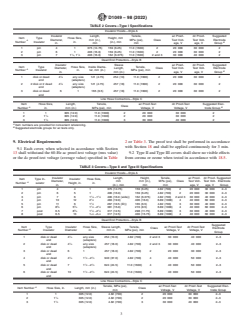
TABLE 2 Covers—Type I Specifications
Insulator Hoods—Style A
Insulator Length, Tensile, ac Proof- dc Proof- Suggested
Item Type Hose Size, Height, mm
Diameter, mm (in.), MPa (psi), Class Test Volt- Test Volt- Electrode
A
Number Insulator in. (in.), min
B
in. min min age, V age, V Group
1 pin 4 1 375 (14.75) 159 (6.25) 11.0 (1600) 2 20 000 30 000 2
2 pin 6 1 406 (16.0) 159 (6.25) 11.0 (1600) 2 20 000 30 000 2
1 1
3pin 7 1 ⁄4,1 ⁄2 406 (16.0) 162 (6.375) 11.0 (1600) 2 and 3 30 000 40 000 2
Dead End Protectors—Style B
Insulator Sleeve ac Proof- dc Proof- Suggested
Item Type Hose Size, Inside Diame- Tensile,
Diameter, Length, Class Test Volt- Test Volt- Electrode
A
Number Insulator in. ter, mm (in.) MPa (psi), min
B
in. mm (in.) age, V age, V Group
1 disk or dead 4 ⁄4 any size 121 (4.75) 254 (10) 11.0 (1600) 2 20 000 30 000 2
end (adapters)
2 2 disk or 2 dead 4 ⁄4 any size 121 (4.75) 457 (18) 11.0 (1600) 2 20 000 30 000 2
end (adapters)
3 disk or dead 6 1 165 (6.5) 457 (18) 11.0 (1600) 2 20 000 30 000 2
end
Line Hose Connectors—Style C
Item Hose Size, Length, Tensile, ac Proof-Test dc Proof-Test Suggested Elec-
Class
A B
Number in. mm (in.) MPa (psi), min Voltage, V Voltage, V trode Group
1 1 305 (12.0) 11.0 (1600) 2 20 000 30 000 2
21 ⁄4 305 (12.0) 11.0 (1600) 2 20 000 30 000 2
31 ⁄2 305 (12.0) 11.0 (1600) 3 30 000 40 000 2
A
Item numbers are provided for convenient referencing.
B
Suggested electrode groups for ac tests only.
9. Electrical Requirements 2 or Table 3. The proof test shall be performed in accordance
with Section 18 and shall be applied continuously for 3 min.
9.1 Each cover, when selected in accordance with Section
13 shall withstand the 60-Hz ac proof-test voltage (rms value) 9.2 TypeIIandTypeIIIcoversshallshownovisibleeffects
or the dc proof-test voltage (average value) specified in Table from corona or ozone when tested in accordance with 18.5.
TABLE 3 Covers—Type II and Type III Specifications
Insulator Hoods—Style A
Insulator Length, Height, Tensile, ac Proof- dc Proof- Suggested
Item Type In- Insulator Hose Size,
Diameter, mm mm (in.), MPa (psi), Class Test Volt- Test Volt- Electrode
A
Number sulator Height, in. in.
in. (in.), min min min age, V age, V Group
1 pin 4 4 1 375 (14.75) 159 (6.25) 4.82 (700) 2 20 000 30 000 2–3
2 pin 6 5 1 406 (16.0) 159 (6.25) 4.82 (700) 2 20 000 30 000 2–3
1 1
3 pin 7 6 1 ⁄4 –1 ⁄2 406 (16.0 (wide)) 162 (6.375) 4.82 (700) 2 and 3 30 000 40 000 2–3
4 pin 10 12 2 ⁄2 483 (19.0) 406 (16.0) 6.89 (1000) 4 40 000 60 000 2–3
5pin 11 6 1 ⁄2 267 (10.5 (ID)) 165 (6.5) 4.82 (700) 3 30 000 40 000 2–3
3 3 1 1
6 pin 8 ⁄4 5 ⁄4 1 ⁄2 –2 ⁄2 381 (15.0) 216 (8.5) 6.89 (1000) 4 40 000 60 000 2–3
3 1 1
7 post 6.5 8 ⁄4 1 ⁄2 –2 ⁄2 317 (12.5) 298 (11.75) 6.89 (1000) 3 30 000 40 000 2–3
1 1
8 post 6.5 13 1 ⁄2 –2 ⁄2 317 (12.5) 400 (15.75) 6.89 (1000) 4 40 000 60 000 2–3
Dead End Protectors—Style B
Suggested
Item Type Insulator Hose Size, Sleeve Length, Tensile, ac Proof-Test dc Proof-Test
Class Electrode
A
Number Insulator Diameter in. mm in. MPa (psi), min Voltage, V Voltage, V
Group
1 disk or dead 4 ⁄4 any size 254 (10.0) 4.82 (700) 2 and 3 30 000 40 000 2–3
end (adapters)
2 disk or dead 4 ⁄4 any size 457 (18.0) 4.82 (700) 2 and 3 30 000 40 000 2–3
end (adapters)
3 disk or dead 6 1 457 (18.0) 4.82 (700) 2 20 000 30 000 2–3
end
1 1 1
4 disk or dead 4 ⁄4 1 ⁄2 –2 ⁄2 940 (37.0) 4.82 (700) 4 40 000 50 000 2–3
end
1 1
5 disk or dead 71 ⁄2 –2 ⁄2 624 (24.5) 11.0 (1600) 4 40 000 50 000 2–3
end
1 1
6 disk or dead 10 1 ⁄2 –2 ⁄2 624 (24.5) 11.0 (1600) 4 40 000 50 000 2–3
end
Line Hose Connectors—Style C
Tensile, MPa (psi), ac Proof-Test dc Proof-Test Suggested Elec-
A
Item Number Hose Size, in. Length, mm (in.) Class
min Voltage, V Voltage, V trode Group
1 1 305 (12.0) 4.82 (700) 2 20 000 30 000 2–3
21 ⁄4 305 (12.0) 4.82 (700) 2 20 000 30 000 2–3
31 ⁄2 305 (12.0) 4.82 (700) 3 30 000 40 000 2–3
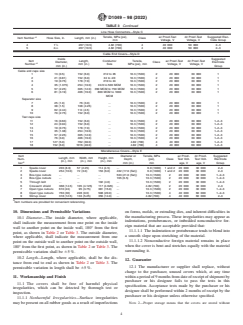
D1049 − 98 (2022)
TABLE 3 Continued
Line Hose Connectors—Style C
Tensile, MPa (psi), ac Proof-Test dc Proof-Test Suggested Elec-
A
Item Number Hose Size, in. Length, mm (in.) Class
min Voltage, V Voltage, V trode Group
41 ⁄2 267 (10.5) 4.82 (700) 4 40 000 50 000 2–3
52 ⁄2 267 (10.5) 4.82 (700) 4 40 000 50 000 2–3
Cable End Covers—Style D
Inside Suggested
Item Length, Conductor Tensile, ac Proof-Test dc Proof-Test
Diameter, Class Electrode
A
Number mm (in.) Size MPa (psi), min Voltage, V Voltage, V
mm (in.) Group
Cable end caps size
1 13 (0.5) 152 (6.0) #12 to #6 10.3 (1500) 2 20 000 30 000 1
2 21 (0.81) 152 (6.0) #4 to 4/0 10.3 (1500) 2 20 000 30 000 1
3 19 (0.75) 178 (7.0) #10 to #4 10.3 (1500) 2 20 000 30 000 1
4 35 (1.375) 254 (10.0) #4/0 to 500 MCM 10.3 (1500) 2 20 000 30 000 1
5 57 (2.25) 305 (12.0) 350 MCM to 750 MCM 10.3 (1500) 2 20 000 30 000 1
6 81 (3.19) 406 (16.0) 800 MCM to 1000 10.3 (1500) 2 20 000 30 000 1
MCM
Separator size
7 25 (1.0) 76 (3.0) . 10.3 (1500) 2 20 000 30 000 1
8 38 (1.5) 108 (4.25) . 10.3 (1500) 2 20 000 30 000 1
9 62 (2.44) 114 (4.5) . 10.3 (1500) 2 20 000 30 000 1
10 70 (2.75) 152 (6.0) . 10.3 (1500) 2 20 000 30 000 1
Test caps size
11 16 (0.63) 152 (6.0) . 10.3 (1500) 2 20 000 30 000 1–2–3
12 24 (0.94) 152 (6.0) . 10.3 (1500) 2 20 000 30 000 1–2–3
13 19 (0.75) 178 (7.0) . 10.3 (1500) 2 20 000 30 000 1–2–3
14 35 (1.38) 254 (10.0) . 10.3 (1500) 2 20 000 30 000 1–2–3
15 57 (2.25) 305 (12.0) . 10.3 (1500) 2 20 000 30 000 1–2–3
16 76 (3.0) 406 (16.0) . 10.3 (1500) 2 20 000 30 000 1–2–3
17 127 (5.0) 762 (30.0) . 4.82 (700) 4 40 000 60 000 1–2–3
18 152 (6.0) 1016 (40.0) . 4.82 (700) 4 40 000 60 000 1–2–3
Miscellaneous Covers—Style E
Item Diameter or Tensile, MPa ac Proof- dc Proof- Suggested
Length, mm Width, mm Height, mm
Num- Depth, (psi), Class Test Volt- Test Volt- Electrode
(in.), min (in.), min (in.), min
A
ber mm (in.) min age, V age, V Group
1 Spade cover 203 (8.0) 57 (2.25) 114 (4.5) . 6.9 (1000) 1 and 2 20 000 30 000 2–3
2 Spade cover 254 (10.0) 72 (3.0) 153 (6.0) 432 (17.0 (flat)) 6.9 (1000) 1 and 2 20 000 30 000 2–3
3 Box-type cutouts . . . 533 (21.0 (flat)) 10.3 (1500) 2 20 000 30 000 1–2–3
4 Box-type cutouts . . . 165 (6.5) 10.3 (1500) 2 20 000 30 000 1–2–3
5 Through bolt . . 102 (4.0) . 10.3 (1500) 2 20 000 30 000 1–2–3
6 Crossarm shield 368 (14.5) 105 (4.125) 117 (4.625)
...