

ASTM D8097-23
(Test Method)Standard Test Method for Determination of Bulk Density for Specific Size Fractions of Calcined Petroleum Coke Using a Transaxial Pressure Pycnometer
General Information
- Abstract
SIGNIFICANCE AND USE
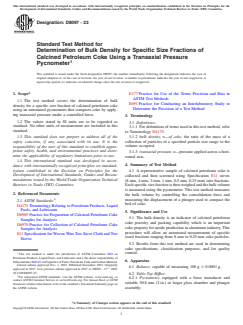
5.1 The bulk density is an indicator of calcined petroleum coke porosity and packing capability which is an important coke property for anode production in aluminum industry. This procedure will allow an automated measurement of specific sized fractions ranging from 8 mm to 0.25 mm coke particles.
5.2 Results from this test method are used in determining coke specifications, classification purposes, and for quality control.
SCOPE
1.1 The test method covers the determination of bulk density for a specific size fraction of calcined petroleum coke using an automated pycnometer that compacts coke by applying transaxial pressure under a controlled force.
1.2 The values stated in SI units are to be regarded as standard. No other units of measurement are included in this standard.
1.3 This standard does not purport to address all of the safety concerns, if any, associated with its use. It is the responsibility of the user of this standard to establish appropriate safety, health, and environmental practices and determine the applicability of regulatory limitations prior to use.
1.4 This international standard was developed in accordance with internationally recognized principles on standardization established in the Decision on Principles for the Development of International Standards, Guides and Recommendations issued by the World Trade Organization Technical Barriers to Trade (TBT) Committee.
- Status
- Published
- Publication Date
- 31-Oct-2023
- Technical Committee
- D02 - Petroleum Products, Liquid Fuels, and Lubricants
- Drafting Committee
- D02.05 - Properties of Fuels, Petroleum Coke and Carbon Material
Buy Documents
ASTM D8097-23 - Standard Test Method for Determination of Bulk Density for Specific Size Fractions of Calcined Petroleum Coke Using a Transaxial Pressure Pycnometer
REDLINE ASTM D8097-23 - Standard Test Method for Determination of Bulk Density for Specific Size Fractions of Calcined Petroleum Coke Using a Transaxial Pressure Pycnometer
Overview
ASTM D8097-23: Standard Test Method for Determination of Bulk Density for Specific Size Fractions of Calcined Petroleum Coke Using a Transaxial Pressure Pycnometer provides a method to measure the bulk density of calcined petroleum coke (CPC) particles within defined size ranges. This standard supports quality control and specification of petroleum coke, which is critical in industries such as aluminum production, where coke properties affect anode manufacture.
The method uses an automated transaxial pressure pycnometer to compact coke samples and calculate their bulk density, enabling efficient, repeatable measurement across various particle size fractions from 8 mm to 0.25 mm.
Key Topics
- Bulk Density Measurement: The procedure provides a standardized way to determine the mass-to-volume ratio (bulk density) of coke in specified size fractions, reflecting its porosity and packing capability.
- Particle Size Fractions: The method applies to CPC particles screened to size ranges of 8.00 mm - 0.25 mm using woven wire test sieves, enabling analysis of material consistency.
- Transaxial Pressure Pycnometer: Utilizes controlled, automated pressure across a horizontal axis to compact samples, ensuring reliable and repeatable measurements.
- Quality Assurance: Results are essential for coke classification, meeting specification requirements, and ongoing quality control.
- Repeatability and Reproducibility: Precision is established by interlaboratory studies, with tables of repeatability and reproducibility limits provided for different particle size ranges.
- SI Units: All measurements are reported in SI units, ensuring international consistency and comparability.
Applications
The ASTM D8097-23 standard is widely used in:
- Aluminum Production: Assesses calcined petroleum coke for suitability in anode production, where bulk density impacts porosity and structural integrity.
- Coke Trading and Specification: Producers, traders, and end-users employ this method to classify coke shipments, ensuring material meets contractual specifications.
- Quality Control Laboratories: Routine monitoring of CPC properties during production helps maintain uniformity and meet regulatory demands.
- Research and Development: Laboratories and manufacturers use this standard to evaluate new coke sources or optimize calcining processes.
By providing an objective method for densimetric analysis of coke, organizations can ensure consistent performance in downstream processes.
Related Standards
Several ASTM standards complement D8097-23 in petroleum coke testing and analysis:
- ASTM D4175: Terminology Relating to Petroleum Products, Liquid Fuels, and Lubricants
- ASTM D6969: Practice for Preparation of Calcined Petroleum Coke Samples for Analysis
- ASTM D6970: Practice for Collection of Calcined Petroleum Coke Samples for Analysis
- ASTM E11: Specification for Woven Wire Test Sieve Cloth and Test Sieves
- ASTM E177: Practice for Use of the Terms Precision and Bias in ASTM Test Methods
- ASTM E691: Practice for Conducting an Interlaboratory Study to Determine the Precision of a Test Method
Practical Value
Implementing ASTM D8097-23 ensures standardized, reliable determination of bulk density in calcined petroleum coke, which:
- Supports optimized anode production and performance in the aluminum industry
- Reduces batch variability and helps identify supply chain issues
- Provides traceable, quantitative results for regulatory compliance and customer requirements
- Increases laboratory efficiency via automated, repeatable measurement
Keywords: bulk density, calcined petroleum coke, transaxial pressure pycnometer, particle size fraction, coke specification, quality control, aluminum anode production, petroleum coke testing, ASTM D8097-23
Relations
- Effective Date
- 01-Nov-2023
- Refers
ASTM D4175-23a - Standard Terminology Relating to Petroleum Products, Liquid Fuels, and Lubricants - Effective Date
- 15-Dec-2023
- Refers
ASTM D4175-23e1 - Standard Terminology Relating to Petroleum Products, Liquid Fuels, and Lubricants - Effective Date
- 01-Jul-2023
Buy Documents
ASTM D8097-23 - Standard Test Method for Determination of Bulk Density for Specific Size Fractions of Calcined Petroleum Coke Using a Transaxial Pressure Pycnometer
REDLINE ASTM D8097-23 - Standard Test Method for Determination of Bulk Density for Specific Size Fractions of Calcined Petroleum Coke Using a Transaxial Pressure Pycnometer
Get Certified
Connect with accredited certification bodies for this standard

Element Materials Technology
Materials testing and product certification.

ABS Group Brazil
ABS Group certification services in Brazil.

ABS Quality Evaluations Inc.
American Bureau of Shipping quality certification.
Sponsored listings
Frequently Asked Questions
ASTM D8097-23 is a standard published by ASTM International. Its full title is "Standard Test Method for Determination of Bulk Density for Specific Size Fractions of Calcined Petroleum Coke Using a Transaxial Pressure Pycnometer". This standard covers: SIGNIFICANCE AND USE 5.1 The bulk density is an indicator of calcined petroleum coke porosity and packing capability which is an important coke property for anode production in aluminum industry. This procedure will allow an automated measurement of specific sized fractions ranging from 8 mm to 0.25 mm coke particles. 5.2 Results from this test method are used in determining coke specifications, classification purposes, and for quality control. SCOPE 1.1 The test method covers the determination of bulk density for a specific size fraction of calcined petroleum coke using an automated pycnometer that compacts coke by applying transaxial pressure under a controlled force. 1.2 The values stated in SI units are to be regarded as standard. No other units of measurement are included in this standard. 1.3 This standard does not purport to address all of the safety concerns, if any, associated with its use. It is the responsibility of the user of this standard to establish appropriate safety, health, and environmental practices and determine the applicability of regulatory limitations prior to use. 1.4 This international standard was developed in accordance with internationally recognized principles on standardization established in the Decision on Principles for the Development of International Standards, Guides and Recommendations issued by the World Trade Organization Technical Barriers to Trade (TBT) Committee.
SIGNIFICANCE AND USE 5.1 The bulk density is an indicator of calcined petroleum coke porosity and packing capability which is an important coke property for anode production in aluminum industry. This procedure will allow an automated measurement of specific sized fractions ranging from 8 mm to 0.25 mm coke particles. 5.2 Results from this test method are used in determining coke specifications, classification purposes, and for quality control. SCOPE 1.1 The test method covers the determination of bulk density for a specific size fraction of calcined petroleum coke using an automated pycnometer that compacts coke by applying transaxial pressure under a controlled force. 1.2 The values stated in SI units are to be regarded as standard. No other units of measurement are included in this standard. 1.3 This standard does not purport to address all of the safety concerns, if any, associated with its use. It is the responsibility of the user of this standard to establish appropriate safety, health, and environmental practices and determine the applicability of regulatory limitations prior to use. 1.4 This international standard was developed in accordance with internationally recognized principles on standardization established in the Decision on Principles for the Development of International Standards, Guides and Recommendations issued by the World Trade Organization Technical Barriers to Trade (TBT) Committee.
ASTM D8097-23 is classified under the following ICS (International Classification for Standards) categories: 75.160.10 - Solid fuels. The ICS classification helps identify the subject area and facilitates finding related standards.
ASTM D8097-23 has the following relationships with other standards: It is inter standard links to ASTM D8097-17e1, ASTM D4175-23a, ASTM D4175-23e1. Understanding these relationships helps ensure you are using the most current and applicable version of the standard.
ASTM D8097-23 is available in PDF format for immediate download after purchase. The document can be added to your cart and obtained through the secure checkout process. Digital delivery ensures instant access to the complete standard document.
Standards Content (Sample)
This international standard was developed in accordance with internationally recognized principles on standardization established in the Decision on Principles for the
Development of International Standards, Guides and Recommendations issued by the World Trade Organization Technical Barriers to Trade (TBT) Committee.
Designation: D8097 − 23
Standard Test Method for
Determination of Bulk Density for Specific Size Fractions of
Calcined Petroleum Coke Using a Transaxial Pressure
Pycnometer
This standard is issued under the fixed designation D8097; the number immediately following the designation indicates the year of
original adoption or, in the case of revision, the year of last revision. A number in parentheses indicates the year of last reapproval. A
superscript epsilon (´) indicates an editorial change since the last revision or reapproval.
1. Scope* E177 Practice for Use of the Terms Precision and Bias in
ASTM Test Methods
1.1 The test method covers the determination of bulk
E691 Practice for Conducting an Interlaboratory Study to
density for a specific size fraction of calcined petroleum coke
Determine the Precision of a Test Method
using an automated pycnometer that compacts coke by apply-
ing transaxial pressure under a controlled force.
3. Terminology
1.2 The values stated in SI units are to be regarded as
3.1 Definitions:
standard. No other units of measurement are included in this
3.1.1 For definitions of terms used in this test method, refer
standard.
to Terminology D4175.
3.1.2 bulk density, n—of coke, the ratio of the mass of a
1.3 This standard does not purport to address all of the
safety concerns, if any, associated with its use. It is the collection of particles of a specified particle size range to the
volume occupied.
responsibility of the user of this standard to establish appro-
priate safety, health, and environmental practices and deter-
3.1.3 transaxial pressure, n—pressure applied across a hori-
mine the applicability of regulatory limitations prior to use.
zontal axis.
1.4 This international standard was developed in accor-
4. Summary of Test Method
dance with internationally recognized principles on standard-
ization established in the Decision on Principles for the
4.1 A representative sample of calcined petroleum coke is
Development of International Standards, Guides and Recom-
collected and then screened using Specification E11 sieves
mendations issued by the World Trade Organization Technical
(8 mm, 4 mm, 2 mm, 1 mm, 0.5 mm, 0.25 mm) into fractions.
Barriers to Trade (TBT) Committee.
Each specific size fraction is then weighed and the bulk volume
is measured using the pycnometer. This test method measures
2. Referenced Documents
the bulk volume by controlling the consolidation force and
measuring the displacement of a plunger used to compact the
2.1 ASTM Standards:
bed of coke.
D4175 Terminology Relating to Petroleum Products, Liquid
Fuels, and Lubricants
5. Significance and Use
D6969 Practice for Preparation of Calcined Petroleum Coke
5.1 The bulk density is an indicator of calcined petroleum
Samples for Analysis
coke porosity and packing capability which is an important
D6970 Practice for Collection of Calcined Petroleum Coke
coke property for anode production in aluminum industry. This
Samples for Analysis
procedure will allow an automated measurement of specific
E11 Specification for Woven Wire Test Sieve Cloth and Test
sized fractions ranging from 8 mm to 0.25 mm coke particles.
Sieves
5.2 Results from this test method are used in determining
coke specifications, classification purposes, and for quality
1 control.
This test method is under the jurisdiction of ASTM Committee D02 on
Petroleum Products, Liquid Fuels, and Lubricants and is the direct responsibility of
6. Apparatus
Subcommittee D02.05 on Properties of Fuels, Petroleum Coke and Carbon Material.
Current edition approved Nov. 1, 2023. Published November 2023. Originally
6.1 Balance, capable of measuring 100 g 6 0.0001 g.
ɛ1
approved in 2017. Last previous edition approved in 2017 as D8097 – 17 . DOI:
10.1520/D8097-23.
6.2 Table Top Riffler:
For referenced ASTM standards, visit the ASTM website, www.astm.org, or
6.2.1 Pycnometer, equipped with a force transducer and
contact ASTM Customer Service at service@astm.org. For Annual Book of ASTM
suitable 50.8 mm (2 in.) or larger glass chamber and plunger
Standards volume information, refer to the standard’s Document Summary page on
the ASTM website. assembly.
*A Summary of Changes section appears at the end of this standard
Copyright © ASTM International, 100 Barr Harbor Drive, PO Box C700, West Conshohocken, PA 19428-2959. United States
D8097 − 23
NOTE 1—GeoPyc 1360 has been successfully used for this analysis.
10.5 Start the analysis following the procedure in the
instruction manual.
6.3 Wire Mesh Sieves, 8 in. diameter, round, 8.00 mm
( ⁄16 in.), 4.00 mm (No. 5), 2.00 mm (No. 10), 1.00 mm (No.
10.6 Enter the necessary or required information such as
18), 0.50 mm (No. 35), 0.25 mm (No. 60), pan, and cover.
sample identification, sample mass, or other user-selected
information.
6.4 Ro-tap Sieve Shaker, for 8 in. diameter sieves.
10.7 Choose the stored blank data set for the analysis.
7. Sampling, Test Specimens, and Test Units
10.8 Press “Enter.” The analysis will begin and will be
7.1 Grab a representative sample according to Practice
performed automatically.
D6970 and reduce the sample to 900 g 6 100 g following
10.9 Record the final volume or density when pycnometer
Practice D6969.
has finished analyzing the test specimen. You may also print a
7.2 Sieve the representative sample using the following
copy of the report if a printer is attached.
screens: 8.00 mm ( ⁄16 in.), 4.00 mm (No. 5), 2.00 mm (No.
10), 1.00 mm (No. 18), 0.50 mm (No. 35), and 0.25 mm (No.
11. Calculation or Interpretation of Results
60).
11.1 The pycnometer measures the volume of each consoli-
7.3 Using a sieve shaker, shake the sieves for 10 min.
dation cycle and then averages the results of all the runs. The
7.4 Discard the top sieve material (8.00 mm ( ⁄16 in.)) and average volume and specimen weight are used to calculate the
transfer each sized fraction of calcined petroleum coke into specimen bulk density. The final results are reported in cm and
appropriate containers. g/cm , with three decimals.
8. Preparation of Apparatus
12. Report
8.1 Follow manufacturer’s instructions for initial assembly,
12.1 The specific size fraction must be reported as part of
conditioning, and preparation of pycnometer.
the test results.
9. Calibration and Standardization
13. Precision and Bias
9.1 Follow the instructions for the equipment used.
13.1 The precision of this test method is based on an
9.2 A blank data set can be performed by following the
interlaboratory study of D8097, conducted in 2016. Five
procedure based upon the equipment used. If the GeoPyc (see laboratories tested five unique petroleum coke specimen types/
Note 1) is used, follow detail in Annex A1 and Table 1.
sizes. Every test result represents an individual determination,
and all participants reported duplicate test results for each
material tested. Practice E691 was followed for the design and
TABLE 1 Recommended Equipment Setting
analysis of the data; the details are given in ASTM Research
Number of Cycles: 10
Report No. RR:D02-1848.
Consolidation Force: 30 N
Preparation Cycles: 5 13.1.1 Repeatability (r)—The difference between two inde-
Agitation: High
pendent results obtained by the same operator in a given
Speed: 150 steps/s
laboratory applying the same test method with the same
apparatus under constant operating conditions on identical test
material within short intervals of time would exceed the
9.3 A blank data set shall be performed each time a new
following value with an approximate probability of 5 % (one
cylinder is used or when the apparatus is moved.
case in 20 in the long run) in the normal and correct operation
of the test method.
10. Procedure
13.1.1.1 Repeatability limits are listed in Tables 2-6.
10.1 Split the sieved sample fraction to a test specimen of
Repeatability = 0.016 g/cm (1)
52 g 6 2 g.
13.1.2 Reproducibility (R)—The difference between two
10.2 Weigh the prepared test specimen to 0.0001 g and
single and independent results obtained by different operators
record the weight.
applying the same test method in different laboratories using
10.3 Pour the entire test specimen into the glass chamber
...
This document is not an ASTM standard and is intended only to provide the user of an ASTM standard an indication of what changes have been made to the previous version. Because
it may not be technically possible to adequately depict all changes accurately, ASTM recommends that users consult prior editions as appropriate. In all cases only the current version
of the standard as published by ASTM is to be considered the official document.
´1
Designation: D8097 − 17 D8097 − 23
Standard Test Method for
Determination of Bulk Density for Specific Size Fractions of
Calcined Petroleum Coke Using a Transaxial Pressure
Pycnometer
This standard is issued under the fixed designation D8097; the number immediately following the designation indicates the year of
original adoption or, in the case of revision, the year of last revision. A number in parentheses indicates the year of last reapproval. A
superscript epsilon (´) indicates an editorial change since the last revision or reapproval.
ε NOTE—Editorially updated 3.1.1 in January 2020.
1. Scope Scope*
1.1 The test method covers the determination of bulk density for a specific size fraction of calcined petroleum coke using an
automated pycnometer that compacts coke by applying transaxial pressure under a controlled force.
1.2 The values stated in SI units are to be regarded as standard. No other units of measurement are included in this standard.
1.3 This standard does not purport to address all of the safety concerns, if any, associated with its use. It is the responsibility
of the user of this standard to establish appropriate safety, health, and environmental practices and determine the applicability of
regulatory limitations prior to use.
1.4 This international standard was developed in accordance with internationally recognized principles on standardization
established in the Decision on Principles for the Development of International Standards, Guides and Recommendations issued
by the World Trade Organization Technical Barriers to Trade (TBT) Committee.
2. Referenced Documents
2.1 ASTM Standards:
D4175 Terminology Relating to Petroleum Products, Liquid Fuels, and Lubricants
D6969 Practice for Preparation of Calcined Petroleum Coke Samples for Analysis
D6970 Practice for Collection of Calcined Petroleum Coke Samples for Analysis
E11 Specification for Woven Wire Test Sieve Cloth and Test Sieves
E177 Practice for Use of the Terms Precision and Bias in ASTM Test Methods
E691 Practice for Conducting an Interlaboratory Study to Determine the Precision of a Test Method
3. Terminology
3.1 Definitions:
3.1.1 For definitions of terms used in this test method, refer to Terminology D4175.
This test method is under the jurisdiction of ASTM Committee D02 on Petroleum Products, Liquid Fuels, and Lubricants and is the direct responsibility of Subcommittee
D02.05 on Properties of Fuels, Petroleum Coke and Carbon Material.
Current edition approved Jan. 1, 2017Nov. 1, 2023. Published March 2017November 2023. Originally approved in 2017. Last previous edition approved in 2017 as
ɛ1
D8097 – 17 . DOI: 10.1520/D8097-17E01.10.1520/D8097-23.
For referenced ASTM standards, visit the ASTM website, www.astm.org, or contact ASTM Customer Service at service@astm.org. For Annual Book of ASTM Standards
volume information, refer to the standard’s Document Summary page on the ASTM website.
*A Summary of Changes section appears at the end of this standard
Copyright © ASTM International, 100 Barr Harbor Drive, PO Box C700, West Conshohocken, PA 19428-2959. United States
D8097 − 23
3.1.2 bulk density, n—of coke, the ratio of the mass of a collection of particles of a specified particle size range to the volume
occupied.
3.1.3 transaxial pressure, n—pressure applied across a horizontal axis.
4. Summary of Test Method
4.1 A representative sample of calcined petroleum coke is collected and then screened using Specification E11 sieves (8 mm,
4 mm, 2 mm, 1 mm, 0.5 mm, 0.25 mm) into fractions. Each specific size fraction is then weighed and the bulk volume is measured
using the pycnometer. This test method measures the bulk volume by controlling the consolidation force and measuring the
displacement of a plunger used to compact the bed of coke.
5. Significance and Use
5.1 The bulk density is an indicator of calcined petroleum coke porosity and packing capability which is an important coke
property for anode production in aluminum industry. This procedure will allow an automated measurement of specific sized
fractions ranging from 8 mm to 0.25 mm coke particles.
5.2 Results from this test method are used in determining coke specifications, classification purposes, and for quality control.
6. Apparatus
6.1 Balance, capable of measuring 100 g 6 0.0001 g.
6.2 Table Top Riffler:
6.2.1 Pycnometer, equipped with a force transducer and suitable 50.8 mm (2 in.) or larger glass chamber and plunger assembly.
NOTE 1—GeoPyc 1360 has been successfully used for this analysis.
6.3 Wire Mesh Sieves, 8 in. diameter, round, 8.00 mm ( ⁄16 in.), 4.00 mm (No. 5), 2.00 mm (No. 10), 1.00 mm (No. 18), 0.50 mm
(No. 35), 0.25 mm (No. 60), pan, and cover.
6.4 Ro-tap Sieve Shaker, for 8 in. diameter sieves.
7. Sampling, Test Specimens, and Test Units
7.1 Grab a representative sample according to Practice D6970 and reduce the sample to 900 g 6 100 g following Practice D6969.
7.2 Sieve the representative sample using the following screens: 8.00 mm ( ⁄16 in.), 4.00 mm (No. 5), 2.00 mm (No. 10), 1.00 mm
(No. 18), 0.50 mm (No. 35), and 0.25 mm (No. 60).
7.3 Using a sieve shaker, shake the sieves for 10 min.
7.4 Discard of the top sieve material (8.00 mm ( ⁄16 in. (8.00 mm)) in.)) and transfer each sized fraction of calcined petroleum
coke into appropriate containers.
8. Preparation of Apparatus
8.1 Follow manufacturer’s instructions for initial assembly, conditioning, and preparation of pycnometer.
The sole source of supply of the apparatus known to the committee at this time is Micromeritics Instrument Corporation, 4356 Communications Dr., Norcross, GA 30093,
USA. If you are aware of alternative suppliers, please provide this information to ASTM International Headquarters. Your comments will receive careful consideration at a
meeting of the responsible technical committee, which you may attend.
D8097 − 23
9. Calibration and Standardization
9.1 Follow the instructions for the equipment used.
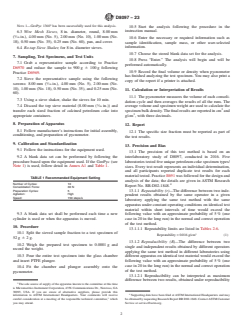
9.2 A blank data set can be performed by following the procedure based upon the equipment used. If the GeoPyc (see Note 1)
is used, follow detail in Annex A1 and Table 1.
TABLE 1 Recommended Equipment Setting
Number of Cycles: 10
Consolidation Force: 30 N
Preparation Cycles: 5
Agitation: High
Speed: 150 steps/s
9.3 A blank data set shall be performed each time a new cylinder is used or when the apparatus is moved.
10. Procedure
10.1 Split the sieved sample fraction to a test specimen of 52 g 6 2 g.
10.2 Weigh the prepared test specimen to 0.0001 g and record the weight.
10.3 Pour the entire test specimen into the glass chamber and insert PTFE plunger.
10.4 Fit the chamber and plunger assembly onto the pycnometer.
10.5 Start the analysis following the procedure in the instruction manual.
10.6 Enter the necessary or required information such as sample identification, sample mass, or other user-selected information.
10.7 Choose the stored blank data set for the analysis.
10.8 Press “Enter.” The analysis will begin and will be performed automatically.
10.9 Record the final volume or density when pycnometer has finished analyzing the test specimen. You may also print a copy
of the report if a printer is attached.
11. Calculation or Interpretation of Results
11.1 The pycnometer measures the volume of each consolidation cycle and then averages the results of all the runs. The average
3 3
volume and specimen weight are used to calculate the specimen bulk density. The final results are reported in cm and g/cm , with
three decimals.
12. Report
12.1 The specific size fraction must be reported as part of the test results.
13. Precision and Bias
13.1 The precision of this test method is based on an interlaboratory study of D8097, conducted in 2016. Five laboratories tested
five unique petroleum coke specimen types/sizes. Every test result represents an individual determination, and all participants
D8097 − 23
reported duplicate test results for each material tested. Practice E691 was followed for the design and analysis of the data; the
details are given in ASTM Research Report No. RR:D02-1848.
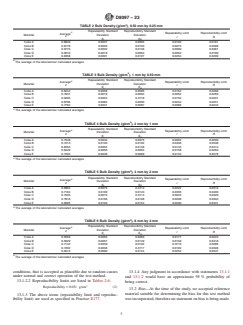
13.1.1 Repeatability (r)—The difference between repetitive two independent results obtained by the same operator in a given
laboratory applying the same test method with the same apparatus under constant operating condition
...