

ASTM D1921-18
(Test Method)Standard Test Methods for Particle Size (Sieve Analysis) of Plastic Materials
General Information
- Abstract
SIGNIFICANCE AND USE
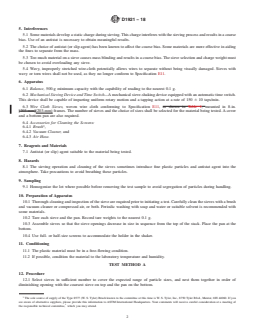
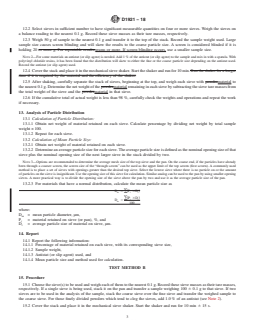
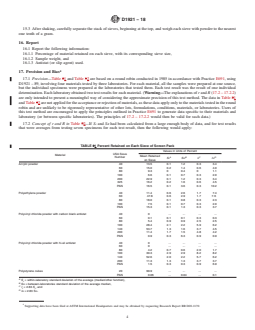
4.1 These test methods are used to determine particle size distribution and therefore are useful for determining lot-to-lot uniformity.
4.2 The particle sizes of plastic materials affect the handling characteristics and sometimes will affect the processing characteristics of some polymers.
SCOPE
1.1 These test methods cover the measurement of the particle size of plastic materials in the powdered, granular, or pelleted forms in which they are commonly supplied. As these test methods utilize dry sieving, the lower limit of measurement is considered to be about 38 μm (No. 400 sieve). For smaller particle sizes, sedimentation test methods are recommended.
1.2 Two test methods are described:
1.2.1 Test Method A—This test method uses multiple sieves selected to span the particle size of the material. This method is used to determine the mean particle diameter and particle size distribution.
1.2.2 Test Method B—This test method is an abbreviated version of Test Method A conducted with a few specific sieves. This test method determines “percent passing” or “percent retained” on a given sieve. Test Method B is applicable to materials which do not have a normal particle size distribution such as pellets and cubes.
1.3 The values stated in SI units are to be regarded as standard for dimensions of the wire cloth openings and the diameter of the wires used in the wire cloth.
1.4 This standard does not purport to address all of the safety concerns, if any, associated with its use. It is the responsibility of the user of this standard to establish appropriate safety, health, and environmental practices and determine the applicability of regulatory limitations prior to use.
Note 1: There is no known ISO equivalent for this test method.
1.5 This international standard was developed in accordance with internationally recognized principles on standardization established in the Decision on Principles for the Development of International Standards, Guides and Recommendations issued by the World Trade Organization Technical Barriers to Trade (TBT) Committee.
- Status
- Published
- Publication Date
- 31-Mar-2018
- Technical Committee
- D20 - Plastics
- Drafting Committee
- D20.70 - Analytical Methods

Overview
ASTM D1921-18: Standard Test Methods for Particle Size (Sieve Analysis) of Plastic Materials is a widely recognized standard developed by ASTM International. This standard outlines procedures for determining the particle size distribution of plastic materials supplied in powdered, granular, or pelleted forms using dry sieving techniques. Understanding particle size is critical in the plastics industry, as it impacts both the handling and processing characteristics of polymers. ASTM D1921-18 ensures consistent and reliable measurement of particle size, supporting quality assurance, process optimization, and product development.
Key Topics
Scope
- Covers plastic materials in powdered, granular, or pelleted forms.
- Measurement via dry sieving, effective for particle sizes down to about 38 μm (No. 400 sieve).
- For particles smaller than 38 μm, sedimentation methods are recommended.
Test Methods
- Test Method A:
- Utilizes a series of sieves to determine mean particle diameter and full particle size distribution.
- Suitable for materials with a normal particle size distribution.
- Test Method B:
- Focuses on “percent passing” or “percent retained” using fewer, specific sieves.
- Designed for materials with non-standard distributions such as pellets or cubes.
- Test Method A:
Apparatus and Procedure
- Requires a balance, mechanical sieve shaker, standard test sieves, and cleaning accessories.
- The standard prescribes careful sample preparation, appropriate sieve selection, and prevention of static bias and sieve blinding.
- Emphasizes proper homogenization and conditioning of test samples for accurate and reproducible results.
Applications
Quality Control:
- Particle size analysis ensures lot-to-lot uniformity of plastic raw materials.
- Reliable measurement helps in meeting customer specifications and regulatory requirements.
Process Optimization:
- Understanding particle size distribution aids in adjusting processing conditions for optimal extrusion, molding, or compounding.
- Can influence flow properties, mixing efficiency, and end product characteristics.
Product Development:
- Assists in tailoring material properties to specific applications by controlling particle size.
- Useful in research and development for benchmarking and comparative analysis.
Industrial Sectors:
- Relevant for manufacturers, suppliers, and processors of thermoplastics, polymer compounds, masterbatches, and resins.
- Supports operations in packaging, automotive, electronics, and other plastic-consuming industries.
Related Standards
ASTM E11: Specification for Woven Wire Test Sieve Cloth and Test Sieves.
- Prescribes the requirements for sieve cloth and frames used in sieve analysis.
ASTM E691: Practice for Conducting an Interlaboratory Study to Determine the Precision of a Test Method.
- Outlines statistical methodology for assessing test method repeatability and reproducibility.
Note:
- There is currently no ISO equivalent for ASTM D1921-18. It is developed in accordance with the WTO TBT Committee’s principles for international standards.
Practical Value
- Improved Uniformity: Enhances production consistency by identifying and controlling material variability.
- Operational Efficiency: Reduces downtime and defects related to improper particle size.
- Regulatory Compliance: Facilitates adherence to global standards and industry best practices.
- Versatile Use: Applicable across a broad range of polymer types and plastic processing methods.
For laboratories, manufacturers, and quality control professionals, adhering to ASTM D1921-18 delivers reliable, comparable particle size data fundamental to plastics production and analysis.
Relations
- Effective Date
- 01-Oct-2013
- Effective Date
- 01-May-2013
- Effective Date
- 01-Nov-2011
- Effective Date
- 01-May-2009
- Effective Date
- 01-Oct-2008
- Effective Date
- 01-Nov-2005
- Effective Date
- 01-May-2004
- Effective Date
- 10-May-2001
- Effective Date
- 10-May-2001
- Effective Date
- 10-May-1999
Get Certified
Connect with accredited certification bodies for this standard

IMP NDT d.o.o.
Non-destructive testing services. Radiography, ultrasonic, magnetic particle, penetrant, visual inspection.
Inštitut za kovinske materiale in tehnologije
Institute of Metals and Technology. Materials testing, metallurgical analysis, NDT.
Q Techna d.o.o.
NDT and quality assurance specialist. 30+ years experience. NDT personnel certification per ISO 9712, nuclear and thermal power plant inspections, QA/
Sponsored listings
Frequently Asked Questions
ASTM D1921-18 is a standard published by ASTM International. Its full title is "Standard Test Methods for Particle Size (Sieve Analysis) of Plastic Materials". This standard covers: SIGNIFICANCE AND USE 4.1 These test methods are used to determine particle size distribution and therefore are useful for determining lot-to-lot uniformity. 4.2 The particle sizes of plastic materials affect the handling characteristics and sometimes will affect the processing characteristics of some polymers. SCOPE 1.1 These test methods cover the measurement of the particle size of plastic materials in the powdered, granular, or pelleted forms in which they are commonly supplied. As these test methods utilize dry sieving, the lower limit of measurement is considered to be about 38 μm (No. 400 sieve). For smaller particle sizes, sedimentation test methods are recommended. 1.2 Two test methods are described: 1.2.1 Test Method A—This test method uses multiple sieves selected to span the particle size of the material. This method is used to determine the mean particle diameter and particle size distribution. 1.2.2 Test Method B—This test method is an abbreviated version of Test Method A conducted with a few specific sieves. This test method determines “percent passing” or “percent retained” on a given sieve. Test Method B is applicable to materials which do not have a normal particle size distribution such as pellets and cubes. 1.3 The values stated in SI units are to be regarded as standard for dimensions of the wire cloth openings and the diameter of the wires used in the wire cloth. 1.4 This standard does not purport to address all of the safety concerns, if any, associated with its use. It is the responsibility of the user of this standard to establish appropriate safety, health, and environmental practices and determine the applicability of regulatory limitations prior to use. Note 1: There is no known ISO equivalent for this test method. 1.5 This international standard was developed in accordance with internationally recognized principles on standardization established in the Decision on Principles for the Development of International Standards, Guides and Recommendations issued by the World Trade Organization Technical Barriers to Trade (TBT) Committee.
SIGNIFICANCE AND USE 4.1 These test methods are used to determine particle size distribution and therefore are useful for determining lot-to-lot uniformity. 4.2 The particle sizes of plastic materials affect the handling characteristics and sometimes will affect the processing characteristics of some polymers. SCOPE 1.1 These test methods cover the measurement of the particle size of plastic materials in the powdered, granular, or pelleted forms in which they are commonly supplied. As these test methods utilize dry sieving, the lower limit of measurement is considered to be about 38 μm (No. 400 sieve). For smaller particle sizes, sedimentation test methods are recommended. 1.2 Two test methods are described: 1.2.1 Test Method A—This test method uses multiple sieves selected to span the particle size of the material. This method is used to determine the mean particle diameter and particle size distribution. 1.2.2 Test Method B—This test method is an abbreviated version of Test Method A conducted with a few specific sieves. This test method determines “percent passing” or “percent retained” on a given sieve. Test Method B is applicable to materials which do not have a normal particle size distribution such as pellets and cubes. 1.3 The values stated in SI units are to be regarded as standard for dimensions of the wire cloth openings and the diameter of the wires used in the wire cloth. 1.4 This standard does not purport to address all of the safety concerns, if any, associated with its use. It is the responsibility of the user of this standard to establish appropriate safety, health, and environmental practices and determine the applicability of regulatory limitations prior to use. Note 1: There is no known ISO equivalent for this test method. 1.5 This international standard was developed in accordance with internationally recognized principles on standardization established in the Decision on Principles for the Development of International Standards, Guides and Recommendations issued by the World Trade Organization Technical Barriers to Trade (TBT) Committee.
ASTM D1921-18 is classified under the following ICS (International Classification for Standards) categories: 19.120 - Particle size analysis. Sieving. The ICS classification helps identify the subject area and facilitates finding related standards.
ASTM D1921-18 has the following relationships with other standards: It is inter standard links to ASTM E11-13, ASTM E691-13, ASTM E691-11, ASTM E11-09e1, ASTM E691-08, ASTM E691-05, ASTM E11-04, ASTM E11-95, ASTM E11-01, ASTM E691-99. Understanding these relationships helps ensure you are using the most current and applicable version of the standard.
ASTM D1921-18 is available in PDF format for immediate download after purchase. The document can be added to your cart and obtained through the secure checkout process. Digital delivery ensures instant access to the complete standard document.
Standards Content (Sample)
This international standard was developed in accordance with internationally recognized principles on standardization established in the Decision on Principles for the
Development of International Standards, Guides and Recommendations issued by the World Trade Organization Technical Barriers to Trade (TBT) Committee.
Designation: D1921 − 18
Standard Test Methods for
Particle Size (Sieve Analysis) of Plastic Materials
This standard is issued under the fixed designation D1921; the number immediately following the designation indicates the year of
original adoption or, in the case of revision, the year of last revision.Anumber in parentheses indicates the year of last reapproval.A
superscript epsilon (´) indicates an editorial change since the last revision or reapproval.
This standard has been approved for use by agencies of the U.S. Department of Defense.
1. Scope* 2. Referenced Documents
1.1 These test methods cover the measurement of the 2.1 ASTM Standards:
particle size of plastic materials in the powdered, granular, or E11Specification forWovenWireTest Sieve Cloth andTest
pelleted forms in which they are commonly supplied.As these Sieves
test methods utilize dry sieving, the lower limit of measure- E691Practice for Conducting an Interlaboratory Study to
ment is considered to be about 38 µm (No. 400 sieve). For Determine the Precision of a Test Method
smaller particle sizes, sedimentation test methods are recom-
mended. 3. Summary of Test Methods
3.1 A dry mass of plastic material is placed on a series of
1.2 Two test methods are described:
1.2.1 Test Method A—This test method uses multiple sieves sieves arranged in order of increasing fineness and the mass is
divided into fractions corresponding to the sieve opening.
selected to span the particle size of the material. This method
is used to determine the mean particle diameter and particle
4. Significance and Use
size distribution.
1.2.2 Test Method B—This test method is an abbreviated
4.1 These test methods are used to determine particle size
versionofTestMethodAconductedwithafewspecificsieves.
distribution and therefore are useful for determining lot-to-lot
This test method determines “percent passing” or “percent
uniformity.
retained” on a given sieve. Test Method B is applicable to
4.2 Theparticlesizesofplasticmaterialsaffectthehandling
materials which do not have a normal particle size distribution
characteristics and sometimes will affect the processing char-
such as pellets and cubes.
acteristics of some polymers.
1.3 The values stated in SI units are to be regarded as
standard for dimensions of the wire cloth openings and the
5. Interferences
diameter of the wires used in the wire cloth.
5.1 Some materials develop a static charge during sieving.
1.4 This standard does not purport to address all of the
This charge interferes with the sieving process and results in a
safety concerns, if any, associated with its use. It is the
coarse bias. Use of an antistat is necessary to obtain meaning-
responsibility of the user of this standard to establish appro-
ful results.
priate safety, health, and environmental practices and deter-
5.2 The choice of antistat (or slip agent) has been known to
mine the applicability of regulatory limitations prior to use.
affect the coarse bias. Some materials are more effective in
NOTE 1—There is no known ISO equivalent for this test method.
aiding the fines to separate from the mass.
1.5 This international standard was developed in accor-
5.3 Too much material on a sieve causes mass blinding and
dance with internationally recognized principles on standard-
results in a coarse bias. The sieve selection and charge weight
ization established in the Decision on Principles for the
must be chosen to avoid overloading any sieve.
Development of International Standards, Guides and Recom-
5.4 Wavy, improperly stretched wire-cloth potentially al-
mendations issued by the World Trade Organization Technical
lows wires to separate without being visually damaged. Sieves
Barriers to Trade (TBT) Committee.
with wavy or torn wires shall not be used, as they no longer
conform to Specification E11.
These test methods are under the jurisdiction of ASTM Committee D20 on
Plastics and are the direct responsibility of Subcommittee D20.70 on Analytical
Methods (Section D20.70.01). For referenced ASTM standards, visit the ASTM website, www.astm.org, or
Current edition approved April 1, 2018. Published April 2018. Originally contact ASTM Customer Service at service@astm.org. For Annual Book of ASTM
approved in 1961. Last previous edition approved in 2012 as D1921-12. DOI: Standards volume information, refer to the standard’s Document Summary page on
10.1520/D1921-18. the ASTM website.
*A Summary of Changes section appears at the end of this standard
Copyright © ASTM International, 100 Barr Harbor Drive, PO Box C700, West Conshohocken, PA 19428-2959. United States
D1921 − 18
6. Apparatus 11.2 If possible, condition the material to the laboratory
temperature and humidity.
6.1 Balance,500-gminimumcapacitywiththecapabilityof
reading to the nearest 0.1 g.
TEST METHOD A
6.2 Mechanical Sieving Device and Time Switch—A me-
chanicalsieve-shakingdeviceequippedwithanautomatictime
12. Procedure
switch. This device shall be capable of imparting uniform
12.1 Selectsievesinsufficientnumbertocovertheexpected
rotary motion and a tapping action at a rate of 150 6 10
range of particle sizes, and nest them together in order of
taps/min.
diminishingopeningwiththecoarsestsieveontopandthepan
6.3 Wire Cloth Sieves, woven wire cloth conforming to
on the bottom.
Specification E11, mounted in 8-in. (203-mm) frames. The
12.2 Select sieves in sufficient number to have significant
number of sieves and the choice of sizes shall be selected for
measurablequantitiesonfourormoresieves.Weighthesieves
the material being tested. A cover and a bottom pan are also
on a balance reading to the nearest 0.1 g. Record these sieve
required.
masses as their tare masses, respectively.
6.4 Accessories for Cleaning the Screens:
12.3 Weigh 50 g of sample to the nearest 0.1 g and transfer
6.4.1 Brush ,
ittothetopofthestack.Recordthesampleweightused.Large
6.4.2 Vacuum Cleaner, and
sample size causes screen blinding and will skew the results to
6.4.3 Air Hose.
the coarse particle size. A screen is considered blinded if it is
holding 20 grams or more. If screen blinding occurs, use a
7. Reagents and Materials
smaller sample size.
7.1 Antistat (or slip) agent suitable to the material being
NOTE 2—For some materials an antistat (or slip agent) is needed. Add
tested.
1% of the antistat (or slip agent) to the sample and mix in with a spatula.
With polyvinyl chloride resins, it has been found that the distribution will
8. Hazards
skew to either the fine or the coarse particle size depending on the antistat
used. Record the antistat (or slip agent) used.
8.1 The sieving operation and cleaning of the sieves some-
times introduce fine plastic particles and antistat agent into the
12.4 Cover the stack and place it in the mechanical sieve
atmosphere. Take precautions to avoid breathing these par-
shaker. Start the shaker and run for 10 min.
ticles.
12.5 After shaking, carefully separate the stack of sieves,
beginning at the top, and weigh each sieve with material to the
9. Sampling
nearest 0.1 g. Determine the net weight of the material
9.1 Homogenizethelotwherepossiblebeforeremovingthe
remaining in each sieve by subtracting the sieve tare masses
test sample to avoid segregation of particles during handling.
fromthetotalweightofthesieveandthematerialinthatsieve.
12.6 If the cumulative total of actual weight is less than
10. Preparation of Apparatus
98%, carefully check the weights and operations and repeat
10.1 Thorough cleaning and inspection of the sieve are
the work if necessary.
required prior to initiating a test. Carefully clean the sieves
with a brush and vacuum cleaner or compressed air, or both.
13. Analysis of Particle Distribution
Periodic washing with soap and water or suitable solvent is
13.1 Calculation of Particle Distribution:
recommended with some materials.
13.1.1 Obtain net weight of material retained on each sieve.
10.2 Tareeachsieveandthepan.Recordtareweightstothe
Calculate percentage by dividing net weight by total sample
nearest 0.1 g.
weight×100.
10.3 Assemble sieves so that the sieve openings decrease in
13.1.2 Repeat for each sieve.
size in sequence from the top of the stack. Place the pan at the
13.2 Calculation of Mean Particle Size:
bottom.
13.2.1 Obtain net weight of material retained on each sieve.
10.4 Use full- or half-size screens to accommodate the
13.2.2 Determine an average particle size for each sieve.
holder in the shaker.
Theaverage
...
This document is not an ASTM standard and is intended only to provide the user of an ASTM standard an indication of what changes have been made to the previous version. Because
it may not be technically possible to adequately depict all changes accurately, ASTM recommends that users consult prior editions as appropriate. In all cases only the current version
of the standard as published by ASTM is to be considered the official document.
Designation: D1921 − 12 D1921 − 18
Standard Test Methods for
Particle Size (Sieve Analysis) of Plastic Materials
This standard is issued under the fixed designation D1921; the number immediately following the designation indicates the year of
original adoption or, in the case of revision, the year of last revision. A number in parentheses indicates the year of last reapproval. A
superscript epsilon (´) indicates an editorial change since the last revision or reapproval.
This standard has been approved for use by agencies of the U.S. Department of Defense.
1. Scope*
1.1 These test methods cover the measurement of the particle size of plastic materials in the powdered, granular, or pelleted
forms in which they are commonly supplied. As these test methods utilize dry sieving, the lower limit of measurement is
considered to be about 38 μm (No. 400 sieve). For smaller particle sizes, sedimentation test methods are recommended.
1.2 Two test methods are described:
1.2.1 Test Method A—This test method uses multiple sieves selected to span the particle size of the material. This method is used
to determine the mean particle diameter and particle size distribution.
1.2.2 Test Method B—This test method is an abbreviated version of Test Method A conducted with a few specific sieves. This
test method determines “percent passing” or “percent retained” on a given sieve. Test Method B is applicable to materials which
do not have a normal particle size distribution such as pellets and cubes.
1.3 The values stated in SI units shall be considered are to be regarded as standard for dimensions of the wire cloth openings
and the diameter of the wires used in the wire cloth. The values stated in inch-pound units shall be considered standard with regard
to the sieve frames.
1.4 This standard does not purport to address all of the safety concerns, if any, associated with its use. It is the responsibility
of the user of this standard to establish appropriate safety safety, health, and healthenvironmental practices and determine the
applicability of regulatory limitations prior to use.
NOTE 1—There is no known ISO equivalent for this test method.
1.5 This international standard was developed in accordance with internationally recognized principles on standardization
established in the Decision on Principles for the Development of International Standards, Guides and Recommendations issued
by the World Trade Organization Technical Barriers to Trade (TBT) Committee.
2. Referenced Documents
2.1 ASTM Standards:
E11 Specification for Woven Wire Test Sieve Cloth and Test Sieves
E691 Practice for Conducting an Interlaboratory Study to Determine the Precision of a Test Method
3. Summary of Test Methods
3.1 A dry mass of plastic material is placed on a series of sieves arranged in order of increasing fineness and the mass is divided
into fractions corresponding to the sieve opening.
4. Significance and Use
4.1 These test methods are used to determine particle size distribution and therefore are useful for determining lot-to-lot
uniformity.
4.2 The particle sizes of plastic materials affect the handling characteristics and sometimes will affect the processing
characteristics of some polymers.
These test methods are under the jurisdiction of ASTM Committee D20 on Plastics and are the direct responsibility of Subcommittee D20.70 on Analytical Methods
(Section D20.70.01).
Current edition approved Aug. 1, 2012April 1, 2018. Published September 2012April 2018. Originally approved in 1961. Last previous edition approved in 20062012 as
ε1
D1921 - 06D1921 - 12. . DOI: 10.1520/D1921-12.10.1520/D1921-18.
For referenced ASTM standards, visit the ASTM website, www.astm.org, or contact ASTM Customer Service at service@astm.org. For Annual Book of ASTM Standards
volume information, refer to the standard’s Document Summary page on the ASTM website.
*A Summary of Changes section appears at the end of this standard
Copyright © ASTM International, 100 Barr Harbor Drive, PO Box C700, West Conshohocken, PA 19428-2959. United States
D1921 − 18
5. Interferences
5.1 Some materials develop a static charge during sieving. This charge interferes with the sieving process and results in a coarse
bias. Use of an antistat is necessary to obtain meaningful results.
5.2 The choice of antistat (or slip agent) has been known to affect the coarse bias. Some materials are more effective in aiding
the fines to separate from the mass.
5.3 Too much material on a sieve causes mass blinding and results in a coarse bias. The sieve selection and charge weight must
be chosen to avoid overloading any sieve.
5.4 Wavy, improperly stretched wire-cloth potentially allows wires to separate without being visually damaged. Sieves with
wavy or torn wires shall not be used, as they no longer conform to Specification E11.
6. Apparatus
6.1 Balance, 500-g minimum capacity with the capability of reading to the nearest 0.1 g.
6.2 Mechanical Sieving Device and Time Switch—A mechanical sieve-shaking device equipped with an automatic time switch.
This device shall be capable of imparting uniform rotary motion and a tapping action at a rate of 150 6 10 taps/min.
6.3 Wire Cloth Sieves, woven wire cloth conforming to Specification E11, as shown in Table 1, mounted in 8-in.
[203-mm](203-mm) frames. The number of sieves and the choice of sizes shall be selected for the material being tested. A cover
and a bottom pan are also required.
6.4 Accessories for Cleaning the Screens:
6.4.1 Brush ,
6.4.2 Vacuum Cleaner, and
6.4.3 Air Hose.
7. Reagents and Materials
7.1 Antistat (or slip) agent suitable to the material being tested.
8. Hazards
8.1 The sieving operation and cleaning of the sieves sometimes introduce fine plastic particles and antistat agent into the
atmosphere. Take precautions to avoid breathing these particles.
9. Sampling
9.1 Homogenize the lot where possible before removing the test sample to avoid segregation of particles during handling.
10. Preparation of Apparatus
10.1 Thorough cleaning and inspection of the sieve are required prior to initiating a test. Carefully clean the sieves with a brush
and vacuum cleaner or compressed air, or both. Periodic washing with soap and water or suitable solvent is recommended with
some materials.
10.2 Tare each sieve and the pan. Record tare weights to the nearest 0.1 g.
10.3 Assemble sieves so that the sieve openings decrease in size in sequence from the top of the stack. Place the pan at the
bottom.
10.4 Use full- or half-size screens to accommodate the holder in the shaker.
11. Conditioning
11.1 The plastic material must be in a free-flowing condition.
11.2 If possible, condition the material to the laboratory temperature and humidity.
TEST METHOD A
12. Procedure
12.1 Select sieves in sufficient number to cover the expected range of particle sizes, and nest them together in order of
diminishing opening with the coarsest sieve on top and the pan on the bottom.
The sole source of supply of the Type 8577 (W. S. Tyler) Brush known to the committee at this time is W. S. Tyler, Inc., 8750 Tyler Blvd., Mentor, OH 44060. If you
are aware of alternative suppliers, please provide this information to ASTM International Headquarters. Your comments will receive careful consideration at a meeting of
the responsible technical committee, which you may attend.
D1921 − 18
12.2 Select sieves in sufficient number to have significant measurable quantities on four or more sieves. Weigh the sieves on
a balance reading to the nearest 0.1 g. Record these sieve masses as their tare masses, respectively.
12.3 Weigh 50 g of sample to the nearest 0.1 g and transfer it to the top of the stack. Record the sample weight used. Large
sample size causes screen blinding and will skew the results to the coarse particle size. A screen is considered blinded if it is
holding 20 or more g. For repeatable results,grams or more. If screen blinding occurs, use a smaller sample size.
NOTE 2—For some materials an antistat (or slip agent) is needed. Add 1 % of the antistat (or slip agent) to the sample and mix in with a spatula. With
polyvinyl chloride resins, it has been found that the distribution will skew to either the fine or the coarse particle size depending on the antistat used.
Record the antistat (or slip agent) used.
12.4 Cover the stack and place it in the mechanical sieve shaker. Start the shaker and run for 10 min. Run the shaker for a longer
time if it is required by the material and the efficiency of the shaker.
12.5 After shaking, carefully separate the stack of sieves, beginning at the top, and weigh each sieve with powdermaterial to
the nearest 0.1 g. Determine the net weight of the powdermaterial remaining in each sieve by subtracting the sieve tare masses from
the total weight of the sieve and the powdermaterial in that sieve.
12.6 If the cumulative total of actual weight is less than 98 %, carefully check the weights and operations and repeat the work
if necessary.
13. Analysis of Particle Distribution
13.1 Calculation of Particle Distribution:
13.1.1 Obtain net weight of material retained on each sieve. Calculate percentage by dividing net weight by total sample
weight × 100.
13.1.2 Repeat for each sieve.
13.2 Calculation of Mean Particle Size:
13.2.1 Obtain net weight of material retained on each sieve.
13.2.2 Determine an average particle size for each sieve. The average particle size is defined as the nominal opening size of that
sieve plus the nominal opening size of the next larger sieve in the stack divided by two.
NOTE 3—Options are recommended to determine the average mesh size of the top sieve and the pan. On the coarse end, if the particles have already
been through a coarser screen, the screen size of the “through screen” can be used as the upper limit of the top screen (first screen). A commonly used
method is to place a set of sieves with openings greater than the desired top sieve. Select the lowest sieve where there is no particle on or the amount
of particles on the sieve is insignificant. Use the opening size of this sieve for calculation. Similar analog can be used to the pan by using smaller opening
sieves. A more practical way is to divide the opening size of the sieve above the pan by two and use it as the average particle size of the pan.
13.2.3 For materials that have a normal distribution, calculate the mean particle size as
D 5 P 3D
~ !
m ( i i
P 3D
~ !
( i i
D 5
m
where:
D = mean particle diameter, μm,
m
P = material retained on sieve (or pan), %, and
i
D = average particle size of material on sieve, μm.
i
14. Report
14.1 Report the following information:
14.1.1 Percentage of material retained on each sieve, with its corresponding sieve size,
14.1.2 Sample weight,
14.1.3 Antistat (or slip agent) used, and
14.1.4 Mean particle size and method used for calculation.
TEST METHOD B
15. Procedure
15.1 Choose the sieve(s) to be used and
...