

ASTM D4394-17
(Test Method)Standard Test Method for Determining In Situ Modulus of Deformation of Rock Mass Using Rigid Plate Loading Method
General Information
- Abstract
SIGNIFICANCE AND USE
5.1 Results of this type of test method are used to predict displacements in rock mass caused by loads from a structure or from underground construction. It is one of several tests that should be performed. The resulting in situ elastic modulus is commonly less than the elastic modulus determined in the laboratory.
5.2 The modulus is determined using an elastic solution for a uniformly distributed load (uniform stress) over a circular area acting on a semi-infinite elastic medium that produces a constant normal displacement of the loaded surface area of the medium.
5.3 This test method is normally performed at ambient temperature, but equipment can be modified or substituted for operations at other temperatures.
Note 1: The quality of the result produced by this standard is dependent on the competence of the personnel performing it, and the suitability of the equipment and facilities used. Agencies that meet the criteria of Practice D3740 are generally considered capable of competent and objective testing/sampling/inspection/etc. Users of this standard are cautioned that compliance with Practice D3740 does not in itself assure reliable results. Reliable results depend on many factors; Practice D3740 provides a means of evaluating some of those factors.
SCOPE
1.1 This test method covers the preparation, equipment, test procedure, and data reduction for determining in situ modulus of deformation of a rock mass using the rigid plate loading method.
1.2 This test method is designed to be conducted in an adit or small underground chamber; however, with suitable modifications it could be conducted at the surface.
1.3 This test method is usually conducted parallel or perpendicular to the anticipated axis of thrust, as dictated by the design load and to diametrically opposite surfaces.
1.4 Both instantaneous deformation and primary creep can be obtained from this test method.
1.5 Time dependent tests can be performed and are discussed briefly here but are to be reported in another standard.
1.6 Observed and calculated values shall conform to the guidelines for significant digits and rounding established in Practice D6026.
1.6.1 The method used to specify how data are collected, calculated, or recorded in this standard is not directly related to the accuracy to which the data can be applied in design or other uses, or both. How one applies the results obtained using this standard is beyond its scope.
1.7 The values stated in inch-pound units are to be regarded as standard. The values given in parentheses are mathematical conversions to SI units that are provided for information only and are not considered standard.
1.8 The references appended to this standard contain further information on this test method.
1.9 This standard does not purport to address all of the safety concerns, if any, associated with its use. It is the responsibility of the user of this standard to establish appropriate safety and health practices and determine the applicability of regulatory requirements prior to use. For specific precaution statements, see Section 8.
1.10 This international standard was developed in accordance with internationally recognized principles on standardization established in the Decision on Principles for the Development of International Standards, Guides and Recommendations issued by the World Trade Organization Technical Barriers to Trade (TBT) Committee.
- Status
- Published
- Publication Date
- 30-Jun-2017
- Technical Committee
- D18 - Soil and Rock
- Drafting Committee
- D18.12 - Rock Mechanics
Buy Documents
ASTM D4394-17 - Standard Test Method for Determining In Situ Modulus of Deformation of Rock Mass Using Rigid Plate Loading Method
REDLINE ASTM D4394-17 - Standard Test Method for Determining In Situ Modulus of Deformation of Rock Mass Using Rigid Plate Loading Method
Overview
ASTM D4394-17: Standard Test Method for Determining In Situ Modulus of Deformation of Rock Mass Using Rigid Plate Loading Method is a widely recognized standard published by ASTM International. This test method provides a guideline to determine the in situ modulus of deformation of rock mass, which is essential for assessing the deformation characteristics of rocks under load, particularly in underground construction and civil engineering projects.
By employing the rigid plate loading method, this standard focuses on measuring both instantaneous deformation and primary creep in rock masses. The results assist geotechnical engineers and project planners in predicting rock displacement caused by imposed loads, such as those from tunnels, foundations, or other underground structures.
Key Topics
In Situ Modulus of Deformation
Measures the deformation properties of a rock mass in its natural setting rather than in a laboratory, providing more realistic data for engineering applications.Rigid Plate Loading Method
Involves applying load through a rigid plate to a prepared rock surface, typically in an adit or underground chamber. Special attention is given to plate rigidity, load application mechanisms, and the minimization of surface irregularities.Test Setup and Execution
Guidelines are provided for site and surface preparation, equipment requirements (including loading systems, deformation measuring devices, and load cells), and step-by-step procedures for conducting the test.Data Collection and Reduction
The standard outlines how to record and interpret deformation data, calculate the modulus of deformation, and report results according to significant digits and relevant ASTM guidelines.Quality Assurance and Safety
Emphasizes the importance of qualified personnel, calibrated equipment, and adherence to health and safety practices throughout the process.
Applications
The rigid plate loading test as described in ASTM D4394-17 has broad applications in the field of geotechnical engineering and construction, principally for:
Underground Construction
Supports the safe and efficient design of tunnels, shafts, underground chambers, and mining excavations by providing in situ deformation data.Foundation Assessment
Informs the structural design and placement of heavy foundations on or within rock masses, such as for dams, buildings, or infrastructure in mountainous/hard rock regions.Evaluation of Structural Stability
Assists in detecting zones with different deformability characteristics within rock masses, such as faults or fractured zones, contributing to risk assessment and mitigation strategies.Creep and Time-Dependent Analysis
Enables assessment of both immediate and primary creep behavior under load, which is critical in long-term stability evaluations.
Related Standards
The ASTM D4394-17 standard references several other related ASTM standards and best practices, including:
- ASTM D653: Terminology Relating to Soil, Rock, and Contained Fluids
- ASTM D2113: Practice for Rock Core Drilling and Sampling of Rock for Site Exploration
- ASTM D3740: Practice for Minimum Requirements for Agencies Engaged in Testing and/or Inspection of Soil and Rock
- ASTM D4395: Test Method for Determining In Situ Modulus of Deformation of Rock Mass Using Flexible Plate Loading Method
- ASTM D4403: Practice for Extensometers Used in Rock
- ASTM D6026: Practice for Using Significant Digits in Geotechnical Data
- ASTM D6032: Test Method for Determining Rock Quality Designation (RQD) of Rock Core
Practical Value
ASTM D4394-17 is invaluable for geotechnical professionals needing to assess rock mass deformation under real-world loading conditions. By following this standard, organizations can:
- Enhance the Reliability of Design Data: In situ measurements are more representative than laboratory-derived values, reducing uncertainty.
- Ensure Traceable and Defensible Test Results: Adherence to calibrated procedures and proper documentation increases confidence in project decisions.
- Promote Safety and Regulatory Compliance: Following recognized international standards supports safety and meets common regulatory and contractual requirements in civil engineering projects.
By integrating ASTM D4394-17 with supplementary standards and best practices, professionals can achieve comprehensive, high-quality insights into the deformation behavior of rock masses for demanding engineering applications.
Relations
- Effective Date
- 01-Jul-2017
- Effective Date
- 01-Nov-2023
- Effective Date
- 01-Jan-2020
- Effective Date
- 01-Oct-2019
- Effective Date
- 01-Aug-2014
- Effective Date
- 15-Aug-2012
- Effective Date
- 01-May-2012
- Effective Date
- 01-Mar-2012
- Effective Date
- 01-Sep-2011
- Effective Date
- 01-Sep-2011
- Effective Date
- 01-Mar-2010
- Effective Date
- 01-May-2009
- Effective Date
- 01-Jan-2009
- Effective Date
- 01-Dec-2008
- Effective Date
- 01-Nov-2008
Buy Documents
ASTM D4394-17 - Standard Test Method for Determining In Situ Modulus of Deformation of Rock Mass Using Rigid Plate Loading Method
REDLINE ASTM D4394-17 - Standard Test Method for Determining In Situ Modulus of Deformation of Rock Mass Using Rigid Plate Loading Method
Get Certified
Connect with accredited certification bodies for this standard

Zavod za gradbeništvo Slovenije (ZAG) - Inšpekcija
ZAG inspection body for construction products, structures, and materials.
Sponsored listings
Frequently Asked Questions
ASTM D4394-17 is a standard published by ASTM International. Its full title is "Standard Test Method for Determining In Situ Modulus of Deformation of Rock Mass Using Rigid Plate Loading Method". This standard covers: SIGNIFICANCE AND USE 5.1 Results of this type of test method are used to predict displacements in rock mass caused by loads from a structure or from underground construction. It is one of several tests that should be performed. The resulting in situ elastic modulus is commonly less than the elastic modulus determined in the laboratory. 5.2 The modulus is determined using an elastic solution for a uniformly distributed load (uniform stress) over a circular area acting on a semi-infinite elastic medium that produces a constant normal displacement of the loaded surface area of the medium. 5.3 This test method is normally performed at ambient temperature, but equipment can be modified or substituted for operations at other temperatures. Note 1: The quality of the result produced by this standard is dependent on the competence of the personnel performing it, and the suitability of the equipment and facilities used. Agencies that meet the criteria of Practice D3740 are generally considered capable of competent and objective testing/sampling/inspection/etc. Users of this standard are cautioned that compliance with Practice D3740 does not in itself assure reliable results. Reliable results depend on many factors; Practice D3740 provides a means of evaluating some of those factors. SCOPE 1.1 This test method covers the preparation, equipment, test procedure, and data reduction for determining in situ modulus of deformation of a rock mass using the rigid plate loading method. 1.2 This test method is designed to be conducted in an adit or small underground chamber; however, with suitable modifications it could be conducted at the surface. 1.3 This test method is usually conducted parallel or perpendicular to the anticipated axis of thrust, as dictated by the design load and to diametrically opposite surfaces. 1.4 Both instantaneous deformation and primary creep can be obtained from this test method. 1.5 Time dependent tests can be performed and are discussed briefly here but are to be reported in another standard. 1.6 Observed and calculated values shall conform to the guidelines for significant digits and rounding established in Practice D6026. 1.6.1 The method used to specify how data are collected, calculated, or recorded in this standard is not directly related to the accuracy to which the data can be applied in design or other uses, or both. How one applies the results obtained using this standard is beyond its scope. 1.7 The values stated in inch-pound units are to be regarded as standard. The values given in parentheses are mathematical conversions to SI units that are provided for information only and are not considered standard. 1.8 The references appended to this standard contain further information on this test method. 1.9 This standard does not purport to address all of the safety concerns, if any, associated with its use. It is the responsibility of the user of this standard to establish appropriate safety and health practices and determine the applicability of regulatory requirements prior to use. For specific precaution statements, see Section 8. 1.10 This international standard was developed in accordance with internationally recognized principles on standardization established in the Decision on Principles for the Development of International Standards, Guides and Recommendations issued by the World Trade Organization Technical Barriers to Trade (TBT) Committee.
SIGNIFICANCE AND USE 5.1 Results of this type of test method are used to predict displacements in rock mass caused by loads from a structure or from underground construction. It is one of several tests that should be performed. The resulting in situ elastic modulus is commonly less than the elastic modulus determined in the laboratory. 5.2 The modulus is determined using an elastic solution for a uniformly distributed load (uniform stress) over a circular area acting on a semi-infinite elastic medium that produces a constant normal displacement of the loaded surface area of the medium. 5.3 This test method is normally performed at ambient temperature, but equipment can be modified or substituted for operations at other temperatures. Note 1: The quality of the result produced by this standard is dependent on the competence of the personnel performing it, and the suitability of the equipment and facilities used. Agencies that meet the criteria of Practice D3740 are generally considered capable of competent and objective testing/sampling/inspection/etc. Users of this standard are cautioned that compliance with Practice D3740 does not in itself assure reliable results. Reliable results depend on many factors; Practice D3740 provides a means of evaluating some of those factors. SCOPE 1.1 This test method covers the preparation, equipment, test procedure, and data reduction for determining in situ modulus of deformation of a rock mass using the rigid plate loading method. 1.2 This test method is designed to be conducted in an adit or small underground chamber; however, with suitable modifications it could be conducted at the surface. 1.3 This test method is usually conducted parallel or perpendicular to the anticipated axis of thrust, as dictated by the design load and to diametrically opposite surfaces. 1.4 Both instantaneous deformation and primary creep can be obtained from this test method. 1.5 Time dependent tests can be performed and are discussed briefly here but are to be reported in another standard. 1.6 Observed and calculated values shall conform to the guidelines for significant digits and rounding established in Practice D6026. 1.6.1 The method used to specify how data are collected, calculated, or recorded in this standard is not directly related to the accuracy to which the data can be applied in design or other uses, or both. How one applies the results obtained using this standard is beyond its scope. 1.7 The values stated in inch-pound units are to be regarded as standard. The values given in parentheses are mathematical conversions to SI units that are provided for information only and are not considered standard. 1.8 The references appended to this standard contain further information on this test method. 1.9 This standard does not purport to address all of the safety concerns, if any, associated with its use. It is the responsibility of the user of this standard to establish appropriate safety and health practices and determine the applicability of regulatory requirements prior to use. For specific precaution statements, see Section 8. 1.10 This international standard was developed in accordance with internationally recognized principles on standardization established in the Decision on Principles for the Development of International Standards, Guides and Recommendations issued by the World Trade Organization Technical Barriers to Trade (TBT) Committee.
ASTM D4394-17 is classified under the following ICS (International Classification for Standards) categories: 93.020 - Earthworks. Excavations. Foundation construction. Underground works. The ICS classification helps identify the subject area and facilitates finding related standards.
ASTM D4394-17 has the following relationships with other standards: It is inter standard links to ASTM D4394-08, ASTM D3740-23, ASTM D4403-20, ASTM D3740-19, ASTM D653-14, ASTM D4403-12, ASTM D3740-12a, ASTM D3740-12, ASTM D3740-11, ASTM D653-11, ASTM D3740-10, ASTM D5434-09, ASTM D653-09, ASTM D653-08a, ASTM D653-08. Understanding these relationships helps ensure you are using the most current and applicable version of the standard.
ASTM D4394-17 is available in PDF format for immediate download after purchase. The document can be added to your cart and obtained through the secure checkout process. Digital delivery ensures instant access to the complete standard document.
Standards Content (Sample)
This international standard was developed in accordance with internationally recognized principles on standardization established in the Decision on Principles for the
Development of International Standards, Guides and Recommendations issued by the World Trade Organization Technical Barriers to Trade (TBT) Committee.
Designation: D4394 − 17
Standard Test Method for
Determining In Situ Modulus of Deformation of Rock Mass
Using Rigid Plate Loading Method
This standard is issued under the fixed designation D4394; the number immediately following the designation indicates the year of
original adoption or, in the case of revision, the year of last revision.Anumber in parentheses indicates the year of last reapproval.A
superscript epsilon (´) indicates an editorial change since the last revision or reapproval.
1. Scope* bility of regulatory requirements prior to use. For specific
precaution statements, see Section 8.
1.1 This test method covers the preparation, equipment, test
1.10 This international standard was developed in accor-
procedure, and data reduction for determining in situ modulus
dance with internationally recognized principles on standard-
of deformation of a rock mass using the rigid plate loading
ization established in the Decision on Principles for the
method.
Development of International Standards, Guides and Recom-
1.2 This test method is designed to be conducted in an adit
mendations issued by the World Trade Organization Technical
or small underground chamber; however, with suitable modi-
Barriers to Trade (TBT) Committee.
fications it could be conducted at the surface.
2. Referenced Documents
1.3 This test method is usually conducted parallel or per-
pendicular to the anticipated axis of thrust, as dictated by the
2.1 ASTM Standards:
design load and to diametrically opposite surfaces.
D653Terminology Relating to Soil, Rock, and Contained
Fluids
1.4 Both instantaneous deformation and primary creep can
D2113Practice for Rock Core Drilling and Sampling of
be obtained from this test method.
Rock for Site Exploration
1.5 Time dependent tests can be performed and are dis-
D3740Practice for Minimum Requirements for Agencies
cussed briefly here but are to be reported in another standard.
Engaged in Testing and/or Inspection of Soil and Rock as
1.6 Observed and calculated values shall conform to the
Used in Engineering Design and Construction
guidelines for significant digits and rounding established in
D4395Test Method for Determining In Situ Modulus of
Practice D6026.
Deformation of Rock Mass Using Flexible Plate Loading
1.6.1 The method used to specify how data are collected,
Method
calculated,orrecordedinthisstandardisnotdirectlyrelatedto D4403Practice for Extensometers Used in Rock
theaccuracytowhichthedatacanbeappliedindesignorother
D4879Guide for Geotechnical Mapping of Large Under-
uses, or both. How one applies the results obtained using this ground Openings in Rock (Withdrawn 2017)
standard is beyond its scope. D5079Practices for Preserving andTransporting Rock Core
Samples (Withdrawn 2017)
1.7 The values stated in inch-pound units are to be regarded
D5434Guide for Field Logging of Subsurface Explorations
as standard. The values given in parentheses are mathematical
of Soil and Rock
conversions to SI units that are provided for information only
D6026Practice for Using Significant Digits in Geotechnical
and are not considered standard.
Data
1.8 Thereferencesappendedtothisstandardcontainfurther
D6032Test Method for Determining Rock Quality Designa-
information on this test method.
tion (RQD) of Rock Core
1.9 This standard does not purport to address all of the
safety concerns, if any, associated with its use. It is the 3. Terminology
responsibility of the user of this standard to establish appro-
3.1 Definitions:
priate safety and health practices and determine the applica-
For referenced ASTM standards, visit the ASTM website, www.astm.org, or
ThistestmethodisunderthejurisdictionofASTMCommitteeD18onSoiland contact ASTM Customer Service at service@astm.org. For Annual Book of ASTM
Rock and is the direct responsibility of Subcommittee D18.12 on Rock Mechanics. Standards volume information, refer to the standard’s Document Summary page on
Current edition approved July 1, 2017. Published August 2017. Originally the ASTM website.
approved in 1984. Last previous edition approved in 2008 as D4394–08. DOI: The last approved version of this historical standard is referenced on
10.1520/D4394-17. www.astm.org.
*A Summary of Changes section appears at the end of this standard
Copyright © ASTM International, 100 Barr Harbor Drive, PO Box C700, West Conshohocken, PA 19428-2959. United States
D4394 − 17
3.1.1 For terminology used in this test method, refer to
Terminology, D653.
3.2 Definitions of Terms Specific to This Standard:
3.2.1 deflection, n—movement of the rigid plate, mortar
pad, or rock in response to and in the same direction as the
applied load.
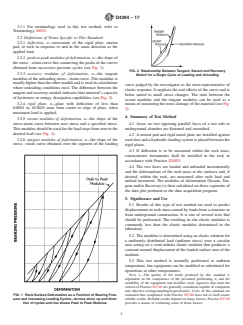
3.2.2 peak-to-peak modulus of deformation, n—the slope of
the stress-strain curve line connecting the peaks of the curves
obtained from successive pressure cycles (see Fig. 1).
FIG. 2 Relationship Between Tangent, Secant and Recovery
3.2.3 recovery modulus of deformation, n—the tangent
Moduli for a Single Cycle of Loading and Unloading
modulus of the unloading stress-strain curve.This modulus is
usuallyhigherthantheothermoduliandisusedincalculations
curve judged by the investigator as the most representative of
where unloading conditions exist. The difference between the
elastic response. It neglects the end effects of the curve and is
tangent and recovery moduli indicates that material’s capacity
better suited to small stress changes. The ratio between the
of hysteresis or energy dissipation capabilities (see Fig. 2).
secant modulus and the tangent modulus can be used as a
3.2.4 rigid plate, n—plate with deflection of less than
meansofmeasuringthestressdamageofthematerial(seeFig.
0.0001 in. (0.0025 mm) from center to edge of plate, when
2).
maximum load is applied.
4. Summary of Test Method
3.2.5 secant modulus of deformation, n—the slope of the
stress-strain curve between zero stress and a specified stress. 4.1 Areas on two opposing parallel faces of a test adit or
underground chamber are flattened and smoothed.
Thismodulusshouldbeusedfortheloadstepsfromzerotothe
desired load (see Fig. 2).
4.2 Amortar pad and rigid metal plate are installed against
3.2.6 tangent modulus of deformation, n—the slope of the eachfaceandahydraulicloadingsystemisplacedbetweenthe
stress-strain curve obtained over the segment of the loading
rigid plates.
4.3 If deflection is to be measured within the rock mass,
extensometer instruments shall be installed in the rock in
accordance with Practice D4403.
4.4 The two faces are loaded and unloaded incrementally
and the deformations of the rock mass at the surfaces and, if
desired, within the rock, are measured after each load and
unload increment. The modulus of deformation (Secant, Tan-
gent and/or Recovery) is then calculated on those segments of
the data plot pertinent to the data acquisition program.
5. Significance and Use
5.1 Results of this type of test method are used to predict
displacementsinrockmasscausedbyloadsfromastructureor
from underground construction. It is one of several tests that
should be performed. The resulting in situ elastic modulus is
commonly less than the elastic modulus determined in the
laboratory.
5.2 The modulus is determined using an elastic solution for
a uniformly distributed load (uniform stress) over a circular
area acting on a semi-infinite elastic medium that produces a
constant normal displacement of the loaded surface area of the
medium.
5.3 This test method is normally performed at ambient
temperature, but equipment can be modified or substituted for
operations at other temperatures.
NOTE 1—The quality of the result produced by this standard is
dependent on the competence of the personnel performing it, and the
suitability of the equipment and facilities used. Agencies that meet the
criteria of Practice D3740 are generally considered capable of competent
and objective testing/sampling/inspection/etc. Users of this standard are
FIG. 1 Rock Surface Deformation as a Function of Bearing Pres- cautioned that compliance with Practice D3740 does not in itself assure
sure and Increasing Loading Cycles—Arrows show up and direc- reliable results. Reliable results depend on many factors; Practice D3740
tion of cycles and line shows Peak to Peak Modulus. provides a means of evaluating some of those factors.
D4394 − 17
6. Interferences tation hole and a tunnel diameter gauge. For surface
measurements, dial gages or linear variable differential trans-
6.1 An inflexible plate used to load the rock face is difficult
formers (LVDTs) are generally used.An accuracy of 60.0001
to construct. However, if the plate is constructed as rigid as
in. (0.0025 mm), including the error of the readout equipment,
practicable, the rock face is smoothed, and a thin, high-
and a sensitivity of at least 0.00005 in. (0.0013 mm) is
modulus material is used for the pad, the error is minimal.
recommended. Errors in excess of 0.0004 in. (0.01 mm) can
6.2 The rock under the loaded area is generally not
invalidate test results when the modulus of rock mass exceeds
6 4
homogeneous, as assumed in theory. Rock will respond to the
5×10 psi (3.5×10 MPa).
load according to its local deformational characteristics.
7.5 Loading Equipment—The loading equipment includes
Therefore, deflection measurements at discrete points on the
the device for applying the load and the reaction members
rocksurfacetendtobeheavilyinfluencedbythedeformational
(usually thick-walled aluminum or steel pipes) which transmit
characteristics of the rock mass at that location and may give
the load of sufficient capacity for the intended test program.
results that are unrepresentative of the rock mass. The use of
Hydraulic rams or flatjacks are usually used to apply the load
the average plate deflection will mitigate this problem.
hydraulically with sufficient capability and volume to apply
6.3 Measurement of the deflection within the rock mass can
and maintain desired pressures to within 3%. If flatjacks are
utilize a finite gauge length to reflect the average rock mass
usedtheyshouldhavesufficientrangetoallowfordeflectionof
deformation properties between the measuring points. This
the rock and should be constructed so that the two main plates
approach entails three drawbacks, however. First, the rock
move apart in a parallel manner over the usable portion of the
mass is tested at very low stress levels unless the measurement
loading range. A spherical bearing of suitable capacity should
points are very close to the rock surface, and because of this,
be coupled to one of the bearing plates.
the same problems as with surface measurements occur. Tests
7.6 Load Cells and Transducers—A load cell is recom-
at low stress levels may give unrealistically low modulus
mended to measure the load on the bearing plate.An accuracy
values because microfractures, joints, and other discontinuities
ofaround 61000lbf(64.4kN),includingerrorsintroducedby
in the rock are open. Secondly, the disturbance caused by
the readout system, and a sensitivity of 500 lbf (2.2 kN) are
implantingthedeflectiontransducerintherockmassisdifficult
recommended. Alternatively, a pressure gauge or transducer
to evaluate. The techniques in this test method are designed to
may be used to monitor hydraulic pressure for calculation of
produce minimal disturbance. Thirdly, in rocks with very high
load, provided the device can measure the load to the same
modulus,theaccuracyoftheinstrumentsmaybeinsufficientto
specifications as the load cell.An accuracy of 620 psi (60.14
provide reliable results.
MPa), including error introduced by readout equipment, and a
6.4 Time-rate of loading has negligible influence on the
sensitivity of 10 psi (0.069 MPa). If a hydraulic ram is used,
modulus.
the effects of ram friction shall be determined. If flatjacks are
used, care shall be taken that the jacks do not operate at the
6.5 Calculations neglect the stress history of the rock.
upper end of their range.
6.6 This test method is insensitive to Poisson’s ratio.
7.7 Bearing Pads—The bearing pads shall have a modulus
6.7 Poisson’s ratio should be assumed or obtained from
6 4
of elasticity of around 4×10 psi (3×10 MPa) and shall be
laboratory testing.
capable of conforming to the rock surface and bearing plate.
High-early strength grout or molten sulfur bearing pads are
7. Apparatus
recommended.
7.1 Equipmentnecessaryforaccomplishingthistestmethod
7.8 Bearing Plates—The bearing plates shall approximate a
includes items for: preparing the test site, drilling and logging
rigid die as closely as practical. A bearing plate that has been
the instrumentation holes, measuring the rock deformation,
found satisfactory is shown on Fig. 3. Although the exact
applying and restraining test loads, recording test data, and
design and materials may differ, the stiffness of the bearing
transporting various components to the test site.
plate shall be the minimum stiffness necessary to not produce
7.2 Test Site Preparation Equipment—This shall include an
measurable deflection of the plate under maximum load.
assortment of excavation tools, such as drills, drill bits, and
chipping hammers. Blasting shall not be allowed during a
8. Safety Hazards
preparation of the test site. The drill for the instrumentation
8.1 Enforce safety by applicable safety standards.
holes shall, if practicable, have the capability of retrieving
8.2 Pressure lines should be bled of air to preclude violent
cores from depths of about 30 ft (10 m).
failure of the pressure system.
7.3 Borehole Viewing Device—Some type of device is
8.3 Total deformation should not exceed the expansion
desirable for observation of the instrumentation holes to
capabilitiesoftheflatjacks;normallythisisapproximately3%
compare and verify geologic features observed in the core if
of the diameter of a metal jack.
core recovery is poor or if it is not feasible to retrieve oriented
cores.
9. In-Situ Conditions
7.4 Deformation Measuring Instruments—Instruments for
NOTE 2—The guidelines presented in this section are the domain of the
measuring deformations shall include a reliable multiple-
agencyororganizationrequestingthetestingandareintendedtofacilitate
position borehole extensometer (MPBX) for each instrumen- definition of the scope and development of site-specific requirements for
D4394 − 17
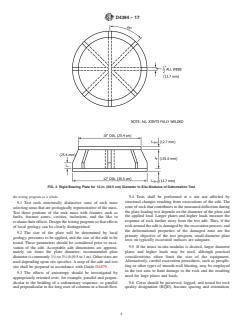
FIG. 3 Rigid Bearing Plate for 12-in. (30.5 cm) Diameter In Situ Modulus of Deformation Test
the testing program as a whole.
9.4 Tests shall be performed at a site not affected by
structural changes resulting from excavations of the adit. The
9.1 Test each structurally distinctive zone of rock mass
zone of rock that contributes to the measured deflection during
selectingareasthataregeologicallyrepresentativeofthemass.
the plate loading test depends on the diameter of the plate and
Test those portions of the rock mass with features such as
the applied load. Larger plates and higher loads measure the
faults, fracture zones, cavities, inclusions, and the like to
response of rock further away from the test adit. Thus, if the
evaluatetheireffects.Designthetestingprogramsothateffects
rockaroundtheaditisdamagedbytheexcavationprocess,and
of local geology can be clearly distinguished.
the deformational properties of the damaged zone are the
9.2 The size of the plate will be determined by local
primary objective of the test program, small-diameter plate
geology, pressures to be applied, and the size of the adit to be
tests on typically excavated surfaces are adequate.
tested. These parameters should be considered prior to exca-
9.5 If the intact in-situ modulus is desired, larger diameter
vation of the adit. Acceptable adit dimensions are approxi-
plates and higher loads may be used, although practical
mately six times the plate diameter; recommended plate
1 1
considerations often limit the size of the equipment.
diameteriscommonly1 ⁄2to3 ⁄4ft(0.5to1m).Othersizesare
Alternatively, careful excavation procedures, such as presplit-
used depending upon site specifics.Amap of the adit and test
ting or other types of smooth-wall blasting, may be employed
site shall be prepared in accordance with Guide D4879.
in the test area to limit damage to the rock and the resulting
9.3 The effects of anisotropy should be investigated by
need for large plates and loads.
appropriately oriented tests: for example, parallel and perpen-
dicular to the bedding of a sedimentary sequence, or parallel 9.6 Cores should be preserved, logged, and tested for rock
and perpendicular to the long axes of columns in a basalt flow. quality designation (RQD), fracture spacing and orientation,
D4394 − 17
consuming test and that running the test is a small part comparted to the
conditionofjointsurfaces,strength,anddeformation.Inlieuof
setup of the test. Therefore, if possible it may be prudent to collect as
specificrequirements,testmethodsD2113,D5079,D5434,and
much data as possible before removing the equipment because in most
D6032 shall be considered the minimum requirements.
instances you will not get a second chance to do this test. It is easier to do
9.7 Siteconditionsmaydictatethatsitepreparationandpad this if you have multiple tests and more than one apparatus. For example,
data can be collected at one test site while the next site is being set up.
construction be performed immediately after excavation.
10.4 Bearing Surface Preparation:
10. Procedure
10.4.1 Method—Prepare the surface by a method that will
10.1 Verifythecomplianceofequipmentandapparatuswith
cause minimal damage to the finished rock surface. Drilling is
theperformancespecificationsinSection7.Ifrequirementsare
advisedtoreachuniformdepth.Residualrockbetweenthedrill
not stated, the manufacturer’s specifications for the equipment
holes may be removed by burnishing or moving the bit back
may be appropriate as a guide, however, care should be taken
andforthuntilasmoothfaceisachieved.Alternatively,inhard,
for sufficient performance. Performance verification is gener-
competent rock, controlled blasting with very small charges is
ally done by calibrating the equipment and measurement
advised to remove the residual materials. In weaker materials,
system. Accomplish calibration and documentation in accor-
coarse grinding or cutting devices may be used.
dance with the quality assurance procedures in Annex A1.
10.4.2 Size—The prepared rock surface shall extend one-
10.2 Ensure that the test results are defensible and traceable
half the diameter of the bearing plate beyond the edge of the
by following at least the minimum guidelines for personnel
plate.
qualifications, calibrations, test setup, test procedure, equip-
10.4.3 Rock Quality—To the extent p
...
This document is not an ASTM standard and is intended only to provide the user of an ASTM standard an indication of what changes have been made to the previous version. Because
it may not be technically possible to adequately depict all changes accurately, ASTM recommends that users consult prior editions as appropriate. In all cases only the current version
of the standard as published by ASTM is to be considered the official document.
Designation: D4394 − 08 D4394 − 17
Standard Test Method for
Determining In Situ Modulus of Deformation of Rock Mass
Using Rigid Plate Loading Method
This standard is issued under the fixed designation D4394; the number immediately following the designation indicates the year of
original adoption or, in the case of revision, the year of last revision. A number in parentheses indicates the year of last reapproval. A
superscript epsilon (´) indicates an editorial change since the last revision or reapproval.
1. Scope*
1.1 This test method covers the preparation, equipment, test procedure, and data reduction for determining in situ modulus of
deformation of a rock mass using the rigid plate loading method.
1.2 This test method is designed to be conducted in an adit or small underground chamber; however, with suitable modifications
it could be conducted at the surface.
1.3 This test method is usually conducted parallel or perpendicular to the anticipated axis of thrust, as dictated by the design
load.load and to diametrically opposite surfaces.
1.4 Both instantaneous deformation and primary creep can be obtained from this test method.
1.5 Time dependent tests can be performed and are discussed briefly here but are to be reported in another standard.
1.6 Observed and calculated values shall conform to the guidelines for significant digits and rounding established in Practice
D6026.
1.6.1 The method used to specify how data are collected, calculated, or recorded in this standard is not directly related to the
accuracy to which the data can be applied in design or other uses, or both. How one applies the results obtained using this standard
is beyond its scope.
1.7 The values stated in inch-pound units are to be regarded as standard. The values given in parentheses are mathematical
conversions to SI units that are provided for information only and are not considered standard.
1.8 The references appended to this standard contain further information on this test method.
1.9 This standard does not purport to address all of the safety concerns, if any, associated with its use. It is the responsibility
of the user of this standard to establish appropriate safety and health practices and determine the applicability of regulatory
requirements prior to use. For specific precaution statements, see Section 8.
1.10 This international standard was developed in accordance with internationally recognized principles on standardization
established in the Decision on Principles for the Development of International Standards, Guides and Recommendations issued
by the World Trade Organization Technical Barriers to Trade (TBT) Committee.
2. Referenced Documents
2.1 ASTM Standards:
D653 Terminology Relating to Soil, Rock, and Contained Fluids
D2113 Practice for Rock Core Drilling and Sampling of Rock for Site Exploration
D3740 Practice for Minimum Requirements for Agencies Engaged in Testing and/or Inspection of Soil and Rock as Used in
Engineering Design and Construction
D4395 Test Method for Determining In Situ Modulus of Deformation of Rock Mass Using Flexible Plate Loading Method
D4403 Practice for Extensometers Used in Rock
D4879 Guide for Geotechnical Mapping of Large Underground Openings in Rock (Withdrawn 2017)
D5079 Practices for Preserving and Transporting Rock Core Samples (Withdrawn 2017)
This test method is under the jurisdiction of ASTM Committee D18 on Soil and Rock and is the direct responsibility of Subcommittee D18.12 on Rock Mechanics.
Current edition approved July 1, 2008July 1, 2017. Published August 2008August 2017. Originally approved in 1984. Last previous edition approved in 20042008 as
D4394 – 04.D4394 – 08. DOI: 10.1520/D4394-08.10.1520/D4394-17.
For referenced ASTM standards, visit the ASTM website, www.astm.org, or contact ASTM Customer Service at service@astm.org. For Annual Book of ASTM Standards
volume information, refer to the standard’s Document Summary page on the ASTM website.
The last approved version of this historical standard is referenced on www.astm.org.
*A Summary of Changes section appears at the end of this standard
Copyright © ASTM International, 100 Barr Harbor Drive, PO Box C700, West Conshohocken, PA 19428-2959. United States
D4394 − 17
D5434 Guide for Field Logging of Subsurface Explorations of Soil and Rock
D6026 Practice for Using Significant Digits in Geotechnical Data
D6032 Test Method for Determining Rock Quality Designation (RQD) of Rock Core
3. Terminology
3.1 For terminology used in this test method, refer to Terminology, D653.Definitions:
3.1.1 For terminology used in this test method, refer to Terminology, D653.
3.2 Definitions of Terms Specific to This Standard:
3.2.1 deflection—deflection, n—movement of the rigid plate, mortar pad, or rock in response to and in the same direction as the
applied load.
3.2.2 load—total force acting on the rock face.
3.2.2 peak-to-peak modulus of deformation—deformation, n—the slope of the stress - strain curve line connecting the peaks of
the curves obtained from successive pressure cycles (see Fig. 1).
3.2.3 recovery modulus of deformation—deformation, n—the tangent modulus of the unloading stress - strain curve. This
modulus is usually higher than the other moduli and is used in calculations where unloading conditions exist. The difference
between the tangent and recovery moduli indicates that material’s capacity of hysteresis or energy dissipation capabilities (see Fig.
2).
3.2.4 rigid plate—plate, n—plate with deflection of less than 0.0001 in. (0.0025 mm) from center to edge of plate, when
maximum load is applied.
3.2.5 secant modulus of deformation—deformation, n—the slope of the stress-strain curve between zero stress and a specified
stress. This modulus should be used for the load steps from zero to the desired load (see Fig. 2).
3.2.6 tangent modulus of deformation—deformation, n—the slope of the stress - strain curve obtained over the segment of the
loading curve judged by the investigator as the most representative of elastic response. It neglects the end effects of the curve and
FIG. 1 Rock Surface Deformation as a Function of Bearing Pressure and Increasing Loading Cycles—Arrows show up and direction of
cycles and line shows Peak to Peak Modulus.
D4394 − 17
FIG. 2 Relationship Between Tangent, Secant and Recovery Moduli for a Single Cycle of Loading and Unloading
is better suited to small stress changes. The ratio between the secant modulus and the tangent modulus can be used as a means
of measuring the stress damage of the material (see Fig. 2).
4. Summary of Test Method
4.1 Areas on two opposing parallel faces of a test adit or underground chamber are flattened and smoothed.
4.2 A mortar pad and rigid metal plate are installed against each face and a hydraulic loading system is placed between the rigid
plates.
4.3 If deflection is to be measured within the rock mass, extensometer instruments shall be installed in the rock in accordance
with Practice D4403.
4.4 The two faces are loaded and unloaded incrementally and the deformations of the rock mass at the surfaces and, if desired,
within the rock, are measured after each load and unload increment. The modulus of deformation is then calculated.(Secant,
Tangent and/or Recovery) is then calculated on those segments of the data plot pertinent to the data acquisition program.
5. Significance and Use
5.1 Results of this type of test method are used to predict displacements in rock mass caused by loads from a structure or from
underground construction. It is one of several tests that should be performed. The resulting in situ elastic modulus is commonly
less than the elastic modulus determined in the laboratory.
5.2 The modulus is determined using an elastic solution for a uniformly distributed load (uniform stress) over a circular area
acting on a semi-infinite elastic medium that produces a constant normal displacement of the loaded surface area of the medium.
5.3 This test method is normally performed at ambient temperature, but equipment can be modified or substituted for operations
at other temperatures.
NOTE 1—The quality of the result produced by this standard is dependent on the competence of the personnel performing it, and the suitability of the
equipment and facilities used. Agencies that meet the criteria of Practice D3740 are generally considered capable of competent and objective
testing/sampling/inspection/etc. Users of this standard are cautioned that compliance with Practice D3740 does not in itself assure reliable results. Reliable
results depend on many factors; Practice D3740 provides a means of evaluating some of those factors.
6. Interferences
6.1 An inflexible plate used to load the rock face is difficult to construct. However, if the plate is constructed as rigid as
practicable, the rock face is smoothed, and a thin, high-modulus material is used for the pad, the error is minimal.
6.2 The rock under the loaded area is generally not homogeneous, as assumed in theory. Rock will respond to the load according
to its local deformational characteristics. Therefore, deflection measurements at discrete points on the rock surface tend to be
heavily influenced by the deformational characteristics of the rock mass at that location and may give results that are
unrepresentative of the rock mass. The use of the average plate deflection will mitigate this problem.
6.3 Measurement of the deflection within the rock mass can utilize a finite gauge length to reflect the average rock mass
deformation properties between the measuring points. This approach entails three drawbacks, however. First, the rock mass is
tested at very low stress levels unless the measurement points are very close to the rock surface, and because of this, the same
problems as with surface measurements occur. Tests at low stress levels may give unrealistically low modulus values because
microfractures, joints, and other discontinuities in the rock are open. Secondly, the disturbance caused by implanting the deflection
transducer in the rock mass is difficult to evaluate. The techniques in this test method are designed to produce minimal disturbance.
Thirdly, in rocks with very high modulus, the accuracy of the instruments may be insufficient to provide reliable results.
6.4 Time-rate of loading has negligible influence on the modulus.
6.5 Calculations neglect the stress history of the rock.
6.6 This test method is insensitive to Poisson’s ratio.
6.7 Poisson’s ratio should be assumed or obtained from laboratory testing.
D4394 − 17
7. Apparatus
7.1 Equipment necessary for accomplishing this test method includes items for: preparing the test site, drilling and logging the
instrumentation holes, measuring the rock deformation, applying and restraining test loads, recording test data, and transporting
various components to the test site.
7.2 Test Site Preparation Equipment—This shall include an assortment of excavation tools, such as drills drills, drill bits, and
chipping hammers. Blasting shall not be allowed during a preparation of the test site. The drill for the instrumentation holes shall,
if practicable, have the capability of retrieving cores from depths of about 30 ft (10 m).
7.3 Borehole Viewing Device—Some type of device is desirable for observation of the instrumentation holes to compare and
verify geologic features observed in the core if core recovery is poor or if it is not feasible to retrieve oriented cores.
7.4 Deformation Measuring Instruments—Instruments for measuring deformations shall include a reliable multiple-position
borehole extensometer (MPBX) for each instrumentation hole and a tunnel diameter gauge. For surface measurements, dial gages
or linear variable differential transformers (LVDTs) are generally used. An accuracy of 60.0001 in. (0.0025 mm), including the
error of the readout equipment, and a sensitivity of at least 0.00005 in. (0.0013 mm) is recommended. Errors in excess of 0.0004
6 4
in. (0.01 mm) can invalidate test results when the modulus of rock mass exceeds 5 × 10 psi (3.5 × 10 MPa).
7.5 Loading Equipment—The loading equipment includes the device for applying the load and the reaction members (usually
thick-walled aluminum or steel pipes) which transmit the load. load of sufficient capacity for the intended test program. Hydraulic
rams or flatjacks are usually used to apply the load hydraulically with sufficient capability and volume to apply and maintain
desired pressures to within 3 %. If flatjacks are used they should have sufficient range to allow for deflection of the rock and should
be constructed so that the two main plates move apart in a parallel manner over the usable portion of the loading range. A spherical
bearing of suitable capacity should be coupled to one of the bearing plates.
7.6 Load Cells and Transducers—A load cell is recommended to measure the load on the bearing plate. An accuracy of around
61000 lbf (64.4 kN), including errors introduced by the readout system, and a sensitivity of 500 lbf (2.2 kN) are recommended.
Alternatively, a pressure gauge or transducer may be used to monitor hydraulic pressure for calculation of load, provided the device
can measure the load to the same specifications as the load cell. An accuracy of 620 psi (60.14 MPa), including error introduced
by readout equipment, and a sensitivity of 10 psi (0.069 MPa). If a hydraulic ram is used, the effects of ram friction shall be
determined. If flatjacks are used, care shall be taken that the jacks do not operate at the upper end of their range.
6 4
7.7 Bearing Pads—The bearing pads shall have a modulus of elasticity of around 4 × 10 psi (3 × 10 MPa) and shall be capable
of conforming to the rock surface and bearing plate. High-early strength grout or molten sulfur bearing pads are recommended.
7.8 Bearing Plates—The bearing plates shall approximate a rigid die as closely as practical. A bearing plate that has been found
satisfactory is shown on Fig. 3. Although the exact design and materials may differ, the stiffness of the bearing plate shall be the
minimum stiffness necessary to not produce measurable deflection of the plate under maximum load.
8. Safety Hazards
8.1 Personnel involved in performing the test shall be formally prequalified under the quality assurance procedures listed in
Enforce safety by applicable safety standards. Annex A1.
8.2 Verify the compliance of equipment and apparatus with the performance specifications in Section Pressure lines 7. If
requirements are not stated, the manufacturer’s specifications for the equipment may be appropriate as a guide, however, care
should be taken for sufficient performance. Performance verification is generally done by calibrating the equipment and
measurement system. Accomplish calibration and documentation in accordance with the quality assurance procedures.should be
bled of air to preclude violent failure of the pressure system.
8.3 Enforce safety by applicable safety standards. Pressure lines should be bled of air to preclude violent failure of the pressure
system. Total deformation should not exceed the expansion capabilities of the flatjacks; normally this is approximately 3 % of the
diameter of a metal jack.
9. In-Situ Conditions
NOTE 2—The guidelines presented in this section are the domain of the agency or organization requesting the testing and are intended to facilitate
definition of the scope and development of site-specific requirements for the testing program as a whole.
9.1 Test each structurally distinctive zone of rock mass selecting areas that are geologically representative of the mass. Test
those portions of the rock mass with features such as faults, fracture zones, cavities, inclusions, and the like to evaluate their effects.
Design the testing program so that effects of local geology can be clearly distinguished.
9.2 The size of the plate will be determined by local geology, pressures to be applied, and the size of the adit to be tested. These
parameters should be considered prior to excavation of the adit. Acceptable adit dimensions are approximately six times the plate
1 1
diameter; recommended plate diameter is commonly 1 ⁄2 to 3 ⁄4 ft (0.5 to 1 m). Other sizes are used depending upon site specifics.
A map of the adit and test site shall be prepared in accordance with Guide D4879.
D4394 − 17
FIG. 3 Rigid Bearing Plate for 12 in. Diameter 12-in. (30.5 cm) Diameter In Situ Modulus of Deformation Test
9.3 The effects of anisotropy should be investigated by appropriately oriented tests: for example, parallel and perpendicular to
the bedding of a sedimentary sequence, or parallel and perpendicular to the long axes of columns in a basalt flow.
9.4 Tests shall be performed at a site not affected by structural changes resulting from excavations of the adit. The zone of rock
that contributes to the measured deflection during the plate loading test depends on the diameter of the plate and the applied load.
Larger plates and higher loads measure the response of rock further away from the test adit. Thus, if the rock around the adit is
damaged by the excavation process, and the deformational properties of the damaged zone are the primary objective of the test
program, small-diameter plate tests on typically excavated surfaces are adequate. If the intact in-situ modulus is desired, larger
diameter plates and higher loads may be used, although practical considerations often limit the size of the equipment. Alternatively,
careful excavation procedures, such as presplitting or other types of smooth-wall blasting, may be employed in the test area to limit
damage to the rock and the resulting need for large plates and loads.
9.5 If the intact in-situ modulus is desired, larger diameter plates and higher loads may be used, although practical
considerations often limit the size of the equipment. Alternatively, careful excavation procedures, such as presplitting or other types
of smooth-wall blasting, may be employed in the test area to limit damage to the rock and the resulting need for large plates and
loads.
9.6 Cores should be preserved, logged, and tested for rock quality designation (RQD), fracture spacing and orientation,
condition of joint surfaces, strength, and deformation. In lieu of specific requirements, test methods D2113, D5079, D5434, and
D6032 shall be considered the minimum requirements.
9.7 Site conditions may dictate that site preparation and pad construction be performed immediately after excavation.
10. Procedure
10.1 Verify the compliance of equipment and apparatus with the performance specifications in Section 7. If requirements are
not stated, the manufacturer’s specifications for the equipment may be appropriate as a guide, however, care should be taken for
D4394 − 17
sufficient performance. Performance verification is generally done by calibrating the equipment and measurement system.
Accomplish calibration and documentation in accordance with the quality assurance procedures in Annex A1.
10.2 Ensure that the test results are defensible and traceable by following at least the minimum guidelines for personnel
qualifications, calibrations, test setup, test procedure, equipment performance and verification, and vetting of test data are followed
in Annex A1.
10.3 Conduct the test across a “diameter” or chord of the adit with the two test surfaces nearly parallel and in planes oriented
perpendicular to the thrust of the loading assembly. A schematic of an acceptable test setup is shown in Fig. 4. A wooden platform
(not shown) allows for ease of construction and alignment of test components.
NOTE 3—The procedure shown is generalized but the user should not be confined by this procedure with regards to the actual testing portion. The user
of this standard needs to realize that this is an expensive time consuming test and that running the test is a small part comparted to the setup of the test.
Therefore, if possible it may be prudent to collect as much da
...