

ASTM D6648-08(2016)
(Test Method)Standard Test Method for Determining the Flexural Creep Stiffness of Asphalt Binder Using the Bending Beam Rheometer (BBR)
General Information
- Abstract
SIGNIFICANCE AND USE
5.1 The temperatures for this test are based upon the winter temperature experienced by the pavement in the geographical area for which the asphalt binder is intended.
5.2 The flexural creep stiffness or flexural creep compliance, determined from this test, describes the low-temperature stress-strain-time response of asphalt binder at the test temperature within the range of linear viscoelastic response.
5.3 The low-temperature thermal cracking performance of asphalt pavements is related to the creep stiffness and the m-value of the asphalt binder contained in the mix.
5.4 The creep stiffness and the m-value are used as performance-based specification criteria for asphalt binders in accordance with Specification D6373.
SCOPE
1.1 This test method covers the determination of the flexural-creep stiffness or compliance and m-value of asphalt binders by means of a bending beam rheometer. It is applicable to material having flexural-creep stiffness values in the range of 20 MPa to 1 GPa (creep compliance values in the range of 50 nPa–1 to 1 nPa–1) and can be used with unaged material or with materials aged using aging procedures such as Test Method D2872 or Practice D6521. The test apparatus may be operated within the temperature range from –36°C to 0°C.
1.2 Test results are not valid for test specimens that deflect more than 4 mm or less than 0.08 mm when tested in accordance with this test method.
1.3 This standard does not purport to address all of the safety concerns, if any, associated with its use. It is the responsibility of the user of this standard to establish appropriate safety and health practices and determine the applicability of regulatory limitations prior to use.
- Status
- Published
- Publication Date
- 30-Sep-2016
- Technical Committee
- D04 - Road and Paving Materials
- Drafting Committee
- D04.44 - Rheological Tests
Overview
ASTM D6648-08(2016), published by ASTM International, introduces a standard test method for determining the flexural creep stiffness of asphalt binder using the bending beam rheometer (BBR). This methodology assesses the low-temperature mechanical behavior of asphalt binders critical for pavement performance in cold climates. The BBR test evaluates both the flexural creep stiffness (S) and the m-value, providing essential information on the stress-strain-time response of asphalt binders under specified temperatures. These metrics play a fundamental role in predicting and preventing low-temperature thermal cracking in asphalt pavements.
The test method applies to asphalt binders both in their unaged form and after aging protocols, such as those described in ASTM D2872 or ASTM D6521. The BBR measurement is performed within a temperature range from –36°C to 0°C, simulating conditions asphalt pavements experience in winter environments.
Key Topics
- Flexural Creep Stiffness (S): The resistance of an asphalt binder to deformation under constant load at low temperatures. Measured in units from 20 MPa to 1 GPa.
- m-value: The rate at which the stiffness of the binder decreases with time under load. A critical factor for pavement durability.
- Temperature Relevance: Test temperatures are directly based on the lowest expected pavement temperatures in the project’s geographic area.
- Performance Grading: Results are used as criteria within performance-based specifications, notably ASTM D6373 for performance-graded asphalt binders.
- Material Suitability: The method applies to both unaged and laboratory-aged binders, using samples prepared via recognized sampling and aging protocols.
- Test Validity: Acceptable deflection range for test specimens is between 0.08 mm and 4 mm for reliable results.
Applications
ASTM D6648 is vital in the following areas:
- Asphalt Binder Selection: Assists engineers in choosing asphalt binders with optimal performance characteristics for cold climates, minimizing risks of thermal cracking.
- Pavement Design and Evaluation: Integral for mix design and quality assurance during construction, ensuring pavements endure cyclical low temperatures.
- Material Certification and Compliance: Supports producers and agencies in verifying that asphalt binders meet the requirements of performance-based grading systems.
- Aging and Durability Studies: Facilitates research on the effects of aging procedures on asphalt binder properties, informing strategies for longer-lasting roads.
- Quality Control: Ensures uniformity and reliability in asphalt binder performance before inclusion in paving projects.
Related Standards
- ASTM D2872: Standard Test Method for Effect of Heat and Air on a Moving Film of Asphalt (Rolling Thin-Film Oven Test) - used for aging binder samples.
- ASTM D6521: Practice for Accelerated Aging of Asphalt Binder Using a Pressurized Aging Vessel (PAV).
- ASTM D6373: Specification for Performance Graded Asphalt Binder - outlines performance-based grading and acceptance criteria using BBR results.
- ASTM D140: Practice for Sampling Bituminous Materials.
- ASTM C802: Practice for Conducting an Interlaboratory Test Program to Determine the Precision of Test Methods for Construction Materials.
- DIN 43760: Standard relating to thermometric devices used in temperature monitoring during testing.
- ASTM E77: Test Method for Inspection and Verification of Thermometers.
Practical Value
By following ASTM D6648, stakeholders in the pavement industry can consistently assess and specify asphalt binders to improve infrastructure longevity, especially in regions susceptible to severe winter temperatures. Accurate determination of flexural creep stiffness and m-value directly leads to better pavement durability, reduced maintenance costs, and enhanced road safety. This standardized approach empowers engineers, manufacturers, and highway agencies with confidence in the long-term performance of asphalt materials under challenging low-temperature conditions.
Keywords: ASTM D6648, bending beam rheometer, asphalt binder, flexural creep stiffness, m-value, low-temperature pavement performance, thermal cracking, performance-graded asphalt binder.
Relations
- Effective Date
- 01-Jul-2019
- Effective Date
- 01-Jul-2018
- Effective Date
- 01-Jan-2015
- Effective Date
- 01-May-2014
- Effective Date
- 01-Sep-2013
- Effective Date
- 01-Jun-2013
- Effective Date
- 01-Aug-2012
- Effective Date
- 01-Aug-2012
- Effective Date
- 15-Dec-2009
- Effective Date
- 01-Nov-2009
- Effective Date
- 01-Dec-2008
- Effective Date
- 01-Jan-2008
- Effective Date
- 01-Dec-2007
- Effective Date
- 01-Aug-2007
- Effective Date
- 01-Aug-2007
Get Certified
Connect with accredited certification bodies for this standard

DIBt (Deutsches Institut für Bautechnik)
German Institute for Building Technology.
DIN CERTCO
DIN Group product certification.

Element Materials Technology
Materials testing and product certification.
Sponsored listings
Frequently Asked Questions
ASTM D6648-08(2016) is a standard published by ASTM International. Its full title is "Standard Test Method for Determining the Flexural Creep Stiffness of Asphalt Binder Using the Bending Beam Rheometer (BBR)". This standard covers: SIGNIFICANCE AND USE 5.1 The temperatures for this test are based upon the winter temperature experienced by the pavement in the geographical area for which the asphalt binder is intended. 5.2 The flexural creep stiffness or flexural creep compliance, determined from this test, describes the low-temperature stress-strain-time response of asphalt binder at the test temperature within the range of linear viscoelastic response. 5.3 The low-temperature thermal cracking performance of asphalt pavements is related to the creep stiffness and the m-value of the asphalt binder contained in the mix. 5.4 The creep stiffness and the m-value are used as performance-based specification criteria for asphalt binders in accordance with Specification D6373. SCOPE 1.1 This test method covers the determination of the flexural-creep stiffness or compliance and m-value of asphalt binders by means of a bending beam rheometer. It is applicable to material having flexural-creep stiffness values in the range of 20 MPa to 1 GPa (creep compliance values in the range of 50 nPa–1 to 1 nPa–1) and can be used with unaged material or with materials aged using aging procedures such as Test Method D2872 or Practice D6521. The test apparatus may be operated within the temperature range from –36°C to 0°C. 1.2 Test results are not valid for test specimens that deflect more than 4 mm or less than 0.08 mm when tested in accordance with this test method. 1.3 This standard does not purport to address all of the safety concerns, if any, associated with its use. It is the responsibility of the user of this standard to establish appropriate safety and health practices and determine the applicability of regulatory limitations prior to use.
SIGNIFICANCE AND USE 5.1 The temperatures for this test are based upon the winter temperature experienced by the pavement in the geographical area for which the asphalt binder is intended. 5.2 The flexural creep stiffness or flexural creep compliance, determined from this test, describes the low-temperature stress-strain-time response of asphalt binder at the test temperature within the range of linear viscoelastic response. 5.3 The low-temperature thermal cracking performance of asphalt pavements is related to the creep stiffness and the m-value of the asphalt binder contained in the mix. 5.4 The creep stiffness and the m-value are used as performance-based specification criteria for asphalt binders in accordance with Specification D6373. SCOPE 1.1 This test method covers the determination of the flexural-creep stiffness or compliance and m-value of asphalt binders by means of a bending beam rheometer. It is applicable to material having flexural-creep stiffness values in the range of 20 MPa to 1 GPa (creep compliance values in the range of 50 nPa–1 to 1 nPa–1) and can be used with unaged material or with materials aged using aging procedures such as Test Method D2872 or Practice D6521. The test apparatus may be operated within the temperature range from –36°C to 0°C. 1.2 Test results are not valid for test specimens that deflect more than 4 mm or less than 0.08 mm when tested in accordance with this test method. 1.3 This standard does not purport to address all of the safety concerns, if any, associated with its use. It is the responsibility of the user of this standard to establish appropriate safety and health practices and determine the applicability of regulatory limitations prior to use.
ASTM D6648-08(2016) is classified under the following ICS (International Classification for Standards) categories: 75.140 - Waxes, bituminous materials and other petroleum products; 91.100.50 - Binders. Sealing materials. The ICS classification helps identify the subject area and facilitates finding related standards.
ASTM D6648-08(2016) has the following relationships with other standards: It is inter standard links to ASTM D6521-19, ASTM D6521-18, ASTM D6373-15, ASTM E77-14, ASTM D6521-13, ASTM D6373-13, ASTM D2872-12e1, ASTM D2872-12, ASTM C802-09a, ASTM C802-09, ASTM C802-96(2008)e1, ASTM D6521-08, ASTM E77-07, ASTM D6373-07, ASTM D6373-07e1. Understanding these relationships helps ensure you are using the most current and applicable version of the standard.
ASTM D6648-08(2016) is available in PDF format for immediate download after purchase. The document can be added to your cart and obtained through the secure checkout process. Digital delivery ensures instant access to the complete standard document.
Standards Content (Sample)
This international standard was developed in accordance with internationally recognized principles on standardization established in the Decision on Principles for the
Development of International Standards, Guides and Recommendations issued by the World Trade Organization Technical Barriers to Trade (TBT) Committee.
Designation: D6648 − 08 (Reapproved 2016)
Standard Test Method for
Determining the Flexural Creep Stiffness of Asphalt Binder
Using the Bending Beam Rheometer (BBR)
This standard is issued under the fixed designation D6648; the number immediately following the designation indicates the year of
original adoption or, in the case of revision, the year of last revision. A number in parentheses indicates the year of last reapproval. A
superscript epsilon (´) indicates an editorial change since the last revision or reapproval.
1. Scope E77 Test Method for Inspection and Verification of Ther-
2 mometers
1.1 This test method covers the determination of the
2.2 DIN Standard:
flexural-creep stiffness or compliance and m-value of asphalt
binders by means of a bending beam rheometer. It is applicable
tomaterialhavingflexural-creepstiffnessvaluesintherangeof
3. Terminology
20 MPa to 1 GPa (creep compliance values in the range of 50
–1 –1
nPa to 1 nPa ) and can be used with unaged material or with 3.1 Definitions:
materials aged using aging procedures such as Test Method
3.1.1 asphalt binder, n—an asphalt-based cement that is
D2872 or Practice D6521. The test apparatus may be operated produced from petroleum residue either with or without the
within the temperature range from –36°C to 0°C.
addition of modifiers.
3.1.2 physical hardening, n—a time-dependent, reversible
1.2 Test results are not valid for test specimens that deflect
stiffening of asphalt binder that typically occurs when the
more than 4 mm or less than 0.08 mm when tested in
binder is stored below room temperature.
accordance with this test method.
1.3 This standard does not purport to address all of the 3.2 Definitions of Terms Specific to This Standard:
safety concerns, if any, associated with its use. It is the 3.2.1 contact load, n—the load, P , required to maintain
c
responsibility of the user of this standard to establish appro- positive contact between the test specimen, supports, and the
priate safety and health practices and determine the applica- loading shaft; 35 6 10 mN.
bility of regulatory limitations prior to use.
3.2.2 flexural creep compliance, D(t), n—the ratio obtained
by dividing the maximum bending strain (see Eq X1.5)ina
2. Referenced Documents
beam by the maximum bending stress (Eq X1.4). The flexural
2.1 ASTM Standards:
creep stiffness is the inverse of the flexural creep compliance.
C802 Practice for Conducting an Interlaboratory Test Pro-
3.2.3 flexural creep stiffness, S (t), n—the creep stiffness
e
gram to Determine the Precision of Test Methods for
obtained by fitting a second order polynomial to the logarithm
Construction Materials
of the measured stiffness at 8.0, 15.0, 30.0 60.0, 120.0, and
D140 Practice for Sampling Bituminous Materials
240.0 s and the logarithm of time (see Eq 5, section 14.4).
D2872 Test Method for Effect of Heat andAir on a Moving
3.2.4 measured flexural creep stiffness, S (t), n—the ratio
m
Film of Asphalt (Rolling Thin-Film Oven Test)
(see Eq 3, section 14.2) obtained by dividing the measured
D6521 Practice for Accelerated Aging of Asphalt Binder
maximum bending stress (see X1.4) by the measured maxi-
Using a Pressurized Aging Vessel (PAV)
mum bending strain (see Eq X1.5). Flexural creep stiffness has
D6373 Specification for Performance Graded Asphalt
been used historically in asphalt technology while creep
Binder
compliance is commonly used in studies of viscoelasticity.
3.2.5 m-value, n—the absolute value of the slope of the
logarithm of the stiffness curve versus the logarithm of time
This test method is under the jurisdiction of ASTM Committee D04 on Road
and Paving Materials and is the direct responsibility of Subcommittee D04.44 on
(see Eq 6, section 14.5).
Rheological Tests.
3.2.6 test load, n—the load, P, of 240-s duration used to
Current edition approved Oct. 1, 2016. Published October 2016. Originally
t
approved in 2001. Last previous edition approved in 2008 as D6648 – 08. DOI:
determine the stiffness of the asphalt binder being tested; 980
10.1520/D6648-08R16.
6 50 mN.
This standard is based on SHRP Product 1002.
For referenced ASTM standards, visit the ASTM website, www.astm.org, or
contact ASTM Customer Service at service@astm.org. For Annual Book of ASTM
Standards volume information, refer to the standard’s Document Summary page on Deutsches Institut fuer Normung (German Standards Institute), Beuth Verlag
the ASTM website. GmbH, Burggrafenstrasse 6, 1000 Berlin 30, Germany.
Copyright © ASTM International, 100 Barr Harbor Drive, PO Box C700, West Conshohocken, PA 19428-2959. United States
D6648 − 08 (2016)
3.2.7 zero load cell reading—the load indicated by the data 5.4 The creep stiffness and the m-value are used as
acquisition system when the shaft is free floating in the bath performance-based specification criteria for asphalt binders in
and at the position that occurs when first making contact with accordance with Specification D6373.
a test specimen.
6. Interferences
4. Summary of Test Method
6.1 Measurements for which the mid-point deflections of
4.1 The bending beam rheometer is used to measure the
the test specimen is greater than 4.0 mm are suspect. Strains in
mid-point deflection of a simply supported prismatic beam of
excess of this value may exceed the linear response of asphalt
asphalt binder subjected to a constant load applied to its
binders.
mid-point. The device operates only in the loading mode;
6.2 Measurements for which the mid-point deflections of
recovery measurements cannot be obtained with the bending
the test specimen are less than 0.08 mm are suspect. When the
beam rheometer.
mid-point deflection is less than 0.08 mm, the test system
4.2 A prismatic test specimen is placed in the controlled
resolution may not be sufficient to produce reliable test results.
temperature fluid bath and loaded with a constant test load for
240.0 s. The test load (980 6 50 mN) and the mid-point
7. Apparatus
deflection of the test specimen are monitored versus time using
7.1 A bending beam rheometer (BBR) test system consist-
a computerized data acquisition system.
ing of the following: (1) a loading frame with test specimen
4.3 The maximum bending stress at the midpoint of the test
supports, (2) a controlled temperature liquid bath which
specimen is calculated from the dimensions of the test
maintains the test specimen at the test temperature and pro-
specimen, the distance between the supports, and the load
vides a buoyant force to counterbalance the force resulting
appliedtothetestspecimenforloadingtimesof8.0,15.0,30.0,
from the mass of the test specimen, (3) a computer-controlled
60.0, 120.0, and 240.0 s. The maximum bending strain in the
data acquisition system, (4) test specimen molds, and (5) items
test specimen is calculated from the dimensions of the test
for verifying and calibrating the system.
specimen and the deflection for the same loading times. The
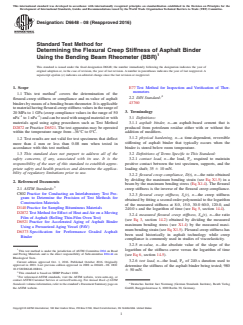
7.2 Loading Frame—A frame consisting of a set of sample
stiffness of the test specimen for the specific loading times is
supports, a blunt-nosed shaft to apply the load to the midpoint
calculated by dividing the maximum bending stress by the
of the test specimen, a load cell mounted in line with the
maximum bending strain.
loading shaft, a means for zeroing the load applied to the test
specimen, a means for applying a constant load to the test
5. Significance and Use
specimen and a deflection measuring transducer attached to the
5.1 The temperatures for this test are based upon the winter
loading shaft. A schematic of the device is shown in Fig. 1.
temperature experienced by the pavement in the geographical
7.3 Loading System—A loading system that is capable of
area for which the asphalt binder is intended.
applyingacontactloadof35 610mNtothetestspecimenand
5.2 Theflexuralcreepstiffnessorflexuralcreepcompliance,
maintaining a test load of 980 6 50 mN within 610 mN.
determinedfromthistest,describesthelow-temperaturestress-
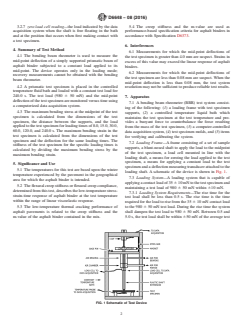
7.3.1 Loading System Requirements—The rise time for the
strain-time response of asphalt binder at the test temperature
test load shall be less than 0.5 s. The rise time is the time
within the range of linear viscoelastic response.
required for the load to rise from the 35 6 10 mN contact load
5.3 The low-temperature thermal cracking performance of to the 980 6 50 mN test load. During the rise time the system
asphalt pavements is related to the creep stiffness and the shall dampen the test load to 980 6 50 mN. Between 0.5 and
m-value of the asphalt binder contained in the mix. 5.0 s, the test load shall be within 650 mN of the average test
FIG. 1 Schematic of Test Device
D6648 − 08 (2016)
verified as per section 11.5. A platinum resistance thermometric device
load, and thereafter shall be within 610 mN of the average test
meeting DIN Standard 43760 (ClassA) is recommended for this purpose.
load. Details of the loading pattern are shown in Fig. 2.
7.3.2 Loading Shaft—Aloading shaft continuous and in line 7.5 Controlled-Temperature Fluid Bath—A controlled-
with the load cell and deflection measuring transducer with a temperature liquid bath capable of maintaining the temperature
spherically shaped end 6.3 6 0.3 mm in radius. at all points in the bath to within 60.1°C of the test tempera-
7.3.3 Load Cell—A load cell to measure the contact load ture in the range of –36°C to 0°C. Placing a test specimen in
and the test load. It shall have a minimum capacity of no less the bath may cause the bath temperature to fluctuate 60.2°C
than 2.00 N and a resolution of at least 2.5 mN. It shall be from the target test temperature. Consequently bath fluctua-
mounted in line with the loading shaft and above the fluid level tions of 60.2°C during iso-thermal conditioning shall be
in the controlled temperature bath. allowed.
7.3.4 Linear Variable Differential Transducer (LVDT)—A 7.5.1 Bath Agitator—A bath agitator for maintaining the
linearvariabledifferentialtransducerorothersuitabledeviceto required temperature homogeneity with agitation intensity
measure the deflection of the test specimen. It shall have a such that the fluid currents do not disturb the testing process
linearrangeofatleast6mm,andbecapableofresolvinglinear and mechanical noise caused by vibrations is less than the
movement of 2.5 µm. It shall be mounted axially with and resolution specified in 7.3.3 and 7.3.4.
above the loading shaft.
7.5.2 Circulating Bath (Optional)—Acirculating bath sepa-
7.3.5 Sample Supports—Two stainless steel or other non-
rate from the test frame, which pumps the bath fluid through
corrosive metal supports with a 3.0 6 0.3 mm contact radius
the test bath. If used, vibrations from the circulating system
and spaced 102 6 1.0 mm apart. The spacing of the supports shall be isolated from the bath test chamber so that mechanical
shallbemeasuredto 60.3mmandthemeasuredvalueshallbe
noise is less than the resolution specified in 7.3.3 and 7.3.4.
used in the calculations in Section 14. The supports shall be
7.6 Data Acquisition and Control Components—A data
dimensionedtoensurethatthetestspecimenremainsincontact
acquisition system that resolves loads to the nearest 2.5 mN,
with the radiused portion of the support during the entire test.
test specimen deflection to the nearest 2.5 µm, and bath fluid
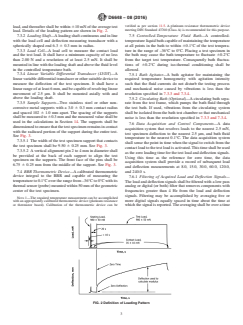
See Fig. 3.
temperature to the nearest 0.1°C. The data acquisition system
7.3.5.1 The width of the test specimen support that contacts
shall sense the point in time when the signal to switch from the
the test specimen shall be 9.50 6 0.25 mm. See Fig. 3.
contactloadtothetestloadisactivated.Thistimeshallbeused
7.3.5.2 Avertical alignment pin 2 to 4 mm in diameter shall
as the zero loading time for the test load and deflection signals.
be provided at the back of each support to align the test
Using this time as the reference for zero time, the data
specimen on the supports. The front face of the pins shall be
acquisition system shall provide a record of subsequent load
6.75 6 0.25 mm from the middle of the support. See Fig. 3.
and deflection measurements at 8.0, 15.0, 30.0, 60.0, 120.0,
7.4 BBR Thermometric Device—A calibrated thermometric and 240.0 s.
device integral to the BBR and capable of measuring the
7.6.1 Filtering of Acquired Load and Deflection Signals—
temperatureto0.1°Covertherangefrom–36°Cto0°Cwithits
The load and deflection signals shall be filtered with a low pass
thermalsensor(probe)mountedwithin50mmofthegeometric
analog or digital (or both) filter that removes components with
center of the test specimen.
frequencies greater than 4 Hz from the load and deflection
signals. Filtering may be accomplished by averaging five or
NOTE 1—The required temperature measurement can be accomplished
more digital signals equally spaced in time about the time at
with an appropriately calibrated thermometric device (platinum resistance
or thermistor based). Calibration of the thermometric device can be whichthesignalisreported.Theaveragingshallbeoveratime
FIG. 2 Definition of Loading Pattern
D6648 − 08 (2016)
FIG. 3 Schematic of Specimen Supports
period less than or equal to 60.2 s of the reporting time. For 7.8.2 Stainless Steel (Thin) Beam for Overall System
example, the load and deflection signals at 8.0 s may be the Check—One stainless steel beam 1.0 to 1.6 mm thick by 12.7
average of signals at 7.8, 7.9, 8.0, 8.1, 8.2 s. 6 0.1 mm wide by 127 6 5 mm long with an elastic modulus
reported to three significant figures by the manufacturer of the
7.7 Test Specimen Molds—Test specimen molds with inte-
BBR. The manufacturer of the BBR shall measure and report
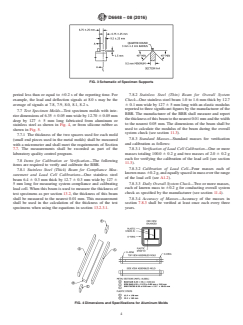
rior dimensions of 6.35 6 0.05 mm wide by 12.70 6 0.05 mm
thethicknessofthisbeamtothenearest0.01mmandthewidth
deep by 127 6 5 mm long fabricated from aluminum or
to the nearest 0.05 mm. The dimensions of the beam shall be
stainless steel as shown in Fig. 4, or from silicone rubber as
used to calculate the modulus of the beam during the overall
shown in Fig. 5.
system check (see section 11.3).
7.7.1 The thickness of the two spacers used for each mold
7.8.3 Standard Masses—Standard masses for verification
(small end pieces used in the metal molds) shall be measured
and calibration as follows:
with a micrometer and shall meet the requirements of Section
7.8.3.1 Verification of Load Cell Calibration—One or more
7.7. The measurements shall be recorded as part of the
masses totaling 100.0 6 0.2 g and two masses of 2.0 6 0.2 g
laboratory quality control program.
each for verifying the calibration of the load cell (see section
7.8 Items for Calibration or Verification—The following
11.3).
items are required to verify and calibrate the BBR.
7.8.3.2 Calibration of Load Cell—Four masses each of
7.8.1 Stainless Steel (Thick) Beam for Compliance Mea-
knownmass 60.2g,andequallyspacedinmassovertherange
surement and Load Cell Calibrations—One stainless steel
of the load cell (see A1.2).
beam 6.4 6 0.3 mm thick by 12.7 6 0.3 mm wide by 127 6
7.8.3.3 Daily Overall System Check—Two or more masses,
5 mm long for measuring system compliance and calibrating
each of known mass to 60.2 g for conducting overall system
load cell. When this beam is used to measure the thickness of
check as specified by the manufacturer (see section 11.4).
test specimens as per section 13.2, the thickness of this beam
shall be measured to the nearest 0.01 mm. This measurement 7.8.3.4 Accuracy of Masses—Accuracy of the masses in
shall be used in the calculation of the thickness of the test section 7.8.3 shall be verified at least once each every three
specimens when using the equations in section 13.2.3.1. years.
FIG. 4 Dimensions and Specifications for Aluminum Molds
D6648 − 08 (2016)
FIG. 5 Dimensions for Fixture for Silicone Molds
7.8.4 Typical Gage Block—A stepped gage block with 7.9.1 A partial immersion liquid-in-glass thermometer with
thickness measured to 65 µm for calibrating and for verifying anicepointandcalibratedinaccordancewithTestMethodE77
the calibration of the displacement transducer (see Fig. 6 for at least once per year. A suitable thermometer is designated
typical design). ASTM 133C-00.
7.9.2 A thermometric device based upon a platinum or
7.9 Calibrated Thermometric Device—Portable calibrated
thermistor sensor calibrated at least once per year.
thermometric device for verification of the BBR thermometric
deviceofsuitablerangewithresolutionof0.1°Casper7.9.1or 7.10 Alignment Fixture (Optional)—A fixture supplied by
7.9.2. the manufacturer to align the loading shaft so that it contacts
FIG. 6 Silicone Rubber Mold
D6648 − 08 (2016)
the specimen at the longitudinal and transverse center of the 9.2 Alcohol baths are flammable and toxic. Locate the
loaded portion of the test specimen. controlled temperature bath in a well-ventilated area away
from sources of ignition. Avoid breathing alcohol vapors, and
8. Materials
contact of the bath fluid with the skin.
8.1 Sheeting for Metal Molds—Used to line the interior
9.3 Contact between the bath fluid and skin at the lower
faces of the three long metal mold sections. Hot asphalt binder
temperatures used in this test method can cause frostbite.
shall not distort the sheeting when the test specimen is
prepared. The sheeting shall be sufficiently rigid so that the
10. Preparation of Apparatus
shrinkage of the asphalt binder does not distort the sheeting or
10.1 Clean the supports, loading head, and bath fluid of any
pull the sheeting from the metal surfaces when the test
particulates and coatings as necessary.
specimen is cooled.
8.1.1 Clear plastic sheeting 0.08 to 0.15 mm thick. Trans- NOTE 3—Because of the brittleness of asphalt binder at the specified
testtemperatures,smallfragmentsofasphaltbindercanbeintroducedinto
parency film sold for use with laser printers has been found
the bath fluid. If these fragments are present on the supports or the loading
suitable for this purpose.
head, the measured deflection may be affected. The small fragments,
8.1.2 Silicone coated release paper sheeting for metal molds
because of their small size, will deform under load and add an apparent
(Optional)—Silicone coated release paper 4.0 to 5.0 mil thick
deflection to the true deflection of the test specimen. Filtration of the bath
and coated on both sides. fluid will aid in preserving the required cleanliness.
10.2 Select the test temperature and adjust the bath fluid to
8.2 Sheeting for Silicone Molds—Silicone rubber sheeting
the selected temperature. Allow the bath to equilibrate to the
for lining the space between the glass plate and the silicone
test temperature 60.1°C before conducting a test.
mold.Hotasphaltbindershallnotdistortthesheetingwhenthe
test specimen is prepared. The sheeting shall be sufficiently
10.3 Turn on the loading and data acquisition system and
rigid so that the shrinkage of the asphalt binder does not distort
start the software as explained in the manufacturer’s manual.
the sheeting or pull the sheeting from the glass when the test
Allow the data acquisition system and computer to warm up
specimen is cooled.
according to the manufacturer’s instruction manual before
operating the BBR.
NOTE 2—Silicone rubber sheeting, 10 6 0.5 mm thick, Shore A
Hardness 60 has been found acceptable for this purpose.
11. Verification of the Calibration of the BBR
8.3 Material for Adhering Strips to Metal Mold Faces—
Components
Used to hold the plastic or silicone strips to the interior faces
NOTE 4—Additional verification steps may be performed at the option
of the three long metal mold sections. Petroleum-based grease,
ofthemanufacturer.Attheoptionofthemanufacturer,theverificationand
a mixture such as glycerin and Dextrin, talc or Kaolin (china
calibration steps may be combined.
clay)orVersamidResinandmineraloilusedtocoatthebottom
11.1 Verification of Displacement Transducer—On each
andsidesofmoldtopreventtheasphaltbinderfromstickingto
day,beforeanytestsareconducted,verifythecalibrationofthe
the mold. Other materials may be used for this purpose if they
displacement transducer using a stepped-gage block of known
havebeenshownnottoaffectthephysicalpropertiesofthetest
dimensionssimilartotheoneshowninFig.6.Withtheloading
specimen. Silicone grease shall not be used. No silicone-based
frame mounted in the bath at the test temperature remove all
products shall be used.
beams from the supports and place the gage block on a
8.4 Release Agent for Coating Metal Molds—Used to coat
reference platform underneath the loading shaft according to
the vertical interior end faces of the metal molds. See Section
the instructions supplied by the instrument manufacturer.
8.3.
Apply a 100 6 0.2 g mass to the loading shaft and measure the
rise of the steps with the displacement transducer. Compare the
8.5 Bath Fluid—Abath fluid that is not absorbed by or does
measured values as indicated by the data acquisition system
not affect the properties of the asphalt binder being tested. The
with the known dimensions of the gage. If the known dimen-
mass density of the fluid shall not exceed 1.05 g/cm at the test
sions as determined from the gage block and the dimensions
temperature as measured with suitable hydrometers. The bath
indicated by the data acquisition system differ by more than
fluid shall be optically clear at the test temperature.
615 µm, calibration is required. Perform the calibration as per
8.5.1 Suitable bath fluids include, but are not limited to
A1.1 and repeat section 11.1. If the requirements of section
ethanol, methanol, stabilized isopropanol, and glycol-
11.1 cannot be met after calibration, discontinue use of the
methanol-water mixtures (for example, 60 % glycol, 15 %
device and consult the manufacturer.
methanol, and 25 % water). Silicone fluids or mixtures con-
taining silicones shall not be used.
11.2 Verification of Freely Operating Air Bearing—On each
day, before any tests are conducted, verify that the air bearing
9. Hazards
is operating freely and is free of friction. Sections 11.2.1 and
9.1 Observe standard laboratory safety procedures when
11.2.2 shall be used to verify that the shaft is free of friction.
handling hot asphalt binder and preparing test specimens.
If the requirements of 11.2.1 and 11.2.2 are not satisfied,
friction is present in the air bearing. Clean the shaft and adjust
the clearance of the displacement transducer as per the manu-
Available from McMaster-Carr Supply Company, P.O. Box 440, New
facturer’s instructions. If this does not eliminate the friction,
Brunswick, NJ 08903, Silicone rubber sheeting, Part No. 863K43:ShoreAHardness
60. discontinue use of the BBR and consult the manufacturer.
D6648 − 08 (2016)
NOTE 5—Friction may be caused by a poorly adjusted displacement NOTE 6—The load indicated by the load cell is affected by the buoyant
transducer core that rubs against its housing, an accumulation of asphalt force caused by submergence of the shaft in the bath fluid. Changes in the
binder on the loading shaft, by oil or other particulates in the air supply, level of the bath fluid and the density of the bath fluid can also affect the
and other causes. zero of the load cell.
11.2.1 Place the thin steel beam (section 7.8.2)onthe
11.3.3.2 While free floating at this position the BBR device
sample supports and apply a 35 6 10 mN load to the beam
shall indicate 0 6 5 mN. If the requirements of Section 11.3.3
usingthezeroloadregulator.ObservethereadingoftheLVDT
cannot be met after calibration, discontinue use of the device
as indicated by the data acquisition system. Gently grasp the
and consult the manufacturer.
loading platform and lift the shaft upwards approximately 5
11.4 Daily Overall System Check—On each day, before any
mm by observing the reading of the LVDT. When the shaft is
tests are conducted and with the loading frame mounted in the
released it shall immediately float downward and make contact
bath, perform a check on the overall operation of the system.
with the beam.
Place the 1.0 to 1.6 mm thick stainless steel (thin) beam of
11.2.2 Remove any beams from the supports. Use the zero
known modulus as described in section 7.8.2 on the sample
load regulator to adjust the loading shaft so that it is free
supports. Following the instructions supplied by the
floating at the approximate midpoint of its vertical travel.
manufacturer,placethebeamonthesupportsandapplya50or
Gently add a coin or other mass of approximately 2 g (for
100.0 6 0.2 g initial mass (491 or 981 mN 6 2 mN) to the
example, copper U.S. penny) to the loading shelf. The shaft
beam to ensure that the beam is seated and in full contact with
shall slowly drop downward under the mass.
the supports. Following the manufacturer’s instructions, apply
11.3 Verification of Load Cell—Verify the calibration of the
a second additional load of 100 to 300.0 6 0.2 g to the beam.
load cell as follows:
The software provided by the manufacturer shall use the
11.3.1 Contact Load—On each day before any tests are
change in load and associated change in deflection to calculate
conducted, verify the calibration of the load cell in the range of the modulus of the beam to three significant Figures. The
the contact load. Place the 6.35 mm thick stainless steel
modulus reported by the software shall be within 10 percent of
compliance beam (Section 7.8.1) on the supports. Apply a 20
the modulus reported by the manufacturer of the BBR, other-
6 10 mN load to the beam using the zero load pressure
wise the overall operation of the BBR shall be considered
regulator.Addthe2.0 60.2gmassasspecifiedinsection7.8.3
suspect and the manufacturer of the device shall be consulted.
to the loading platform. The increase in the load displayed by
11.5 Verification of Thermometric Device—On each day
the data acquisition system shall be 20 6 5 mN.Add a second
before any tests are conducted, and whenever the test tempera-
2.0 6 0.2 g mass to the loading platform. The increase in the
ture is changed, verify calibration of the temperature detector
load displayed by the data acquisition system shall be 20 6 5
by using a calibrated thermometric device as described in
mN. If the increases in displayed load are not 20 6 5 mN,
section 7.9. With the loading frame placed in the liquid bath,
calibration is required. Perform the calibration as per A1.2 and
immerse the probe of the thermometric device in the liquid
repeat section 11.3.1. If the requirements of section 11.3.1
bath close to the temperature transducer and compare the
cannot be met after calibration, discontinue use of the device
temperature indicated by the thermometric device to the
and consult the manufacturer.
temperature displayed by the data acquisition system. If the
11.3.2 Test Load—On each day, before any tests are
temperature indicated by the data acquisition system does not
conducted, verify the calibration of the load cell in the range of
agree with the thermometric device within 60.1°C, calibration
the test load. Place the 6.35 mm thick stainless steel compli-
as per A1.3 is required.
ance beam (section 7.8.1) on the supports. Use the zero load
regulator (contact load) to apply a 20 6 10 mN load to the
11.6 Verification of Front-to-Back Alignment of Loading
beam. Add the 100 g mass to the loading platform. The
Shaft—When the instrument is installed or otherwise disturbed
increase in the load displayed by the data acquisition system
through handling such that the alignment of the loading shaft
shall be 981 6 5 mN. Otherwise, calibrate the load cell in
may be suspect, the alignment of the loading shaft with the
accordance with A1.2 and repeat section 11.3.2. If the require-
center of the sample supports shall be checked with an
ments of section 11.3.2 cannot be met after calibration,
alignment gage supplied by the manufacturer or by measure-
discontinue use of the device and consult the manufacturer.
ment as follows: Cut a strip of white paper about 25 mm in
11.3.3 Verification of Zero Load Cell Reading—On each length and slightly narrower than the width of the compliance
day, before any tests are conducted and with the loading frame
beam. Stick the paper strip to the center of the compliance
mounted in the bath, bring the loading shaft to the vertical
beam with Scotch tape. Move the frame out of the bath, place
position that it will occupy at the start of a test (starting
the compliance beam on the supports and place a small section
position).
of carbon paper over the bond paper. With the air pressure
11.3.3.1 Theverticalpositionoftheshaftatthestartofatest applied to the air bearing, push the shaft downward causing the
whenthecontactloadisappliedshallbedeterminedbyplacing carbon paper to make an imprint on the white paper. Remove
the thick stainless steel beam (See Section 7.8.1) on the the beam and measure the distance from the center of the
supportsandplacinga100gmassontheloadingplatform.The imprinttoeachedgeofthebeamwithapairofverniercalipers.
reading displayed for the position transducer indicates the The difference between the two measurements shall be 1.0 mm
approximate position of the shaft when a 6.35-mm thick beam or less. If this requirement is not met, contact the manufacturer
is tested. of the device.
D6648 − 08 (2016)
12. Preparation of Molds and Test Specimens overfilling the mold. When pouring, hold the sample container
20 to 30 mm from the top of the mold, pouring continuously
12.1 Preparation of Molds—Each time specimens are
toward the other end in a single pass. Place the filled mold on
prepared, prior to filling the molds, prepare the molds as
the laboratory bench and allow the mold to cool for 45 to 60
described in Section 12.1 or 12.2.2.
min to room temperature. After cooling to room temperature,
NOTE7—Siliconemoldsmaybeusedattheoptionoftheuserbutmetal
trim the exposed face of the cooled specimens flush with the
molds shall be used for reference purposes.
top of the mold using a hot knife or a heated spatula.
12.1.1 Preparation of Metal Molds—Remove any deposits
NOTE 10—Immediately before trimming, a heated spatula may be
of asphalt binder, grease or other residue from the molds.
brought into momentary contact with the surface of the asphalt binder so
Visually inspect the metal mold components to verify that they
that the surface of the asphalt binder is softened just sufficiently to flatten
the surface. This process is often referred to a “buttering” and has been
are free of dings, nicks, or burrs that would affect the spacing
shown to improve the quality of test specimens prepared from the stiffer
of the side plates and reject those components with such dings,
gradesofbinders.Thisprocedureshouldnotbeusedwiththesofterbinder
nicks,andburrs.Topreparethemetalmolds,spreadaverythin
grades.
layerofthematerialdescribedin8.3ontheinteriorfacesofthe
12.3.2 Molding Test Specimen (Silicone Rubber Mold)—If
three long metal mold sections. Use only the amount of grease
the viscosity of the binder warrants, the operator may preheat
necessary to hold the plastic or silicone strips to the metal.
the silicone rubber mold in its aluminum fixture in a 135°C
Strips that have become distorted from previous heating shall
ovenforupto30minpriortofilling.Fillthemoldfromthetop
not be
...