

ASTM E2102-21
(Test Method)Standard Test Method for Measurement of Mass Loss and Ignitability for Screening Purposes Using a Conical Radiant Heater
General Information
- Abstract
SIGNIFICANCE AND USE
5.1 This test method provides a means for screening materials, products, or assemblies, for the mass loss, and ignitability they exhibit under specified heat flux exposure conditions. As an option, the test method is also suitable for screening for the heat released, by using a thermopile method (See Annex A2).
5.1.1 Terminology E176, on fire standards, states that fire-test-response characteristics include ease of ignition and mass loss (both measured in this test method), as well as flame spread, smoke generation, fire endurance, and toxic potency of smoke.
5.1.2 The mass loss rate of a material, product, or assembly is a fire-test-response characteristic that gives an indication of its burning rate. Thus, a lower mass loss rate is often associated with slower burning. Note, however, that mass loss is not always a result of combustion, and that this method does not assess release of smoke or combustion products.
5.1.3 The time to ignition of a material, product, or assembly is a fire-test-response characteristic that gives an indication of its propensity to ignite at the applied heat flux level and subsequently to release heat and spread flame over its surface. Thus, a longer time to ignition is an indication of a lower propensity for the material, product, or assembly to become involved and contribute to fire spread or growth; however this method does not assess the smoke or combustion products released.
5.1.4 The apparatus used for this test method is suitable to assess the critical heat flux for ignition of the materials, products, or assemblies tested, by assessing ignitability at various heat fluxes (see Appendix X3 for guidance).
5.2 Values determined by this test are specific to the specimen in the form and thickness tested and are not inherent fundamental properties of the material, product, or assembly tested. Thus, closely repeatable or reproducible experimental results are not to be expected from this test method when tests are conducted ...
SCOPE
1.1 This fire-test-response standard provides a means of measuring mass loss and ignitability, for screening purposes, from essentially planar materials, products, or assemblies (including surface finishes), exposed to controlled levels of radiant heating, with or without an external ignitor. This test method is intended for screening purposes only.
1.2 The principal fire-test-response characteristics obtained from this test method are those associated with mass loss from the specimens tested, as a function of time. Time to sustained flaming is also determined. Heat release is, optionally, determined using thermopile measurements detailed in Annex A2.
1.2.1 The fire-test-response characteristics obtained from this test are best used for comparisons between materials with some similarities in composition or structure.
1.3 The relationship between mass loss and heat release depends on the material, product, or assembly tested, and no universal formula exists for calculation of heat release using mass loss measurements (see also additional limitations in 5.7).
1.4 The fire-test-response characteristics obtained from this test method are also obtainable with the apparatus used in Test Method E1354 (the cone calorimeter) or in an applications standards of that equipment (see also 5.4). The referenced test methods permit measurements of added fire-test-response characteristics.
1.5 The fire-test-response characteristics obtained by this test method are specific to the specimen tested, in the form and thickness tested, and are not an inherent property of the material, product, or assembly.
1.6 This fire-test-response method does not provide information on the fire performance of the test specimens under fire conditions other than those conditions specified in this test method. For additional limitations of this test method, see 5.7.
1.7 Use the SI system of units in referee decisions; see IEEE/ASTM SI-10. T...
- Status
- Published
- Publication Date
- 30-Nov-2021
- Technical Committee
- E05 - Fire Standards
- Drafting Committee
- E05.21 - Smoke and Combustion Products
Buy Documents
ASTM E2102-21 - Standard Test Method for Measurement of Mass Loss and Ignitability for Screening Purposes Using a Conical Radiant Heater
REDLINE ASTM E2102-21 - Standard Test Method for Measurement of Mass Loss and Ignitability for Screening Purposes Using a Conical Radiant Heater
Overview
ASTM E2102-21: Standard Test Method for Measurement of Mass Loss and Ignitability for Screening Purposes Using a Conical Radiant Heater is an internationally recognized fire-test-response standard developed by ASTM International. This method provides a controlled laboratory approach for screening the ignitability and mass loss characteristics of essentially planar materials, products, or assemblies when exposed to radiant heat. It serves as a preliminary screening tool, delivering essential data that can inform further, more comprehensive fire tests.
Designed primarily for research, development, and material comparison purposes, this standard employs a simplified test apparatus and procedure, making it accessible for initial fire response evaluations without the need for more complex equipment such as full-scale calorimeters.
Key Topics
- Mass Loss Measurement: The test method is used to determine the mass loss of the test specimen as a function of time under a specific radiant heat flux. Mass loss rate serves as an indicator of a material’s burning rate, with a lower rate typically aligning with slower burning.
- Ignitability Assessment: The time it takes for a test specimen to ignite under radiant heating is measured, providing an indication of the material’s susceptibility to ignition and potential to contribute to fire growth.
- Screening Heat Release (Optional): While the primary focus is on ignitability and mass loss, an optional thermopile method allows for approximate measurement of heat release during the test.
- Critical Heat Flux Determination: The apparatus can assess the minimum radiant heat flux required to ignite a material, which is important for understanding fire initiation in various materials.
- Specimen-Specific Results: The results are unique to each tested material, product, or assembly, reflecting its specific configuration and thickness.
- Use Limitations: This method is for preliminary screening only – it does not evaluate fire performance in all possible scenarios, nor does it account for factors such as smoke generation or toxic emissions.
Applications
ASTM E2102-21 is widely used in materials research, quality control, and initial product development to evaluate and compare fire-response characteristics, including:
- Material Selection and Comparison: Manufacturers and researchers utilize this method to compare ignitability and mass loss between materials with similar composition or use profiles.
- Product Development: It provides quick feedback during the R&D phase, helping identify materials or configurations less likely to contribute to fire spread.
- Preliminary Fire Safety Screening: Contractors and safety professionals apply this test to screen building materials, surface finishes, and assemblies before committing to more costly comprehensive fire testing.
- Supporting Regulatory Compliance: While not a substitute for full-scale fire performance tests, the data obtained supports due diligence and preliminary compliance efforts in fire safety design.
- International and Cross-Industry Utility: Relevant for diverse sectors including construction, transportation, consumer products, and electrical assemblies, wherever material ignitability and burning behavior are important.
Related Standards
ASTM E2102-21 leverages and complements numerous other ASTM, ISO, and national standards:
- ASTM E1354: Standard Test Method for Heat and Visible Smoke Release Rates for Materials and Products Using an Oxygen Consumption Calorimeter (Cone Calorimeter) – a more comprehensive method using similar equipment for advanced measurements.
- ASTM D5537, D6113, E906, E1474, E1740, E1537, E1590, E1623, E1822: Additional ASTM fire testing methods covering a range of fire performance metrics.
- ASTM E176: Fire safety terminology, providing standard definitions used in E2102-21.
- ISO 5657, ISO 5660-1, ISO 9705: International fire test standards for ignitability, heat release, and full-scale room testing.
- BS 476 Part 15: British standard for reaction to fire - rate of heat release.
Proper application of ASTM E2102-21 enhances material selection, supports fire safety screening, and provides foundational data for subsequent in-depth fire behavior evaluations. For official procedures and current requirements, users should always reference the latest version of the standard published by ASTM International.
Relations
- Effective Date
- 01-Jan-2024
- Effective Date
- 01-Nov-2023
- Effective Date
- 01-Jan-2020
- Effective Date
- 01-Jan-2020
- Effective Date
- 01-Jul-2019
- Effective Date
- 15-Dec-2018
- Effective Date
- 01-Mar-2018
- Effective Date
- 15-Nov-2016
- Effective Date
- 01-May-2016
- Effective Date
- 01-Feb-2016
- Effective Date
- 01-Nov-2015
- Effective Date
- 01-Aug-2015
- Effective Date
- 01-Aug-2015
- Effective Date
- 01-Aug-2015
- Effective Date
- 15-May-2015
Buy Documents
ASTM E2102-21 - Standard Test Method for Measurement of Mass Loss and Ignitability for Screening Purposes Using a Conical Radiant Heater
REDLINE ASTM E2102-21 - Standard Test Method for Measurement of Mass Loss and Ignitability for Screening Purposes Using a Conical Radiant Heater
Get Certified
Connect with accredited certification bodies for this standard

CIS Institut d.o.o.
Personal Protective Equipment (PPE) certification body. Notified Body NB-2890 for EU Regulation 2016/425 PPE.

Kiwa BDA Testing
Building and construction product certification.
Kmetijski inštitut Slovenije
Agricultural Institute of Slovenia. Soil testing, plant health, agricultural product analysis.
Sponsored listings
Frequently Asked Questions
ASTM E2102-21 is a standard published by ASTM International. Its full title is "Standard Test Method for Measurement of Mass Loss and Ignitability for Screening Purposes Using a Conical Radiant Heater". This standard covers: SIGNIFICANCE AND USE 5.1 This test method provides a means for screening materials, products, or assemblies, for the mass loss, and ignitability they exhibit under specified heat flux exposure conditions. As an option, the test method is also suitable for screening for the heat released, by using a thermopile method (See Annex A2). 5.1.1 Terminology E176, on fire standards, states that fire-test-response characteristics include ease of ignition and mass loss (both measured in this test method), as well as flame spread, smoke generation, fire endurance, and toxic potency of smoke. 5.1.2 The mass loss rate of a material, product, or assembly is a fire-test-response characteristic that gives an indication of its burning rate. Thus, a lower mass loss rate is often associated with slower burning. Note, however, that mass loss is not always a result of combustion, and that this method does not assess release of smoke or combustion products. 5.1.3 The time to ignition of a material, product, or assembly is a fire-test-response characteristic that gives an indication of its propensity to ignite at the applied heat flux level and subsequently to release heat and spread flame over its surface. Thus, a longer time to ignition is an indication of a lower propensity for the material, product, or assembly to become involved and contribute to fire spread or growth; however this method does not assess the smoke or combustion products released. 5.1.4 The apparatus used for this test method is suitable to assess the critical heat flux for ignition of the materials, products, or assemblies tested, by assessing ignitability at various heat fluxes (see Appendix X3 for guidance). 5.2 Values determined by this test are specific to the specimen in the form and thickness tested and are not inherent fundamental properties of the material, product, or assembly tested. Thus, closely repeatable or reproducible experimental results are not to be expected from this test method when tests are conducted ... SCOPE 1.1 This fire-test-response standard provides a means of measuring mass loss and ignitability, for screening purposes, from essentially planar materials, products, or assemblies (including surface finishes), exposed to controlled levels of radiant heating, with or without an external ignitor. This test method is intended for screening purposes only. 1.2 The principal fire-test-response characteristics obtained from this test method are those associated with mass loss from the specimens tested, as a function of time. Time to sustained flaming is also determined. Heat release is, optionally, determined using thermopile measurements detailed in Annex A2. 1.2.1 The fire-test-response characteristics obtained from this test are best used for comparisons between materials with some similarities in composition or structure. 1.3 The relationship between mass loss and heat release depends on the material, product, or assembly tested, and no universal formula exists for calculation of heat release using mass loss measurements (see also additional limitations in 5.7). 1.4 The fire-test-response characteristics obtained from this test method are also obtainable with the apparatus used in Test Method E1354 (the cone calorimeter) or in an applications standards of that equipment (see also 5.4). The referenced test methods permit measurements of added fire-test-response characteristics. 1.5 The fire-test-response characteristics obtained by this test method are specific to the specimen tested, in the form and thickness tested, and are not an inherent property of the material, product, or assembly. 1.6 This fire-test-response method does not provide information on the fire performance of the test specimens under fire conditions other than those conditions specified in this test method. For additional limitations of this test method, see 5.7. 1.7 Use the SI system of units in referee decisions; see IEEE/ASTM SI-10. T...
SIGNIFICANCE AND USE 5.1 This test method provides a means for screening materials, products, or assemblies, for the mass loss, and ignitability they exhibit under specified heat flux exposure conditions. As an option, the test method is also suitable for screening for the heat released, by using a thermopile method (See Annex A2). 5.1.1 Terminology E176, on fire standards, states that fire-test-response characteristics include ease of ignition and mass loss (both measured in this test method), as well as flame spread, smoke generation, fire endurance, and toxic potency of smoke. 5.1.2 The mass loss rate of a material, product, or assembly is a fire-test-response characteristic that gives an indication of its burning rate. Thus, a lower mass loss rate is often associated with slower burning. Note, however, that mass loss is not always a result of combustion, and that this method does not assess release of smoke or combustion products. 5.1.3 The time to ignition of a material, product, or assembly is a fire-test-response characteristic that gives an indication of its propensity to ignite at the applied heat flux level and subsequently to release heat and spread flame over its surface. Thus, a longer time to ignition is an indication of a lower propensity for the material, product, or assembly to become involved and contribute to fire spread or growth; however this method does not assess the smoke or combustion products released. 5.1.4 The apparatus used for this test method is suitable to assess the critical heat flux for ignition of the materials, products, or assemblies tested, by assessing ignitability at various heat fluxes (see Appendix X3 for guidance). 5.2 Values determined by this test are specific to the specimen in the form and thickness tested and are not inherent fundamental properties of the material, product, or assembly tested. Thus, closely repeatable or reproducible experimental results are not to be expected from this test method when tests are conducted ... SCOPE 1.1 This fire-test-response standard provides a means of measuring mass loss and ignitability, for screening purposes, from essentially planar materials, products, or assemblies (including surface finishes), exposed to controlled levels of radiant heating, with or without an external ignitor. This test method is intended for screening purposes only. 1.2 The principal fire-test-response characteristics obtained from this test method are those associated with mass loss from the specimens tested, as a function of time. Time to sustained flaming is also determined. Heat release is, optionally, determined using thermopile measurements detailed in Annex A2. 1.2.1 The fire-test-response characteristics obtained from this test are best used for comparisons between materials with some similarities in composition or structure. 1.3 The relationship between mass loss and heat release depends on the material, product, or assembly tested, and no universal formula exists for calculation of heat release using mass loss measurements (see also additional limitations in 5.7). 1.4 The fire-test-response characteristics obtained from this test method are also obtainable with the apparatus used in Test Method E1354 (the cone calorimeter) or in an applications standards of that equipment (see also 5.4). The referenced test methods permit measurements of added fire-test-response characteristics. 1.5 The fire-test-response characteristics obtained by this test method are specific to the specimen tested, in the form and thickness tested, and are not an inherent property of the material, product, or assembly. 1.6 This fire-test-response method does not provide information on the fire performance of the test specimens under fire conditions other than those conditions specified in this test method. For additional limitations of this test method, see 5.7. 1.7 Use the SI system of units in referee decisions; see IEEE/ASTM SI-10. T...
ASTM E2102-21 is classified under the following ICS (International Classification for Standards) categories: 13.220.40 - Ignitability and burning behaviour of materials and products. The ICS classification helps identify the subject area and facilitates finding related standards.
ASTM E2102-21 has the following relationships with other standards: It is inter standard links to ASTM E176-24, ASTM E535-23, ASTM E1474-20, ASTM E1740-20, ASTM E535-19, ASTM E176-18a, ASTM E176-18, ASTM E1590-16, ASTM E1354-16a, ASTM E1354-16, ASTM E1537-15, ASTM E176-15ae1, ASTM E176-15a, ASTM E1354-15a, ASTM E1354-15. Understanding these relationships helps ensure you are using the most current and applicable version of the standard.
ASTM E2102-21 is available in PDF format for immediate download after purchase. The document can be added to your cart and obtained through the secure checkout process. Digital delivery ensures instant access to the complete standard document.
Standards Content (Sample)
This international standard was developed in accordance with internationally recognized principles on standardization established in the Decision on Principles for the
Development of International Standards, Guides and Recommendations issued by the World Trade Organization Technical Barriers to Trade (TBT) Committee.
Designation: E2102 − 21 An American National Standard
Standard Test Method for
Measurement of Mass Loss and Ignitability for Screening
Purposes Using a Conical Radiant Heater
This standard is issued under the fixed designation E2102; the number immediately following the designation indicates the year of
original adoption or, in the case of revision, the year of last revision. A number in parentheses indicates the year of last reapproval. A
superscript epsilon (´) indicates an editorial change since the last revision or reapproval.
INTRODUCTION
The screening fire-test-response method described in this standard uses a radiant energy source
similar to that used in the cone calorimeter, Test Method E1354. However, the test method apparatus
is much simpler, because it excludes measurements of oxygen consumption or of smoke obscuration,
which are incorporated into the cone calorimeter to measure heat and smoke release. A fire-test-
response standard describes a test method from which one or more fire-test-response characteristics
can be measured, as a result of exposure to a prescribed source of heat or flame, under controlled
conditions. There are many occasions, typically for initial research and development, when there is a
need for screening samples of materials, products, or assemblies, using a simple test. This allows the
user to verify whether certain fire-test-response characteristics of the sample fall within the expected
margins. Screening tests, as related to fire, are described in fire terminology as fire-response tests
performed to determine whether a material, product, or assembly (a) exhibits any unusual fire-related
characteristics, (b) has certain expected fire-related characteristics, or (c) is capable of being
preliminarily categorized according to the fire characteristic in question. Screening tests addressing
fire properties should be chosen so that the energy input (as heat or flame) is representative of that in
the fire test method for which screening is desired.
1. Scope* universal formula exists for calculation of heat release using
masslossmeasurements(seealsoadditionallimitationsin5.7).
1.1 This fire-test-response standard provides a means of
measuring mass loss and ignitability, for screening purposes,
1.4 The fire-test-response characteristics obtained from this
from essentially planar materials, products, or assemblies
test method are also obtainable with the apparatus used in Test
(including surface finishes), exposed to controlled levels of
Method E1354 (the cone calorimeter) or in an applications
radiant heating, with or without an external ignitor. This test
standards of that equipment (see also 5.4). The referenced test
method is intended for screening purposes only.
methodspermitmeasurementsofaddedfire-test-responsechar-
1.2 The principal fire-test-response characteristics obtained acteristics.
from this test method are those associated with mass loss from
1.5 The fire-test-response characteristics obtained by this
the specimens tested, as a function of time. Time to sustained
test method are specific to the specimen tested, in the form and
flaming is also determined. Heat release is, optionally, deter-
thickness tested, and are not an inherent property of the
mined using thermopile measurements detailed in Annex A2.
material, product, or assembly.
1.2.1 The fire-test-response characteristics obtained from
this test are best used for comparisons between materials with
1.6 This fire-test-response method does not provide infor-
some similarities in composition or structure.
mation on the fire performance of the test specimens under fire
conditions other than those conditions specified in this test
1.3 The relationship between mass loss and heat release
method. For additional limitations of this test method, see 5.7.
depends on the material, product, or assembly tested, and no
1.7 Use the SI system of units in referee decisions; see
IEEE/ASTM SI-10. The units given in parentheses are for
This test method is under the jurisdiction of ASTM Committee E05 on Fire
information only.
Standards and is the direct responsibility of Subcommittee E05.21 on Smoke and
Combustion Products.
1.8 This standard is used to measure and describe the
Current edition approved Dec. 1, 2021. Published January 2022. Originally
responseofmaterials,products,orassembliestoheatandflame
approved in 2000. Last previous edition approved in 2017 as E2102 - 17. DOI:
10.1520/E2102-21. under controlled conditions, but does not by itself incorporate
*A Summary of Changes section appears at the end of this standard
Copyright © ASTM International, 100 Barr Harbor Drive, PO Box C700, West Conshohocken, PA 19428-2959. United States
E2102 − 21
all factors required for fire hazard or fire risk assessment of the Covering or Ceiling Covering Composites Using a Cone
materials, products, or assemblies under actual fire conditions. Calorimeter
E1822 Test Method for Fire Testing of Stacked Chairs
1.9 Fire testing is inherently hazardous. Adequate safe-
IEEE/ASTM SI-10 International System of Units (SI) The
guards for personnel and property shall be employed in
Modernized Metric System
conducting these tests. See also Section 7.
2.2 ISO Standards:
1.10 This standard does not purport to address all of the
ISO 3261 Fire Tests–Vocabulary
safety concerns, if any, associated with its use. It is the
ISO 5657 Fire Tests–Reaction to Fire–Ignitability of Build-
responsibility of the user of this standard to establish appro-
ing Products
priate safety, health, and environmental practices and deter-
ISO 5660-1 Fire Tests–Reaction to Fire–Rate of Heat Re-
mine the applicability of regulatory limitations prior to use.
lease from Building Products (Cone calorimeter method)
1.11 This international standard was developed in accor-
ISO 9705 Fire Tests–Full Scale Room Test for Surface
dance with internationally recognized principles on standard-
Products
ization established in the Decision on Principles for the
ISO 13943 Fire Safety Vocabulary
Development of International Standards, Guides and Recom-
mendations issued by the World Trade Organization Technical 2.3 British Standards:
Barriers to Trade (TBT) Committee. BS 476, Part 15, Fire Tests– Reaction to Fire–Rate of Heat
Release from Building Products (Cone calorimeter
2. Referenced Documents method)
BS 6809 Method of Calibration of Radiometers for Use in
2.1 ASTM Standards:
Fire Testing
D5537 Test Method for Heat Release, Flame Spread, Smoke
Obscuration, and Mass Loss Testing of Insulating Mate-
3. Terminology
rialsContainedinElectricalorOpticalFiberCablesWhen
Burning in a Vertical Cable Tray Configuration 3.1 Definitions: For definitions of terms used in this test
D6113 Test Method for Using Cone Calorimeter to Deter-
method refer to the terminology contained in Terminology
mineFire-Test-ResponseCharacteristicsofInsulatingMa- E176, ISO 3261 and ISO 13943. In case of conflict, the
terials Contained in Electrical or Optical Fiber Cables
definitions given in Terminology E176 shall prevail.
E176 Terminology of Fire Standards 3.2 Definitions of Terms Specific to This Standard:
E535 Practice for Preparation of Fire-Test-Response Stan-
3.2.1 assembly, n—a unit or structure composed of a com-
dards bination of materials or products, or both.
E603 Guide for Room Fire Experiments
3.2.2 continuous (as related to data acquisition), adj—
E638 Test Method for Calibration of Heat Transfer Rate
conducted at data collection intervals of5sor less.
Calorimeters Using a Narrow-Angle Blackbody Radiation
3 3.2.3 critical heat flux for ignition, n—the midpoint within
Facility (Withdrawn 2001)
the range of heat fluxes between the maximum (highest) heat
E906 Test Method for Heat and Visible Smoke Release
flux that produces no ignition and the minimum (lowest) heat
Rates for Materials and Products Using a Thermopile
flux that produces ignition, for a specified exposure time.
Method
3.2.4 essentially flat surface, n—surface where the irregu-
E1354 Test Method for Heat and Visible Smoke Release
larity from a plane does not exceed 61 mm.
Rates for Materials and Products Using an Oxygen Con-
sumption Calorimeter 3.2.5 exposed surface, n—that surface of the specimen
E1474 Test Method for Determining the Heat Release Rate
subjected to the incident heat.
of Upholstered Furniture and Mattress Components or
3.2.6 flashing, n—existence of flame on or over the surface
Composites Using a Bench Scale Oxygen Consumption
of the specimen for periods of less than 1 s.
Calorimeter
3.2.7 irradiance (at a point of a surface),n—ratio of the
E1537 Test Method for Fire Testing of Upholstered Furni-
radiant flux incident on a small but measurable element of
ture
surface containing the point, by the area of that element.
E1590 Test Method for Fire Testing of Mattresses
3.2.7.1 Discussion—Convective heating is negligible in the
E1623 Test Method for Determination of Fire and Thermal
horizontalspecimenorientation.Intheverticalorientation,itis
Parameters of Materials, Products, and Systems Using an
small, but not negligible. Despite this contribution from
Intermediate Scale Calorimeter (ICAL)
convective heating, the term “irradiance” is used instead of
E1740 Test Method for Determining the Heat Release Rate
“heat flux” throughout this test method as it best indicates the
and Other Fire-Test-Response Characteristics of Wall
essentially radiative mode of heat transfer.
For referenced ASTM standards, visit the ASTM website, www.astm.org, or
contact ASTM Customer Service at service@astm.org. For Annual Book of ASTM Available from International Standardization Organization, P.O. Box 56,
Standards volume information, refer to the standard’s Document Summary page on CH-1211; Geneva 20, Switzerland or American National Standards Institute
the ASTM website. (ANSI), 25 W. 43rd St., 4th Floor, New York, NY 10036.
3 5
The last approved version of this historical standard is referenced on Available from British Standards Institution, PO Box 4033, Linford Wood,
www.astm.org. Milton Keynes, MK 14 6LE, United Kingdom
E2102 − 21
3.2.8 material, n—single substance, or uniformly dispersed 5.1.2 The mass loss rate of a material, product, or assembly
mixture, for example metal, stone, timber, concrete, mineral is a fire-test-response characteristic that gives an indication of
fiber, or polymer. itsburningrate.Thus,alowermasslossrateisoftenassociated
with slower burning. Note, however, that mass loss is not
3.2.9 orientation, n—the plane in which the exposed face of
always a result of combustion, and that this method does not
the specimen is located during testing.
assess release of smoke or combustion products.
3.2.9.1 Discussion—For this standard, the specimen orien-
5.1.3 The time to ignition of a material, product, or assem-
tation may only be either vertical or horizontal.
bly is a fire-test-response characteristic that gives an indication
3.2.10 sample, n—an amount of the material, product, or
of its propensity to ignite at the applied heat flux level and
assembly, to be tested, which is representative of the item as a
subsequently to release heat and spread flame over its surface.
whole.
Thus, a longer time to ignition is an indication of a lower
3.2.11 specimen, n—representative piece of the product
propensity for the material, product, or assembly to become
which is to be tested together with any substrate or treatment.
involved and contribute to fire spread or growth; however this
3.2.11.1 Discussion—This may include an air gap.
method does not assess the smoke or combustion products
3.2.12 sustained flaming, n—the existence of flame on or
released.
over the surface of the specimen for a period of4sor more.
5.1.4 The apparatus used for this test method is suitable to
assess the critical heat flux for ignition of the materials,
3.2.13 time to ignition, n—time between the start of the test
products, or assemblies tested, by assessing ignitability at
and the presence of a flame on or over most of the specimen
various heat fluxes (see Appendix X3 for guidance).
surface for a period of at least 4 s.
3.2.14 time to sustained flaming, n—time to ignition. 5.2 Values determined by this test are specific to the
specimen in the form and thickness tested and are not inherent
3.2.15 transitory flaming, n—the existence of flame on or
fundamental properties of the material, product, or assembly
over the surface of the specimen for periods of between 1 and
tested. Thus, closely repeatable or reproducible experimental
4s.
results are not to be expected from this test method when tests
are conducted for a given material, product, or assembly, while
4. Summary of Test Method
introducing variations in properties such as specimen thickness
4.1 This test method employs a conically-shaped
or density.
electrically-heated radiant-energy source, positioned so as to
5.3 No incident irradiance is specified in this test method.
produce an irradiance level of up to 100 kW/m , averaged over
The instrument is capable of generating irradiances ranging up
the center of the exposed surface of an essentially planar
to 100 kW/m . The choice of irradiance is a function of the
specimen. An external spark ignitor is available, if required.
application of the material, product, or assembly to be tested,
This test method is used to determine continuously the mass
and of the fire scenario the user is investigating. However, the
lost during the combustion process, using a load cell, for
method is not suitable for incident irradiances below
screening purposes. Ignitability is also assessed by the test
10 kW⁄m (see 5.7.3).
method.
4.1.1 Optionally, the test method is capable of obtaining an
5.4 The method used for optionally measuring heat release,
estimate of the heat released by the specimen during the
a thermopile, is not as accurate as the conventional oxygen
burning process, using a thermopile housed above the burning
consumptioncalorimetrymethod,usedintheconecalorimeter,
specimen (See Annex A2). Determinations of heat release
Test Method E1354, in its applications standards, such as Test
using a similar radiant-energy source and oxygen consumption
Method E1474 and E1740, or in intermediate scale or a large
calorimetry, are made with the cone calorimeter, Test Method
scale calorimetry test methods, such as Test Methods E1623,
E1354.
E1537, E1590 or D5537 (see also Annex A2). On the other
hand the thermopile method of assessing heat release has been
4.2 The specimen is essentially planar, 100 mm by 100 mm
used extensively because of its simplicity, including Test
(3.9 in. by 3.9 in.) in size, at a thickness not exceeding 25 mm
Method E906, and other applications discussed in Guide
(1 in.) and is mounted within a holder.
E603.
5. Significance and Use
5.5 Testing of composites and dimensionally unstable ma-
5.1 This test method provides a means for screening terials requires special procedures (see 8.4 and 8.5).
materials, products, or assemblies, for the mass loss, and
5.6 Testingintheverticalorientationisfeasiblewiththetest
ignitability they exhibit under specified heat flux exposure
method, but not recommended, as it has been shown to have
conditions. As an option, the test method is also suitable for
the potential to lead to serious measurement errors on time to
screening for the heat released, by using a thermopile method
ignition.
(See Annex A2).
5.7 Limitations
5.1.1 Terminology E176, on fire standards, states that fire-
test-response characteristics include ease of ignition and mass
loss (both measured in this test method), as well as flame
spread, smoke generation, fire endurance, and toxic potency of
Note that this section refers to accuracy of measurement, and not to precision.
smoke. The precision of this test method has not yet been determined.
E2102 − 21
5.7.1 No universal formula exists for calculation of heat 6. Apparatus and Ancillary Equipment
release as a function of mass loss. If heat release data are
6.1 General—The apparatus shall consist essentially of the
desired, calibration curves must be developed by the user, and
following components: a conically-shaped radiant heater, a
they are specific to the material, product, or assembly tested.
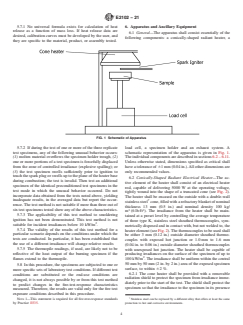
FIG. 1 Schematic of Apparatus
5.7.2 If during the test of one or more of the three replicate load cell, a specimen holder and an exhaust system. A
test specimens, any of the following unusual behavior occurs: schematic representation of the apparatus is given in Fig. 1.
(1) molten material overflows the specimen holder trough, (2) Theindividualcomponentsaredescribedinsections6.2–6.11.
one or more portions of a test specimen is forcefully displaced Unless otherwise stated, dimensions specified as critical shall
from the zone of controlled irradiance (explosive spalling); or have a tolerance of 61 mm (0.04 in.).All other dimensions are
(3) the test specimen swells sufficiently prior to ignition to only recommended values.
touchthesparkplugorswellsuptotheplaneoftheheaterbase
6.2 Conically-Shaped Radiant Electrical Heater—The ac-
during combustion; the test is invalid. Then test an additional
tive element of the heater shall consist of an electrical heater
specimen of the identical preconditioned test specimens in the
rod, capable of delivering 5000 W at the operating voltage,
test mode in which the unusual behavior occurred. Do not
tightly wound into the shape of a truncated cone (see Fig. 2).
incorporate data obtained from the tests noted above, yielding
The heater shall be encased on the outside with a double-wall
inadequate results, in the averaged data but report the occur-
stainless steel cone, filled with a refractory blanket of nominal
rence. The test method is not suitable if more than three out of
thickness 13 mm (0.5 in.) and nominal density 100 kg/
3 3
six test specimens tested show any of the above characteristics.
m (6 lb⁄ft ). The irradiance from the heater shall be main-
5.7.3 The applicability of this test method to smoldering
tained at a preset level by controlling the average temperature
ignition has not been demonstrated. This test method is not
of three type K, stainless steel sheathed thermocouples, sym-
suitable for incident irradiances below 10 kW/m .
metrically disposed and in contact with, but not welded to, the
5.7.4 The validity of the results of this test method for a
heater element (see Fig. 2).The thermocouples to be used shall
particular scenario depends on the conditions under which the
be either 3 mm (0.12 in.) outside diameter sheathed thermo-
tests are conducted. In particular, it has been established that
couples with exposed hot junction or 1.0 mm to 1.6 mm
the use of a different irradiance will change relative results
(0.04 in. to 0.06 in.) outside diameter sheathed thermocouples
5.7.5 The thermopile readings, if used, are likely not to be
with unexposed hot junction. The heater shall be capable of
reflective of the heat output of the burning specimen if the
producing irradiances on the surface of the specimen of up to
flames extend to the thermopile.
100 kW/m . The irradiance shall be uniform within the central
50 mm by 50 mm (2 in. by 2 in.) area of the exposed specimen
5.8 In this procedure, the specimens are subjected to one or
surface, to within 62%.
more specific sets of laboratory test conditions. If different test
6.2.1 The cone heater shall be provided with a removable
conditions are substituted or the end-use conditions are
radiation shield to protect the specimen from irradiance imme-
changed, it is not always possible by or from this test method
diately prior to the start of the test. The shield shall protect the
to predict changes in the fire-test-response characteristics
specimen so that the irradiance to the specimen in its presence
measured. Therefore, the results are valid only for the fire test
exposure conditions described in this procedure.
NOTE 1—This statement is required for all fire-test-response standards Stainless steel can be replaced by a different alloy that offers at least the same
by Practice E535. protection to hot and corrosive environments.
E2102 − 21
FIG. 2 Cross-Section View Through the Heater
is decreased by 90% within 10 s and that the irradiance after 6.4 Weighing Device, for measuring mass loss. The device
shield withdrawal does not differ by more than 1 kW/m from shall have an accuracy of 0.1 g, and a 90 % response time of
the value calibrated. The radiation shield shall be made of less than 3 s, as determined in accordance with the calibrations
non-combustible material, with a total thickness not to exceed described in 10.2. It should preferably have a specimen
12mm.Theradiationshieldshallcomplywitheither6.2.1.1or measuring range of at least 500 g and a mechanical tare
6.2.1.2 and shall be kept in place for a maximum period of adjustment range of 3.5 kg (7.7 lb).
10 s.
6.5 Specimen Holder:
6.2.1.1 A water-cooled radiation shield coated with a du-
6.5.1 The specimen holder is shown in Fig. 3. It shall have
rable matte black finish of surface emissivity e = 0.95 6 0.05
the shape of a square pan with an opening of outside dimen-
(Type I Shield); or
sions of 106 mm by 106 mm (4.2 in. by 4.2 in.) at the top, and
6.2.1.2 A radiation shield with a reflective top surface in
a depth of 25 mm (1 in.). The holder shall be constructed from
order to minimize radiation transfer, but not water-cooled
stainless steel with a thickness of 2.4 mm 6 0.1 mm (0.094 in.
(Type II Shield).
6 0.004 in.). It shall include a handle to facilitate insertion and
6.2.1.3 The radiation shield shall be equipped with a handle
removal, and a mechanism to ensure central location of the
or other suitable means for quick insertion and removal. The
specimen under the heater and proper alignment with the
cone heater base plate shall be equipped with the means for
weighing device. The bottom shall be lined with a layer of a
holding the radiation shield in position and allowing its easy 3 3
low density (nominal density 65 kg/m (4 lb/ft )) refractory
and quick removal.
fiber blanket with thickness of at least 13 mm (0.5 in.). The
6.3 Irradiance Controller—The irradiance control system distance between the bottom surface of the cone heater and the
top of the specimen shall be adjusted to be 25 mm (1 in.).
shall maintain the average temperature of the heater thermo-
couples during calibration at the preset level to within 62 °C. 6.5.1.1 An open stainless steel square, 59 mm in inside
dimensions, shall be spot welded to the underside of the
6.3.1 An acceptable system is a “3-term” controller
(proportional, integral, and derivative) and a thyristor unit horizontal specimen holder, to facilitate the centering of the
specimen under the cone heater. The leading edge of the open
capable of switching currents up to 25 A at 250 V.
6.3.2 The controller shall have a temperature input range of square underneath the specimen holder, which is the one
oppositethehandle,isoptional.Theopensquareonthebottom
0 °Cto1000 °C(32 °Fto1832 °F),asetscalecapableofbeing
read to 2 °C (5 °F) or better, and automatic cold junction of the specimen holder shall be designed to seat with the
sample mount assembly located at the top of the load cell
compensation. The controller shall be equipped with a safety
ensuring that the specimen holder is centered with respect to
feature so that, in the event of an open circuit in the thermo-
the cone heater.
couple line, it causes the temperature to fall to near the bottom
6.5.2 An optional retainer frame and grid is useful for
of its range.
6.3.3 The thyristor unit shall be of the “zero crossing” type testing some samples, and is shown in Fig. 4. The grid is
constructed from 1 mm nominal stainless steel and has
and not of the “phase angle” type.
6.3.4 The heater temperature shall be monitored by a meter dimensions of 109 mm by 109 mm (62 mm). The grid has
1 mm ribs and the openings in the center are 19 mm by 19 mm
capable of being read to 62 °C (5 °F) or better.
(61 mm). The edge frame is constructed from 2 mm nominal
stainless steel with outside dimensions of 116 mm by 116 mm
It is possible that the use of a radiation shield for periods longer than 10 s will
by 56 mm height (62 mm). The frame has an 8 mm lip on the
affect radiator heat control and, consequently, the heat flux level applied to the
top to provide an opening of 100 mm by 100 mm on the top.
specimen.
Therearetwo3mm(60.5mm)diameterby130mm(63mm)
This device is necessary in order to enable repeat tests to be carried out without
switching off the radiator cone. long retaining pins to lock the test specimen in the edge frame.
E2102 − 21
NOTE 1—All dimensions are in millimetres.
NOTE 2—* Indicates a critical dimension.
FIG. 3 Horizontal Specimen Holder
6.5.3 Details on specimen preparation are given in 9.3. temperature in the laboratory. Radiation shall not pass
through any window before reaching the sensing surface. The
6.6 Exhaust Gas System. Use the instrument under a hood
instrument shall have an accuracy of within 63%.
with adequate ventilation to safely remove all combustion
6.9.2 Thecalibrationoftheheatfluxmetershallbechecked,
products from the laboratory.
whenever a recalibration of the apparatus is carried out, by
6.7 Ignition Circuit—External ignition is accomplished by a
comparison with two instruments of the same type as the
sparkplugpoweredfroma10 kVtransformerora10 kVspark
workingheatfluxmeter,andofsimilarrange,heldasreference
generator. The spark plug shall have a gap of 3 mm (0.12 in.).
standards and not used for any other purpose (see Annex A1).
If used, the transformer shall be of a type specifically designed
One of the reference standards shall be fully calibrated at a
for spark ignition use. The transformer shall have an isolated
standardizing laboratory, at yearly intervals. This meter shall
(unearthed) secondary to minimize interference with the data
be used to calibrate the heater. It shall be positioned at a
transmission lines. The electrode length and location of the
location equivalent to the center of the specimen face, in either
spark plug shall be such that the spark gap is located 13 mm
orientation, during this calibration.
(0.5 in.) above the center of the specimen, in the horizontal
orientation.
6.10 Calibration Burner—Acalibrationburnershallbeused
to calibrate the rate of heat release apparatus (see Fig. 5). The
6.8 Ignition Timer—It shall be capable of recording elapsed
timetothenearest1s,andshallbeaccuratetowithin1sin1h. burnershallbeconstructedfromasquare-sectionmetallictube,
with a square orifice covered with wire gauze through which
6.9 Heat Flux Meter:
methane gas diffuses. The tube shall be packed with ceramic
6.9.1 The heat flux meter shall be of the Schmidt-Boelter
fiber to improve uniformity of flow. The calibration burner
(thermopile) type, with a design range of about 100 kW/m .
shall be connected to a metered supply of methane, with a
Thesensingsurfaceoftheheatfluxmetershallbefiat,circular,
purity of at least 99.5 percent.
ofapproximately12.5 mm(0.5in.)indiameterandcoatedwith
a durable matt black finish. The target shall be water-cooled,
to the temperature at which it was calibrated, at least at room
If the cooling temperature is lower than the temperature at which the gage is
calibrated, condensation on the sensor is possible and would lead to serious
The target also receives, to a small extent, some convected heat. measurement errors.
E2102 − 21
FIG. 4 Optional Wire Grid (For Horizontal or Vertical Orientation)
6.11 Data Acquisition System—The data acquisition system combustion products into the surrounding atmosphere, it is
shall have facilities to record the output from the load cell and advisable to fully evacuate the smoke, at the end of a test, into
fromthethermopile(ifused).Thedataacquisitionsystemshall
an exhaust system with adequate capacity. The operator must
have an accuracy of 0.01 % of full-scale load cell output. The
use heavy gloves, safety tongs or other suitable protection for
system shall be capable of recording data at least every5sfor
removal of the specimen holder. The venting must be checked
a minimum of 1 h.Achart recorder is an acceptable system, if
periodically for proper operation. Care shall be taken not to
it meets the accuracy required and the minimum chart speed
touch the spark igniter, which carries a substantial potential
used is no less than 10 mm/min (0.4 in.⁄min).
(10 kV),duringoperation.Theexhaustsystemoftheapparatus
shall be checked for proper operation before testing and shall
7. Operator Safety
discharge into a building exhaust system with adequate capac-
7.1 The test procedure involves high temperatures, and
ity. The possibility of the violent ejection of molten hot
combustion processes.Therefore, it is possible for eye injuries,
material or sharp fragments from some kinds of specimens
burns,ignitionofextraneousobjectsorclothing,andinhalation
when irradiated must be taken into account.
of smoke or combustion products to occur, unless proper
precautions are taken. To avoid accidental leakage of toxic
8. Suitability of a Sample for Testing
8.1 Surface Characteristics—A product having one of the
If a chart recorder which only displays a millivolt output is used, the millivolt
properties described in 8.1.1 or 8.1.2 is suitable for testing.
value shall be converted to heat flux, in kW/m , using the calibration factor (or
equation, if appropriate) specific to the heat flux meter. 8.1.1 An essentially flat exposed surface (see 3.2.4).
E2102 − 21
FIG. 5 Calibration Burner
8.1.2 Asurface irregularity which is evenly distributed over ent order in relation to the two faces. If either of the faces is
the exposed surface provided that it complies with either potentially exposed to a fire in use within a room, cavity or
8.1.2.1 or 8.1.2.2. void, then both faces shall be tested.
8.1.2.1 At least 50 % of the surface of a representative
8.3 Lightweight Materials—This test method is not suitable,
square area of 100 mm (4 in.) per side lies within a depth of
unless modified, for materials that are excessively low in
10 mm (0.4 in.) from a plane taken across the highest points on
weight, since it is likely that insufficient mass loss data will be
the exposed surface.
collected for the calculation of mass loss rates. For some
8.1.2.2 The total area of any cracks, fissures or holes does
samples, this problem is solved by using a lower data acqui-
notexceed30 %ofarepresentativesquarearea100mm(4in.)
sition interval, such as 1 s; the test report shall then state that
persideoftheexposedsurface,andnoneofthecracks,fissures
the sample has been tested in a modified form and clearly
or holes exceeds 8 mm (0.3 in.) in width nor 10 mm (0.4 in.)
describe the modification.
in depth.
8.4 Composite Specimens—Composite specimens shall be
8.1.2.3 When an exposed surface does not meet the require-
exposed in a manner typical of the end use condition (for
mentsof8.1.1or8.1.2,theproductshallbetestedinamodified
example, if used with an air gap (see 9.1.7), and air gap shall
form complying as nearly as possible with the requirements
be included behind the specimen, within the aluminum foil).
given in 8.1.2. The test report shall then state that the sample
Use a metal spacer frame to achieve the air gap.
has been tested in a modified form and clearly describe the
modification.
8.5 Dimensionally Unstable Materials—Testing of materi-
8.2 Asymmetrical Products—A sample submitted for this als that change their dimensions substantially when exposed to
test is permitted to have faces which differ from each other, or the radiant heat from the cone require special procedures. This
contain laminations of different materials arranged in a differ- section addresses materials that intumesce (and have the
E2102 − 21
potential to expand to such an extent that they make physical ignition, or (b) the underside of the cone heater after ignition.
contact with the spark igniter or the underside of the cone Inthisconfiguration,thesparkigniterwillbelocated48 mm 6
heater; see 8.5.1), materials that melt (and have the potential to 2 mm above the center of the specimen.
overflow the aluminum foil; see 8.5.2) and materials that warp
NOTE 2—The time to ignition measured with the 60 mm separation is
(and have the potential to shrink away from the cone heater;
not comparable to that measured with the standard separation of 25 mm.
see 8.5.3). In all these cases, it is possible that the heat flux on
8.5.1.4 Use a special mounting procedure suitable for the
the surface of the specimen at the time of ignition will differ
specimen to be tested.
from the initial test heat flux.
8.5.2 Melting Materials:
8.5.1 Intumescent Materials—The testing technique to be
8.5.2.1 Materials that melt and overflow the aluminum foil
used when testing intumescing specimens shall be documented
wrapping during testing shall be tested using aluminum foil
in detail in the test report. Options include those shown in
that extends above the specimen surface level. The aluminum
8.5.1.1 through 8.5.1.4.
foil extension above the specimen surface shall be such that
8.5.1.1 Use a retainer frame without a grid (Fig. 6), to
melt overflow is contained, without interfering with the com-
reduce unrepresentative edge burning of specimens.
bustion process. A height of 2 mm to 3 mm is recommended.
8.5.1.2 Use a retainer frame with a wire grid (Fig. 4), which
8.5.2.2 If a test has been conducted without using the
is suitable for retaining specimens prone to delamination and
special technique described in 8.5.2.1 and melt overflow has
for several types of intumescent specimens.
occurred, that test shall be deemed invalid and the technique in
8.5.1.3 Use a separation distance between the cone base
8.5.2.1 shall be used for future tests.
plate and the upper specimen surface of 60 mm instead of
8.5.3 Warping Materials—Unstable materials that warp so
25 mm, without using a retainer frame. Use this technique for
that the exposed surface of the test specimen is not flat during
those dimensionally unstable materials that have the potential
testing shall be restrained to maintain the surface in a flat
to intumesce or deform to such an extent that they are likely to
orientation. This shall be accomplished with four tie wires, as
make physical contact with either (a) the spark plug before
described in 8.5.3.1 through 8.5.3.4.
8.5.3.1 The four tie wires shall be metal wires, 1.0 mm 6
0.1 mm in diameter and at least 350 mm long.
8.5.3.2 The test specimen shall be prepared as described in
Section 9 and then tied with the metal wires.
8.5.3.3 A tie wire shall be looped around the specimen
holder assembly so that it is parallel to and 20 mm 62mm
away from any of the four sides of the assembly. The ends of
thetiewireshallbetwistedtogethersuchthatthewireispulled
firmly against the specimen holder assembly. Trim excess wire
from the twisted section before testing.
8.5.3.4 Fit the other three tie wires around the specimen
holder assembly in a similar manner, so that each one is
parallel to one of the sides of the assembly.
9. Test Specimen
9.1 Types of Test Specimens:
9.1.1 Unless otherwise specified, three specimens shall be
tested at each level of irradiance selected and for each different
exposed surface.
9.1.2 The specimens shall be representative of the product
and shall be square with sides measuring 100 mm 6 0.5 mm
(3.9 in. 6 0.2 in.).
9.1.3 Samples with normal thicknesses of 50 mm (2 in.) or
less shall be tested at their full thickness.
9.1.4 For samples with normal thicknesses of greater than
50 mm (2 in.), the requisite specimens shall be obtained by
cutting away the unexposed face to reduce the thickness to
50 mm 6 0.5 mm (2.0 in. 6 0.2 in.).
9.1.5 When cutting specimens from samples with irregular
surfaces, the highest point on the surface shall be arranged to
occur at the center of the specimen.
9.1.6 Assemblies shall be tested as specified in 9.1.3 or
9.1.4, as appropriate. When the product is a material or
NOTE 1—All dimensions are in millimetres.
composite which is normally attached to a well defined
NOTE 2—* Indicates a critical dimension.
FIG. 6 Retainer Frame substrate in practical use, then it shall be tested in conjunction
E2102 − 21
with that substrate using the recommended fixing technique, 10. Calibration
for example bonded with the appropriate adhesive or mechani-
10.1 Heater Calibration—Remove the radiation shield be-
cally fixed.
fore a heater calibration. Adjust the temperature controller so
9.1.6.1 Where thin materials or composites are used in the
that the conical heater produces the required irradiance, as
fabrication of an assembly, it is likely that the presence of air
measuredbytheheatfluxmeter,(a)atthestartofeachtestday,
or an air gap or the nature of any underlying construction will
(b) when changing to a new irradiance or (c) when the conical
significantly affect the ignition and burning characteristics of
heater orientation is changed. Do not use a specimen or a
the exposed surface. Take steps to ensure that the test result
specimen holder when the heat flux meter is inserted into the
obtained on any assembly is relevant to its use in practice.
calibration position. Operate the cone heater for at least 10 min
9.1.7 Samples that are thinner than 6 mm (0.25 in.) shall be
and ensure that the controller is within its proportional band
tested with a substrate representative of end use conditions,
before beginning this calibration.
such that the total specimen thickness is 6 mm (0.25 in.) or
10.2 Mass Measuring System Calibration—Calibrate the
more. In the case of specimens of less than 6 mm (0.25 in.) in
load cell with standard weight pieces in the range of test
thickness and used with an air space adjacent to the unexposed
specimen mass at least every day, and whenever the load cell
face, the specimens shall be mounted so that there is an air
zero needs to be adjusted.
space of at least 12 mm (0.5 in.) between the unexposed face
and the refractory fiber blanket (8.4).
11. Test Procedure
9.1.8 Resultsobtainedfromfiretestmethodsareaffectedby
11.1 Initial Preparation:
variations in sample geometry, surface orientation, thickness
11.1.1 Turnonpowertotheconeheaterandtheexhaustfan.
(both overall and of the individual layers), mass, and compo-
Do not turn off power to the load cell on a daily basis.
sition. For any fire test method, it is therefore important that
11.1.2 Perform the required calibration procedures specified
fire test replicate samples be cut, sawed, or blanked to identical
(10.1 and 10.2). Put a thermal screen on top of the load cell (an
sample areas, and that records be kept of the respective masses
empty specimen holder with a refractory blanket is suitable)
with the individual test data. Evaluation of the data obtained,
during warm-up and between tests, to avoid excessive heat
together with the individual masses, will assist in assessing the
transmission to the load cell.
reasons for any observed variability in measurements.
11.1.3 Unlessexternalignitionisnottobeused,positionthe
9.2 Conditioning:
spark plug holder in the location appropriate to the orientation
9.2.1 Before the test, condition the specimens to constant being used (6.7).
mass at a temperature of 23 °C 6 2 °C (73 °F 6 5 °F), and a
11.2 Procedure:
relative humidity of 50 % 65%.
11.2.1 When ready to test, first remove the empty specimen
9.2.2 Constant mass is considered to have been reached
holder (see 11.1.3).
when two successive weighing operations, carried out at an
11.2.2 Move the radiation shield in position, and place the
interval of 24 h, do not differ by more than 0.1% of the mass
specimen holder, with the test specimen, under the heater. The
of the test piece or 0.1 g, whichever is the greater.
specimen holder shall be centered with respect to the cone
heater. The specimen holder shall be at room temperature
9.3 Specimen Preparation:
initially.
9.3.1 Specimen Wrapping—A conditioned specimen shall
11.2.3 Remove the radiation shield within 10 s.
be wrapped in a single layer of aluminum foil, of 0.03 mm to
Immediately, move the spark igniter into place, and turn on the
0.05 mm (0.001 in. to 0.002 in.) thickness, with the shiny side
power to the spark igniter and start data collection simultane-
towards the specimen, covering the unexposed surfaces.
ously. If a computerized data acquisition system is used (see
9.3.2 Specimen Preparation—All test specimens shall be
6.11), data collection intervals shall be5sor less.
testedwiththeretainerframeshowninFig.4,unlessotherwise
11.2.4 Record the times when flashing or transitory flaming
required in Section 8 of this test method. The steps outlined in
occur; when sustained flaming occurs, record the time, turn off
9.3.2.1 – 9.3.2.5 shall be taken to prepare the specimen for
thespark,andremovethesparkigniter.Iftheflamesextinguish
testing.
after turning off the spark, reinsert the spark igniter and turn on
NOTE 3—Use of the retainer frame is an option in Test method E1354.
the spark, within5sof extinguishment. The spark igniter shall
then be left in position until sustained flaming resumes or until
9.3.2.1 Put the retainer frame on a flat surface facing
the 15 minute sustained flaming period has elapsed. Report all
downwards.
these events in the test report.
9.3.2.2 Insert a foil-wrapped specimen into the retainer
11.2.5 Collect all data until 32 min after the time to
frame, with the exposed surface facing downwards.
sustained flaming, 2 min after any flaming or other signs of
9.3.2.3 Put layers of ceramic fiber blanket (nominal thick-
combustion cease or the average mass loss per unit area over a
ness 13 mm (0.5 in.), see section 6.5) on top of the sample,
1 min period has dropped below 150 g/m , whichever occurs
until two layers extend above the rim of the retainer frame.
first.
9.3.2.4 Fit the sample holder into the retainer frame, on top
of the ceramic fiber and press downwards.
9.3.2.5 Tightenthescrewatthebottomoftheretainerframe
It is possible that the load cell zero will need adjustments after changing
and turn the frame around. orientation, due to different specimen holder tare masses.
E2102 − 21
11.2.6 Ifthespecimendoesnotignitein30min,removeand 12.2.17 State whether measurements with an optional col-
discard, unless the specimen is showing signs of heat evolu- umn with thermopile were made. If such measurements were
tion. made, describe the column with thermopile used, by reference
to the relevant annex section.
NOTE 4—Test method E1354 specifies a 10 min test period if the
specimen does not ignite.
12.3 Include the following test results in the test report.
12.3.1 Table of numerical results containing the following
11.2.7 Remove specimen and specimen holder.
information for each specimen tested.
11.2.8 Replace an empty specimen holder. Let the chimney
12.3.1.1 Time to sustained flaming, in s.
(if used) cool between tests.
12.3.1.2 Test duration: the time elapsed between the start of
11.2.9 Test three specimens and report the results as de-
the test and the end point (11.2.5 or 11.2.6), in s.
scribedbelow.Comparethe180smeanmasslossratereadings
12.3.1.3 Total mass lost during the test, in g and in % of
for the three specimens. If any of these mean readings differ by
initial mass.
morethan10%fromthearithmeticmeanofthethreereadings,
12.3.1.4 Sample mass loss per unit area, in kg/m .
then test a further set of three specimens. In such cases, report
12.3.1.5 Averagerateofspecimenmasslossperunitarea,in
the arithmetic mean of the set of six readings.
g/(s m ), computed over the period between ignition and the
11.3 Record any particular burning characteristics of the
end of the test.
specimens, such as delamination, intumescence, shrinkage,
12.3.1.6 Maximumrateofspecimenmasslossperunitarea,
melting, dripping, collapse, occurrence of pool fire under the
in g/(s m ), computed over the period between ignition and the
test specimen, or any other event of special interest, and record
end of the test.
the time at which the particular behavior occurs, including the
12.3.1.7 Time to maximum value of mass loss rate per unit
timetoignitionanddurationofflaming.Alsorecordthesmoke
area, in s.
characteristics, such as color, and the nature of
...
This document is not an ASTM standard and is intended only to provide the user of an ASTM standard an indication of what changes have been made to the previous version. Because
it may not be technically possible to adequately depict all changes accurately, ASTM recommends that users consult prior editions as appropriate. In all cases only the current version
of the standard as published by ASTM is to be considered the official document.
Designation: E2102 − 17 E2102 − 21 An American National Standard
Standard Test Method for
Measurement of Mass Loss and Ignitability for Screening
Purposes Using a Conical Radiant Heater
This standard is issued under the fixed designation E2102; the number immediately following the designation indicates the year of
original adoption or, in the case of revision, the year of last revision. A number in parentheses indicates the year of last reapproval. A
superscript epsilon (´) indicates an editorial change since the last revision or reapproval.
INTRODUCTION
The screening fire-test-response method described in this standard uses a radiant energy source
similar to that used in the cone calorimeter, Test Method E1354. However, the test method apparatus
is much simpler, because it excludes measurements of oxygen consumption or of smoke obscuration,
which are incorporated into the cone calorimeter to measure heat and smoke release. A fire-test-
response standard describes a test method from which one or more fire-test-response characteristics
can be measured, as a result of exposure to a prescribed source of heat or flame, under controlled
conditions. There are many occasions, typically for initial research and development, when there is a
need for screening samples of materials, products, or assemblies, using a simple test. This allows the
user to verify whether certain fire-test-response characteristics of the sample fall within the expected
margins. Screening tests, as related to fire, are described in fire terminology as fire-response tests
performed to determine whether a material, product, or assembly (a)(a) exhibits any unusual
fire-related characteristics, (b)(b) has certain expected fire-related characteristics, or (c)(c) is capable
of being preliminarily categorized according to the fire characteristic in question. Screening tests
addressing fire properties should be chosen so that the energy input (as heat or flame) is representative
of that in the fire test method for which screening is desired.
1. Scope*
1.1 This fire-test-response standard provides a means of measuring mass loss and ignitability, for screening purposes, from
essentially planar materials, products, or assemblies (including surface finishes), exposed to controlled levels of radiant heating,
with or without an external ignitor. This test method is intended for screening purposes only.
1.2 The principal fire-test-response characteristics obtained from this test method are those associated with mass loss from the
specimens tested, as a function of time. Time to sustained flaming is also determined. Heat release is, optionally, determined using
thermopile measurements detailed in Annex A2.
1.2.1 The fire-test-response characteristics obtained from this test are best used for comparisons between materials with some
similarities in composition or structure.
1.3 The relationship between mass loss and heat release depends on the material, product, or assembly tested, and no universal
formula exists for calculation of heat release using mass loss measurements (see also additional limitations in 5.7).
This test method is under the jurisdiction of ASTM Committee E05 on Fire Standards and is the direct responsibility of Subcommittee E05.21 on Smoke and Combustion
Products.
Current edition approved July 1, 2017Dec. 1, 2021. Published August 2017January 2022. Originally approved in 2000. Last previous edition approved in 20152017 as
E2102 - 15.E2102 - 17. DOI: 10.1520/E2102-17.10.1520/E2102-21.
*A Summary of Changes section appears at the end of this standard
Copyright © ASTM International, 100 Barr Harbor Drive, PO Box C700, West Conshohocken, PA 19428-2959. United States
E2102 − 21
1.4 The fire-test-response characteristics obtained from this test method are also obtainable with the apparatus used in Test Method
E1354 (the cone calorimeter) or in an applications standards of that equipment (see also 5.4). The referenced test methods permit
measurements of added fire-test-response characteristics.
1.5 The fire-test-response characteristics obtained by this test method are specific to the specimen tested, in the form and thickness
tested, and are not an inherent property of the material, product, or assembly.
1.6 This fire-test-response method does not provide information on the fire performance of the test specimens under fire conditions
other than those conditions specified in this test method. For additional limitations of this test method, see 5.7.
1.7 Use the SI system of units in referee decisions; see IEEE/ASTM SI-10. The units given in parentheses are for information only.
1.8 This standard is used to measure and describe the response of materials, products, or assemblies to heat and flame under
controlled conditions, but does not by itself incorporate all factors required for fire hazard or fire risk assessment of the materials,
products, or assemblies under actual fire conditions.
1.9 Fire testing is inherently hazardous. Adequate safeguards for personnel and property shall be employed in conducting these
tests. See also Section 7.
1.10 This standard does not purport to address all of the safety concerns, if any, associated with its use. It is the responsibility
of the user of this standard to establish appropriate safety safety, health, and healthenvironmental practices and determine the
applicability of regulatory limitations prior to use.
1.11 This international standard was developed in accordance with internationally recognized principles on standardization
established in the Decision on Principles for the Development of International Standards, Guides and Recommendations issued
by the World Trade Organization Technical Barriers to Trade (TBT) Committee.
2. Referenced Documents
2.1 ASTM Standards:
D5537 Test Method for Heat Release, Flame Spread, Smoke Obscuration, and Mass Loss Testing of Insulating Materials
Contained in Electrical or Optical Fiber Cables When Burning in a Vertical Cable Tray Configuration
D6113 Test Method for Using Cone Calorimeter to Determine Fire-Test-Response Characteristics of Insulating Materials
Contained in Electrical or Optical Fiber Cables
E176 Terminology of Fire Standards
E535 Practice for Preparation of Fire-Test-Response Standards
E603 Guide for Room Fire Experiments
E638 Test Method for Calibration of Heat Transfer Rate Calorimeters Using a Narrow-Angle Blackbody Radiation Facility
(Withdrawn 2001)
E906 Test Method for Heat and Visible Smoke Release Rates for Materials and Products Using a Thermopile Method
E1354 Test Method for Heat and Visible Smoke Release Rates for Materials and Products Using an Oxygen Consumption
Calorimeter
E1474 Test Method for Determining the Heat Release Rate of Upholstered Furniture and Mattress Components or Composites
Using a Bench Scale Oxygen Consumption Calorimeter
E1537 Test Method for Fire Testing of Upholstered Furniture
E1590 Test Method for Fire Testing of Mattresses
E1623 Test Method for Determination of Fire and Thermal Parameters of Materials, Products, and Systems Using an
Intermediate Scale Calorimeter (ICAL)
E1740 Test Method for Determining the Heat Release Rate and Other Fire-Test-Response Characteristics of Wall Covering or
Ceiling Covering Composites Using a Cone Calorimeter
E1822 Test Method for Fire Testing of Stacked Chairs
IEEE/ASTM SI-10 International System of Units (SI) The Modernized Metric System
For referenced ASTM standards, visit the ASTM website, www.astm.org, or contact ASTM Customer Service at service@astm.org. For Annual Book of ASTM Standards
volume information, refer to the standard’s Document Summary page on the ASTM website.
The last approved version of this historical standard is referenced on www.astm.org.
E2102 − 21
2.2 ISO Standards:
ISO 3261 Fire Tests–Vocabulary
ISO 5657 Fire Tests–Reaction to Fire–Ignitability of Building Products
ISO 5660-1 Fire Tests–Reaction to Fire–Rate of Heat Release from Building Products (Cone calorimeter method)
ISO 9705 Fire Tests–Full Scale Room Test for Surface Products
ISO 13943 Fire Safety Vocabulary
2.3 British Standards:
BS 476, Part 15, Fire Tests– Reaction to Fire–Rate of Heat Release from Building Products (Cone calorimeter method)
BS 6809 Method of Calibration of Radiometers for Use in Fire Testing
3. Terminology
3.1 Definitions: For definitions of terms used in this test method refer to the terminology contained in Terminology E176, ISO
3261 and ISO 13943. In case of conflict, the definitions given in Terminology E176 shall prevail.
3.2 Definitions of Terms Specific to This Standard:
3.2.1 assembly, n—a unit or structure composed of a combination of materials or products, or both.
3.2.2 continuous (as related to data acquisition),adj—conducted at data collection intervals of 5 s or less.
3.2.3 critical heat flux for ignition, n—the midpoint within the range of heat fluxes between the maximum (highest) heat flux that
produces no ignition and the minimum (lowest) heat flux that produces ignition, for a specified exposure time.
3.2.4 essentially flat surface, n—surface where the irregularity from a plane does not exceed 61 mm.
3.2.5 exposed surface, n—that surface of the specimen subjected to the incident heat.
3.2.6 flashing, n—existence of flame on or over the surface of the specimen for periods of less than 1 s.
3.2.7 irradiance (at a point of a surface),n—ratio of the radiant flux incident on a small but measurable element of surface
containing the point, by the area of that element.
3.2.7.1 Discussion—
Convective heating is negligible in the horizontal specimen orientation. In the vertical orientation, it is small, but not negligible.
Despite this contribution from convective heating, the term “irradiance” is used instead of “heat flux” throughout this test method
as it best indicates the essentially radiative mode of heat transfer.
3.2.8 material, n—single substance, or uniformly dispersed mixture, for example metal, stone, timber, concrete, mineral fiber, or
polymer.
3.2.9 orientation, n—the plane in which the exposed face of the specimen is located during testing.
3.2.9.1 Discussion—
For this standard, the specimen orientation may only be either vertical or horizontal.
3.2.10 sample, n—an amount of the material, product, or assembly, to be tested, which is representative of the item as a whole.
3.2.11 specimen, n—representative piece of the product which is to be tested together with any substrate or treatment.
3.2.11.1 Discussion—
This may include an air gap.
3.2.12 sustained flaming, n—the existence of flame on or over the surface of the specimen for a period of 4 s or more.
3.2.13 time to ignition, n—time between the start of the test and the presence of a flame on or over most of the specimen surface
for a period of at least 4 s.
Available from International Standardization Organization, P.O. Box 56, CH-1211; Geneva 20, Switzerland or American National Standards Institute (ANSI), 25 W. 43rd
St., 4th Floor, New York, NY 10036.
Available from British Standards Institution, PO Box 4033, Linford Wood, Milton Keynes, MK 14 6LE, United Kingdom
E2102 − 21
3.2.14 time to sustained flaming, n—time to ignition.
3.2.15 transitory flaming, n—the existence of flame on or over the surface of the specimen for periods of between 1 and 4 s.
4. Summary of Test Method
4.1 This test method employs a conically-shaped electrically-heated radiant-energy source, positioned so as to produce an
irradiance level of up to 100 kW/m , averaged over the center of the exposed surface of an essentially planar specimen. An external
spark ignitor is available, if required. This test method is used to determine continuously the mass lost during the combustion
process, using a load cell, for screening purposes. Ignitability is also assessed by the test method.
4.1.1 Optionally, the test method is capable of obtaining an estimate of the heat released by the specimen during the burning
process, using a thermopile housed above the burning specimen (See Annex A2). Determinations of heat release using a similar
radiant-energy source and oxygen consumption calorimetry, are made with the cone calorimeter, Test Method E1354.
4.2 The specimen is essentially planar, 100 mm by 100 mm (3.9(3.9 in. by 3.9 in.) in size, at a thickness not exceeding 25 mm
(1 in.) and is mounted within a holder.
5. Significance and Use
5.1 This test method provides a means for screening materials, products, or assemblies, for the mass loss, and ignitability they
exhibit under specified heat flux exposure conditions. As an option, the test method is also suitable for screening for the heat
released, by using a thermopile method (See Annex A2).
5.1.1 Terminology E176, on fire standards, states that fire-test-response characteristics include ease of ignition and mass loss (both
measured in this test method), as well as flame spread, smoke generation, fire endurance, and toxic potency of smoke.
5.1.2 The mass loss rate of a material, product, or assembly is a fire-test-response characteristic that gives an indication of its
burning rate. Thus, a lower mass loss rate is often associated with slower burning. Note, however, that mass loss is not always a
result of combustion, and that this method does not assess release of smoke or combustion products.
5.1.3 The time to ignition of a material, product, or assembly is a fire-test-response characteristic that gives an indication of its
propensity to ignite at the applied heat flux level and subsequently to release heat and spread flame over its surface. Thus, a longer
time to ignition is an indication of a lower propensity for the material, product, or assembly to become involved and contribute
to fire spread or growth; however this method does not assess the smoke or combustion products released.
5.1.4 The apparatus used for this test method is suitable to assess the critical heat flux for ignition of the materials, products, or
assemblies tested, by assessing ignitability at various heat fluxes (see Appendix X3 for guidance).
5.2 Values determined by this test are specific to the specimen in the form and thickness tested and are not inherent fundamental
properties of the material, product, or assembly tested. Thus, closely repeatable or reproducible experimental results are not to be
expected from this test method when tests are conducted for a given material, product, or assembly, while introducing variations
in properties such as specimen thickness or density.
5.3 No incident irradiance is specified in this test method. The instrument is capable of generating irradiances ranging up to 100
kW/m . The choice of irradiance is a function of the application of the material, product, or assembly to be tested, and of the fire
scenario the user is investigating. However, the method is not suitable for incident irradiances below 10 10 kW kW/m⁄m (see
5.7.3).
5.4 The method used for optionally measuring heat release, a thermopile, is not as accurate as the conventional oxygen
consumption calorimetry method, used in the cone calorimeter, Test Method E1354, in its applications standards, such as Test
Method E1474 and E1740, or in intermediate scale or a large scale calorimetry test methods, such as Test Methods E1623, E1537,
E2102 − 21
E1590 or D5537 (see also Annex A2). On the other hand the thermopile method of assessing heat release has been used extensively
because of its simplicity, including Test Method E906, and other applications discussed in Guide E603.
5.5 Testing of composites and dimensionally unstable materials requires special procedures (see 8.4 and 8.5).
5.6 Testing in the vertical orientation is feasible with the test method, but not recommended, as it has been shown to have the
potential to lead to serious measurement errors on time to ignition.
5.7 Limitations
5.7.1 No universal formula exists for calculation of heat release as a function of mass loss. If heat release data are desired,
calibration curves must be developed by the user, and they are specific to the material, product, or assembly tested.
FIG. 1 Schematic of Apparatus
5.7.2 If during the test of one or more of the three replicate test specimens, any of the following unusual behavior occurs: (1)
molten material overflows the specimen holder trough, (2) one or more portions of a test specimen is forcefully displaced from
the zone of controlled irradiance (explosive spalling); or (3) the test specimen swells sufficiently prior to ignition to touch the spark
plug or swells up to the plane of the heater base during combustion; the test is invalid. Then test an additional specimen of the
identical preconditioned test specimens in the test mode in which the unusual behavior occurred. Do not incorporate data obtained
from the tests noted above, yielding inadequate results, in the averaged data but report the occurrence. The test method is not
suitable if more than three out of six test specimens tested show any of the above characteristics.
5.7.3 The applicability of this test method to smoldering ignition has not been demonstrated. This test method is not suitable for
incident irradiances below 10 kW/m .
5.7.4 The validity of the results of this test method for a particular scenario depends on the conditions under which the tests are
conducted. In particular, it has been established that the use of a different irradiance will change relative results
5.7.5 The thermopile readings, if used, are likely not to be reflective of the heat output of the burning specimen if the flames extend
to the thermopile.
Note that this section refers to accuracy of measurement, and not to precision. The precision of this test method has not yet been determined.
E2102 − 21
5.8 In this procedure, the specimens are subjected to one or more specific sets of laboratory test conditions. If different test
conditions are substituted or the end-use conditions are changed, it is not always possible by or from this test method to predict
changes in the fire-test-response characteristics measured. Therefore, the results are valid only for the fire test exposure conditions
described in this procedure.
NOTE 1—This statement is required for all fire-test-response standards by Practice E535.
6. Apparatus and Ancillary Equipment
6.1 General—The apparatus shall consist essentially of the following components: a conically-shaped radiant heater, a load cell,
a specimen holder and an exhaust system. A schematic representation of the apparatus is given in Fig. 1. The individual
components are described in sections 6.2 – 6.11. Unless otherwise stated, dimensions specified as critical shall have a tolerance
of 61 mm (0.04 in.). All other dimensions are only recommended values.
6.2 Conically-Shaped Radiant Electrical Heater—The active element of the heater shall consist of an electrical heater rod, capable
of delivering 5000 W at the operating voltage, tightly wound into the shape of a truncated cone (see Fig. 2). The heater shall be
encased on the outside with a double-wall stainless steel cone, filled with a refractory blanket of nominal thickness 13 mm (0.5
3 3
in.) and nominal density 100 kg/m (6 (6 lb lb/ft⁄ft ). The irradiance from the heater shall be maintained at a preset level by
controlling the average temperature of three type K, stainless steel sheathed thermocouples, symmetrically disposed and in contact
with, but not welded to, the heater element (see Fig. 2). The thermocouples to be used shall be either 3 mm (0.12 in.) outside
diameter sheathed thermocouples with exposed hot junction or 1.01.0 mm to 1.6 mm (0.04(0.04 in. to 0.06 in.) outside diameter
sheathed thermocouples with unexposed hot junction. The heater shall be capable of producing irradiances on the surface of the
specimen of up to 100 kW/m . The irradiance shall be uniform within the central 5050 mm by 50 mm (2(2 in. by 2 in.) area of
the exposed specimen surface, to within 6 2 62 %.
6.2.1 The cone heater shall be provided with a removable radiation shield to protect the specimen from irradiance immediately
prior to the start of the test. The shield shall protect the specimen so that the irradiance to the specimen in its presence is decreased
by 90% within 10 s 10 s and that the irradiance after shield withdrawal does not differ by more than 1 kW/m from the value
calibrated. The radiation shield shall be made of non-combustible material, with a total thickness not to exceed 12 mm. The
radiation shield shall comply with either 6.2.1.1 or 6.2.1.2 and shall be kept in place for a maximum period of 10 s.10 s.
6.2.1.1 A water-cooled radiation shield coated with a durable matte black finish of surface emissivity e = 0.95 6 0.05 (Type I
Shield); or
6.2.1.2 A radiation shield with a reflective top surface in order to minimize radiation transfer, but not water-cooled (Type II
Shield).
FIG. 2 Cross-Section View Through the Heater
Stainless steel can be replaced by a different alloy that offers at least the same protection to hot and corrosive environments.
It is possible that the use of a radiation shield for periods longer than 10 s will affect radiator heat control and, consequently, the heat flux level applied to the specimen.
E2102 − 21
6.2.1.3 The radiation shield shall be equipped with a handle or other suitable means for quick insertion and removal. The cone
heater base plate shall be equipped with the means for holding the radiation shield in position and allowing its easy and quick
removal.
6.3 Irradiance Controller—The irradiance control system shall maintain the average temperature of the heater thermocouples
during calibration at the preset level to within 62°C.62 °C.
6.3.1 An acceptable system is a “3-term” controller (proportional, integral, and derivative) and a thyristor unit capable of
switching currents up to 25 A at 250 V.
6.3.2 The controller shall have a temperature input range of 0°C0 °C to 1000°C (32°F1000 °C (32 °F to 1832°F),1832 °F), a set
scale capable of being read to 2°C (5°F)2 °C (5 °F) or better, and automatic cold junction compensation. The controller shall be
equipped with a safety feature so that, in the event of an open circuit in the thermocouple line, it causes the temperature to fall
to near the bottom of its range.
6.3.3 The thyristor unit shall be of the “zero crossing” type and not of the “phase angle” type.
6.3.4 The heater temperature shall be monitored by a meter capable of being read to 6 2°C (5°F) 62 °C (5 °F) or better.
6.4 Weighing Device, for measuring mass loss. The device shall have an accuracy of 0.1 g, and a 90%90 % response time of less
than 3 s, as determined in accordance with the calibrations described in 10.2. It should preferably have a specimen measuring range
of at least 500 g and a mechanical tare adjustment range of 3.5 kg (7.7 lb).
6.5 Specimen Holder:
6.5.1 The specimen holder is shown in Fig. 3. It shall have the shape of a square pan with an opening of outside dimensions of
106106 mm by 106 mm (4.2(4.2 in. by 4.2 in.) at the top, and a depth of 25 mm (1 in.). The holder shall be constructed from
stainless steel with a thickness of 2.4 6 0.1 mm (0.094 2.4 mm 6 0.1 mm (0.094 in. 6 0.004 in.). It shall include a handle to
facilitate insertion and removal, and a mechanism to ensure central location of the specimen under the heater and proper alignment
3 3
with the weighing device. The bottom shall be lined with a layer of a low density (nominal density 65 kg/m (4 lb/ft )) refractory
fiber blanket with thickness of at least 13 mm (0.5 in.). The distance between the bottom surface of the cone heater and the top
of the specimen shall be adjusted to be 25 mm (1 in.).
6.5.1.1 An open stainless steel square, 59 mm in inside dimensions, shall be spot welded to the underside of the horizontal
specimen holder, to facilitate the centering of the specimen under the cone heater. The leading edge of the open square underneath
the specimen holder, which is the one opposite the handle, is optional. The open square on the bottom of the specimen holder shall
be designed to seat with the sample mount assembly located at the top of the load cell ensuring that the specimen holder is centered
with respect to the cone heater.
6.5.2 An optional retainer frame and grid is useful for testing some samples, and is shown in Fig. 4. The grid is constructed from
1 mm nominal stainless steel and has dimensions of 109109 mm by 109 mm (62 mm). The grid has 1 mm 1 mm ribs and the
openings in the center are 1919 mm by 19 mm (61 mm). The edge frame is constructed from 2 mm nominal stainless steel with
outside dimensions of 116116 mm by 116116 mm by 56 mm height (62 mm). The frame has an 8 mm lip on the top to provide
an opening of 100100 mm by 100 mm on the top. There are two 3 mm (60.5 mm) diameter by 130 mm (63 mm) long retaining
pins to lock the test specimen in the edge frame.
6.5.3 Details on specimen preparation are given in 9.3.
6.6 Exhaust Gas System. Use the instrument under a hood with adequate ventilation to safely remove all combustion products from
the laboratory.
6.7 Ignition Circuit—External ignition is accomplished by a spark plug powered from a 10-kV10 kV transformer or a 10-kV10 kV
spark generator. The spark plug shall have a gap of 3 mm (0.12 in.). If used, the transformer shall be of a type specifically designed
This device is necessary in order to enable repeat tests to be carried out without switching off the radiator cone.
E2102 − 21
NOTE 1—All dimensions are in millimetres.
NOTE 2—* Indicates a critical dimension.
FIG. 3 Horizontal Specimen Holder
for spark ignition use. The transformer shall have an isolated (unearthed) secondary to minimize interference with the data
transmission lines. The electrode length and location of the spark plug shall be such that the spark gap is located 13 mm (0.5 in.)
above the center of the specimen, in the horizontal orientation.
6.8 Ignition Timer—It shall be capable of recording elapsed time to the nearest 1 s, and shall be accurate to within 1 s in 1 h.1 h.
6.9 Heat Flux Meter:
6.9.1 The heat flux meter shall be of the Schmidt-Boelter (thermopile) type, with a design range of about 100 kW/m . The sensing
surface of the heat flux meter shall be fiat, circular, of approximately 12.5 mm 12.5 mm (0.5 in.) in diameter and coated with a
durable matt black finish. The target shall be water-cooled, to the temperature at which it was calibrated, at least at room
temperature in the laboratory. Radiation shall not pass through any window before reaching the sensing surface. The instrument
shall have an accuracy of within 63%.63 %.
6.9.2 The calibration of the heat flux meter shall be checked, whenever a recalibration of the apparatus is carried out, by
comparison with two instruments of the same type as the working heat flux meter, and of similar range, held as reference standards
and not used for any other purpose (see Annex A1). One of the reference standards shall be fully calibrated at a standardizing
laboratory, at yearly intervals. This meter shall be used to calibrate the heater. It shall be positioned at a location equivalent to the
center of the specimen face, in either orientation, during this calibration.
6.10 Calibration Burner—A calibration burner shall be used to calibrate the rate of heat release apparatus (see Fig. 5). The burner
shall be constructed from a square-section metallic tube, with a square orifice covered with wire gauze through which methane gas
The target also receives, to a small extent, some convected heat.
If the cooling temperature is lower than the temperature at which the gage is calibrated, condensation on the sensor is possible and would lead to serious measurement
errors.
E2102 − 21
FIG. 4 Optional Wire Grid (For Horizontal or Vertical Orientation)
diffuses. The tube shall be packed with ceramic fiber to improve uniformity of flow. The calibration burner shall be connected to
a metered supply of methane, with a purity of at least 99.5 percent.
6.11 Data Acquisition System—The data acquisition system shall have facilities to record the output from the load cell and from
the thermopile (if used). The data acquisition system shall have an accuracy of 0.01%0.01 % of full-scale load cell output. The
system shall be capable of recording data at least every 5 s for a minimum of 1 h. A chart recorder is an acceptable system, if it
meets the accuracy required and the minimum chart speed used is no less than 10 mm/min (0.4 (0.4 in. in./min).⁄min).
7. Operator Safety
7.1 The test procedure involves high temperatures, and combustion processes. Therefore, it is possible for eye injuries, burns,
ignition of extraneous objects or clothing, and inhalation of smoke or combustion products to occur, unless proper precautions are
taken. To avoid accidental leakage of toxic combustion products into the surrounding atmosphere, it is advisable to fully evacuate
the smoke, at the end of a test, into an exhaust system with adequate capacity. The operator must use heavy gloves, safety tongs
or other suitable protection for removal of the specimen holder. The venting must be checked periodically for proper operation.
If a chart recorder which only displays a millivolt output is used, the millivolt value shall be converted to heat flux, in kW/m , using the calibration factor (or equation,
if appropriate) specific to the heat flux meter.
E2102 − 21
FIG. 5 Calibration Burner
Care shall be taken not to touch the spark igniter, which carries a substantial potential (10 kV), (10 kV), during operation. The
exhaust system of the apparatus shall be checked for proper operation before testing and shall discharge into a building exhaust
system with adequate capacity. The possibility of the violent ejection of molten hot material or sharp fragments from some kinds
of specimens when irradiated must be taken into account.
8. Suitability of a Sample for Testing
8.1 Surface Characteristics—A product having one of the properties described in 8.1.1 or 8.1.2 is suitable for testing.
8.1.1 An essentially flat exposed surface (see 3.2.4).
8.1.2 A surface irregularity which is evenly distributed over the exposed surface provided that it complies with either 8.1.2.1 or
8.1.2.2.
8.1.2.1 At least 50 % of the surface of a representative square area of 100 mm (4 in.) per side lies within a depth of 10 mm 10 mm
(0.4 in.) from a plane taken across the highest points on the exposed surface.
8.1.2.2 The total area of any cracks, fissures or holes does not exceed 30 % of a representative square area 100 mm (4 in.) per
side of the exposed surface, and none of the cracks, fissures or holes exceeds 8 mm (0.3 in.) in width nor 10 mm (0.4 in.) in depth.
8.1.2.3 When an exposed surface does not meet the requirements of 8.1.1 or 8.1.2, the product shall be tested in a modified form
E2102 − 21
complying as nearly as possible with the requirements given in 8.1.2. The test report shall then state that the sample has been tested
in a modified form and clearly describe the modification.
8.2 Asymmetrical Products—A sample submitted for this test is permitted to have faces which differ from each other, or contain
laminations of different materials arranged in a different order in relation to the two faces. If either of the faces is potentially
exposed to a fire in use within a room, cavity or void, then both faces shall be tested.
8.3 Lightweight Materials—This test method is not suitable, unless modified, for materials that are excessively low in weight,
since it is likely that insufficient mass loss data will be collected for the calculation of mass loss rates. For some samples, this
problem is solved by using a lower data acquisition interval, such as 1 s; the test report shall then state that the sample has been
tested in a modified form and clearly describe the modification.
8.4 Composite Specimens—Composite specimens shall be exposed in a manner typical of the end use condition (for example, if
used with an air gap (see 9.1.7), and air gap shall be included behind the specimen, within the aluminum foil). Use a metal spacer
frame to achieve the air gap.
8.5 Dimensionally Unstable Materials—Testing of materials that change their dimensions substantially when exposed to the
radiant heat from the cone require special procedures. This section addresses materials that intumesce (and have the potential to
expand to such an extent that they make physical contact with the spark igniter or the underside of the cone heater; see 8.5.1),
materials that melt (and have the potential to overflow the aluminum foil; see 8.5.2) and materials that warp (and have the potential
to shrink away from the cone heater; see 8.5.3). In all these cases, it is possible that the heat flux on the surface of the specimen
at the time of ignition will differ from the initial test heat flux.
8.5.1 Intumescent Materials—The testing technique to be used when testing intumescing specimens shall be documented in detail
in the test report. Options include those shown in 8.5.1.1 through 8.5.1.4.
8.5.1.1 Use a retainer frame without a grid (Fig. 6), to reduce unrepresentative edge burning of specimens.
8.5.1.2 Use a retainer frame with a wire grid (Fig. 4), which is suitable for retaining specimens prone to delamination and for
several types of intumescent specimens.
8.5.1.3 Use a separation distance between the cone base plate and the upper specimen surface of 60 mm instead of 25 mm, 25 mm,
without using a retainer frame. Use this technique for those dimensionally unstable materials that have the potential to intumesce
or deform to such an extent that they are likely to make physical contact with either (a) the spark plug before ignition, or (b) the
underside of the cone heater after ignition. In this configuration, the spark igniter will be located 4848 mm 6 2 mm above the
center of the specimen.
NOTE 2—The time to ignition measured with the 60-mm60 mm separation is not comparable to that measured with the standard separation of 25 mm.
8.5.1.4 Use a special mounting procedure suitable for the specimen to be tested.
8.5.2 Melting Materials:
8.5.2.1 Materials that melt and overflow the aluminum foil wrapping during testing shall be tested using aluminum foil that
extends above the specimen surface level. The aluminum foil extension above the specimen surface shall be such that melt
overflow is contained, without interfering with the combustion process. A height of 2-3 2 mm to 3 mm is recommended.
8.5.2.2 If a test has been conducted without using the special technique described in 8.5.2.1 and melt overflow has occurred, that
test shall be deemed invalid and the technique in 8.5.2.1 shall be used for future tests.
8.5.3 Warping Materials—Unstable materials that warp so that the exposed surface of the test specimen is not flat during testing
shall be restrained to maintain the surface in a flat orientation. This shall be accomplished with four tie wires, as described in
8.5.3.1 through 8.5.3.4.
8.5.3.1 The four tie wires shall be metal wires, 1.01.0 mm 6 0.1 mm in diameter and at least 350 mm long.
E2102 − 21
NOTE 1—All dimensions are in millimeters.millimetres.
NOTE 2—* Indicates a critical dimension.
FIG. 6 Retainer Frame
8.5.3.2 The test specimen shall be prepared as described in Section 9 and then tied with the metal wires.
8.5.3.3 A tie wire shall be looped around the specimen holder assembly so that it is parallel to and 2020 mm 6 2 mm away from
any of the four sides of the assembly. The ends of the tie wire shall be twisted together such that the wire is pulled firmly against
the specimen holder assembly. Trim excess wire from the twisted section before testing.
8.5.3.4 Fit the other three tie wires around the specimen holder assembly in a similar manner, so that each one is parallel to one
of the sides of the assembly.
9. Test Specimen
9.1 Types of Test Specimens:
9.1.1 Unless otherwise specified, three specimens shall be tested at each level of irradiance selected and for each different exposed
surface.
9.1.2 The specimens shall be representative of the product and shall be square with sides measuring 100100 mm 6 0.5 mm
(3.9(3.9 in. 6 0.2 in.).
9.1.3 Samples with normal thicknesses of 50 mm (2 in.) or less shall be tested at their full thickness.
E2102 − 21
9.1.4 For samples with normal thicknesses of greater than 50 mm (2 in.), the requisite specimens shall be obtained by cutting away
the unexposed face to reduce the thickness to 5050 mm 6 0.5 mm (2.0(2.0 in. 6 0.2 in.).
9.1.5 When cutting specimens from samples with irregular surfaces, the highest point on the surface shall be arranged to occur
at the center of the specimen.
9.1.6 Assemblies shall be tested as specified in 9.1.3 or 9.1.4, as appropriate. When the product is a material or composite which
is normally attached to a well defined substrate in practical use, then it shall be tested in conjunction with that substrate using the
recommended fixing technique, for example bonded with the appropriate adhesive or mechanically fixed.
9.1.6.1 Where thin materials or composites are used in the fabrication of an assembly, it is likely that the presence of air or an
air gap or the nature of any underlying construction will significantly affect the ignition and burning characteristics of the exposed
surface. Take steps to ensure that the test result obtained on any assembly is relevant to its use in practice.
9.1.7 Samples that are thinner than 6 mm (0.25 in.) shall be tested with a substrate representative of end use conditions, such that
the total specimen thickness is 6 mm (0.25 in.) or more. In the case of specimens of less than 6 mm (0.25 in.) in thickness and
used with an air space adjacent to the unexposed face, the specimens shall be mounted so that there is an air space of at least 12
mm (0.5 in.) between the unexposed face and the refractory fiber blanket (8.4).
9.1.8 Results obtained from fire test methods are affected by variations in sample geometry, surface orientation, thickness (both
overall and of the individual layers), mass, and composition. For any fire test method, it is, therefore,is therefore important that
fire test replicate samples be cut, sawed, or blanked to identical sample areas, and that records be kept of the respective masses
with the individual test data. Evaluation of the data obtained, together with the individual masses, will assist in assessing the
reasons for any observed variability in measurements.
9.2 Conditioning:
9.2.1 Before the test, condition the specimens to constant mass at a temperature of 2323 °C 6 2 °C (73(73 °F 6 5 °F), and a
relative humidity of 5050 % 6 5 %.
9.2.2 Constant mass is considered to have been reached when two successive weighing operations, carried out at an interval of
24 h, do not differ by more than 0.1% of the mass of the test piece or 0.1 g, whichever is the greater.
9.3 Specimen Preparation:
9.3.1 Specimen Wrapping—A conditioned specimen shall be wrapped in a single layer of aluminum foil, of 0.030.03 mm to 0.05
mm (0.001(0.001 in. to 0.002 in.) thickness, with the shiny side towards the specimen, covering the unexposed surfaces.
9.3.2 Specimen Preparation—All test specimens shall be tested with the retainer frame shown in Fig. 4, unless otherwise required
in Section 8 of this test method. The steps outlined in 9.3.2.1 – 9.3.2.5 shall be taken to prepare the specimen for testing.
NOTE 3—Use of the retainer frame is an option in Test method E1354.
9.3.2.1 Put the retainer frame on a flat surface facing downwards.
9.3.2.2 Insert a foil-wrapped specimen into the retainer frame, with the exposed surface facing downwards.
9.3.2.3 Put layers of ceramic fiber blanket (nominal thickness 13 mm (0.5 in.), see section 6.5) on top of the sample, until 2two
layers extend above the rim of the retainer frame.
9.3.2.4 Fit the sample holder into the retainer frame, on top of the ceramic fiber and press downwards.
9.3.2.5 Tighten the screw at the bottom of the retainer frame and turn the frame around.
E2102 − 21
10. Calibration
10.1 Heater Calibration—Remove the radiation shield before a heater calibration. Adjust the temperature controller so that the
conical heater produces the required irradiance, as measured by the heat flux meter, (a)(a) at the start of each test day, (b)(b) when
changing to a new irradiance or (c)(c) when the conical heater orientation is changed. Do not use a specimen or a specimen holder
when the heat flux meter is inserted into the calibration position. Operate the cone heater for at least 10 min and ensure that the
controller is within its proportional band before beginning this calibration.
10.2 Mass Measuring System Calibration—Calibrate the load cell with standard weight pieces in the range of test specimen mass
at least every day, and whenever the load cell zero needs to be adjusted.
11. Test Procedure
11.1 Initial Preparation:
11.1.1 Turn on power to the cone heater and the exhaust fan. Do not turn off power to the load cell on a daily basis.
11.1.2 Perform the required calibration procedures specified (10.1 and 10.2). Put a thermal screen on top of the load cell (an empty
specimen holder with a refractory blanket is suitable) during warm-up and between tests, to avoid excessive heat transmission to
the load cell.
11.1.3 Unless external ignition is not to be used, position the spark plug holder in the location appropriate to the orientation being
used (6.7).
11.2 Procedure:
11.2.1 When ready to test, first remove the empty specimen holder (see 11.1.3).
11.2.2 Move the radiation shield in position, and place the specimen holder, with the test specimen, under the heater. The specimen
holder shall be centered with respect to the cone heater. The specimen holder shall be at room temperature initially.
11.2.3 Remove the radiation shield within 10 s. Immediately, move the spark igniter into place, and turn on the power to the spark
igniter and start data collection simultaneously. If a computerized data acquisition system is used (see 6.11), data collection
intervals shall be 5 s or less.
11.2.4 Record the times when flashing or transitory flaming occur; when sustained flaming occurs, record the time, turn off the
spark, and remove the spark igniter. If the flames extinguish after turning off the spark, reinsert the spark igniter and turn on the
spark, within 5 s of extinguishment. The spark igniter shall then be left in position until sustained flaming resumes or until the 15
minute sustained flaming period has elapsed. Report all these events in the test report.
11.2.5 Collect all data until 32 min after the time to sustained flaming, 2 min after any flaming or other signs of combustion cease
or the average mass loss per unit area over a 1 min period has dropped below 150 g/m , whichever occurs first.
11.2.6 If the specimen does not ignite in 30 min, remove and discard, unless the specimen is showing signs of heat evolution.
NOTE 4—Test method E1354 specifies a 10 min test period if the specimen does not ignite.
11.2.7 Remove specimen and specimen holder.
11.2.8 Replace an empty specimen holder. Let the chimney (if used) cool between tests.
11.2.9 Test three specimens and report the results as described below. Compare the 180 s mean mass loss rate readings for the three
specimens. If any of these mean readings differ by more than 10 % from the arithmetic mean of the three readings, then test a
further set of three specimens. In such cases, report the arithmetic mean of the set of six readings.
It is possible that the load cell zero will need adjustments after changing orientation, due to different specimen holder tare masses.
E2102 − 21
11.3 Record any particular burning characteristics of the specimens, such as delamination, intumescence, shrinkage, melting,
dripping, collapse, occurrence of pool fire under the test specimen, or any other event of special interest, and record the time at
which t
...