

ASTM E2965-22a
(Test Method)Standard Test Method for Determination of Low Levels of Heat Release Rate for Materials and Products Using an Oxygen Consumption Calorimeter
General Information
- Abstract
SIGNIFICANCE AND USE
5.1 This test method is used primarily to determine the heat evolved in, or contributed to, a fire involving materials or products that emit low levels of heat release. The recommended use for this test method is for materials with a total heat release rate measured of less than 10 MJ over the first 20 min test period, and which do not give peak heat release rates of more than 200 kW/m2 for periods extending more than 10 s. Also included is a determination of the effective heat of combustion, mass loss rate, the time to sustained flaming, and (optionally) smoke production. These properties are determined on small size test specimens that are representative of those in the intended end use.
5.2 This test method is applicable to various categories of products and is not limited to representing a single fire scenario.
5.3 This test method is not applicable to end-use products that do not have planar, or nearly planar, external surfaces.
SCOPE
1.1 This fire-test-response standard provides a procedure for measuring the response of materials that emit low levels of heat release when exposed to controlled levels of radiant heating with or without an external igniter.
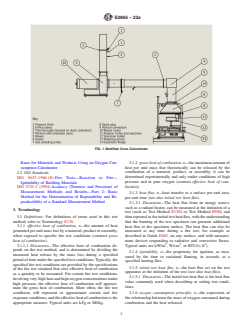
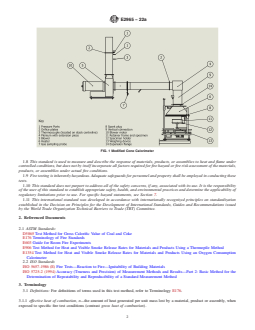
1.2 This test method differs from Test Method E1354 in that it prescribes a different specific test specimen size, specimen holder, test specimen orientation, a direct connection between the plenum and the top plate of the cone heater assembly to ensure complete collection of all the combustion gases (Fig. 1), and a lower volumetric flow rate for analyses via oxygen consumption calorimetry. It is intended for use on materials and products that contain only small amounts of combustible ingredients or components, such as test specimens that yield a peak heat release of 2 and total heat release of 2.
Note 1: PMMA is typically used to check the general operation of a Cone Calorimeter. PMMA should not be used with this standard as the heat release rate is too high.
1.3 The rate of heat release is determined by measurement of the oxygen consumption as determined by the oxygen concentration and the flow rate in the exhaust product stream. The effective heat of combustion is determined from a concomitant measurement of test specimen mass loss rate, in combination with the heat release rate. Smoke development (an optional measurement) is measured by obscuration of light by the combustion product stream.
1.4 Test specimens shall be exposed to initial test heat fluxes generated by a conical radiant heater. External ignition, when used, shall be by electric spark. The test specimen testing orientation is horizontal, independent of whether the end-use application involves a horizontal or a vertical orientation.
1.5 Ignitability is determined as a measurement of time from initial exposure to time of sustained flaming.
1.6 This test method has been developed for use for material and product evaluations, mathematical modeling, design purposes, and development and research. Examples of material test specimens include portions of an end-use product or the various components used in the end-use product.
1.7 The values stated in SI units are to be regarded as standard. No other units of measurement are included in this standard.
1.8 This standard is used to measure and describe the response of materials, products, or assemblies to heat and flame under controlled conditions, but does not by itself incorporate all factors required for fire hazard or fire risk assessment of the materials, products, or assemblies under actual fire conditions.
1.9 Fire testing is inherently hazardous. Adequate safeguards for personnel and property shall be employed in conducting these tests.
1.10 This standard does not purport to address all of the safety concerns, if any, associated with its use. It is the responsibility of the user of this standard to establish appropriate safety, health, and environmental practices and determine the applic...
- Status
- Published
- Publication Date
- 31-Oct-2022
- Technical Committee
- E05 - Fire Standards
- Drafting Committee
- E05.23 - Combustibility
Buy Documents
ASTM E2965-22a - Standard Test Method for Determination of Low Levels of Heat Release Rate for Materials and Products Using an Oxygen Consumption Calorimeter
REDLINE ASTM E2965-22a - Standard Test Method for Determination of Low Levels of Heat Release Rate for Materials and Products Using an Oxygen Consumption Calorimeter
Overview
ASTM E2965-22a: Standard Test Method for Determination of Low Levels of Heat Release Rate for Materials and Products Using an Oxygen Consumption Calorimeter is an internationally recognized fire testing standard published by ASTM International. This test method outlines procedures for measuring the heat response of materials and products that emit low levels of heat when exposed to controlled radiant heating, using oxygen consumption calorimetry. It is specifically designed for materials with a total heat release rate of less than 10 MJ in the first 20 minutes of exposure and where peak heat release rates do not exceed 200 kW/m² for more than 10 seconds.
ASTM E2965-22a is intended for testing small-sized specimens that are representative of end-use products, providing essential data for fire hazard evaluation, mathematical modeling, design, and research. The standard is highly valuable for industry professionals concerned with fire safety, product development, and compliance with fire performance requirements.
Key Topics
- Measurement Principle: Utilizes the oxygen consumption principle to determine the rate of heat release, calculating the effective heat of combustion based on oxygen depletion and flow rate in combustion exhaust gases.
- Test Parameters: Focuses on low-heat-release materials, using a horizontal specimen orientation regardless of intended end-use, and requires an initial radiant heat flux applied via a conical heater.
- Material Suitability: Applicable only to products with planar or nearly planar surfaces and that contain minimal combustible ingredients. Prior testing (such as ASTM E1354) is necessary to confirm suitability and safety.
- Observations and Measurements:
- Time to sustained flaming to assess ignitability.
- Heat release rate and total heat released.
- Mass loss rate during combustion.
- (Optional) Smoke production, determined through light obscuration by combustion products.
Applications
- Fire Safety Evaluation: Commonly used to assess the fire properties of building materials, transportation components, and consumer products with low combustibility.
- Product Development: Supports design and research by quantifying heat evolution, helping manufacturers innovate safer materials.
- Regulatory Compliance: Enables compliance with international fire performance standards for products in industries such as construction, automotive, and aerospace.
- Modeling and Fire Risk Analysis: Provides essential input for mathematical models used in the prediction of fire growth and risk assessment.
- Comparative Testing: Allows side-by-side evaluation of materials or system components to guide product selection, safety certification, and performance optimization.
Related Standards
For comprehensive fire testing and assessment, consider these related standards:
- ASTM E1354: Standard Test Method for Heat and Visible Smoke Release Rates for Materials and Products Using an Oxygen Consumption Calorimeter (Cone Calorimeter Method). E2965-22a should only be applied to materials that meet specific heat release limits under E1354.
- ASTM E176: Standard Terminology of Fire Standards - provides definitions of technical terms used in ASTM fire test standards.
- ASTM E603: Guide for Room Fire Experiments - relevant for understanding heat flux and fire exposure conditions.
- ASTM D5865: Gross Calorific Value of Coal and Coke - referenced for combustion heat calculations.
- ISO 5657: Reaction to Fire Tests - Ignitability of Building Materials.
- ISO 5725-2: Addresses repeatability and reproducibility of test results.
Keywords: ASTM E2965-22a, heat release rate, oxygen consumption calorimeter, fire testing, low combustibility materials, effective heat of combustion, ignitability testing, building materials fire safety, combustion measurement standard, smoke production, fire standards compliance.
Relations
- Effective Date
- 01-Jan-2024
- Effective Date
- 15-Dec-2018
- Effective Date
- 01-Mar-2018
- Effective Date
- 01-May-2016
- Effective Date
- 01-Feb-2016
- Effective Date
- 01-Aug-2015
- Effective Date
- 01-Aug-2015
- Effective Date
- 01-Aug-2015
- Effective Date
- 15-May-2015
- Effective Date
- 01-Feb-2015
- Effective Date
- 01-Oct-2014
- Effective Date
- 15-Aug-2014
- Effective Date
- 01-Aug-2014
- Effective Date
- 01-Jul-2014
- Effective Date
- 01-May-2014
Buy Documents
ASTM E2965-22a - Standard Test Method for Determination of Low Levels of Heat Release Rate for Materials and Products Using an Oxygen Consumption Calorimeter
REDLINE ASTM E2965-22a - Standard Test Method for Determination of Low Levels of Heat Release Rate for Materials and Products Using an Oxygen Consumption Calorimeter
Get Certified
Connect with accredited certification bodies for this standard

CIS Institut d.o.o.
Personal Protective Equipment (PPE) certification body. Notified Body NB-2890 for EU Regulation 2016/425 PPE.

Kiwa BDA Testing
Building and construction product certification.
Kmetijski inštitut Slovenije
Agricultural Institute of Slovenia. Soil testing, plant health, agricultural product analysis.
Sponsored listings
Frequently Asked Questions
ASTM E2965-22a is a standard published by ASTM International. Its full title is "Standard Test Method for Determination of Low Levels of Heat Release Rate for Materials and Products Using an Oxygen Consumption Calorimeter". This standard covers: SIGNIFICANCE AND USE 5.1 This test method is used primarily to determine the heat evolved in, or contributed to, a fire involving materials or products that emit low levels of heat release. The recommended use for this test method is for materials with a total heat release rate measured of less than 10 MJ over the first 20 min test period, and which do not give peak heat release rates of more than 200 kW/m2 for periods extending more than 10 s. Also included is a determination of the effective heat of combustion, mass loss rate, the time to sustained flaming, and (optionally) smoke production. These properties are determined on small size test specimens that are representative of those in the intended end use. 5.2 This test method is applicable to various categories of products and is not limited to representing a single fire scenario. 5.3 This test method is not applicable to end-use products that do not have planar, or nearly planar, external surfaces. SCOPE 1.1 This fire-test-response standard provides a procedure for measuring the response of materials that emit low levels of heat release when exposed to controlled levels of radiant heating with or without an external igniter. 1.2 This test method differs from Test Method E1354 in that it prescribes a different specific test specimen size, specimen holder, test specimen orientation, a direct connection between the plenum and the top plate of the cone heater assembly to ensure complete collection of all the combustion gases (Fig. 1), and a lower volumetric flow rate for analyses via oxygen consumption calorimetry. It is intended for use on materials and products that contain only small amounts of combustible ingredients or components, such as test specimens that yield a peak heat release of 2 and total heat release of 2. Note 1: PMMA is typically used to check the general operation of a Cone Calorimeter. PMMA should not be used with this standard as the heat release rate is too high. 1.3 The rate of heat release is determined by measurement of the oxygen consumption as determined by the oxygen concentration and the flow rate in the exhaust product stream. The effective heat of combustion is determined from a concomitant measurement of test specimen mass loss rate, in combination with the heat release rate. Smoke development (an optional measurement) is measured by obscuration of light by the combustion product stream. 1.4 Test specimens shall be exposed to initial test heat fluxes generated by a conical radiant heater. External ignition, when used, shall be by electric spark. The test specimen testing orientation is horizontal, independent of whether the end-use application involves a horizontal or a vertical orientation. 1.5 Ignitability is determined as a measurement of time from initial exposure to time of sustained flaming. 1.6 This test method has been developed for use for material and product evaluations, mathematical modeling, design purposes, and development and research. Examples of material test specimens include portions of an end-use product or the various components used in the end-use product. 1.7 The values stated in SI units are to be regarded as standard. No other units of measurement are included in this standard. 1.8 This standard is used to measure and describe the response of materials, products, or assemblies to heat and flame under controlled conditions, but does not by itself incorporate all factors required for fire hazard or fire risk assessment of the materials, products, or assemblies under actual fire conditions. 1.9 Fire testing is inherently hazardous. Adequate safeguards for personnel and property shall be employed in conducting these tests. 1.10 This standard does not purport to address all of the safety concerns, if any, associated with its use. It is the responsibility of the user of this standard to establish appropriate safety, health, and environmental practices and determine the applic...
SIGNIFICANCE AND USE 5.1 This test method is used primarily to determine the heat evolved in, or contributed to, a fire involving materials or products that emit low levels of heat release. The recommended use for this test method is for materials with a total heat release rate measured of less than 10 MJ over the first 20 min test period, and which do not give peak heat release rates of more than 200 kW/m2 for periods extending more than 10 s. Also included is a determination of the effective heat of combustion, mass loss rate, the time to sustained flaming, and (optionally) smoke production. These properties are determined on small size test specimens that are representative of those in the intended end use. 5.2 This test method is applicable to various categories of products and is not limited to representing a single fire scenario. 5.3 This test method is not applicable to end-use products that do not have planar, or nearly planar, external surfaces. SCOPE 1.1 This fire-test-response standard provides a procedure for measuring the response of materials that emit low levels of heat release when exposed to controlled levels of radiant heating with or without an external igniter. 1.2 This test method differs from Test Method E1354 in that it prescribes a different specific test specimen size, specimen holder, test specimen orientation, a direct connection between the plenum and the top plate of the cone heater assembly to ensure complete collection of all the combustion gases (Fig. 1), and a lower volumetric flow rate for analyses via oxygen consumption calorimetry. It is intended for use on materials and products that contain only small amounts of combustible ingredients or components, such as test specimens that yield a peak heat release of 2 and total heat release of 2. Note 1: PMMA is typically used to check the general operation of a Cone Calorimeter. PMMA should not be used with this standard as the heat release rate is too high. 1.3 The rate of heat release is determined by measurement of the oxygen consumption as determined by the oxygen concentration and the flow rate in the exhaust product stream. The effective heat of combustion is determined from a concomitant measurement of test specimen mass loss rate, in combination with the heat release rate. Smoke development (an optional measurement) is measured by obscuration of light by the combustion product stream. 1.4 Test specimens shall be exposed to initial test heat fluxes generated by a conical radiant heater. External ignition, when used, shall be by electric spark. The test specimen testing orientation is horizontal, independent of whether the end-use application involves a horizontal or a vertical orientation. 1.5 Ignitability is determined as a measurement of time from initial exposure to time of sustained flaming. 1.6 This test method has been developed for use for material and product evaluations, mathematical modeling, design purposes, and development and research. Examples of material test specimens include portions of an end-use product or the various components used in the end-use product. 1.7 The values stated in SI units are to be regarded as standard. No other units of measurement are included in this standard. 1.8 This standard is used to measure and describe the response of materials, products, or assemblies to heat and flame under controlled conditions, but does not by itself incorporate all factors required for fire hazard or fire risk assessment of the materials, products, or assemblies under actual fire conditions. 1.9 Fire testing is inherently hazardous. Adequate safeguards for personnel and property shall be employed in conducting these tests. 1.10 This standard does not purport to address all of the safety concerns, if any, associated with its use. It is the responsibility of the user of this standard to establish appropriate safety, health, and environmental practices and determine the applic...
ASTM E2965-22a is classified under the following ICS (International Classification for Standards) categories: 13.220.40 - Ignitability and burning behaviour of materials and products. The ICS classification helps identify the subject area and facilitates finding related standards.
ASTM E2965-22a has the following relationships with other standards: It is inter standard links to ASTM E176-24, ASTM E176-18a, ASTM E176-18, ASTM E1354-16a, ASTM E1354-16, ASTM E176-15ae1, ASTM E1354-15a, ASTM E176-15a, ASTM E1354-15, ASTM E176-15, ASTM E176-14c, ASTM E176-14b, ASTM E176-14a, ASTM E176-14, ASTM E1354-14e1. Understanding these relationships helps ensure you are using the most current and applicable version of the standard.
ASTM E2965-22a is available in PDF format for immediate download after purchase. The document can be added to your cart and obtained through the secure checkout process. Digital delivery ensures instant access to the complete standard document.
Standards Content (Sample)
This international standard was developed in accordance with internationally recognized principles on standardization established in the Decision on Principles for the
Development of International Standards, Guides and Recommendations issued by the World Trade Organization Technical Barriers to Trade (TBT) Committee.
Designation:E2965 −22a An American National Standard
Standard Test Method for
Determination of Low Levels of Heat Release Rate for
Materials and Products Using an Oxygen Consumption
Calorimeter
This standard is issued under the fixed designation E2965; the number immediately following the designation indicates the year of
original adoption or, in the case of revision, the year of last revision.Anumber in parentheses indicates the year of last reapproval.A
superscript epsilon (´) indicates an editorial change since the last revision or reapproval.
1. Scope* 1.6 Thistestmethodhasbeendevelopedforuseformaterial
and product evaluations, mathematical modeling, design
1.1 Thisfire-test-responsestandardprovidesaprocedurefor
purposes,anddevelopmentandresearch.Examplesofmaterial
measuringtheresponseofmaterialsthatemitlowlevelsofheat
test specimens include portions of an end-use product or the
release when exposed to controlled levels of radiant heating
various components used in the end-use product.
with or without an external igniter.
1.7 The values stated in SI units are to be regarded as
1.2 ThistestmethoddiffersfromTestMethodE1354inthat
standard. No other units of measurement are included in this
it prescribes a different specific test specimen size, specimen
standard.
holder, test specimen orientation, a direct connection between
the plenum and the top plate of the cone heater assembly to
1.8 This standard is used to measure and describe the
ensurecompletecollectionofallthecombustiongases(Fig.1),
response of materials, products, or assemblies to heat and
and a lower volumetric flow rate for analyses via oxygen
flame under controlled conditions, but does not by itself
consumption calorimetry. It is intended for use on materials
incorporate all factors required for fire hazard or fire risk
and products that contain only small amounts of combustible
assessment of the materials, products, or assemblies under
ingredients or components, such as test specimens that yield a
actual fire conditions.
peak heat release of <200kW⁄m and total heat release of
1.9 Fire testing is inherently hazardous. Adequate safe-
<15MJ⁄m .
guards for personnel and property shall be employed in
conducting these tests.
NOTE 1—PMMA is typically used to check the general operation of a
Cone Calorimeter. PMMA should not be used with this standard as the
1.10 This standard does not purport to address all of the
heat release rate is too high.
safety concerns, if any, associated with its use. It is the
1.3 The rate of heat release is determined by measurement responsibility of the user of this standard to establish appro-
of the oxygen consumption as determined by the oxygen priate safety, health, and environmental practices and deter-
concentration and the flow rate in the exhaust product stream. mine the applicability of regulatory limitations prior to use.
The effective heat of combustion is determined from a con- For specific hazard statements, see Section 7.
comitant measurement of test specimen mass loss rate, in
1.11 This international standard was developed in accor-
combinationwiththeheatreleaserate.Smokedevelopment(an
dance with internationally recognized principles on standard-
optional measurement) is measured by obscuration of light by
ization established in the Decision on Principles for the
the combustion product stream.
Development of International Standards, Guides and Recom-
mendations issued by the World Trade Organization Technical
1.4 Testspecimensshallbeexposedtoinitialtestheatfluxes
Barriers to Trade (TBT) Committee.
generated by a conical radiant heater. External ignition, when
used, shall be by electric spark. The test specimen testing
2. Referenced Documents
orientation is horizontal, independent of whether the end-use
application involves a horizontal or a vertical orientation.
2.1 ASTM Standards:
D5865Test Method for Gross Calorific Value of Coal and
1.5 Ignitability is determined as a measurement of time
Coke
from initial exposure to time of sustained flaming.
E176Terminology of Fire Standards
E603Guide for Room Fire Experiments
This test method is under the jurisdiction of ASTM Committee E05 on Fire
Standards and is the direct responsibility of Subcommittee E05.23 on Combustibil-
E906Test Method for Heat and Visible Smoke Release
ity.
Rates for Materials and Products Using a Thermopile
Current edition approved Nov. 1, 2022. Published November 2022. Originally
Method
approved in 2015. Last previous edition approved in 2022 as E2965-22. DOI:
10.1520/E2965-22A. E1354Test Method for Heat and Visible Smoke Release
*A Summary of Changes section appears at the end of this standard
Copyright © ASTM International, 100 Barr Harbor Drive, PO Box C700, West Conshohocken, PA 19428-2959. United States
E2965−22a
FIG. 1Modified Cone Calorimeter
Rates for Materials and Products Using an Oxygen Con- 3.1.2 gross heat of combustion, n—themaximumamountof
sumption Calorimeter heat per unit mass that theoretically can be released by the
combustion of a material, product, or assembly; it can be
2.2 ISO Standards
determined experimentally and only under conditions of high
ISO 5657-1986 (E) Fire Tests—Reaction to Fire—
pressure and in pure oxygen (contrast effective heat of com-
Ignitability of Building Materials
bustion).
ISO 5725-2 (1994)Accuracy (Trueness and Precision) of
Measurement Methods and Results—Part 2: Basic
3.1.3 heat flux, n—heat transfer to a surface per unit area,
Method for the Determination of Repeatability and Re-
per unit time (see also initial test heat flux).
producibility of a Standard Measurement Method
3.1.3.1 Discussion—The heat flux from an energy source,
such as a radiant heater, can be measured at the initiation of a
3. Terminology
test (such as Test Method E1354 or Test Method E906) and
3.1 Definitions: For definitions of terms used in this test thenreportedastheinitialtestheatflux,withtheunderstanding
method, refer to Terminology E176. that the burning of the test specimen can generate additional
3.1.1 effective heat of combustion, n—the amount of heat
heat flux to the specimen surface. The heat flux can also be
generatedperunitmasslostbyamaterial,productorassembly, measured at any time during a fire test, for example as
when exposed to specific fire test conditions (contrast gross
described in Guide E603, on any surface, and with measure-
heat of combustion). ment devices responding to radiative and convective fluxes.
2 2 2
3.1.1.1 Discussion—The effective heat of combustion de-
Typical units are kW/m , W/cm , or BTU/(s ft ).
pends on the test method, and is determined by dividing the
3.1.4 ignitability, n—the propensity for ignition, as mea-
measured heat release by the mass loss during a specified
sured by the time to sustained flaming, in seconds, at a
periodoftimeunderthespecifiedtestconditions.Typically,the
specified heating flux.
specified fire test conditions are provided by the specifications
3.1.5 initial test heat flux, n—the heat flux set on the test
of the fire test standard that cites effective heat of combustion
apparatus at the initiation of the test (see also heat flux).
as a quantity to be measured. For certain fire test conditions,
3.1.5.1 Discussion—The initial test heat flux is the heat flux
involvingveryhighheatandhighoxygenconcentrationsunder
value commonly used when describing or setting test condi-
high pressure, the effective heat of combustion will approxi-
tions.
mate the gross heat of combustion. More often, the fire test
conditions will represent or approximate certain real fire 3.1.6 oxygen consumption principle, n—the expression of
exposureconditions,andtheeffectiveheatofcombustionisthe the relationship between the mass of oxygen consumed during
appropriate measure. Typical units are kJ/g or MJ/kg. combustion and the heat released.
E2965−22a
3.1.7 smoke obscuration, n—reduction of light transmission
V = volume exhaust flow rate, measured at the location
by smoke, as measured by light attenuation.
of the laser photometer, m /s.
X = oxygen analyzer reading, mole fraction O (–).
3.2 Definitions of Terms Specific to This Standard: O 2
X = initial value of oxygen analyzer reading (–).
O
3.2.1 heat release rate, n—the heat evolved from the 2
X = oxygen analyzer reading, before delay time correc-
O
specimen, per unit of time.
tion (–).
3.2.2 net heat of combustion, n—the oxygen bomb (seeTest
σ = specific extinction area, for smoke, m /kg.
f
MethodD5865)valuefortheheatofcombustion,correctedfor
σ = repeatability standard deviation (same units as r).
r
gaseous state of product water.
σ = reproducibility standard deviation (same units as
R
3.2.2.1 Discussion—The net heat of combustion differs
R).
from the gross heat of combustion, in that the former assesses
the heat per unit mass generated from a combustion process
4. Summary of Test Method
that ends with water in the gaseous state, while the latter ends
4.1 This test method is based on the observation that,
with water in the liquid state.
generally, the net heat of combustion is directly related to the
3.2.3 orientation, n—the plane in which the exposed face of
amount of oxygen required for combustion. The relationship,
the specimen is located during testing, either vertical or
known as the oxygen consumption principle, is that approxi-
horizontal facing up. 3
mately 13.1 × 10 kJ of heat are released per 1 kg of oxygen
3.2.4 sustained flaming, n—existence of flame on or over
consumed.Test specimens in the test are burned in ambient air
most of the specimen surface for periods of at least 4 s.
conditions,whilebeingsubjectedtoapredeterminedinitialtest
3.2.4.1 Discussion—Flaming of less than 4 s duration is
heat flux. In the test, the test specimens are exposed to a
identified as flashing or transitory flaming.
pre-determined initial test heat flux, either with or without the
added use of a spark igniter. The primary measurements are
3.3 Symbols:
oxygen concentrations and exhaust gas flow rate, which are
A = nominaltestspecimenexposedsurfacearea,0.0225 used to determine heat release rate and total heat released.
s
m .
Additional measurements include the mass-loss rate of the test
C = calibration constant for oxygen consumption
specimen,thetimetosustainedflamingand(optionally)smoke
1/2 1/2 1/2
analysis, m –kg –K .
obscuration, or as required in the relevant material or perfor-
∆h = net heat of combustion, kJ/kg.
mance standard.
c
∆h = effective heat of combustion, kJ/kg.
c,eff
4.2 Prior to testing any material using this test method,
I = actual beam intensity.
assurance shall be given to the test laboratory that the material
I = beam intensity with no smoke.
o
-1
to be tested will not generate excessive heat when tested, for
k = smoke extinction coefficient, m .
example by complying with 4.2.1 or with 4.2.2.
L = extinction beam path length, m.
m = test specimen mass, kg.
4.2.1 The material shall be tested to Test Method E1354 at
m = final test specimen mass, kg.
the same initial test heat flux and yield a peak heat release rate
f
2 2
m = initial test specimen mass, kg.
i
of <200 kW/m and a total heat release of <15 MJ/m,as
m = test specimen mass loss rate, kg/s.
required in 11.1.
∆P = orifice meter pressure differential, Pa.
4.2.2 InlieuofconductingthetestwithTestMethodE1354,
Q'' = total heat released, kJ/m (Note that kJ ≡ kW·s).
tot
thetestrequestorispermittedtoprovidealternateevidencethat
q˙ = heat release rate, kW.
2 thematerialtobetestedwillmeettheheatreleaserequirements
q˙'' = heat release rate per unit area, kW/m .
'' of 4.2, as required in 11.2.
q˙ = maximum heat release rate per unit area (kW/m ).
max
''
q˙ = average heat release rate, per unit area, over the
5. Significance and Use
time period starting at t and ending 180 s later
ig
(kW/m ).
5.1 This test method is used primarily to determine the heat
r = repeatability (the units are the same as for the
evolved in, or contributed to, a fire involving materials or
variable being characterized).
products that emit low levels of heat release. The recom-
R = reproducibility (the units are the same as for the
mended use for this test method is for materials with a total
variable being characterized).
heat release rate measured of less than 10 MJ over the first
r = stoichiometric oxygen/fuel mass ratio (–).
O
20min test period, and which do not give peak heat release
s = sample-based standard deviation estimate for re-
r 2
ratesofmorethan200kW⁄m forperiodsextendingmorethan
peatability (same units as r).
10s. Also included is a determination of the effective heat of
s = sample-basedstandarddeviationestimateforrepro-
R
combustion, mass loss rate, the time to sustained flaming, and
ducibility (same units as R).
(optionally) smoke production. These properties are deter-
t = time, s.
mined on small size test specimens that are representative of
t = oxygen analyzer delay time, s.
d
those in the intended end use.
t = time to sustained flaming (s).
ig
ρ = density (kg/m ).
5.2 This test method is applicable to various categories of
∆t = sampling time interval, s.
products and is not limited to representing a single fire
T = absolute temperature of gas at the orifice meter, K.
e
scenario.
E2965−22a
5.3 This test method is not applicable to end-use products uniform within the central 100 mm by 100mm area of the
that do not have planar, or nearly planar, external surfaces. exposed test specimen surface, to within 62 % and within
63% over the entire surface of the specimen.The heater shall
6. Apparatus
consistofelectricalheaterrods,tightlywoundintotheshapeof
a truncated cone. The heater shall be encased on the outside
6.1 General:
with a double-wall stainless steel cone, packed with a refrac-
6.1.1 The test apparatus shall be as described in Test
tory fiber material of approximately 100kg⁄m density.
MethodE1354withthechangesdescribedbelow.Fig.1shows
an overview of the apparatus.
6.3 Test Specimen Mounting:
6.1.2 All dimensions given in the figures that are followed
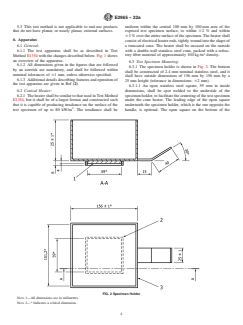
6.3.1 The specimen holder is shown in Fig. 2. The bottom
by an asterisk are mandatory, and shall be followed within
shall be constructed of 2.4 mm nominal stainless steel, and it
nominal tolerances of 61 mm, unless otherwise specified.
shall have outside dimensions of 156 mm by 156 mm by a
6.1.3 Additionaldetailsdescribingfeaturesandoperationof
25mm height (tolerance in dimensions: 62 mm).
the test apparatus are given in Ref (2).
6.3.1.1 An open stainless steel square, 59 mm in inside
6.2 Conical Heater: dimensions, shall be spot welded to the underside of the
6.2.1 TheheatershallbesimilartothatusedinTestMethod specimenholder,tofacilitatethecenteringofthetestspecimen
E1354, but it shall be of a larger format and constructed such under the cone heater. The leading edge of the open square
that it is capable of producing irradiance on the surface of the underneath the specimen holder, which is the one opposite the
test specimen of up to 80 kW/m . The irradiance shall be handle, is optional. The open square on the bottom of the
FIG. 2Specimen Holder
NOTE 1—All dimensions are in milimetres.
NOTE 2—* Indicates a critical dimension.
E2965−22a
burning of test specimens.
specimen holder shall be designed to seat with the sample
mount assembly located at the top of the load cell, ensuring
6.3.3.2 Use a wire grid.
that the specimen holder is centered with respect to the cone
NOTE 3—The wire grid is used for retaining test specimens prone to
heater.
delamination, and is suitable for several types of intumescent test
6.3.2 The bottom of the specimen holder shall be lined with
specimens.
a layer of low density (nominal density 65 kg/m ) refractory
6.3.3.3 Use a special mounting procedure suitable for the
fiber blanket with a thickness of at least 13 mm. The distance
test specimen to be tested.
between the bottom surface of the cone heater and the top of
6.3.4 Unstable materials that warp so that the exposed
the test specimen shall be adjusted to be 25 mm.
surface of the test specimen is not flat during testing shall be
6.3.2.1 If a test has been conducted and there was physical
restrained to maintain the surface in a flat orientation. This
contact of the test specimen with the spark igniter or the cone
shall be accomplished with four tie wires, as described in
baseplate, that test shall be deemed invalid.
6.3.4.1 – 6.3.4.4.
6.3.3 Intumescent Materials—The testing technique to be
6.3.4.1 The four tie wires shall be metal wires, 1.0mm 6
used when testing intumescing test specimens shall be docu-
0.1mm in diameter and at least 350 mm long.
mented in the test report. Options include those described in
6.3.4.2 The test specimen shall be prepared as described in
6.3.3.1 – 6.3.3.3.
Section 8 and then tied with the metal wires.
6.3.3.1 Use a retainer frame or edge frame (Fig. 3).
6.3.4.3 A tie wire shall be looped around the specimen
NOTE 2—The edge frame is used to reduce unrepresentative edge
holder assembly so that it is parallel to and 20mm 62mm
FIG. 3Retainer Frame
NOTE 1—All dimensions are in milimetres.
E2965−22a
away from any of the four sides of the assembly. The ends of 7.3 The use of PMMAto check the general operation of the
thetiewireshallbetwistedtogethersuchthatthewireispulled equipment, such as is done for the cone calorimeter (Test
firmly against the specimen holder assembly.Trim excess wire Method E1354) is not suitable for this test method. Do not test
from the twisted section before testing. PMMA with this test method as the heat release rate of this
material is too high for adequate safety.
6.3.4.4 Fit the other three tie wires around the specimen
holder assembly in a similar manner, so that each one is
parallel to one of the sides of the assembly.
8. Test Specimens
6.4 Gas Sampling—The gas sampling system shall incorpo-
8.1 Size and Preparation:
rate a pump, a filter to prevent entry of soot, a cold trap to
8.1.1 Test specimens shall be 150mm by 150 mm in area,
remove most of the moisture, a bypass system set to divert all
up to 50 mm thick, and cut to be representative of the
flow except that required for the oxygen analyzer, a further
construction of the end-use product. For products of normal
moisturetrap,andatrapforcarbondioxide(CO )removal;the
2 thicknessgreaterthan50mm,therequisitetestspecimensshall
latter shall be used only if CO is not measured. When a CO
2 2 be obtained by cutting away the unexposed face to reduce the
trap is used, the sample stream entering the oxygen analyzer
thickness to 50mm. For testing, wrap test specimens in a
must be fully dry; some designs of CO traps require an
2 single layer of aluminum foil, shiny side toward the test
additional moisture trap downstream of the CO trap.
2 specimen, covering the sides and bottom. Foil thickness shall
be 0.025mm to 0.04mm.
NOTE 4—If an optional CO analyzer is used instead of removing CO
2 2
from the oxygen analyzer stream, the equations to calculate the rate of 8.1.2 Some materials, including composites, intumescing
heat release will be different from those for the standard case (Section 13)
materials, other dimensionally unstable materials, materials
and are, instead, given in Annex A1.
that warp during testing, and materials that melt and overflow
6.5 Oxygen Analyzer—The analyzer shall be of the para-
thealuminumfoil(8.1.1)duringtesting,requirespecialmount-
magnetic type with a range from 0 to 25 % oxygen. The ing and retaining techniques to retain them adequately within
analyzer shall exhibit a linear response and drift of not more
the specimen holder during combustion. Section 6.3 includes
than 630ppmofoxygenoveraperiodof30min,andnoiseof descriptions of some of the key techniques. The exact mount-
not more than 30ppm of oxygen (root-mean-square value)
ing and retaining method used shall be specified in the test
during this same 30 min period. Since oxygen analyzers are report. Additional specialized guidance to the operator is
sensitive to stream pressures, the stream pressure shall be
provided in Ref (2).
regulated (upstream of the analyzer) to allow for flow
8.1.3 Assembliesshallbetestedasspecifiedin8.1.2or8.1.3
fluctuations, and the readings from the analyzer compensated
as appropriate. Moreover, where thin materials or composites
with an absolute pressure regulator to allow for atmospheric
are used in the fabrication of an assembly, the presence of an
pressure variations. The analyzer and the absolute pressure
air gap or the nature of any underlying construction often
regulator shall be located in a constant-temperature environ-
significantly affects the ignition and burning characteristics of
ment. The oxygen analyzer shall have a 10 to 90 % response
the exposed surface. The influence of the underlying layers
time of less than 12 s.
must be understood and care taken to ensure that the test result
obtained on any assembly is relevant to its use in practice.
6.6 Exhaust Gas System—The exhaust gas system shall
When the product is a material or a composite that is normally
consist of a centrifugal exhaust fan rated for the operating
attached to a well-defined substrate, the product shall be tested
temperatures, intake and exhaust ducts for the fan, and an
in conjunction with that substrate, using the recommended
orifice plate flow meter (see Fig. 1). The exhaust system shall
fixing technique, for example, bonded with the appropriate
be capable of developing flows up to 0.018 m /s, under
adhesive or mechanically fixed.
standard conditions of temperature and pressure.
8.1.4 Products that are thinner than 6 mm shall be tested
with a substrate representative of end use conditions, such that
7. Hazards
the total test specimen thickness is 6 mm or more. In the case
7.1 The test procedure involves high temperatures and
of test specimens of less than 6 mm in thickness and that are
combustion processes. Therefore, hazards exist for burns,
used with an air space adjacent to the unexposed face, the test
ignition of extraneous objects or clothing, and for inhalation of
specimens shall be mounted so that there is an air space of at
combustion products. The operator shall use protective gloves
least 12 mm between its unexposed face and the refractory
for insertion and removal of test specimens. Neither the cone
fiber blanket. This is achieved by the use of a metal spacer
heater nor the associated fixtures shall be touched while hot
frame.
except with the use of protective gloves. The possibility of the
8.2 Conditioning—Test specimens shall be conditioned to
violentejectionofmoltenhotmaterialorsharpfragmentsfrom
moisture equilibrium (constant weight) at an ambient tempera-
some kinds of test specimens when irradiated cannot totally be
ture of 23°C 6 3°C and a relative humidity of 50% 65%.
discounted, and eye protection shall be worn.
7.2 The exhaust system shall be checked for proper opera-
9. Test Environment
tion before testing and must discharge into a building exhaust
system with adequate capacity. Provision shall be made for 9.1 The apparatus shall be located in a draft-free environ-
collecting and venting any combustion products that are not ment in an atmosphere of relative humidity of between 20%
collected by the normal exhaust system of the apparatus. and 80 % and a temperature between 15 °C and 30 °C.
E2965−22a
10. Calibration of Apparatus The electronic mass-flow controller used shall be calibrated
periodicallyagainstadrytestmeterorawettestmeter.Thetest
10.1 Heater Flux Calibration—Set the temperature control-
meter shall be equipped with devices to measure the tempera-
ler to give the desired initial test heat flux by using the heat
ture and pressure of the flowing gas, so that appropriate
fluxmeter at the start of the test day, or after changing to a new
corrections to the reading may be made. If a wet test meter is
flux level. Do not use a specimen holder when the heat
used, the readings shall also be corrected for the moisture
fluxmeter is inserted into the calibration position. Operate the
content.Theexhaustfanshallbesettothespeedtobeusedfor
cone heater for at least 10 min and ensure that the controller is
subsequent testing. The required calculations are given in
within its proportional band before beginning this calibration.
Section 14.
10.1.1 Calibrate the heat flux by placing the heat fluxmeter
at a distance of 25 mm from the base plate of the cone heater NOTE 5—Calibration shall be permitted to be performed with the cone
heater operating or not, but calibration shall not be performed during
as the upper surface of the test specimen will be placed during
heater warm up.
testing.
10.4 Load Cell Calibration—The load cell shall be cali-
10.1.2 Note that times to sustained flaming measured with
brated with standard weights in the range of test specimen
different distances between the base plate of the cone heater
weight each day of testing, or when the load cell mechanical
and the upper surface of the test specimen are likely to be
zero needs to be adjusted.Adjust the load cell mechanical zero
different.
if necessary due to different specimen holder tare weights after
10.2 Oxygen Analyzer Calibration:
changing orientation.
10.2.1 Preliminary Calibrations:
10.5 Smoke Meter Calibration—The smoke meter (if used)
10.2.1.1 The oxygen analyzer delay time must be deter-
shall be initially calibrated to read correctly for two different
mined. This is done by arranging for a methane flow rate
value neutral density filters, and also at 100 % transmission.
equivalent to 1kW to the calibration burner. The heater shall
Once this calibration is set, only the zero value of extinction
not be turned on for this calibration. Record the output of the
coefficient (100% transmission) normally needs to be verified
analyzer as the methane supply, turned on and ignited, reaches
prior to each test.
a steady value, and then returns to baseline after the supply is
cut off. Record the temperature for the exhaust-orifice meter at
11. Assessment of Suitability of Material for Testing to
the same time. Determine the turn-on delay as the time
Test Method E2965
difference between the time when the temperature reading
11.1 Testing in Accordance with Test Method E1354—
reaches 50 % of its ultimate deflection and the time when the
Before testing any material in accordance with this test
oxygen reading reaches 50 % of its ultimate deflection.
method, test the material in accordance with Test Method
Determine the turn-off delay similarly at turn-off. Take the
E1354.
...
This document is not an ASTM standard and is intended only to provide the user of an ASTM standard an indication of what changes have been made to the previous version. Because
it may not be technically possible to adequately depict all changes accurately, ASTM recommends that users consult prior editions as appropriate. In all cases only the current version
of the standard as published by ASTM is to be considered the official document.
Designation: E2965 − 22 E2965 − 22a An American National Standard
Standard Test Method for
Determination of Low Levels of Heat Release Rate for
Materials and Products Using an Oxygen Consumption
Calorimeter
This standard is issued under the fixed designation E2965; the number immediately following the designation indicates the year of
original adoption or, in the case of revision, the year of last revision. A number in parentheses indicates the year of last reapproval. A
superscript epsilon (´) indicates an editorial change since the last revision or reapproval.
1. Scope*
1.1 This fire-test-response standard provides a procedure for measuring the response of materials that emit low levels of heat
release when exposed to controlled levels of radiant heating with or without an external igniter.
1.2 This test method differs from Test Method E1354 in that it prescribes a different specific test specimen size, specimen holder,
test specimen orientation, a direct connection between the plenum and the top plate of the cone heater assembly to ensure complete
collection of all the combustion gases (Fig. 1), and a lower volumetric flow rate for analyses via oxygen consumption calorimetry.
It is intended for use on materials and products that contain only small amounts of combustible ingredients or components, such
2 2
as test specimens that yield a peak heat release of <200 kW ⁄m and total heat release of <15 MJ ⁄m .
NOTE 1—PMMA is typically used to check the general operation of a Cone Calorimeter. PMMA should not be used with this standard as the heat release
rate is too high.
1.3 The rate of heat release is determined by measurement of the oxygen consumption as determined by the oxygen concentration
and the flow rate in the exhaust product stream. The effective heat of combustion is determined from a concomitant measurement
of test specimen mass loss rate, in combination with the heat release rate. Smoke development (an optional measurement) is
measured by obscuration of light by the combustion product stream.
1.4 Test specimens shall be exposed to initial test heat fluxes generated by a conical radiant heater. External ignition, when used,
shall be by electric spark. The test specimen testing orientation is horizontal, independent of whether the end-use application
involves a horizontal or a vertical orientation.
1.5 Ignitability is determined as a measurement of time from initial exposure to time of sustained flaming.
1.6 This test method has been developed for use for material and product evaluations, mathematical modeling, design purposes,
and development and research. Examples of material test specimens include portions of an end-use product or the various
components used in the end-use product.
1.7 The values stated in SI units are to be regarded as standard. No other units of measurement are included in this standard.
This test method is under the jurisdiction of ASTM Committee E05 on Fire Standards and is the direct responsibility of Subcommittee E05.23 on Combustibility.
Current edition approved April 1, 2022Nov. 1, 2022. Published May 2022November 2022. Originally approved in 2015. Last previous edition approved in 20172022 as
E2965-17.-22. DOI: 10.1520/E2965-22.10.1520/E2965-22A.
*A Summary of Changes section appears at the end of this standard
Copyright © ASTM International, 100 Barr Harbor Drive, PO Box C700, West Conshohocken, PA 19428-2959. United States
E2965 − 22a
FIG. 1 Modified Cone Calorimeter
1.8 This standard is used to measure and describe the response of materials, products, or assemblies to heat and flame under
controlled conditions, but does not by itself incorporate all factors required for fire hazard or fire risk assessment of the materials,
products, or assemblies under actual fire conditions.
1.9 Fire testing is inherently hazardous. Adequate safeguards for personnel and property shall be employed in conducting these
tests.
1.10 This standard does not purport to address all of the safety concerns, if any, associated with its use. It is the responsibility
of the user of this standard to establish appropriate safety, health, and environmental practices and determine the applicability of
regulatory limitations prior to use. For specific hazard statements, see Section 7.
1.11 This international standard was developed in accordance with internationally recognized principles on standardization
established in the Decision on Principles for the Development of International Standards, Guides and Recommendations issued
by the World Trade Organization Technical Barriers to Trade (TBT) Committee.
2. Referenced Documents
2.1 ASTM Standards:
D5865 Test Method for Gross Calorific Value of Coal and Coke
E176 Terminology of Fire Standards
E603 Guide for Room Fire Experiments
E906 Test Method for Heat and Visible Smoke Release Rates for Materials and Products Using a Thermopile Method
E1354 Test Method for Heat and Visible Smoke Release Rates for Materials and Products Using an Oxygen Consumption
Calorimeter
2.2 ISO Standards
ISO 5657-1986 (E) Fire Tests—Reaction to Fire—Ignitability of Building Materials
ISO 5725-2 (1994) Accuracy (Trueness and Precision) of Measurement Methods and Results—Part 2: Basic Method for the
Determination of Repeatability and Reproducibility of a Standard Measurement Method
3. Terminology
3.1 Definitions: For definitions of terms used in this test method, refer to Terminology E176.
3.1.1 effective heat of combustion, n—the amount of heat generated per unit mass lost by a material, product or assembly, when
exposed to specific fire test conditions (contrast gross heat of combustion).
E2965 − 22a
3.1.1.1 Discussion—
The effective heat of combustion depends on the test method, and is determined by dividing the measured heat release by the mass
loss during a specified period of time under the specified test conditions. Typically, the specified fire test conditions are provided
by the specifications of the fire test standard that cites effective heat of combustion as a quantity to be measured. For certain fire
test conditions, involving very high heat and high oxygen concentrations under high pressure, the effective heat of combustion will
approximate the gross heat of combustion. More often, the fire test conditions will represent or approximate certain real fire
exposure conditions, and the effective heat of combustion is the appropriate measure. Typical units are kJ/g or MJ/kg.
3.1.2 gross heat of combustion, n—the maximum amount of heat per unit mass that theoretically can be released by the combustion
of a material, product, or assembly; it can be determined experimentally and only under conditions of high pressure and in pure
oxygen (contrast effective heat of combustion).
3.1.3 heat flux, n—heat transfer to a surface per unit area, per unit time (see also initial test heat flux).
3.1.3.1 Discussion—
The heat flux from an energy source, such as a radiant heater, can be measured at the initiation of a test (such as Test Method E1354
or Test Method E906) and then reported as the initial test heat flux, with the understanding that the burning of the test specimen
can generate additional heat flux to the specimen surface. The heat flux can also be measured at any time during a fire test, for
example as described in Guide E603, on any surface, and with measurement devices responding to radiative and convective fluxes.
2 2 2
Typical units are kW/m , W/cm , or BTU/(s ft ).
3.1.4 ignitability, n—the propensity tofor ignition, as measured by the time to sustained flaming, in seconds, at a specified heating
flux.
3.1.5 initial test heat flux, n—the heat flux set on the test apparatus at the initiation of the test (see also heat flux).
3.1.5.1 Discussion—
The initial test heat flux is the heat flux value commonly used when describing or setting test conditions.
3.1.6 oxygen consumption principle, n—the expression of the relationship between the mass of oxygen consumed during
combustion and the heat released.
3.1.7 smoke obscuration, n—reduction of light transmission by smoke, as measured by light attenuation.
3.2 Definitions of Terms Specific to This Standard:
3.2.1 heat release rate, n—the heat evolved from the specimen, per unit of time.
3.2.2 net heat of combustion, n—the oxygen bomb (see Test Method D5865) value for the heat of combustion, corrected for
gaseous state of product water.
3.2.2.1 Discussion—
The net heat of combustion differs from the gross heat of combustion, in that the former assesses the heat per unit mass generated
from a combustion process that ends with water in the gaseous state, while the latter ends with water in the liquid state.
3.2.3 orientation, n—the plane in which the exposed face of the specimen is located during testing, either vertical or horizontal
facing up.
3.2.4 sustained flaming, n—existence of flame on or over most of the specimen surface for periods of at least 4 s.
3.2.4.1 Discussion—
Flaming of less than 4 s duration is identified as flashing or transitory flaming.
3.3 Symbols:
A = nominal test specimen exposed surface area, 0.0225 m .
s
1/2 1/2 1/2
C = calibration constant for oxygen consumption analysis, m – kg – K .
Δh = net heat of combustion, kJ/kg.
c
Δh = effective heat of combustion, kJ/kg.
c,eff
E2965 − 22a
I = actual beam intensity.
I = beam intensity with no smoke.
o
-1
k = smoke extinction coefficient, m .
L = extinction beam path length, m.
m = test specimen mass, kg.
m = final test specimen mass, kg.
f
m = initial test specimen mass, kg.
i
m = test specimen mass loss rate, kg/s.
ΔP = orifice meter pressure differential, Pa.
Q'' = total heat released, kJ/m (Note that kJ ≡ kW·s).
tot
q˙ = heat release rate, kW.
q˙ '' = heat release rate per unit area, kW/m .
''
q˙ = maximum heat release rate per unit area (kW/m ).
max
''
q˙ = average heat release rate, per unit area, over the time period starting at t and ending 180 s later (kW/m ).
180 ig
r = repeatability (the units are the same as for the variable being characterized).
R = reproducibility (the units are the same as for the variable being characterized).
r = stoichiometric oxygen/fuel mass ratio (–).
O
s = sample-based standard deviation estimate for repeatability (same units as r).
r
s = sample-based standard deviation estimate for reproducibility (same units as R).
R
t = time, s.
t = oxygen analyzer delay time, s.
d
t = time to sustained flaming (s).
ig
ρ = density (kg/m ).
Δt = sampling time interval, s.
T = absolute temperature of gas at the orifice meter, K.
e
V = volume exhaust flow rate, measured at the location of the laser photometer, m /s.
X = oxygen analyzer reading, mole fraction O (–).
O 2
X = initial value of oxygen analyzer reading (–).
O
X = oxygen analyzer reading, before delay time correction (–).
O
σ = specific extinction area, for smoke, m /kg.
f
σ = repeatability standard deviation (same units as r).
r
σ = reproducibility standard deviation (same units as R).
R
4. Summary of Test Method
4.1 This test method is based on the observation that, generally, the net heat of combustion is directly related to the amount of
oxygen required for combustion. The relationship, known as the oxygen consumption principle, is that approximately 13.1 × 10
kJ of heat are released per 1 kg of oxygen consumed. Test specimens in the test are burned in ambient air conditions, while being
subjected to a predetermined initial test heat flux. In the test, the test specimens are exposed to a pre-determined initial test heat
flux, either with or without the added use of a spark igniter. The primary measurements are oxygen concentrations and exhaust gas
flow rate, which are used to determine heat release rate and total heat released. Additional measurements include the mass-loss rate
of the test specimen, the time to sustained flaming and (optionally) smoke obscuration, or as required in the relevant material or
performance standard.
4.2 Prior to testing any material using this test method, assurance shall be given to the test laboratory that the material to be tested
will not generate excessive heat when tested, for example by complying with 4.2.1 or with 4.2.2.
4.2.1 The material shall be tested to Test Method E1354 at the same initial test heat flux and yield a peak heat release rate of <200
2 2
kW/m and a total heat release of <15 MJ/m , as required in 11.1.
4.2.2 In lieu of conducting the test with Test Method E1354, the test requestor is permitted to provide alternate evidence that the
material to be tested will meet the heat release requirements of 4.2, as required in 11.2.
5. Significance and Use
5.1 This test method is used primarily to determine the heat evolved in, or contributed to, a fire involving materials or products
that emit low levels of heat release. The recommended use for this test method is for materials with a total heat release rate
measured of less than 10 MJ over the first 20 min test period, and which do not give peak heat release rates of more than
200 kW ⁄m for periods extending more than 10 s. Also included is a determination of the effective heat of combustion, mass loss
E2965 − 22a
rate, the time to sustained flaming, and (optionally) smoke production. These properties are determined on small size test
specimens that are representative of those in the intended end use.
5.2 This test method is applicable to various categories of products and is not limited to representing a single fire scenario.
5.3 This test method is not applicable to end-use products that do not have planar, or nearly planar, external surfaces.
6. Apparatus
6.1 General:
6.1.1 The test apparatus shall be as described in Test Method E1354 with the changes described below. Fig. 1 shows an overview
of the apparatus.
6.1.2 All dimensions given in the figures that are followed by an asterisk are mandatory, and shall be followed within nominal
tolerances of 61 mm, unless otherwise specified.
6.1.3 Additional details describing features and operation of the test apparatus are given in Ref (2).
6.2 Conical Heater:
6.2.1 The heater shall be similar to that used in Test Method E1354, but it shall be of a larger format and constructed such that
it is capable of producing irradiance on the surface of the test specimen of up to 80 kW/m . The irradiance shall be uniform within
the central 100 mm by 100 mm 100 mm area of the exposed test specimen surface, to within 62 % and within 63 % over the
entire surface of the specimen. The heater shall consist of electrical heater rods, tightly wound into the shape of a truncated cone.
The heater shall be encased on the outside with a double-wall stainless steel cone, packed with a refractory fiber material of
approximately 100 100 kg kg/m⁄m density.
6.3 Test Specimen Mounting:
6.3.1 The specimen holder is shown in Fig. 2. The bottom shall be constructed of 2.4 mm nominal stainless steel, and it shall have
outside dimensions of 156 mm by 156 mm by a 25 mm height (tolerance in dimensions: 62 mm).
6.3.1.1 An open stainless steel square, 59 mm in inside dimensions, shall be spot welded to the underside of the specimen holder,
to facilitate the centering of the test specimen under the cone heater. The leading edge of the open square underneath the specimen
holder, which is the one opposite the handle, is optional. The open square on the bottom of the specimen holder shall be designed
to seat with the sample mount assembly located at the top of the load cell, ensuring that the specimen holder is centered with
respect to the cone heater.
6.3.2 The bottom of the specimen holder shall be lined with a layer of low density (nominal density 65 kg/m ) refractory fiber
blanket with a thickness of at least 13 mm. The distance between the bottom surface of the cone heater and the top of the test
specimen shall be adjusted to be 25 mm.
6.3.2.1 If a test has been conducted and there was physical contact of the test specimen with the spark igniter or the cone baseplate,
that test shall be deemed invalid.
6.3.3 Intumescent Materials—The testing technique to be used when testing intumescing test specimens shall be documented in
the test report. Options include those described in 6.3.3.1 – 6.3.3.3.
6.3.3.1 Use a retainer frame or edge frame (Fig. 3).
NOTE 2—The edge frame is used to reduce unrepresentative edge burning of test specimens.
6.3.3.2 Use a wire grid.
NOTE 3—The wire grid is used for retaining test specimens prone to delamination, and is suitable for several types of intumescent test specimens.
E2965 − 22a
FIG. 2 Specimen Holder
NOTE 1—All dimensions are in milimetres.
NOTE 2—* Indicates a critical dimension.
6.3.3.3 Use a special mounting procedure suitable for the test specimen to be tested.
6.3.4 Unstable materials that warp so that the exposed surface of the test specimen is not flat during testing shall be restrained to
maintain the surface in a flat orientation. This shall be accomplished with four tie wires, as described in 6.3.4.1 – 6.3.4.4.
6.3.4.1 The four tie wires shall be metal wires, 1.0 mm 6 0.1 mm in diameter and at least 350 mm long.
6.3.4.2 The test specimen shall be prepared as described in Section 8 and then tied with the metal wires.
6.3.4.3 A tie wire shall be looped around the specimen holder assembly so that it is parallel to and 20 mm 6 2 mm away from
any of the four sides of the assembly. The ends of the tie wire shall be twisted together such that the wire is pulled firmly against
the specimen holder assembly. Trim excess wire from the twisted section before testing.
6.3.4.4 Fit the other three tie wires around the specimen holder assembly in a similar manner, so that each one is parallel to one
of the sides of the assembly.
6.4 Gas Sampling—The gas sampling system shall incorporate a pump, a filter to prevent entry of soot, a cold trap to remove most
E2965 − 22a
FIG. 3 Retainer Frame
NOTE 1—All dimensions are in milimetres.
of the moisture, a bypass system set to divert all flow except that required for the oxygen analyzer, a further moisture trap, and
a trap for carbon dioxide (CO ) removal; the latter shall be used only if CO is not measured. When a CO trap is used, the sample
2 2 2
stream entering the oxygen analyzer must be fully dry; some designs of CO traps require an additional moisture trap downstream
of the CO trap.
NOTE 4—If an optional CO analyzer is used instead of removing CO from the oxygen analyzer stream, the equations to calculate the rate of heat release
2 2
will be different from those for the standard case (Section 13) and are, instead, given in Annex A1.
6.5 Oxygen Analyzer—The analyzer shall be of the paramagnetic type with a range from 0 to 25 % oxygen. The analyzer shall
exhibit a linear response and drift of not more than 630 ppm of oxygen over a period of 30 min, and noise of not more than 30
ppm 30 ppm of oxygen (root-mean-square value) during this same 30 min period. Since oxygen analyzers are sensitive to stream
pressures, the stream pressure shall be regulated (upstream of the analyzer) to allow for flow fluctuations, and the readings from
the analyzer compensated with an absolute pressure regulator to allow for atmospheric pressure variations. The analyzer and the
absolute pressure regulator shall be located in a constant-temperature environment. The oxygen analyzer shall have a 10 to 90 %
response time of less than 12 s.
6.6 Exhaust Gas System—The exhaust gas system shall consist of a centrifugal exhaust fan rated for the operating temperatures,
E2965 − 22a
intake and exhaust ducts for the fan, and an orifice plate flow meter (see Fig. 1). The exhaust system shall be capable of developing
flows up to 0.018 m /s, under standard conditions of temperature and pressure.
7. Hazards
7.1 The test procedure involves high temperatures and combustion processes. Therefore, hazards exist for burns, ignition of
extraneous objects or clothing, and for inhalation of combustion products. The operator shall use protective gloves for insertion
and removal of test specimens. Neither the cone heater nor the associated fixtures shall be touched while hot except with the use
of protective gloves. The possibility of the violent ejection of molten hot material or sharp fragments from some kinds of test
specimens when irradiated cannot totally be discounted, and eye protection shall be worn.
7.2 The exhaust system shall be checked for proper operation before testing and must discharge into a building exhaust system
with adequate capacity. Provision shall be made for collecting and venting any combustion products that are not collected by the
normal exhaust system of the apparatus.
7.3 The use of PMMA to check the general operation of the equipment, such as is done for the cone calorimeter (Test Method
E1354) is not suitable for this test method. Do not test PMMA with this test method as the heat release rate of this material is too
high for adequate safety.
8. Test Specimens
8.1 Size and Preparation:
8.1.1 Test specimens shall be 150 mm by 150 mm in area, up to 50 mm thick, and cut to be representative of the construction of
the end-use product. For products of normal thickness greater than 50 mm, the requisite test specimens shall be obtained by cutting
away the unexposed face to reduce the thickness to 50 mm. For testing, wrap test specimens in a single layer of aluminum foil,
shiny side toward the test specimen, covering the sides and bottom. Foil thickness shall be 0.0250.025 mm to 0.04 mm.0.04 mm.
8.1.2 Some materials, including composites, intumescing materials, other dimensionally unstable materials, materials that warp
during testing, and materials that melt and overflow the aluminum foil (8.1.1) during testing, require special mounting and retaining
techniques to retain them adequately within the specimen holder during combustion. Section 6.3 includes descriptions of some of
the key techniques. The exact mounting and retaining method used shall be specified in the test report. Additional specialized
guidance to the operator is provided in Ref (2).
8.1.3 Assemblies shall be tested as specified in 8.1.2 or 8.1.3 as appropriate. Moreover, where thin materials or composites are
used in the fabrication of an assembly, the presence of an air gap or the nature of any underlying construction often significantly
affects the ignition and burning characteristics of the exposed surface. The influence of the underlying layers must be understood
and care taken to ensure that the test result obtained on any assembly is relevant to its use in practice. When the product is a
material or a composite that is normally attached to a well-defined substrate, the product shall be tested in conjunction with that
substrate, using the recommended fixing technique, for example, bonded with the appropriate adhesive or mechanically fixed.
8.1.4 Products that are thinner than 6 mm shall be tested with a substrate representative of end use conditions, such that the total
test specimen thickness is 6 mm or more. In the case of test specimens of less than 6 mm in thickness and that are used with an
air space adjacent to the unexposed face, the test specimens shall be mounted so that there is an air space of at least 12 mm between
its unexposed face and the refractory fiber blanket. This is achieved by the use of a metal spacer frame.
8.2 Conditioning—Test specimens shall be conditioned to moisture equilibrium (constant weight) at an ambient temperature of 23
°C 6 3 °C 23 °C 6 3 °C and a relative humidity of 5050 % 6 5 %.
9. Test Environment
9.1 The apparatus shall be located in a draft-free environment in an atmosphere of relative humidity of between 2020 % and 80
% and a temperature between 15 °C and 30 °C.
10. Calibration of Apparatus
10.1 Heater Flux Calibration—Set the temperature controller to give the desired initial test heat flux by using the heat fluxmeter
E2965 − 22a
at the start of the test day, or after changing to a new flux level. Do not use a specimen holder when the heat fluxmeter is inserted
into the calibration position. Operate the cone heater for at least 10 min and ensure that the controller is within its proportional
band before beginning this calibration.
10.1.1 Calibrate the heat flux by placing the heat fluxmeter at a distance of 25 mm from the base plate of the cone heater as the
upper surface of the test specimen will be placed during testing.
10.1.2 Note that times to sustained flaming measured with different distances between the base plate of the cone heater and the
upper surface of the test specimen are likely to be different.
10.2 Oxygen Analyzer Calibration:
10.2.1 Preliminary Calibrations:
10.2.1.1 The oxygen analyzer delay time must be determined. This is done by arranging for a methane flow rate equivalent to 1
kW 1 kW to the calibration burner. The heater shall not be turned on for this calibration. Record the output of the analyzer as the
methane supply, turned on and ignited, reaches a steady value, and then returns to baseline after the supply is cut off. Record the
temperature for the exhaust-orifice meter at the same time. Determine the turn-on delay as the time difference between the time
when the temperature reading reaches 50 % of its ultimate deflection and the time when the oxygen reading reaches 50 % of its
ultimate deflection. Determine the turn-off delay similarly at turn-off. Take the delay time (t ) as the average of the turn-on delay
d
and turn-off delay. Use this value, t , subsequently to time-shift all the oxygen readings.
d
10.2.1.2 If the oxygen analyzer is equipped with an electric response-time adjustment, set it so that at turn-off there is just a trace
of overshoot when switching rapidly between two different calibration gases.
10.2.1.3 The timing of the scans by the data collection system shall be calibrated with a timer accurate to within 1 s in 1 h. The
data output shall show event times correct to 3 s.
10.2.2 Operating Calibrations: At the start of testing each day, the oxygen analyzer shall be zeroed and calibrated. For zeroing,
the analyzer shall be fed with nitrogen gas with the same flow rate and pressure as for the sample gases. Calibration shall be
similarly achieved using ambient air and adjusting for a response of 20.95 %. Analyzer flow rates shall be carefully monitored and
set to be equal to the flow rate used when testing actual test specimens. After each test specimen has been tested, ensure that a
response level of 20.95 % is obtained using ambient air.
10.3 Heat Release Rate Calibration:
10.3.1 The heat release calibration shall be performed at the start of testing each day. Methane (purity of at least 99.5 %) shall
be introduced into the calibration burner at a flow rate corresponding to 1 kW based on the net heat of combustion of methane (50.0
× 10 kJ ⁄kg) using a precalibrated flowmeter. The flowmeter used shall be an electronic mass flow controller. The electronic
mass-flow controller used shall be calibrated periodically against a dry test meter or
...