

ASTM D5373-21
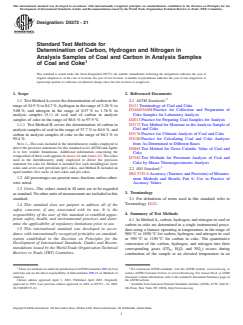
(Test Method)Standard Test Methods for Determination of Carbon, Hydrogen and Nitrogen in Analysis Samples of Coal and Carbon in Analysis Samples of Coal and Coke
General Information
- Abstract
SIGNIFICANCE AND USE
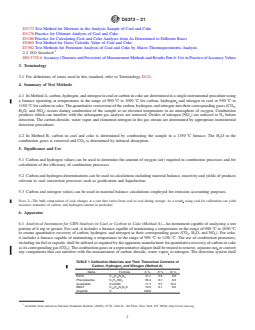
5.1 Carbon and hydrogen values can be used to determine the amount of oxygen (air) required in combustion processes and for calculation of the efficiency of combustion processes.
5.2 Carbon and hydrogen determinations can be used in calculations including material balance, reactivity and yields of products relevant to coal conversion processes such as gasification and liquefaction.
5.3 Carbon and nitrogen values can be used in material balance calculations employed for emission accounting purposes.
Note 2: The bulk composition of coal changes at a rate that varies from coal to coal during storage. As a result, using coal for calibration can yield incorrect estimates of carbon, and hydrogen content in particular.
SCOPE
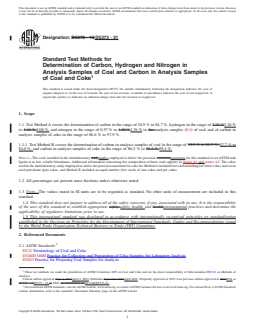
1.1 Test Method A covers the determination of carbon in the range of 54.9 % to 84.7 %, hydrogen in the range of 3.26 % to 5.08 %, and nitrogen in the range of 0.57 % to 1.76 % in analysis samples (8.1) of coal and of carbon in analysis samples of coke in the range of 86.6 % to 97.9 %.
1.1.1 Test Method B covers the determination of carbon in analysis samples of coal in the range of 57.7 % to 84.0 %, and carbon in analysis samples of coke in the range of 86.3 % to 95.4 %.
Note 1: The coals included in the interlaboratory studies employed to derive the precision statements for this standard cover ASTM rank lignite A to low volatile bituminous. Additional information concerning the composition of these coals appears in Annex A4 and Annex A5. The cokes used in the interlaboratory study employed to derive the precision statement for coke for Method A included five each metallurgical (met) cokes and seven each petroleum (pet) cokes, and Method B included an equal number (five each) of met cokes and pet cokes.
1.2 All percentages are percent mass fractions unless otherwise noted.
1.3 Units—The values stated in SI units are to be regarded as standard. No other units of measurement are included in this standard.
1.4 This standard does not purport to address all of the safety concerns, if any, associated with its use. It is the responsibility of the user of this standard to establish appropriate safety, health, and environmental practices and determine the applicability of regulatory limitations prior to use.
1.5 This international standard was developed in accordance with internationally recognized principles on standardization established in the Decision on Principles for the Development of International Standards, Guides and Recommendations issued by the World Trade Organization Technical Barriers to Trade (TBT) Committee.
- Status
- Published
- Publication Date
- 31-Mar-2021
- Technical Committee
- D05 - Coal and Coke
- Drafting Committee
- D05.21 - Methods of Analysis
Buy Documents
ASTM D5373-21 - Standard Test Methods for Determination of Carbon, Hydrogen and Nitrogen in Analysis Samples of Coal and Carbon in Analysis Samples of Coal and Coke
REDLINE ASTM D5373-21 - Standard Test Methods for Determination of Carbon, Hydrogen and Nitrogen in Analysis Samples of Coal and Carbon in Analysis Samples of Coal and Coke
Overview
ASTM D5373-21 is the international standard developed by ASTM International for the determination of carbon, hydrogen, and nitrogen in analysis samples of coal, and for carbon determination in analysis samples of coal and coke. These standardized test methods ensure precise, repeatable, and reliable chemical analysis of coal and coke, supporting critical industries such as energy production, metallurgy, and materials science.
By providing detailed methodologies, ASTM D5373-21 plays an essential role in combustion analysis, process optimization, emissions accounting, and regulatory compliance related to coal and coke usage. All measurements are reported as percent mass fractions, and the standard is aligned with internationally recognized best practices.
Key Topics
- Elemental Analysis of Coal and Coke
- Carbon measured in coal (54.9% to 84.7% by mass) and coke (86.6% to 97.9% by mass)
- Hydrogen (3.26% to 5.08%) and nitrogen (0.57% to 1.76%) measured in coal
- Test Methodologies
- Method A: Simultaneous determination of carbon, hydrogen, and nitrogen using furnace combustion and gas analysis
- Method B: Carbon determination via high-temperature furnace (1350°C) and infrared detection
- Calibration and Validation
- Use of certified reference materials and calibration procedures for accuracy
- Data Reporting and Calculation
- Results corrected to dry basis, ensuring meaningful comparisons
- Precision and Reproducibility
- Criteria for repeatability within and between laboratories
Applications
ASTM D5373-21 finds application across multiple facets of the coal and coke industry, delivering accurate elemental information crucial for:
Combustion/Power Generation
- Calculating the oxygen requirement for efficient fuel combustion
- Assessing combustion efficiency and fuel value in power plants
Coal Conversion Processes
- Supporting calculations for gasification and liquefaction yield
- Aiding in reactivity studies and material balance in coal-to-liquids or coal-to-gas processes
Emission Accounting & Environmental Compliance
- Providing baseline data for tracking and reporting emissions, as required by regulations
- Determining nitrogen content relevant to NOx emission inventories
Metallurgy & Industrial Coke Production
- Quality control for metallurgical (met) coke and petroleum (pet) coke
- Supporting raw material characterization for steelmaking and chemical processing
Sampling and Laboratory Analysis
- Standardizes laboratory methods to ensure interlaboratory consistency
- Supports procurement, trading, and certification of fuel quality
Related Standards
To achieve comprehensive elemental coal and coke characterization, ASTM D5373-21 should be used alongside the following standards:
- ASTM D121 - Terminology of Coal and Coke
- ASTM D2013 - Preparing Coal Samples for Analysis
- ASTM D346/D346M - Collection and Preparation of Coke Samples
- ASTM D3173 - Moisture Analysis
- ASTM D3176 - Ultimate Analysis of Coal and Coke
- ASTM D3180 - Calculating Analyses on Different Bases
- ASTM D5865 - Gross Calorific Value Determination
- ASTM D7582 - Proximate Analysis by Thermogravimetric Methods
- ISO 5725-6 - Accuracy (Trueness and Precision) of Measurement Methods
Practical Value
Adhering to ASTM D5373-21 ensures:
- Reliable, high confidence chemical analysis of coal and coke for quality assurance and process optimization
- Enhanced regulatory compliance with emissions and reporting requirements
- Uniform data reporting supporting global trade, research, and policy decisions in the energy sector
For any organization involved in coal combustion, coke production, or environmental monitoring, implementation of ASTM D5373-21 is a vital step for robust, repeatable, and accurate analytical results.
Relations
- Effective Date
- 01-Apr-2024
- Effective Date
- 01-Apr-2024
- Effective Date
- 01-Mar-2024
- Effective Date
- 01-Dec-2023
- Effective Date
- 01-Dec-2023
- Effective Date
- 01-Dec-2023
- Effective Date
- 01-Sep-2015
- Effective Date
- 01-Jan-2015
- Effective Date
- 01-Jan-2015
- Effective Date
- 01-Oct-2013
- Effective Date
- 01-Sep-2012
- Effective Date
- 01-Apr-2012
- Effective Date
- 01-Nov-2011
- Effective Date
- 01-Oct-2011
- Effective Date
- 01-Oct-2011
Buy Documents
ASTM D5373-21 - Standard Test Methods for Determination of Carbon, Hydrogen and Nitrogen in Analysis Samples of Coal and Carbon in Analysis Samples of Coal and Coke
REDLINE ASTM D5373-21 - Standard Test Methods for Determination of Carbon, Hydrogen and Nitrogen in Analysis Samples of Coal and Carbon in Analysis Samples of Coal and Coke
Get Certified
Connect with accredited certification bodies for this standard

Element Materials Technology
Materials testing and product certification.

ABS Group Brazil
ABS Group certification services in Brazil.

ABS Quality Evaluations Inc.
American Bureau of Shipping quality certification.
Sponsored listings
Frequently Asked Questions
ASTM D5373-21 is a standard published by ASTM International. Its full title is "Standard Test Methods for Determination of Carbon, Hydrogen and Nitrogen in Analysis Samples of Coal and Carbon in Analysis Samples of Coal and Coke". This standard covers: SIGNIFICANCE AND USE 5.1 Carbon and hydrogen values can be used to determine the amount of oxygen (air) required in combustion processes and for calculation of the efficiency of combustion processes. 5.2 Carbon and hydrogen determinations can be used in calculations including material balance, reactivity and yields of products relevant to coal conversion processes such as gasification and liquefaction. 5.3 Carbon and nitrogen values can be used in material balance calculations employed for emission accounting purposes. Note 2: The bulk composition of coal changes at a rate that varies from coal to coal during storage. As a result, using coal for calibration can yield incorrect estimates of carbon, and hydrogen content in particular. SCOPE 1.1 Test Method A covers the determination of carbon in the range of 54.9 % to 84.7 %, hydrogen in the range of 3.26 % to 5.08 %, and nitrogen in the range of 0.57 % to 1.76 % in analysis samples (8.1) of coal and of carbon in analysis samples of coke in the range of 86.6 % to 97.9 %. 1.1.1 Test Method B covers the determination of carbon in analysis samples of coal in the range of 57.7 % to 84.0 %, and carbon in analysis samples of coke in the range of 86.3 % to 95.4 %. Note 1: The coals included in the interlaboratory studies employed to derive the precision statements for this standard cover ASTM rank lignite A to low volatile bituminous. Additional information concerning the composition of these coals appears in Annex A4 and Annex A5. The cokes used in the interlaboratory study employed to derive the precision statement for coke for Method A included five each metallurgical (met) cokes and seven each petroleum (pet) cokes, and Method B included an equal number (five each) of met cokes and pet cokes. 1.2 All percentages are percent mass fractions unless otherwise noted. 1.3 Units—The values stated in SI units are to be regarded as standard. No other units of measurement are included in this standard. 1.4 This standard does not purport to address all of the safety concerns, if any, associated with its use. It is the responsibility of the user of this standard to establish appropriate safety, health, and environmental practices and determine the applicability of regulatory limitations prior to use. 1.5 This international standard was developed in accordance with internationally recognized principles on standardization established in the Decision on Principles for the Development of International Standards, Guides and Recommendations issued by the World Trade Organization Technical Barriers to Trade (TBT) Committee.
SIGNIFICANCE AND USE 5.1 Carbon and hydrogen values can be used to determine the amount of oxygen (air) required in combustion processes and for calculation of the efficiency of combustion processes. 5.2 Carbon and hydrogen determinations can be used in calculations including material balance, reactivity and yields of products relevant to coal conversion processes such as gasification and liquefaction. 5.3 Carbon and nitrogen values can be used in material balance calculations employed for emission accounting purposes. Note 2: The bulk composition of coal changes at a rate that varies from coal to coal during storage. As a result, using coal for calibration can yield incorrect estimates of carbon, and hydrogen content in particular. SCOPE 1.1 Test Method A covers the determination of carbon in the range of 54.9 % to 84.7 %, hydrogen in the range of 3.26 % to 5.08 %, and nitrogen in the range of 0.57 % to 1.76 % in analysis samples (8.1) of coal and of carbon in analysis samples of coke in the range of 86.6 % to 97.9 %. 1.1.1 Test Method B covers the determination of carbon in analysis samples of coal in the range of 57.7 % to 84.0 %, and carbon in analysis samples of coke in the range of 86.3 % to 95.4 %. Note 1: The coals included in the interlaboratory studies employed to derive the precision statements for this standard cover ASTM rank lignite A to low volatile bituminous. Additional information concerning the composition of these coals appears in Annex A4 and Annex A5. The cokes used in the interlaboratory study employed to derive the precision statement for coke for Method A included five each metallurgical (met) cokes and seven each petroleum (pet) cokes, and Method B included an equal number (five each) of met cokes and pet cokes. 1.2 All percentages are percent mass fractions unless otherwise noted. 1.3 Units—The values stated in SI units are to be regarded as standard. No other units of measurement are included in this standard. 1.4 This standard does not purport to address all of the safety concerns, if any, associated with its use. It is the responsibility of the user of this standard to establish appropriate safety, health, and environmental practices and determine the applicability of regulatory limitations prior to use. 1.5 This international standard was developed in accordance with internationally recognized principles on standardization established in the Decision on Principles for the Development of International Standards, Guides and Recommendations issued by the World Trade Organization Technical Barriers to Trade (TBT) Committee.
ASTM D5373-21 is classified under the following ICS (International Classification for Standards) categories: 75.160.10 - Solid fuels. The ICS classification helps identify the subject area and facilitates finding related standards.
ASTM D5373-21 has the following relationships with other standards: It is inter standard links to ASTM D7582-24, ASTM D3176-24, ASTM D121-15(2024), ASTM D7582-15(2023), ASTM D3180-15(2023), ASTM D3176-15(2023), ASTM D121-15, ASTM D3176-15, ASTM D3180-15, ASTM D5865-13, ASTM D5865-12, ASTM D3180-12, ASTM D5865-11a, ASTM D5865-11, ASTM D346/D346M-11. Understanding these relationships helps ensure you are using the most current and applicable version of the standard.
ASTM D5373-21 is available in PDF format for immediate download after purchase. The document can be added to your cart and obtained through the secure checkout process. Digital delivery ensures instant access to the complete standard document.
Standards Content (Sample)
This international standard was developed in accordance with internationally recognized principles on standardization established in the Decision on Principles for the
Development of International Standards, Guides and Recommendations issued by the World Trade Organization Technical Barriers to Trade (TBT) Committee.
Designation: D5373 − 21
Standard Test Methods for
Determination of Carbon, Hydrogen and Nitrogen in
Analysis Samples of Coal and Carbon in Analysis Samples
of Coal and Coke
This standard is issued under the fixed designation D5373; the number immediately following the designation indicates the year of
original adoption or, in the case of revision, the year of last revision. A number in parentheses indicates the year of last reapproval. A
superscript epsilon (´) indicates an editorial change since the last revision or reapproval.
1. Scope 2. Referenced Documents
2.1 ASTM Standards:
1.1 Test MethodAcovers the determination of carbon in the
range of 54.9 % to 84.7 %, hydrogen in the range of 3.26 % to D121 Terminology of Coal and Coke
D346/D346M Practice for Collection and Preparation of
5.08 %, and nitrogen in the range of 0.57 % to 1.76 % in
analysis samples (8.1) of coal and of carbon in analysis Coke Samples for Laboratory Analysis
D2013 Practice for Preparing Coal Samples for Analysis
samples of coke in the range of 86.6 % to 97.9 %.
D3173 Test Method for Moisture in the Analysis Sample of
1.1.1 Test Method B covers the determination of carbon in
Coal and Coke
analysis samples of coal in the range of 57.7 % to 84.0 %, and
D3176 Practice for Ultimate Analysis of Coal and Coke
carbon in analysis samples of coke in the range of 86.3 % to
D3180 Practice for Calculating Coal and Coke Analyses
95.4 %.
NOTE 1—The coals included in the interlaboratory studies employed to from As-Determined to Different Bases
derive the precision statements for this standard coverASTM rank lignite
D5865 Test Method for Gross Calorific Value of Coal and
A to low volatile bituminous. Additional information concerning the
Coke
compositionofthesecoalsappearsinAnnexA4andAnnexA5.Thecokes
D7582 Test Methods for Proximate Analysis of Coal and
used in the interlaboratory study employed to derive the precision
Coke by Macro Thermogravimetric Analysis
statement for coke for Method A included five each metallurgical (met)
cokes and seven each petroleum (pet) cokes, and Method B included an
2.2 ISO Standard:
equal number (five each) of met cokes and pet cokes.
ISO 5725-6 Accuracy (Trueness and Precision) of Measure-
1.2 All percentages are percent mass fractions unless other-
ment Methods and Results Part 6: Use in Practice of
wise noted.
Accuracy Values
1.3 Units—The values stated in SI units are to be regarded
3. Terminology
as standard. No other units of measurement are included in this
standard.
3.1 For definitions of terms used in this standard, refer to
Terminology D121.
1.4 This standard does not purport to address all of the
safety concerns, if any, associated with its use. It is the
4. Summary of Test Methods
responsibility of the user of this standard to establish appro-
priate safety, health, and environmental practices and deter-
4.1 In MethodA, carbon, hydrogen, and nitrogen in coal or
mine the applicability of regulatory limitations prior to use.
carbon in coke are determined in a single instrumental proce-
1.5 This international standard was developed in accor-
dure using a furnace operating at temperatures in the range of
dance with internationally recognized principles on standard-
900 °C to 1050 °C for carbon, hydrogen, and nitrogen in coal
ization established in the Decision on Principles for the
or 950 °C to 1150 °C for carbon in coke. The quantitative
Development of International Standards, Guides and Recom-
conversion of the carbon, hydrogen, and nitrogen into their
mendations issued by the World Trade Organization Technical
corresponding gases (CO,H O, and NO ) occurs during
2 2 x
Barriers to Trade (TBT) Committee.
combustion of the sample at an elevated temperature in an
1 2
ThesetestmethodsareunderthejurisdictionofASTMCommitteeD05onCoal For referenced ASTM standards, visit the ASTM website, www.astm.org, or
and Coke and are the direct responsibility of Subcommittee D05.21 on Methods of contact ASTM Customer Service at service@astm.org. For Annual Book of ASTM
Analysis. Standards volume information, refer to the standard’s Document Summary page on
Current edition approved April 1, 2021. Published April 2021. Originally the ASTM website.
approved in 1993. Last previous edition approved in 2016 as D5373 – 16. DOI: Available fromAmerican National Standards Institute (ANSI), 25 W. 43rd St.,
10.1520/D5373-21. 4th Floor, New York, NY 10036, http://www.ansi.org.
Copyright ©ASTM International, 100 Barr Harbor Drive, PO Box C700, West Conshohocken, PA19428-2959. United States
D5373 − 21
atmosphere of oxygen. Combustion products which can inter- the quantitative recovery of carbon from cokes. The infrared
fere with the subsequent gas analysis are removed. Oxides of absorption detection system shall include provisions for evalu-
nitrogen (NO ) are reduced to N before detection. The carbon ating the response in a manner that correlates accurately with
x 2
dioxide, water vapor and elemental nitrogen in the gas stream thecarbondioxidepresentinthedrycombustiongases.Follow
are determined by appropriate instrumental detection proce- the manufacturer’s recommendations for sample mass (typi-
dures. cally 50 mg to 300 mg).
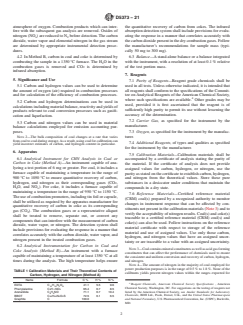
4.2 In Method B, carbon in coal and coke is determined by 6.3 Balance—Astand-alone balance or a balance integrated
combusting the sample in a 1350 °C furnace. The HOinthe with the instrument, with a resolution of at least 0.1 % relative
combustion gases is removed and CO is determined by of the test portion mass.
infrared absorption.
7. Reagents
5. Significance and Use
7.1 Purity of Reagents—Reagent grade chemicals shall be
5.1 Carbon and hydrogen values can be used to determine used in all tests. Unless otherwise indicated, it is intended that
the amount of oxygen (air) required in combustion processes all reagents shall conform to the specifications of the Commit-
and for calculation of the efficiency of combustion processes. tee onAnalytical Reagents of theAmerican Chemical Society,
where such specifications are available. Other grades may be
5.2 Carbon and hydrogen determinations can be used in
used, provided it is first ascertained that the reagent is of
calculationsincludingmaterialbalance,reactivityandyieldsof
sufficiently high purity to permit its use without lessening the
products relevant to coal conversion processes such as gasifi-
accuracy of the determination.
cation and liquefaction.
7.2 Carrier Gas, as specified for the instrument by the
5.3 Carbon and nitrogen values can be used in material
manufacturer.
balance calculations employed for emission accounting pur-
poses. 7.3 Oxygen, as specified for the instrument by the manufac-
NOTE 2—The bulk composition of coal changes at a rate that varies
turer.
from coal to coal during storage.As a result, using coal for calibration can
7.4 Additional Reagents, of types and qualities as specified
yield incorrect estimates of carbon, and hydrogen content in particular.
for the instrument by the manufacturer.
6. Apparatus
7.5 Calibration Materials—Calibration materials shall be
6.1 Analytical Instrument for CHN Analysis in Coal or
accompanied by a certificate of analysis stating the purity of
Carbon in Coke (Method A)—An instrument capable of ana-
the material. If the certificate of analysis does not provide
lyzing a test portion of 6 mg or greater. For coal, it includes a
assigned values for carbon, hydrogen, or nitrogen, use the
furnace capable of maintaining a temperature in the range of
purity as stated on the certificate to establish carbon, hydrogen,
900 °C to 1050 °C to ensure quantitative recovery of carbon,
and nitrogen from the theoretical values. Store these pure
hydrogen, and nitrogen as their corresponding gases (CO ,
2 substances in a desiccator under conditions that maintain the
H O, and NO ). For coke, it includes a furnace capable of
compounds in a dry state.
2 x
maintaining a temperature in the range of 950 °C to 1150 °C.
7.6 Reference Materials—Certified reference material
The use of combustion promoters, including tin foil or capsule,
(CRM) coal(s) prepared by a recognized authority to monitor
shall be utilized as required by the apparatus manufacturer for
changes in instrument response that can be affected by con-
quantitative recovery of carbon in coke as its corresponding
stituents not present in the calibration materials (Note 3) and to
gas (CO ). The combustion gases or a representative aliquot
verify the acceptability of nitrogen results. Coal(s) and coke(s)
shall be treated to remove, separate out, or convert any
traceable to a certified reference material (CRM) coal(s) and
components that can interfere with the measurement of carbon
coke(s) can also be used. Follow instructions on the reference
dioxide, water vapor, or nitrogen. The detection system shall
material certificate with respect to storage of the reference
include provisions for evaluating the response in a manner that
material and use of assigned values. Use only those carbon,
correlates accurately with the carbon dioxide, water vapor, and
hydrogen, and nitrogen values that have an assigned uncer-
nitrogen present in the treated combustion gases.
tainty or are traceable to a value with an assigned uncertainty.
6.2 Analytical Instrumentation for Carbon in Coal and
NOTE3—Coalcontainsmineralconstituentsaswellasacidgasforming
Coke Analysis (Method B)—An instrument with a furnace
constituents that can affect the performance of chemicals used to ensure
capable of maintaining a temperature of at least 1350 °C at all
the consistent and uniform conversion and recovery of carbon, hydrogen,
times during the analysis. The high temperature helps ensure
and nitrogen.
NOTE 4—The amount of nitrogen in the majority of coal employed for
power production purposes is in the range of 0.5 % to 1.8 %. None of the
TABLE 1 Calibration Materials and Their Theoretical Contents of
calibrants yields percent nitrogen values within the ranges expected for
Carbon, Hydrogen, and Nitrogen (Method A)
Name Formula C % H % N %
Reagent Chemicals, American Chemical Society Specifications , American
EDTA C H N O 41.1 5.5 9.6
10 16 2 8
Chemical Society, Washington, DC. For suggestions on the testing of reagents not
Phenylalanine C H NO 65.4 6.7 8.5
9 11 2
listed by the American Chemical Society, see Analar Standards for Laboratory
Acetanilide C H NO 71.1 6.7 10.4
8 9
Chemicals, BDH Ltd., Poole, Dorset, U.K., and the United States Pharmacopeia
BBOT C H N O S 72.5 6.1 6.5
26 26 2 2
Graphite C 100.0 and National Formulary, U.S. Pharmaceutical Convention, Inc. (USPC), Rockville,
MD.
D5373 − 21
coal. For this reason, reference material (RM) coal is used to check the
mended by the manufacturer. Conduct determinations on
acceptability of nitrogen results.
consecutive test portions of an analysis sample as needed to
7.7 Tungsten Oxide (WO ), as specified for the instrument
meet quality control requirements.
by the manufacturer.
10.1.3 Verify the calibration upon completion of all test
determinations and as needed to meet quality control require-
7.8 Tin (Sn), as specified for the instrument by the manu-
ments according to Annex A2.
facturer.
10.1.4 Prior to conducting any test determinations, upon
8. Preparation of Analysis Sample
completion of all test determinations, and as needed to meet
8.1 The sample shall be the analysis sample prepared to a quality control requirements, conduct determinations on con-
top size of less than 250 µm (No. 60). Coal samples shall be secutivetestportionsofareferencematerial(RM)(7.6).Verify
prepared in accordance with Practice D2013. Coke samples the acceptability of results for the RM in accordance with
shall be prepared in accordance with Practice D346/D346M.
Annex A3.
NOTE 5—Appendix X2 provides guidance on the selection of the mass
9. Instrument Preparation
of a test portion that will yield for a mass of carbon similar to the mid
9.1 Instrument Set-Up—Verify all instrument operating pa-
range mass of the calibration material.
rameters meet the specifications in the instrument operating
manual. Verify the condition and quantities of all chemicals
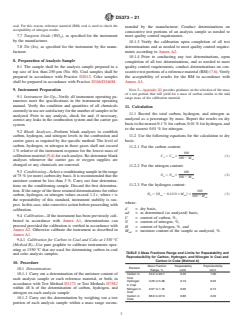
11. Calculation
currentlyinusearesatisfactoryforthenumberofsamplestobe
11.1 Record the total carbon, hydrogen, and nitrogen as
analyzed. Prior to any analysis, check for and, if necessary,
analyzed as a percentage by mass. Report the results on dry
correct any leaks in the combustion system and the carrier gas
basis to the nearest 0.1 % for carbon, 0.01 % for hydrogen, and
system.
to the nearest 0.01 % for nitrogen.
9.2 Blank Analyses—Perform blank analyses to establish
11.2 Use the following equations for the calculation to dry
carbon, hydrogen, and nitrogen levels in the combustion and
basis:
carrier gases as required by the specific method. The level of
carbon, hydrogen, or nitrogen in these gases shall not exceed
11.2.1 For the carbon content:
1 % relative of the instrument response for the lowest mass of
calibration material (9.4) for each analyte. Re-determine blank
C 5 C 3 (1)
d ad
100 2 M
ad
analyses whenever the carrier gas or oxygen supplies are
changed or any chemicals are renewed.
11.2.2 For the nitrogen content:
9.3 Conditioning—Selectaconditioningsampleintherange
N 5 N 3 (2)
d ad
of 75 % (or more) carbon dry basis. It is recommended that the
100 2 M
ad
moisture content be less than 3 %. Carry out four determina-
11.2.3 For the hydrogen content:
tions on the conditioning sample. Discard the first determina-
tion. If the range of the three retained determinations for either
H 5 ~H 2 0.1119 3 M ! 3 (3)
d ad ad
carbon, hydrogen, or nitrogen values exceed 1.2 r, where r is
100 2 M
ad
the repeatability of this standard, instrument stability is sus-
where:
pect.Inthiscase,takecorrectiveactionbeforeproceedingwith
d = dry basis,
calibration.
ad = as determined (as analyzed) basis,
9.4 Calibration—If the instrument has been previously cali-
C = content of carbon, %,
brated in accordance with Annex A1, determinations can
N = content of nitrogen, %,
proceed provided the calibration is verified in accordance with
H = content of hydrogen, %, and
Annex A2. Otherwise calibrate the instrument as described in
M = moisture content of the sample as analyzed, %.
ad
Annex A1.
9.4.1 Calibration for Carbon in Coal and Coke at 1350 °C
(Method B)—Use pure graphite to calibrate instruments oper-
ating at 1350 °C that are used for determining carbon in coal
TABLE 2 Mass Fractions Range and Limits for Repeatability and
and coke analysis samples.
Reproducibility for Carbon, Hydrogen, and Nitrogen in Coal and
Carbon in Coke (Method A)
10. Procedure
Mass Fraction Repeatability Reproducibility
Element
10.1 Determination: Range, % Limit Limit
10.1.1 Carry out a determination of the moisture content of
Carbon in 54.9 to 84.7 0.45 1.00
Coal
each analysis sample or each reference material, or both, in
Hydrogen 3.26 to 5.08 0.10 0.25
accordance with Test Method D3173 or Test Methods D7582
in Coal
within 48 h of the determination of carbon, hydrogen, and Nitrogen in 0.57 to 1.76 0.05 0.15
Coal
nitrogen on each analysis sample.
Carbon in 86.6 to 97.9 0.85 2.20
10.1.2 Carry out the determination by weighing out a test
Coke
portion of each analysis sample within a mass range recom-
D5373 − 21
ratory study (RR:D05–1046) appears in Table A4.4 and Table A4.5.
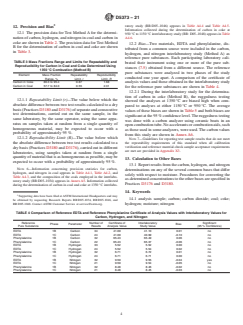
12. Precision and Bias
Information collected during the determination of carbon in coke at
12.1 The precision data for Test Method A for the determi-
950 °Cto1150 °Cinterlaboratorystudy(RR:D05–1048)appearsinTable
nation of carbon, hydrogen, and nitrogen in coal and carbon in
A4.6.
coke are shown in Table 2. The precision data for Test Method
12.2 Bias—Two materials, EDTA and phenylalanine, dis-
B for the determination of carbon in coal and coke are shown
tributed from a common source were included in the carbon,
in Table 3.
hydrogen, and nitrogen interlaboratory study (Method A) as
reference pure substances. Each participating laboratory cali-
TABLE 3 Mass Fractions Range and Limits for Repeatability and
brated their instrument using one or more of the pure sub-
Reproducibility for Carbon in Coal and Coke Determined Using
stances (7.5) obtained from a different source. The reference
1350 °C Combustion (Method B)
pure substances were analyzed in two phases of the study
Element Mass Fraction Repeatability Reproducibility
conducted one year apart. A comparison of the certificate of
Range, % Limit, r Limit, R
Carbon in Coke 86.3 to 95.4 0.87 1.68 analysis values and those obtained in the interlaboratory study
Carbon in Coal 57.7 to 84.0 0.55 2.31
for the reference pure substances are shown in Table 4.
12.2.1 During the interlaboratory study for the determina-
tion of carbon in coke (Method B), the ruggedness testing
12.1.1 Repeatability Limit (r)—The value below which the
showed the analyses at 1350 °C are biased high when com-
absolute difference between two test results calculated to a dry
pared to analyses at either 1150 °C or 950 °C. The average
basis(PracticesD3180andD3176)ofseparateandconsecutive
values of these biases are shown in Table 5 and both biases are
test determinations, carried out on the same sample, in the
significantatthe95%confidencelevel.Theruggednesstesting
same laboratory, by the same operator, using the same appa-
was done with a carbon analyzer using ceramic boats in an
ratus on samples taken at random from a single quantity of
opencombustiontube.Noaccelerantsorcombustionaids,such
homogeneous material, may be expected to occur with a
as those used in some analyzers, were used. The carbon values
probability of approximately 95 %.
from this study are shown in Annex A6.
12.1.2 Reproducibility Limit (R)—The value below which
NOTE 7—Guidelines for reporting test sample results that do not meet
the absolute difference between two test results calculated to a the repeatability requirements of this standard when all calibration
verification and reference material check sample acceptance requirements
dry basis (Practices D3180 and D3176), carried out in different
are met are provided in Appendix X3.
laboratories, using samples taken at random from a single
quantityofmaterialthatisashomogeneousaspossible,maybe
13. Calculation to Other Bases
expected to occur with a probability of approximately 95 %.
13.1 Report results from the carbon, hydrogen, and nitrogen
NOTE 6—Information concerning precision statistics for carbon,
determinations on any of the several common bases that differ
hydrogen, and nitrogen in coal appears in Table A4.1, Table A4.2, and
solely with respect to moisture. Procedures for converting the
Table A4.3, and the composition of the coals employed in the interlabo-
as-determined concentrations to the other bases are specified in
ratory study (RR:D05–1034) appears in AnnexA5. Information collected
Practices D3176 and D3180.
during the determination of carbon in coal and coke at 1350 °C interlabo-
14. Keywords
Supporting data have been filed at ASTM International Headquarters and may
14.1 analysis sample; carbon; carbon dioxide; coal; coke;
be obtained by requesting Research Reports RR:D05-1034, RR:D05-1046, and
hydrogen; moisture; nitrogen
RR:D05-1048. Contact ASTM Customer Service at service@astm.org.
TABLE 4 Comparison of Reference EDTA and Reference Phenylalanine Certificate of Analysis Values with Interlaboratory Values for
Carbon, Hydrogen, and Nitrogen
Reference Number of Certificate of Interlaboratory Significant
Phase Parameter Bias
Pure Substance Results Analysis Value Study Value (95% Confidence)
EDTA 1B Carbon 34 41.09 41.10 0.01 no
EDTA 1C Carbon 24 41.09 40.99 -0.10 no
Phenylalanine 1B Carbon 32 65.43 65.49 0.06 no
Phenylalanine 1C Carbon 22 65.43 65.37 -0.06 no
EDTA 1B Hydrogen 33 5.52 5.52 0.00 no
EDTA 1C Hydrogen 24 5.52 5.54 0.02 no
Phenylalanine 1B Hydrogen 32 6.71 6.72 0.01 no
Phenylalanine 1C Hydrogen 24 6.71 6.71 0.00 no
EDTA 1B Nitrogen 32 9.59 9.55 -0.04 yes
EDTA 1C Nitrogen 21 9.59 9.54 -0.05 no
Phenylalanine 1B Nitrogen 32 8.48 8.46 -0.02 no
Phenylalanine 1C Nitrogen 21 8.48 8.45 -0.03 no
D5373 − 21
TABLE 5 Relative Biases for Carbon in Coke Determined for 10 Coke Samples at Different Combustion Temperatures
Parameter Test Condition 1 Test Condition 2 Average Bias Significant
Combustion Temperature Combustion Temperature % (Absolute) (95% Confidence)
Carbon in Coke 1350°C 1150°C 0.44 yes
Carbon in Coke 1350°C 950°C 0.96 yes
NOTE 1—Test Condition 2 is biased lower.
ANNEXES
(Mandatory Information)
A1. NUMBER OF CALIBRATION POINTS FOR METHODS A AND B
A1.1 To meet the precision requirements of this method, six calibration point consists of a determination on a single test
calibration points are required for a linear fit and eight portion of calibration material.
calibration points are required for a non-linear fit. These
NOTE A1.1—The interlaboratory study employed to validate the preci-
requireme
...
This document is not an ASTM standard and is intended only to provide the user of an ASTM standard an indication of what changes have been made to the previous version. Because
it may not be technically possible to adequately depict all changes accurately, ASTM recommends that users consult prior editions as appropriate. In all cases only the current version
of the standard as published by ASTM is to be considered the official document.
Designation: D5373 − 16 D5373 − 21
Standard Test Methods for
Determination of Carbon, Hydrogen and Nitrogen in
Analysis Samples of Coal and Carbon in Analysis Samples
of Coal and Coke
This standard is issued under the fixed designation D5373; the number immediately following the designation indicates the year of
original adoption or, in the case of revision, the year of last revision. A number in parentheses indicates the year of last reapproval. A
superscript epsilon (´) indicates an editorial change since the last revision or reapproval.
1. Scope
1.1 Test Method A covers the determination of carbon in the range of 54.9 % to 84.7 %, hydrogen in the range of 3.25 %3.26 %
to 5.10 %,5.08 %, and nitrogen in the range of 0.57 % to 1.80 %1.76 % in the analysis samples (8.1) of coal and of carbon in
analysis samples of coke in the range of 86.6 % to 97.9 %.
1.1.1 Test Method B covers the determination of carbon in analysis samples of coal in the range of 58.0 % to 84.2 %, 57.7 % to
84.0 %, and carbon in analysis samples of coke in the range of 86.3 % to 95.2 %.95.4 %.
NOTE 1—The coals included in the interlaboratory studystudies employed to derive the precision statementstatements for this standard cover ASTM rank
lignite A to low volatile bituminous. Additional information concerning the composition of these coals appears in Annex A4 and Annex A5. The cokes
used in the interlaboratory study employed to derive the precision statement for coke for Method A included five each metallurgical (met) cokes and seven
each petroleum (pet) cokes, and Method B included an equal number (five each) of met cokes and pet cokes.
1.2 All percentages are percent mass fractions unless otherwise noted.
1.3 Units—The values stated in SI units are to be regarded as standard. No other units of measurement are included in this
standard.
1.4 This standard does not purport to address all of the safety concerns, if any, associated with its use. It is the responsibility
of the user of this standard to establish appropriate safety safety, health, and healthenvironmental practices and determine the
applicability of regulatory limitations prior to use.
1.5 This international standard was developed in accordance with internationally recognized principles on standardization
established in the Decision on Principles for the Development of International Standards, Guides and Recommendations issued
by the World Trade Organization Technical Barriers to Trade (TBT) Committee.
2. Referenced Documents
2.1 ASTM Standards:
D121 Terminology of Coal and Coke
D346/D346M Practice for Collection and Preparation of Coke Samples for Laboratory Analysis
D2013 Practice for Preparing Coal Samples for Analysis
These test methods are under the jurisdiction of ASTM Committee D05 on Coal and Coke and are the direct responsibility of Subcommittee D05.21 on Methods of
Analysis.
Current edition approved Sept. 1, 2016April 1, 2021. Published September 2016April 2021. Originally approved in 1993. Last previous edition approved in 20142016 as
ɛ2
D5373 – 14D5373 – 16. . DOI: 10.1520/D5373-16.10.1520/D5373-21.
For referenced ASTM standards, visit the ASTM website, www.astm.org, or contact ASTM Customer Service at service@astm.org. For Annual Book of ASTM Standards
volume information, refer to the standard’s Document Summary page on the ASTM website.
Copyright © ASTM International, 100 Barr Harbor Drive, PO Box C700, West Conshohocken, PA 19428-2959. United States
D5373 − 21
D3173 Test Method for Moisture in the Analysis Sample of Coal and Coke
D3176 Practice for Ultimate Analysis of Coal and Coke
D3180 Practice for Calculating Coal and Coke Analyses from As-Determined to Different Bases
D5865 Test Method for Gross Calorific Value of Coal and Coke
D7582 Test Methods for Proximate Analysis of Coal and Coke by Macro Thermogravimetric Analysis
2.2 ISO Standard:
ISO 5725-6 Accuracy (Trueness and Precision) of Measurement Methods and Results Part 6: Use in Practice of Accuracy Values
3. Terminology
3.1 For definitions of terms used in this standard, refer to Terminology D121.
4. Summary of Test Methods
4.1 In Method A, carbon, hydrogen, and nitrogen in coal or carbon in coke are determined in a single instrumental procedure using
a furnace operating at temperatures in the range of 900 °C to 1050 °C for carbon, hydrogen, and nitrogen in coal or 950 °C to
1150 °C for carbon in coke. The quantitative conversion of the carbon, hydrogen, and nitrogen into their corresponding gases (CO ,
H O, and NO ) occurs during combustion of the sample at an elevated temperature in an atmosphere of oxygen. Combustion
2 x
products which can interfere with the subsequent gas analysis are removed. Oxides of nitrogen (NO ) are reduced to N before
x 2
detection. The carbon dioxide, water vapor and elemental nitrogen in the gas stream are determined by appropriate instrumental
detection procedures.
4.2 In Method B, carbon in coal and coke is determined by combusting the sample in a 1350 °C furnace. The H O in the
combustion gases is removed and CO is determined by infrared absorption.
5. Significance and Use
5.1 Carbon and hydrogen values can be used to determine the amount of oxygen (air) required in combustion processes and for
calculation of the efficiency of combustion processes.
5.2 Carbon and hydrogen determinations can be used in calculations including material balance, reactivity and yields of products
relevant to coal conversion processes such as gasification and liquefaction.
5.3 Carbon and nitrogen values can be used in material balance calculations employed for emission accounting purposes.
NOTE 2—The bulk composition of coal changes at a rate that varies from coal to coal during storage. As a result, using coal for calibration can yield
incorrect estimates of carbon, and hydrogen content in particular.
6. Apparatus
6.1 Analytical Instrument for CHN Analysis in Coal or Carbon in Coke (Method A)—An instrument capable of analyzing a test
portion of 6 mg or greater. For coal, it includes a furnace capable of maintaining a temperature in the range of 900 °C to 1050 °C
to ensure quantitative recovery of carbon, hydrogen, and nitrogen as their corresponding gases (CO , H O, and NO ). For coke,
2 2 x
it includes a furnace capable of maintaining a temperature in the range of 950 °C to 1150 °C. The use of combustion promoters,
including tin foil or capsule, shall be utilized as required by the apparatus manufacturer for quantitative recovery of carbon in coke
as its corresponding gas (CO ). The combustion gases or a representative aliquot shall be treated to remove, separate out, or convert
any components that can interfere with the measurement of carbon dioxide, water vapor, or nitrogen. The detection system shall
TABLE 1 Calibration Materials and Their Theoretical Contents of
Carbon, Hydrogen, and Nitrogen (Method A)
Name Formula C % H % N %
EDTA C H N O 41.1 5.5 9.6
10 16 2 8
Phenylalanine C H NO 65.4 6.7 8.5
9 11 2
Acetanilide C H NO 71.1 6.7 10.4
8 9
BBOT C H N O S 72.5 6.1 6.5
26 26 2 2
Graphite C 100.0
Available from American National Standards Institute (ANSI), 25 W. 43rd St., 4th Floor, New York, NY 10036, http://www.ansi.org.
D5373 − 21
include provisions for evaluating the response in a manner that correlates accurately with the carbon dioxide, water vapor, and
nitrogen present in the treated combustion gases.
6.2 Analytical Instrumentation for Carbon in Coal and Coke Analysis (Method B)—An instrument with a furnace capable of
maintaining a temperature of at least 1350 °C at all times during the analysis. The high temperature helps ensure the quantitative
recovery of carbon from cokes. The infrared absorption detection system shall include provisions for evaluating the response in
a manner that correlates accurately with the carbon dioxide present in the dry combustion gases. Follow the manufacturer’s
recommendations for sample mass (typically 50 mg to 300 mg).
6.3 Balance—A stand-alone balance or a balance integrated with the instrument, with a resolution of at least 0.1 % relative of the
test portion mass.
7. Reagents
7.1 Purity of Reagents—Reagent grade chemicals shall be used in all tests. Unless otherwise indicated, it is intended that all
reagents shall conform to the specifications of the Committee on Analytical Reagents of the American Chemical Society, where
such specifications are available. Other grades may be used, provided it is first ascertained that the reagent is of sufficiently high
purity to permit its use without lessening the accuracy of the determination.
7.2 Carrier Gas, as specified for the instrument by the manufacturer.
7.3 Oxygen, as specified for the instrument by the manufacturer.
7.4 Additional Reagents, of types and qualities as specified for the instrument by the manufacturer.
7.5 Calibration Materials—Calibration materials shall be accompanied by a certificate of analysis stating the purity of the
material. If the certificate of analysis does not provide assigned values for carbon, hydrogen, or nitrogen, use the purity as stated
on the certificate to establish carbon, hydrogen, and nitrogen from the theoretical values. Store these pure substances in a desiccator
under conditions that maintain the compounds in a dry state.
7.6 Reference Materials—Certified reference material (CRM) coal(s) prepared by a recognized authority to monitor changes in
instrument response that can be affected by constituents not present in the calibration materials (Note 3) and to verify the
acceptability of nitrogen results. Coal(s) and coke(s) traceable to a certified reference material (CRM) coal(s) and coke(s) can also
be used. Follow instructions on the reference material certificate with respect to storage of the reference material and use of
assigned values. Use only those carbon, hydrogen, and nitrogen values that have an assigned uncertainty or are traceable to a value
with an assigned uncertainty.
NOTE 3—Coal contains mineral constituents as well as acid gas forming constituents that can affect the performance of chemicals used to ensure the
consistent and uniform conversion and recovery of carbon, hydrogen, and nitrogen.
NOTE 4—The amount of nitrogen in the majority of coal employed for power production purposes is in the range of 0.5 % to 1.8 %. None of the calibrants
yields percent nitrogen values within the ranges expected for coal. For this reason, reference material (RM) coal is used to check the acceptability of
nitrogen results.
7.7 Tungsten Oxide (WO )—), as specified for the instrument by the manufacturer.
7.8 Tin (Sn)—(Sn), as specified for the instrument by the manufacturer.
8. Preparation of Analysis Sample
8.1 The sample shall be the analysis sample prepared to a top size of less than 250 μm (No. 60). Coal samples shall be prepared
in accordance with Practice D2013. Coke samples shall be prepared in accordance with Practice D346/D346M.
Reagent Chemicals, American Chemical Society Specifications , American Chemical Society, Washington, DC. For suggestions on the testing of reagents not listed by
the American Chemical Society, see Analar Standards for Laboratory Chemicals, BDH Ltd., Poole, Dorset, U.K., and the United States Pharmacopeia and National
Formulary, U.S. Pharmaceutical Convention, Inc. (USPC), Rockville, MD.
D5373 − 21
9. Instrument Preparation
9.1 Instrument Set-Up—Verify all instrument operating parameters meet the specifications in the instrument operating manual.
Verify the condition and quantities of all chemicals currently in use are satisfactory for the number of samples to be analyzed. Prior
to any analysis, check for and, if necessary, correct any leaks in the combustion system,system and the carrier gas system.
9.2 Blank Analyses—Perform blank analyses to establish carbon, hydrogen, and nitrogen levels in the combustion and carrier gases
as required by the specific method. The level of carbon, hydrogen, or nitrogen in these gases shall not exceed 1 % relative of the
instrument response for the lowest mass of calibration material (9.4) for each analyte. Re-determine blank analyses whenever the
carrier gas or oxygen supplies are changed or any chemicals are renewed.
9.3 Conditioning—Select a conditioning sample in the range of 75 % (or more) carbon dry basis. It is recommended that the
moisture content be less than 3 %. Carry out four determinations on the conditioning sample. Discard the first determination. If
the range of the three retained determinations for either carbon, hydrogen, or nitrogen values exceed 1.21.2 r, where r is the
repeatability of this standard, instrument stability is suspect. In this case, take corrective action before proceeding with calibration.
9.4 Calibration—If the instrument has been previously calibrated in accordance with Annex A1, determinations can proceed
provided the calibration is verified in accordance with Annex A2. Otherwise calibrate the instrument as described in Annex A1.
9.4.1 Calibration for Carbon in Coal and Coke at 1350°C1350 °C (Method B)—Use pure graphite to calibrate instruments
operating at 1350°C1350 °C that are used for determining carbon in coal and coke analysis samples.
10. Procedure
10.1 Determination:
10.1.1 Carry out a determination of the moisture content of each analysis sample or each reference material, or both, in accordance
with Test Method D3173 or Test Methods D7582 within 48 h of the determination of carbon, hydrogen, and nitrogen on each
analysis sample.
10.1.2 Carry out the determination by weighing out a test portion of each analysis sample within a mass range recommended by
the manufacturer. Conduct determinations on consecutive test portions of an analysis sample as needed to meet quality control
requirements.
10.1.3 Verify the calibration upon completion of all test determinations and as needed to meet quality control requirements
according to Annex A2.
10.1.4 Prior to conducting any test determinations, upon completion of all test determinations, and as needed to meet quality
control requirements, conduct determinations on consecutive test portions of a reference material (RM) (7.6). Verify the
acceptability of results for the RM in accordance with Annex A3.
NOTE 5—Appendix X2 provides guidance on the selection of the mass of a test portion that will yield for a mass of carbon similar to the mid range mass
of the calibration material.
11. Calculation
11.1 Record the total carbon, hydrogen, and nitrogen as analyzed as a percentage by mass. Report the results on dry basis to the
nearest 0.1 % for carbon, 0.01 % for hydrogen, and to the nearest 0.01 % for nitrogen.
11.2 Use the following equations for the calculation to dry basis:
11.2.1 For the carbon content:
C 5 C 3 (1)
d ad
100 2 M
ad
11.2.2 For the nitrogen content:
D5373 − 21
TABLE 2 Mass Fractions Range and Limits for Repeatability and
Reproducibility for Carbon, Hydrogen, and Nitrogen in Coal and
Carbon in Coke (Method A)
Mass Fraction Repeatability Reproducibility
Element
Range, % Limit Limit
Carbon in 54.9 to 84.7 0.45 1.00
Coal
Hydrogen 3.25 to 5.10 0.10 0.25
in Coal
Hydrogen 3.26 to 5.08 0.10 0.25
in Coal
Nitrogen in 0.57 to 1.80 0.05 0.15
Coal
Nitrogen in 0.57 to 1.76 0.05 0.15
Coal
Carbon in 86.6 to 97.9 0.85 2.20
Coke
N 5 N 3 (2)
d ad
100 2 M
ad
11.2.3 For the hydrogen content:
H 5 ~H 2 0.1119 3M ! 3 (3)
d ad ad
100 2 M
ad
where:
d = dry basis,
ad = as determined (as analyzed) basis,
C = content of carbon, %,
N = content of nitrogen, %,
H = content of hydrogen, %, and
M = moisture content of the sample as analyzed, %.
ad
12. Precision and Bias
12.1 The precision data for Test Method A for the determination of carbon, hydrogen, and nitrogen in coal and carbon in coke are
shown in Table 2. The precision data for Test Method B for the determination of carbon in coal and coke are shown in Table 3.
TABLE 3 Concentration Mass Fractions Range and Limits for
Repeatability and Reproducibility for Carbon in Coal and Coke
Determined Using 1350 °C Combustion (Method B)
Element Concentration Repeatability Reproducibility
Range, % Limit, r Limit, R
Element Mass Fraction Repeatability Reproducibility
Range, % Limit, r Limit, R
Carbon in Coke 86.3 to 95.4 0.87 1.68
Carbon in Coal 57.7 to 84.0 0.55 2.31
12.1.1 Repeatability Limit (r)—The value below which the absolute difference between two test results calculated to a dry basis
(Practices D3180 and D3176) of separate and consecutive test determinations, carried out on the same sample, in the same
laboratory, by the same operator, using the same apparatus on samples taken at random from a single quantity of homogeneous
material, may be expected to occur with a probability of approximately 95 %.
12.1.2 Reproducibility Limit (R)—The value below which the absolute difference between two test results calculated to a dry basis
(Practices D3180 and D3176), carried out in different laboratories, using samples taken at random from a single quantity of
material that is as homogeneous as possible, may be expected to occur with a probability of approximately 95 %.
Supporting data have been filed at ASTM International Headquarters and may be obtained by requesting Research ReportReports RR:D05-1034, RR:D05-1046, and
RR:D05-1048. Contact ASTM Customer Service at service@astm.org.
D5373 − 21
NOTE 6—Information concerning precision statistics for carbon, hydrogen, and nitrogen in coal appears in Annex A4Table A4.1, Table A4.2, and Table
A4.3, and the composition of the coals employed in the interlaboratory study (RR:D05–1034) appears in Annex A5. Information collected during the
determination of carbon in coal and coke at 1350 °C interlaboratory study (RR:D05–1046) appears in AnnexTable A4.4 Annex A6and Table A4.5.
Information collected during the determination of carbon in coke at 950 °C to 1150 °C 950 °C to 1150 °C interlaboratory study (RR: D05–1048) appears
in A4.3Table A4.6.
12.2 Bias—Two materials, EDTA and phenylalanine, distributed from a common source were included in the carbon, hydrogen,
and nitrogen interlaboratory study (Method A) as reference pure substances. Each participating laboratory calibrated their
instrument using one or more of the pure substances (7.5) obtained from a different source. The reference pure substances were
analyzed in two phases of the study conducted one year apart. A comparison of the certificate of analysis values and those obtained
in the interlaboratory study for the reference pure substances are shown in Table 4.
12.2.1 During the interlaboratory study for the determination of carbon in coke (Method B)B), the ruggedness testing showed the
analyses at 1350 °C are biased high when compared to analyses at either 1150 °C or 950 °C. The average values of these biases
are shown in Table 5 and both biases are significant at the 95 % confidence level. The ruggedness testing was done with a carbon
analyzer using ceramic boats in an open combustion tube. No accelerants or combustion aids, such as those used in some analyzers,
were used. The carbon values from this study are shown in Annex A6.
NOTE 7—Guidelines for reporting test sample results that do not meet the repeatability requirements of this standard when all calibration verification and
reference material check sample acceptance requirements are met are provided in Appendix X3.
13. Calculation to Other Bases
13.1 Report results from the carbon, hydrogen, and nitrogen determinations on any of the several common bases that differ solely
with respect to moisture. Procedures for converting the as-determined concentrations to the other bases are specified in Practices
D3176 and D3180.
14. Keywords
14.1 analysis sample; carbon; carbon dioxide; coal; coke; hydrogen; moisture; nitrogen
TABLE 4 Comparison of Reference EDTA and Reference Phenylalanine Certificate of Analysis Values with Interlaboratory Values for
Carbon, Hydrogen, and Nitrogen
Reference Number of Certificate of Interlaboratory Significant
Phase Parameter Bias
Pure Substance Results Analysis Value Study Value (95 % Confidence)
EDTA 1B Carbon 34 41.09 41.10 0.01 no
EDTA 1C Carbon 24 41.09 40.99 -0.10 no
Phenylalanine 1B Carbon 32 65.43 65.49 0.06 no
Phenylalanine 1C Carbon 22 65.43 65.37 -0.06 no
EDTA 1B Hydrogen 33 5.52 5.52 0.00 no
EDTA 1C Hydrogen 24 5.52 5.54 0.02 no
Phenylalanine 1B Hydrogen 32 6.71 6.72 0.01 no
Phenylalanine 1C Hydrogen 24 6.71 6.71 0.00 no
EDTA 1B Nitrogen 32 9.59 9.55 -0.04 yes
EDTA 1C Nitrogen 21 9.59 9.54 -0.05 no
Phenylalanine 1B Nitrogen 32 8.48 8.46 -0.02 no
Phenylalanine 1C Nitrogen 21 8.48 8.45 -0.03 no
D5373 − 21
TABLE 5 Relative Biases for Carbon in Coke Determined for 10 Coke Samples at Different Combustion Temperatures
Parameter Test Condition 1 Test Condition 2 Average Bias Significant
Combustion Temperature Combustion Temperature % (Absolute) (95 % Confidence)
Carbon in Coke 1350 °C 1150 °C 0.44 yes
Carbon in Coke 1350 °C 950 °C 0.96 yes
NOTE 1—Test Condition 2 is biased lower.
ANNEXES
(Mandatory Information)
A1. NUMBER OF CALIBRATION POINTS FOR METHODS A AND B
A1.1 To meet the precision requirements of this method, six calibration points are required for a linear fit and eight calibration
points are required for a non-linear fit. These requirements are summarized for various fits in Table A1.1. A calibration point
consists of a determination on a single test portion of calibration material.
NOTE A1.1—The interlaboratory study employed to validate the precision of this test method required laboratories to employ six calibration points for
a linear fit and eight for a non-linear fit. Additional calibration points can be used.
A1.2 Guidance on the selection of masses of pure substance for calibration is given in Appendix X1.
A1.3 Verify the ca
...